Monthly Archives: Nov 2025

The Railways of Worcester – Part 1 – The ‘Vinegar Works Branch’ or ‘Lowesmoor Tramway’ – An Unusual Branch at Worcester

The Railway Magazine of April 1959 carried an article by Anthony A. Vickers about a short branch in Worcester of about 29 chains in length. [1] 29 chains is  638 yards (583.4 metres). The line served Worcester’s Vinegar Works.

After a time operating at their Vinegar Works in Lowesmoor, Worcester, Hill, Evans & Co. decided that a connection to the national railway network was required via the nearby joint Worcester Shrub Hill railway station which at the time served both the Oxford, Worcester and Wolverhampton Railway and the Midland Railway.

The resultant Worcester Railways Act 1870 allowed Hill, Evans and Co to extend the existing branchline that had served the Worcester Engine Works, from where it crossed the Virgin’s Tavern Road (later Rainbow Hill Road and now Tolladine Road) by a further 632 yards (578 m) to terminate in … the vinegar works. This route required a level crossing at Shrub Hill Road, a bridge over the Worcester and Birmingham Canal, and a second level crossing at Pheasant Street.[3] The Act also permitted a second siding to be constructed that was wholly within the parish of St.Martin, which enabled the branchline to connect to both the local flour mill, and the Vulcan Works of engineers McKenzie & Holland.” [6]

One of the provisions of the Act, was that signals must be provided at the public crossings to warn the public when trains required to cross. The speed of the latter was also to be limited to 4 m.p.h.” [1: p238]

A.A. Vickers notes that a few years prior to his article, “a Land-Rover was in collision with a train on Shrub Hill Road level crossing. It is understood that legal opinion of the question of liability was sought, and was to the effect that the semaphore signals fulfilled the obligations of the railway to give adequate warning of the approach of a train, and that the attendance of a shunter with red flags was unnecessary. Be that as it may, road traffic pa[id]no heed to the semaphores, being mostly unaware of their significance.” [1: p238]

The branch was completed in 1872 and was known as the Vinegar Works branch or the Lowesmoor Tramway. As an engineering company, McKenzie & Holland supplied the required shunting locomotive. From 1903, engineering company Heenan & Froude also built a works in Worcester, which was served by an additional extension. After the closure of the flour mill in 1915, post-World War I that part of the branchline was lifted, and the flour mill and original part of the Vulcan Works redeveloped in the mid-1920s as a bus depot. In 1936, Heenan & Froude took over McKenzie & Holland, and hence responsibility for the supply of the private shunting locomotive.” [6]

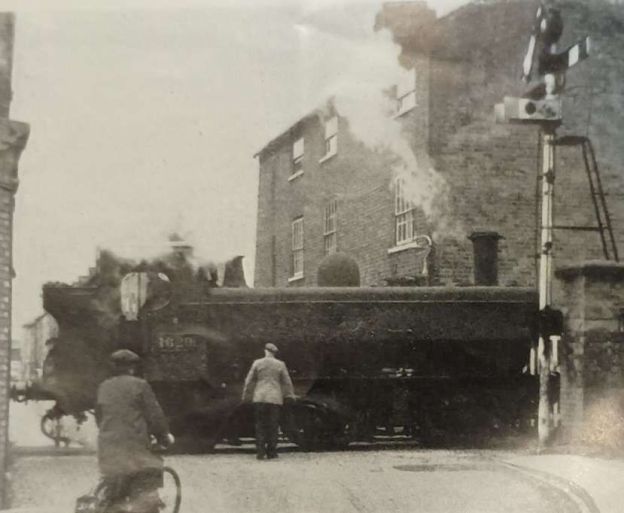
Post World War II, the Great Western Railway and then British Railways took over supply of the shunting locomotive to the branchline. Supplies to the vinegar works switched to road transport in 1958. The last train on the branchline ran on 5th June 1964, hauled by GWR Pannier Tank engine 0-6-0PT No.1639. The branchline was taken up in the late 1970s.

Although the line was short it had a number of interesting features!
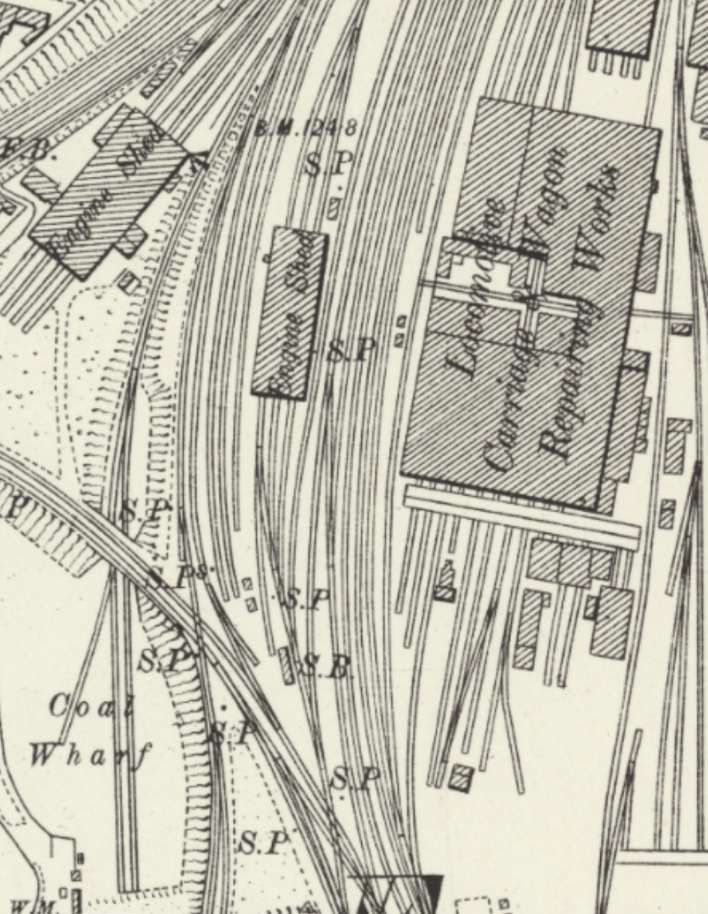
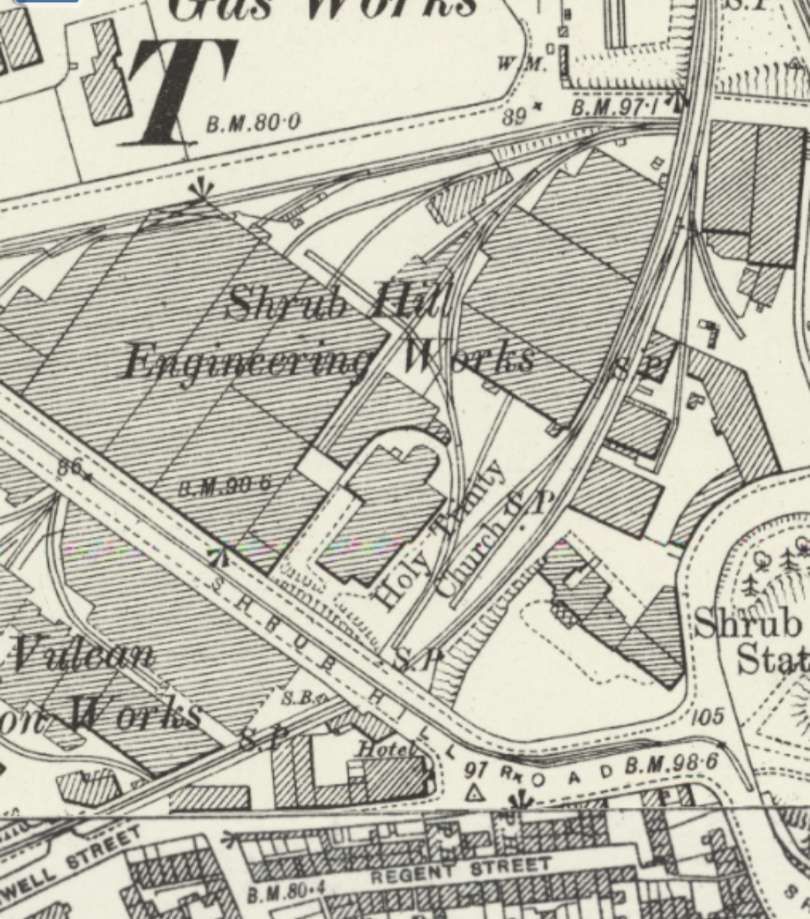
The line ran South between the two engines shed on this extract from the 25″ Ordnance Survey of 1901/1902, published in 1904, © Crown Copyright. [2]
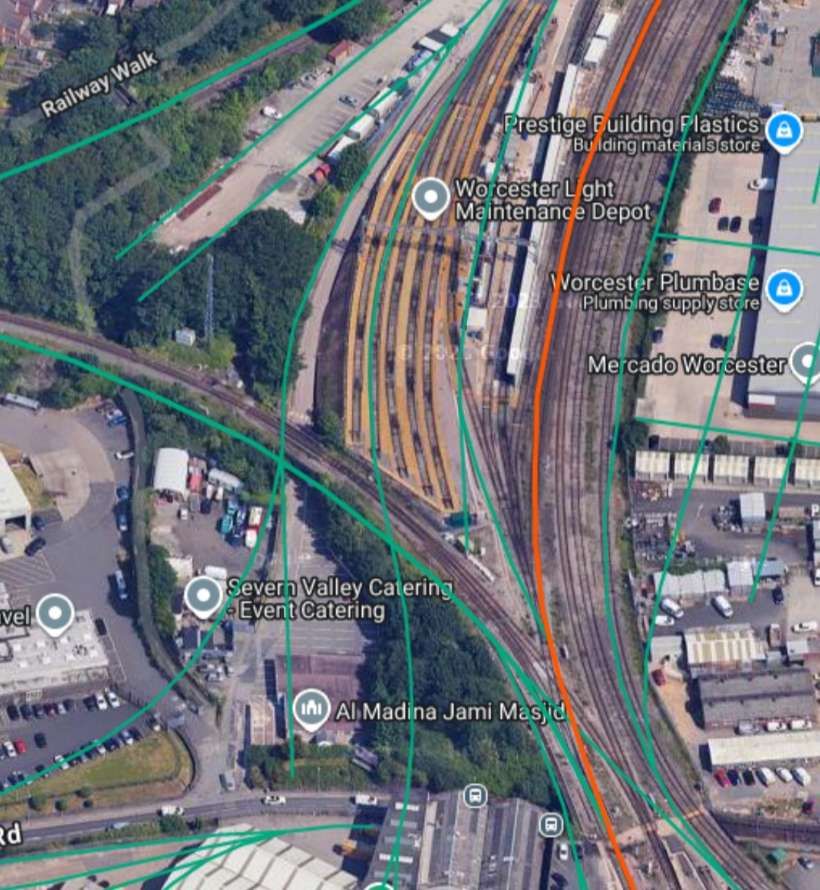
The same area in the 21st century. This is an extract from railmsponline.com’s satellite imagery. The route of the line that we are looking at is marked in green and runs down the centre of this image. [4]
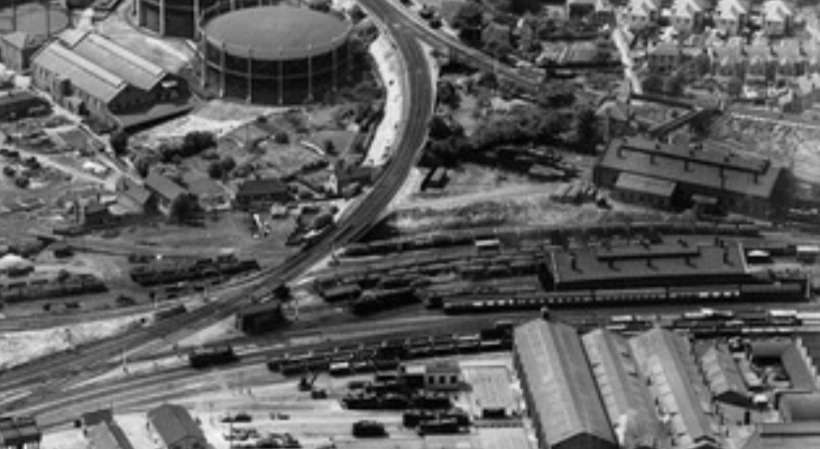
This aerial view looks West across the same area in 1934. The two engine sheds are on the right of the image. One of the sidings between them can be seen extending across the southern arm of the triangle. This is an enlarged extract from Britain from Above Image No. EPW044990, © Historic England. [12]

The line crossed the south loop of the junction, and then by a bridge over what A.A. Vickers tells us was, at the end of the 1950s, Rainbow Hill Road (now Tolladine Road). The line then ran through Shrub Hill Engineering Work, curving gradually round towards the Southwest.
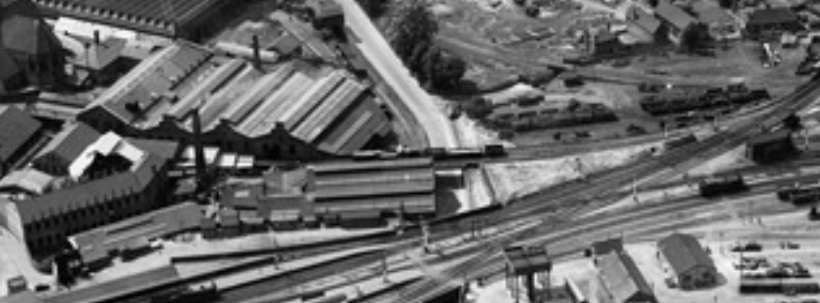
The line runs from right to left across the centre of this enlarged extract from EPW044990, beyond (to the West of) the main line, © Historic England. [12]
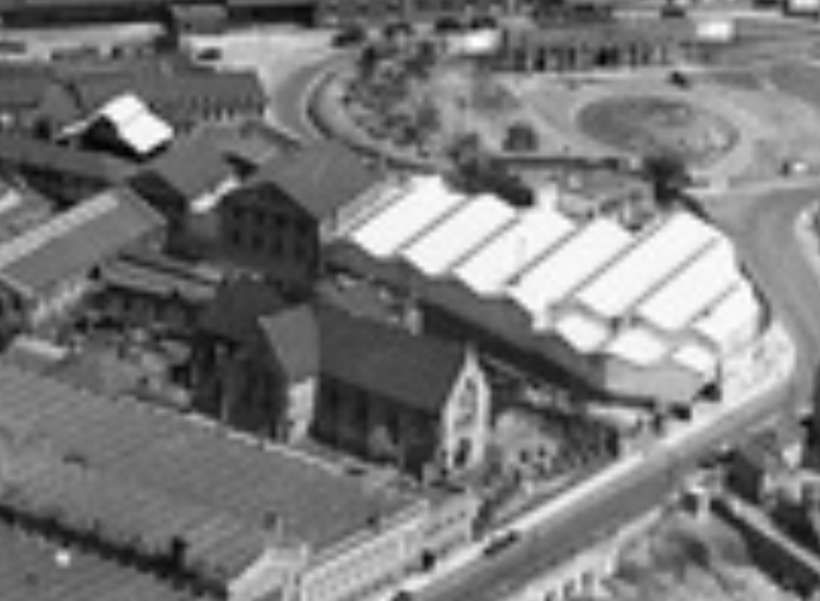
This enlarged extract from another of the aerial images provided on the Britain from Above website, No. EPW044987 which faces East, shows the line curving round beyond Holy Trinity Church and then crossing Shrub Hill Road, © Historic England. [13]
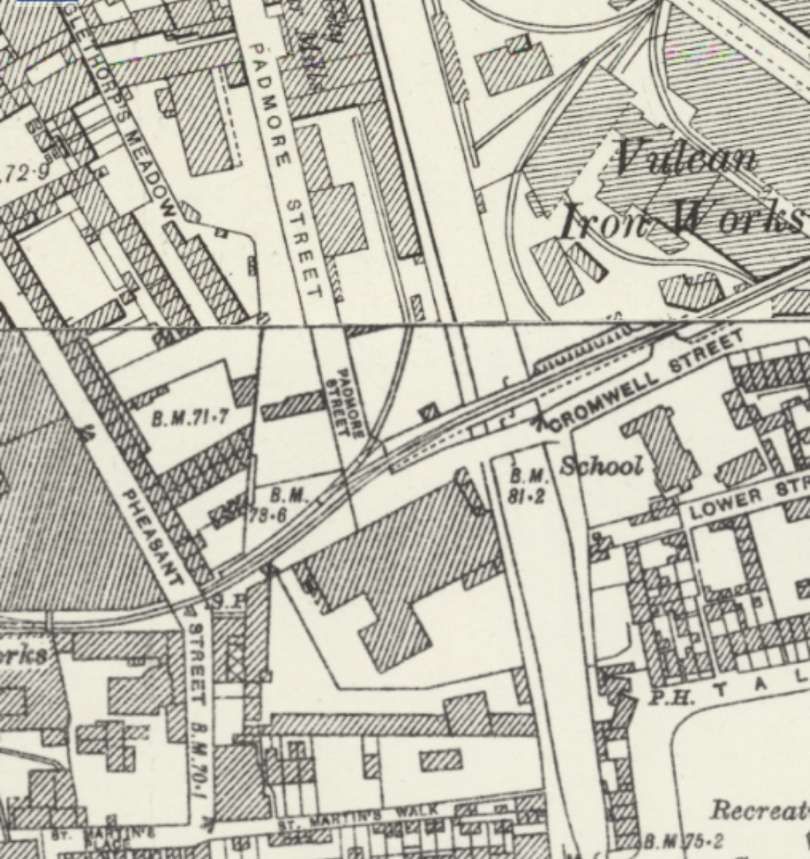
The line crossed Rainbow Hill Road (now Tolladine Road) and curved towards the Southwest as it ran through Shrub Hill Engineering Works, crossing Shrub Hill Road by means of a level-crossing (despite being shown on the 25″ OS map extract as passing under the road). It then ran on through the Vulcan Iron Works, © Crown Copyright. [2]
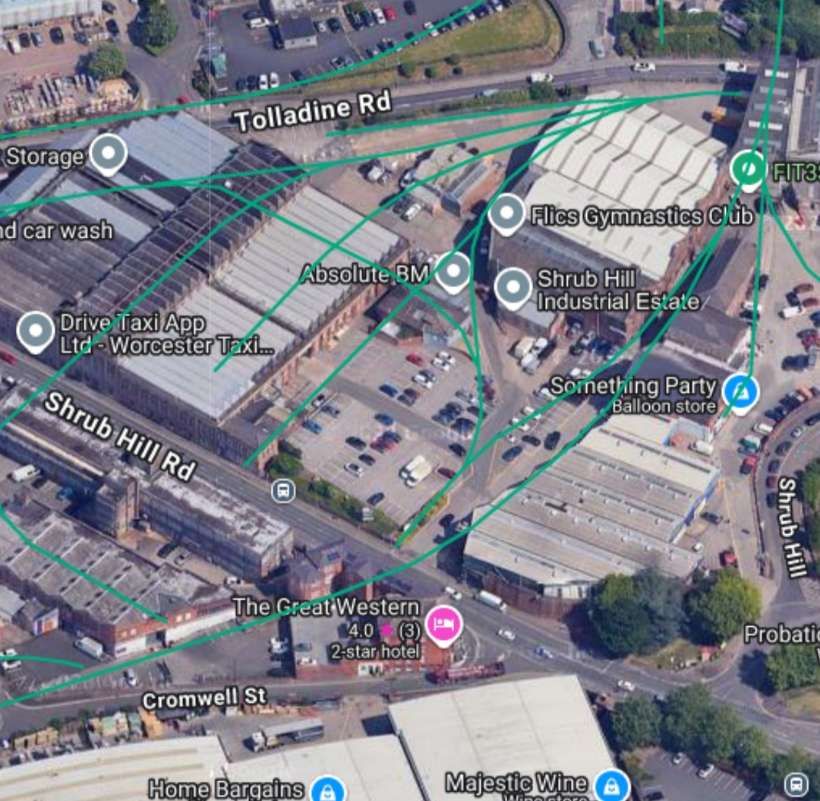
The same area in the 21st century. The route of the line that we are interested in curves across the extract from top-right to bottom-left. [4]
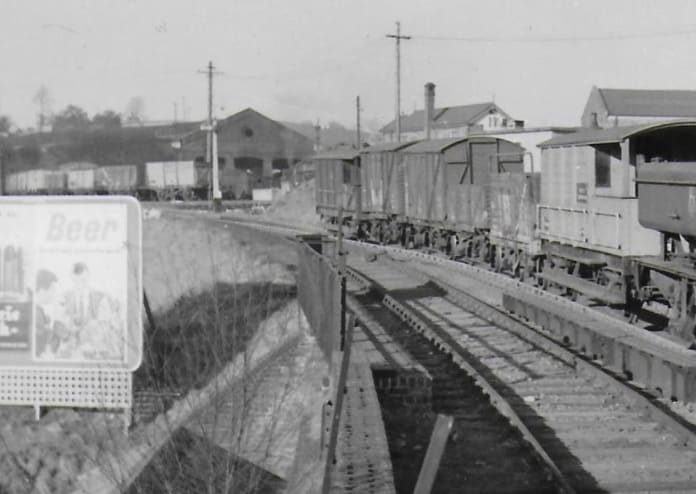
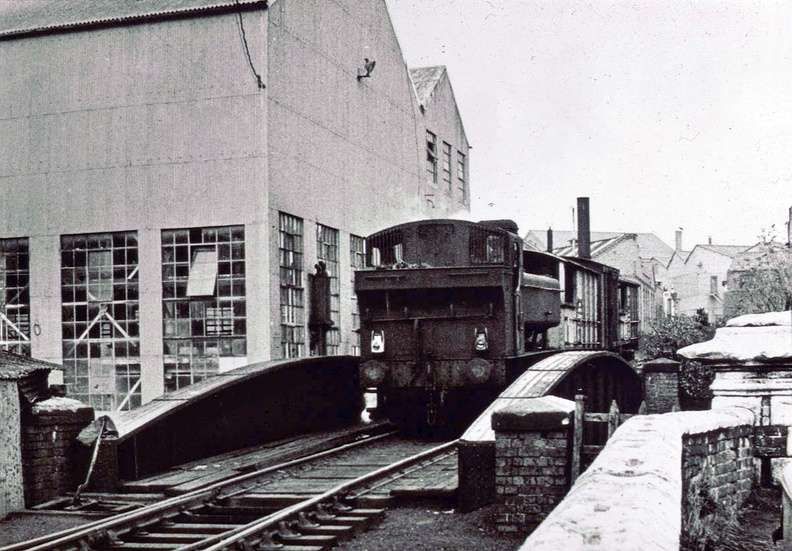
The branch train crossing the bridge over what is now Tolladine Road, © Unknown. [10]
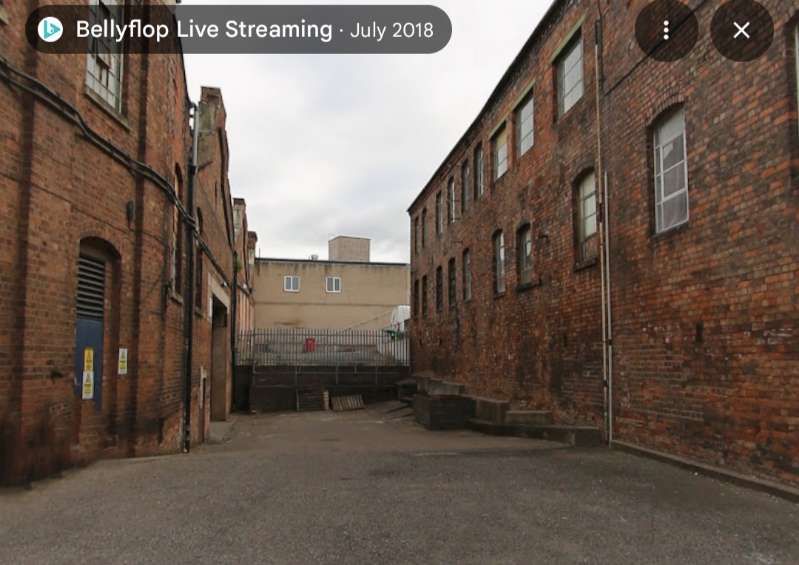
Looking Northeast along the line of the old branch in Stub Hill Industrial Estate. [Google Streetview. July 2018]
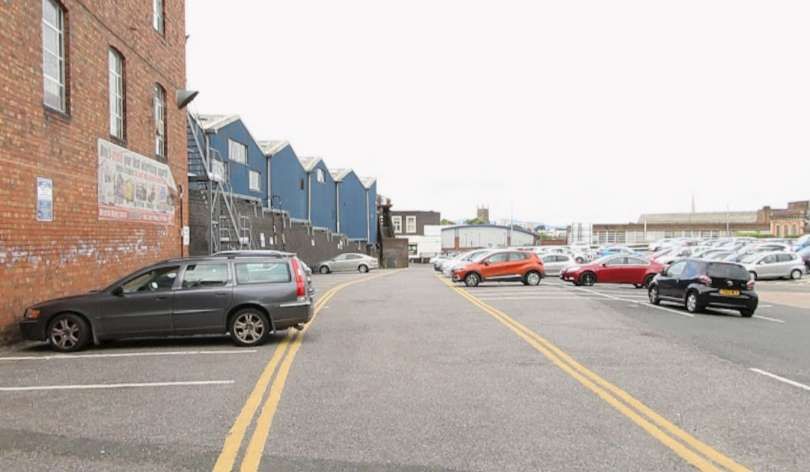
Looking Southwest along the line of the old railway from the same location. [Google Streetview, July 2018]

Vickers tells us that, “As the time for the daily (weekdays except Saturdays) trip approache[d], a shunter walk[ed] down from Shrub Hill Station, unfasten[ed] the padlocks, and open[ed] the gates at each side of the crossing over Shrub Hill. These protect[ed] the railway track when closed, but [did] not project onto the roadway when opened. When the engine with its train dr[ew] up to a signal protecting a catch point about fifty yards away from the road, the shunter pull[ed] on the road semaphores, which [were] of standard main-line pattern and operated from their posts, and, at a small ground frame beside the track. While the train close[d] the catch point and pull[ed] off the signal protecting it [and ran] slowly down the incline towards the road the shunter flag[ged] the traffic along Shrub Hill to a stand still, and when he ha[d] achieved this he signal[led] to the train to cross. Then, after allowing the road traffic to proceed, the shunter return[ed] the signals to their original position. He then walk[ed] down the track, across a bascule lift bridge, and over a canal bridge, on which the train ha[d] stopped.” [1: p236]
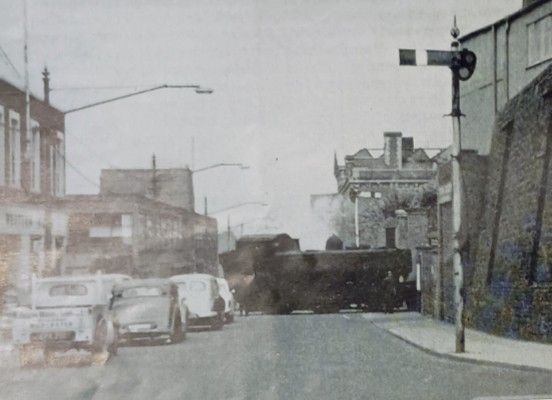
Western Region 0-6-0 pannier-tank engine on the ungated level crossing at Shrub Hill, Worcester, showing the semaphore signals to warn road traffic, © A.A. Vickers. [1: p236]
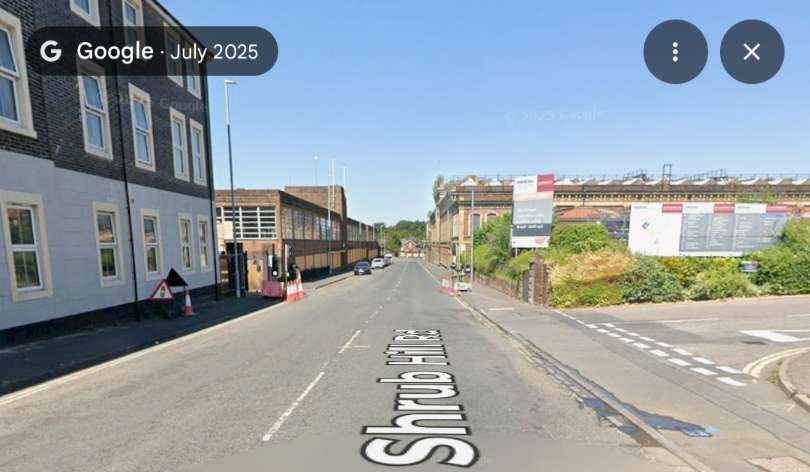
The same location in the 21st century. The hotel on the left is still in use. The building on the horizon on the left of the road was once part of the Vulcan Iron Works which was on the North side of the line. The road leaving the right of this image sits on the line of the old railway. [Google Streetview, July 2025]
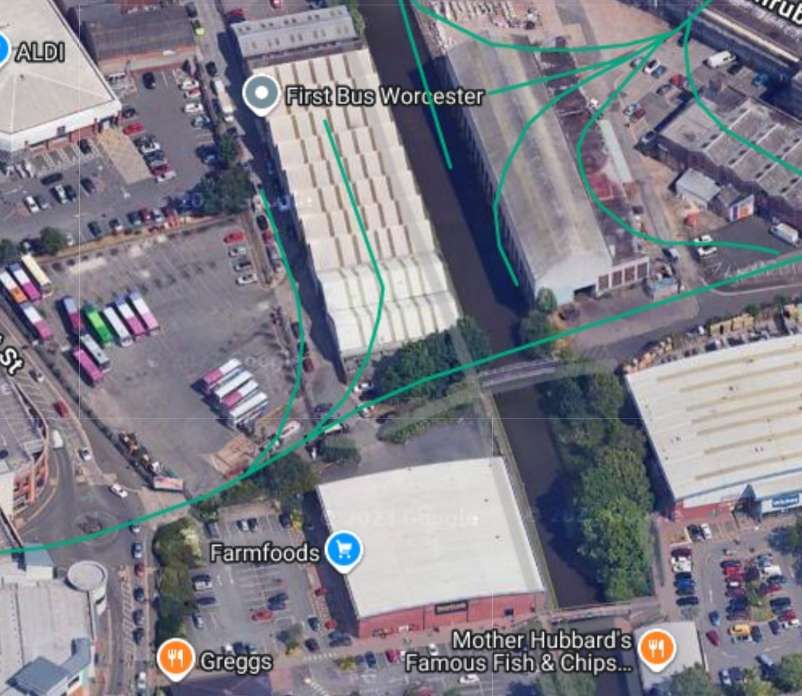
The line then ran at high level towards and then over the Worcester & Birmingham Canal. Before reaching the canal crossed one of the accesses to the Vulcan Iron Works by means of a Bascule bridge! Once over the canal the line crossed Padmore Street and Pheasant Street before entering the site of Worcester Vinegar Works. This is an extract from the 25″ OS mapping of 1926, published in 1928, © Crown Copyright. [3]
The same location in the 21st century. The building running alongside the canal in this image (centre-top) was the Midland Red Bus Depot on Padmore Street. [4]
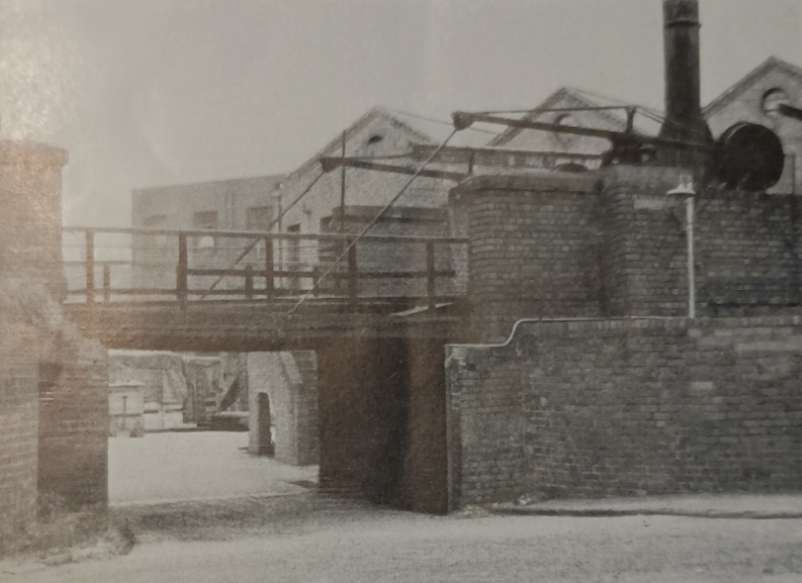
The bascule lift bridge which in 1959 was no longer operated. It carried the railway over one of the entrances to the Vulcan Iron Works, © A.A. Vickers. [1: p237]

Vickers continues: “The bascule bridge [was] at a factory gate. and the headroom below it [was] about 6 ft. 6 in. [By 1959], only private cars and foot and cycle traffic [used] this entrance. The bridge was last operated many years [before], and one of the basic movements at its fulcrum [had, in 1955,] been immobilised by a concrete wedge which [bore] the date 6th February 1955. The span [was] partly counterweighted, but required a chain and capstan haulage to raise it. The fulcrum contained a complicated arrangement to allow sufficient free space for movement at rail level to occur. First a padlock was unfastened to free a pivoted sleeper which blocked rotation of the fulcrum of a small 18 in. length of rail which was in effect a subsidiary bascule section. When this was raised there was thus an 18 in. gap which allowed the fulcrum of the main span to roll back as the span was raised. The free end of the subsidiary and main span was in each case allowed to slide into an open fish-plate end, the bottom bulge of the rail section having been cut away flush at the end of the span for this purpose. At the main span end the junction [was] fixed by insertion of the fish-bolts.” [1: p236-237]
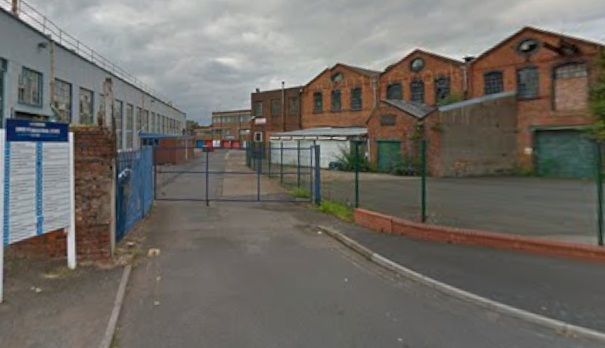
This photograph shows a very similar view to that on the monochrome image above. The bascule bridge is long gone but the Vulcan Iron Works buildings on the right remain in 2016. [Google Streetview, July 2016]
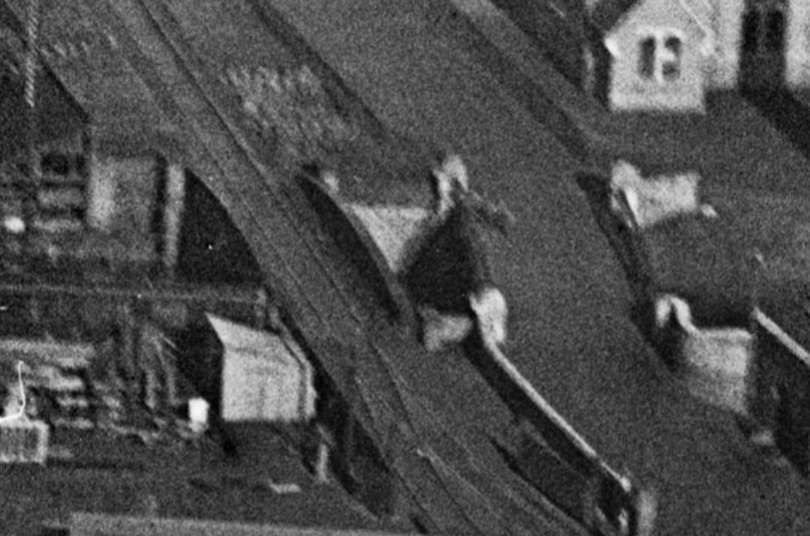
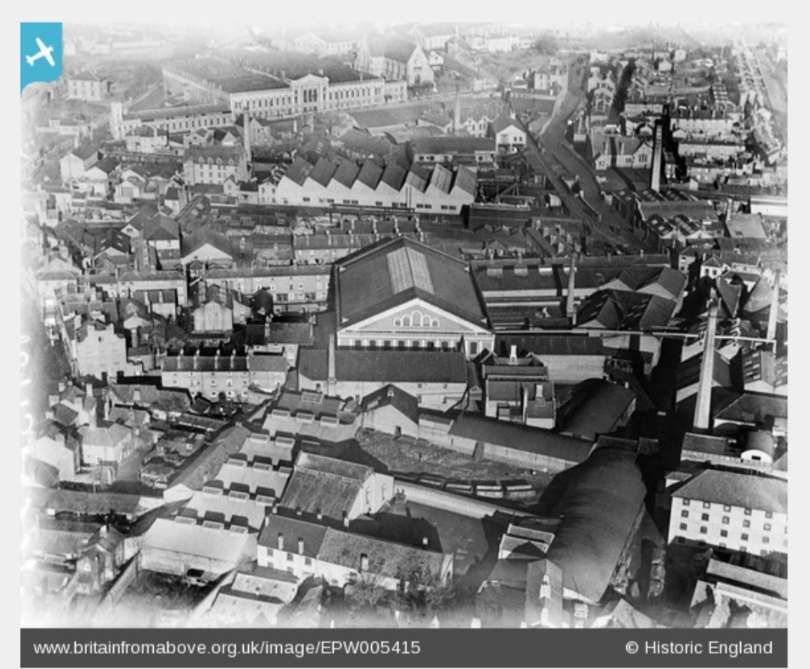
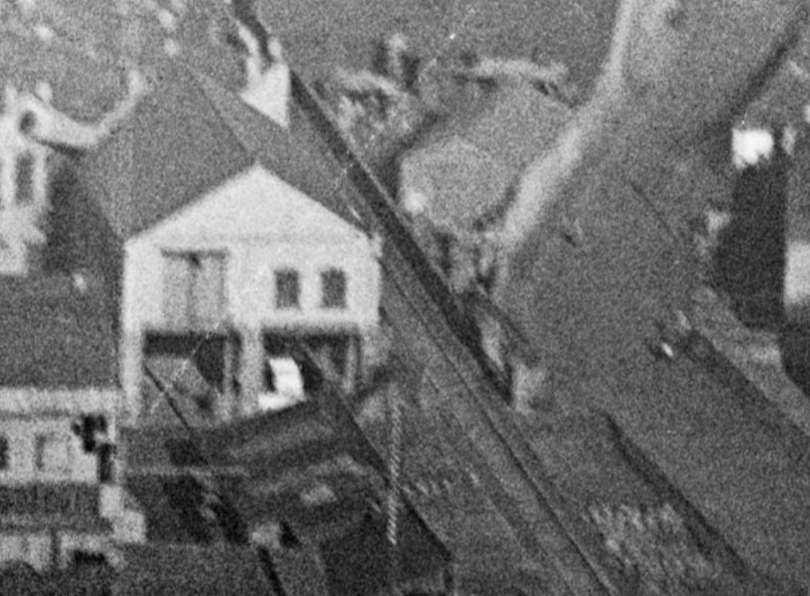
The bascule bridge as it appeared in an East facing aerial image from 1921. Image no. EPW005415, © Historic England. [7]
The rail bridge and Cromwell Street bridge over the Birmingham & Worcester Canal as seen in another extract from the 1922 aerial image. Image no. EPW005415, © Historic England. [7]
The railway bridge over the Canal again, © Unknown. [9]

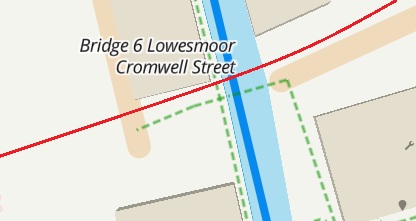
Adjacent to the railway bridge over the canal there was a road bridge carrying Cromwell Street which by 1959 was unsafe for vehicular use. The red line denotes the route of the branch. The road bridge was replaced by a footbridge. [5]
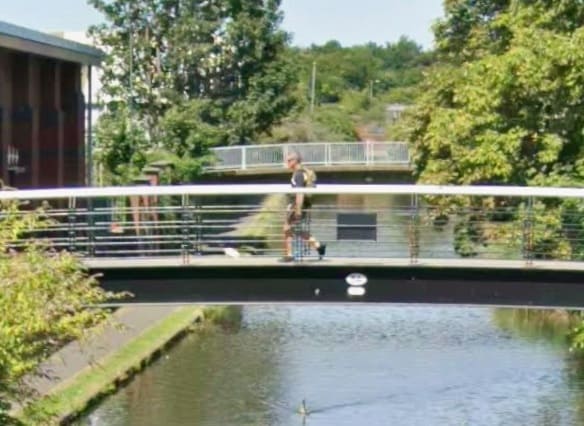
The view North from George Street, Worcester along the Birmingham & Worcester Canal. The bridge furthest from the camera is the footbridge that replaced Cromwell Road Bridge. The railway bridge beyond it was removed some time ago. [Google Streetview, July 2025]

The level-crossing to the immediate West of the canal only crossed a road of very minor importance (Padmore Street), leading only to a private car park and yard.
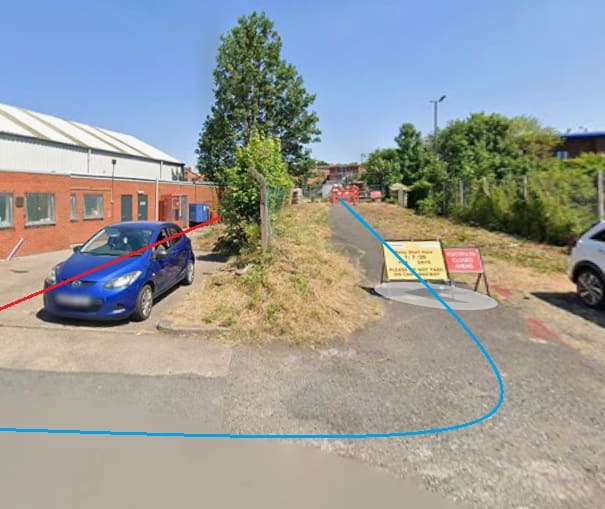
The corner of Padmore Street and Cromwell Street in 2025. The blue line shows what was once a through road over the canal. Work was being undertaken on the pedestrian bridge over the canal in July 2025. The red line on the image is the line of the old railway. The building at the left was the Midland Red Bus Depot on Padmore Street. In the 21st century it is the depot for First Bus. [Google Streetview, July 2025]

While the shunter [was] opening the crossing gate, the engine [was] uncoupled from the train. To allow for this the train, which usually consist[ed] of about eight wagons, [was] marshalled with a brake van at each end. The brakes of the leading van [were] applied and the engine [ran] forwards onto a short spur, on which [was] the remainder of a trailing point which once gave access to a factory on the site [which is 1959 was] occupied by the Midland Red Omnibus Company’s depot. The point leading to this spur [was] sprung to act as a catch point protecting the third level crossing, at Pheasant Street, which is the lowest point on the line.” [1: p237]

The Midland Red Depot was once the site of City Flour Mills. The site was later redeveloped and used by McKenzie, Clunes & Holland, renamed McKenzie & Holland from 1875, then McKenzie & Holland Limited from 1901, for the manufacturing of railway signalling equipment. Worcester operations of that company closed in 1921. A number of railway branch-lines were used to access the site. The site was acquired in 1927 by the Birmingham and Midland Motor Omnibus Company Limited (BMMO—Midland “Red” Motor Services) in preparation for the expansion required to operate the new Worcester City local bus area network due to start the following year. The purchase included an eight-bay, steel-framed corrugated-iron factory sited between the canal and Padmore Street which was converted for use as a bus depot, and part of former railway sidings from the Vinegar Works branch line to be used for outdoor parking. Work to convert the building included removing the wall that faced onto Padmore Street and replacing it with a series of sliding doors to allow vehicle access. ‘MIDLAND “RED” MOTOR SERVICES.’ was painted in large letters above the doors. The new depot opened on 1st June 1928. The garage was extended in 1930 with the addition of two extra bays built over the former railway sidings at the south end of the main building. The new bays were notably wider and, unlike the original building, could accommodate full-height enclosed double-deck buses. [11]
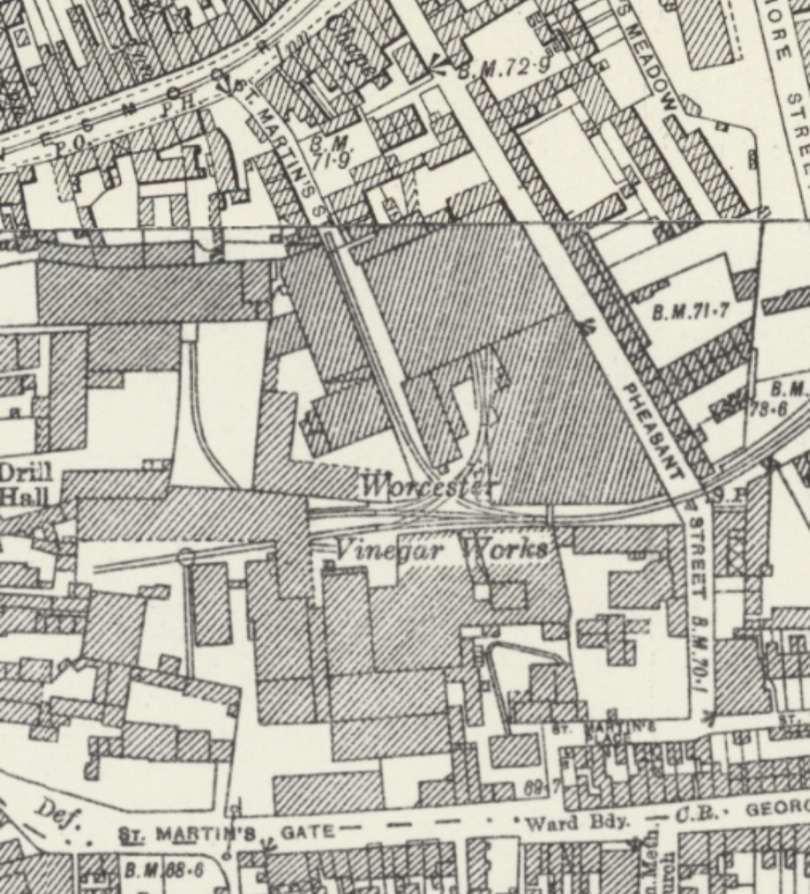
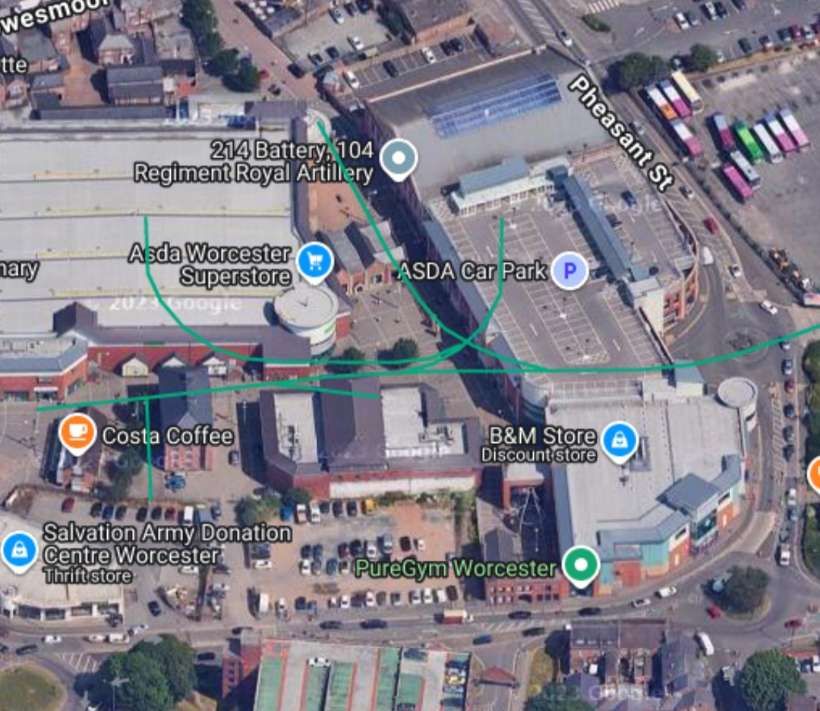
Worcester Vinegar Works in 1926, © Crown Copyright. [3]
The site of the Vinegar Works in the 21st century. Major retail development has occurred on the site. The green lines represent the sidings which once served the Vinegar Works. [4]
Worcester Vinegar Works seen from the air in 1921. Note the large warehouse at the centre of the photograph. Image no. EPW005415, © Historic England. [7]

Pheasant Street had a gated crossing, while the locomotive and its short train were negotiating the crossing on Padmore Street, “a shunter from Hill, Evans & Company, for the benefit of whose vinegar factory the whole operation[was] carried out, … unfastened the padlocks and opened the gates at Pheasant Street level crossing.” [1: p237]
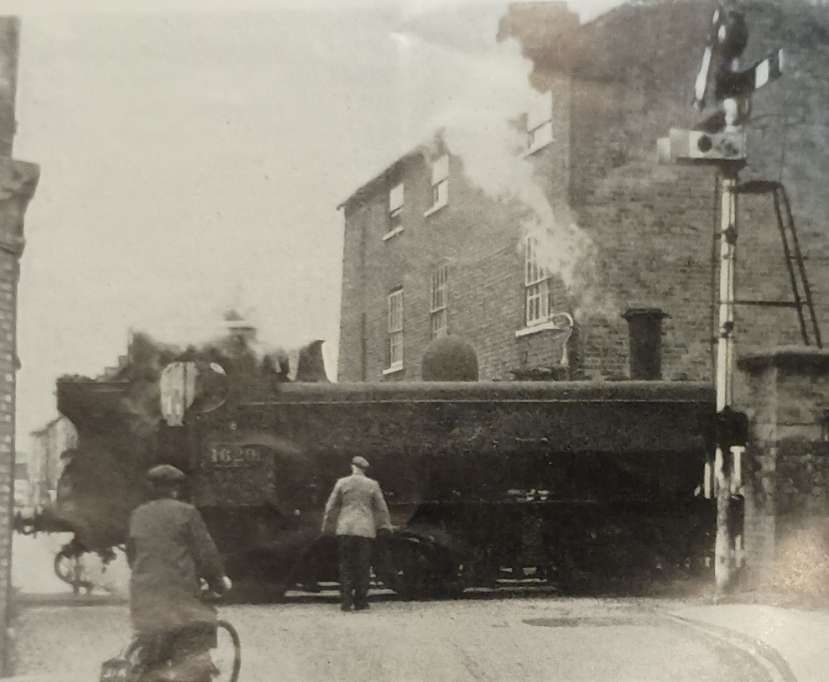
Another photograph of an 0-6-0PT, this time crossing Pheasant Street in 1959. Note the unusual signals referred to in the text,© A.A. Vickers. [1: p238]
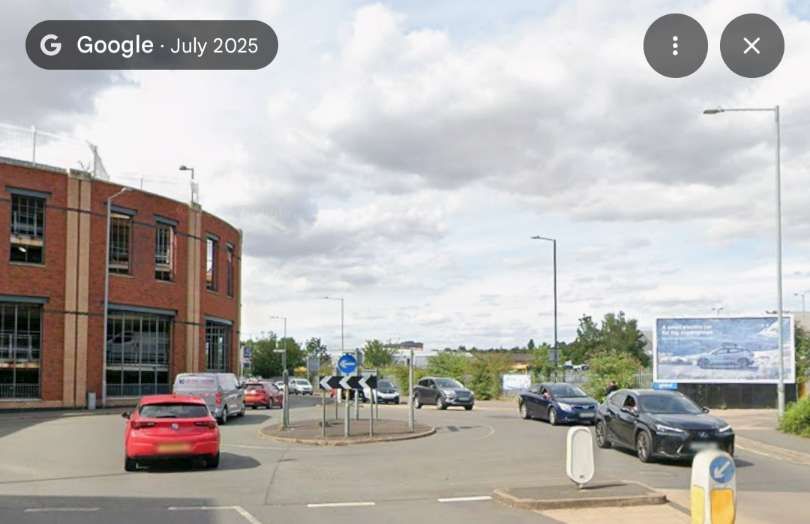
Looking North along Pheasant Street in the 21st century. The old branch line crossed the road just to the North of the traffic island. The building on the left is part of the large ASDA which sits on the site of the old Vinegar Works. Further North on the West side of Pheasant Street, the main warehouse for the Vinegar Works remains standing. [Google Streetview, July 2025]
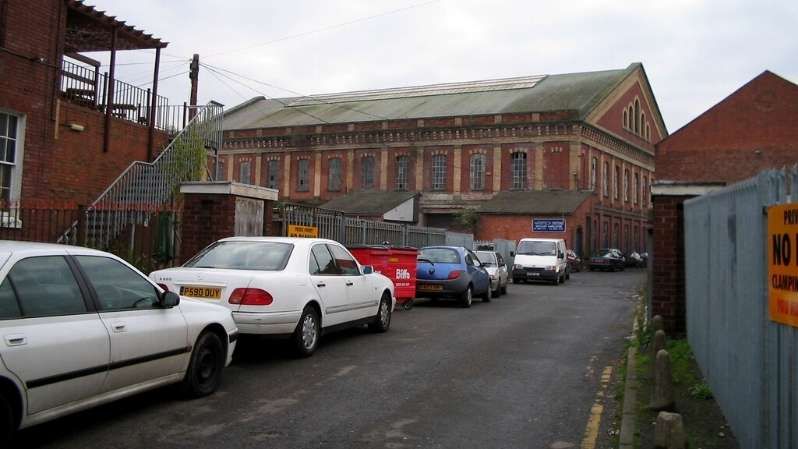
Standing at a location close to the roundabout but on the East side of Pheasant Street in 2006, this image centres on the Vinegar Works warehouse. The building on the right has gone and those on the left have been replaced by the ASDA store, © Sandy Gerrard and licenced for reuse under a Creative Commons licence (CC BY-SA 2.0). [8]
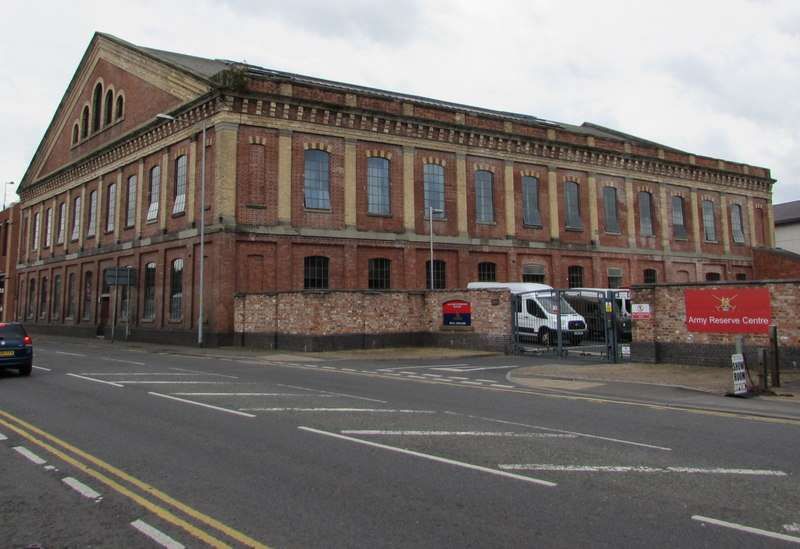
Another view in 2017 of what was the warehouse for the Vinegar Works. The ASDA store building just encroaches on the left of this image, © Jaggery and licenced for reuse under a Creative Commons licence (CC BY-SA 2.0). [8]

At the Pheasant Street level-crossing, the signals were on one post. small somersault arms control road traffic, with central spectacles, and coupled together directly so that one inclines in the wrong direction when ‘off’. They are provided with a central lamp. “When both shunters [were] satisfied that road traffic at the second and third crossings [was] responding to their flags, the guard in the leading brake van release[d] his brakes and allow[ed] the train to run forward down the slope. … The approach to Pheasant Street [was] quite blind, and the train appear[ed] through the gap in the high walls at the side of the road without audible warning at some 20 m.p.h., and [was] gone as quickly through the gap on the other side of the road. The engine follow[ed] at its leisure, to do any necessary shunting before pulling a train back up to Shrub Hill.” [1: p238]

Hill, Evans & Co was founded in the centre of Worcester in 1830 by two chemists, William Hill and Edward Evans. The pair started producing vinegar, but later the company also produced: wines from raisin, gooseberry, orange, cherry, cowslip, elderberry; ginger beer; fortified wines including port and sherry; as well as Robert Waters branded original quinine which was drunk to combat malaria.” [6]

As the company quickly expanded, they purchased a 6 acres (2.4 ha) site at Lowesmoor. In 1850 the company built the Great Filling Hall, containing the world’s largest vat, which at 12 metres (39 ft) high could hold 521,287 litres (114,667 imp gal; 137,709 US gal) of liquid.  For a century this made the works the biggest vinegar works in the world, capable of producing 9,000,000 litres … of malt vinegar every year.” [6]

Movement of wagons within the factory [was] carried out by a small road tractor equipped with a cast-iron buffer beam and a hook for towing with the aid of a rope. For this reason the rails in the factory [were] mostly laid in tramway fashion, flush with the surface.” [1: p238]

One of the provisions of the Worcester Railways Act of 1870, under which the line was built, was that signals must be provided at the public crossings to warn the public when trains required to cross the speed of the latter was also to be limited to 4 m.p.h. A few years ago a Land-Rover was in collision with a train on Shrub Hill Road level crossing. It is understood that legal opinion of the question of liability was sought, and was to the effect that the semaphore signals fulfilled the obligations of the railway to give adequate warning of the approach of a train, and that the attend-ance of a shunter with red flags was unnecessary. Be that as it may, road traffic pays no heed to the semaphores, being mostly unaware of their significance.

References

  1. A.A. Vickers; An Unusual Branch at Worcester; in The Railway Magazine, April 1959; London, 1958, p236-238.
  2. https://maps.nls.uk/view/120900868, accessed on 7th November 2025.
  3. https://maps.nls.uk/view/120900904, accessed on 7th November 2025.
  4. https://railmaponline.com/UKIEMap.php, accessed on 7th November 2025.
  5. https://explore.opencanalmap.uk/canal/worcester-and-birmingham-canal/#7.3/53.952/-2.258, accessed on 8th November 2025.
  6. https://en.wikipedia.org/wiki/Hill,Evans%26_Co, accessed on 8th November 2025.
  7. https://www.britainfromabove.org.uk/en/image/EPW005415?check_logged_in=1, accessed on 8th November 2025.
  8. https://www.geograph.org.uk/stuff/list.php?title=Old+Vinegar+Works+&gridref=SO8555, accessed on 8th November 2025.
  9. https://www.cfow.org.uk/picture.php?/1197/categories, accessed on 8th November 2025.
  10. https://www.worcesternews.co.uk/resources/images/17365723/?type=responsive-gallery-fullscreen, accessed on 8th November 2025.
  11. https://www.midlandred.net/depots/index.php?depot=wr, accessed on 10th November 2025.
  12. https://www.britainfromabove.org.uk/en/image/EPW044990, accessed on 10th November 2025.
  13. https://www.britainfromabove.org.uk/en/image/EPW044987, accessed on 19th November 2025.

The Sermon on the Plain (Luke 6: 20-31)

Luke 6: 20-31 is known as “The Sermon on the Plain” and is parallel to Matthew Chapters 5 to 7, which are known as “The Sermon on the Mount”. It is known as ‘The Sermon on the Plain’ because Luke writes in Luke 6:17 “Jesus came down with them and stood on a level place”. …

There are four blessings in this passage, rather than the eight blessings in Matthew’s Gospel, and ‘woes’ follow quickly and starkly after the blessings. Whereas in Matthew’s Gospel the ‘woes’ are much more gently couched and hidden in the longer text.


Luke’s account of Jesus’ words is much more direct, more immediate, more pressing, and does not, obviously, carry a spiritual meaning. Here in Luke’s Gospel Jesus says, ‘Blessed are you poor, for yours is the kingdom of God’. In Matthew he says, ‘Blessed are the poor in spirit, for theirs is the kingdom of heaven’. … We need to hear and heed both of these versions of Jesus’ sermon if we are not to misinterpret what he says. …

Recognising our spiritual poverty (as in Matthew’s Gospel) is important if we are to hear the gentle word of God’s love spoken to us in the bible. Spiritual poverty is the opposite of arrogantly assuming that we know God’s will and purposes, it encourages an enquiring mind, seeking out what God’s Holy Spirit is doing in our lives. It accepts that we will always have something to learn. It might even mean that we really do try to see things from the perspective of those with whom we disagree.

But what might it mean to say that the poor are blessed? …

Jesus uses the present tense. … The poor already have the Kingdom of Heaven. … They are blessed now. … This is hard to accept. It seems uncaring. How can those who have next to nothing be blessed? …… Perhaps Jesus means that for those who are poor there is nothing to distract them from their need for the love of God. Whereas for those of us who have resources and money, who are wealthier than so many, we can be distracted by our wealth. Rather than relying on God for our daily needs, our daily bread, we rely on own resources. Perhaps we are in danger of missing God’s blessing.

This seems to be borne out in human experience. It is when we are aware of our deepest needs that we are most prone to pray. … Even those of us who profess no faith in God.

In Luke’s Gospel, Jesus goes on to say: ‘Blessed are you who hunger now, for you will be satisfied. Blessed are you who weep now, for you will laugh.”

The parallel lines in Matthew’s Gospel say: ‘Blessed are those who hunger and thirst for righteousness, for they will be filled’, and ‘Blessed are those who mourn, for they will be comforted’.

Jesus, in Matthew’s Gospel, seems to be more concerned about some kind of spiritual intensity. … Jesus’ statements, in Luke, are more pithy and seemingly more concerned about physical things. It is those who do not have enough to eat now who will be satisfied; those who weep now will laugh. It is people’s immediate; substantive needs that Luke’s words focus on.

In each of these two cases in Luke’s Gospel, one part of the sentence is in the present and the other in the future. Jesus, in Luke, seems to be saying, ‘I know you are hungry, I know you weep and your tears exhaust you. But what you suffer now does not need to define you’.

The truth is that as Christians, we are defined by God’s perspective, God’s idea of who we are. We are defined by God’s love. We are defined by the Kingdom of Heaven. There is a place beyond our current situations when hunger will be satisfied, and tears will no longer fall. … While we are building the Kingdom of God on earth we can experience pain, suffering and persecution, but something is certain: the Kingdom will be attained, and you will have your fill and you will laugh! …

I don’t think this is meant to be just about a heavenly future, a hope of heaven; although it is certainly that. But it is more. It is about the land of the living, it is about living as people who have hope, who trust that the whole of their future is in God’s hands, who persevere because they believe, along with the psalmist who says (in Psalm 27:13): “I believe I will see the goodness of the Lord in the land of the living.” And along with Isaiah (in Isaiah 40: 31): “Those who wait on the lord will renew their strength, they shall mount up with wings like eagles, they shall run and not be weary, they shall walk and not faint.” With our future secure in God’s hands, we are free to love and to live with courage today.

Jesus’ first three blessings encourage us to live as those who are not distracted by all the things we have; to live as those who believe that the future is in God’s hands.

Jesus’ fourth blessing seems utterly absurd. How can those who experience hatred and abuse be blessed. How can those who are persecuted be blessed? Jesus seems to answer that question by explaining that when we experience difficulty for our faith we are identifying with the Old Testament prophets. We are identifying with myriad faithful saints of God.

We know that Jesus’ words spoke directly to the early church and were heard, not as absurd, but as an encouragement to see beyond their current circumstances – suffering and persecution were not the ultimate reality, but rather a sign of new life and hope.

I cannot imagine the things those who are persecuted face. I do know that it is not just Christians across the world who experience times of deep darkness, or hatred from neighbours and acquaintances. We repeatedly see them on our television screens. In Gaza, in Ukraine, in the Democratic Republic of Congo, in Sudan and South Sudan. So often it is the weak and vulnerable who suffer most. There is little that I can do for them but pray and give.

To the question, ‘Where is God when the innocent die, or face persecution?’ The answer available to us, the only answer I can offer, seemingly the only one God offers us, is a story of God becoming human, living first as a refugee, then as an itinerant preacher, before dying in acute suffering, treated as a common criminal, on a cross.

The God we believe in has identified with human suffering, has felt the pain of rejection, has been persecuted. … This God points to the cross and says time and again, “I love you, this is my answer to your questions. This is how much I care. ”

The Godhead, Father, Son and Holy Spirit torn apart as Jesus cries out, “My God, My God, why have you forsaken me?”

It is as if God says to us, “This is where you will find the answers to all the questions you ask – in sitting at the foot of the cross and pondering on the depth of love that it demonstrates.”

As Paul says in our reading from Ephesians: “I pray that the God of our Lord Jesus Christ, the Father of glory, may give you a spirit of wisdom and revelation as you come to know him, so that, with the eyes of your heart enlightened, you may know what is the hope to which he has called you, what are the riches of his glorious inheritance among the saints.”

This God, who loves us so much, welcomes us at his table to share in bread and wine. This God, calls on all his saints, you and me too, to live in the light of that loving welcome and acceptance. To live as those who are not distracted by all the things we have; to live as those who believe that the future is in God’s hands; and to love others with an all-inclusive, death-accepting love that knows no limit.

Prayer
God our Father, you redeem us and make us all your children in Christ. You extend a loving welcome to all. Look with favour upon us, give us true freedom and bring us to the inheritance you promise. We ask this through our Lord Jesus Christ, Your Son our Lord. Amen.