
Most biblical scholars agree that the author of the Letter to the Galatians was very probably St. Paul. The main arguments in favour of the authenticity of Galatians include its style and themes, which are common to the core letters of the Pauline corpus. Back in the 1930s, George S. Duncan described its authenticity as “unquestioned. In every line it betrays its origin as a genuine letter of Paul.” [3]
Some scholars “have cast doubts upon its authorship due to stylistic and vocabulary discrepancies with other letters uncontestedly attributed to Paul. These disparities have caused speculations that someone other than Paul may have composed it, yet most biblical scholars uphold Paul as its true author due to strong autobiographical elements in its content and thematic consistency with other Pauline works as evidence of Paul’s authentic authorship of Ephesians.” [4]
It seems reasonable for us to ascribe the authorship of the letter to St. Paul. Although ultimately this is not critical. What matters most of all is the text that we have received.
Paul constructs an argument in Galatians which seems to culminate in the idea that a new covenant, which is built on the foundations of earlier understandings of God’s relationship with his people, has now arrived. A covenant in which we are all included in God’s kingdom by faith through God’s grace alone.
Galatians 3:23 to 4:7 sits at the culmination of this letter.
A couple of things to note:
A. ‘Children’ or ‘Heirs’.
In ancient Rome ‘heirs’ were named in a will. Other children were not named. Heirs received everything from the bequest – both debts and benefits. “In the case of intestacy, Roman inheritance law had no concept of primogeniture and treated male and female children equally. However, in most cases intestacy was avoided by means of a will. Roman law recognised very broad freedom of testation, but wills had to strictly follow correct formulae and phrases in order to be valid. The will had to name an heir. In addition to this, it could name a legal guardian (tutor) for underage children, manumit slaves, and leave legacies to third parties. Over time a separate system of ‘fideicommissa’ (‘trusts’), which allowed greater flexibility, developed alongside the system of wills.” [5]
If a man died intestate, “property went first to ‘sui heredes’ (‘his own heirs’), who were any children of the deceased that had remained under his ‘patria potestas, (‘paternal power’) until his death. [6: p200] There was no assumption of ‘primogeniture’ – all children, male and female, received an equal share of the estate. [6: p201] If there were no children, then agnate relatives in the male line would inherit (i.e. other children of the deceased’s father, paternal grandfather, and so on). [6: p200] If there were none of these, then the ‘Twelve Tables’ [6: p199][7: p505] provided for the property to be inherited by the wider gens, but as the social role of the gens declined after the Early Republican period, this ceased to occur.[6: p200] There was no concept that an intestate property might pass to the state. [6: p200] Children of the deceased who had been emancipated before the deceased’s death or who had passed into the ‘potestas’ of another (through certain kinds of marriage or through adoption by another) were excluded from the succession, as were relatives in the female line (i.e. relatives of the deceased’s mother), and the deceased’s spouse.” [6: p200-201][7: p505]
Most Roman inheritances were, however, not intestate. “Instead, they were governed by a will (‘testamentum’). [7: p500] Some Roman writers speak of producing a will as a duty (‘officium’). [6: p201] Henry Maine in 1861 characterised the Roman approach as a ‘horror of intestacy.’ [6: p201][7: p499] Only a ‘pater familias: (male head of household) could make a will that disposed of a whole estate. [7: p502] But any Roman citizen who had reached the age of majority could make a will for property that they possessed in their own right. Women could make wills through a process of fictional sale (coemptio), until the reign of Hadrian, when they were given the ability to make a will through their tutor (legal guardian). [6: p202][7: p502] Non-Romans (peregrini) and people with intellectual disabilities could not make wills under Roman law. [7: p502] Exiles were not allowed to make wills either and this ban was retrospective; being sent into exile voided any will that the exile had already made. [7: p502] … The will had to name an heir. [6: p202] In addition to this, it could name a legal guardian (tutor) for underage children, manumit slaves, and leave legacies to third parties.” [6: p204]
Failure to name an heir could render a will void. [6: p204] An heir did not have to be a natural child of the deceased. An adopted heir was acceptable. This was often the practice in higher-ranking household as couples were often infertile.
An heir inherited both the deceased’s debts and his possessions. Being a child did not guarantee being an heir.
In verse 26 of Galatians chapter 3, the NIV and NRSV choose to translate a Greek word which means ‘sons’ as ‘children’. A word which carried great weight in the ancient world, ‘the son and heir’, the one who receives everything, is replaced in the NIV and NRSV by one which is about us all being ‘children’. In modern thinking, being one of many children of the father does confer status. But the word ‘children’ fails to carry the great sense of particularity intended by the author of the epistle. The status of ‘son and heir’ was more significant than being a ‘child’. In our thinking about this passage we must give weight to this distinction. Paul intends us to understand that we all (female and male) have the same status as the ‘son and heir’.
The distinction in ancient Rome between ‘son and heir’ and ‘child’ will also have been important to those reading the passage in many eras of civilisation and the history of the church. Particularly so, once the concept of primogeniture became established in the medieval world. A concept which kept land and estates whole as they were passed from father to eldest son. The eldest son was ‘the heir’, the other children, while usually loved, had a demonstrably secondary status.
Paul intends us to understand that we are all (female and male) co-heirs with Christ, we have the same status, the same entitlements. We have been chosen as ‘heirs’. We are more than ‘children’. In verse 29, Paul uses the word κληρονόμοι (klēronomoi) ‘heirs’ emphasising the point that ‘son’ is different from ‘child’.
Our status ‘in Christ’ is that of heirs to the promise, not just children.
B. Verse 28 – ‘Or’ and ‘And’
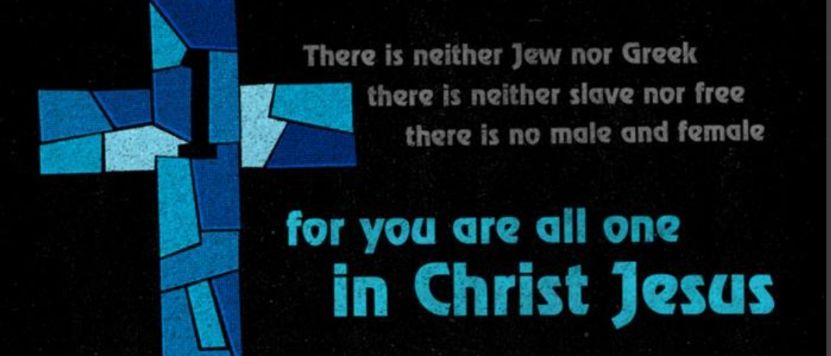
In the context that we are all inheritors of everything God has to offer, it may be worth us noting what Paul writes in verse 28. There is a small but perhaps significant change from ‘or’ (οὐδὲ) to ‘and’ (καὶ) in Galatians 3:28. The Greek reads like this:
οὐκ ἔνι Ἰουδαῖος οὐδὲ Ἕλλην, οὐκ ἔνι δοῦλος οὐδὲ ἐλεύθερος, οὐκ ἔνι ἄρσεν καὶ θῆλυπάντες γὰρ ὑμεῖς εἷς ἐστε ἐν Χριστῷ Ἰησοῦ. [1]
The direct translation is shown in interlinear form below:
οὐκ ἔνι. Ἰουδαῖος οὐδὲ Ἕλλην, οὐκ ἔνι δοῦλος οὐδὲ
Not/neither there is Jew or Greek not/neither there is slave or
ἐλεύθερος, οὐκ ἔνι ἄρσεν καὶ θῆλυ πάντες γὰρ
free not/neither there is male and female all for
ὑμεῖς εἷς ἐστε ἐν Χριστῷ Ἰησοῦ.
you one are in Christ Jesus.
The direct translation does not read easily in English. As is usual, this means that the translators have had to decide how best to make the text readable in English. Almost inevitably they have chosen to give greater continuity in their translations. The variety of different translations can be found here. [2]
Many of the translators choose not to recognise the change from ‘or’ (οὐδὲ) to ‘and’ (καὶ). I guess the question must be whether or not Paul meant the change to be significant. Many of the translators think not, and in doing so they prevent most modern readers having the opportunity to engage with the possibility that the difference is significant. Effectively, the translators narrow down the possible interpretation of the text in favour of their own interpretation.
But is that difference significant? Perhaps it is sufficient for us to read that there is no distinction in Christ, that we are all one in Christ. Whether we are Jew or Greek, slave or free, male or female, there is no distinction between us. We are one in Christ, all of us ‘heirs’ of the promise, much more than just children. If that were the case, I would happily go on to argue that these pairings are intended to demonstrate the breadth of God’s inclusive love for everyone.
But, that single καὶ (and) may add to the argument. Two couplets are ‘neither/nor’ but for one couplet Paul choses to use καὶ, why? … This part of our passage, (i.e. οὐκ ἔνι ἄρσεν καὶ θῆλυ), seems to allude to Genesis 1:27 (ἄρσεν καὶ θῆλυ ἐποίησεν αὐτούς, in the Septuagint) where God first creates a being, Adam, seemingly both male and female, if verse 27 of Genesis chapter 1 is taken literally.
Daniel W. Roberts comments that “Galatians 3:28 is a rare case of a direct quote going relatively unnoticed by scholarship, which is then followed by a one-word allusion to further solidify Paul’s claims concerning unity.” [8: p1] “Paul in Galatians 3:27–28 quotes Genesis 1:27, … this purposeful quotation of Gen 1:27 is meant to couple with an allusion to Genesis 2:24 to articulate further the unity found in Christ.” [8:p3][9]
Roberts goes on to argue for the unity which comes from marriage and which mirrors the unity between Christ and his Church. But there are other interpretations which include feminist, intersex, or queer, etc. perspectives.
If there is a significance to the use of the word καὶ, and there may not be, but if there is, it must delineate a difference between the male/female couplet and the Jew/Greek and slave/free couplets. In Christ there is no longer Jew or Gentile, no longer slave or free, no longer male and female. It must, as Roberts suggests, refer to something else. Particularly, probably, the passage in Genesis.
Are the first two couplets a case of ‘either/or’ while the third is a case of ‘both/and’? Is ‘male and female’ just, for Paul, one category rather than two categories? Just one thing? Perhaps he sees us as being included in God’s blessings because we are human rather than because we are male or female? Perhaps gender/sex is insignificant? I am not sure where this leads us, but perhaps it places our disputes about what it is to be a male or a female in a wider context. Perhaps it is about freedom to be who God has made us to be, rather than having to conform to the either/or of the other categories in Galatians 3: 28. Paul sums this all up with the fact that, whatever he means earlier in the verse, we are all one in Christ Jesus.
References
- Galatians 3:28 in Greek, via https://www.biblegateway.com/passage/?search=Galatians%203%3A28&version=SBLGNT, accessed on 23rd February 2025.
- https://www.biblegateway.com/verse/en/Galatians%203%3A28, accessed on 23rd February 2025.
- George S. Duncan; The Epistle of Paul to the Galatians; Hodder & Stoughton, London, 1934, p xviii.
- https://www.ministryvoice.com/who-wrote-galatians, accessed on 23rd February 2025.
- https://en.m.wikipedia.org/wiki/Inheritance_law_in_ancient_Rome, accessed on 26th February 2025.
- David Johnston; Succession; in David Johnston, (ed.); The Cambridge Companion to Roman Law; Cambridge University Press, 2015, p199–212.
- Eva Jakab; Inheritance; in Paul J. du Plessis (ed.); The Oxford handbook of Roman law and society; Oxford University Press, 2016, p498–510.
- Daniel W. Roberts; Male and Female in Galatians 3:28: A Short Biblical Theology of Unity; in Southeastern Theological Review 13.1 (Spring 2022), p1–23; via https://www.sebts.edu/wp-content/uploads/2023/12/STRIssue13.1_BenMerkle.pdf , accessed on 26th February 2025.
- Roberts comments that Richard Hays’s study is especially significant for the study of Paul’s more subtle uses of the OT, what he calls echoes and allusions. This specific example, not discussed by Hays, arguably passes all seven of his tests for Pauline echoes. (Richard Hays, Echoes of Scripture in the Letters of Paul; Yale University Press, New Haven, p29–32.)
 Roger Farnworth
Very useful reflection.