Monthly Archives: Oct 2024

The East Indian Railway – The Railway Magazine, December 1905 and a journey along the line.

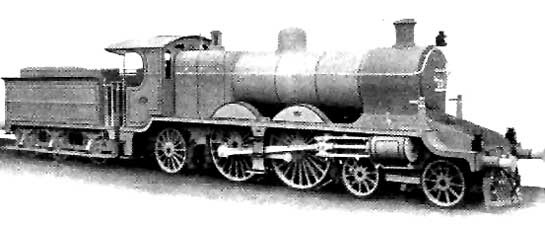
The featured image for this article shows a Class AP 4-4-2 Locomotive of the East Indian Railways. [19]

At the end of 1905, G. Huddleston, CLE., was Deputy Traffic Manager (Goods) East Indian Railway. This article is based round the one written by him in the December 1905 Railway Magazine.
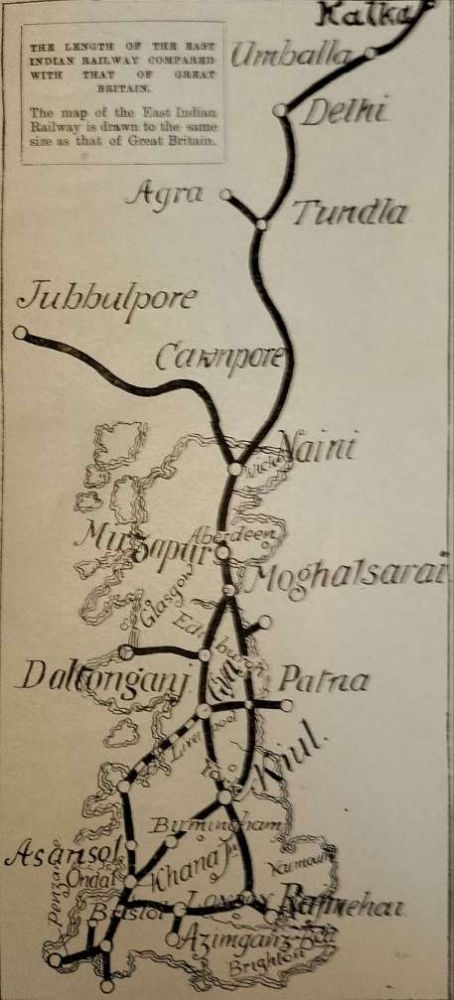
In 1905, there were over 27,000 miles of railway in India: some owned and worked by the State, while other lengths of railway were owned by the State but worked by private railway companies, and others privately owned and worked. Of all of these, the East Indian Railway had the highest traffic figures and earnings. It was worked for the Government by a private company.

The East Indian Railway (EIR) had a network, including branches and lines worked by it, covering a distance of 2,242 miles. The first image below provides an illustration of what this meant on the ground.

The adjacent sketch map provides a simple comparison between a map of the UK and the network of the EIR – although Kolkata (Calcutta) is not clearly marked. [1: p483]
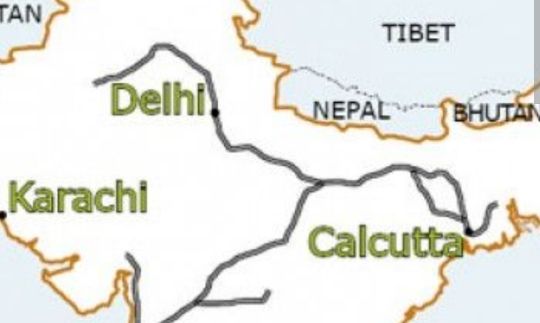
This schematic map gives a much clearer idea of the route of the line, oriented more traditionally, which shows the line running from Kolkata (Calcutta) to Delhi. [5]

Roughly speaking, the East Indian Railway [was] as long as from Land’s End to John-o’Groats and back again, and, in addition, [had] several important branches. It traverses very much the same country as that great waterway, the mighty river Ganges, which, before the days of railways, afforded the chief means of transport for the commerce of Bengal and the North-West, The original main line was, as a matter of fact, constructed to tap the river at various points, and to draw from it the traffic then carried by boat. As indicated by the Chairman (General Sir Richard Strachey) at the last general meeting of the Company, the line [passed] through the richest and most populous districts of British India, following more or less closely the great trade route between the metropolis of Calcutta and the province of the Punjab, which [had] existed for centuries from the time, in fact, of Alexander the Great, if not before.” [1: p481]

The construction of the EIR was commenced before the Mutiny of 1857, “the general idea being to connect the seat of the Supreme Government in Calcutta with Delhi, the ancient capital of Hindustan. … Only 121 miles were open to traffic when the outbreak occurred.” [1: p481-482]

The country through which the EIR passed was for the most part on the level. “In the first 950 miles of its course from Calcutta the line rises less than 700 ft. The absence of heavy gradients [was] naturally a great help towards economical working, …, the [EIR] was probably the cheapest worked line of its size in the world, it’s working expenses being less than 33% of its gross receipts, or about half that on English lines.” [1: p482]
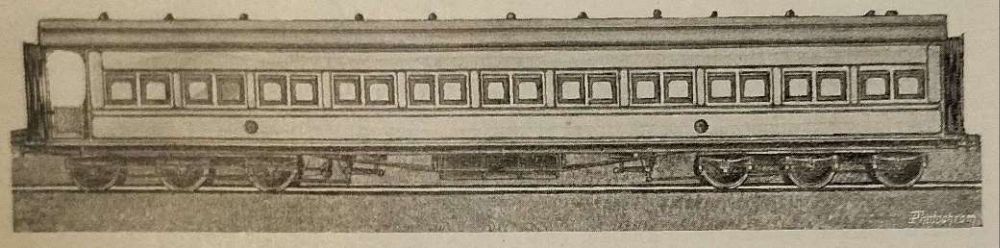
One of the carriages used by the Prince and Princess of Wales (later George V and Queen Mary) during their tour of India between November 1905 and March 1906. The saloon above, and the other coaches used, were generally referred to as the Royal train. These were, however, built just after the turn of the 20th century for the use of the Viceroy and suite, and were known as Viceregal saloons. They were numbered 3002 to 3007, inclusive, and were constructed in India from the designs of Mr. H. K. Bamber, the Carriage and Wagon Superintendent of the East Indian Railway. The saloons weighed 45 tons each. [1: p481][2]

Leaving Calcutta, where its chief offices were situated the main line ran through more than 400 miles of the Province of Bengal; then traverse[d] the United Provinces of Agra and Oudh, and, crossing the Jumma River, reache[d] the Punjab at Delhi. Here the [EIR] proper end[ed], but the Delhi Umballa Kalka Railway, which [was] worked by the East Indian, continued for another 162 miles to the foot of the Himalayan Mountains, whence a hill railway [ran] to Simla, 7,084 ft. above sea level. … The [EIR] thus connect[ed] the winter and summer headquarters of Government, and [was] not only the route followed by the mails between these points, but [was] the route followed by the mails between Bombay and Calcutta, the Great Indian Peninsular Railway carrying them over the section between Bombay and Jubblepore, where it connect[ed] with the Jubblepore branch of the [EIR].” [1: p482]

On the EIR, 1st and 2nd class passengers taken together only provided 7% of the passenger income in 1905. 3rd class passengers provided over 70% of the EIR’s income and we’re therefore “all important to the railway, and it is to assist him and to make his journeys as comfortable and pleasant as possible that the efforts of the management [were] mainly directed.” [1: p482]

After the turn of the 20th century, the EIR was carrying more than 20 million 3rd class passengers each year. A significant proportion of these rail users are pilgrims travelling to holy shrines and particularly to/from the sacred River Ganges.

Huddleston comments on the fares paid by 3rd class travellers: The Anna is the equivalent of 1d and there are 12 Pies in one Anna. “The third class fare [was] 2.5 Pies per mile for the first 100 miles, with a still lower rate for distances beyond. … The third class fare [was] considerably below a farthing a mile. If [EIR] fares were charged in England a trip from London to Brighton would [have] cost about 10d., and a journey from London to Edinburgh could [have been] made for about 8s. 6d.” [1: p485]

In 1905, the standard fare for third class rail travel in the UK was 1d per mile, and first class fares were usually 1.5–2 times that. Fares were based on distance traveled, and the shortest route between two places was used to calculate the price. For example, if there were multiple routes between London and Edinburgh, the price for all routes would be based on the shortest route. [3]

Making the assumption that the distance between London and Edinburgh by rail is/was 332 miles then a 3rd class ticket from London to Edinburgh would have cost £1 7s 8d. Rail travel on the EIR was around 30% of that in the UK at the time.

We have noted the importance of 3rd class passengers to the finances of the EIR. Huddleston tells us that, “Still more important [were] the goods and minerals carried, for these contribute[d] nearly 70 per cent of the gross earnings. During the year 1904, the weight of coal and general merchandise transported over the East Indian Railway system amounted to considerably more than 12,000,000 tons, the average distance carried being more than 200 miles, the average freight charged being less than a halfpenny per ton mile in the case of ordinary merchandise, and a fraction over a farthing per ton mile in the case of coal.” [1: p485]

The EIR provides the main means of access to the coalfields of Bengal, from which it carried more than 6,000,000 tons of coal annually. “This traffic, of which a large proportion [was] exported from Calcutta, [had], by cheap rates and by the opening up of new and important coal- producing areas, been enormously developed during the [past] ten years, and [was] still continu[ing] to grow. At the time the construction of the East Indian Railway was started, coal was almost unknown in India, and India’s requirements, which were practically confined to its ports, were met by Cardiff. [After the turn of the 20th century] hardly any English coal [was] sent to India. … and Bengal claim[ed] that it [could] supply all requirements east of Suez.” [1: p485]

In addition to the coal traffic, the EIR also transported “large quantities of wheat, seeds, grain, cotton, salt, and other articles of general merchandise, and in order to enable it to make a profit out of the very low rates charged [paid] great attention to the question of train and wagon loads. The greatest importance [was] attached to traffic statistics. A system of accurately recording ton and passenger unit mileage, together with such other statistics as [were] necessary to judge of work done on a railway, was introduced in India [in the second half of the 19th century. These statistics were] placed each week before the officers concerned in the management of the traffic, so that they [were] continually kept acquainted with its essential features and [were] in a position to watch progress and to remedy defects without loss of time.” [1: p485]

Since 1872, the average train load on the EIR … increased from a little over 100 tons to more than 275 tons in 1904. … The Indian figures [were] far beyond those on the best worked lines in England.” [1: p485-486]

The EIR uses only its own wagons for the carriage of domestic freight. “The standard of work for each wagon on the line [was] laid down at 75,000 ton miles per half year, and this figure [was] often exceeded. … The average cost of coal consumed on the [EIR was] less than 2s. 8d. per ton. … There [were] … other reasons besides a cheap fuel supply for the great economy in working which the statistics show; labour, for instance, [was] very cheap compared with European standards, and this tend[ed] to keep down the cost of maintenance and the cost of staff generally. But beyond all this the attention paid to detail [was] remarkable. Competition exist[ed], especially between the railway systems serving the rival ports of Bombay and Calcutta, and [that called] for a close watch on every ton of traffic, each fluctuation requiring explanation. The wagon supply, as already indicated, being on a low scale, necessitate[d] every vehicle being looked after; the movements of each wagon [were] known, in fact, from day to day. Train mileage, shunting mileage and detention mileage [were] kept as low as possible, the figures for each section of the line being closely scrutinised every week.” [1: p486-487]

Huddleston then goes on to describe travel for European expats on the EIR Punjab mail train from Calcutta (Kolkata] to Delhi, in 1st class naturally! …

Suppose yourself, in the month of December, to be a first-class passenger by the Punjab mail train from Calcutta to Delhi; after having taken your ticket, and booked your luggage and a berth at a cost of considerably less than a £5 note, which, by the way, will also cover your return journey if you take a Christmas holiday concession ticket available for a month, you will enter the train at half-past nine in the evening, and your servant will at once make your bed. During the night you will pass through part of the coalfields of Bengal, and travelling along the Chord, or present main line, find yourself at about 6.15 a.m. at Dinapore, 344 miles from Calcutta. Dinapore is a military cantonment, and is the first place on the line from Calcutta at which troops are stationed. Here you will be served with what is called ‘chotahaziri’, or, literally translated, ‘little breakfast’; this usually consists of tea and toast, and is ordinarily taken in India the first thing in the morning.” [1: p487]

Leaving Dinapore, after a halt of ten minutes, you will dress at your ease, assisted by your servant, who will afterwards roll up your bedding, and leave you to your newspaper and cigarette until half-past nine, when the trin arrives at the important junction of Moghalsarai, a few miles from Benares, the sacred city of the Hindoos. At Moghalsarsi, during a halt of twenty-five minutes, you will proceed to the refreshment room to breakfast, which consists of several courses and coats two shillings. Leaving Moghalsarai, the train passes the old fort of Chunar, now abandoned by the military, but once an important stonghold. Shortly afterwards the city of Mirzapur, famous for its hand made carpets and its brass and metal ware, is passed. The shrines and temples along the banks of the Ganges, on which Mirzapore is situated, are well worth seeing,because of their beautifully carved stone-work. … The train runs on to Allahabad, large civil and military cantonment, in time for luncheon, and the next station of importance is Cawnpore, notorious on account of the massacre of Europeans there during the Mutiny of 1857. Cawnpore is now the junction with several railway systems and a very important centre of trade, with numerous mills and factories; woollen mills, cotton mills, leather works, sugar factories and flour mills are to be found in greater number in Cawnpore than in any other up-country station in India. During the fifteen minutes the train stays there you have afternoon tea, and shortly afterwards, or at about 7 p.m., there is a halt of 30 minutes for dinner. Dinner in India is the big meal of the day, and costs at the railway refreshment room 2s. 8d. – not a very extravagant sum for a substantial meal of at least five courses.” [1: p488]

The junction for Agra, which, by the way, is on a branch line and 14 miles distant from the main line, is passed shortly after 9 p.m., and Delhi is reached at 1.30 in the morning. Rather an awkward hour at which to alight, but through trains cannot be timed to reach everywhere at convenient hours, and your train has still a long way to go. Delhi is naturally one of the most interesting places in the East; it is a large fortified city on the west bank of the River Jumna, and was, at the time of the Moghal dynasty, the capital of India. … Your journey of 954 miles from Calcutta will have taken you little more than 28 and 1/2 hours and when it is remembered that, in addition to shorter halts, there have been three long stoppages for breakfast, lunch, and dinner, that about half the distance has been over single line, and that the load of the train equal to 18 heavy coaches, the running a is time is by no means bad. … Throughout your journey you will have seen many objects of interest, and will have gained some idea of the extent of our great Eastern dependency. You will have noticed the hundreds of miles of cultivated plain through which your train has passed; great seas of rice, wheat, seeds and other grains and cereals, broken only by villages and trees, without a hedgerow or a single field of grass. You will have crossed some great rivers, among them the Keul, the Soane and the Jumna – the latter at two points, the first at Allahabad, where it runs into the Ganges, the second at Delhi. You will have found throughout a perfect climate, getting colder as you proceed to the north, but always bright, with sunshine every hour of the day. You will have observed great crowds of natives of all creeds and caste, Hindoos and Mahommedans predominating. You will have seen camels, bullock-carts, and other means of transport used by the natives, and, above all, you will have experienced the glorious fascination of the East, which is beyond description.” [1: p488]

Huddleston completes his article in the December 1905 issue of The Railway Magazine at this point with a promise of more articles in future editions of the journal.

We return to Kolkata and attempt to follow the same journey to Delhi over a century later.

The Route of the East Indian Railway (EIR) from Kolkata to Delhi.

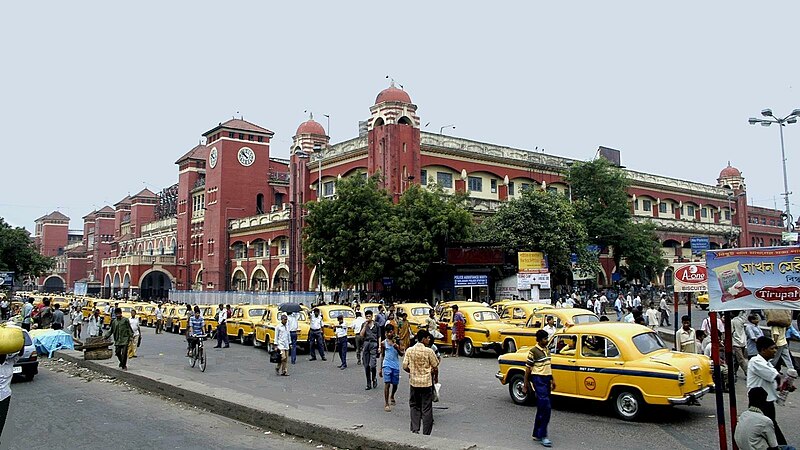
Making a journey from Kolkata West-northwest towards Delhi, we start at Howrah Railway Station on the banks of the River Hooghly. Distances are so vast that it would be impossible to follow every mile of the line. Hopefully what follows gives a good flavour of the line.
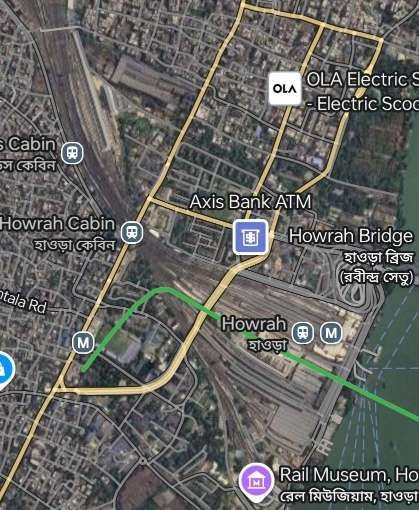
Howrah Railway Station in Kolkata. [Google Earth, October 2024]
Howrah Railway Station, Kolkata, (c) samarkumarsarkar, Public Domain. [7]

Howrah railway station (also known as Howrah Junction) is a railway station located in the city of Howrah, West Bengal in Kolkata metropolitan region. “It is the largest and busiest railway complex in India as well as one of the busiest and largest train stations in the world. It is also the oldest surviving railway complex in India. Howrah is one of the five large intercity railway stations serving the Kolkata metropolitan area, the others being Sealdah, Santragachi, Shalimar and Kolkata railway station.” [8]
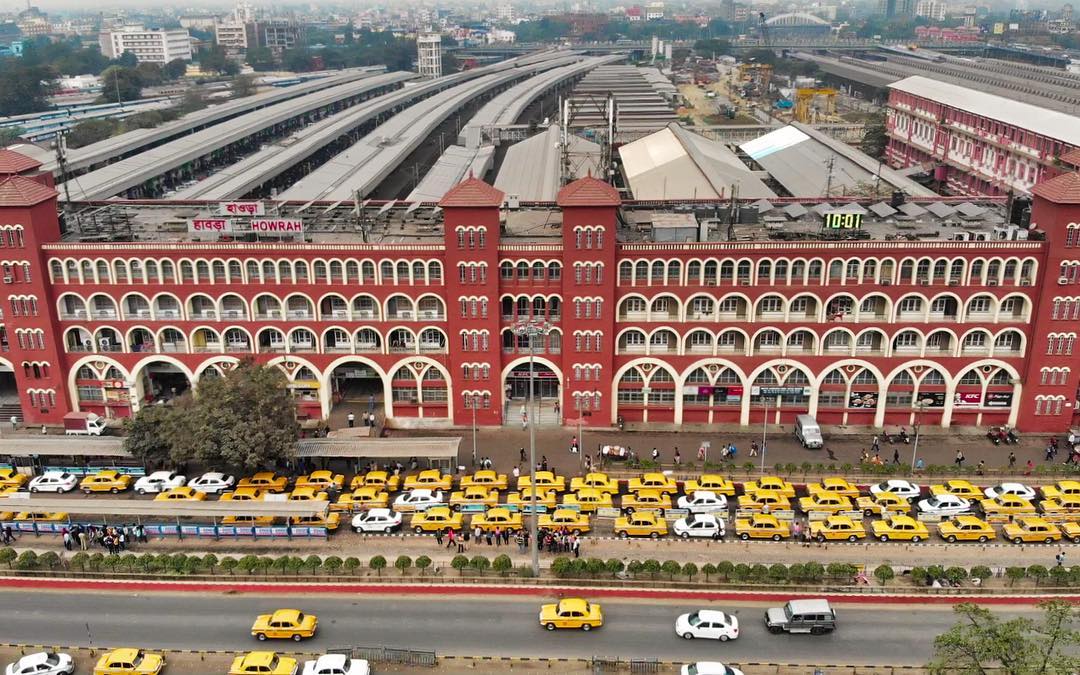
Howrah Railway Station, Kolkata, shared on the Beauty of India Facebook Page on 19th February 2019. [9]

The first significant conurbation outside Kolkata is Barddhaman.

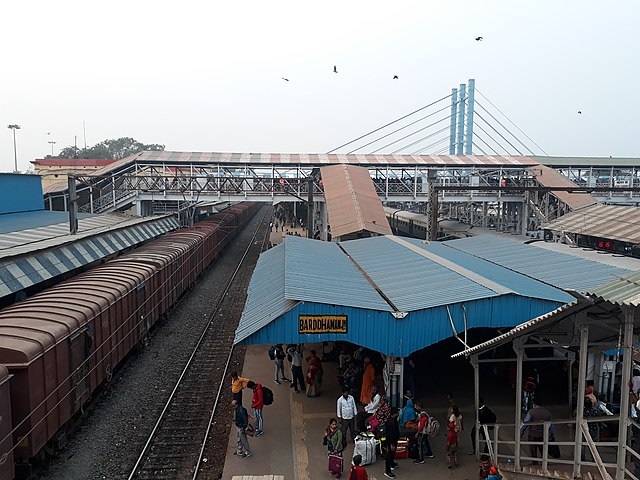
Barddhaman Junction Railway Station. [Google Earth, October 2024]
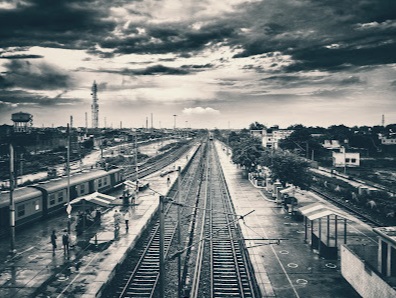
Looking Northwest through Barddhaman Junction Station, (c) pinakpani and licenced for reuse under a Creative Commons Licence (CC BY_SA 4.0). [7]
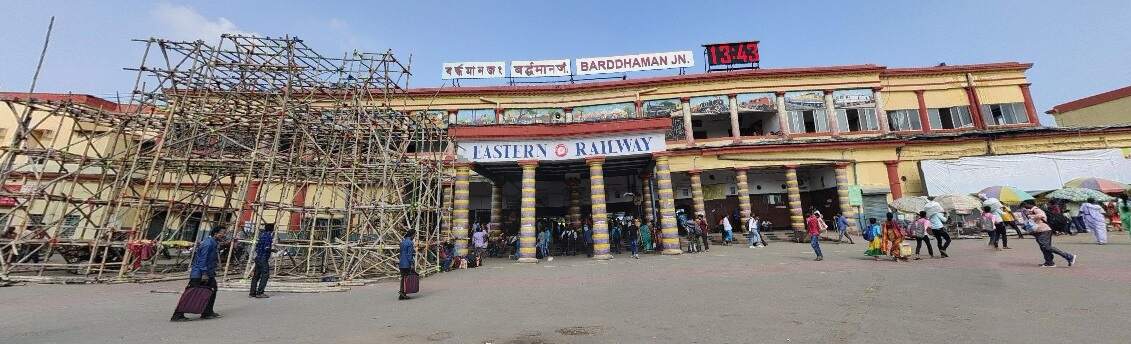
Barddhaman Junction Passenger Station building seen from the station forecourt. [Google Streetview, October 2019]
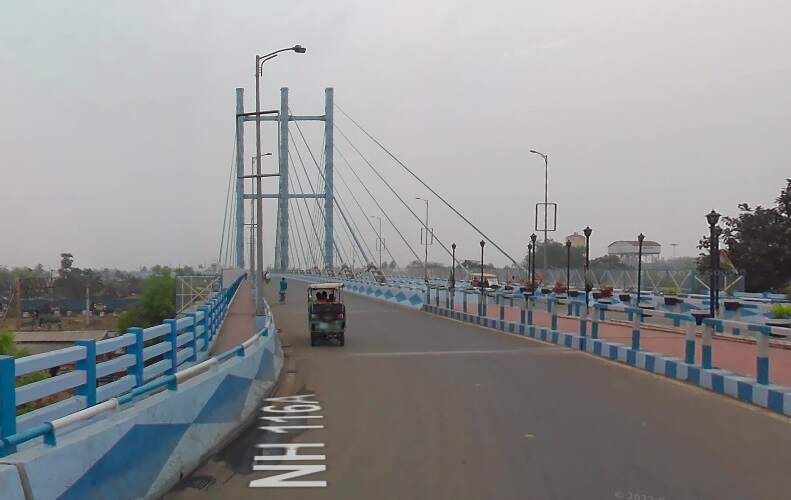
The modern cable-stayed bridge which spans the track at Barrdhaman. [Google Streetview, May 2023]
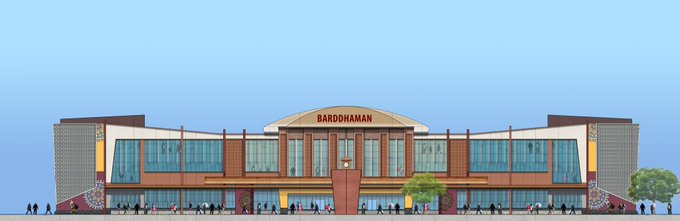
Proposed new station building at Barddhaman (21st August 2023). [6]

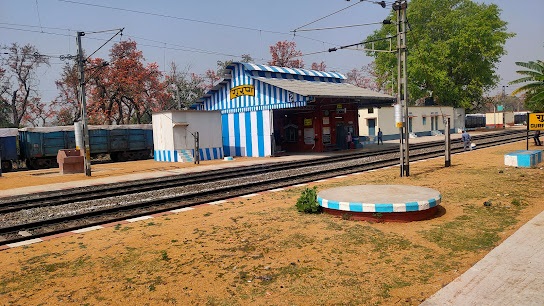
Our next scheduled stop is at Durgapur but on the way we pass through a number of local stations. Just one example is Mankar Railway Station.
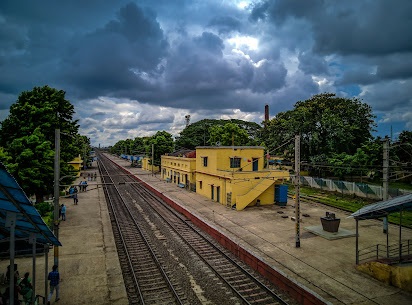
Mankar Railway Station. [Google Eartth, October 2024]
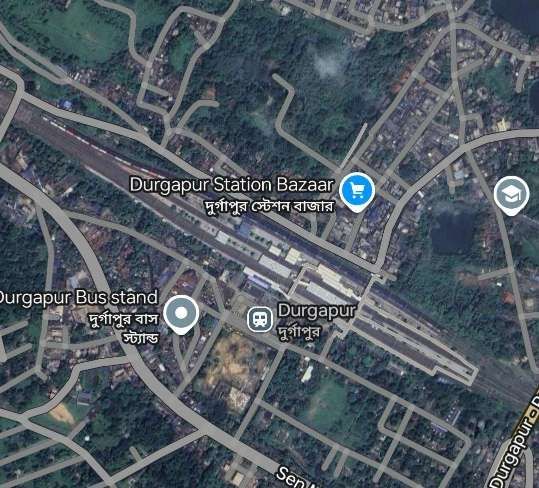
Durgapur Railway Station. [Google Earth, October 2024]
The Main station building at Durgapur, (c) Satyajit Dey. [Google Streetview, February 2019]
Looking Southeast from Cinema Hall Road towards the Railway Station at Durgapur. [Google Streetview, April 2023]

Beyond Durgapur is a very significant steelworks and power station.
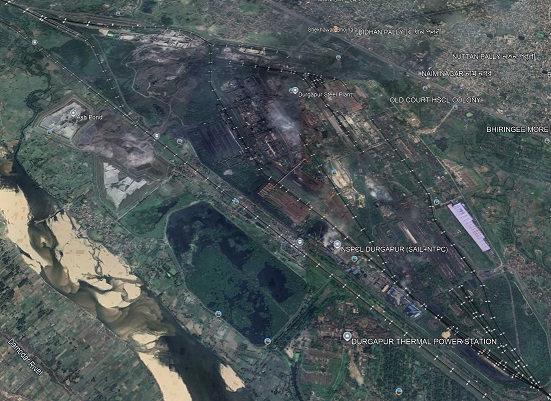
Durgapur Steelworks and Thermal Power Station. A couple of views appear in the two images below. [Google Earth, October 2024]

Just a couple of stations en-route to Asansol, our next stop, are shown below.
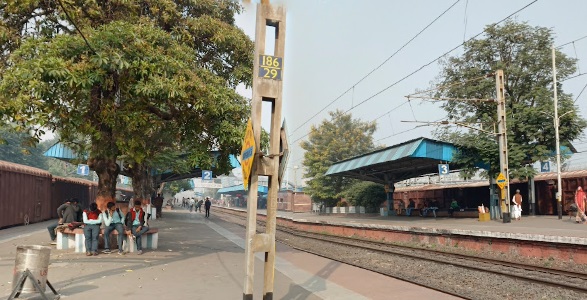
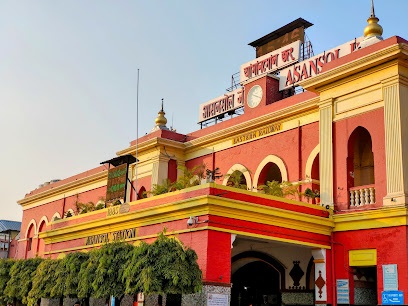
We arrive at Asansol Railway Station. …
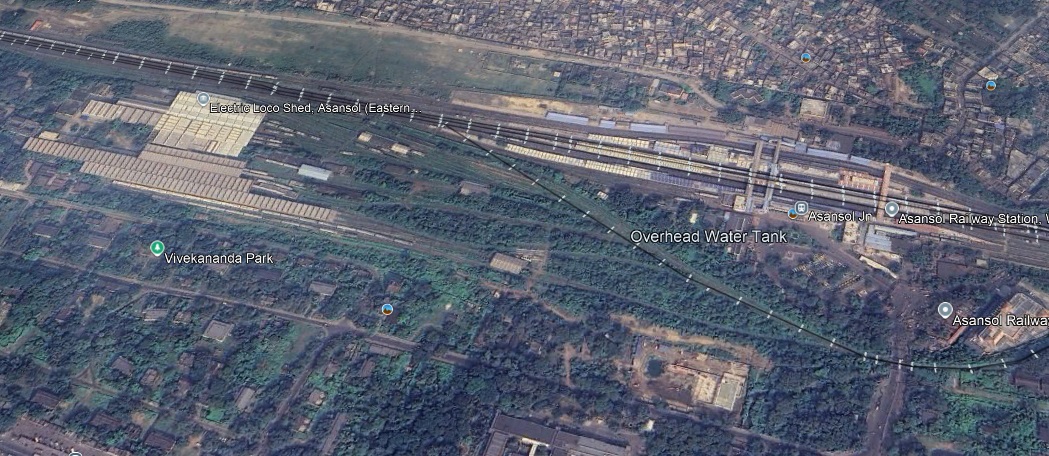
Asansol Railway Station and Electric Loco Shed. [Google Earth, October 2024]

Continuing on from Asansol we pass through Sitarampur and Kulti.
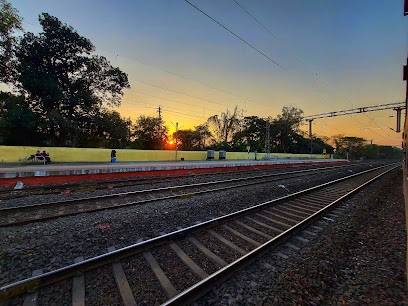
And on through Barakar before leaving West Bengal and entering Jharkhand and crossing the Barakar River.
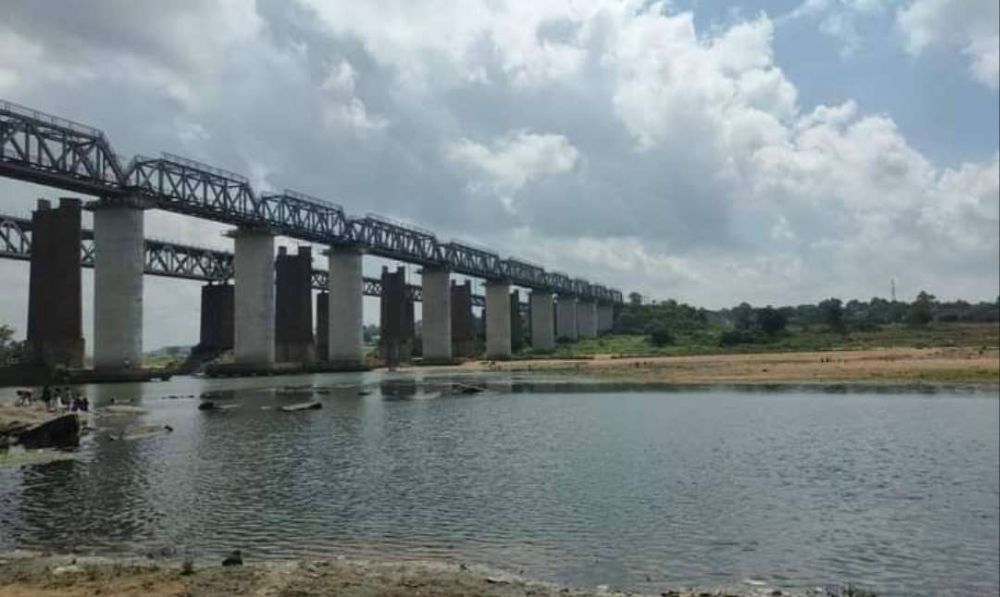
The Bridges over the Barakar River, The original single-track railway bridge is beyond the more modern bridge which also carries a single track. (c) Sarsati Devi, 2023.

West of the Barakar River we travel on through Kumardubi, Mugma, Thapar Nagar, Kalubathan, and Chhota Ambana.
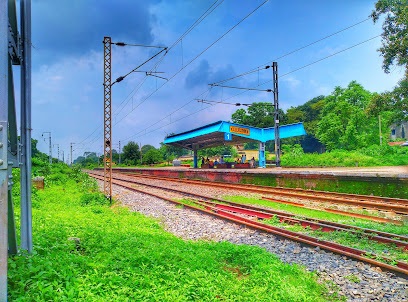
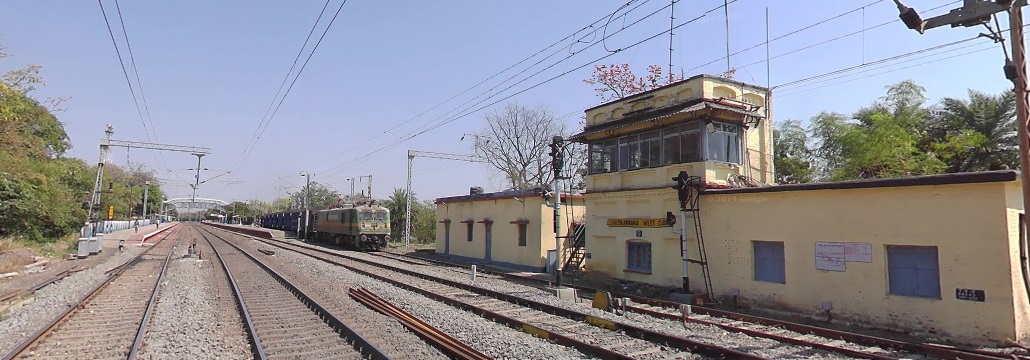
The journey continues through Pradhankhunta Junction and Dokra Halt before arriving at the next significant conurbation, Dhanbad.
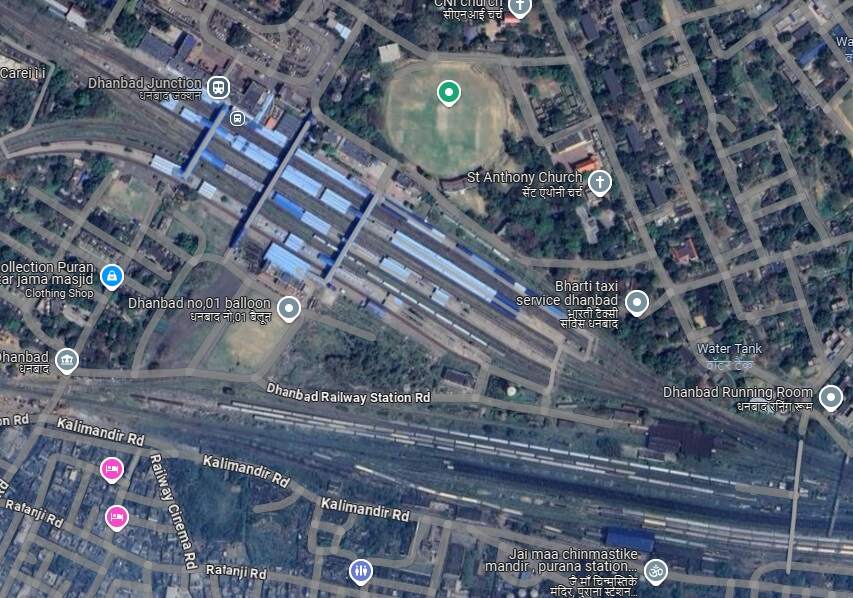
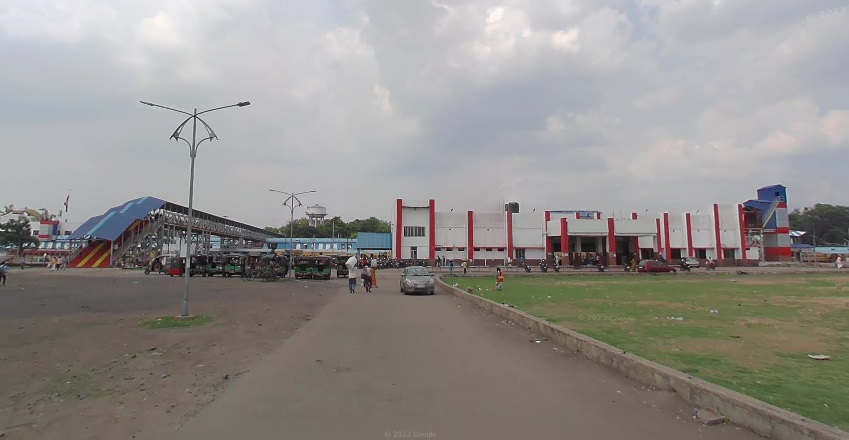
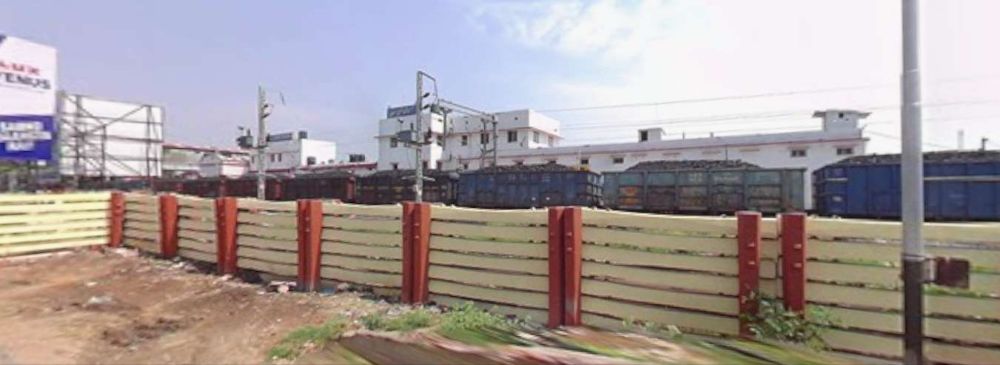
Dhyanbad Junction Railway Station and Goods Yard. [Google Maps, October 2024]
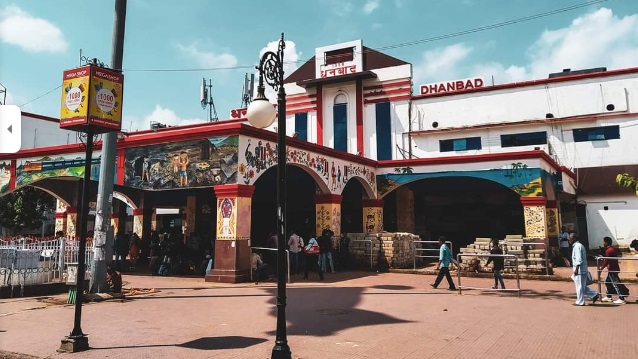
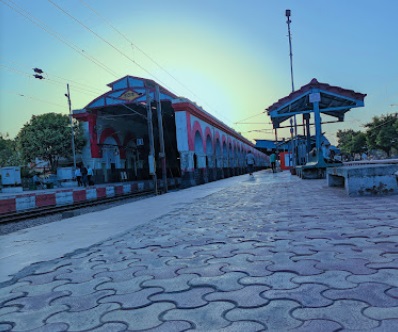
Dhanbad Railway Station forecourt seen from the South. [Google Streetview, July 2023]
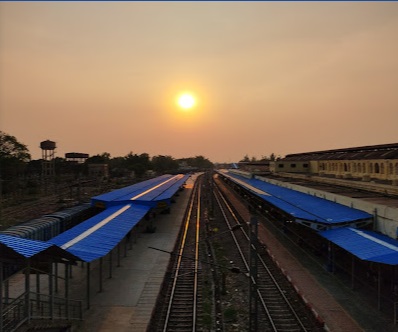
Dhanbad Railway Station seen from one of the three station footbridges, (c) Gaurav Kumar. [Google Maps, September 2022]
Dhanbad Railway Station seen from the North, (c) Kaushik Dhar. [Google Maps, July 2021]

From Dhanbad Railway Station, the EIR ran on through Bhuli to Tetulmari.
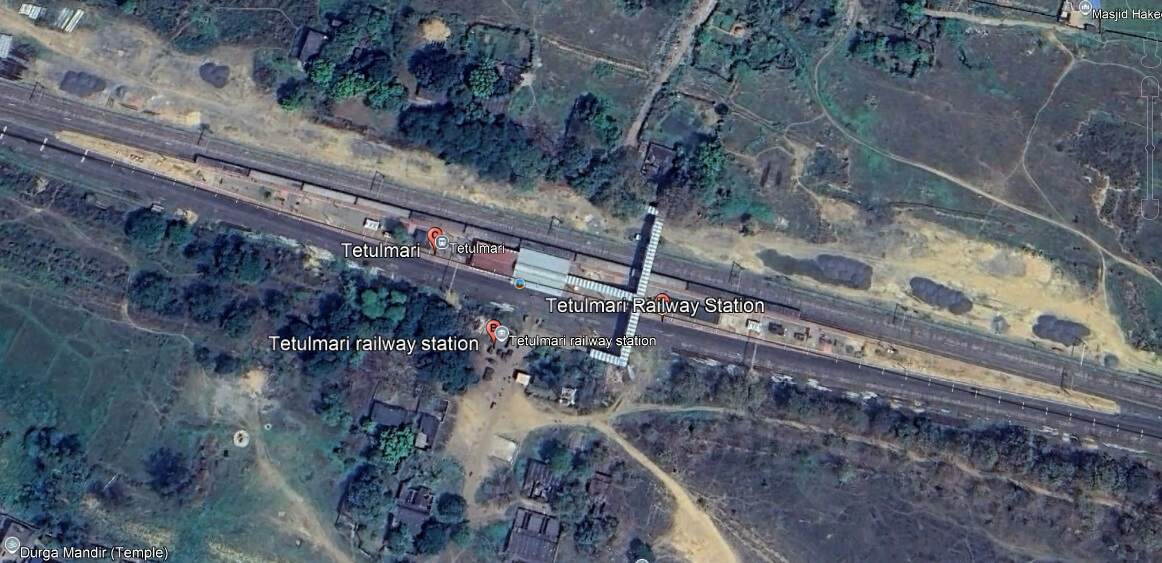
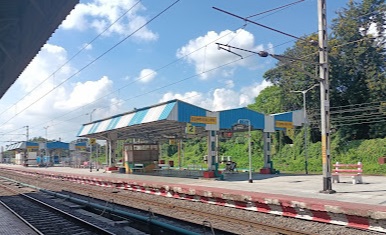
Tetulmari Railway Station. [Google Earth, October 2024]

And on from Tetulmari through Nichitpur, Matari and Ramakunda Halt to Gomoh Junction.
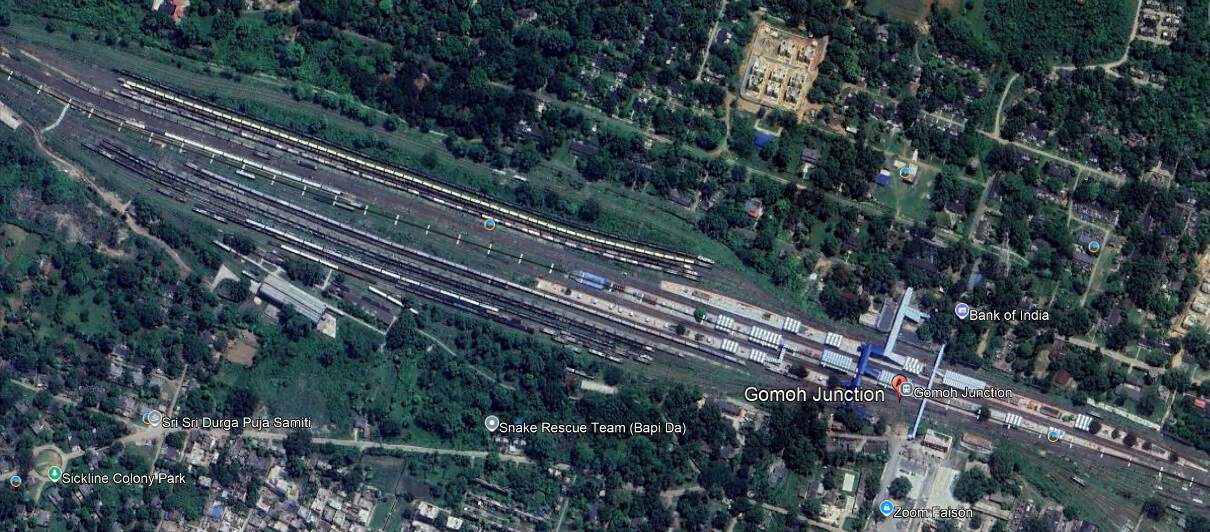
Gomoh Junction Railway Station and Yard. [Google Earth, October 2024]

From Gomoh Junction Railway Station the line continued Northwest through Bholidih and Nimiaghat to Parasnath Railway Station.
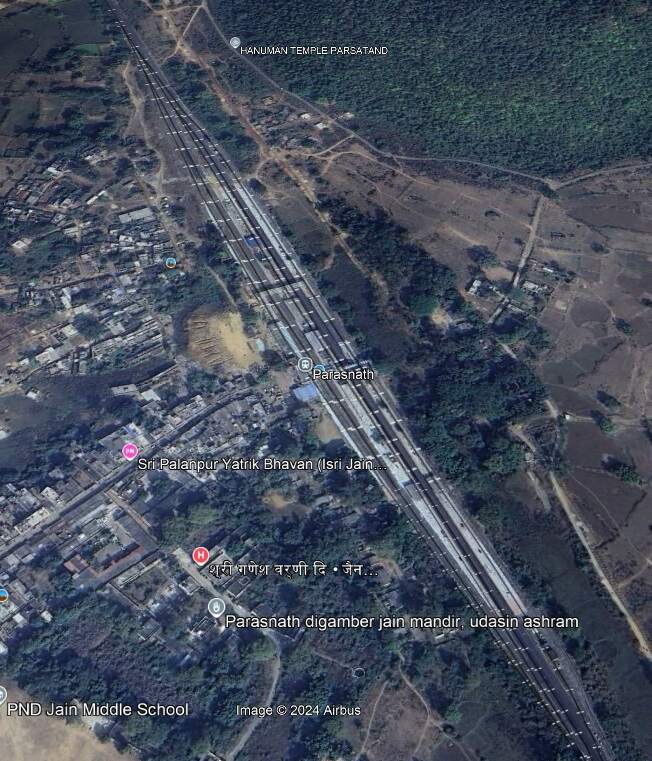
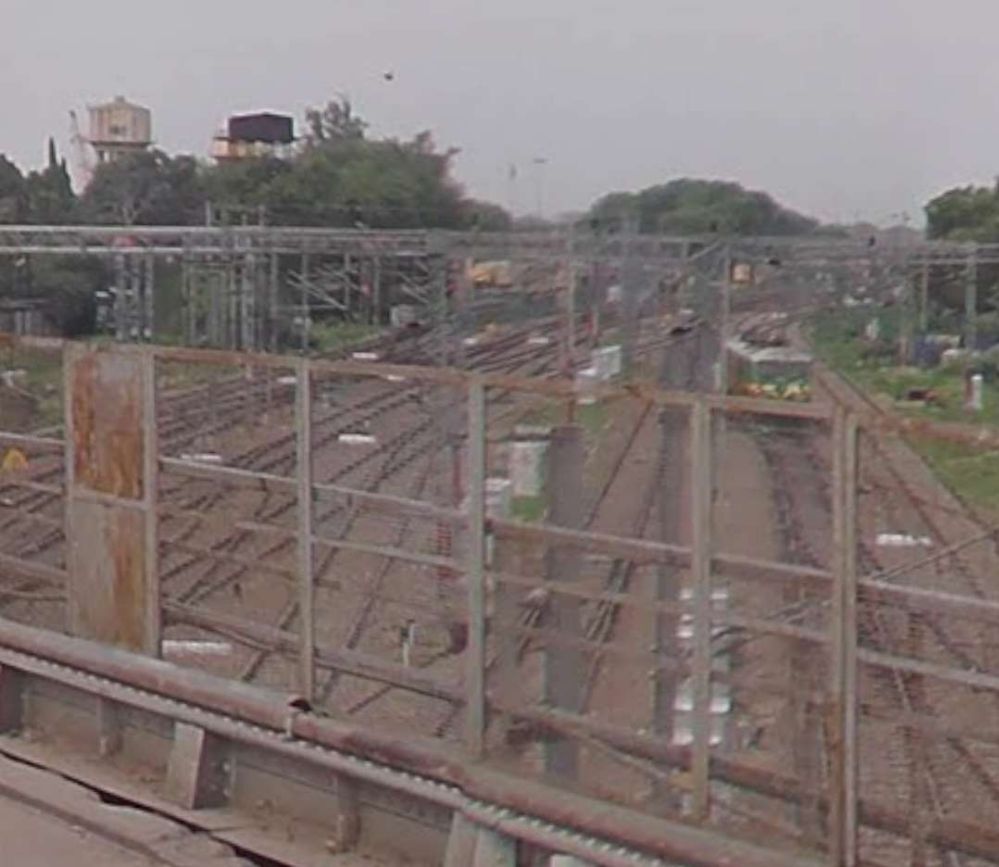
Parasnath Railway Station. [Google Earth, October 2024]

rom Parasnath the line continued Northwest through Chaudhribandh, Chichaki, Garea Bihar to Suriya Railway Station (Hazaribag Road Station).
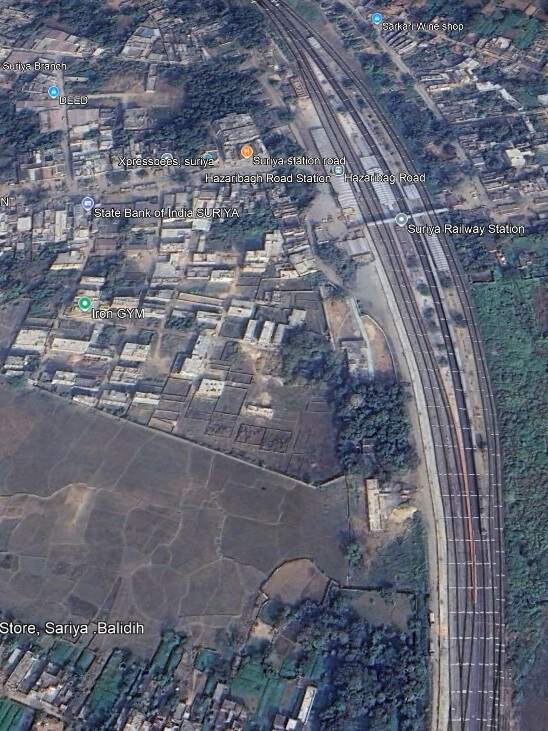
Suriya Railway Station (Hazaribag Road Station). [Google Earth, Octo9ber 2024]

From Suriya we travel on across the Kheruwa River Railway Bridge and the Barsoti River Bridge, through Chaube and Dasara Railway Stations, over the Banka Railway Bridge and through Parsabad Railway Station before crossing the Acto River Bridge and entering Sarmatanr Railway Station.
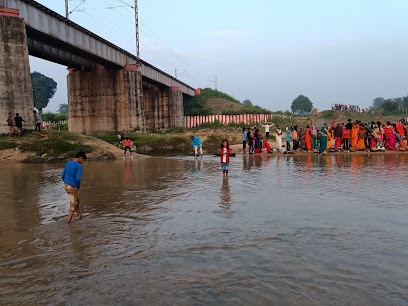
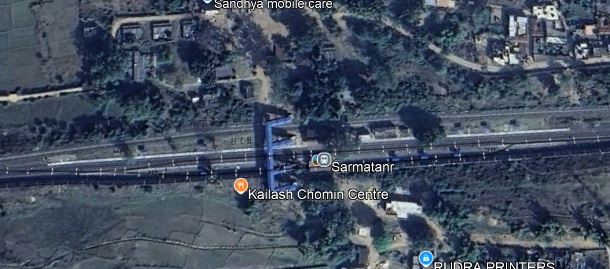
The line continues West from Sarmatanr through Hirodih Railway Station and into Koderma Junction Railway Station.
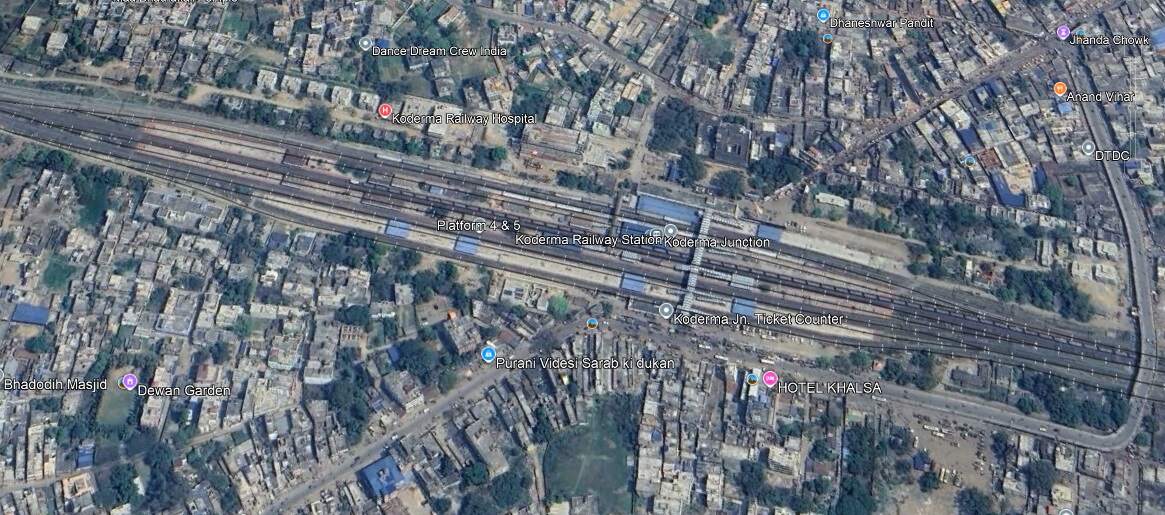
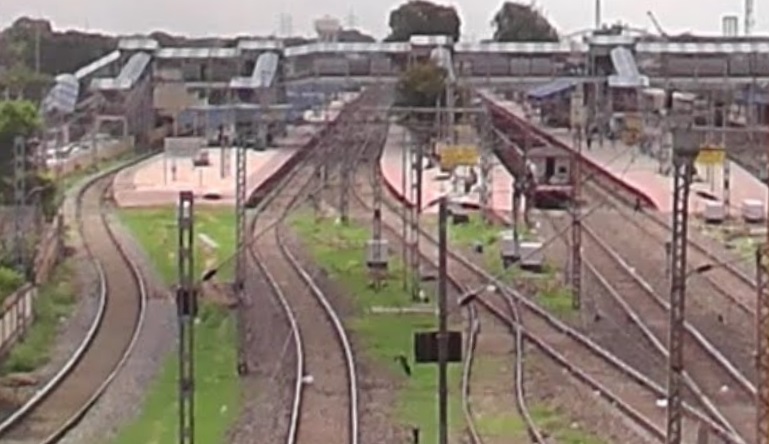
Koderma Junction Railway Station. [Google Earth, October 2024]
Koderma Junction Railway Station seen from the Southeast, from the Ranchi-Patna Road. [Google Streetview, July 2023]

Leaving Koderma Junction travelling West-northwest the line runs on through Gujhandi, Delwa, Nath Ganj The scenery is more rugged, tunnels and sharp curves are needed to keep railway gradients to a minimum. Tunnel No. 3 is shown below.
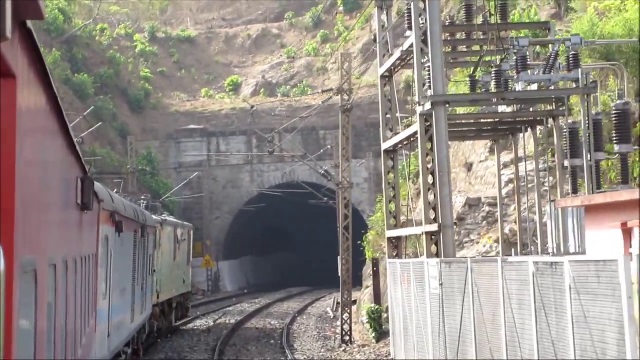
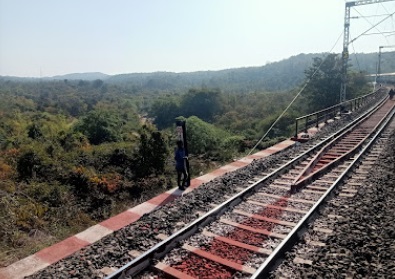
The Western Portal of Tunnel No. 3. Nath Ganj Railway Station is a few hundred metres behind the camera, (c) Safal Ahmed. [Google Earth, October 2024]

West of Nath Ganj the line passes through Baskatwa B. H. and Gurpa Railway Stations, crosses the River Dhadhar River, runs through Paharpur Railway Station, Bansinala Halt, Tankuppa and Bandhua Railway Stations, before entering Manpur Junction Station.
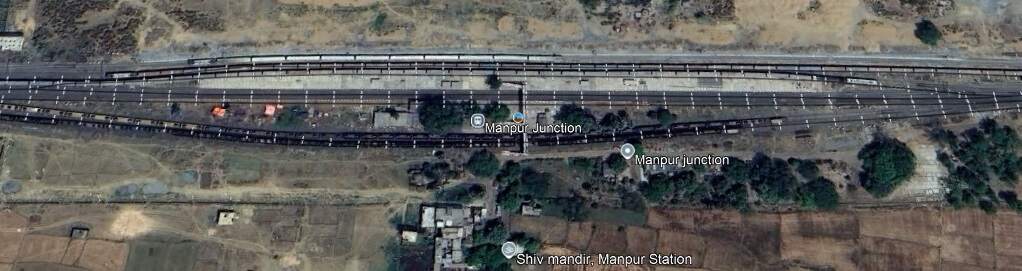
Manpur Junction Station. [Google Earth, October 2024]
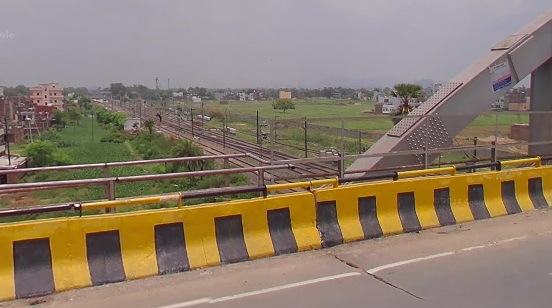
Looking back to the East towards Manpur Junction Railway Station from Manpur Overbridge. [Google Streetview, July 2023]

West of Manpur the line crosses the Falgu River Bridges.
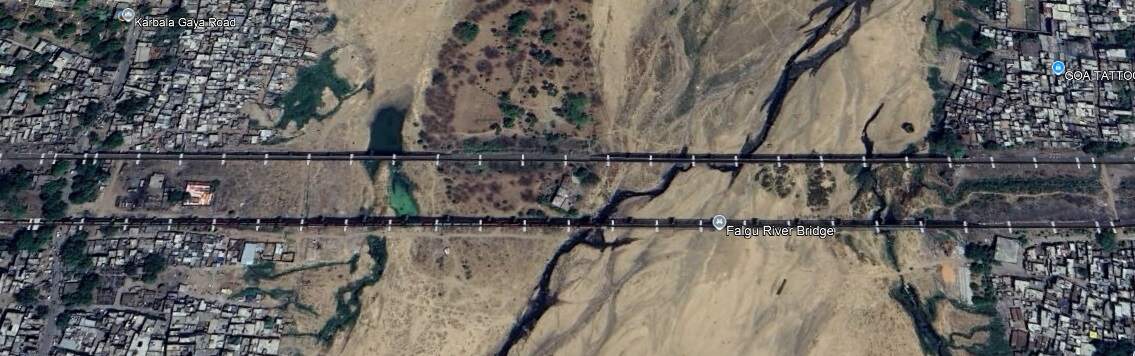
The Falgu River Bridges. [Google Earth, October 2024]

The line continues to the West for only a very short distance before sweeping round to the South into Gaya Junction Railway Station.

Gaya in Bihar State is the second city in the state. It sits on the West bank of the Falgu (Phalgu) River. Gaya is 116 kilometres (72 mi) south of Patna and has a population of 470,839. The city is surrounded on three sides by small, rocky hills (Mangla-Gauri, Shringa-Sthan, Ram-Shila, and Brahmayoni).
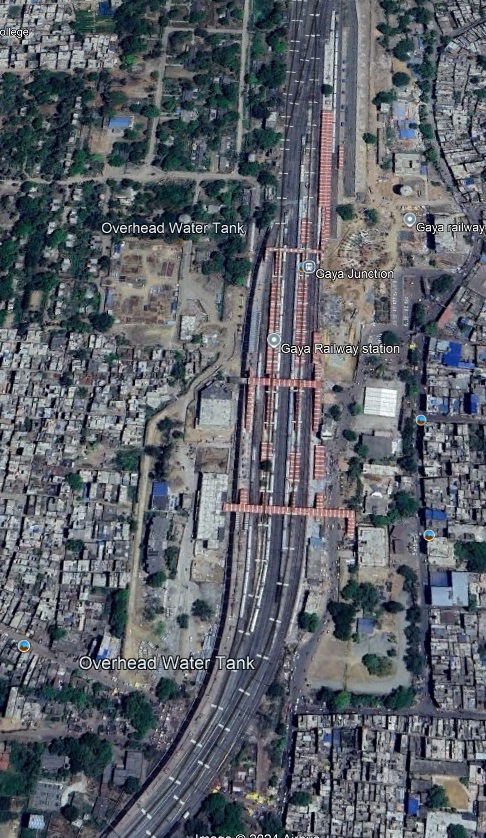
Gaya is a city of historical significance and is one of the major tourist attractions in India. It is sanctified in the Jain, Hindu, and Buddhist religions. Gaya district is mentioned in the great epics, the Ramayana and the Mahabharata. It is the place where Rama, with Sita and Lakshmana, came to offer piṇḍadāna for their father, Dasharatha, and continues to be a major Hindu pilgrimage site for the piṇḍadāna ritual. Bodh Gaya, where Buddha is said to have attained enlightenment, is one of the four holy sites of Buddhism. [10]
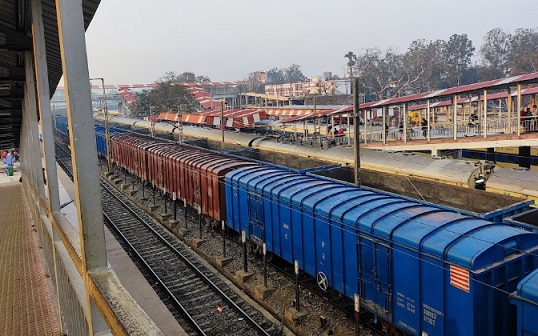
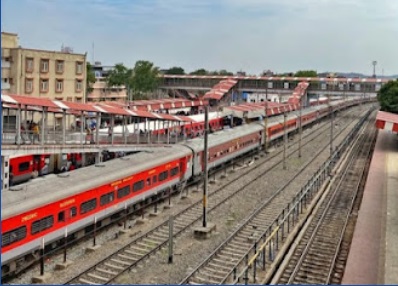
Turning sharply to the West at the Railway Station limits, the line runs through Kastha Railway Station and over the Morhar River Bridge.
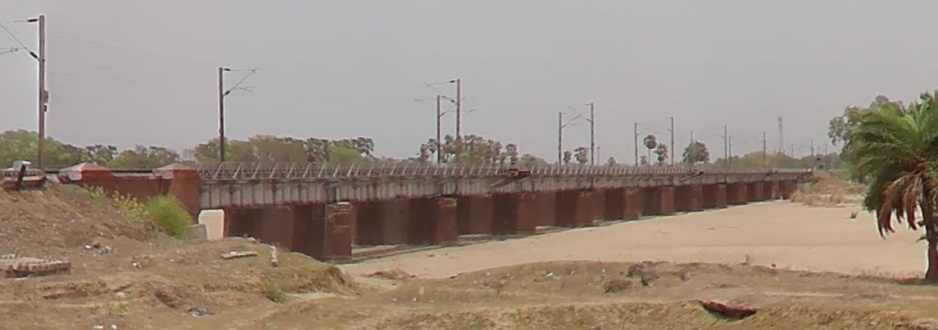
The first Morhar River Bridge seen from the West bank of the river channel. [Google Streetview, June 2023]

Once across the first bridge (above) the line passes through Paraiya Railway Station and then crosses the western channel of the Morhar River.
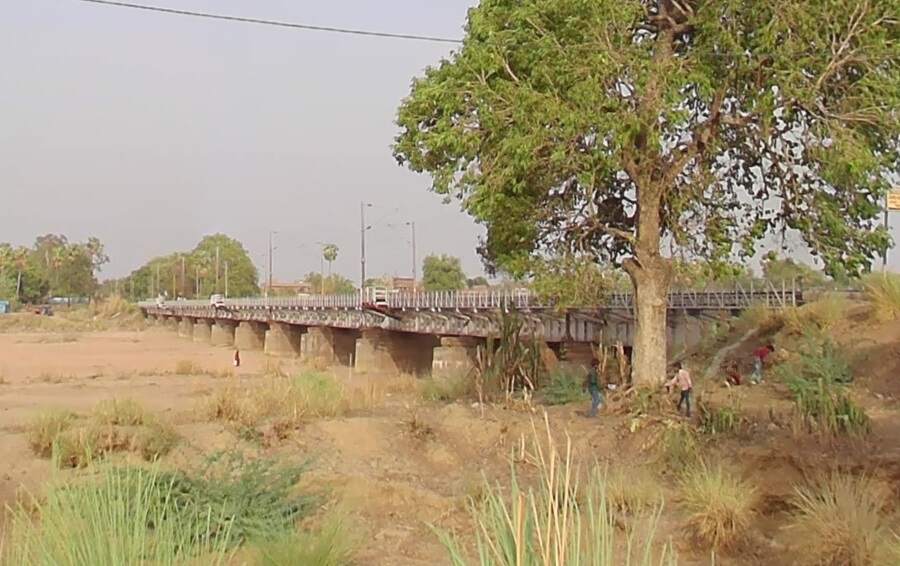
The bridge over the western channel of the Morhar River seen from the West bank of the channel. [Google Streetview, June 2023]

On wards to the West, the line runs through Guraru, Ismailpur, Rafiganj, Jakhim, Phesar, Stations and into Anugraha Narayan Road Railway Station.
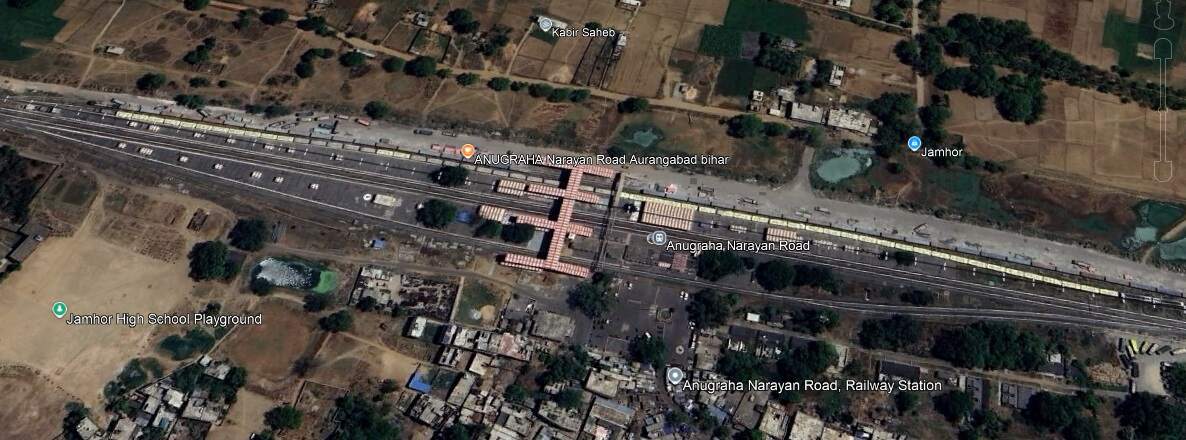
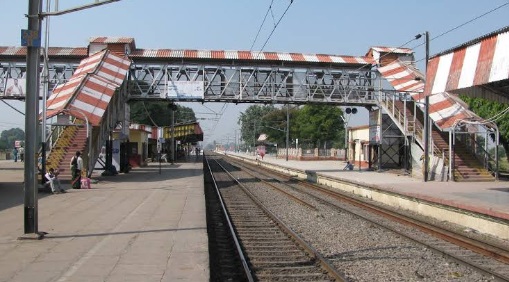
Anugraha Narayan Road Railway Station. [Google Earth, October 2024]
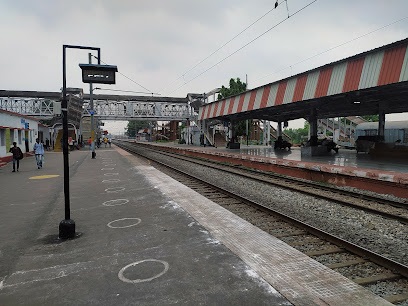
Continuing West, the line crosses the Punpun Railway Bridge passes through the relatively complex Son Nagar Junction and arrives at Son Nagar Junction Railway Station.
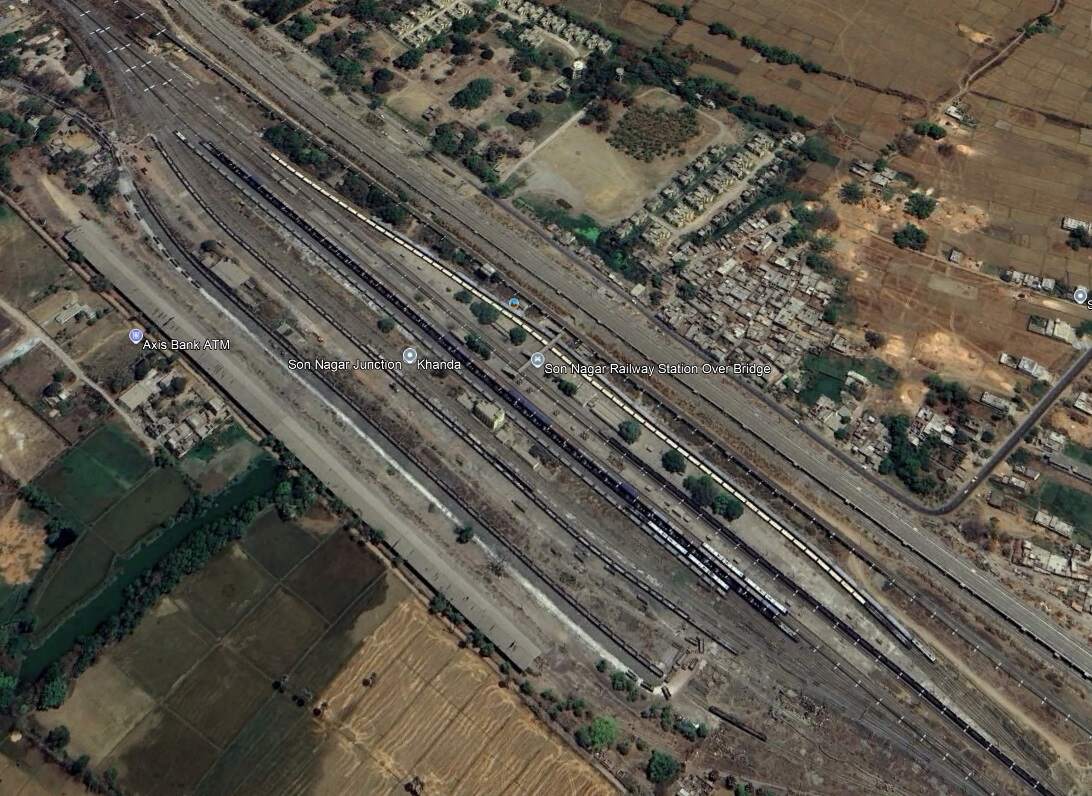
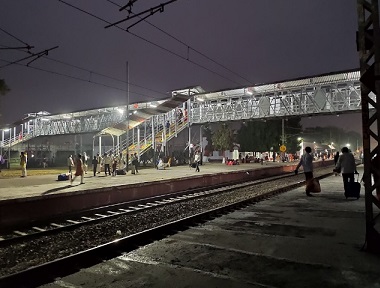
Son Nagar Junction Railway Station. [Google Earth, October 2024]

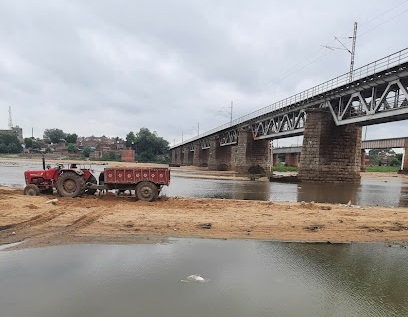
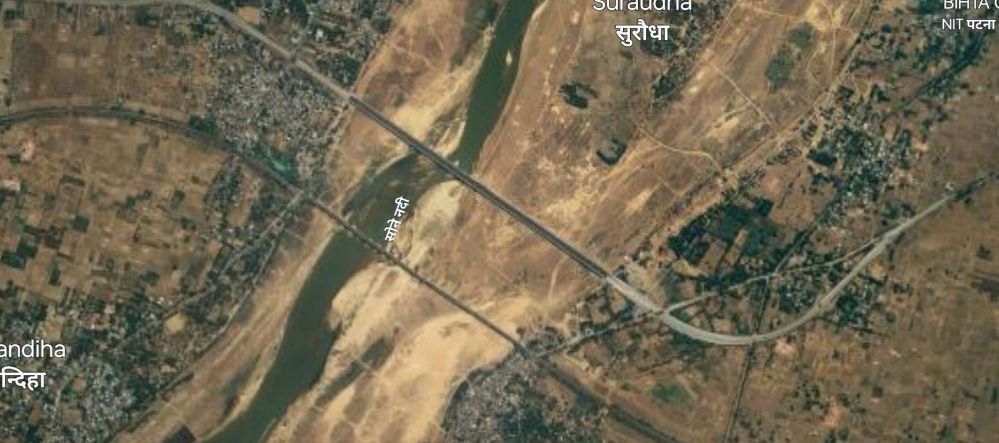
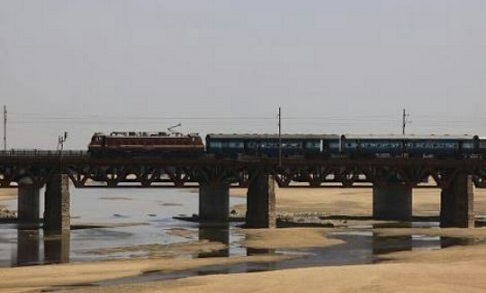
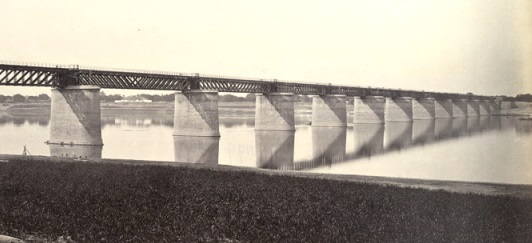
Northwest from Son Nagar Junction Railway Station the railway crosses the River Sone (Soane). Huddleston provided a photograph of the first railway bridge across the river.
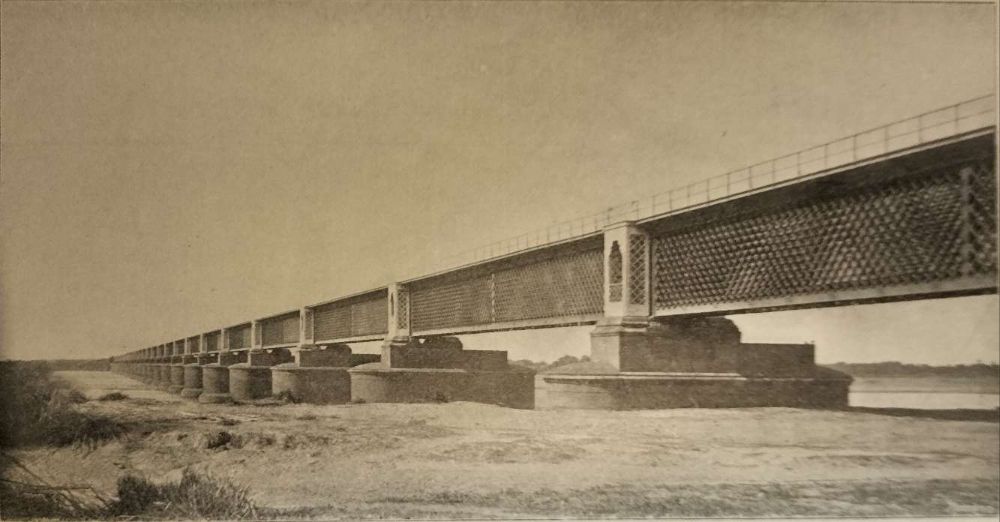
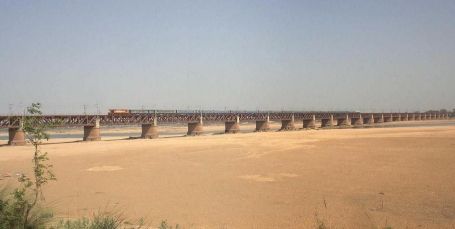
The Soane Bridge, East Indian Railway – 28 spans of 150 ft. The stone piers were constructed sufficiently wide to allow for bridge widening. [1: p484]
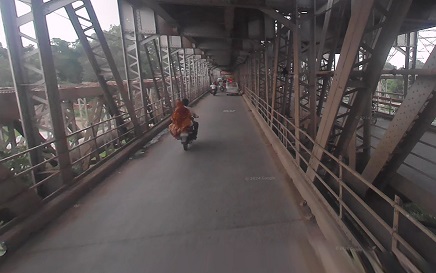
The Koilwar Bridge crosses the River Sone (Soane). The original Koilwar Bridge (Soane Bridge) “has twenty-eight wrought-iron lattice girders, each of 150 feet clear span, resting on brickwork piers 12 feet wide, these piers being built upon wooden curbs shod with iron and sunk into the clay bed of the river to an average depth of about 30 feet. The total length of the bridge between the abutments is 4,530 feet, added to which there are smaller spans on each side forming the land approaches. …  The bridge (weighing approximately 3,500 tons) was constructed in the UK, and its erection in India was entrusted to the late Samuel Power, an experienced member of Mr. Brunel’s staff, with Bernhard Schmidt who soon took charge of the works with the rank of District Engineer. Work commenced in 1856 and the bridge was open by February 1863.” © Abdulbarisif, and licensed for reuse under a Creative Commons Licence (CC BY-SA 4.0). [4]
The two Koilwar Railway Bridges run immediately adjacent to each other. Together they form the more northerly crossing. The more southerly crossing is the modern road bridge. [Google Earth, October 2024]

On the West of the River Sone (Soane) the railway runs into Dehri on Sone Railway Station.
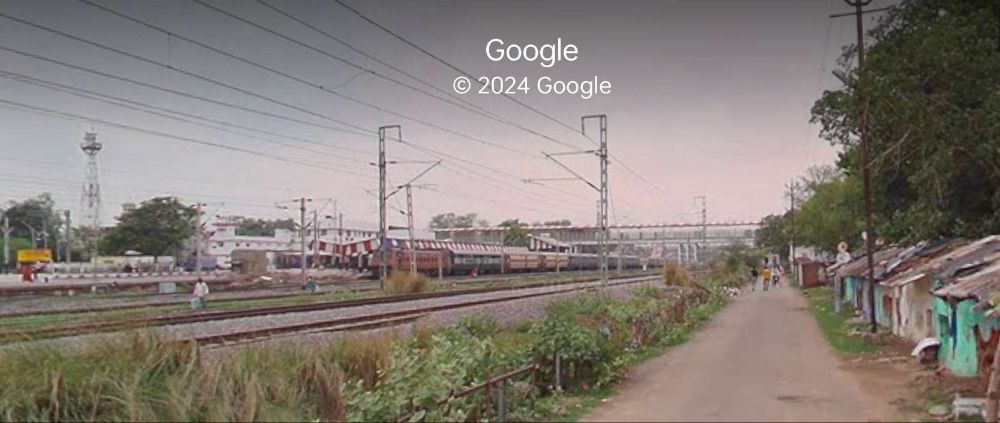
To the West of Dehri the line runs through Pahaleja Railway Station. It is noticeable as we travel to the West that traffic levels must be high. There are significant additional tracks along this length of the line with a number of stations only on the new lines and others only on the older lines.

On the new lines we see New Karwandiya DFC Railway Station with Karwandiya Railway Station on the older lines.
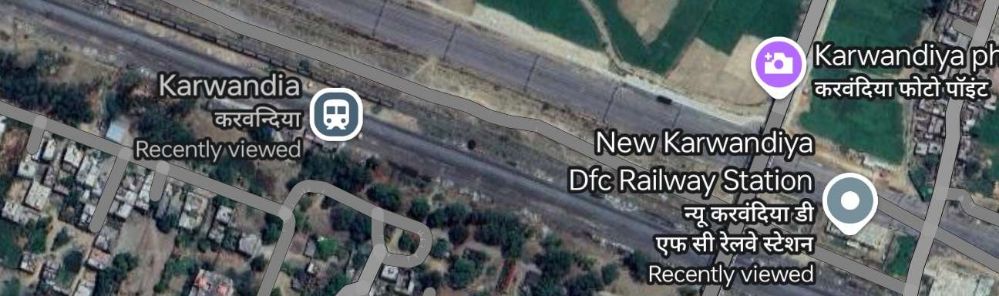
Karwandiya Railway Stations. [Google Earth, October 2024]

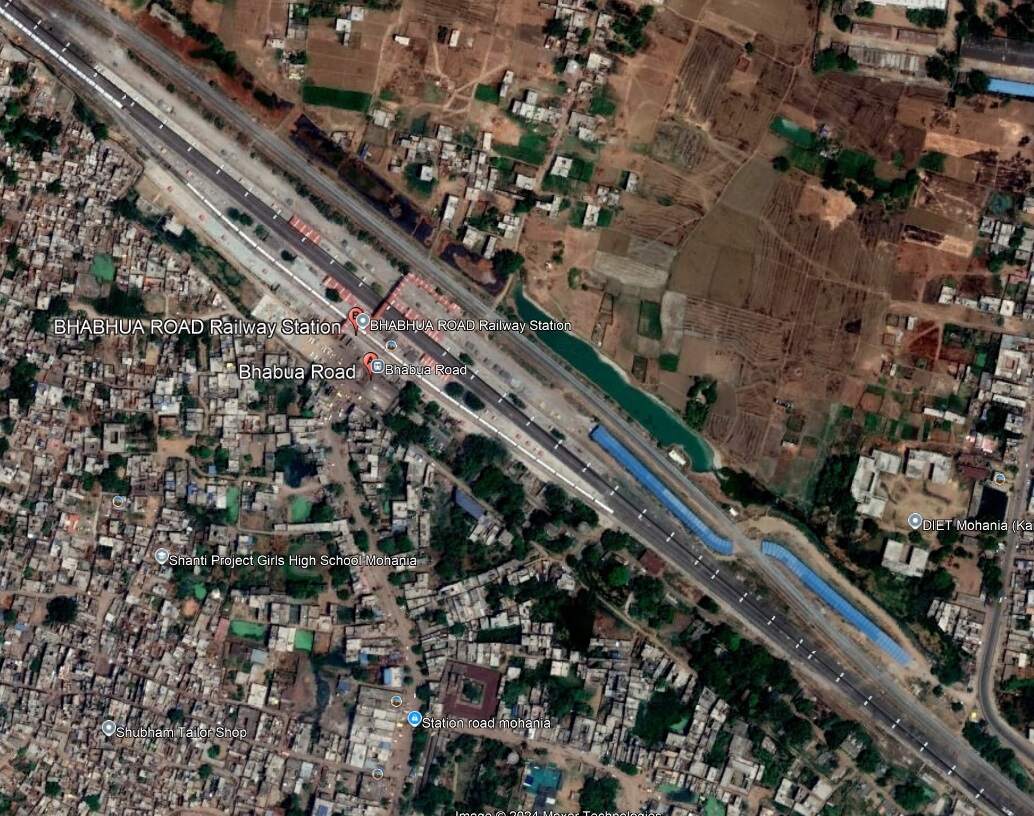
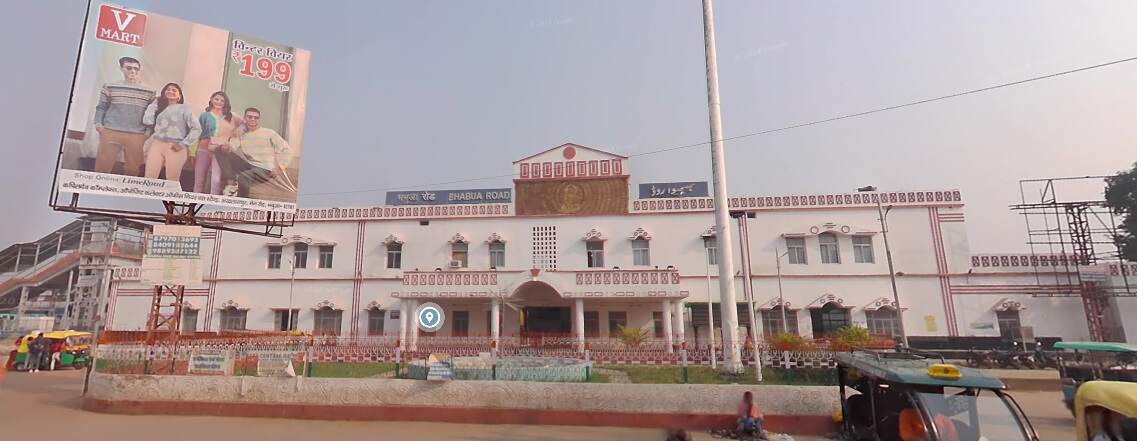
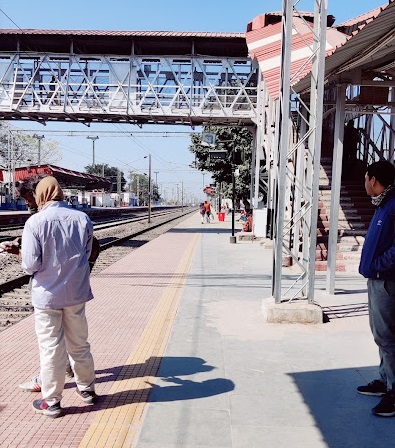
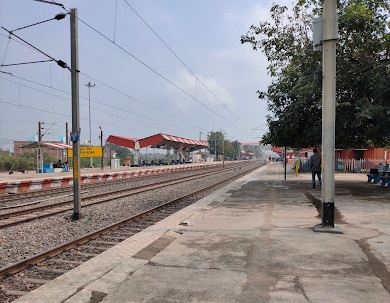
West of Karwandiya, the line runs on through Sasaram Junction Railway Station, Kumahu, Shiu Sagar Road, Khurmabad, New Kudra Junction (and Kundra), Pusauli and Muthani Railway Stations before entering Bhabhua Road Railway Station. The two images below show the 5 main lines in use in the 21stcentury as seen from the overbridge to the Southeast of Bhabhua Road Railway Station.
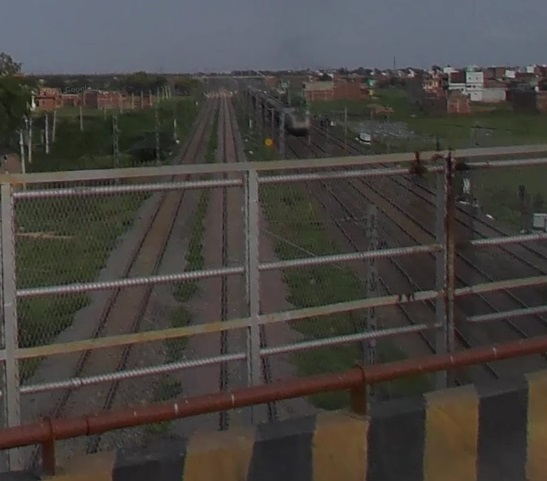
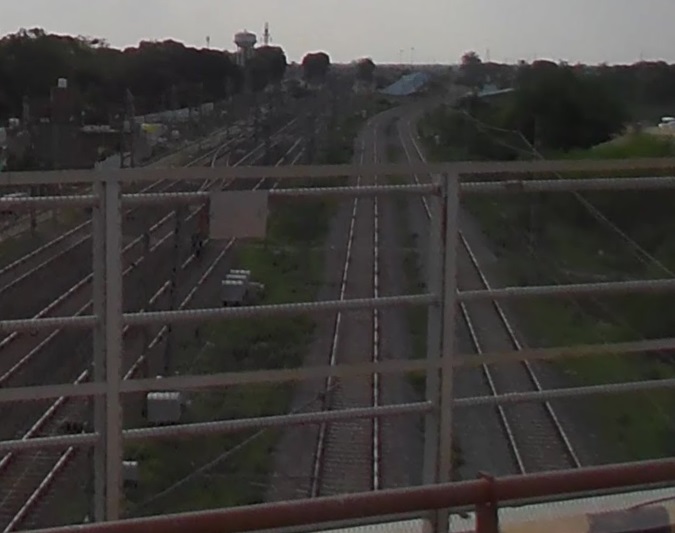
Bhabua Road Railway Station. [Google Earth, October 2024]
Bhabhua Road Railway Station. [Google Streetview, December 2023]

On from Bhabhua heading Northwest the line runs on through New Durgauti Junction (Durgauti), Dhanaichha, Karamnasa, Saidraja, Chandauli Majhwar and Ganj Khawaja Railway Stations, by which now the line is running East-West. Immediately beyond Ganj Khawaja the line turns to the North, then sweeps round to the Southwest through a series of junctions and then through Mughal Sarai Marshalling Yard and DDU Railway Station.
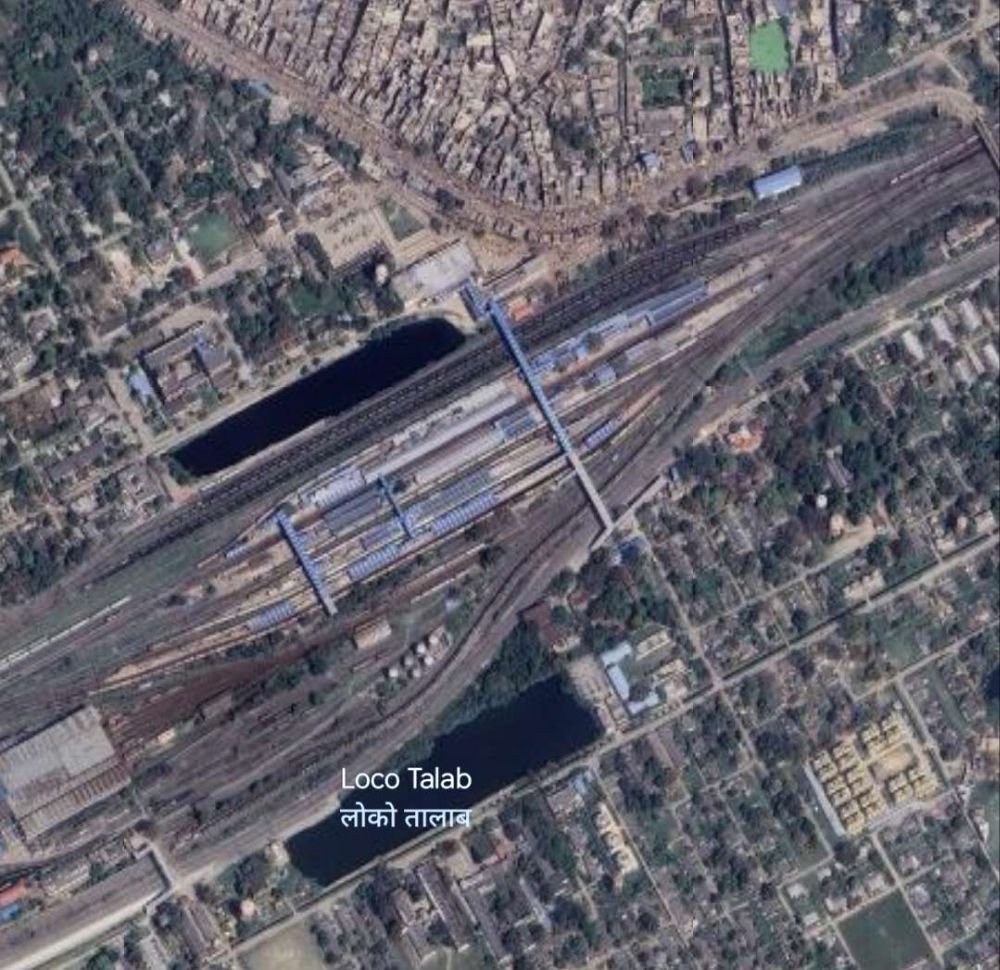
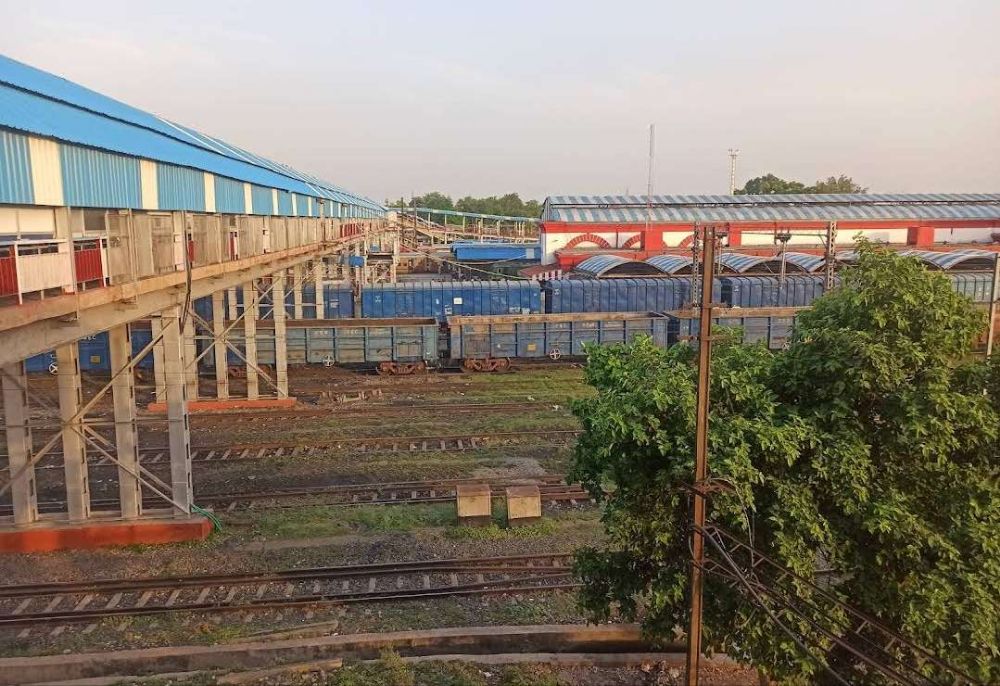
Dean Dayal Upadhyaya Railway Station sited just to the Southwest of the Mughal Sarai Marshalling Yard. [Google Earth, October 2024]

Running on in a Southwesterly direction not far from the Southern bank of the River Ganges, the line runs through Jeonathpur, Narayananpur and Narayananpur Bazar (Ahraura) Railway Stations. On further through Kailahat Station to Chunar Junction Railway Station.
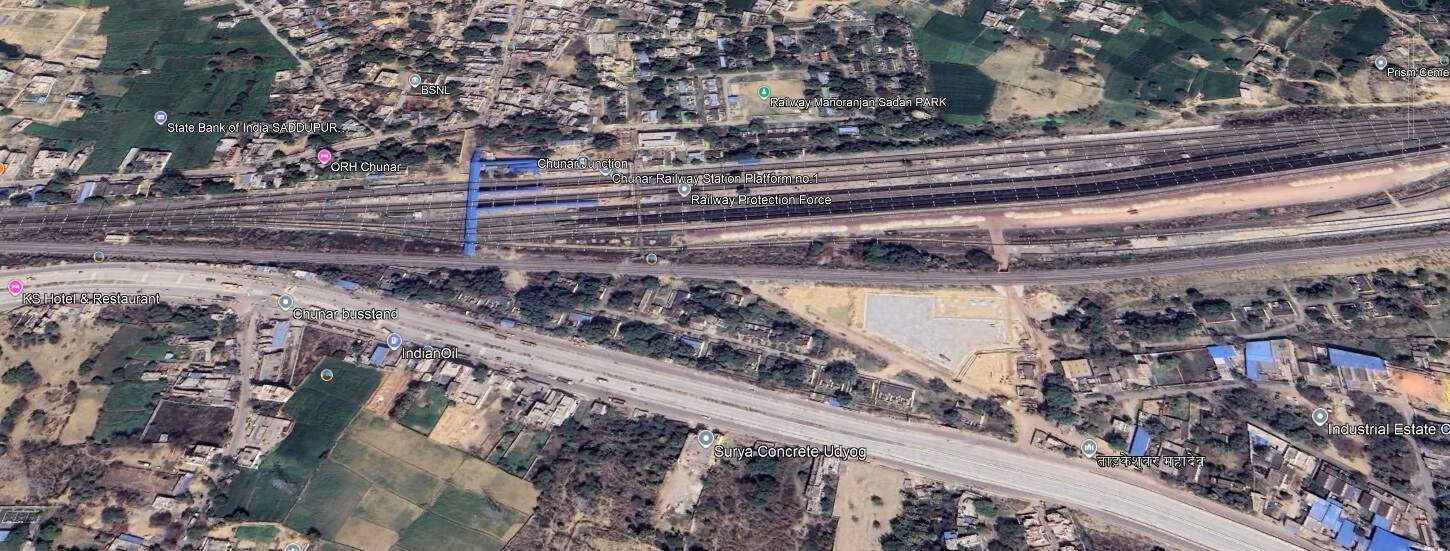
Chunar Junction Railway Station. [Google Earth, October 2024]
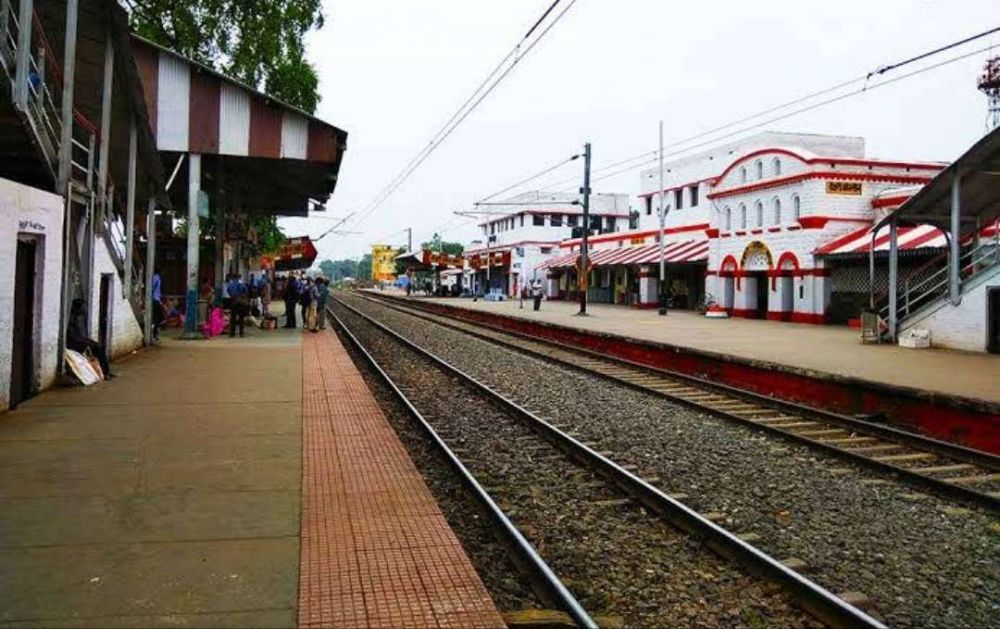
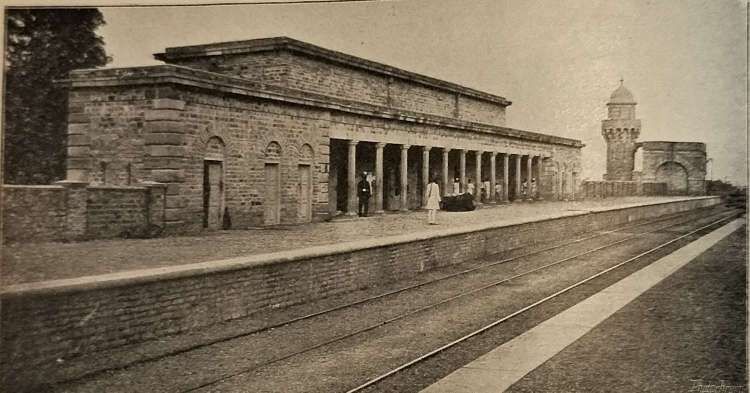
Huddleston says that this is Chunar Railway Station. Note the solid construction and the architectural detail of the water tower at the far end of the platform. I can only assume that as the line was widened these buildings were removed. [1: p486]

The railway continues West through Dagmagpur, Pahara and Jhingura Railway Stations to Mirzapur Railway Station.
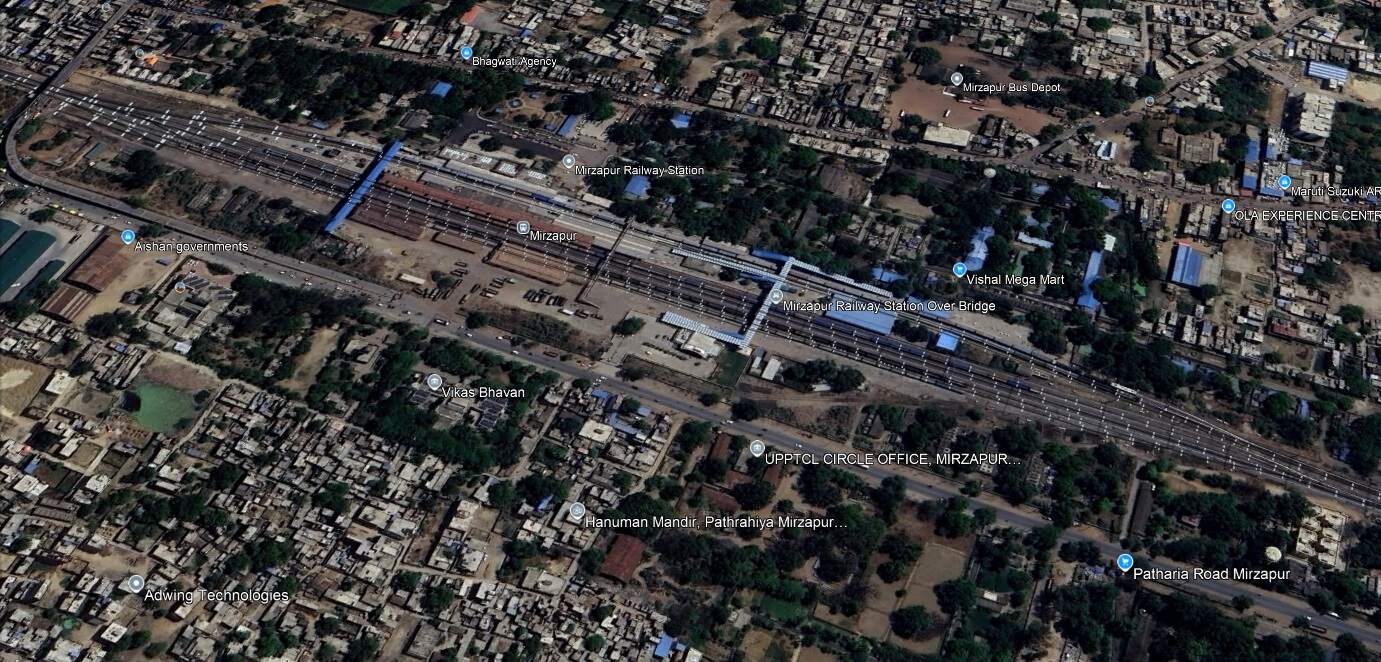
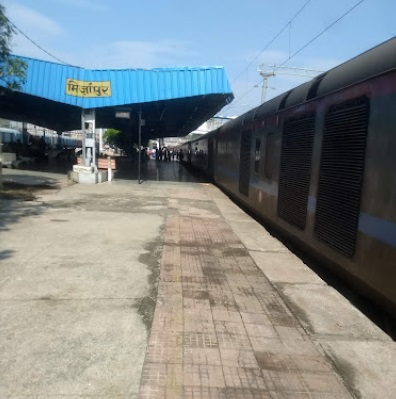
Mirzapur Railway Station. [Google Earth, October 2024]

Mirzapur … is known for its carpets and brassware industries, and the tradition of kajari and birha music. Straddled by the Maikal Hills, it served as the headquarters of the Mirzapur district [of Uttar Pradesh]. … Indian Standard Time is calculated from the clock tower in Mirzapur.” It had a population of 245,817 in 2011. [11]
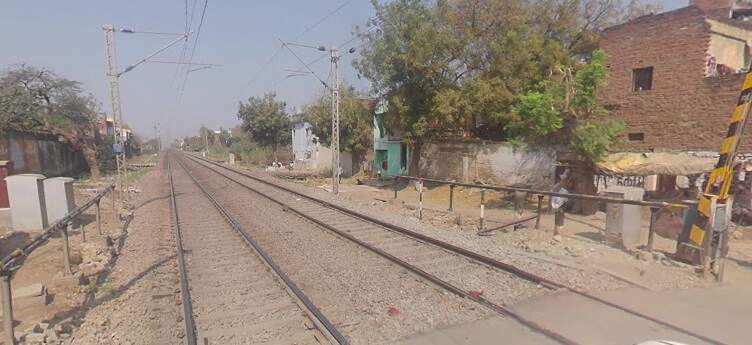
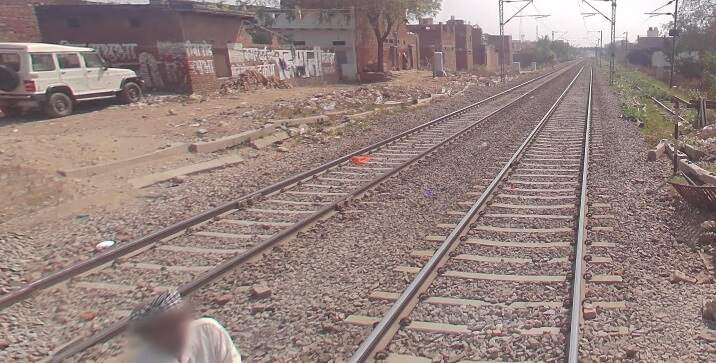
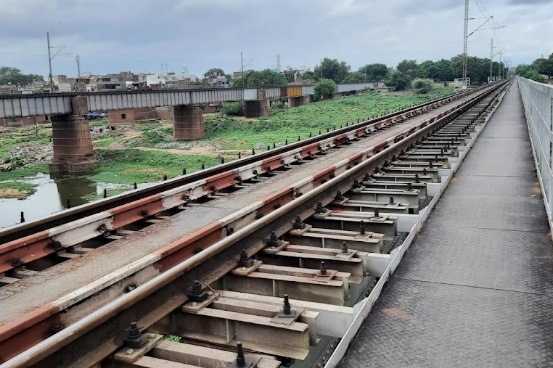
West of Mizapur the line ran on through Vindhyachal, Birohe, Gaipura, Jigna, Mandah Road, Unchdih and Chauraha Railway Stations before crossing the Tamas River Rail Bridges.
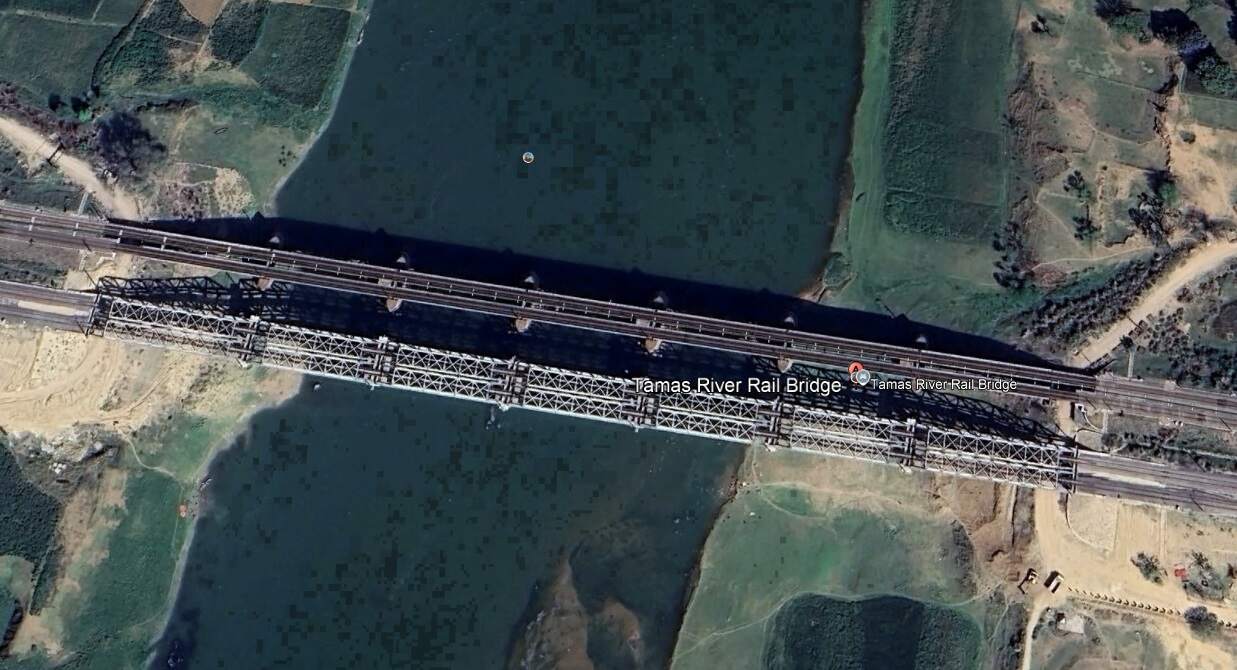
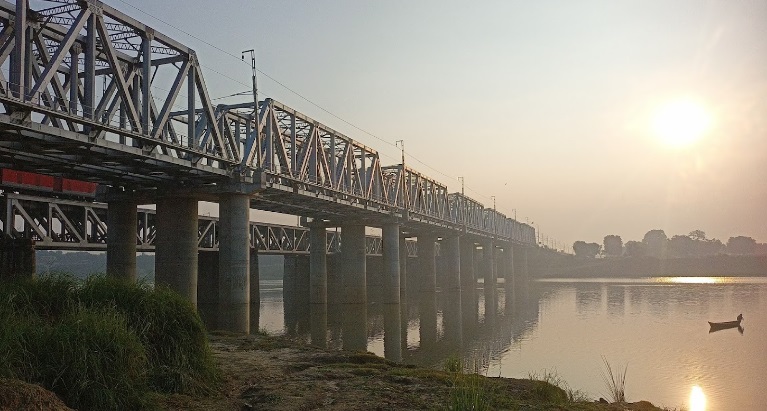
Tamas River Rail Bridges. [Google Earth, October 2024]
Tamas River Rail Bridges, (c) S Kumar Gemar. [October 2022]

Continuing Northwest, the railway passes through Bheerpur and Karchana Railway Stations before entering Prayagraj Chheoki Junction Railway Station.
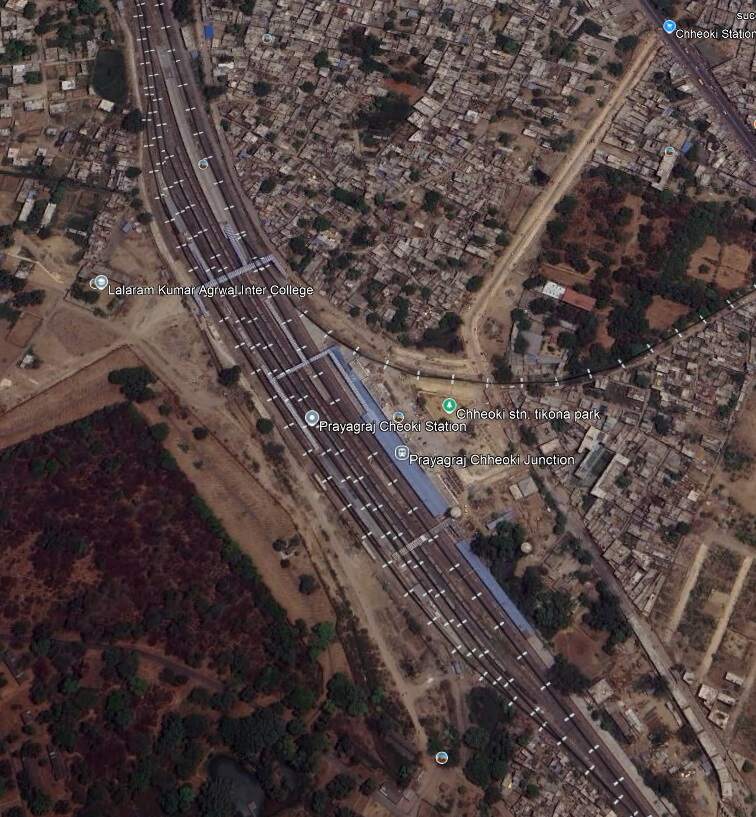
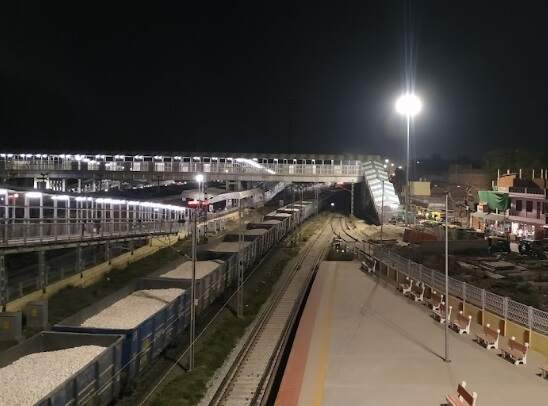
Prayagraj Chheoki Junction Railway Station. [Google Earth, October 2024]
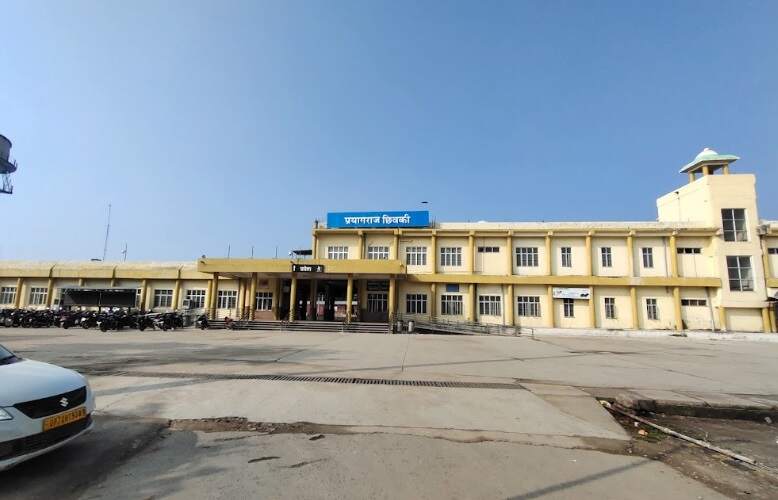
To the Northwest of Prayagraj Chheoki Junction Railway Station the line runs through Naini Junction Station and then crosses the Old Naini Bridge over the Yamuna River.
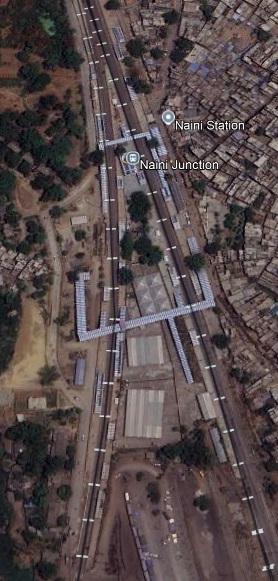
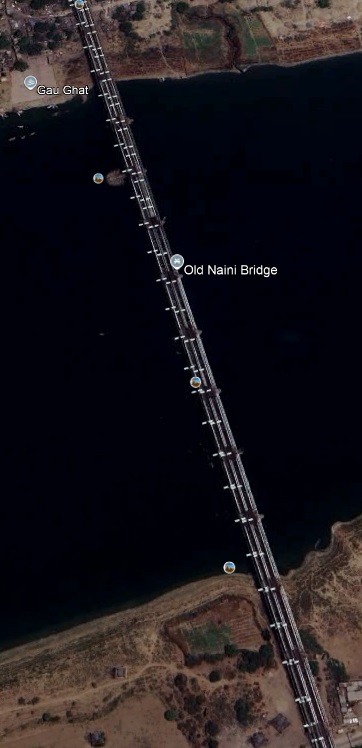
The original Old Naini Bridge! This picture shows it as it was in about 1870. [12]

The Old Naini Bridge is situated over the Yamuna River, “just above the confluence with the Ganges at Allahabad. … It opened in 1865 and is a great feat of British engineering; it is over 1,006 metres (3,300 feet) long.” [12] The present structure carries vehicles on a deck below the rail lines.

Prayagraj is also known as Allahabad. “The city is the judicial capital of Uttar Pradesh with the Allahabad High Court being the highest judicial body in the state. As of 2011, Prayagraj is the seventh most populous city in the state, thirteenth in Northern India and thirty-sixth in India, with an estimated population of 1.53 million in the city.” [13]

North of the Yamuna River in Prayagraj/Allahabad, the line turns West and enters the main city station,
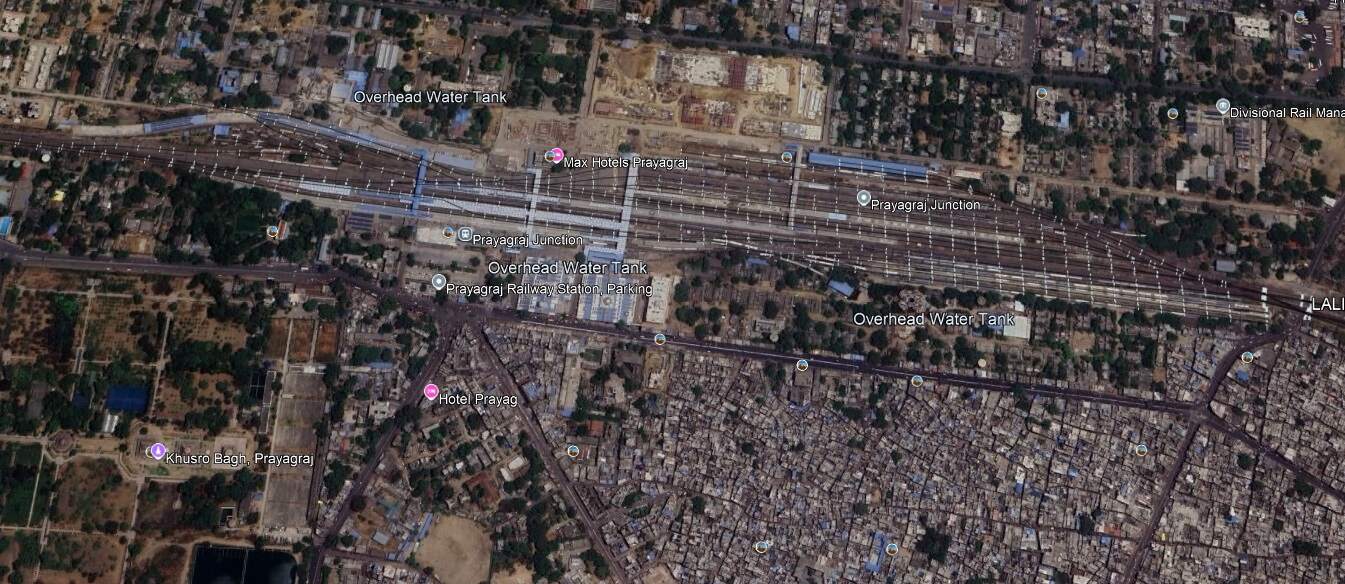
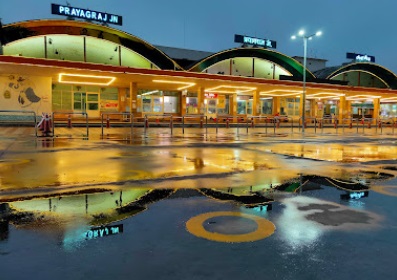
Prayagraj Junction Railway Station. [Google Earth, October 2024]

West of Prayagraj Railway Station the line passed through Subedarganj, Bamhrauli, Manauri, Saiyid Sarawan, Bharwari, Bidanpur, Shujaatpur, Sirathu, Athsarai, Kanwar, Katoghan, Khaga, Sath Naraini, Rasulabad, Faizullapur and Ramva Railway Stations before arriving at Fatehpur Railway Station.
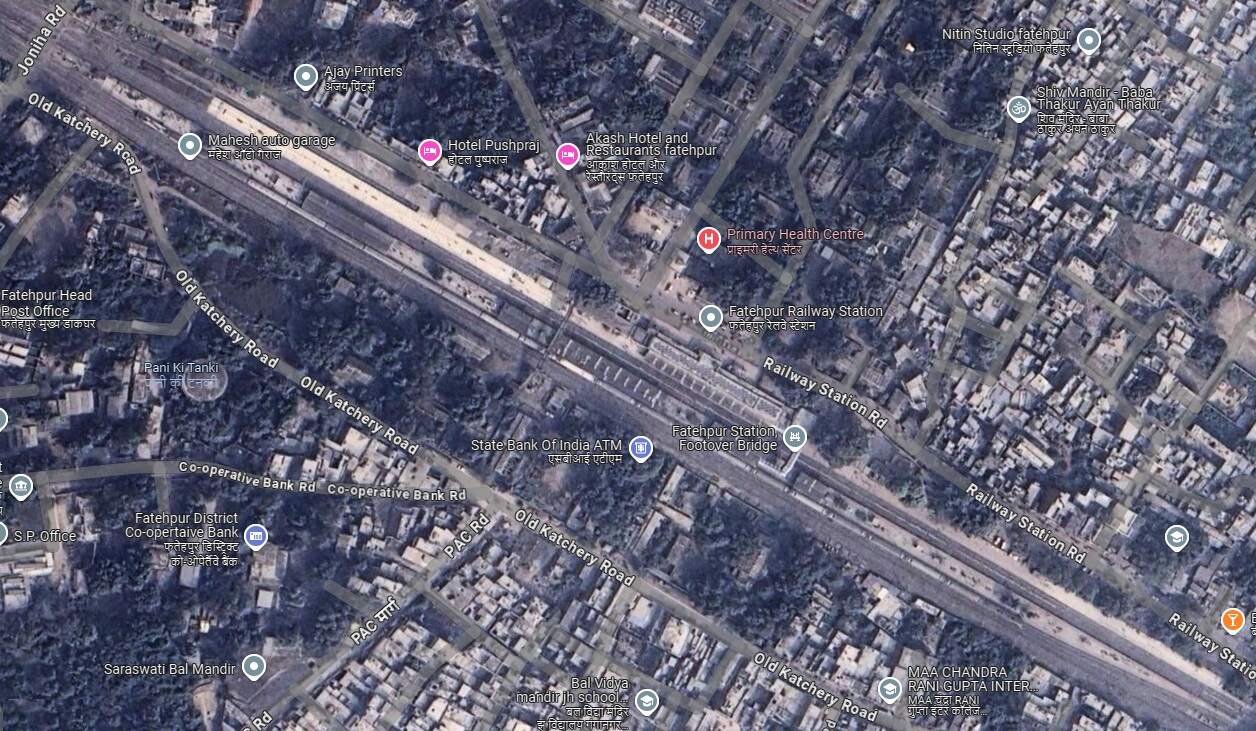
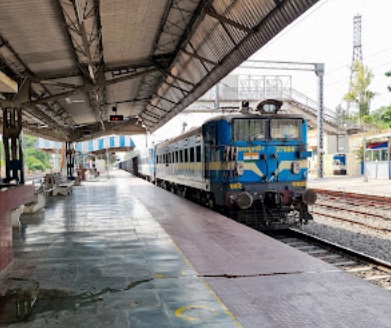
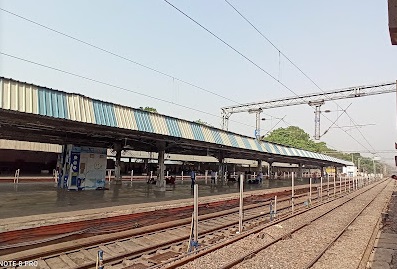
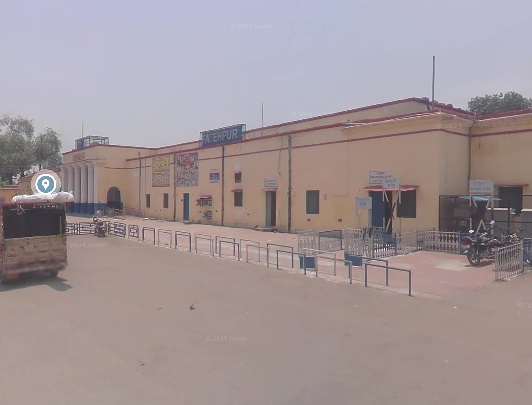
Fatehpur Railway Station. [Google Maps, October 2024]

Northwest of Fatehpur, the railway continued on through Kurasti Kalan, Malwan, Kanspur Gugauli, Binki Road, Aung, Karbigwan, Prempur, Sirsaul, Rooma, Chakeri, and Chanari Railway Stations before looping sharply round into Kanpur Central Railway Station.
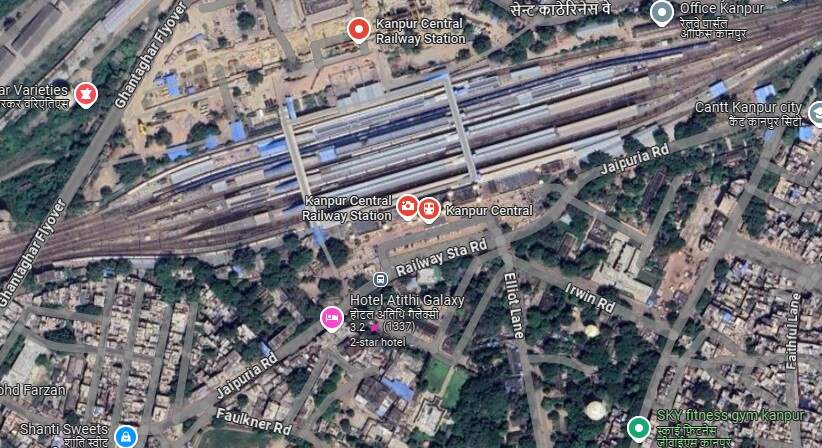
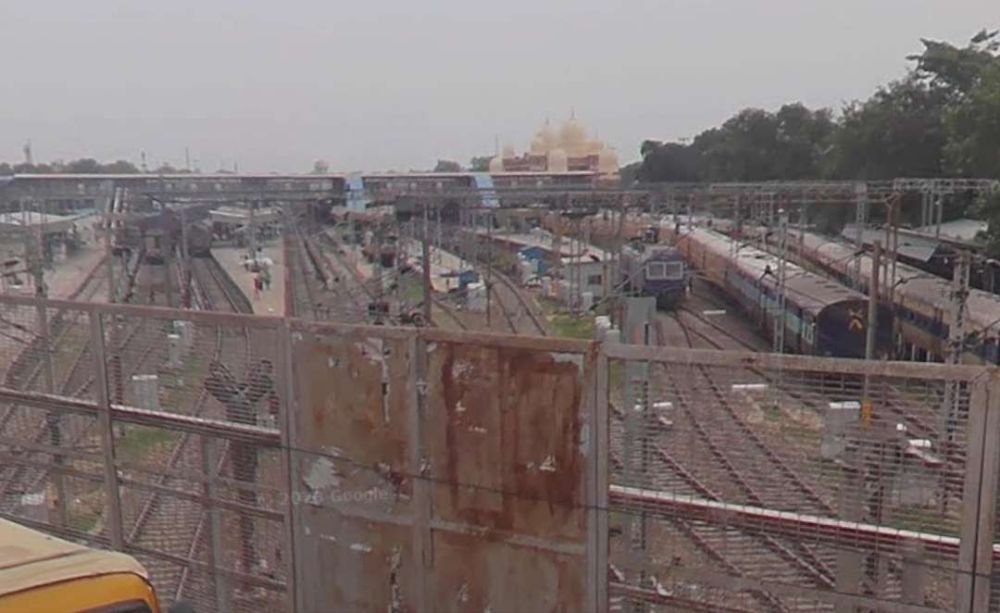
Kanpur Central Railway Station. [Google Maps, October 2024]

After leaving Kanpur Central Railway station, the line ran through the GMC Marshalling Yard and on through Panki Sham, Bhaupur (and New Bhaupur), Maitha, Roshan Mau, Patra, Rura, Ambiapur, Jhinjhak, Parjani, Kanchausi, Phaphund, Pata, Achalda, Bharthana, Ekdil (and New Ekdil) and into Etawah Junction Railway Station.
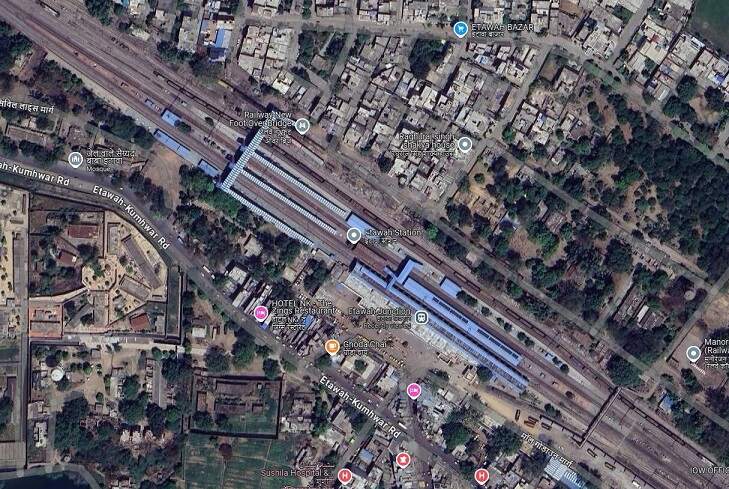
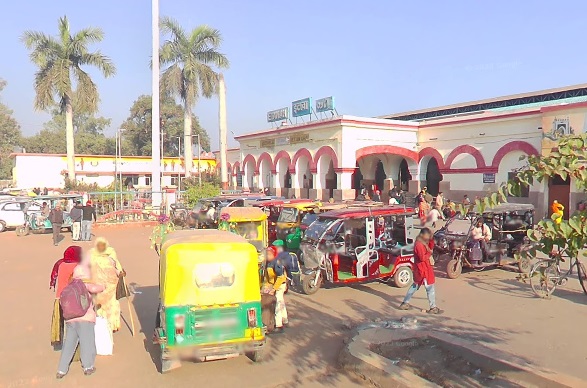
Etawah Junction Railway Station. [Google Maps, October 2024]

On to the Northwest from Etawah the line passes through Sarai Bhopat, Jaswantnagar, Balrai and Bhadan Railway Stations before entering Shikohabad Junction Railway Station.
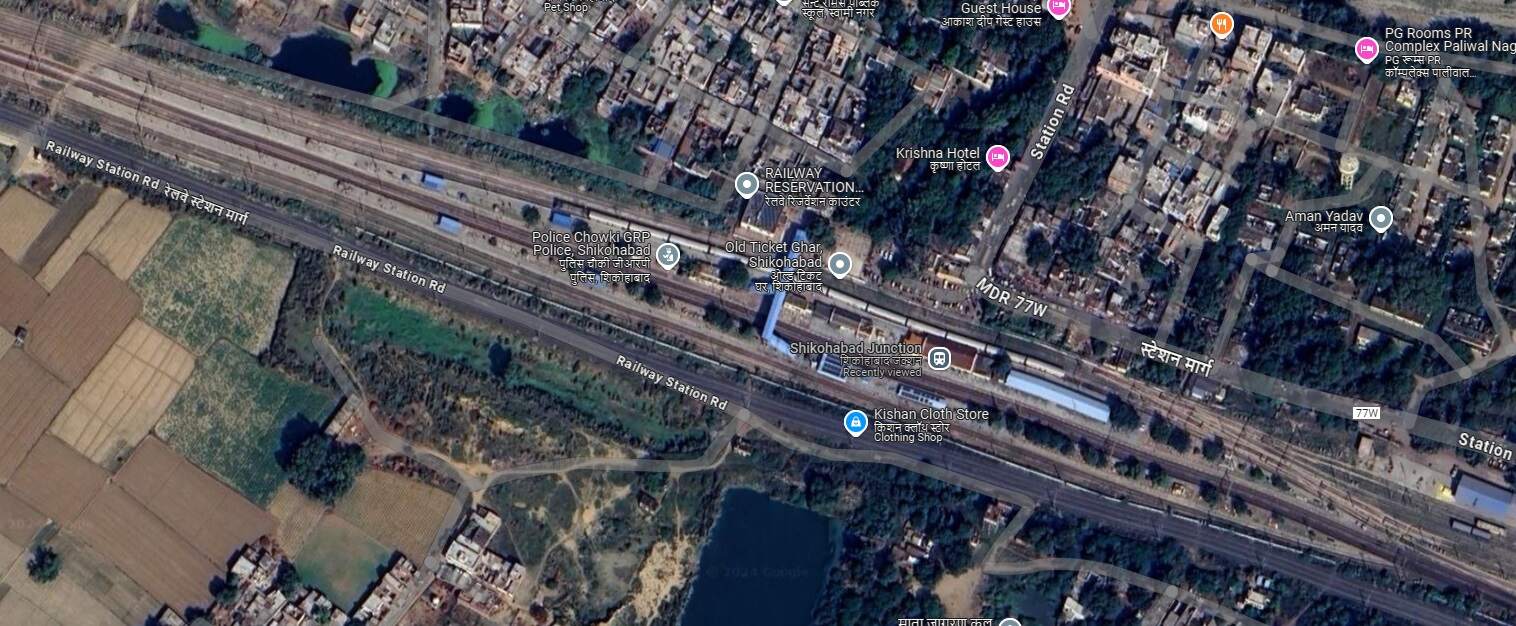
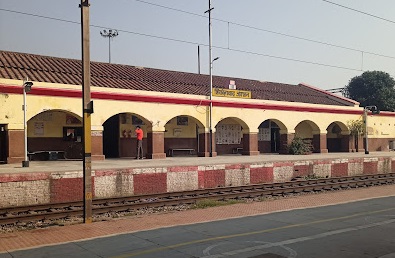
Shikohabad Junction Railway Station. [Google Maps, October 2024]
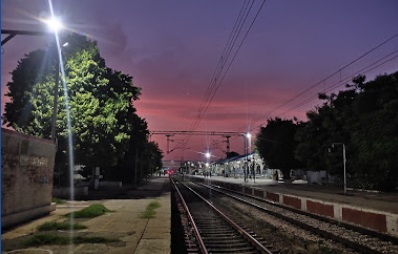
Beyond Shikohabad, we go on Northwest towards Delhi. The line passes through Makkhanpur Railway Station before arriving at Firozabad Railway Station.
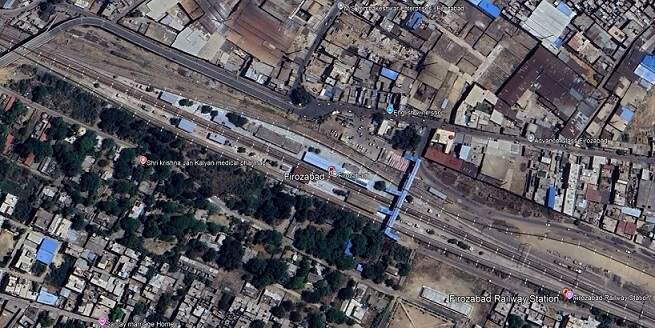
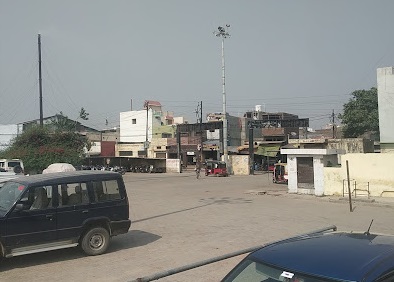
Firozabad Railway Station. [Google Earth, October 2024]

After Firozabad Railway Station, the railway continues Northwest through Hirangaon Railway Station and Tundla Goods Train Yard and into Tundla Junction Railway Station.
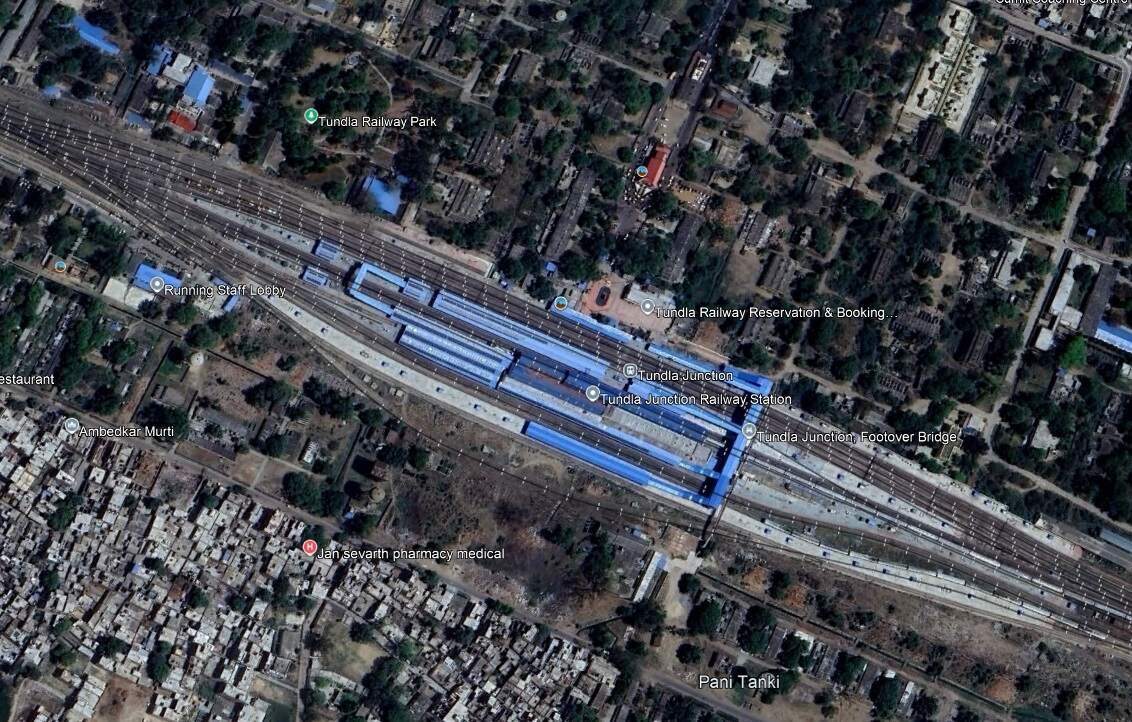
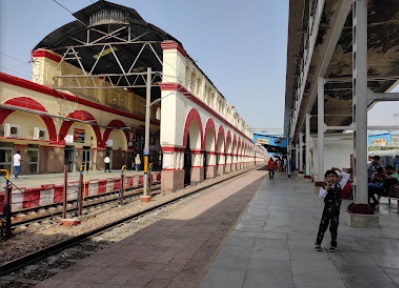
Tundla Junction Railway Station. [Google Earth, October 2024]

We continue on to the Northwest along the railway line running through Tundla Junction and on in a more northerly direction through Mitawali, Barhan Junction, Chamrola, Jalesar Road, Pora, Hathras Junction (and New Hathras DFCCIL) Railway Station. Just after crossing the station limits at Hathras Junction Station the line passed beneath a Warren Truss Steel Bridge carrying The Kasganj Mathura railway line. While the train is stopped at the station we explore the line carried by the rail overbridge.

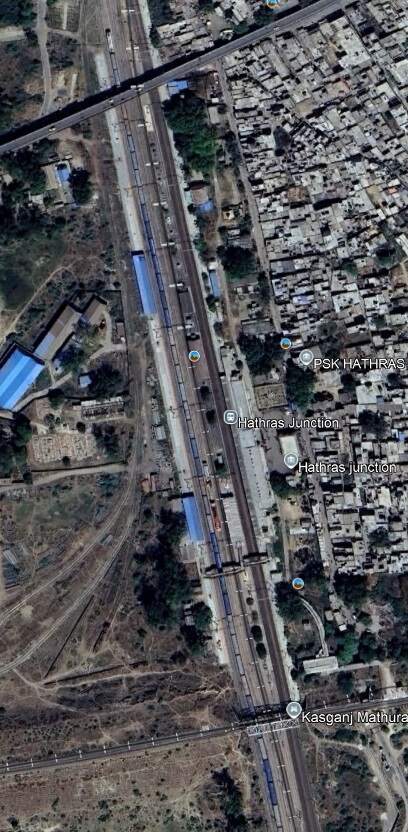
The Kasganj Mathura Railway Line Bridge over the Kolkata to Delhi railway line at Hathras Junction. [Google Streetview, November 2022]

The adjacent extract from Google Earth’s satellite imagery shows Hathras Junction Station. At the bottom of the image a rail overbridge carries the Kasganj Mathura Railway lIne. A scheduled passenger service runs along this line between between Kasganj (KSJ) and Mathura Junction (MTJ). [14]

Mathura Junction Railway Station (MTJ) is an important station on the Agra–Delhi chord of the Delhi–Mumbai and Delhi–Chennai lines. It is located in Mathura district in the Indian state of Uttar Pradesh. It is one of the important North-Central Railway stations. It serves Mathura and Vrindavan.

Mathura is the birthplace of Lord Krishna. He spent his childhood in Vrindavan, 11 km away from Mathura. Therefore, both are major pilgrimage centres for Hindus. [15]

The Kasganj Mathura Passenger train covers a total distance of 105 kilometres. [14] Kasganj Junction Railway Station is situated on the Delhi-Kanpur line, it boasts 5 platforms and connects to various destinations across the country. The station is known for its historical significance, being located near the renowned Kasganj Fort and the historic mosque of Shah Jahan. [16]

Hathras Junction Railway Station serves the small city of Hathras. Hathras is a place in mythology where Lord Mahadev and Goddess Parvati stopped on their way to Brij to visit Lord Krishna at the time of his birth. There are also some significant historical and sites/remains in its vicinity. These include: Hathras Fort, a Monument to Major Robert Naim, a Monument to Samuel Anderson Nichterlein, a mound known as Gohana Khera; and a number of Hindu temples. [17] Hathras Junction Railway Station is about 164 km from Delhi.
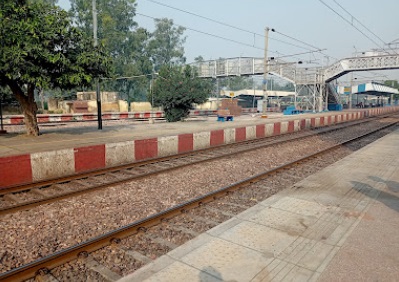
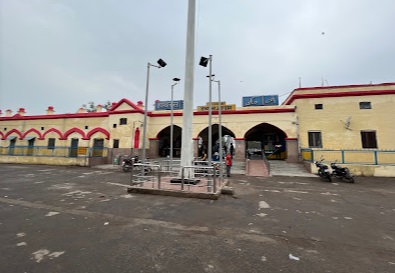
We leave Hathras Junction Station travelling North and pass through Mandrak and Daud Khan Railway Stations before reaching Aligarh Junction Railway Station.
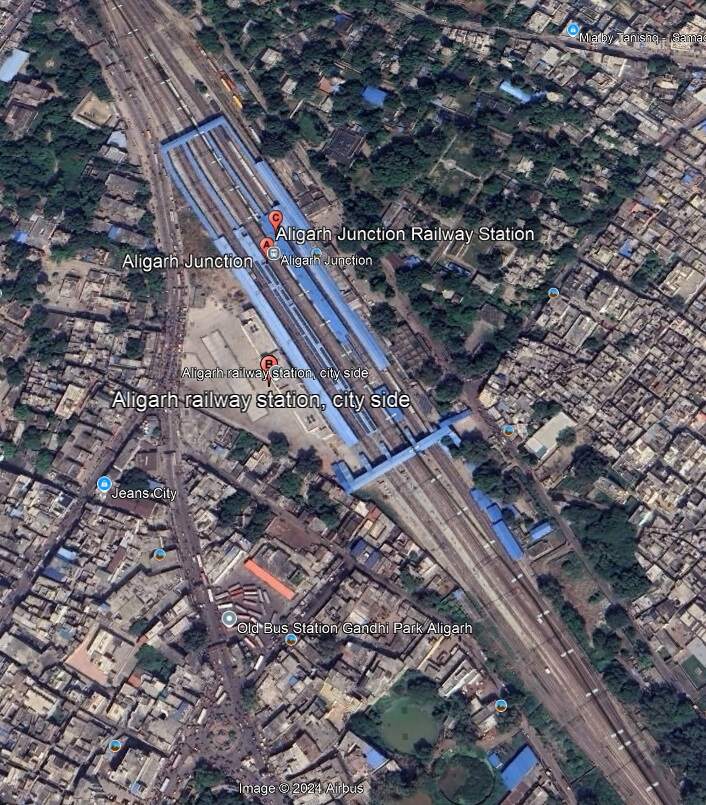
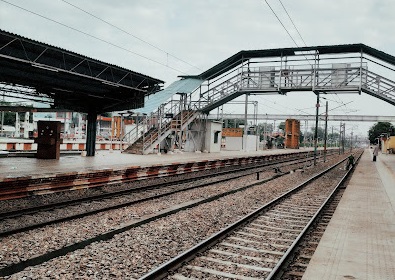
Aligarh Junction Station. [Google Earth, October 2024]

We are now perhaps about 150 kilonmetres from Delhi and travellin North-northwest. The line continues through Mehraval, Kulwa, Somna, Danwar and Kamalpur Railway Stations and into Khurja Junction Railway Station.
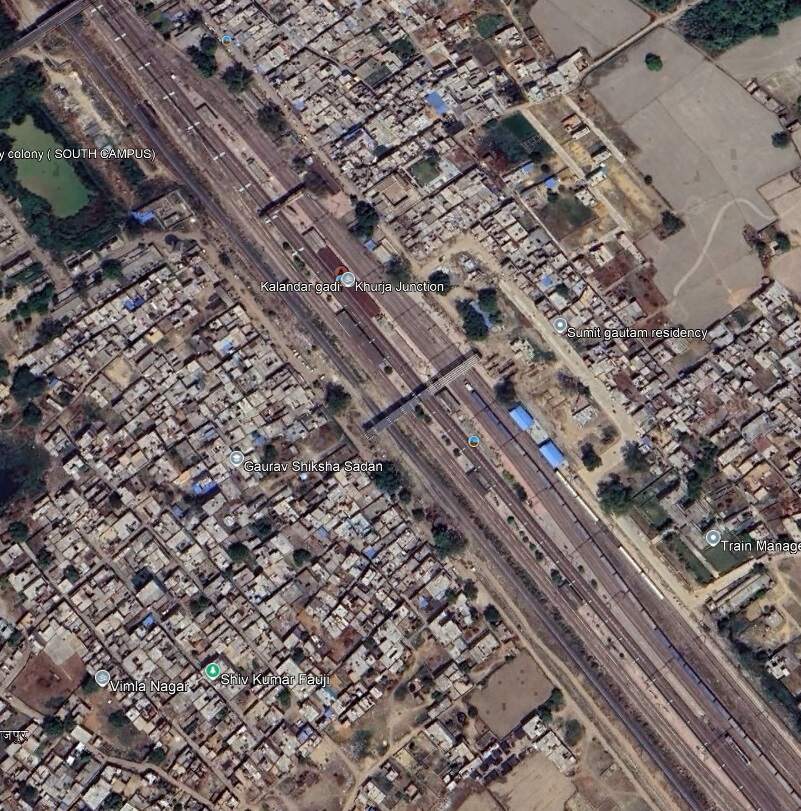
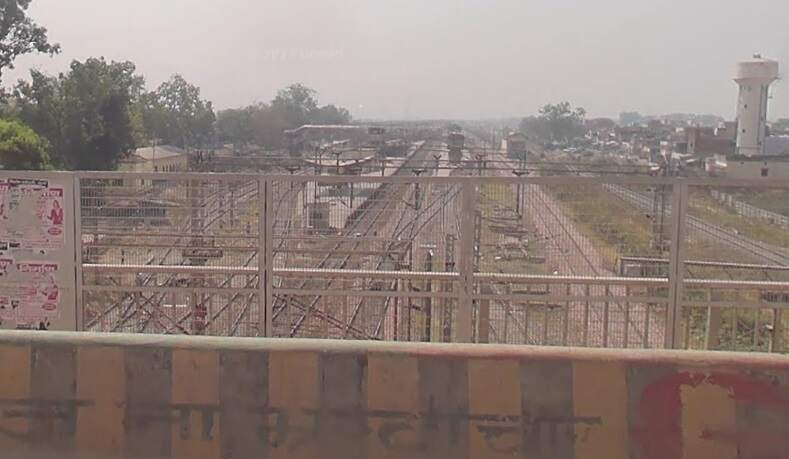
Khurja Junction Railway Station. [Google Earth, October 2024]
Khurja Junction Railway Station, seen from the road overbridge at the North end of the station site. [Google Streetview, April 2022]

we travel on through Sultanpur and Sikandarpur Stations, Gangraul Halt, Chola, Wair, Fatehpur Makrandpur, Dankaur, Ajaibpur, Boraki, Dadri, Maripat, Chipyana Buzurg Railway Stations and into Ghaziabad Junction Railway Station.
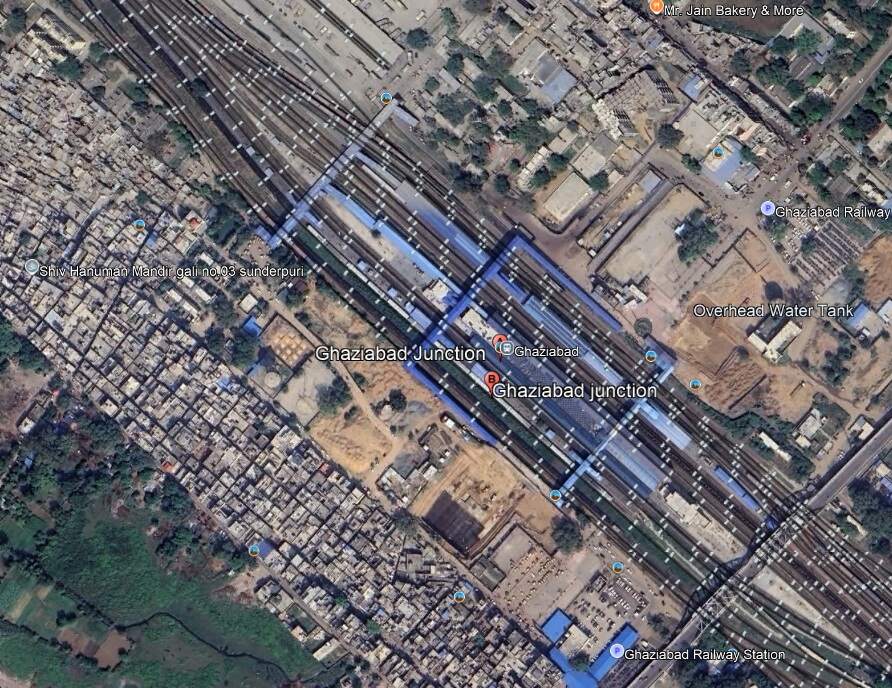
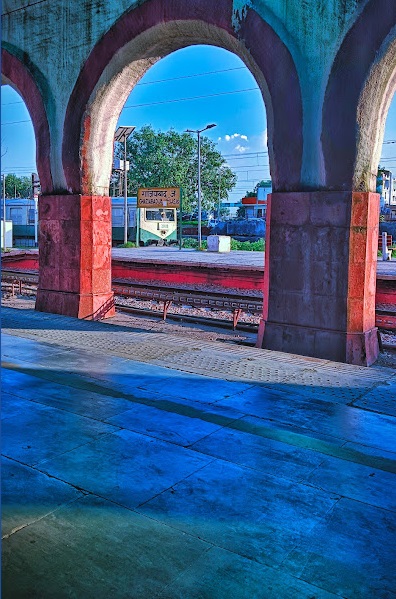
Ghaziabad Junction Railway Station. [Google Earth, October 2024]

Heading on Northwest towards Delhi trans pass through Sahibabad Junction Railway Station.
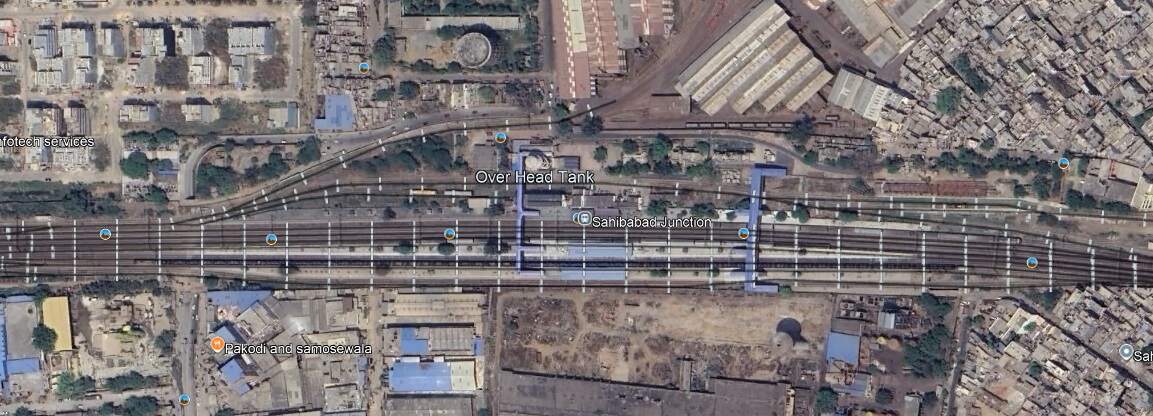
Sahibabad Junction Railway Station. [Google Earth, October 2024]

Now running East-West the line continues on through Vivek Vihar Railway Station – the area around the line is now heavily built up. Ahead lies the Old Iron Railway Bridge over the Yamuna River.
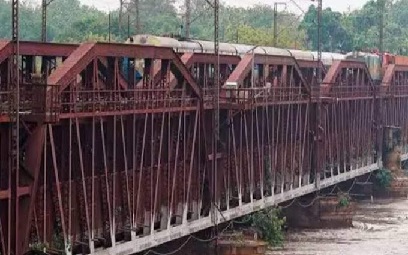
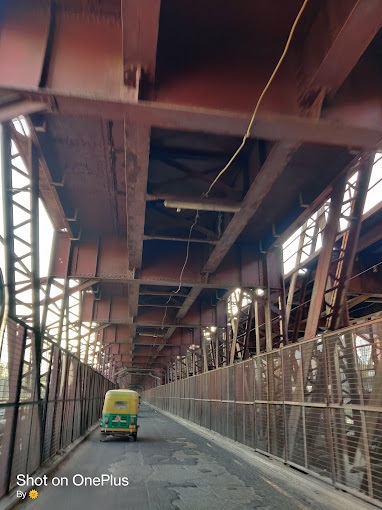
The old Indian Railways bridge, popularly referred to as ‘lohey ka pul’ (iron bridge) has witnessed many floods and is also a reference point for measuring danger level for Yamuna water levels.” [18] The bridge was first opened for traffic in 1866 and is numbered as Bridge No. 249. It “was constructed initially as a single line, at a cost of £16,355. … It had a total length of 2,640 ft and consisted of 12 spans of 202 ft each. The superstructure consisted of steel lattice girders. … In 1913, the bridge was converted into a double line and later in the 1930s some of the spans were re-girdered and the roadway below was widened. The bridge was taken over by the North Western Railway in 1925 and is currently under the Northern Railway.” [18]

To the West of the Yamuna River, the line entered Delhi Junction Station.
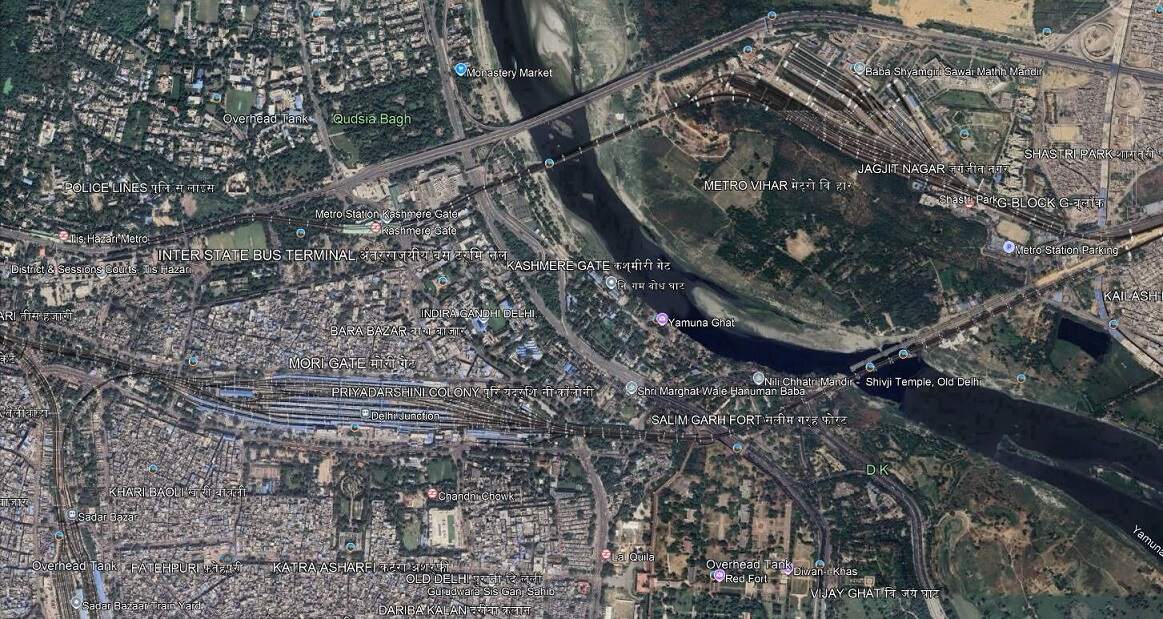
Dehli Junction Railway Station was West of the Yamuna River. This extract from Google Earth’s satellite imagery shows bridges over the Yamuna River and Delhi Junction Railway Station. The Old Iron Railway Bridge over the Yamuna River is in the bottom-right quadrant of the image, the Station is just left of centre in the bottom half of the image. [Google Earth, October 2024]

The line runs on to the West through Kishanganj, Delhi Sarai Rohilla, Dayabasti, and Shakur Basti Railway Stations, any of which will allow a traveller to access the city of Delhi.

Our journey along the old EIR lines is completed here in Delhi. There may well be more articles in this series looking at some of the other lines initially constructed by the East Indian Railway. What has been most noticeable on the modern journey is the number of tracks required by the line and the frequency of services.

References

  1. G. Huddleston; The East Indian Railway; in The Railway Magazine, London, December 1905, p481-488.
  2. http://www.colonialfilm.org.uk/node/4544#:~:text=Between%20November%201905%20and%20March,members%20of%20the%20Royal%20Family, accessed on 9th October 2024.
  3. https://www.google.com/url?sa=t&source=web&rct=j&opi=89978449&url=https://www.railwaymuseum.org.uk/sites/default/files/2024-08/Rail%2520fares%2520resource%2520pack.pdf&ved=2ahUKEwiJ8Zr0yIGJAxU32QIHHReBFiUQzsoNegQIAhAM&usg=AOvVaw3PS6VobUUgVWMQcx3s9jzo, accessed on 9th October 2024.
  4. https://en.m.wikipedia.org/wiki/Koilwar_Bridge, accessed on 9th October 2024.
  5. https://es.pinterest.com/pin/indian-railwaysa-utility-for-the-british-turned-out-to-be-a-boon-for-independent-india-in-2024–603130575127693830, accessed on 9th October 2024.
  6. https://x.com/EasternRailway/status/1693572897451958538, accessed on 10th October 2024.
  7. https://commons.wikimedia.org/wiki/File:065.STARTED_FROM_HOTEL_MANISH_ON_14.08.2017_AT_02-30_P.M._FOR_HOWRAH_RAILWAY_STATION_BY_HIRED_TAXI.jpg, accessed on 10th October 2024.
  8. https://en.wikipedia.org/wiki/Howrah_railway_station, accessed on 10th October 2024.
  9. https://www.facebook.com/photo/?fbid=1224418747723184&set=a.207457379419331, 10th October 2024.
  10. https://en.wikipedia.org/wiki/Gaya_(India), accessed on 11th October 2024.
  11. https://en.wikipedia.org/wiki/Mirzapur, accessed on 13th October 2024.
  12. https://en.wikipedia.org/wiki/File:Allahabad_railwaybridge1870.jpg, accessed on 13th October 2024.
  13. https://en.wikipedia.org/wiki/Prayagraj, accessed on 13th October 2024.
  14. https://www.railyatri.in/trains/route-55339-kasganj-mathura-passenger, accessed on 16th October 2024.
  15. https://en.wikipedia.org/wiki/Mathura_Junction_railway_station, accessed on 16th October 2024.
  16. https://indiarailinfo.com/departures/kasganj-junction-ksj/254, accessed on 16th October 2024.
  17. https://www.hathrasonline.in/guide/about-hathras, accessed on 16th October 2024.
  18. https://zeenews.india.com/railways/priceless-heritage-know-all-about-indian-railways-157-year-old-yamuna-bridge-in-delhi-2636419.html, accessed on 16th October 2024.
  19. https://jdhsmith.math.iastate.edu/term/slineir.htm, accessed on 16th October 2024.
Ruth: “Carry On Gleaning” – A Comedy with a Deeper Meaning?

This article was originally written as an essay as part of Old Testament Studies for my MA.

Scholars have suggested a number of motives behind the writing of Ruth. [1] Whatever the merits of the different proposals, it seems to me that Ruth was just as likely to have been written as a bawdy adult comedy/pantomime. It could perhaps be subtitled ‘Carry On Gleaning’. It might have been the ‘Up Pompeii’ of ancient Israel. However, within the clever plot [2] and camouflaged by sexual innuendo, there are robust and intriguing characters that the reader can identify with. [3]

It was ‘Harvest Festival’ (‘Pentecost’ or the ‘Feast of Weeks’) [4] everyone had been drinking – the whole village was ‘happy’. Dinner had been followed by all the usual speeches. Old jokes had been told (and retold), particularly those about sheaves, grain and seed – full of the usual sexual innuendo. [5] Village dignitaries had pompously promised gifts to the poor, some had made commitments that they would rue, come the morning.

It was now time for the reading of Ruth; or rather, for the second, ‘real’ reading. Ruth was read in the morning in the Synagogue a beautiful story of loyalty, conversion, hope [6] and of the ancestry of King David, or so it always seemed in the morning light. In the Synagogue the village elders had pontificated about the importance of caring for the stranger, [7] about the possibility of redemption for the worst of aliens (even Moabites); [8] and about duty and honour They talked of Boaz, fulfilling his responsibilities; [9] of Naomi the godly mother-in-law (struggling to accept the consequences of her husband’s folly); [10] of a beautiful, modest, dutiful, Moabite daughter-in-law. [11] Characters full of loyalty and faithfulness. [12] A sickly-sweet story – the ‘Mills and Boon’ of the five scrolls. [13]

I don’t think Ruth was written for the Synagogue. Those pious interpreters probably missed the point. [14] It was written for the evening, for the party! It was, first and foremost (and still is), a ripping good yam! A really well written ‘comedy’, [15] full of innuendo, with real 3-D but ambiguous characters. Characters that you could easily read yourself into. You couldn’t but be drawn into the plot – especially if you’d had a little too much to drink!

The evening reading of Ruth was the highlight of the Festival!

So, how did people engage with the main characters?

Naomi

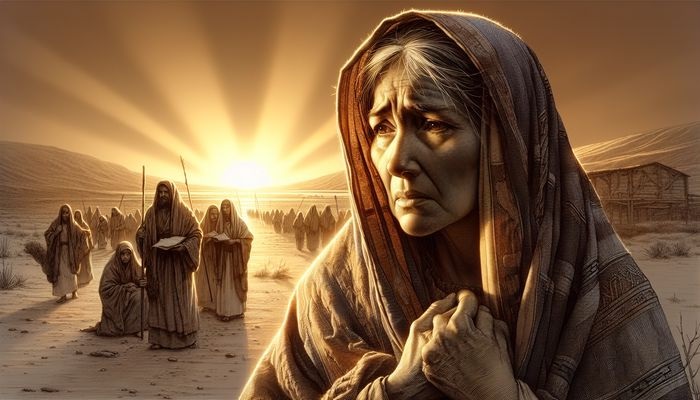
Naomi enters the story through pain, suffering and complaint, [16] but her experience and response are full of ambiguity. Was she sinned against or sinning, party to the decision to go to Moab, or just following her husband, being punished for her husband’s sin, or the innocent victim? [17] Does she enter the story engulfed in bitterness trapped in her own prejudices, and remain so? Or is she, perhaps a model for working through grief? The narrative does not answer these questions directly – this is part of its strength. [18] No one is excluded, ancient/modem readers are invited into the plot, invited to see themselves in Naomi. Her experience and expression of suffering parallel theirs – they can feel their own pain worked out in Naomi’s character.

Naomi decides to return to Bethlehem. [79]

It would be natural also to question Yahweh’s role? Given prevailing theology, early audiences would see ’cause and effect Elimelech flirted with ‘Moabite foreigners’ and reaped the reward. [19] It seemed that his sons did too ‘sins of the fathers’ and all that! [20] How many generations would reap the rewards of Elimelech’s sin? None! Unless that is, Naomi, or one of her daughters-in-law, remarried! If that happened, would the curse remain?

Given all the possibilities, what is going on in Naomi’s mind? Perhaps this:

Elimelech’s decision was wrong. I knew that right from the start. Moab, of all places! Whatever possessed him?”

“It’s an evil place’, I warned him. ‘Yahweh warned us against Moabites’, [21] I said. And I was right!”

“Losing Elimelech left me all alone in Moab! I couldn’t face the shame of returning to Bethlehem. I just had my two boys – I focused on them, but couldn’t really forgive Elimelech. I worked hard to secure wives for the boys and began to hope for grandchildren.”

“In ten years there were no children. How I wished that I’d chosen better wives. I’d decided to suggest that the boys should look for second wives, when both boys upped and died – Yahweh’s curse, [22] I’m sure.”

“Elimelech, what have you done? I am all alone, I have no one! I’m left with two barren Moabite women to care for! What is to become of me? I’d be better off dead.”

Naomi identifies herself with the dead rather than the living. [23] Her depression is self-reinforcing. She wants nothing more to do with these Moabite women they embody her distress. [24] The dialogue in Ruth 1.8-17 might suggest concern for her daughters-in-law [25] but actually depicts her as bitter and self-focused. Her subsequent silence on the journey speaks volumes. [26] Her ‘poem’ in Ruth 1:20-21 is melodramatic. [27] Her failure to mention Ruth reflects ambivalence toward Ruth: [28] “This Moabite woman is an embarrassment, she highlights my folly and disgrace, I do not want her here.” Yet Ruth is all Naomi has.

Naorm remains self-focused throughout the story, showing no concern for Ruth as she leaves for the fields to glean. [29] Apparently concerned for Ruth’s future happiness, she is, however, Gontent to risk Ruth’s honour at night at the threshing floor. [30] Her silence once she has her grandchild and the women extol Ruth’s virtue, is telling: “Calamity from the god of the patriarchy she has been quick to proclaim. Generosity from a wealthy man she is quick to praise. Grace from a foreign woman is perhaps beyond her comprehension. Little wonder that to the message, ‘your daughter-in-law who loves you is better than seven sons’, her response is silence“. [31]

Boaz

If Naomi is bitter and twisted, Boaz is ‘a pillar of the community’. [32] He greets everyone according to the proper religious formulae; [33] he speaks in a ponderous/pompous form of Hebrew; [34] his initial dealings with Ruth are very correct. [35] The listeners will recognise, in him, the leading men in their village – very proper, yet in the context of this yarn, possible to ridicule.

His pomposity is the appropriate foil for his growing infatuation with Ruth. [36] We cannot be sure what about Ruth attracts him – possibly beauty. [37] However, a slightly plump, country-girl Ruth might best fit a ‘Carry-On’ story. If this was a play we would see an exaggerated turning of the head as Boaz first notices Ruth, we might hear a quiet exclamation of delight before he draws himself together to ask his overseer, “Whose maiden is this?” [38] Boaz behaves properly toward Ruth, but the audience know that he’s hooked.

Boaz and Ruth’s conversations are laced with double meaning. He talks of ‘staying close’ [39] She talks of him ‘noticing’ [40] her, a foreigner. [41] He covers his confusion with a wordy statement but can’t quite avoid sexual overtones. [42] Her reply gives room for that little giggle, or raised eyebrow, that might accompany one meaning of ‘your maidservant’. [43] Boaz is hooked, his mild generosity of the morning gives way to profligacy [44] everyone listening ‘knows’ [45] where things are leading.

The tension, for the audience, is enhanced by the reputation of Moabite women. [46] Boaz is entering dangerous territory – what will happen to him?

We next meet Boaz at night on the threshing floor, in a slightly pickled state, asleep after celebrating the end of the harvest. Any Israelite would know that the fields were a dangerous place for an eligible man to sleep at night. Boaz’s alarm when woken was understandable – the Lilith, the demon maiden, could have been about, searching for a mate! [47]

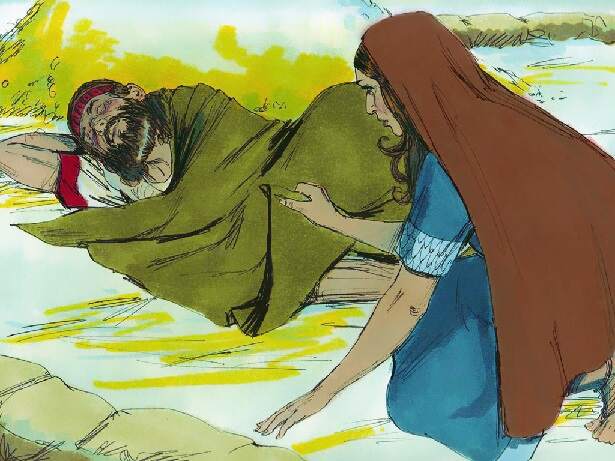
The audience is prepared for sexual encounter by the activities of Naomi and Ruth. They are clearly preparing for marriage. [48] Sexual innuendo continues with references to ‘feet’ [49] and ‘lying down’. [50] Boaz wakes, perhaps because of the cold on his legs, in his alarm he is undone/uncovered in more ways than one. Perhaps Ruth wakes him and he sees her uncovered before him. [51] Which is it? The audience is left to wonder.

Which of these two images gives the better impression of what was happening that night in the field? [77]
Boaz and Ruth. [78]

What does happen between Boaz and Ruth that night? We can’t be sure. We’re not sure that Boaz is really sure what happened. [52] – there was plenty of drink around that evening! We can, however, be sure that the ambiguity is intended by the author. [53] The audience cannot but see the similarities with other biblical stories. [54] They’re left to read almost anything into the situation.

Ruth seems to offer herself to him – Boaz recognises the sexual connotation in her reference to his cloak, but also that she is challenging him to fulfil his earlier blessing. [55] The audience is torn between titillation, at the possibility of sexual gratification, and jeering at pompous Boaz for being trapped by two women, [56] one a Moabite woman!

The latter part of the story has Boaz cunningly manoeuvring the anonymous relative [57] into a corner from which there is no retreat. He manages to buy [58] a Moabite woman without losing the respect of the community – he is the honourable redeemer. [59] In the story he’s definitely the winner. [60] The audience is left considering the motives of the village elders who sit at the gate of their village. What is happening as they make decisions? Is everything just as it appears, or are these ‘pompous’, ostensibly magnanimous/gracious, elders only really working for their own ends? Could that also be true of the elders teaching in the Synagogue?

Ruth

Ruth, a Moabite! The audience titters when she first enters the narrative. Moabites, and particularly their women are not good news. [61] The first possible signs of Ruth and Orpah’s loyalty [62] surprise them. Orpah’s decision to leave Naomi draws the audience’s boos: “We told you so, Moabites are no good! Go on Ruth, leave too!”

They hear her profession of loyalty [63] – its difficult to believe – they can’t credit good motives to Ruth: “She’s after something. Let’s wait and see!” Ruth’s loyalty to Naomi [64] continues to perplex the audience throughout the story. They are surprised at her willingness to glean in the field, but quickly they suspect that she will seduce the young Israelite men. Eventually they see her tangled with Boaz in a complicated romance, perhaps this is where she will show her true Moabite colours. The sly comparison with the Lilith tickles their fancy, [65] and they certainly have some fun at Boaz and Ruth’s expense.

But which side should they take? They have to decide. Prejudice says Ruth is evil, to be avonded Yet Rath shows faithfulness and loyalty, to Naomi and Boaz. [66] Yes, the author has allowed some titillation, but did anything wrong actually happen at the threshing Door Re can they believe that a Moabite woman is good? Yet if they don’t what does that say at the ancestry of their great King, David?

What does Ruth herself feel? Her husband is dead. Hier mother-in-lapse doesn’t want to know her. Chances of another husband in Moab are low. Who would want to marry second-hand goods? Israelite second-hand goods at that? [67]

Are Ruth’s motives as pure as they first seem? She has little choice. She cannot bring herself to follow Orpah who walks out of the narrative, probably into poverty and spinsterhood. [68] Ruth knows she’s committed to Naomi, no matter how bitter the wild woman is. Loyalty is her only option and she goes for it.

The journey to Bethlehem is hard – Naomi ignores her. [69] The entry into Bethlehem, harder still – for everyone ignores her. [70] She is determined not to be defeated. It is harvest-time and she heads for the fields – she’s heard Naomi mumbling about Boaz. [71] and determines that she will find his area of the field, she’s surprised to find it at the first attempt. This will be her way of helping both herself and Naomi. Her encounter with Boaz goes well – she can see that he’s interested in her. He’s clearly a respected man a bit ponderous/pompous but widowed Moabite women in Israel cannot be too choosy, can they?

Her triumph is hard to hide when see returns home – she tells Naomi of her work in the field, holding the name of Boaz for the last final flourish of her statement [72] (incidentally, holding the audience’s interest – they know something Naomi doesn’t know). She plays a small word game with Naomi, about men/maid-servants [73] which gently reminds Naomi of her earlier lack of care for Ruth.

Seven weeks she works in Boaz’s fields – she becomes quite fond of the old blighter. She isn’t surprised when Naomi suggests that marriage should be pursued, she listens to the plan and works out her own variation of it. [74] The risk is great, Boaz may just use her. In the event she has him trapped, just as on the following day he would trap the anonymous relative.

Conclusion

This is a very clever story, one that draws the audience in through an excellent plot and bawdy humour. The characters and the message contained within the story are such that the original audience could not have been left unmoved or challenged. It really does rate as “a ‘good yam’, superbly written”. [75] We can see God’s providence at work – and that seems to be the point. The story asks whether we can really see God at work in the lives of ordinary people. [76] The answer it provides is ‘Yes!’.

Notes

  1. 1:p25ff; 2:p259; 7:p201.
  2. A well devised plot – intrigue draws us into each scene. A classic pattern of exposition/conflict/resolution (12:102ff). This “story has power to draw us in almost against our will” (11:p63f). Part of its allure is its honest embrace of pain (6:p25ff) see also note 15 below.
  3. The interaction of the narrator and characters (12:p68-71) and the quality/depth of the characters (19:p37-40; 20:p71ff) is what makes this story.
  4. 17:p78; 21:p12f
  5. 8:p126 (note 29).
  6. 5:p146-165; 7:p197; 20:p71ff
  7. cf. Exodus 23:9; Numbers p9:14.
  8. Ruth 1:16f: cf. 15:p37,42 – re: conversion.
  9. 17:p102.
  10. 15:p36f.
  11. 5:p148-161.
  12. Hesed, (חֶסֶד) Ruth 1:8 occurs frequently in the book, and carries the idea of covenant loyalty, cf. 5:p148; 7:p206; 21 p23.
  13. 21:p12 cf. 17:(whole book)
  14. Although they would receive Rabbinic support (cf. 5:p148-165, 15:p37-47)
  15. ‘Comedy’ is also the literary term for ‘the story of the happy ending’ (19:p82; cf. 20:p72) – Ruth fits this traditional pattern.
  16. 17.p98
  17. 7 p208; 8:p72; 10:p197; 15 p36f.
  18. Our response to narrative gaps affects our understanding of the story cf. 4 p12: 22:p20-25.
  19. 15:p36f
  20. cf. e.g., Exodus 20:5; 34:7.
  21. cf. Deuteronomy .23:3.
  22. Ruth 1:13: cf. 21:p27; Exodus 20:5; 34:7.
  23. 8:p70f cf. 1:p46.
  24. 15:p 34.
  25. 15:p35f
  26. Ruth 1:18, 8:p74.
  27. 15:p34f
  28. Ruth 1:19-22, 8:p74f.
  29. Ruth 2:2, 8:p76f
  30. Ruth 3:2-4, 15:p36.
  31. 8:p82; Ruth 4:14-16.
  32. ba’an (בעז) was one of the columns in the temple the name could mean ‘quickness/strength’ (1:p55), ‘powerful/potent’ (3:p51); he is introduced as a man of substance/worth/wealth (1:p56; 8:p83).
  33. Ruth 2:4, 10:p205
  34. Ruth 2:8-9,11-12; 15:p43.
  35. Ruth 2:8-9, 15:p43.
  36. 8:p85: 15:p44
  37. 5:p161-163
  38. Ruth 2:5 (RSV) – he is already thinking, ‘Who does she belong to?”
  39. Ruth 2:8, of. Ruth 1:14 – root (דָבֵק) – cleave – cf. Genesis 2:24; 34:3.
  40. Ruth 2:10 cf. 21:p51
  41. Ruth 2:10: Ruth is a נָכְרִיָה – a ‘temporary foreigner’ – emphasising her alienness (14:p147), or ‘one not recognised as part of the family (21:p51).
  42. Ruth 2:12: of. Ezekiel 16:8 – which is using sexual imagery.
  43. Ruth 2:13 – שִׁפְחַת – may be ‘concubine’, but Ruth 3:9 – אַמַתִי  – does mean ‘concubine’ (21:p53).
  44. Ruth 2:14-17, 21:p54
  45. Ruth 3:4 – ידע – there is double meaning when this word is used (7:p218).
  46. Numbers 25:1-5; cf. Genesis 19:31-38.
  47. 21:p76-80
  48. Ruth 3:3; cf. Ezek. 16:8-13.
  49. Ruth 3:4,7,14; בול  – feet/legs/genitals (7:p217; 9:p156,193, 18:p37f, 21:p70)
  50. Ruth 3:4,7,8,13,14 root שָׁכַב – ‘to lie with/down’ (7:p218; 18:p39).
  51. Ruth 3:4 – נליח – the Hebrew works both ways.
  52. 8:p87.
  53. 2:p272; 7:p217; 15:p46f
  54. Ruth 4:11f; Jacob/Leah/Rachel – Genesis 29; Judah/Tamar – Genesis 38 (3:p62ff, 8:p72f, 9:p104f).
  55. Ruth 3:9 cf. Ruth 2:12.
  56. 7:p212; 10:p207
  57. The Hebrew (בְּלֹנִי אַלְמני) – 7:p222f, 8:p91; 15:p45 and specifically p127-129
  58. Ruth 4:10: cf. 13:p140, note 140 – they would not question the ‘purchase’, just her Moabite status!
  59. 2:p275f, 15:p45f; 21:p107ff, 115ff, 136ff.
  60. 8:p91f
  61. Genesis 19:31-38, Numbers 25:1-5; Deuteronomy 23:3f, Judges 3:12-30, 1:p33; 8:p69f, 15:p38.
  62. Ruth 1:6,10.
  63. Ruth 1:16f
  64. 16:p97
  65. Ruth 3:8-9 cf. 21:p76-80.
  66. Hesed, (חֶסֶד)
  67. 8:p97f.
  68. 8:p97f.
  69. Ruth 1:18; 8:p74.
  70. Ruth 1:19-21.
  71. Ruth 2:1.
  72. Ruth 2:19.
  73. Ruth 2:21f; 8:p98f; 21:p58.
  74. Ruth 3:9 cf. Ruth 3:4; 8:p99ff; 17:p101f.
  75. 4:p9: quoting Goitein; Iyyunim ba-miqra; Yavneh, Tel Aviv, 1957; p49.
  76. 2:p280; 7:p197.
  77. https://emilysmucker.com/2020/04/27/five-actual-romantic-lessons-from-the-life-of-ruth, accessed on 14th October 2024.
  78. https://www.radstockwestfieldmethodists.co.uk/book-of-ruth-chapter-3-.php, accessed on 14th October 2024.
  79. https://www.bookbaker.com/ko/v/Genesis-A-Visual-Exploration-Ruth-and-Naomi/8a99ff0b-37ca-4dc0-8e51-09a03b1a14e3/13, accessed on 14th October 2024.

References

  1. David Atkinson; The Message of Ruth;, IVP, Leicester, 1983,
  2. A. Graeme Auld; Joshua, Judges and Ruth; St. Andrew Press, Edinburgh, 1984
  3. Mieke Bal; Heroism and Proper Names, or the Fruits of Analogy; in Atalaya Brenner ed.; A Feminist Companion to Ruth; Sheffield Academic Press and Ruth St. Andrew Press, Sheffield, 1993.
  4. Athalaya Brenner; Introduction; in Atalaya Brenner ed.; A Feminist Companion to Ruth; Sheffield Academic Press and Ruth St. Andrew Press, Sheffield, 1993.
  5. Leila Leah Bronner; A Thematic Approach to Ruth in Rabbinic Literature; in Athalaya Brenner ed.; A Feminist Companion to Ruth; Sheffield Academic Press, Sheffield, 1993.
  6. Walter Bruggemann; Old Testament Theology: in Patrick D. Miller ed., Fortress Press, Philadelphia. 1992.
  7. John Craghan, C.SS.R.; Esther, Judith, Tobit, Jonah, Ruth; Michael Glazier, Wilmington, Delaware, 1982.
  8. Danna Nolan Fewell & David M. Gunn; Compromising Redemption; Westminster/John Knox Press, Louisville, Kentucky, 1990.
  9. Danna Nolan Fewell & David M. Gunn; Gender, Power, and Promise; Abingdon Press, Nashville, Tennessee, 1993.
  10. John Goldingay; After Eating the Apricot; Paternoster, Carlisle, 1996.
  11. John Goldingay: Models for Scripture; Paternoster, Carlisle, 1987.
  12. David M. Gunn & Danna Nolan Fewell; Narrative in the Hebrew Bible; Oxford University Press, Oxford, 1993.
  13. Paula S. Hiebert; Whence Shall Help Come to Me: The Biblical Widow; in Peggy L. Day (ed.); Gender and Difference in Ancient Israel; Fortress Press, Minneapolis, 1989.
  14. Jonathan Magonet; A Rabbi’s Bible; SCM, London, 1991.
  15. Jonathan Magonet; Bible Lives; SCM, London, 1992.
  16. John H. Otwell; And Sarah Laughed; Westminster Press, Philadelphia, 1977.
  17. Eugene H. Peterson; Five Smooth Stones for Pastoral Work; Eerdmans, Grand Rapids, Michigan, 1992
  18. Ilona Rashkow, Ruth: The Discourse of Power and the Power of Discourse; in Athalaya Brenner ed.; A Feminist Companion to Ruth; Sheffield Academic Press, Sheffield, 1993.
  19. Leland Ryken, How to Read the Bible As Literature; Zondervan, Grand Rapids, Michigan, 1984.
  20. Leland Ryken; The Literature of the Bible; Zondervan, Grand Rapids, Michigan, 1974.
  21. Jack M. Sasson; Ruth; 2nd Ed., reprinted, Sheffield Academic Press, Sheffield, 1995.
  22. Elizabeth Cady Stanton, The Book of Ruth; in Athalaya Brenner ed.; A Feminist Companion to Ruth; Sheffield Academic Press, Sheffield, 1993.

GWR Steam Motor Road Vehicles

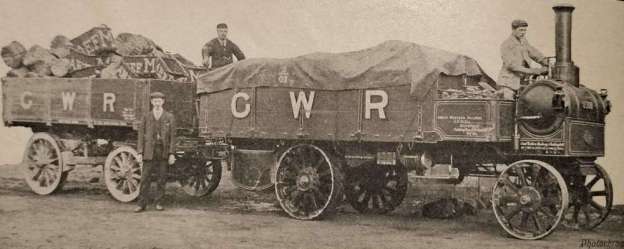
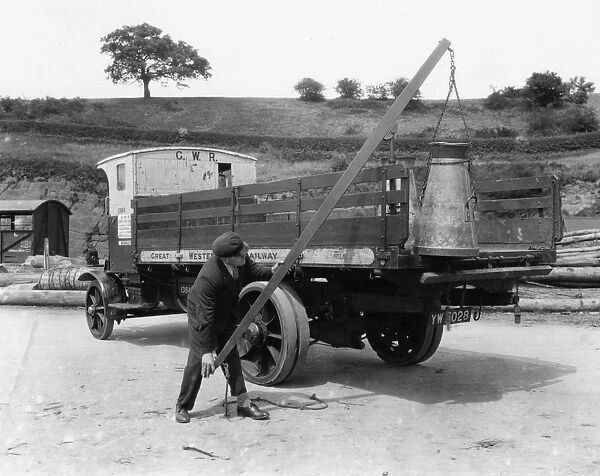
The Railway Magazine of December 1905 included a photograph of a road vehicle powered by steam. The picture in The Railway Magazine is the featured image for this short article.

The Railway Magazine entitled this image, “Great Western Railway Enterprise.” It shows a steam motor wagon and trailer which was used for collecting and delivering goods at Henwick. [1: p480]

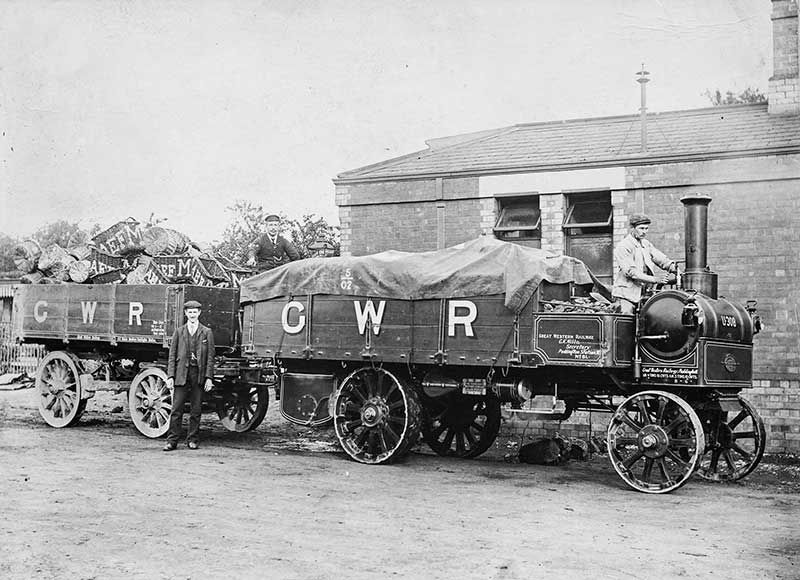
It seems as though the editor of The Railway Magazine removed the background from a photograph to prepare it for the magazine. The original photograph is shown immediately below.

An archive image from the GW Trust archive of road motors at Didcot. It is clear that this is the original image from which The Railway Magazine took their illustration. [2]

An article about GWR Steam Road Motors was included in Going Loco, May 2022. [2]

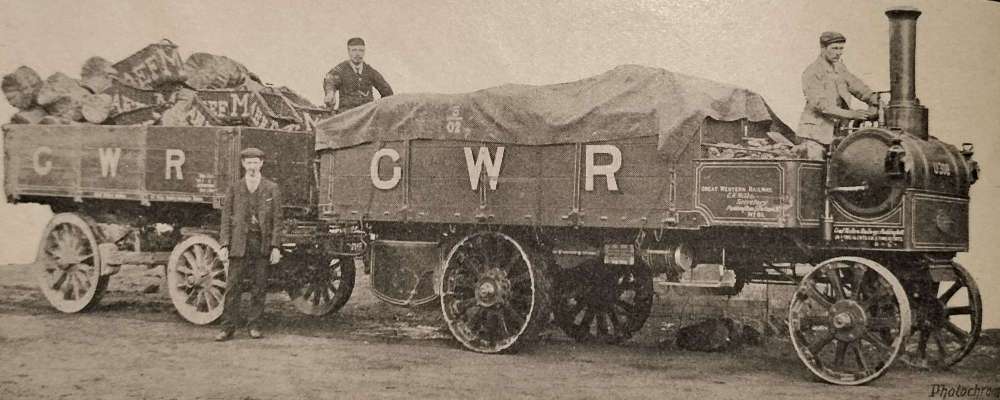
The two photographs show the same vehicle, No. U 308, built by the Yorkshire Patent Steam Wagon Co of Leeds in 1905. “The novel double-ended transverse-mounted boiler was used to avoid problems on steep hills. With a horizontal boiler mounted fore and aft, skill is required to keep the inner firebox crown covered with water when descending a steep hill.” [2]

The same photo can be found on the Leeds Engine Builders webpage. [3]

The novel double-ended transverse-mounted boiler was used to avoid problems of tilting when climbing hills. Internally it resembled a locomotive or Fairlie boiler with a central firebox and multiple fire-tubes to each end. In the Yorkshire though, a second bank of fire-tubes above returned to a central smokebox and a single chimney. [9]
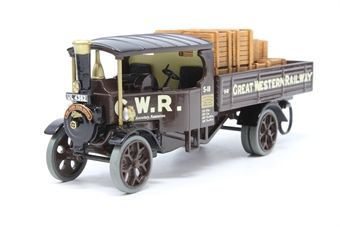
More typical of the steam road motors was this vehicle which Hattons identify as “a Sentinel Dropside Short-wheelbase Steam Wagon which Corgi have produced in GWR Livery in 1:50 scale.” [4] This is actually Corgi CC20204 – Foden C-Type Dropside Wagon. [10]
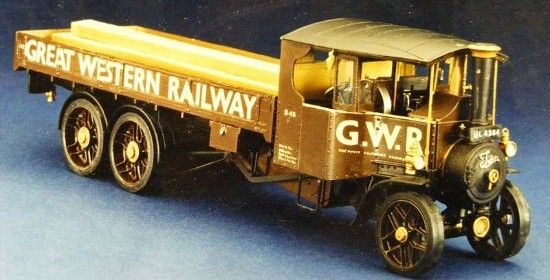
A model of a Foden K Steam Road Motor Lorry. [5]
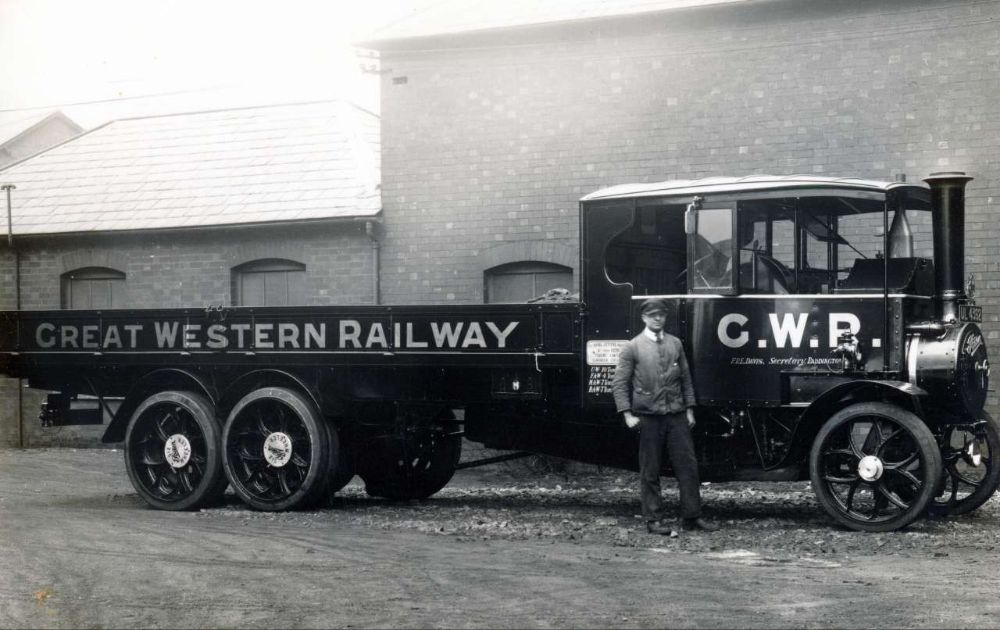
The full size version of the Foden K Steam Road Motor Lorry. [6]
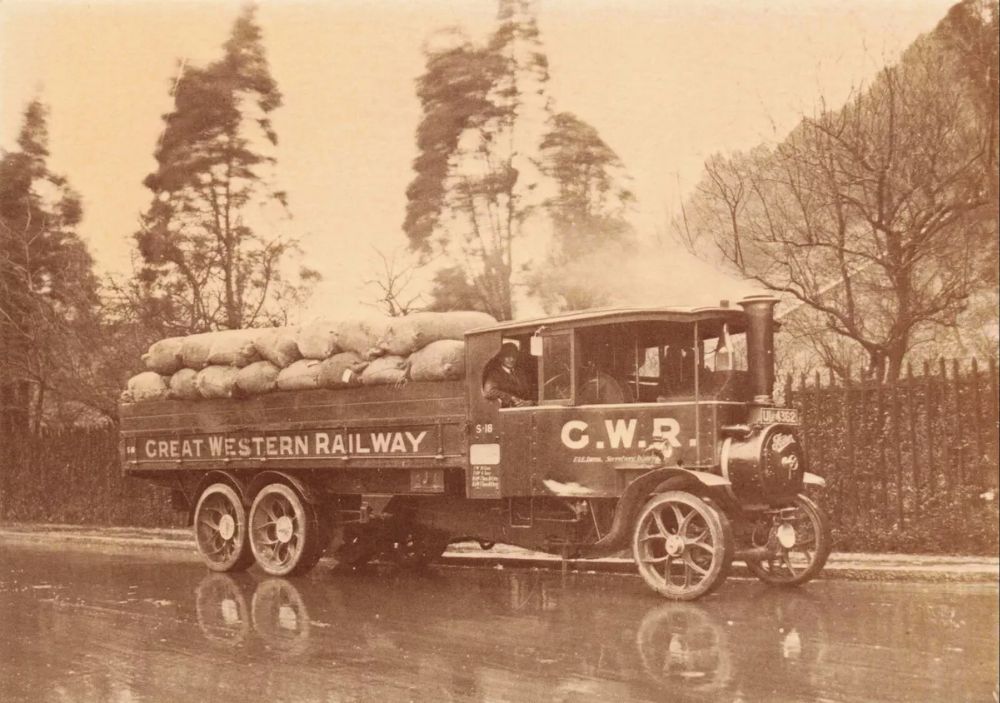
Series Two Foden Steam Traction Lorry – Okehampton 1929, © Public Domain. [7]
GWR 4 Ton Thornycroft Lorry, 1929. [8]

Further Reading

References

  1. The Railway Magazine, London, December 1905.
  2. https://didcotrailwaycentre.org.uk/article.php/514/going-loco-may-2022, accessed on 10th October 2024.
  3. https://www.leedsengine.info/leeds/gallery.asp?section=/leeds/images/Yorkshire%20PSWCo, accessed on 10th October 2024.
  4. https://www.hattons.co.uk/213735/corgi_cc20204_sentinel_dropside_steam_wagon_with_sack_load_in_gwr_livery/stockdetail, accessed on 10th October 2024.
  5. https://www.constructionscalemodels.com/en/foden-k-steam-wagon-south-eastern-finecast-sefte10, accessed on 10th October 2024.
  6. https://fortepan.hu/hu/photos/?id=228651, accessed on 10th October 2024.
  7. https://www.ebay.ph/itm/235633691321, accessed on 10th October 2024.
  8. https://www.steampicturelibrary.com/gwr-road-vehicles/road-motor-vehicles/gwr-4-ton-thornycroft-lorry-1929-536382.html, accessed on 10th October 2024.
  9. https://en.m.wikipedia.org/wiki/Yorkshire_Patent_Steam_Wagon_Co.#:~:text=The%20Yorkshire%20Patent%20Steam%20Wagon%20Co.&text=Their%20designs%20had%20a%20novel,was%20finally%20dissolved%20in%201993, accessed o. 10th October 2024.
  10. https://www.chezbois.com/corgi/modern_corgi/Model_97124.htm, accessed on 15th February 2025.

The Manchester and Leeds Railway – The Railway Magazine, December 1905 – Part 2

This is the second part of a short series about the Manchester and Leeds Railway. The first part can be found here. [66]

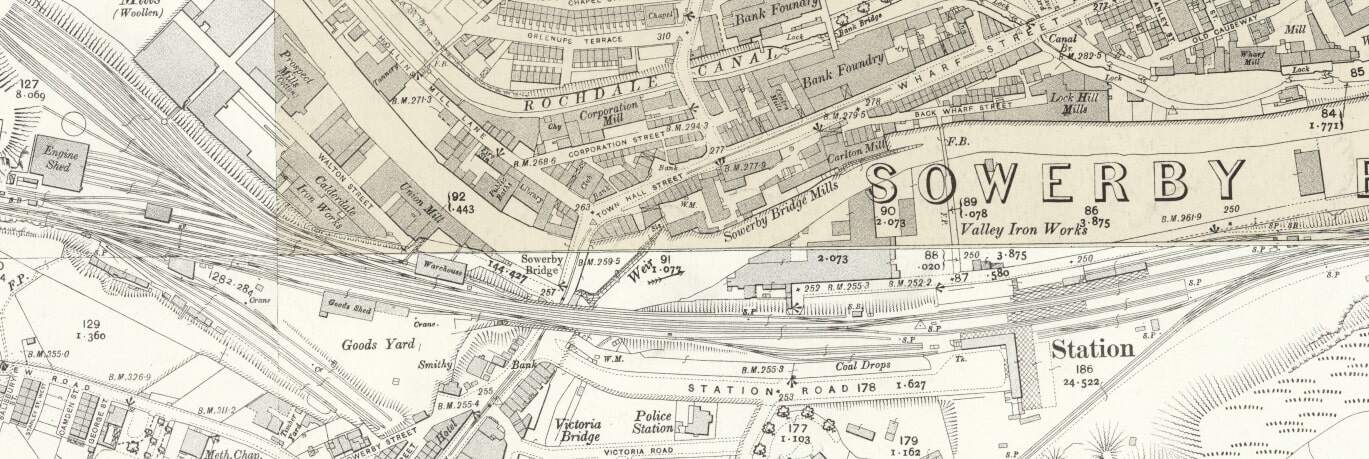
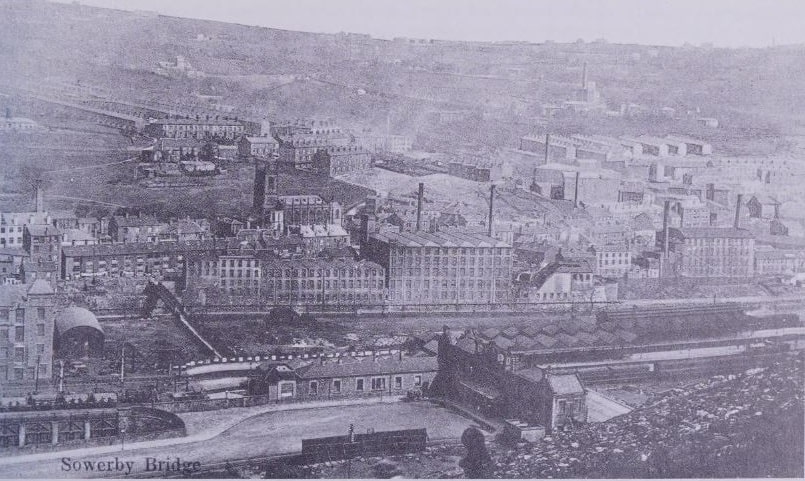
We re-commence our journey at Sowerby Bridge Railway Station. ….

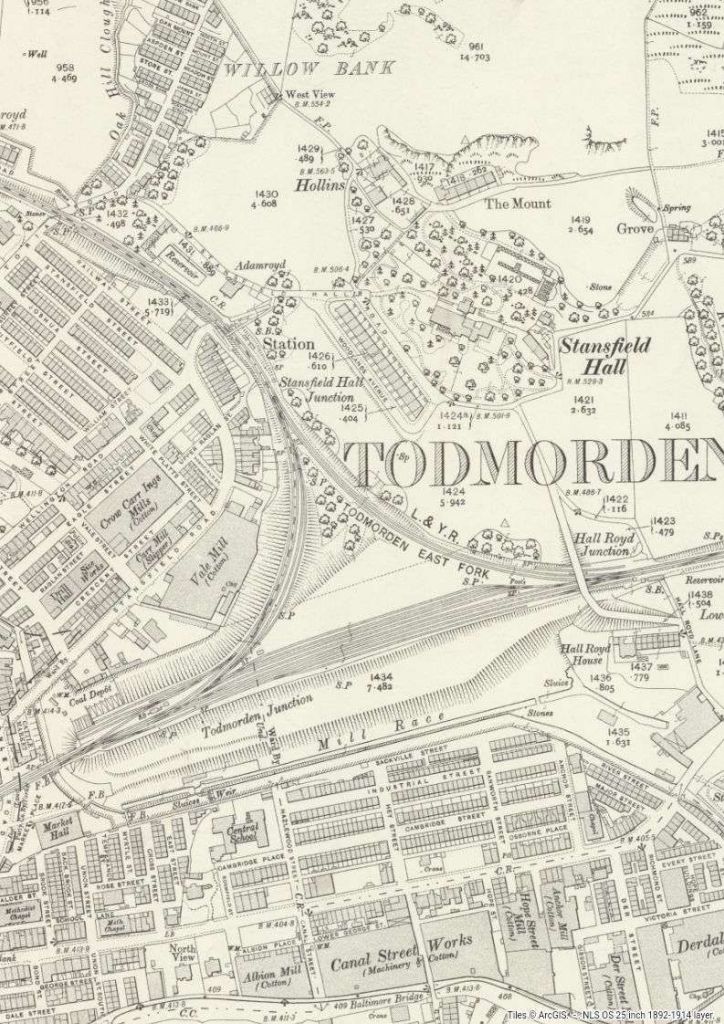
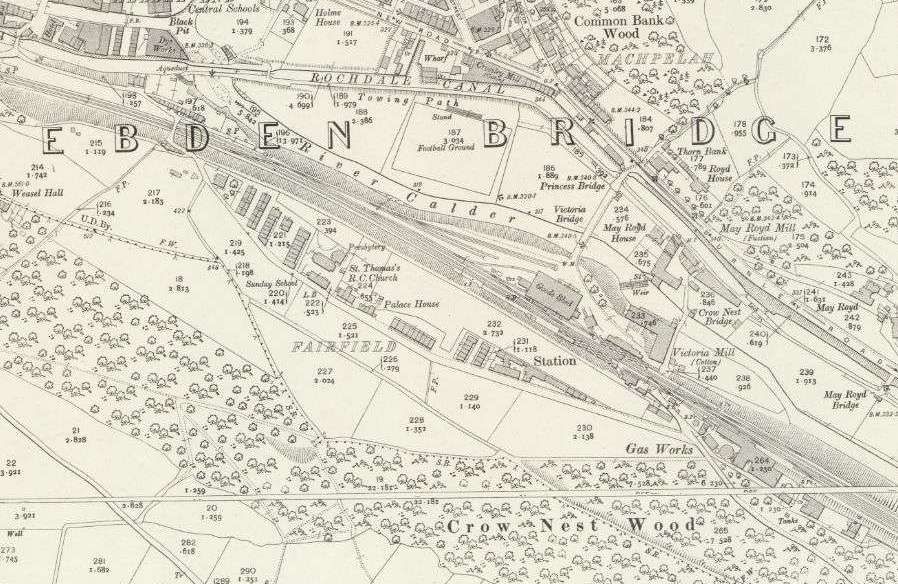
Sowerby Bridge Railway Station – note the Ripponden Branch emerging from a tunnel and joining the Manchester and Leeds Railway at the East end of the Station. [15]
An early postcard image of Sowerby Bridge with the railway station in the foreground, © Public Domain. [23]
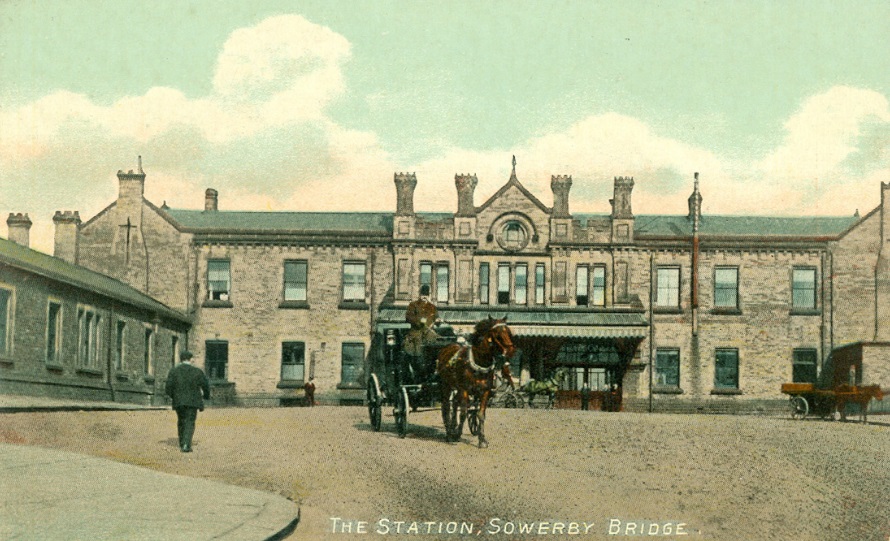
A colourised postcard view of the Station Forecourt at Sowerby Bridge around the turn of the 20th century. [60]
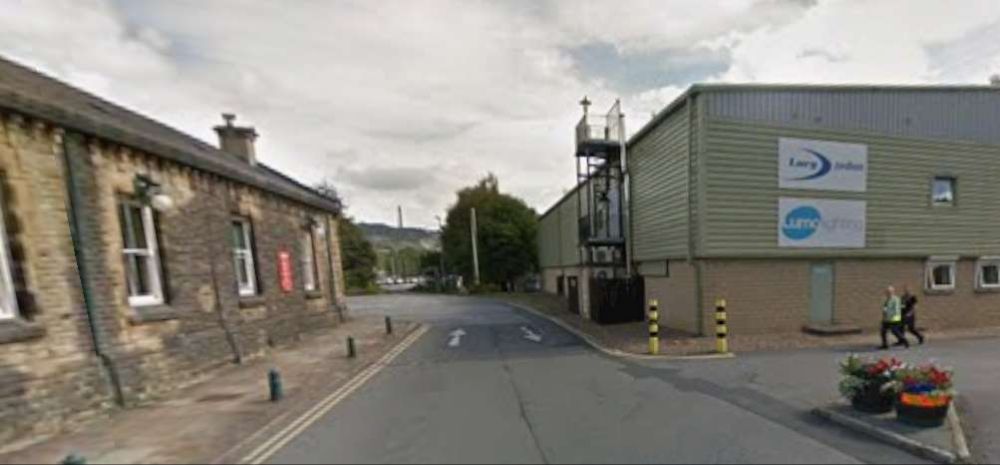
The main station building in Sowerby Bridge was demolished but the single storey building to the left of the postcard image above survives as can be seen in this image from 2016. [Google Streetview, 2016]
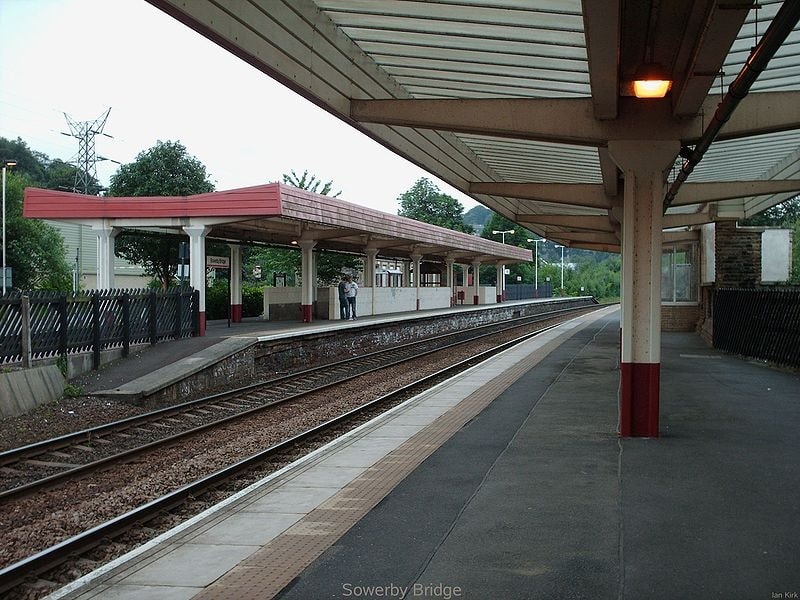
Sowerby Bridge Railway Station in 2006, (c) Ian Kirk and authorised for reuse under a Creative Commons Licence (CC BY 2.5). [24]
The area shown on this extract from Google Maps satellite imagery is a slightly enlarged area compared to the OS map extract above. It shows the area immediately around the railway station. [Google Maps, October 2024]

More images of Sowerby Bridge Railway Station can be found here [67] and here. [68]

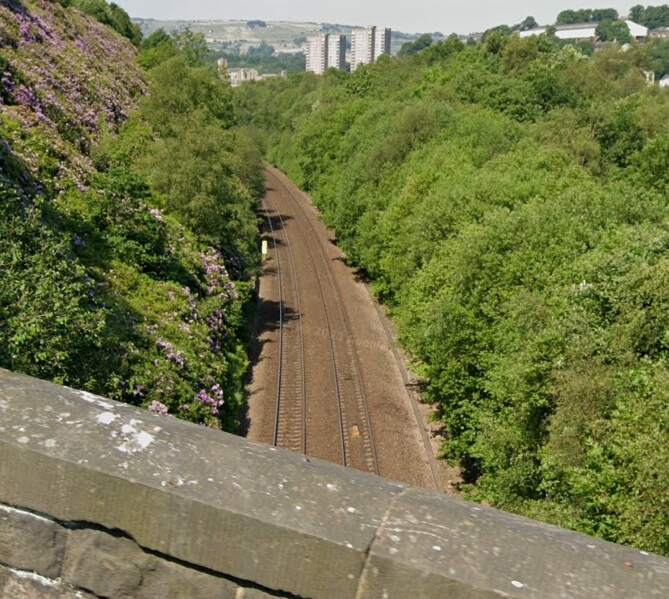
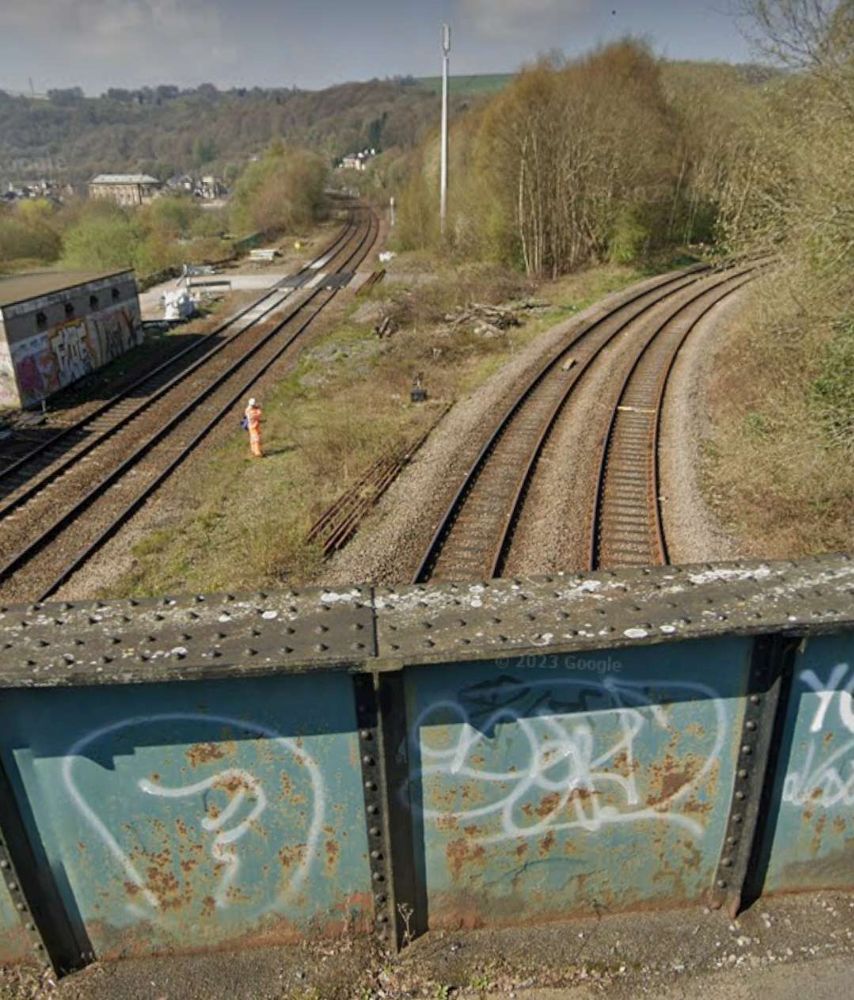
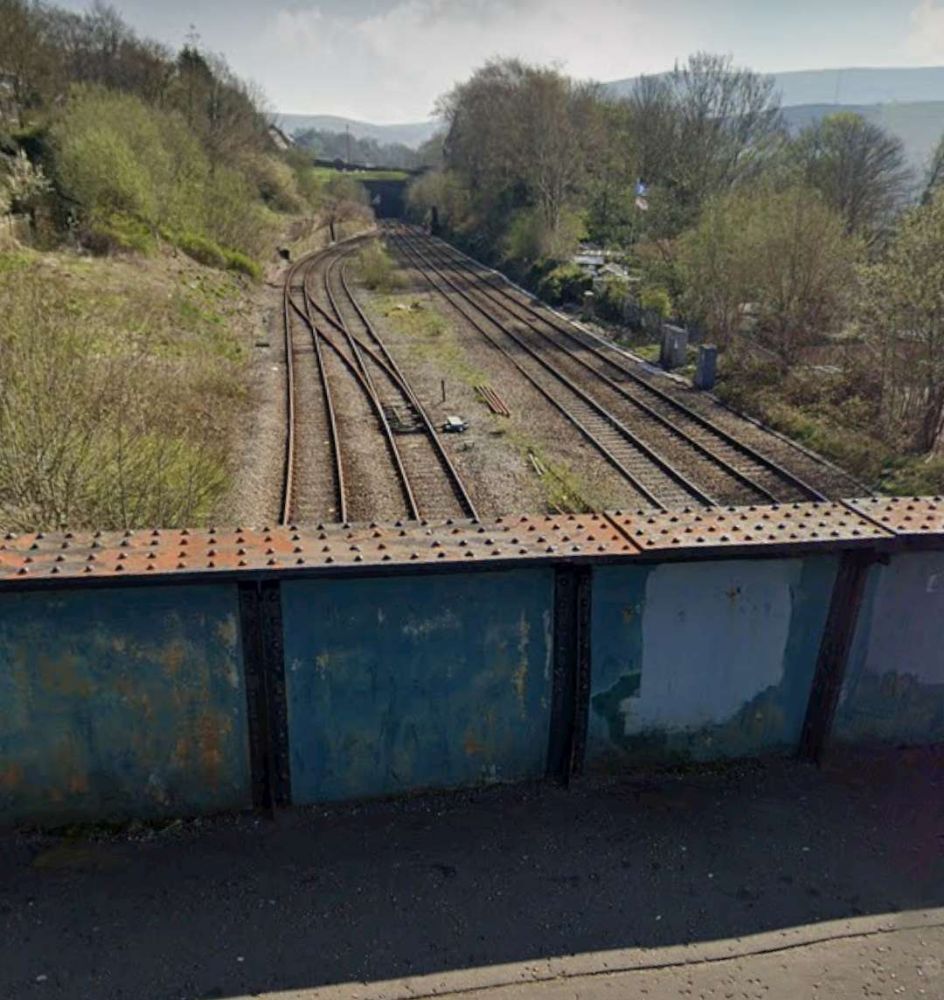
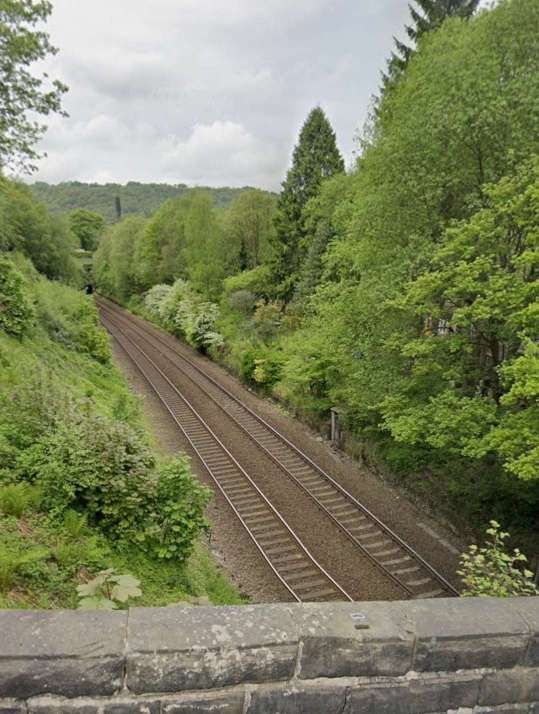
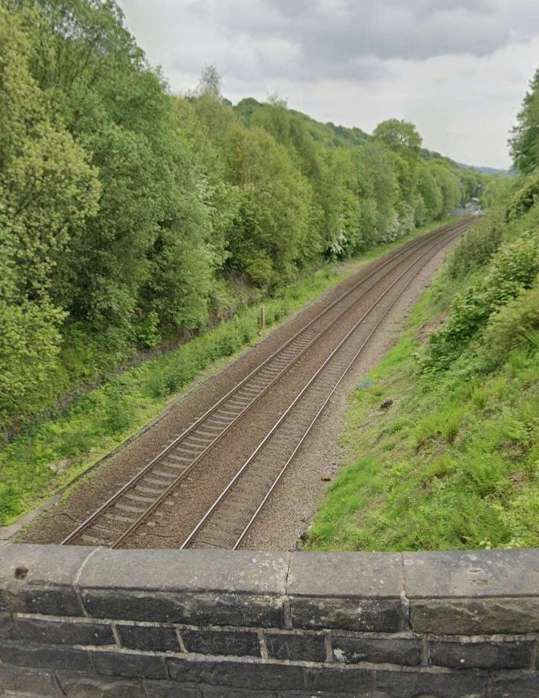
Just beyond the eastern station limits Fall Lane bridges the line – two views from the bridge follow.

To the East of Sowerby Bridge the line crosses the River Calder again.

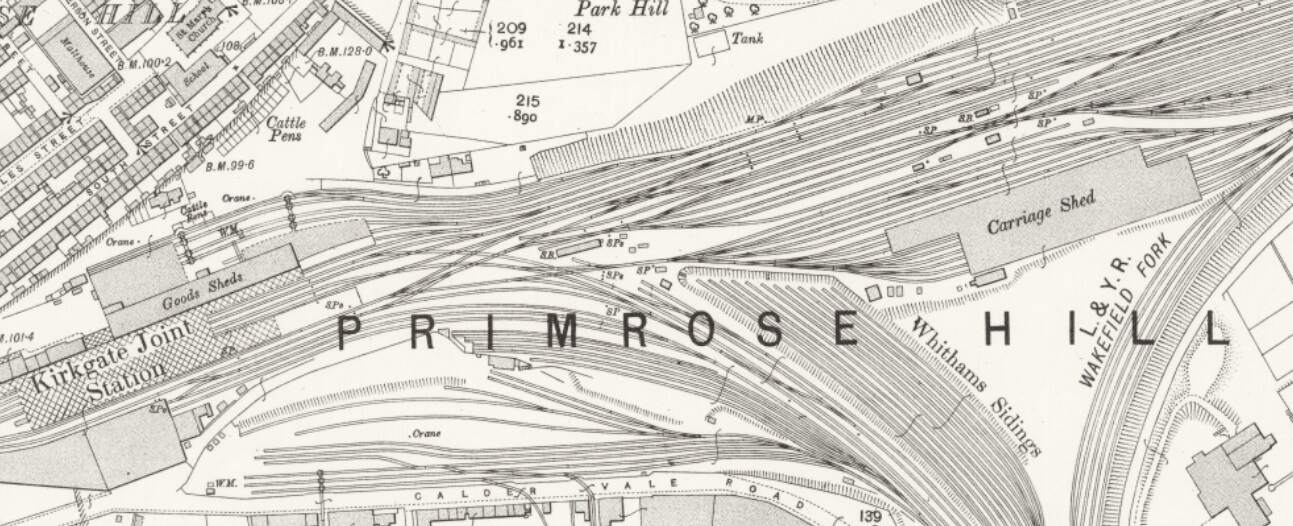
Another extract from the 25″ Ordnance Survey of 1905, published in 1907 shows Calder Dale Grease Works, Copley Bridge and Copley Viaduct. The Sowerby Bridge, Halifax and Bradford line leaves the main line at this point. [25]
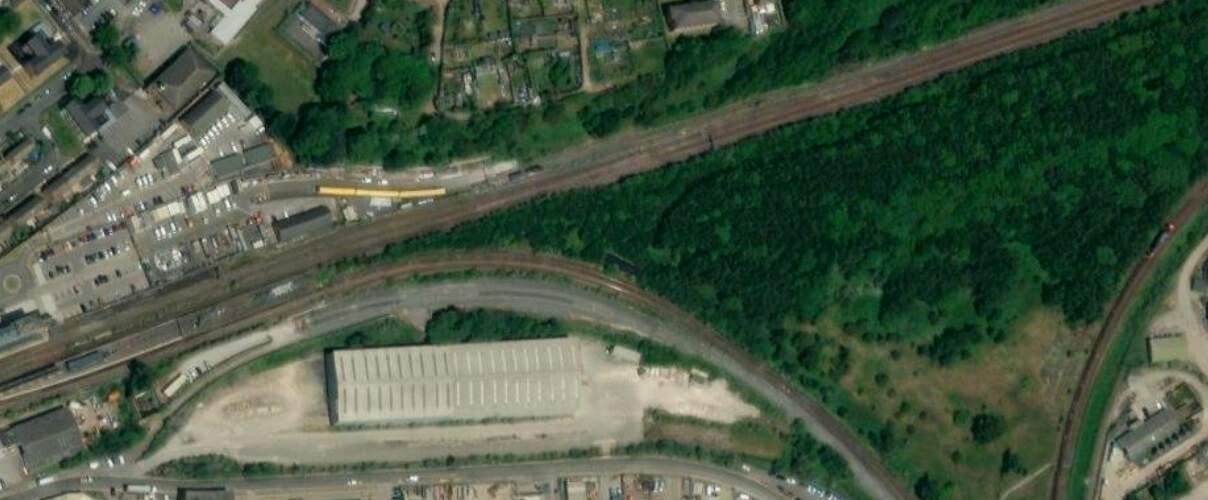
The bridge and Viaduct as they appear on Google Maps satellite imagery in 2024. [Google Maps, October 2024]

An image of Copley Viaduct can be seen here. Just beneath the viaduct, at the left of the linked photograph, a train is crossing Copley Bridge on the line we are following. [61]

The Manchester and Leeds Railway then crosses the Calder once again and enters Greetland Station. The second arm of the Sowerby Bridge, Halifax and Bradford line joins the mainline just before (to the Northwest of) Greetland Station.

Greetland Station shown on the 25″ Ordnance Survey of 1905. Top-left the second arm of the triangular junction with the Sowerby Bridge, Halifax and Bradford line can be seen joining the Manchester and Leeds Railway. Bottom-right, the Stainland Branch leaves the main line just before the main line bridges the River Calder once again. [26]
The same location in the 21st century. Greetland Station is long gone and the branch South (the Stainland Branch has also been lifted. [Google Maps, October 2024]
Greetland Railway Station in 1962, just before closure. The camera is positioned at the Northwest end of the station. [28]

Greetland Railway Station “was originally opened as North Dean in July 1844. It was subsequently changed to North Dean and Greetland and then to Greetland in 1897. Situated near the junction of the main Calder Valley line and the steeply-graded branch towards Halifax (which opened at the same time as the station), it also served as the junction station for the Stainland Branch from its opening in 1875 until 1929. It was closed to passenger traffic on 8th September 1962.” [27]

Looking West from the A629, Halifax Road which sits over the line adjacent to the West Portal of Elland Tunnel. [Google Streetview, July 2024]

Rake says that the line then approaches “Elland Tunnel, 424 yards, in length, and, after leaving Elland Station, pass[es] through a deep cutting, from which a large quantity of stone for the building of the bridges was obtained.” [1: p471]

Rake says that this is the Eastern Portal of Elland Tunnel. Looking at the 25″ OS mapping it appears to be the Western Portal as Elland Station sits immediately to the East of the Eastern Portal. [1: p471]
Elland Tunnel and Elland Railway Station as they appear on the 1905 25″ Ordnance Survey. The Calder & Hebble Navigation and the River Calder also feature on the map extract. [29]
Elland Railway Station in 1964, seen from above the East Portal of Elland Tunnel, © Glock Wild & S. Chapman Collection. [30]

To the East of Elland Railway Station the railway is carried above the River Calder, passing Calder Fire Clay Works. Further East again, “the railway is carried across a steep and rugged acclivity, rising almost perpendicularly from the river. …  The viaduct consists of six arches of 45ft span each, and leads directly to Brighouse, originally the nearest station to Bradford.” [1: 472]

The view from the South of the bridge which carries the railway over Park Road (A6025), Elland. Elland Station stood above this location and to the left. [Google Streetview, July 2024]

From Elland, the line runs on through Brighouse

Brighouse Station and Goods Yard as shown on the 25″ Ordnance Survey of 1905. [31]
The view West from Gooder Lane Bridge towards Cliff Road Bridge Elland. [Google Streetview, May 2023]
The view East across Brighouse Railway Station from Gooder Lane. [Google Streetview, May 2023]
Brighouse Railway Station (originally called ‘Brighouse for Bradford’). [1: p472]
B1 61034 Chiru at Brighouse
Embedded link to Flickr. The image shows B1 No. 61034 Chiru at Brighouse Station on 2nd April 1964.
The locomotive is arriving at the station from the East with a local passenger train. The locomotive had only recently been transferred to Wakefield from Ardseley. It was withdrawn at the end of 1964. The photograph looks Southeast through the station. [32]
A much later photograph of Brighouse Railway Station (2006) which looks Northwest through the station from platform 1, (c) Ian Kirk and authorised for reuse under a Creative Commons Licence (CC BY 2.5). [33]

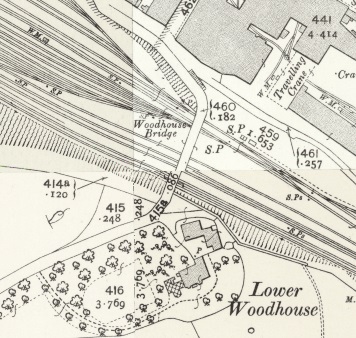
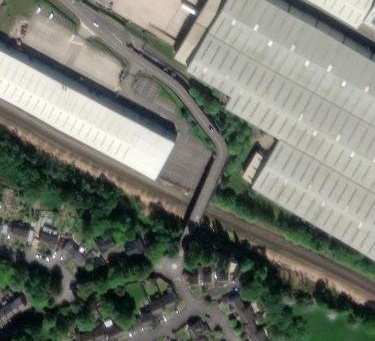
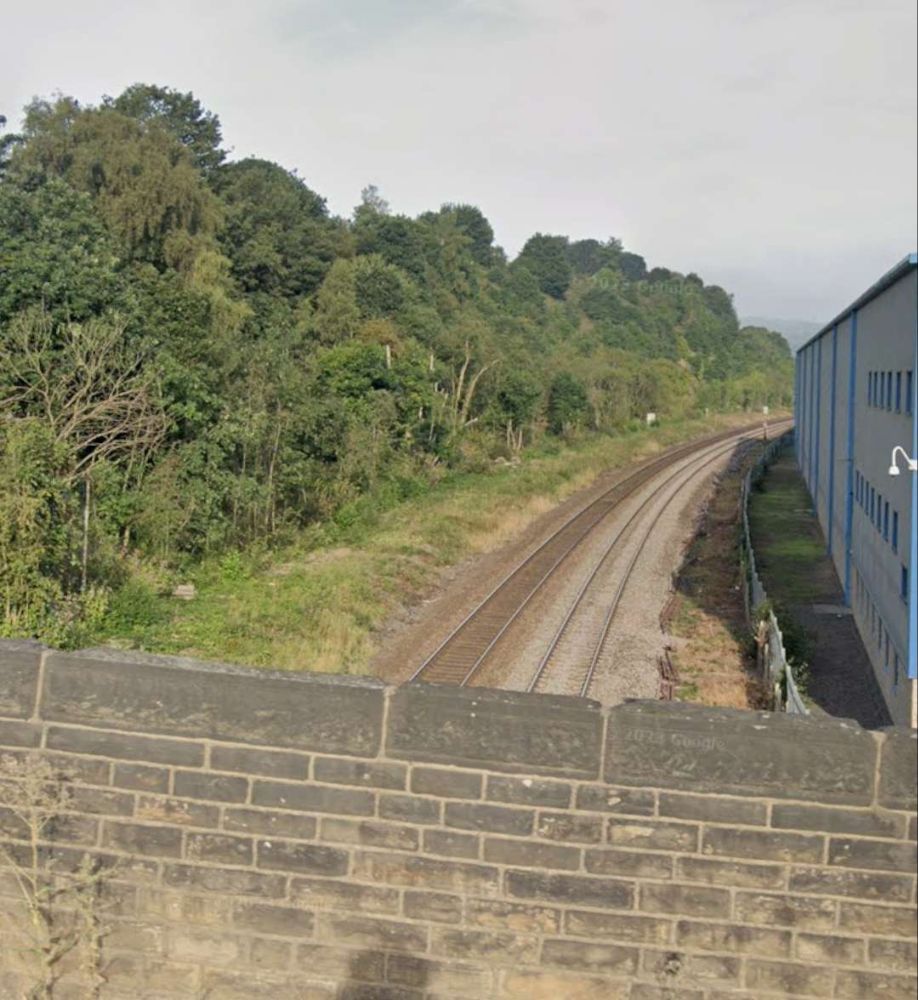
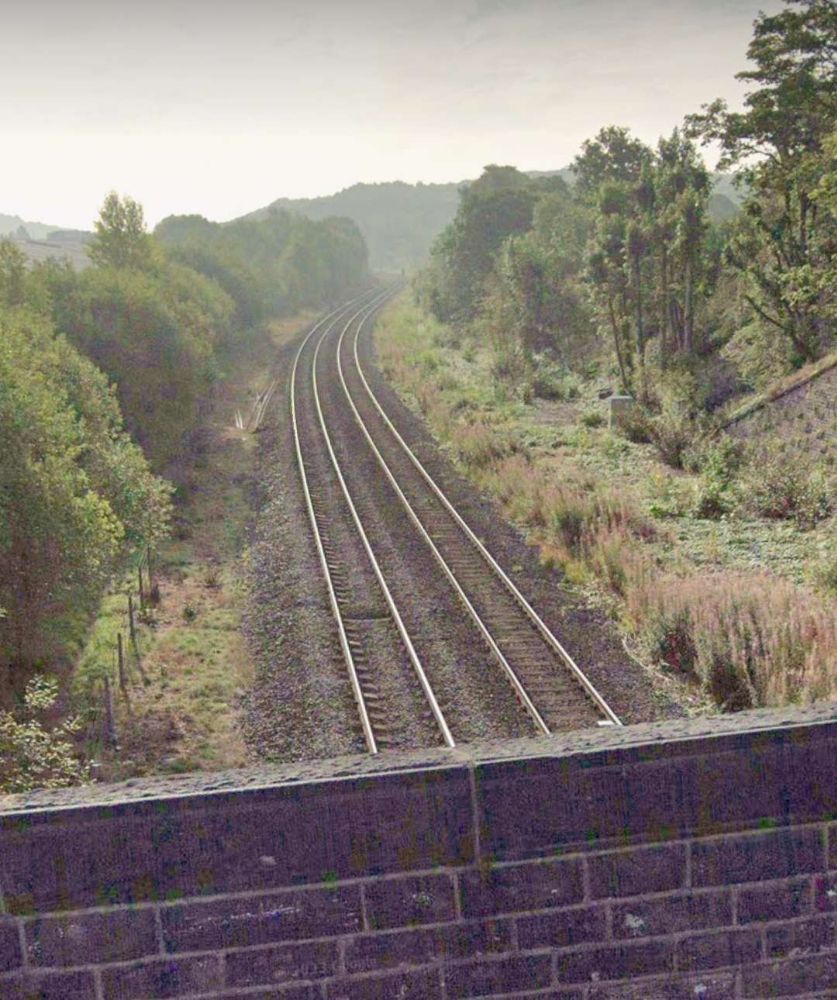
To the East of the passenger facilities at Brighouse there were a significant array of sidings. The first length of these can be seen on the OS Map above. Around 75% of the way along these sidings Woodhouse Bridge spanned the lines. Much of the area has been redeveloped by modern industry. The next four images relate to that bridge.

Leaving Brighouse Station, the railway is joined, from the North, by the Bailiff Bridge Branch (long gone in the 21st century).

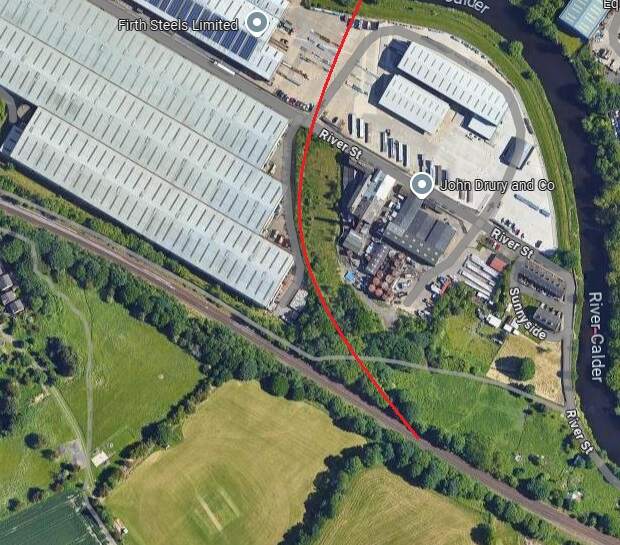
Immediately to the East of Brighouse Station Goods Yards, the Bailiff Bridge Branch joined the Manchester and Leeds Railway. [62]
Approximately the same area in the 21st century as shown on the OS map extract above. The line of the old Bailiff Bridge Branch is superimposed on the satellite image. [Google Maps, October 2024]

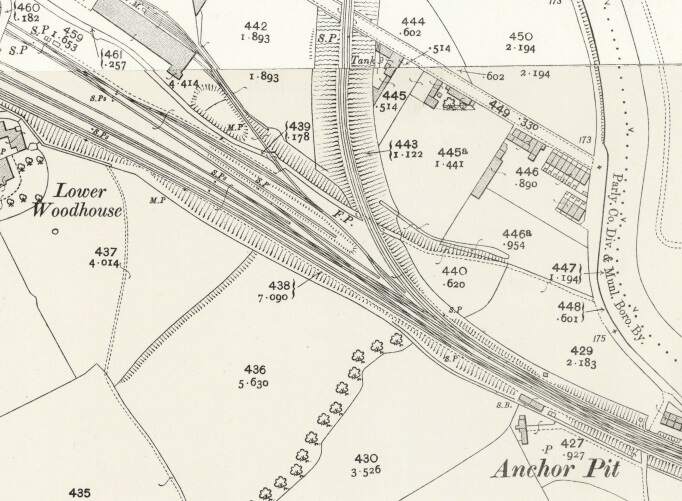
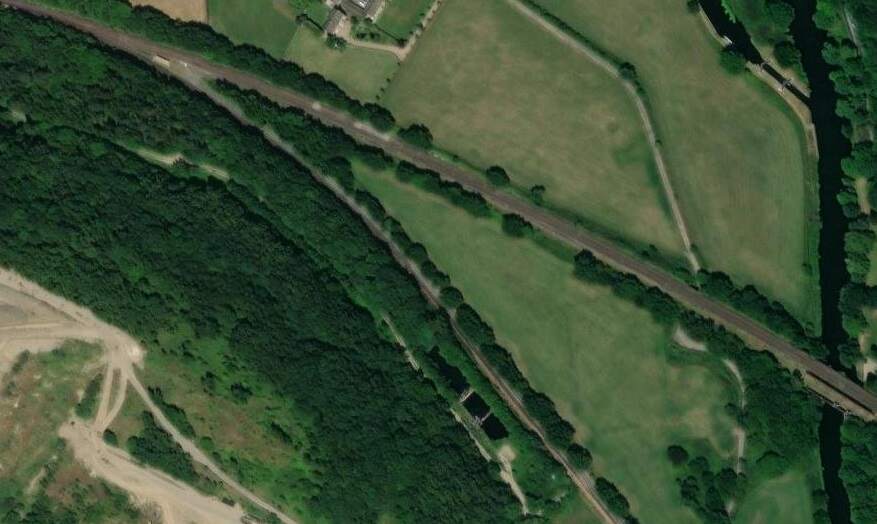
A little further to the East, in the 21st century, the line passes under the M62 and enters a deep cutting before, at Bradley Wood Junction, the Bradley Wood Branch leaves the line to the South (still present in the 21st century).

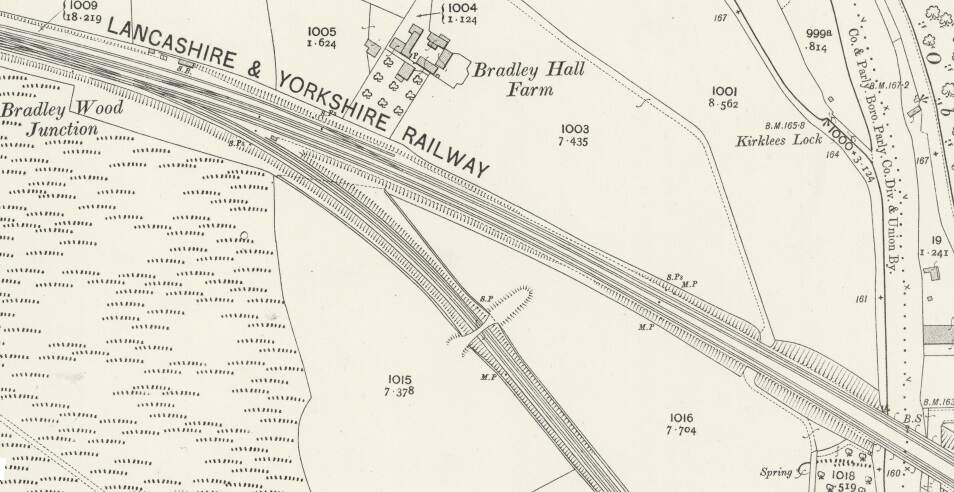
Bradley Wood Junction as shown on the 25″ Ordnance Survey of 1905. [70]
Much the same area in the 21st century. [70]

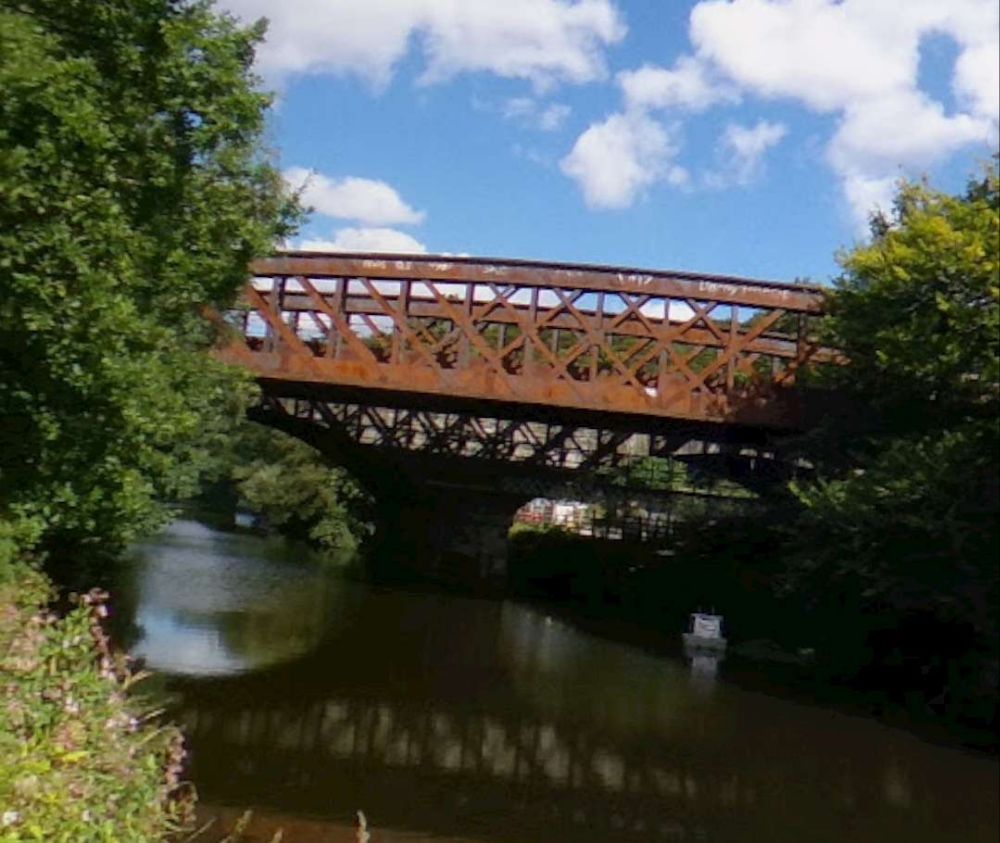
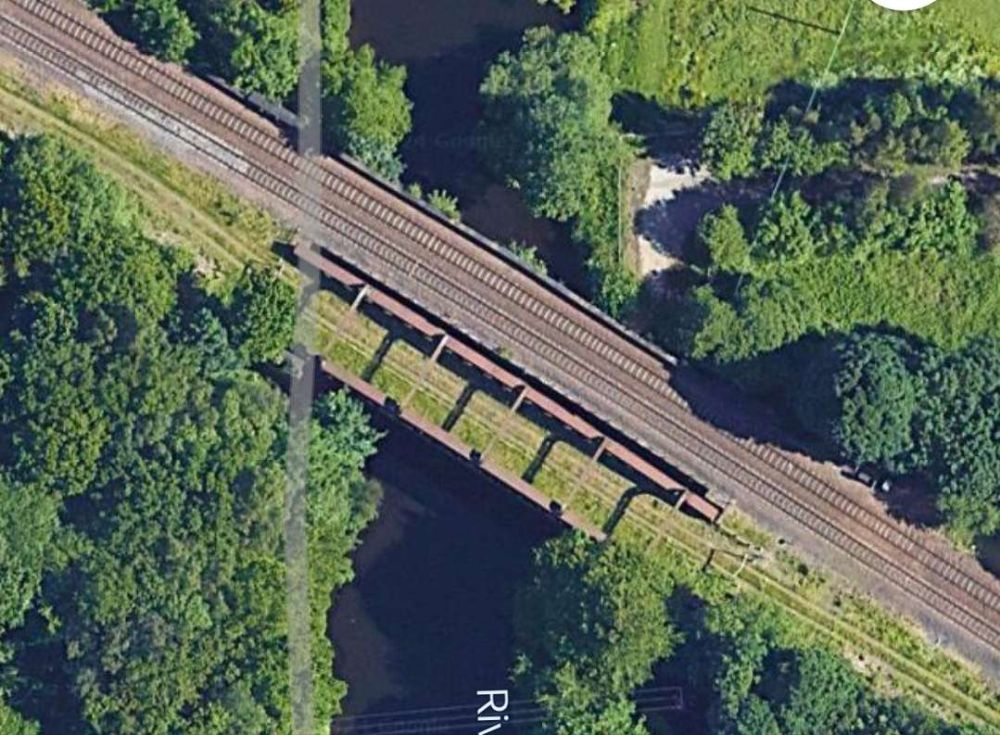
Beyond [Bradley Wood Junction] the Calder is crossed by a viaduct of two arches of 76 ft. span each. this is succeeded by an embankment, along which the line continues down the valley. [It] again cross[es] the Calder by a viaduct similar to that just referred to.” [1: p472] The line was widened to the South side to create a four-track main line and single span girder bridges were positioned alongside the original structures.

At the first crossing of the River Calder mentioned immediately above, the original two arches of the stone viaduct can be seen beyond the more modern girder bridge in this photograph, (c) Uy Hoang. [Google Streetview, September 2022]
The same bridges as they appear on Google Maps satellite imagery in 2024. [Google Maps, October 2024]

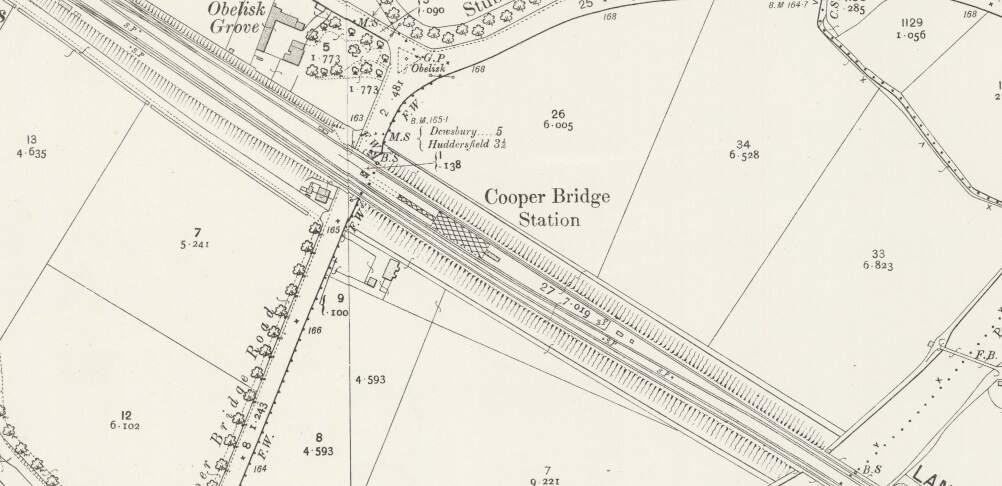
In between the two bridges across the River Calder, was Cooper Bridge Station.

Cooper Bridge Station as it appears on the 1905 25″ Ordnance Survey. [34]
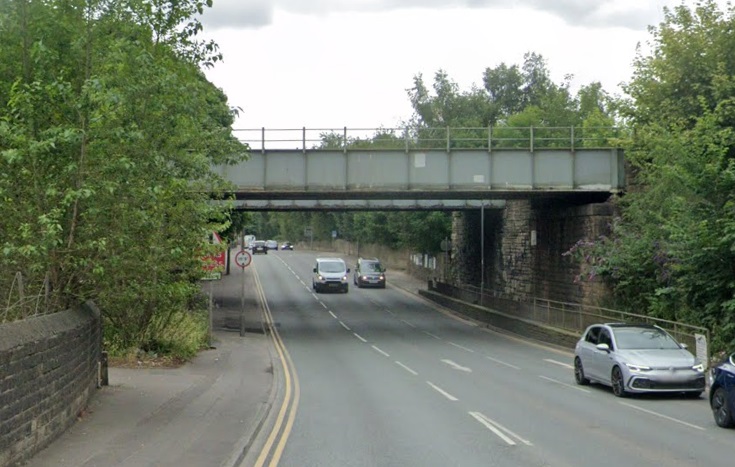
The Station at Cooper Bridge is long gone in the 2st century, but the bridges remain. The station sat over the road at this location with platform buildings between the rails of the left edge of this image. This photograph is taken from the North on Cooper Bridge Road. [Google Streetview, July 2024]
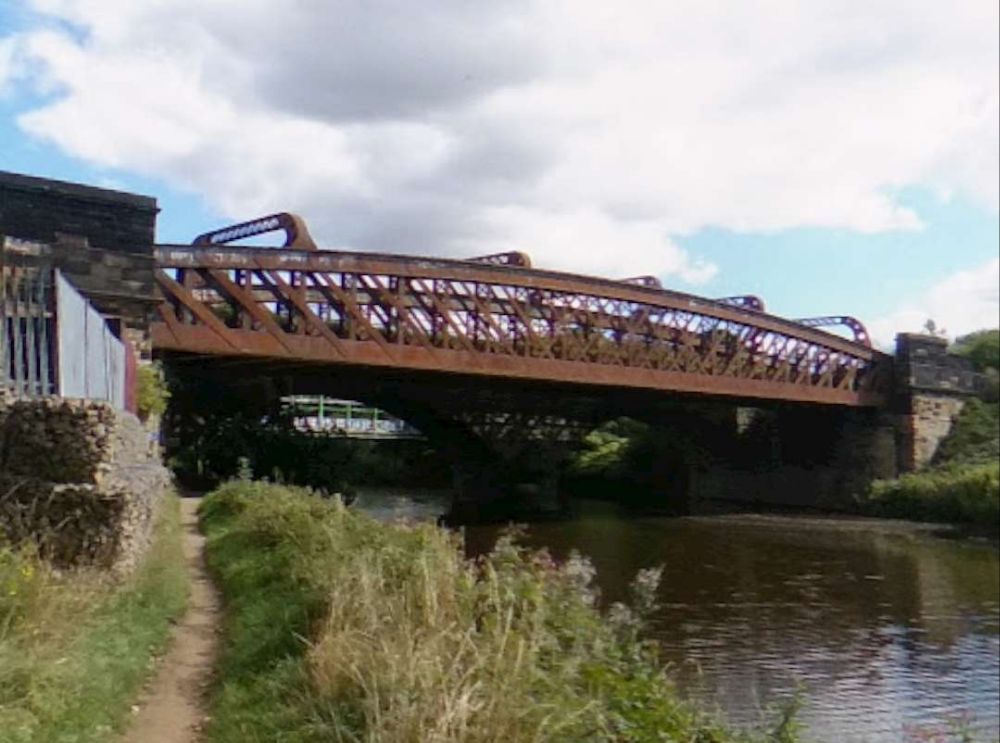
The second of the two crossings of the River Calder mentioned above. This photograph, taken from the Southwest, shows the girder bridge with the stone-arched 2-span bridge beyond, (c) Uy Hoang. [Google Streetview, September 2022]
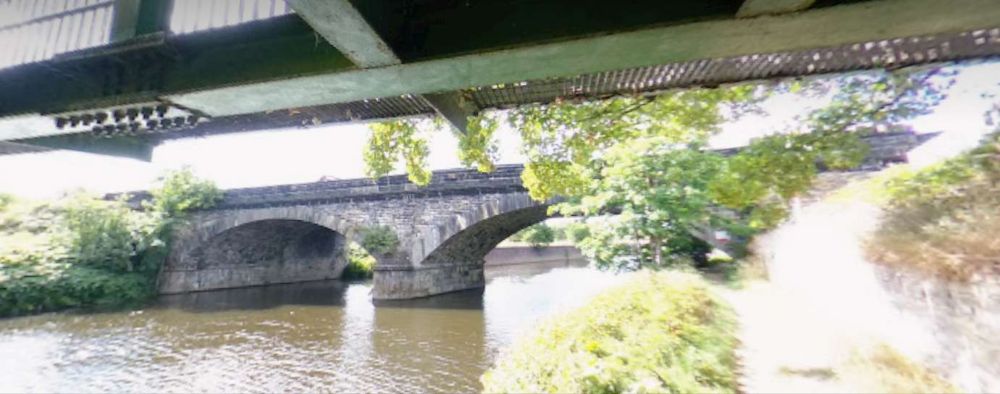
This view from the North East and from under an adjacent footbridge shows the stone-arched 2-span structure, (c) Uy Hoang. [Google Streetview, September 2022]

Rake’s journey along the line seems not to focus so closely on the remaining length of the line. Various features and a number of stations seem to have been missed (particularly Cooper Bridge, Mirfield, Ravensthorpe, Thornhill, Horbury & Ossett). It also seems to suggest that the line goes through Dewsbury Station. Rather than rely on Rake’s commentary about the line, from this point on we will provide our own notes on the route.

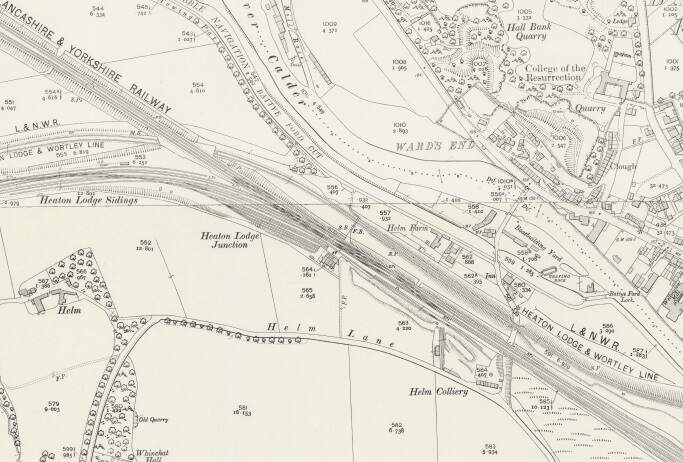
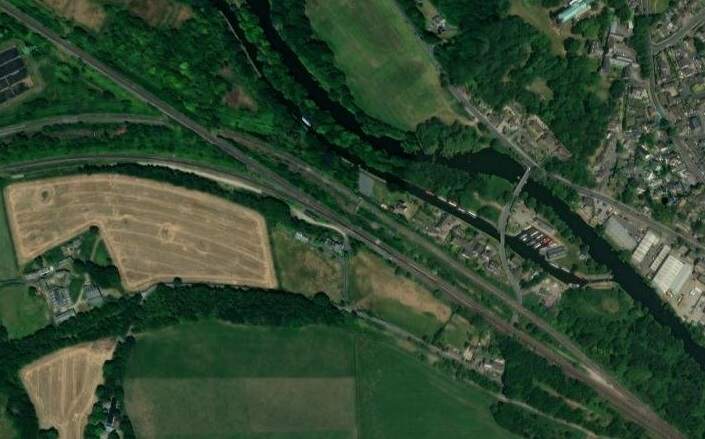
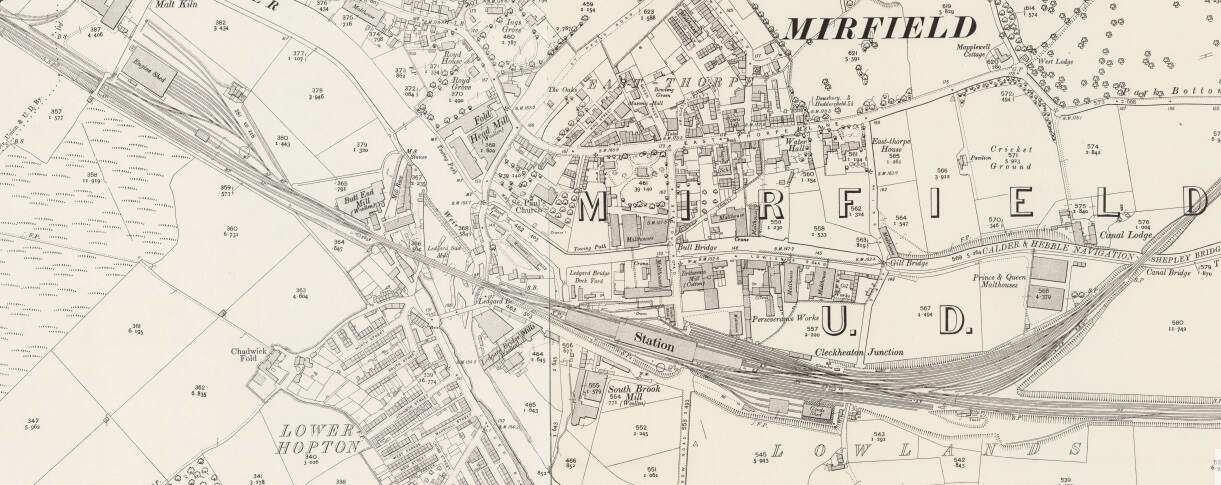
At Heaton Lodge Junction, the LNWR Huddersfield & Manchester line joined the Manchester & Leeds line with the LNWR Heaton & Wortley line passing beneath. The Manchester & Leeds line ran on towards Mirfield Station passing the large engine shed before entering the station over a long viaduct which once again crossed the River Calder.

Heaton Lodge Junction as it appeared in 1905 on the 25″ Ordnance Survey. [71]
The same junction as it appears on the ESRI satellite imagery which is provided by the National Library of Scotland (NLS). [71]
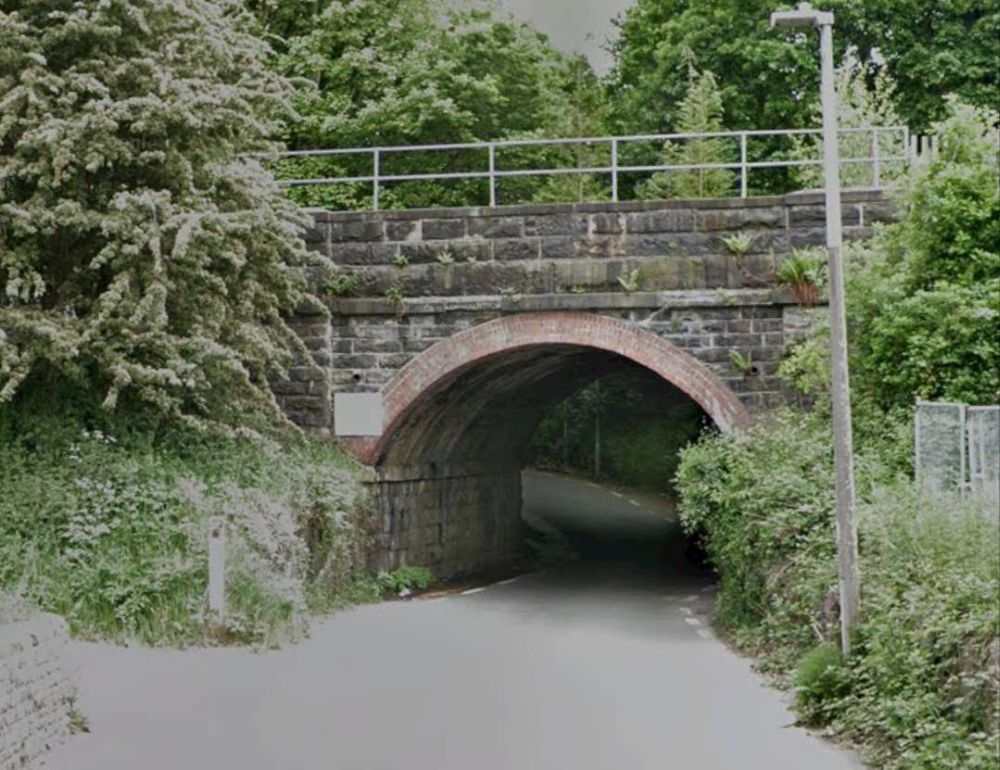
The bridge carrying the Manchester and Leeds Railway over Wood Lane which can be made out to the right of the map extract and satellite images above. [Google Streetview, May 2023]
Mirfield Station and Engine Shed.
The view from the North of the viaduct carrying the line over the River Calder to the West of Mirfield Station. [Google Streetview, March 2021]
The same viaduct viewed from the Southwest. The original stone-arched viaduct was widened by metal spans on brick abutments and piers. [Google Streetview, March 2021]
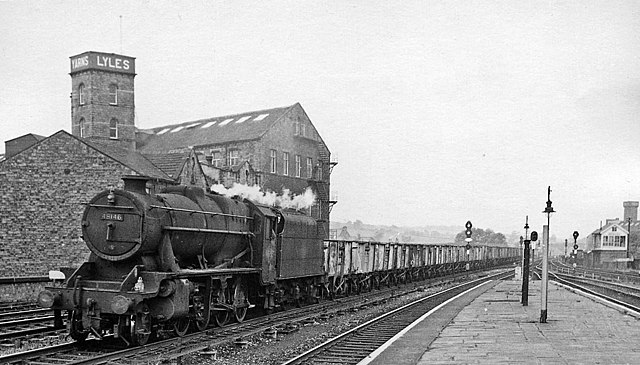
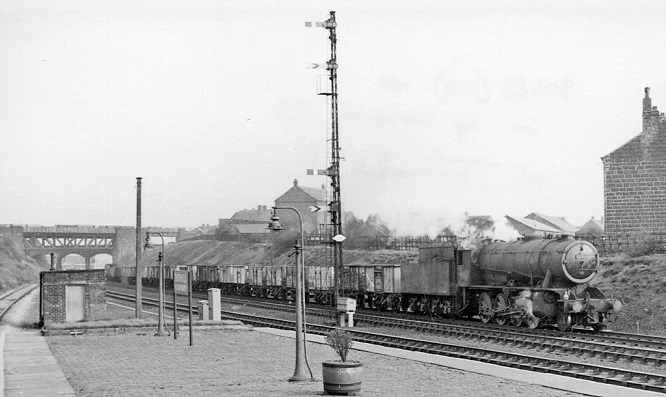
Eastbound empties passing Mirfield Station behind BR 8F 2-8-0 Locomotive No. 48146. The photograph looks West from the central island platform and shows some of the Speed Signals – unusual in Britain – installed in 1932 on the exceptionally busy section of this dual trunk route between Heaton Lodge Junction and Thornhill Junction, which remained until 1969-70, (c) Ben Brooksbank and licenced for reuse under a Creative Commons Licence (CC BY-SA 2.0). [35]
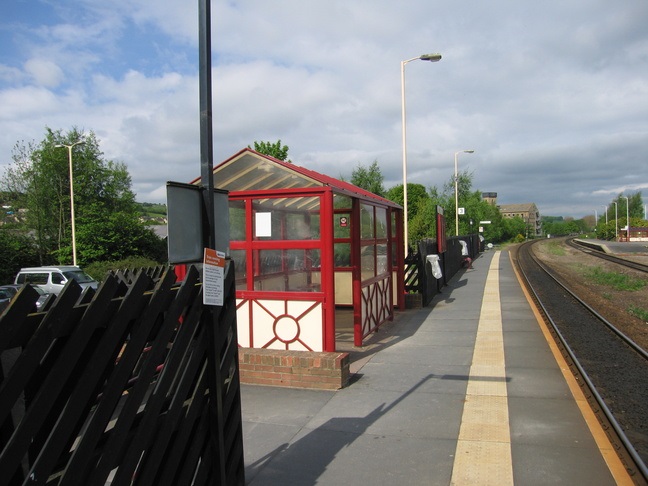
Mirfield Railway Station in 2010 taken looking West from Platform three which was a later addition to the station and sits alongside what was the up slow line. The original island platform can be see to the right of this image, © Alexandra Lanes, Public Domain. [36]

Just to the East of Mirfield Station was Cleckheaton Junction and then Wheatley’s Bridge over the River Calder. A bridge then carries Sand Lane over the railway.

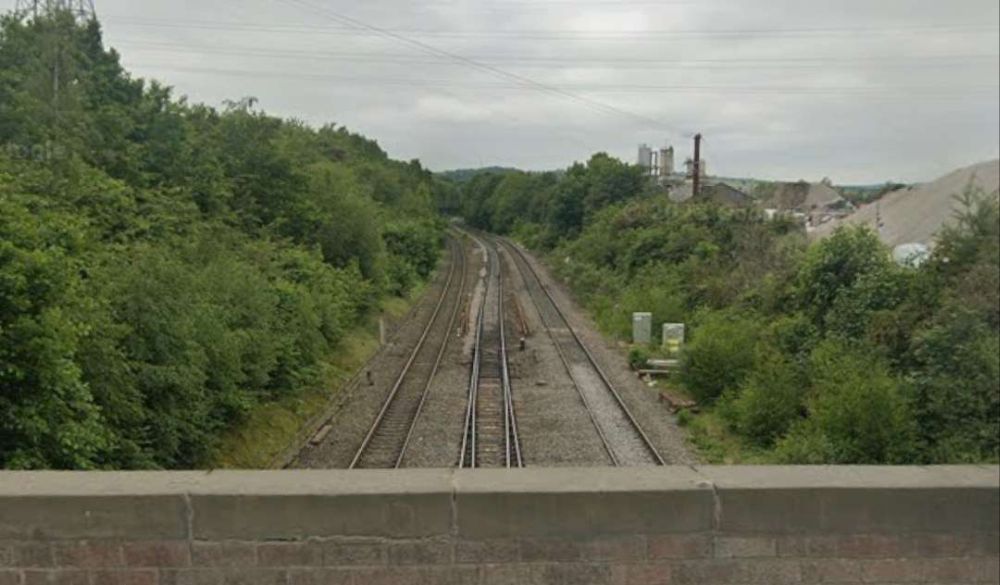
Looking West from Sands Lane Bridge back towards Mirfield. [Google Streetview, May 2023]
Looking East from Sands Lane Bridge. [Google Streetview, May 2023]

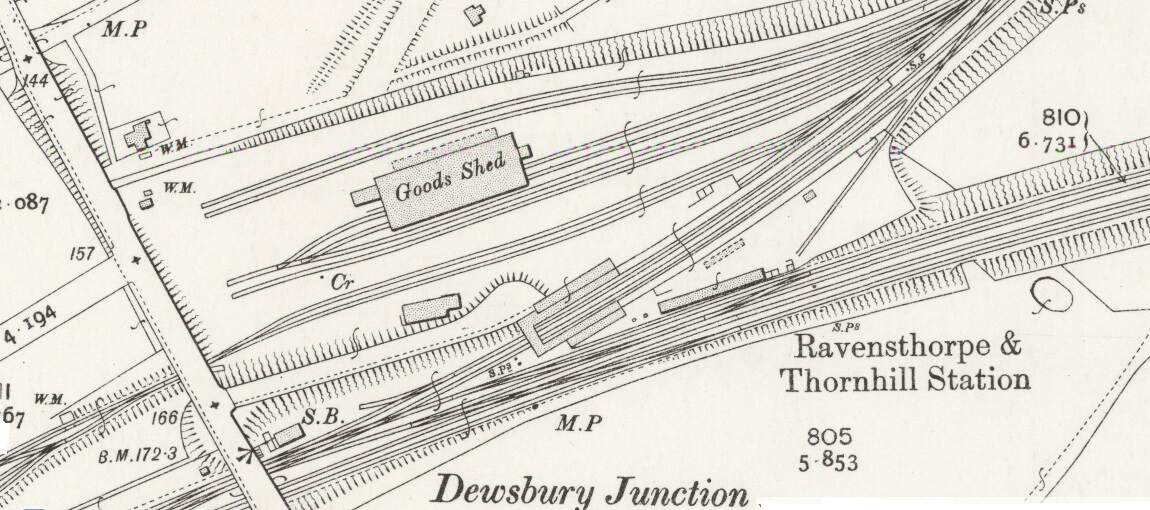
Soon after this the line encountered Dewsbury Junction which hosted Ravensthorpe (Ravensthorpe and Thornhill) Station.

Dewsbury Junction and Ravensthorpe Station. [39]
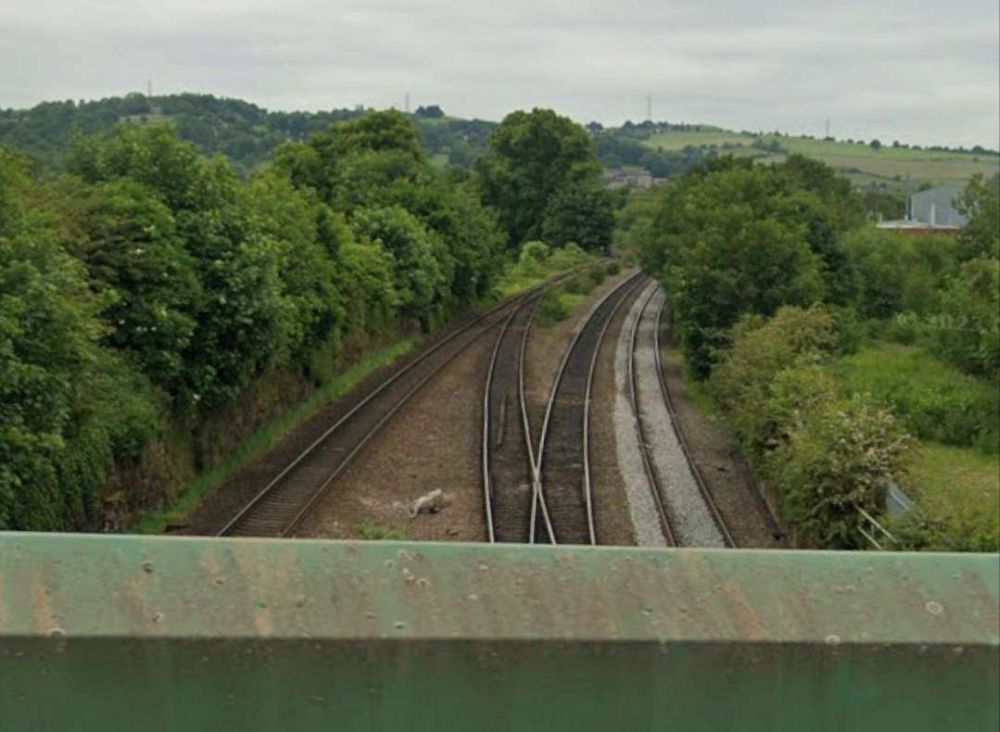
Looking West from Calder Road towards Mirfield. [Google Streetview, May 2023]
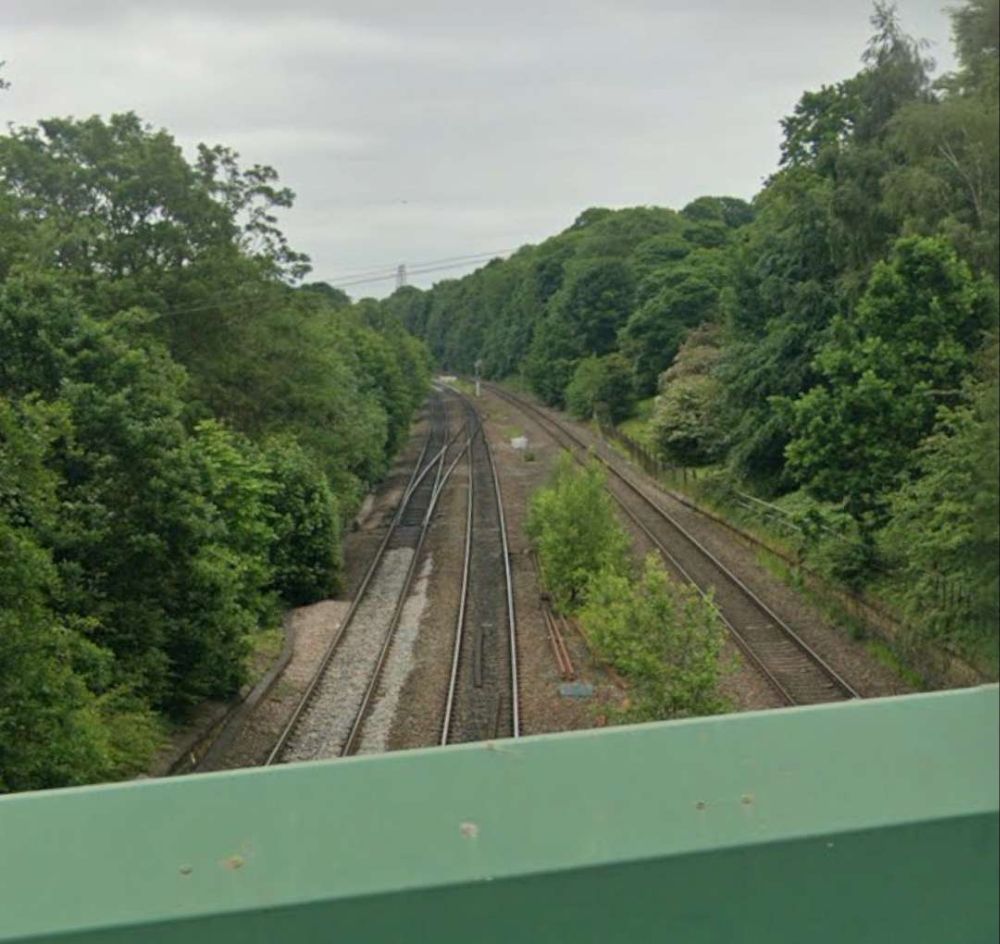
The view East from Calder Road showing Ravensthorpe Station with the Manchester & Leeds line heading away to the right of the picture. [Google Streetview, May 2023]

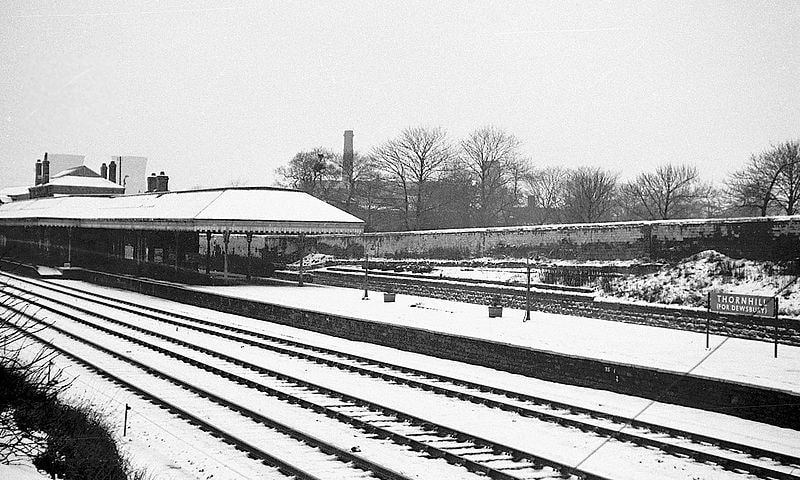
Thornhill Railway Station was a short distance further East just beyond the junction where the Ravensthorpe Branch met the main line at Thornfield Junction.

Thornfield Junction, Goods Yard and Station as shown on the 25″ Ordnance Survey of 1905. [40]
Thornhill Station opened with the Manchester & Leeds Railway and only closed on the last day of 1961, a short time before Beeching’s closure of of Dewsbury Central. [37]
The same station looking East towards Wakefield, Normanton etc. In the background is the bridge of the ex-Midland branch from Royston to Dewsbury (Savile Town), closed 18/12/50, (c) Ben Brooksbank and licenced for reuse under a Creative Commons Licence (CC BY-SA 2.0). [38]
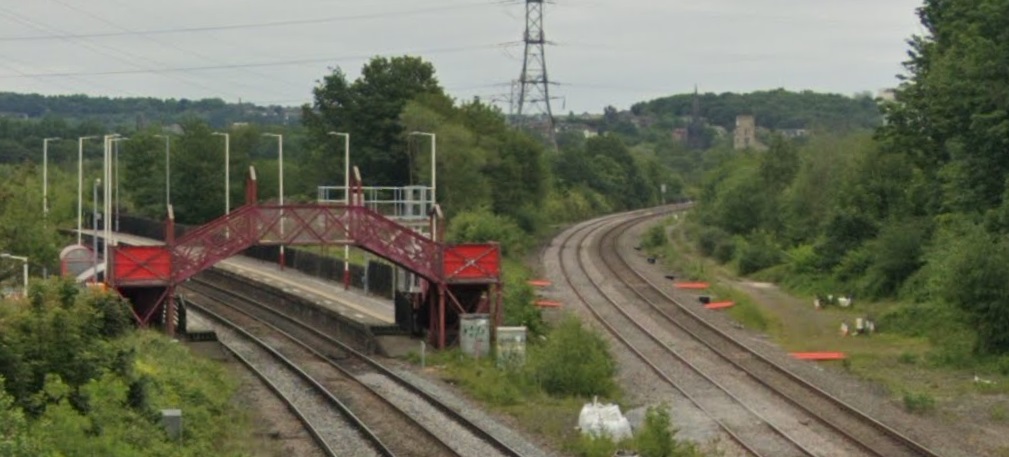
The view West from Station Road in the 21st century, through what was Thornhill Railway Station. {Google Streetview, March 2023]
The view East from Station Road in the 21st century. The bridge ahead carries Headfield Road over the railway. [Google Streetview, March 2023]
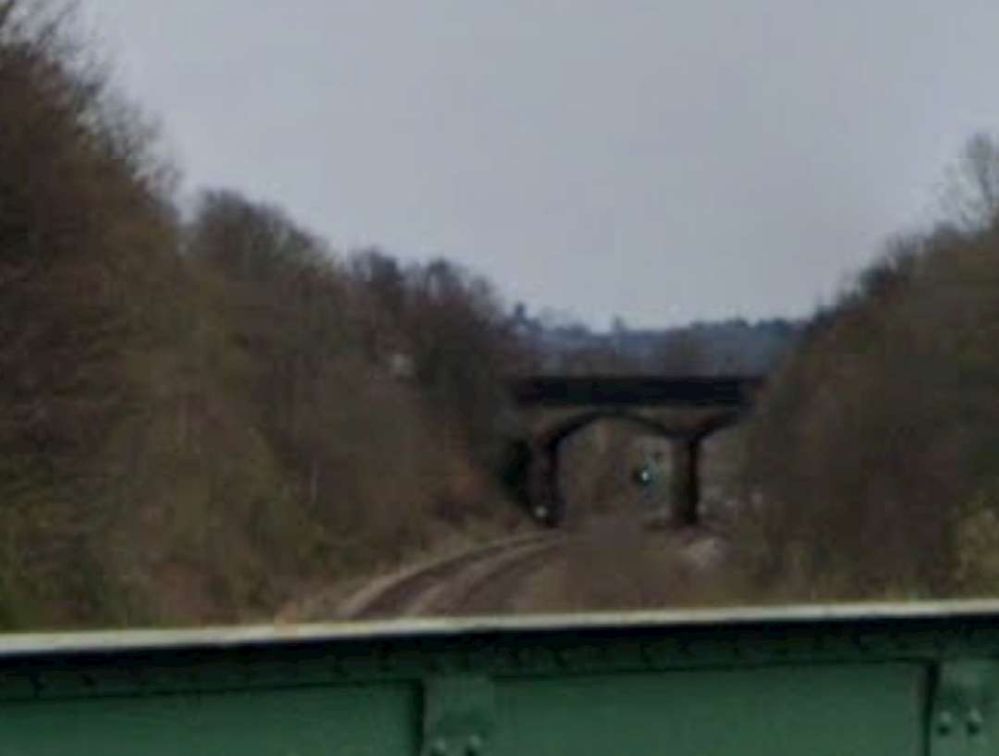
The view West from Headfield Road Bridge towards the site of the erstwhile Thornhill Railway Station and Station Road. [Google Streetview, October 2022]
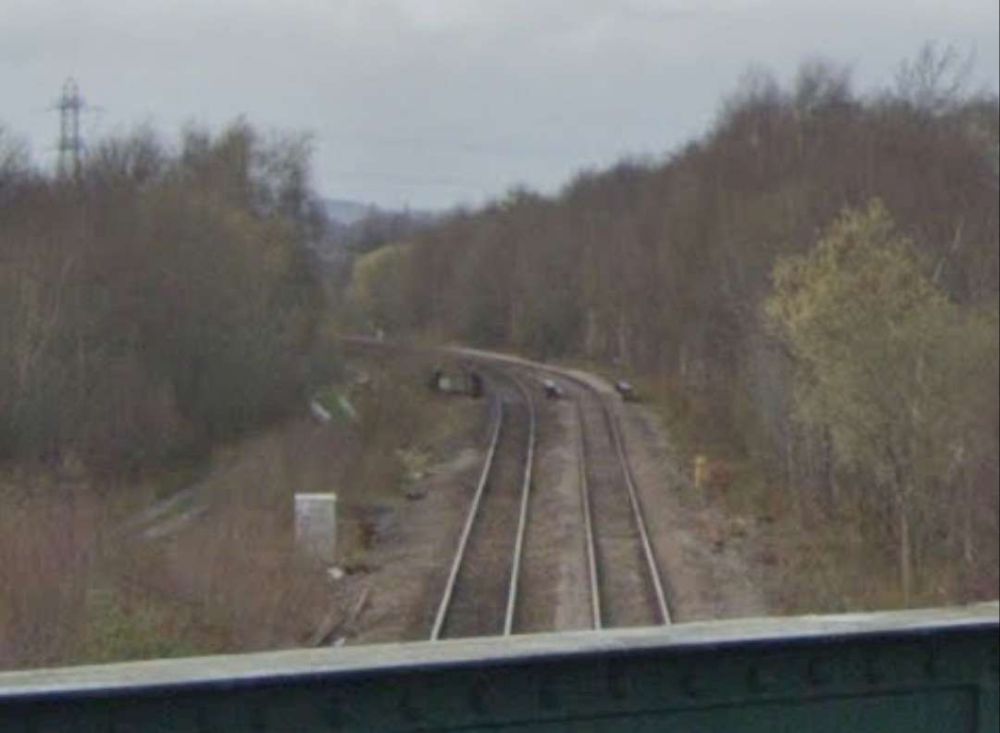
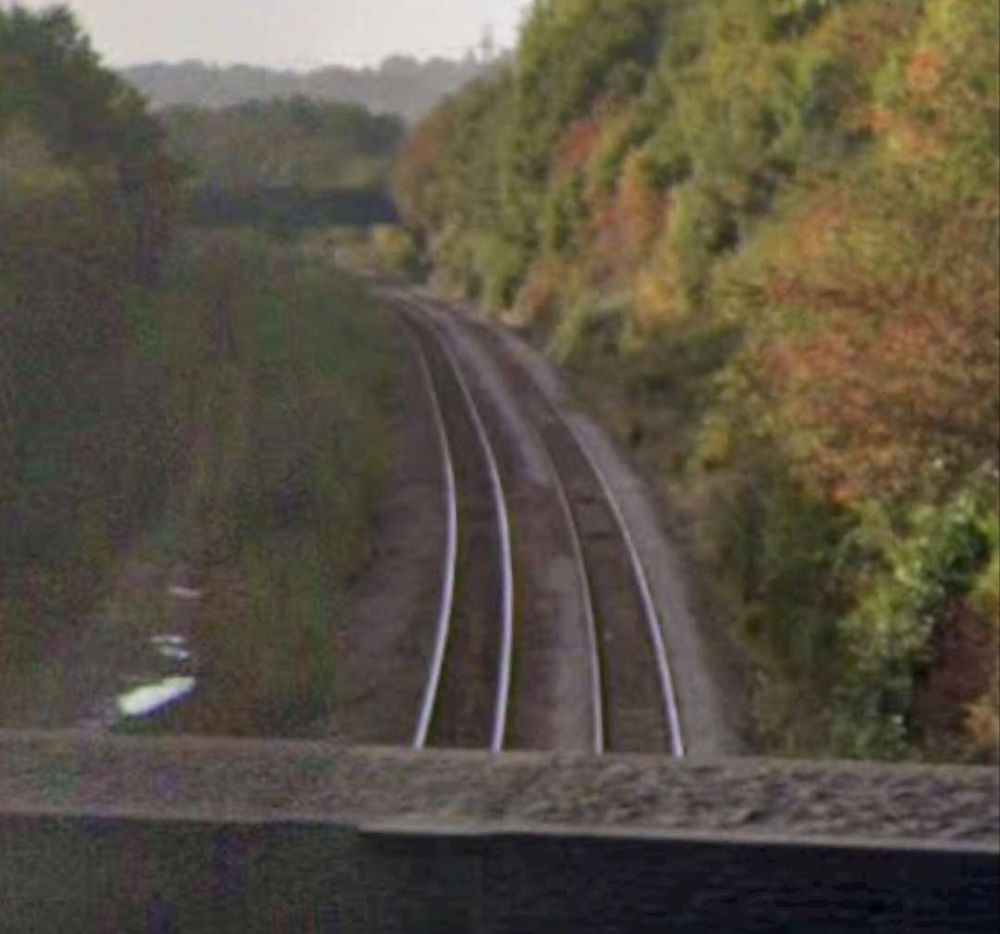
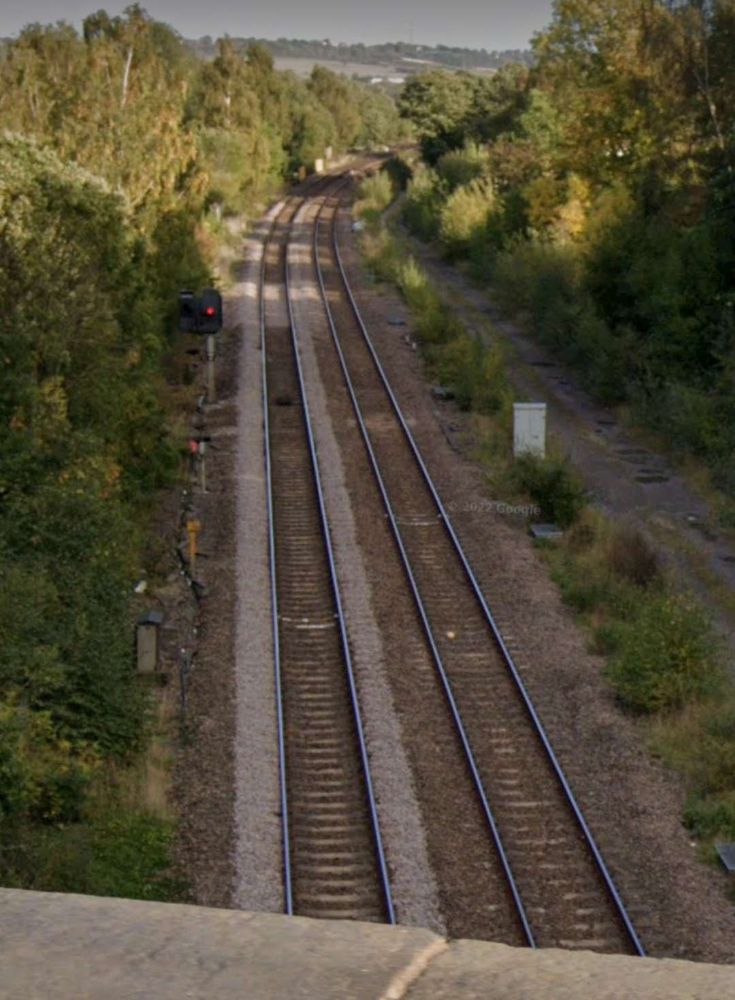
The view East from Headfield Road Bridge. [Google Streetview, October 2022]

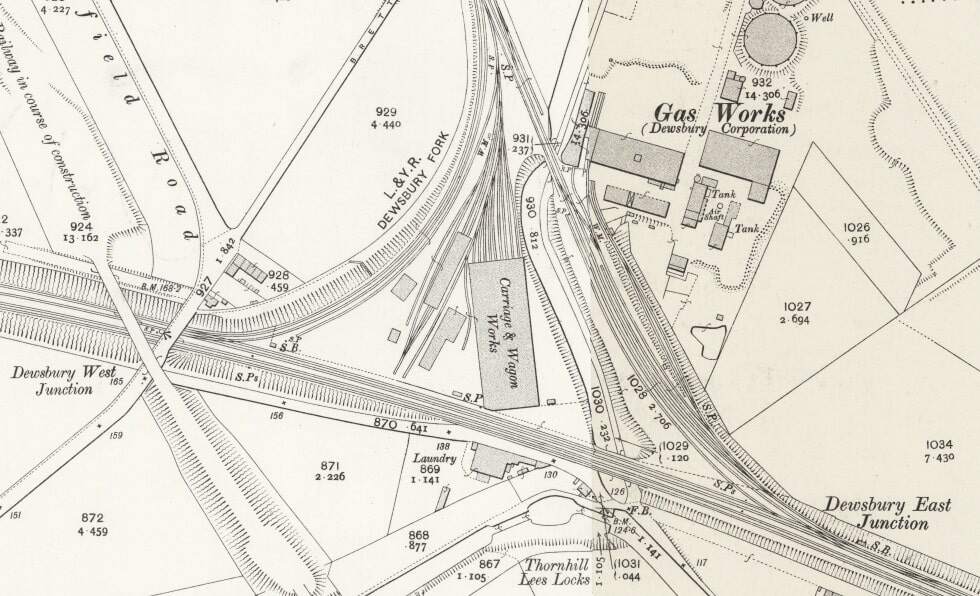
East of Thornhill Station were Dewsbury West and Dewsbury East junctions which together with Headfield Junction formed a triangular access to Didsbury Market Place Station. This was a busy location which sat close to Dewsbury Gas Works, Thornhill Carriage and Wagon Works and Thornhill Lees Canal Locks and a canal branch.  Just off the North of the map extract below was a further junction giving access to the GNR’s Headfield Junction Branch, before the line crossed the River Calder and entered Dewsbury Market Place Station and Yard and terminated there.

This extract from the 25″ Ordnance Survey of 1905 shows the triangular junction which provided access to Dewsbury Market Place Station and a series of Goods Yards and Sheds. Headfield Road is on the left side of this image. [41]
A similar area in the 2st century as it appears on Google Maps satellite imagery. [Google Maps, October 2024]

Dewsbury was very well provided for by both passenger and freight facilities. In its railway heyday the Midland Railway, the London & North Western Railway, the Lancashire & Yorkshire Railway and the Great Northern Railway all had access to the town. A computer drawn map showing the different lines can be found here. [42]

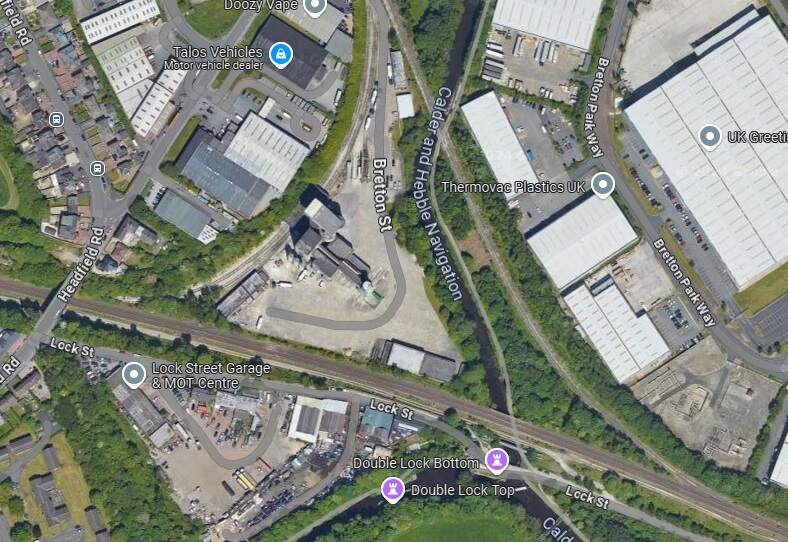
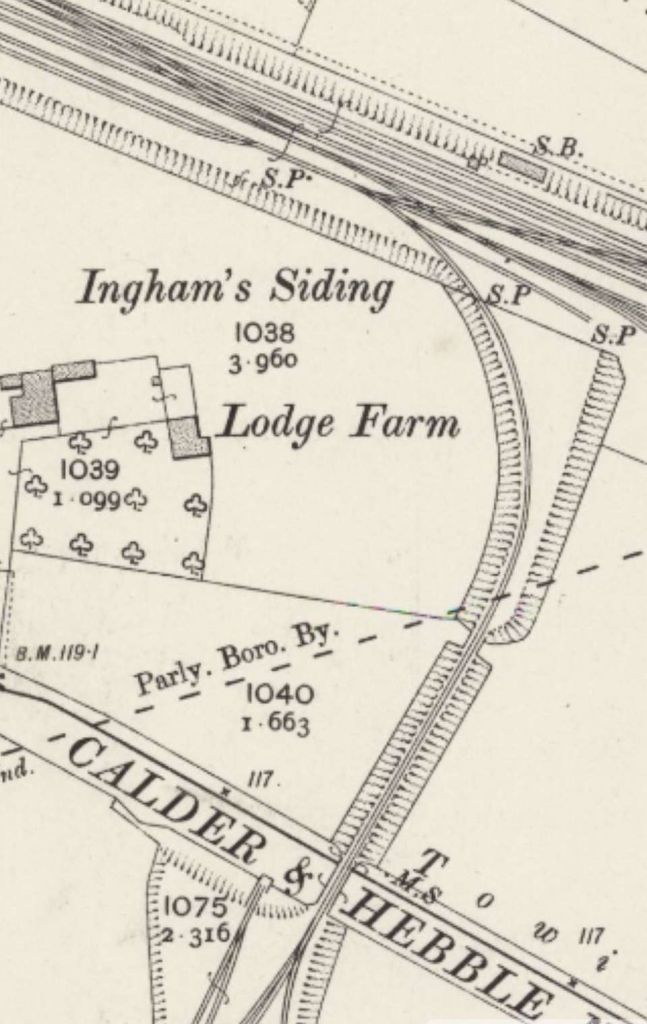
Continuing along the line towards Wakefield and Normanton, the next feature of note is the junction for Combs Colliery’s Mineral Railway at Ingham’s Sidings. Nothing remains of this short branch line.

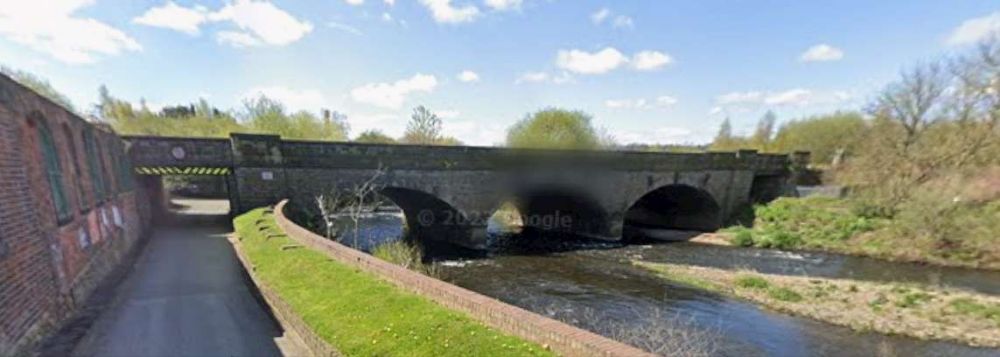
Ingham’s Siding ran South, crossing the Calder & Hebble Navigation to reach Comb’s Colliery. [43]

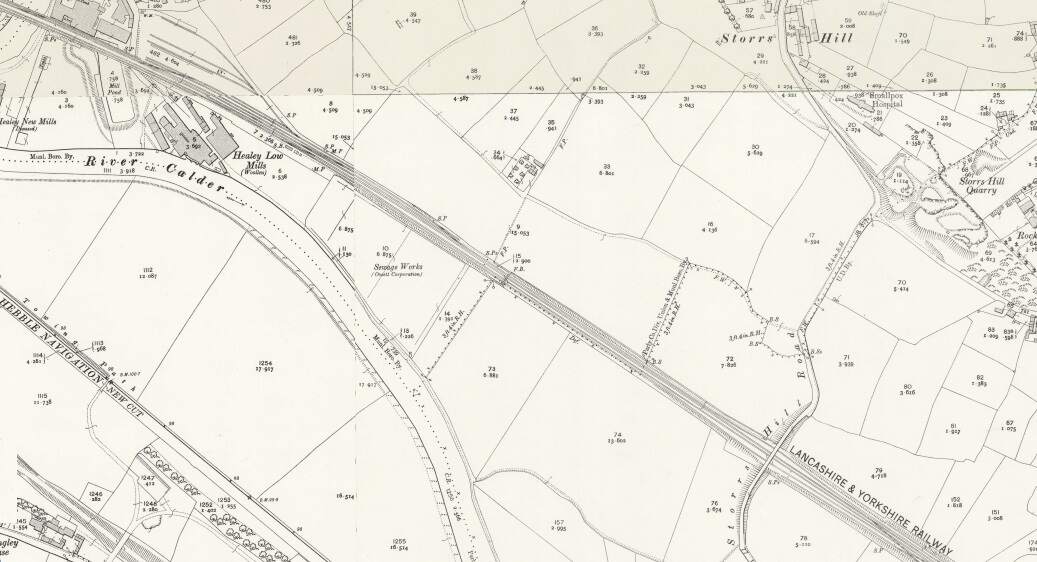
Further East the line continues in a straight line East-southeast to cross the River Calder once again. It then passes the Calder Vale and Healey Low Mills at Healey and runs Southeast to Horbury and Ossett Station.

The bridge over the River Calder adjacent to Calder Vale and Healey Low Mills. [Google Streetview, April 2023]
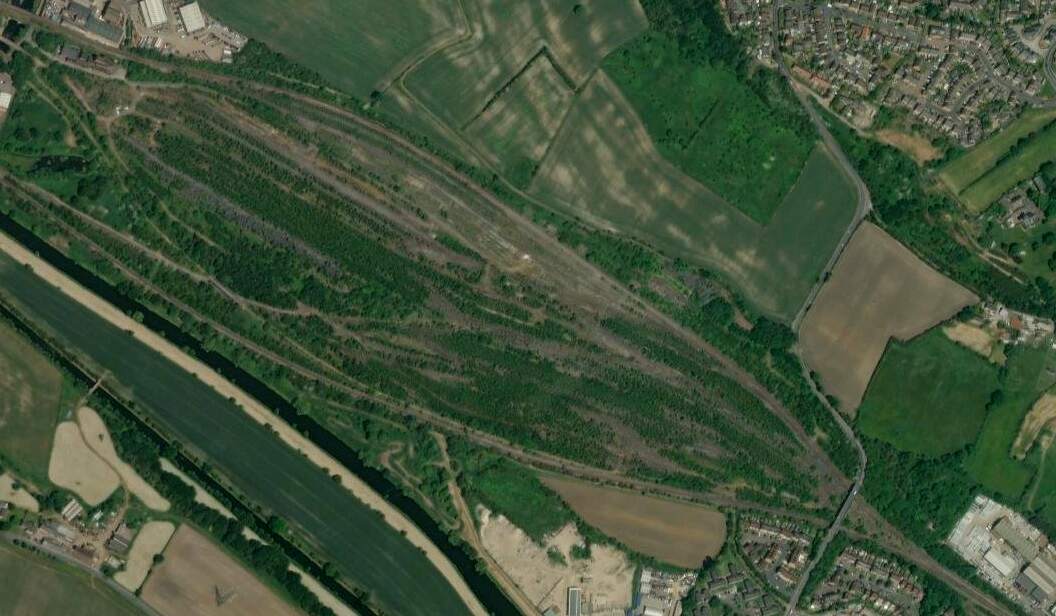
The bridge over the River Calder at Calder Vale and Healey Low Mills is in the top-left of this map extract from the 1905 25″ Ordnance Survey. This area was chosen by British Rail in the 1960s for a large marshalling yard. [46]
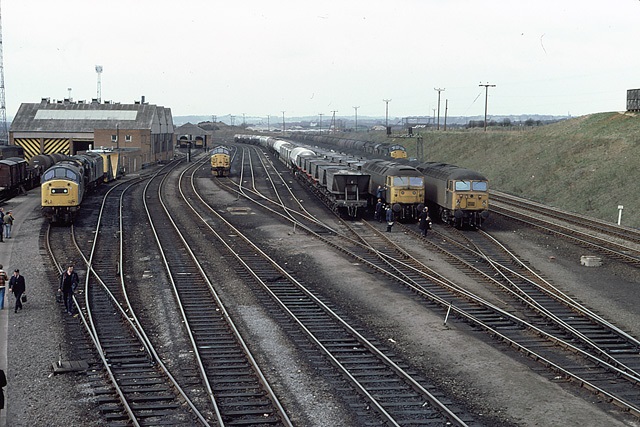
British Railways developed a large marshalling yard in the 1960s at Healey Mills. The yard was opened in 1963 and replaced several smaller yards in the area. It was part of the British Transport Commission’s Modernisation plan, and so was equipped with a hump to enable the efficient shunting and re-ordering of goods wagons. The yard lost its main reason for existence through the 1970s and 1980s when more trains on the British Rail system became block trains where their wagons required less, or more commonly, no shunting. Facilities at the site were progressively run down until it closed completely in 2012. [46][47]
Healey Mills Marshalling Yard in April 1982, (c) Martin Addison and licensed for reuse under a Creative Commons Licence (CC BY-SA 2.0). [48]
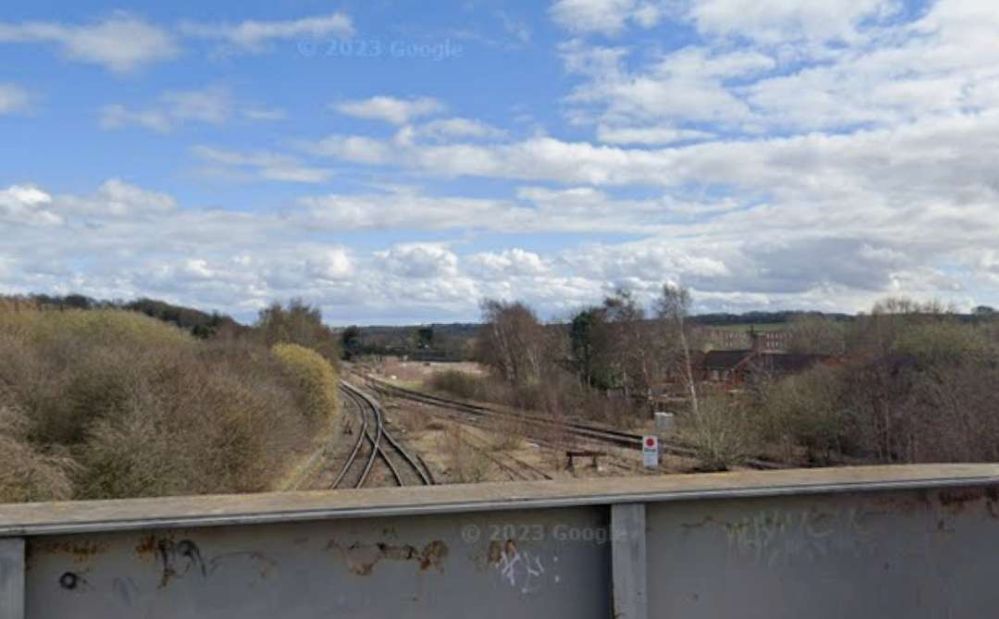
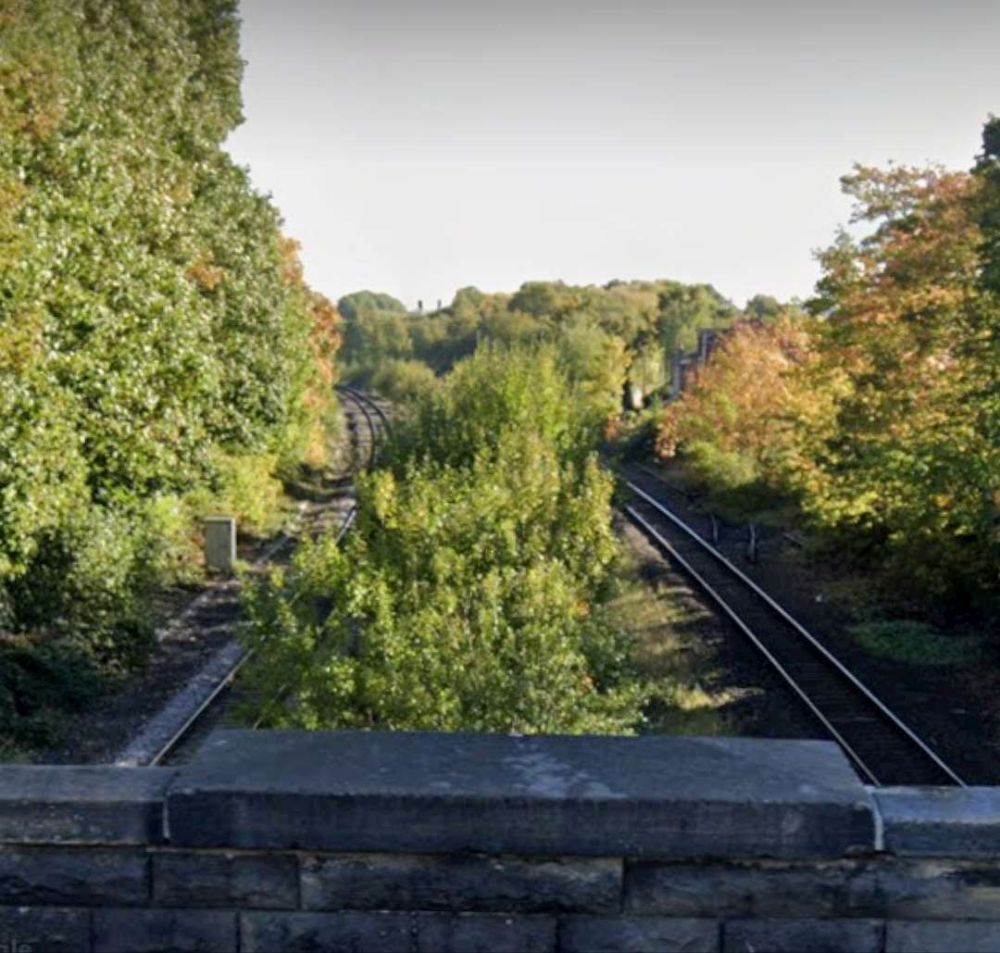
Looking Northwest from Storrs Hill Road Bridge in the 21st century. [Google Streetview, March 2023]
Looking Southeast from Storrs Hill Road Bridge in the 21st century through the throat of the old marshalling yard. [Google Streetview, March 2023]
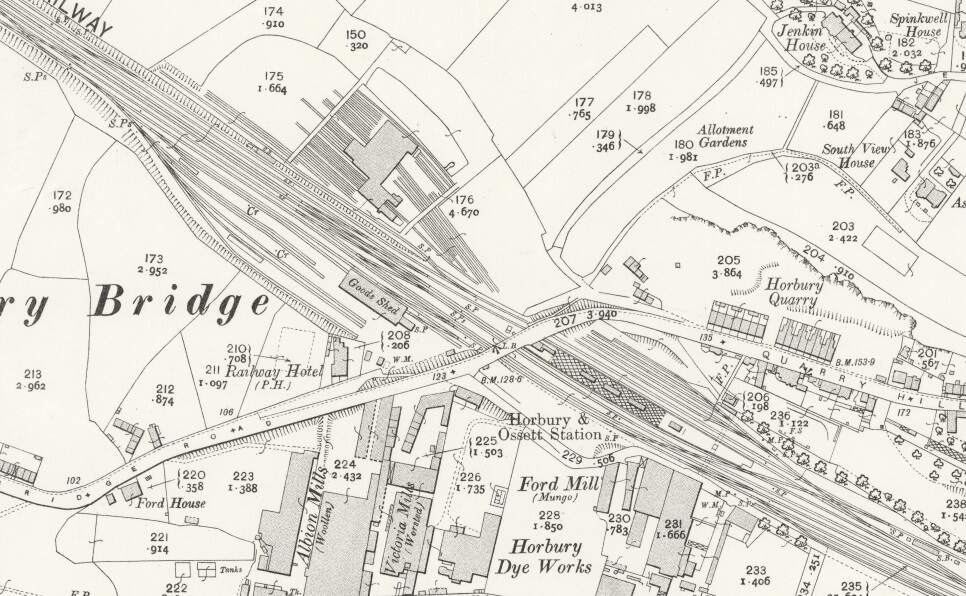
Horbury & Ossett Railway Station. [44]
The site of Horbury & Ossett Railway Station in the 21st century. [Google Maps, October 2024]
Looking Northwest from Bridge Road, A642 towards Storrs Road Bridge. Horbury and Ossett Railway Station goods facilities were on the left. [Google Streetview, July 2024]
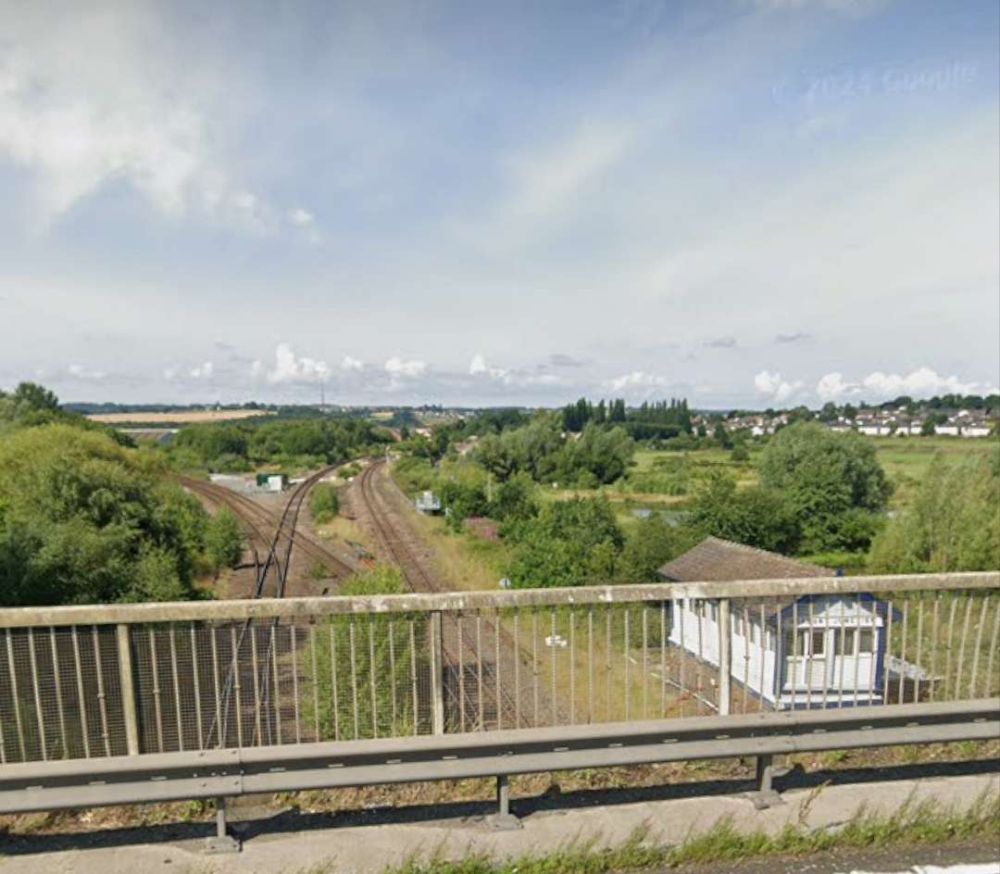
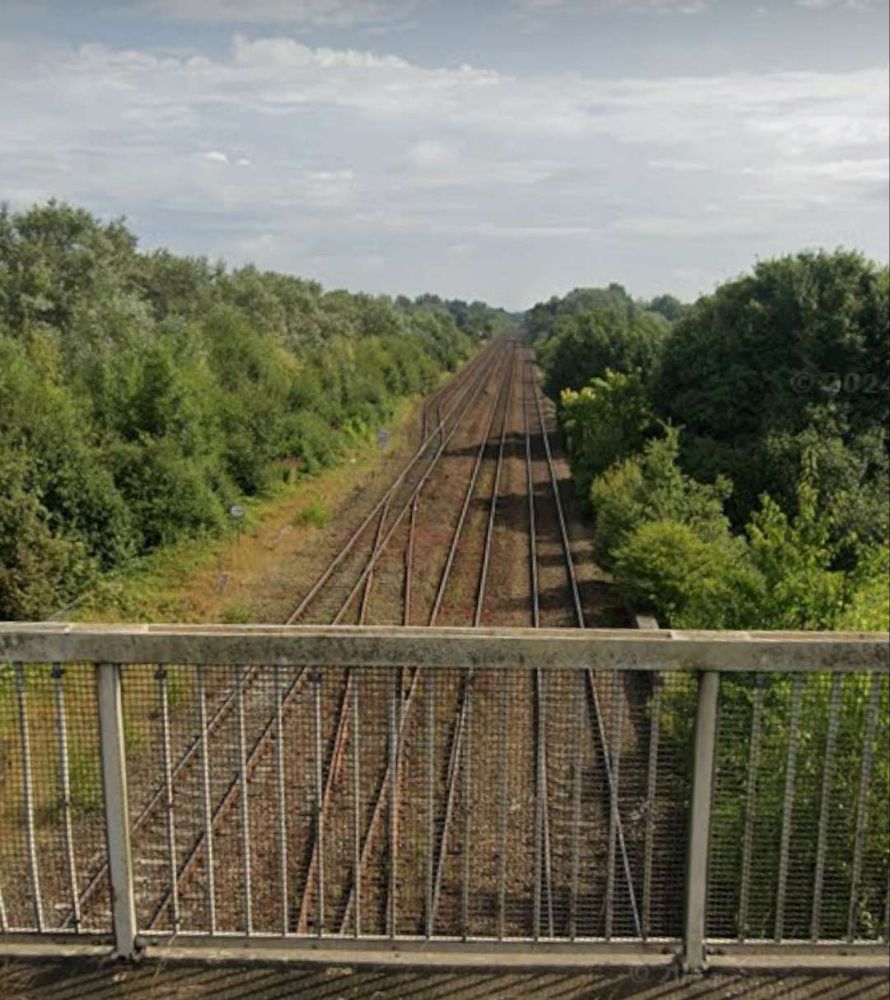
looking Southeast from Bridge Road. the passenger facilities were on the Southeast side of Bridge Road with the platform sat between the running lines. [Google Streetview, July 2024]

Horbury and Ossett railway station formerly served the town of Horbury. … The station was opened with the inauguration of the line in 1840, on the west of the Horbury Bridge Road, to the south-west of the town. Later a new, more substantial structure was built just to the east. … British Railways developed a large marshalling yard in the 1960s at Healey Mills immediately to the west of the original station. … [The station] closed in 1970. Almost all that remains is the old subway which ran under the tracks. Ossett is now the largest town in Yorkshire without a railway station. Proposals to open a new one are periodically canvassed, perhaps on part of the Healey Mills site.” [45]

A little further East is Horbury Fork Line Junction where a mineral railway runs South to Harley Bank Colliery and the Horbury & Crigglestone Loop leaves the Manchester to Leeds line.

Horbury Fork Line Junction on the 1905 25″ordnance Survey. The junction sat just to the West of Horbury Tunnel. That tunnel has since been removed. [49]
The same location in the 21st century. The tunnel sat to on the East side of the present footbridge which is just to the left of the centre of this image. This image is an extract from the NLS’ ESRI satellite imagery. [49]

These next few photographs show views of the line from a series of three overbridges to the East of Horbury Fork Line Junction.

The view West from Southfield Lane Bridge. [Google Streetview, October 2022]
The view East from Southfield Lane Bridge. [Google Streetview, October 2022]
The view West from Dudfleet Lane Bridge towards Southfield Lane Bridge. [Google Streetview, October 2022]
The view East from Dudfleet Lane Bridge towards Millfield Road Bridge. [Google Streetview, October 2022]
The view West from Millfield Road Bridge towards Dudfleet Lane Bridge. [Google Streetview, October 2022]
The view East from Millfield Road Bridge. [Google Streetview, October 2022]

The next significant location on the line is Horbury Junction.

Horbury Junction on the 1905 25″ordnance Survey. Horbury Junction Ironworks sat in-between the Manchester and Leeds Railway and the. There was a Wagon Works just off the South edge of this image. The line heading South from Horbury Junction was the L&YR line to Flockton Junction and beyond. [50]
The same location in the 21st century as shown on the ESRI satellite imagery provided by the NLS.. [50]

Industrialisation in the immediate area of Horbury Junction began “in the early 1870s with the construction of Millfield Mill, followed by the Horbury Ironworks Co. In 1873, Charles Roberts bought a site for a new factory at Horbury Junction and moved his wagon building business from Ings Road, Wakefield to Horbury Junction. Before that, the area of Horbury Junction was a quiet backwater with a corn mill and a ford across the Calder for farm traffic.” In reality, a beautiful pastoral area of countryside was changed forever with the coming of the Railway, Millfield Mill, the Wagon Works and the Ironworks.” [51]

In the 21st century, just beyond Horbury Junction, the line is crossed by the M1.

In the 21st century, just beyond Horbury Junction (on the left of this extract from Google Maps), the line is crossed by the M1. [Google Maps, October 2024.

Horbury Junction seen, looking Southwest from the M1. [Google Streetview, July 2024]
Looking Northeast from the M1. [Google Streetview, August 2024]
Green Lane Underpass seen from the North. This underpass sits just to the East of the modern M1. [Google Streetview, October 2008]

Following the line on to the Northeast, it next passes through Thornes.

The railway bridge at the centre of Thornes in 1905. [52]
The same location in the 21st century. The now quadruple line is carried by two separate bridges. [52]
Thorne Bridge seen from the South in June 2024. [Google Streetview, June 2024]

Northeast of Thornes, the Manchester and Leeds Railway ran at high level into Kirkgate Joint Station in Wakefield.

The bridge carrying the line over Kirkgate. [All three images from Google Streetview April 2023]
The Manchester and Leeds Railway enters this extract from the 1905 25″ Ordnance Survey bottom-left, To the North of it id the GNR Ings Road Branch. To the South of it is a Goods Yard with access to Wakefield’s Malthouses and Mark Lane Corn Mill. [53]
The same area in the 21st century. The rail lines remain approximately as on the map extract above. Wakefield Kirkgate Station (top-right) is somewhat reduced in size. Much of the built environment is different to that shown on the map above. This image is another extract from the ESRI satellite imagery. [53]

Wikipedia tells us that once it was opened by the Manchester and Leeds Railway in 1840, Kirkgate station was “the only station in Wakefield until Westgate was opened in 1867. The railway station building dates from 1854. … Some demolition work took place in 1972, removing buildings on the island platform and the roof with its original ironwork canopy which covered the whole station. A wall remains as evidence of these buildings. After this, Kirkgate was listed in 1979.” [72]

Kirkgate Station was refurbished in two phases between 2013 and 2015. [72]

The view westward on 29th July 1966, through Kirkgate Station towards Mirfield, The locomotive is LMS Fairburn class 4MT 2-6-4T No. 42196 (built 3/48, withdrawn 5/67), © Ben Brooksbank and licensed for reuse under a Creative Commons Licence (CC BY-SA 2.0). [74]

A series of modern images of Kirkgate Station are shared below

The images of Kirkgate Station above are:

  1. The support wall to the overall roof which was retained in the 1972 reordering and which has been refurbished in the 21st century, © Rept0n1x and licenced for reuse under a Creative Commons Licence (CC BY-SA 3.0). [72]
  2. The modern road approach to the station buildings, © Alan Murray-Rust and licensed for reuse under a Creative Commons Licence (CC BY-SA 2.0). [72]
  3. A Pacer DMU at Wakefield Kirkgate platform one in May 2006, (c) Ian Kirk and licenced for reuse under a Creative Commons Licence, (CC-By 2.5). [72]
  4. The recently refurbished front façade of Kirkgate Railway Station, © Groundwork Landscape Architects. [73]
East of Kirkgate Joint Station in 1905. The landscape in Primrose Hill is dominated by the railway. The line exiting to the South of this extract is the L&YR Oakenshaw Branch which crosses the River Calder and runs past the station’s Engine Sheds. [54]
the same area in the 21st century, much of the railway infrastructure has disappeared and is beginning to be taken over by nature. [54]

Just to the East of Wakefield Kirkgate Station were Park Hill Colliery Sidings.

Much the same area in the 21st century. The Midland’s lines South of Goosehill have gone, the footbridge remains but the large area of sidings to the Northeast of the Junction have also gone. [56]
Park Hill Colliery Sidings and the River Calder in 1913. [55]
The same location in the 21st century. [55]

And beyond those sidings a further crossing of the River Calder.

The three arched stone viaduct across the River Calder. This photograph is taken from Neil Fox Way and looks Southeast towards the bridge. [Google Streetview, June 2024]

Just a short distance further along the line, at Goosehill, the Manchester and Leeds Railway (by 1905, The Lancashire and Yorkshire Railway) joined the North Midland Railway (by 1905, The Midland Railway)

Goosehill Bridge and Junction witht he Midland Railway entering from the bottom of the extract and the Manchester 7 Leeds entering from the bottom-left. [56]
Immediately to the Northeast of the last extract from the 1905 25″ Ordnance Survey, the Midland’s lines can be seen heading Northeast with branches off to the North and West. The branch heading away to the West is the St. John’s Colliery line running to wharves at Stanley Ferry. That to the North runs through the screens and serves St. John’s Colliery itself. [57]
The same area in the 21st century. The roadway crossing the railway and heading off the satellite image to the West runs to a large opencast site. [57]
Looking Southwest from the bridge carrying the access road to the opencast site. [Google Streetview, May 2023]
Looking Northeast from the bridge carrying the access road to the opencast site. [Google Streetview, May 2023]
Looking Southwest from the Newlands Lane Bridge. [Google Streetview, May 2023]
Looking Northeast from Newlands Lane Bridge. [Google Streetview, May 2023]

From this point on the traffic from the Manchester and Leeds Railway ran on North Midland (later Midland) Railway metals, via Normanton Railway Station and then passing Silkstone and West Riding Collieries, and on towards Leeds, approaching Leeds from the Southeast. Normanton Station appears on the map extract below.

An smaller scale extract from the 25″ Ordnance Survey of 1905 which shows Normanton and its railway station. St. John’s Colliery and Gooshill Junction are just of the extract on the bottom left. [58]
Looking Southwest from Altofts Road Bridge through the site of Normanton Railway Station. [Google Streetview, April 2023]

Rake’s last words on a journey along the railway are these: “Just previous to reaching Wakefield, the railway is carried over a viaduct of 16 arches, and, quitting that station it enters a deep cutting, and crosses the Vale of Calder for the last time, a little to the east of Kirkthorpe. Here was the most important diversion of the Calder, by which the cost of building two bridges was saved. … The line terminated by a junction with the North Midland Railway, a mile to the north of which point was situated the Normanton Station, where the York and North Midland, and by its means, the Leeds and Selby and Hull and Selby Railways united with the former lines. The remainder of the journey to Leeds, 9 miles, was traversed on the North Midland Railway.” [1: p472]

Rake goes on to talk about the gradients of the railway which “were considered somewhat severe. Starting from Manchester, the line ascends to Rochdale, 10 miles, over a series of inclinations averaging about 1 in 155; from Rochdale to the summit level, 6½ miles, the ascent is 1 in 300; the total rise from Manchester being 351 ft. From the summit level plane, which extends for 1 mile 55 chains, to Wakefield, a distance of 30 miles, the line descends for the first six miles on a gradient of 1 in 182, after which it is continued by easy grades of an average inclination of 1 in 350. Below Wakefield a comparatively level course is maintained to the junction with the North Midland Railway, the total fall from the summit being 440 ft. The curves were laid out so as not to be of a less radius than 60 chains. The gauge adopted on the Manchester and Leeds Railway was 4 ft. 9 in., to allow a in. play on each side for the wheels. … The rails were of the single parallel form, in 15 ft. lengths, with 3 ft. bearings, and were set in chairs, to which they were secured by a ball and key, as on the North Midland Railway. The balls, (3/4  in. diameter), were of cast iron, and fitted into a socket formed in one side of the stem of the rail; the key, which was of wrought iron, was 8 in. long (and 5/8 in. wide at one end, from which it tapered to 3/8 in. at the other end). … Stone blocks were used where they could be obtained from the cuttings, and were placed diagonally, but sleepers of kyanised larch were used on the embankments, the ballasting being of burnt and broken stone.” [1: p472-473]

It is interesting to note that the tramway/tramroad practice of using stone blocks as sleepers was in use when this railway was first built!

Rake continues: “The Manchester terminal station was located between Lees Street and St. George’s Road, and was entirely elevated on arches. The passenger shed was covered with a wooden roof, in two spans, and the whole length of the station was 528 ft. The passenger platform was approached by a flight of 45 steps from the booking-office on the ground floor. [1: p473]

Early signals on the Manchester and Leeds.Railway which became part of the Lancashire & Yorkshire Railway network. [64]

The signals were of the horizontal double disc or spectacle form which, when revolved to the extent of a half circle, caused both discs to be invisible to the driver and indicated all right, the lamp above showing, when illuminated, green; the colour shown by the lamp when both discs were crosswise to the line being red.” [1: p473]

Rolling Stock

The carriages consisted of three classes, The first class, in three compartments, upholstered, and fitted with sash windows painted blue; second-class, in three compartments, but open at the sides and furnished with wooden sliding shutters painted yellow; and carriages termed  ‘mixed’, in which the middle compartment was for first-class, and each of the ends was for second-class passengers. There was also a carriage of novel construction, built according to the plan of the chairman of the company and used at the opening of the line. The under-framing was of the usual construction, but the body was unique. The floor was considerably wider than ordinary, and the sides curved outwards until they joined a semicircular roof, the greater part of which was fitted with wire gauze to give air, but capable of being instantaneously covered with waterproof material, by the action of an inside handle, so that sun and rain could be shaded out at pleasure. The sides were fitted throughout with plate glass, and ranges of seats occupied the floor, having passages on either side. Tents were also contrived in the sides which closed at will by spring action. The effect of the interior was said to resemble the interior of a conservatory! These carriages were in each case mounted on four wheels, with a perforated footboard of iron running the whole length of the body, in substitution for the lower tier of steps in use on other railways at the time.” [1: p473-474]

I have produced Rake’s description of this ‘unusual carriage’ as I have found it impossible to imagine what it looked like from Rake’s word-picture.

At the end of 1840, “an improved form of third-class carriage was constructed, in which each wheel was braked; the brake levers were attached to the axle-boxes and, consequently, when applied by the guard. who sat on the roof, did not bring the body of the carriage down on to the springs, The buffing springs were placed in front of the headstocks, and a flat iron bar attached to the buffer worked in brackets on the sole bar. The doors were fitted with latches on the outside, which were fastened by the guard when the passengers were inside.” [1: p474]

An improved third class carriage. Looking back from a 21st century perspective, these carriages seem to be not much better than the wagons used to carry livestock. This is borne out by Rake’s notes below. It was, however, a significant improvement on the open wagons, having a roof, glass windows and brakes. Contrary to what Rake appears to say below, Wells suggests that these covered third class wagons did have seating. [1: p474][75: p85]

The windows and the doors being fixed, no passenger could open the door until the guard had released the catch. Roof lamps were not provided in these coaches, which were painted green. … The third-class carriages. or rather, wagons, were provided with four entrances, to correspond with the “pens” into which they were sub-divided by means of a wooden bar down the centre, crossed by another bar intersecting the former at right angles in the middle of its length. There were no seats, and the number of passengers for which standing room could be found was limited solely to the to the bulk Stanhope or ‘Stan’ups’, as they were derisively termed. The contrivance of pens was said to be due to a determination to prevent respectably dressed individuals from availing themselves of the cheaper mode of conveyance, in which there was little to distinguish them, it was complained, ‘from the arrangements for the conveyance of brute beasts which perish’. The company’s servants were strictly enjoined “not to porter for wagon passengers‘!” [1: p474]

Rake’s illustration of an early Manchester and Leeds Railway first class coach. [1: p474]

Further details of Rolling Stock on the Railway can be found in Jeffrey Wells book about the line. [75: p81-85]

Locomotives

Rake tells us that the locomotives were all mounted on 6 wheels and purchased from Sharp, Roberts & Co., Robert Stephenson & Co., and Taylor & Co. They all had 14 in. diameter, 18 in. stroke cylinders and 5 ft. 6 in. diameter driving wheels. Jeffrey Wells provides a more comprehensive, tabulated, list of those early locomotives. [75: p79-80]

A typical 0-4-2 Locomotive of 1839/1840. [76]
An early (1834) R. Stephenson & Co. 0-4-2 locomotive of very similar design to those supplied to the Manchester and Leeds Railway 9c0 Public Domain. [77]

The first three 0-4-2s were made by Robert Stephenson & Co., and that company supplied plans and specifications for its locomotives which meant that The Manchester and Leeds Railway could have the same design manufactured by other firms of the Company’s choice. The first 12 locomotives built for the Manchester and Leeds in 1839 were all to Stephenson’s 0-4-2 design. Wells tells us that of these locomotives, the first three (Nos. 1 -3) were called Stanley, Kenyon and Stephenson and were built by R. Stephenson & Co. They were supplied to the Railway in April and May 1839. [75: p79]

The next three locomotives (Nos. 4-6) were supplied by Sharp Bros., Manchester. Lancashire and Junction were supplied in May 1839 and York in July 1839. Nos. 7, 9 and 10, named respectively, Rochdale (16th July), Bradford (6th September) and Hull (7th September)came from Naysmith & Co., Patricroft. Nos. 8, 11, 12 (Leeds, Scarborough and Harrogate) were supplied by Shepherd & Todd by September 1839. [75: p79]

Wells comments that No. 1, ‘Stanley’ “was named after Lord Stanley, Chairman of the House of Commons Committee who supported the Manchester and Leeds Railway Bill in 1836. … Other Stephenson designs followed: 19 engines, numbered 15 to 40, of the 2-2-2 wheel arrangement were delivered between October 1840 and April 1842. These were recommended by Stephenson to work the eastern section of the line, between Sowerby Bridge and Wakefield, thus gradually removing the [Manchester and Leeds Railway’s] reliance on North Midland Railway motive power which had at first prevailed from late in 1840.” [75: p80]

R. Stephenson patented 2-2-2 locomotive No. 123 ‘Harvey Combe’ built 1835, from Simm’s ‘Public Works of Great Britain’, 1838. This locomotive is of a very similar design to those supplied by various manufacturers to the Manchester and Leeds Railway in 1840-1842. These were given the Nos. 15-40 and were supplied by Charles Tayleur & Co., Rothwell & Co., Laird Kitson & Co., Sharp Bros., Naysmith & Co., and W. Fairburn & Co., (c) C. F. Cheffins, Public Domain. [78]

He continues: “Once again several manufacturers were involved in the supply of these locomotives. Goods engines were represented by a further batch of 0-4-2s; 13 were delivered (Nos 33 to 46) between April 1841 and June 1843, the three manufacturers involved being R. Stephenson & Co., Haigh Foundry, Wigan, and William Fairbairn & Co. of Manchester. … Three standard Bury-type 0-4-0s were the last engines to be delivered (Nos 47 to 49) the first two bearing the names West Riding Union and Cleckheaton respectively. All three were completed between November 1845 and January 1846 by the firm of Edward Bury of Liverpool.”

And finally. …

Rake concludes his article, the first to two about the line in The Railway Magazine (I currently only have access to this first article) with two short paragraphs. The first reflects on policing: “There were no police on the railway, the whole of the platelayers being constituted as constables on the completion of the first section of the line; and, we are afterwards told, that ‘the vigilance resulting from the pride these men take, in being thus placed in authority, had been found to supersede the necessity of any more expensive system of surveillance.'” [1: p474]

The second notes that: “The directors [were] very anxious to complete the railway as far as Rochdale, at the earliest possible time, and on the 4th July, 1839, it was opened through that town to Littleborough, a distance of about 14 miles, the event ‘exciting a most extraordinary degree of local interest and wonder’ we are told.” [1: p474]

References

  1. Herbert Rake; The Manchester and Leeds Railway: The Origin of the Lancashire and Yorkshire Railway; in The Railway Magazine, London, December 1905, p468-474
  2. https://www.geograph.org.uk/photo/820318, accessed on 23rd September 2024.
  3. https://premierconstructionnews.com/2016/04/14/summit-tunnel, accessed on 23rd September 2024.
  4. https://en.m.wikipedia.org/wiki/Summit_Tunnel, accessed on 23rd September 2024.
  5. https://commons.m.wikimedia.org/wiki/File:Gauxholme_Bridge,_Todmorden.jpg, accessed on 23rd September 2024.
  6. https://www.yorkshirepost.co.uk/news/opinion/columnists/trans-pennine-rail-in-the-age-of-victoria-1807452, accessed on 23rd September 2024.
  7. https://www.geograph.org.uk/photo/504379, accessed on 23rd September 2024.
  8. https://maps.nls.uk/geo/explore/#zoom=17.9&lat=53.71428&lon=-2.09924&layers=168&b=ESRIWorld&o=100, accessed on 23rd September 2024.
  9. https://maps.nls.uk/geo/explore/#zoom=18.9&lat=53.70635&lon=-2.10701&layers=168&b=ESRIWorld&o=100, accessed on 23rd September 2024.
  10. https://maps.nls.uk/geo/explore/#zoom=16.9&lat=53.71706&lon=-2.09298&layers=168&b=ESRIWorld&o=100, accessed on 23rd September 2024.
  11. https://maps.nls.uk/geo/explore/#zoom=17.1&lat=53.73968&lon=-2.03054&layers=168&b=ESRIWorld&o=100, accessed on 23rd September 2024.
  12. https://maps.nls.uk/geo/explore/#zoom=16.5&lat=53.73833&lon=-2.00992&layers=168&b=ESRIWorld&o=100, accessed on 23rd September 2024.
  13. https://maps.nls.uk/geo/explore/#zoom=16.1&lat=53.73044&lon=-1.98307&layers=168&b=ESRIWorld&o=100, accessed on 23rd September 2024.
  14. https://maps.nls.uk/geo/explore/#zoom=16.1&lat=53.72280&lon=-1.94806&layers=168&b=ESRIWorld&o=100, accessed on 23rd September 2024.
  15. https://maps.nls.uk/geo/explore/#zoom=16.8&lat=53.70808&lon=-1.91151&layers=168&b=ESRIWorld&o=100, accessed on 23rd September 2024
  16. https://commons.wikimedia.org/wiki/File:Mytholmroyd_3.jpg, accessed on 24th September 2024.
  17. https://en.wikipedia.org/wiki/Luddendenfoot_railway_station, accessed on 24th September 2024.
  18. https://www.geograph.org.uk/photo/4500324, accessed on 24th September 2024.
  19. https://en.wikipedia.org/wiki/Mytholmroyd_railway_station#/media/File:Mytholmroyd_railway_station,_November_2020.jpg, accessed on 24th September 2024.
  20. https://commons.wikimedia.org/wiki/File:Todmorden_station_p2.jpg, accessed on 24th September 2024.
  21. https://maps.nls.uk/geo/explore/#zoom=17.0&lat=53.61032&lon=-2.15338&layers=168&b=ESRIWorld&o=100, accessed on 24th September 2024.
  22. https://www.geograph.org.uk/photo/2160438, accessed on 24th September 2024.
  23. http://www.halifaxpeople.com/Sowerby-Bridge-Train-Station.html#google_vignette, accessed on 24th September 2024.
  24. https://commons.wikimedia.org/wiki/File:Sowerby_Bridge_stn.jpg, accessed on 24th September 2024.
  25. https://maps.nls.uk/geo/explore/#zoom=17.0&lat=53.70193&lon=-1.88141&layers=168&b=ESRIWorld&o=100, accessed on 24th September 2024.
  26. https://maps.nls.uk/geo/explore/#zoom=17.0&lat=53.69406&lon=-1.85773&layers=168&b=ESRIWorld&o=100, accessed on 24th September 2024.
  27. https://en.wikipedia.org/wiki/Greetland_railway_station, accessed on 24th September 2024.
  28. http://www.halifaxpeople.com/Historic-West-Vale.html, accessed on 24th September 2024.
  29. https://maps.nls.uk/geo/explore/#zoom=17.0&lat=53.69065&lon=-1.84016&layers=168&b=ESRIWorld&o=100, accessed on 24th September 2024.
  30. http://www.halifaxpeople.com/Historic-Elland.html, accessed on 24th September 2024.
  31. https://maps.nls.uk/geo/explore/#zoom=17.0&lat=53.69860&lon=-1.77905&layers=168&b=ESRIWorld&o=100, accessed on 24th September 2024.
  32. https://www.flickr.com/photos/tcs-pics/6805337658, accessed on 24th September 2024.
  33. https://commons.wikimedia.org/wiki/File:Brighouse_station.jpg, accessed on 24th September 2024.
  34. https://maps.nls.uk/geo/explore/#zoom=17.0&lat=53.68478&lon=-1.72933&layers=168&b=ESRIWorld&o=100, accessed on 24th September 2024.
  35. https://www.geograph.org.uk/photo/2151166, accessed on 24th September 2024.
  36. https://www.chiark.greenend.org.uk/~owend/interests/rail/stnpages/mirfield.html, accessed on 20th May 2010.
  37. https://en.wikipedia.org/wiki/Thornhill_railway_station, accessed on 24th September 2024.
  38. https://www.geograph.org.uk/photo/2146249, accessed on 24th September 2024.
  39. https://maps.nls.uk/geo/explore/#zoom=17.0&lat=53.67578&lon=-1.65453&layers=168&b=ESRIWorld&o=100, accessed on 24th September 2024.
  40. https://maps.nls.uk/geo/explore/#zoom=17.0&lat=53.67662&lon=-1.63870&layers=168&b=ESRIWorld&o=100, accessed on 24th September 2024.
  41. https://maps.nls.uk/geo/explore/#zoom=17.0&lat=53.67609&lon=-1.62408&layers=168&b=ESRIWorld&o=100, accessed on 24th September 2024.
  42. http://lostrailwayswestyorkshire.co.uk/Dewsbury.htm, accessed on 26th September 2024.
  43. https://maps.nls.uk/geo/explore/#zoom=17.0&lat=53.67145&lon=-1.61316&layers=168&b=ESRIWorld&o=100, accessed on 27th September 2024.
  44. https://maps.nls.uk/geo/explore/#zoom=17.0&lat=53.65930&lon=-1.56897&layers=168&b=ESRIWorld&o=100, accessed on 27th September 2024.
  45. https://en.wikipedia.org/wiki/Horbury_and_Ossett_railway_station, accessed on 27th September 2024.
  46. https://maps.nls.uk/geo/explore/#zoom=16.0&lat=53.66442&lon=-1.58084&layers=168&b=ESRIWorld&o=0, accessed on 27th September 2024.
  47. https://en.wikipedia.org/wiki/Healey_Mills_Marshalling_Yard, accessed onn 27th September 2024.
  48. https://www.geograph.org.uk/photo/864329, accessed on 27th September 2024.
  49. https://maps.nls.uk/geo/explore/#zoom=17.0&lat=53.65617&lon=-1.55890&layers=168&b=ESRIWorld&o=100, accessed on 27th September 2024.
  50. https://maps.nls.uk/geo/explore/#zoom=17.0&lat=53.65728&lon=-1.53700&layers=168&b=ESRIWorld&o=100, accessed on 30th September 2024.
  51. https://www.horburyhistory.org/Horbury-Junction/, accessed on 30th September 2024.
  52. https://maps.nls.uk/geo/explore/#zoom=17.0&lat=53.66955&lon=-1.50480&layers=168&b=ESRIWorld&o=100, accessed on 30th September 2024.
  53. https://maps.nls.uk/geo/explore/#zoom=17.4&lat=53.67749&lon=-1.49163&layers=168&b=ESRIWorld&o=100, accessed on 30th September 2024.
  54. https://maps.nls.uk/geo/explore/#zoom=17.4&lat=53.67943&lon=-1.48383&layers=168&b=ESRIWorld&o=100, accessed on 30th September 2024.
  55. https://maps.nls.uk/geo/explore/#zoom=17.4&lat=53.68334&lon=-1.47138&layers=168&b=ESRIWorld&o=100, accessed on 30th September 2024.
  56. https://maps.nls.uk/geo/explore/#zoom=17.4&lat=53.69000&lon=-1.43723&layers=168&b=ESRIWorld&o=100, accessed on 2nd October 2024.
  57. https://maps.nls.uk/geo/explore/#zoom=17.4&lat=53.69243&lon=-1.43590&layers=168&b=ESRIWorld&o=100, accessed on 2nd October 2024.
  58. https://maps.nls.uk/geo/explore/#zoom=15.4&lat=53.70320&lon=-1.42452&layers=168&b=ESRIWorld&o=100, accessed on 2nd October 2024.
  59. Embedded link: https://www.flickr.com/photos/neil_harvey_railway_photos/7834033734, accessed on 3rd October 2024.
  60. https://www.invaluable.com/auction-lot/two-albums-containing-300-cards-incl-yorkshire-ox-166-c-6fd4b7e9e0, accessed on 3rd October 2024.
  61. https://www.blipfoto.com/entry/3134415230512138681, accessed on 3rd October 2024.
  62. https://maps.nls.uk/geo/explore/#zoom=17.0&lat=53.69371&lon=-1.76350&layers=168&b=ESRIWorld&o=100, accessed on 3rd October 2024.
  63. https://maps.nls.uk/geo/explore/#zoom=15.0&lat=53.72852&lon=-2.05697&layers=168&b=ESRIWorld&o=100, accessed on 3rd October 2024.
  64. https://igg.org.uk/rail/3-sigs/sigs-1.htm, accessed on 5th October 2024.
  65. https://commons.wikimedia.org/wiki/File:L%26MR_engine_%27Victoria%27.jpg, accessed on 6th October 2024.
  66. https://rogerfarnworth.com/2024/10/06/the-manchester-and-leeds-railway-the-railway-magazine-december-1905-part-1/
  67. http://www.halifaxpeople.com/Sowerby-Bridge-Train-Station.html, accessed on 6th October 2024.
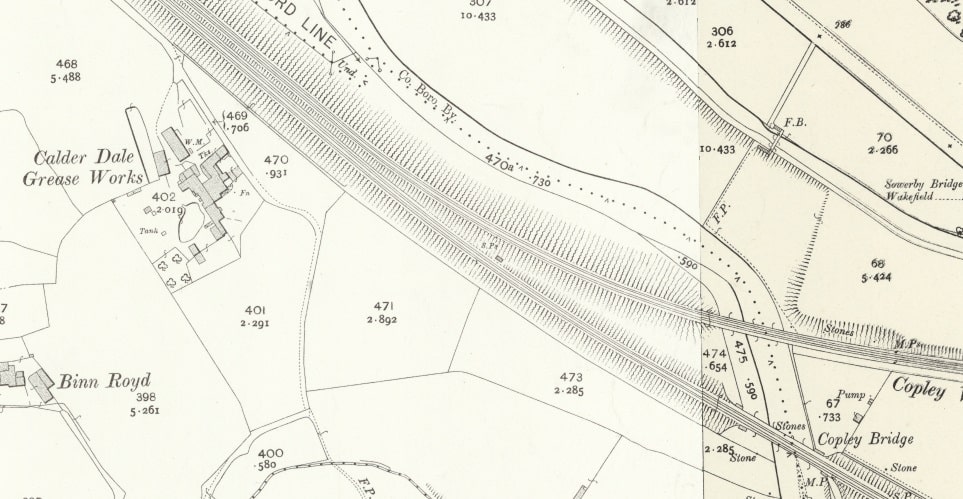
  68. http://www.calderdalecompanion.co.uk/ph796.html, accessed on 6th October 2024.
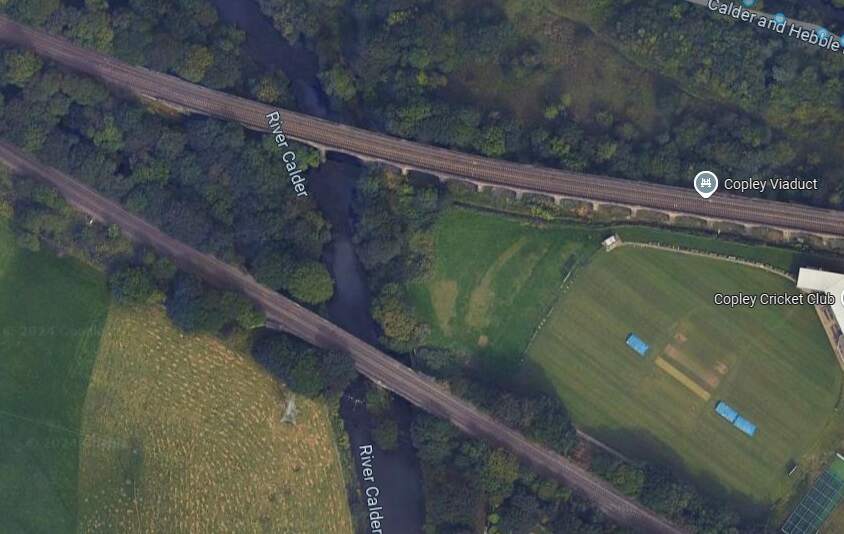
  69. https://maps.nls.uk/geo/explore/#zoom=17.0&lat=53.69483&lon=-1.76821&layers=168&b=ESRIWorld&o=100, accessed on 7th October 2024.
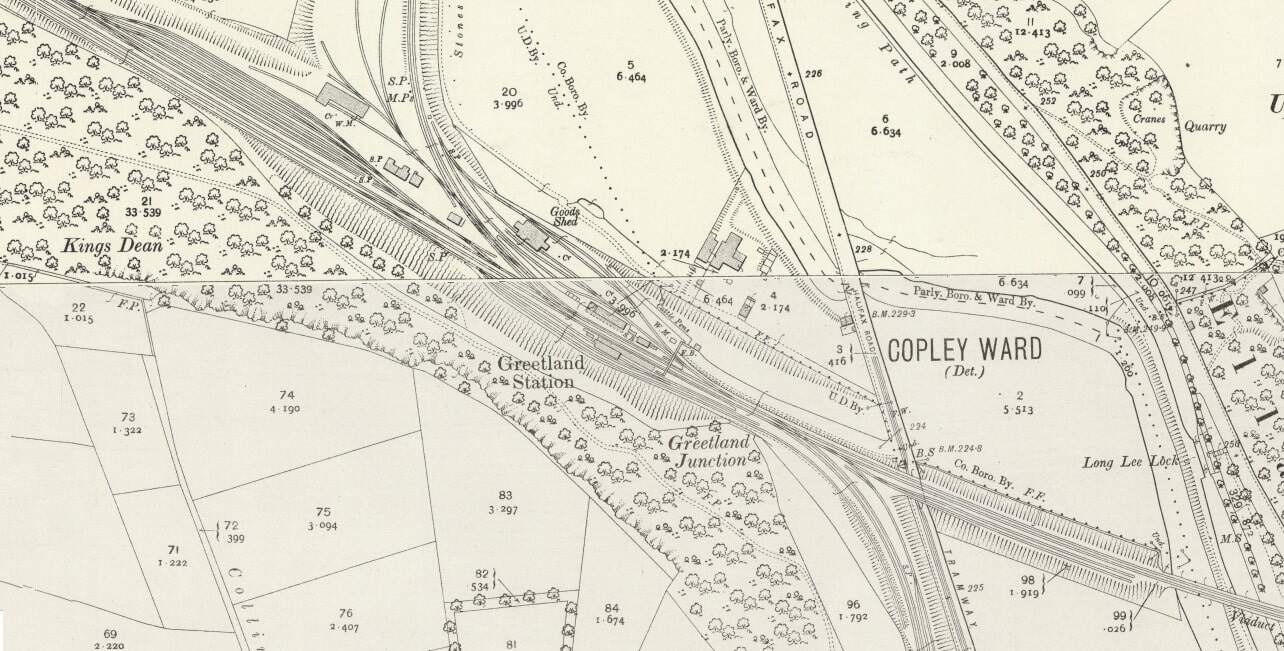
  70. https://maps.nls.uk/geo/explore/#zoom=17.0&lat=53.68967&lon=-1.74458&layers=168&b=ESRIWorld&o=100, accessed on 7th October 2024.
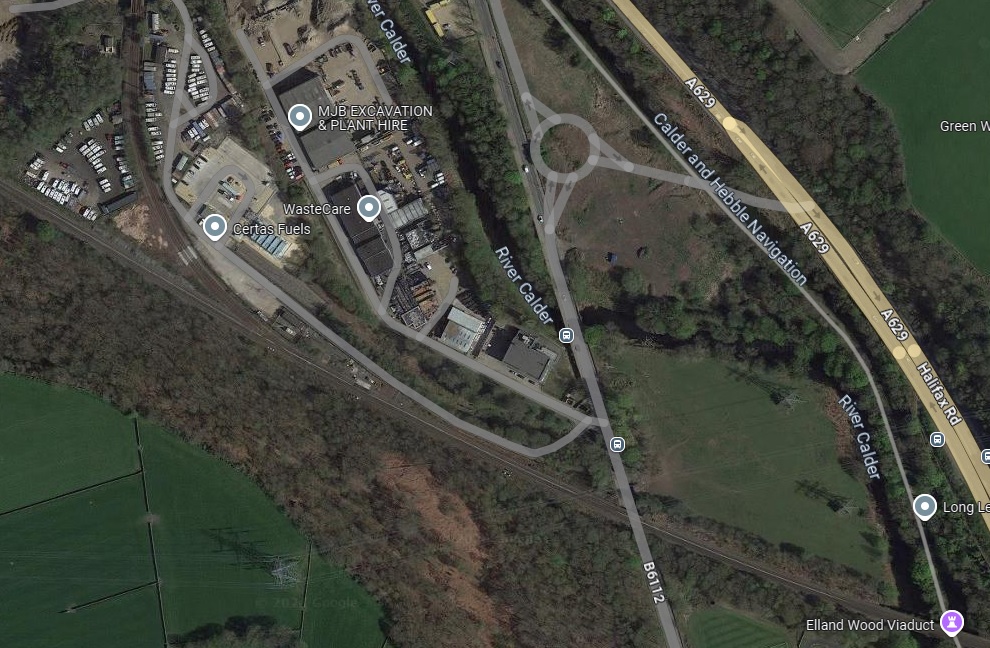
  71. https://maps.nls.uk/geo/explore/#zoom=16.0&lat=53.68030&lon=-1.71952&layers=168&b=ESRIWorld&o=100, accessed on 7th October 2024.
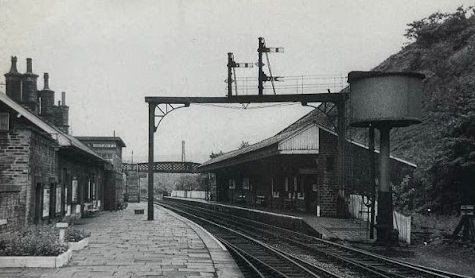
  72. https://en.m.wikipedia.org/wiki/Wakefield_Kirkgate_railway_station, accessed on 7th October 2024.
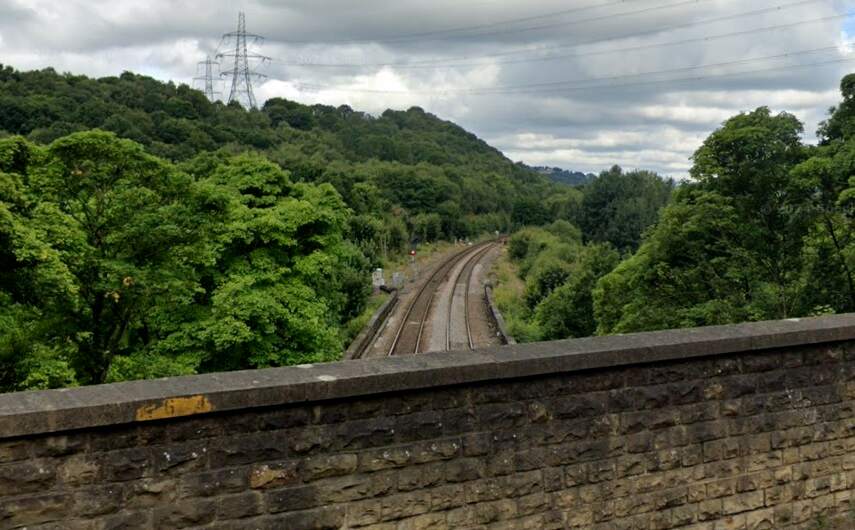
  73. https://groundworklandscapearchitects.org.uk/regions/yorkshire-and-the-humber/kirkgate-station, accessed on 7th October 2024.
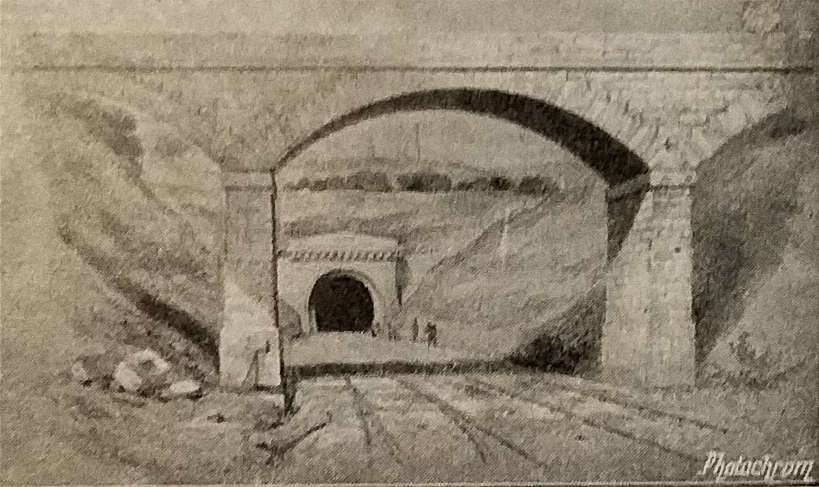
  74. https://www.geograph.org.uk/photo/2043843, accessed on 8th October 2024.
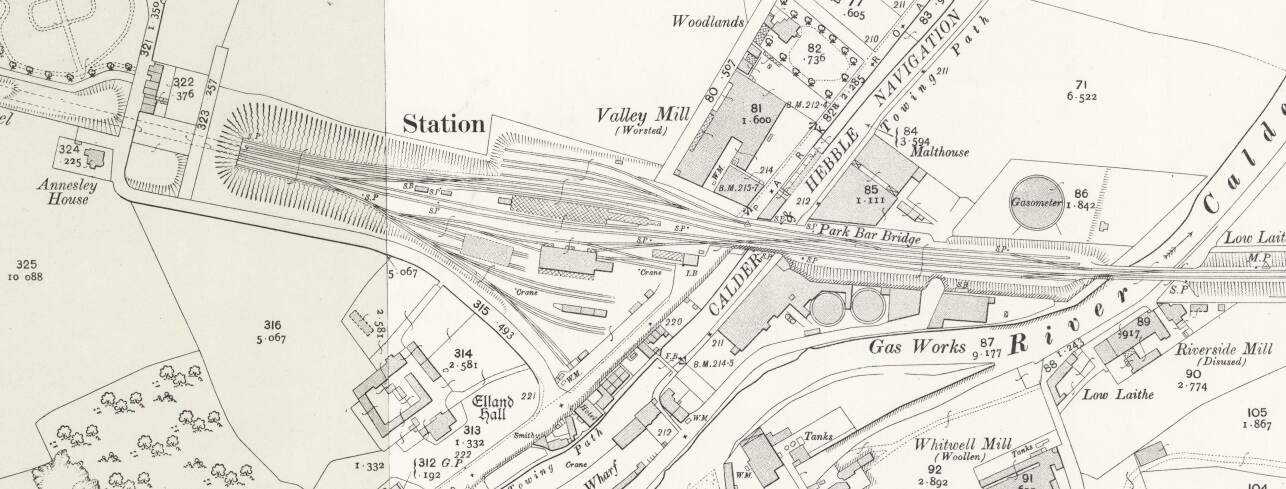
  75. Jeffrey Wells; The Eleven Towns Railway: The Story of the Manchester and Leeds Main Line; Railway & Canal Historical Society, Keighley, West Yorkshire, 2000.
  76. https://picryl.com/topics/period+drawings+of+early+steam+locomotives, accessed on 9th October 2024.
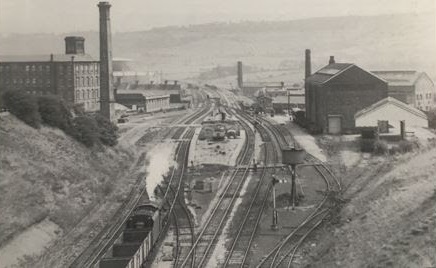
  77. https://en.m.wikipedia.org/wiki/0-4-2#/media/File%3AStephenson_0-4-2.jpg, accessed on 9th October 2024.
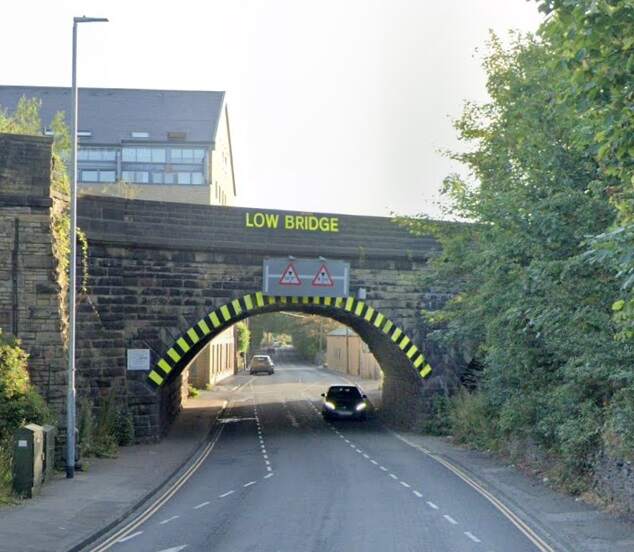
  78. https://commons.wikimedia.org/wiki/File:Stephenson_Patentee_type_2-2-2_locomotive_no_123_%E2%80%9CHarvey_Combe%E2%80%9D_built_1835,_from_Simm%E2%80%99s_%E2%80%9CPublic_Works_of_Great_Britain%E2%80%9D_1838,_newly_engraved_%2B_reprinted_1927_%E2%80%93_No_caption,_black_and_white.jpg, accessed on 9th October 2024

Mark 10: 2-16 – A Warm Welcome – St. Andrew, Ryton – 6th October 2024 (19th Sunday after Trinity)

A series of clipart images are included in this article/sermon which I believe are free to download and royalty free. The first, at the head of this article is a picture of a welcome mat.


People place welcome mats outside the front door of their houses. Do you have one? ….. I think they carry a mixed message, something like this: “It is nice to see you but please do wipe your feet before you come into my house!”

It conveys a sense that visitors are welcome if they …..?

A true welcome is really about greeting someone in a warm and friendly way. A few pictures to illustrate what we do to welcome people into our homes. …..

What things do we do when someone comes to our house to make them feel welcome?

Pretty much naturally, when we do welcome someone into our home we offer a warm drink, some biscuits, a comfy chair, a warm room, a welcoming smile and an invitation to return.

But, has anyone ever come to your house who you don’t want to welcome in? … Sometimes we get people selling us stuff we don’t want, or someone we find it difficult to likecomes to the door. I remember letting a bathroom salesman into my house and then spending the whole time he was there wishing I hadn’t.

Or what above a Jehovah’s Witness or a Mormon missionary….. Perhaps we keep them standing on the doorstep rather than let them in.

A challenging question for clergy might be what constitutes a true welcome be for the awkward and abusive homeless person on the vicarage doorstep?

How do you feel when someone you don’t want around is on your doorstep? Perhaps you feel a bit aggressive and defensive, or maybe mean, awkward, uncomfortable or even guilty, as you turn them away?

It’s not always easy welcoming some people into our homes, our places of work, our schools, or even our churches – is it?

Towards the end of our Gospel reading today, we heard about some people who were not made to feel welcome by Jesus’ disciples.

Jesus was teaching and people were bringing little children to have Jesus touch them. The disciples criticized the parents and told them to stop bringing their children to Jesus. When Jesus heard what his disciples were saying, he was very upset. “Let the children come to me and don’t stop them!” Jesus said. “The Kingdom of God belongs to those who are like these children. Anyone who doesn’t come like a little child will never enter.” And the Gospel tells us, that Jesus took the children in his arms and blessed them.

Jesus really knew how to make a child feel welcome. Perhaps you might be able to imagine how those children must have felt when Jesus took them up in his arms and blessed them? That image – that we often see in stained glass windows in churches – of Jesus with the children in his arms is one that should reminds us to make everyone feel welcome like Jesus did!

The kind of welcome we offer to others is critical. It says so much about us. When we welcome people into our homes or into our churches, we are sharing something of ourselves with them, and in doing so we make ourselves vulnerable. Because, at times, our guests can ride rough-shod over our hospitality.

The temptation is to respond like the disciples – to try to exclude those who don’t understand our ways of doing things – and there are plenty of churches that do just that. To come to the main service in the church that I grew up in, you were expected to have a letter of introduction from another similar church before you could be part of the worship!

Some churches refuse to have baptisms in their main services – because the wider baptism party may disrupt their quiet worship. Some churches refuse to even make their building available to the community – a great sadness when those churches are the only large indoor community space available.

In our Gospel, Jesus models a response of loving welcome – an acceptance of the mess and the noise that goes with children being around, but a true acknowledgement that they have so much to offer us. This is the response that we are called on the make in our churches, not only to children, but to all who need the love of our Saviour – open, loving, vulnerable welcome!

Back to our welcome mat and that gallery of welcome pictures. …

What does our figurative welcome mat say to those who cross the threshold of the church for the first time? Is our welcome warm, open and true? Or is it grudging and perhaps motivated by fear that we will have to be different, to change, if we truly welcome them?

Do we do our best to extend that welcome – perhaps with a warm drink, something to eat, comfortable seating, a warm space, a welcoming smile and a heartfelt invitation to come again?

What does our figurative welcome mat say to people? Wipe your feet, clean yourself up, sort yourself out and come in – or does it really say that people are welcome as they are?

The God we worship worship week after week offers an open, inclusive welcome to all. God includes everyone without exception and God calls on us to do the same.

The Manchester and Leeds Railway – The Railway Magazine, December 1905 – Part 1

An article in the Railway Magazine in December 1905 prompted a look at the Manchester and Leeds Railway. For a number of years my parents lived in sheltered housing in Mirfield which is on the line. Looking at the line as it appeared in 1905 and again in the 21st century seemed a worthwhile exercise! Part 1 of this short series provides a short history of the line and takes us from Manchester to Sowerby Bridge.

The featured image at the head of this article shows the Manchester & Leeds Railway locomotive ‘Victoria’, in about 1878-80. This locomotive was designed by Edward Bury and built at his works in Liverpool. It was one of a batch of 0-4-0 engines ordered in 1845, and later converted to an 0-4-2 wheel arrangement (c) Public Domain. [65]

In his first article in 1905, about the Manchester and Leeds Railway which was accompanied by a series of engravings included here, Herbert Rake wrote that on 11th September 1830 a committee tasked with improving communications between Leeds and Manchester, emboldened by the success of the Liverpool and Manchester Railway, decided to hold a meeting to form a new railway company.

On 18th October 1930, the decision was taken. A board of directors was appointed, a survey was authorised and work was undertaken to prepare for an application to Parliament. It was based on a junction with the Liverpool and Manchester Railway at Oldfield Lane, Salford and at St. George’s Road, Manchester.

The route from Manchester to Sowerby Bridge was easily agreed, that from Sowerby Bridge to Leeds was more difficult to agree. The Bill prepared for Parliament focused on the Manchester to Sowerby Bridge length of the planned line and was presented on 10th March 1831. Opposition from the Rochdale Canal Company and others and then the dissolution of Parliament halted the progress of the Bill.

Resubmission was agreed on 8th June 1830 but once again failed in its progress through Parliament. In the end, the project was revised, the company was reorganised, and the capital fixed at £800,000 in £100 shares in a meeting in October 1935.

Rake tells us that this “new project abandoned the Salford junction line, but embraced a deviated extension beyond Sowerby Bridge, along the lower portion of the Vale of Calder, past Dewsbury and Wakefield, to Normanton, thence to Leeds, in conjunction with the North Midland Railway. … [The line was] intended to form a central portion of a great main line running east and west between Liverpool and Hull.” [1: p469-470]

The prospectus noted a few important facts, particularly:

  • The population density with three miles either side of the proposed line was 1,847 persons per square mile. The average for England was 260 persons per square mile.
  • Within 10 miles of the line there were 29 market towns, twelve with a population greater than 20,000.
  • Within 20 miles of the line there were 48 market towns with more than 10,000 inhabitants.

Rake tells us that “The Act of Incorporation received the Royal Assent on the 4th July 1836, and authorised a joint stock capital to be raised of £1,000,000, with an additional amount by loan of £433,000.” [1: p470]

Construction commenced on 18th August 1837. On 14th February 1838 it was decided to apply to Parliament for an Act authorising branch lines to Oldham and Halifax.

Victoria Station, Manchester, was first known as Hunt’s Bank Station. [1: p468]
Part of the original station at Manchester Victoria, as it appeared in 1989. In around 1860, the single storey station building was extended by the addition of a second floor. The Lancashire and Yorkshire Railway sensitively incorporated the original building into the new 1904 facade of Victoria station, © Whatlep and authorised for reuse under a Creative Commons Licence (CC BY-SA 2.0). [2]

Late in 1838, “a modification of the original plan for effecting a junction of the Manchester and Leeds Railway with the Liverpool and Manchester Railway was proposed, by an extension of both to a joint terminus within 500 yards of the Manchester Exchange. … The Act of Parliament for this and other purposes received the Royal Assent on the 31st July 1839, authorising the sum of £866,000 to be raised for the purpose of constructing the Oldham and Halifax branches, for making a diversion in the railway at Kirkthorpe, for enlarging the station in Lees Street, and for constructing the line to join the Liverpool and Manchester extension.” [1: p470]

Rochdale railway Station as shown on the 25″ Ordnance Survey 0f 1908, published in 1910. [21]
View NE from south end of Rochdale Station. On the left, Hughes/Fowler 5P 4F 2-6-0 No. 42724 on the 11.58am Wakefield to Manchester; on the right, Stanier 4MT 2-6-4T No. 42653 on a local to Bolton, © Ben Brooksbank and licenced for reuse under a Creative Commons Licence (CC BY-SA 2.0). [22]

Rake explains that the railway ran through Miles Platting where the Ashton and Stalybridge branch diverges. At Middleton the Oldham branch connected to the main line. Mill Hills embankment (maximum height 75 feet) carries the line towards Blue Pits Station where the Heywood line joins the main line. The line runs on through Rochdale, Littleborough and Todmorden Vale before running in cutting (maximum depth 100 feet) to Summit Tunnel.

During construction, “Six contracts were awarded between the Manchester terminus and the Summit Tunnel and were progressing satisfactorily by August 1838.” [6]

The West Portal of Summit Tunnel is approached from Manchester through a deep cutting. [1: p469]
The same portal of Summit Tunnel in 20th century steam days. [3]

When built, Summit Tunnel was the longest in the world. It opened on 1st March 1841 by Sir John F. Sigismund-Smith.

The tunnel is just over 1.6 miles (2.6 km) long and carries two standard-gauge tracks in a single horseshoe-shaped tube, approximately 24 feet (7.2 m) wide and 22 feet (6.6 m) high. Summit Tunnel was designed by Thomas Longridge Gooch, assisted by Barnard Dickinson. Progress on its construction was slower than anticipated, largely because excavation was more difficult than anticipated. … It … cost £251,000 and 41 workers had died.” [4]

Rake noted that the tunnel is “14 shafts were necessary, and the strata of rock shale and clay was of so treacherous a character that the brick lining of the roof, which is semi circular, consists in places of no less than 10 concentric rings.” [1: p471] He also comments that: the tunnel entrance is if an imposing Moorish design; 1,000 men were employed with work continuing day and night.

Beyond the tunnel, the railway “entered a cutting in silt, which required piling to secure a foundation. Continuing onwards, we pass through the Winterbut Lee Tunnel, 420 yds. in length, and across a viaduct of 18 arches, one of which is of 60 ft. span we then proceed over the Rochdale Canal, on a cast iron skew bridge 102 ft. in span, at a height of 40 ft. above the surface of the water.” [1: p471]

A colourised engraving of the bridge over the Rochdale Canal by A.F. Tait. [6]
The Manchester and Leeds Railway’s castellated bridge over the Rochdale Canal to the South of Todmorden on 16th September 2007, © Tim Green and authorised for reuse under a Creative Commons Licence (CC BY 2.0 Generic). [5]
The railway bridge illustrated above as it appears on the 25″ Ordnance Survey of 1905, published in 1907. [9]

Tenders for work on the eastern section were advertised in 1838. … Contractors then worked fastidiously under the threat of heavy penalties should they over-run the set time limits. They were also forbidden to work on Sundays.” [6]

At Todmorden, “the railway is carried over almost the entire breadth of the valley by a noble viaduct of nine arches, seven of which are each of 60 ft. span, and two of 30 ft., at a height of 54 ft. above the level of the turnpike road.” [1: p471]

Todmorden Railway Station on the 25″ Ordnance Survey of 1905, published in 1907. The viaduct which spans Burnley Road to the East of the Railway Station appears top left on this map extract and below on a more modern photograph. [8]
Todmorden Railway Station, seen from Platform 2, in the 21st century, © Ian Kirk and licenced for reuse under a Creative Commons Licence (CC-BY 2.5). [20]
Todmorden – Railway Viaduct over Burnley Road: The railway viaduct reaching the station is a prominent feature and is here seen crossing Burnley Road with the bus station on one side of it and the local market on the other, © David Ward and licensed for reuse under a Creative Commons Licence (CC BY-SA 2.0). [7]
The junction with the Burnley Branch on the 25″ Ordnance Survey of 1905, published in 1907. [10]
Looking West from Hallroyd Road Bridge in 2023. Hallroyd Road Bridge overlooks Hall Road Junction close to the right side of the map extract above. [Google Streetview, April 2023]
Looking East from Hallroyd Road Bridge. [Google Streetview, April 2023]

Quitting Todmorden, where the Burnley branch diverges, the line enters Yorkshire, passes through Millwood Tunnel (225 yards), Castle Hill Tunnel (193 yards), and Horsefall Tunnel (424 yards) and then arrives at Eastwood Station. Some distance further on is Charlestown. Afterwards the railway “crosses river, road, and canal, by a skew bridge of three arches, the canal being separately spanned by an iron bridge.” [1: p471]

Looking back West from Cross Stone Road across the western portal of Millwood Tunnel. [Google Streetview, April 2023]
Looking East from the corner of Phoenix Street and Broadstone Street, above the eastern portal of Millwood Tunnel. [Google Streetview, April 2023]

These next few images give a flavour of the line as it travels towards Hebden Bridge.

Lobb Mill Viaduct sits alongside the A646, Halifax Road between Castle Hill Tunnel and Horsefall Tunnel. [Google Streetview, June 2023]
Looking Southwest along the line towards Todmorden from E. Lee Lane. [Google Streetview, April 2023]
A little to the Northeast, Duke Street passes under the railway. This view looks West from Halifax Road [Google Streetview, June 2023]
Eastwood Railway Station as it appears on the 1905 25″ Ordnance Survey. [63]
Thye approximate location of Eastwood Station as it appears on Google Maps satellite imagery in 2024. [Google Maps, October 2024]
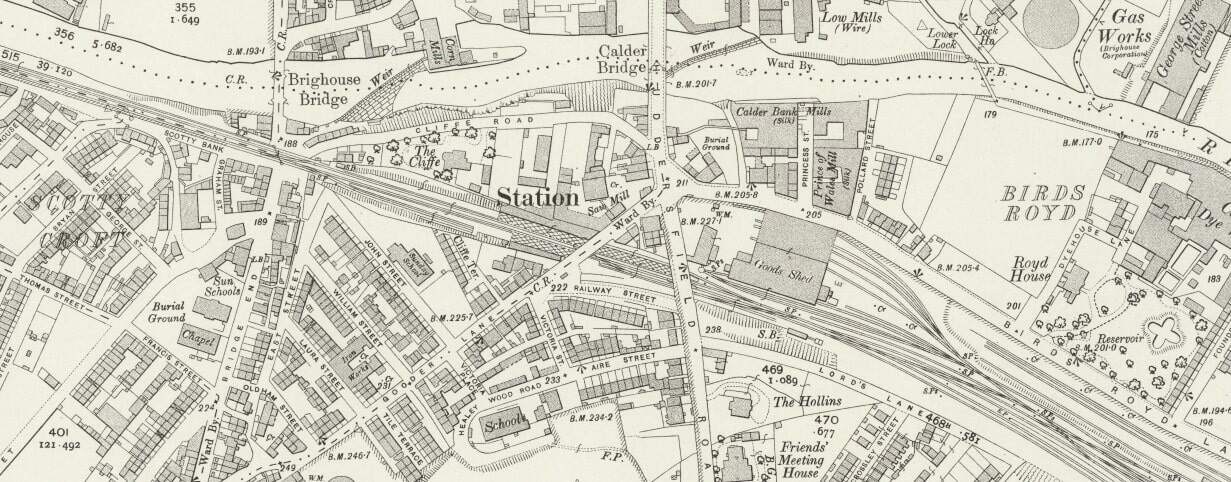
A little further Northeast, this is the view Northwest along Jumble Hole Road under the railway. [Google Streetview, June 2011]
The view Northwest from he A646, Halifax Road along the Pennine Way Footpath which passes under the railway at this location. [Google Streetview, June 2023]
Again, looking Northwest from Halifax Road along Stony Lane which runs under the railway. [Google Streetview, June 2023]
The view Southwest along Oakville Road which runs next to the railway. [Google Streetview, April 2023]
The view Northeast from the same location on Oakville Road. [Google Streetview, April 2023]

A short distance Northeast, the railway “crosses river, road, and canal, by a skew bridge of three arches, the canal being separately spanned by an iron bridge.” [1: p471] The location is shown on the 25″ Ordnance Survey of 1905 below.

The bridge mentioned above, as it appears on the 25″ Ordnance Survey of 1905. [11]
The same location shown on Google Maps satellite imagery in 2024. [Google Maps, October 2024]
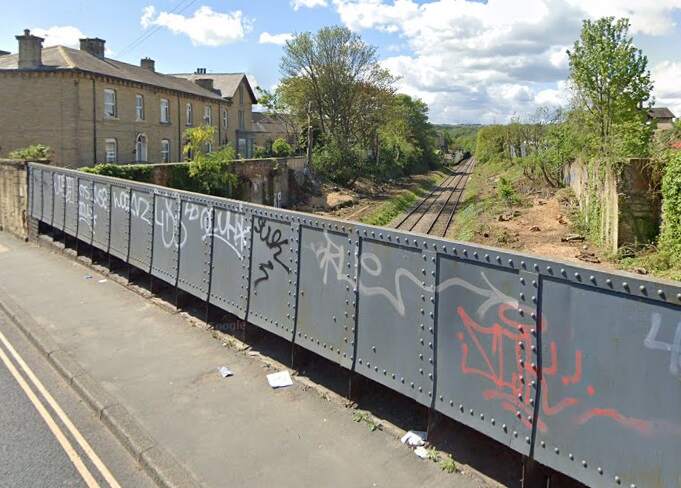
Looking Northeast along Halifax Road, the three arches of the viaduct are easily visible. Beyond it there is a girder bridge which Rake does not mention. [Google Streetview, June 2023]

A little further East Stubbing Brink crosses the railway.

Looking West along the railway from Stubbing Brink Bridge. [Google Streetview, April 2023]
The view East along the line from Stubbing Brink. [Google Streetview, April 2023]

The line next passes through a short short tunnel (Weasel Hall Tunnel (124 yards)) and arrives at Hebden Bridge Station.

Looking West-northwest from Shelf Road Bridge, it is just possible to make out the mouth of Weasel Hall Tunnel. [Google Streetview, April 2023]
The view East-southeast from Shelf Road Bridge towards Hebden Bridge Railway Station. [Google Streetview, April 2023]
This next extract from the 25″ Ordnance Survey shows Hebden Bridge Station. [12]
Platelayers at work at Hebden Bridge Station in 1840. [1: p470]
Hebden Bridge Railway Station (Platform 2) in the 21st century, © El Pollock and licenced for reuse under a Creative Commons Licence (CC BY-SA 2.0). [18]

After Hebden Bridge Station, the line proceeds along the South bank of the River Calder, through two small stations (Mytholmroyd and Luddenden Foot) and by a number of riverside mills.

Mytholmroyd Railway Station as it appeared on the 1905 25″ Ordnance Survey. The Station is still open in the 21st century. [13]
The original station building at Mytholmroyd, seen from the North in 2006, with the line crossing New Road at high level, © Ian Kirk and licenced for reuse under a Creative Commons Licence (CC By 2.5) . The building has since been renovated. [16]
Mytholmroyd Railway Station in the 21st century, © Rcsprinter123 and licenced for reuse under a Creative Commons Licence (CC BY 3.0,). [19]

East along the line towards Luddendenfoot, Brearley Lane bridges the line.

Looking West from Brearley Lane Bridge towards Mytholmroyd Station. [Google Streetview, July 2009]
Ahead to the East, the line curves round towards the location of Luddendenfoot Railway Station. [Google Streetview, July 2009]
Luddenden Foot Railway Station. The station closed on 10th September 1962. The site has been developed since 2007 and the northern half is now occupied by the Station Industrial Park, which is accessible via Old Station Road. Two gate pillars from the original station flank the entrance to the road. [14][17]
The location of the erstwhile Luddendenfoot Railway Station as seen from Willow Bank, (c) Matt Thornton. [Google Streetview, February 2021]
Looking Southeast from Willow Bank. The arch bridge visible ahead carries Jerry Fields Road over the line, (c) Matt Thornton. [Google Streetview, February 2021]

To the Southeast, Ellen Holme Road passes under the line.

Ellen Holme Road passess under the railway to the Southeast of the old Luddendenfoot Railway Station. [Google Streetview, June 2023]

Passing other mills and traversing a deep cutting the line enters Sowerby Tunnel, (645 yards) and reaches Sowerby Bridge Station.

Class 101 At Sowerby Bridge Tunnel.
This image is embedded her from Flickr. It shows a Class 101 DMU entering Sowerby Bridge Tunnel from the East while working 2M14 10:31hrs York to Southport service on 8th May 1987, (c) Neil Harvey 156. [59]
Sowerby Bridge Railway Station – note the Ripponden Branch emerging from a tunnel and joining the Manchester and Leeds Railway at the East end of the Station. [15]
An early postcard image of Sowerby Bridge with the railway station in the foreground, © Public Domain. [23]
A colourised postcard view of the Station Forecourt at Sowerby Bridge around the turn of the 20th century. [60]
Sowerby Bridge Railway Station in 2006, (c) Ian Kirk and authorised for reuse under a Creative Commons icence (CC BY 2.5). [24]

We complete this first part of the journey along the Manchester and Leeds Railway here at Sowerby Bridge Railway Station.

References

NB: These references relate to all the articles about the Manchester and Leeds Railway.

  1. Herbert Rake; The Manchester and Leeds Railway: The Origin of the Lancashire and Yorkshire Railway; in The Railway Magazine, London, December 1905, p468-474
  2. https://www.geograph.org.uk/photo/820318, accessed on 23rd September 2024.
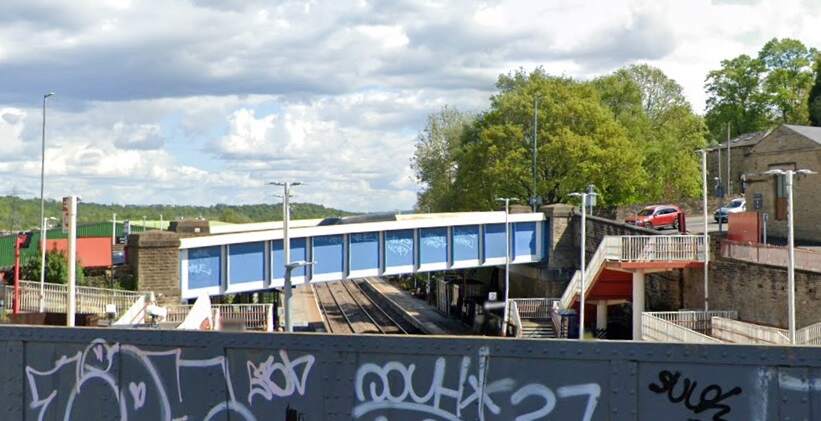
  3. https://premierconstructionnews.com/2016/04/14/summit-tunnel, accessed on 23rd September 2024.
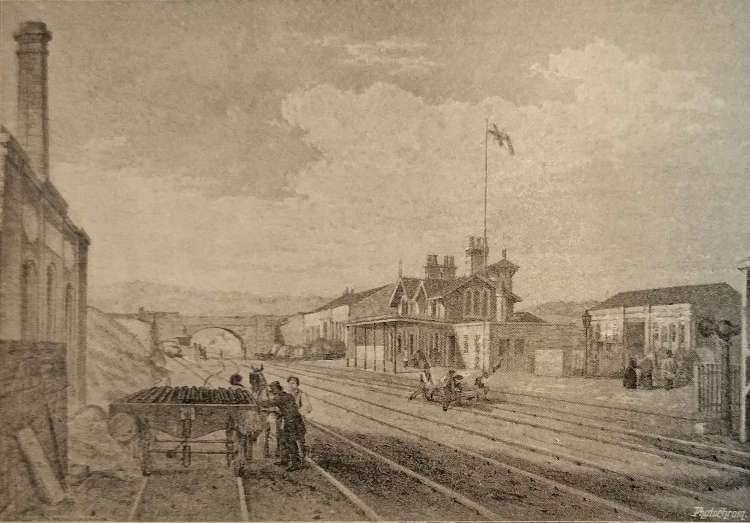
  4. https://en.m.wikipedia.org/wiki/Summit_Tunnel, accessed on 23rd September 2024.
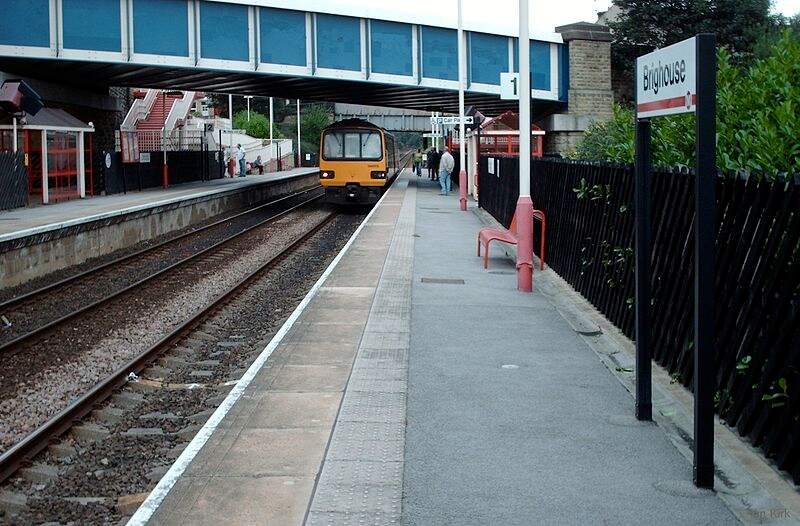
  5. https://commons.m.wikimedia.org/wiki/File:Gauxholme_Bridge,_Todmorden.jpg, accessed on 23rd September 2024.
  6. https://www.yorkshirepost.co.uk/news/opinion/columnists/trans-pennine-rail-in-the-age-of-victoria-1807452, accessed on 23rd September 2024.
  7. https://www.geograph.org.uk/photo/504379, accessed on 23rd September 2024.
  8. https://maps.nls.uk/geo/explore/#zoom=17.9&lat=53.71428&lon=-2.09924&layers=168&b=ESRIWorld&o=100, accessed on 23rd September 2024.
  9. https://maps.nls.uk/geo/explore/#zoom=18.9&lat=53.70635&lon=-2.10701&layers=168&b=ESRIWorld&o=100, accessed on 23rd September 2024.
  10. https://maps.nls.uk/geo/explore/#zoom=16.9&lat=53.71706&lon=-2.09298&layers=168&b=ESRIWorld&o=100, accessed on 23rd September 2024.
  11. https://maps.nls.uk/geo/explore/#zoom=17.1&lat=53.73968&lon=-2.03054&layers=168&b=ESRIWorld&o=100, accessed on 23rd September 2024.
  12. https://maps.nls.uk/geo/explore/#zoom=16.5&lat=53.73833&lon=-2.00992&layers=168&b=ESRIWorld&o=100, accessed on 23rd September 2024.
  13. https://maps.nls.uk/geo/explore/#zoom=16.1&lat=53.73044&lon=-1.98307&layers=168&b=ESRIWorld&o=100, accessed on 23rd September 2024.
  14. https://maps.nls.uk/geo/explore/#zoom=16.1&lat=53.72280&lon=-1.94806&layers=168&b=ESRIWorld&o=100, accessed on 23rd September 2024.
  15. https://maps.nls.uk/geo/explore/#zoom=16.8&lat=53.70808&lon=-1.91151&layers=168&b=ESRIWorld&o=100, accessed on 23rd September 2024
  16. https://commons.wikimedia.org/wiki/File:Mytholmroyd_3.jpg, accessed on 24th September 2024.
  17. https://en.wikipedia.org/wiki/Luddendenfoot_railway_station, accessed on 24th September 2024.
  18. https://www.geograph.org.uk/photo/4500324, accessed on 24th September 2024.
  19. https://en.wikipedia.org/wiki/Mytholmroyd_railway_station#/media/File:Mytholmroyd_railway_station,_November_2020.jpg, accessed on 24th September 2024.
  20. https://commons.wikimedia.org/wiki/File:Todmorden_station_p2.jpg, accessed on 24th September 2024.
  21. https://maps.nls.uk/geo/explore/#zoom=17.0&lat=53.61032&lon=-2.15338&layers=168&b=ESRIWorld&o=100, accessed on 24th September 2024.
  22. https://www.geograph.org.uk/photo/2160438, accessed on 24th September 2024.
  23. http://www.halifaxpeople.com/Sowerby-Bridge-Train-Station.html#google_vignette, accessed on 24th September 2024.
  24. https://commons.wikimedia.org/wiki/File:Sowerby_Bridge_stn.jpg, accessed on 24th September 2024.
  25. https://maps.nls.uk/geo/explore/#zoom=17.0&lat=53.70193&lon=-1.88141&layers=168&b=ESRIWorld&o=100, accessed on 24th September 2024.
  26. https://maps.nls.uk/geo/explore/#zoom=17.0&lat=53.69406&lon=-1.85773&layers=168&b=ESRIWorld&o=100, accessed on 24th September 2024.
  27. https://en.wikipedia.org/wiki/Greetland_railway_station, accessed on 24th September 2024.
  28. http://www.halifaxpeople.com/Historic-West-Vale.html, accessed on 24th September 2024.
  29. https://maps.nls.uk/geo/explore/#zoom=17.0&lat=53.69065&lon=-1.84016&layers=168&b=ESRIWorld&o=100, accessed on 24th September 2024.
  30. http://www.halifaxpeople.com/Historic-Elland.html, accessed on 24th September 2024.
  31. https://maps.nls.uk/geo/explore/#zoom=17.0&lat=53.69860&lon=-1.77905&layers=168&b=ESRIWorld&o=100, accessed on 24th September 2024.
  32. https://www.flickr.com/photos/tcs-pics/6805337658, accessed on 24th September 2024.
  33. https://commons.wikimedia.org/wiki/File:Brighouse_station.jpg, accessed on 24th September 2024.
  34. https://maps.nls.uk/geo/explore/#zoom=17.0&lat=53.68478&lon=-1.72933&layers=168&b=ESRIWorld&o=100, accessed on 24th September 2024.
  35. https://www.geograph.org.uk/photo/2151166, accessed on 24th September 2024.
  36. https://www.chiark.greenend.org.uk/~owend/interests/rail/stnpages/mirfield.html, accessed on 20th May 2010.
  37. https://en.wikipedia.org/wiki/Thornhill_railway_station, accessed on 24th September 2024.
  38. https://www.geograph.org.uk/photo/2146249, accessed on 24th September 2024.
  39. https://maps.nls.uk/geo/explore/#zoom=17.0&lat=53.67578&lon=-1.65453&layers=168&b=ESRIWorld&o=100, accessed on 24th September 2024.
  40. https://maps.nls.uk/geo/explore/#zoom=17.0&lat=53.67662&lon=-1.63870&layers=168&b=ESRIWorld&o=100, accessed on 24th September 2024.
  41. https://maps.nls.uk/geo/explore/#zoom=17.0&lat=53.67609&lon=-1.62408&layers=168&b=ESRIWorld&o=100, accessed on 24th September 2024.
  42. http://lostrailwayswestyorkshire.co.uk/Dewsbury.htm, accessed on 26th September 2024.
  43. https://maps.nls.uk/geo/explore/#zoom=17.0&lat=53.67145&lon=-1.61316&layers=168&b=ESRIWorld&o=100, accessed on 27th September 2024.
  44. https://maps.nls.uk/geo/explore/#zoom=17.0&lat=53.65930&lon=-1.56897&layers=168&b=ESRIWorld&o=100, accessed on 27th September 2024.
  45. https://en.wikipedia.org/wiki/Horbury_and_Ossett_railway_station, accessed on 27th September 2024.
  46. https://maps.nls.uk/geo/explore/#zoom=16.0&lat=53.66442&lon=-1.58084&layers=168&b=ESRIWorld&o=0, accessed on 27th September 2024.
  47. https://en.wikipedia.org/wiki/Healey_Mills_Marshalling_Yard, accessed onn 27th September 2024.
  48. https://www.geograph.org.uk/photo/864329, accessed on 27th September 2024.
  49. https://maps.nls.uk/geo/explore/#zoom=17.0&lat=53.65617&lon=-1.55890&layers=168&b=ESRIWorld&o=100, accessed on 27th September 2024.
  50. https://maps.nls.uk/geo/explore/#zoom=17.0&lat=53.65728&lon=-1.53700&layers=168&b=ESRIWorld&o=100, accessed on 30th September 2024.
  51. https://www.horburyhistory.org/Horbury-Junction/, accessed on 30th September 2024.
  52. https://maps.nls.uk/geo/explore/#zoom=17.0&lat=53.66955&lon=-1.50480&layers=168&b=ESRIWorld&o=100, accessed on 30th September 2024.
  53. https://maps.nls.uk/geo/explore/#zoom=17.4&lat=53.67749&lon=-1.49163&layers=168&b=ESRIWorld&o=100, accessed on 30th September 2024.
  54. https://maps.nls.uk/geo/explore/#zoom=17.4&lat=53.67943&lon=-1.48383&layers=168&b=ESRIWorld&o=100, accessed on 30th September 2024.
  55. https://maps.nls.uk/geo/explore/#zoom=17.4&lat=53.68334&lon=-1.47138&layers=168&b=ESRIWorld&o=100, accessed on 30th September 2024.
  56. https://maps.nls.uk/geo/explore/#zoom=17.4&lat=53.69000&lon=-1.43723&layers=168&b=ESRIWorld&o=100, accessed on 2nd October 2024.
  57. https://maps.nls.uk/geo/explore/#zoom=17.4&lat=53.69243&lon=-1.43590&layers=168&b=ESRIWorld&o=100, accessed on 2nd October 2024.
  58. https://maps.nls.uk/geo/explore/#zoom=15.4&lat=53.70320&lon=-1.42452&layers=168&b=ESRIWorld&o=100, accessed on 2nd October 2024.
  59. Embedded link: https://www.flickr.com/photos/neil_harvey_railway_photos/7834033734, accessed on 3rd October 2024.
  60. https://www.invaluable.com/auction-lot/two-albums-containing-300-cards-incl-yorkshire-ox-166-c-6fd4b7e9e0, accessed on 3rd October 2024.
  61. https://www.blipfoto.com/entry/3134415230512138681, accessed on 3rd October 2024.
  62. https://maps.nls.uk/geo/explore/#zoom=17.0&lat=53.69371&lon=-1.76350&layers=168&b=ESRIWorld&o=100, accessed on 3rd October 2024.
  63. https://maps.nls.uk/geo/explore/#zoom=15.0&lat=53.72852&lon=-2.05697&layers=168&b=ESRIWorld&o=100, accessed on 3rd October 2024.
  64. https://igg.org.uk/rail/3-sigs/sigs-1.htm, accessed on 5th October 2024.
  65. https://commons.wikimedia.org/wiki/File:L%26MR_engine_%27Victoria%27.jpg, accessed on 6th October 2024.
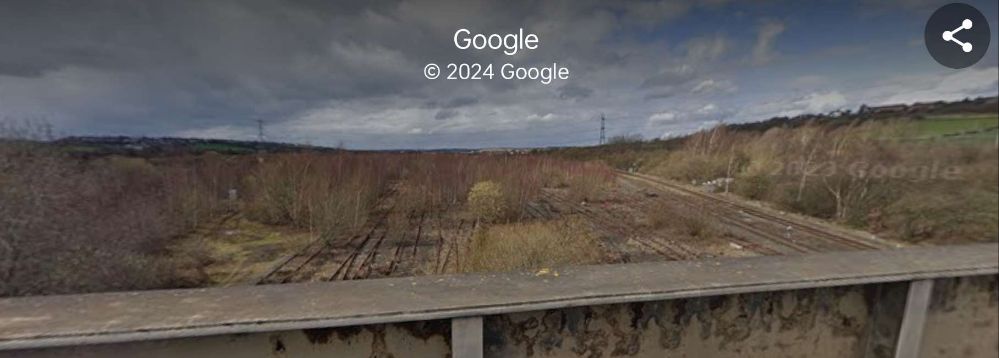
Romans 1: 26-27 – ‘Against Nature’ (παρὰ φύσιν)

The featured image above is one person’s attempt to reflect the angst associated with ‘dishonorable passions’ and ‘natural relations versus those contrary to nature’. [22]

In a previous article about Romans 1: 16-32, (https://rogerfarnworth.com/2024/06/15/romans-1-16-32-pauls-discussion-considered), [2] I think we demonstrated that we cannot, with any integrity, assert that the first chapter of the epistle to the Romans makes an unequivocal negative statement about lifelong, loving, covenantal same-gender relationships.

It is possible that Paul is quoting what many a Jewish Christian might be thinking and then countering it with his ‘you therefore’ in Romans 2: 1. That interpretation, if correct, would mean that, rather than expressing his own understanding of God’s position in Romans 1: 16-32. He is, in fact, quoting Jewish Christians and then going on to challenge their sense of superiority over their Gentile siblings. Indeed, “some biblical scholars have long suspected that these verses were borrowed, with some reworking and paraphrasing, from some other source, as the language and word choices are atypical of the rest of the book of Romans.These verses resemble a rhetorical tool used by contemporaries of Paul to contrast the Jews and Gentiles, the basic argument being that idolatry, as practiced by the pagan Gentiles, leads to all manner of sinful behaviour.” [10]

In the midst of the passage is an assertion about particular same-sex sexual activities being ‘against nature‘ (παρὰ φύσιν). [Romans 1:26-27]

If we think that Paul is quoting others, then these words are tangential to Paul’s argument in Romans 1, and are of little importance. But, if these are Paul’s own words, then we need to give our attention to them. The meaning of those two words is particularly important if we remain unsure as to who is speaking. Is it Paul? Or is he quoting others, specifically Jewish Christians? This particular question is discussed in the article mentioned above (which can be found here).

Let’s work on the assumption that these words are indeed important. in that case, we need to consider two things if we are to understand the phrase ‘against nature‘ (παρὰ φύσιν):

  • We need to ask what particular activities are being referred to as being, ‘against nature’ (παρὰ φύσιν: para physin); and
  • We need to question what is meant by something being ‘against nature‘ (παρὰ φύσιν: para physin).

The intention in this article is to address these two concerns. In passing, we will also note a couple of other Greek words used in the two verses: ἀτιμίας (atimias) and ἀσχημοσύνη (aschēmosynē).

First, here are the words in the relevant verses translated into English in the NIV and the NRSV.

Romans 1: 24-27 in the NIV reads:

Therefore God gave them over in the sinful desires of their hearts to sexual impurity for the degrading of their bodies with one another. They exchanged the truth about God for a lie, and worshipped and served created things rather than the Creator—who is forever praised. Amen.Because of this, God gave them over to shameful lusts. Even their women exchanged natural sexual relations for unnatural ones. In the same way the men also abandoned natural relations with women and were inflamed with lust for one another. Men committed shameful acts with other men, and received in themselves the due penalty for their error.” [Romans 1: 24-27 (NIV)]

Romans 1: 24-27 in the NRSV reads:

Therefore God gave them up in the lusts of their hearts to impurity, to the degrading of their bodies among themselves, because they exchanged the truth about God for a lie and worshipped and served the creature rather than the Creator, who is blessed for ever! Amen. …  For this reason God gave them up to degrading passions. Their women exchanged natural intercourse for unnatural, and in the same way also the men, giving up natural intercourse with women, were consumed with passion for one another. Men committed shameless acts with men and received in their own persons the due penalty for their error.” [Romans 1: 24-27 (NRSV)]

Without wanting to chase back all the way through Romans 1, we can note that the ‘Therefore‘ of verse 24 refers back to the way in which people, probably particularly Gentiles, “exchanged the glory of the immortal God for images made to look like a mortal human being and birds and animals and reptiles.” [Romans 1: 23 (NIV)]

So, the argument in these verses goes like this: ‘because of their idolatry, God has given Gentiles over to the sinful desires of their hearts and to their idolatry (v24-25). And because of this (v26) God gave them over to shameful lusts/degrading passions. Women exchanged natural sexual desires for unnatural ones. Men abandoned natural relations with women and were inflamed with lust for one another committing shameful/shameless acts with other men.’

The Greek text is included in the references to this article below, at reference [8]. The key words are highlighted in italics above and in the Greek in the references. These are:

Shameful lusts/degrading passions: πάθη ἀτιμίας (‘passions of dishonour‘)

Unnatural: παρὰ φύσιν (‘against nature‘)

Shameless/shameful acts: ἀσχημοσύνην κατεργαζόμενοι (‘shame working out‘)

Having already considered the question whether this is Paul speaking, or whether he is quoting others, I guess our next question must be whether the acts being described are explicitly sinful or are to be seen in another category. The text sees these actions as shameful/shameless, degrading and against nature. Is that the same as being ‘sinful’? Is being ‘against nature‘ the same as being ‘sinful’?

A parallel question which we must consider is what exactly the text is saying is shameful/shameless and ‘against nature‘.

To be clear, traditional arguments appear to misread Romans 1. Those traditional arguments refer back to the creation stories, deriving from them what is seen to be the only form of marriage allowed in Scripture, that between a man and a woman. Those arguments go on to point to Matthew 19 and Mark 10 in which Jesus appears to say that that issues related to marriage hinge on how God created humanity. so, the traditional arguments say: “the sin of homosexuality is the giving up of natural desires and engaging in unnatural acts, which are defined as any same gender sexual activity.” [3]

But is that what the text says? Careful consideration of the text suggests that a different argument is being made. First, in Romans 1: 18-23, the argument is being made that the wrath of God is revealed from heaven “against all ungodliness and wickedness of those who by their wickedness supress the truth.” [NRSV: Romans 1: 18] … “Claiming to be wise, they became fools; and they exchanged the glory of the immortal God for images resembling a mortal human being or birds or four-footed animals or reptiles.” {NRSV: Romans 1: 22-23] This is, first and foremost, a concern about idolatry. “People have stopped worshipping God, who should be obviously known to them through the creation they live in. They turn to idol worship instead, and God allows them to experience life without Him.” [3]

So, God gives idol worshippers over to “impurity for the degrading of their bodies among themselves, because they exchanged the truth about God for a lie and worshipped and served the creature rather then the Creator, who is blessed for ever! Amen.” [NRSV: Romans 1:24-25] This is then developed by the next two verses: “God gave them up to degrading passions. Their women exchanged natural intercourse for unnatural, and in the same way also the men, giving up natural intercourse with women, were consumed with passion for one another. Men committed shameless acts with men and received in their own persons the due penalty for their error.” [NRSV: Romans 1:26-27]

We have already noted that degrading passions/shameful lusts: as the NSRV and the NIV translate πάθη ἀτιμίας actually mean something different, perhaps ‘passions of dishonour‘, something dishonourable, not highly valued, not held in honour or not respected. A translation closer to the meaning of the original words would not be ‘degrading passions‘ or ‘shameful lusts‘ but ‘of ill repute’ or ‘socially unacceptable’. It seems, perhaps, that the translators of the NRSV and NIV have allowed preconceptions of the meaning of πάθη ἀτιμίας to dictate their translation. πάθη ἀτιμίας actually “refers to something that is culturally unacceptable, rather than something that is morally wrong.” [3]

In judging whether it is reasonable to differentiate between ‘culturally unacceptable’ and ‘morally wrong’, it might be helpful to look back to Romans 1:18. In that verse, the text does refer to ‘wickedness‘ (NRSV/NIV), ἀδικίαν. In that verse, the wickedness referred to is the supressing of the truth of the Godhead, replacing it with idols. The same word (ἀδικίᾳ) appears in Romans 1:29. It heads a list of “every kind of wickedness, evil, covetousness, malice. Full of envy, murder, strife, deceit, craftiness, they are gossips, slanderers, God-haters, insolent, haughty, boastful, inventors of evil, rebellious toward parents, foolish, faithless, heartless, ruthless. They know God’s decree, that those who practice such things deserve to die, yet they not only do them but even applaud others who practice them.” [Romans 1:29-32]

The two occurrences of the word ἀδικίαν/ἀδικίᾳ appear either side of Romans 1:26-27 but the text uses a different word, ἀτιμίας when dealing with the specific sexual matters covered in those two verses. In those two verses, there is a different dynamic to the ‘wickedness’ (sinfulness/guiltiness) of the surrounding verses. Romans 1:26-27 appear to operate on the basis of a ‘shame’/’honour’ spectrum. Honour/dishonour in the eyes of society seem to be at stake. The text uses ἀτιμίας to describe those things mentioned in verses 26 and 27 of Romans 1. “The plain meaning of [ἀτιμίας] is something culturally unacceptable, and does not carry a moral connotation.” [3]

Codrington says that there is a “clear progression in [the text’s] description of a descent into moral decay, from idolatry to culturally unacceptable behaviour to sinful actions to moral decay to the complete destruction of humanity. ” [3]

Codrington asks us to consider other examples of the use of ἀτιμίας to which I have added one:

  • Romans 9:21 – ἀτιμίας “refers to a potter making a pot ‘for common use’. This is a euphemism for a chamber pot – not morally unclean, but culturally unacceptable to talk about in public … the same usage is found in 2 Timothy 2:20.” [3]
  • 2 Corinthians 6:8 the writer talks of being ‘shamed’ (ἀτιμίας) for the Gospel.
  • 2 Corinthians 11:21 – the writer refers to themselves as ἀτιμίαν, (NRSV: ‘To my shame…’.
  • 1 Corinthians 11:14 – it is ‘shameful’ (ἀτιμία) for a man to wear long hair – not a moral issue, nor a creation ordinance, just a societal norm being contravened.
  • 1 Corinthians 15:43 (ἐν ἀτιμία) – in a state of disgrace, used of the unseemliness and offensiveness of a dead body).

There is no New Testament occurrence of ἀτιμίας which expresses a moral judgment – it is used to refer to ‘unseemingliness‘, to cultural preferences and societal norms. “So when Paul calls certain passions ‘shameful’ in Romans 1:26, he is not saying they are wrong; he is merely saying they do not enjoy social approval and are culturally unacceptable.” [3]

There is a further word which we need to look at – ἀσχημοσύνη – it, or an associated word, appears only three times in the New Testament, in Romans 1:27, 1 Corinthians 12:23 and Revelation 16:15. In the book of Revelation, ἀσχημοσύνην is used to denote being seen naked as shameful. Literally, ‘without form’, not nice, unseemly, inappropriate. In 1 Corinthians it appears alongside ἀτιμότερα (less honourable). In that context, ἀσχήμονα seems to mean unpresentable [parts], less honourable parts. [9] It was socially unacceptable in Jewish Christian culture at the time to even name private body parts. “These references have no moral judgment in them.” [3]

In Romans 1:27 ἀσχημοσύνη appears to have the connotation of ‘lewdness’, of shameless behaviour. This seems to be the only location when the word is used in this way. Why, if it was intended to convey deep moral outrage, did the writer not use more unambiguous words? Does the use of ἀσχημοσύνη suggest that the actions to which it refers fall into a category of being unacceptable in Jewish Christian culture rather than morally wrong?

We have something else to consider before thinking about the meaning of the phrase παρὰ φύσιν. We need to try to determine exactly what it was that men and women were doing that was παρὰ φύσιν.

Women in Romans 1:26

Their women exchanged natural intercourse for unnatural, …” [Romans 1:26 (NRSV)]

This verse does not explicitly say that women were having sex with women. “It simply says that women were doing something unnatural with their bodies.” [3] Careful consideration of the context both in society and in the biblical text is critically important. What was it that Paul saw as unnatural?

The traditional argument relies of verse 27 and considers that Paul was paralleling the two matters – verse 27 refers to men having sex with men, so the reference in verse 26 must be about women having sex with women. But was that what Paul was saying?

Codrington reminds us that the “Old Testament never mentions, nor prohibits, lesbian sexual activity. In fact, there is almost no acknowledgement of female sexuality at all – the focus of all sexual prohibitions and instructions is the male. This is in line with Jewish – and ancient cultural – views on both gender and procreation. … Ancient cultures believed that all life was in the sperm, with the woman providing nothing more than an incubator for the foetus. That women would enjoy sex, or take an active role in it, was almost unthinkable. And for women to take a dominant role in sexual activity was considered, … ‘unnatural’.” [3]

The word that the NRSV translates as ‘intercourse’ is χρῆσιν (chrēsin). Apart from Romans 1:26-27 the word is absent from the New Testament but it is “used frequently in other literature of the time, and meant ‘use, relations, function, especially of sexual intercourse’ The emphasis of this word is on the functionality of the sex … insemination and procreation. Any sex that could not result in insemination is ‘unnatural’. [3] Verse 26 does not indicate the sex of the woman’s partner. Culturally, “the prohibitions on women having sex that was considered inappropriate include having sex during menstruation, oral or anal sex (these would involve non-procreative ejaculation), or mutual masturbation. Paul could also have been referring to having sex with an uncircumcised man.” [3]

It is, of course, possible that Paul is talking, in Romans 1:26, of lesbian sexual activity, but this is not certain and perhaps, in the light of the absence of references in the Old Testament and in the structure of Paul’s argument, unlikely. [15]

What Paul is probably saying is that “any sexual activity that is not aimed at insemination is considered socially unacceptable to the Jews.” [3] and as the letter to the Romans unfolds, Paul goes on in Romans 2 to tell his Jewish Christian readers that they should not judge others in this way and ultimately, in Romans 14:13-14 to say, “Let us therefore no longer pass judgment on one another. … I know and am persuaded in the Lord Jesus, that nothing is unclean in itself. …” [Romans 14:13-14]

Men in Romans 1:27

What does Paul condemn when he says, “Men, giving up natural intercourse with women, were consumed with passion for one another. Men committed shameless acts with men and received in their own persons the due penalty for their error.”? [Romans 1:27 (NRSV)]

We have noted that Paul’s argument focusses primarily on cultural rather than moral issues, societal norms rather than absolute morality, but what does Paul have on his mind as he writes Romans 1:27?

Paul could not help but be thinking here of Leviticus 18 and 20,” [17:p74] and the Holiness Code. Paul’s concern is to discourage his readers from involvement in Roman temple worship but also not to judge those involved. So in this verse, Paul could have been referring to pederasty. In Rome, “it was very common for young boys to give themselves to older men as a way of gaining social advantage. Mark Anthony had famously done this when he was a teenager, but was by no means an isolated case. This kind of mutuality in pederasty was considered “unnatural” (as in socially unacceptable) by Jews and most Gentiles as well.” [3][18]

Male same-sex sexual activity was normal in Roman and Greek culture. If Paul’s intention was to condemn all “homosexual activity in Rome, his words actually don’t go far enough. Paul is concerned here with men who’s sexuality is out of control.” [3] We must also note Paul’s use of the word χρῆσιν (chrēsin) which we have just seen relates to the ‘misuse’ of someone “upon whom a sexual act has been performed, and could apply to pederasty or temple prostitution. Both of these issues would make sense in the context of the passage, and be consistent with … Scripture … It definitely has the tone of abuse, excess and being out of control. The men are ‘inflamed with lust’.” [3]

So, is Paul condemning same-sex sexual practice, per se? Or is he more concerned about what is being done and for what reason? If same-sex sexual activity is occurring and neither partner is ‘inflamed by lust’ would he see that as wrong?

And what about the last phrase of verse 27 – ‘received in their own persons the due penalty for their error.’ We do not know what Paul was referring to here, but what is clear is that the word he uses to describe the behaviour to which he has been referring – ‘error’ (πλάνης (planēs)) – is a less judgemental word than ‘sin’, ‘evil’ or ‘wickedness’. When used elsewhere in the New Testament this word (it appears a total of six times) has been translated: ‘error’ (Romans 1:27); ‘deceit’, ‘deceitful’ (Ephesians 4:14); error, deceit (1 Thessalonians 2:3); ‘deluding’, delusion, ‘departure’, (2 Thessalonians 2:11); ‘error’, ‘wandering’ (James 5:20); ‘error’ (1 John 4:6). [19 + NRSV] The meaning of πλάνης appears to be around having been deceived, having wandered off. This meaning is far more neutral than other possible words such as ‘sin’ or ‘evil’. It is illuminating also to note that in each of the references to ‘deceit’ above, the sense is that of ‘having been deceived’ or ‘refusing to deceive others’ rather than ‘having been the deceiver’. So:

  • We must no longer be children, tossed to and fro and blown about by every wind of doctrine, by people’s trickery, by their craftiness in deceitful scheming.” [Ephesians 4:14]
  • Our appeal does not spring from deceit or impure motives or trickery.” [1 Thessalonians 2:3]
  • God sends them a powerful delusion, leading them to believe what is false.” [2 Thessalonians 2:11]
  • Whoever brings back a sinner from wandering will save the sinner’s soul from death and will cover a multitude of sins.” [James 5: 20] This is the closest link between πλάνης and ‘sin’, but sin here is regarded as a ‘wandering’ (πλάνης) not a wilful act.
  • From this we know the spirit of truth and the spirit of error.” [1 John 4:6] here the dynamic involved is truth/error, rather than right/wrong.

This begs the question of how certain we can be, that here in Romans 1:27, we find God’s final definitive statement against male same gender sexual activity?

Codrington asks: “If today’s LGBT people express their sexual activity without being “inflamed with lust”, and do not receive “the due penalty” in their bodies, can we say that God is not against their activity? … These verses … [are] not as clear as they may first appear.” [3]

We reached this conclusion without directly focussing on another important question of whether the same-sex sexual acts to which Paul refers are the same as loving faithful, committed, same-sex relationships which include sexual intimacy. As Michael Younis says: In Paul’s thinking, “the conception of sex and the roles of the respective partners differs drastically from today’s world.” [16] While there is undoubtedly still abuse in today’s world, for many gay couples, “Sexuality … is used not as a means for domination, but rather as a means of mutual love and respect. The use of sex as a means for domination constitutes rape or domestic abuse, both of which are criminal offences where the victim has the right to prosecute to perpetrator.” [16]

Against Nature (παρὰ φύσιν)

We focus now on the phrase that formed the tile of this article – παρὰ φύσιν.

Codrington tells us that in παρὰ φύσιν, παρὰ is a word that is familiar to modern ears because we have uses of the word derived from the Greek. παρὰ usually means ‘besides’, ‘more than’, ‘over and above’ or ‘beyond’. In English, we use this word to indicate similar things, “for example a paralegal is someone not totally qualified to be a lawyer, but who assists a real lawyer; and paranormal is something other than normal (rather than ‘opposed to normal’).” [3]

Codrington continues: In the Romans 1 context, the phrase παρὰ φύσιν “could mean ‘more than nature’ or ‘beyond nature’, but is probably better rendered ‘contrary to nature’ as most modern translations have it. But the sense of the phrase is not ‘in opposition to the laws of nature’ but rather ‘unexpected’ or ‘in an unusual way’. We might say, for example: ‘Contrary to his nature, John woke up early and went for a run’. This is not a moral issue, but refers to the character of something or someone.” [3]

In attempting to better understand the phrase παρὰ φύσιν,it is perhaps important that we look at other occurrences of its use, or of the use of φύσιν (or its derivatives). And here we have our first problem, The words φυσικός and φύσις, which are both translated as some form of the words ‘nature’, ‘natural’, or ‘instinctive’, present a considerable challenge. Paul only uses the phrase sparingly in his epistles. In fact, as Ness tells us, the word “is never used in the canonical books of the Septuagint, Paul’s source for Old Testament material. … The only other text in the [New Testament] that uses φυσικός is 1 Peter 2:12: ‘But these people blaspheme in matters they do not understand. They are like unreasoning animals, creatures of instinct (φυσικα), born only to be caught and destroyed, and like animals they too will perish.” [3]

So, perhaps Paul is speaking of something deeply engrained in human beings. Perhaps Paul is claiming that same-sex relations are unnatural, contrary to God’s plan for humanity, making all same-sex sexual relations a sin, regardless the context. If Paul was using παρὰ φύσιν in one particular way then that becomes a reasonable assumption.

However, we have already noted that the English phrase ‘contrary to nature’ does not necessarily refer to a moral issue.

To be sure of what Paul is talking about, we cannot just take our own understanding of one possible meaning, nor can we necessarily rely on our own instincts, our own cultural assumptions and apply them to the culture of Paul’s day. We have first to accept that in choosing to interpret the phrase ‘contrary to nature‘ as being about something utterly abnormal or abhorrent, we are making a choice to do so. We are perhaps, taking a cultural norm and making it a moral issue.

Here, starting with the example above, are ways in which the phrase, similar phrases or similar thinking might be used which imply no clear moral judgement, or which require considerable additional thinking to determine their ethics:

  • Contrary to his nature, John woke up early and went for a run;
  • Human beings cannot fly, if God had intended them to do so, he would have given them wings. Flight is ‘contrary to our nature‘, but we subvert that reality each time we fly to go on holiday;
  • Aldous Huxley: ‘Consistency is contrary to nature, contrary to life. The only completely consistent people are the dead.’ No moral judgement is implied by Huxley;
  • St. Augustine: ‘Miracles are not contrary to nature but only contrary to what we know about nature’;
  • Roger is naturally longsighted, so he wears glasses to correct his sight;
  • Is cosmetic surgery, or any surgery, contrary to nature?
  • Is genetic modification, or cloning, contrary to nature?
  • The choices made by different cultures about what it is appropriate to eat could also fall into this category – things that make me cringe, like the idea of eating dogs or horses, frogs legs or locusts.
  • Human beings cannot breath under water, yet, contrary to our nature we have found ways to over come this.

Perhaps we might want to argue that some of those things require significant ethical consideration before we agree that they are right or wrong, but simply describing them as contrary to nature does not get close to resolving the debate. Perhaps some of these things cause an emotional response in me either of fear or dislike.

Throughout history cultures have made similar judgements about a variety of things, men having long hair, the wearing of beards, women speaking/leading in church, what constitutes male or female clothing. Some of these things carry a lot of stigma in particular cultures but they are not, ultimately, moral issues even when they might be enforced as such.

Codrington encourages us to think carefully about this within the context of the Roman world: “This concept of ‘according to nature’ or ‘contrary to nature’ needs to be understood properly in context. It is only since the Renaissance that the concept of ‘natural law’ has embedded itself in Western philosophy. In Paul’s world, the concept of ‘natural law’ was something linked with Stoicism, and referred mainly to socially unacceptable behaviour. It was a commonly used concept, and was not typically associated with moral rights and wrongs built into the fabric of reality as we perceive it today. For example, the Greek Stoic philosopher Epictetus criticised men who shaved their body hair in order to look more like women, saying that such men act ‘against [their] nature’ (physis) (Discourses 3.1.27–37). [11] Philo of Alexandria, a Jewish contemporary of Paul living in Alexandria, used para physin three times in his ‘On the Special Laws’ (3.7-82), [12] where he applies it to: (1) intercourse between a man and women during her menstrual period, (2) intercourse between a man and a boy (pederasty), and (3) intercourse between a person and an animal (bestiality). He also calls men who have sex with barren women (instead of divorcing them and remarrying) ‘enemies of nature’. While we might find pederasty and bestiality vile and evil, what do we make of the other issues? The defining characteristic of these sexual activities is not consent, or mutuality or love. The defining characteristic that groups them together is that there is no possibility of having children. This is what is defined as ‘unnatural sex’ in classical literature.” [3]

Codrington quotes Marilyn Riedel who writes: “The concept of ‘natural law’ was not fully developed until more than a millennium after Paul’s death. He thought ‘nature’ was not a question of universal law or truth but, rather, a matter of the character of some person or group of persons, character which was largely ethnic and entirely human: Jews are Jews ‘by nature’, just as Gentiles are Gentiles ‘by nature’. ‘Nature’ is not a moral force for Paul: humankind may be evil or good ‘by nature’, depending on their own disposition. Paul uses ‘nature’ in the possessive, that is, not in the abstract ‘nature’ but as someone’s nature. Paul is therefore writing about the personal nature of the pagans in question.” [3][20]

Bryan Ness quotes James Brownson: “When we seek to bring ancient discussions into our modern context, we run into some problems. In the ancient world we see almost no interest at all in the question of sexual orientation, particularly among critics of same-sex behaviour. Rather, we see the kinds of discussion found in Romans 1 focusing on two problems: the subjective problem of excessive lust and the objective problem of behavior that is regarded as ‘contrary to nature’. Yet when these discussions are translated into a modern context, the question of lust tends to recede into the background, because, as we have seen, it seems irrelevant to the question of committed gay unions. Instead, the focus falls on the objective problem that same-sex eroticism is ‘contrary to nature’. Traditionalists generally are far more comfortable talking about sexuality ‘objectively’ than in dealing with the inner and subjective aspects of sexual orientation. This is true in no small part because the Bible does not envision the category of sexual orientation; it only addresses the problem of excessive desire.” [10][13: p170]

Returning to early Christian, and parallel Jewish, thought: “For early Jews in particular, the Alexandrian school had a great influence in what was considered ‘natural’. In the third century, Clement of Alexandria asserted that ‘to have sex for any purpose other than to produce children is to violate nature’. This concept was also taught by Philo (to a Jewish audience). For him, any use of human sexuality which did not produce children ‘violated nature’. For some early Christians, celibacy was as unnatural as homosexuality, and so was masturbation. Failure to divorce a barren wife was ‘unnatural’ as well. Jewish thinking … believed that ‘unnatural sex’ is any sexual activity which is not capable of inseminating a woman. This is not a moral category, but a cultural one. For example, Maimonides, an early Jewish scholar within the Rabbinic tradition (and hostile to [same-sex sexual] activity as well) … addressed the issue of ‘unnatural sex’ between a husband and wife: ‘A man’s wife is permitted to him. Therefore he may do whatever he wishes with his wife. He may have intercourse with her at any time he wishes and kiss her on whatever limb of her body he wants. He may have natural or unnatural sex, as long as he does not bring forth seed in vain’.” [3][14]

It is perhaps the last sentence of the quote from Maimonides that is the most instructive – the moral issue for him was about ‘bring[ing] forth seed in vain’. The natural/unnatural question was not a moral issue, it was neutral in any moral sense.

Codrington also reminds us that the letter to the Romans uses the phrase παρὰ φύσιν sparingly – in Romans 1:26-27, and Romans 11:24. It is used also in 1 Corinthians: “the word φύσις appears elsewhere in Romans and in 1 Corinthians.” [3] this is picked up in our next few paragraphs.

A biblical understanding of ‘Nature’

We have already looked at a number of biblical references with the hope of understanding what Paul and other authors understand by the use of the word φύσιν and the phrase παρὰ φύσιν.

There are more to consider:

  • Romans 2:27: Paul talks of Gentiles being ‘uncircumcised ‘by nature’ (ἐκ φύσεως);
  • Galatians 2:15: Paul talks of Jews being circumcised ‘by nature’ (φύσει) – often translated ‘by birth’ rather than ‘by nature’, but the same Greek word is used. Paul effectively argues that circumcision is a cultural practice, a social norm, rather than a moral requirement or an eternal command.
  • 1 Corinthians 11:14: Paul says: “Does not nature itself tell you that it is shameful for a man to have long hair.” (οὐδὲ ἡ φύσις αὐτὴ διδάσκει ὑμᾶς ὅτι ἀνὴρ μὲν ἐὰν κομᾷ ἀτιμία αὐτῷ ἐστιν). both φύσις and ἀτιμία are used here. Paul uses the same language when speaking of the length of men’s hair as he does when speaking about same-sex sexual activity.
  • Romans 11:24: Paul uses ‘nature’ (φύσιν), and ‘contrary to nature’ (παρά φύσιν) to describe Gentile conversion to Christian faith. “After all, if you were cut out of an olive tree that is wild by nature (φύσιν), and ‘contrary to nature’ (παρά φύσιν) were grafted into a cultivated olive tree, how much more readily will these, the natural (φύσιν) branches, be grafted into their own olive tree.” [Romans 11:24] Codrington comments: “Paul is saying, ‘you Jews might think that some of the actions of Gentiles are socially unacceptable, but God has done something even more culturally unacceptable to you as Jews: he’s included these Gentiles in His Kingdom, alongside you’. The key point here is simple: if God Himself can do something παρά φύσιν it clearly cannot be something inherently evil or immoral.” [3]

Alongside the fact that the idea of ‘natural law’ did not fully enter Western thought until the Middle Ages at the earliest (cf. Riedel, [20]) we can be relatively sure that ‘nature’ was not a moral force for Paul but rather a cultural/social norm or something personal to a particular person (according to ‘her nature’).

The evidence, here, is as clear as it can be. That something is ‘contrary to nature’ or ‘against nature’ does not make it “morally wrong, but rather indicates something that is against what the writer – and/or reader – would see as normal, expected and usual.” [3] The statement that specific sexual acts were ‘against nature’ does not necessarily mean “they were perceived to be morally wrong, but just [that] they were unusual, socially unacceptable or not normal.” [3]

In summary then:

In Romans 1 and 2 , it seems as though Paul holds his readers to account for judging others. He sees his readers’ position as being based on their own cultural mores and dislikes (their own ‘nature’). As the letter unfolds, it seems as though Paul is attempting to “encourage unity between Jewish and Gentile Christians, and to help them overcome the way they each saw each others’ cultural practices. Gentiles despised circumcision, and did not like the dietary laws of the Jews; and the Jews were disgusted by a whole range of Gentile practices, especially the way they flaunted their bodies in public at their bath houses, and their sexual habits.” [3] 

Paul wants his readers to recognise their own cultural prejudices. He chooses, when he is unambiguously speaking of same-sex sexual acts, not to use words which denote moral or ethical wrong. He is perfectly capable doing so as we have seen in parts of Romans 1. Where we might easily describe pederasty as heinous sin, the closest Paul gets to this is when talking of what he sees Gentiles doing more as ‘falling into error’ than ‘heinous evil’. He is cautious in his words and he is surprisingly unwilling to condemn. However, when talking of other things he is perfectly capable of condemnation: “They were filled with every kind of injustice, evil, covetousness, malice. Full of envy, murder, strife, deceit, craftiness, they are gossips, slanderers, God-haters, insolent, haughty, boastful, inventors of evil, rebellious toward parents, foolish, faithless, heartless, ruthless. They know God’s decree, that those who practice such things deserve to die.” [Romans 1: 29-32]

Romans 1: 26-27 is written in the midst of Paul’s comments about idolatry, cultic temple practices and Roman pagan activities in which same-gender sexual activity played a major part. It has to be stretched significantly beyond any ‘elastic limit’ to be seen as applying to faithful, loving, lifelong homosexual relationships today. And, even if this argument were to be pursued to its limit, it can only apply to sexual activity itself not to any ‘orientation’, feelings of love, or lifelong commitments of companionship and fidelity.

Even if everything is still remains less clear that this, Romans 1, for me at least, is not a passage which contains sufficient certainty of meaning to be used as a definitive statement of condemnation of those who as part of a loving, long-term, committed relationship engage in same-sex sexual activity.

Romans 1 is not a passage that can safely carry that burden. It must as a result be subject to a wider theological, ethical and biblical thinking and to the paramount understanding of God as a God of love who reaches out to his creatures in gracious, merciful love, making no distinction between male and female, Gentile and Jew, slave or free, [Galatians 3: 28] and not making a distinction between people on the basis of “disability, economic power, ethnicity, gender, gender identity, learning disability, mental health, neurodiversity, or sexuality.” [21]

References

  1. N.T. Wright: https://ntwrightpage.com/2016/05/07/romans-and-the-theology-of-paul, accessed on 7th June 2024.
  2. https://rogerfarnworth.com/2024/06/15/romans-1-16-32-pauls-discussion-considered
  3. Graeme Codrington: https://www.futurechurchnow.com/2015/10/15/the-bible-and-same-sex-relationships-part-11-shameful-acts-and-going-against-nature, accessed on 8th June 2024.
  4. Graeme Codrington: https://www.futurechurchnow.com/2015/11/12/the-bible-and-same-sex-relationships-part-12-what-romans-1-is-really-all-about, accessed on 8th June 2024.
  5. https://en.wikipedia.org/wiki/Epistle_to_the_Romans, accessed on 9th June 2024.
  6. Daniel Castello; Introduction to the Epistle to the Romans; https://spu.edu/lectio/introduction-to-the-epistle-to-the-romans, accessed on 9th June 2024.
  7. Gary Shogren; Romans Commentary, Romans 1:18-3:20; https://openoureyeslord.com/2018/02/27/romans-commentary-romans-118-320, accessed on 10th June 2024.
  8. Διὸ παρέδωκεν αὐτοὺς ὁ θεὸς ἐν ταῖς ἐπιθυμίαις τῶν καρδιῶν αὐτῶν εἰς ἀκαθαρσίαν τοῦ ἀτιμάζεσθαι τὰ σώματα αὐτῶν ἐν αὐτοῖς, οἵτινες μετήλλαξαν τὴν ἀλήθειαν τοῦ θεοῦ ἐν τῶ ψεύδει, καὶ ἐσεβάσθησαν καὶ ἐλάτρευσαν τῇ κτίσει παρὰ τὸν κτίσαντα, ὅς ἐστιν εὐλογητὸς εἰς τοὺς αἰῶνας· ἀμήν. … Διὰ τοῦτο παρέδωκεν αὐτοὺς ὁ θεὸς εἰς πάθη ἀτιμίας· αἵ τε γὰρ θήλειαι αὐτῶν μετήλλαξαν τὴν φυσικὴν χρῆσιν εἰς τὴν παρὰ φύσιν, ὁμοίως τε καὶ οἱ ἄρσενες ἀφέντες τὴν φυσικὴν χρῆσιν τῆς θηλείας ἐξεκαύθησαν ἐν τῇ ὀρέξει αὐτῶν εἰς ἀλλήλους, ἄρσενες ἐν ἄρσεσιν τὴν ἀσχημοσύνην κατεργαζόμενοι καὶ τὴν ἀντιμισθίαν ἣν ἔδει τῆς πλάνης αὐτῶν ἐν ἑαυτοῖς ἀπολαμβάνοντες.
  9. https://biblehub.com/text/1_corinthians/12-23.htm, accessed on 26th September 2024.
  10. Bryan Ness; Paul on Same-Sex Sexual Relations in Romans; in Spectrum, 4th May 2021; via, https://spectrummagazine.org/views/paul-same-sex-sexual-relationships-romans/, accessed on 30th September 2024.
  11. https://classics.mit.edu/Epictetus/discourses.3.three.html, accessed on 1st October 2024.
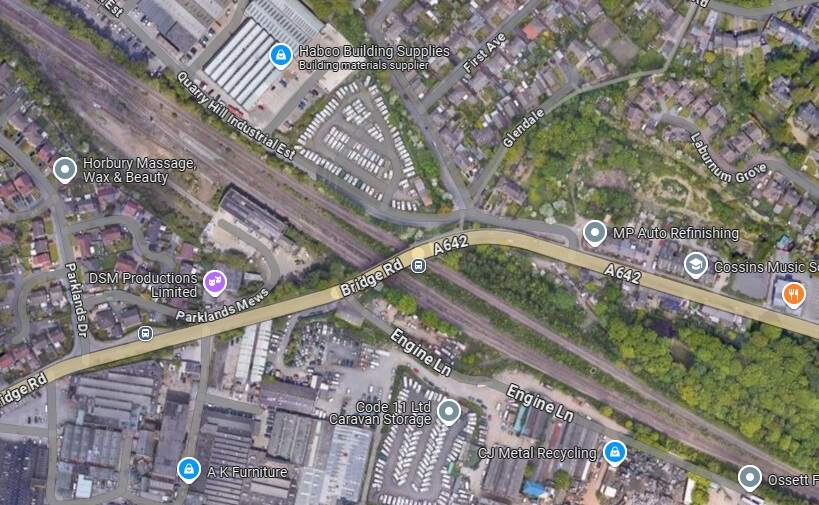
  12. Philo; De Specialibus Legibus, III; via https://scaife.perseus.org/reader/urn:cts:greekLit:tlg0018.tlg024.1st1K-grc1:3.7, cf.; https://summerstudy.yale.edu/sites/default/files/chapter_3._gender.pdf, https://www.earlychristianwritings.com/yonge/book29.html, https://www.loebclassics.com/view/philo_judaeus-special_laws/1937/pb_LCL320.473.xml, all accessed on 1st October 2024.
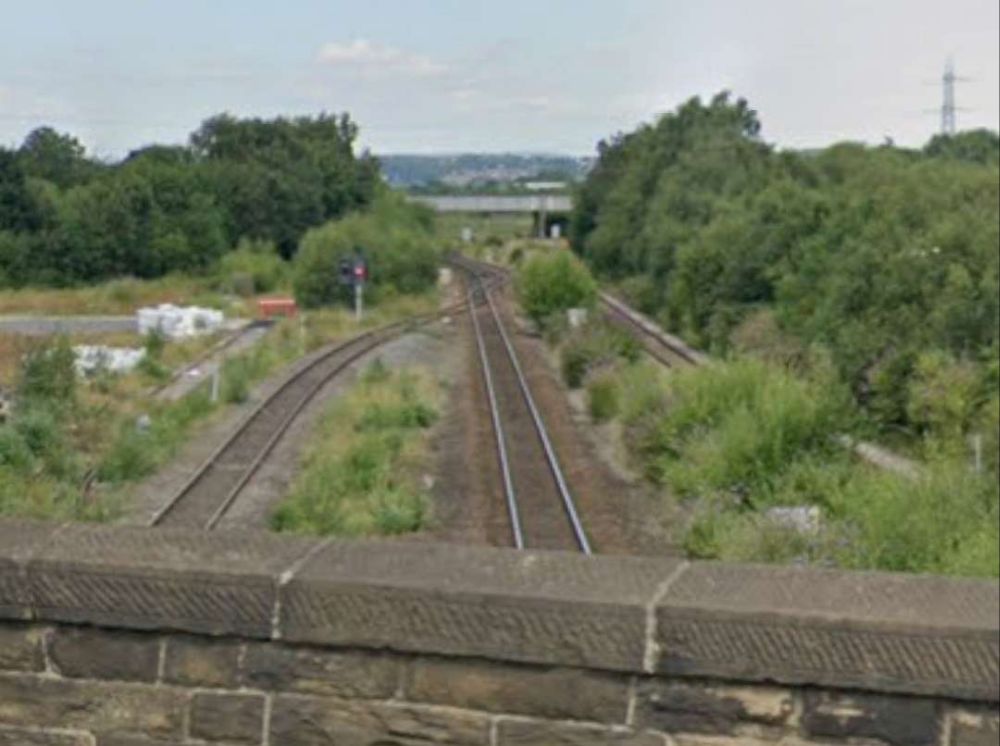
  13. James V. Brownson; Bible, gender, sexuality: Reframing the church’s debate on same-sex relationships; Wm. B. Eerdmans Publishing, Grand Rapids, Michigan, 2013.
  14. cf., the Mishneh Torah Issurei B’iah 21:9 (https://www.myjewishlearning.com/article/judaism-and-sexuality), https://prism.ucalgary.ca/server/api/core/bitstreams/770995b3-cc5b-4ed2-90be-7d0cb53e46a8/content, all accessed on 1st October 2024.
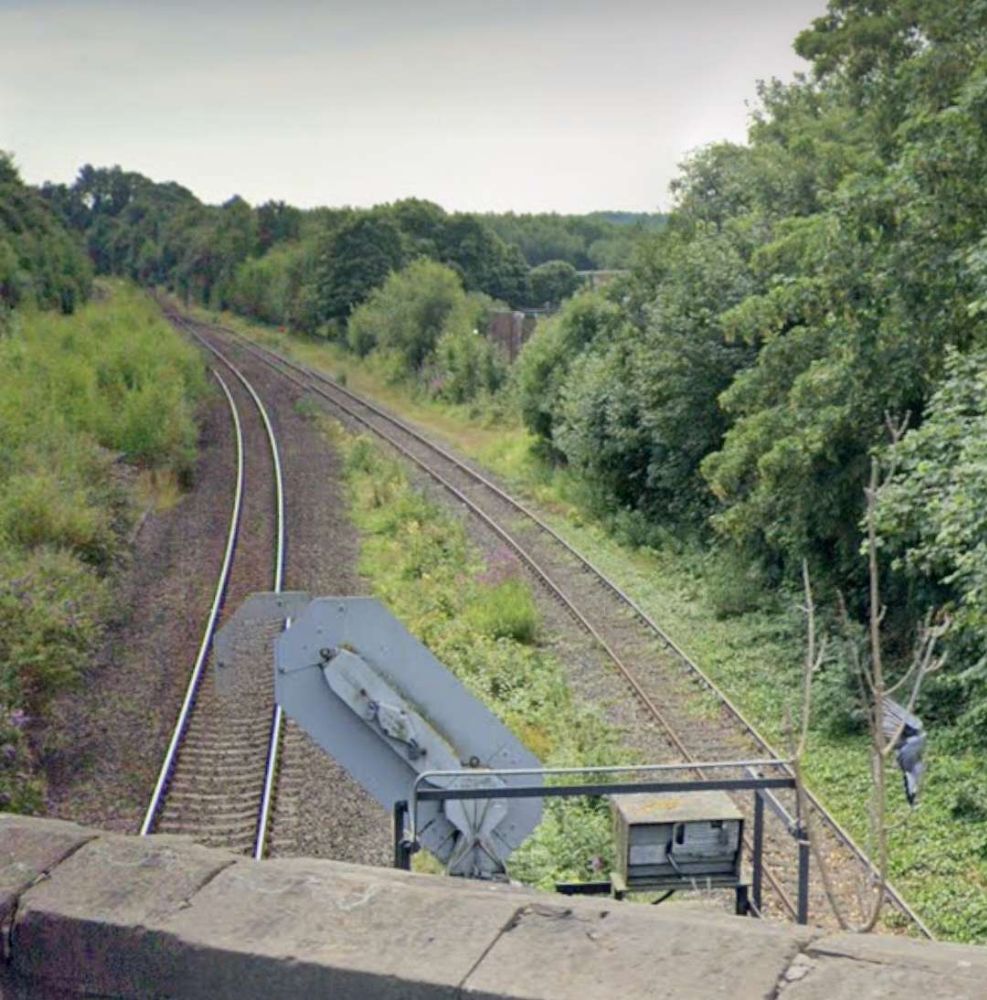
  15. Codrington asserts that “In classical literature … lesbianism is never discussed in this way. … Male homosexuality was discussed a lot in classical literature. When female homosexuality was discussed, it was always preceded by discussions of male homosexuality, which was itself typically preceded by discussions on unnatural heterosexual sexual activity. This is a very typical progression when dealing with sexual issues in ancient literature. It’s very unlikely that Paul would break with this literary form, unless he was trying to make a different point. To say that Romans 1:26 forbids lesbian sexual activity is to read much more into the verse than is actually there.” [3]
  16. Michael Younes; Engaging Romans: An Exegetical Analysis of Romans 1:26-27; John Carroll University, Summer 2017, via https://collected.jcu.edu/cgi/viewcontent.cgi?article=1077&context=mastersessays#:~:text=Romans%201:26%E2%80%9327%20offers,over%20against%20the%20LGBTQ+%20community, accessed on 1st October 2024.
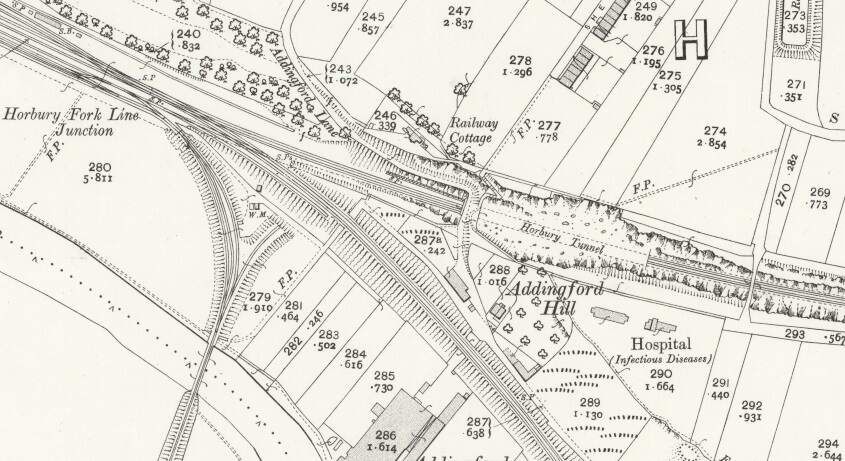
  17. James D.G. Dunn; 38A Word Biblical Commentary Romans 1-8; Word Books, Dallas, Texas, 1988.
  18. This is what Martti Nissinen believes to be the case, Martti Nissinen; Homoeroticism in the Biblical World: A Historical Perspective; Fortress Press, 2004.
  19. https://biblehub.com/greek/plane_s_4106.htm, accessed on 2nd October 2024.
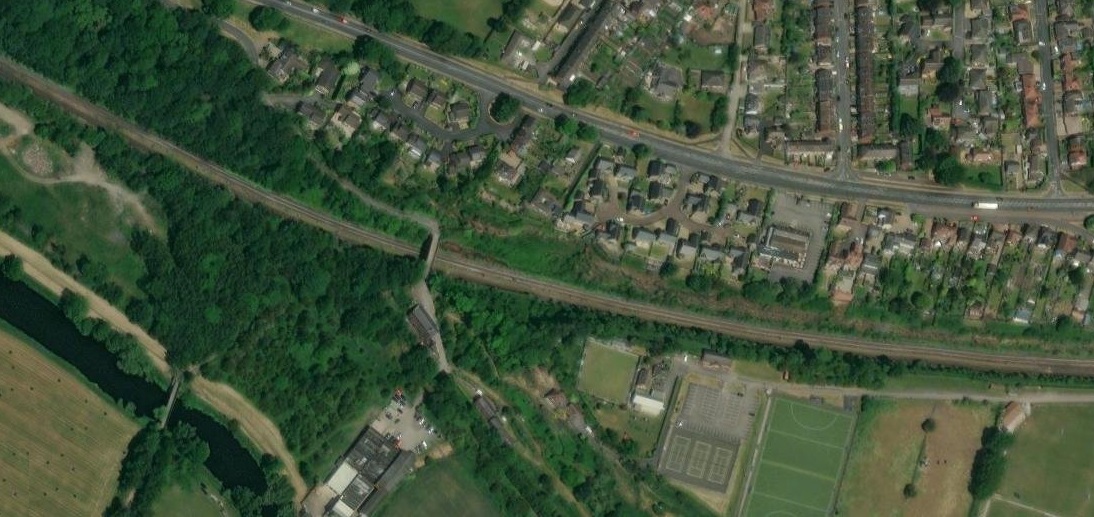
  20. Marilyn Riedel; Hermeneutics of Homosexuality; [broken link: http://users.wi.net/~maracon/lesson1.html, attempted access on 2nd October 2024.]
  21. https://www.inclusive-church.org/the-ic-statement, accessed on 2nd October 2024.
  22. https://bible.art/p/cslrdLTqR4obex8ipiFo/romans-1:26-27-for-this-reason-god, accessed on 2nd October 2024.