Yearly Archives: 2020

The Uganda Railway during the First World War

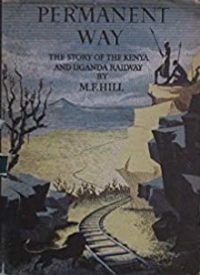
I recently picked up a copy of each of the two volumes of ‘Permanent Way‘ written by M.F. Hill and published in 1949. The first volume [1] is a history of ‘The Uganda Railway’ written in the 1940s when the railway company was known as ‘The Kenya and Uganda Railways and Harbours’ and published at the end of that decade under the jurisdiction of the new ‘East African Railways and Harbours’ which was formed to formally include the infrastructure in the modern country of Tanzania.

Hill’s first volume provides a detailed history of the Uganda Railway until just after the end of World War II. This article covers the period of WW1.

Hill provides, at least as far as I can tell, what appears to be a very fair compilation of activity throughout the East Africa Protectorate (EAP) and the Uganda Protectorate UP) during the War. [1: p344ff] There was significant unrest in the EAP contributed to by a range of incompetencies exhibited by the EAP Government based in Nairobi, during the first year of the War. He highlights the importance of a meeting of Settlers in September 2015, which pressed on the Government the need for effective organisation and which resulted in the first elected representation for the Settlers onto a War Council.

Hill says that organisation improved markedly from this time on, although there were still significant losses in the community and the forces particularly due to fever. The German resistance throughout the War is noted by Hill as being one of “courage, endurance and astounding ingenuity” before it surrendered eventually on 25th November 1918. [1: p354]

Hill’s summary of the EAP campaign says: “The most ardent advocate of the East African campaign cannot maintain that it contributed to the ultimate to the ultimate defeat of Germany. The most caustic critic cannot deny that the story of the campaign is an epic of human endurance in the face of terrible trials. Fever, disease and starvation, through the breakdown of a suicidal system of supply, were von Lettow’s [2] allies, and they caused far more casualties than his soldiers.” [1: p354]

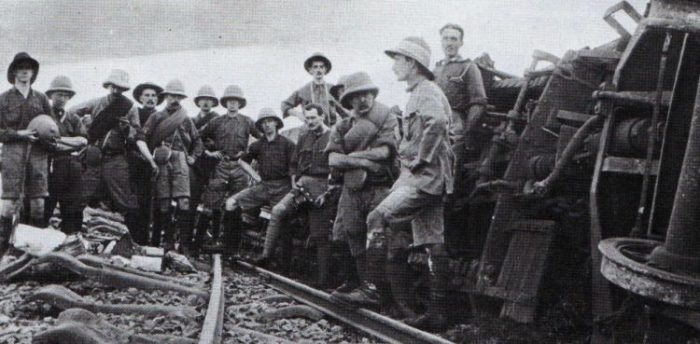
British troops after their train has run over a German mine. [3][4]

Hill points to the War Office record which states that, “during the campaign, 976 officers and 17,650 other ranks were killed, died or missing. Those figures covered the East African, South African, West African, British and Indian troops engaged in the campaign. In addition, 44,572 African porters were killed or died of disease. The maximum strength employed at any time was 24,156 combatants and 187,369 non-combatants. Altogether 112,000 fighting troops and 261,000 non-combatants took part in the campaign. Of the vast army of African porters, on which the transport and supply of the troops in the field mainly depended, nearly 60,000 were recruited in Uganda and the great majority of the remainder came from the Native tribes of the East Africa Protectorate. They were called upon to pay a terrible price in human life and misery because the First German War overspilt from Europe into Africa ” [1: p355]

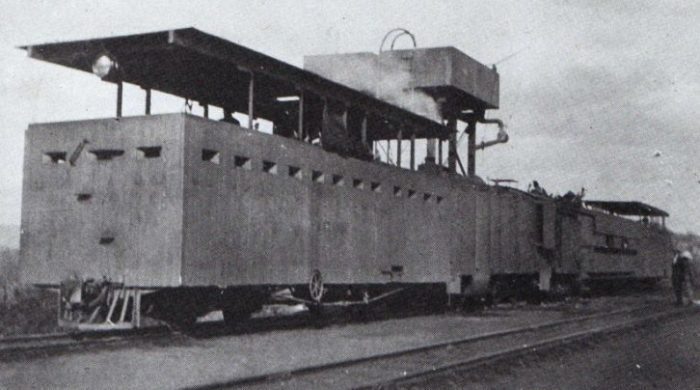
H.M. armoured train, ‘Simba’ was built in the workshops at Nairobi to counteract the German mounted patrols that carried out nuisance raids on the railway during the War. [3][4] It was destroyed by a mine.

He goes on to talk about ‘The Uganda Railway’. Throughout the text of the chapter on the War, Hill again provides details of the working profit each year:

1914-1915     –      £180,600     [1: p355]

1915-1916     –      £287,300     [1: p360]

1916-1917     –      £351,815     [1: p364]

1917-1918     –      £208,986     [1: p368]

1918-1919     –      £152,255     [1: p370]

During 1915, Parliament approved a loan of £1.868 million for further expenditure at Kilindini Harbour, for railway improvements and for roads and bridges. Only a fraction of the loan was spent until the end of the War. Survey work onthe line from Nakuru across the Uasinn Gishu Plateau did continue. Oil storage at Kilindini and at Kisumu was increased along with work to piers at several ports and Harbours associated with trade on Lake Victoria. One new ship, the ‘Rusunga’, was launched on the lake. [1: p355f]

Hill highlights locomotive developments in 1915: 3 new tank engines were put into service; seven ‘G’ class engines were erected but not out into service until 1817 for lack of flangeless tyres for the leading powered axle/wheel set.

Twenty-nine of the ‘F’ class locos were still working. By the start of the War, the annual engine mileage was 1,862,453 of which the ‘F’ class locos were doing about 50%. The Mallets (18 No.) were doing good work, hauling satisfactory loads, but we’re proving very expensive to maintain. [1: p356]

The Magadi Line opened on 14th January 1915, the Thika Line was still passenger only and already paying its way. The Busoga Railway was crippled by the major drop in export and import traffic. It had also been realised that the costs associated with making Lake Kioga navigable would be exorbitant.

Towards the end of 1915 it was decided to build a new branch line from Voi to Maktau to solve supply problems for the proposed offensive into German East Africa. In due course this line would be extended to Kahe and so would link The Uganda Railway with the line from Tanga to the foothills of Kilimanjaro. [1: p358]

At around this time the military took control of The Uganda Railway. [1: p358f]

By June 1915,1,166 vehicles were being dispatched  monthly from Kilindini. In January 1916 this had increased to 2,994 vehicles. Before the end of March 1916, 25 engines and 200 ten ton covered wagons had been imported from India, mainly for the Voi-Maktau line, but also to receive pressure on the main line. Further wagons were purchased from the contractors for the Magadi Line. [1: p359]

A working profit of £287,000 was achieved in the 1915/1916 financial year but there was no significant allowance made for necessary maintenance and a renewals fund had still not been created. The survey of the line across the Uasin-Gishu Plateau was completed and the first mention appeared in an Annual Report of the General Manager of this route becoming the start of a trunk line through Uganda to the Congo. [1: p361]

In November 1915, the Port at Kilindini was taken over by the Royal Navy and closed to civilian traffic. The inadequate Old Port at Mombasa had to be used for all exports.

The March 1817 report if the General Manager drew attention to the wretched state of engines and rolling stock.

Little had changed by March 1919. The General Manager’s report was a repetition of the difficulties of previous years:

“Little had been done to remedy a chronic decay, the difficulties had, inevitably, become more critical. Several engines had been taken out of service either for lack of spares or as not worth repairing. In February 1919, fifteen new ‘G’ class engines were ordered, but they were not expected to arrive before the end of the year. Meanwhile, of the railway’s ninety-two engines, only seventy-seven were in working order and many of those were in bad shape. Most of the railway’s original rolling-stock particularly the second- and third-class carriages, was virtually beyond repair except at great and uneconomic cost. The majority of the machines in the workshops were worn out and incapable of turning out accurate work.” [1: p371]

All the subsidiary lines were also showing a loss and it was recognised that the two lines in Uganda (Busoga and Port Bell) were too small to be operated effectively as separate systems. [1: p372]

“For years the Treasury of the EAP had pillaged the railway in order to balance its budget. Now the Treasury had extended the field of pillage to Uganda. By this time the state of the railway was so derelict and critical that some radical reorganisation could not long be avoided. The surcharge, and the protests of Uganda, proved to be the last straws. Undoubtedly they impelled the series of events and the design of policy which eventually placed the railway on a sounder constitutional basis and a very much sounder financial basis. Unfortunately, this ill-advised surcharge, following upon the long struggle to secure to Uganda a fair allocation of the customs revenue derived from its imports via Kilindini, left a legacy of suspicion and resentment which exercised an unhappy influence on relations between the two territories for many years.” [1: p373]

References

  1. M.F. Hill; Permanent Way – The Story of the Kenya and Uganda Railway – Volume 1; Hazel, Watson & Viney Ltd, Aylesbury & London, 1949.
  2. Lieut.-Colonel (later General) von Lettow-Vorbeck was the German commander-in-chief in East Africa and remained so throughout the conflict until the end of November 2018 when surrender became inevitable.
  3. http://www.kaiserscross.com/188001/293122.html, accessed on 28th December 2020.
  4. Lieutenant Colonel Charles Hordern; Military Operations East Africa August 1914 – September 1916; Battery Press, Nashville, Tennesse, 1990.
  5. The featured Image at the start of this article comes from http://ww1blog.osborneink.com/?p=10064, accessed on 28th December 2020

The Feast of St. John the Apostle and Evangelist – 27th December 2020

John 20:19-31

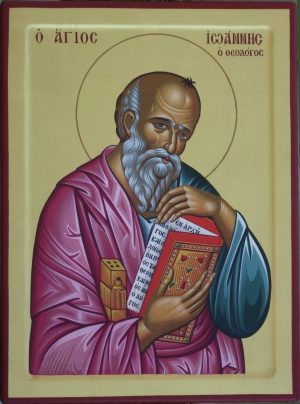
On 27th December, the Church celebrates the Feast of St. John, Apostle and Evangelist. Born in Bethsaida, he was called while mending his nets to follow Jesus. He became the beloved disciple of Jesus. He wrote the fourth Gospel, three Epistles and the Apocalypse. The first chapter of his Gospel which focuses of the Word made flesh is one of the most read Gospel reading at Christmas time. In his Gospel and in his epistles, he speaks of the divinity of Christ and of the primacy of love. With James, his brother, and Simon Peter, he was one of the witnesses of the Transfiguration. At the Last Supper, he leans on the Master’s breast. At the foot of the cross, Jesus entrusts His Mother to his care. John was close to both Jesus and Mary. Towards the end of his life, we know that John was exiled to the island of Patmos under Emperor Domitian.

I have chosen to reflect on a passage from close to the end of John’s Gospel. It might seem strange to be reading an Easter story just after Christmas. It isn’t the passage set for the Feast of St. John. But it is the point at which John’s Gospel reaches its climax.

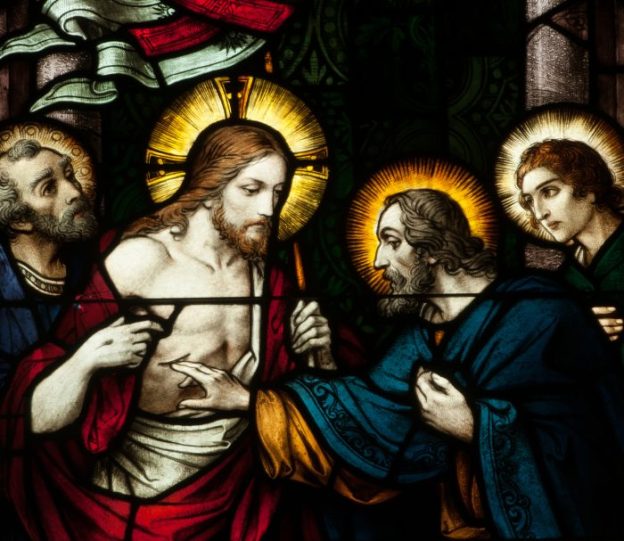
We’re not told why Thomas wasn’t in the upper room that first Easter evening when Jesus visited his disciples. We could spend time trying to imagine where he was – but we won’t! Suffice to say, he missed the key event, the turning point, the moment that changed defeat into victory. And how did he respond? … In exactly the same way as most of us would have done. … Thomas just could not believe what the others told him.

I doubt any of us would have done under those same circumstances. We say that ‘Seeing is believing’ – but so is sharing in an experience with others. Thomas not only didn’t see what happened, he was left out of the experience that everyone else shared. He was in a lonely place, wanting to believe, wanting to share in everyone else’s happiness, but unable to do so. He’d not been there, he had not seen Jesus.

Thomas’ reactions and feelings are understandable, and as we read the story we can see that Jesus thought so too. He provided a repeat of the same encounter – one in which Thomas could share. He then gently reminded Thomas of his outburst – no indignant rebuke, just words which drew Thomas back to faith. Thomas’ response is one of the clearest statements of Jesus’ divinity in the Bible. Having seen the truth of the resurrection he cannot but exclaim, “My Lord and my God!”

The next 3 verses are important, and they are pivotal to St. John’s message:

Jesus said to Thomas: “Have you believed because you have seen me? Blessed are those who have not seen and yet have come to believe.” ….  Now Jesus did many other signs in the presence of his disciples, which are not written in this book. But these are written so that you may come to believe that Jesus is the Messiah, the Son of God, and that through believing you may have life in his name.

St. John has led his readers through a story – a story which allows those readers to meet Jesus and begin to understand who he is. It’s a journey of discovery, one in which we can identify with the different characters, feel their emotions, struggle with them to understand what Jesus is doing and saying. Thomas’ words are the culmination, the pinnacle of the story – the point where even the strongest of doubters expresses faith. Jesus response is not just for Thomas’ ears, not just for the disciples, but for all who read John’s Gospel in coming generations. “Don’t think,” says Jesus, “that the disciples were in some way special because they saw all these events first hand. Rather, blessed are those who read the stories and encounter Christ through the work of his Spirit in their lives and the lives of those around them.”

“Blessed,” says Jesus, “are all who read this Gospel, who struggle with doubts & come to believe that I am the Son of God.”

St. John’s message for us is that we have not missed out on the party, we can still be part of the events which changed defeat into victory. We too can own the risen Jesus as our Lord.

This is good news – particularly for those of us who struggle with doubt; for those of us who’d like to believe more strongly than we do; for those of us who see other people’s faith, or the joy they seem to experience in their Christian life, and feel that we are somehow missing out.

I think this passage is not just important as the culmination, the climax of St. John’s Gospel. It is important because St. John chooses, at this climactic moment of change, to embrace doubt. He places the strongest words of faith in the mouth of Thomas the doubter.

Everything is different, Jesus was dead and is now alive. Nothing can now be the same. In the story, Thomas struggles to accept this new reality. For so many of us change is difficult to handle, yet it is happening all the time. It is happening right now as we struggle towards a possible post-Covid reality.

We need to continue to engage with the communities around our churches, looking for new ways to serve, new ways to make Christ known and to bring hope where there is despair. We need to accept that the future for the Church of England is one with significantly less stipendiary clergy – perhaps one third less in numbers in only a few years’ time – and we need to imagine new forms of ministry both lay and ordained, new ways of being church. Nothing is the same as it was, nothing will be the same as it was, and we want to shout out the loudest “No! Not now, not ever!”

I think that there are two key things to take away from this passage.

First – it’s OK to be honest – don’t pretend that everything is OK when it isn’t, don’t manufacture faith if it isn’t there. We can express our fears and we can express our doubts. In fact expressing our fear and our doubt is often, like it was for Thomas, the first step to faith.

Second – this story of doubt and faith is made the crowning moment of John’s Gospel – the pinnacle – Jesus reaching out to his loyal but doubting and fearful follower, not in anger but in love. Thomas’ exclamation, “My Lord and my God!” is the point at which John choses to rest his case. He has asked his readers to understand who Jesus is and this story of doubt and faith is the crucial last part of his argument. Honest struggling with change, honest struggling through doubt towards faith is given the highest honour in John’s Gospel.

So, don’t be discouraged if the pace of change or the circumstances we face are a struggle. Don’t be discouraged if believing is a struggle. Be encouraged as you struggle to be faithful in an ever-changing context, when at times everything you hold dear seems threatened. Be encouraged as you struggle to believe, for the story of Thomas makes clear that God loves the open and honest doubter.

The Uganda Railway at the beginning of 20th century.

I recently picked up a copy of each of the two volumes of ‘Permanent Way‘ written by M.F. Hill and published in 1949. The first volume [1] is a history of ‘The Uganda Railway’ written in the 1940s when the railway company was known as ‘The Kenya and Uganda Railways and Harbours’ and published at the end of that decade under the jurisdiction of the new ‘East African Railways and Harbours’ which was formed to formally include the infrastructure in the modern country of Tanzania.

Hill’s first volume provides a detailed history of the Uganda Railway until just after the end of World War II. This article covers the period from the beginning of the 20th century up to WW1.

The railway was handed over to the administration of the East Africa Protectorate on 1st October 1903. [1: p236] Before that date, the line was in use  first, until 1901, primarily as a construction line. The period from the beginning of 1902 until 31st March 1903 was treated as one accounting year. In that first ‘year’, the working deficit of the line was £49.690. This figure excludes interest on the capital  cost of the line. [1: p236]

The actual capital cost was assessed as £5,502,592 which had been financed by annuities by HM Treasury. An annual payment of £319,112 [1: p242] serviced these annuities. When they were finally discharged in November 1925, the Uganda Railway had cost the British taxpayer just under £7,909,295. [1: p243]

In the years following its opening a working deficit was converted into a working profit. Yearly figures are provided by Hill within the narrative of following chapters of his book.

1903/1904       –      -£60,101      [1: p280]

1904/1905       –         £2,639      [1: p280]

1905/1906       –       £56,678      [1: p290]

1906/1907       –       £76,763      [1: p293]

1907/1908       –       £64,713      [1: p300]

1908/1909       –       £64,838      [1: p304]

1909/1910       –       figures not provided by Hill

1910/1911       –       £98,519      [1: p308]

1911/1912       –     £131,373      [1: p320]

1912/1913       –     £209,046      [1: p330]

1913/1914       –     £213,484      [1: p337]

Hill provides a snapshot of the situation on the Uganda Railway on 31st March 1905: “the staff of the railway consisted of 53 Europeans, 176 Eurasians, 1,254 Indians and 3,050 Africans. … The railway had 70 engines, 209 units of coaching stock and 947 units of good stock. The engines consisted of the 34 English-built Class F and 36 American-built Class B, which had all been used on construction.” [1: p290]

The profit margins quoted above were struck “without making provision for the renewal of wasting assets, without any charge for interest on the capital cost, and it accrued not to the railway, but to the Treasury of the East Africa Protectorate.” [1: p280] This was done so as to meet the debt owed to the British taxpayer both resulting from grant-aid and the loans made to cover the costs of building the railway. The grant-aid to the East Africa Protectorate was £2,843,383. The charge on the capital cost, as noted above, was £319,112 per annum. [1: p281]

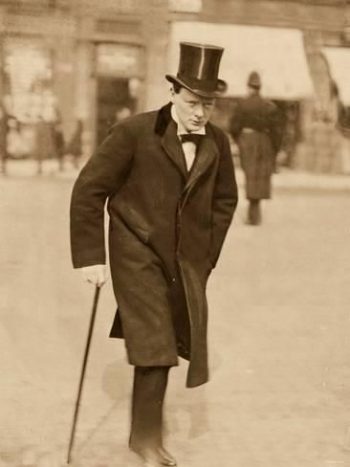
Winston Churchill in 1907, taken in London close to the time of his African Safari. [4]

Winston Churchill visited Uganda in 1907. Speaking about that time he commented that the Uganda Railway was “one of the most romantic and wonderful railways in the world.” [2: p3]

He writes: “Short has been the life, many the vicissitudes, of the Uganda Railway. The adventurous enterprise of a Liberal Government, it was soon exposed, disowned, to the merciless criticism of its parents. Adopted as a cherished foundling by the Conservative party, it almost perished from mismanagement in their hands. Nearly ten thousand pounds a mile were expended upon its construction; and so eager were all parties to be done with it and its expense that, instead of pursuing its proper and natural route across the plateau to the deep waters of Port Victoria, it fell by the way into the shallow gulf of Kavirondo, lucky to get so far. It is easy to censure, it is impossible not to criticize, the administrative mistakes and miscalculations which tarnished and nearly marred a brilliant conception. But it is still more easy, as one traverses in forty-eight hours countries which ten years ago would have baffled the toilsome marches of many weeks, to underrate the difficulties in which unavoidable ignorance and astonishing conditions plunged the pioneers. The British art of “muddling through” is here seen in one of its finest expositions. Through everything—through the forests, through the ravines, 5through troops of marauding lions, through famine, through war, through five years of excoriating Parliamentary debate, muddled and marched the railway; and here at last, in some more or less effective fashion, is it arrived at its goal.” [2: p4-5]

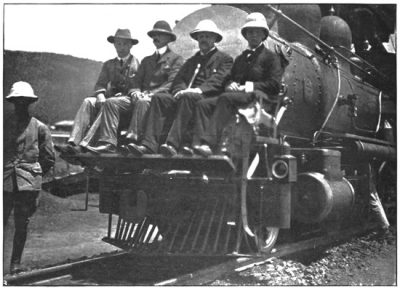
On the Cow-catcher. (Mr. Currie, Mr. Marsh, Col. Wilson, Sir J. Hayes-Sadler, Mr. Churchill.) [2: p7]

Churchill continues: “The Uganda Railway is already doing what it was never expected within any reasonable period to do. It is paying its way. It is beginning to yield a profit—albeit a small profit—upon its capital charge. Projected solely as a political railway to reach Uganda, and to secure British predominance upon the Upper Nile, it has already achieved a commercial value. Instead of the annual deficits upon working expenses which were regularly anticipated by those most competent to judge, there is already a substantial profit of nearly eighty thousand pounds a year. And this is but the beginning, and an imperfect beginning; for at present the line is only a trunk, without its necessary limbs and feeders, without its deep-water head at Kilindini, without its full tale of steamers on the lake; above all, without its natural and necessary extension to the Albert Nyanza.” [2: p6]

Winston Churchill was clearly impressed with the line, in the state that he found it, in 1907.

It was under the tenure of Sir Percy Girouard as Governor that serious thought was first given to real development of the railway and other transport infrastructure – railway, roads, hospitals and schools, and agricultural, veterinary and social services. “The railway needed a deep water quay, or pier, at Kilindini, and branch lines to bring traffic from potentially productive areas, remote from the main line.” [1: p307]

Sir Percy decided that a branch line North from Nairobi through coffee and sisal plantations and on into Kikuyuland was needed, with the hope that later on it could be extended towards Mt. Kenya. This did not receive support from the Treasury until the plan was revised to request permission to build a ‘tramway’ thirty miles long from Nairobi to Thinks. [1: p307]

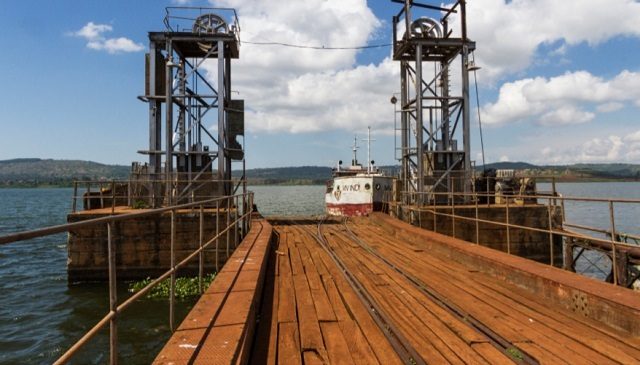
The Jinja Pier was built in 1912, it once served as the main export gate for Uganda. The the railway tracks can still be seen in the timber planking of the deck. [3]

Winston Churchill was a significant player in a decision to build a line from Jinja to Kakindi (the Busoga Railway) which was reviewed in 1911 as the port facilities developed were inadequate. A decision was taken to extend the line to Namasagali where better quay/port facilities could be developed. An amount of close to £170,000 was allowed for this line which could become a longer route to Lake Albert, a project put forward by Churchill which would have cost around £1.25 million. [1: p309-310]

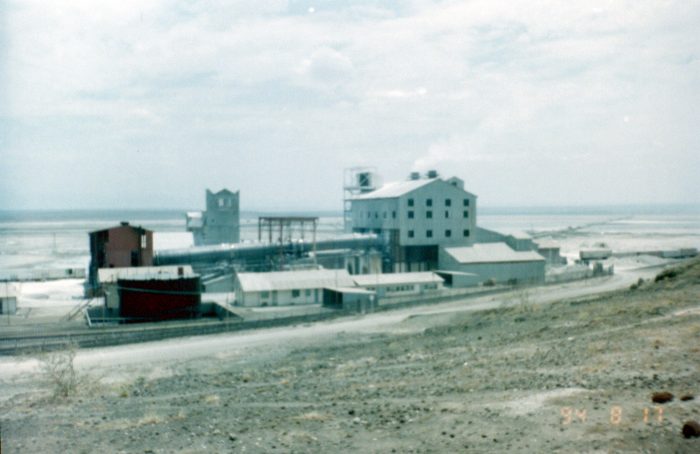
Magadi Soda Works in 1994 (my photograph).

At a similar time, negotiations were ongoing with the Magadi Soda Company, a new venture, which was given a site at Kilindini to erect godowns and a pier for the storage and shipment of its products. The plan was to build a 106 mile branch line to Lake Magadi to permit economic transport of soda products to the coast. Capital of about £1.3 million was set aside for the whole project on the founding of the company. The Treasury agreed to £350,000 of expenditure on the mail line to upgrade buildings, locomotive fleet and rolling stock. [1: p311]

In order to expedite the development of facilities at Kilindini, the Railway took over responsibility for the port in August 1911.

In 1912 David Lloyd-George, then Chancellor of the Exchequer, pushed a bill through parliament in the UK which allocated a loan £500,000 for the development of the port at Kilindini. In addition a series of smaller sums were agreed to cover the cost of: the line to Namasagali; the branch line to Thika; and the main line improvement to facilitate the branch to Lake Magadi. [1: p322]

However, the story of these years before the beginning of WW1 was one of inadequate stock and locomotives, with investment never quite keeping pace with demand. [1: p322ff]

In Uganda in 1912, “In addition to the loan of £170,000 for the building of the Busoga Railway, His Majesty’s Government granted a loan of £125,000 … for the improvement of communications in the Eastern province of the protectorate and the building of a short railway from Kampala to Port Bell on Lake Victoria.” [1: p327]

By March 1913, the Locomotive Superintendent reported: “With the power on order, there will be some 100 engines on the line, eighteen of which will be Mallet engines, equalling 36 ordinary type engines.” [1: p332] Of these Mallets, two were already in service and seemed, after some initial problems with the lack of familiarity of staff with the the locomotives, to be giving effective service. By the middle of 1913, eight Mallet engines had been delivered along with three further shunting engines.

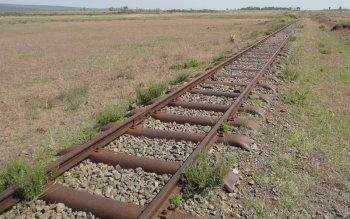
The original Thika Railway tracks before the upgrading and refurbishment in the 21st century. [5]

Major Taylor, the General Manager, reported in March 1913, that the 6 mile long Port Bell railway was under construction and that the Thika line would be open to traffic by the end of October. [1: p333] His promise came to fruition with the opening of the line and in the same month a daily passenger service was inaugurated between Nairobi and Mombasa. [1: p337]

At the end of 1912, the Magadi Railway had reached Lake Magadi. However, it was not until 1914 that the Magadi Works was ready to start production. In the spring of the same year Parliament approved another loan to the East Africa Protectorate – a sum of £3 million of which £610,000 was allocated to Kilindini harbour, £957,000 to railway improvements. There remained £90,000 available from the previous loan associated with the harbour. This meant £700,000 could be spent on the renewed works at Kilindini. [1: p340-341]

Part of the main line improvement was the construction of 18 new crossing stations which would greatly increase the frequency of trains and the strengthening of bridges and viaducts to allow for a maxim.axle load of 15 tons. [1: p335, p337] Also of paramount importance was the strengthening of the rails from 50lb to 80lb and the replacememt of the sleepers with 109lb steel. The old 50lb rail was to be use for the branch lines. [1: p337]

By 1914, “the European population of the East Africa Protectorate was few more than 3,000. Of the 2,321 men of fighting age – including civil servants, missionaries and aliens – 1,987 served in the armed forces of the Crown, some for part of the war and some throughout the war.” [1: p342] The barest minimum of expatriates remained in the Protectorate throughout WW1.

References

  1. M.F. Hill; Permanent Way – The Story of the Kenya and Uganda Railway – Volume 1; Hazel, Watson & Viney Ltd, Aylesbury & London, 1949.
  2. Winston Churchill; My African Journey; William Briggs, Toronto, 1909.
  3. https://www.independent.co.ug/falling-in-love-with-ugandas-fading-glory/3, accessed on 26th December 2020.
  4. https://images.app.goo.gl/pDAJDzhSpxPmERfc8 accessed on 26th December 2020.
  5. https://www.pd.co.ke, accessed on 26th December 2020.

Uganda at the end of 19th century and the events leading up to the construction of the Uganda Railway.

It has been some time since I last posted about the Uganda Railway. I have very recently picked up a copy of each of the two volumes of ‘Permanent Way’ written by M.F. Hill in 1949. The first volume [1] is a history of ‘The Uganda Railway’ written in the 1940s when the railway company was known as ‘The Kenya and Uganda Railways and Harbours’ and published at the end of that decade under the jurisdiction of the new ‘East African Railways and Harbours’ which was formed to formally include the infrastructure in the modern country of Tanzania.

In order to provide the context for the construction of the Uganda Railway, M.F. Hill saw it as imperative in his book to provide a social and economic history of the East African region. It is impossible for me to judge the veracity of what he writes, but it clearly is written from a British Colonial perspective. In addition to covering the strife between the European powers who sought to increase their influence in the Great  Lakes region of the continent of Africa, Hill provides extensive quotes from leading British figures in the region about the Uganda that they knew before the coming of the railway.

It must be acknowledged that the perspective is essentially that of those who were seeking to enhance British influence and eventually to establish Colonial rule, however, it also has to be said that these men (and it was always men) sought, within their own Colonial and paternalistic terms of reference, to be a benign civilizing force. The picture which develops, as one reads M.F. Hill’s book, is, on the one hand, one of competition for influence between Germany, Britain and to some extent, France and Belgium, but on the other hand, a significant and seemingly quite unhealthy competition between three main religious groups, Roman Catholics, Protestants and followers of Islam.

Within the sphere of the Buganda ‘nation’, the influence of the two forms of Christianity was very significant, with adherents to the Muslim faith being a significant minority. The conflict between these groups has to be seen as one of the major influences on the choices made by Colonial emissaries. Yes, there was also an urgent consideration of competition with Germany for control over the Great Lakes region but it is significant that much of the focus of those who were leaders in the development of the British sphere of influence seems to be on the internal tribal conflicts in the region which seemingly were fueled by the rivalry between Protest and Catholic leaders.

Sir Gerald Portal, who led an overland expedition to Uganda in the early months of 1893 at the insistence of the 5th Earl of Rosebery (Secretary of State for Foreign Affairs in the 4th Gladstone administration) commented in a despatch to Lord Rosebury on the situation he discovered on his arrival in Uganda in March 1893, “he emphasised both the evils of the native system of administration and the curse of the religious conflict which largely arose from political causes.” [1: p103]

The decisions being made about the possible/probable construction of ‘The Uganda Railway’  were equally focussed on the possibility of these tribal/faith conflicts flaring up as they were on firmly establishing British interests over-and-against those of Germany.

In this light, it is worth quoting directly from Hill who is himself predominantly quoting Portal:

Portal described Uganda as a ‘whited sepulchre’, and traced the country’s tragic story from the bloody despotism of Mutesa, and the early years of Mwanga’s reign, when the condition of Uganda had been scarcely rivalled by the horrible records of Dahomey.

“The form of government in Uganda,” he wrote, “is nominally a despotic monarchy, and in the days of the late Mutesa it was really so; but his successors, and notably the present King Mwanga, have been unable to maintain either the prestige or the power of the Crown. . . . At the time when I arrived, the whole population of Uganda was divided into three semi-religious parties, two of which acknowledge no authority on the part either of Mwanga or his Council. Uganda is divided into ten provinces, each of which is under the nominal governorship of a chief. Under these governors again are an immense number of minor chiefs, one below the other, in a complicated system of transmitted authority. . . . In theory, at first sight, this organisation would appear to be not a bad one; in practice, it has proved to be the cause of a vast system of oppression and robbery. The unfortunate peasantry are forced to toil for the support and glory of an immense number of useless and idle petty chieftains who would think it beneath their dignity to do a stroke of any sort of work from one end of the year to another. In recent times, even the small chiefs had powers of life and death over the peasants, and although this has been stopped, there can still be no doubt that cruelty and oppression in various forms are rife throughout the provinces. Economically, the present system is as bad a one as could be devised; certain taxes in kind have to be paid to the King from each province; these taxes are levied solely from the lowest classes, but as they have to pass through the hands of a long gradation of chiefs, the amount which ultimately reaches the King does not represent more than a fifth part of what has been paid by the villagers.”

Portal pointed out that this administrative system accounted for the importance attached by the Bishops and the political leaders of the opposing parties to the possession, on their side, of certain chieftainships or provincial governorships. The acceptance by a great chief of the Protestant creed might mean the addition of a thousand fighting men to the Protestant cause, whilst the appointment of a Catholic governor to the command of a province might mean that every chief, sub-chief and villager in the province had to make up his mind quickly between embracing the same faith, or being forthwith turned adrift and deprived of his house, dignity and position.

The miserable history of Uganda during the previous few years had shown how inextricably religion and politics were interwoven. The three great parties, Mohammedans, Catholics and Protestants, were nominally divided only by religious tenets, but in fact they were adverse and jealous political factions, two of which were led, to all intents and purposes, by European missionaries. [1: p103-104]

Portal went on to say:

“That the missionaries, on both sides, are the veritable political leaders of their respective factions there can be no doubt whatever. As regards the Catholics, Mgr. Hirth and the Fathers would probably be the first to admit this to be the case. On the Protestant side, it is not, I believe, admitted, but the fact unfortunately remains. . . . The present state of affairs is that the natives on both sides have acquired the habit of appealing to their respective missionaries on every possible question, whether it be a personal quarrel with one of the opposite faction, an assault case, an eviction from a plantation, a murder, a decree from the King, or a decision or order from Her Majesty’s Commissioner. There has thus grown up a sort of dual or even triple system of government, which adds very seriously to the difficulties of administration. It will from this be readily understood that the race for converts, now being carried on by the Catholics and Protestants in Uganda, is synonymous with a race for political power. To-day the Protestants are the strongest, and the most numerous, party; to-morrow a successful battle might place the Catholics in a dominant position and, in such case, that religion would gain on the second day many thousands of converts, from among those who are now reckoned as belonging to the Protestant party. Catholics and Protestants here seem to look upon each other as natural enemies; no doctrine of toleration, if it has been taught on either side, appears to have been received by the native Christians; the fear of English officers and of the Nubian soldiers at the Fort may keep them from overt acts of hostility towards one another while this control remains here, but as soon as it is withdrawn, the war of extermination will at once be renewed. It is this feeling which, through the introduction of the two forms of Christianity into Uganda, has cost so many hundreds of lives, and has thrown the country fifty years back in its advance towards prosperity. It is deeply to be regretted that the avowedly great influence of missionaries in Uganda is not used to introduce a spirit of tolerance and peace even at the risk of the loss to the party of some political power of a few wealthy chieftainships.” [1: p104]

Hill continues:

The Mohammedan party was weaker in numbers, wealth and arms than either of the two Christian parties. In the event of the withdrawal of British control, the strength of the Mohammedans lay in their power to hold the balance between the two Christian factions. When it became known that the Company proposed to withdraw from Uganda, overtures to the Mohammedans were made, almost simultaneously, by the Catholics and by the Protestants. Portal realised that the Mohammedan influence in Uganda was inevitably doomed. If civil war again broke out, whichever party gained the Mohammedans’ affiance would certainly win the day—and then turn upon and annihilate the allies who had assured their victory. If peace continued, the Mohammedan party would inevitably be wrecked on the same rock which destroyed the power of so many Mussulman states—that of slavery. [1: p104-105]

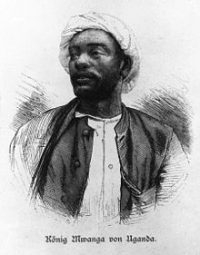
Mwanga II was kabaka in Buganda from 1884 – 1888 & 1889 – 1897. He died aged 34 or 35 in 1903. There are notes about his reign below the references at the end of this article.

In retrospect it seems as though there is ample evidence in the story told here for a rejection of all religious influence in matters of state/politics. However, the world is not such a simple place. Portal did not regard all the Christian converts in Uganda as animated solely by political or material motives. He knew that only “a proportion of the so-called Catholic and Protestant parties could truly be called Christians, but Christianity had undoubtedly gained a firm hold in the country. Mwanga’s persecutions, [2] a few years previously, had proved that there were a considerable number of sincere-Christians prepared to die for their faith.” [1: p105] In addition, politics is a descriptive term for all interactions between differing groups of people. Where people exist, politics will occur. It is to be sincerely regretted that denominational loyalties in the West were imported into the Great Lakes region of Africa in such a way as to promote conflict rather than tolerance and understanding! The level of trust between the principal Christian denominations was not high in Europe at this same time.

The primacy of religious leaders in the politics of the time meant that one of Portal’s first tasks was to seek an accommodation between Bishop Tucker, the Protestant Bishop of East Equatorial Africa and Mgr. Hirth, the Rpam Catholic Bishop of Thereste and Vicar Apostolic of Nyanza. Careful negotiation brought reluctant agreement to the partition of provinces between Catholic and Protestant factions.

On 8th April 1893, 40 Protestant Chiefs signed a statement agreeing to release all their slaves. On 29th May, Mwanga also signed an agreement which accepted British authority. On that same day, Portal left for the coast.

By late 1893, Portal’s health was failing and he made his last report to his masters in London before setting off for the UK himself, where he died very early in 1894. Much of the report had to do with the management of British interests in the Great Lakes region. As [part of that report he strongly recommended the building of a railway from the coast to Kikuyu, not to Lake Victoria Nyanza, but including a significant enhancement of the British fleet on the Lake. That report was considered, after his death, by Parliament in London.

In June 1894, the British government was still hedging its bets and not making a commitment to the construction of a railway, although a decision was taken to declare a Protectorate over Uganda. This move was proclaimed in Uganda in August 1894 and was heartily welcomed. A further Protectorate covering the area from Uganda to the coast was proclaimed in 1896 – the ‘East African Protectorate’.

The Report of the Committee on Railway Communication with Uganda was submitted in April 1895, by the end of June 1895, Lord Rosebery’s Government had fallen and the new Tory administration under Lord Salisbury lost no time in deciding that the railway should be built. It was seen as essential to the life of the Uganda Protectorate. Preliminary expense were granted in the sum of £20,000 in August 1895. And the decision was taken to construct the full length of the railway from the coast at Mombasa to Lake Victoria Nyanza – a distance of 650 miles. Through choosing a reduced gauge and a lighter rail, the cost estimate for the work was set at about £2,700 per mile – a reduction from £3,409 per mile in the early estimates of cost. However in April 1896, a Government committee recommended that the gauge should be increased to one metre and the rail weight restored to that originally recommended – 50lb per yard.

The engineering team arrived in Mombasa in late 1895 but the empowering Act was not to achieve its passage through Parliament until August 1896 with a budget of £3 million.

Earlier posts in my series on the Uganda Railway cover the line and its construction. That story starts with the following article on this site:

The Uganda Railway – Part 1

Hill continues with the story of the building of the line. [1: p139-244] Given that this series is meant to be primarily about the Uganda Railway, this article has been something of a diversion.

As I am an Anglican priest it seems worthwhile to me to  return to the religious issues mentioned above. These will, in due course, be the subject of a further article in this series.

To restore the balance in favour of the railway itself. I will finish this post with some images directly associated with the railway which come from the pages of Hill’s book. [1]

Sir George Whitehouse KCB., the first Chief Engineer and General Manager of the Uganda Railway. [1: facing p144]

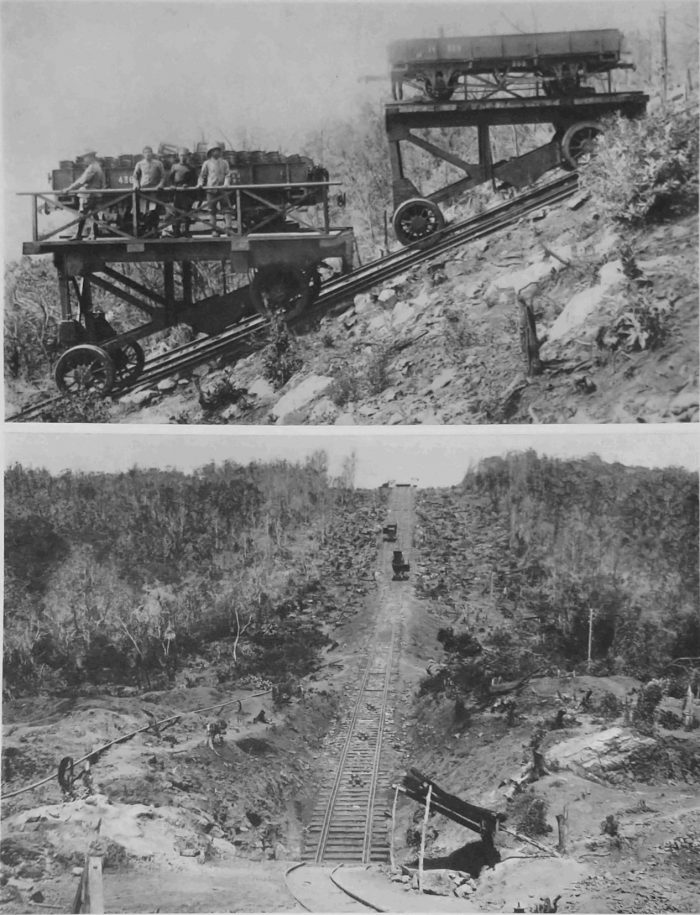
Rope Inclines on the Eastern face of the Rift Valley during construction in March 1900. [1: facing p179]

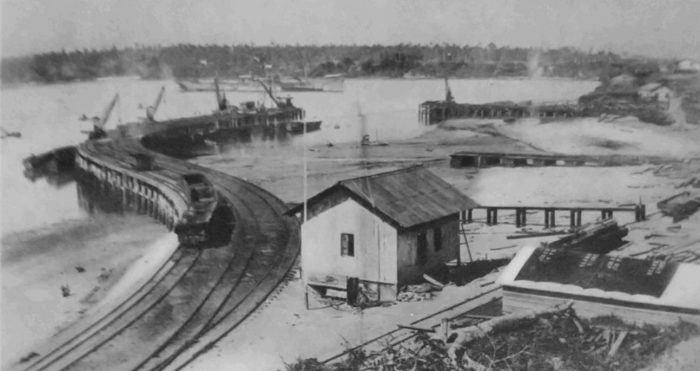
Kilindini in 1900. [1: facing p208]

Nairobi Railway Station in 1900. [1: facing p228]

Nairobi in 1900. [1: facing p228]

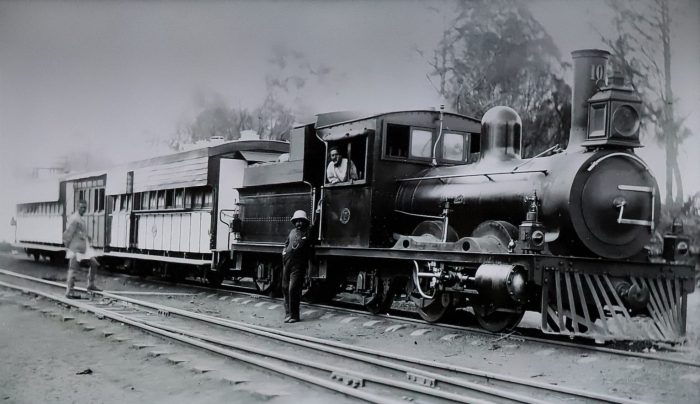
Uganda Railway – Class G 0-4-2 steam locomotive Nr. 101 and passenger train (Hawthorn 1746/1878). This locomotive was a one-off import from India, ex South Indian Railway. This image was posted recently on a French language site associated with the LRPresse Magazine(s), rather than coming from Hill’s book [3]

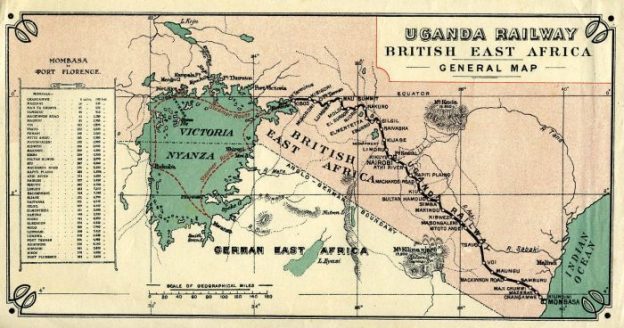
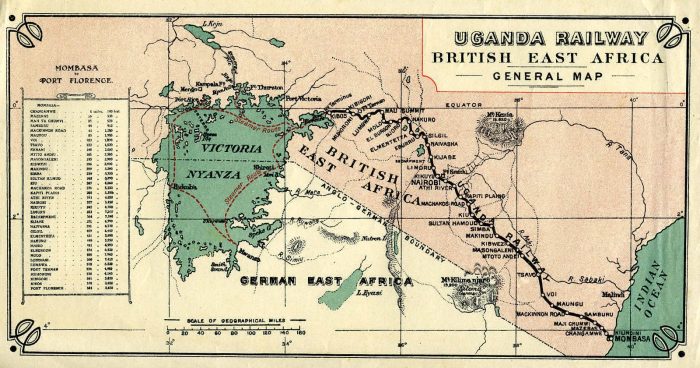
British East Africa in 1910. The Uganda Railway from Mombasa to Victoria Nyanza. Also included on the LR Presse forum. [3]

References

  1. M.F. Hill; Permanent Way – The Story of the Kenya and Uganda Railway – Volume 1; Hazel, Watson & Viney Ltd, Aylesbry & London, 1949.
  2. https://en.wikipedia.org/wiki/Mwanga_II_of_Buganda, accessed on 17th December 2020. Part of the text of this Wikipedia page is reproduced in italics below.
  3. https://forum.e-train.fr/viewtopic.php?f=5&t=87849&p=2255445&hilit=Ouganda#p2255445; accessed on 19th December 2020.

Mwanga came to the throne at the age of 16. He increasingly regarded the greatest threat to his rule coming from the Christian missionaries who had gradually penetrated Buganda . His father had played-off the three religions, Catholics, Protestants and Muslims, against each other and thus balanced the influence of the European colonial powers that were backing each group in order to extend their reach into Africa. Mwanga II took a much more aggressive approach, expelling missionaries and insisting that Christian converts abandon their faith or face death. A year after becoming king he executed Yusufu Rugarama, Makko Kakumba, and Nuuwa Sserwanga, who had converted to Christianity. On 29th October 1885, he had the incoming archbishop James Hannington assassinated on the eastern border of his kingdom.

For Mwanga, the ultimate humiliation was the insolence he received from the (male) pages of his harem when they resisted his sexual advances. According to old tradition the king was the centre of power and authority, and he could dispense with any life as he felt. It was unheard of for mere pages to reject the wishes of a king. Given those conflicting values Mwanga was determined to rid his kingdom of the new teaching and its followers. Mwanga therefore precipitated a showdown in May 1886 by ordering converts in his court to choose between their new faith and complete obedience to his orders and kingdom.

It is believed that at least 30 Catholic and Protestant neophytes went to their deaths. Twenty-two of the men, who had converted to Catholicism, were burned alive at Namugongo in 1886 and later became known as the Uganda Martyrs. Among those executed were two Christians who held the court position of Master of the Pages, Joseph Mukasa Balikuddembe and Charles Lwanga. They had repeatedly defied the king by rescuing royal pages in their care from sexual exploitation by Mwanga which they believed contrary to Christian teaching.

These murders and Mwanga’s continued resistance alarmed the British, who backed a rebellion by Christian and Muslim groups who supported Mwanga’s half brother and defeated Mwanga at Mengo in 1888. Mwanga’s brother, Kiweewa Nnyonyintono, was elevated to the throne. He lasted exactly one month and was replaced on the throne by another brother, Kabaka Kalema Muguluma. However, Mwanga escaped and negotiated with the British. In exchange for handing over some of his sovereignty to the British East Africa Company, the British changed their backing to Mwanga, who swiftly removed Kalema from the throne in 1889. He later converted to Christianity and was baptised.

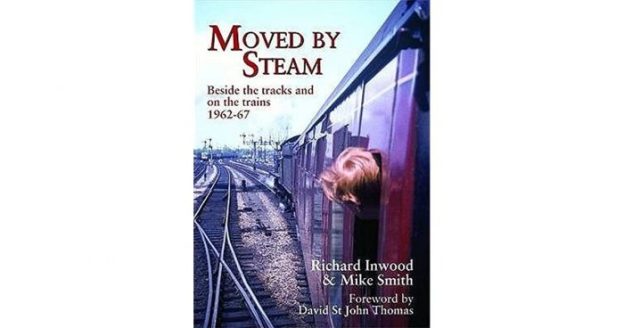
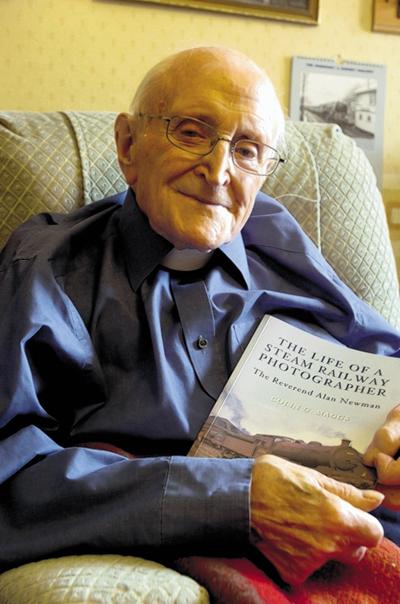
“Moved by Steam” by Richard Inwood and Mike Smith

Published by Silver Link Publishing Ltd in 2009, this excellent book is made up of the personal reflections of the two authors on their memories of following steam as teenagers in the years 1962 to 1967. [1] This was a particularly poignant time in the life of Britain’s railways as the Modernisation Plan saw the relatively rapid demise of steam power.

In his forward to the book, Davis St. John Thomas says: ‘Here is a book with that tingle factor to bring memories flooding back to those old enough to remember the colourful last days of steam’. [1: p7]

I picked up a signed secondhand copy of this book and its sequel, ‘Steam Tracked Back’ online during the second lockdown in 2020. I had just written an article about clergy and railways [2] and was encouraged by someone who read the article to purchase these two volumes. The signed copies were a real bonus.

I mention the article about clergy and railways because one of the authors of these volumes was a retired member of the clergy. Bishop Richard Inwood was Suffragan Bishop of Bedford in St. Alban’s Diocese until his retirement and lived, in retirement in Chesterfield.

His obituary, carried by the Church Times in May 2019 [3] mentions his co-authorship of books on railways during his time as a Suffragan. It also highlights parallel with my own experiences. Like him: I taught for a short time in Uganda; attended Holy Trinity, Platt in Rusholme, Manchester; studied at St. John’s College, Nottingham. My time working for the Church of England as a parish priest and first Area Dean then Borough Dean did not mirror in anyway his later career as Archdeacon and then Suffragan Bishop.

I marvel at his capacity to write books about his love of the railways alongside sustaining a demanding ministry as a Bishop.

In the days before the end of steam on mainline duties on the railways of Britain, Richard Inwood and Mike Smith developed from trainspotters into railway photographers. They first met as schoolboys at the beginning of the 1960s. Subsequently, as members of their school’s Locospotters’ Club, they attempted to record as much British steam as possible in its last years, from Derbyshire to Dorset, from Oxford to Oxenholme.

This volume charts their growing desire to follow what was left of steam as it was being withdrawn across the whole rail network. It is a deeply personal account  which ‘brings to life some of the excitement tinged with sadness of those times’. [1: p7] It is supplemented by some great photographs of the railways around Burton-on-Trent and further afield. Each of these photos is carefully annotated

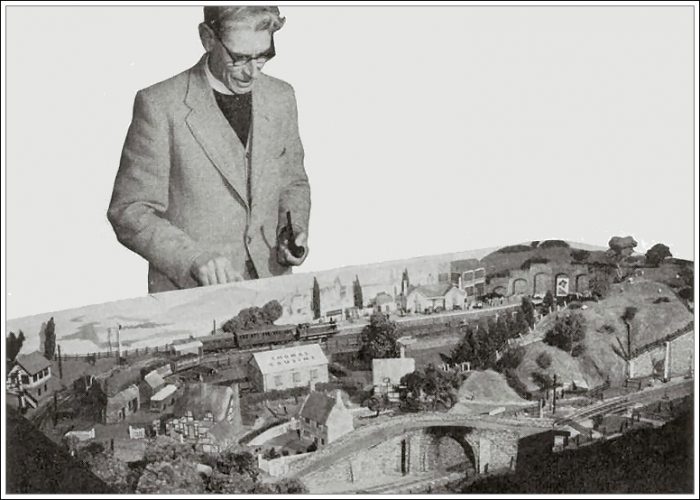
I was delighted to find a few pictures of the line between Hereford and Gloucester, and particularly one photograph taken at the Aylestone Hill end of Hereford Barrscourt Station. My modelling interest centres on the City of Hereford and its railways. [4]

As an aside, I read this volume very soon after I read ‘Platform Souls’ by Nicholas Whittaker to which also comes out of a teenage spent trainspotting in Burton-on-Trent!

References

  1. Richard Inwood & Mike Smith; Moved By Steam; Silver Link Publishing Ltd., Kettering, Northants, 2009.
  2. https://rogerfarnworth.com/2020/11/14/clergy-and-railways, published on 14th November 2020.
  3. https://www.churchtimes.co.uk/articles/2019/17-may/gazette/obituaries/obituary-the-rt-revd-richard-inwood, accessed on 10th December 2020.
  4. https://rogerfarnworth.com/category/railways-blog/model-railway – the articles on this page are substantially about the model that I have been creating in the vicarage loft. The first article is a general comment on the use of N Gauge (2mm to the foot) as a modelling scale. The remainder focus on Hereford.
  5. Nicholas Whittaker; Platform Souls; Orion, London, 1995 (Revised Edition, 2015).

Sunday 6th December – Mark 1:1-8 and Isaiah 40:1-11

The first Candle on our advent wreath in church spoke of the Patriarchs. The second candle speaks of the Prophets. Both groups witnesses, ahead of time in the Old Testament, to the coming of Jesus. The remaining two outer candles on the wreath represent John and Baptist and Mary.

Our gospel this week and that next week focus on John the Baptist, the last of a long line of Old Testament prophets.

I used to work in the centre of Manchester, and during lunch breaks I’d often wander around Piccadilly Gardens. Frequently I’d be approached by one of the men who lived rough – sleeping on the benches in the Bus Station or in the sunken gardens which were once the basement of a hospital bombed out in the Second World War. Usually I’d be asked for a coin or two to help purchase a meal. Money which, I was near certain, would be spent on alcohol. … Jo, my wife, once told me that when she worked in London and shopped on Oxford Street there was one character that she could rely on meeting. … Trudging up and down, eyes downcast, with a sad look on his face, a rather dishevelled looking man with a scruffy brown overcoat carried a sign “Repent, the end is nigh”. It wasn’t surprising that no one ever stopped him to ask about his message. He seemed rather strange, a person to avoid. Of no relevance to their lives.

This is how I imagine the Old Testament prophets and John the Baptist – very similar to this dishevelled tramp, although perhaps with a little more fire in their bellies! . John the Baptist was an unconventional man, living in the desert, with clothes made of camels hair, living on a diet of locusts and wild honey – proclaiming a message of repentance. A seemingly unattractive person – someone to be ignored. Yet John was attracting large crowds and his message was credible. People listened and acted on what he said.

‘Repent’, said John, and people did, in large numbers. He was a success. …

So, what can we learn from John? How come he was so successful?

In John’s day, Israel was a weary people, living under occupation. They’d been so for 400 years – first the Greeks and Persians, and now the Romans. They were right at the bottom, depressed and desperate for any sign of hope. God had promised a Messiah, and in 400 years there had been only imposters claiming the title. God seemed to have gone silent. They lived under pagan occupying forces; they lived in a secular, world with a corrupt king and hypocritical religious leaders.

Yet among the people were those prepared and willing to hear John’s message. People longing for renewal and change, people who knew that there was more to life than the grind of daily living under the burden of an occupying power. People who perhaps were desperate enough to respond to anything – they’d tried everything else, and here was their last hope. Perhaps people, who when they heard John, recognised God’s voice calling to them. Or perhaps they were people who were just dissatisfied with the world around them and wanted something more.

This sounds very familiar? A secular world, full of unbelief? A lack of confidence in authority? Religion on the back foot? Church attendance dropping? Values of society changing – no longer so easily identified with our Christian heritage? God seemingly absent? … Just like today? Well, almost. …. Perhaps the pandemic makes our circumstances different, but the people in Palestine at the time of John the Baptist would have had significant concerns about their health. There were none of the amazing drugs which we can rely on today!

How should we respond? Pack up and go home? That seems to be the easiest option. Let’s retreat back into our churches, do the things we enjoy doing and let the world get on with its own agenda. Unfortunately, in churches across our land that seems to be the temptation. It’s so much easier to stick with what we know than to contemplate radical change.

John the Baptist chose differently, and so did those who listened him. John spoke words that the people needed to hear. Not, perhaps, what they might have wanted to hear. …… “Repent.” Why? Because God’s kingdom is near! There, in John’s message are the first seeds of hope. God seems to be speaking again, just like he did to the prophets of old, speaking with authority once again. Hope was being born again in the hearts and minds of all who listened to John. John was preparing the way for something significant to happen. Something new, something different.

John brought hope, and with it renewed energy and life. Hope that God would act. Hope that, in the words of the placard carried by the tramp in London, hope that the end was nigh. The end, not of the world, but of waiting for God to act. Now, soon, God will act. The people who went out to John in the desert became a people of hope, people with a renewed vision for the coming of the Messiah.

Advent is a season for preparation, for anticipation, for longing; a season of hope; a season to allow ourselves to yearn for things to be right. A season when we can express even our anger to God – anger that the world is not the way it should be, longing that God will do something about it. Advent is a season when we can start to recognise that God has given us his first response to that longing, to that hope; a down-payment, a deposit that we can trust. In the incarnation of Jesus, we have God’s “Yes!” to our cries for help. “Yes, I am with you. … Yes, I have heard you.” … But it is also the season when we acknowledge that we wait for his final answer. We wait in hope for God’s final solution, when everything will be made right.

Advent hope, Christian hope. Hope that is not just ‘pie-in-the-sky’, but hope based on the firm commitment of a deposit made 2000 years ago in the birth of Jesus. Hope that doesn’t just pretend that everything is going to be all right, despite the evidence. But hope which has seen everything and endured everything and still has not despaired, because it trusts God and his promises. Hope which continues to bear fruit in reality, as people’s lives are changed through meeting with God in Jesus; as they encounter Christians who clearly aren’t perfect but whose lives have something deeply attractive about them.

John calls his hears, calls us to renewal, to repentance – to ‘turn round’, to change direction. Not just to tinkering with the edges of our lives, those little personal things that need to change, it’s a call to a complete reorientation of our lives, a call to begin to believe again in God’s love, to turn away from selfish values and to love again as God has loved us – only this kind of all-embracing repentance will begin to demonstrate that hope is more than wishful thinking, that lives can be and are being changed by God’s love. Only through this kind of repentance will we prepare our hearts and the hearts of those around us for the coming of Jesus.

John’s life witnessed to the truth of what he believed. He was sold out to what he proclaimed. He lived his message. Nothing in the way John behaved, not his words nor his actions, left any doubt about where his priorities lay. However strange found him, the one thing that you could not do was accuse John of duplicity. He was whole-heartedly committed to his message. John’s words and actions belonged together. John’s challenge to us is a challenge to integrity – to live day by day the way that we talk at Church on Sunday. To be united with each other, caring for each other, to be seen to be growing in understanding of our faith, to be seen to be loving each other, and to be reaching out with the love of Christ to everyone that we meet in our daily lives. And by so doing, to emulate John who, as our Gospel reading tells us, pointed beyond himself to another, to the one on whom people’s hope can justifiably rest, to Jesus.

How will we make Advent hope more of a reality in our world today? Certainly not by carrying a placard which speaks of impending judgement, nor by mouthing words of faith which are not clearly supported by the lives that we live. Advent hope, real hope, will be seen as a reality by those around us only when they see lives that are sold out to the Gospel.

Advent Sunday 2020

Mark 13: 24-37 – 29th November 2020

It is over 30 years since the fall of many of the Soviet states in Europe.

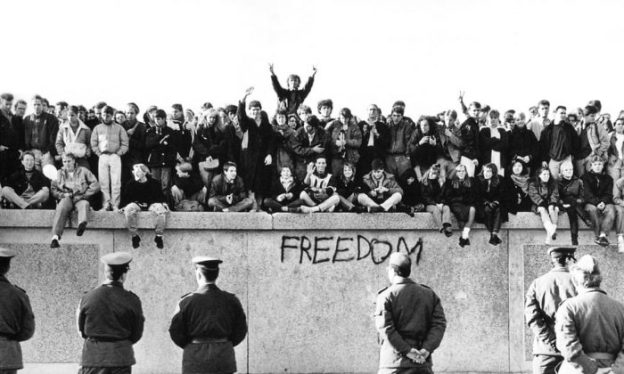
31 years since the Berlin Wall was torn down!

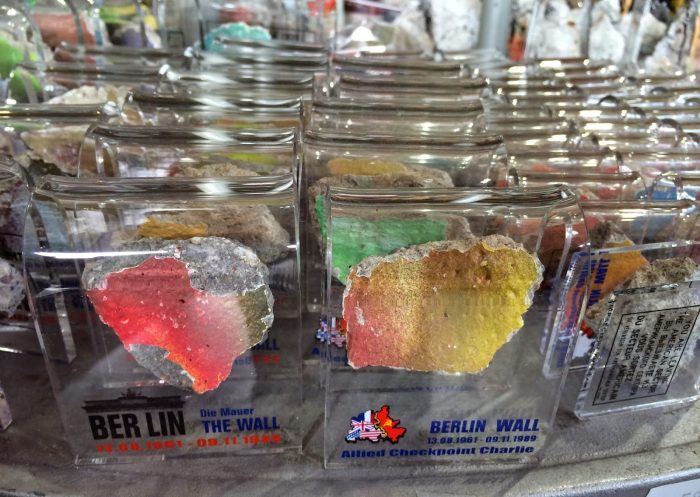
My brothers-in-law travelled there at the end of 1989 and picked up a souvenir piece of the wall. Pieces of the Berlin wall are still on sale today.

Over the New Year Holiday, the Berlin Wall was being dismantled. … The end of the Berlin Wall was the end of probably the most potent symbol of oppression in Europe in the 20th Century.

It’s disturbing to realise that it all happened over 30 years ago now. Maybe, at that time, you shared my sense of unbelief – ‘Is this really happening?’ It was hard to believe that the world order that I had grown up in – that of a Cold War, stand-off between two superpowers – was seemingly coming to an end. Something that even just months before those amazing events at the end of 1989 seemed impossible.

This same seeming impossibility surrounded the Jewish people in the centuries before Christ. They had been longing for a Messiah – someone who would change the course of history for ever. They were so often disappointed, different men came promising what they could not deliver. No doubt Israel felt the mocking eyes of others as they clung onto this seemingly vain hope of a glorious Messiah. Someone who would bring in Israel’s golden age. Everything pointed against it. Israel was a pawn, a minor league nation caught in the ebb and flow of the politics of the real powers.

In Advent, as Christians, we do at least two things – firstly, we remember, we enter into something of the feelings of the people of Israel as they waited for the coming of their Messiah. We wait with them. … They had to wait 500 years from the first promises made to them. We allow ourselves the month of December – but we wait for the coming of the Christ-child. Unlike them we know for sure that he will come – for we’ve read the story before.

But we are in other ways just like them. For we impose our expectations on him – we know what the Christmas story is all about – we’ve got the story neatly packaged. … We need the story to be constant, unchanging because life is too busy, too pressurised at this time of year. ‘Let’s stick to the routine,’ we say, ‘enjoy the celebrations, and hopefully have time to relax in January!’ Although what those Christmas celebrations will be like in 2020 is still a matter of uncertainty.

If we are not careful – if we don’t make the time to reflect, to listen, to wait – we’ll miss the Christ-child. We’ll not see the miracle of God in human form. Just as most of Israel missed its Messiah, so God’s grace will pass us by. Advent is our time to centre ourselves before Christmas, to focus on the true meaning of the Christmas story, to grasp that God’s Son, the Christ, God incarnate, Emmanuel, God with us – Jesus, is coming and he is coming for us, for me.

But we also wait in other ways … for many of us, life is not the way we want it to be and we pray for God’s intervention. It feels at times as though nothing is happening. Times like this are hard. We wait for God to come, and he seems absent. We are a little like the people of Israel awaiting their Messiah.

Advent is not just preparing for Christmas, but about looking forward to Christ’s Second Coming. Jesus spoke about this our Gospel reading. A difficult passage, because this Second Coming seems for Jesus to be so immediate. And so we, the Church, have our questions – raised at different times with different intensity. Why has it been so long? Has God forgotten us? Is Jesus never coming back? Were we intended to take it literally? Was Jesus mistaken? Is it important to believe in the Second Coming?

And these questions are often mirrored in our experience of daily life as at times God seems to be absent. And our experience of waiting in some way matches that of those nations waiting year after year under the tyranny of Communism. Seemingly without hope – yet in 1989 there was that dramatic change. What was unbelievable, happened. The wall came down, Communist regimes toppled.

Similar but different.

In our daily lives, we hold onto a promise – a promise to be taken on trust. Jesus’ promise to be there for us in the midst of all that life brings our way – Christ will come again.

But, as Christians, we also have something of the reality on deposit. In the meal of Holy Communion we look back to the realities of Christ=s first coming – his death and resurrection. And we also look forward to that heavenly banquet in which we will all share – a meal that Jesus promised to eat with us in his Kingdom.

We can believe that God is with us in our suffering. We can believe that Christ will return. Things that people dream about, do happen, God’s, presence with us is real, and Christ Second Coming is no more impossible than the collapse of the Berlin Wall felt to a divided Europe, a divided Germany. The seemingly impossible is possible with God.

Christ has died, Christ is risen, Christ will come again.

Railways in Iran – Part 11 – Anglo-Persian Oil Company Ltd.

The Anglo-Persian Oil Company (APOC) was founded in 1908 after the discovery of a large oil field in the South of what is now Iran. [2] Masjid-i-Sulaiman was the location where oil was first discovered in the Middle East. [3]

At the beginning of the 20th century, Khuzestan was one of the most impoverished and least urbanized areas of Iran, itself a desperately poor country. “In 1900 Iran was a fairly primitive, almost isolated state, barely distinguishable as an economic entity. About one fifth of the population lived in small towns; another quarter consisted of nomadic tribes, while the rest eked out an existence in poor villages” [9][11]. “Historical cities of Shushtar, Dezful, Ramhormoz, Hoveyzeh, and Behbahan, had small populations ranging between 7 and 25 thousand. Ahvaz (the provincial capital to the North of Abadan) was initially a large village, but it had been turning into a fast growing market town following the opening of Karun in 1880s to steamship commerce and the construction of the mule transport “Lynch Road” from there through Zagros to Esfahan.” [9].

William Knox D’Arcy, under contract to Ali-Qoli Khan Bakhtiari, obtained permission to explore for oil in Iran, he discovered oil near Masjid-i-Sulaiman in 1908. [3][4][5] This was the first time that oil  had been discovered in the Middle East, changing the history of the region and resulting in wealth beyond what country leaders could ever have hoped for or imagined. The oil discovery led to a petrochemical industry and the establishment of industries that strongly depended on oil.

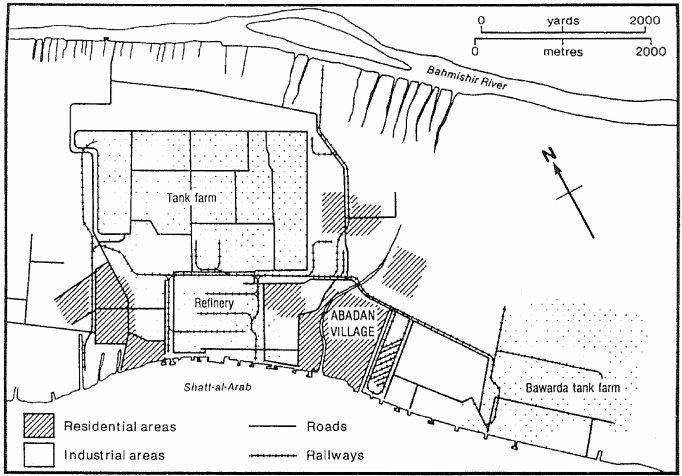
Masjid-i-Sulaiman, is situated among the foothills of the Iranian plateau, about 130 miles inland from the Persian Gulf. The reserves are very significant and resulted in the construction of a pipeline to link Majid-i-Sulaiman, and another oilfield at Haft Kel, with the Persian Gulf, an oil depot, and what became a large refinery at Abadan.

An early view of the Oilfield at Masjid-i-Sulaiman. [16]

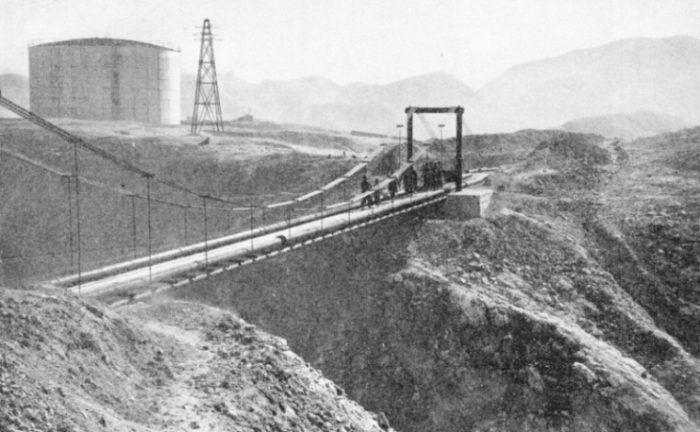
Near Masjid-i-Sulaiman, the pipe line is carried on a suspension bridge. In this illustration men are seen assembling the lengths of pipe line after the completion of the bridge. [17]

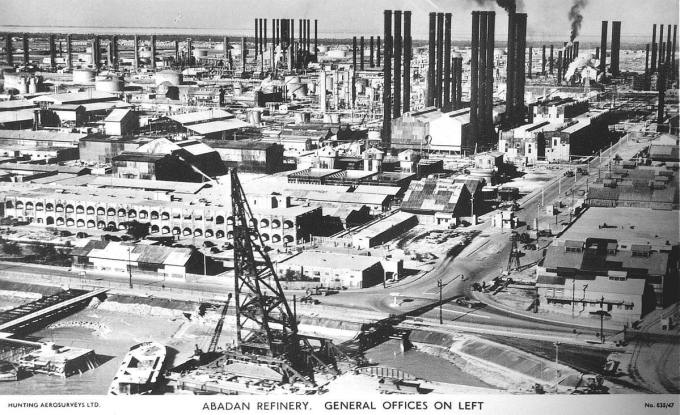
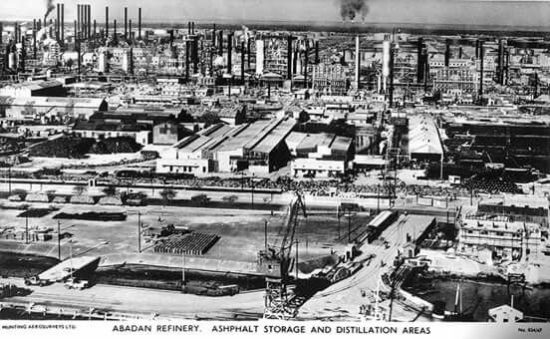
Construction of the refinery commenced in 1910 and the contraction was completed in 1912. Its capacity was 2500 barrels/day and it was the first oil refinery in the Middle East. [18]

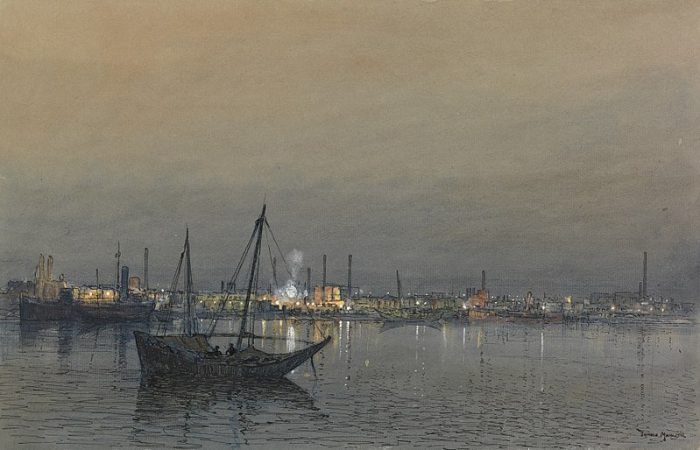
The island at the junction of the Euphrates and Tigris. The depot of the Anglo-Persian Oil Company. Oil fuel was of utmost necessity for the Mesopotamian river traffic in the advance on Baghdad in the First World War. This image is a a view of Abadan from the river at the junction of the Euphrates and Tigris, seen at night. There is a dhow with sails down in the foreground, and the lights and outlines of an oil depot in the background. Date: (First World War). [12]

In 1914, the British government purchased a 51% stake in the oil company, [6] and during the First World War, Abadan refinery was expanded to provide fuel for warships. [18]

The development of Abadan oil refinery accelerated in 1932 and in 1935, APOC was renamed the Anglo-Iranian Oil Company (AIOC) when Reza Shah Pahlavi asked foreign countries to refer to Persia as Iran. An institute of technology was established at Abadan in 1939. [18]

In World War II, after the Allies lost the Burmese oil and refinery, more attention was paid to the expansion of Abadan refinery and it became the largest refinery in the world. It supplied 25,000 barrels/day of aircraft gasoline during the war with the amount of 25,000 barrels per day and, as a result, contributed significantly to the Allied victory in WWII. [18]

Embed from Getty Images

An aerial view of barges in a dock at Abadan, Iran, 12th January 1947. (Photo by Pictorial Parade/Archive Photos/Getty Images) Parts of the 3ft gauge rail network are visible in this image. One track runs alongside the road to the left of the image. Two lines run parallel to each other to the left of the dock wall. They run between the legs of the rail mounted cranes. Wagons can be made out on these lines. This image is embedded from the Getty Images website with their kind permission. [14]

Later the government of Mohammad Mosaddegh nationalized the company’s local infrastructure assets and gave the new company the name National Iranian Oil Company. Mohammed Mosaddegh was Prime Minster of Iran from 1951 until 1953, when his government was overthrown in a coup d’état which was orchestrated by the CIA and MI6. [7]

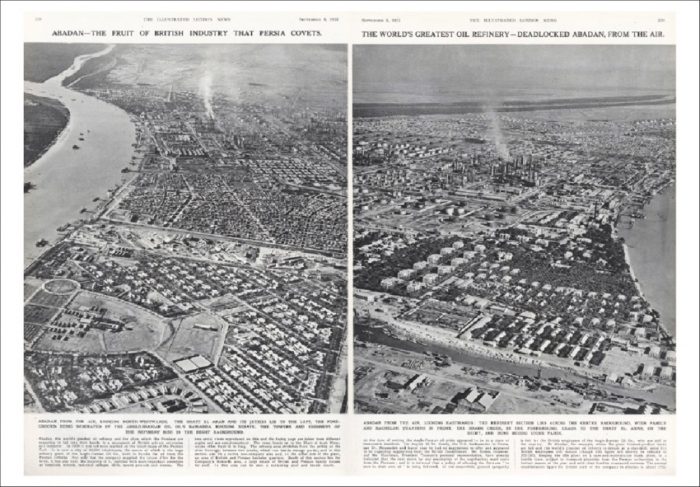
An aerial view of Abadan in 1951, when the Iranian government nationalized the Anglo-Iranian Oil Company. Source: The Illustrated London News, London, 8th September 1951, (Creative Commons Attribution-Non Commercial 4.0 International) [13].

In 1954, after the coup, the Company was renamed again to the British Petroleum Company (BP). [2] The products of Abadan refinery were once again sent to international markets at a rate of up to 300,000 barrels/day. By 1977, the capacity of the refinery had increased to 600,000 barrels/day. With that expansion, Abadan refinery regained its status as the largest refinery in the world. However, in 1980, the Iran/Iraq war brought all production to an end. [18] 

Recovery and further development has been slow and has been significantly affected by the international blockade.

The Railway Network in and around Abadan

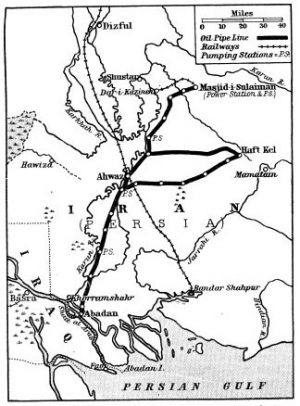
The Anglo-Persian Oil Company had its own railway network at their Abadan Oil Depot and had a series of other lines which accessed the oil fields. The Wonders of World Engineering Magazine which was published from Spring 1937 to Spring 1938, [16][17] has two articles about the Iranian oilfields. The adjacent sketch map  is included in the second of those articles. [17] The dark lines represent oil pipelines which were already transporting oil in 1937/1938. Of interest for this article are the two railway lines shown. One is the Trans-Iranian Railway which heads North from the port of Bandar Shahpur. Eariier articles in this short series about the railways of Iran cover that line. Towards the top of the map is a short line running from Dar-i-Khazineh to the oilfield at Masjid-i-Suleiman.

Also, it is interesting to read a military report which was written in 1940. Iain Logie, an online acquaintance through the Continental Railway Circle (CRC) and author of an article about the Dar-i-Khazineh Fields Railway in The Narrow Gauge magazine [32], pointed me to this document which is available on the Qatar National Library website. [19] That document focuses on possible supply routes from the Persian Gulf to the North of Iran and so is not particularly interested in the pipeline supplying oil to Abadan.

It is probably very appropriate to note at this point that Iain Logie’s scholarly article in The Narrow Gauge magazine [32] is a comprehensive and detailed look at the Dar-i-Khazineh Fields Railway. I only received a copy of the article after having written this present article based around the 1940 Military Report. I have reviewed the text below in the light of receiving Iain Logie’s article and corrected some things which were incorrect.

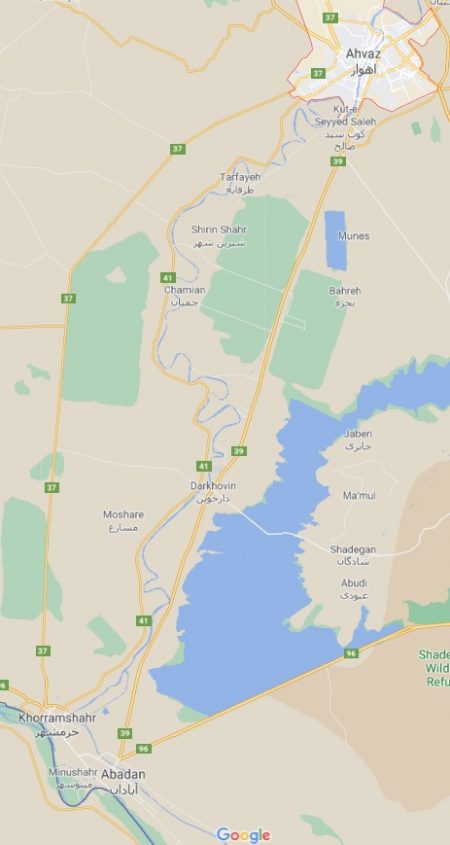
The landscape between Abadan and Ahwaz. The River Karun was used for transporting oil/good to and from Masjid-i-Suleiman. (Google Maps)

I find the content, of what was a very long military report fascinating, but for our present purposes, we need to focus on the route to the oilfields. The report tells us that in July 1940: “From Basra, Mohammerah (Khorramshahr) or Abadan the recognised and only reliable all-weather route to the oilfields is by river craft. At Ahwaz transshipment is necessary owing to the rapids.” [19: p13]  The river used was the River Karun. Details regarding transshipment are given later in the military document. I have unearthed some footage from the early 20th century which is shown below. Transshipment took place by means of a tramway at Ahvaz. Sadly I cannot translate the Persian subtitles which appear from time to time.

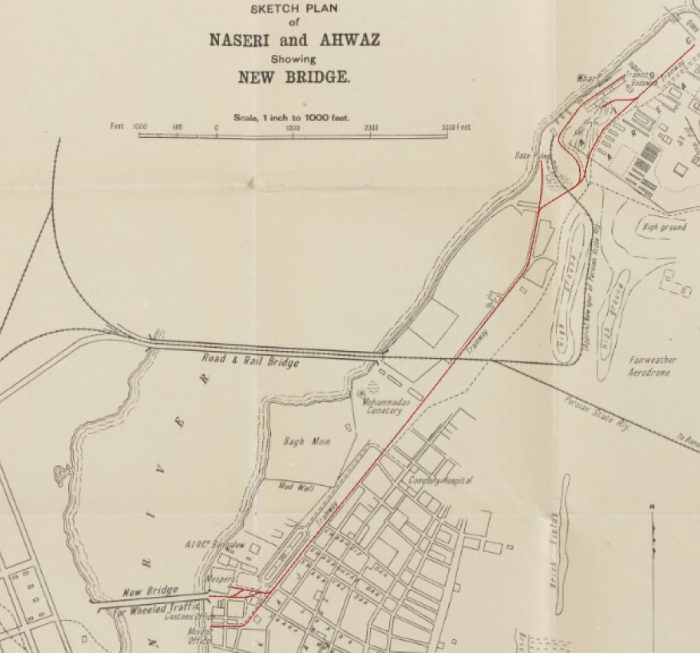
The Military Report from the 1940s has a plan showing the new railway link to the Trans-Iranian Railway in the centre of Ahvaz. The transshipment tramway is marked on that plan and is highlighted by a light red line on an extract from that plan below. [19: Map 3] By the time the report was written the tramway was no longer in use.

Central Ahvaz in the late 1930s. [19: Map 3]

The short film above and the author of the military report confirm that, “Dar-i-Khazineh is the riverhead, and a light railway (via Tembi) and metalled road to the oil-field (Masjid-i-Suleiman) area start from there.” [19: p13]

The Dar-i-Khazineh Fields Railway

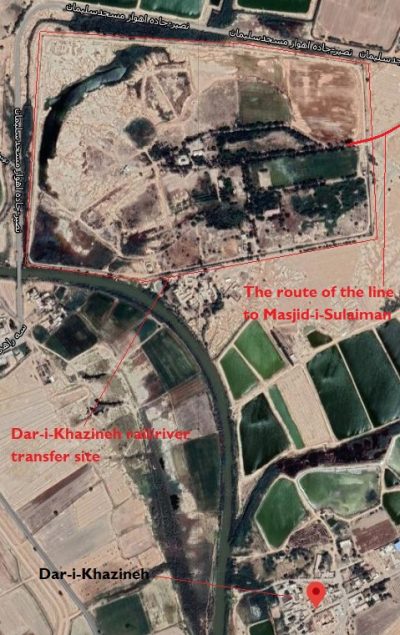
Dar-i-Khazineh is North-northeast from Ahvaz on the River Karun. The location is shown on the satellite image immediately below. The transshipment wharf was at the riverside. The railway only had a few access sidings at that location. A little further to the Northeast were a series of holding sidings.

Dar-i-Khazineh in the 21st century. (Google Maps)

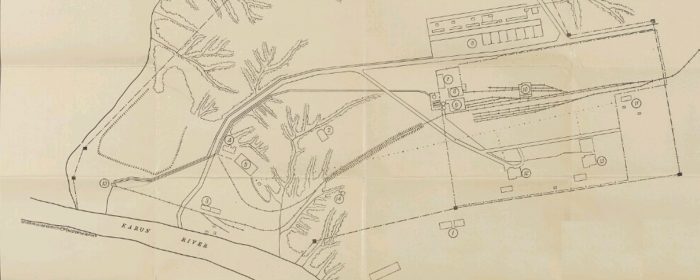
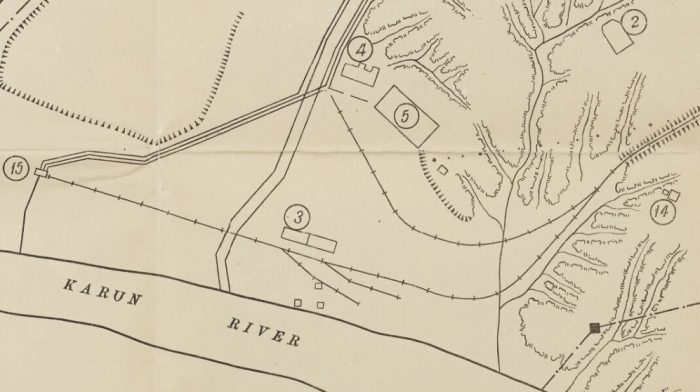
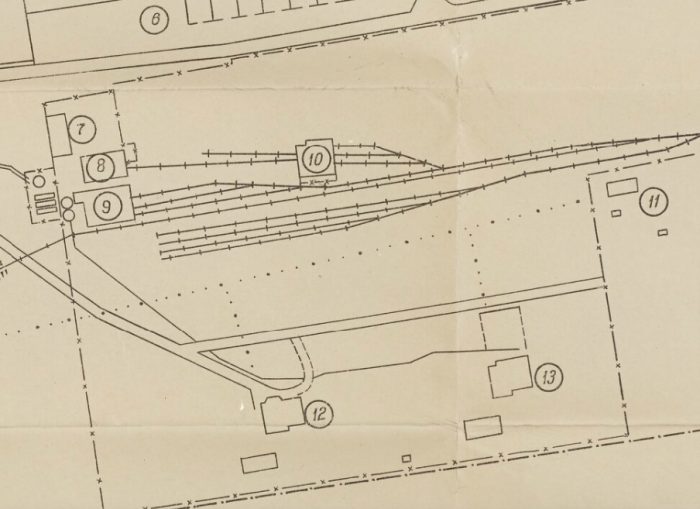
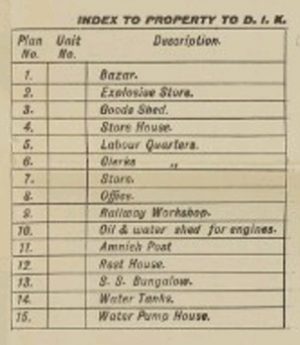
The plan below was included with the 1940 military report, it is from a survey undertaken in the late 1930s and shows the Dar-i-Khazineh site. It is followed by two enlarged extracts. A key to the numbered buildings has also been enlarged below. The railway layout is clear on these plans.

Alongside these sidings you can see the locomotive shed which was the oil-supply point for the locomotives ((10) on the plans). (7)(8) and (9) were the stores, offices and railway workshop. (5) and (6) were living accommodation. (3) was a goods shed and (4) was a store house. (2) was an explosives store. (12) was guest accommodation and (13) was the superintendent’s house. (14) was the site water tank and (15) was the water pump-house.

At Dar-i-Khazineh, the wharf was 150 to 200 feet long and could accept 5-ton axle loads. Access to the wharf was by good metalled roads and the light railway. The wharf was occasionally submerged during periods of floods – around once in 5 years. Two cranes served the barges. One 15-ton Scotch derrick and one 10-ton travelling crane. [19: Appendix X, p91]

Dar-i-Khazineh transshipment point between river and rail. [19: Map 4] If the numbers can be made out in the image then the key below will be useful!Dar-i-Khazineh, riverside. [19: Map 4]Dar-i-Khazineh, sidings. [19: Map 4]

Key to the maps above. [19: Map 4]

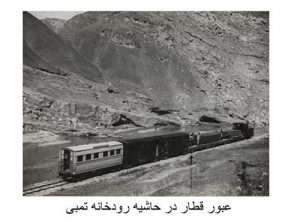
The Light Railway from Dar-i-Khazineh to Masjid-i-Suleiman was a single line 2ft 6 in gauge railway of 36 miles in length, (increasing to 40 miles if sidings are included). The Rails on the earliest section of the railway were 30 lbs. secured to steel sleepers by steel keys. The track was ballasted with sandstone and river shingle. The notes go on to say that the railway had:

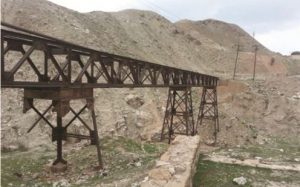
“Curves 5° to 45°. Maximum grade 3.2%. There are 3 main bridge[s of] Hopkins Truss type of spans 105, 120 and 120 feet. The line follows the metalled road from Dar-i-Khazineh towards Masjid-i-Suleiman to Abgah after which it turns south-east following the Tembi River to Tembi Power Station and thence runs to Masjid-i-Suleiman and Chashm-i-Ali. There are stations at D.i.K., Abgah (12 miles) Batwand (16 miles) Tembi (27 miles) M.i.S. (32 miles) Chashm-i-Ali (36 miles). The average time taken from D.i.K. to Chashm-i-Ali is 4.5 hours.” [19: p19]

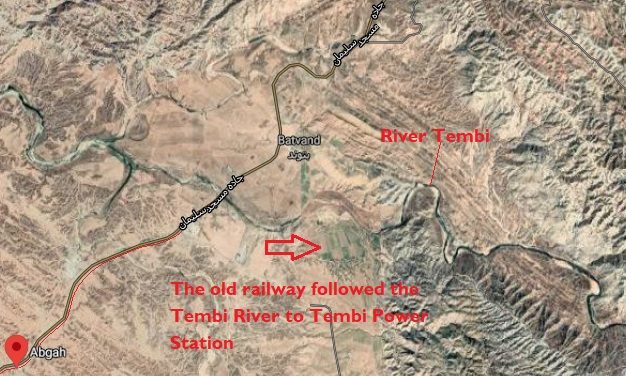
The old railway followed the metalled road between Dar-i-Khazineh and Abgah, (Google Maps). The route f the line has been imposed on the satellite image as a faint red line hugging the South side of the road.The narrow gauge railway followed the road from Abgah to Batvand. It’s approximate route is shown by a faint red line imposed on the satellite image. Close to Batvand the line left the metalled road and followed the course of the River Tembi. 

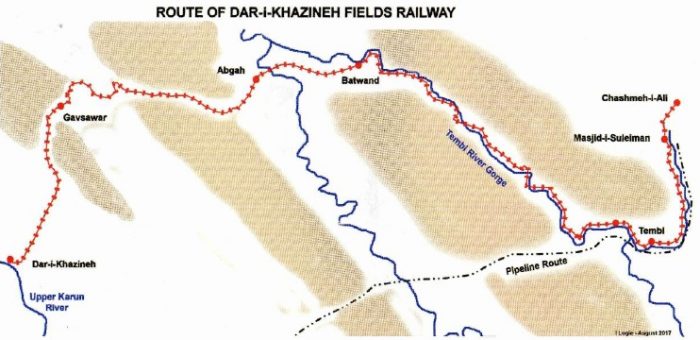
As a point of clarification, the old railway probably dictated the route of the metalled road at least as far as Abgah. [32] Iain Logie includes a superb picture of the bridge which carried the railway over the River Tembi close to Batvand. [32] His article also includes the map below.

Iain Logie produced this plan of the route in 2017 and included it in his article about the railway [32] Used by kind permission.

I have not been able to find any sign of the route of the railway on Google Earth close to the River Tembi. Nor can I find any modern reference to Tembi Power Station on the internet. For the military report to refer to it, it must have been a reasonably significant structure. All we know from that military report is that between Batvand Railway Station (the location of which I have failed to ascertain) and Tembi Railway Station close to the Power Station was a distance of around 11 miles (18 kilometres).

There was apparently a short branchline from the main line to Masjid-i-Suleiman which was built to serve the construction work on the power station. [32]

The river approaches Masjid-i-Suleiman from the Southwest, that was the direction from which the narrow gauge railway approached the town. Iain Logie has an excellent map of the route of the line and some additional pictures which come from the BP archive.

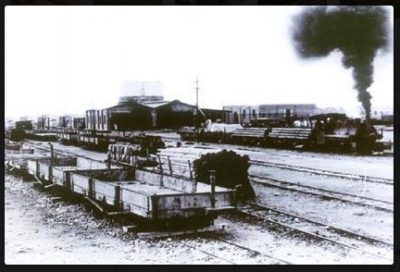
Masjid-i-Suleiman Station Yard. [20]

I have been able to find one relatively grainy image of the station yard at Masjid-i-Suleiman on wikiwand. It shows what appears to be a saddle tank (possibly an ALCO 0-6-0ST which would have been supplied from Egypt) in steam and a range of goods wagons. [20]

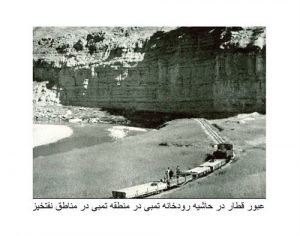
Further searching on the internet identified one Iranian website which covers the story of the construction of the line and provides some other interesting pictures. [21]

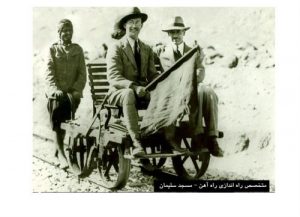
That site tells the story like this (translated using Google Translate): “In 1921 AD, the Anglo-Iranian Oil Company started the construction of a railway line from the River Karun to Masjed Soleiman and completed it in 1923 AD. The length of this railway was 57 km and the track-gauge was 76 cm. In fact, a railway of this length had never been built in Iran until then. Previously, the only railway linked the city of Rey with Tehran. The national railway of Iran was not inaugurated until 15 years later.” [21]

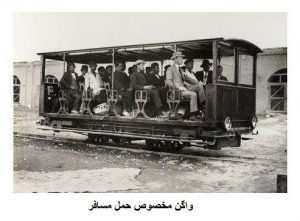
Stations were established along the way which included Abgah, Haji Abad, Tembi, Malkarim, Masjid-i-Suleiman and Chashm-i-Ali, and finally a Food Depot and Gunpowder Depot. The train stopped at these stations to supply the coal and water it needed, or to pick up and drop off passengers. At Tembi station, the sulfur for transport to Abadan or abroad was loaded. At Malkarim a passing loop was provided and alongside the line a Gypsum Factory produced gypsum for delivery by goods train to various places for use. At Chashm-i-Ali there was a goods warehouse and locomotive maintenance depot.

The railway had eight locomotives, initially it commenced operation with light locomotives that  had been received from the Army Delegation and Sales Board at Kantara railway station in Egypt. (These locomotives were used in World War I). In 1925, two 2-6-0 tank locomotives made by Kerr Stuart and 25 wagons from Britain were transferred to this line. And in later years newer locomotives were added to the line. The fuel for these locomotives was initially coal, but soon changed to oil. [21]

There were several small and large bridges along the railway, some of which still remain. There were four large bridges, three of which were at the intersection of the Tembi River, which were made of metal, and another with crescent-shaped openings on the Behlool River (Batvand), where only traces of concrete or stone pillars are visible. In general, the route has disappeared.” [21]

At the peak of its activity, the railway moved about 9800 tons of goods per month. During its 27-year life, the railway transported more than one million tons of goods and during the first years of its operation also transported passengers. It played a very important role for the oil industry and the development of Masjed-e-Soliman. [21]

The 1940 Military Report continues:

“From D.i.K. to Abgah and from Tembi to M.i.S. the maximum useful lift per train is 45 tons; between Abgah and Tembi, 85 tons.

At present, the A.I.O.C. run an average of one train per day. moving 60 tons from end to end. The maximum ever moved by them in one month is 3,600 tons, or 120 tons average per day.” [19: p19]

The military report then goes on to estimate how much greater use could be made of the line and notes, in 1940, that the locomotives in use burned oil fuel. 

Locomotives and Rolling Stock

The military report [19] has an Appendix which covers the available motive power and wagons in 1940. [19: Appendix XI, 19: p92-93] There were 3 No. Peckett Locos and 3 No. Kerr-Stuart Locos on the line at that time. In addition a Drewry Railcar was available as an inspection vehicle. This does not tell the full story of what motive power was available at different times on the line. But we consider the 6 oil-fired steam locomotives mentioned in the military report, first.

Peckett and Sons Locomotives

It is known that at least two locomotives were supplied to the railway by Peckett and Sons of Bristol. A detailed description of one of these locos is provided in a paper in the Industrial Railway Record (IRR). [8] The paper was a reproduction of an article first published in ‘The Locomotive Magazine and Railway Carriage & Wagon Review’ on 14th March 1931.

0-6-2 tank locomotive, 2 ft. 6 in gauge, for the Anglo-Persian Oil Co., built by Peckett and Sons, Bristol. This locomotive is No.1750, ‘D.I.K 1928’, of February 1928, a Peckett Type M5. [8]

These locomotives were oil-fired. When fully loaded they carried 520 gallons of water and 200 gallons of fuel oil. [8]

That same article explains that there were around 40 miles of track “linking up the different oil wells at Masjid-i-Sulaiman and providing means of transport for stores and supplies between that district and the depot at Abadan, which is also the port of shipment for the oil.” [8]

Martyn Bane also provides a copy of the paper in the IRR [8] He goes on to say that the “Anglo-Persian Oil Co. must have been happy with their locomotives as “Peckett’s later supplied two more machines: Locomotive No.1816 of October 1930, named ‘D.I.K. 1930’ came first and was followed by No.1909, ‘D.I.K. 1936’ in October 1936.” [1] It was Martyn Bane’s article that first alerted me to the 2ft 6in network at Abadan.

No.1909, ‘D.I.K. 1936’ of October 1936. It is possible that this photograph may be a re-touched version of the photograph above showing No.1750. [1]

Wikipedia lists these locomotives as below:

4 No. Peckett Locomotives used at Abadan. [15] It seems that, at the time of the military inspection only three of these were available. [19: p92] Since first publishing this article. I have been informed that No. 1751 was not built. The M5 classification is also strictly incorrect as these locomotives were a variant, an M5 special. The M5 locos were 0-4-0T locomotives.

Kerr Stuart Locomotives

The following Kerr Stuart Locomotives were purchased by Anglo Persia Oil Co. for their 2ft 6in gauge line running from the River Karun to Masjid-i-Suleiman:

Kerr Stuart No. 4189 – May 1923 (Huxley Boiler).
Kerr Stuart No. 4190 – May 1923 (Huxley Boiler).
Kerr Stuart No. 4191 – May 1923 (Huxley Boiler).

They were from a series of 21 No. 104 H.P. 0-6-2T locomotives to a design first built in 1912. Kerr Stuart christened the class, “Matary”. The design was suitable for gauges between 2ft and 4ft 8 ½ inches and rails of between 25-30 lbs per yard. The metre gauge locomotives had inside frames and locomotives with narrower gauges had outside frames. [23]

Further details of the class can also be found on the Fourdees website. [24]

These are noted as being available in the 1940 military report. [19: p92]

Other Motive Power

W.G. Bagnall Locomotives

Internet searches show that Fourdees also make a model which is based on the Bagnall version of the “Matary.”. They say that two of these Bagnall 0-6-2T locos were supplied to the Dar-i-Khazineh line in 1941. [25] There is a series of historical railway photographs from Iran on on ‘flickriver’ [26] among which are the front [27] and reverse [28] of an order card from Bagnall’s works showing one of these locomotives.

A letter to ‘The Narrow Gauge Magazine suggests that these two 0-6-2T oil-fired Bagnall Locomotives were actually ordered in 1944 and delivered in 1945/6. [29] Iain Logie agrees with these dates. [32]

Before the line was settled enough to order new locomotives 8 steam and petrol locomotives were in use on the line, all ex-ROD locomotives. Iain Logie has full details of these in a table of the motive power used on the line.[32]

ALCO Locomotives

The 8 steam locomotives were all ALCO locomotives which were manufactured during the Great War and supplied to the Egyptian Expeditionary Force. British  manufacturers were unable to meet the delivery requirements of the Army and so an American supplier was used. Iain Logie says that the locos were first required  for a 2ft 6in gauge light railway which served an elaborate system of defences along the Suez Canal. [32] He continues: “The ALCOs  proved to be rather limited in power and they were soon confined to shunting and local freight trips, rather than being used on the mainline where they were replaced by newer more powerful locomotives.” [32] Iain Logie has one picture of a loco of this class at work in one of the station yards. [32]

It appears that 24 of these locomotives were bought by the ROD in 1916 for use in Egypt. [33]

Hawthorn Leslie Petrol Locomotives

Iain Logie syas that two Hawthorn Leslie petrol locos (Army No 67 and 75) were purchased by APOC in 1922 and were used as shunting locos at Chashmeh-i-Ali and were operated by the stores staff rather than railway staff. [32]

Drewry Railcar

In 1940, one Drewry Railcar was available in the line. It was a 25 hp vehicle. [19: p92] It is likely that this vehicle was the one shown earlier in this article. The photo is repeated here.

In an article in The Narrow Gauge Magazine, [29] Rodney Weaver writes of a series of 19 No. Drewry Railcars were supplied during the 1st World War to 2ft 6in gauge as ambulances for Mesopotamia. The order was designated ‘Mesrail 14’. it was placed on “20th November 1916 and confirmed on 22nd December.
The first nine cars were handed over on 29th March 1917 and delivery was completed on 1st June, Like all Drewry cars between 1911 and 1930 they were actually built by Baguley Cars Ltd. (later Baguley (Engineers) Ltd.) of Burton-upon-Trent.” [29: p19]

Weaver goes on to say: “The cars were built on standard B-type chassis as used for hundreds of more orthodox (and a few more unorthodox) railcars over the years, The frame length was 16ft and the wheelbase 7ft, the light cast wheels being 24″ diameter. Power was provided by a Baguley petrol engine, a four-cylinder unit of 90mm bore x 130mm stroke rated at 20 hp. There was a three-speed gearbox, and a reverse box, one axle only being driven by a roller chain from the latter.” [29: p19]

Weaver describes the railcar like this: “The body comprised two driving platforms with a stretcher compartment between them. Two stretchers could be carried on either side of the car, one resting on top of a folded canvas seat that formed the floor and the other
carried on an upper platform that could be swung out and down on a form of parallel motion. Alternatively both stretchers and the upper platform could be removed and the canvas seat erected, when six walking cases could be accommodated. Between the stretchers was a corridor and seat for the attendant, access to which was gained by a door at one end of the car. The car could thus carry four stretcher cases, two stretcher and six walking cases or twelve walking cases as required.” [29: p19]

He continues: “In service the sides of the cars were normally covered by canvas screens bearing the Red Cross insignia, the rest of the vehicle being painted khaki.” [29: p20]

It seems that APOC must have seen these Railcars in action and decided to purchase two direct from Bauley in 1924. Iain Logie comments that these were intended to provide a passenger service on the line. At the same time as their purchase one trailer was also bought. [32]

The passenger service on the line was short-lived and abandoned in 1930. It seems as though the construction of the metalled road meant that a much quicker journey from Dar-i-Khazineh to Masjid-i-Suleiman was available. Iain Logie also comments that one of the ex-Army bogie vans was converted to provide better passenger facilities. The wartime use of the Drewry vehicle is illustrated below. [29: p22]

Drewry Railcar ambulance for Mesopotamia. [29: p22]

Baguley/Drewry Inspection Trolleys

APOC purchased a number of inspection trolleys, one of which is shown earlier in this article. These are listed by Iain Logie as well. [32]

Closure

Iain Logie’s article goes on to survey the goods wagons available on the line before highlighting the rapide decline of the railway after the Second World War. By the end of the War the military construction of roads had dramatically improved road links. The “road distance from Abadan to Masjid-i-Suleiman was 262 kilometres (163 miles) and that journey could be completed in 8 hours, whereas using the existing river and rail route, the distance was 382, kilometres and the journey would take 4 days, or longer.” [32] The railway closed in 1948 and its track was lifted in 1949.

Abandon Oil-Depot, Port and Refinery

There were railways at the port of Abadan as the image earlier in this article shows. The Abadan Depot and Refinery lines were set at 3ft gauge. More of them can be seen on the photographs below.

An Aerial view of Abadan from sometime in the 1920s or 1930s [10] This image appears to show rail tracks just above the T-junction on the bottom right of the photograph and again at the extreme bottom right with one line apparently running across the image on the near side of the road.Ships unloading at the Abadan waterfront in 1942. The rail lines and some wagons are in evidence. [30]Ships unloading at the Abadan waterfront in 1942. The rail lines and some wagons are in evidence. [30]Another postcard image of the wharf at Abadan. The rails providing access to the wharf are visible near the centre of the card image. [31]

The layout of the refinery railway is shown on the next two images which are taken from the 1940 Military Report. [19] The majority of the network is illustrated on the two extracts.

A two-part plan of Abadan Refinery in the late 1930s contained in the 1940 Military Report. The Railway network is visible although the resolution is not that good. [19: Map 2]

Oil production rose from a capacity of 2,500 barrels per day in the early 1910s to 650,000 barrels per day in the late 1970s. [36: APOC Abadan Refinery Railway]

Notes kept in the Narrow Gauge Railway Society library  say that the railway network at the refinery was 65 miles in length. They say that there were 405 points, that as the refinery expanded around 3 miles of track were laid each month.  Maintenance work saw around 2 miles of track lifted and reconditioned each month with around 5 miles of track ballasted each month! [34]

Iain Logie kindly sent me a distillation from the 1940 Military Report Map above which is held in the Narrow Gauge Railway Society Library. It is much easier to read than the original map. [35]

A map of Abadan as it was in the 1930s. [35] The railways can more eaily be [picked out on this plan.

The Narrow Gauge Railway Society Library holds a set of notes which incorporate the best of the sources about locomotives into one document. [36: APOC Abadan Refinery Railway]

The first railway at the refinery and port was a 2ft gauge railway purchased from a War disposal auction after the Great War. The Company were less than content with the 2ft gauge and despite there being a great deal of 2ft-gauge stock available in the post war years, decided that a 3ft-gauge railway would be meet the needs of the refinery. [36: APOC Abadan Refinery Railway]

The locomotive list for the site in quite long! It included Petrol (4No.), ‘Light’ Diesel (8 No.), ‘Heavy’ Diesel (16 No.) and Fireless (15 No.) Locomotives. [36: APOC Abadan Refinery Railway][37]

Iain Logie very kindly sent me the next two images which show a Hunslet 0-6-0 Diesel Mechanical locomotive as supplied to APOC/AIOC in the late 1930s and during WW2, and Hudswell Clarke Fireless Locomotive Works No. 1646 which was supplied to Abadan in June 1931.


References

  1. https://www.martynbane.co.uk/peckett/articles/persia.html, accessed on 26th March 2020 and 18th November 2020.
  2. https://en.m.wikipedia.org/wiki/Anglo-Persian_Oil_Company, accessed on 23rd July 2020.
  3. https://en.m.wikipedia.org/wiki/Masjed_Soleyman, accessed on 23rd July 2020.
  4. M.S. Vassiliou; Historical Dictionary of the Petroleum Industry; Lanham; Scarecrow, Maryland, 2009.
  5. Peter Frankopan; The Silk Roads: A New History of the World; Alfred A. Knopf;New York, 2016, p. 319
  6. Daniel Yergin;  The Prize: The Epic Quest for Oil, Money, and Power; New York: Simon & Schuster, 1991; p138–147, 158.
  7. https://en.m.wikipedia.org/wiki/Mohammad_Mosaddegh, accessed on 16th November 2020.
  8. The Industrial Railway Record, Volume 53, April 1974, p202-203; https://www.irsociety.co.uk/Archives/53/Persia.htm, accessed on 18th November 2020.
  9. https://abadantimes.com/2016/04/28/making-abadan-an-oil-town-1911-1921, accessed on 18th November 2020.
  10. https://ajammc.com/2015/02/16/abadan-oil-city-dreams, accessed on 18th November 2020.
  11. Julian Bharier, Economic Development in Iran 1900-1970; Oxford University Press, London, 1971, p19.
  12. https://commons.wikimedia.org/wiki/File:Extended_caption-_The_island_in_the_mouth_of_junction_of_the_Euphrates_and_Tigris._The_depot_of_the_Anglo-Persian_Oil_Company._Oil_fuel_was_of_utmost_necessity_for_the_Mesopotamian_river_traffic_in_the_advance_Art.IWMART1835.jpg, accessed on 19th November 2020.  This image was created and released by the Imperial War Museum on the IWM Non Commercial Licence. Photographs taken, or artworks created, by a member of the forces during their active service duties are covered by Crown Copyright provisions. Faithful reproductions may be reused under that licence, which is considered expired 50 years after their creation.
  13. Carola Hein; Oil Spaces: The Global Petroleumscape in the Rotterdam/The Hague Area; Journal of Urban History. Volume No. 44, 2018, p1-43; https://www.researchgate.net/publication/323157672_Oil_Spaces_The_Global_Petroleumscape_in_the_RotterdamThe_Hague_Area accessed on 19th November 2020.
  14. https://www.gettyimages.co.uk/detail/news-photo/an-aerial-view-of-barges-in-a-dock-at-abadan-iran-12th-news-photo/136780310, accessed on 19th November 2020.
  15. https://en.wikipedia.org/wiki/List_of_Peckett_and_Sons_railway_locomotives, accessed on 19th November 2020.
  16. https://www.wondersofworldengineering.com/part22.html#OilRefining1, accessed on 19th November 2020.
  17. https://www.wondersofworldengineering.com/part23.html#OilRefining2, accessed on 19th November 2020.
  18. https://abadan-ref.ir/en/about-us, accessed on 19th November 2020.
  19. http://www.qdl.qa/en/archive/81055/vdc_100000000239.0x00013e, accessed on 20th November 2020, full details are in Appendix 1, the document can be accessed using this link which is repeated in the Appendix.
  20. https://en.wikipedia.org/wiki/Masjed_Soleyman, accessed on 22nd November 2020.
  21. http://www.goftemanews.ir/احداث-خط-آهنی, accessed on 22nd November 2020.
  22. https://www.facebook.com/ahwazion20/videos/952199738538878/?sfnsn=scwspmo, accessed on 22nd November 2020.
  23. https://www.national-preservation.com/threads/bowaters-superior-and-triumph.245774, accessed on 22nd November 2020
  24. https://www.fourdees.co.uk/superior, accessed on 22nd November 2020.
  25. https://www.fourdees.co.uk/darkhazineh, accessed on 22nd November 2020.
  26. https://www.flickriver.com/photos/124446949@N06/sets/72157654112126260, accessed on 23rd November 2020.
  27. https://www.flickr.com/photos/124446949@N06/23052963480/in/album-72157654112126260, accessed on 23rd November 2020.
  28. https://www.flickr.com/photos/124446949@N06/22720381344, accessed on 23rd November 2020.
  29. https://ngrslibrary.files.wordpress.com/2019/01/tng56-feb-1971.pdf, accessed on 23rd November 2020.
  30. https://www.msabbekerk.nl/?p=3234, accessed on 24th November 2020.
  31. https://www.pinterest.fr/ABTIMES/abadan-in-the-1930s, accessed on 24th November 2020.
  32. Iain Logie; The Dar-i-Khazineh Fields Railway: A British Narrow Gauge Railway in Persia; in The Narrow Gauge Magazine No. 252, January 2019.
  33. http://www.borht.org.uk/WW1Corrigenda.pdf, accessed on 26th November 2020.
  34. Iain Logie provided access to the notes about the refinery railway at Abadan. They come from the BP Archive – File: ARC 44257. Iain Logie advises caution in reading these notes as they provide some detailed information which is different from other sources. This is particularly true in the details provided about motive power and rolling stock. [36]
  35. The Narrow Gauge Railway Society Library.
  36. A series of notes provided by the NGRS covering the railways of Iran, of which the NGRS says the following: ‘These research notes are intended to provide users of the Narrow Gauge Railway Society’s library with an introduction to the narrow gauge railways of Iran as a starting point for personal research projects. Additional, more specific sources for further research are noted in the text for each railway.’ 
  37. A.C. Baker & T.D. Civil; Fireless Locomotives; Oakwood Press, 1976.

Appendix 1

Military Report on The Anglo-Iranian Oil Company’s (South Iranian) Oilfield Area

Reference IOR/L/MIL/17/15/24
Date(s) 1940 (CE, Gregorian)
Written in English
Extent and Format 1 volume (69 folios)
Holding Institution British Library: India Office Records and Private Papers

A copy of this document is available via the Qatar National Library and can be accessed freely under an Open Government Licence. Full details of the licence can be found on the link below.

Rather than printing this document in full as part of this post, it can be viewed on the following link:                           http://www.qdl.qa/en/archive/81055/vdc_100000000239.0x00013e

Clergy and Railways!?!

I was asked to give a talk in 2020 to a clergy discussion group on the subject ‘Clergy and Trains’. This group had decided to have its annual outing on The East Lancs Railway and I was to be the after dinner ‘entertainment’! It did not work out, for obvious reasons in 2020, as the Covid-19 pandemic altered everyone’s plans!

However, as a result of the request,  I began to study what was available online and in the press on this subject and the place it takes in the wide range of interests available to the clergy. … Whether my research counts as original research, I very much doubt. However, you might find what follows of interest!

“It is a truth universally acknowledged that the clergy love trains.”  So started an article by Ed Beavan in the Church Times on 15th June 2011, entitled ‘All Steamed Up About Trains’. [1] On the centenary of the birth of the Revd W. V. Awdry, creator of Thomas the Tank Engine, Ed Beavan asked, in his article in the Church Times, why so many clergy are railway buffs.

The statement, ‘so many clergy are railway buffs’, seems to me to be the kind of statement which becomes more and more true as time goes by. Once we begin to believe that it is true, we then begin to validate our own understanding and our own take on reality.

I know of no independently accredited study of clergy interests which proves that there is a greater preponderance of railway interest among the clergy when compared with other professions. Although there will probably be someone out there to correct me. Nor, I think is there a similar study which compares the range of different  interests held by the clergy and determines the most prevalent.

Model railways (and even railways themselves) are a relative latecomer in the various fields open to clergy to pursue. There are a number of good examples of clergy in previous generations who had interests beyond their own parish, church or flock.

Clergy with interests in Science

In Palaeontology, most early fossil workers were gentleman scientists and members of the clergy, who self‐funded their studies in this new and exciting field. [2]

Wikipedia lists Catholic Clergy who have made significant contributions to Science, [3] and there are many from other denominations too. Examples from across the spectrum of Clergy allegiance to denominations, include:

Roger Bacon – a medieval English philosopher and Franciscan friar who placed considerable emphasis on the study of nature through empiricism. [7]

Nicolaus Copernicus – a Renaissance-era mathematician, astronomer, and Catholic clergyman who formulated a model of the universe that placed the Sun rather than Earth at its centre. [4]

Gregor Mendel – a scientist, Augustinian friar and abbot of St. Thomas’ Abbey in Brno, Margraviate of Moravia. He gained posthumous recognition as the founder of the modern science of genetics. [5]

Georges Lemaître – a Belgian Catholic priest, mathematician, astronomer, and professor of physics at the Catholic University of Louvain. He was the first to identify that the recession of nearby galaxies can be explained by a theory of an expanding universe. [6]

John Michell – an English natural philosopher and clergyman provided pioneering insights iin astronomy, geology, optics, and gravitation. He was the first person known to: propose the existence of black holes; suggest that earthquakes traveled in (seismic) waves; explain how to manufacture an artificial magnet; and, recognise that double stars were a product of mutual gravitation …. [9]

The extensive Wikipedia list is merely a snapshot of a longer list which extends down to the present day. There have been many people who have combined their scientific eminence with a role as a member of the clergy. A prime example is Revd. John Polkinghorne, [10] Other in the contemporary age include Revd. Arthur Peacocke, the first director of the Ian Ramsey Centre for Science and Religion and the first director of the Ian Ramsey Centre for Science and Religion. [16] Others include: Canon Eric Jenkins, [17]; Revd. John Chalmers, moderator of the Church of Scotland and who has been involved with Church of Scotland projects such as Society Religion and Technology, [18] and Grasping the Nettle. [19]

There is also today, a society for priest-scientists. The Society of Ordained Scientists is a society within the Anglican Communion.  The organisation was founded at the University of Oxford by  Arthur Peacocke following the establishment of several other similar societies in the 1970s, in order to advance the field of religion and science. [11][15]

Other interests are also shared by clergy and the religious.

One particularly engaging study of clergy interests and proclivities was produced recently by Revd Fergus Butler-Gallie, “A Field Guide to the English Clergy: A Compendium of Diverse Eccentrics, Pirates, Prelates and Adventurers; All Anglican, Some Even Practising.” [12]

Waterstones comment: “Judge not, lest ye be judged. This timeless wisdom has guided the Anglican Church for hundreds of years, fostering a certain tolerance of eccentricity among its members. Good thing, too!” [13] Given my interests in blogging, railways and model railways, I have no alternative but to echo the sentiment. … “Yes, it is a good thing too!”

Butler-Gallie regales us with “eye-popping tales of lunacy, debauchery and depravity … he has done a splendid job presenting a smorgasbord of most peculiar parsons.” [14]

Among many other things, he tells us of a variety of different eccentrics who somehow found themselves within the ranks of the clergy. Examples include Revd Robert Hawker, Vicar of Morwenstow who was the first to institute a church Harvest Festival, but who at one time also used to dress as a mermaid. There was also an erstwhile Rector of Carrington whose fear of photography meant that he led services from behind a screen and who during a very long ministry built the largest folly ever constructed within these shores. Butler-Gallie goes on the describe a pantheon of eccentrics, nutty professors, bon viveurs, prodigal sons and rogues, all of whom appear to have somehow ended up either with their own parish or in the position of senior clergy. [12]

My current curate, while definitely not being an eccentric, has been an avid player of computer games, he plays regularly in a variety of different local bands, and he has taken up roller-blading. One Franciscan friar, Brother Gabriel, spends his spare time at a Bloomington, Indiana, Skate Park several times a week after participating in evening Mass and prayers. [8] 

This article is, in no way, a formal survey of clergy interests, and all these examples are, of course, very obviously anecdotal.

So, are there any grounds for believing that an interest in railways is more typical of the clergy than these other things?

I suspect not.

Nevertheless, there do seem to be a good number of clergy who are interested in both full-scale and model railways.

Clergy with an interest in Railways.
Font to Footplate – Teddy Boston’s autobiography completed while he was in hospital just before he died at the age of 61. [48]

Butler-Gallie directs our attention to one Revd. Teddy Boston. [12: p19-22] who was for 26 years Rector of Cadeby and Vicar of Sutton Cheney, in Leicestershire, (1960 – 1986). He built a light railway in the grounds of the Rectory at Cadeby. It was U-shaped, with a total length of 110 yards. He opened the line to passengers in 1963 [20] and named the line, “Cadeby Light Railway.”

Wikipedia tells us that Boston, “was a close friend of the Rev. W. V. Awdry OBE, creator of Thomas the Tank Engine, a kindred spirit with whom he shared many railway holidays. In Small Railway Engines (1967), Awdry relies on a trip the two made together to the Ravenglass and Eskdale Railway, and they appear in the book as ‘the Fat Clergyman’ (Boston) and ‘the Thin Clergyman’ (Awdry). [21]
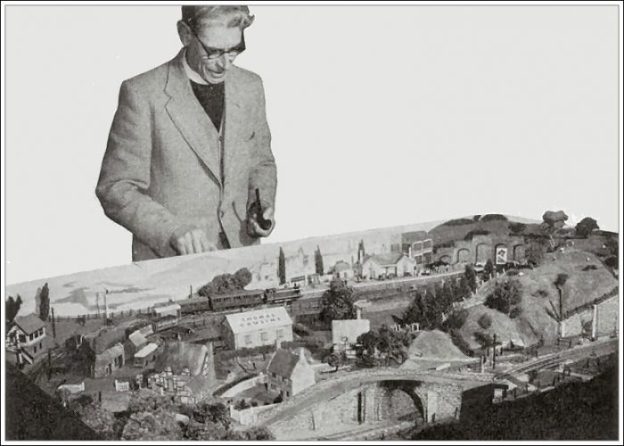
The Rev Wilbert Awdry “controlling” Thomas on the Ffarquhar Branch in Railway Modeller, December 1959. [21]

Wilbert Awdry is perhaps the best know clergy railway fanatic across the world. The ‘Thomas’ franchise is still very popular on the 2020s and Covid-permitting brings in significant revenue for Heritage Railway organisations each year. Awdry himself wrote 26 books in “the Railway Series”. His son Christopher went on to publish a further 16 books between 1983 and 2011. The series has also spawned a number of related books and a significant number of TV/Video/DVD programmes in English. [22] and in many other languages. [23]

Another star in this firmament was Revd. Peter Denny who for many years was a regular feature in the Model Railway Press. [24] He was known alongside others for being at the forefront of the development of the hobby after the Second World War. He was known for modelling which exceeded the expectation of the times for realism. He innovated in the management of his model railway and the timetabling of train movements. His layout Buckingham went through a number of incarnations as it developed in size. There are a variety of books written about his modelling achievements [25] and he is still feted online as well. [26] His layout is described by Tony Wright as, “one of the most important layouts in the hobby’s history since WW2.” [27]

Rt. Revd Eric Treacy MBE was an English railway photographer and Anglican bishop. He was Suffragan Bishop of Pontefract and then Bishop of Wakefield (1968-1976). his passion outside of office was railway photography. The Treacy Collection of 12,000 photographs forms part of the National Railway Museum’s archive of over 1.4 million images. His published works were almost entirely railway photograph albums. [28] 

After a major, 11-year, £600,000 overhaul by volunteers on the North Yorkshire Moors Railway, which was completed in 2010, you would have found 70 clergy in the carriages behind the newly named locomotive, ‘Eric Treacy’ on it inaugural run. The then Bishop of Wakefield, the Rt. Revd. Stephen Platten, held a re-dedication service for the train at Pickering Station on 27th August 2010. He was joined by Rt. Revd. Dr David Hope, former Archbishop of York, and Stephen Sorby, of the National Railway Chaplaincy. [32]

Revd Richard Patten, in the late 1960s, bought his own full-size steam locomotive, 73050, and so began the restoration of the Nene Valley Railway near Peterborough. [35]

An interest in railways is something that a number of clergy own up to when talking about themselves. For example:

The Revd. Timothy L’Estrange, MA, DipMin, FRSA, Vicar of North Acton and Surrogate: Spent his spare time as a first aider with the St John Ambulance Brigade, and pursuing a life-long interest in railways, especially the narrow gauge. His parish Reader also expresses an interest in dabbling ‘in the ancient art of railway modelling’. [33]

The Restless Rector, who is not keen to divulge his identity, wrote in his blog of his love of trains. In 2009, he said: “My own theory is that railways are all about order and communication. For some clergy the stress of parish life, and the number of awkward people that one sometimes has to deal with, can be forgotten about in the ordered environment of a model railway. Here you are in complete control, with no-one to answer back or contradict. Yes, trains sometimes get derailed, but no-one gets hurt. Some model railway enthusiasts run their trains to a strict timetable – another layer of order and control. But running a railway can be a very social activity. In real life trains are passed from the control of one signalbox to another with great care. Nowadays this is all computerised, but it used to be by a series of bell codes and telephones.” [34]

He goes on to ask: “Is there anything theological or biblical in all of this? I’m not sure, but maybe building and running a model railway reflects something of the creativeness of God, and his fatherly care.” [34] … In addition, he suggests that because railways are about communication – travel to a destination, the news and the post – then interest in railways may be found more often in the evangelical wing of the church where, “a high priority is put on taking the good news to new places.” [34]

His final comment is perhaps quite Anglican. Talking of his interest in railways, he says: “it’s just something I’ve grown up with and embraced for myself – rather like my faith I suppose.” [34]

In my own experience, interest in railways is relatively evenly spread between clergy colleagues and a particular churchpersonship does not seem to increase the likelihood of that interest. The ecumenical nature of railway interests is illustrated by two clerics invovled with the Railway Preservation Society of Ireland. …
Fr. Eddie Creamer (RPSI). [39]
Revd. Canon John McKegney (RPSI) [39]

Fr. Eddie Creamer, a part-time prison chaplain, aged 77, talked in 2017, when he had already been a member of the RPSI for nearly 40 years, of his fascination with trains from his childhood. He goes on to explain that, “When [he] was working in the Philippines [he] joined the RPSI just to get their magazine sent to [him], but when [he] returned to Ireland [he] came to Whitehead to take a few photographs of the trains. I asked if they needed anyone to help them and they haven’t let me go. And now I’m here once a week. I find it very relaxing.” [39]

In 2017, the Chair of the RPSI was Revd. Canon John McKegney, a retired Church of Ireland rector. In 2017, he had been involved with the RPSI for over half-a-century. [39]

Railways and Religion

The interaction between the church and the railways goes right back to the very early days of what was then a new mode of transport. Revd. Michael Ainsworth points out that “the coming of the railways in the 19th century excited deep passions among churchmen, as many novels of the time illustrate. … For some the speed, the smoke, the ‘blot on the landscape’, were unnatural and diabolical – particularly when Sunday trains broke the sabbath commandment. The vast church of St Bartholomew, Brighton was built on a commanding site, and allegedly on the dimensions of Noah’s Ark, as a witness to those travelling down for ‘dirty weekends’.” [29]

He goes on to say: “Clergy joined with landowners in resisting encroachment. (They had limited success – note, for example, how the line curves round Sacred Trinity Church in Salford.)But others hailed railways as a godsend and a sign of divinely-blessed progress (despite blighting the urban landscape). … By the latter part of the century, they had certainly revolutionised episcopal ministry. The late 19th-century renewal of enthusiasm for confirmation would not have been possible without the railways. For example, of James Fraser, Bishop of Manchester 1870-85, it was written he spent the week travelling through his diocese, so that there were few days in which he was not somewhere on the railways.” [29]

So, why are a number of clergy interested in railways?
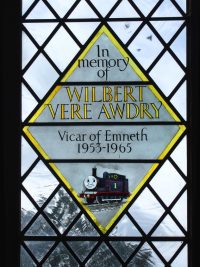
Revd. Michael Ainsworth again: “It has often been said that the reason why some clergy – probably male rather than female – and others, including church musicians, are keen on railways is because they are reassuringly ‘closed systems’, and Awdry’s setting of his railways on the Isle of Sodor confirms this. Lines and boundaries are set, detailed timetables can be pored over, structures are clear: a joy for those who run model railways in their attics for their own pleasure, or larger versions in their gardens to raise funds. … This joy is less pronounced now that the real railways have been franchised and fragmented. Responsibility for trains, track, signalling, stations and all else is dispersed among many bodies – providing more benefit to lawyers than to passengers …‘customers’.” [29]

The Rt Revd Michael Bourke comments about 19th Century Clergy in the Church Times Letters page in July 2011, that, “Many feared the pace of change, and some religious conservatives denounced the new world, including trains, as the work of the devil. In that context, clerical railway fever (across churchmanship divides) signified an affirmation of modernity. Both railwaymen and churchmen (mostly men in both cases) were re-engineering the nation with their networks of new lines and junctions, new parishes, church schools, and forms of spirituality.” [30]

He goes on to say: “For broad churchmen, the railways spelled enlightened progress; for Evangelicals, the new emphasis on punctuality embodied the Protestant work ethic; and for Catholics, the shared wisdom and co-operation of engineers, locomotive crews, and signalmen represented the mystery of a dedicated priesthood. No wonder the great stations were compared with cathedrals! … Clergy’s instinctive sympathy with this world led to support for the people who ran it, in what amounted to early forms of industrial mission.” [30]

He continues, in his letter, to draw parallels with “a similar clerical enthusiasm for the brave new world of computers.” [30]

It seems that, in the early days of the railways, at least, a clergyperson’s attitude to the newfangled railways said something significant, and provided one uniting factor in the midst of clerical division. However, this is not enough to justify a modern clergy interest in the railways.

Rev Clifford Owen was longing eagerly for his retirement at the age of 70. He was delighted to be surprised by his retirement gift from his last parish in Brugge and Oostende in Belgium: a 5 year membership of the Nene Valley Railway. He describes his joy at the gift and goes on to describe some of the pleasures of being involved with the life of that heritage line near Peterborough and particularly the connection he discovered with his grandfather through undertaking a job that his grandfather would have undertaken 70 years previously. [31]
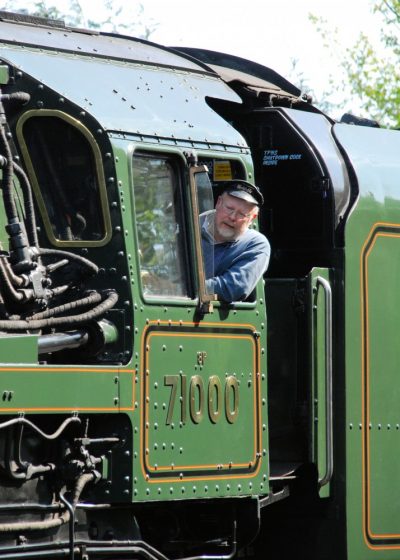
Revd Preb Mike Kneen.

Revd. Alan Newman. [41]
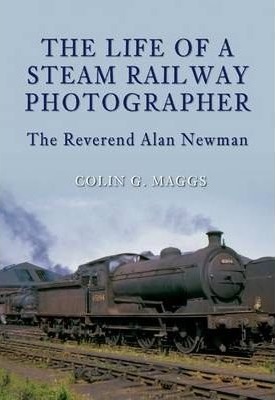
Revd. Preb. Mike Kneen who retired as Rector of Leominster in September 2020 has had a lifelong interest in steam locomotives. His farewell statement on the Leominster Priory Website says nothing of this interest but it is accompanied by a picture of him as an Engine Driver on the Severn Valley Railway – a pastime which he enjoyed throughout his ministry.

The former vicar of Christchurch, Bradford on Avon, Revd. Alan Newman was another significant railway photographer who became part of the photographic triumvirate of himself, Ivo Peters and Norman Lockett, and he was friendly with two other notable railway clerics that we have already encountered above: the Rev. W Awdry and the Rev Teddy Boston. His story is told by Colin Maggs in a book published by Amberley Press. [40]

Newman was born and brought up in Bath near to the Great Western Railway, which sparked a lifelong interest in steam trains in particular. He took extensive trips throughout the country, hoping to see a train of every class in Britain, recording his finds as detailed notes supported by photographs. [41]

David Self in the Church Times in January 2008 asked the same question as this article: ‘What draws clerics to railways?’ [35] It is worth quoting parts of that piece here.

Self says: “In the 1950s, most enthusiasts were merely trainspotters. Folklore suggests that a few clerics could always then be found on the ends of platforms at Crewe, York, and (for some mysterious reason) Worcester Shrub Hill.” [35]

He continues: “There was nothing comic in the ’50s about being interested in trains. Boys wanted to become engine-drivers. In the 1952 Ealing comedy The Titfield Thunderbolt, it was perfectly natural that the leading light in the village’s attempts to preserve its branch line should be the parson, the Revd Samuel Weech. Over the next ten years, however, the railway enthusiast became a figure of fun: a gormless, spotty loner, obsessed by numbers and timetables, and always clutching Biro and notebook.” [35]

In research reported in ‘Trends in Cognitive Sciences’ in June 2002, [42] there was an attempt to define trainspotters as people with a form of Asperger syndrome, as they had a strong desire to order the world. In 2001, the National Autistic Society conducted research among children with autism to explore their frequent attraction to Thomas the Tank Engine. “Among the survey’s findings was the way that many children with autism regard Thomas much as others cherish a comfort blanket. They seem to appreciate the clear plot lines of the stories, the predictability of the characterisation, and the fact that, if something goes wrong, it will be put right by the conclusion. They also seem[ed] fascinated by the engines’ faces.” [35]

David Self says that, “this is not to draw cheap parallels or to make bad jokes about clerics and those with autism or Asperger syndrome. Even so, it is possible to see both ecclesiastical and psychological reasons why watching trains should appeal especially to those in ministry.” [35]

To the cognoscenti … railways are predictable. For every delay, there is a cause. It is a world of facts and realities, a world where (with luck) it is possible to see all — even if it is only every locomotive of a given type. It is the perfect antidote to the often more nebulous realm of theology.” [35]

Similarly, for the clerical railway modeller, the layout in the loft presents an opportunity to create a parallel world, where everything runs to order, and at times and in ways you dictate — unlike normal parish life.” [35]

It was David Self’s article that pointed me to an American website (www.steamingpriest.com) that revels something of the breadth of interest among Roman Catholic priests, Protestant ministers, and Rabbis in ‘playing trains’. [36] On that website, as well as seeing something of the scope of his hobby, we are introduced by Fr. Fanelli to his interest in live steam modelling. His interest in railway modelling developed throughout his ministry from first, N scale, through to large scale, live steam models. [37] 

David Self reminds us that the former Chancellor Dennis Healey once stressed the importance of a politician’s hinterland — an interest in areas other than politics. Winston Churchhill had his painting, Ted Heath had his sailing and music, and John Major his cricket, and Gordon Brown, an interest in soccer. Lord Healey enjoyed photography and literature. Self says that, “Such interests are not just a means of escape or relaxation, important as these may be. They are evidence of a rounded personality.” [35]

That idea of a ‘hinterland’ to describe interests outside of ‘work’ is useful when thinking of clergy interests. David Self suggests that a ‘hinterland’ of interests outside of the theological and ecclesiastical is essential for clergy, “not just for their own sanity, but to help them relate more easily to the world outside the Church. It can also contribute to developing an inner calm. For some, their hinterland will be their family. For others, it will be cricket — a world where, for a few hours, you are isolated on the pitch and unable to be got at. Many have found a similar escape at the end of a station platform.” [35]

There is more to an interest in railways than trainspotting but I think that Self’s conclusion to his article is apposite to all interest in railways: “Why mock such happiness? Trainspotting must be one of the most harmless and inexpensive hobbies. It can be pursued alone or with friends, and is surprisingly democratic. Your profession (or lack of one) is irrelevant: it is the trains that matter.” [35]
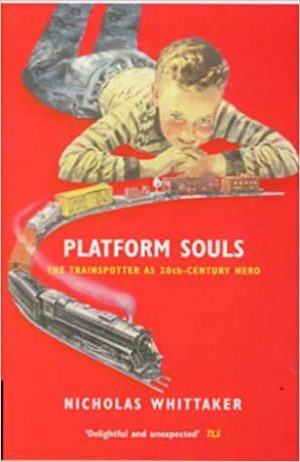
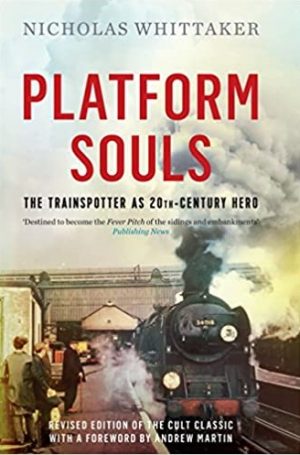
Although Nicholas Whittaker‘s book, “Platform Souls” is purportedly about trainspotting, it acknowledges a wider interest in the realm of railways and, unsurprisingly, within its pages we also encounter the clergy.

He describes an open day at a railway depot. “Hauling myself up into the cab of E3003 . . . I bump into my first clergyman. He is semi-disguised in trainers and jeans, but his tweedy jacket and dog collar are a dead giveaway. Perched in the driver’s seat, he . . . whistles high-speed fantasies through his teeth.” [38: p221-222]

Whittaker manages to capture some of the factors that seem inexorably to draw some individuals to the railway. “Trainspotting: here was a real boy’s hobby with its own gaberdine camaraderie. It was dirty and mechanical, proudly masculine and solid, yet at the same time … romantic and educational.” [38: p19]

He talks of a time when as a young boy he first managed to slip unnoticed through a small door in the side of one of Burton-on-Trent MPD’s two roundhouses: “In that moment, you slipped from a fresh-smalling open-air into a strange sepulchral atmosphere, silent but for the his of escaping steam. This was the first time I’d been so close to a railway engine and, without a station platform to bring me level, I stood feeling small and awed by the scale of it.” [38: p23]

One ‘interesting’ footnote is the range of society stars that could be seen while standing at the end of a station platform but of even greater significance to a young Nicholas Whittaker, was the possibility that you might encounter one of the dignitaries of the railway interest establishment such as Cecil J. Allen or C. Hamilton-Ellis. In the light of the purpose of this article, it is worth recording that Whittaker goes on to say: “The one we all wanted to meet was… Eric Treacy, Bishop of Wakefield. We knew that, for some reason, railways attracted the clergy, but a bishop was something special!” [38: p43]

My own interest in railways and railway modelling stems, I believe, from a childhood fascination with trains and from a pre-ordination career in civil engineering. My interest in railways is pretty eclectic, but I accept that for many people it will be perceived as a niche interest.

If you were to read my blog you would find that I have a particular interest in Secondary French railways and tramways, many of which fell into disuse soon after the Second World War but whose routes can still be followed through the French countryside by car and bicycle. Jo and I have done just that in a variety of contexts in Southern France on regular Autumn visits. [45][46]

You will find that I have developed a childhood interest in the 3ft Gauge railways of Ireland into a series of narratives following the routes of those old lines which disappeared in the early second-half of the 20th Century. [44]

You will see that one seminal moment for me was travelling on the ‘Lunatic Express’ in East Africa, and you can, if you wish, follow a full journey along the line from Mombasa to Kampala and beyond. [43]

You will, I hope, be delighted to follow the story of the building of an N-Gauge model railway in the vicarage loft. [47] At times these interests have been all-consuming, they certainly have allowed me to escape from times when ministry has been particularly stressful.

A few pictures of my own layout in the vicarage loft bring the main narrative of this article to a close. The layout focuses on the railways in and around the city of Hereford. Sadly, the ‘day job’ has meant little progress on the layout in the past few years. as retirement beckons there will be a significant effort involved in deconstructing what has been built  …Building the Baseboards!Laying the track!Hand-made, card Coaling Stage – Hereford MPDHereford, Barrscourt Station Footbridge under construction.Hereford, Barrscourt Railway Station in its location on the layout.The station approach, showing the footbridge in position.One of Hereford Station’s two signal boxes also of a card construction. Beyond are the two large goods sheds which framed the station approach from the North – these are also of card constriction. The view from the station yard across the allotments to Aylestone Hill.The view across the station yard to Aylestone Hill and bridge.Aylestone Hill Signal Box and carriage sidings.
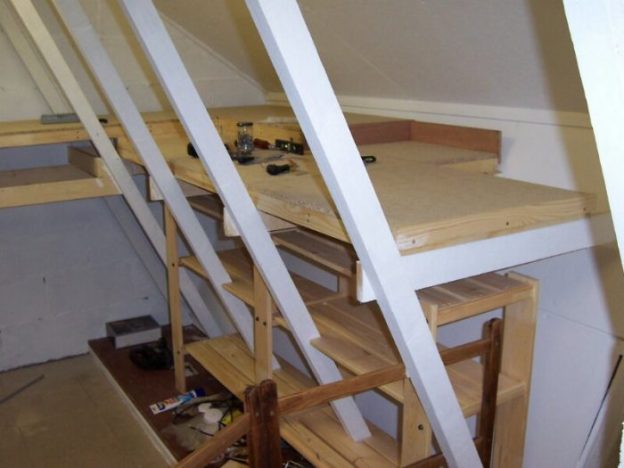
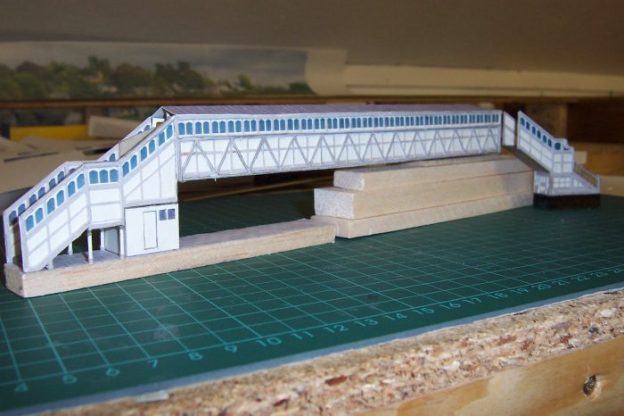
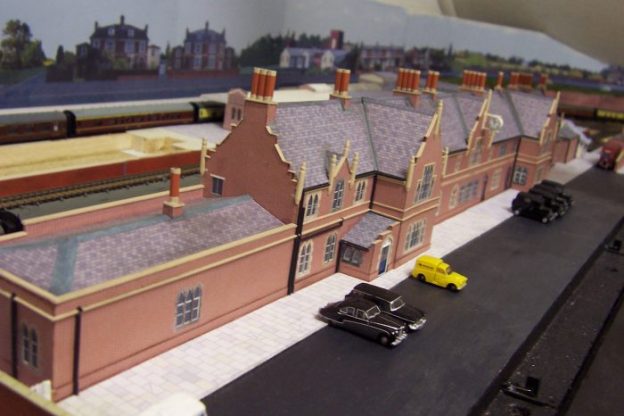
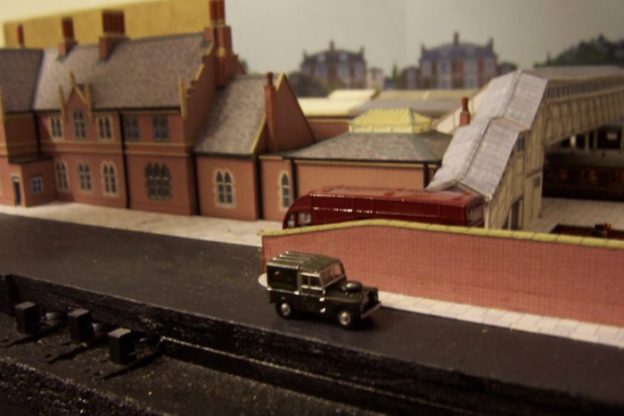
Conclusion

It seems that whether a cleric’s interest in railways comes from a past outside the church, or is borne in the midst of theological formation, it has some significant things going for it. In particular, like many other interests, it forms an alternative world to the world of work.

I’m not sure that, ultimately, any further justification is required.

References

  1. Ed Bevan; All Steamed Up About Trains; Church Times, 15th June 2011; https://www.churchtimes.co.uk/articles/2011/17-june/features/all-steamed-up-about-trains, accessed on 9th February 2020.
  2. Russell J. Garwood, Imran A. Rahman, Mark D. Sutton; From Clergy to Computers; Geology Today, Volume 26, Issue 3, 2010; p96-100; https://onlinelibrary.wiley.com/doi/abs/10.1111/j.1365-2451.2010.00753.x, accessed on 5th November 2020.
  3. https://en.wikipedia.org/wiki/List_of_Catholic_clergy_scientists, accessed on 5th November 2020.
  4. https://en.wikipedia.org/wiki/Nicolaus_Copernicus, accessed on 5th November 2020.
  5. https://en.wikipedia.org/wiki/Gregor_Mendel, accessed on 5th November 2020.
  6. https://en.wikipedia.org/wiki/Georges_Lemaître, accessed on 5th November 2020.
  7. https://en.wikipedia.org/wiki/Roger_Bacon, accessed on 5th November 2020.
  8. https://www.osvnews.com/2019/04/07/what-clergy-and-religious-do-in-their-spare-time, accessed on 5th November 2020.
  9. https://en.wikipedia.org/wiki/John_Michell, accessed on 5th November 2020.
  10. https://en.wikipedia.org/wiki/John_Polkinghorne, accessed on 5th November 2020.
  11. https://en.wikipedia.org/wiki/Society_of_Ordained_Scientists, accessed on 6th November 2020.
  12. Revd Fergus Butler-Gallie; A Field Guide to the English Clergy: A Compendium of Diverse Eccentrics, Pirates, Prelates and Adventurers; All Anglican, Some Even Practising; Oneworld Publications, London, 2018.
  13. https://www.waterstones.com/book/a-field-guide-to-the-english-clergy/the-revd-fergus-butler-gallie/9781786074416, accessed on 6th November 2020.
  14. Sebastian Shakespeare; The Daily Mail, 2018.
  15. https://ordsci.org, accessed on 7th November 2020.
  16. https://ordsci.org/history, accessed on 7th November 2020.
  17. https://www.churchtimes.co.uk/articles/2007/9-february/news/uk/canon-eric-neil-jenkins, accessed on 7th November 2020.
  18. https://www.churchofscotland.org.uk/speak-out/science-and-technology, accessed on 7th November 2020.
  19. https://www.churchofscotland.org.uk/news-and-events/news/2016/moderator-why-i-support-grasping-the-nettle, accessed on 7th November 2020.
  20. https://en.wikipedia.org/wiki/Edwin_Boston, accessed on 7th November 2020.
  21. http://www.pegnsean.net/~railwayseries/awdryobit.htm, accessed on 7th November 2020.
  22. https://en.wikipedia.org/wiki/List_of_books_in_The_Railway_Series#Thomas_the_Tank_Engine, accessed on 7th November 2020.
  23. https://ttte.fandom.com/wiki/Other_Languages, accessed on 7th November 2020.
  24. For example: Peter Denny; The Railway Modeller Magazine July and August 1958.
  25. For example: Peter Denny; Peter Denny’s Buckingham Branch Lines: 1945-1967 Pt. 1; Peter Denny’s Buckingham Branch Lines: 1967-1993 Pt. 2; Wild Swan, Oxfordshire; 1993, 1994
  26. For example: https://highlandmiscellany.com/tag/peter-denny, accessed on 7th November 2020.
  27. Tony Wright – https://www.world-of-railways.co.uk/model-railways/famous-model-train-layouts-and-their-creators–part-1, accessed on 7th November 2020.
  28. https://en.wikipedia.org/wiki/Eric_Treacy, accessed on 7th November 2020.
  29. Revd. Michael Ainsworth; Thoughts on railways, clergy, religion and the law; in Law & Religion UK, 17 April 2015; https://lawandreligionuk.com/2016/04/18/thoughts-on-railways-clergy-religion-and-the-law, accessed on 7th November 2020.
  30. Rt. Revd. Michael Bourke; https://www.churchtimes.co.uk/articles/2011/8-july/comment/letters-to-the-editor/clergy-who-fall-in-love-with-railways-article-was-on-the-right-track, accessed on 7th November 2020.
  31. Rev Clifford Owen; Retired Clergy Don’t Run Out Of Steam; Diocese of Europe; https://europe.anglican.org/main/latest-news/post/994-retired-clergy-donat-run-out-of-steam, accessed on 7th November 2020.
  32. Clergy carrying train tribute to former railway fan vicar; The Northern Echo, 2010; https://www.thenorthernecho.co.uk/news/local/northyorkshire/8358957.clergy-carrying-train-tribute-former-railway-fan-vicar, accessed on 7th November 2020.
  33. https://sites.google.com/site/stgabrielacton/our-priests, accessed on 7th November 2020.
  34. http://coulsdonrectory.blogspot.com/2009/06/clergy-and-trains.html, accessed on 7th November 2020.
  35. David Self; What draws clerics to railways?; Church Times , 30th January 2008; https://www.churchtimes.co.uk/articles/2008/1-february/comment/what-draws-clerics-to-railways, accessed on 8th November 2020.
  36. https://www.steamingpriest.com, accessed on 8th November 2020.
  37. https://www.steamingpriest.com/about/fathers-rr-story, accessed on 8th November 2020.
  38. Nicholas Whittaker; Platform Souls; Orion, London, 1995 (Revised Edition, 2015).
  39. https://www.belfasttelegraph.co.uk/life/features/love-of-railways-sent-clerics-off-on-a-totally-new-track-36257796.html, accessed on 8th November 2020.
  40. https://www.amberley-books.com/discover-books/transport-industry/railways/the-life-of-a-steam-railway-photographer.html, accessed on 8th November 2020.
  41. https://www.wiltshiretimes.co.uk/news/5072513.with-god-and-gwr, accessed on 8th November 2020.
  42. Simon Baron-Cohen; The extreme male brain theory of autism; in Trends in Cognitive Sciences, Volume 6, Issue 6, 1st June 2002, p248-254.
  43. https://rogerfarnworth.com/category/railways-blog/uganda-and-kenya-railways.
  44. https://rogerfarnworth.com/category/railways-blog/ireland.
  45. https://rogerfarnworth.com/category/railways-blog/railways-and-tramways-around-nice.
  46. https://rogerfarnworth.com/category/railways-blog/railways-and-tramways-of-south-western-france.
  47. https://rogerfarnworth.com/category/railways-blog/model-railway.
  48. Revd. E. R. Boston & P.D. Nicholson; Font to Footplate; Line One Publications, 1986.

Remembrance Sunday 2020

Remembrance Sunday

On Sunday 8th November, Remembrance Sunday, all our churches would usually have been full of people remembering, along with millions around our world, the many women and men who have given their lives in the different conflicts of the past 110 and more years.  People who either by choice, or through compulsion, risked their lives in the pursuit of peace and justice.  We owe our freedom to many such people who have stood up against tyranny and oppression – to people who risked everything, laying themselves on the line.

Things are very different this year! We enter another national lockdown because of Coronavirus on Thursday 5th November and our churches will now only be open for private prayer for the next few weeks.

But we will all remember. …. Some will be able to attend church on 8th November, others will want to remain at home. We have sent out Remembrance Sunday prayer cards to people who usually attend our churches or who receive mailings. The prayers included here are specifically for Remembrance Sunday and Armistice Day. As you use them, you might want to have a poppy to hand.

As I said in our Parish magazine this month:

Our remembering will … include the memories of those who have served on the battlefield or in conflict zones around our world will no doubt justifiably tell and re-tell stories of valour and bravery. For those who served, >remembering= will also bring to the front of the mind stories of those who did not return. Remembering brings to the surface the naked fear of conflict, the pain of loss and a real sense of comradeship.

 But remembering is so very important to us all, not just on Remembrance Sunday or Armistice Day, but in all areas of our lives. Remembering leads to us telling our stories. Both as individuals and communities. And as we tell our story, we reaffirm our roots, and we define who we are. We put our own lives in context. For today=s world, where we define ourselves not so much by where we come from as by our networks of friends and acquaintances can so easily become a rootless place where we do not know who we really are.

Our shared memories are our key to understanding ourselves. And our collective memory needs to be sustained by hearing the stories of our past. By hearing from those who went out from us here to serve in different arenas in our world. These stories, these people are so much a part of who we are here … today. They contribute to our history, they strengthen our community spirit.

Our stories are important. Remembering is vital. Nowhere is this more true than in relation to the conflicts with which we have been involved as a nation. Failure to engage with and learn from our past is the height of modern arrogance. We have to hear again the stories of conflict, of bravery, of pain and loss. And we need to allow those stories, … that remembering, to change us now. It must inform our thinking about the future, it must be allowed to change our wills and our actions.

 For in today’s world, we are all called to take new & different risks. To act for justice, for peace in society, in the world around us. To work for racial justice, to fight discrimination, to engage with injustice in whatever form it might arise.”

We have the promise of God in Christ: “Work,” says Jesus, “for the coming of God’s kingdom and I will be with you always.” God does not leave us alone to face new challenges, to risk our lives in the cause of his Kingdom. He promises always to be with us. So let us covenant again, as people of different races, ages, interests, appearances, and with different views, choose to live together in harmony, to work within our own communities, groups and congregations, for peace, justice and understanding.

Prayers

A prayer of commemoration for the fallen

Father of all, remember your holy promise, and look with love on all your people, living and departed.

On this day we especially ask that you would hold forever all who have suffered during war, those who returned scarred by warfare, those who waited anxiously at home, and those who returned wounded, and disillusioned; those who mourned, and those communities that were diminished and suffered loss.

Remember too those who acted with kindly compassion, those who bravely risked their own lives for their comrades, and those who in the aftermath of war, worked tirelessly for a more peaceful world.

And as you remember them, remember us, O Lord; grant us peace in our time and a longing for the day when people of every language, race, and nation will be brought into the unity of Christ’s kingdom. This we ask in the name of the same Jesus Christ our Lord. Amen.

A prayer for World peace
O God of the nations,
as we look to that day when you will gather people
from north and south, east and west,
into the unity of your peaceable Kingdom,
guide with your just and gentle wisdom all who take counsel
for the nations of the world,
that all your people may spend their days in security, freedom, and peace, through Jesus Christ, our Lord. Amen.

Prayers with poppies – suitable for children, as well as adults!

All you need for this simple prayer is a poppy.

Look at your poppy. Poppies are bright and cheerful flowers: give thanks to God for the lives of those who have died in war, remembering all the joy they brought to families and friends, and all the good things they did for their home and their country.

Then look at the red petals: red reminds us of danger and harm. Ask God to be close to those who are still facing danger each day, to give courage to the armed forces, and compassion to all who help others.

Place your whole hand over the poppy: poppies are also fragile and need to be handled gently. God cares for those who are hurting and those who are sad. Ask God to comfort all who are grieving the loss of someone they love.

Finally place a finger on the centre of the poppy: ask God to help you play your part in working for peace in the world.