
‘The Modern Tramway‘ was the title of the journal of the Light Railway Transport League.
I picked up a small batch of copies of The Modern Tramway Journal which included volumes from the 1950s, 1960s and 1980s and have begun reading through them. The first Journal that I have is dated 15th July 1953. At the time of writing it is 70 years old. This is the second article about its contents. The first can be found here. [1]
Volume 16 No. 187 of July 1953 includes an article about Tramways and Traffic Planning in Munich which reflects on decisions taken by leaders in the Munich municipality which were implemented by the Munich Municipality Roads Department in the years,it appears from the article, following the First World War (1925) [2: p136-138] The article is dated 1925 in the introduction in The Modern Tramway but, as we will see later, considers action undertaken in Munich in the 1930s, in Rome at the beginning of that decade, and in Cologne and Lübeck in 1945. It is likely, therefore, that in giving the date as 1925, two digits got transposed and that the article actual came from the German language press in 1952, after the Second World War. [2: p136, 137, 138]
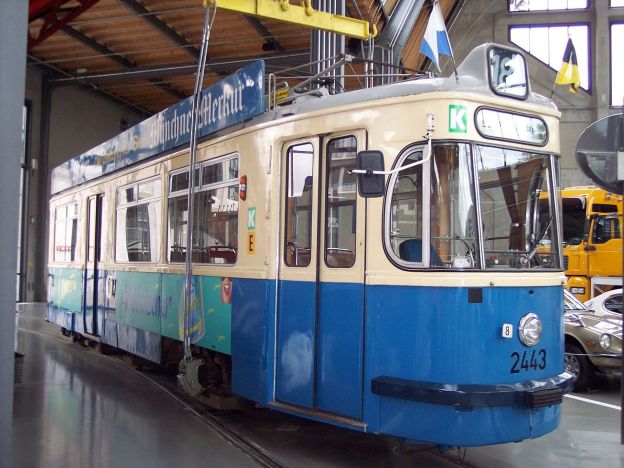
The featured image above shows Munich tram car series M 4.65 in the traffic exhibition of the Deutsches Museum, Munich, Germany © MaxM and shared here under a Creative Commons Licence (Creative Commons Attribution-Share Alike 2.5 Generic, 2.0 Generic and 1.0 Generic licences). [4]

“In Munich, some extremely costly plans to replace the trams in the central area by motor buses and three underground railway lines have been discarded. It has been decided that all the main local passenger traffic will continue to be carried by tramways; the construction of sub-surface tramways as in Boston, Philadelphia and as projected in Toronto, has been considered but rejected on the grounds of cost. It has been stated that a modern and well-planned tramway system with a 50% increase in speed, supplemented by an extensive and well-planned network of trolley and motor bus services in the suburbs could provide the Munich of the future with transport services which would be far cheaper to build and maintain and almost as fast as the services enjoyed in cities which have installed expensive and unprofitable underground railways.
The objections to the present Munich tramway system and the way in which these objections will be overcome are summarised below:-1. That present 50-year old trams moving in the overtaking lane of the carriageway constitute an obstacle to fast traffic flow even when they are moving, owing to their slow speed. This disadvantage will be eliminated by the use of fast modern tramcars.
Tramways and Traffic Planning in Munich; The Modern Tramway, Vol. 16 No. 187, [2: p136-137]
2. Double track tramways in one-way streets. It is desirable that tramways should obey the one-way regulations but this is only practicable in fairly long streets or where broad parallel streets are available. Unlike the American cities with their regular street patterns, European cities rarely have such parallel streets and one-way working for tramcars is not often possible. Where it can be done, tramways in one-way streets should be laid so as to allow for two traffic lanes to the right of the track used by trams running in the same direction as the other traffic, thereby allowing the use of three lanes in one direction and only one lane, occupied by the trams, running the other way, against the stream. It may also be possible in some streets to leave a parking lane between the track of the “against the stream” trams and the kerb.
3. Alleged congestion caused by tram-trailer trains. In America single tramcars 15 to 17 mtres (49ft. 24in. to 55ft. 9 in.) in length and 2.5 to 2.6 metres (8ft. 2in. to 8ft. 6in.) wide have a capacity equal to that of an old fashioned European two-car tram train but single cars of such dimensions are not generally possible in Europe and in many cases it is impossible to dispense with the two or three-car sets. It is however possible to build cars which will clear junctions and curves more rapidly. An old type Munich three-car set requires 15 to 20 seconds to clear a 40 metre (131ft) crossing with its acceleration of 2 to 36 metres (7in. to 1ft. 2in.) per second. High speed cars of modern design will reduce this time by half. It should not be forgotten that three of the most modern oil buses require more time over a crossing than an old type three-car tram set. It is interesting to note that Stockholm and Zurich, which have adopted high capacity tramcars, have re-introduced trailers, Four large Italian cities use articulated cars.
4. No loading can be provided in a carriagway only 12 metres (39ft. 4 in.) wide. This can be overcome by making use of every opportunity available to build loading islands and by eliminating stops at points where no loading island can at present be built. In the main streets loading islands will be provided at all stops; they create better traffic conditions than would be available if oil buses were used. Oil buses, apart from being uneconomical, require twice as much road space in spite of the fact that they have a smaller capacity than a tram. Loading islands in broad streets where the tramways are not on reservation force road users to keep to their own traffic lanes and impose driving discipline on motorists. Overtaking on the wrong side of the street becomes almost impossible and pedestrians are provided with a welcome resting place enabling them to cross the road in two stages. The oil bus, by continually turning out of the traffic stream and also across the cyclist stream, to reach the curb and repeating the movement as it restarts, hinders traffic flow.”
After this careful explanation of the municipality’s plans. The author, Dr. Ing F Flugel, Chief Officer, Munich Municipality Roads Department, considers the relative merits of trolleybuses, buses and trams. It is worth noting that trolleybuses were introduced on Munich’s streets in 1948 and that the last trolleybus services ceased in 1966. [3] He said:
“When the removal of tramways from city centres is advocated by the oil and trolley bus patisans as a pancea for traffic congestion it is always forgotten that buses require nearly twice as much road space as a tram, leaving less space for other traffic; also that fares would be doubled and many passengers would no longer enjoy direct services as they would have to change vehicles and endure longer journeys. In 1933, Christian Weber wanted to remove the tramways from the Theatiner Strasse and Sendlinger Strasse and accordingly introduced a bus service from Sendlinger Tor-Platz to Odeonsplatz: tram services 6 and 26 were diverted via Karlsplatz. As a result, trams on these services emptied at the Odeonsplatz. and Sendling Tor-Platz and even at rush hours travelled empty via Karlspatz The number of passengers leaving the trams at the Sendlinger Tor and Odeonsplatz in rush hours was so large that the buses could not cope with the traffic in spite of a 90 second headway. The trams were very quickly restored for the rush hours and the buses only ran at slack hours; this entirely unnecessary bus service cost the undertaking several hundred thousand marks yearly. The section between Theatiner Strasse and Sendlinger Strasse was very badly damaged during the war and owing to traffic congestion on this badly damaged route tramway service has not been restored since the war; consequently there is at present no north-south tramway through the heart of the city. This is a great improvement for fast motor traffic but quite the reverse for 80% of the population who rely on public transport. These unfortunates are obliged to travel via the Karlsplats and so to lose 5 or 10 minutes on every journey.
A suggestion has also been made that the tramway across the city in the east-west direction be replaced by buses in the city centre and the trams diverted round the city centre. At rush hours trams on the east-west route work a one minute headway and at each change of the traffic lights at Marienplatz (about every 2 minutes) tram sets pass through in each direction – eight buses would be required to replace them. The 9.5 to 11 metre (31 ft. to 36 ft.) wide street traversed only just allows four traffic lanes when trams are in service. If the trams were replaced by buses, traffic lanes would be reduced to two owing to the width of the buses and their inability to operate with such small clearances as the trams.
In the street concerned (Kaufingerstrasse) there are 2,000 private cars, passing through to every 120 tram sets (16:1) in London one out of every four vehicles is a bus; this comparision demonstrates that buses leave much less space available for other traffic in streets. Apart from the chaos, loss of time and general inconvenience this project would cause if it were put into effect, the idea of penalising the majority in order to appease the car owning minority is anti-social; the diverting of motor car traffic round the edge of the city would cause much less inconvenience,
Tramways and Traffic Planning in Munich; The Modern Tramway, Vol. 16 No. 187, [2: p137-138]
In Rome, Mussolini ordered the closing of the city centre tramways in 1930 and passengers had thereafter to transfer to inadequate motor and trolley bus services if they wished to travel within the area bounded by the Inner Circle tramway: fares had to be raised considerably. In contrast, in Milan only one or two tramways in very narrow streets have been abandoned, the tramway remaining the backbone of public transport in the city centre, There are three 6 metre (19 ft. 6 in.) wide streets where trams only are allowed, to the exclusion of all other traffic. As a consequence of the retention of her central tramways, Milan enjoys extremely efficient and cheap passenger transport. In Cologne and Lübeck tramways inside the “Ring” Avenues were mostly abandoned in 1945 but contrary to the plans of the bus advocates, many tramways have been and will be re-opened in these city centres. Public transport, whether buses or trams, should always run to the town centre; congestion can always be eased by diverting through traffic, banning it from the central streets. Replacement of trams in the centre of Munich would be extremely unwise economically and operationally and would be a reactionary step socially. The Munich Roads Department is endeavouring, with the limited means at its disposal, to carry out as many street improvements as possible, always taking into account the needs of all road users and always with a view to making a sound basis for the future high speed tramways system.”
Once again, given recent experience in cities in the UK, it is worth noting the highlighted text above. …
“Public transport, whether buses or trams, should always run to the town centre; congestion can always be eased by diverting through traffic, banning it from the central streets. Replacement of trams in the centre of Munich would be extremely unwise economically and operationally and would be a reactionary step socially.” [2: p138]
It does seem as though we may have been better advised to heed these words in the mid-20th century. The recent revival of the LRT networks in major cities in the UK suggest that greater heed should have been taken of these voices in the way tramways were considered in the late 1940s and early 1950s in the UK.

References
- https://rogerfarnworth.com/2023/06/07/the-modern-tramway-part-1/
- The Modern Tramway, Volume 16 No. 187, July 1953, p136-138.
- https://en.m.wikipedia.org/wiki/List_of_trolleybus_systems_in_Germany, accessed on 8th June 2023.
- https://commons.m.wikimedia.org/wiki/File:Munichtramm4.jpg#mw-jump-to-license, accessed on 8th June 2023.
- https://en.sporvognsrejser.dk/foto/postcard-munich-extra-line-29-with-railcar-510-at-ostbahnhof-1920, accessed on 8th June 2023.
- https://en.m.wikipedia.org/wiki/Trams_in_Munich#/media/File%3ATram_M%C3%BCnchen_-_Baureihen_P%2C_R_und_S_-_Betriebshof_Einsteinstra%C3%9Fe_-_April_2014.jpg, accessed on 8th June 2023.
 Roger Farnworth

