Tag Archives: Whitland & cardigan railway

Railways in West Wales Part 2C – The Whitland & Cardigan Railway – Rolling Stock, Locomotives and Llanglydwen to Whitland

Before resuming our journey along the Whitland & Cardigan Railway, just a few comments about Locomotives and Rolling Stock. …

Locomotives

In early days the line operated with three locomotives. These were all constructed by the same company, Fox, Walker & Co. of Bristol.

“The company was founded by Francis William Fox and Edwin Walker who opened an engineering works at Atlas Locomotive Works in Bristol in 1864.

They built four and six-coupled saddle tank engines for industrial use. They also built stationary engines and pioneered steam tramcars, the first being tested in Bristol in 1877.

Much of their output was exported.

By 1878 the company had made over 400 small tank engines.

In 1878 they produced six narrow gauge 2-4-2 trench engines for the Royal Engineers at Chatham using Henry Handyside’s steep gradient apparatus. They also produced nine 0-6-0 saddle tank engines for the Somerset and Dorset Railway.

They were taken over by Thomas Peckett in 1880, becoming Peckett and Sons, Atlas Engine Works, Bristol.” [1]

These locomotives were:

No. 1, John Owen, (Works No. 170 of 1872).

No. 2, (Works No. 271 of 1875) – sold by GWR to Bute Works Supply Co., and East Kent Light Railway in 1911. Working until the early 1930s, last known in steam on 22 September 1934, scrapped by September 1935. [10][11][6: p91]

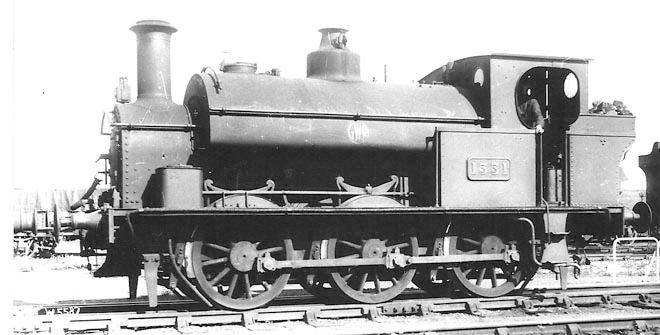
No. 3, (Works No. 340 of 1877) – rebuilt by GWR in 1896; rebuilt again and renumbered 1331 in 1926. Withdrawn in 1950. [11] A story about the building of a model of this locomotive in 00 Gauge can be found here. [12]

https://x.com/JonSLatona/status/1555748042376110080?t=MGZm0QpCXQztdDO4aIYn0A&s=19
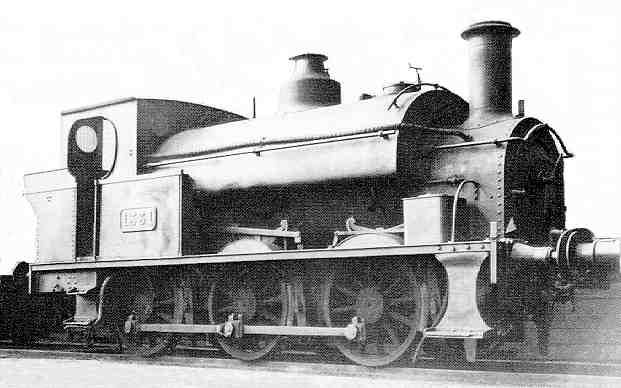
Nos. 1 and 2 were 0-6-0ST locos of a similar design. No. 3 was a larger 0-6-0ST locomotive. All three were rebuilt by the GWR. No.1 was rebuilt in 1894. [6: p91]

Soon after the GWR began operating the railway in 1886, a valuation of W&CR stock was made.No.1 was valued at £450, No. 2 at £600 and No. 3 at £850.” [6: p97]

M.R. Connop Price tells us that:

“Small Great Western tank locomotive types soon put in an appearance and the Whitland and Cardigan engines were moved away. Amongst the designs in evidence at the turn of the century were ’19XX’ 0-6-0 saddle tanks and Armstrong 0-4-2 tanks of ‘517’ class. Pannier tanks were frequently seen as well, but during World War I one of the 0-6-0 saddle tanks, either No. 1939 or No. 1999, was stationed at Cardigan. On the freight side a ‘Dean Goods’ 0-6-0 regularly arrived at Crymmych with the monthly cattle train. This was probably the only working to bring a tender engine onto the branch with any frequency, but tender engines were never common. About 1950 a ‘Dean Goods’ was seen standing on the Cardigan line at Cardigan Junction, in the company of a composite coach and a Siphon ‘G’ van: this is the last known instance of the class on the W&C route. Larger tender locomotives were prohibited by virtue of the line having a yellow colour weight restriction.

For many years ‘2021’ class pannier tanks were active on the line, and between the wars the more powerful ’45XX’ 2-6-2 tank locomotives appeared. These held sway on the Cardigan branch until the complete closure in 1963, although latterly they were supported by more modern pannier tanks in the ’16XX’ series. Amongst the engines seen on the railway in the post-war period were 0-6-0PTs Nos. 2011, 1637, 1648, 1666 and 2-6-2Ts Nos. 4550, 4557, 4569, 5550, 5571. In the final weeks of operation Nos. 4557 and 4569 were the most common performers on the railway.” [6: p99]

Carriages

Connop Price tells us that, “The Whitland & Taf Vale Railway owned six four-wheeled carriages, all constructed by the Gloucester Wagon Co. The first four were completed in June 1875, and comprised two composite coaches each having a first and two second class compartments, and a luggage compartment. The other two were brake thirds – that is to say comprising three third class compartments and a compartment for the guard. … Two more coaches were supplied by the Gloucester Wagon Co. in September 1875, and these vehicles comprised three third class compartments and a luggage compartment.” [6: p99]

After the GWR takeover of the line, standard GWR coach types began to appear.

Wagons

The Company’s wagons were all constructed by the Bristol Wagon Co. In October 1872, “in anticipation of the opening of the line, the W&TVR ordered a 4-wheel goods brake van and six 4-wheel open goods wagons. … In May 1874, as traffic developed, it was decided to order four more 4-wheel open wagons. … A 4-wheel covered van [was] … Ordered by the company in October 1974, for use on the Crymmych freight service.” [6: p101]

Records of the Gloucester Railway Carriage and Wagon Co. Ltd show that a number of  private owner wagons were in use on the line. Connop Price mentions: a five-plank wagon obtained by William Thomas, Coal, Lime & Manure merchant in March 1903; a seven-plank wagon delivered to the Cardigan Mercantile Co. Ltd. in March 1904. A near identical seven-plank wagon was supplied to G.D. Owen, Coal and Lime Merchant of Cardigan in April 1904. Another seven-plank wagon was supplied to S.J. Phillips of Crymmych Arms, Coal and Lime Merchant in September 1908. [6: p101-103]

Connop Price continues: “One other vehicle had a claim to be an item of Cardigan line rolling stock, although at a later date. This was the water tank wagon provided by the GWR in the 1920s or early 1930s to convey water to Cardigan where the supply was sometimes too low to fill the tank. … It was a standard 4-wheel tank wagon, painted white with the initials GW painted in black on the side. The underframe was also black.” [6: p103]
This unusual short goods at Cardigan contains a tank wagon between two coal wagons. There are stories of water supply problems at Cardigan. Although the station sits on the bank of the  River Teifi, being tidal water was only available at low tide as salt water damaged the locomotives. A tank wagon was used to bring water down to Cardigan presumably  from Glogue. This image was shared on the Login Railway Station Facebook Page on 12th March 2018. [9]
An enlarged extract from the image above. The tank wagon referred to in the text above is between the two mineral wagons. Connop Price indicated [6: p103] that no photograph of this tank wagon had been identified by  the date of the 2nd Edition of his book (August 1990). This image may therefore be the only one of the tank wagon! [9]

Llanglydwen to Whitland

We restart our journey to Whitland at Llanglydwen Railway Station. …
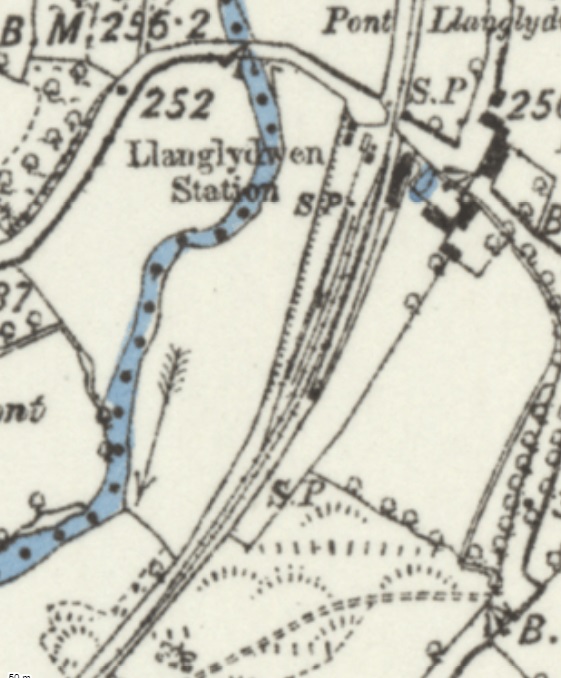
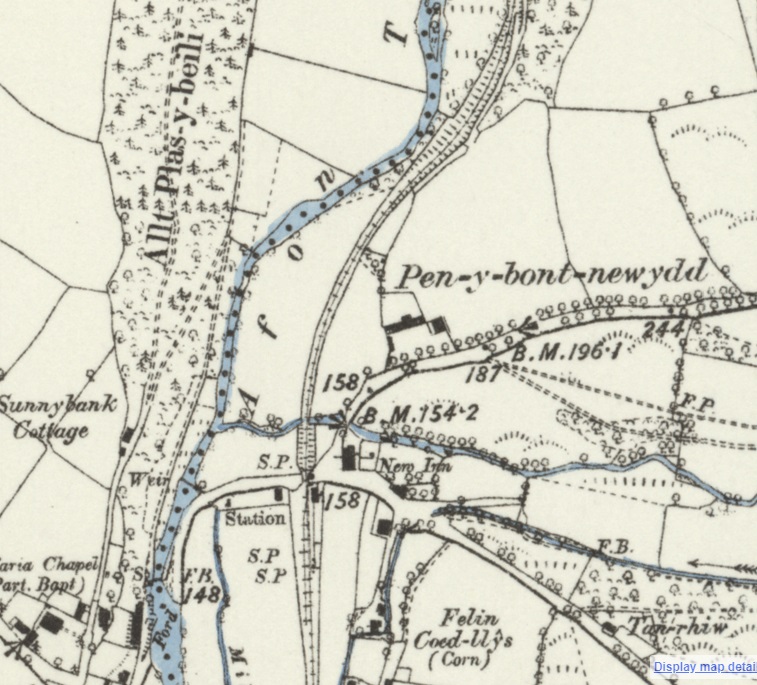
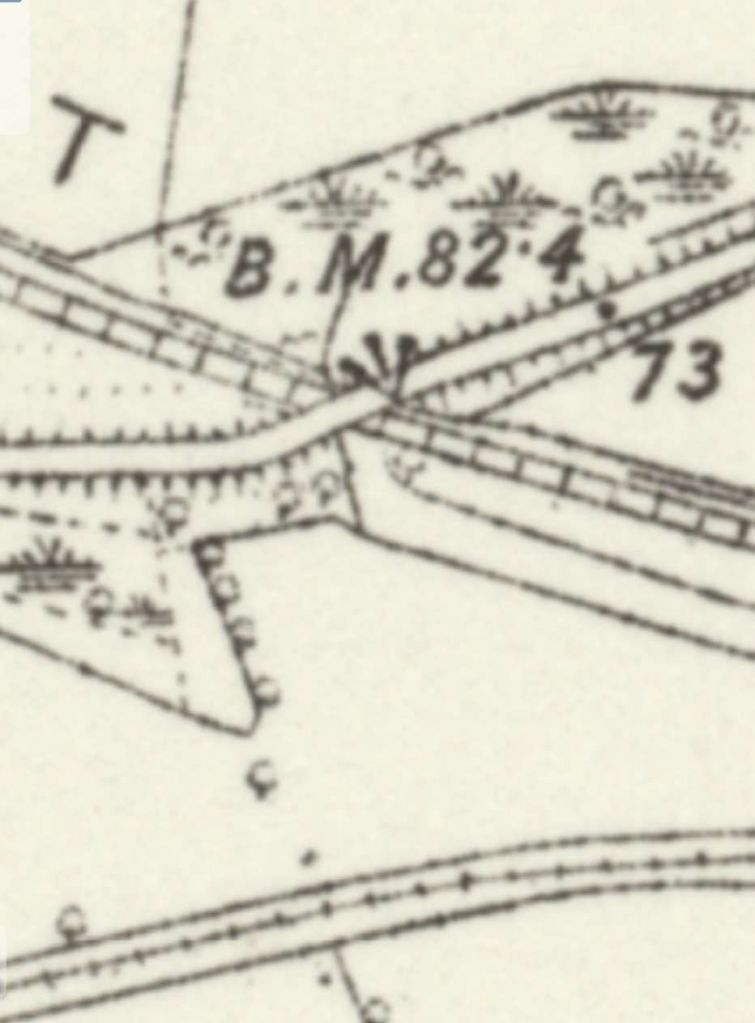
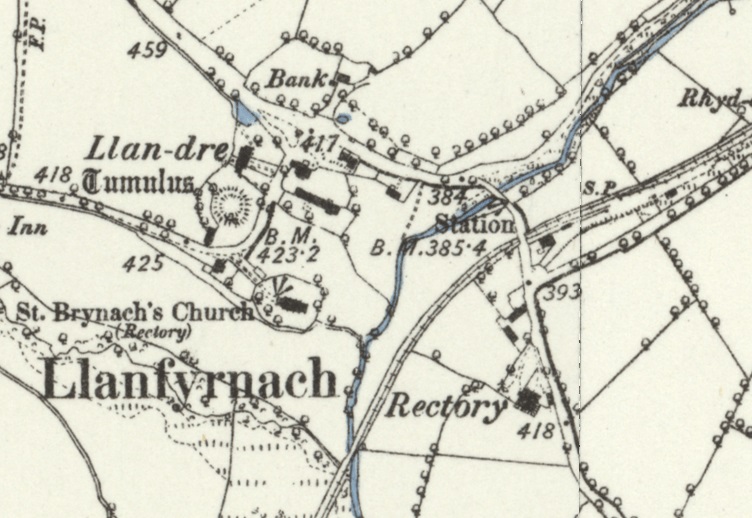
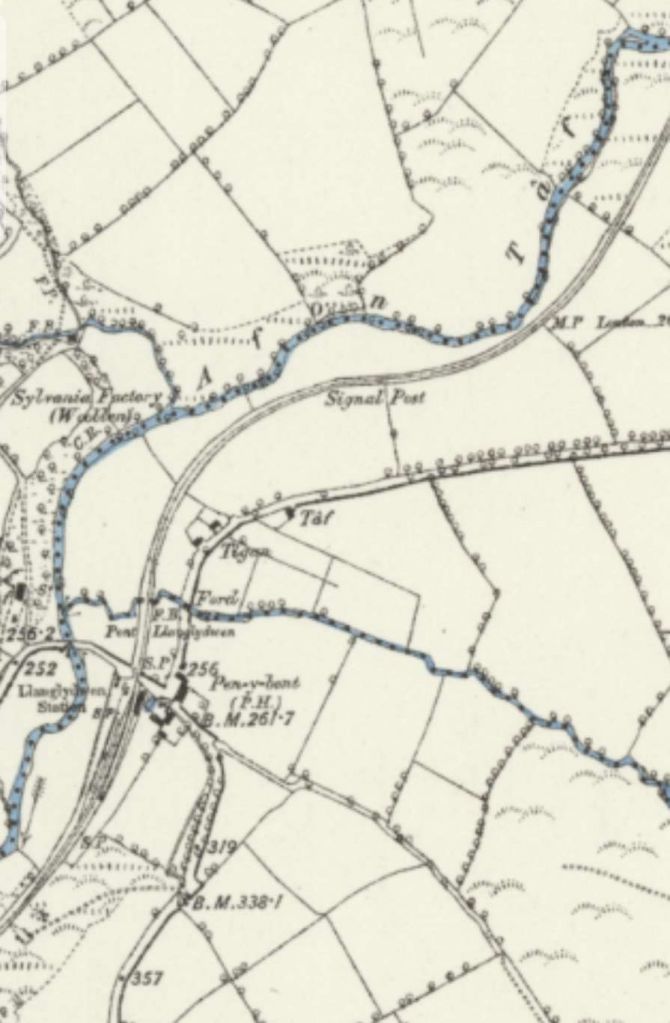
Llanglydwen Railway Station as it appeared on the First Edition of the 6″ Ordnance Survey. [18]
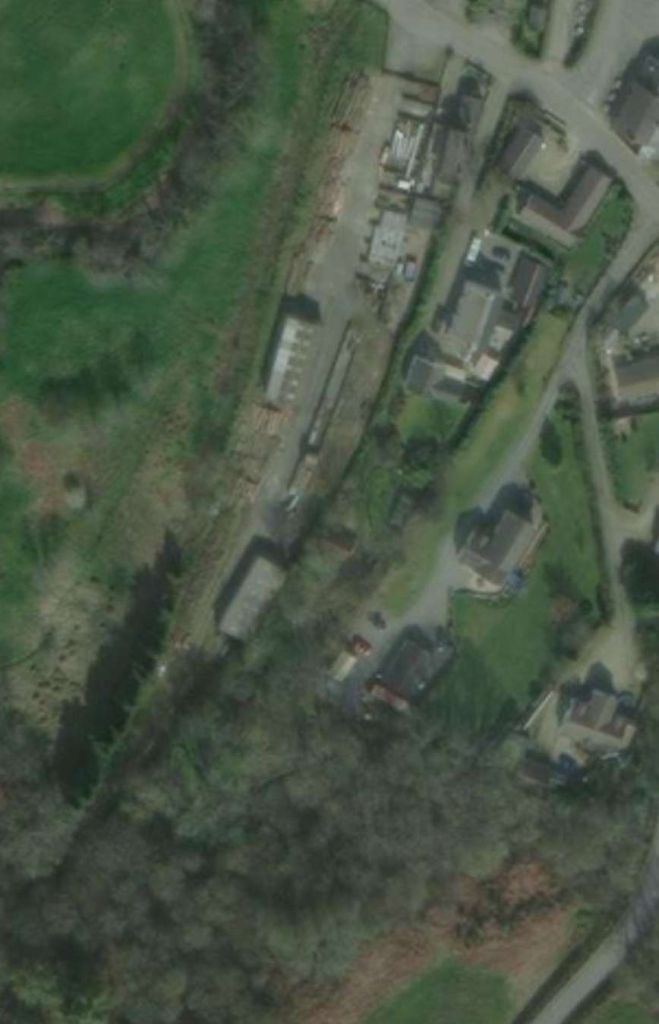
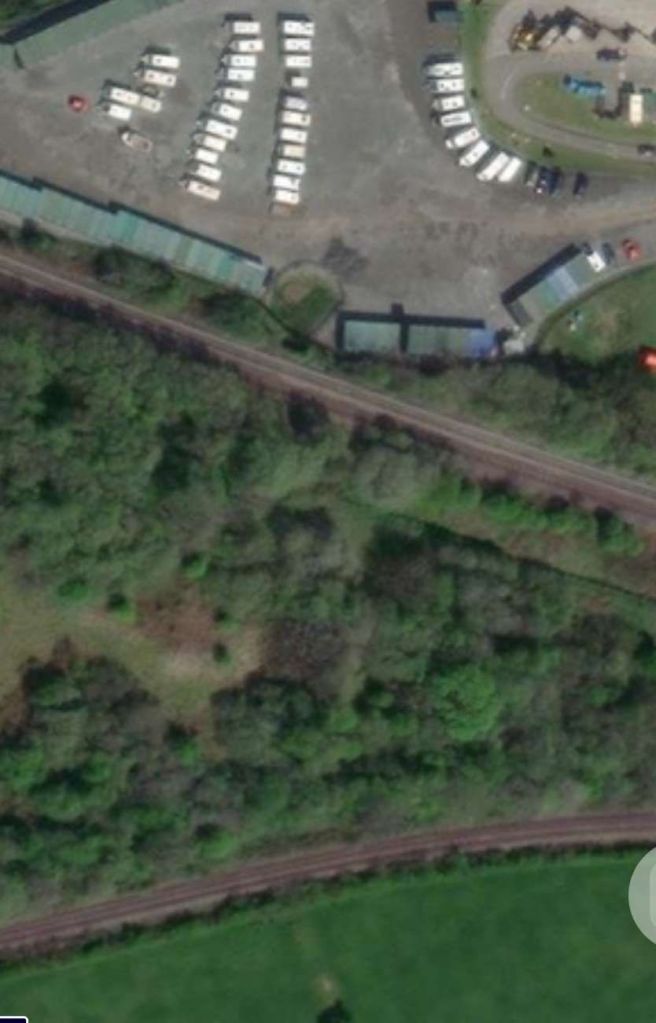
A similar area on the ESRI satellite imagery from the National Library of Scotland (NLS). [18]
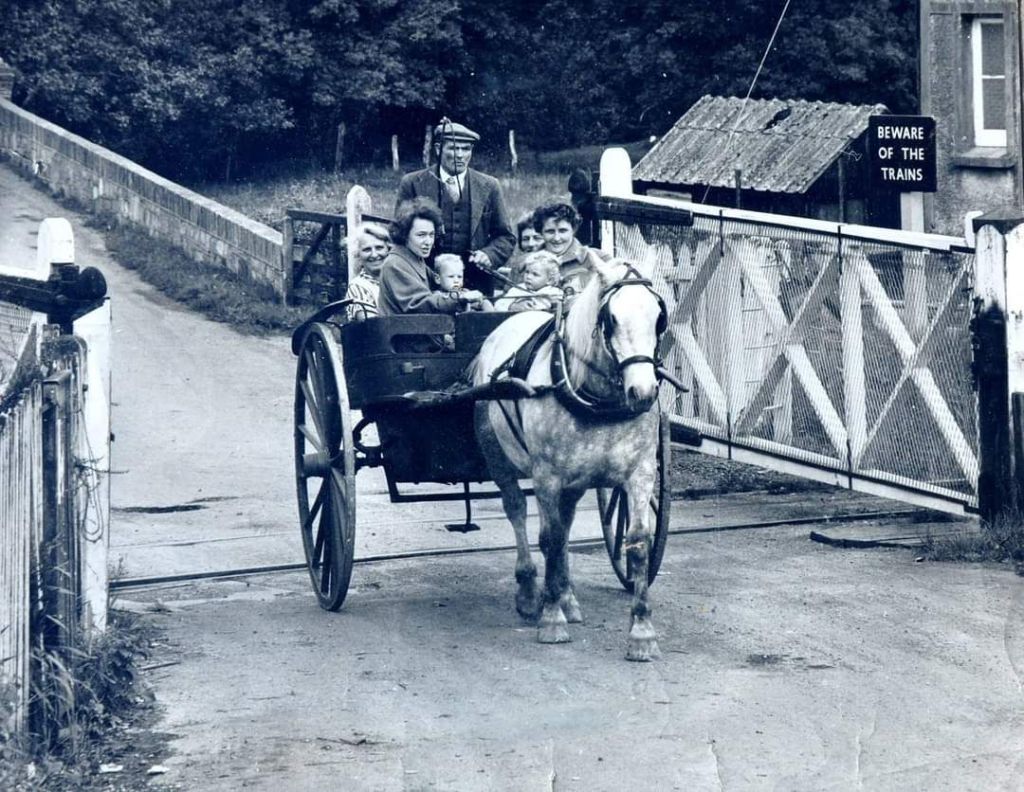
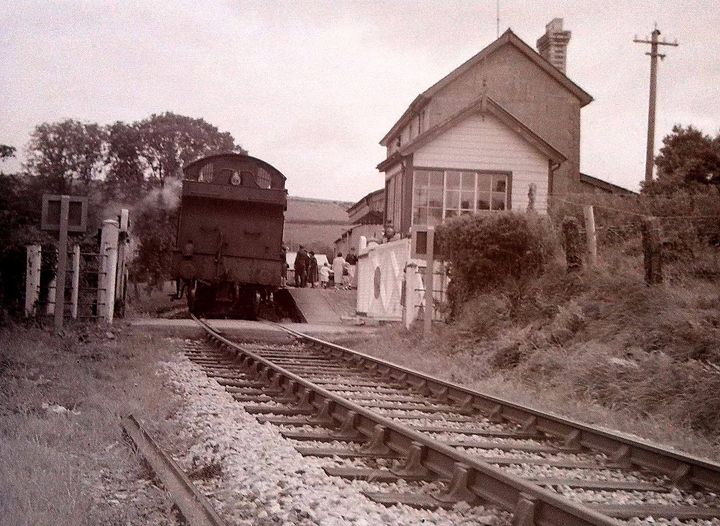
Taken in 1961, this photograph looks across the level crossing at the North end of Llanglydwen Railway Station. It appeared in the Western Telegraph on 7th December 2014 and was shared on the Login Railway Station Facebook Page on 1st November 2015. [33]
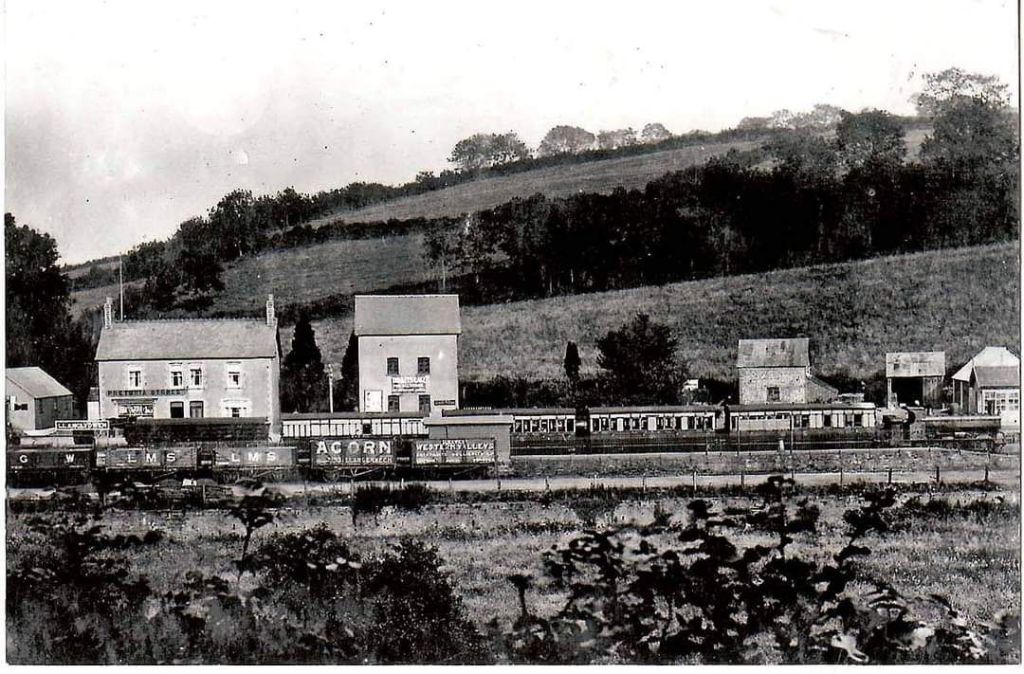
A view of Llanglydwen Railway Station from the West, possibly in the 1920s. This photograph was brought by Vickie Ashley to an open day at the Login Railway Station in July 2015 and shared on the Login Railway Station Facebook Page on 16th July 2015. [14]
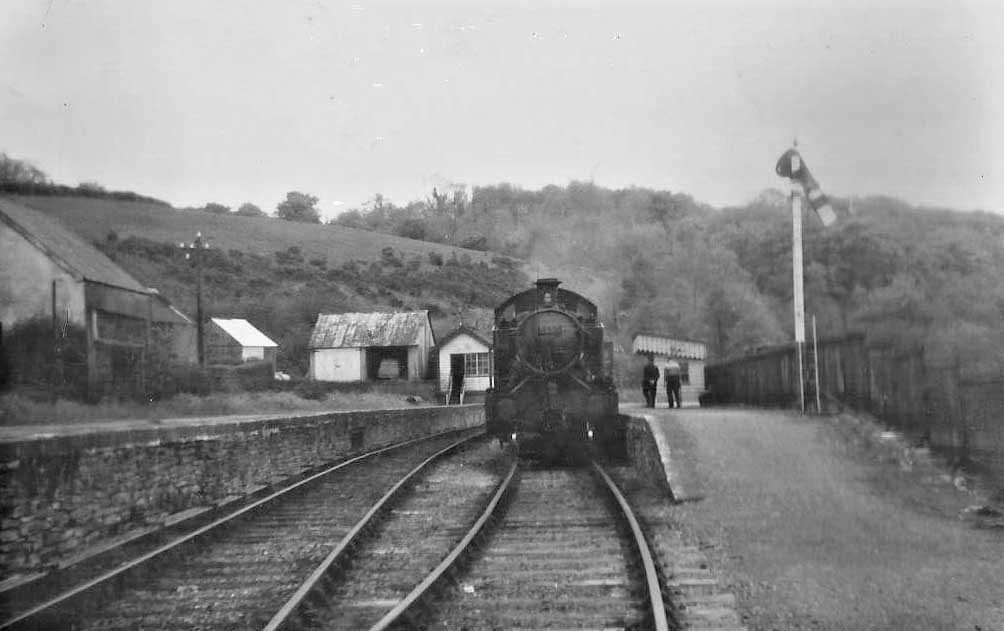
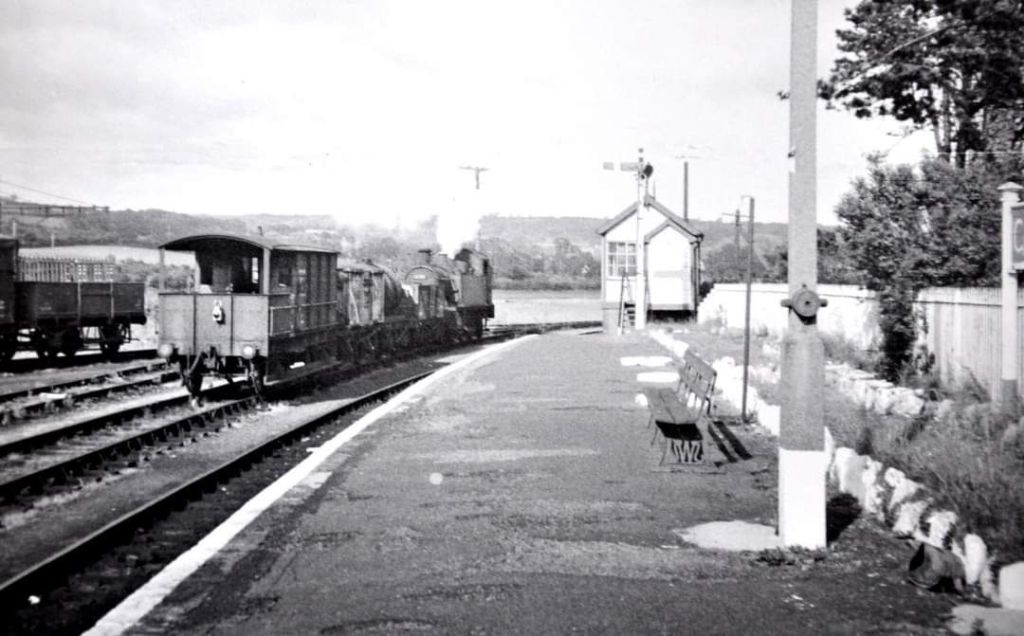
4575 Class Small Prairie, possibly 5550, at Llanglydwen in May 1962 with a train from Login. This image was shared on the Login Railway Station Facebook Page. [31]
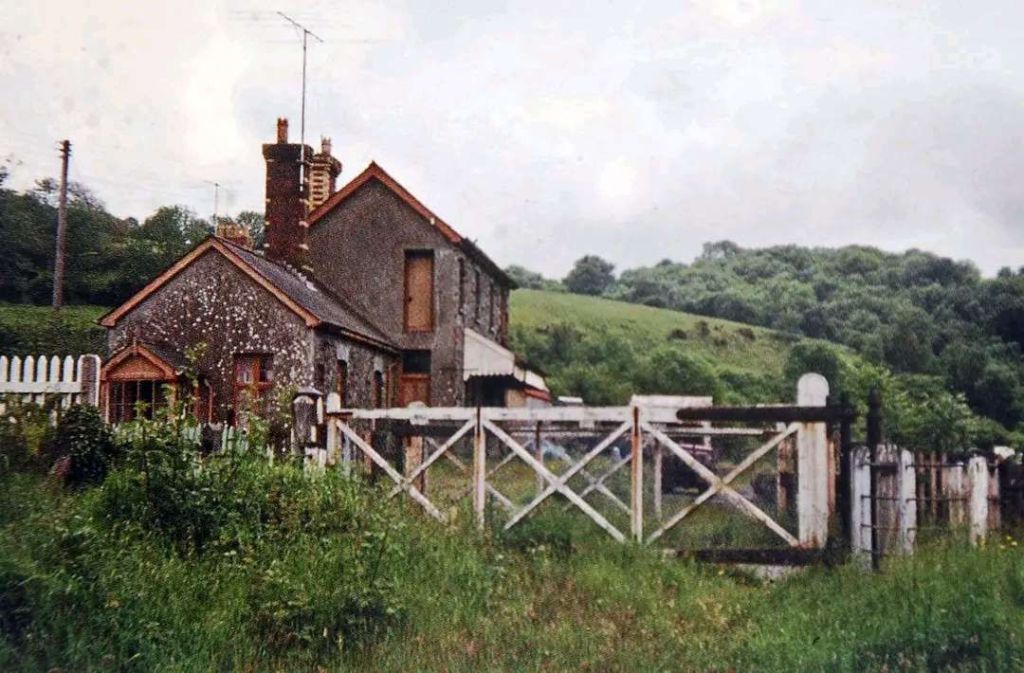
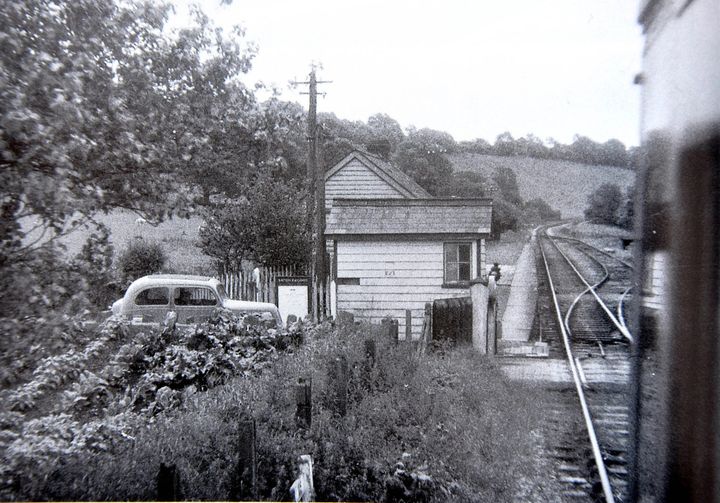
Llanglydwen Station seen from the North with the crossing gates still in place. This image was shared on the Login Railway Station Facebook Page on 2nd September 2020. [16]
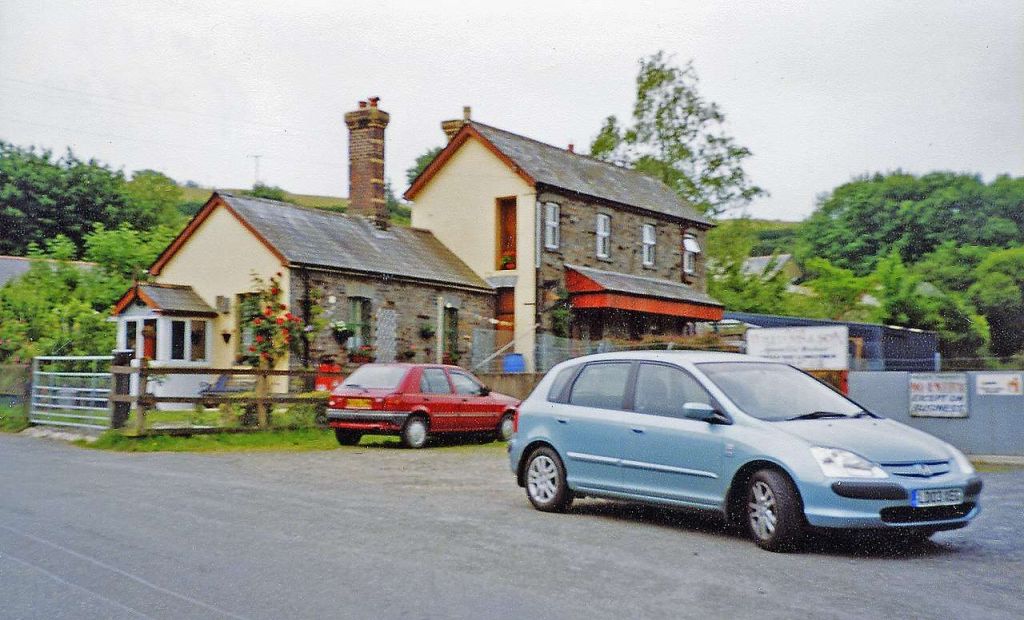
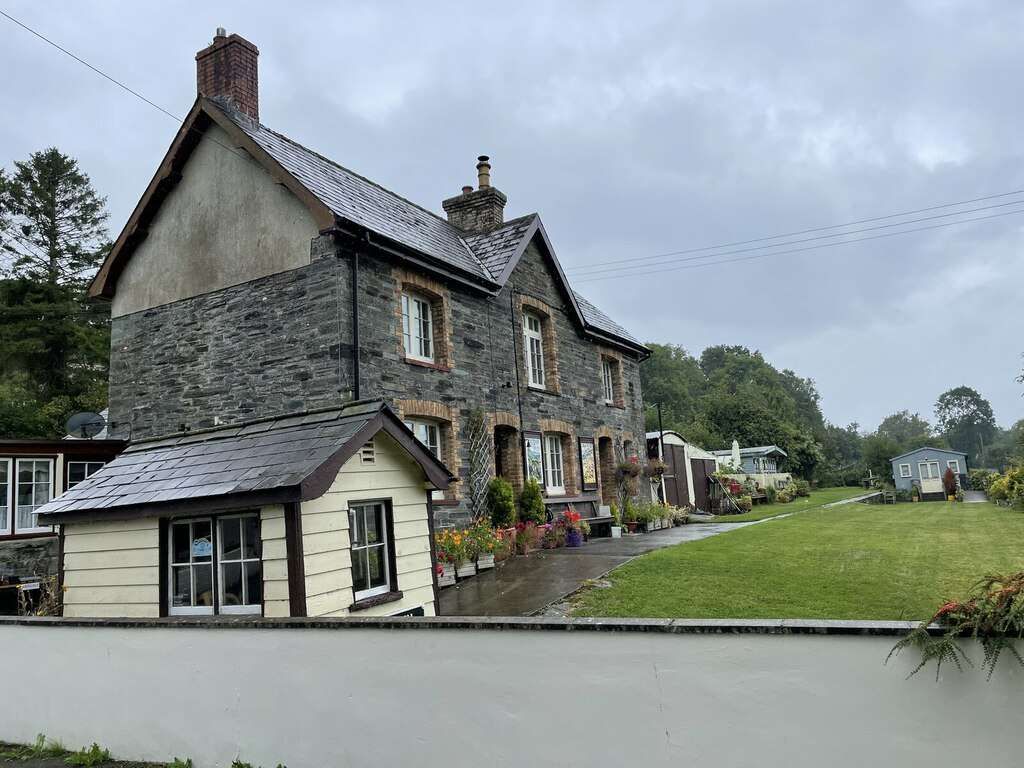
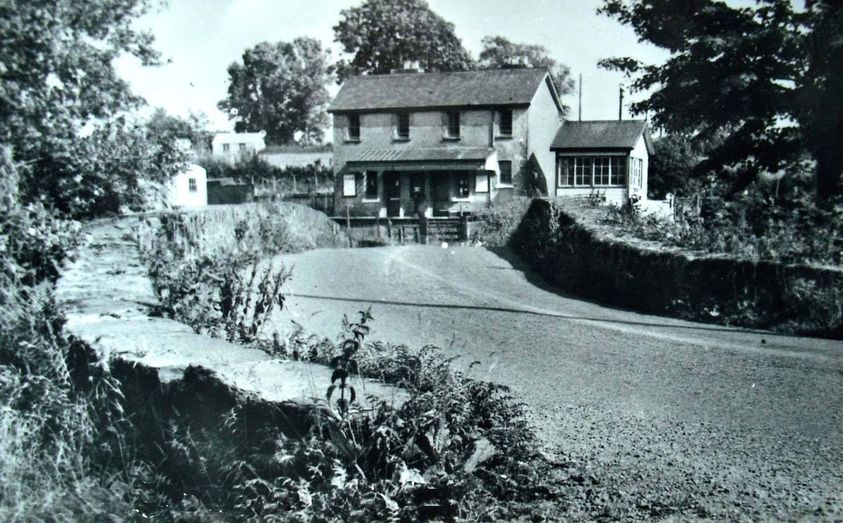
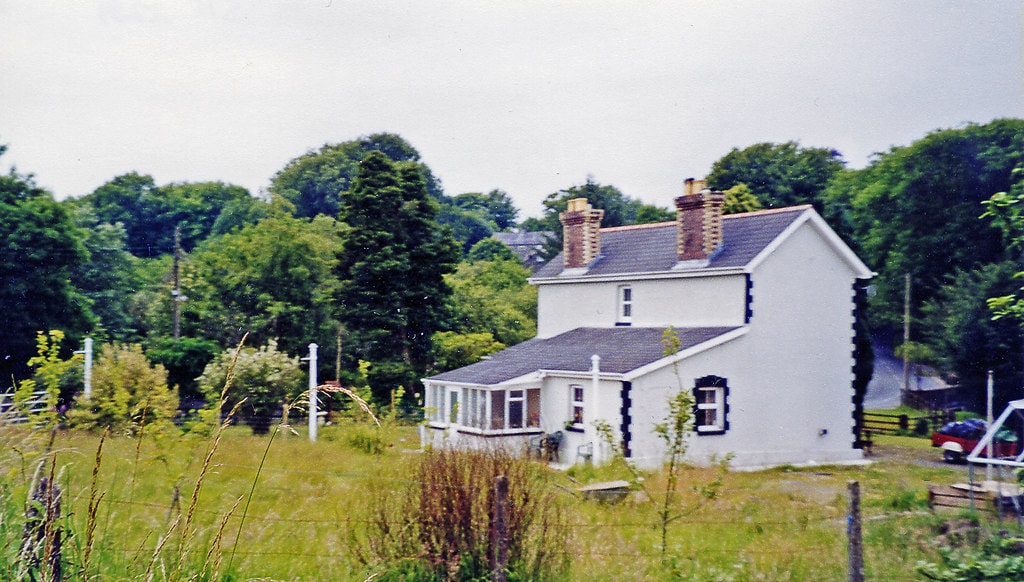
Llanglydwen Railway Station building viewed from the Northwest in 2003, © Ben Brooks bank and included here under a Creative Commons Licence (CC BY-SA 2.0). [15]

Wikipedia tells that “the original station only had a wooden shed as a station building. A new station was built in 1886. This had a two-storey station building, incorporating the station master’s house, the booking office and a waiting room. The down platform had a timber waiting shelter. Behind this platform was the goods yard, which had one siding. Access to this was enabled by the signal box, which also controlled the level crossing and was at the south end of the up platform. There was also a busy coal yard near the station. The station closed to passengers on 10th September 1962 but remained open for goods until 27th May 1963. The coal depot closed on 2nd February 1963.” [17]
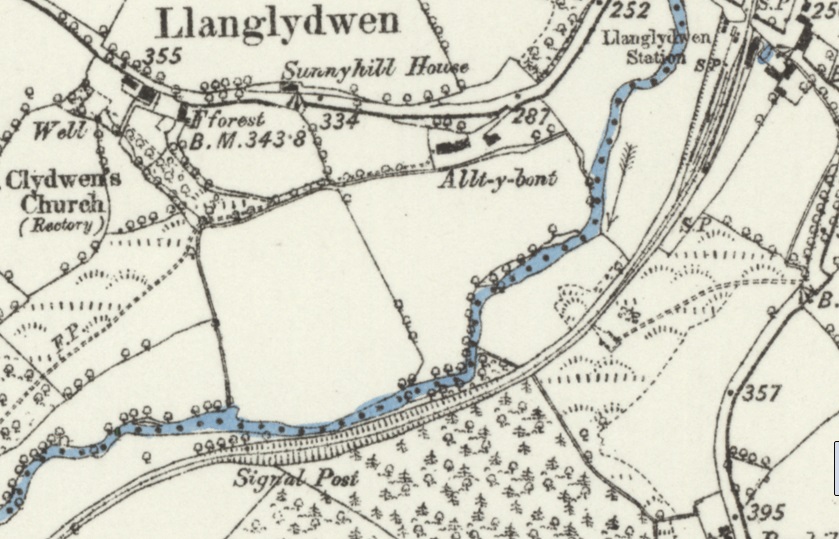
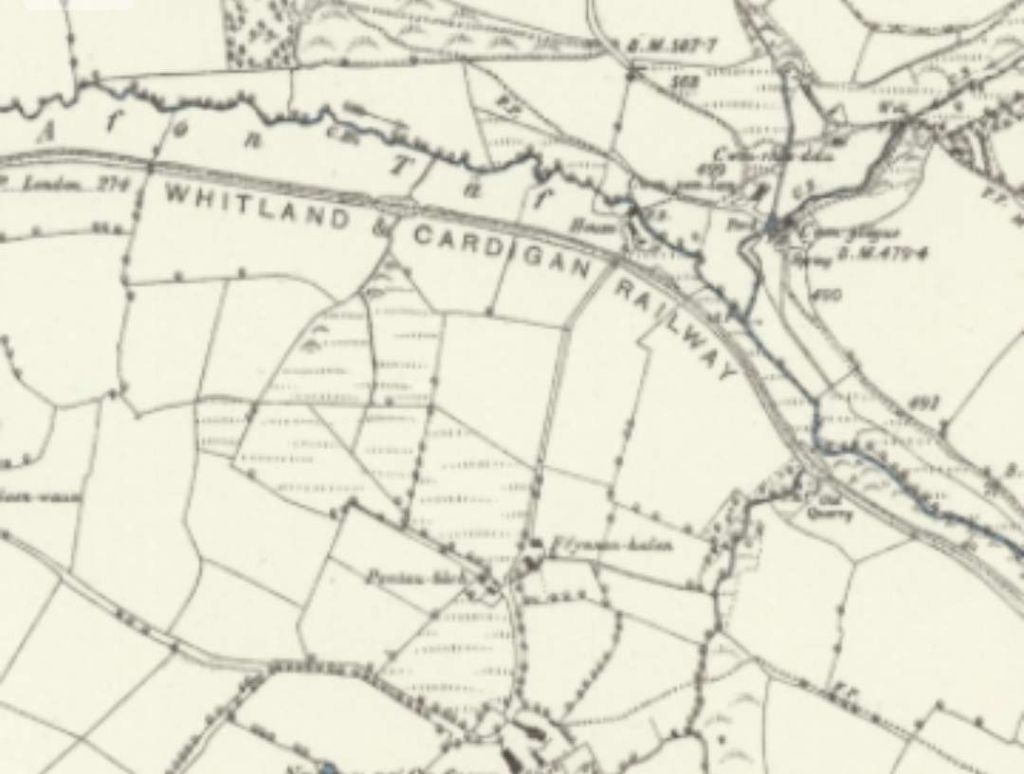
This extract from the 6″ Ordnance Survey of 1887 shows the old railway left Llanglydwen following the Southeast bank of the Afon Taf.  [23]
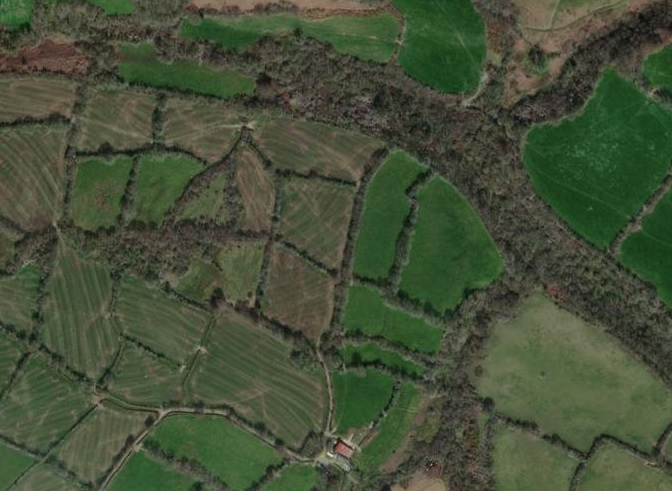
The same area on railmaponline.com. [3]
Continuing on the Southeast bank of the Afon Taf. [24]
And the same length again on railmaponline.com’s satellite imagery. [3]
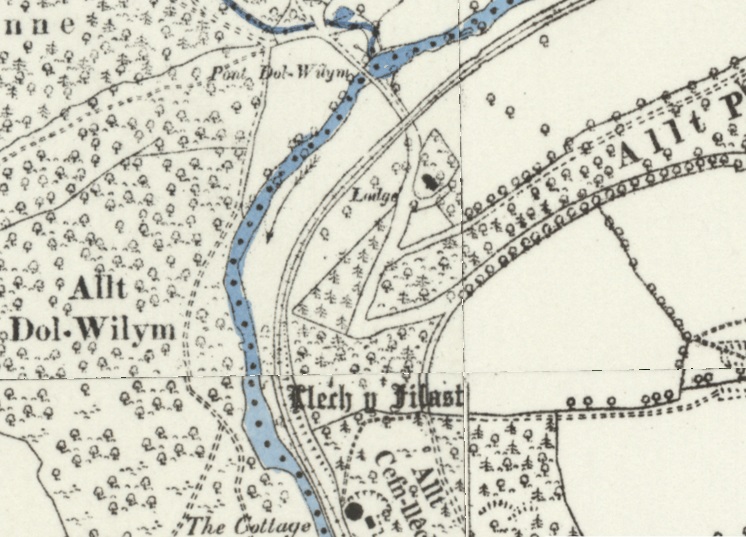
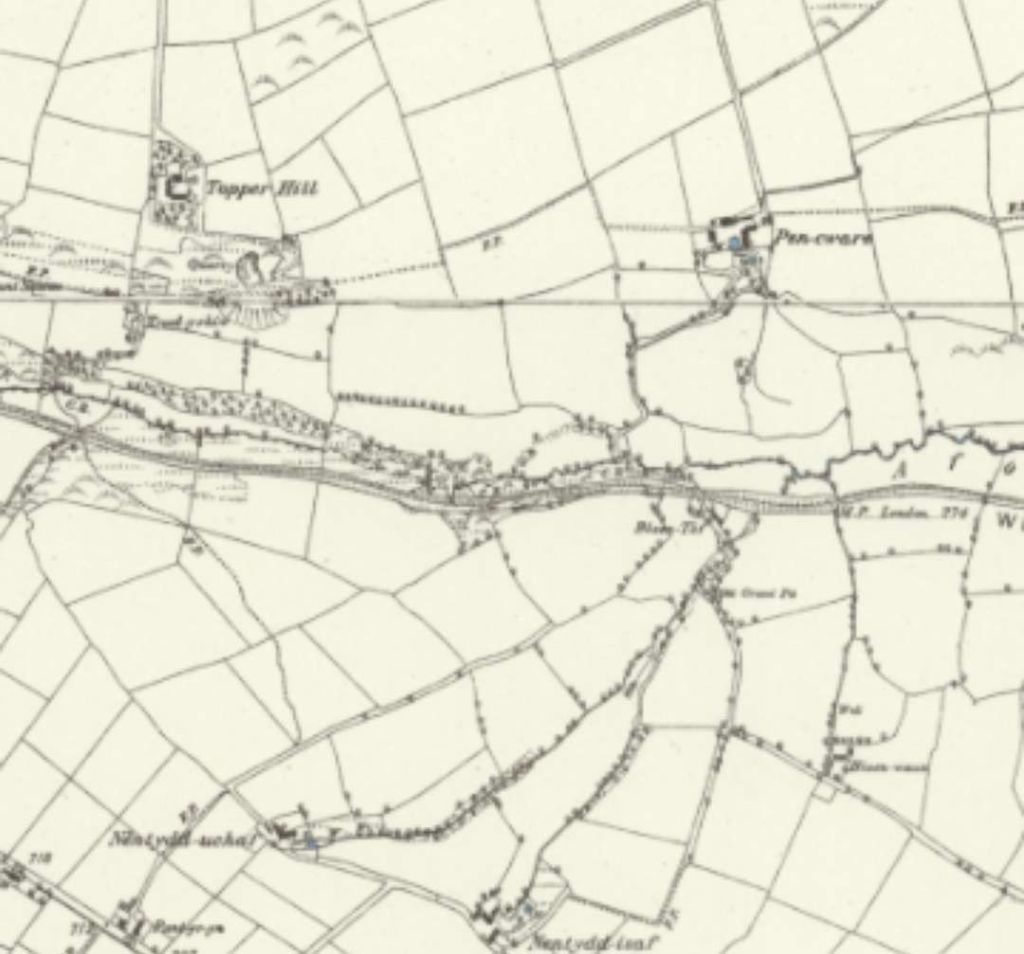
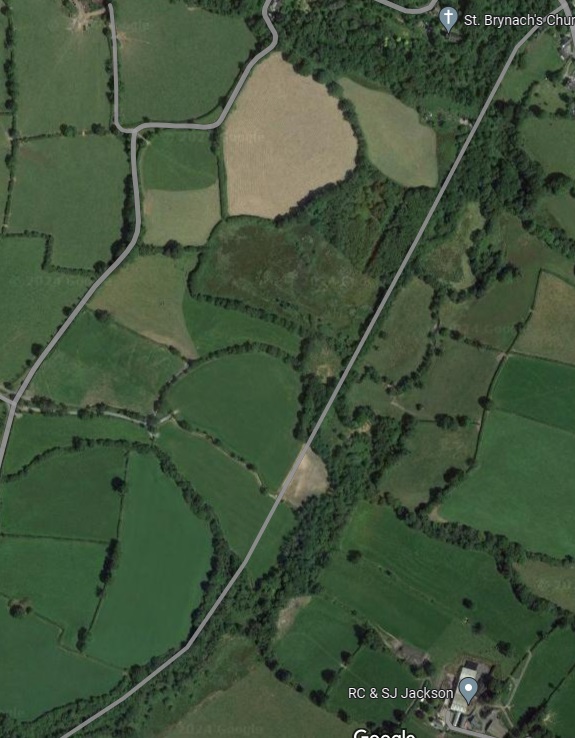
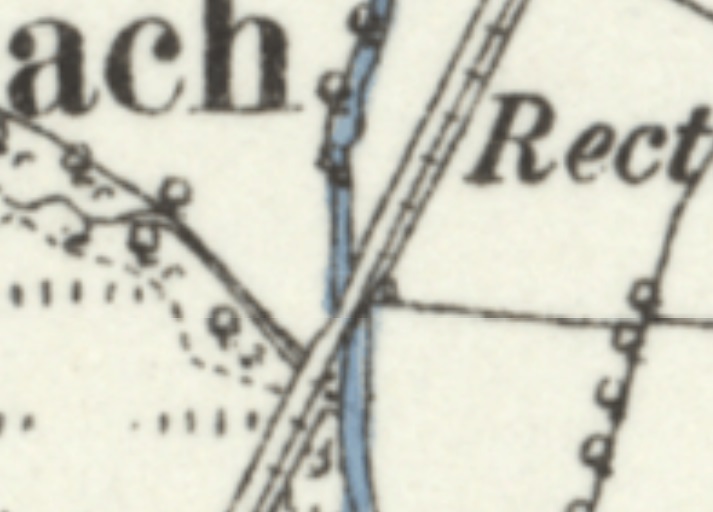
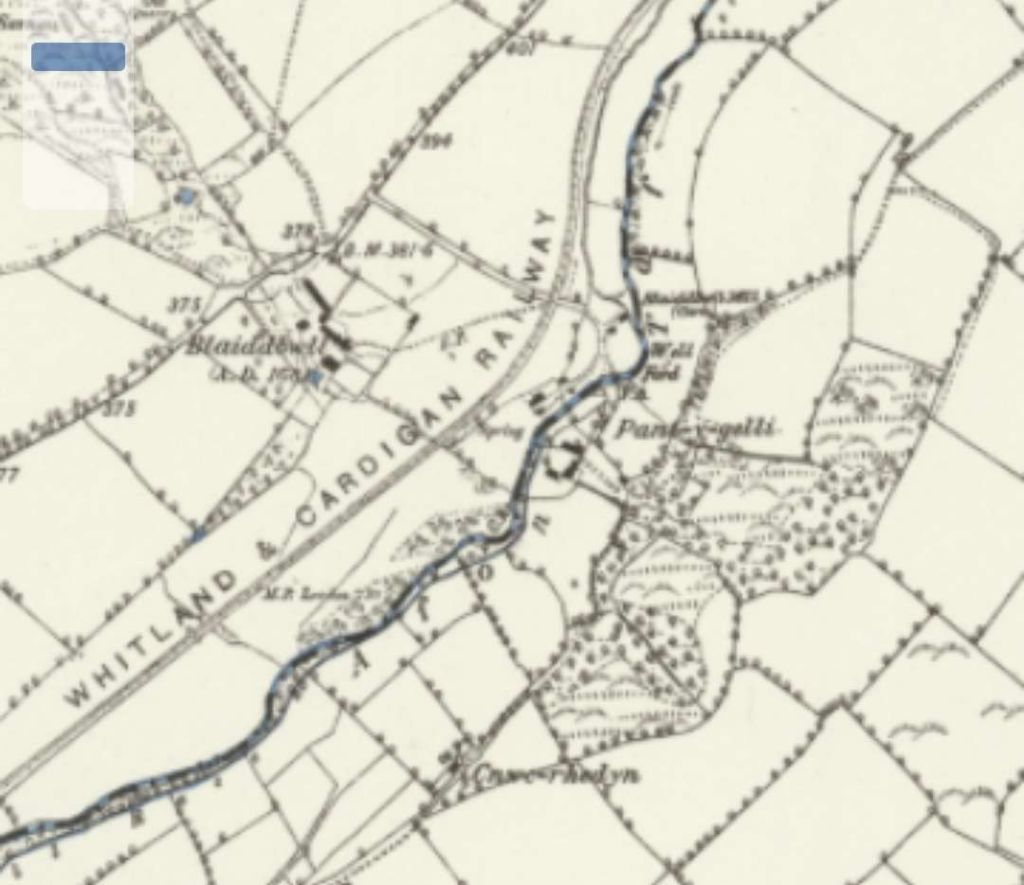
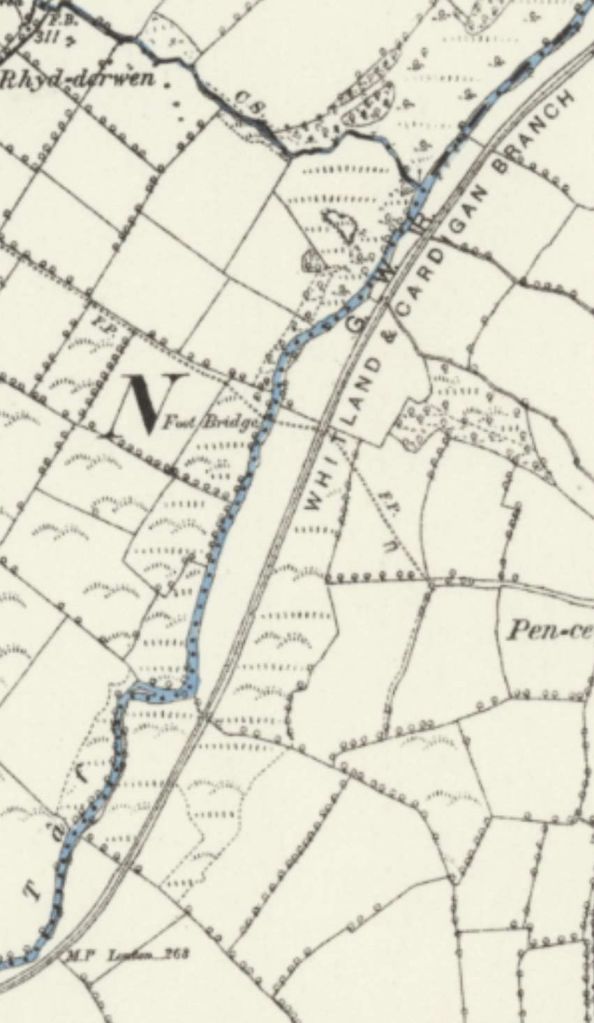
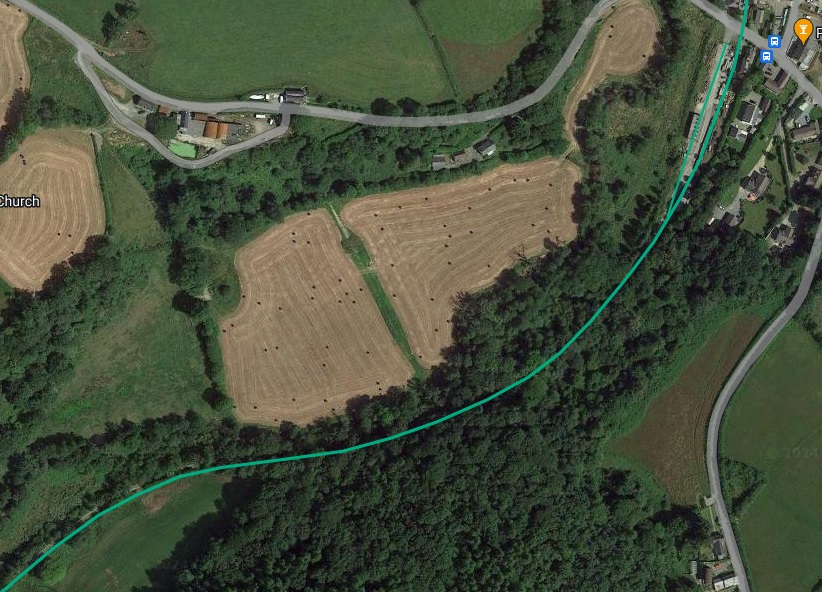
Continuing alongside the Afon Taf, the old railway ran past the Dol-Wilym bridge which appears close to the top of this extract from the 6″ Ordnance Survey of 1887. [25]
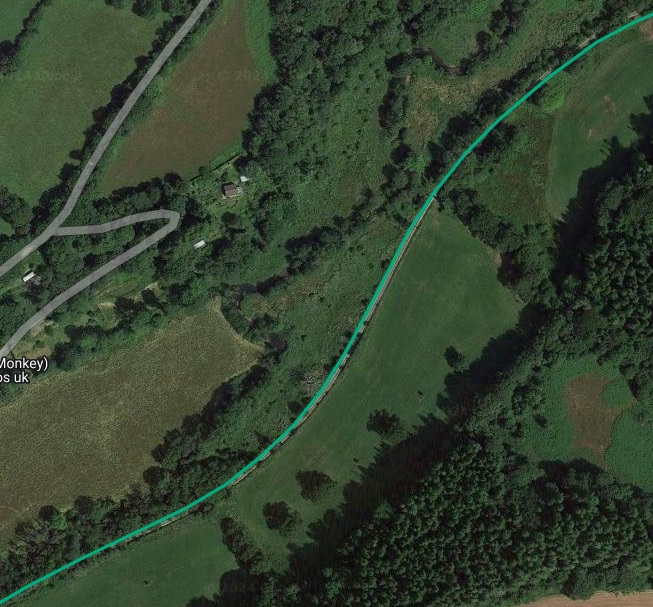
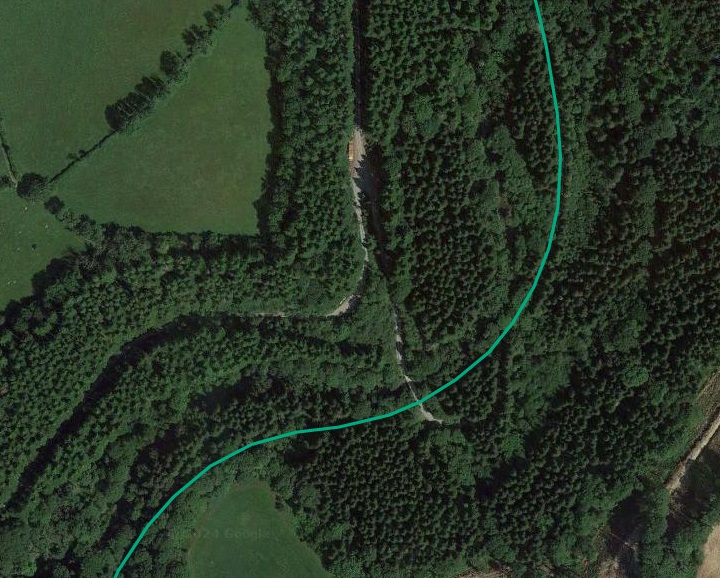
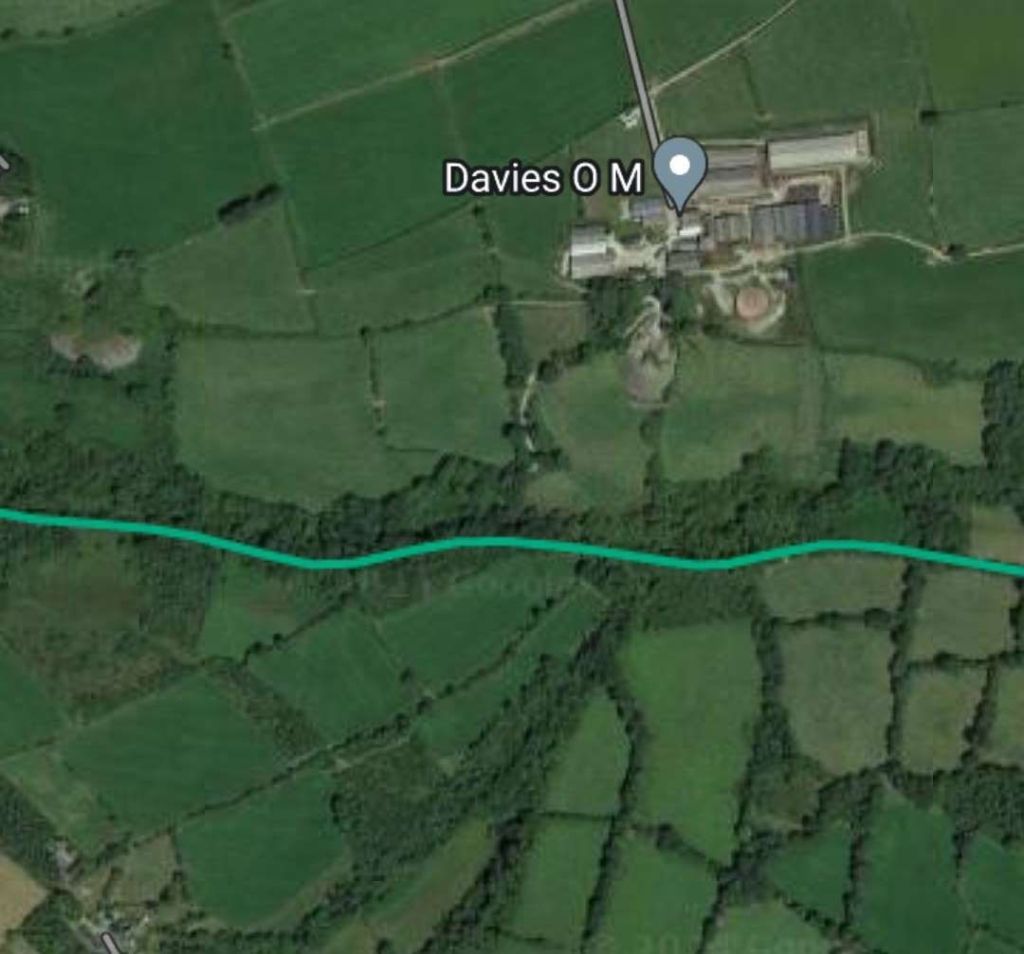
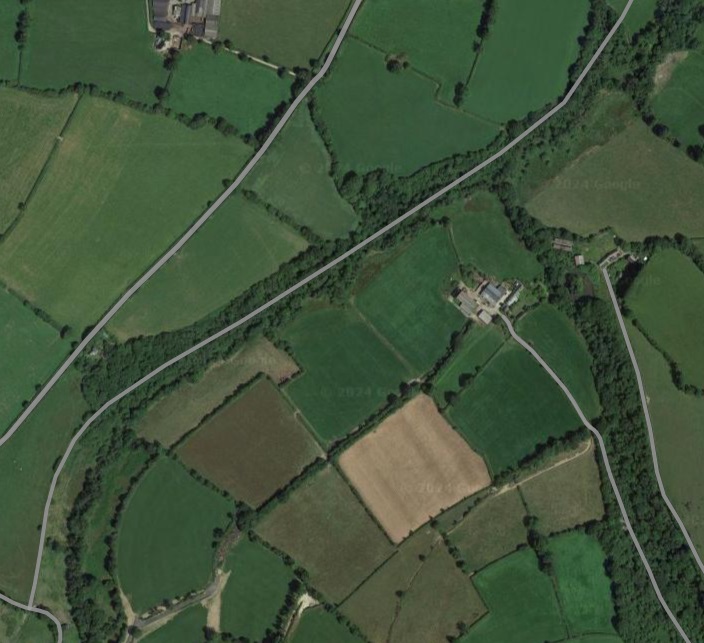
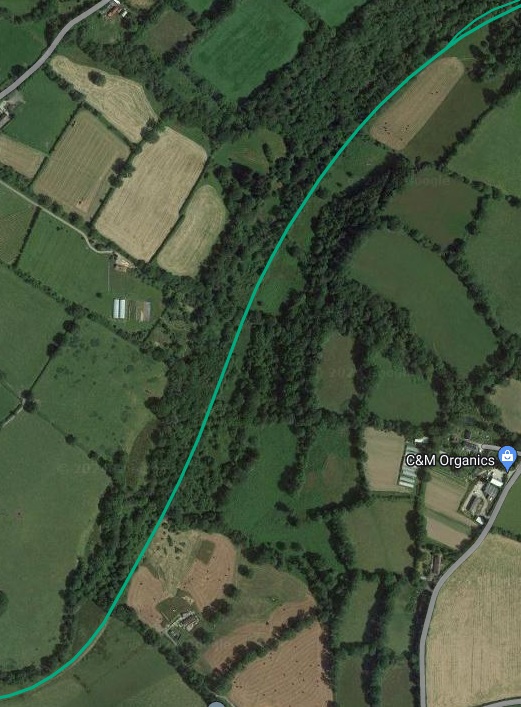
The same area as shown on the railmaponline.com satellite imagery. An area of forest close to the Dol-Wilym Bridge. [3]

The first significant location South of Llanglydwen is the Dol-Wilym bridge over the Afon Taf. This appears at the top of the OS Map extract above and is shown below.
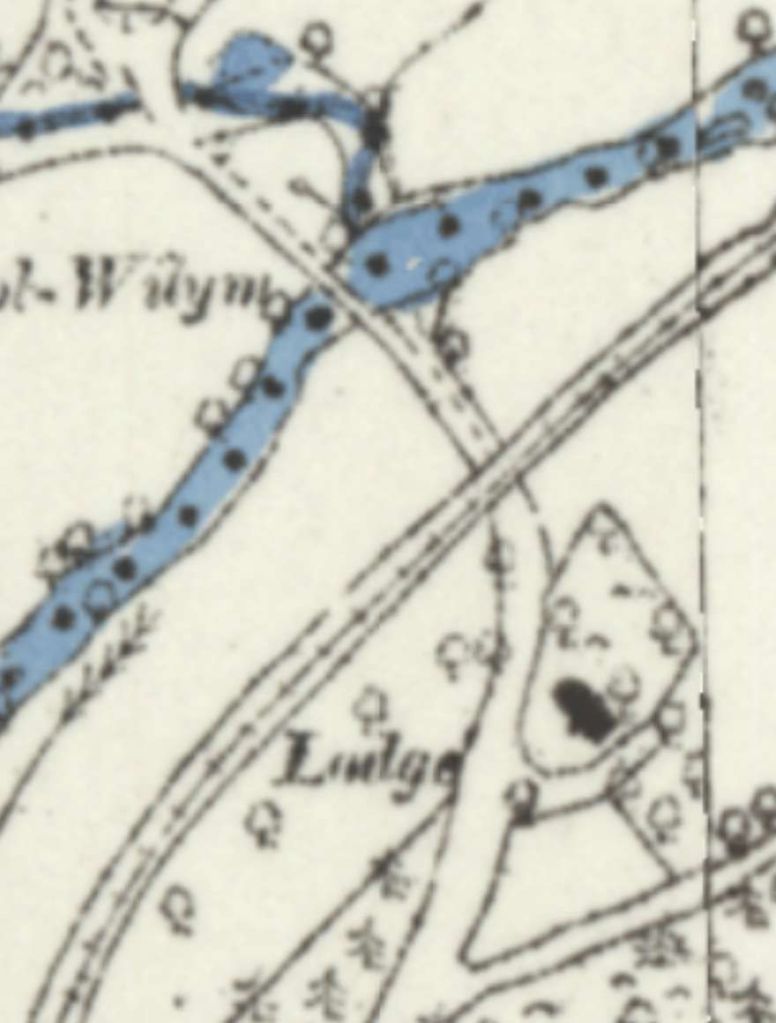
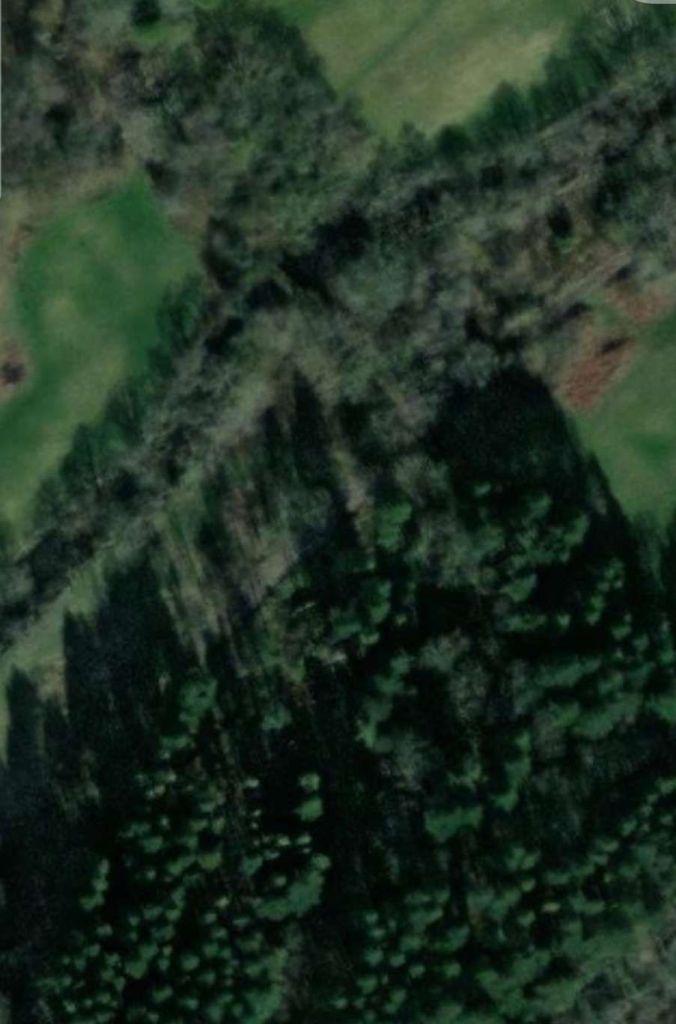
An enlarged extract from the 6″ Ordnance Survey 1st Edition. [20]
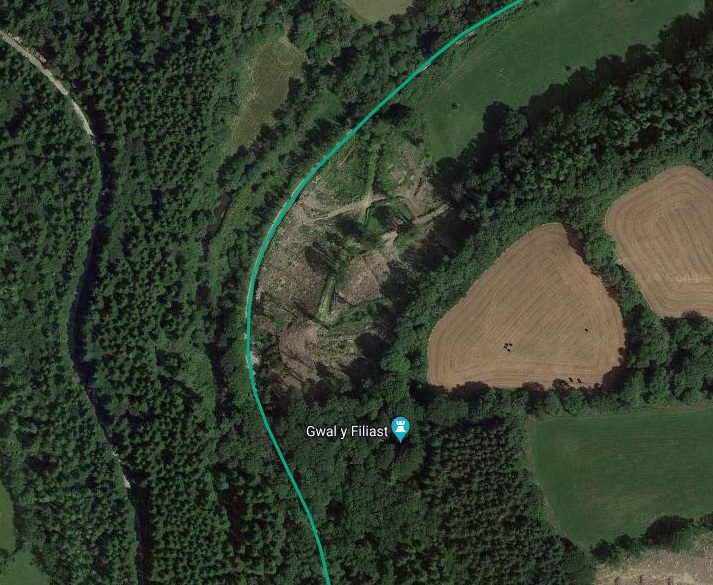
The same area as covered by the extract from the 6″ Ordnance Survey. Little of note can be seen in this satellite image as the area is thickly wooded. [20]
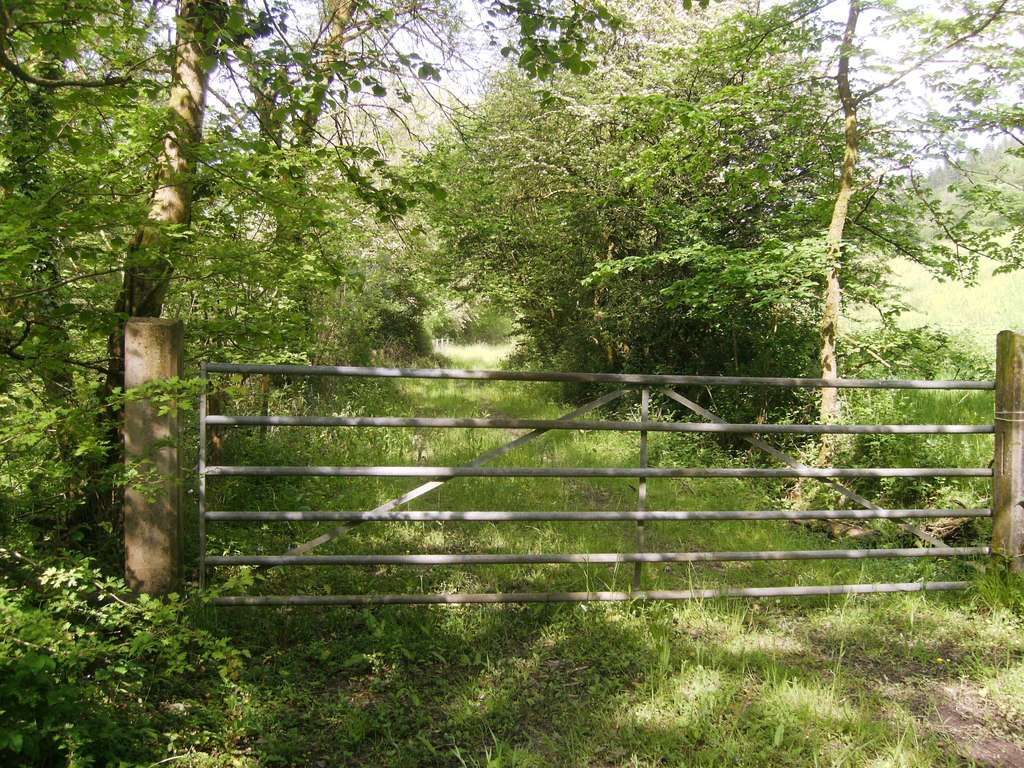
Looking Northeast along the route of the old railway towards Llanglydwen at the location featured in the enlarged OS map extract above. The line followed the Afon Taf closely. Pont Dolwilym is to the left and to the right is the path to Gwal y Filiast an ancient stone-tabled burial chamber, © Chris Whitehouse and licensed for reuse under a Creative Commons Licence (CC BY-SA 2.0). [21]
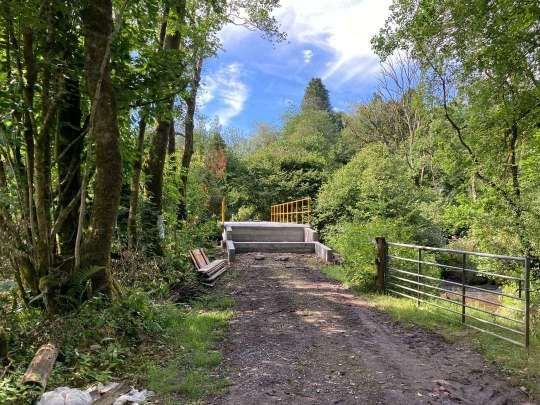
Pont Dolwilym in February 2010 prior to its rebuilding, It appears to have been reinforced with sleepers probably taken from the disused railway line close by. The bridge was rebuilt in 2024, © Natasha Ceridwen de Chroustchoff and licensed for reuse under a Creative Commons Licence (CC BY-SA 2.0) [22]
The nearly complete new Dolwilym Bridge. The bridge will allow vehicles to cross the river as the old bridge did. Work still remains to lift the road to bridge deck level. This image was shared by Julie Sweet on the Re-open the Footpath from Llanglydwen to Login along the Cardi Bach Railway Facebook Group on the 28th July 2024, © Julie Sweet. [20]

Connop Price says that between Llanglydwen and Login “the gradients continued to change often as the track followed the lie of the land; the steepest grade on this section was 1 in 40. About half a mile north of Login was the tightest curve on the railway: it was short but built to a mere 8 chains radius.” [4: p68]
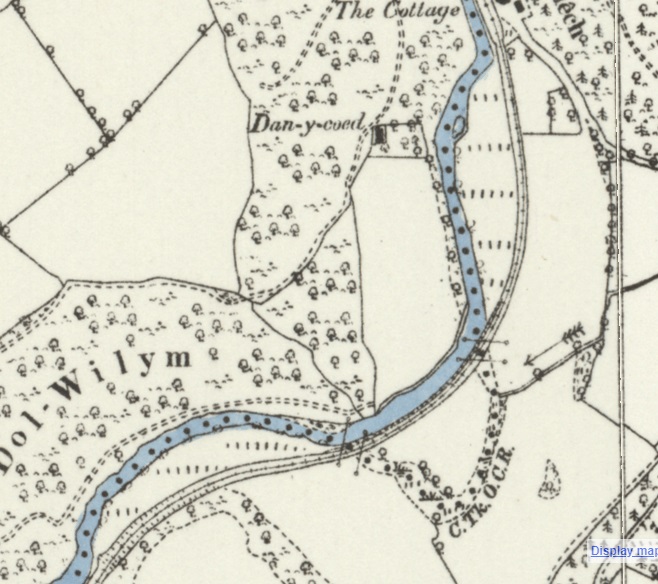
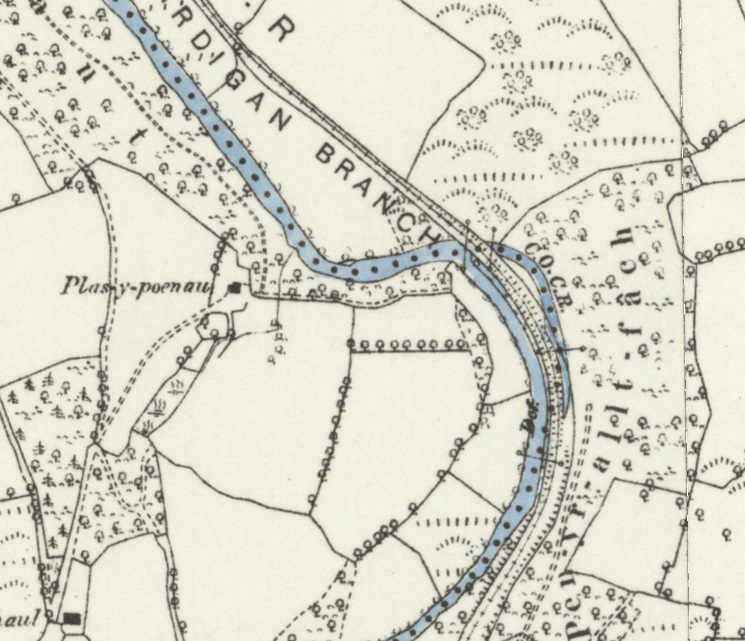
Further to the South the old railway curves around to the West before beginning to switch back to the South. The 6″ Ordnance Survey of 1887. The Dol-Wilym woods sit on the far side of the Taf. [26]
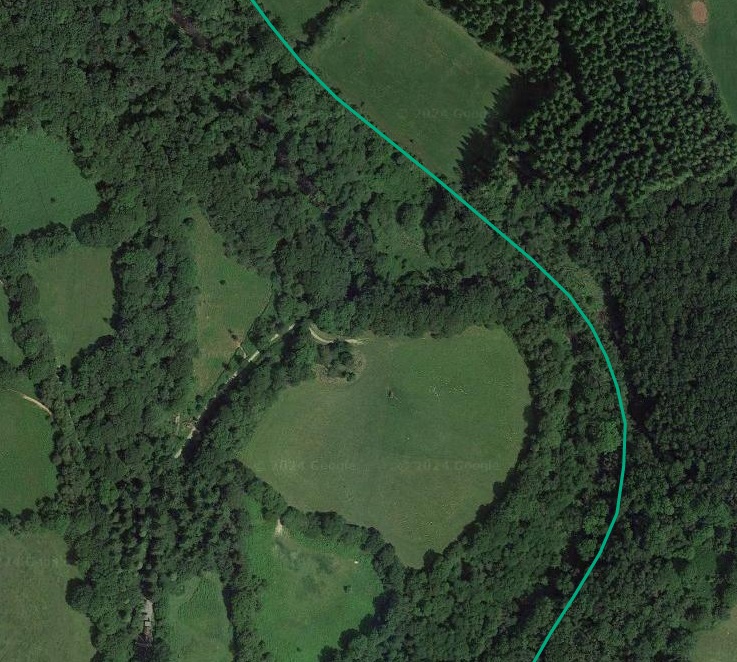
Heavily camouflaged by the forest this railmaponlone.com extract does the same area. [3]
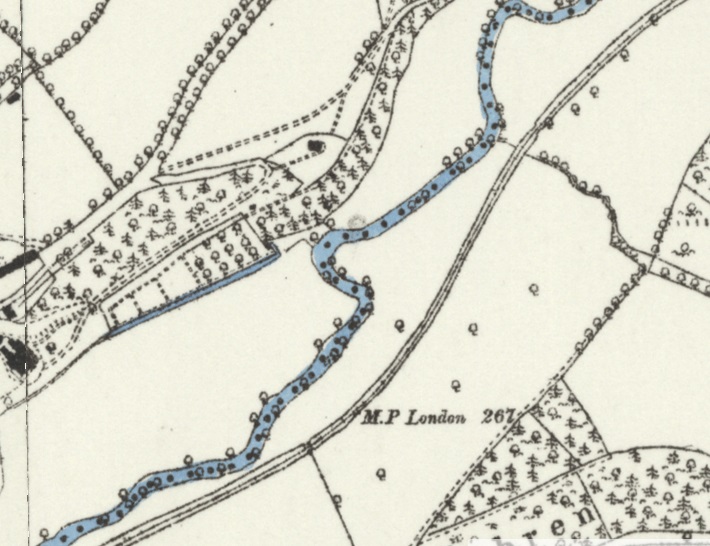
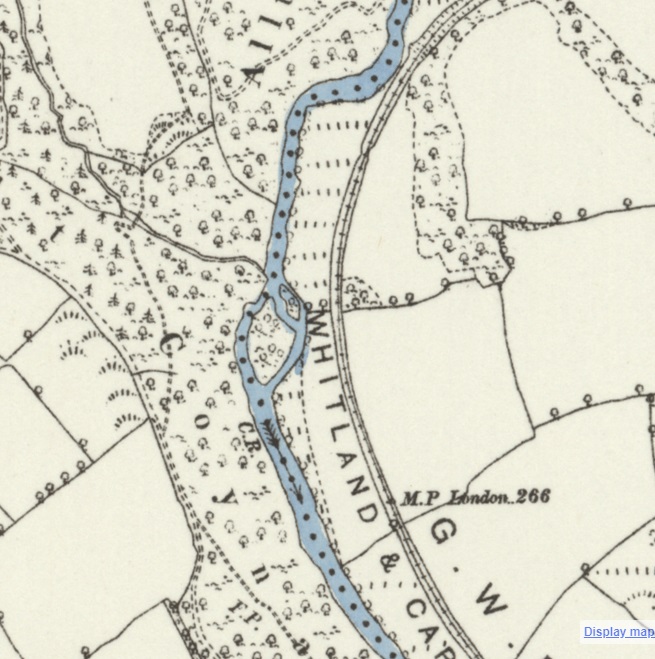
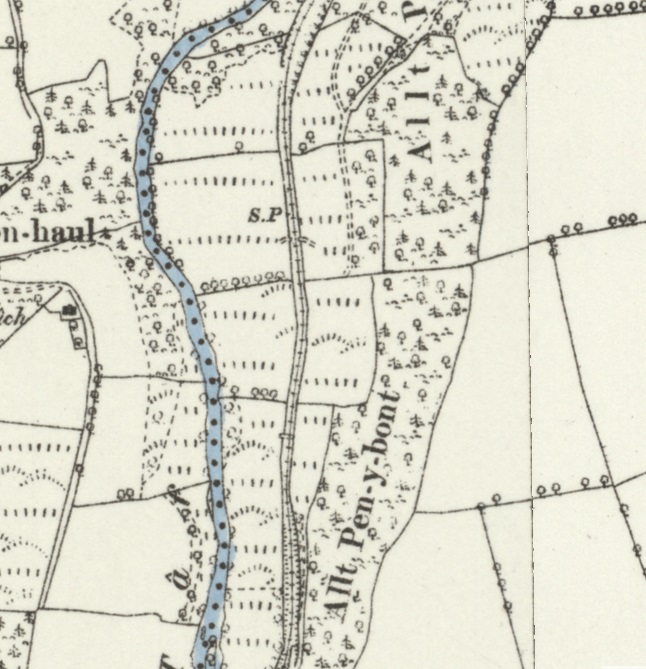
Further South still and the OS map shows the mileage from London – 266 miles. [27]
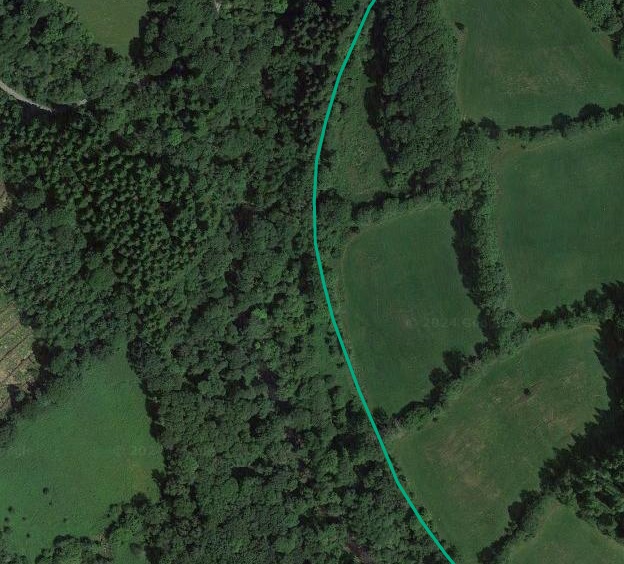
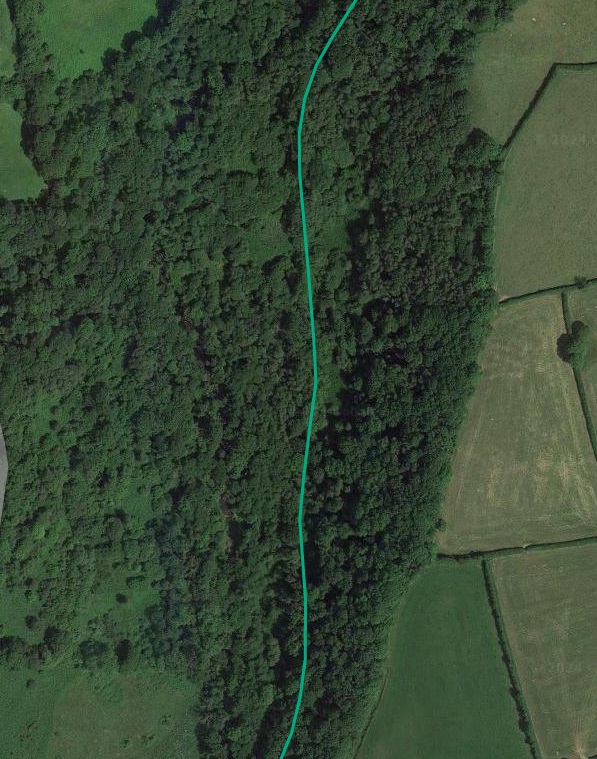
The same area as shown on the railmaponline.com. Rather than being in the middle of the woodland, it now proves the eastern border of the area of trees. [3]
Still on the East side of the Afon Taf,  the old railway continues to head for Login. [28]
Again, the same length of line as shown on railmaponlone.com’s satellite imagery. [3]
Now on the run down to Login Railway Station the old railway heads due South. [29]
The same length of line on the railmaponline.com satellite imagery. [3]
Login Railway Station appears at the bottom of this next extract from the 1887 6″ Ordnance Survey. [30]
The open area at the bottom of this extract from the railmaponline.com satellite imagery is the station site. [3]
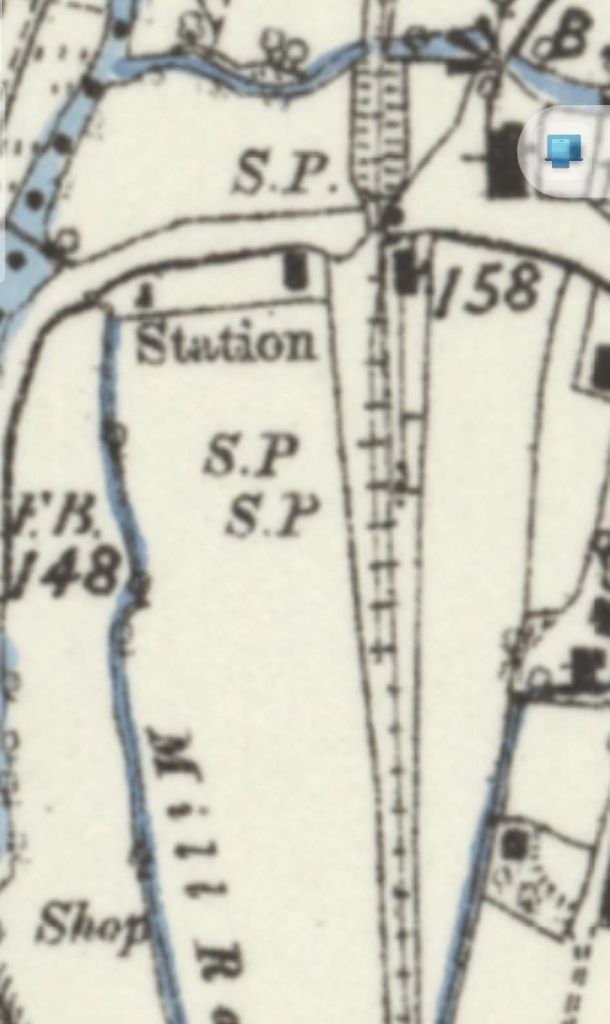
Login Railway Station as it appeared on the First Edition of the 6″ Ordnance Survey. [19]
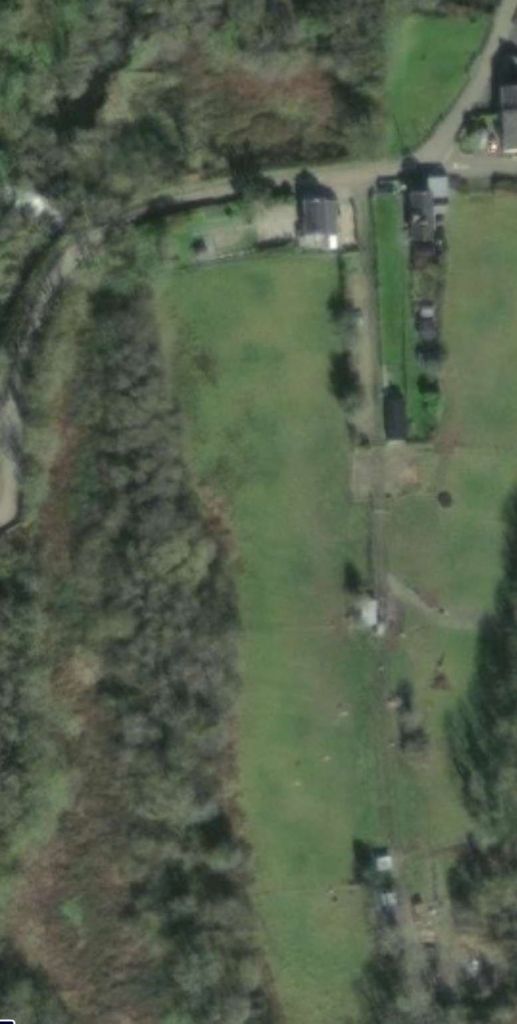
The same area on the ESRI satellite imagery from the NLS. [19]

At Login, “a short platform was dignified by the large station building serving the tiny hamlet perched on the hillside just across the river. The goods loop was protected by a ground frame at each end, that at the south end being just a single lever unlocked by the Cardigan Junction – Llanglydwen electric tablet. The ground frame at the north end, however, also controlled the level crossing, and it was housed in a wooden hut of typical Great Western design.” [4: p68]
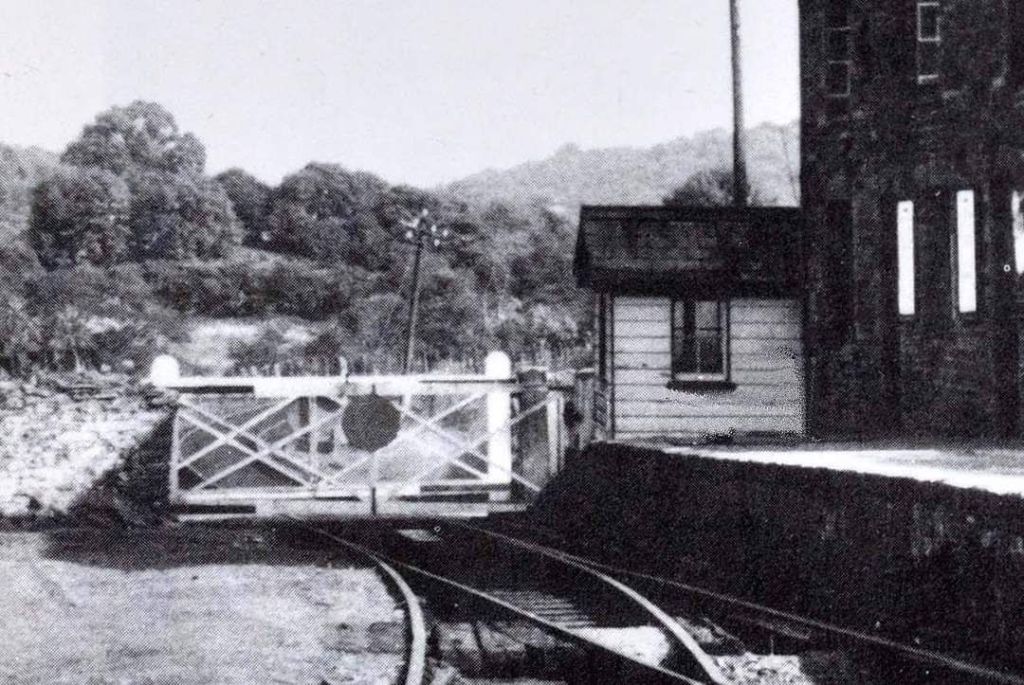
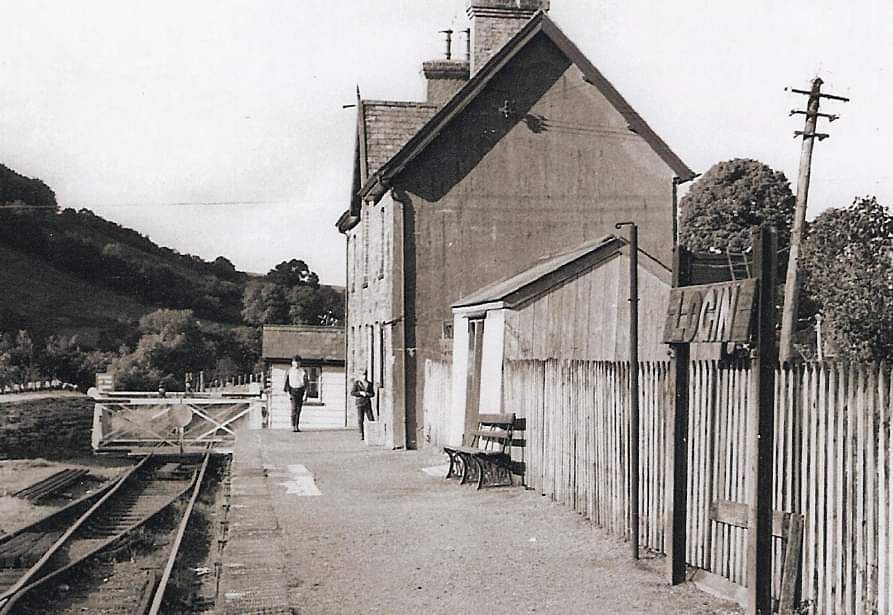
The view North from the Login Railway Station site, looking across the road towards Llanglydwen. [32]
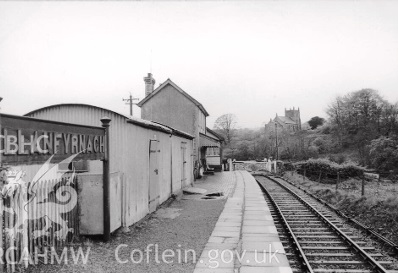
Looking North along the platform at Login Railway Station. This image was shared on the Login Railway Station Facebook Page on 20th March 2023. [34]
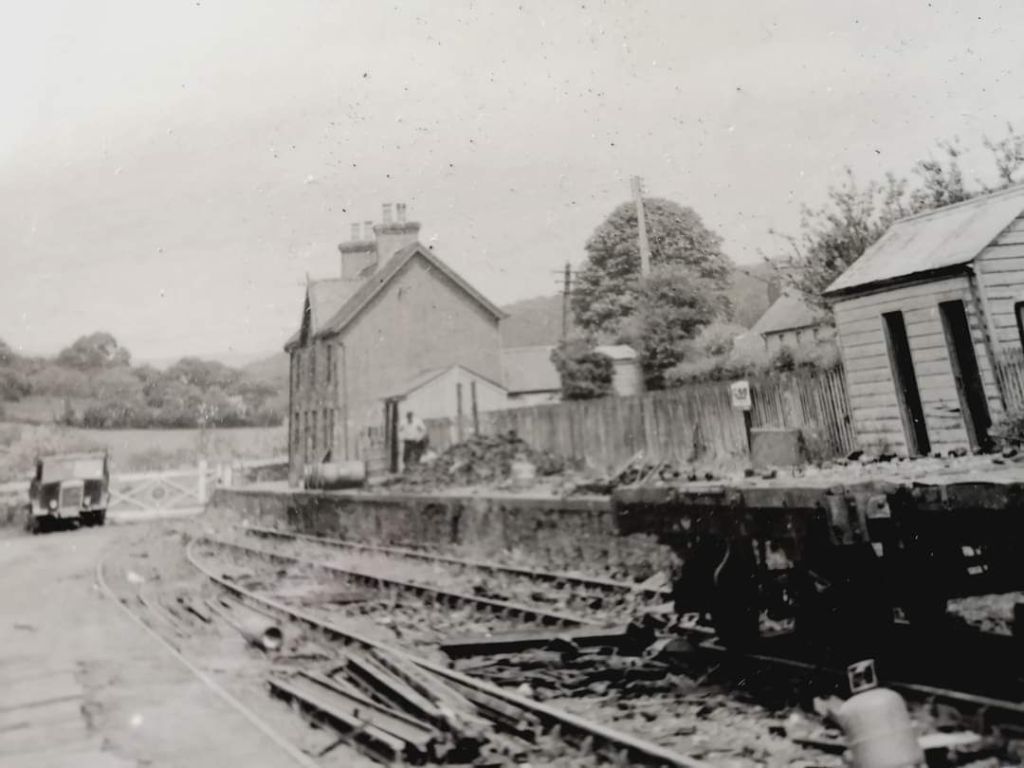
Looking North through Login Railway Station after closure of the line and during lifting of the track. This image was shared on the Railways of Wales Facebook Group by John F. Wake on 21st May 2022, © Unknown. [36]
View south towards Llanfalteg and Whitland from the former level crossing on 3rd September 2022. The single-platform station was well preserved when this image was taken, © Nigel Thompson and licensed for reuse under a Creative Commons Licence, (CC BY-SA 2.0). [35]

South of Login the valley of the Taf begins to widen out and the hillsides become less steep. However, gradients continued to change. On the East of the Taf, the railway ran through Penclippen level crossing and past its wooden crossing keeper’s hut. 

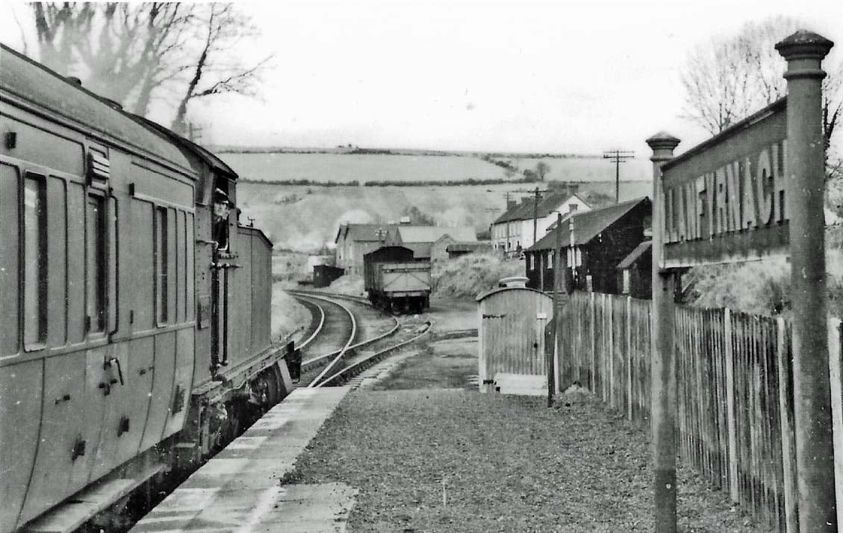
The Whitland & Cardigan Railway continued South to Llanfalteg (3 miles 48 chains from Whitland). “In the early years of the line … this place had some importance. Until the reconstruction of the mid-1880s the layout consisted of a loop, with a siding parallel to it to serve the goods shed, and a further siding for the locomotive shed and for coal traffic. In its heyday, the locomotive shed had a forge for day-to-day repairs, but it was not big enough to be able to undertake major overhauls. After the Great Western took over the W&CR the shed at Whitland assumed most of the responsibilities of Llanfallteg shed, and gradually the latter fell into disuse. For a while it was occupied by Mr J. Williams’ carpenter’s shop, but this ceased and decay set in until eventually the shed fell down in about 1939.” [4: p68]
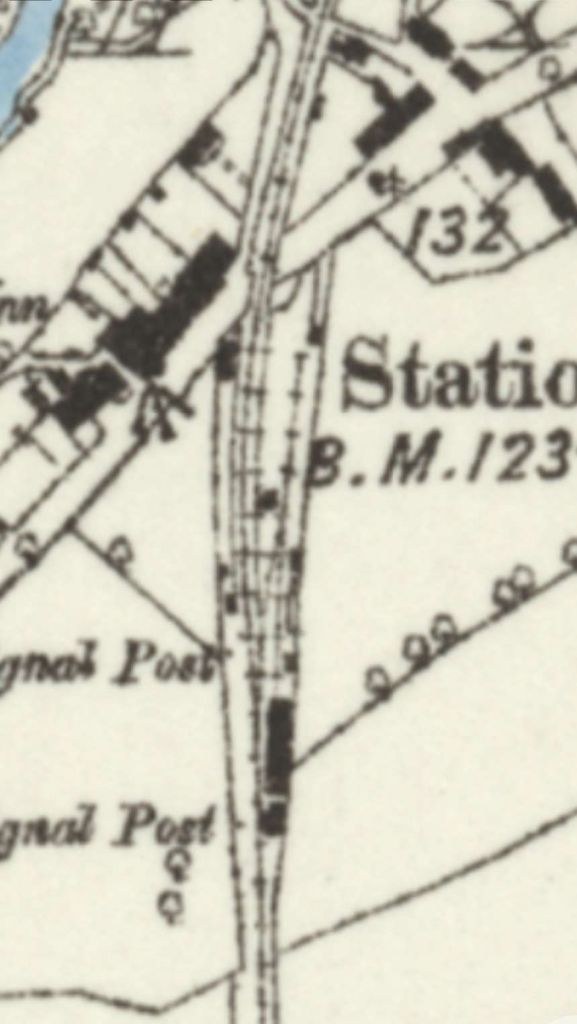
Llanfallteg Railway Station as it appeared on the First Edition of the 6″ Ordnance Survey. [37]
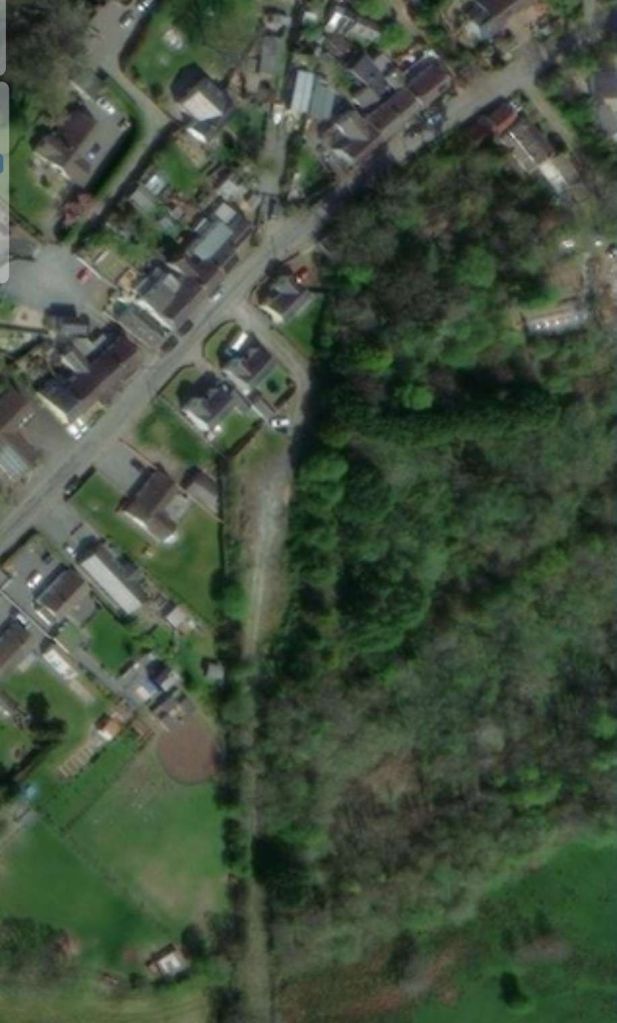
The same location on the ESRI satellite imagery provided by the National Library of Scotland (NLS). [37]

At closure in 1962, the station building and the wooden ground frame box were intact, and a dilapidated iron goods shed still stood by the level crossing. The layout, however, was reduced: the loop had been replaced by a siding, and although the siding to the goods shed remained the rest of the trackwork had long gone. A length of rusting cable in the undergrowth provided the only evidence of the practice at Llanfallteg of cable-shunting. The site was cramped and inconvenient, and for many years the most effective way of moving wagons in and out of the sidings was by a cable linking them to a locomotive on a parallel track.”

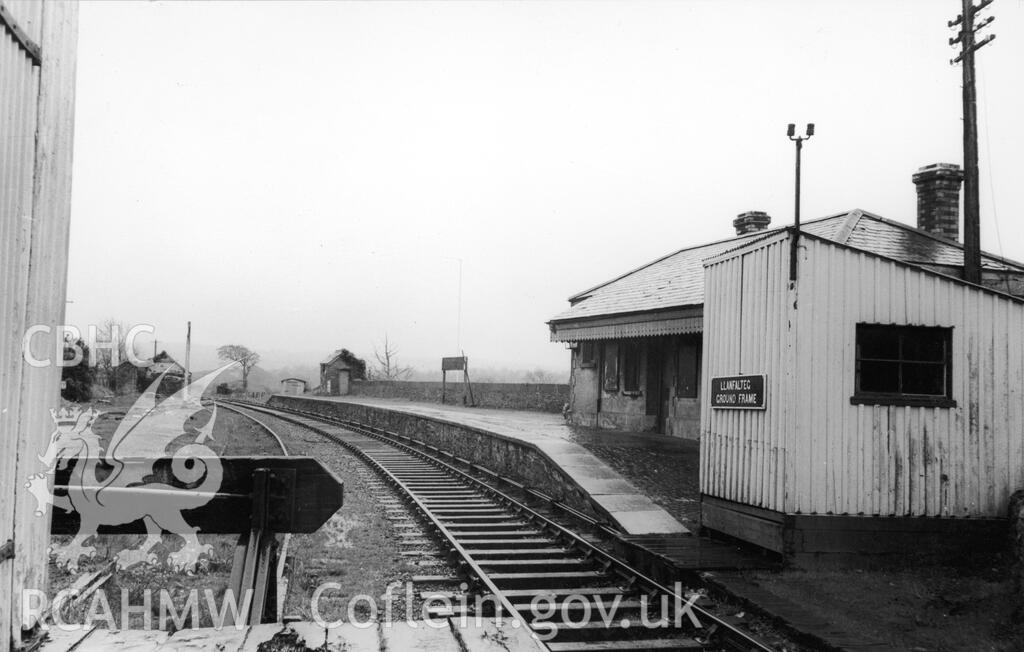
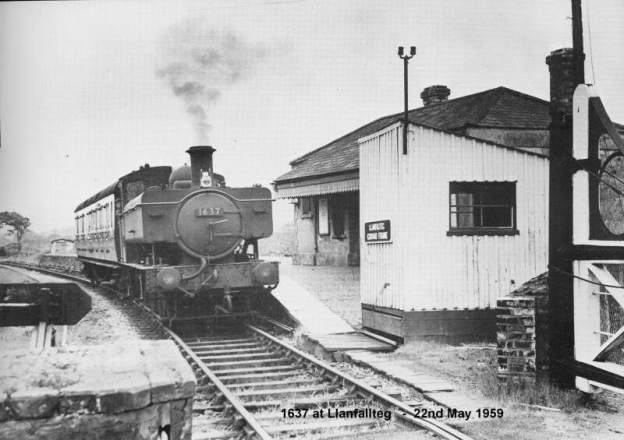
0-6-0PT at Lanfallteg Railway Station in May 1959, (c) Unknown. [38]
A similar view of Llanfallteg Railway Station in 1961, from the Rokeby Album IV ref 5a. [47]
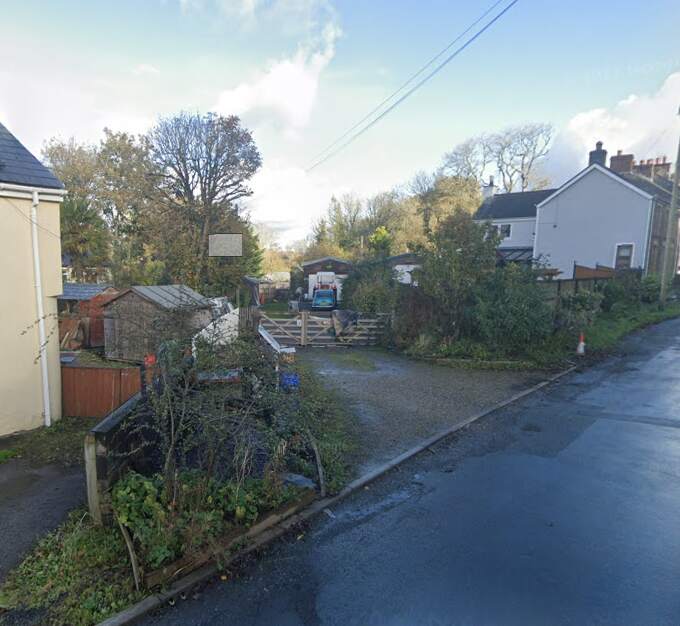
Looking North from the location of the level-crossing in Llanfallteg. {Google Streetview, November 2021]
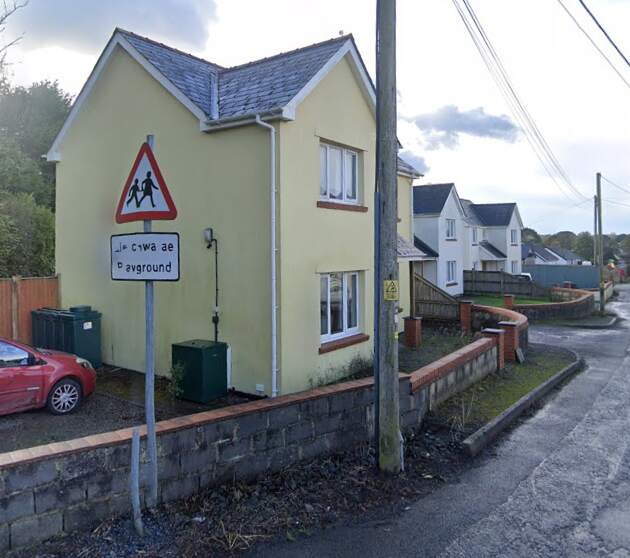
Looking South from the location of the level-crossing. Residential properties have been built over the line of the old railway and the station site. [Google Streetview, November 2021]

South of Llanfallteg a run of just over a mile brought the single track line to its junction with the main line known latterly as Cardigan Junction. There were no significant features on this length of the line. It remained on the Northeast bank of the Afon Taf.
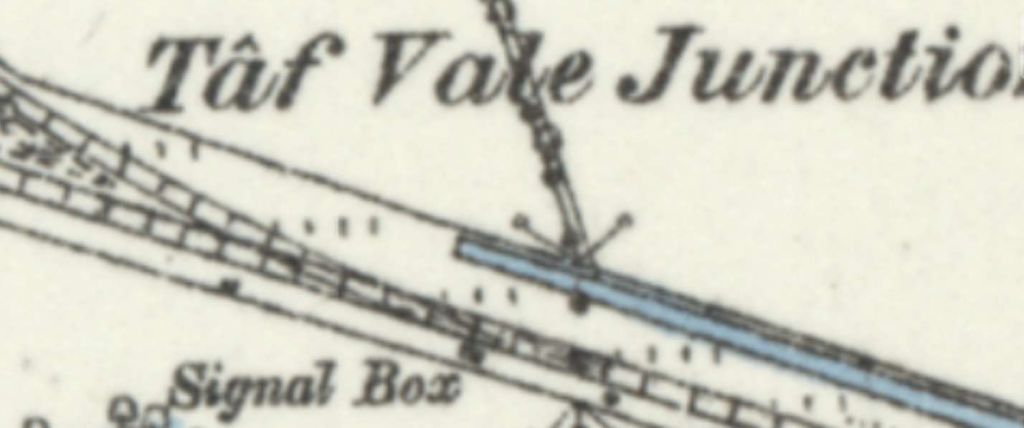
Taf Vale Junction as shown on the 6″ Ordnance Survey. The name of this junction was changed to ‘Cardigan Junction’ later in the life of the old branch line. [39]
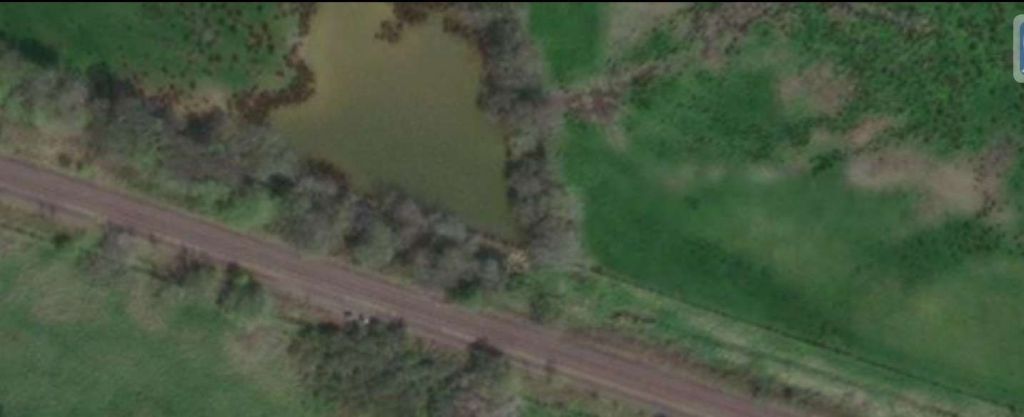
The same location on the NLS ESRI satellite imagery. [39]

At Cardigan Junction the signal box, opening in 1873 and closed in 1964, was whitewashed, pebble-dashed and austerely domestic in appearance, being built entirely in stone or brick. The window overlooking the tracks was a modest rectangle with two uprights in the window frame. The name-board ‘Cardigan Junction’ was located directly under it. The door was on the east side of the box, with another window, and the pitched roof was surmounted by a single chimney. A gaslight was situated outside.” [4: p68]
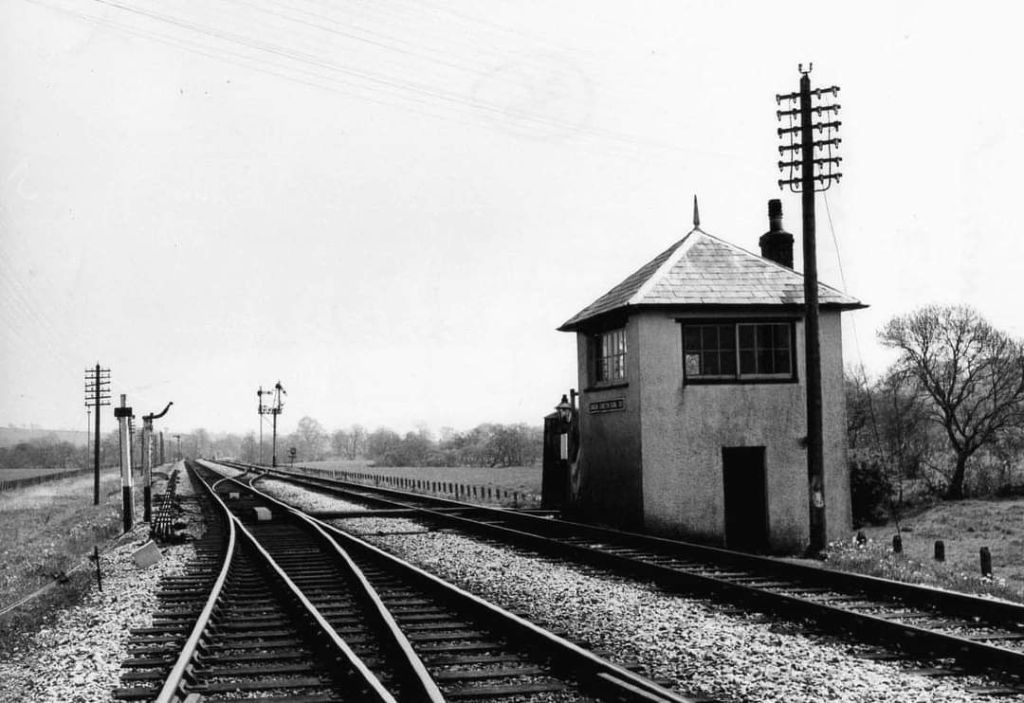
Cardigan Junction (formerly Taf Vale Junction) where the Cardigan Branch left the main line.
This photograph was taken on Saturday 25th May 1963, significant because the goods only rail service on the branch was withdrawn on the following Monday (27th May 1963). This picture was shared on the Login Railway Station Facebook Page on 20th June 2024. It looks Southeast. [8]

The last 2 miles 21 chains of the route was along the main line from Cardigan Junction (originally Taf Vale Junction) to Whitland.
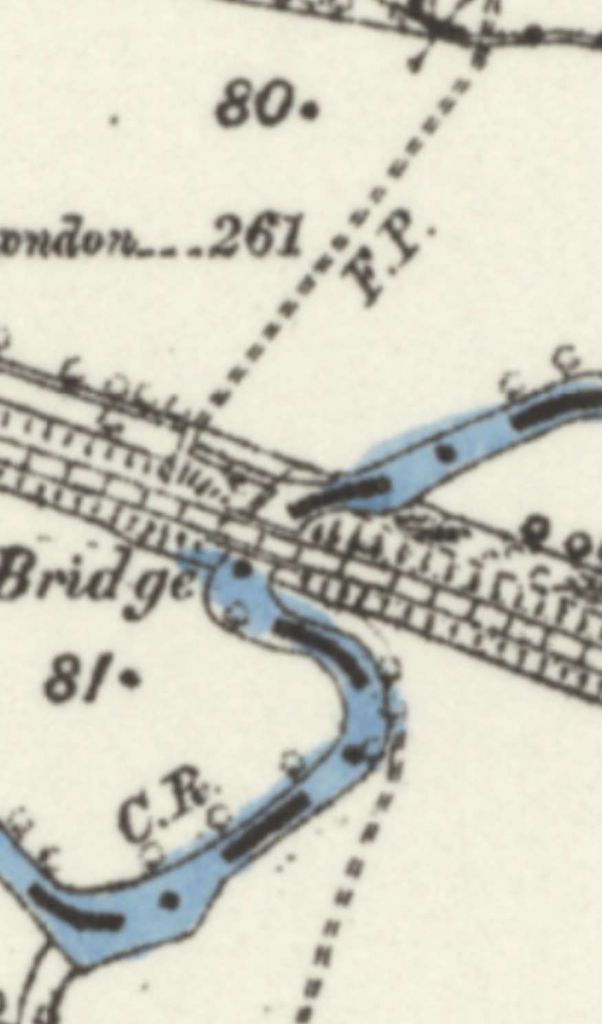
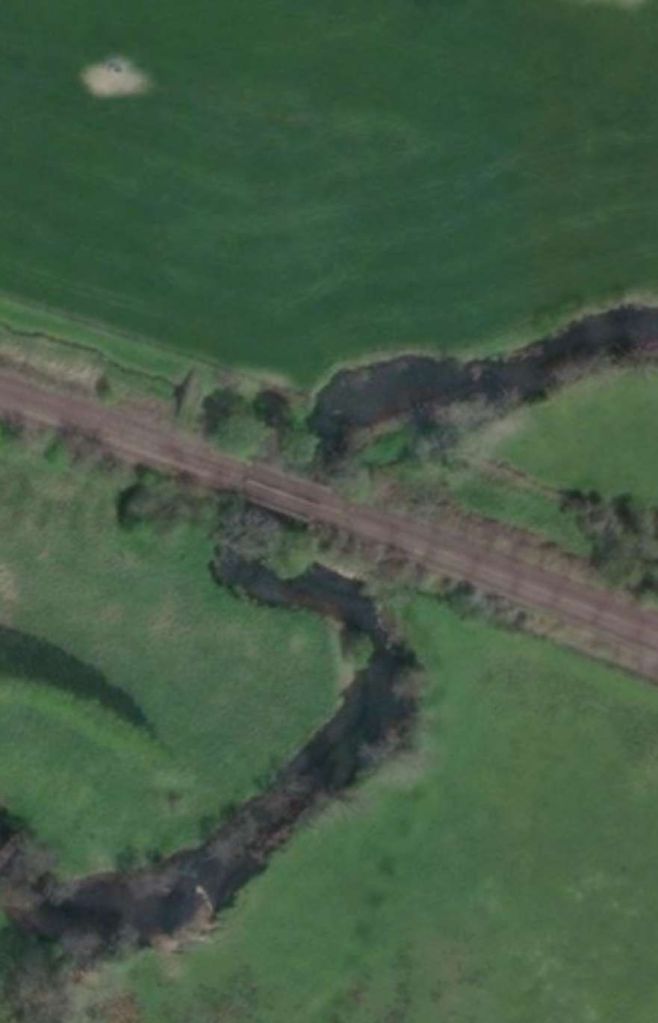
Close to Taf Vale Junction (Cardigan Junction) the main line crossed rivers twice. This is the location of the first of the bridges (Sarn-las Bridge) which crossed the Afon Daulan, a tributary of the Afon Taf. [40]
The same location on the ESRI satellite imagery. [40]
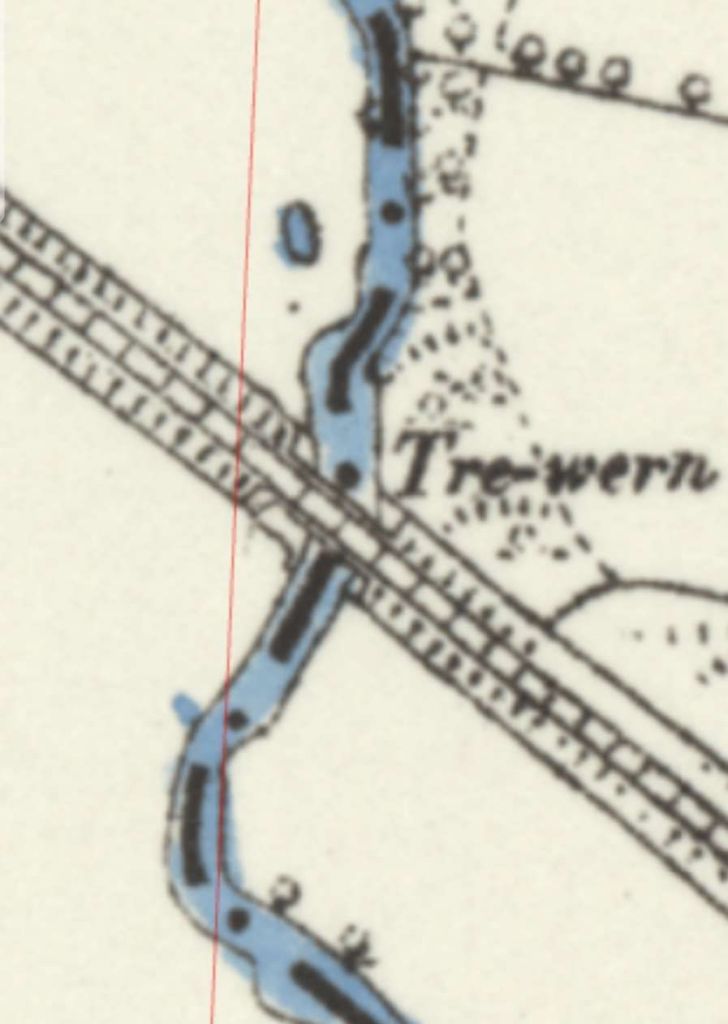
The second bridge crossed the Afon Taf (Tre-wern Bridge). [41]
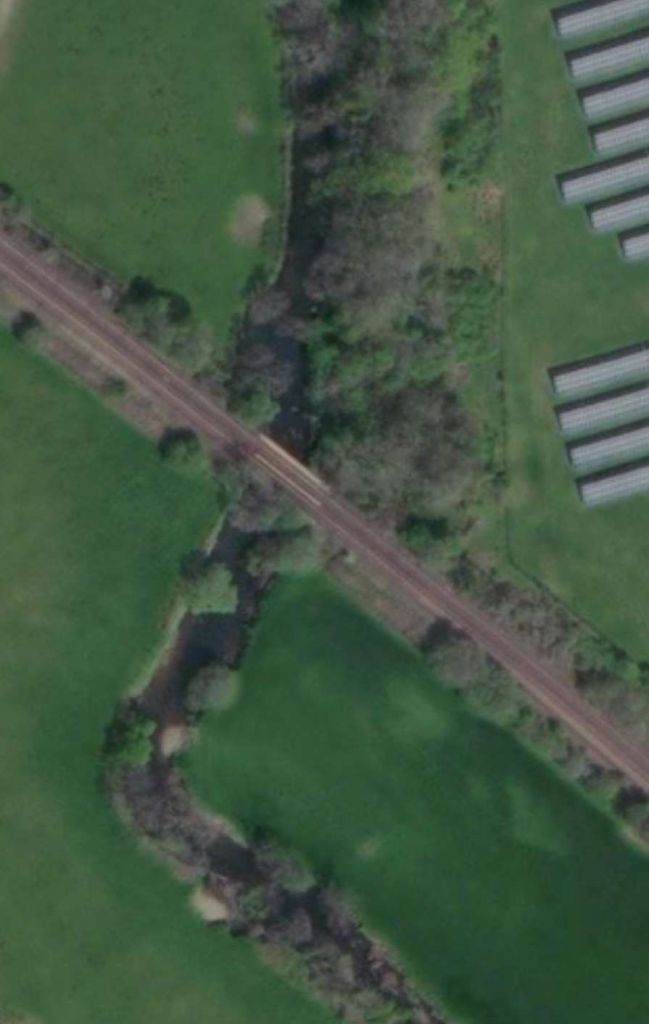
The same location in the 21st century. [41]
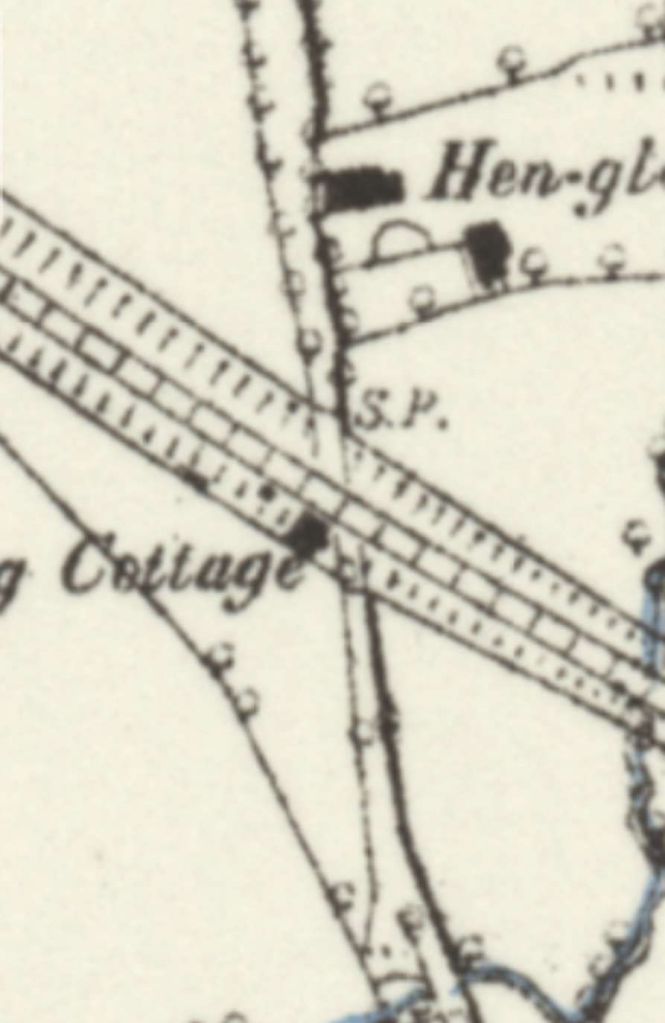
The line then crossed what was a minor road. [42]
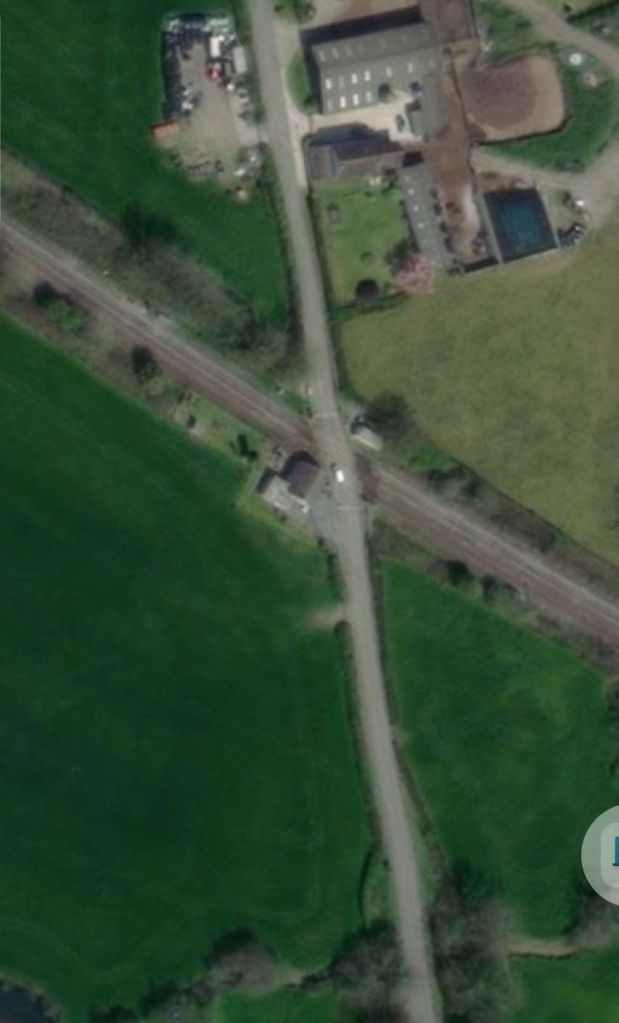
The crossing and it’s keeper’s cottage remain in the 2st century. [42]
The crossing seen from the South in the 21st century. [Google Streetview, November 2021]
What is now the A40 then bridged the mainline. [43]
The same location on the NLS ESRI satellite imagery. [43]
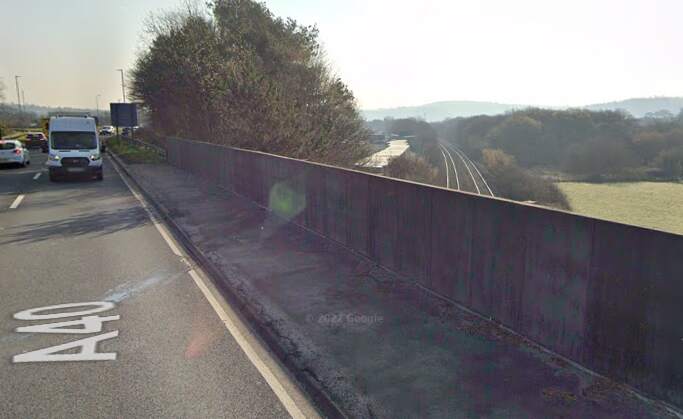
Looking East from the A40 roadbridge towards Whitland Railway Station. [Google Streetview, March 2022]

There were no further significant features on the line before it entered Whitland Station.
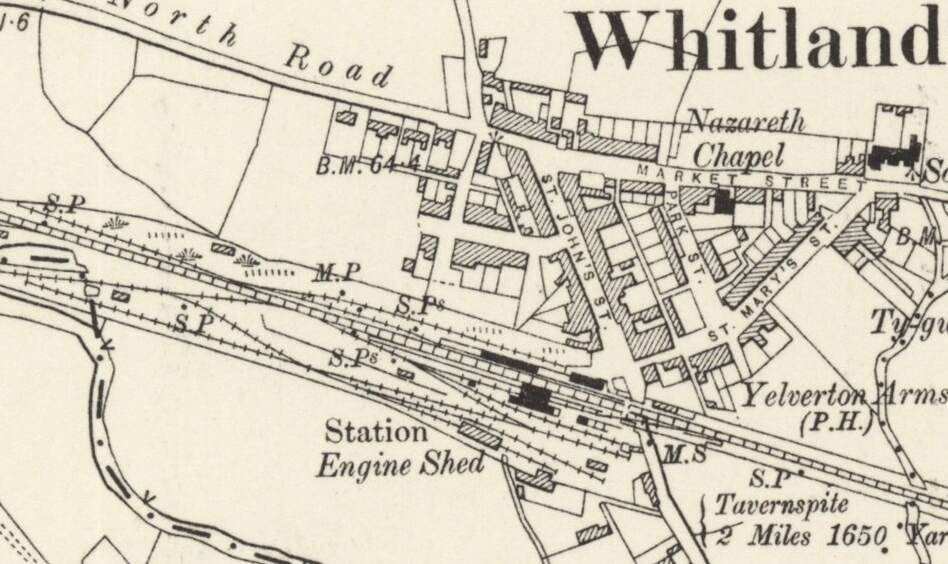
Whitland Railway Station as it appeared on the 6″ Ordnance Survey from the turn of the 20th century. [44]
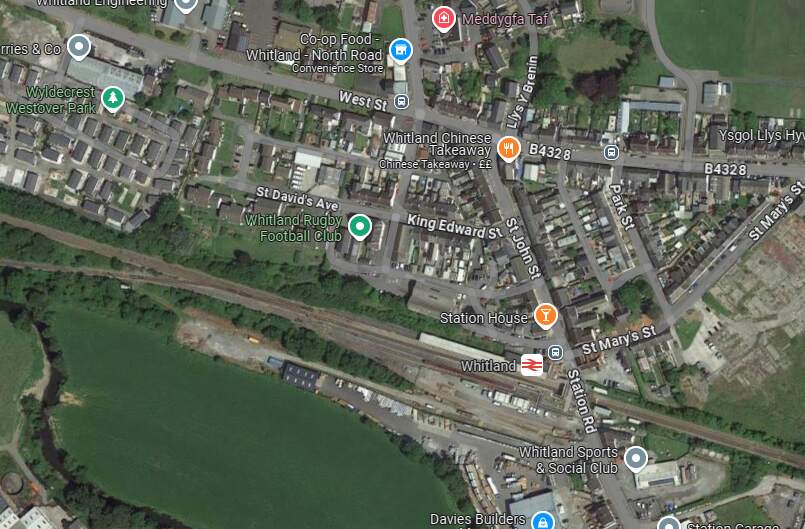
A similar area as shown on the map extract above as it appears in 2024. [Google Maps, September 2024]

After the opening of the Pembroke and Tenby and Whitland and Taf Vale Railways the station at Whitland had four platform faces. Two of these served the main line, one served a loop round the down island platform and the other a bay behind the up platform, access to which was from the west. The main station buildings were on the up side and nearby, close to the bay platform, there was a goods shed and a few sidings. All these changed little until British Railways’ days when the station was extensively modernised. In addition, in the 1960s the down loop was disconnected and became a bay for Pembroke Dock trains. On the down side, too, there was a small goods vard originally constructed for the use of the Pembroke and Tenby Railway, and for the exchange of traffic between that company and the GWR before the Great Western took over the working of the P&T in 1896. A short distance west of Whitland station the locomotive shed stood until the mid-1960s. Passenger trains from Cardigan ran into either the bay or the up main platform at Whitland, but trains departing for Cardigan customarily shared the outer face of the down island platform with P&T line trains.” [4: p61]
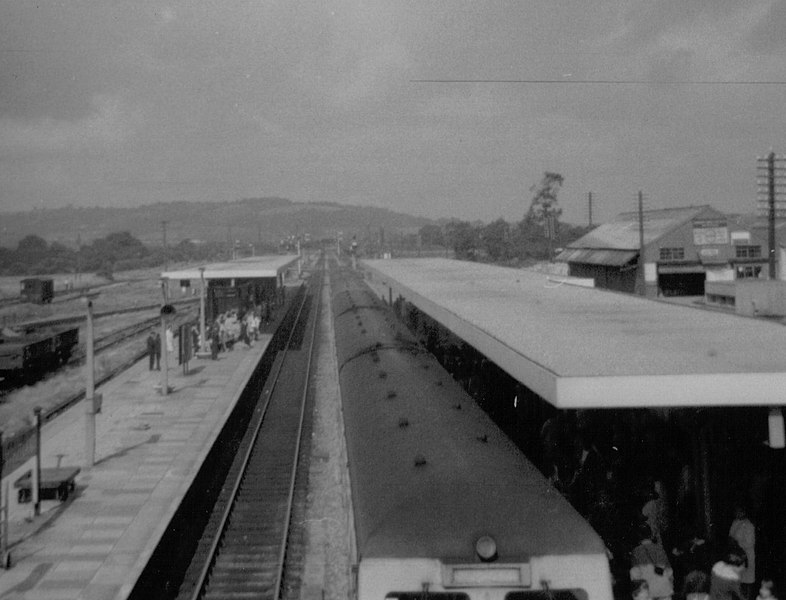
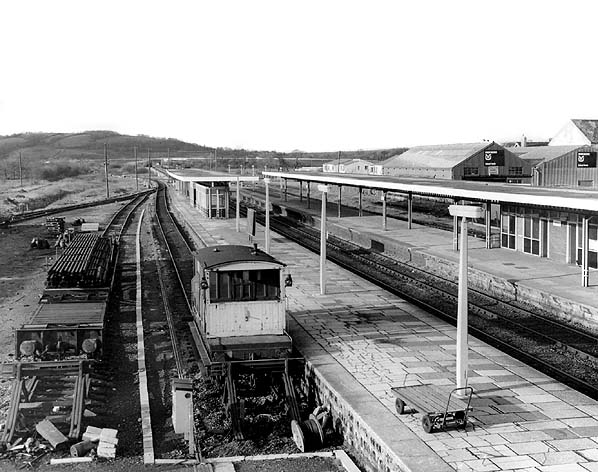
Whitland Railway Station in 1971 (c) Roger Griffith (Public Domain). [45]
Whitland Railway Station in 1979, (c) John Mann Collection and used with the kind permission of Nick Catford. [46]
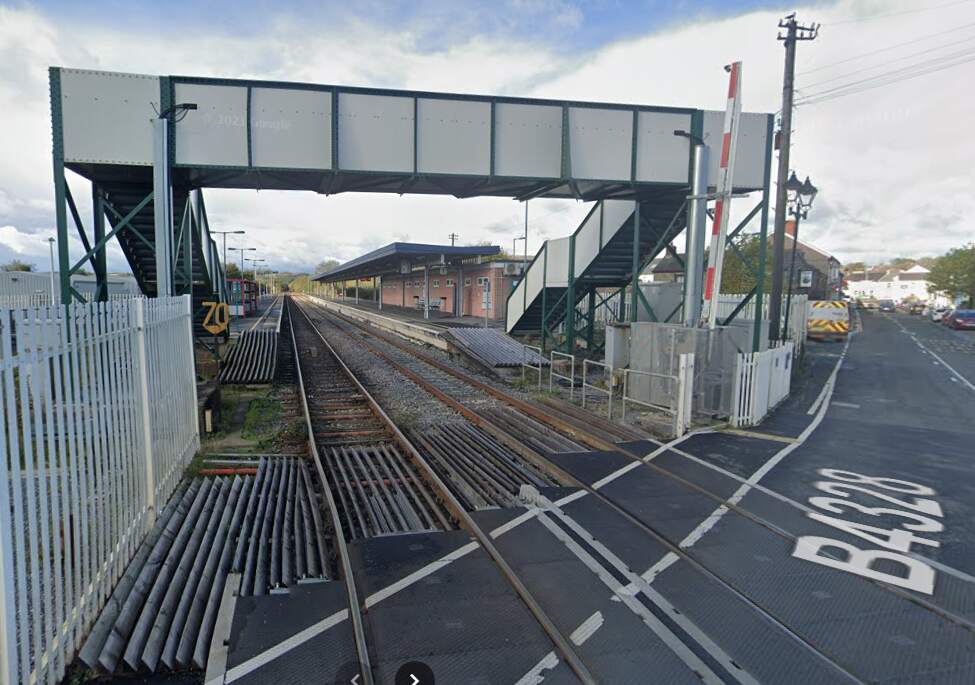
Whitlad Station seen from Station Road, the B4328 in 2021. This view looks West along the modern railway line. [Google Streetview, November 2021]

References

  1. https://preservedbritishsteamlocomotives.com/fox-walker-company, accessed on 25th July 2025.
  2. M.R. Connop Price; Before the Railways: The Early Steamers of Cardiganshire; in the RCHS  Journal, Vol. 40 Part 8 No. 244 July 2022, p471-477.
  3. https://railmaponline.com/UKIEMap.php, accessed in July/August 2024.
  4. https://rogerfarnworth.com/2024/07/15/railways-in-west-wales-part-2a-the-whitland-cardigan-railway-cardigan-to-boncath.
  5. https://rogerfarnworth.com/2024/07/25/railways-in-west-wales-part-2b-the-whitland-cardigan-railway-boncath-to-llanglydwen
  6. M.R. Connop Price; The Whitland and Cardigan Railway (2nd Edition); The Oakwood Press, Headington, Oxford, 1991.
  7. C.J. Gammell; Slow Train to Cardigan; in British Railways Illustrated Volume 4 No. 5, February 1995, p228-235.
  8. https://www.facebook.com/share/p/wkGZo8ow7QjquYvi, accessed on 25th July 2024.
  9. https://www.facebook.com/share/p/7G6PpWSruh98EJQv, accessed on 25th July 2024.
  10. https://en.m.wikipedia.org/wiki/East_Kent_Light_Railway, accessed on 26th July 2024.
  11. https://en.m.wikipedia.org/wiki/List_of_Peckett_and_Sons_railway_locomotives, accessed on 26th July 2024.
  12. https://www.rmweb.co.uk/forums/topic/72460-gwr-1331-ex-whitland-cardigan-0-6-0st-project, accessed on 26th July 2024.
  13. https://x.com/JonSLatona/status/1555748042376110080?t=MGZm0QpCXQztdDO4aIYn0A&s=19, accessed on 26th July 2024.
  14. https://www.facebook.com/share/DtzcxUKZy6rBUUu3, accessed on 26th July 2024.
  15. https://www.geograph.org.uk/photo/3756804, accessed on 26th July 2024.
  16. https://www.facebook.com/share/p/PbPSgvwUcgQw56dX, accessed on 26th July 2024.
  17. https://en.m.wikipedia.org/wiki/Llanglydwen_railway_station, accessed on 26th July 2024.
  18. https://maps.nls.uk/geo/explore/#zoom=15.5&lat=51.90951&lon=-4.64625&layers=257&b=1&o=100, accessed on 24th July 2024.
  19. https://maps.nls.uk/geo/explore/#zoom=17.6&lat=51.87913&lon=-4.66484&layers=257&b=1&o=100, accessed on 26th July 2024.
  20. https://www.facebook.com/share/p/YThEDvmbTYJhb57u, accessed on 8th August 2024.
  21. https://www.geograph.org.uk/photo/4721738, accessed on 27th July 2024.
  22. https://www.geograph.org.uk/photo/1703219, accessed on 28th July 2024.
  23. https://maps.nls.uk/geo/explore/#zoom=17.0&lat=51.90756&lon=-4.64998&layers=257&b=1&o=100, accessed on 30th July 2024.
  24. https://maps.nls.uk/geo/explore/#zoom=17.0&lat=51.90419&lon=-4.65760&layers=257&b=1&o=100, accessed on 30th July 2024.
  25. https://maps.nls.uk/geo/explore/#zoom=17.0&lat=51.90071&lon=-4.66139&layers=257&b=1&o=100, accessed on 30th July 2024.
  26. https://maps.nls.uk/geo/explore/#zoom=17.0&lat=51.89728&lon=-4.66253&layers=257&b=1&o=100, accessed on 30th July 2024.
  27. https://maps.nls.uk/geo/explore/#zoom=17.0&lat=51.89362&lon=-4.66594&layers=257&b=1&o=100, accessed on 30th July 2024.
  28. https://maps.nls.uk/geo/explore/#zoom=17.0&lat=51.88936&lon=-4.66134&layers=257&b=1&o=100, accessed on 30th July 2024.
  29. https://maps.nls.uk/geo/explore/#zoom=17.0&lat=51.88511&lon=-4.66114&layers=257&b=1&o=100, accessed on 30th July 2024.
  30. https://maps.nls.uk/geo/explore/#zoom=17.0&lat=51.88100&lon=-4.66301&layers=257&b=1&o=100, accessed on 30th July 2024.
  31. https://www.facebook.com/share/p/GHTPSQBAfQ4YCMNL, accessed on 9th August 2024.
  32. https://www.facebook.com/share/7Rns5L1LJ8iCKFFf, accessed on 9th August 2024.
  33. https://www.facebook.com/share/jRJQhnqenneHQXX3, accessed on 9th August 2024.
  34. https://www.facebook.com/share/p/z1CyZqboS8yjc6zv, accessed on 9th August 2024.
  35. https://www.geograph.org.uk/photo/7309799, accessed on 9th August 2024.
  36. https://www.facebook.com/share/p/6gDMXW2YBFgNqmj9, accessed on 9th August.
  37. https://maps.nls.uk/geo/explore/#zoom=15.0&lat=51.84779&lon=-4.67887&layers=6&b=1&o=100, accessed on 9th September 2024.
  38. http://www.llanfallteg.org/information/photographs, accessed on 9th September 2024.
  39. https://maps.nls.uk/geo/explore/#zoom=16.0&lat=51.83427&lon=-4.66215&layers=6&b=1&o=100, accessed on 9th September 2024.
  40. https://maps.nls.uk/geo/explore/#zoom=16.0&lat=51.83245&lon=-4.65458&layers=6&b=1&o=100, accessed on 9th September 2024.
  41. https://maps.nls.uk/geo/explore/#zoom=16.0&lat=51.82813&lon=-4.64390&layers=6&b=1&o=100, accessed on 9th September 2024.
  42. https://maps.nls.uk/geo/explore/#zoom=16.0&lat=51.82198&lon=-4.63287&layers=6&b=1&o=100, accessed on 9th September 2024.
  43. https://maps.nls.uk/geo/explore/#zoom=17.0&lat=51.81995&lon=-4.62494&layers=6&b=1&o=100, accessed on 9th September 2024.
  44. https://maps.nls.uk/geo/explore/#zoom=17.0&lat=51.81879&lon=-4.61463&layers=6&b=1&o=100, accessed on 9th September 2024.
  45. https://commons.wikimedia.org/wiki/File:Whitland_railway_station,_Wales_in_1971.jpg, accessed on 9th September 2024.
  46. http://disused-stations.org.uk/w/whitland/index.shtml, accessed on 9th September 2024.
  47. https://coflein.gov.uk/en/site/410170, accessed on 9th September 2024.
Railways in West Wales Part 2B – The Whitland & Cardigan Railway – Boncath to Llanglydwen

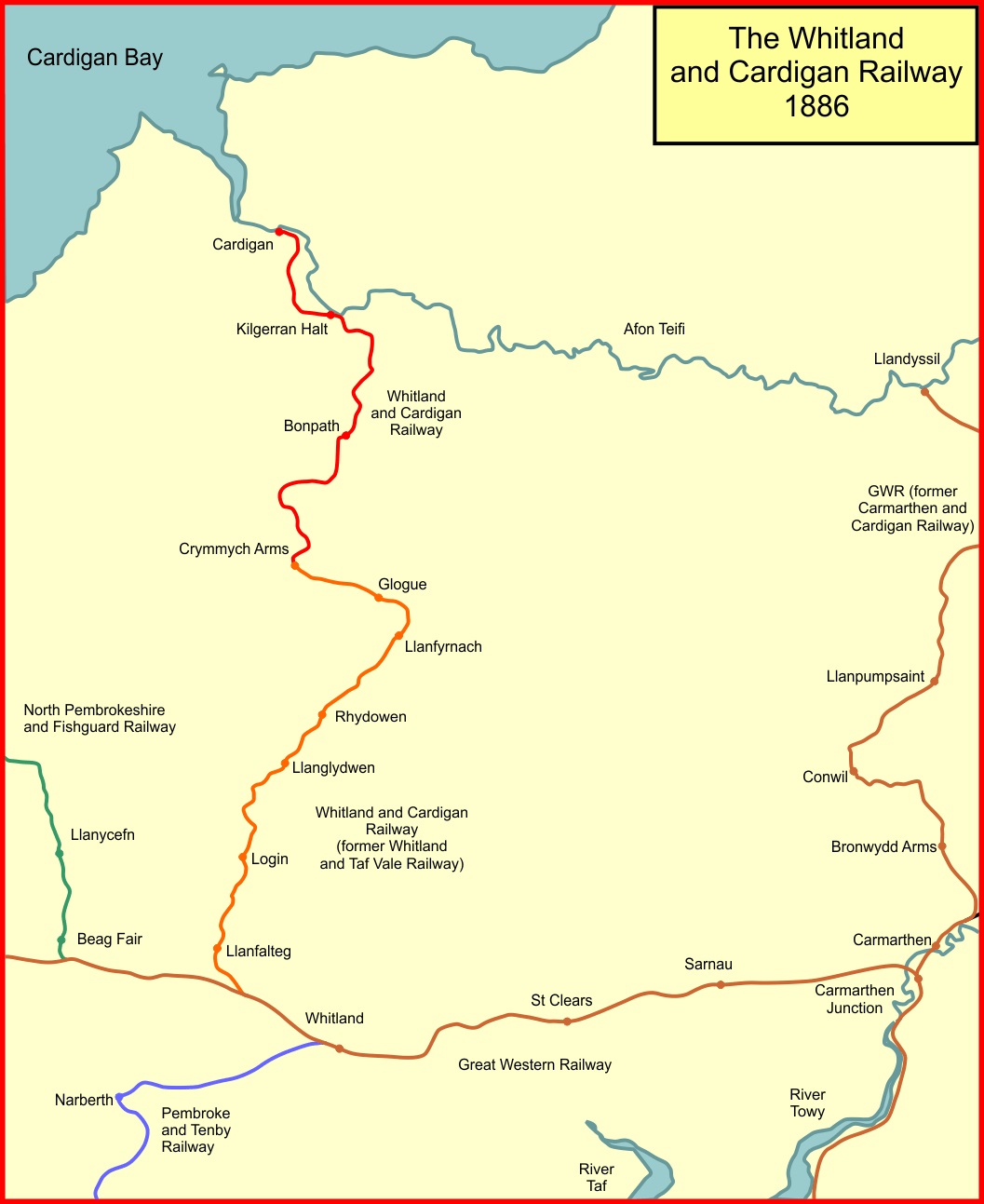
The Whitland & Cardigan Railway was a 27.5 miles (44.3 km) long branch line, “built in two stages, at first as the Whitland and Taf Vale Railway from the South Wales Main Line at Whitland to the quarries at Glogue. It opened in 1873, at first only for goods and minerals and later for passengers. The line to Cardigan opened in 1886; reflected in the company name change.” [2]

“The Company was always short of cash. Huge borrowings made it unable to pay its way; it was taken over by the Great Western Railway in 1886. Still considerably loss-making, it closed to passengers in 1962 and completely in 1963.” [2]

The route of the W&CR is shown on this schematic map. © Afterbrunel and licenced for use here under a Creative Commons Licence, Attribution-ShareAlike 4.0 International (CC BY-SA 4.0) [2]

This is the second in a short series of articles about the line. The first of the articles can be found here. [4]

My interest in this branch line stems from reading an article by M.R. Connop Price; Before the Railways: The Early Steamers of Cardiganshire; in the Railway & Canal Historical Society Journal in July 2022. [1] And from staying North of Cardigan in 2023 and walking part of the route of the old line.

We restart our journey from Cardigan to Whitland at Boncath Railway Station.

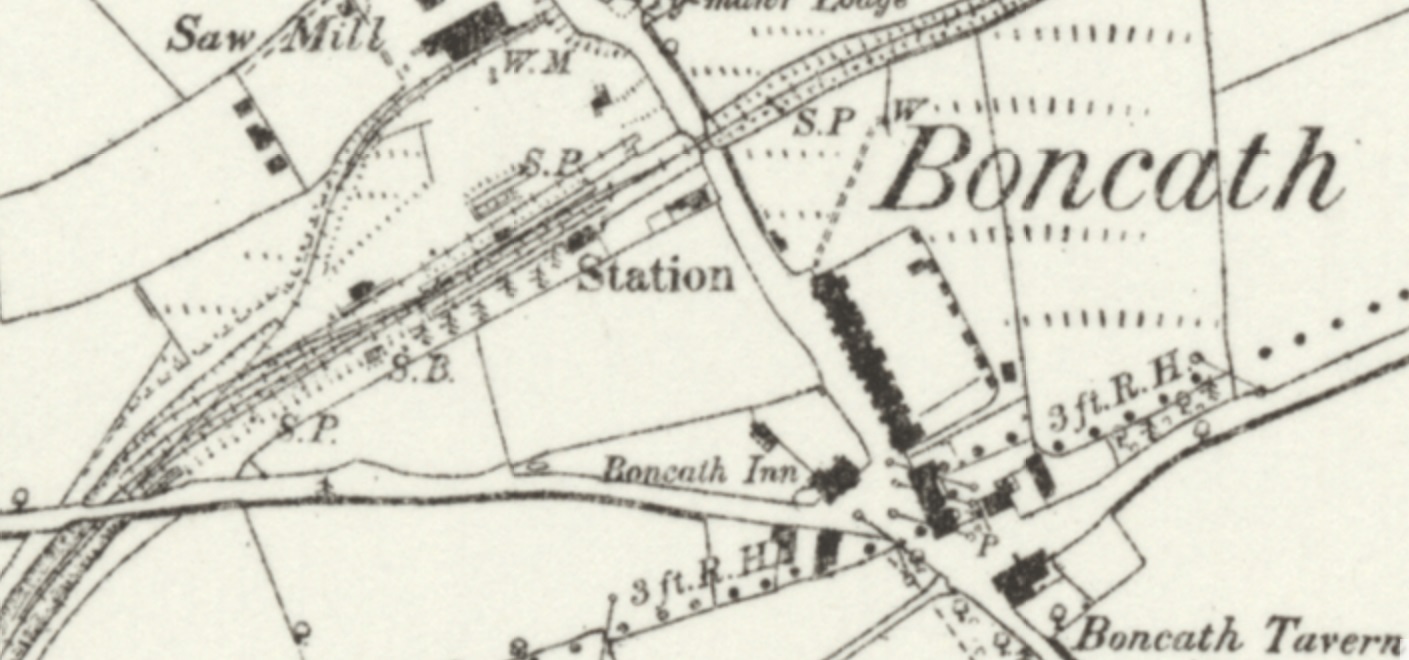
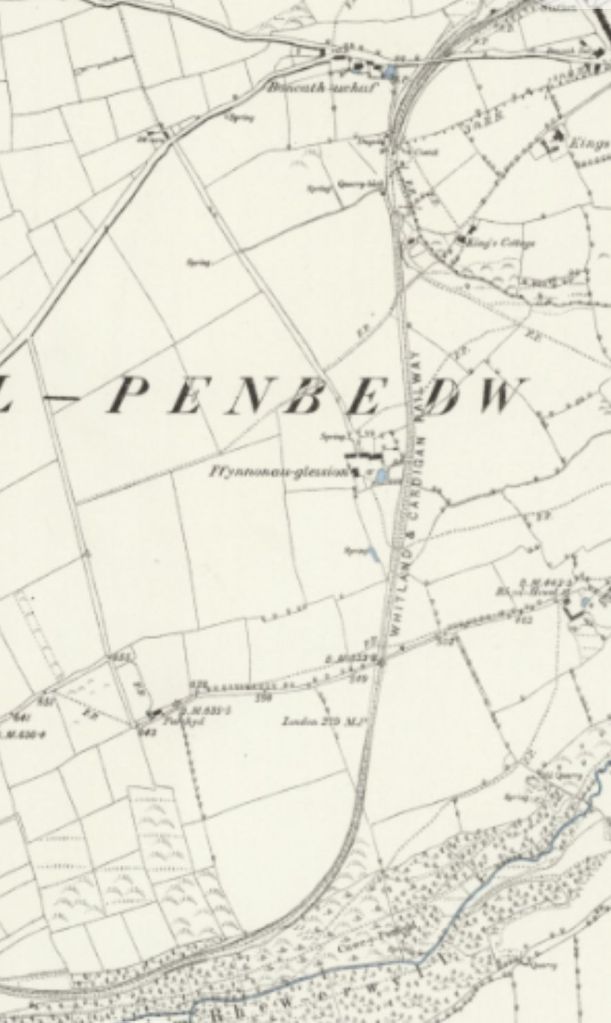
Boncath Railway Station as it appears on the 6″ Ordnance Survey of 1887 (published in 1888). [5]

The station had a passing loop served by two passenger platforms and a goods loop on the down side where there was a small goods yard and shed. A siding from the yard served a saw mill nearby to the north of the station. The single-storey stone-built main station building was on the up platform and, along with the goods shed, still survives, as does the nearby Station House.” [6] The line serving the saw mill can be seen in its entirety in the map extract above.

M.R. Connop Price says that Boncath “was a crossing place and a tablet exchange station. The goods yard was quite sizeable, comprising three sidings on the down side, one forming a loop behind the down platform. Traffic consisted mostly of timber from the adjacent saw mills, rabbits and agricultural goods. Apparently the level crossing gates were demolished so often by accident that there was talk of doing away with them. In his two articles on the Cardigan line J.F. Burrell has pointed out that from the platform at Boncath it was possible to see the smoke of a freight train coming up from Cardigan for as long as a quarter of an hour before arrival. The many curves caused it to disappear and reappear at frequent intervals on the way. This was one of the most remarkable sights on a remarkable railway, because the line fell away from Boncath towards Cardigan on a gradient of 1 in 40 for nearly three miles. Climbing up this incline was hardly less exciting than the ever steepening climb up the Taf vale to Crymmych! Had the original route north of Boncath been built it would have kept to some higher ground and been more gently graded. It might also have been less attractive because the line as built ran for a mile and a half above a beautiful and heavily wooded valley towards Kilgerran” (Cilgerran). [15: p82 & 90]

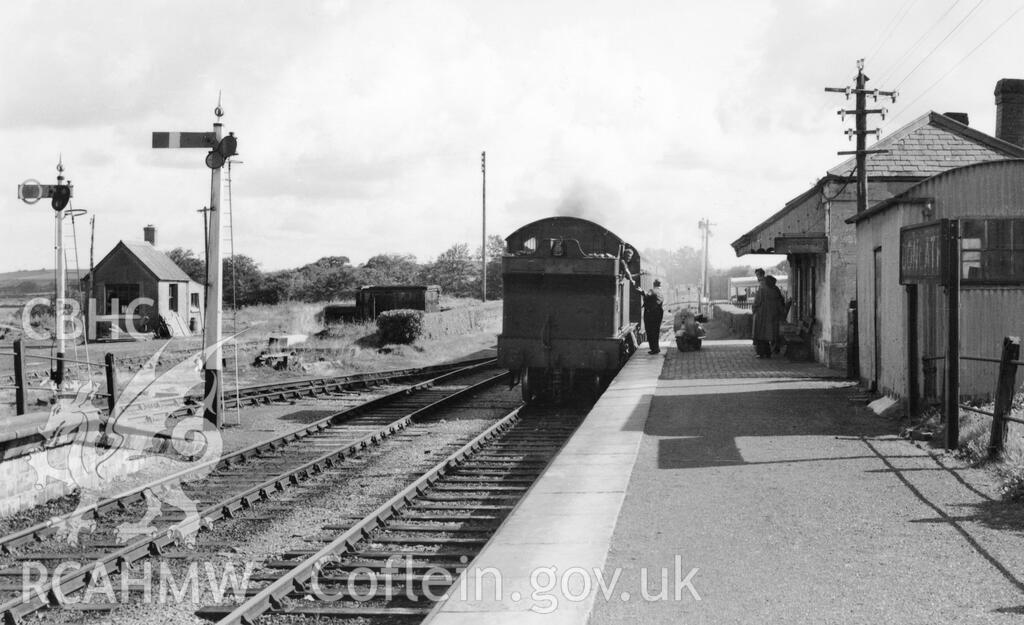
Boncath Railway Station, looking Northeast from the ‘Up’ platform. This image is Crown copyright and is reproduced with the permission of the Royal Commission on the Ancient and Historical Monuments of Wales (RCAHMW), under delegated authority from The Keeper of Public Records, © Crown copyright: RCAHMW, contains information licensed under the Non-Commercial Government Licence v2.0. [6]
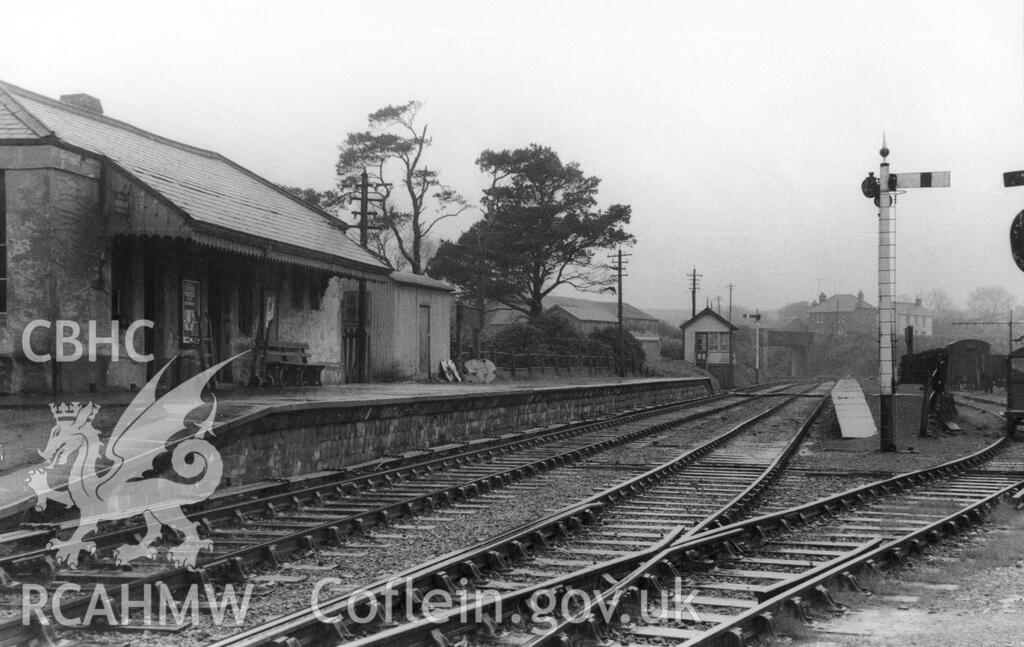
Boncath Station seen from the Northeast. This image is Crown copyright and is reproduced with the permission of the Royal Commission on the Ancient and Historical Monuments of Wales (RCAHMW), under delegated authority from The Keeper of Public Records, © Crown copyright: RCAHMW, contains information licensed under the Non-Commercial Government Licence v2.0. [6]

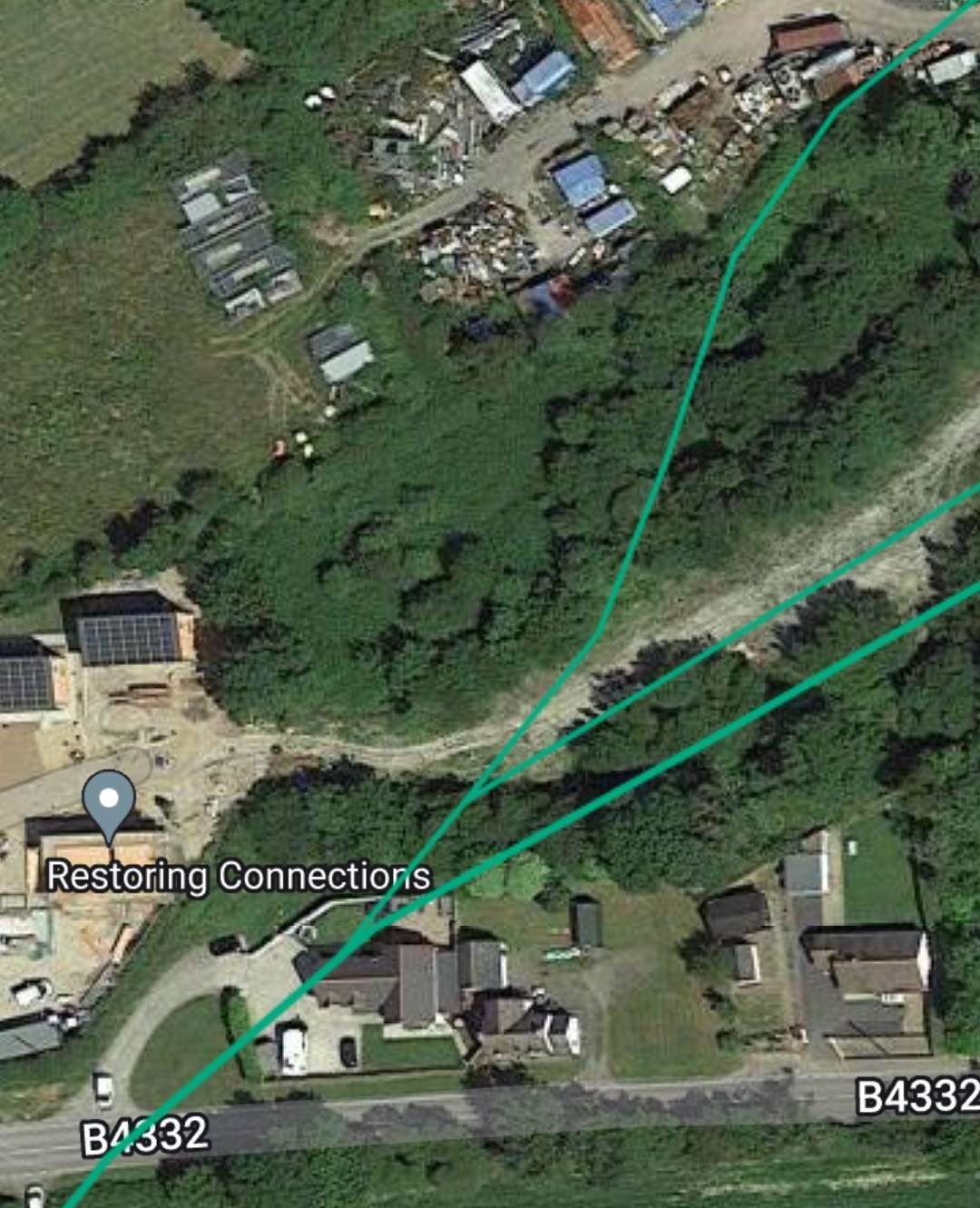
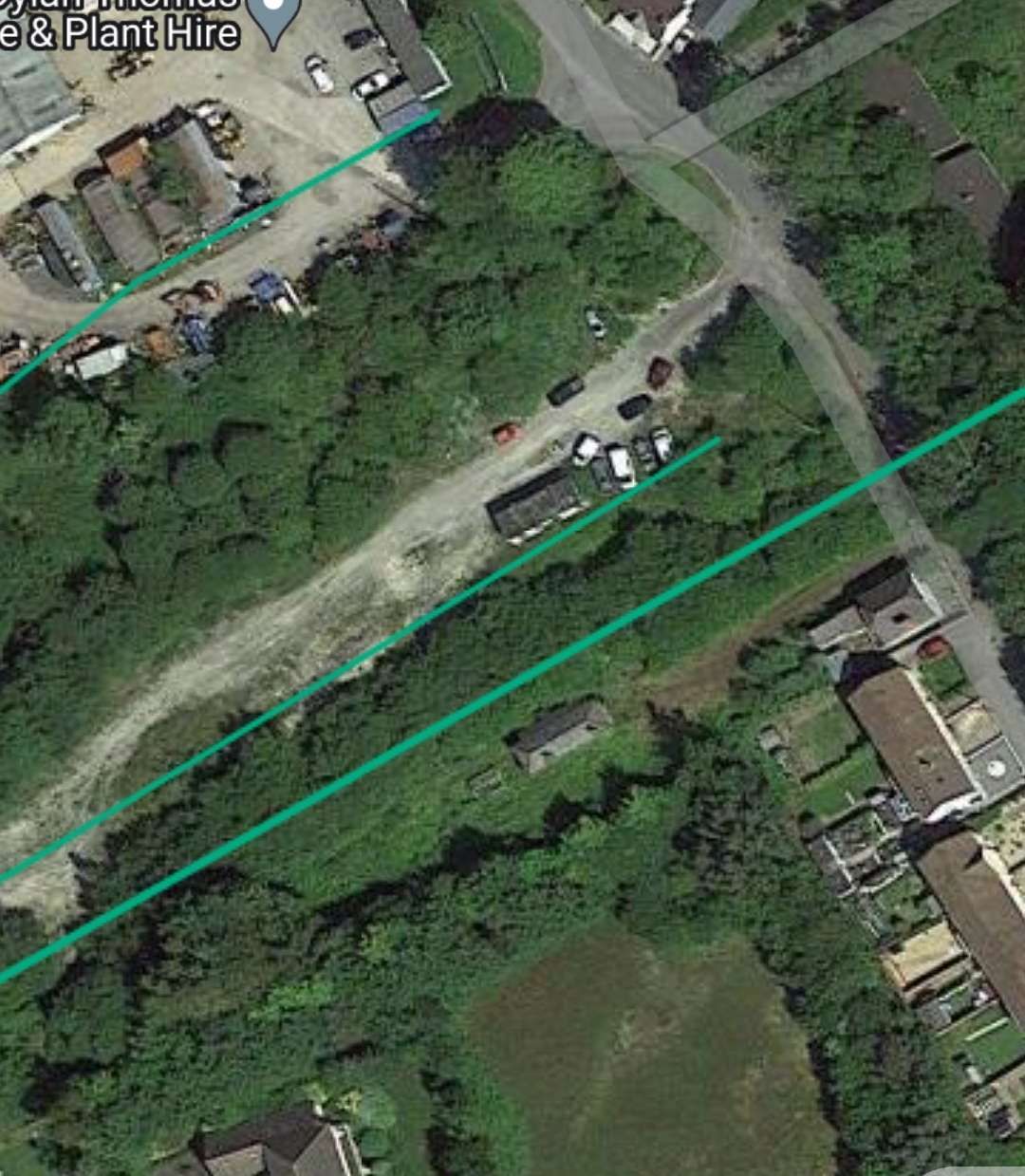
These two extracts from the railmaponline.com satellite imagery cover the full extent of the Boncath Railway Station site. The old railway is shown by the green lines on the images from railmaponline.com. And these green lines include the siding serving the saw mill. [3]

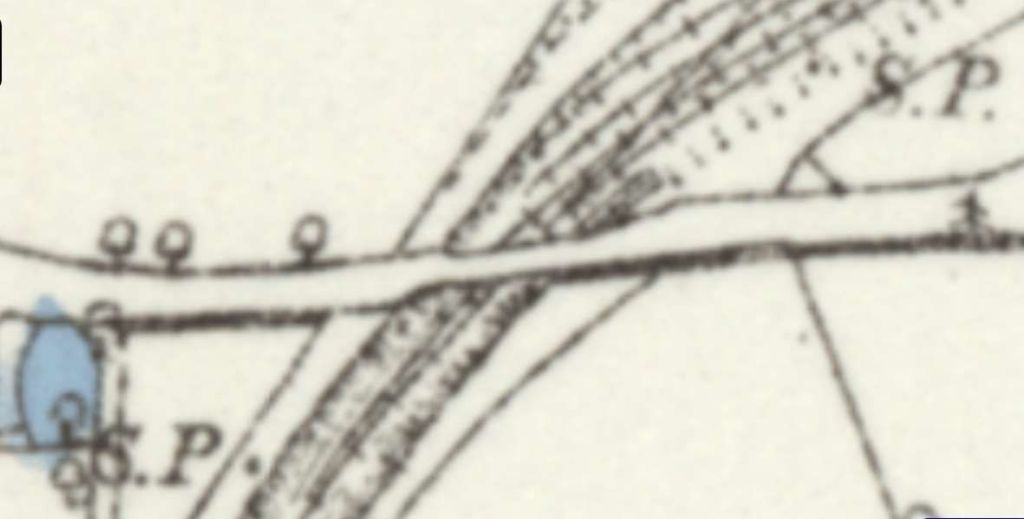
The Southwest end of the Boncath Station site was framed by the highway bridge which carried what was to become the B4332. [5]
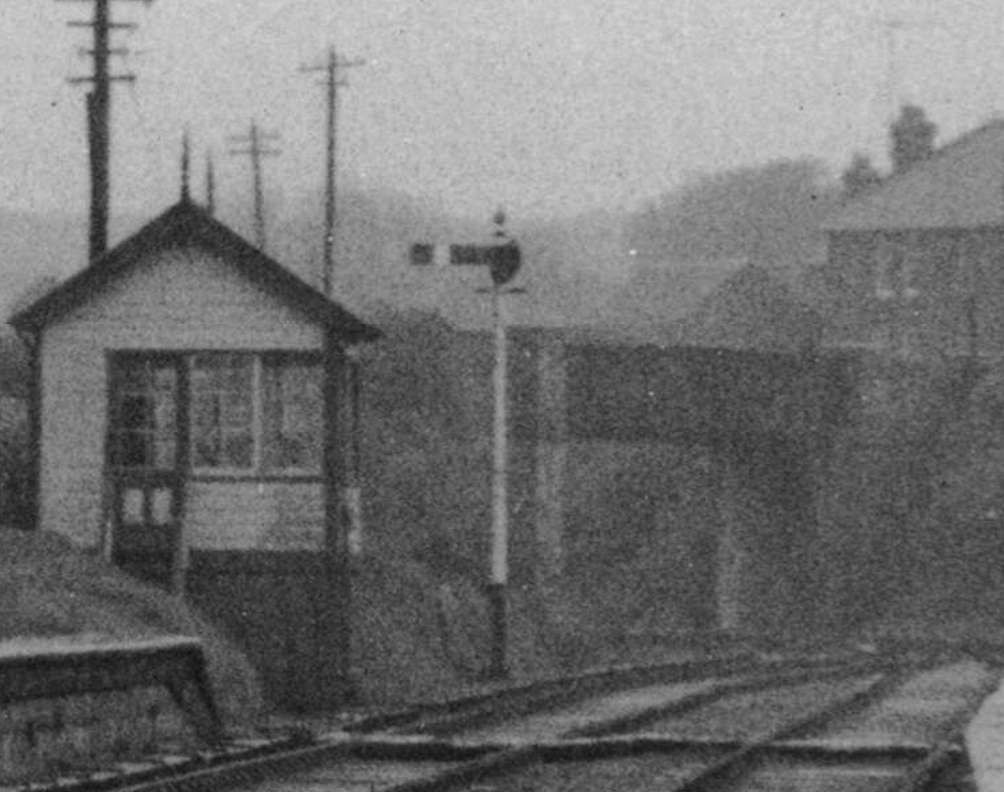
An enlarged segment of one of the two images shared on the coflein.gov.uk website. This is the best image that I have been able to find of the bridge at the Southwest end of the station site. [6]
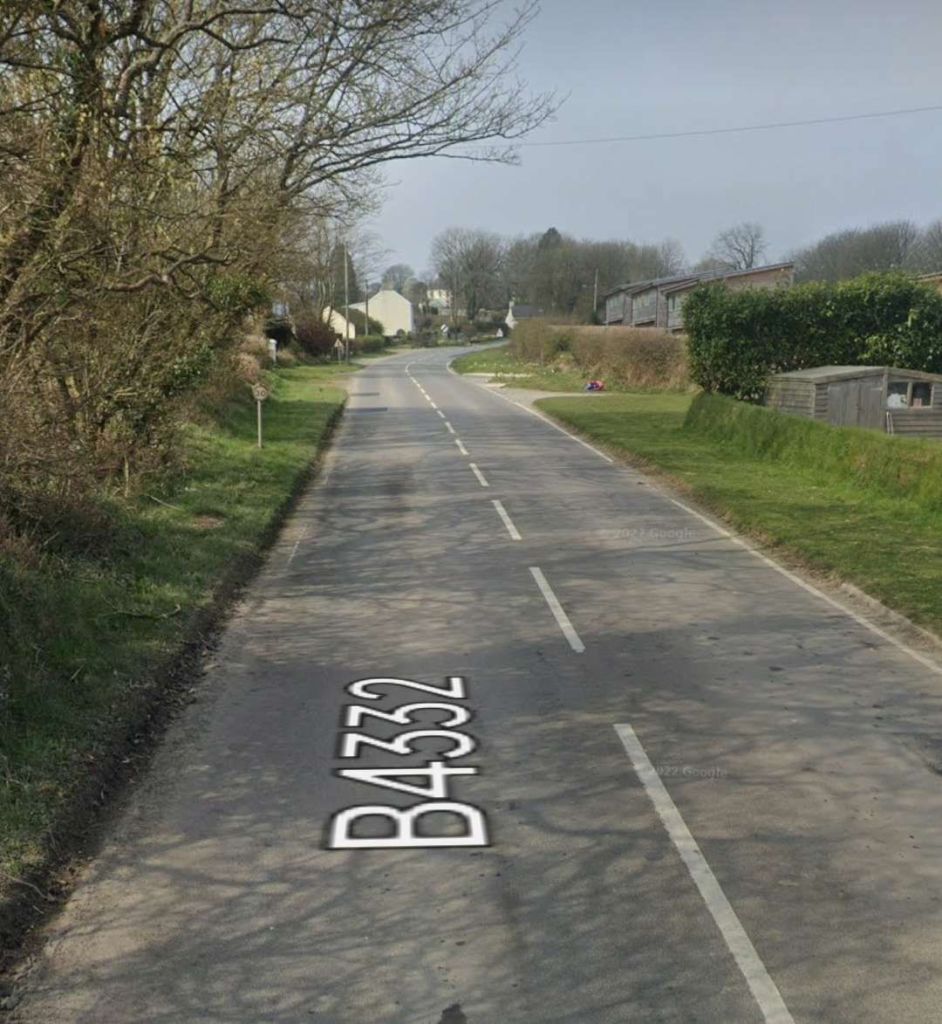
The view along the B4332 from the East through what was the location of the bridge carrying the road over the old railway. [Google Streetview, March 2022]

Shaun Butler’s TT gauge model of Boncath can be seen in photographs here. [27] Other views of the station can be seen here [28] and here [29]. The station has a page of its own on the Disused Stations website, here. [30]

M.R. Connop Price covers the route of the line from Whitland to Cardigan travelling towards Cardigan – the ‘down’ direction on the line. His description is quite evocative of the line’s rural and meandering nature. He describes the length of the line between Boncath and Crymmych Arms stations but in the ‘down’ direction: “North of Crymmych the [line] … climbed through a deep rock cutting to the summit before descending briefly on a gradient of 1 in 80 and rising again at 1 in 200 to a secondary summit about a mile and 30 chains beyond the station. By now the track was winding round a ledge on the hillside and giving magnificent views westwards to the Prescelly mountains. … On a clear day the view extended across the valley of the Afon Nyfer to the sea near Newport. … Meanwhile, [the line] negotiated a horseshoe bend and a remarkable series of sharp curves across the desolate countryside as it began its steady descent. Just over two miles from Crymmych the railway passed Rhyd-du, where once it was proposed to build a station. … Just beyond Rhyd-du the [railway] passed near Blaenffos and under the main Cardigan-Tenby road for the second time. A short distance further on a tributary of the River Teifi could be seen running through woods far below on the east side of the line, giving confirmation to the traveller that he was now across the watershed” and close to Boncath. [15: p82]

The railway first headed South as it left Boncath and then turned to the West above a wooded valley. [7]
This extract from the ESRI satellite imagery from the NLS covers approximately the same area as the 6″ OS map extract above.  Once again, the route of the old railway can be followed by tracing the field boundaries, hedgerows and trees. [7]
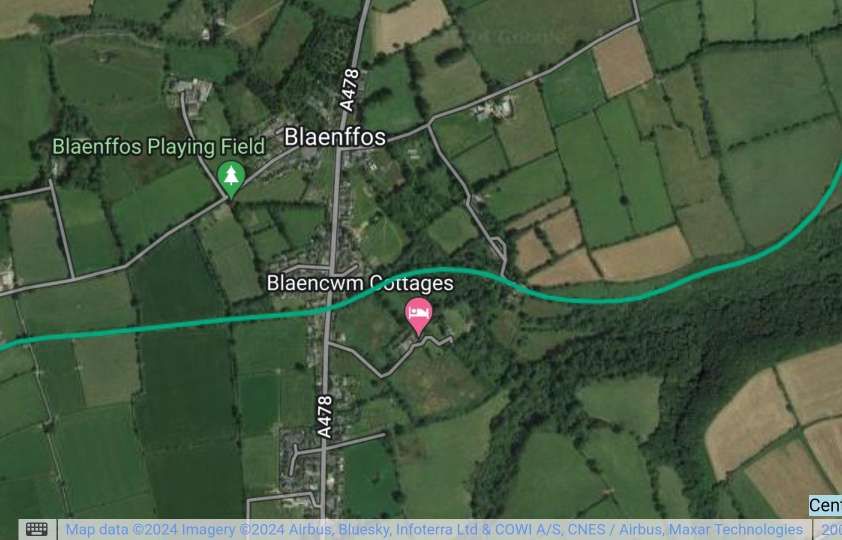
The line then turned West. [8]
The route of the old railway was a little difficult to see on the Google mapping, so it is good to have the green line on this railmaponline.com satellite image. [3]

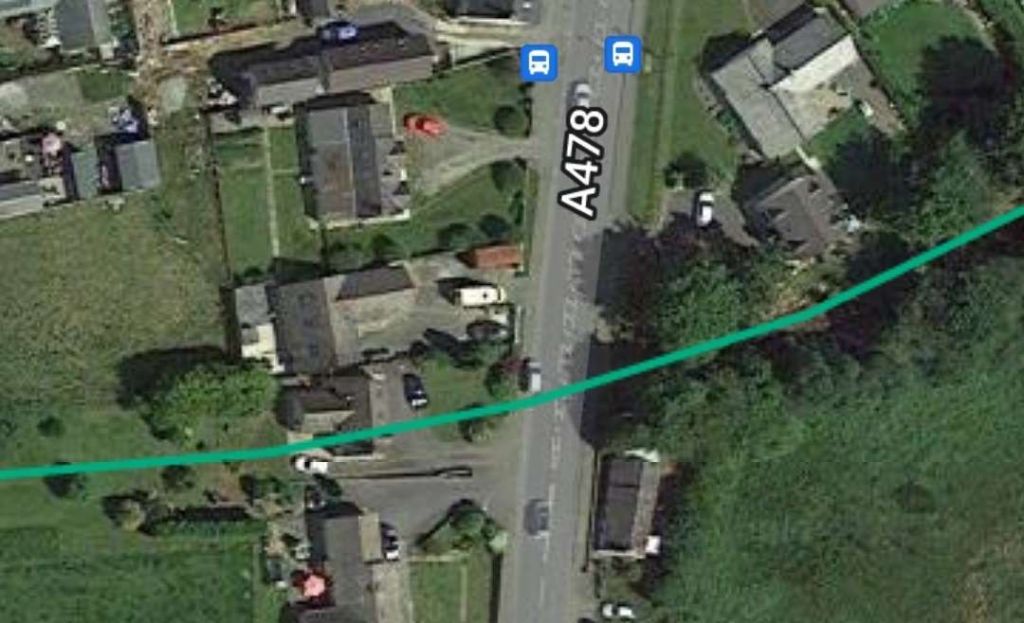
On both of the two images above the Whitland & Cardigan Railway crosses the A478. The next couple of images show enlarged views of the location, on the 6″ OS Map and the railmaponline.com satellite imagery. …

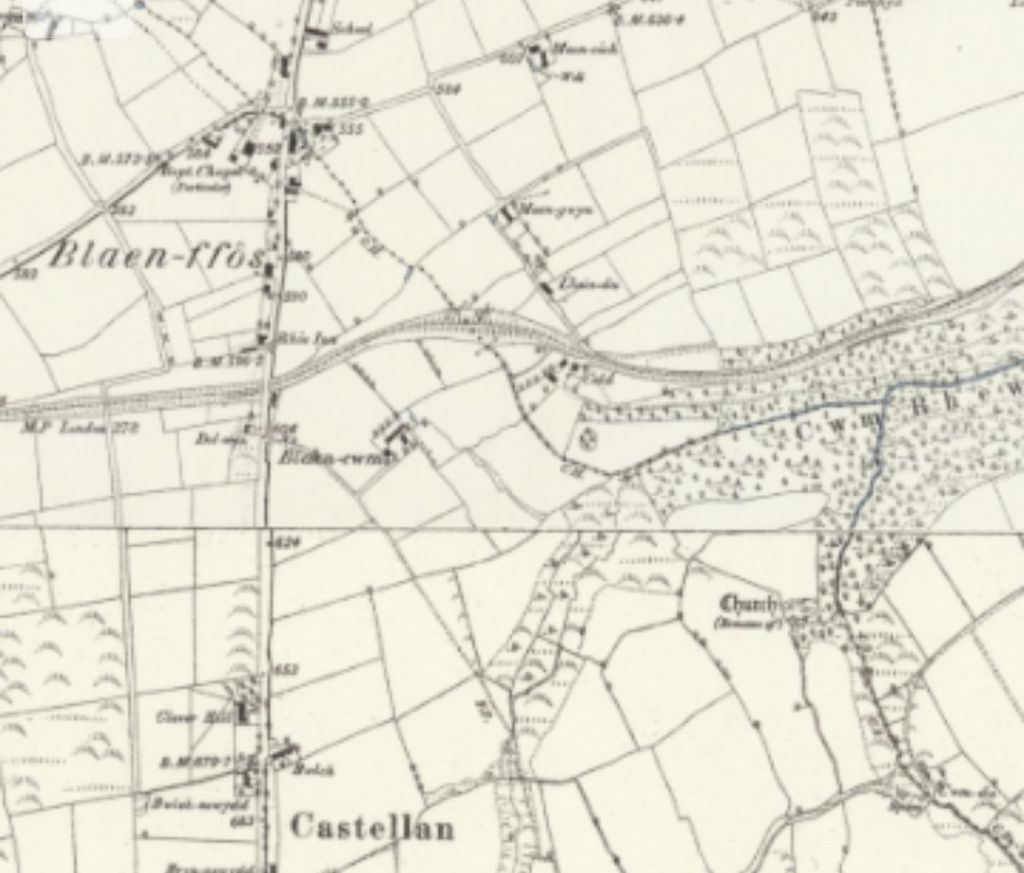
The road which was to become the A478 crossed the old railway cutting as shown on this enlarged extract from the 6″ OS mapping of the late 19th century. [8]
The same location on railmaponline.com’s satellite imagery. [3]
Looking North through the location of the bridge which once carried the road over the old railway. [Google Streetview, 2017]
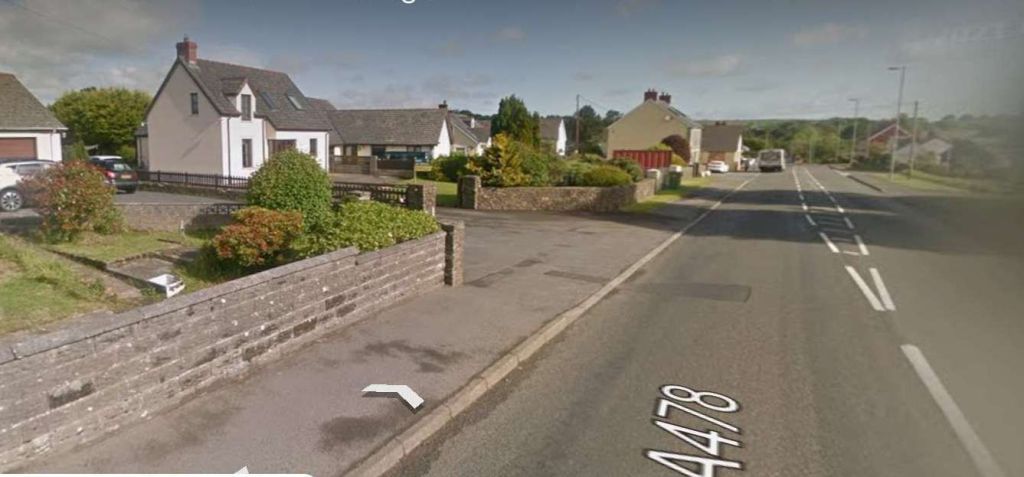
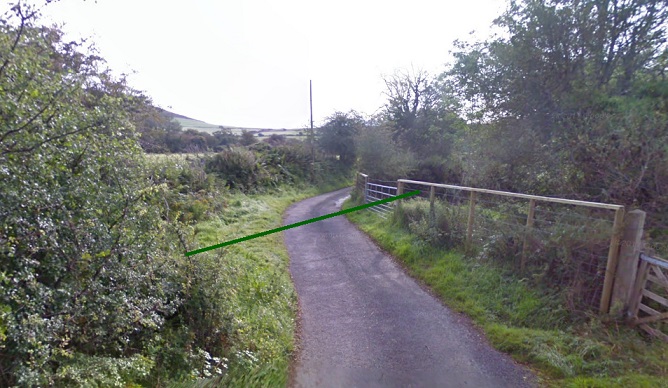
Looking West along the line of the old railway from the A478. [Google Streetview, 2017]
Looking East along the line of the old railway from the A478. [Google Streetview, 2017]
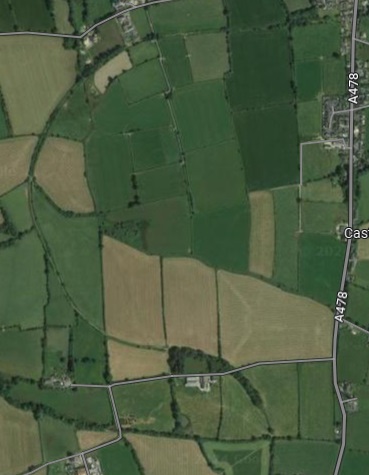
The old railway decribed a curve from travelling in a westerly direction, back towards the East before then turning south. (The 6″ OS map of 1887/1888.) [9]
The route of the old railway is easily identified on this Google Maps satellite image. As the line turns toward the South close to the bottom of this image it crosses a farm access road. Modern photographs of the location are shown below. [Google Maps, 16th July 2024]
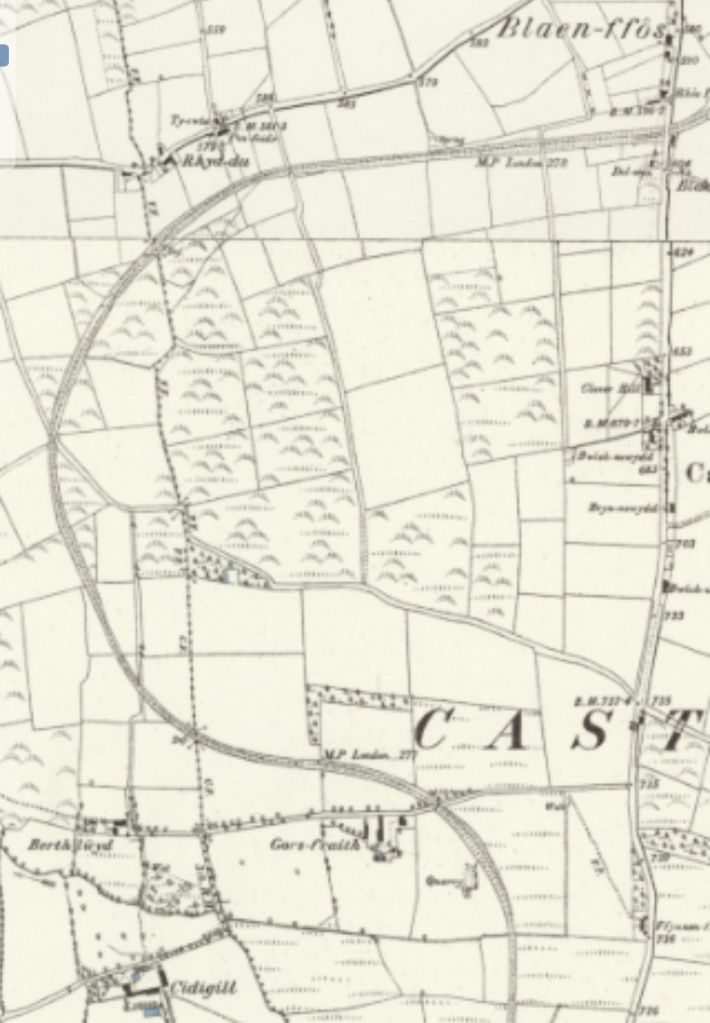
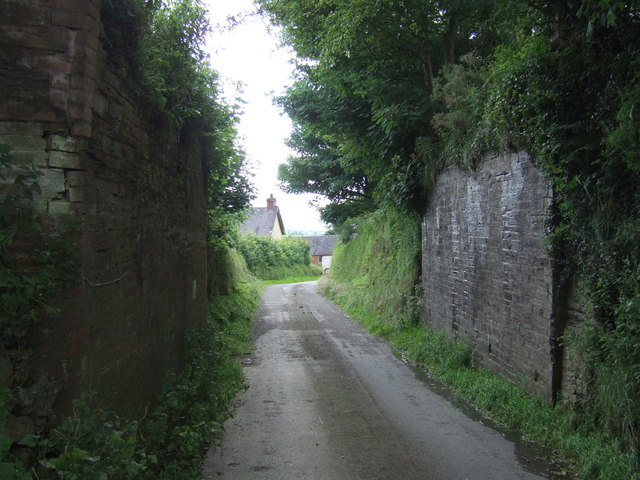
Looking West along the farm access road to Gorsfraith Farm which ran beneath a girder bridge supporting the Whitland & Cardigan Railway. Only the stone abutments remain. This photograph was taken by Natasha Ceridwen de Chroustchoff  on 29th June 2007 and shared by her on the geograph.org.uk website on the following day. It shared here under a Creative Commons Licence (CC BY-SA 2.0). [13]
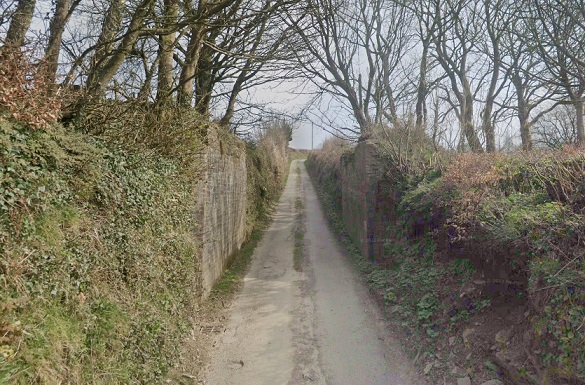
The same bridge abutments seen from the West. {Google Streetview, March 2022]
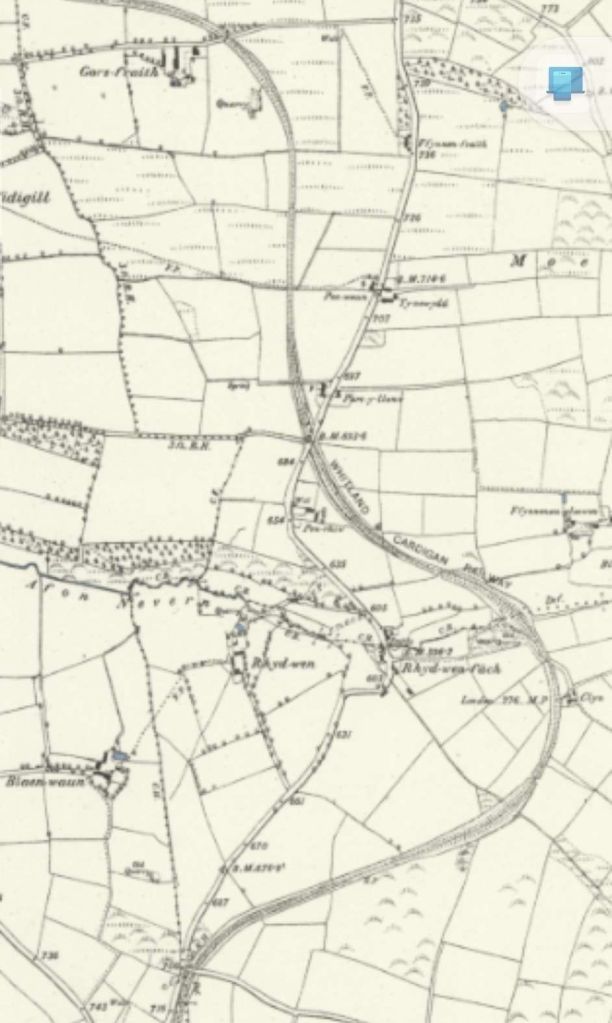
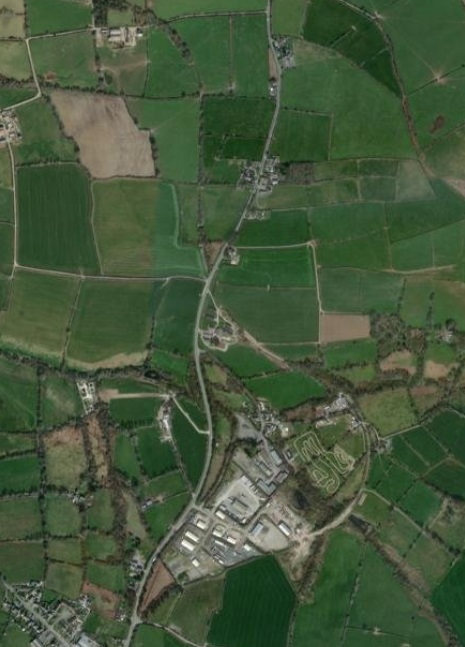
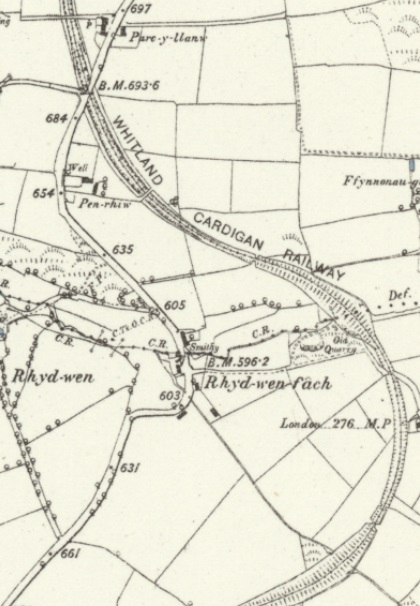
The line ran North-South towards Crymmych deviating to the East to bypass Rhyd-wen-Fach. [10]
The same area as shown on the ESRI imagery from the NLS. [10]
This enlarged extract from the 6″ OS mapping is much clearer. It shows the railway in cutting passing under the main road to the North of Rhyd-wen-Fach, a footbridge (or accommodation bridge just to the Southeast of the road bridge, a crossing to the East of an old quarry near Rhyd-wen-Fach and the railway curving back West towards the main road. [10]
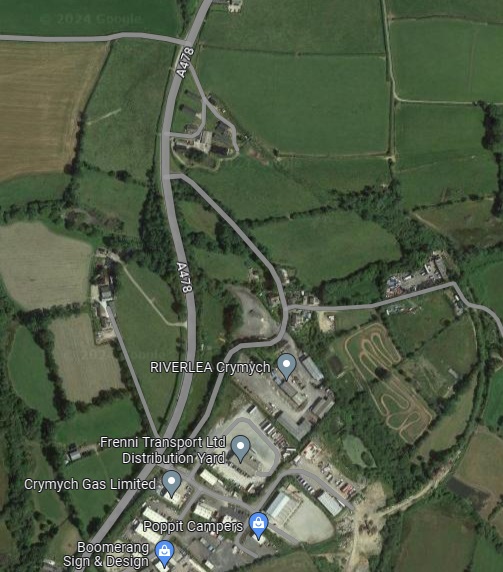
The route of the old railway can easily be picked up on this enlarged satellite image. It passed under the mainroad and round the East side of Rhyd-wen-Fach. The minor road to the East of the hamlet seems to have crossed the line at an unmanned level. [Google Maps, July 2024]
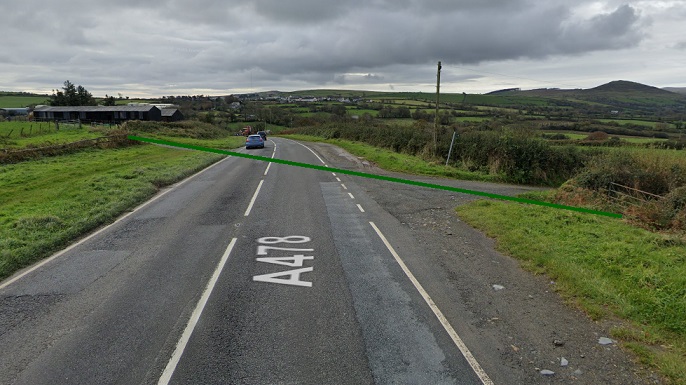
The view South along the modern A478 with the line of the old railway marked by the green line. The Whitland *+& Cardigan Railway was in cutting at this location. The cutting has been infilled and the old road bridge has been removed, facilitating the widening of the main road. {Google Streetview, November 2021]
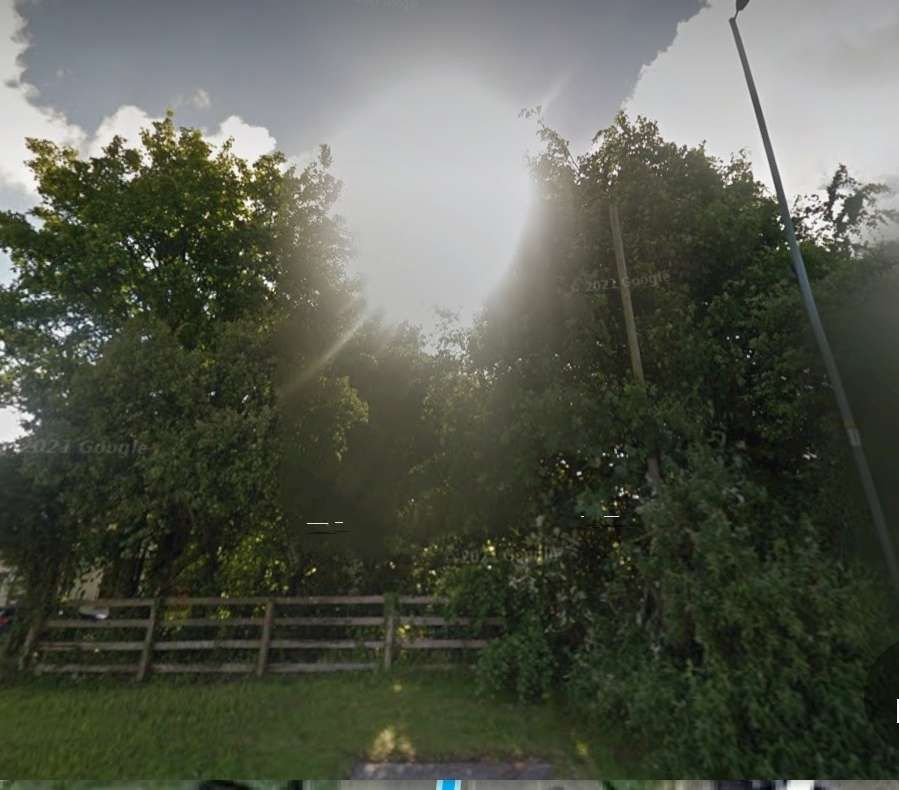
Looking Southeast along the minor road to the East of Rhyd-wen-Fach. The line of the old railway is again shown by the green line. [Google Streetview, September 2011]
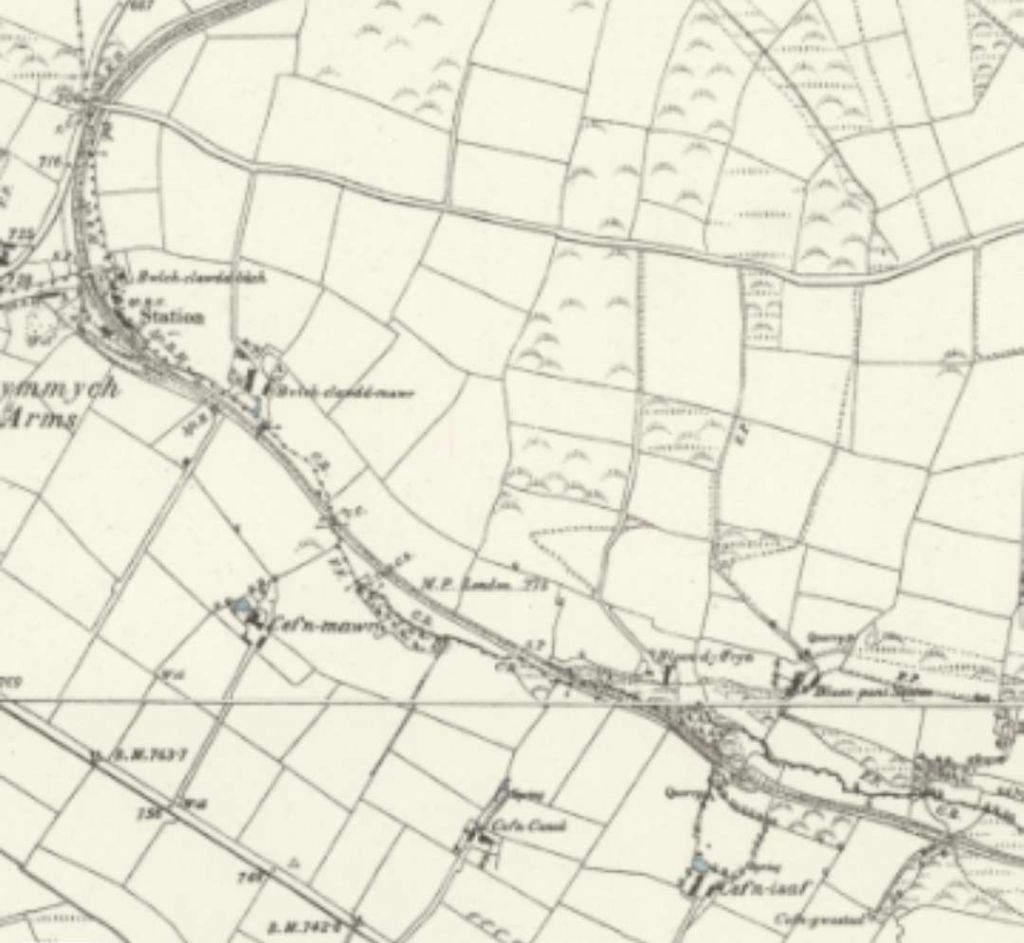
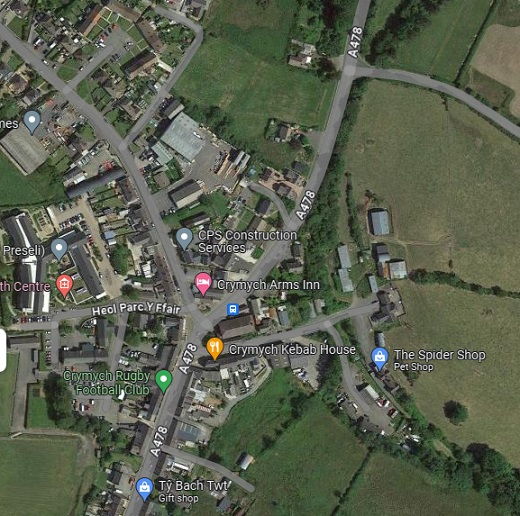
Another rather fuzzy extract from the 6″ OS mapping of 1887/1888. This shows the line passing through Crymmych. [11]
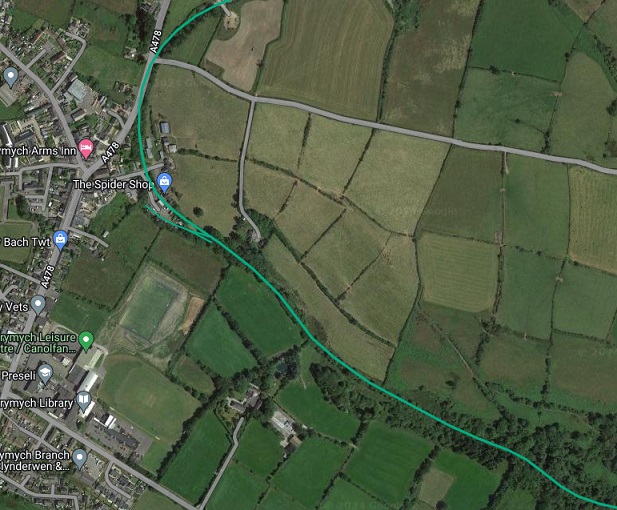
The same area as shown on the railmaponline.com satellite imagery with the old railway marked by the green line. [3]
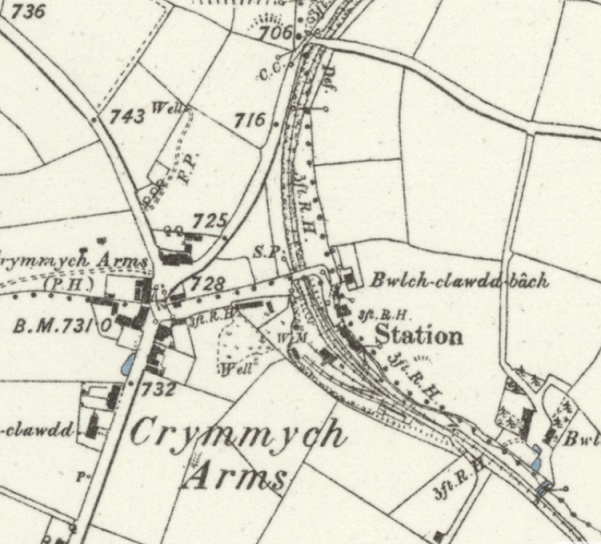
A better quality, clearer extract from the OS map at an enlarged scale. The old railway can be seen running to the East side of the main road at the top of this extract. It passed in cutting under the minor road approaching from the East and then curved round into Crymmych Arms Railway Station. [11]
The same area on Google Maps satellite imagery. [Google Maps, July 2024]
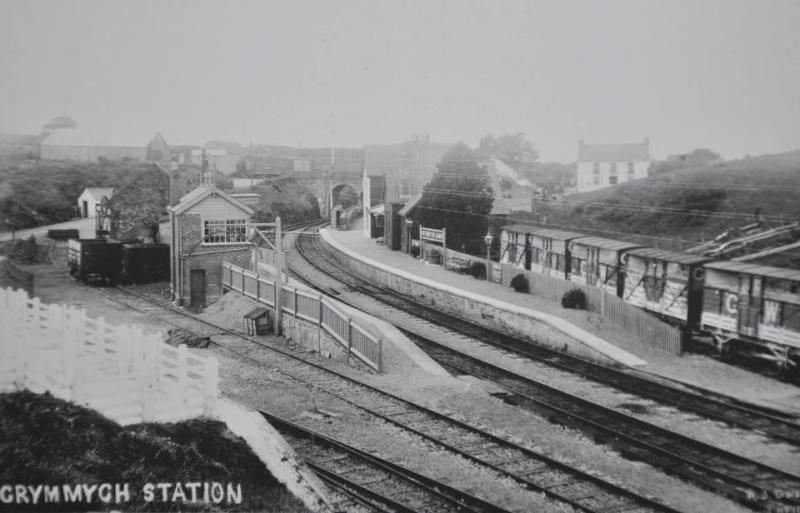
A postcard view of Crymych (Crymmych Arms) Railway Station looking Northnorthwest through the site towards Cardigan, © Public Domain. [14]
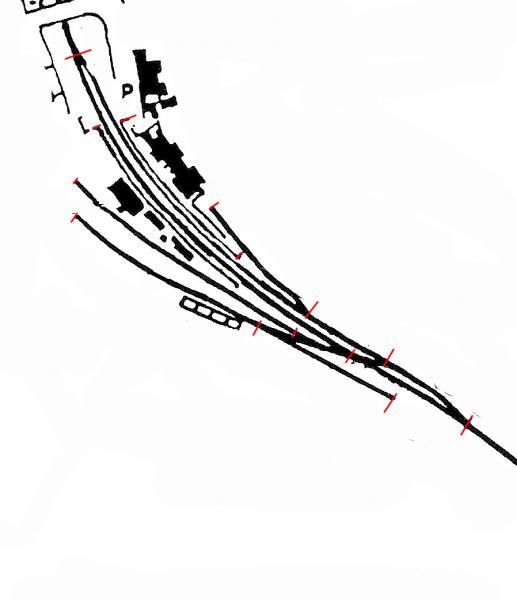
A plan of Crymmych Arms Railway Station taken from M.R. Cannop Price’s book about the line and marked for power supply locations for modelling. [14]
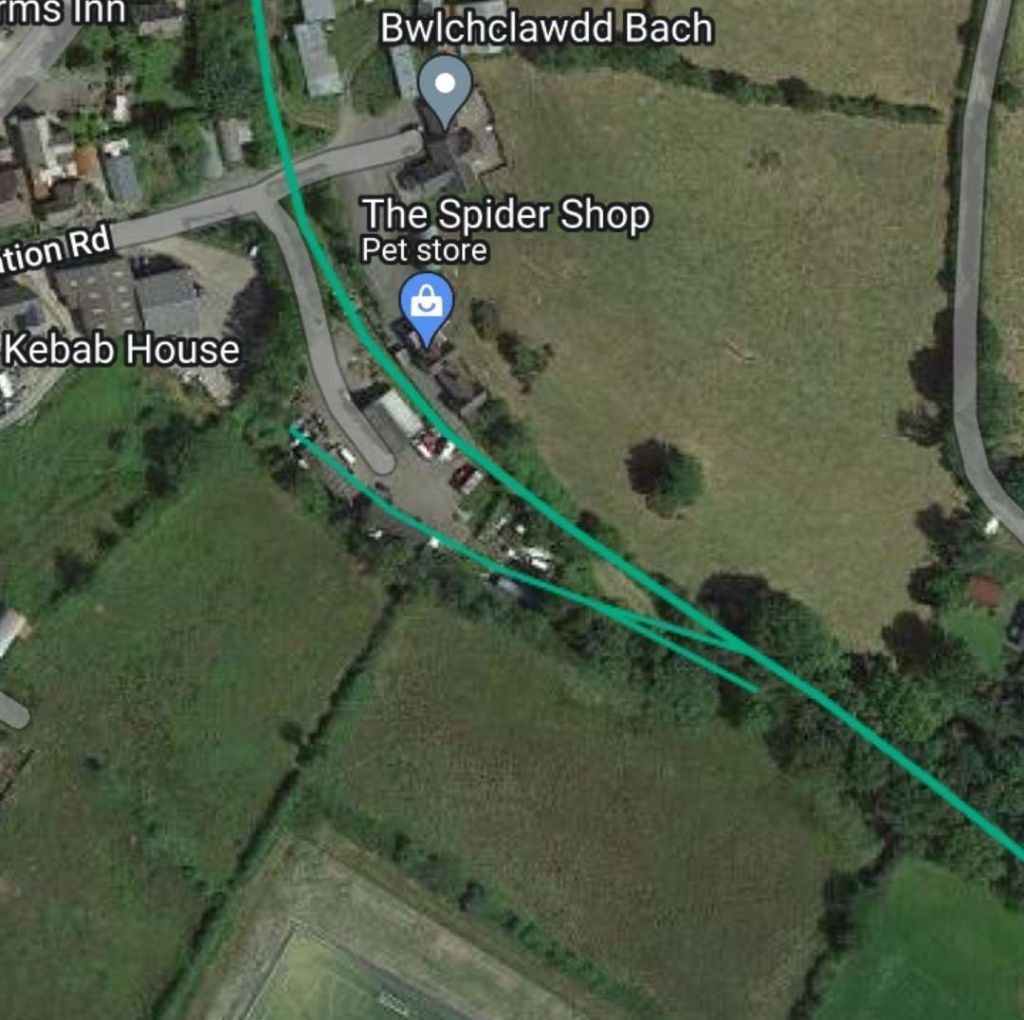
A closer view of the station site as shown on railmaponline.com’s satellite imagery. The station building was on the Northeast side of the running lines, the goods shed on the Southwest  side of the through lines. [3]
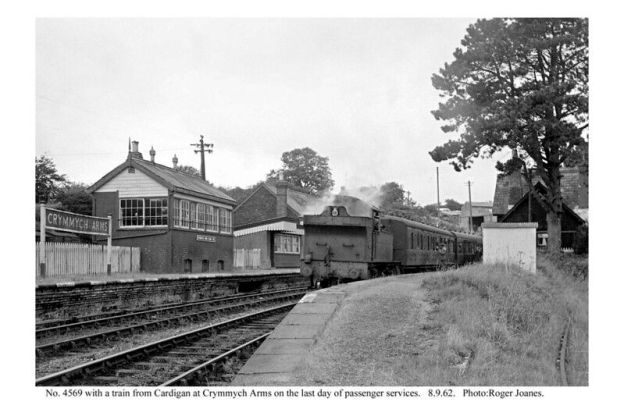
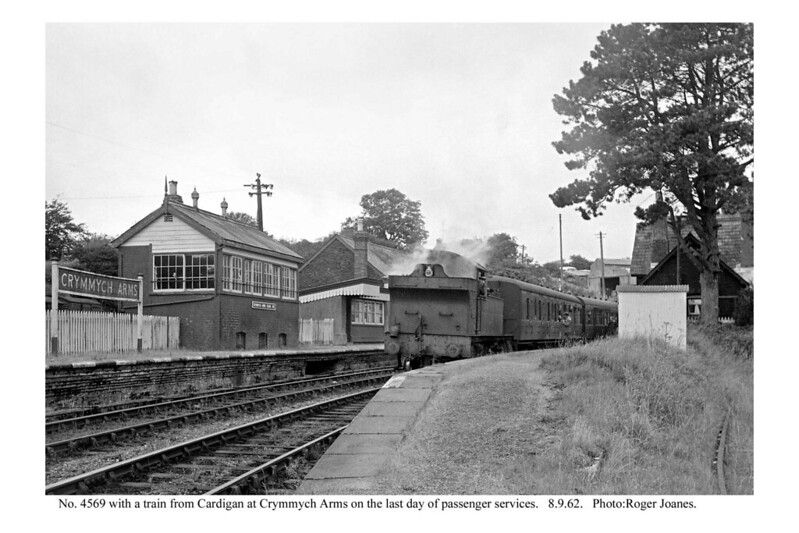
Looking Northwest from a point just off the end of the up platform at Crymmych Arms Railway Station. Locomotive  No 4569 is in charge of a service from Cardigan on 8th September 1962. The main station building can be glimpsed on the right side of the image with the signal box and goods shed to the left of the image at the back of the down platform, © Roger Jones and authorised for use here under a Creative Commons Licence (CC BY-NC-ND 2.0). [26]

The story of an N Gauge project to model Crymmych Arms Railway Station can be found here. [14] The station is covered in some detail in text and photographs on the Disused Stations website. [16]

The station was, for a time the terminus of a branch line from Whitland which was extended by the GWR to Cardigan.

M.R. Connop Price says that Crymmych Arms station was “situated near the source of the [Afon] Taf and in the shadow of the 1,297 ft high Freni Fawr, on the edge of the Prescelly mountains. The buildings were substantial, and right up to the 1960s a pillar box was provided on the wall of the large station house on the up platform. Another facility on the up platform was a well that always gave ice cold water; a GWR cup was available for drinking purposes. After the tablet instruments were removed from Llanfyrnach [further South down the line], Crymmych Arms became [a] … tablet station on the line. Latterly it was the only intermediate station to be in the charge of a station master.” [15: p82]

C.J. Gammell notes that Crymmych Arms, “as well as being a crossing point and block post was closed to the summit of the line, reached by steep gradients from both sides. Up goods and mineral trains had to stop to pin down brakes on the 1 in 35 decent from Crymmych Arms as well as the 1 in 60 rise from the North to the station.” [18: p233]

M.R. Connop Price notes that South of Crymmych Arms “there was a 500 yd stretch at 1 in 35. Train crews [on down trains] undoubtedly entered Crymmych Arms with a great sense of relief!” [15: p77]

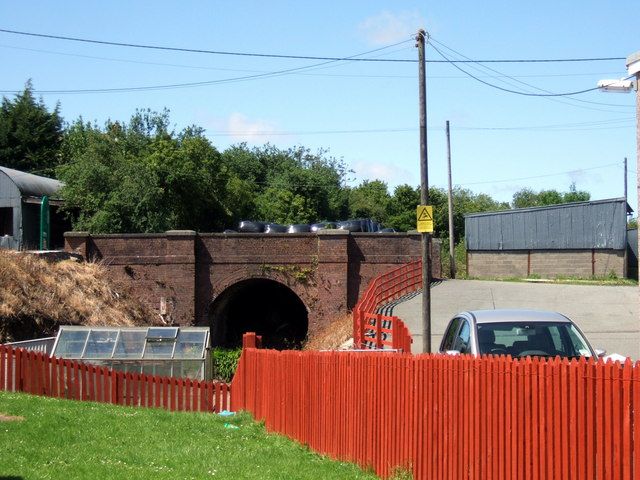
The photographer says that this picture shows the mouth of the short tunnel at the North end of Crymmych Arms Railway Station. Other sources refer to this as a bridge. It appears that the cutting to the North may have been backfilled. This photograph was taken by Natasha Ceridwen de Chroustchoff  on 29th June 2007 and shared by her on the geograph.org.uk website on the following day. It shared here under a Creative Commons Licence (CC BY-SA 2.0). [17]
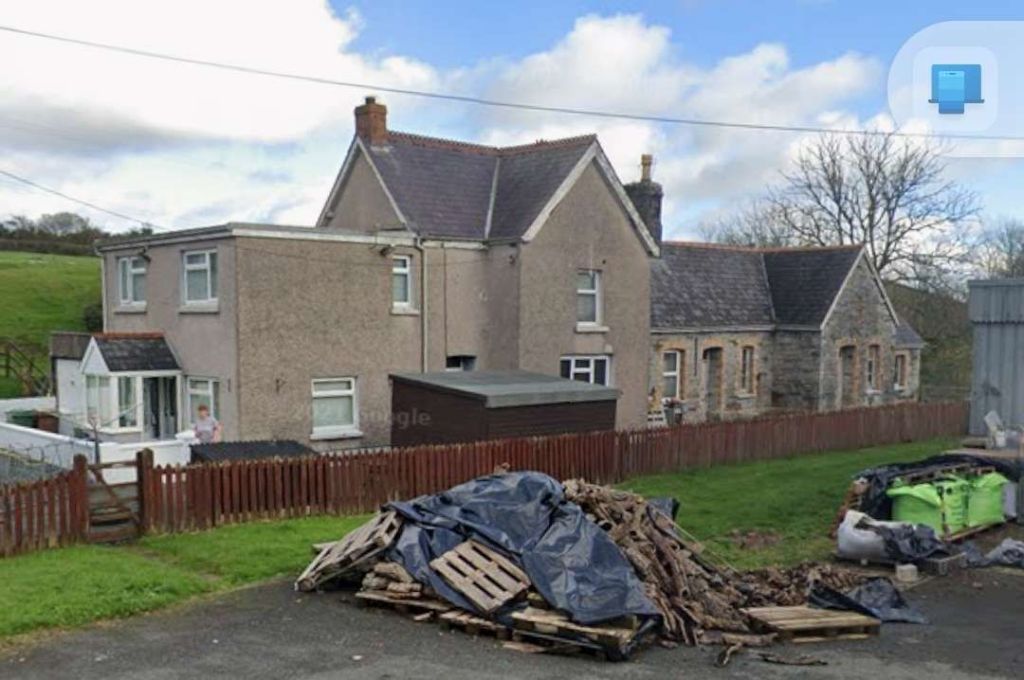
Crymmych Arms Railway Station building in the 21st century. This view looks Southeast across what were once the running lines. The platform edge was approximately along the line of the fence. [Google Streetview, November 2021]
The goods shed at Crymmych Arms Railway Station seen from the North in the 21st century. Its canopy remains but has been enclosed. [Google Streetview, November 2021]

Southeast of Crymych village, the Whitland & Cardigan Railway ran almost due Easton the South side of the valley of the Afon [12]
This railmaponline.com satellite image takes the line as far as the map extract above. [3]
The old railway continues in a generally easterly direction on the South side of the valley of the Afon Taf. [19]
The same area as shown on the map extract above as it appears on the ESRI satellite imagery from the National Librbary of Scotland. The line of the old railway follows the Southern boundary of the wooded area in the valley of the Afon Taf. [19]
Still travelling in a generally easterly direction the Whitland & Cardigan Railway runs through the village of Glogue with its adjacent quarries. A better map of these quarries can be found in M.R. Connop Price’s book about the Whitland & Cardigan Railway. [15: p73][20]
The same length of the line as shown on railmaponline.com’s satellite imagery. [3]
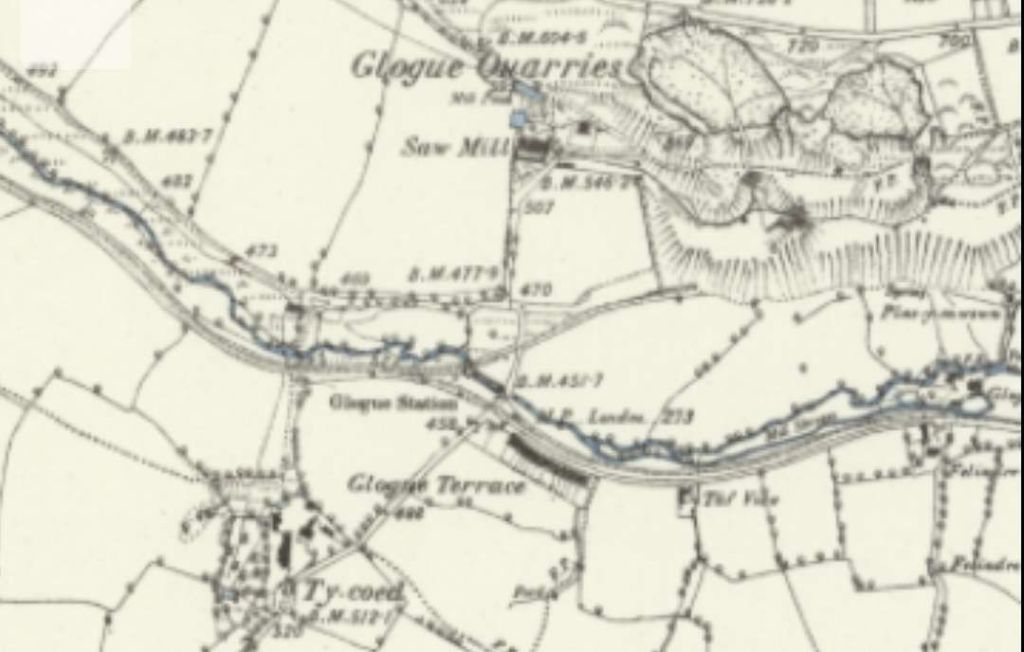
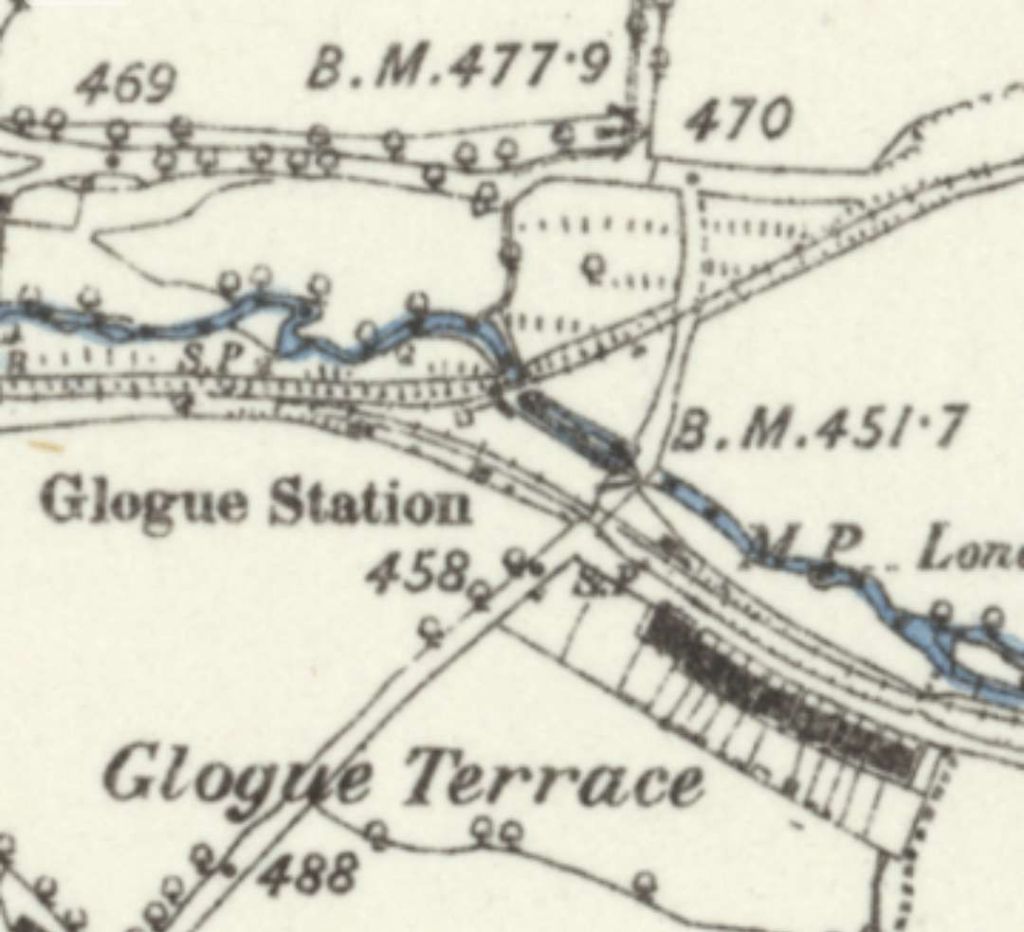
An enlarge extract from the OS Survey of 1887 (published in 1888) showing the village of Glogue, its level-crossing and its railway station. The short branch serving Glogue Quarries can be see crossing the Afon Taf on a bridge to the West of the station which was itself to the West of the level-crossing. [20]
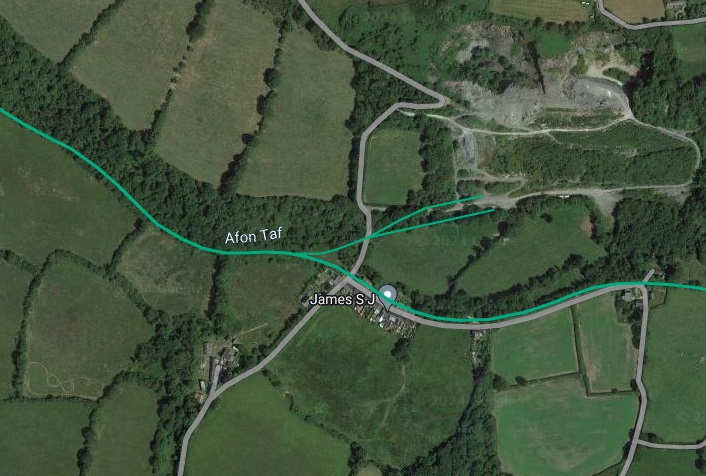
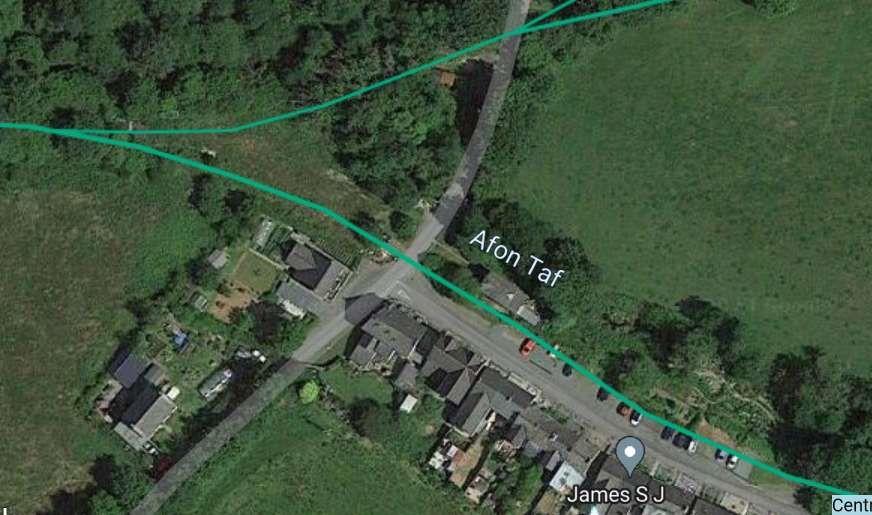
This extract from the railmsponline.com satellite imagery shows the immediate area of the station and terrace in Glogue. The old railway line is marked by the green line. The line shown heading away to the North headed for Glogue Quarries. [3]
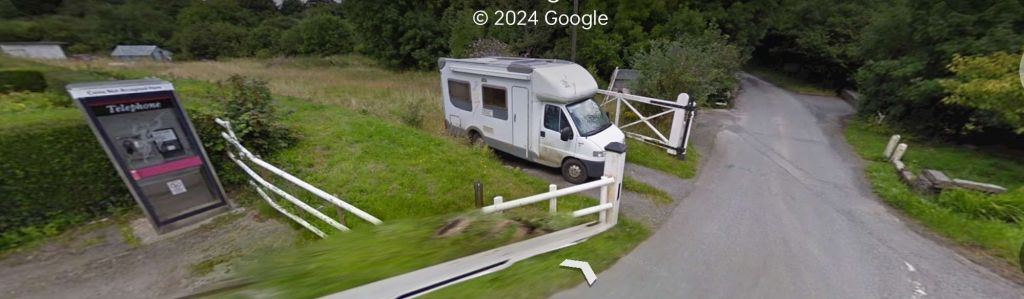
A panoramic view of the level crossing and railway station site seen from the road to the South and looking North in 2009. At this time, one of the two crossing gates is still in position. The motor home is parked on the line of the old railway. The station house is a short distance off to the right of the image. [Google Streetview, August 2009]
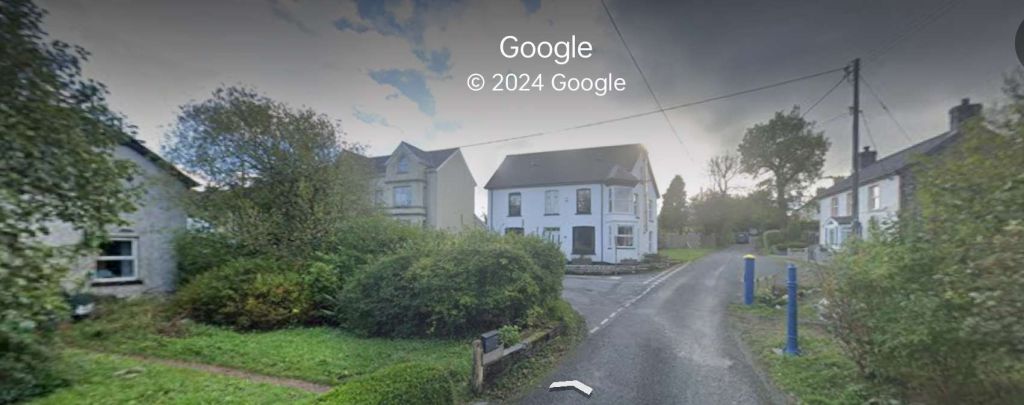
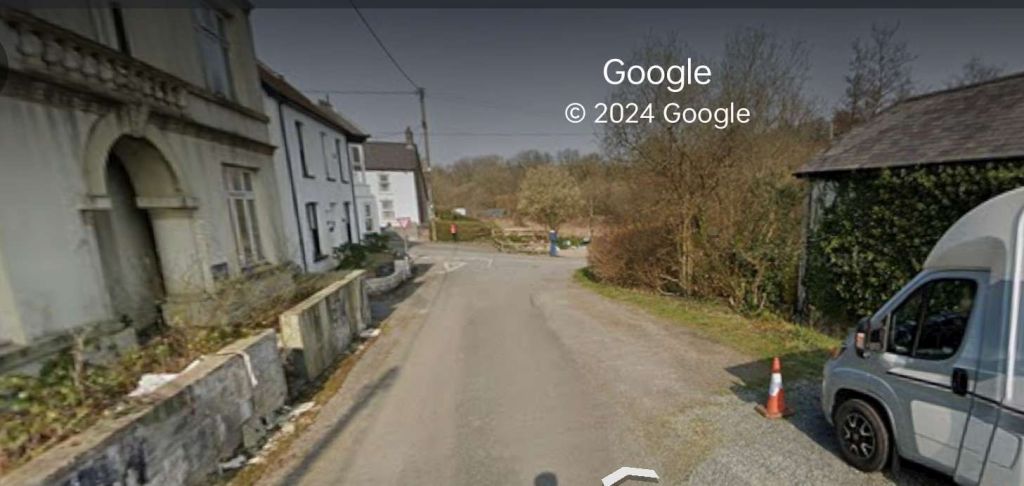
Another panoramic view, this time from the road to the North of the level crossing, in 2021. The crossing gate posts in the last image have been painted blue, the station house can this time be seen in the image. It is on the left. The old railway ran between the gateposts on the right and through the area of bushes to the left of the road, continuing behind the station house in this view. [Google Streetview, November 2021]
Looking West alongside the terraced houses in Glogue (on the left of this picture). These houses used to face across the street onto the old railway which ran from the crossing gateposts in the distance and along what is now a grass verge alongside the station house on the right of the photograph. [Google Streetview, November 2021]
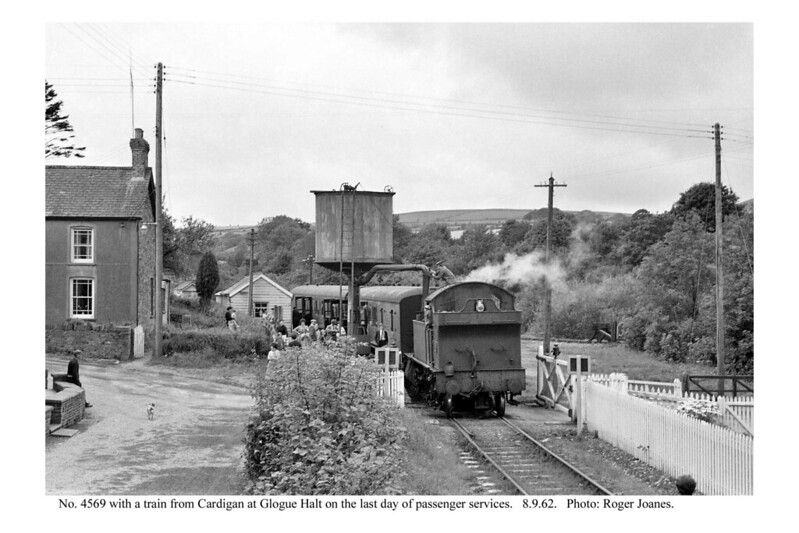
Looking West through the level crossing at Glogue with the station platform beyond. Locomotive  No 4569 is in charge of a service from Cardigan on 8th September 1962. This area equates to the central area of the Streetview image above,, © Roger Jones and authorised for use here under a Creative Commons Licence (CC BY-NC-ND 2.0). [25]

The station has a page on the Disused Stations website. [31] The Coflein record for the station notes that when “the station closed in 1962, the wooden station buildings and water tower were demolished although Station House nearby still survives.” [33]

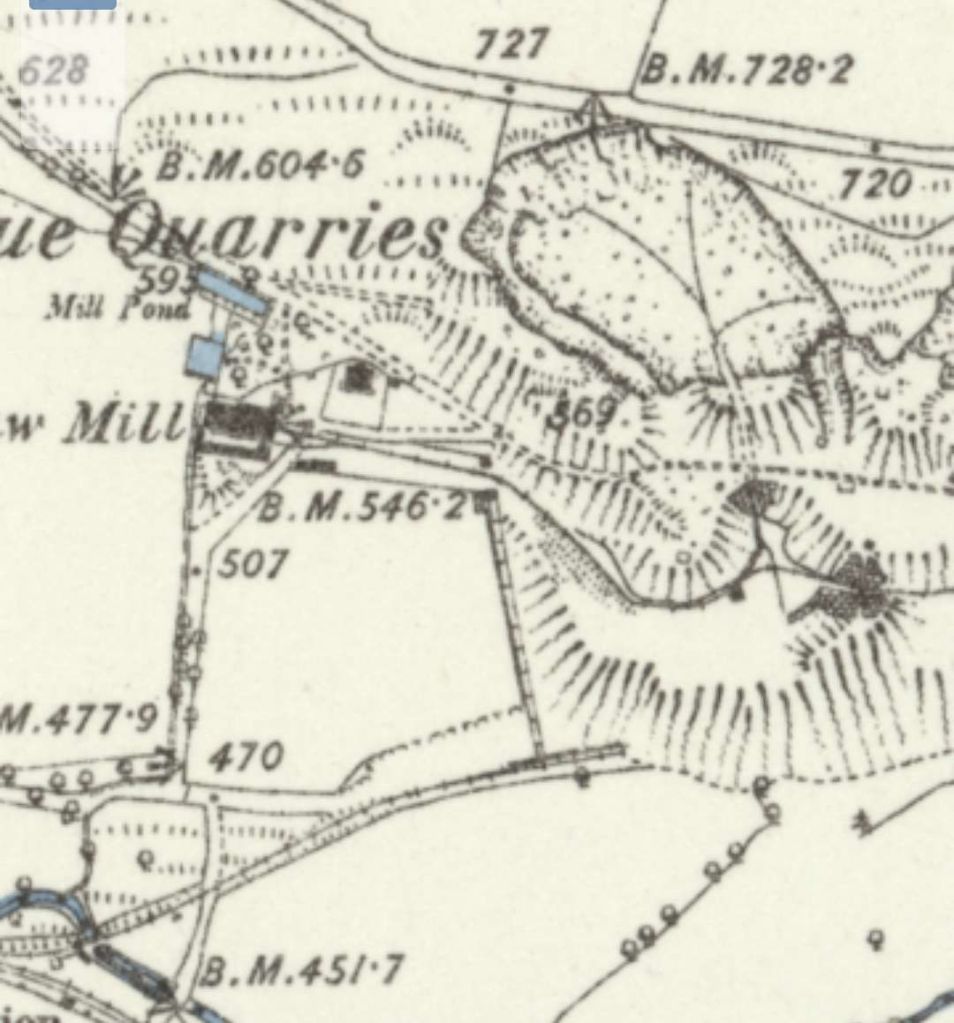
Glogue Quarries were served by a short branch from the Whitland & Cardigan Railway which terminated in two sidings. The quarries had an internal tramway system which included a number of inclines and tunnels. A better map of the quarries can be found in M.R. Connop Price’s book about the old railway. [15: p73][20]

The Coflein record, written by David Leighton, RCAHMW in February 2015, talks of a single quarry formed by “the merging of two early, perhaps seventeenth-century, workings. Material was lowered by two inclines, the upper one abandoned when work deepened and a tunnel was cut to bring material out to the head of the lower incline. The workings were handicapped by a lack of transport. Originally slate was was carted to Blackpool on the Eastern Cleddau, and after 1853 to Narberth Road on the South Wales Railway. Expansion only became possible when in 1873 a siding on the Whitland & Cardigan Railway was laid.” [21] There was a mill, powered by steam and later electricity, at the Western edge of the site. “Roofing slates of good colour were produced but as they were heavy the main output was slab. During the 1920s attempts were made to make bricks from slate dust. But these became uncompetitive when, in 1927, the GWR demanded a transport premium due to their weight; forcing closure. Bulk working has left little to be seen aside from vestiges of buildings in the mill area and the stone-built lower incline. Notably, a terrace of family dwellings was built by the company and is still occupied (in 1991).” [21]

Wikipedia says: “Glogue quarry was a slate quarry … worked from the late 1700s, by the mid-1800s it was owned by John Owen, who wanted to make higher profits by improving his distribution. This led to the construction of the Whitland and Cardigan Railway. The advent of the railway led to Owen expanding his workforce to over 80 men. … After sale to a local consortium, the quarry was worked until 1926.” [32]

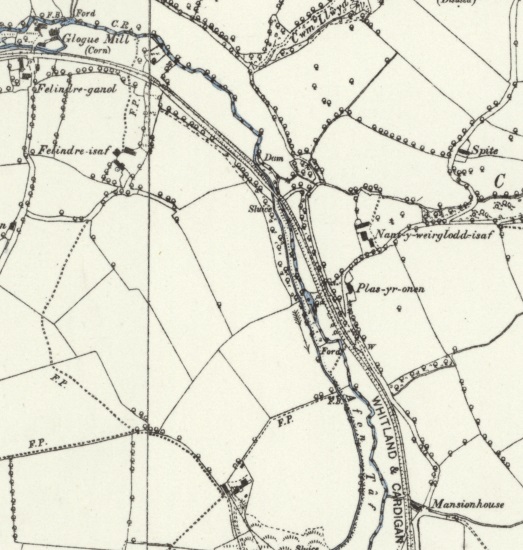
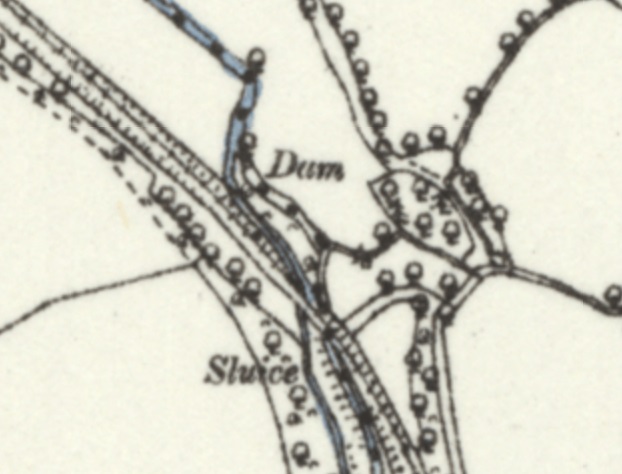
The 6″ Ordnance Survey of 1887 shows the old railway continuing East alongside the Glogue Corn Mill before turning South. All the while, it ran alongside the Afon Taf, although as it turned South it bridged the river, as shown here in the central part of the image and in the enlargement which is a few images below. [22]
The same area on the railmaponline.com satellite images. [3]
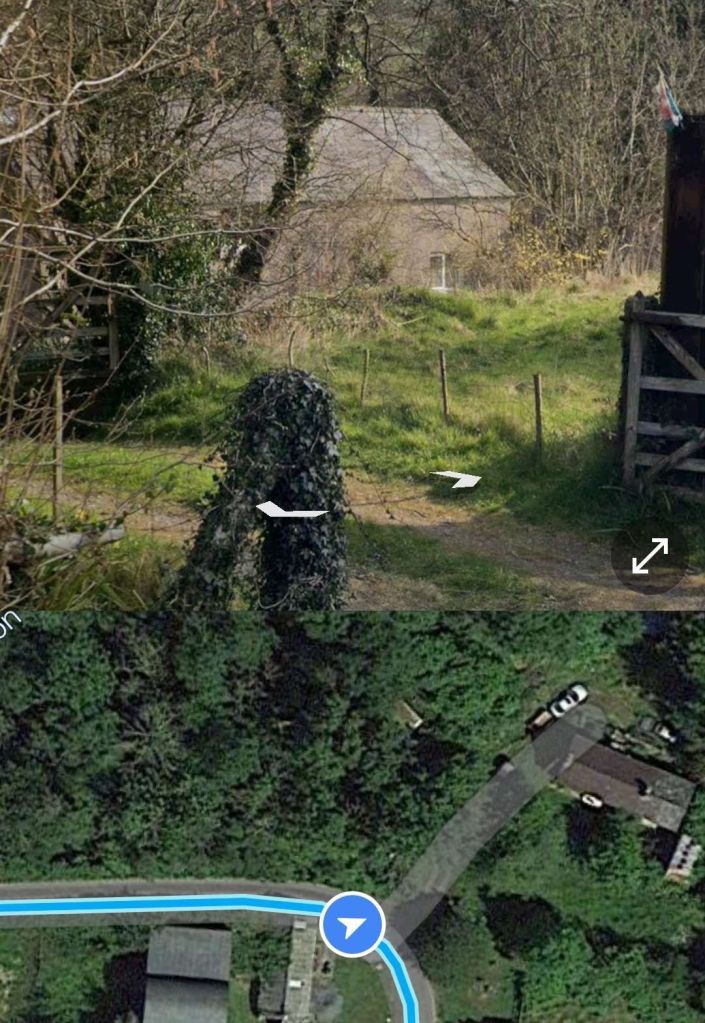
A combined image which shows both the view across the line of the old railway to the buildings of Glogue Corn Mill, in the upper part of the image, and the location of the camera on the lane to the East of Glogue, in the lower portion of the image. [Google Maps/Streetview, November 2021]
An enlarged extract from the 6″ OS map above which shows the location where the railway bridged the Afon Taf. [22]
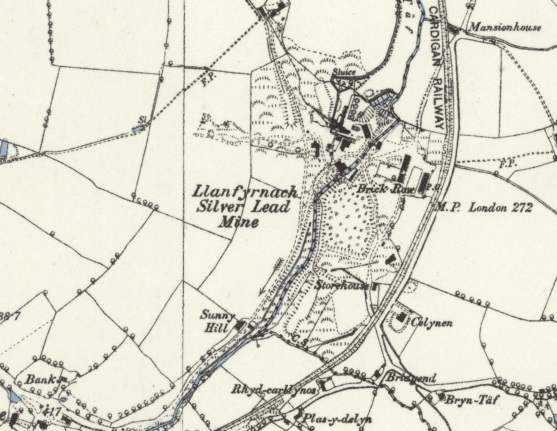
As the railway continued heading South it curved round the Llanfyrnach Sliver Lead Mine on the approach to the railway station at Llanfyrnach. [23]
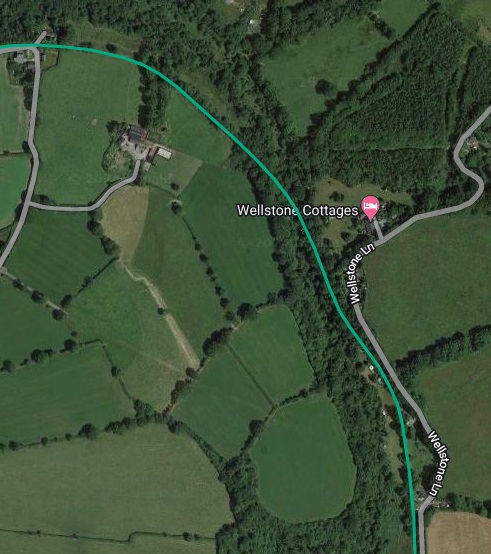
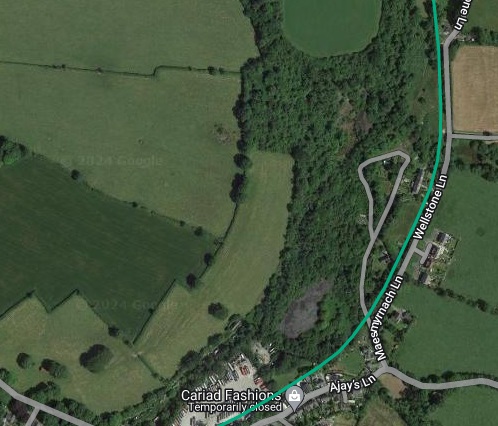
A very similar length of the Whitland & Cardigan Railway shown on the railmaponline.com satellite imagery. Both these images  show that the old railway ran alongside Wellstone Lane as it travelled South. [3]
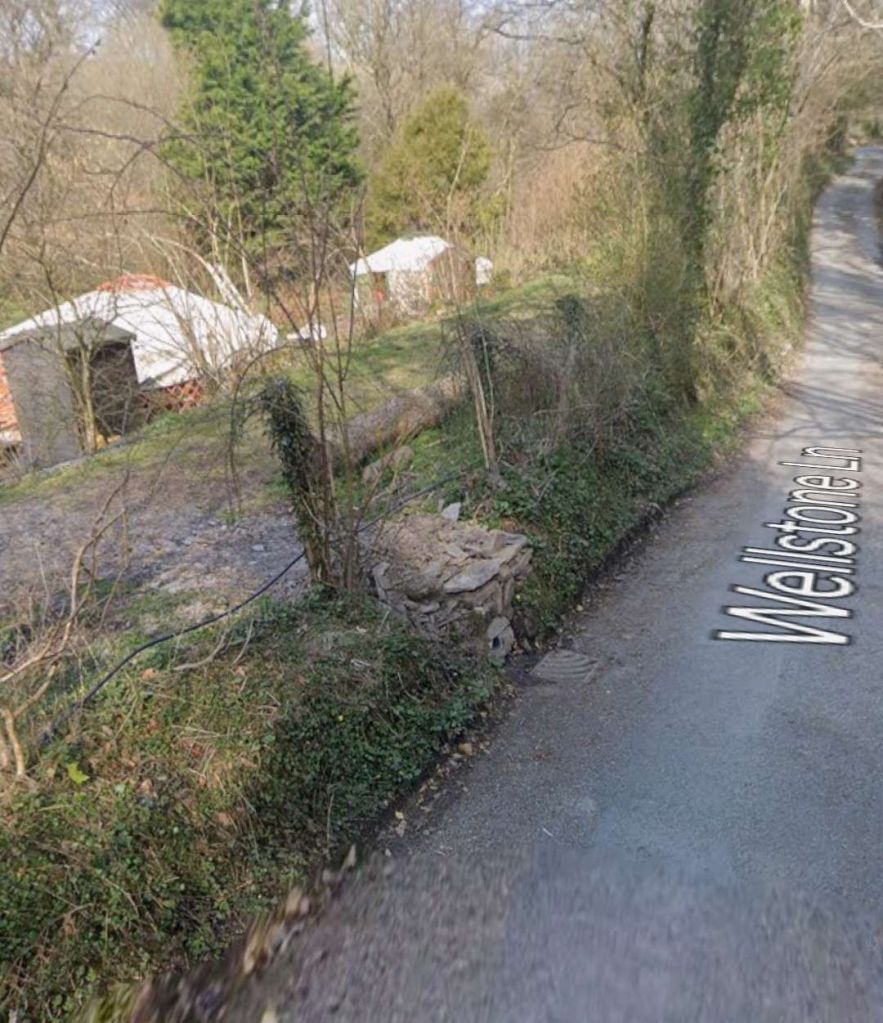
Looking Northwest from Wellstone Lane, the railway ran on the shoulder next to the lane. The land dropped away into the adjacent field, the other side of the line. The sheds visible in this picture are at the lower level beyond the line of the old railway. [Google Streetview, November 2021]

As its name suggests, Llanfyrnach Silver Lead Mine was a 19th century silver/lead producer; on site in the 21st century there are ruins of Cornish engine house and other mine buildings. [34] It was, “an important lead mine with a number of shafts, extensive tips and tailings heaps, buddle pits, together with a number of mine buildings including the remains of a Cornish engine house and boiler remaining on the site. … [It was] by far the largest of the Pembrokeshire mines, and of the south Wales mines, second only to Carmarthenshire’s Nantymwyn Mine in terms of the recorded output. A reference in the Mining Journal (1879) notes a well-defined east-west lode made up of sugary quartz and containing a good deal of lead, and about 150 tons of lead ore being delivered monthly from this and the old lode. Very little sphalerite was sold until the final few years of its working. Silver was extracted from the galena.” [35]

Passing through Llanfyrnach, the railway ran Southwest, crossing to the West bank of the Afon Taf. [24]
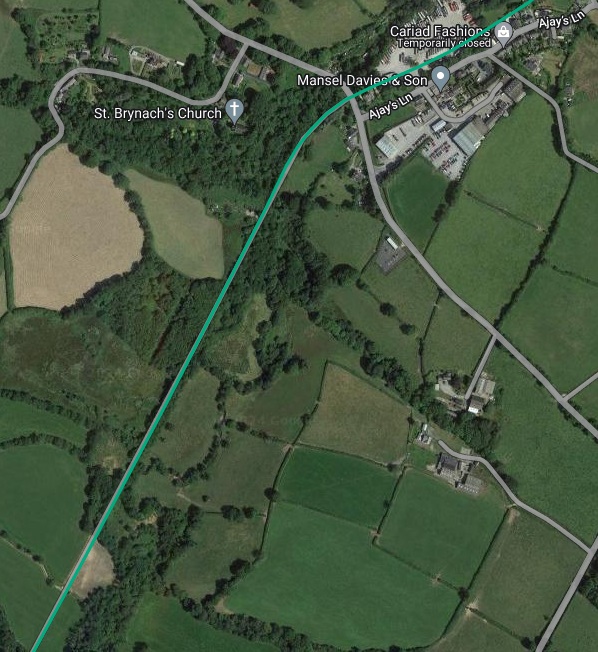
The railmaponline.com satellite imagery shows the same area as the map extract above, with the old railway heading Southwest close to the Afon Taf. [3]
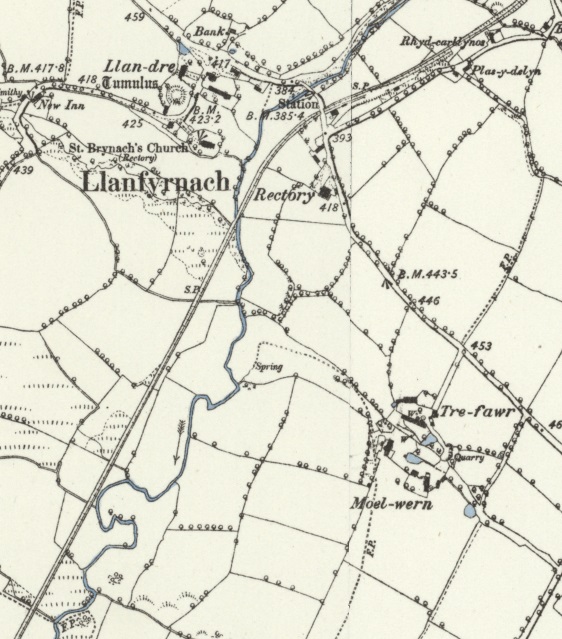
An enlarged extract from the 6″ Ordnance Survey of 1887 focussed on the village of Llanfyrnach and its Railway Station. The Station was to the East of the main road through the village. The location of the next railway bridge over the Afon Taf can be seen at the bottom of this extract. [24]
Llanfyrnach Railway Station facing Southwest with the level crossing at the far end of the platform. This image is provided on the Coflein record for the station. It comes from the Rokeby Album VIII no 51, 167/21. It is authorised for use here by Coflein. [40]
This photograph was taken on the last day of operations on the line on 8th September 1962. The camera is facing Northeast through the level-crossing into the site of Llanfyrnach Railway Station. This image was shared on the Login Railway Station Facebook Page on 22nd June 2024. [41]
Llanfyrnach Station House seen from the road to the Northwest in 1915. This image was shared on the Login Railway Station Facebook Page on 31st May 2015. [42]
A view looking Northwest: Llanfyrnach station building in 2003, the railway ran on the far side of the building, crossing the road at level, © Ben Brooksbank and licensed for reuse under a Creative Commons Licence (CC BY-SA 2.0). [37]
Llanfyrnach Railway Station building in 2009 – seen from the South. [Google Streetview, August 2009]

Llanfyrnach Railway Station has its own page which includes text and photographs on the Disused Stations website. It can be viewed here. [36] The Disused Stations page for the railway station suggests that the building in in a considerably worse condition in 2024. Two images showing its condition can be viewed here [38] and here. [39]
This final image taken looking Southwest along the platform at Llanfyrnach Station shows the siding which provided a small goods facility at the station. This image was shared on the Login Railway Station Facebook Page on 8th November 2019. [43]

Southwest of the station the old railway is now followed by a modern single track access road.

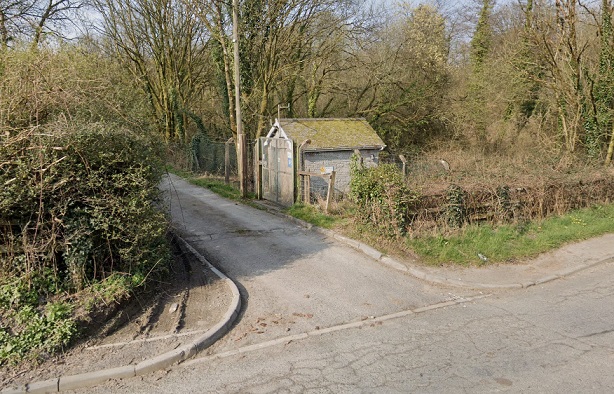
The Llanfyrnach entrance to the modern track following the route of the old railway. [Google Streetview, March 2022]
Google Maps shows the track running along the formation of the Whitland & Cardigan Railway Southwest from Llanfyrnach. [51, Google Maps, July 2024]

A short distance along the access road/old railway route, the line crossed the Afon Taf again. An enlarged extract from the 6″ Ordnance Survey is shown below.

This enlarged extract from the 6″ Ordnance Survey of 1887 shows the location of the bridge across the Afon Taf which was to the Southwest of Llanfyrnach Station. [24]
Continuing to the Southwest, the Whitland & Cardigan Railway followed the North bank of the Afon Taf. [44]
This extract from Google Maps shows the track running along the formation of the old railway. It covers a slightly larger area than the extract form OS mapping above. In the bottom-right of this image the modern track can be seen terminating at a T-junction with another track. [52, Google Maps, July 2024]
Again, continuing to the Southwest, the Whitland & Cardigan Railway followed the contours on the North bank of the Afon Taf, crossing a farm access road. The length of the line Northeast of the access track at the centre of this image is shown on the modern Google satellite image above. That to the Southwest is shown below. [45]
The access track which followed the line of the old railway terminated in a T-junction with the farm access road at the top right of this extract from the railmaponline.com satellite imagery. The line continues in a southwesterly direction from that point. [3]
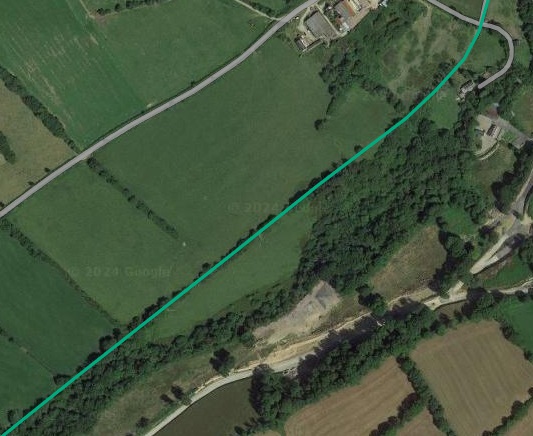
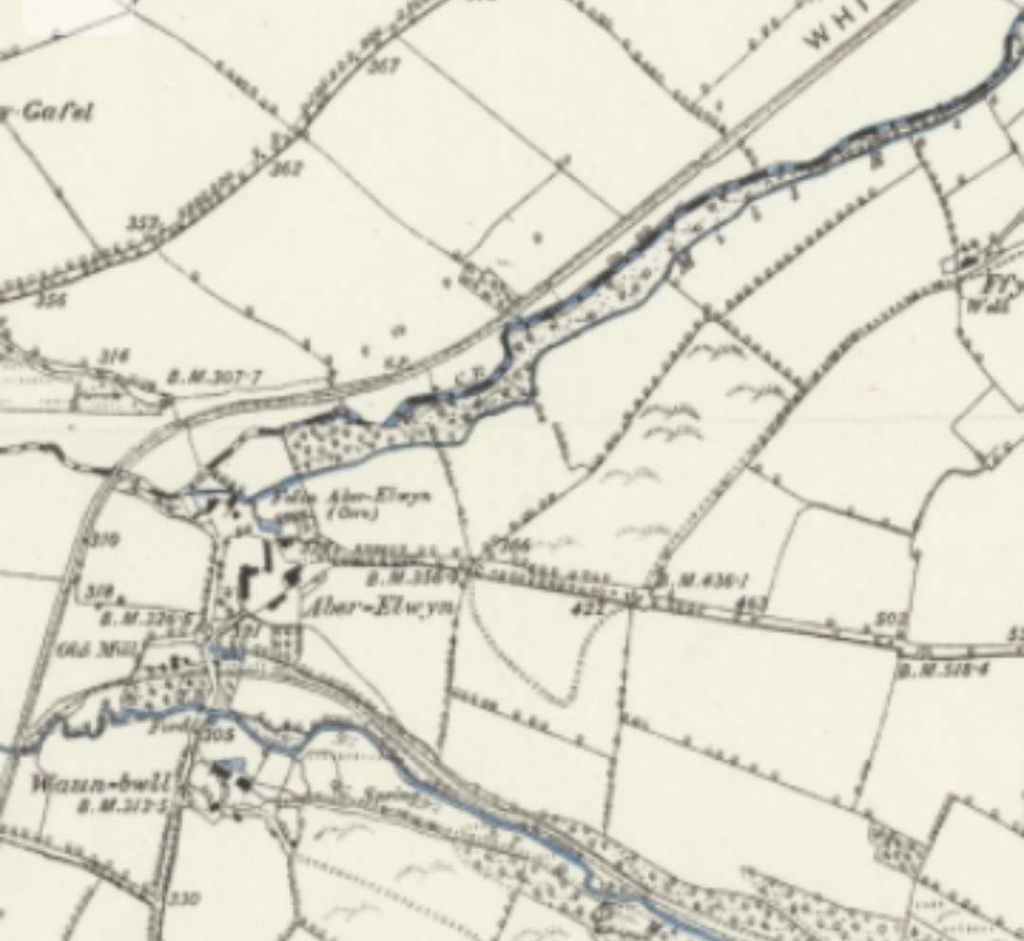
Continuing to the Southwest, the Whitland & Cardigan Railway continued to follow the North bank of the Afon Taf as far as Aber-Elwyn. An enlarged extract from the 6″ Ordnance Survey of 1887 below shows the location more clearly [46]
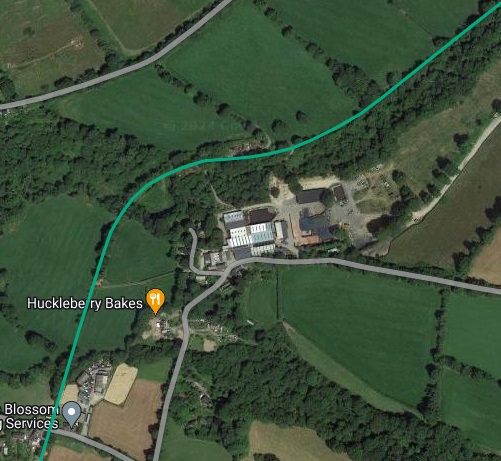
A similar length of the old railway is covered on this next extract from the railmaponline.com satellite imagery. [3]
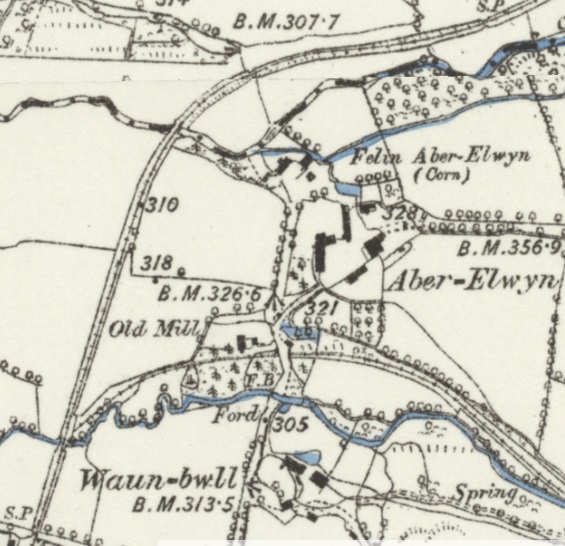
An enlarged extract from the 6″ Ordnance Survey of 1887 shows the old railway bridging the Afon Taf to the Northwest of Aber-Elwyn and then a tributary of the Taf to the Southwest of the hamlet, close to Waun-Bwll. The next station on the line sits just off the bottom-left of this extract – Rhyd-Owen Station. [47]
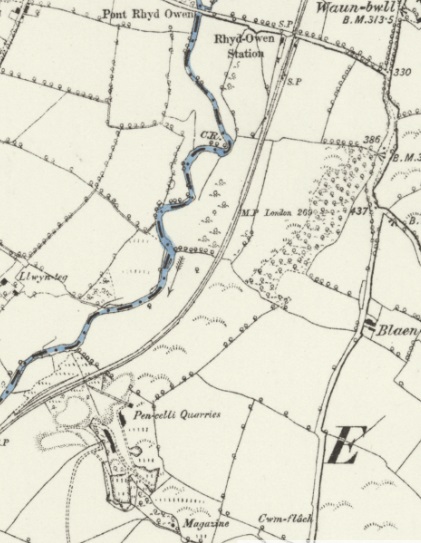
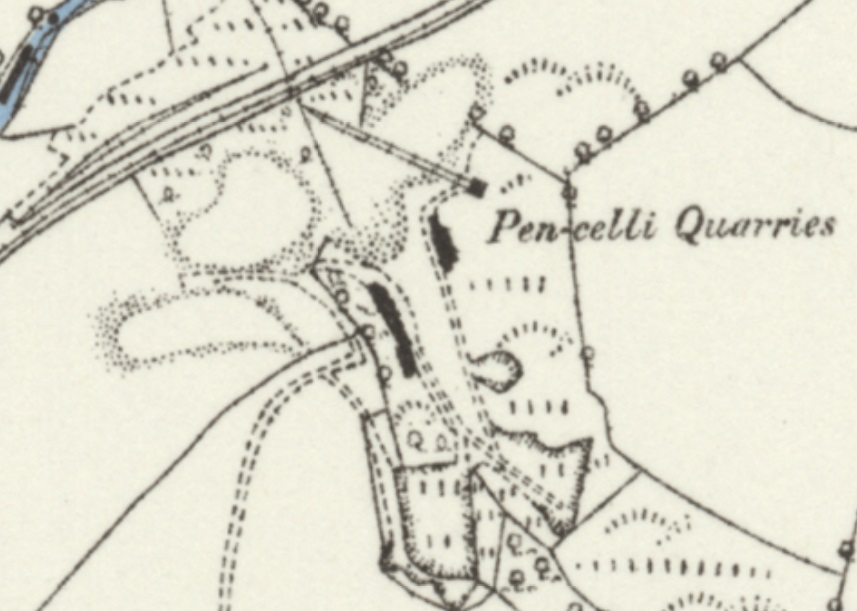
This next extract from the 6″ 1887 Ordnance Survey shows Rhyd-Owen Station, top-right and the Pen-celli Quarries, bottom-left. [48]
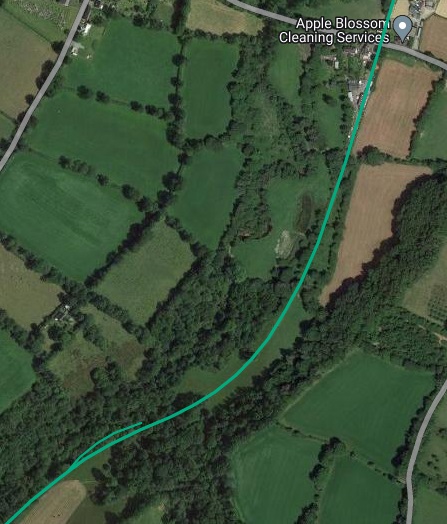
A similar length of the old railway is covered on this next extract from the railmaponline.com satellite imagery. [3]
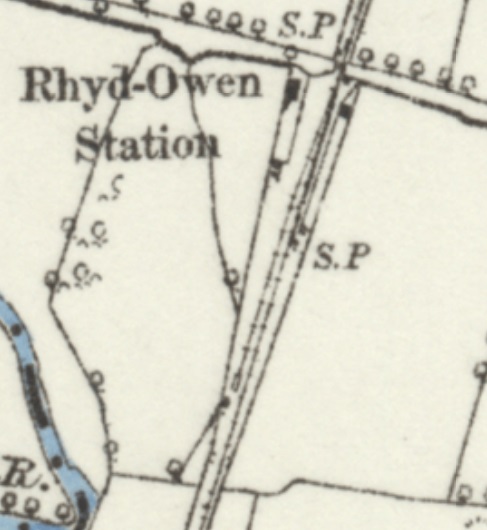
An enlarged extract from the 6″ Ordnance Survey of 1887 focussing on the Rhyd-Owen Railway Station. [49]

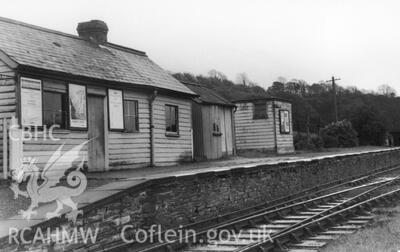
The Coflein record for Rhyd-Owen Station, written in 2010, notes that there was a through line with a passing loop; the passenger platform was on the up side. The station closed in 1962; although the wooden station buildings have been demolished, the nearby station house survives. [53]

Rhydowen Station in 1961, seen from the road at the North end of the station site, from the Rokeby Collection III ref 25c. It is authorised for use here by Coflein. [53]
Rhydowen Station in 1961, seen from the South end of the platform, from the Rokeby Collection III ref 25b. It is authorised for use here by Coflein. [53]
Another view of Rhyd-Owen Station. The train is on a down service to Cardigan and consists of a single Hawkesworth Corridor Brake 3rd coach pulled by an unidentified 16xx 0-6-0PT.The station house just appears at the extreme left of this image. This image was shared on the Login Railway Station Facebook Page on 11th February 2022. [54]
A view through the station from the North shows the loop siding at Rhyd-Owen. This image was shared on the Login Railway Station Facebook page on 16th September 2015. [55]
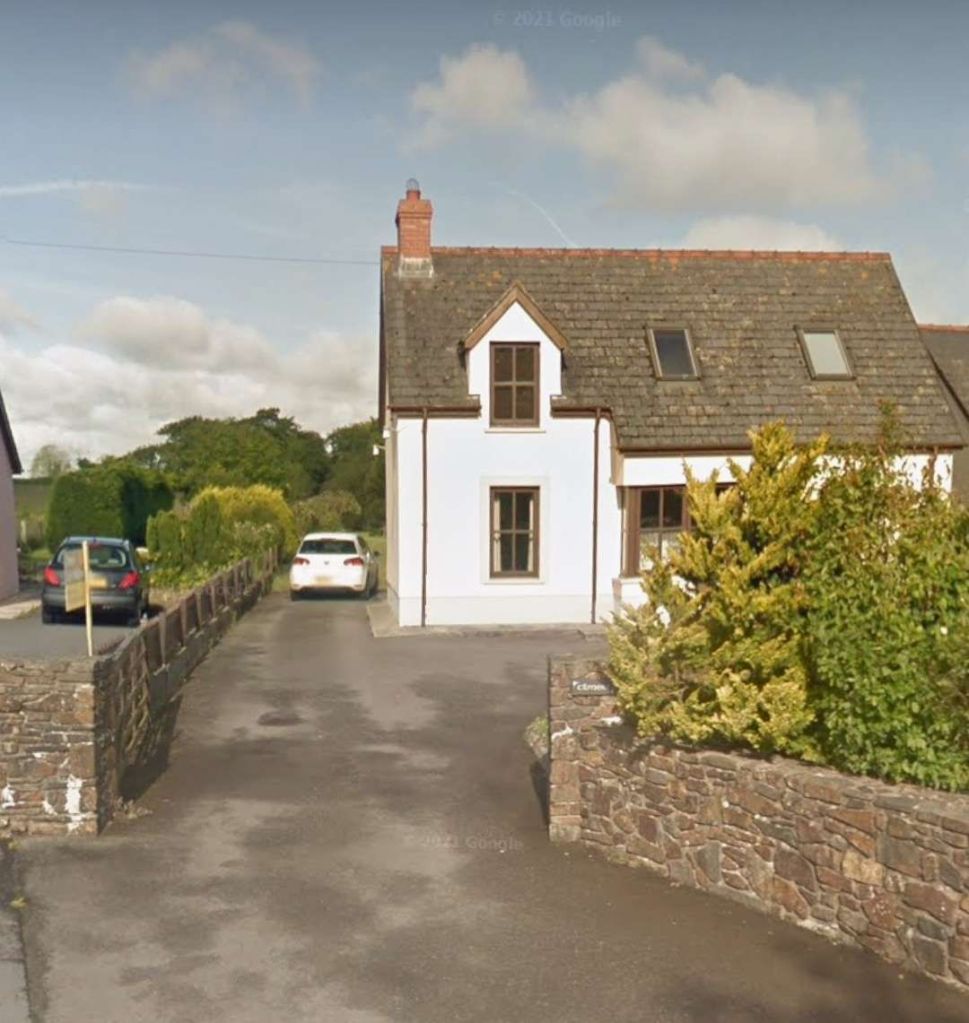
The site of Rhyd-Owen Railway Station, seen from the road at its northern end. The station itself was on the left side of this image with the station house on the right side. It appears as though the station house has been significantly extended and modernised. [Google Streetview, November 2021]

Rhyd-Owen Railway Station has its own page on the Disused Stations website. Click here. [60]

Another enlarged extract from the 6″ Ordnance Survey which shows the site of the Pen-celli Quarries. A single siding was provided for the quarries on the down side of the line. [50]
Another length of the old railway which was still heading in a southwesterly direction. [56]
This extract from the railmaponline.com satellite imagery covers a similar length of the line to that shown on the map extract above. [3]
This next extract from the 6″ Ordnance Survey of 1887 covers the length of the line as far as Llanglydwen Station. [57]
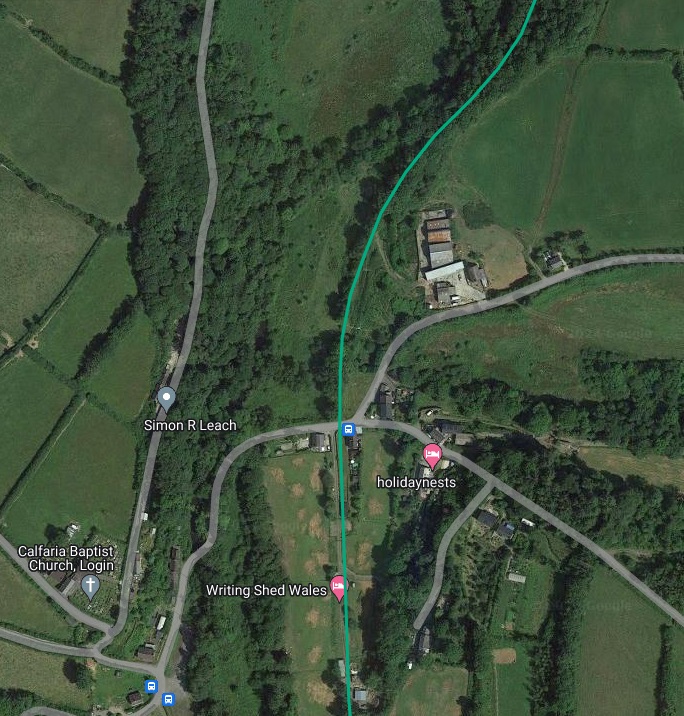
This extract from the railmaponline.com satellite imagery covers a similar length of the line to that shown on the map extract above. Llanglydwen Railway Station was sited towards the bottom of this image to the south side of the road through the village. [3]
An enlarged extract from the 6″ Ordnance Survey of 1887 which focusses on Llanglydwen Railway Station. [58]
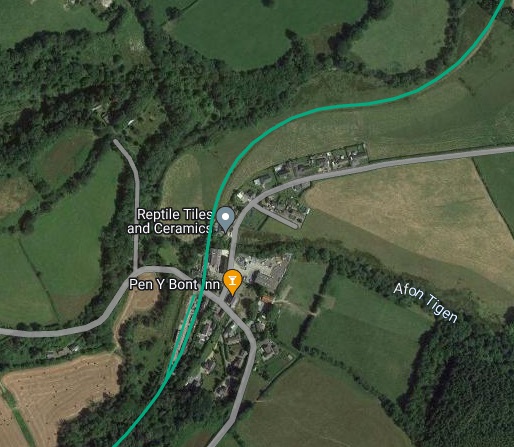
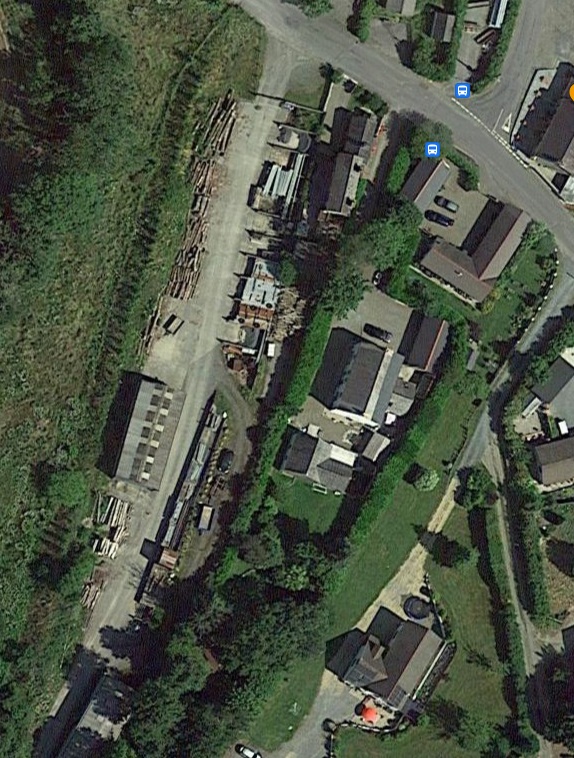
The Llanglydwen station site as it appears in the 21st century. [Google Maps, July 2024. [59]
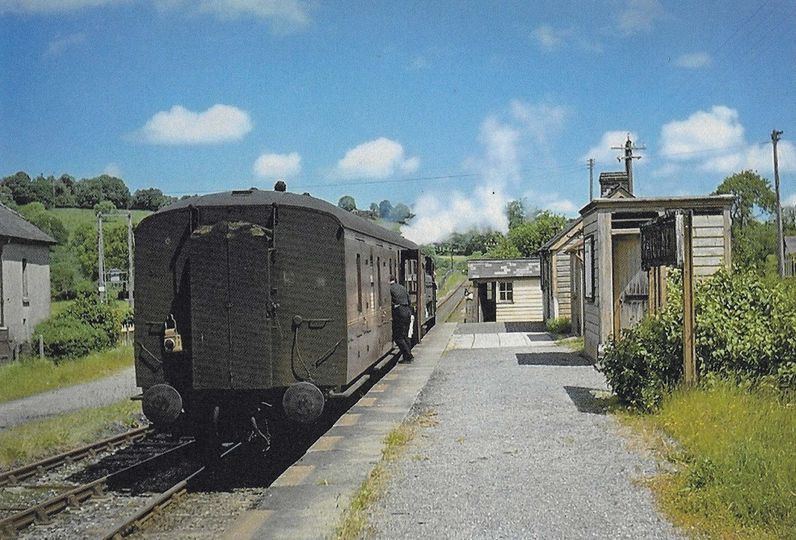
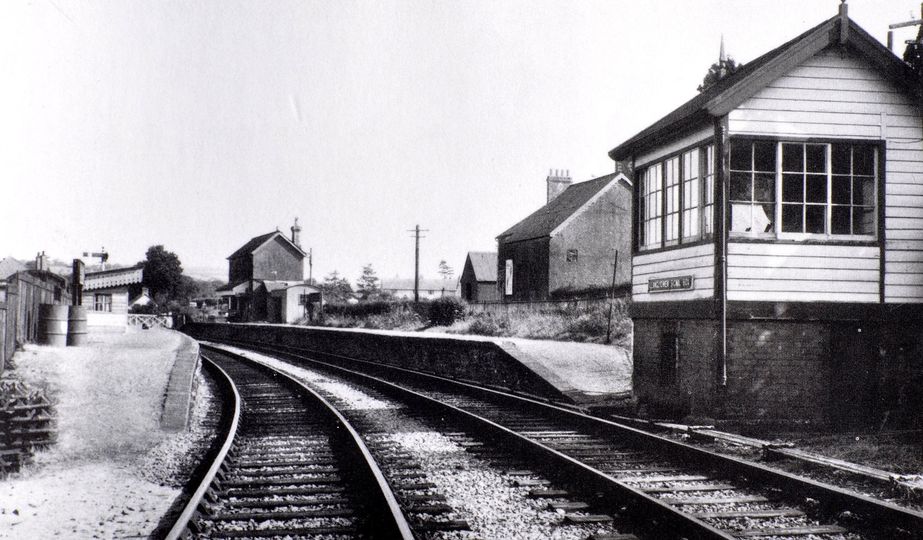
Llanglydwen Railway Station in the 1950s. This photo was shared on the Login Railway Station Facebook Page on 9th October 2014. [63]
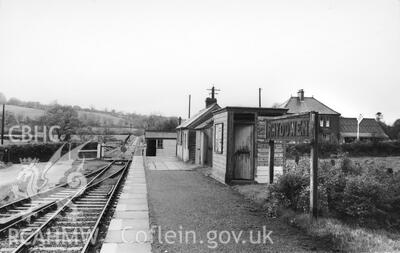
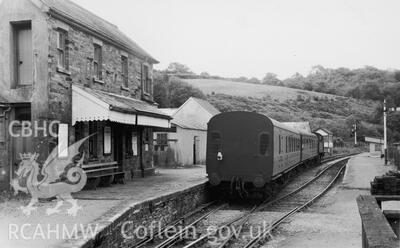
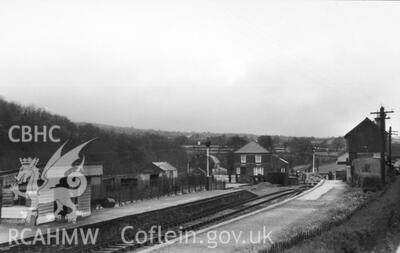
View of Llanglydwen Station in 1962 from the Rokeby Collection III ref 3b. [64]
View of Llanglydwen Station in 1962 from the Rokeby Collection III ref 4b. [64]
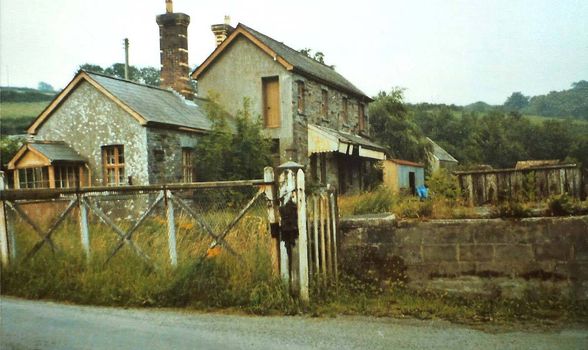
The station building in 1982 when the crossing gates were still in place. This photo was taken by John Gale and was more recently shared on the Login Railway Station Facebook Page on 23rd June 2015. [61]
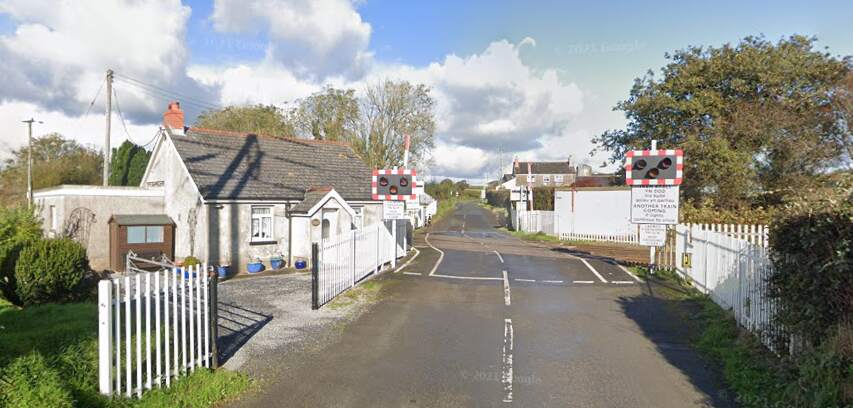
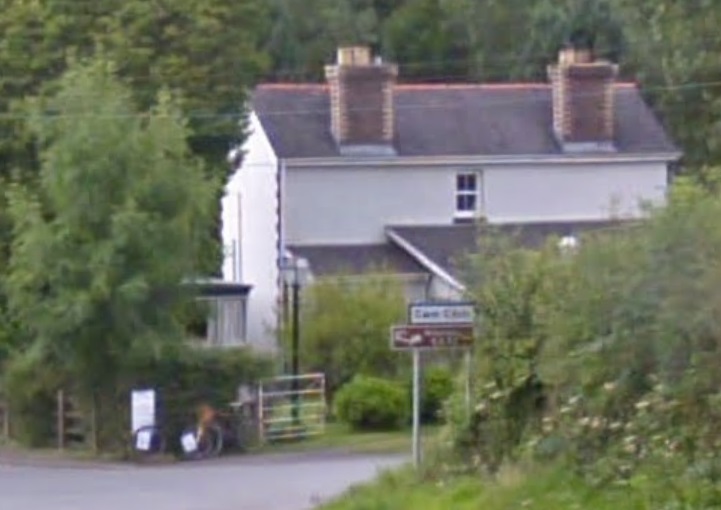
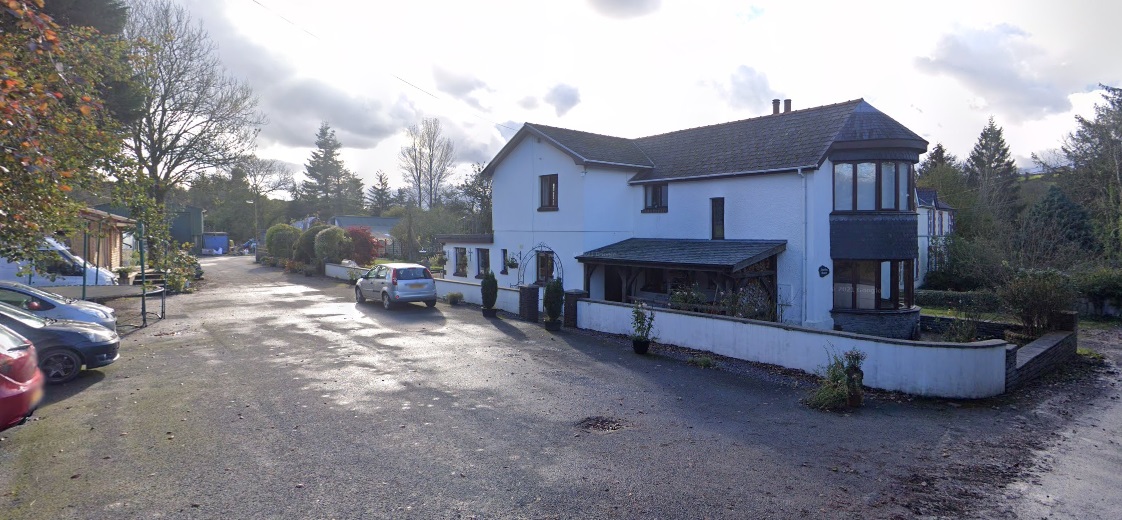
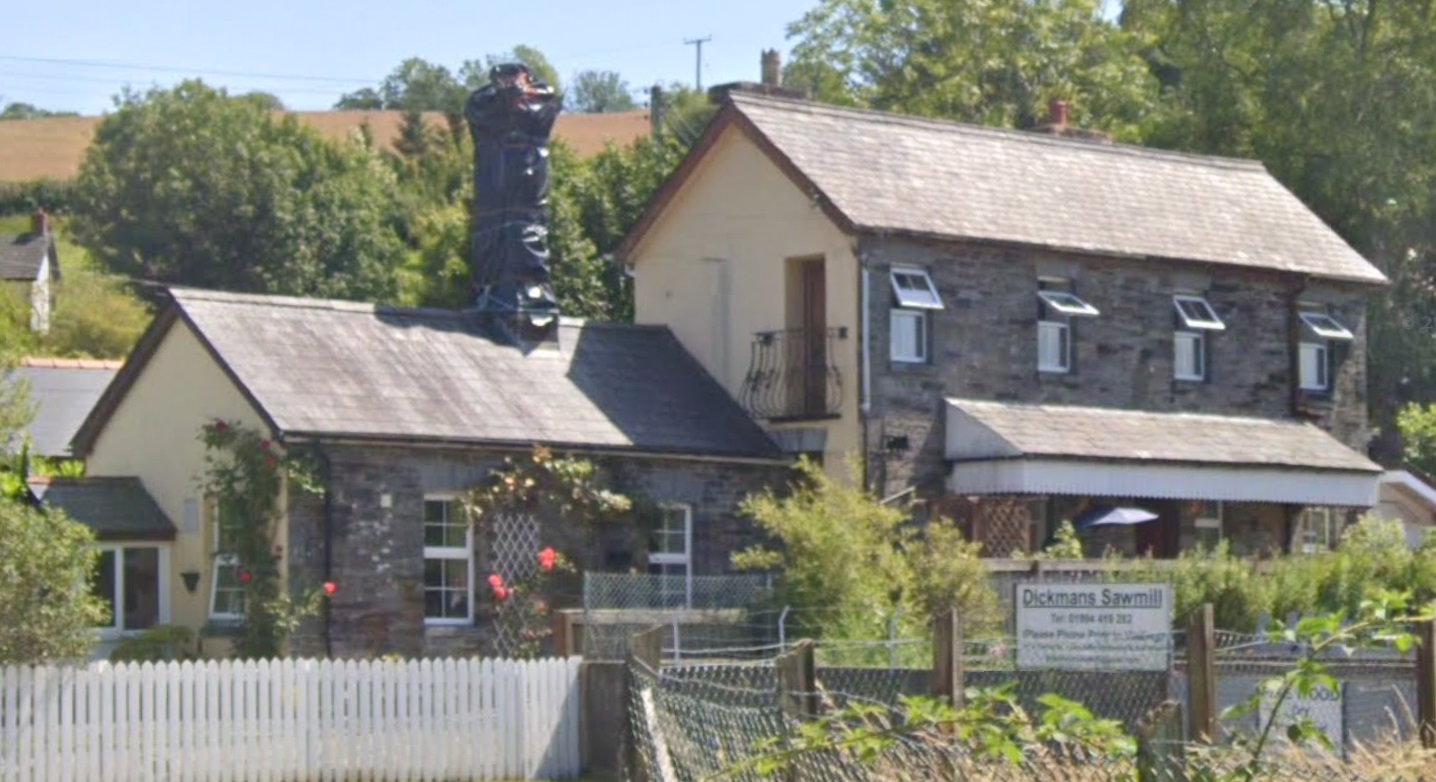
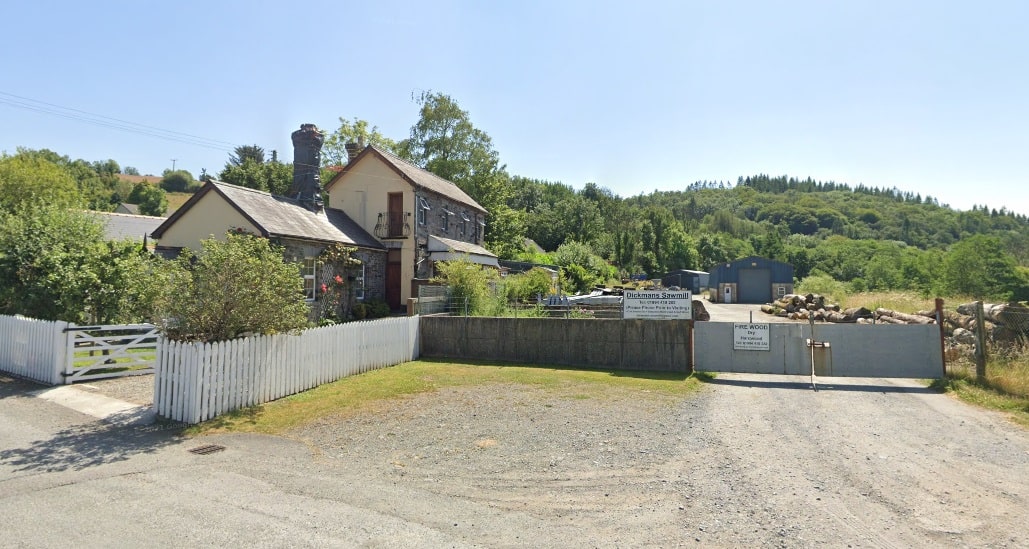
The erstwhile station site at Llanglydwen. The station building remains in place. The white gated driveway is on the line of the station platform and the white fence marks the approximate location of the main running line through the station. The station yard is, in the 21st century, occupied by Dickman’s Sawmill. [Google Streetview, July 2021]
A better view of what was the platform elevation of the station building as it appears in 21st century. [Google Streetview, July 2021]

Llanglydwen Railway Station has its own page on the Disused Stations website. Please click here to access that site. [62]

References

  1. M.R. Connop Price; Before the Railways: The Early Steamers of Cardiganshire; in the RCHS  Journal, Vol. 40 Part 8 No. 244 July 2022, p471-477.
  2. https://en.wikipedia.org/wiki/Whitland_and_Cardigan_Railway, accessed on 11th August 2022.
  3. https://railmaponline.com/UKIEMap.php, accessed in July 2024.
  4. https://rogerfarnworth.com/2024/07/15/railways-in-west-wales-part-2a-the-whitland-cardigan-railway-cardigan-to-boncath/
  5. https://maps.nls.uk/geo/explore/#zoom=18.0&lat=52.01480&lon=-4.61847&layers=257&b=1&o=100, accessed on 13th July 2024.
  6. https://coflein.gov.uk/en/site/410177/#:~:text=Boncath%20Railway%20Station%20was%20on,small%20goods%20yard%20and%20shed, accessed on 13th July 2024.
  7. https://maps.nls.uk/geo/explore/#zoom=14.9&lat=52.00860&lon=-4.62333&layers=257&b=1&o=100, accessed on 13th July 2024.
  8. https://maps.nls.uk/geo/explore/#zoom=14.6&lat=52.00067&lon=-4.63879&layers=257&b=1&o=100, accessed on 13th July 2024
  9. https://maps.nls.uk/geo/explore/#zoom=15.1&lat=51.99476&lon=-4.64762&layers=257&b=1&o=100, accessed on 13th July 2024.
  10. https://maps.nls.uk/geo/explore/#zoom=15.1&lat=51.98243&lon=-4.64199&layers=257&b=1&o=100, accessed on 13th July 2024.
  11. https://maps.nls.uk/geo/explore/#zoom=15.1&lat=51.97415&lon=-4.63963&layers=257&b=1&o=100, accessed on 13th July 2024.
  12. https://maps.nls.uk/geo/explore/#zoom=15.1&lat=51.96776&lon=-4.62089&layers=257&b=1&o=100, accessed on 13th July 2024.
  13. https://www.geograph.org.uk/photo/481271, accessed on 16th July 2024.
  14. https://platform1mrc.com/p1mrc/index.php?threads/crymmych-arms.1435, accessed on 17th July 2024.
  15. M.R. Connop Price; The Whitland and Cardigan Railway (2nd Edition); The Oakwood Press, Headington, Oxford, 1991.
  16. http://disused-stations.org.uk/c/crymmych_arms/index.shtml, accessed on 17th July 2024.
  17. https://www.geograph.org.uk/photo/482052, accessed on 17th July 2024.
  18. C.J. Gammell; Slow Train to Cardigan; in British Railways Illustrated Volume 4 No. 5, February 1995, p228-235.
  19. https://maps.nls.uk/geo/explore/#zoom=16.0&lat=51.96578&lon=-4.61030&layers=257&b=1&o=100, accessed on 22nd July 2024.
  20. https://maps.nls.uk/geo/explore/#zoom=16.0&lat=51.96337&lon=-4.59903&layers=257&b=1&o=100, accessed on 22nd July 2024.
  21. https://coflein.gov.uk/en/site/114990/, accessed on 22nd July 2024.
  22. https://maps.nls.uk/geo/explore/#zoom=16.0&lat=51.95927&lon=-4.59062&layers=257&b=1&o=100, accessed on 22nd July 2024.
  23. https://maps.nls.uk/geo/explore/#zoom=16.0&lat=51.95278&lon=-4.58841&layers=257&b=1&o=100, accessed on 22nd July 2024.
  24. https://maps.nls.uk/geo/explore/#zoom=16.0&lat=51.94827&lon=-4.59182&layers=257&b=1&o=100, accessed on 22nd July 2024.
  25. https://www.flickr.com/photos/110691393@N07/28427558505, accessed on 23rd July 2024.
  26. https://www.flickr.com/photos/110691393@N07/28322784052, accessed on 23rd July 2024.
  27. https://www.flickr.com/search/?text=Boncath+, accessed on 23rd July 2024.
  28. https://www.flickr.com/photos/gone_with_regret/53035064747, accessed on 23rd July 2024.
  29. https://www.flickr.com/photos/gone_with_regret/48809819188, accessed on 23rd July 2024.
  30. http://disused-stations.org.uk/b/boncath/index.shtml, accessed on 23rd July 2024.
  31. http://disused-stations.org.uk/g/glogue/index.shtml, accessed on 23rd July 2024.
  32. https://en.m.wikipedia.org/wiki/Glogue, accessed on 23rd July 2024.
  33. https://coflein.gov.uk/en/site/410175, accessed on 23rd July 2024.
  34. https://coflein.gov.uk/en/site/34019, accessed on 24th July 2024.
  35. https://www.mindat.org/loc-32194.html, accessed on 24th July 2024.
  36. http://www.disused-stations.org.uk/l/llanfyrnach/index.shtml, accessed on 24th July 2024.
  37. https://www.geograph.org.uk/photo/3756690, accessed on 24th July 2024.
  38. http://disused-stations.org.uk/l/llanfyrnach/llanfyrnach4.jpg, accessed on 24th July 2024.
  39. http://disused-stations.org.uk/l/llanfyrnach/llanfyrnach5.jpg, accessed on 24th July 2024.
  40. https://rcahmw.ibase.media/en/view-item?i=125819&WINID=1721814758456, accessed on 24th July 2024.
  41. https://www.facebook.com/photo/?fbid=937656021492030&set=pb.100057429220696.-2207520000, accessed on 24th July 2024.
  42. https://www.facebook.com/photo/?fbid=698836053561332&set=a.323496504428624, accessed on 24th July 2024.
  43. https://www.facebook.com/photo/?fbid=2320301204748134&set=a.323496504428624, accessed on 24th July 2024.
  44. https://maps.nls.uk/geo/explore/#zoom=16.9&lat=51.94074&lon=-4.59961&layers=257&b=1&o=100, accessed on 24th July 2024.
  45. https://maps.nls.uk/geo/explore/#zoom=15.9&lat=51.93339&lon=-4.60709&layers=257&b=1&o=100, accessed on 24th July 2024.
  46. https://maps.nls.uk/geo/explore/#zoom=15.9&lat=51.92955&lon=-4.61875&layers=257&b=1&o=100, accessed on 24th July 2024.
  47. https://maps.nls.uk/geo/explore/#zoom=16.9&lat=51.92822&lon=-4.62256&layers=257&b=1&o=100, accessed on 24th July 2024.
  48. https://maps.nls.uk/geo/explore/#zoom=15.9&lat=51.92258&lon=-4.62509&layers=257&b=1&o=100, accessed on 24th July 2024.
  49. https://maps.nls.uk/geo/explore/#zoom=17.9&lat=51.92507&lon=-4.62615&layers=257&b=1&o=100, accessed on 24th July 2024.
  50. https://maps.nls.uk/geo/explore/#zoom=17.9&lat=51.92001&lon=-4.62948&layers=257&b=1&o=100, accessed on 24th July 2024.
  51. https://www.google.co.uk/maps/@51.9481989,-4.5911748,1153m/data=!3m1!1e3?entry=ttu, accessed on 24th July 2024.
  52. https://www.google.co.uk/maps/@51.9394292,-4.6022256,1153m/data=!3m1!1e3?entry=ttu, accessed on 24th July 2024.
  53. https://coflein.gov.uk/en/site/410173, accessed on 24th July 2024.
  54. https://www.facebook.com/photo/?fbid=4557232634388302&set=a.323496504428624, accessed on 24th July 2024.
  55. https://www.facebook.com/photo/?fbid=744856005626003&set=a.323496504428624, accessed on 24th July 2024.
  56. https://maps.nls.uk/geo/explore/#zoom=15.9&lat=51.91634&lon=-4.63335&layers=257&b=1&o=100, accessed on 24th July 2024.
  57. https://maps.nls.uk/geo/explore/#zoom=15.9&lat=51.91053&lon=-4.64267&layers=257&b=1&o=100, accessed on 24th July 2024.
  58. https://maps.nls.uk/geo/explore/#zoom=17.9&lat=51.90839&lon=-4.64590&layers=257&b=1&o=100, accessed on 24th July 2024.
  59. https://www.google.co.uk/maps/@51.9084681,-4.6466332,162m/data=!3m1!1e3?entry=ttu, accessed on 24th July 2024.
  60. http://disused-stations.org.uk/r/rhydowen/index.shtml, accessed on 24th July 2024.
  61. https://www.facebook.com/photo?fbid=708290742615863&set=pcb.708293385948932, accessed on 24th July 2024.
  62. http://disused-stations.org.uk/l/llanglydwen/index.shtml, accessed on 24th July 2024.
  63. https://www.facebook.com/photo/?fbid=589391961172409&set=a.323496504428624, accessed on 24th July 2024.
  64. https://coflein.gov.uk/en/site/410172/images, accessed on 24th July 2024.