
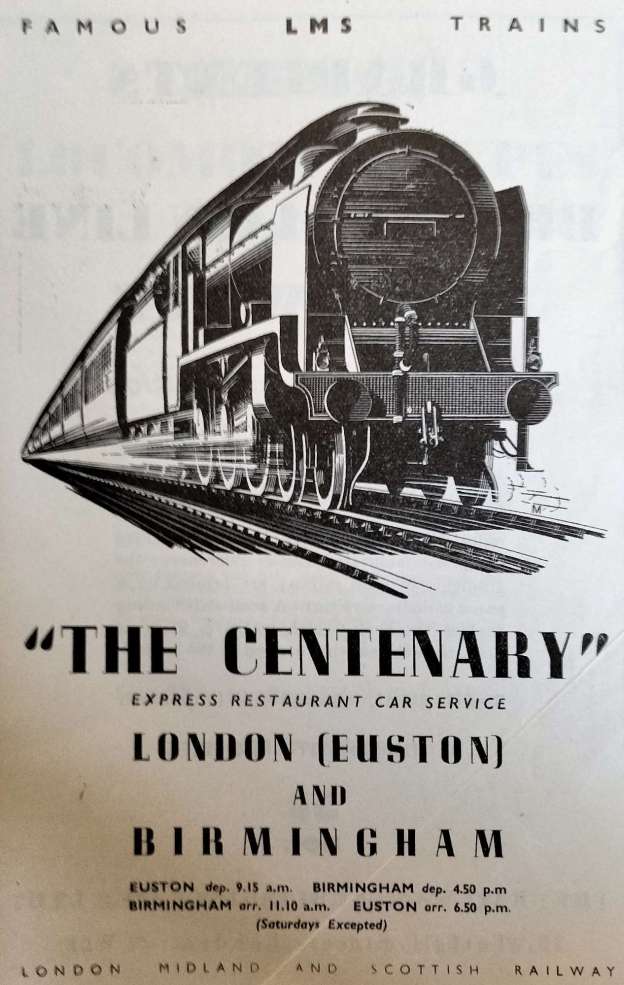
Following on from the short article about The Railway and Travel Monthly of July 1918 which can be found here, [1] this is a short reflection on the advertising which appeared in the November 1938 edition of The Railway Magazine, [2] twenty years after the magazine looked at from 1918 and only a few months before the outbreak of the Second World War.
Advertising included a series of adverts for:
- New publications such as: A History of the Southern Railway (17s/6d); Gradients if the British Main Line Railways (5s); British Locomotive Types – 3rd Edition (5s); History of the Great Western Railway, Volume 1 (1833-1863)(£1/1s) and Volume 2 (1863-1921)(10s/6d);The Railway Handbook 1938-1939, 5th Annual Edition (2s/6d); a reprint of The Locomotive Stock Book (2s/6d), and its Appendix (1s/6d), bought together – 3s/9d.
- Damaged books at low prices from The Locomotive Publishing Co. Ltd.
- St. Martin’s Engraving Co. Ltd.
- The Railway Correspondence & Travel Society membership and visits.
- The Railway Club membership.
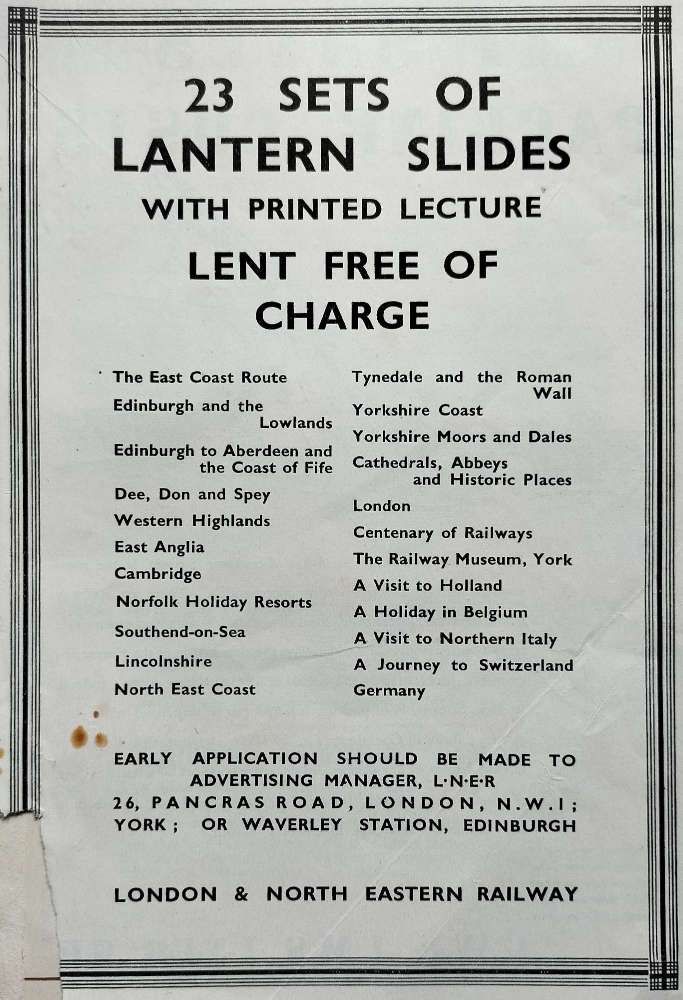
- The LNER’s practice of loaning out slides free of charge accompanied by a set of lecture notes, enabling individuals, clubs and societies to put on talks about railway related subjects themselves.
Sending Containered Loads & Liquids in Bulk by Rail
There were three full page adverts placed jointly by the Big Four railway companies. The first two pages related to the movement of prepacked loads – containers and tankers.
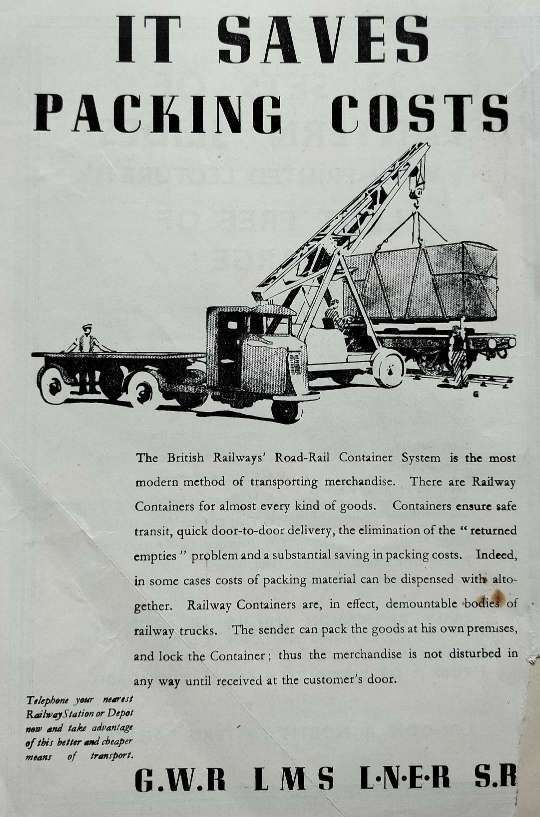
Containerisation on Britain’s railways can be traced back to very early days. “In the 1830s the Liverpool & Manchester Railway used simple rectangular boxes, four to a waggon, to convey coal from the Lancashire collieries to Liverpool, where they were transferred to horse-drawn carts by crane.” [3] This had some advantages, particularly the reduced handling of the cargo.
After the turn of the 20th century, “the London & North Western, Lancashire & Yorkshire, and Midland Railway companies were carrying ‘box coal’ on flat wagons, the coal being destined for use by steamboats.” [3]
The Great Central Railway “also played a part in the story of containerisation, being one of only three companies which provided special wagons for the conveyance of ‘fish tanks’.” [3] The wagons were classified as passenger stock.
The Midland and the Great Northern also followed this practice; in the case of the Great Northern Railway the containers were referred to as ‘cod boxes’ some of which lasted into the 1930s.
As early as the late 19th Century railways were using closed containers which resembled the bodies of wooden box vans, “these were initially known as ‘lift vans’ and were privately owned by several furniture removal firms. They were carried both on railway wagons and on flat road trailers drawn by horses or steam tractors.” [3]
The Advent of more effective road transport after WWI brought a challenge to railway companies. The biggest concern was that lorries could offer a door-to-door service which significantly reduced handling costs.
“The LMS launched its first container in 1926, and over the next few years all four of the pre-Nationalisation railway companies developed significant container traffic. Containers were soon to be found carrying all manner of goods, including bicycles, confectionery, castings, cookers, baths, machinery, boots, cloth, carpet, pianos, gramophones, sugar, shrubs, and of course furniture. Special insulated containers were soon developed for the conveyance of meat, dry ice bunkers being provided to maintain the temperature.” [3]
Containerisation worked best for high value items many of which required careful packing to avoid breakages. “This meant that a premium could be charged for a fast ‘door to door’ service, which justified the use of containers.” [3]
In the first instance a variety of different wagons were used to carry thesevstandardised containers. But “by the 1930s specialised container flat wagons or ‘conflats’ were built. In many cases these were converted from other wagons, for example the LNER converted a number of cattle trucks following a downturn in livestock traffic.” [3]
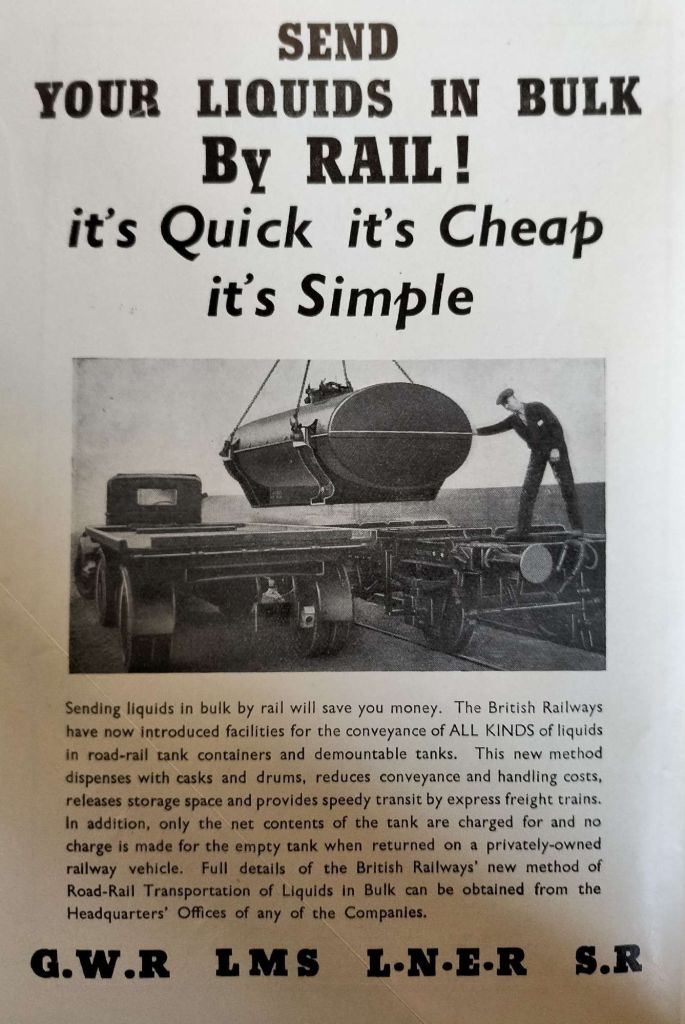
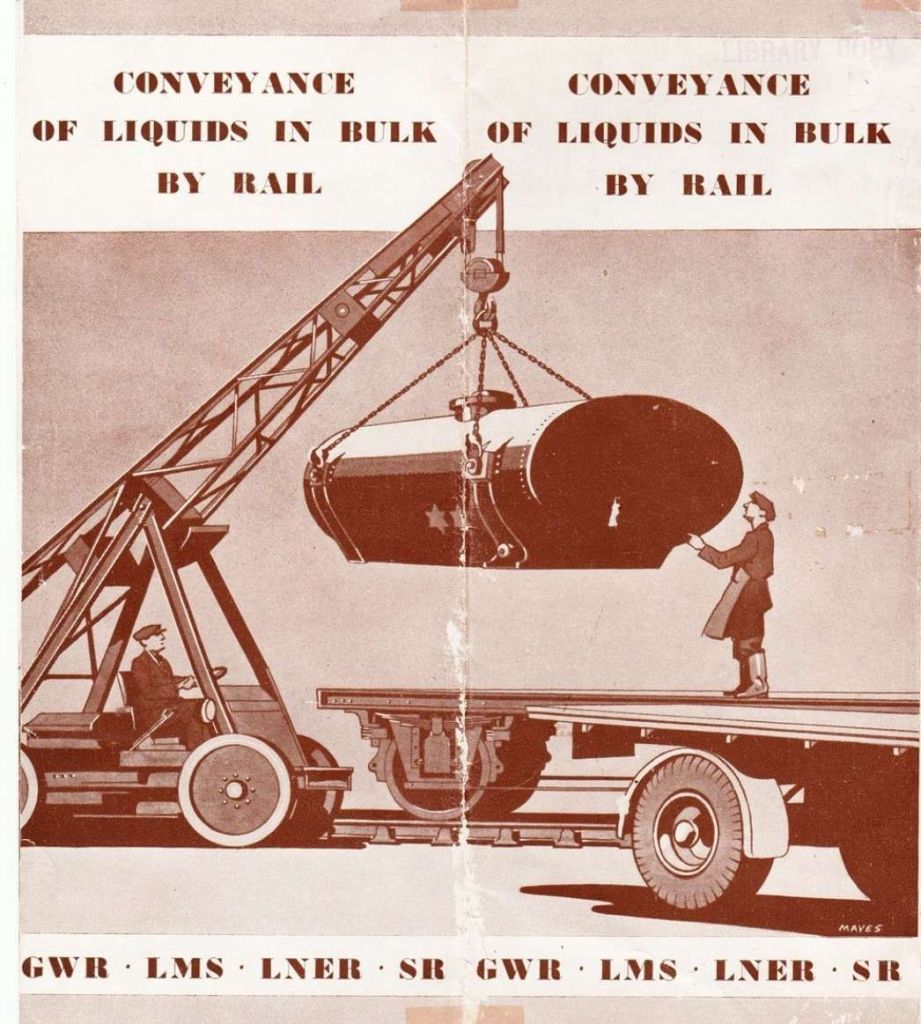
This advert highlights a further, more recent, development in the movement of goods – sending liquids in bulk by rail. Road-Rail tank containers dispensed with the use of casks and drums, so reducing conveyance and handling costs. The rail companies sweetened the deal by only charging for transport of the contents of these tanks provided they were carried on privately owned railway vehicles – so no return charge for the empty tank/wagon!
The Green Arrow Freight Service
The third full page advert placed jointly by the railway companies was for ‘The Green Arrow’.
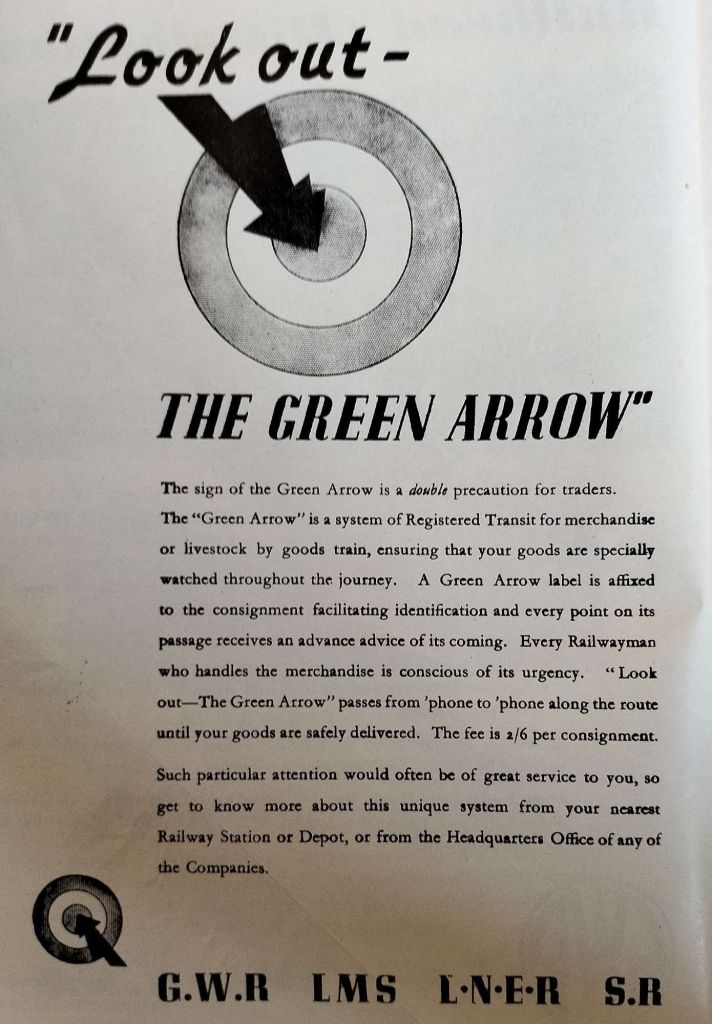
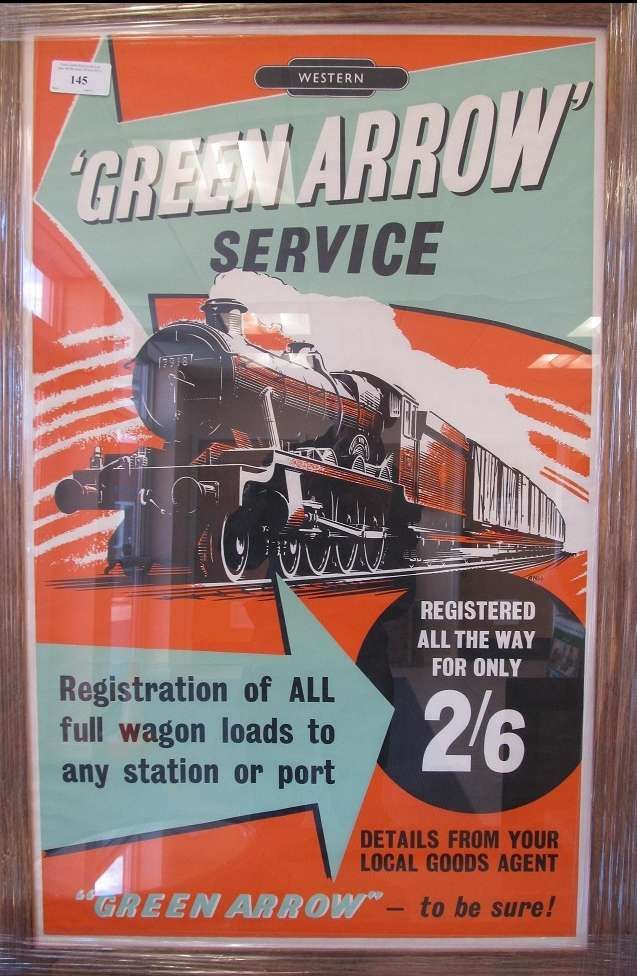
“In 1928 the LNER set up their officially named full wagon load ‘Green Arrow’ service, offering registered overnight transits.” [8] There is a confusion between sources – Atkins, Beard, Hyde and Tourret say that “the GWR ran an experiment with registered transit loads between 1927 and March 1929. This was a great success and became the ‘Green Arrow’ service. The other railway companies would not accept the principle until March 1933 when they at last followed suit.” [9]
However, by 1938, all four companies were clearly participating in the Green Arrow scheme.
Railhead Distribution – the GWR
The GWR advertised its road services in a full page advert in the November 1938 Railway Magazine as shown in the image below.
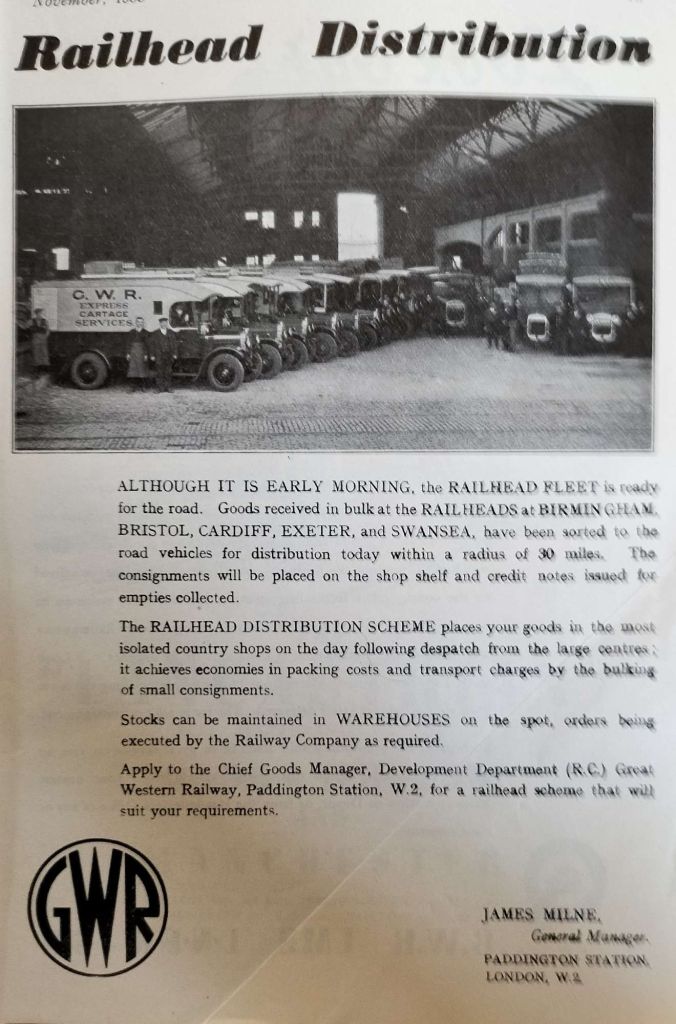
Goods received in bulk at railheads in Birmingham, Bristol, Cardiff, Exeter and Swansea were, by early morning, sorted ready for distribution and had been placed in road vehicles ready for distribution. The GWR distributed goods to destinations within a radius of 30 miles from their railheads.
The scheme ensured that goods reached even the most isolated destinations by the day following their original despatch. This meant that customer’s orders could be fulfilled in a timely manner direct from the warehouse rather than needing to be pre-stocked in a company’s outlying branches.

Famous Trains of the LMS
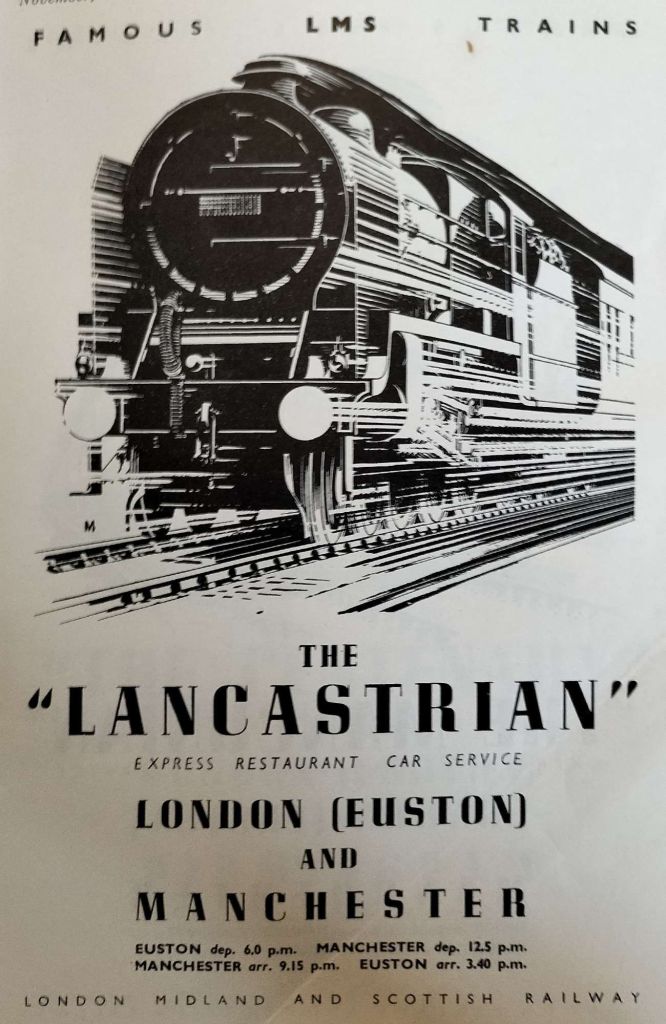
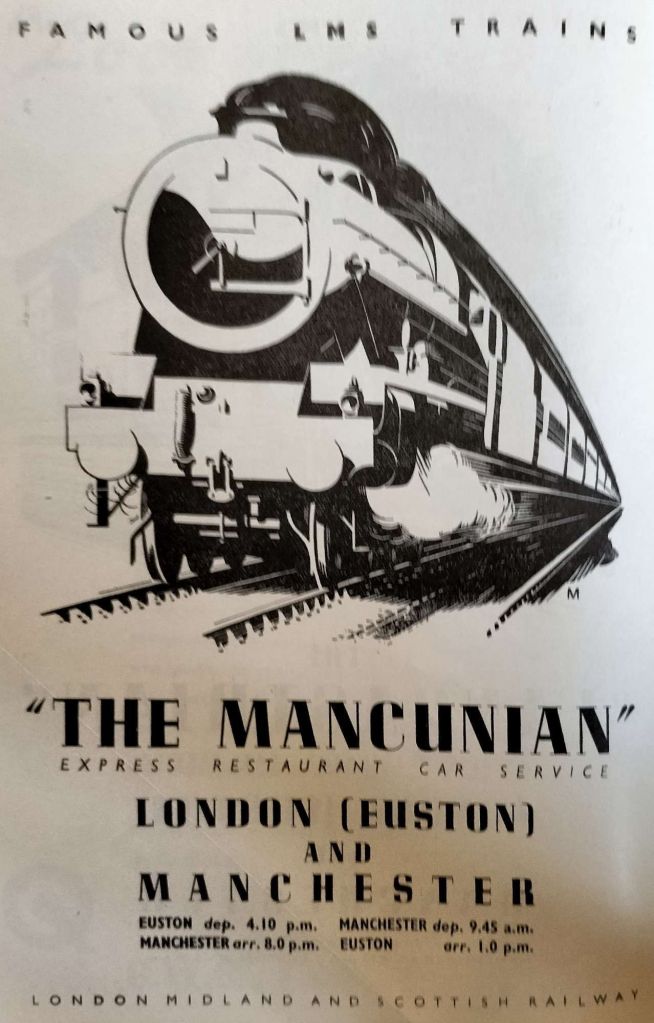
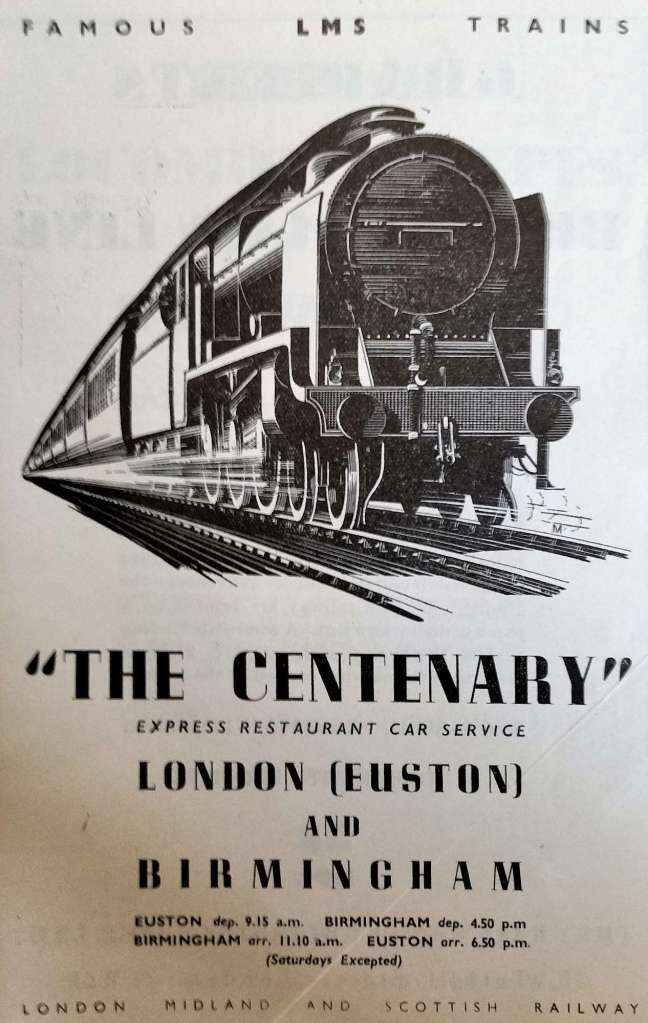
The LMS placed adverts across 3 full pages for three express restaurant car services: The ‘Lancastrian’; the ‘Mancunion’; and the ‘Centenary’. …………
References
- https://rogerfarnworth.com/2024/07/18/the-railway-and-travel-monthly-july-1918-a-snapshot-including-advertising, accessed on 19th July 2024.
- The Railway Magazine, November 1938; Westminster, London, November 1938.
- http://www.conflat.co.uk/con_hist.html, accessed on 19th July 2024.
- https://x.com/DidcotRailwayC/status/1508715315500396547?t=7rPufDVycZdMSMwsKtl2Zg&s=19, accessed on 19th July 2024.
- https://archive.commercialmotor.com/article/21st-january-1930/68/gwr-goods-road-service-developments, accessed on 20th July 2024.
- https://www.lner.info/forums/viewtopic.php?t=10450, accessed on 20th July 2024.
- https://collection.sciencemuseumgroup.org.uk/objects/co229508/green-arrow-service-poster, accessed on 20th July 2024.
- https://igg.org.uk/rail/7-fops/fo-traintype.htm, accessed on 20th July 2024.
- Atkins, Beard, Hyde & Tourett; A History of GWR Goods Wagons Volumes 1 & 2 ; David & Charles, Newton Abbot, Devon, 1972.
- https://files.ekmcdn.com/c8ed37/images/express-gwr-cartage-couriers-ww2-van-old-lorry-thornycroft-postcard-155198-p.jpg?v=357516B0-F987-4892-9C8F-1FDA4765FD9A, accessed on 29th July 2024.
 Roger Farnworth
