
Tag Archives: shame

Shame at the wedding banquet …. Luke 14:1,7-14

feastWhenever I hear today’s Gospel reading, I can feel myself cringing in embarrassment at the situation that the wedding guest creates for themselves.

I can just imagine all the other guests muttering to one another: Did you see that?  The cheek of it ‑ thinking that they should sit in the best place!  Surely, no‑one in their right mind would do such a thing?  After all, we all know our place and we’d never put ourselves in such a situation, would we?

I can also imagine the shame that the guest must have felt having been moved from their chosen seat to the worst place ‑ in full view of all the other guests.   I guess they wished that the ground would swallow them up, as they went red in the face and started to stammer.

This parable ‑ seemingly about the etiquette of dinner invitations ‑ turns into a story about shame and honour.  Luke draws us into the story by choosing a scenario that we can identify with ‑ we’ve all been to wedding feasts and we all know the social rules that go with them.  Bridal party on the top table ‑ everyone else in the rest of the room, carefully placed so all possible conflicts are avoided and no‑one is left on their own.   We know the rules and we are expected to stick by them ‑ so how could anyone be so foolish, do such a shameful thing as sit in the wrong place?

Shame is a very powerful emotion ‑ accompanied by often visible signs ‑ and it is one that we seek to avoid.  It can bring very real distress and pain.  Shame can also be a healthy reminder to us that we’ve transgressed, that we’ve done something wrong. To avoid being shamed, we have to think about doing the right thing, about being honourable.
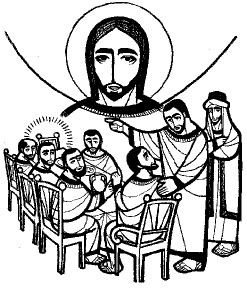
CN22TN CAnd this is where Luke takes his parable ‑ by describing the honourable way to behave when you have a wedding invitation.  Start off by assuming that you have been allocated the worst place and you might just find that you are rewarded with a better seat. And Luke wraps up the tale with these words of wisdom: “If you put yourselves above others, you will be put down.  But if you humble yourself, you will be honoured.”

This story is worldly-wise ‑ perhaps it echoes advice in Proverbs: “Do not take a place among the great; better to be invited ‘come up here,’ than be humiliated in the presence of the prince.” The parable is a neat and slightly crafty lesson on how to get on in the world.  And yet…….  As with all of Jesus’ parables it has a meaning on many other levels.

There are several lessons here for Christians about knowing one’s place as a Christian disciple.  But first a few words which come from a different direction. A true story. A friend of mine had not been to church in a very long time. The first time she came to church with her family she chose to sit near the front of the church – it was a little odd, for no one came to sit with them until just as the service was starting … She enjoyed her first service in church – the singing was wonderful and the family decided to come again. The next Sunday they took the same seats, the same people came to sit with them and again they enjoyed the worship. They started going to church regularly. It was only after they had been there a couple of months that one of the congregation came to them and asked why they were sitting in the choir stalls …

So many who come to church no longer know the right things to do, don’t understand why in Anglican churches we don’t use the front pews. Often I have seen new people sitting right at the front (in the best seats) then not able to work out what to do with their service sheets and hymn books and clearly feeling ill-at-ease, feeling shamed. How do we help these people to feel at home? It is so important. …

Having seen that the parable can be turned on its head. What are the other lessons here for Christians about knowing one’s place as a Christian disciple?

There’s a message for those in leadership.  Jesus was speaking to the lawyers and Pharisees when he told this tale and he wanted them to heed the warning about pushing themselves forward in the sight of God.  In Jesus’ day it was all too easy for the well‑off and the legally trained to imagine that they were superior in God’s sight to the poor and to those without the opportunity to study, let alone practice the law.  So he spoke to the powerful people in the Jewish faith ‑ wanting them to think about the way they related to other Jews.  This, of course, is also important for powerful Christians, such as church leaders (ordained or lay), to remember when they relate to other Christians.  Power and learning make no difference to the way that God relates to his children.

But Jesus spoke not just to the powerful and learned ‑ he also spoke to his disciples.  Perhaps you remember the story of James and John who were eager to take the top two places at Jesus’ right and left hand ‑ above everyone else.  They didn’t know what they we asking, because Jesus’ came in his glory not on a throne but on a cross and the places on either side of him were reserved for thieves.

James and John were rebuffed and reminded that this was not the aim of discipleship ‑ it was not for them to seek the highest places.   So to for us ‑ there is no hierarchy in our church, our parish, our Deanery, our Diocese  ‑ we are all brothers and sisters in Christ.  Yes, we have different roles and some of these roles mean that some people are more visible than others.  But as disciples, we all occupy the same place ‑ as God’s children, all equal in his eyes.  So this parable reminds us that we need to act with humility in the church.

There is however a wider message delivered by this parable and this would have been obvious for those in the world for which Luke was writing.   Within Luke’s lifetime, thousands of non‑Jews had become Christians.  They had entered, as it were, into the dinner party prepared by the God of Abraham, Isaac and Jacob.  Many Jewish Christians found this difficult, if not impossible to understand or approve.  They were so eager to maintain their own places at the top table that they could not grasp God’s great design to stand the world on its head.  They couldn’t see that their pride, their belief that they were favoured, blotted out God’s generosity to others and ultimately denied their own place as Jews in God’s plan for the world.

Because, in the end, if anyone reckons that they deserve to be favoured by God, not only do they declare that they don’t need God’s grace, mercy and love, but they also imply that those who don’t deserve it shouldn’t have it.  And perhaps this is the most challenging aspect of this parable ‑ a message for all Christians.  Whenever we act without humility and see ourselves as better than others, not only do we shame ourselves but we act dishonourably towards other people by seeking to limit their access to God’s love and God’s grace.  And where does that leave us in relation to God? For each of us needs the grace of God as much as anyone else.

So lets keep our eyes open for those who are new and who struggle with knowing the social rules of our church, let’s give them every help and support that we can.

May this parable also prompt us to be aware of those times when we bring shame on ourselves because of our lack of humility.  May it also cause us to rejoice that God’s love is so forgiving that at the end we will all be invited to feast at God’s banquet.

Water into Wine – John 2:1-11

Epiphany 3, 2024 – John 2:1-11

What’s your most embarrassing moment?

My worst in church was being called up to help with the chalice at Communion in my church in Didsbury in the early 1990s and tripping over the steps on the way up to the altar. I fell flat on my face in front of everyone and then found everyone sniggering as I gave them the cup. How did I feel? … I wished that the ground would open and swallow me up!

The bridegroom in John 2:1-11 was in just such an embarrassing predicament. This was supposed to be his special time. He & his new wife had been escorted through the streets with burning torches, lighting their way to their new home. They weren’t going away on a honeymoon, but would keep open house for an entire week for people to come along and celebrate the occasion. This was Jewish custom, and the celebrations and showing hospitality to guests were a sacred duty. And what has happened, but the wine has run out! Not because his guests have been over-indulging. Apparently, he’s just been to stingy – he’s not bought enough.

Perhaps he’d underestimated how much wine he’d need. Perhaps he didn’t have the money to buy enough wine, even the cheapest available, to meet his needs. But there was no room for excuses – it was his duty to pay for the celebration. Deeply embarrassed, perhaps red in the face, getting hot, wanting a hole to open up and swallow him, he waited for the complaints from his guests to roll in. Can you imagine his prayer, “Why does this always happen to me? … Please Lord don’t let anyone notice.”

clay-jars1-960x250

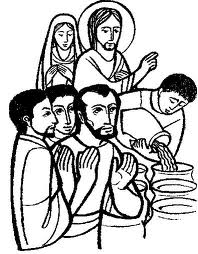
But one guest did notice. Mary saw and she told Jesus. And Jesus quietly set to work. He gets the servants to fill the six water pots with water, the water is turned into wine and the bridegroom’s embarrassment turns to amazement and joy. The equivalent of over 700 bottles of wine, the finest wine appears from nowhere. No longer does the bridegroom face shame and humiliation.

df9f283bbc3d8ec5423e2b207f122756

The reading concludes: “Jesus performed this first miracle…… there he revealed his glory
and his disciples believed in him.” Those who were with Jesus knew that this was an act of divine power – an act in which the personal situation of the bridegroom was transformed. This miracle revealed the nature of Jesus’ ministry: Jesus, the provider of joy, transforming sadness and embarrassment into experiences of gladness and rejoicing. Jesus, the one who can overcome our mistakes/failings, bringing good out of seeming disaster.

The good news of the Gospel is that this is what God is like. If Jesus transformed one situation, then God can transform the situations that we find ourselves in today.

Perhaps we’ve made mistakes – like the bridegroom without enough wine. We may look back over our lives, and think “if only I’d not done or said that.” There may be things that have happened in the last few days – we’ve done or said something we regret. These things can linger with us, leaving us feeling embarrassed, ashamed, and not knowing what to do.

Perhaps we are low in resources – like the bridegroom who couldn’t provide adequately for his guests? There are times when we feel spiritually dry, we struggle to pray, we wonder where God is. Or we feel physically weak, no energy to do what matters. Or emotionally drained, with no motivation to sustain relationships or get on with our work.

Perhaps life is full of sadness – like the bridegroom who sees his joyful day disappearing before his eyes. We see others around who are happy, but find it hard to be like them. We know that others think we should be smiling, but it’s not as easy as all that…..

Whether trivial or significant, God in Jesus is ready to transform these situations. He can, and does break into our lives. We think or feel that we are defined by the past, by our mistakes and failings. But God says, “No!” Just as Jesus transformed the bridegroom’s day from failure to joy, God can transform our lives bringing good out of the mess we see in our lives.

Not only is God ready to transform situations, he is even at work when we cannot ask him ourselves. The bridegroom wasn’t actually aware that Jesus was working to help him until the steward announced that there was more, and even better, wine on offer. It was someone else, Mary, who noticed the need, and asked Jesus to act. When we are unable to pray, or don’t know what to pray for – we don’t need to worry that we’ll be left helpless. God will act.

cana-bw

God can act unilaterally, but more often than not it is through others around us. Those who notice the way things are and do something. … Action isn’t always appropriate. When we see our friends or family members struggling – we can follow Mary’s example. We can talk quietly to Jesus, in the background, and we can have confidence that we have done the right thing. For we have given their situation to God. And God is able to work for good in any situation.

And when Jesus acts, when God acts, we may be amazed at what happens – the bridegroom didn’t just receive enough wine to get by on. He got good, fine wine – more than he needed, better than he needed. The generosity of God was overwhelming at the wedding in Cana. And when Jesus acts to transform our situations, our lives, we can expect this same generosity. However, with Jesus, it’s not about quick fixes that solve the problem for the moment. No, God’s work in our lives will often be quiet, often over the longer term. We may experience setbacks, but God will not give up.

We can experience transformation, and as Jesus works in our lives the glory of God will be revealed – just as it was at Cana. And we can be part of that transformation in the lives of others by taking the mess and muddle that we see to God, by asking God to break in a bring hope and transformation.

Lord Jesus, just as you transformed the situation of the bridegroom at Cana, may you work in our lives, transforming our embarrassments, our inadequacies, our sadnesses, our mistakes, into experiences of gladness and joy, to the glory of your name. Amen.

Proverbs

John J. Pilch in ‘Introducing the Cultural Context of the Old Testament’ focuses on Wisdom literature, and to help his readers understand how important honour and shame were in Ancient Israel, Pilch takes them on a journey of discovery around the book of Proverbs (Pilch: pp49-70). He comments: “The core values of Mediterranean culture are ‘honor and shame’” (Pilch: p49). He explains it like this:

“The central or core value of our Mediterranean ancestors in the faith is ‘interpersonal contentment’. This value dictates that people should be content with what they have and not worry about getting ahead of others, achieving more than others, or being better than others. This, in fact, is what Mediterranean people are ‘anxious’ about: not to infringe on others, and not to allow others to infringe on them.

“Such anxiety revolves especially around the value feeling of ‘honour’ and ‘shame’. Whatever the status into which a person is born is ‘honourable’ and must be maintained throughout life. Indeed, being born into honour is the chief way of getting it. The reason for genealogies in the Bible is to let the reader know that the person to whom this genealogy is applied is honourable because the entire ancestral line is full of honourable people.” (Pilch: p52.)

Pilch then goes on to help his students reflect on a whole series of different verses from Proverbs (3:9, 16, 35; 4:8; 5:9; 6:33; 8:18; 11:16; 13:18; 14:31; 15:33; 18:3, 12; 20:3; 21:21; 22:4; 26:1, 8; 27:18; 29:23). His asertion is that these proverbs are intended to direct and control people’s behaviour and to do so they include sanctions and rewards. It seems as though the writer of Proverbs ‘carrot and stick’ (my words) are honour and shame. Take Proverbs 13:18 as an example:

“He who ignores discipline comes to poverty and shame,
But whoever heeds correction is honoured.”

“Honor is contrasted with disgrace (shame). … Honor results from heeding instruction, particularly reproof (discipline). The book of Proverbs is … ‘wisdom literature’ which is practical, down-to-earth advice on successful living. Such wisdom helps a person maintain honor” (Pilch: p57), and avoid being shamed.

Pilch then encourages his readers to look at references to shame in Proverbs ( which include: Proverbs 10:5; 12:4; 13:5; 14:35; 17:2; 18:3; 19:26; 25:8-10; 28:7; 29:15). Shame, he says, “in a positive view, is a sensitivity to one’s honor and a determination to guard and maintain it. In a negative view it is the result of a loss of honor” (Pilch: p61). Consider Proverbs 28:7 as an example:

“He who keeps the law is a discerning son,
but a companion of gluttons disgraces his father.”

“Gluttony bespeaks having more than enough. The Mediterranean cultural obligation when one has more than enough is to share with those who do not have enough. To be capable of gluttony means one has refused to share, and this is shameful. Notice who bears the shame. The father is tainted by the son’s misbehaviour.” (Pilch: p63). Pilch goes on to explain that shame and honour are never purely personal matters. The son shames the father, the father bears that shame as a deep pain negating his honour, his place in the community, he is reduced as a person.

Shame in Proverbs, then, is a sanction. It seems to as much affect the family of a miscreant rather than necessarily just the miscreant him/herself. For those who are shamed, there is little they can do to change the circumstances. Shame overwhelms them but they have nowhere to turn to resolve their predicament. Their honour has been taken away.

References:

Please see the bibliography on Honour and Shame on this blog.