Another snapshot of advertising from the 1950s Railway Magazine. The featured image is the front cover photograph from the December 1952 issue. The adverts in this issue are an eclectic mix of modelling tools, books, railway equipment, chemical elements, British Railways jobs and miscellaneous items. …
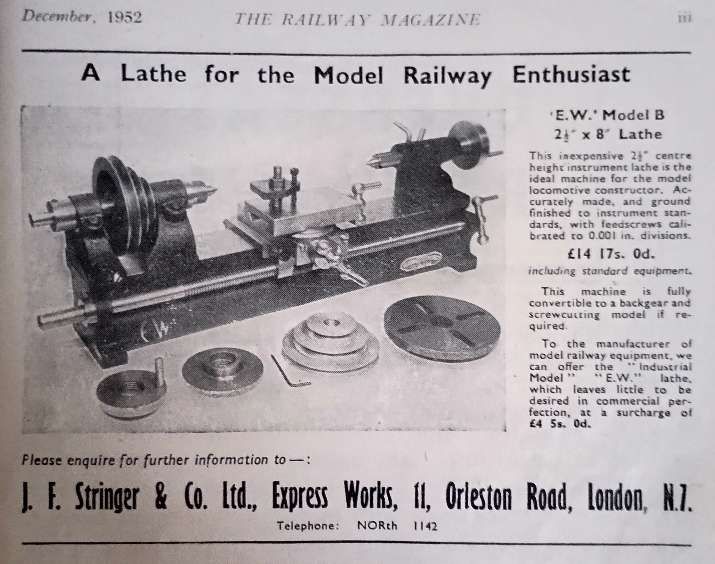
J.F. Stringer & Co. Ltd – E.W. Model B Lathe
A Lathe for Model Makers. [1]
“Conceived, designed and manufactured by John Frederick Stringer, the 2.5″ x 8″ EW lathe was first built circa 1946/47, just after the formation of his first company, J. F. Stringer & Co. Ltd. … Due to the economic strictures that prevailed during the early 1950s, the EW was cleverly designed and marketed as the “Convertible”, being available as a basic plain-turning model less backgear and screwcutting that could then be upgraded, as the owner’s finances permitted, with parts that simply bolted on to effect the desired improvements. For the better healed, or those with the opportunities for extra overtime, it could also be had as a complete machine with countershaft and motor ready to tackle a wide range of model and experimental engineering jobs.” [2]
The December 1952 edition of The Railway Magazine carried the advert. We know that it was also carried in the June 1952 magazine with the lathe offered at the same price as in the December issue of the magazine. This was at a time when a skilled man could earn around £9 a week!
Lathes.co.uk tells us that this lathe was “constructed in an absolutely straightforward manner, the EW had a 19.5-inch long, 2.5-inch wide bed of hollow box section (an arrangement that required no corebox), ground on the top surface and feet – and with three bracing ribs up the back face. It was designed for ease of manufacture on a limited range of machine tools – for the original works had only two South Bend lathes, a mechanical hacksaw, an ordinary pillar drill and a small horizontal miller – it is surprising that so much could be done with so little. … [It was] of unusual design, the headstock carried a 0.75-inch diameter spindle, bored through 13/32″ with a No. 1 Morse taper running in plain bearings carried on two entirely separate, box-form, cast-iron posts that were jigged so as to be interchangeable between machines. The top of each post was split, bored and homed honed to form the headstock bearings (the spindle running directly in the cast iron) and the base clamped to the V-edged (dovetail) bed with a transverse through bolt. The spindle carried a narrow, 3-step Z-section V-belt pulley.” [2]
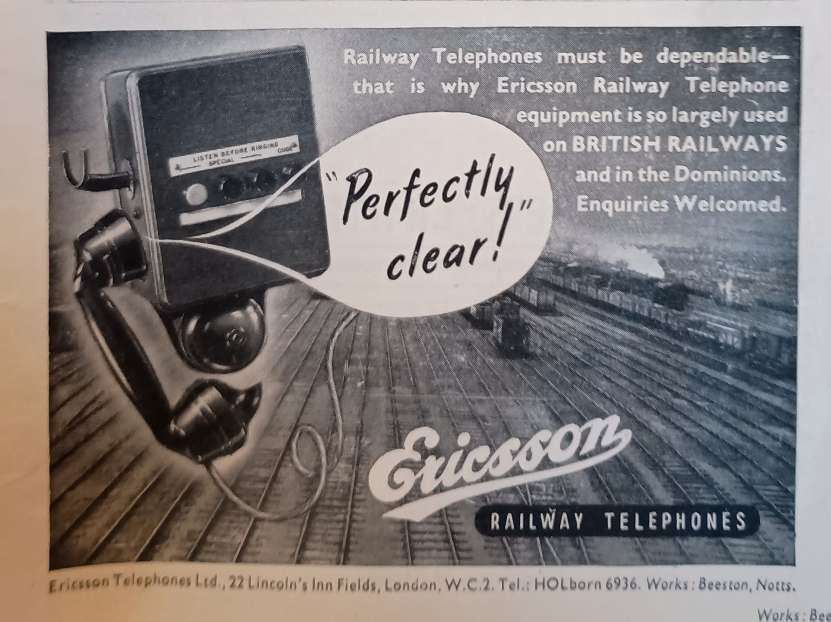
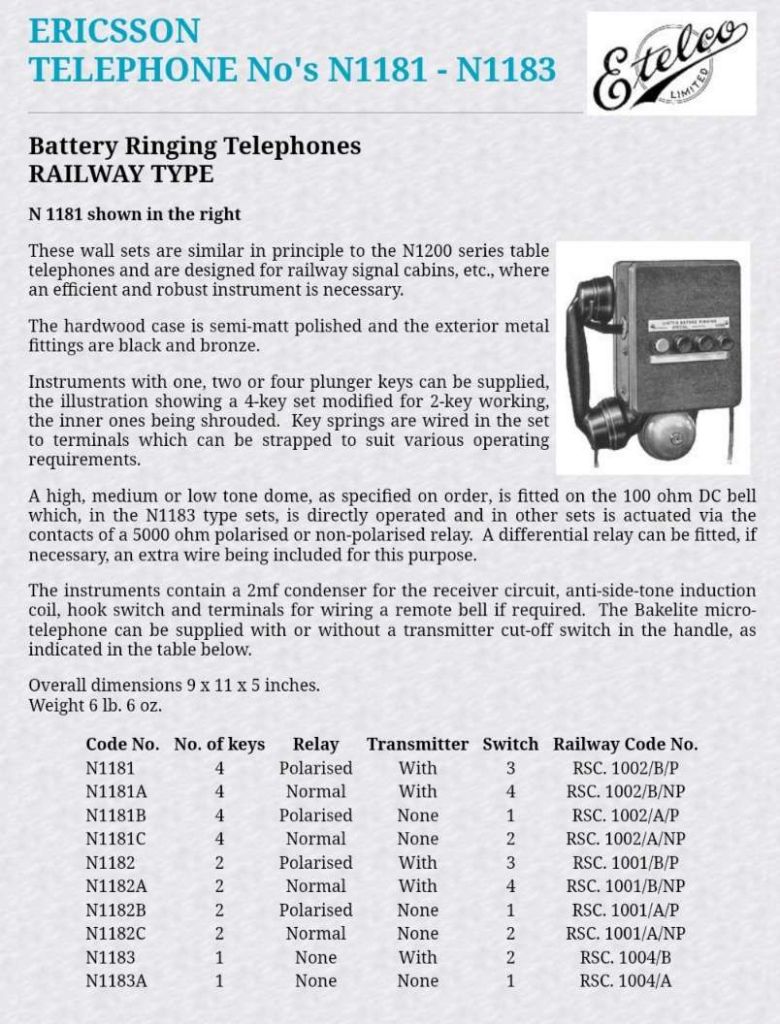
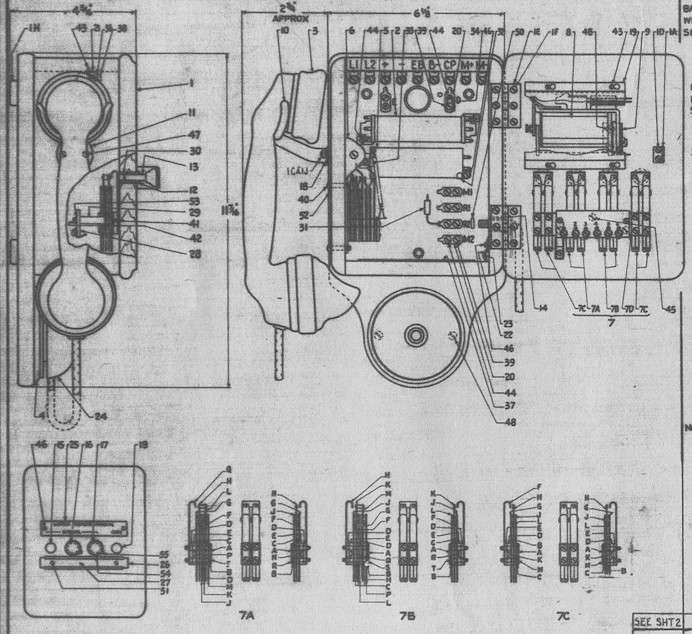
The Advert for the Ericsson Railway Telephone. [1]The Spec. Sheet for the Ericsson phones. [3]A Blueprint for one of the Ericsson phones. [3]
Ericsson Bulletin No 17 describes the phones which it supplied to British Railways.A copy of the article can be found on page 40 of that bulletin. [4]
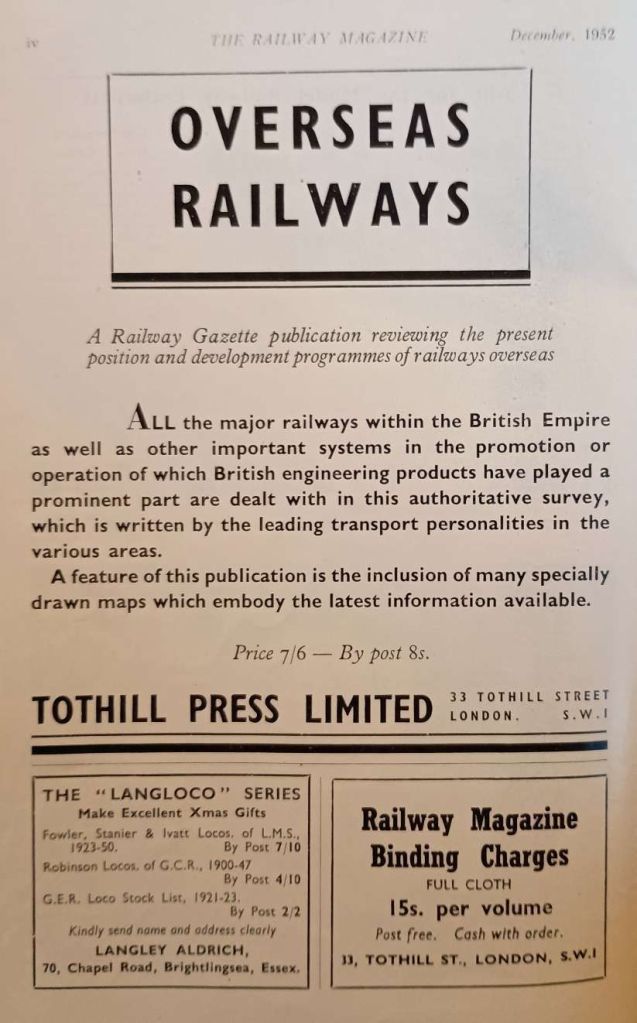
Overseas Railways
A book produced annually by the Railway Gazette which reviewed the current position and development programmes of railways overseas. The Railway Gazette was, like The Railway Magazine published by the Tothill Press in London.
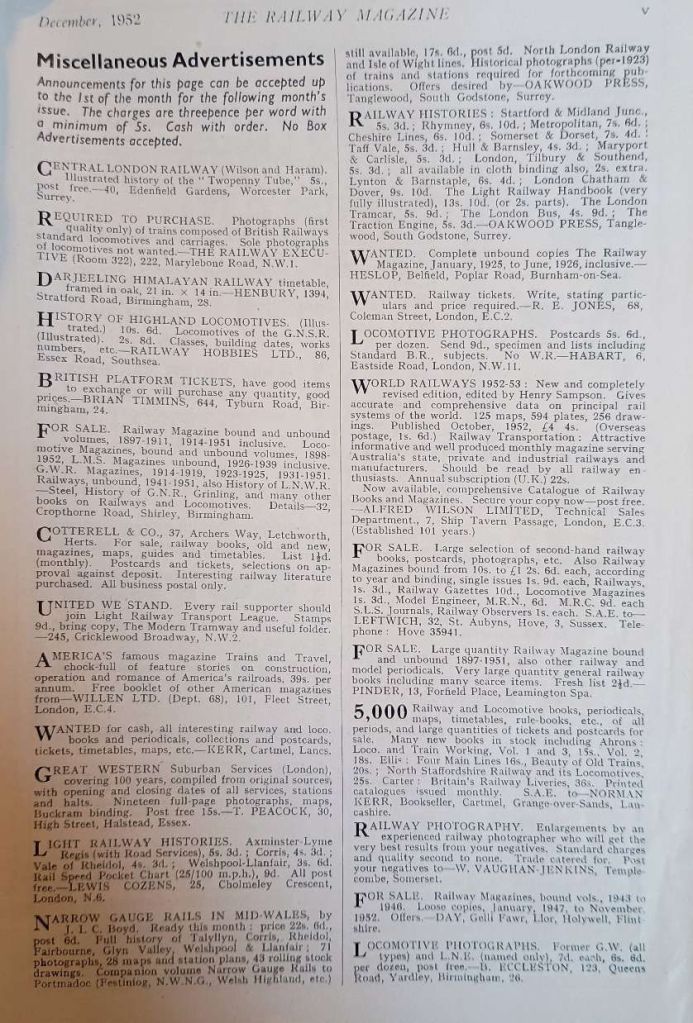
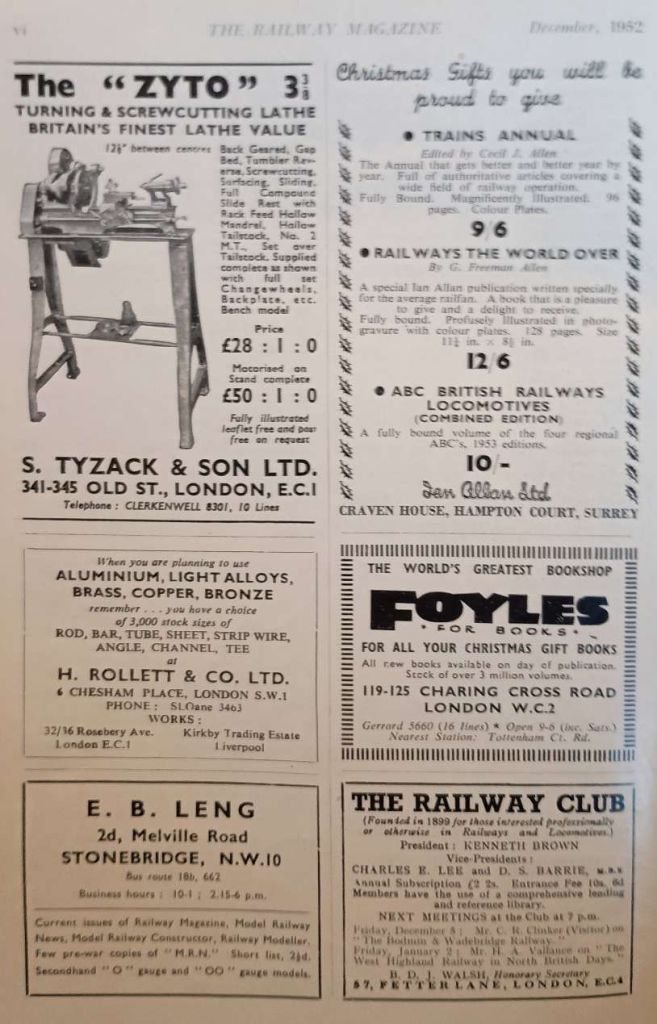
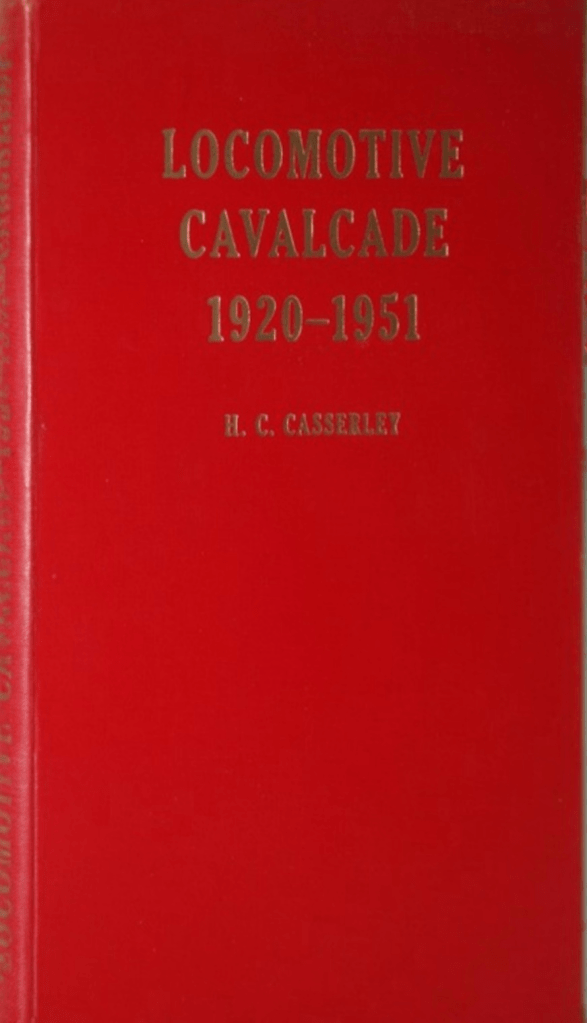
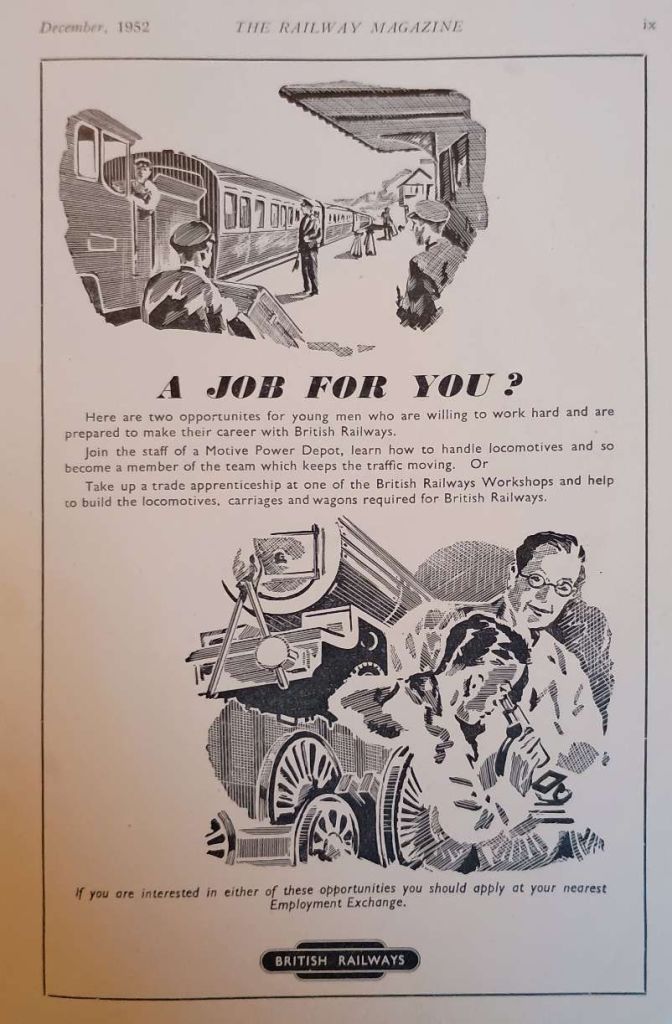
An Advert for ‘Overseas Railways’ is accompanied by a small advert for The Railway Magazine’s binding services and one advertising ‘Langloco’ books. [1]A whole series of classified adverts filled one page of the magazine.A series of smaller adverts filled another page. Ian Allen Ltd. advertised books for Christmas presents. A turning and screwcutting lathe (the ZYTO) from S. Tyzack & Son Ltd. An advert from H. Rollet & Co. Ltd. suppliers of various metal bars, angles, tubes, sheet and wire. An advert from Foyles Book Shop, from E.B. Length suppliers of magazines and secondhand railway models, and finally, an advert for membership of The Railway Club. [1]An advert from London Transport’s Private Hire Office for excursion buses and coaches sat alongside an advert for Roamer Waterproof Watches and an advert for a book by H.C. Casserley – Locomotive Cavalcade (1920-1951). [1]H.C. Casserley; Locomotive Cavalcade, 1920-1951. [5]An advert for employment opportunities with British Railways. Two opportunites for young men willing to work hard and prepared to make their career with British Railways. The openings were apprenticeships at Motive Power Depots and st British Railways Workshops. [1]
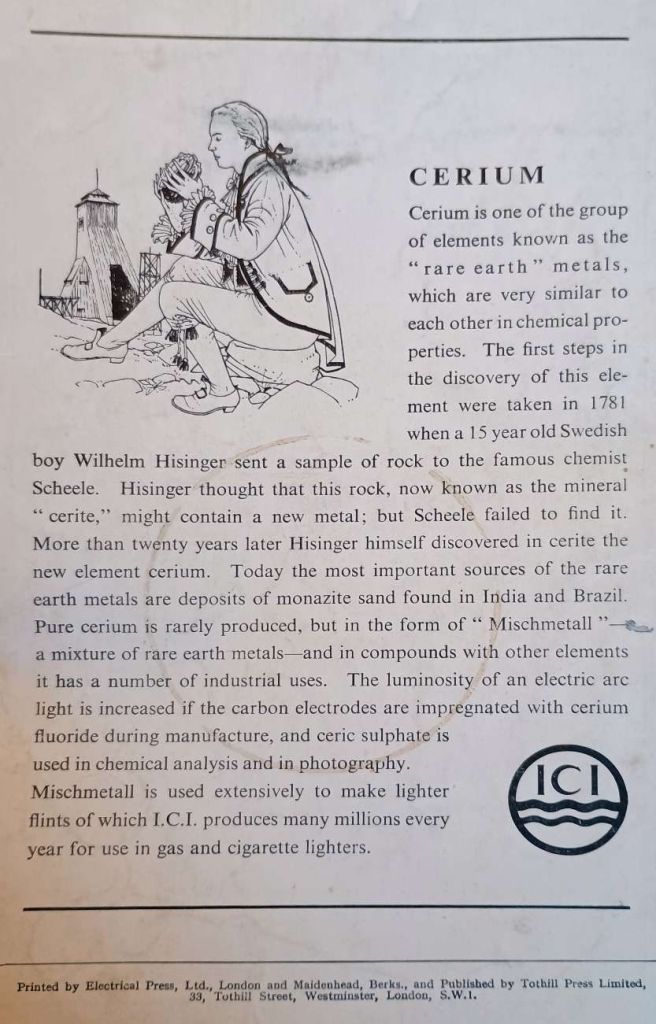
The final advert in the issue was on the back cover. It was placed by ICI advertising a particular ‘rare earth’ metal – Cerium. Rare-earth metals are of growing interest in the 21st century.
Cerium (Ce, atomic number 58) is the most abundant rare earth element, a soft, silvery-grey metal that tarnishes in air. It is used extensively in catalytic converters, glass polishing, alloys, and lighter flints due to its high reactivity and unique catalytic properties, though it’s rarely used in pure form because it oxidizes rapidly and reacts with water, finding applications in products from fuel cells to military optics. [6]
“Cerium was first identified by Jöns Berzelius and Wilhelm Hisinger in the winter of 1803/4. Martin Klaproth independently discovered it around the same time. Although Cerium is one of 14 rare earth elements it was discovered independently of them. There are some minerals that are almost exclusively cerium salts such as cerite, which is cerium silicate. A lump of this mineral had been found in 1751 by Axel Cronstedt at a mine in Vestmanland, Sweden. He sent some to Carl Scheele to analyse it but he failed to realise it was new element. In 1803, Berzelius and Hisinger examined it themselves and proved that it contained a new element.” [6]
“It was not until 1875 that William Hillebrand and Thomas Norton obtained a pure specimen of cerium itself, by passing an electric current through the molten cerium chloride.” [6]
In railways, Cerium is primarily used as an alloying additive in steel components to improve their material properties, such as corrosion resistance, strength, and toughness.
References
The Railway Magazine Volume 98, No. 620; Tothill Press, London, December 1952.
This is the earliest Railway Magazine that I have so far been able to view. A rather tatty copy with both front two and at least the back two pages missing.
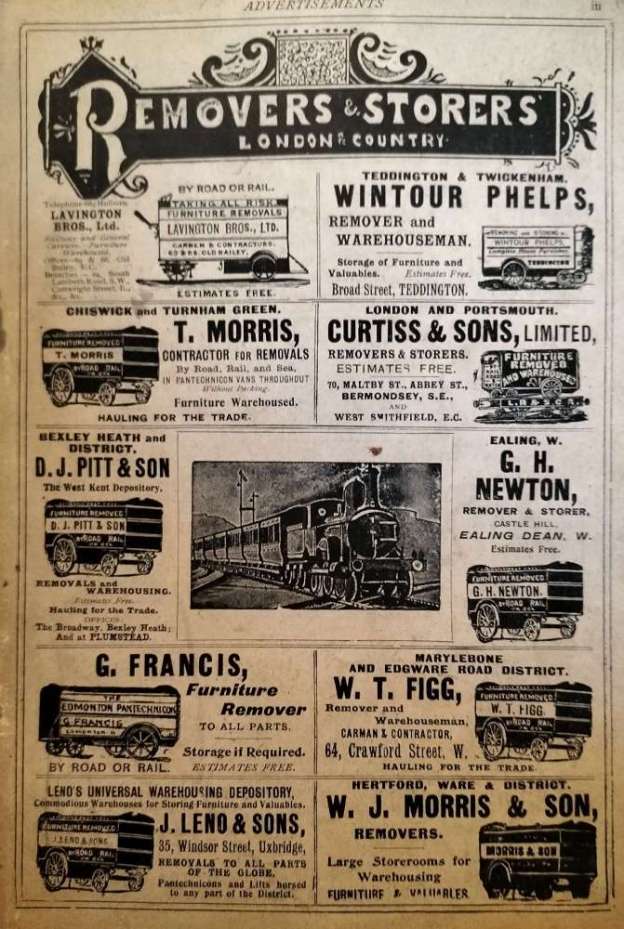
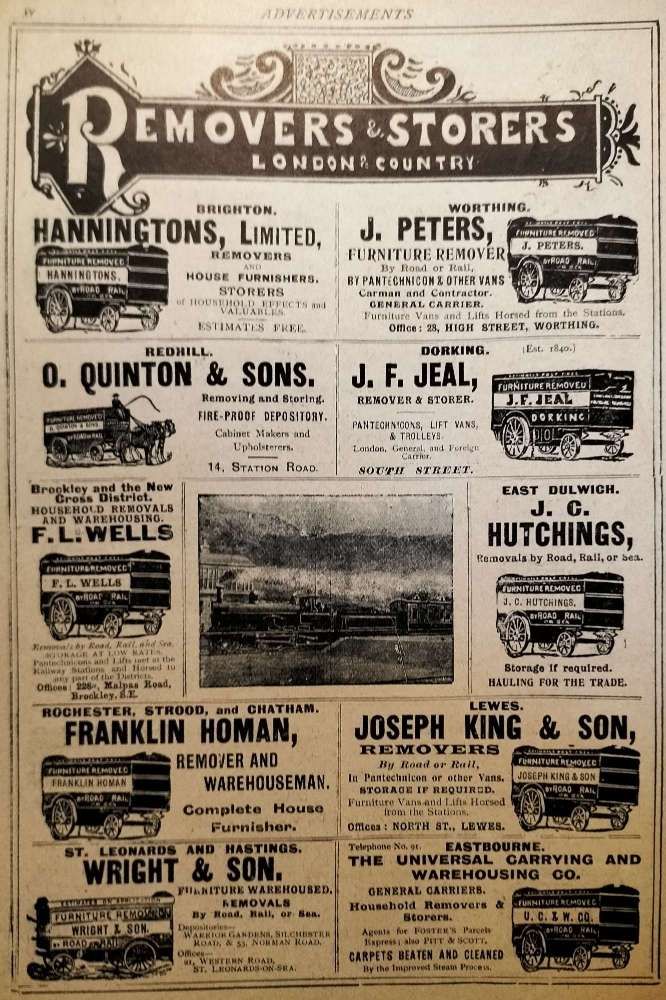
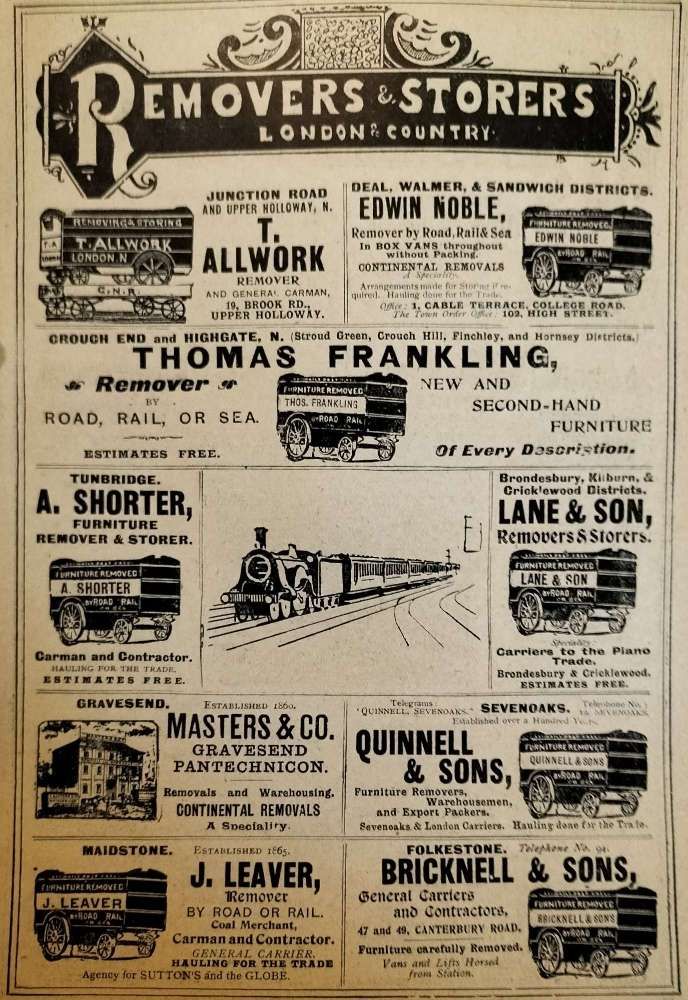
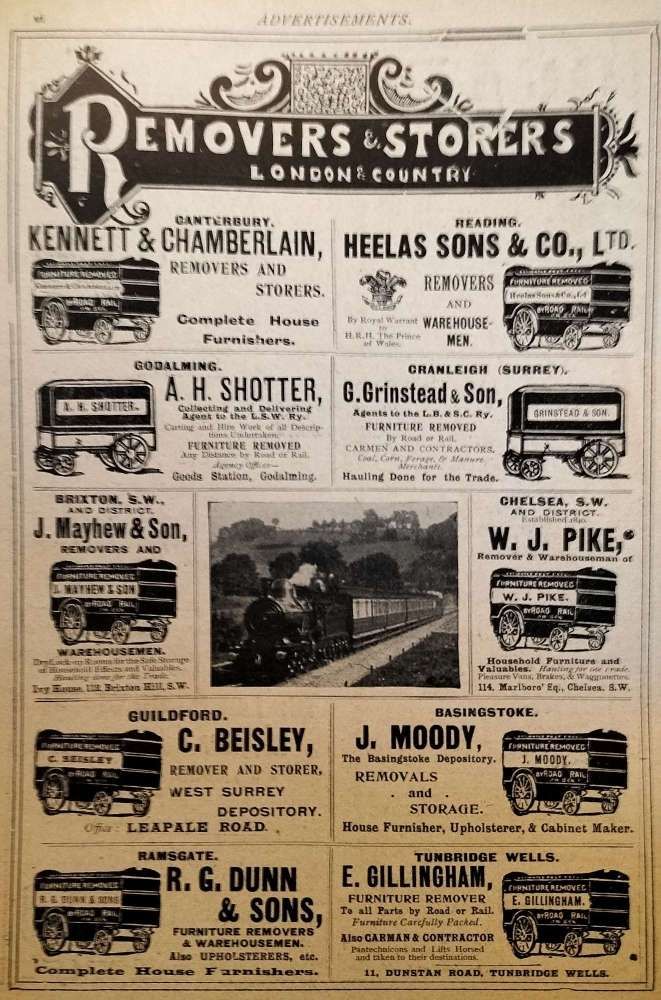
The first thing to note is the four pages of advertising given over to removal and storage companies! …
First page of advertisements by Removal & Storage Companies [1: pIII]Second page of advertisements by Removal & Storage Companies [1: pIV]Third page of advertisements by Removal & Storage Companies [1: pV]Fourth page of advertisements by Removal & Storage Companies [1: pVI]
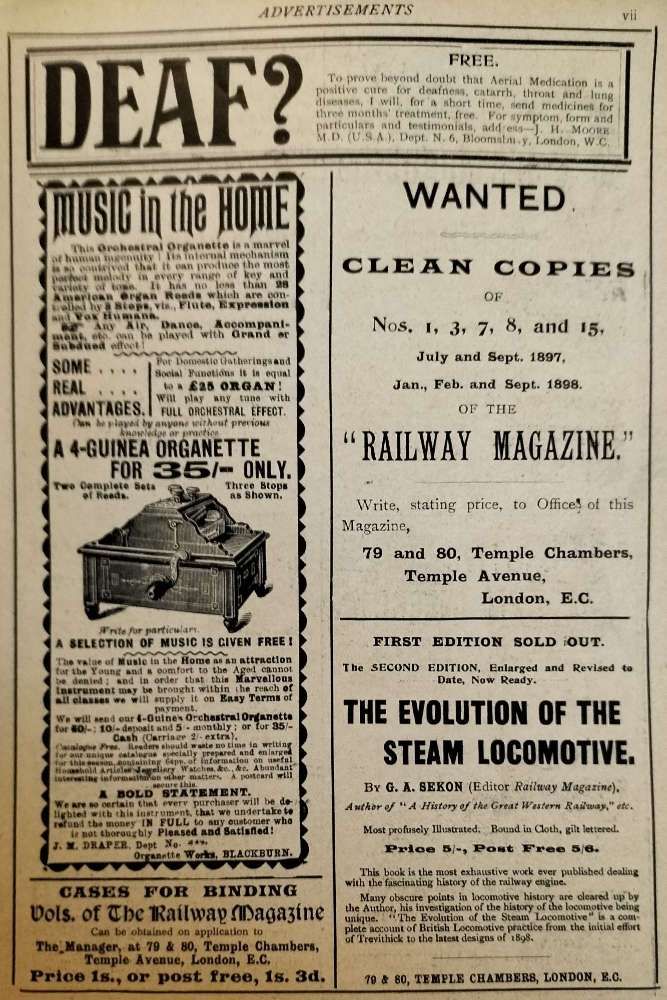
The fifth page of advertising is headed by what appears to be a dubious cure for deafness. Perhaps a third of the page is given over to an advert for an Organette with the remainder of the page devoted to The Railway Magazine’s publisher’s needs/offers: cases for binding The Railway Magazine; a request for return to the publisher of early editions of The Railway Magazine; the second edition of G.A. Sekon’s ‘Evolution of the Steam Locomotive‘.
The fifth page of advertisements in my possession. [1: pVII]
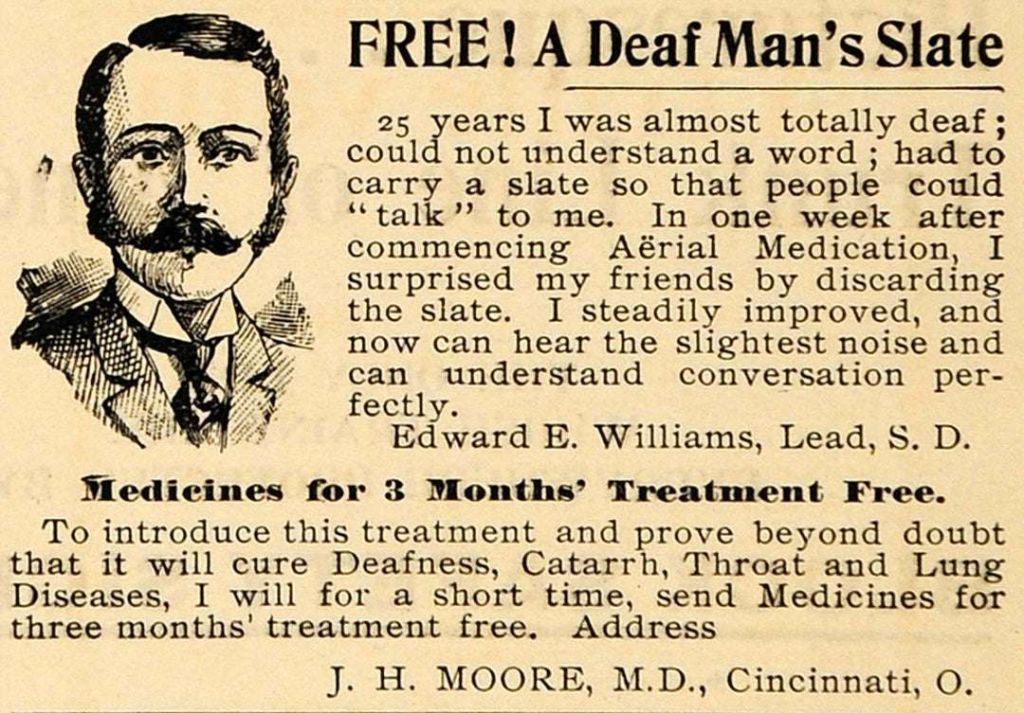
Advertisements for J.H. Moore’s Deafness Aerial Medication were relatively common in periodicals in the late 19th century. The offer of three months free treatment was also frequently made. Here is a second example, this time from 1894. ….
1894 Advert for J H Moore’s Treatment – Deafness Aerial Medication. [2]
Searches online produce a series of references to these advertisements but no indication as to the veracity of the claims made in them!
The 4 Guinea Organette on the market for just 35 shillings was a relatively common place advertisement. Draper’s factory in Blackburn was claimed to be the largest such works in the world. The Journal The Music Box carries the story of the company. [3]
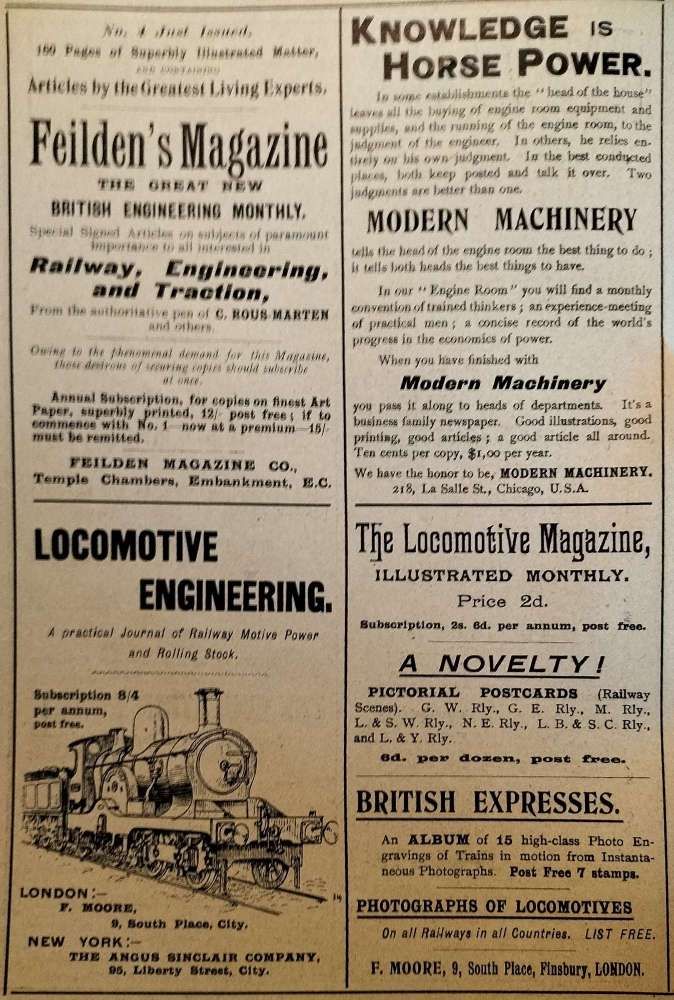
The next page of adverts focussed mainly on publications. ….
The sixth page of advertisement in my possession. [1: pVII]
The journals which appear on this page are a mixture of British and American publications. A couple of the adverts are for publications sold by F. Moore of Finsbury, London. As we have noted in an earlier article, ‘F. Moore’ was not the name of a real artist, but rather the name adopted by the Locomotive Publishing Company, which employed the services of the rather reclusive Edwin Thomas Rudd to do the actual painting. [4]
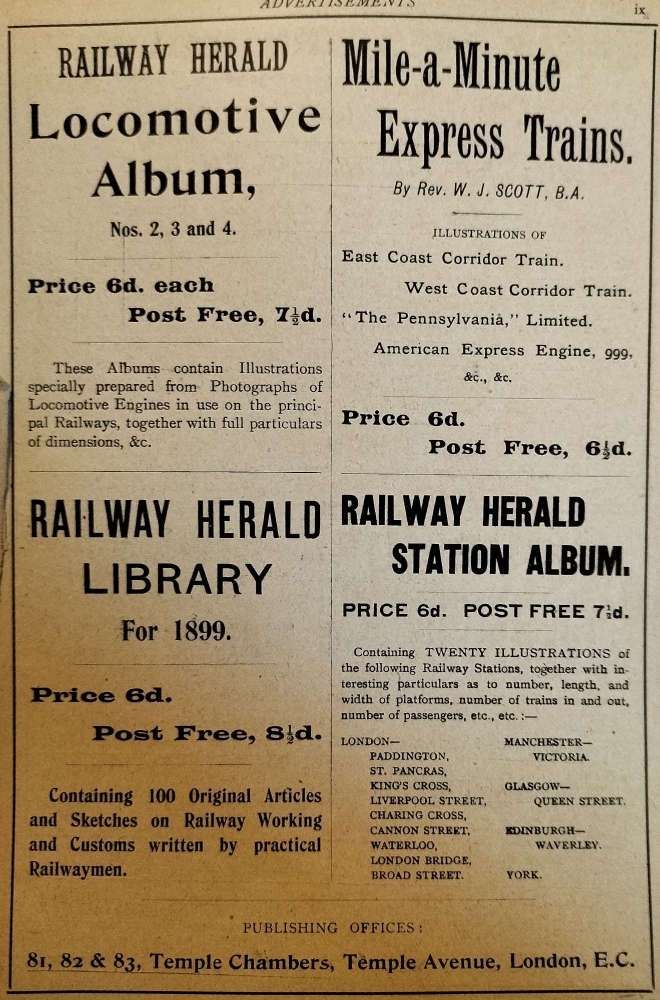
That sixth page of adverts is followed by a page of notices of in-house publications by the publishers of The Railway Magazine. A sister journal was the ‘Railway Herald’. It was a weekly journal published between 1887-1903 which “reported on the activities of the General Railway Workers’ Union, the Railway Clerks’ Association and the United Pointsmen and Signalmen’s Society (and criticised the rival Amalgamated Society of Railway Servants). The newspaper included branch and district news for unions and welfare societies; general reports on the railway industry, including technical developments and descriptions of working conditions; information about railway-related accidents (fatal and non-fatal) and criminal offences; ‘The women’s corner’ (including recipes and household tips); correspondence and advertisements (including for clothing and patent medicines).” [5]
The seventh of these images includes Railway Herald publications and a book by Rev R.W. Scott. [1: pIX]
Alongside its weekly publication, the Railway Herald also produced a series of illustrated albums of Locomotives and Stations.
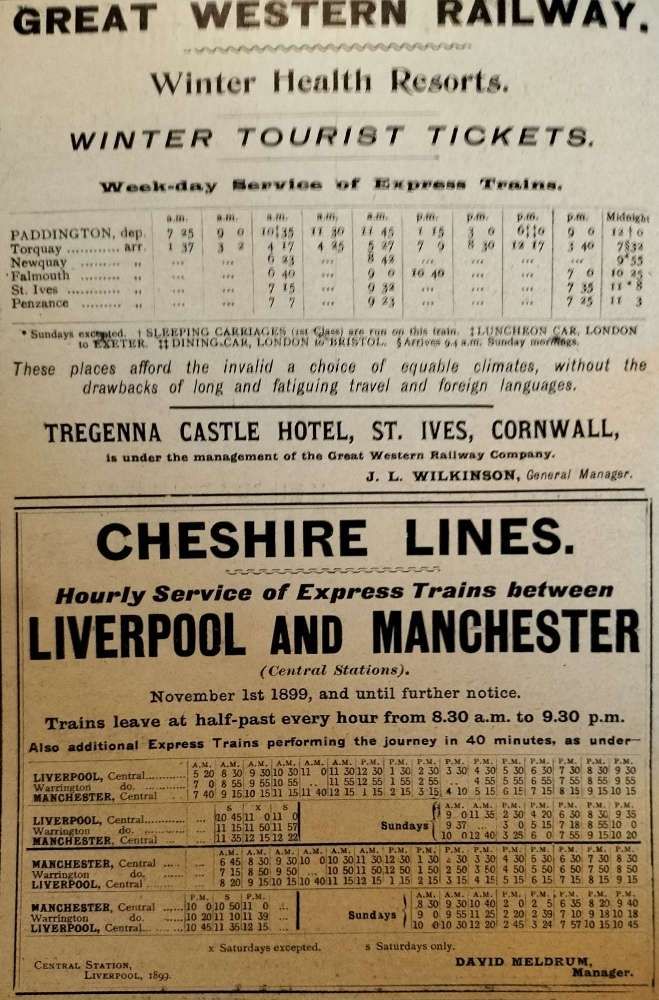
The next page consists of two adverts for train services. The first for GWR winter services to Cornwall and Devon, the second for the new timetable for express services between Manchester and Liverpool provided by the Cheshire Lines Committee. …
The eighth of these images. [1: pX]
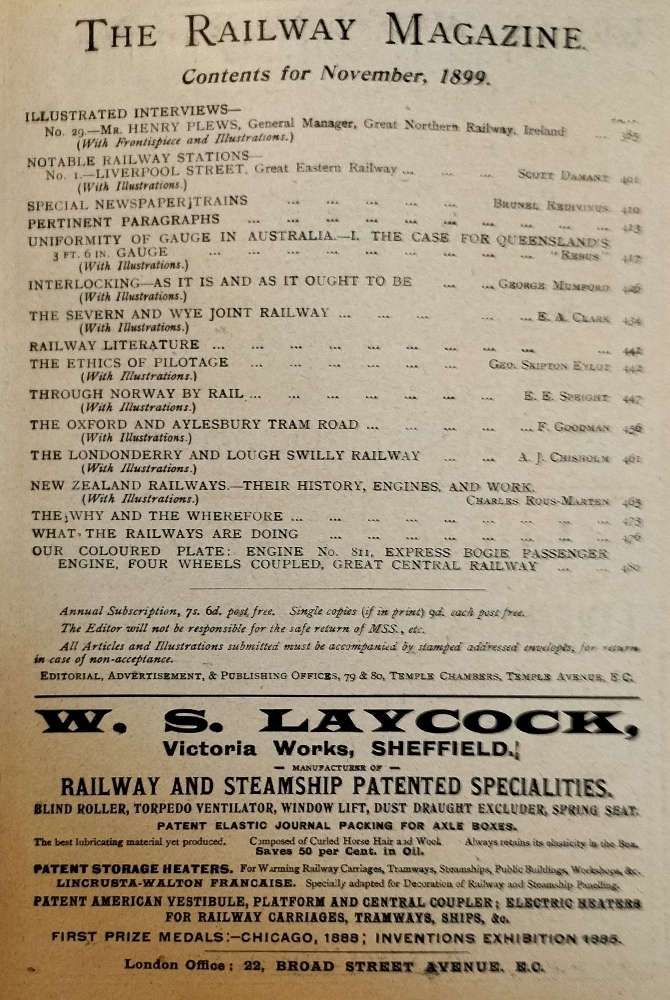
The contents page for the journal follows with a number of interesting articles which may well feature on this blog in due course. This page includes an advertisement by W.S. Laycock of Victoria Works, Sheffield.
The ninth of these images includes an advert by W.S. Laycock Engineering Ltd. [1: pIX]
W.S. Laycock Engineering Ltd., was based in Sheffield. The company is covered in some detail by Grace’s Guide. [6]
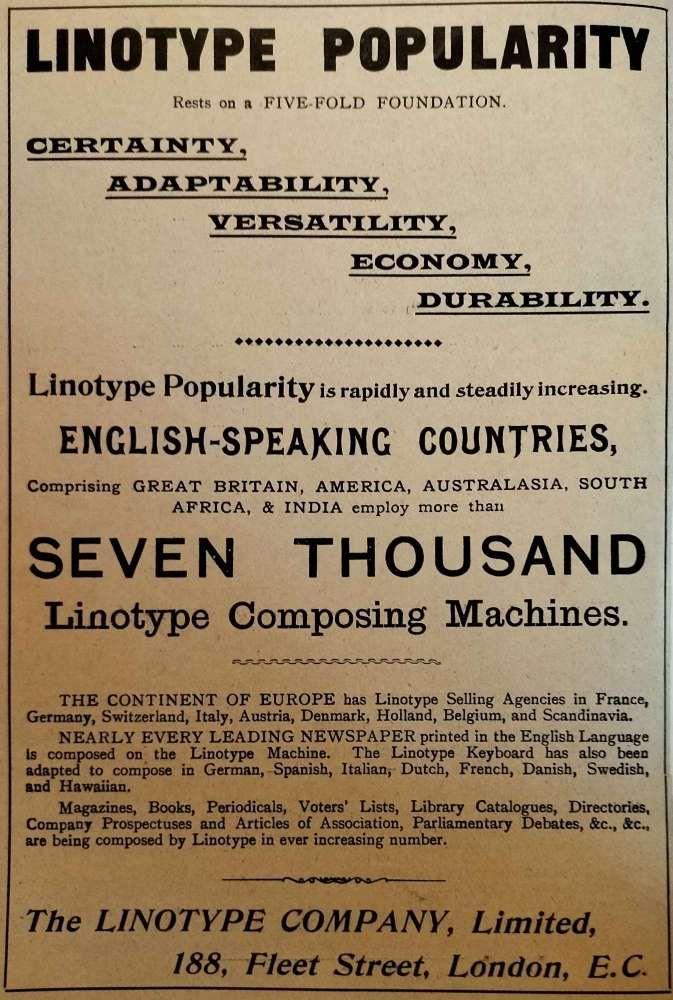
The final page of adverts at the front of this edition of The Railway Magazine contains a full-page advert by the Linotype Company of Fleet Street, London.
“The Linotype Company was set up in 1889 by a group of British businessmen in order to buy Linotype and other patents from American interests. These men included the publisher Sir Joseph Lawrence, founder of the Railway Magazine, later Sheriff of London and an MP; Lord Kelvin, the famous scientist, and other well-known men of the time. In 1889, Lawrence and Stilson Hutchins, a representative of the American manufacturer, brought three experimental machines to England. These caused great interest amongst the printing and newspaper industries. In 1895 Lawrence became chairman of the Linotype Company and remained so until his death in 1919.” [7]
“Funding for the project did not come from British banks, but from the American Mergenthaler Company, which granted the Linotype’s licence in return for shares. (By 1909 Mergenthaler controlled the British company and by 1921 both the chairman and the managing director were American.) The British company’s head office was at 188-9 Fleet St, London until 1947 when it moved to John Street, London, WC1.” [7]
The UK company started life at “Hulme Street, Oxford Road, Manchester, where a factory for assembling machines and making some of the simpler parts was built. Manchester had an abundance of skilled labour and also had good rail and canal networks for transporting raw materials, such as iron and coal, and for distribution of the completed machinery. As the company became more successful, the Hulme Street factory became overcrowded. In 1896 the Linotype Company took land at Broadheath, Altrincham for a new factory, which was formally opened by Lady Kelvin on Friday 14 July 1899. The Altrincham plant was sited next to the Bridgewater Canal which brought coal for the furnaces directly from the Worsley mines to the works.” [7]
The works in Altrincham were accompanied by a large housing development for the company’s staff which included social amenities. Morning can be found out by clicking here. [7]
References
The Railway Magazine, November 1899, London, 1899.
The August 1905 edition of the Railway Magazine was the 98th issue. In preparation for its 100th edition, it carried this advert. …
A reminder to Railway Magazine Readers that the 200th edition will not have an unlimited print run. [1: p176]
The Railway Magazine had been established for over 8 years. … The above image can be read easily with the exception of the central portion which, in my copy, is damaged. As far as I can tell that portion reads:
“As a memento of this success of the RAILWAY MAGAZINE, we propose to make the 100th Number (October, 1905), a special issue, containing, in addition to the usual articles, several contributions by the leading experts in various phases of railway working, locomotive development, etc. A feature of these special articles will be the reference to improvements in train services, locomotive working and railway management that have taken place during the past 8 years. The RAILWAY MAGAZINE is entitled to the credit of suggesting many of these improvements. With the 100th Number of the RAILWAY MAGAZINE will be issued a Large Presentation Plate, specially drawn, showing the evolution of the steam locomotive from 1803 to the present time, by means of typical engines of various periods.” [1: p176]
The practice of modern railway magazine special supplements and celebratory issues clearly goes back right to the very earliest months of publication of railway magazines.
The August 1905 edition of the Railway Magazine contains a number of third party adverts which are interesting. ….
In addition to a good number of railway company adverts for particular train services and holiday destinations which are themselves worth looking at, are a number from companies which supplied the railway industry, provided services for railway passengers, or catered for the wider public. …
A. Hotel Cecil
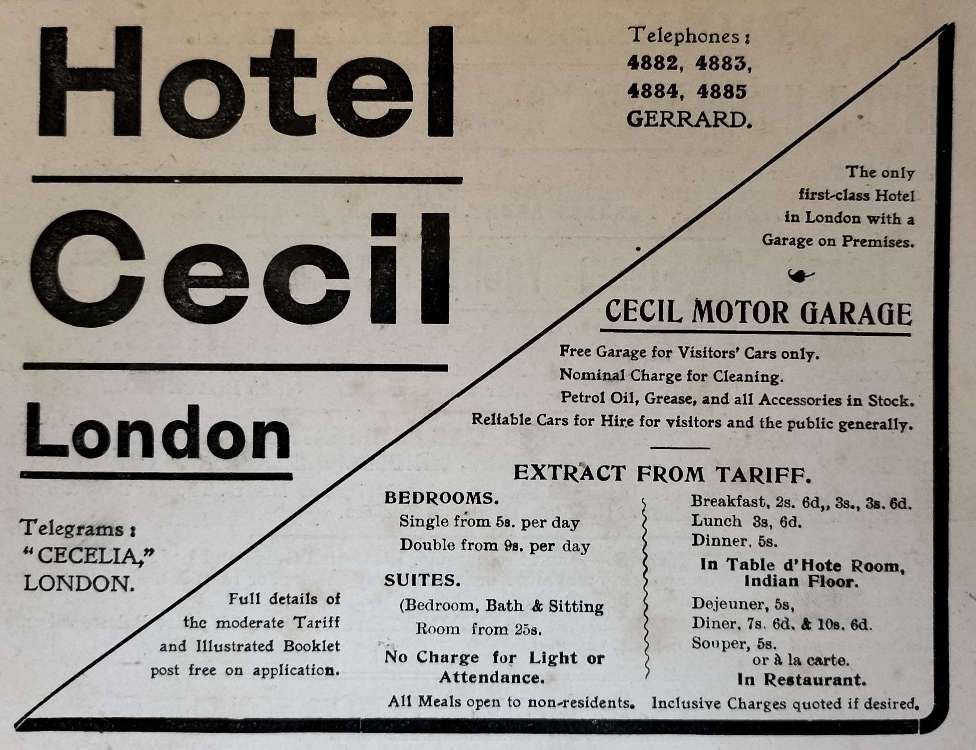
Hotel Cecil, London. [1: pI]
The Hotel Cecil advertised itself as the only first class hotel in London with a garage on the premises. Tariffs included: a single room at 5 shillings, a double at 9 shillings, and a suite at 25 shillings. Food was equally inexpensive to modern eyes, breakfast, lunch and dinner could be purchased for a total of 11 shillings. A single person could stay full board for 16 shillings! (80 pence!)
A loaf of bread cost 5d in London in February 1905, [2] around 2p in today’s money. If we accept that supermarket prices for a 800g loaf are about £1.35 in 2024 we can make a simplistic comparison with modern day costs for full board in London. £1.35 would have bought close to 70 loaves in 1905. That factor of 70 would suggest that a comparable price for full board would be £56!
Five-star accommodation in 2024 at the Shangri-La at The Shard, London costs upwards from £602 which could include breakfast!
B. A Motoring Atlas
The British Motor Tourists ABC, published in the same premises as The Railway Magazine. [1: pIII]
The British Motor Tourists ABC, could be purchased as a paperback (limp) for 5 shillings – the same price as a single room at the Hotel Cecil! If you were using it as a chauffeur, then a special edition could be purchased far cheaper – just 1s 3d.
This ‘Indispensible’ volume included ‘Hints to Motor Tourists’, by S.F. Edge – 57 pages of clear Main Road Maps, Alphabetical List of Towns and Villages in Great Britain and Ireland. with Best Hotels, Garages, Spirit Stores, Charging Stations and Repairing Depots, Hints on Tyres. Customs Tariff and Regulations, Steamer Freights, Railway Regulations, re Petrol and Carriage of Motor Cars, Motor Car Act, Motor Signs, Racing Fixtures, Lighting-up Table, Yacht and Golfing Clubs, Automobile Clubs, Fishing and Hunting Centres.
C. Postcards
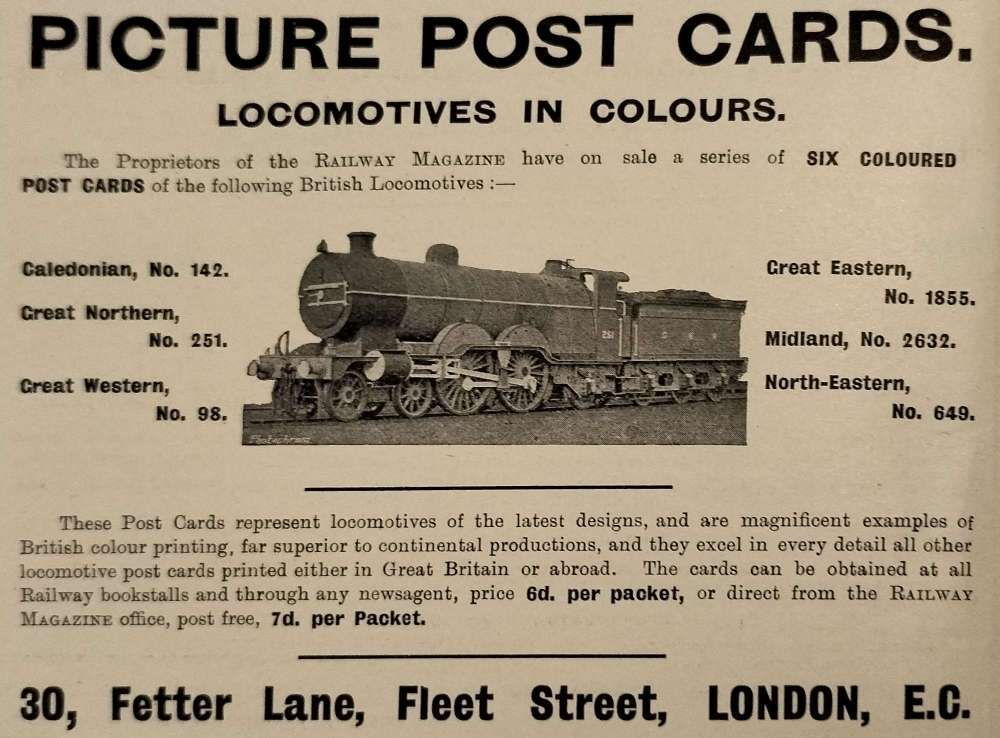
These Post Cards represented locomotives of the latest designs, they could be obtained at all railway bookstalls and through any newsagent, price 6d. per set/packet, or direct from the Railway Magazine office, post free, 7d. per packet. [1: pVI]
D. Railway Inspection Cars
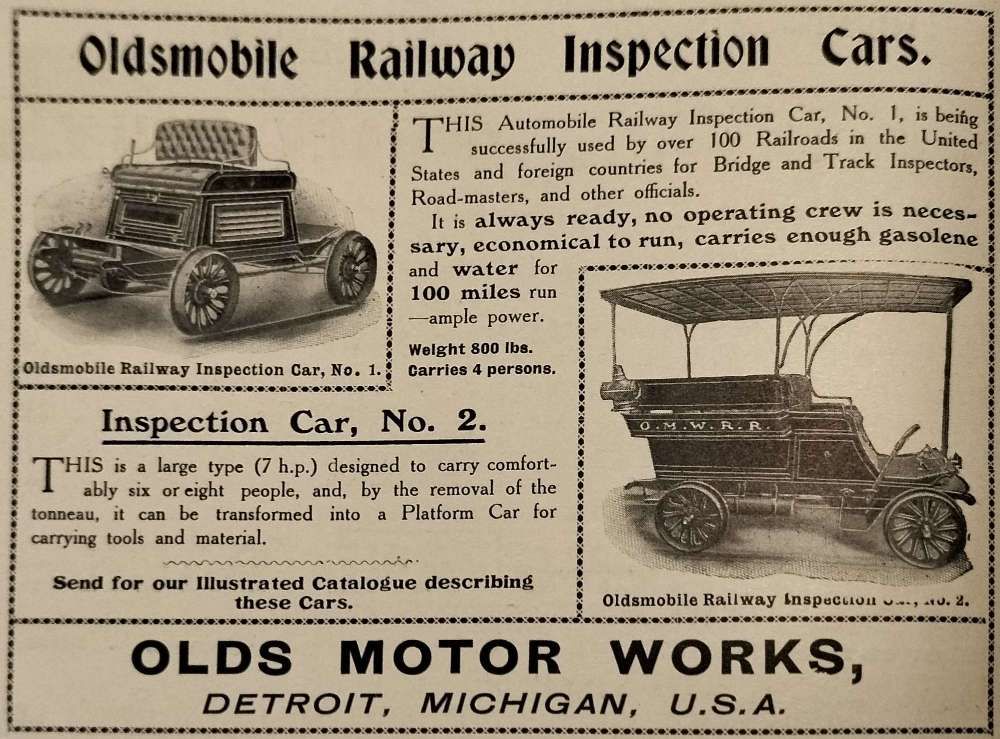
Oldsmobile advertised two inspection cars. The first was a self-drive vehicle with space for 4 people. Weight: 800lbs. The second was a larger vehicle which could carry 6 to 8 people or carry tools and material. [1: pX]
Inspection Car, No. 1 was already in use by over 100 Railroads in the United States and other countries. for Bridge and Track Inspectors, Road-masters, and other officials. The Company claimed that it was economical to run and had a range of 100 miles.
Production was limited to only 127 units, the Olds Rail Road Inspection Car was built by the Olds Motor Works from 1903 to 1905 and sold exclusively by the Railway Appliance Company of New York and Chicago. [3]
Inspection Car No. 2 was a larger vehicle with a 7 hp engine. It weighed in at 1200lbs, was designed for standard-gauge track but could be reduced to a minimum of 3ft 6 in gauge. A top speed of 30 mph was possible. Its range was comparable to Inspection Car No. 1 at 100 miles. [3]
There were a number of converted road vehicles in use over time as inspection vehicles in the USA. More can be discovered here. [4]
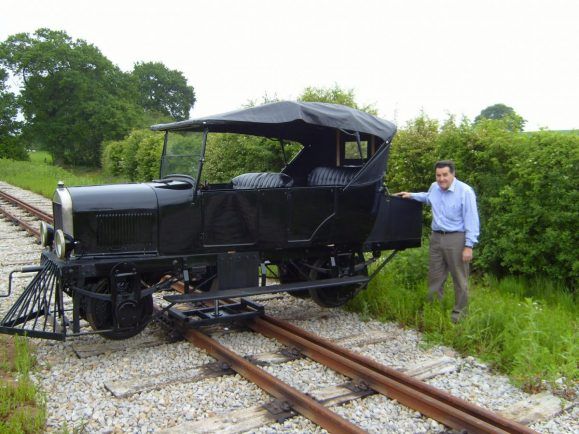
Ford produced one which included its own turntable. A 1925 Ford Model T Railway Inspection Car was on display on a short 30m section of track outside the Collections Centre at the British Motor Museum at Gaydon on 16th July 2024.
A Ford Model T Rail Inspection Car with inbuilt turntable. [5]
E. A Mug or Two of Cocoa
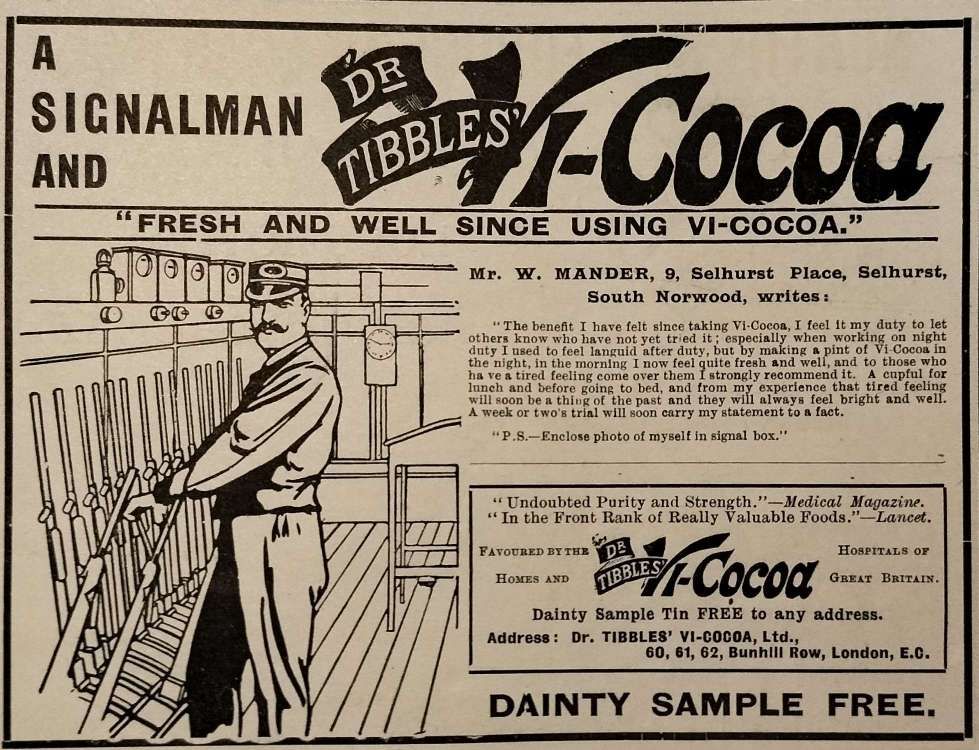
Dr. Tibbles’ Vi-Cocoa was a popular energy restorative in the Victorian era. At its height it was one of the highest-selling cocoa-based drinks in Britain. [6]
Dr. Tibbles’ advert in the Railway Magazine. [1: pXI]
Adverts for Dr Tibbles Vi-Cocoa, which was a mixture of malt, hops, kola and cocoa, first appeared in 1893. He registered the company at that time and later re-registered as Dr Tibbles’ Vi- Cocoa (1898) Ltd in 1898. Tibbles retired soon afterwards.
“Land was purchased in North Watford to expand Vi-Cocoa production in 1899. A fire devastated the factory in 1903 but the site was rebuilt and became an important local employer making cocoa and chocolates.” [7]
The business was renamed the Watford Manufacturing Company in 1907.
“The Watford Manufacturing Company produced munitions during the First World War. Following the War, the company expected an increase in business and invested in the construction of a huge, new factory. However the business did not materialize. The new factory became a white elephant, was left unfinished and bankrupted the company in 1922.” [8]
In 1918, Lord Leverhulme became the largest shareholder. In 1922 the Company entered into liquidation and Lord Leverhulme purchased the Company. Virtually straight-away, Leverhulme sold up to Planters Products Ltd, a Lever Brothers subsidiary. Vi-Cocoa production continued, the factory was employing 400 people in 1929, and was one of the largest employers in the area. [6]
In 1930, the factory was sold and Unilever absorbed by Unilever, the new incarnation of Lever Brothers. Vi-Cocoa was still being advertised in 1945.
Dr. Tibble’s Vi-Cocoa “achieved remarkable success through a combination of innovative marketing techniques, including health claims, scientific endorsements, extensive print advertising, free samples, and targeted marketing. These strategies not only propelled Vi Cocoa to commercial success but also influenced broader trends in advertising and consumer culture in late Victorian Britain.” [9]
F. Thomas Firth & Sons Ltd.
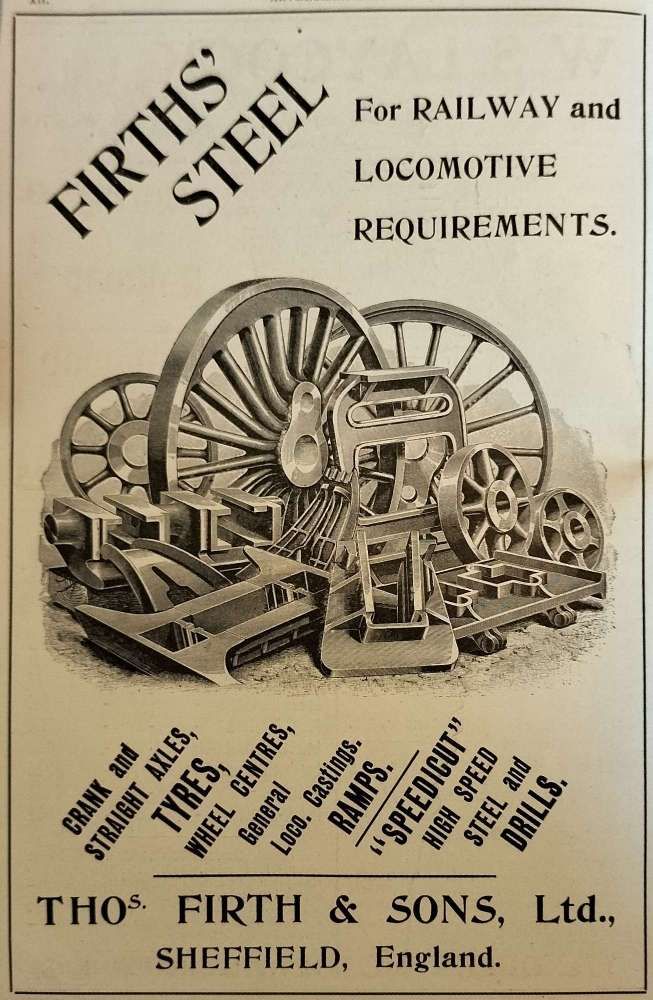
Firths’ Steel of Sheffield. [1: pXII]
Wikipedia tells us that, “In 1902, Sheffield steelmakers John Brown & Company exchanged shares and came to a working agreement with neighbouring company Thomas Firth & Sons, the companies continuing under their own management until they finally merged in 1930.” [10] At the merger they formally became Firth Brown Steels.
G. W.S. Laycock Ltd.
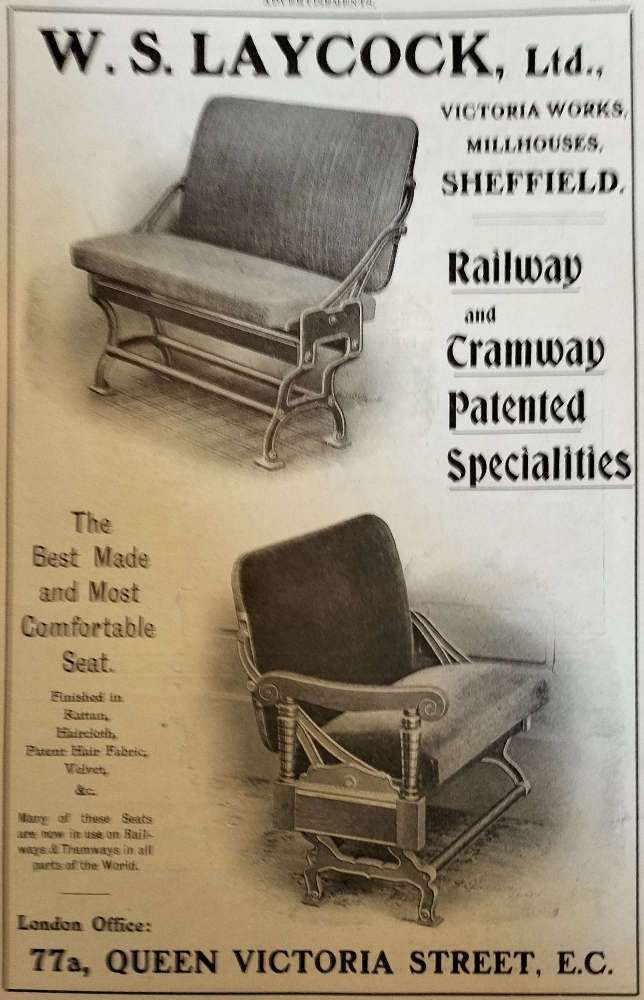
W.S. Laycock Ltd. [1: pXIII]
W. S. Laycock of Levygreave Road and Victoria Works, Gell Street, Sheffield were Railway Carriage Fittings and Appliance Manufacturers in 1901. First established by Laycock in Victoria Street, Sheffield in 1884. In 1893, the Company “introduced a system for train heating using steam from the locomotive with storage reservoirs in each compartment.” [11]
By 1900, the Company was incorporated as a limited company. Grace’s Guide tells us that the company “supplied equipment to every railway company in the world, the main specialities being carriage blinds, buckeye automatic couplers, vestibule gangway connections, and steam-heating equipment for complete trains.” [11]
In 1902, the Company opened new works at Millhouses, adjoining the Midland Railway. The Company produced munitions during WW1 and in time became Laycock Engineering Co. and later still Laycock Engineering. The company was still exhibiting at the Motor Show in the late 1980s.
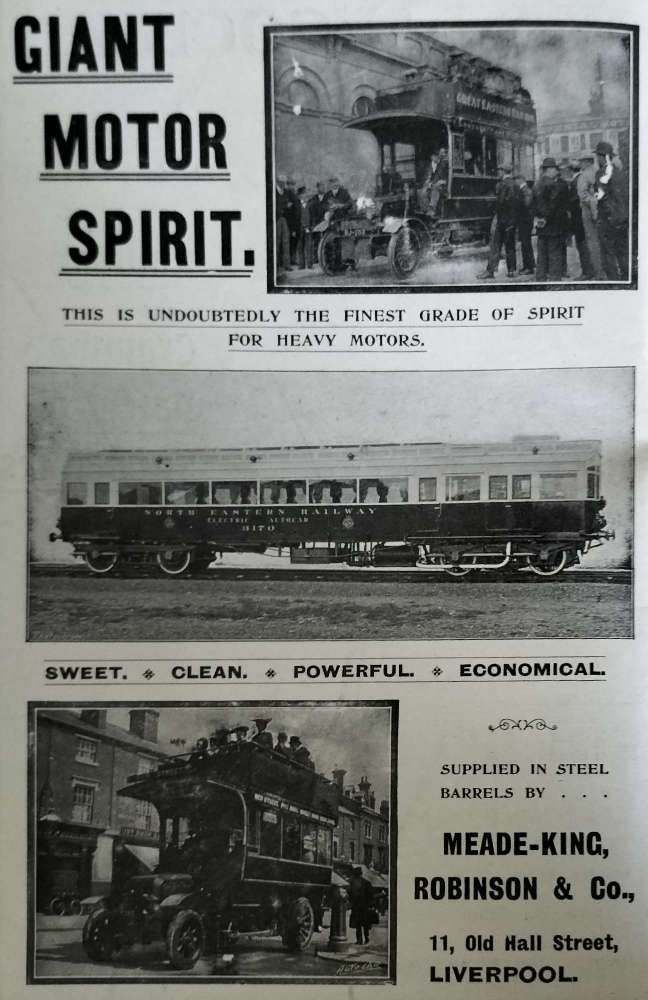
H. Giant Motor Spirit
Motor Spirit is Petrol or Gasoline. Meade-King, Robinson & Co., of Liverpool place the advert below in the Railway Magazine. For more information about early Petrol-powered rail vehicles, click here. [12]
Meade-King Robinson [13] is still in business in 2024. “It is a privately owned chemical distribution company with over 140 years experience in the supply of a wide range of oils and chemicals.” [14]
An early advert for Petrol! [1: pXIV]
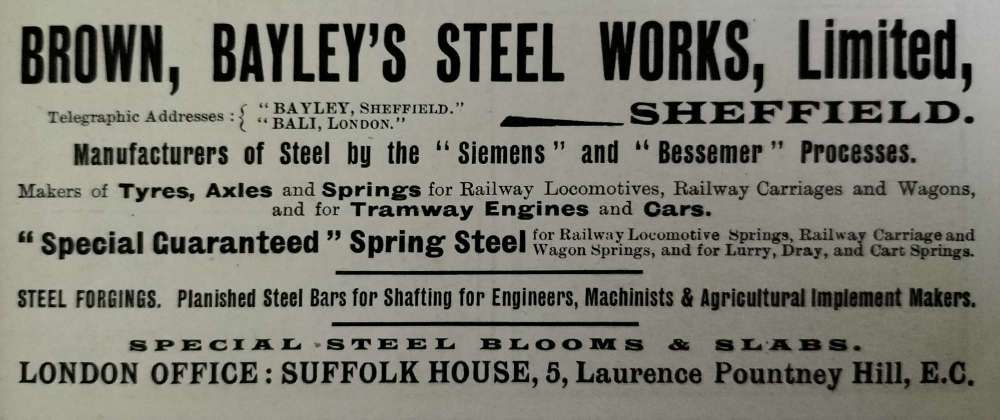
I. Brown, Bayley’s Steel Works, Ltd.
Wikipedia tells that “Brown Bayley Steels was a steel-making company established in Sheffield, England in 1871, as Brown, Bayley & Dixon. They occupied a site on Leeds Road which was later occupied by the Don Valley sports stadium.” [15]
[1: pXV]
Brown, Bayley’s Steel Works had three main sites: Leeds Road, East Works, and Brighton Bar Shop.
Wikipedia tells us that “the Leeds Road site included: a spring shop, a hammer shop, a ring rolling shop with Telpher Crane, a machine shop for railway axles & tyres, an axle & railway tyre drop test plant, a heat treatment department, creep laboratories, a tyre blank press, a blacksmiths shop, a loco Shed, a drawing office, and a generator converter house creating direct current for cranes.” [15]
East Works: had “a sheet rolling mill, a sheet pickling plant, sheet polishing and guillotine shops andSteckel mills (slitting machines).” [15]
Bright Bar Shop: undertook “bar drawing, had centreless turning machines, centreless Lidkoping grinding machines, a 5 ton hammer, a 500 ton press and a railway tyre rolling mill.” [15]
NB: “A Steckel mill is also known as a reversible finishing mill, it is similar to a reversing rolling mill except two coilers are used to feed the material through the mill. One coiler is on the entrance side and the other on the exit side. The coilers pull the material through the mill, therefore the process is more similar to drawing than rolling. The material is fed back and forth through the mill until the desired thickness is reached, much like a reversing rolling mill.” [16]
NB: “The Lidkoping centerless grinder is designed and manufactured to meet practically any challenge in precision grinding. More details of the most modern form of this equipment can be found here. [17]
J. A Few Small Ads
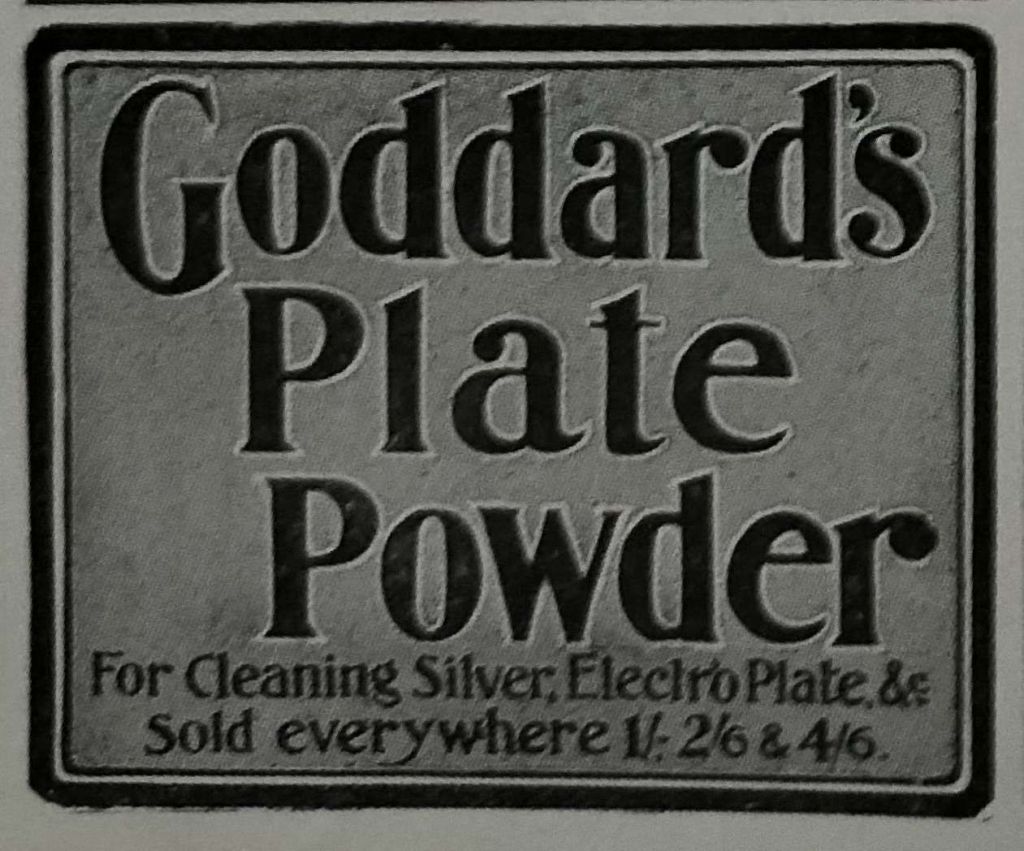
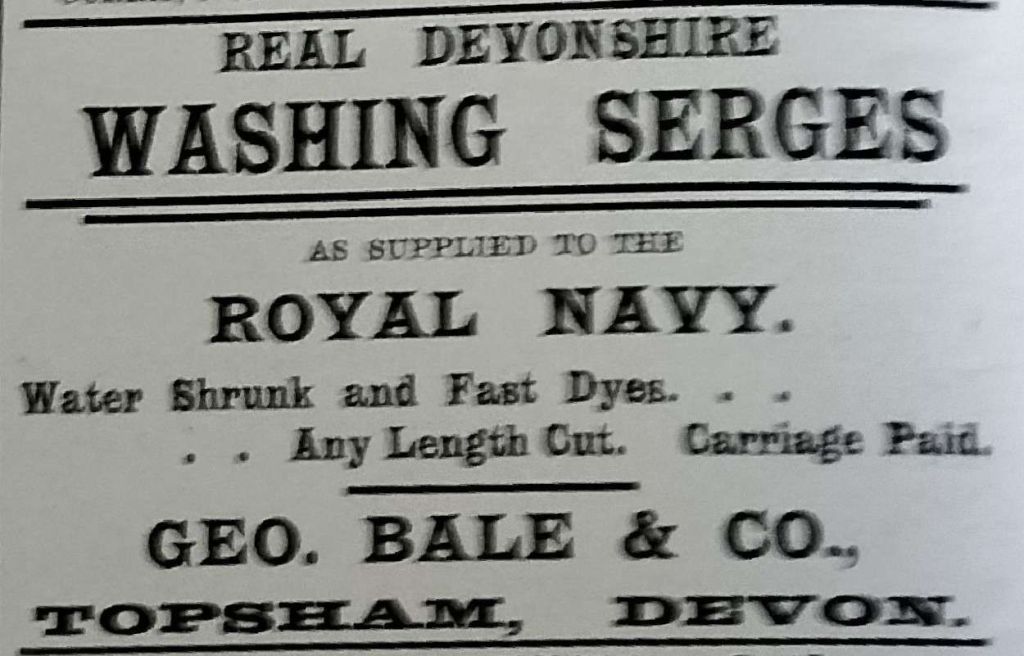
The last page of adverts at the front of the magazine includes these four small adverts. [1: pXVI]
Goddard’s Plate Powder was developed by Joseph Goddard in the early 19th century and 180 years later Goddard’s is still a going concern. [18]
Real Devonshire Washing Serge was sold by G. Bale & Co. of Topsham, Devon. I guess they anticipated sales to railway companies subsequent to their advert. I have not been able to find out anything about the company.
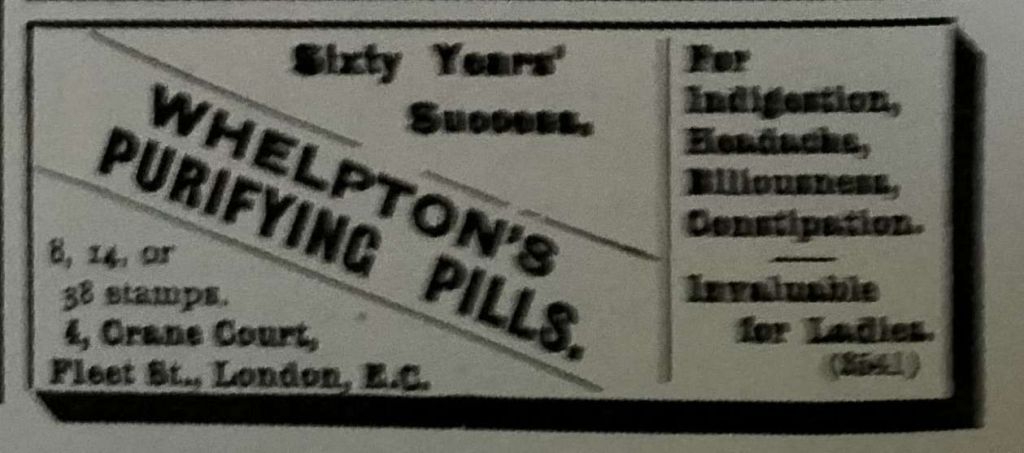
Whelpton’s Purifying Pills “were supplied by G. Whelpton and Son, London. They were advertised as being able to arouse the stomach to action, promoting the flow of gastric juice, and giving tone to the whole system. Headache flies away. Biliousness, Kidney Disorders, and Skin Complaints disappear, while cheerful spirits and clear complexions follow in due course!” [19: p1325]
“The pills had an average weight of 21 grains. Chemical and microscopical examination showed the presence of aloes (apparently Socotrine), powdered colocynth, ginger, and gentian. The last-named ingredient being less positively indicated than the others. No evidence of the presence of mercury or calomel was obtained.” [19: p1326]
I could not find any convincing evidence either that they were effective, or that they caused any real harm.
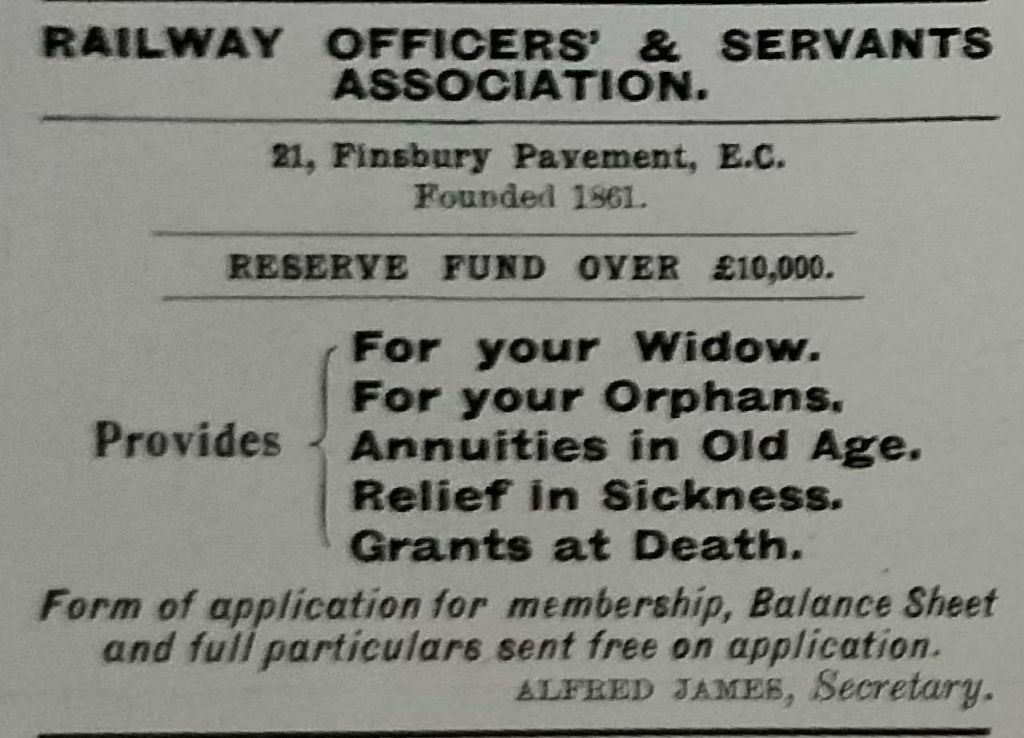
The Railway Officers and Servants Association was, until 1974, a Friendly Society, it was removed from the Charity register in November 1974.
This article features advertising from the November 1929 edition of The Railway Magazine. It will probably be of interest to compare the various adverts here with those in The Railway Magazine of November 1938. An article about the 1938 magazine can be found here. [2]
The Southern Railway
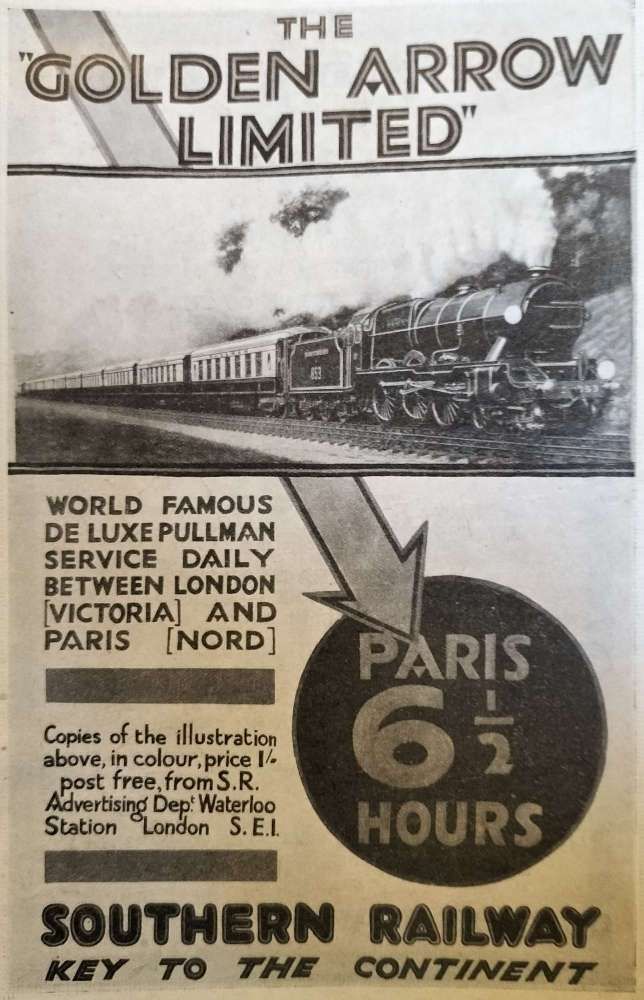
The Southern Railway had a single page advertisement in the magazine which featured the Golden Arrow Pullman Service between London and Paris.
London to Paris in 6 hrs 30 mins! [1: pIII]
Wikipedia tells us that, “The Flèche d’Or was introduced in 1926 as an all-first-class Pullman service between Paris and Calais. On 15th May 1929, the Southern Railway introduced the equivalent between London Victoria and Dover while simultaneously launching a new first class only ship, the ‘Canterbury’, for the ferry crossing. The train usually consisted of 10 British Pullman cars, hauled by one of the Southern Railway’s Lord Nelson class locomotives, and took 98 minutes to travel between London and Dover. Because of the impact of air travel and ‘market forces’ on the underlying economy of the service, ordinary first- and third-class carriages were added in 1931. Similarly the first-class-only ferry, ‘Canterbury’, was modified to allow other classes of passenger.” [3]
It is not surprising that the train service ceased at the outbreak of the Second World War in September 1939. “It resumed after the war on 15th April 1946, initially running with the pre-war Pullmans and the Trianon Bar car, a converted twelve-wheeled Pullman. The Southern Railway flagship, the ‘Invicta’ replaced the ‘Canterbury’ from 10th October 1946. As of 1949, the all-Pullman train was scheduled to depart from London Victoria at 10:30, with the connecting train from Calais reaching Paris (Gare du Nord) at 17:30, and from Paris at 12:15, with the connecting train from Dover arriving in London at 19:30. This worked out to a scheduled journey time of 6 hours eastbound and 6 hours, 15 minutes, westbound.” [3]
Four Full-page Adverts from the LMS
The LMS had four full-page adverts in the November 1929 magazine:
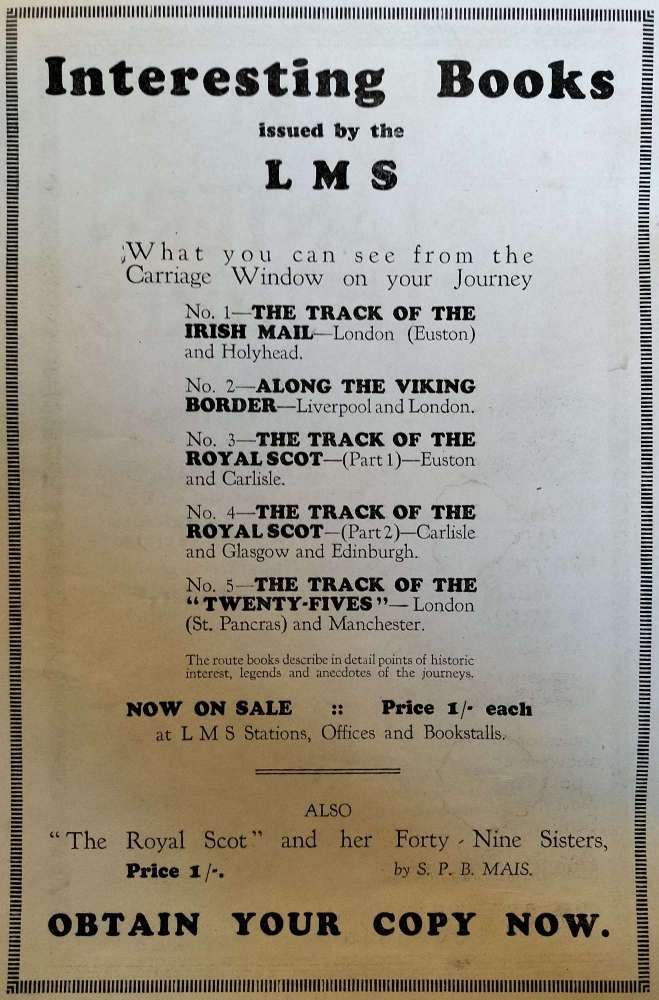
The first advert was for a series of ‘Carriage Window’ books. …
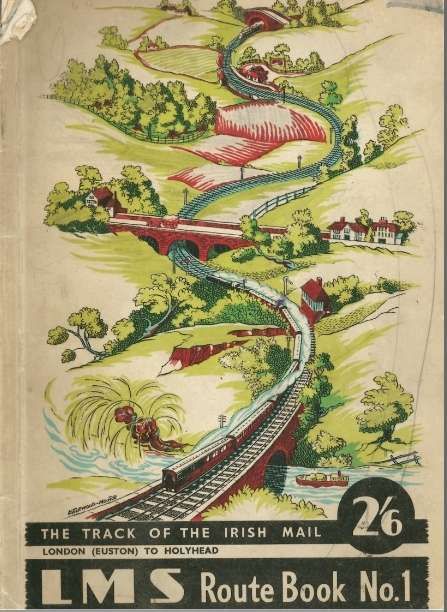
The first page pointed to a series of ‘carriage window’ books which helped travellers to comprehend what they were seeing beyond the windows on their journeys. [1: p IV]
These ‘Carriage Window’ books were usually entitled ‘The Track of the …’. They covered a number of different main line routes.
The frontispiece from the edition of ‘Track of the Irish Mail’ issued in 1947. [4]
In the article about The Railway Magazine of November 1938 we noted that the LNER was supplying scripts and slides for talks about their network. In 1929, the LMS was offering a similar range of lectures. …
Lecture notes and slides, illustrating holiday places and places of general interest on the LMS, supplied free! There is also a suggestion that a lecturer may be available too! [1: p V]
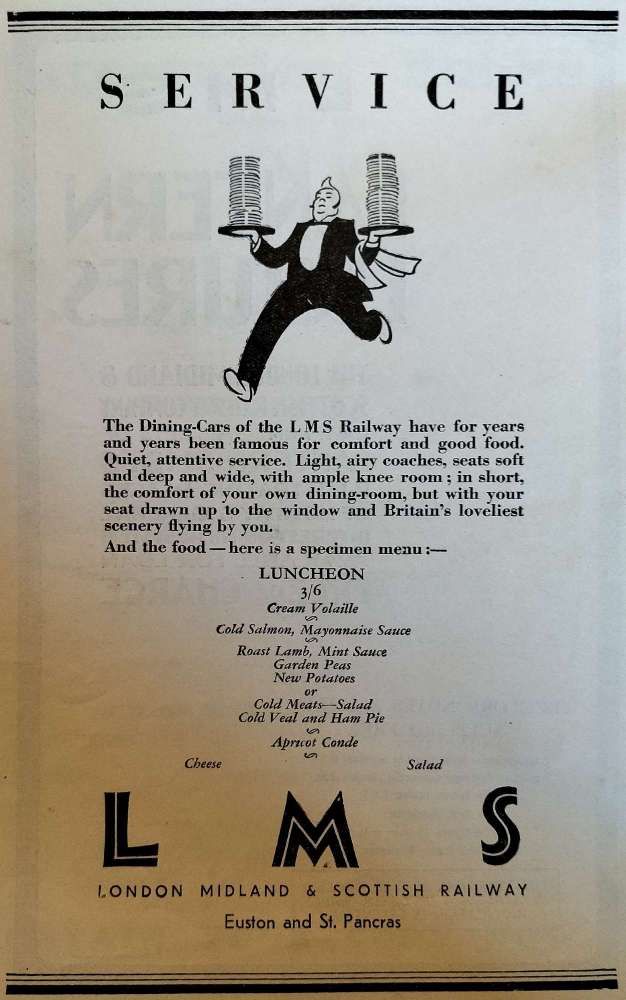
The LMS also advertised the dining experience on their express services. …
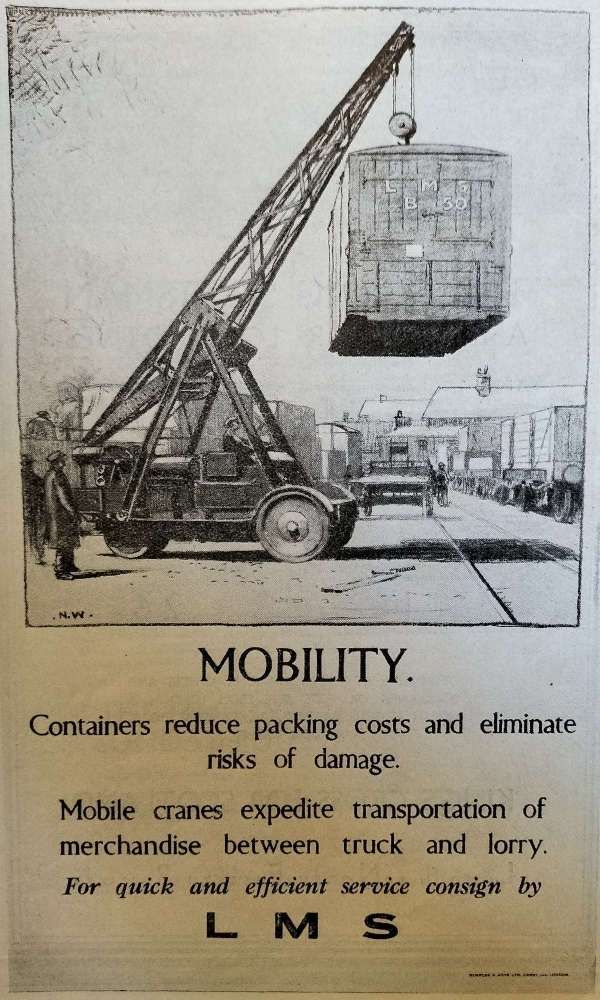
The dining experience on LMS is celebrated in this advert. I wonder whether their customers saw the advertised service or had similar disappointments as people in later generations? The food on offer probably simplified preparation work. [1: p VI]The use of containers on the LMS was clearly established by 1929. Mobile cranes in goods depots at railheads facilitated transfer from railway wagons to trucks and lorries. [1: p VII]
Four LNER Full-page Adverts
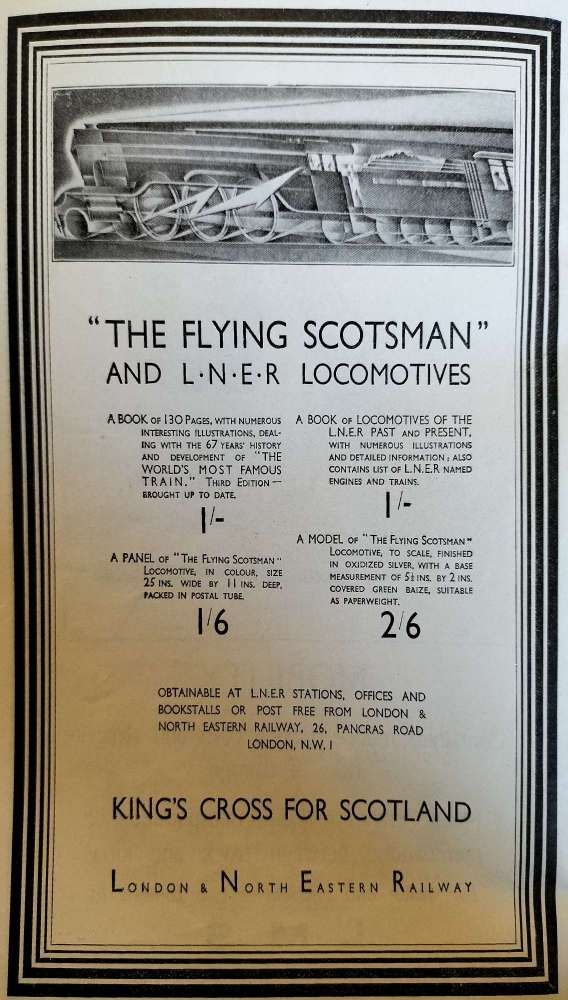
The first advert is for two books, a picture and a model celebrating ‘The Flying Scotsman’ and other LNER locomotives.
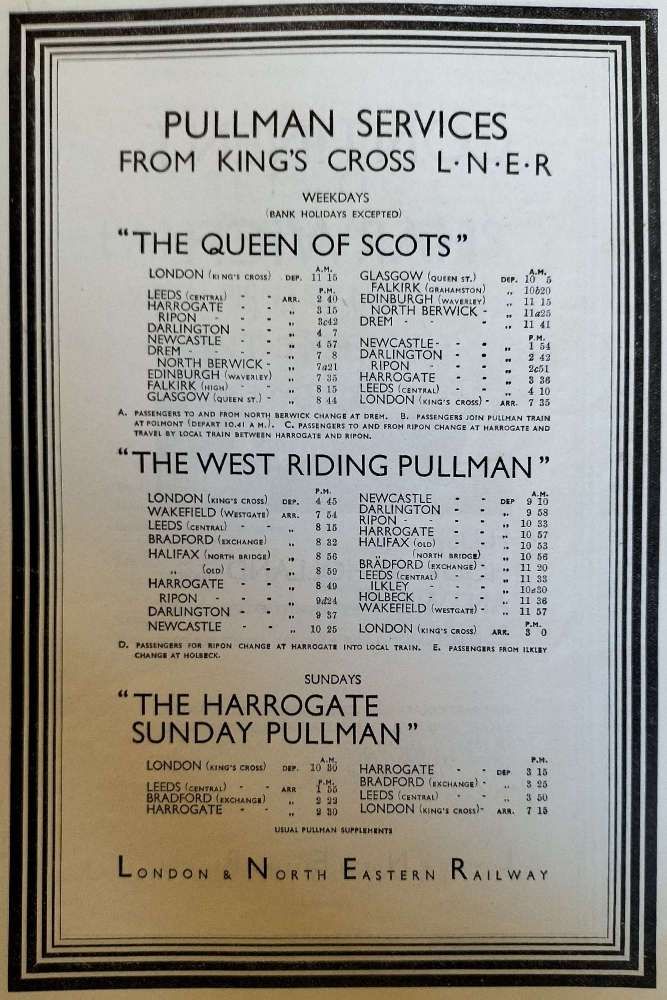
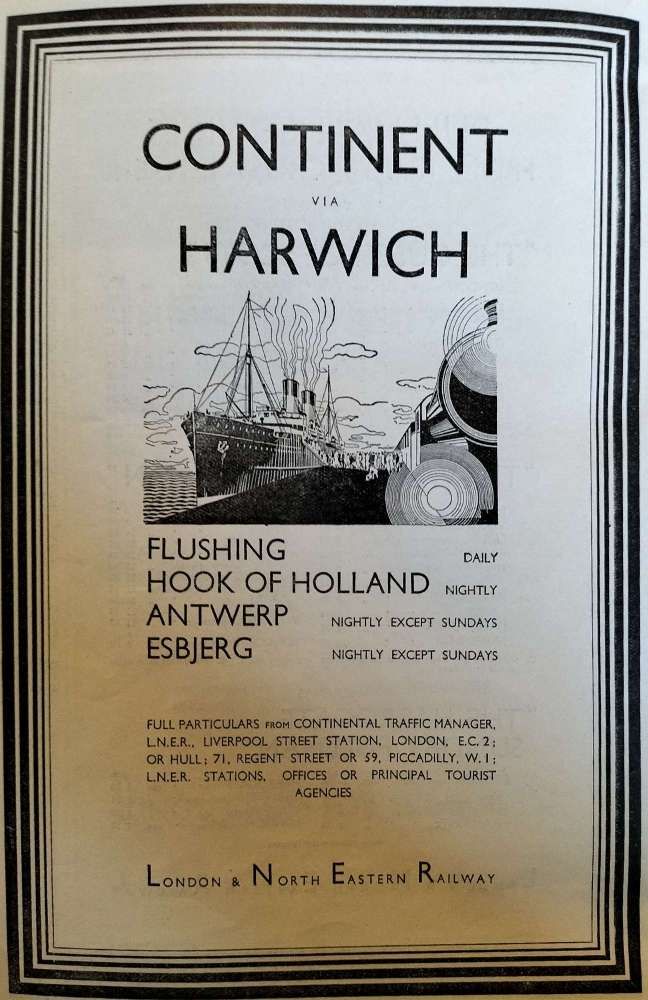
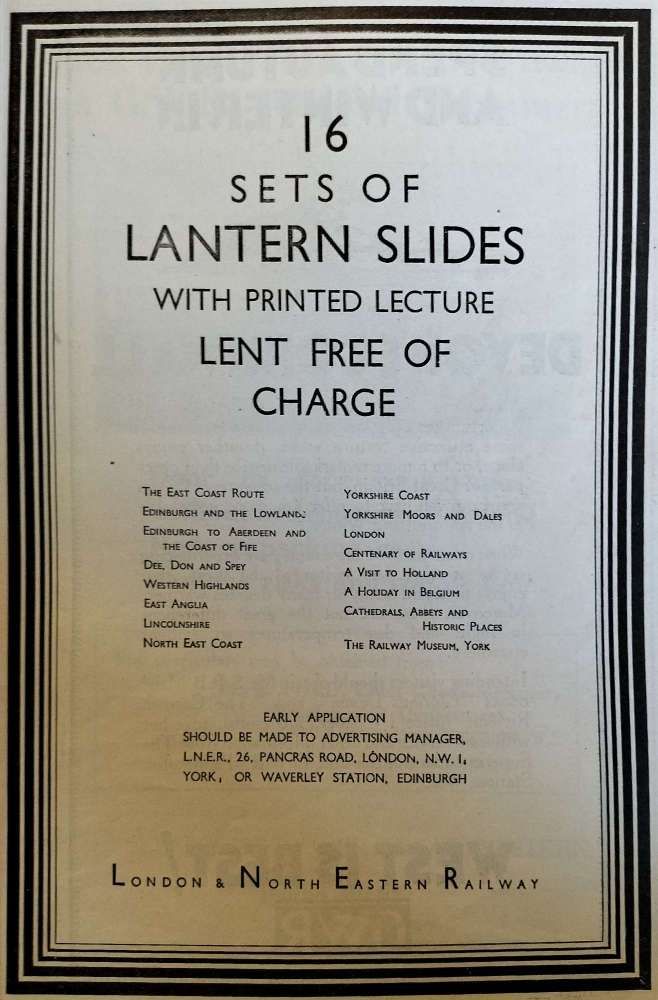
Two books, a ‘panel’ and a paperweight, all available direct from the LNER! [1: pVIII]Pullman services provided by the LNER. The ‘Queen of Scots’, the ‘West Riding Pullman’, the ‘ Harrogate Sunday Pullman’. [1: pIX]Ferry routes to Flushing (every day), to Hook of Holland (every night) to Antwerp and to Esbjerg (both nightly except Sundays). [1: pX]LNER slides and lectures, available free of charge! It seems from this advert, and that from 1938, that this practice was normal during the interwar period. Some interesting subjects! [1: pXI]
Two GWR Adverts
The first GWR adverts seems to be endeavouring to extend the summer season in the West Country. …
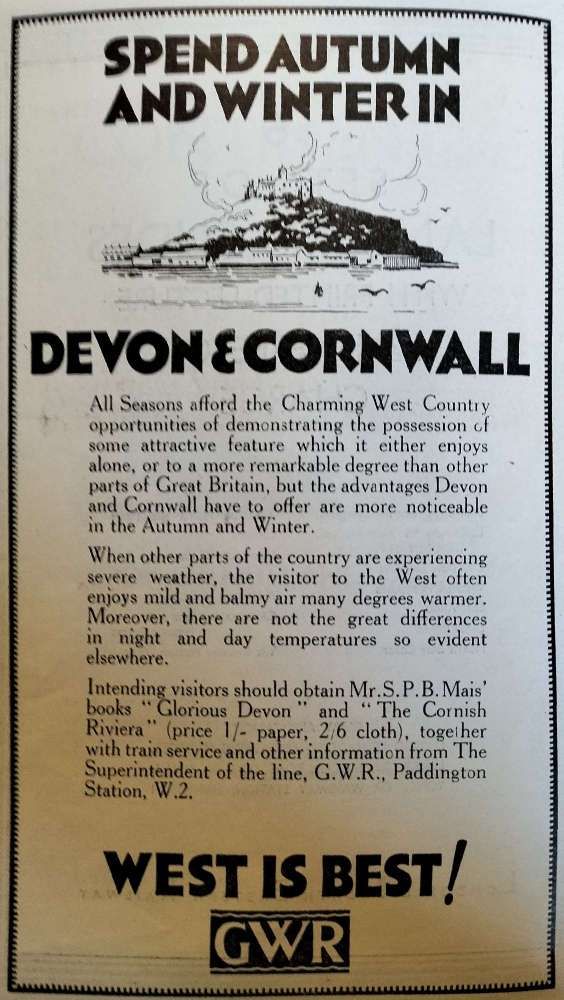
The GWR encourages out-of-season travel to the West Country, and the purchase of travel books direct from the GWR. [1: pXII]
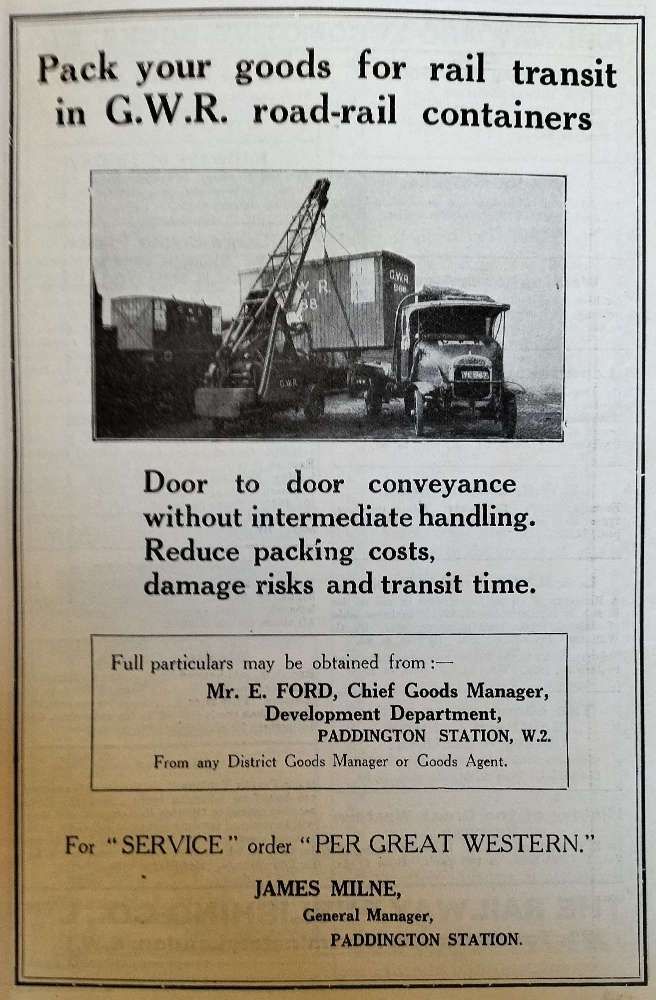
Their second advert focussed on their container service. …
Advertising the GWR container services, the photograph used shows a contemporary mobile crane and a GWR road-lorry. [1: pXIII]
Other Adverts
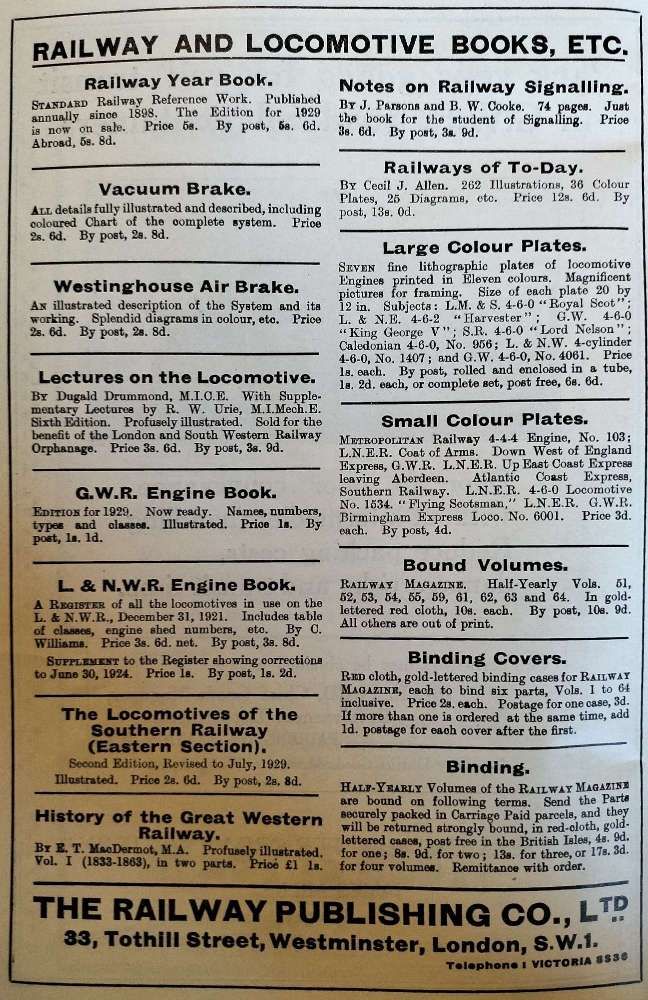
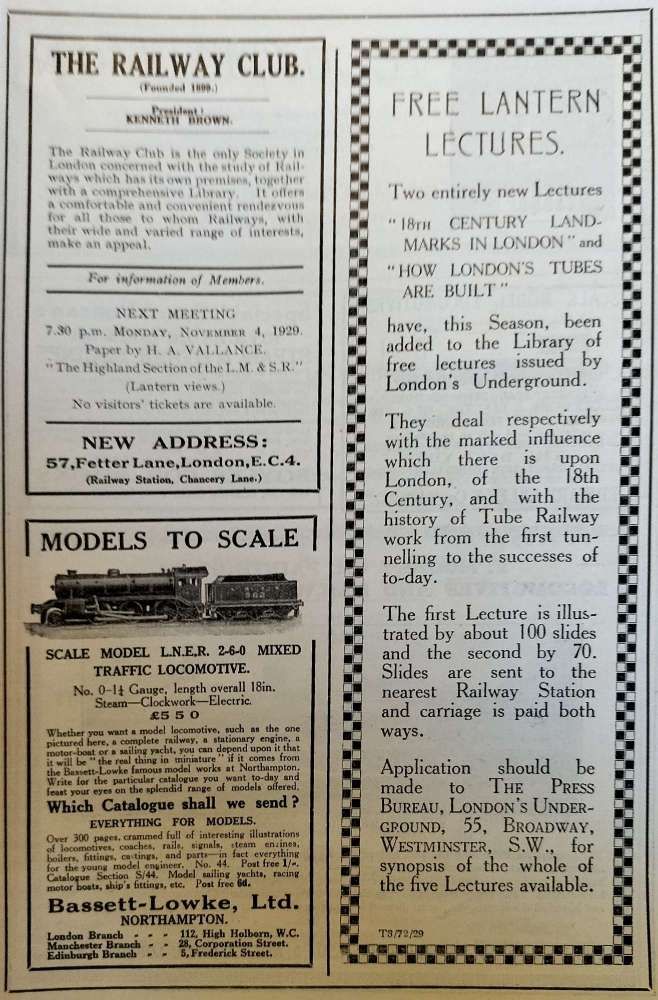
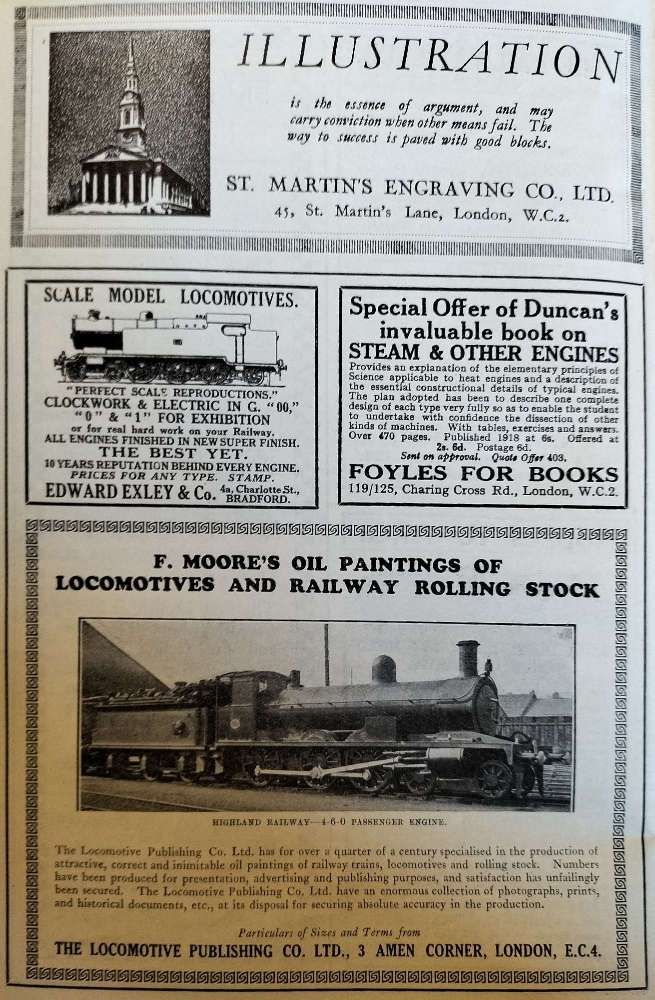
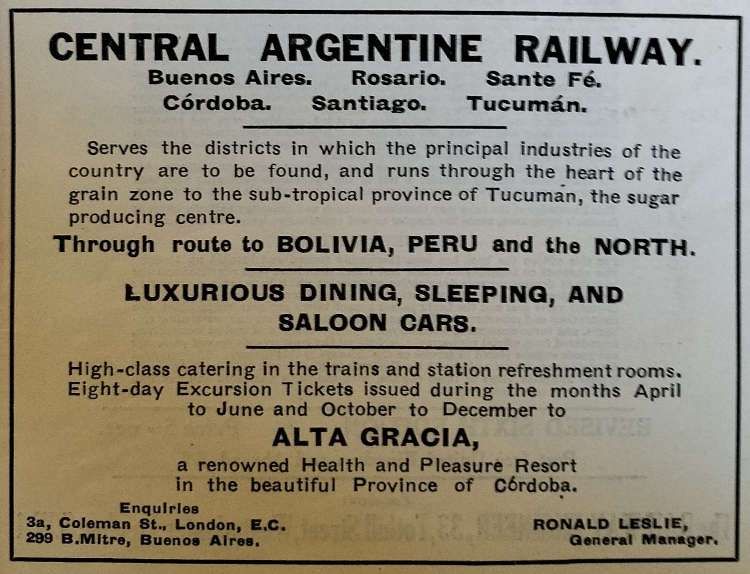
A regular feature is a full-page advert from the Railway Publishing Co. Ltd. [1: pXIV]Adverts from ‘The Railway Club’ and Bassett-Lowke sit alongside an offering from the Press Bureau of London’s Underground of two new lectures, the first about London’s landmarks, the second about the building of the underground railways. [1: pXV]The advert from St. Martin’s Engraving Co. Ltd. appears also in the November 1938 magazine. Fouled for Books is still a going concern in 2024. Edward Exley & Co. was founded in Bradford in about 1920 and the company is still in existence in 1924, undertaking repairs of Exley products from the past. [5] F. Moore was not the name of a real artist, but rather the name adopted by the Locomotive Publishing Company, which employed the services of the rather reclusive Edwin Thomas Rudd to do the actual painting. [6][1: pXVI]The Central Argentine Railway [1: pXVII]
The Central Argentine Railway was one of four broad gauge (5ft 6in/1676mm) British companies that built and operated railway networks in Argentina. Established in the 19th century, to serve the provinces of Santa Fe and Córdoba, in the east-central region of the country, it eventually also served Buenos Aires, Tucumán, and Santiago del Estero. It effectively ceased to exist after nationalisation.
“British railway companies operating in Argentina, including the CA, were nationalized in 1948 by the Juan Perón administration. The CA took over the northern section of the Ferrocarril Rosario y Puerto Belgrano and then became part of the state-owned Ferrocarril General Bartolomé Mitre.” [7]
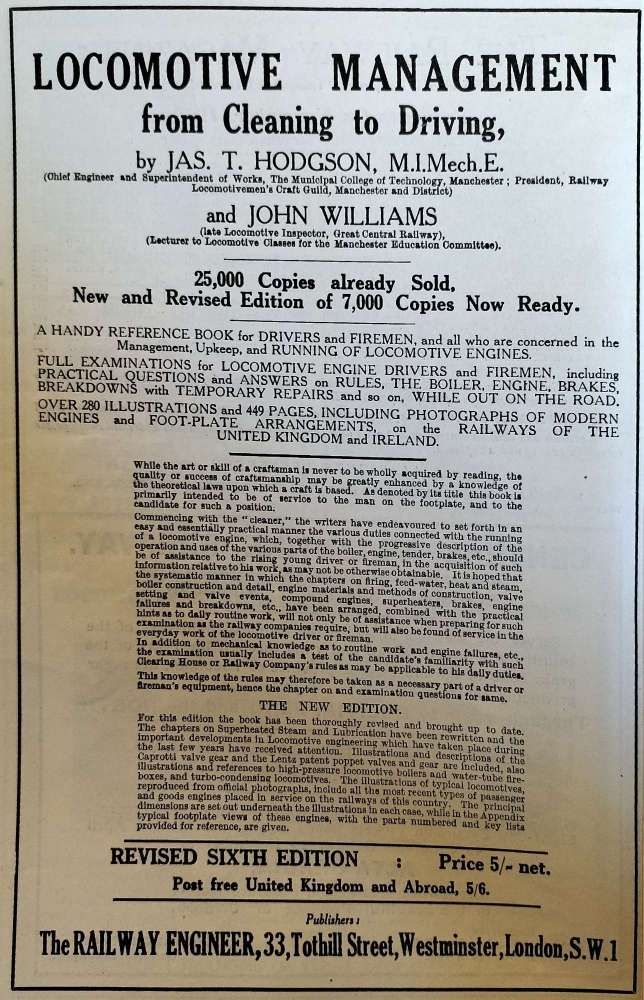
This final advert from the front pages of the November 1929 magazine promoted a publication by The Railway Engineer, the revised 6th edition of “Locomotive Management – from Cleaning to Driving” by Jas T. Hodgson and John Williams. [1: pXVIII]
‘Locomotive Management – from Cleaning to Driving’ was a standard text which went through regular revisions to keep it up-to-date.
Some LMS “Business” Posters
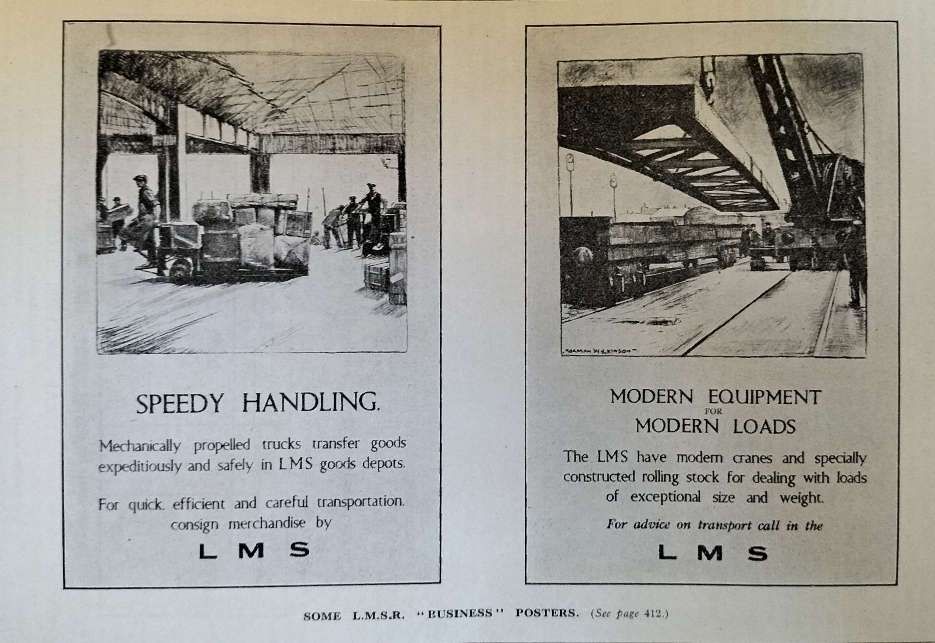
The LMS. sent specimen copies of an “admirable set of new posters recently issued by them depicting the various goods traffic facilities offered on their system. There [were] four posters altogether, all drawn by Mr. Norman Wilkinson, and these differ from the usual run of such things inasmuch as they are in black and white, with good bold red and black lettering beneath each picture.” [1: p412] Two were reproduced in the magazine.
Two of the LMS posters were reproduced in monochrome in The Railway Magazine. [1: p410]
One poster dealt with “‘Modern Equipment for Modern Loads’, and illustrate[d] the fact that the LMS. have modern cranes and specially constructed rolling-stock for dealing with loads of exceptional size and weight; another is mainly concerned with ‘Mobility’, and stresses the fact that containers reduce[d] packing costs and eliminate[d] risks of damage – besides expediting transportation of merchandise between truck and lorry. A third poster – a specially fine bit of work, this illustrate[d] the LMS. method of ‘rapid transport of goods from ship to dock’ – that is, by means of electric trucks – the contention being that modern LMS. steamers and handling appliances ensure[d] safe and expeditious transportation of goods between Great Britain and the Irish Free State and Northern Ireland. The last of the series also deals with ‘Speedy Handling’ by means of mechanically-propelled trucks, which ‘transfer goods expeditiously and safely in LMS. goods depots’.” [1: p412]
New GWR posters
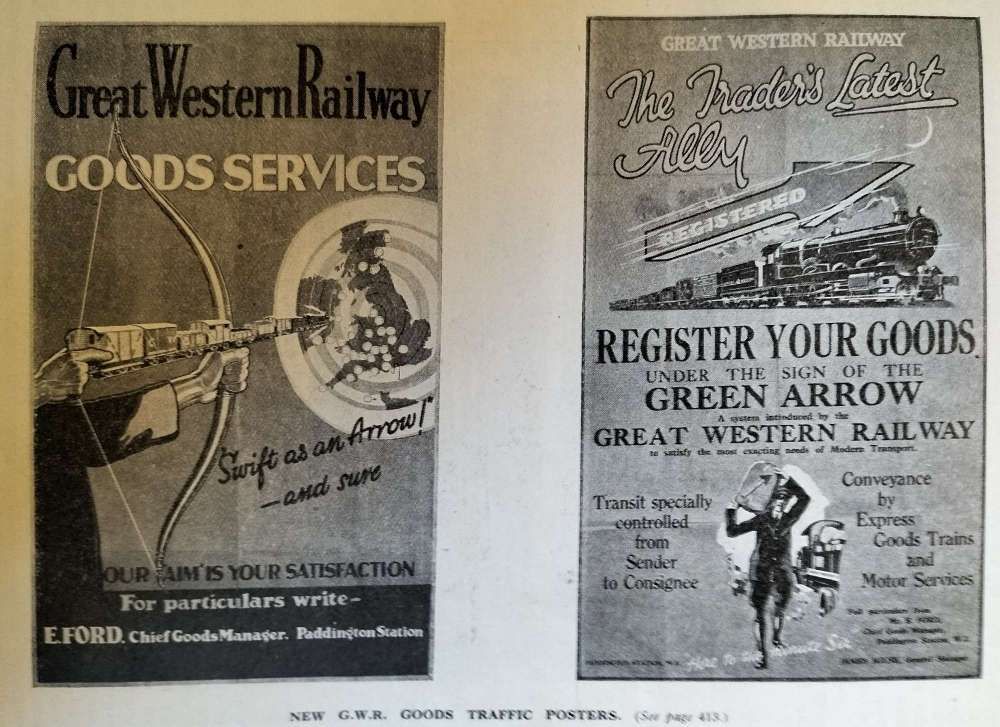
“Two posters which have been issued by Mr. E. Ford, Chief Goods Manager, GWR. … They may be regarded as good examples of the modern tendency to recognise that there is almost as much scope for advertising goods traffic facilities as for those provided by the passenger department. The first emphasise[d] the fact that express freight trains provide[d] for rapid transit, usually on the basis of collection one evening and delivery early next morning, while it is quite appropriate that a first-class express engine should be shown at the head of the train, in that the latest express engines [were] quite frequently employed for running these trains, especially those on ‘registered’ service, with which the poster [was] particularly concerned. The poster itself [was] in colour, with lettering in black, white and amber on a blue ground. Pictorial portions [were] in full colour, while the arrow [was] in green, with amber shading, to emphasise ‘The Sign of the Green Arrow’.” [1: p 413]
The two GWR posters were reproduced in monochrome in the Railway Magazine. [1: p411]
“The second poster also use[d] the symbol of an arrow to indicate, in this case, speed and sureness. The train itself [was] utilised as the arrow, while the target [was] an outline map of the British Isles in green, the name of the principal centres served by the GWR. was indicated as arrow destinations. The poster in other respects [was] on a green ground, utilising also blue, red and amber to an effective degree.” [1: p413]
These two posters go some way towards addressing the veracity of different views about the commencement of the ‘Green Arrow’ service referred to in my article about the November 1938 edition of the magazine. These posters demonstrate that the GWR, at least, was offering a Green Arrow service by November 1929 and suggest that the service reached into Scotland and so into the territories of the LMS and LNER.
Following on from the short article about The Railway and Travel Monthly of July 1918 which can be found here, [1] this is a short reflection on the advertising which appeared in the November 1938 edition of The Railway Magazine, [2] twenty years after the magazine looked at from 1918 and only a few months before the outbreak of the Second World War.
Advertising included a series of adverts for:
New publications such as: A History of the Southern Railway (17s/6d); Gradients if the British Main Line Railways (5s); British Locomotive Types – 3rd Edition (5s); History of the Great Western Railway, Volume 1 (1833-1863)(£1/1s) and Volume 2 (1863-1921)(10s/6d);The Railway Handbook 1938-1939, 5th Annual Edition (2s/6d); a reprint of The Locomotive Stock Book (2s/6d), and its Appendix (1s/6d), bought together – 3s/9d.
Damaged books at low prices from The Locomotive Publishing Co. Ltd.
St. Martin’s Engraving Co. Ltd.
The Railway Correspondence & Travel Society membership and visits.
The Railway Club membership.
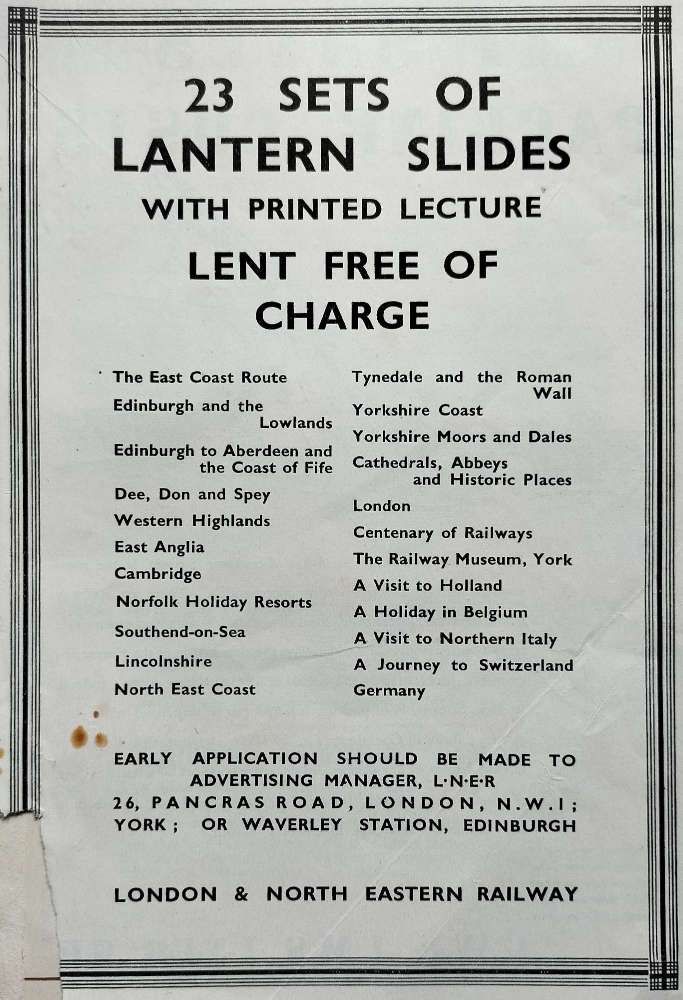
The LNER’s practice of loaning out slides free of charge accompanied by a set of lecture notes, enabling individuals, clubs and societies to put on talks about railway related subjects themselves.
Lantern Slide talks at minimal cost. A goodwill gesture from the LNER or perhaps a good publicity exercise! [2: pIV]
Sending Containered Loads & Liquids in Bulk by Rail
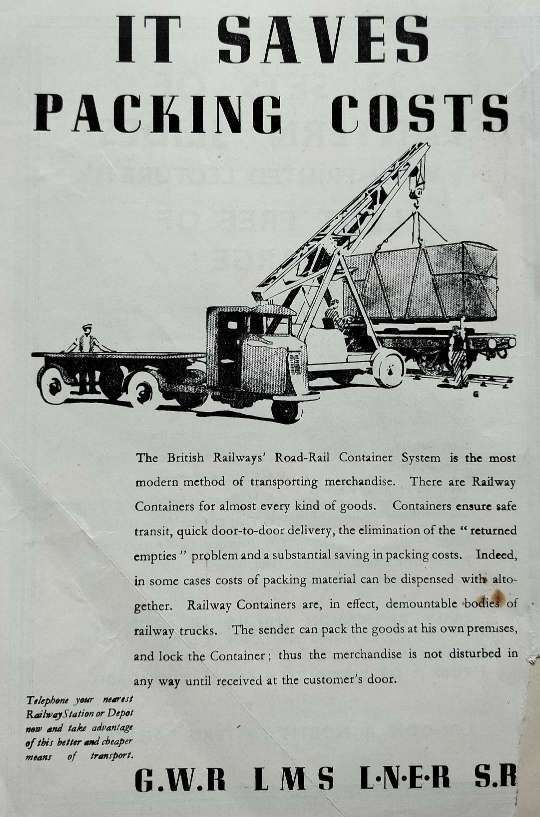
There were three full page adverts placed jointly by the Big Four railway companies. The first two pages related to the movement of prepacked loads – containers and tankers.
A joint advert in The Railway Magazine of November 1938 by the Big Four railway companies. [2: pV]
Containerisation on Britain’s railways can be traced back to very early days. “In the 1830s the Liverpool & Manchester Railway used simple rectangular boxes, four to a waggon, to convey coal from the Lancashire collieries to Liverpool, where they were transferred to horse-drawn carts by crane.” [3] This had some advantages, particularly the reduced handling of the cargo.
After the turn of the 20th century, “the London & North Western, Lancashire & Yorkshire, and Midland Railway companies were carrying ‘box coal’ on flat wagons, the coal being destined for use by steamboats.” [3]
The Great Central Railway “also played a part in the story of containerisation, being one of only three companies which provided special wagons for the conveyance of ‘fish tanks’.” [3] The wagons were classified as passenger stock.
The Midland and the Great Northern also followed this practice; in the case of the Great Northern Railway the containers were referred to as ‘cod boxes’ some of which lasted into the 1930s.
As early as the late 19th Century railways were using closed containers which resembled the bodies of wooden box vans, “these were initially known as ‘lift vans’ and were privately owned by several furniture removal firms. They were carried both on railway wagons and on flat road trailers drawn by horses or steam tractors.” [3]
The Advent of more effective road transport after WWI brought a challenge to railway companies. The biggest concern was that lorries could offer a door-to-door service which significantly reduced handling costs.
“The LMS launched its first container in 1926, and over the next few years all four of the pre-Nationalisation railway companies developed significant container traffic. Containers were soon to be found carrying all manner of goods, including bicycles, confectionery, castings, cookers, baths, machinery, boots, cloth, carpet, pianos, gramophones, sugar, shrubs, and of course furniture. Special insulated containers were soon developed for the conveyance of meat, dry ice bunkers being provided to maintain the temperature.” [3]
Containerisation worked best for high value items many of which required careful packing to avoid breakages. “This meant that a premium could be charged for a fast ‘door to door’ service, which justified the use of containers.” [3]
In the first instance a variety of different wagons were used to carry thesevstandardised containers. But “by the 1930s specialised container flat wagons or ‘conflats’ were built. In many cases these were converted from other wagons, for example the LNER converted a number of cattle trucks following a downturn in livestock traffic.” [3]
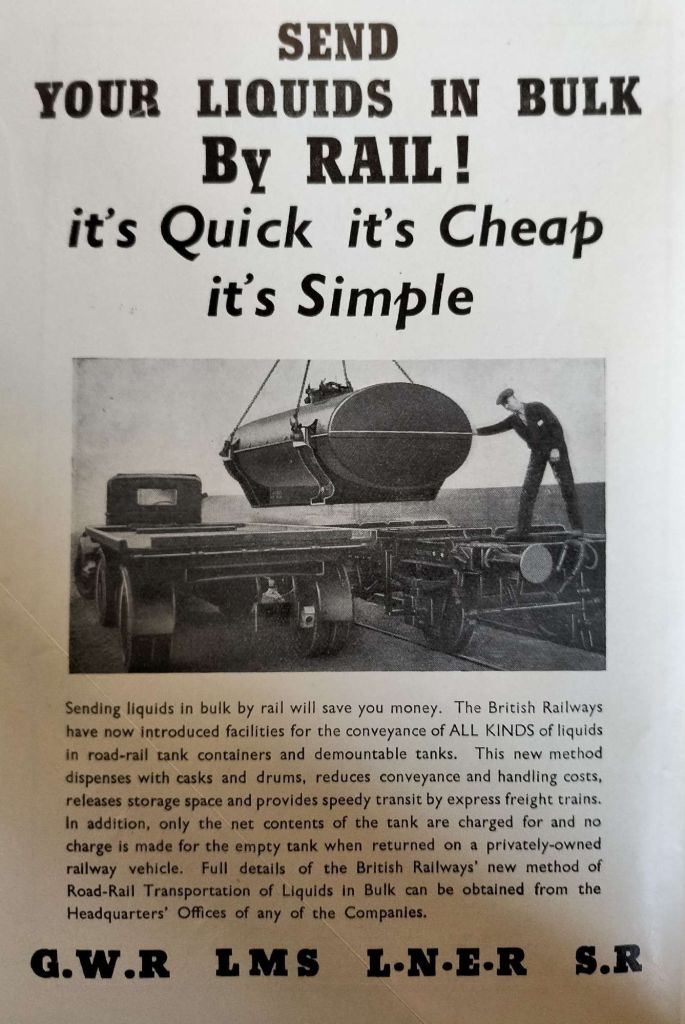
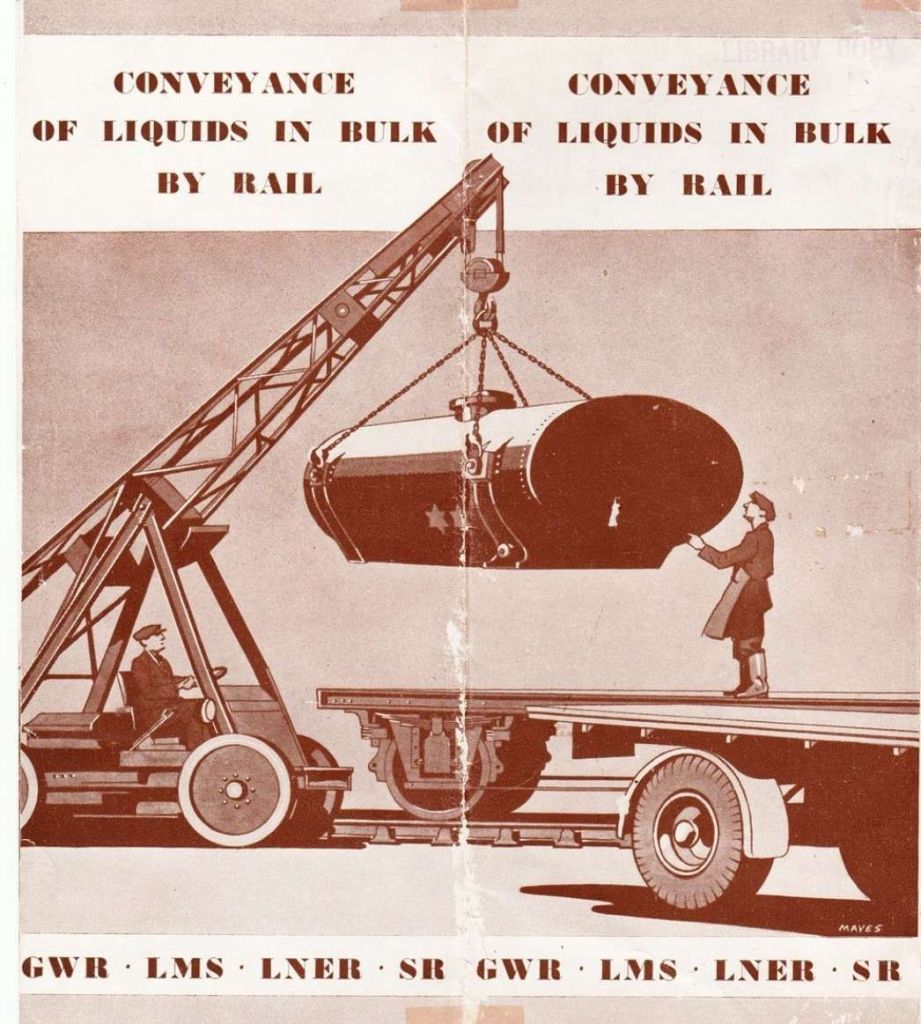
Early Road-Rail Tank Containers and Demountable Tanks. This full page advert in The Railway Magazine is on the following page to the ‘Containerisation’ advert above. [2: pVI]
This advert highlights a further, more recent, development in the movement of goods – sending liquids in bulk by rail. Road-Rail tank containers dispensed with the use of casks and drums, so reducing conveyance and handling costs. The rail companies sweetened the deal by only charging for transport of the contents of these tanks provided they were carried on privately owned railway vehicles – so no return charge for the empty tank/wagon!
A similar image from a leaflet produced at the time, entitled “Conveyance of Liquids in Bulk by Rail” jointly produced by the GWR, LNER, LMS and the SR in the 1930s. [4]
The Green Arrow Freight Service
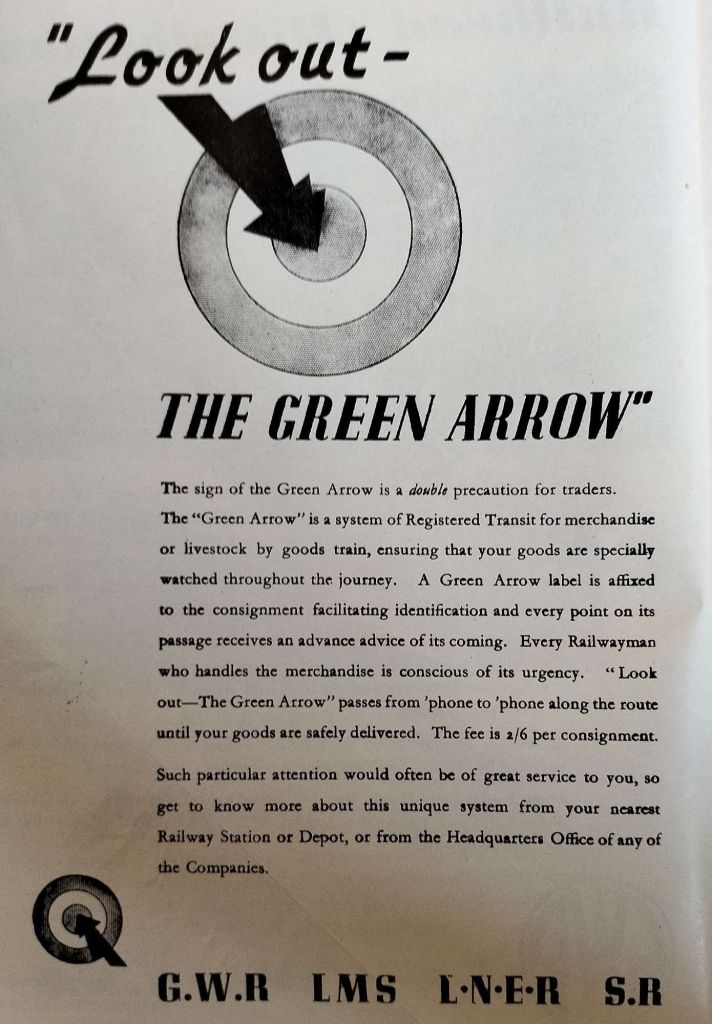
The third full page advert placed jointly by the railway companies was for ‘The Green Arrow’.
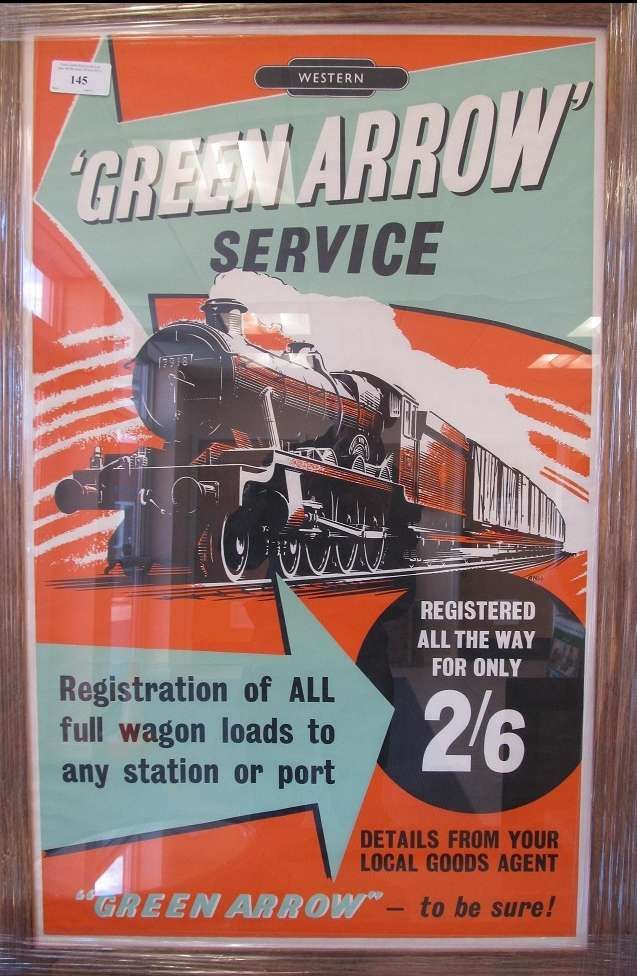
“The sign of the Green Arrow was a double precaution for traders – a system of Registered Transit for merchandise or livestock by goods train, ensuring that goods were monitored effectively throughout their journey. A Green Arrow label was fixed to the consignment facilitating identification and advance notification of its arrival. A fee of 2s/6d per consignment secured this service.” [2: pVIII]A BR western region poster advertising the Green Arrow service, framed and protected by glass. This image was shared on the LNER Forum by ‘1H was 2E’ on 3rd March 2015. It is made available for use by the Science Museum under a Creative Commons Licence (CC BY-NC-SA 4.0). [6][7]
“In 1928 the LNER set up their officially named full wagon load ‘Green Arrow’ service, offering registered overnight transits.” [8] There is a confusion between sources – Atkins, Beard, Hyde and Tourret say that “the GWR ran an experiment with registered transit loads between 1927 and March 1929. This was a great success and became the ‘Green Arrow’ service. The other railway companies would not accept the principle until March 1933 when they at last followed suit.” [9]
However, by 1938, all four companies were clearly participating in the Green Arrow scheme.
Railhead Distribution – the GWR
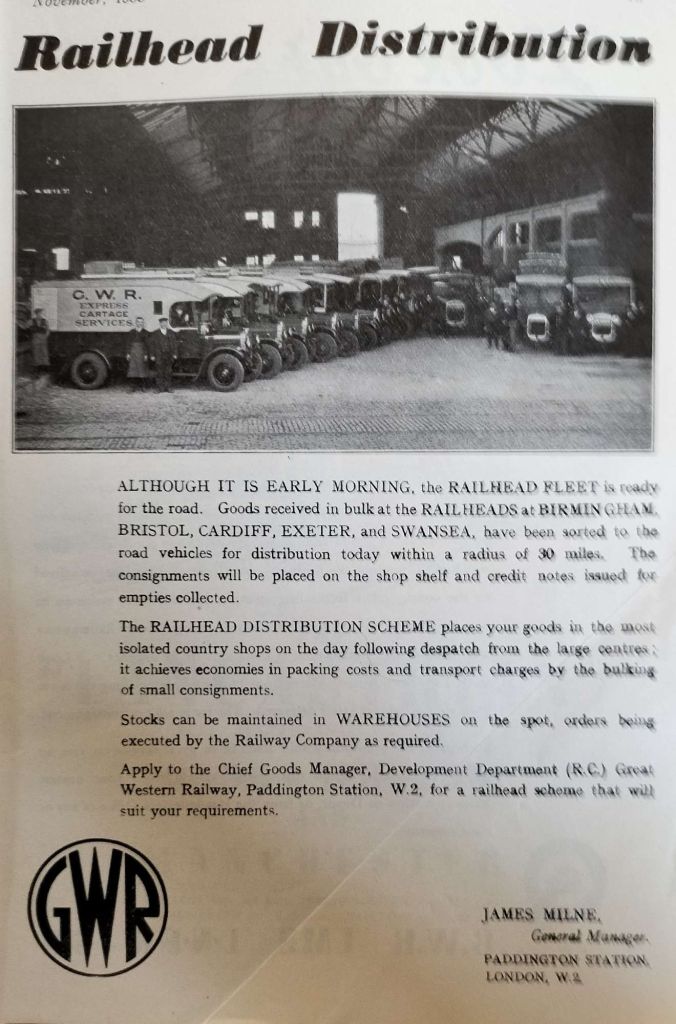
The GWR advertised its road services in a full page advert in the November 1938 Railway Magazine as shown in the image below.
Although it is early morning the railhead fleet is ready for the road! [2: pVII]
Goods received in bulk at railheads in Birmingham, Bristol, Cardiff, Exeter and Swansea were, by early morning, sorted ready for distribution and had been placed in road vehicles ready for distribution. The GWR distributed goods to destinations within a radius of 30 miles from their railheads.
The scheme ensured that goods reached even the most isolated destinations by the day following their original despatch. This meant that customer’s orders could be fulfilled in a timely manner direct from the warehouse rather than needing to be pre-stocked in a company’s outlying branches.
A contemporary postcard image showing a Thornycroft van supplied to the GWR. This vehicle is dated as being in service in 1939. [10]
Famous Trains of the LMS
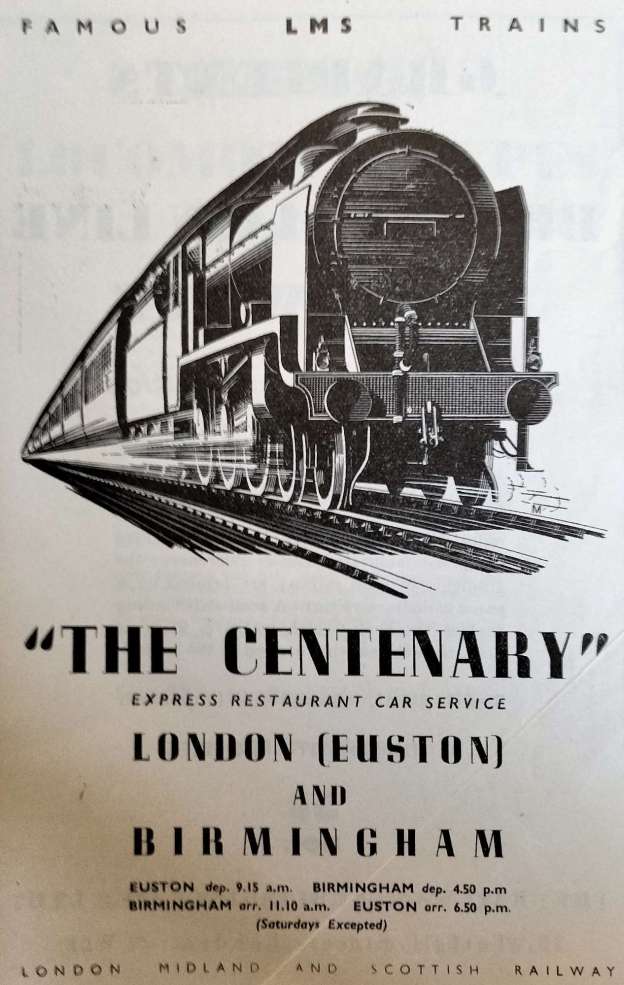
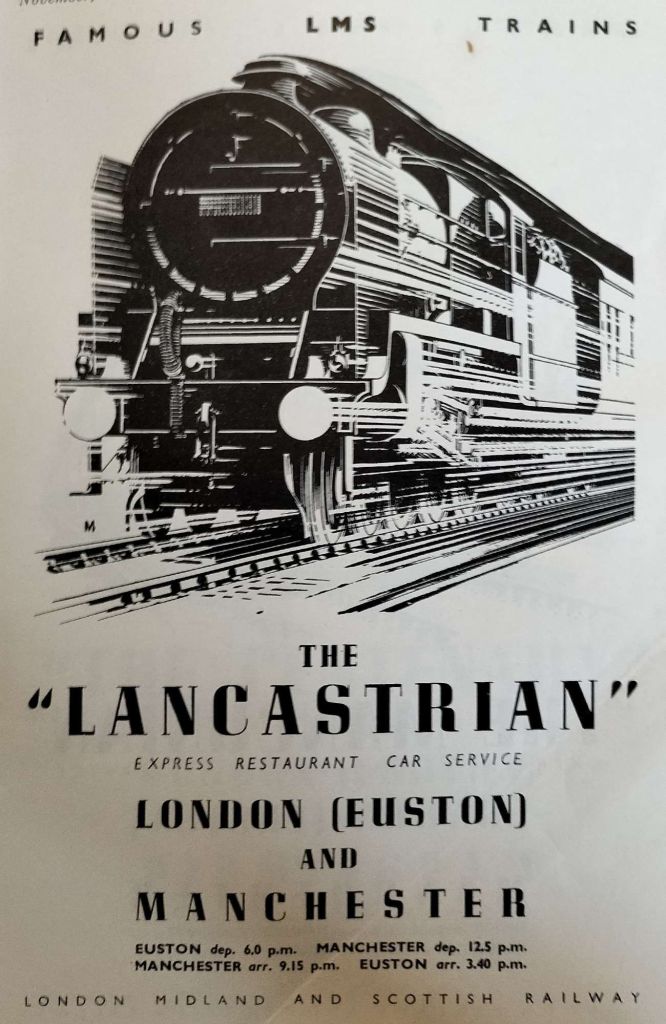
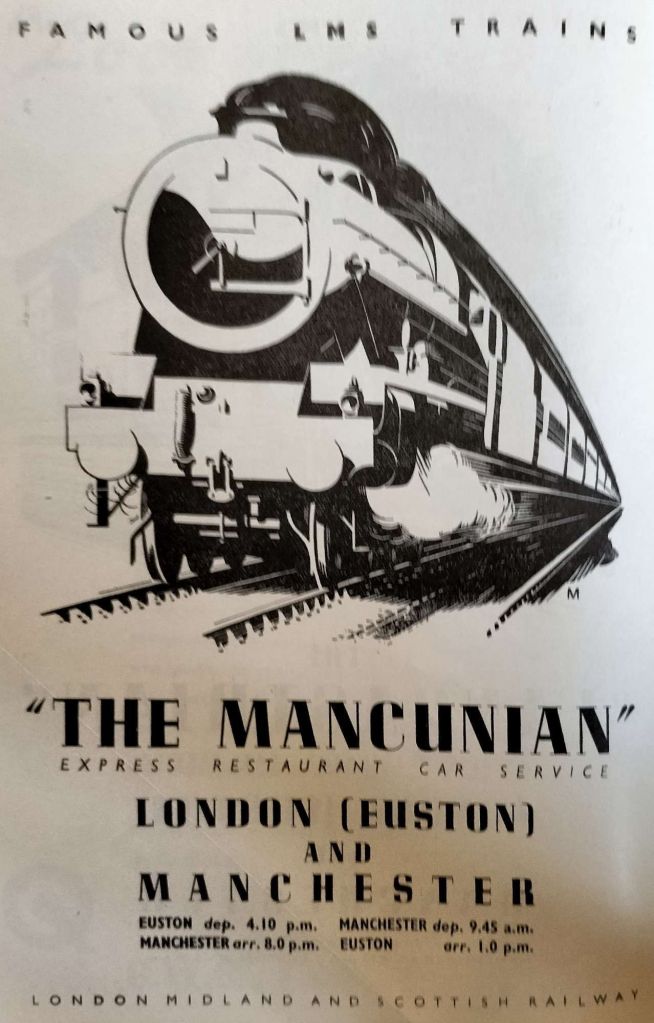
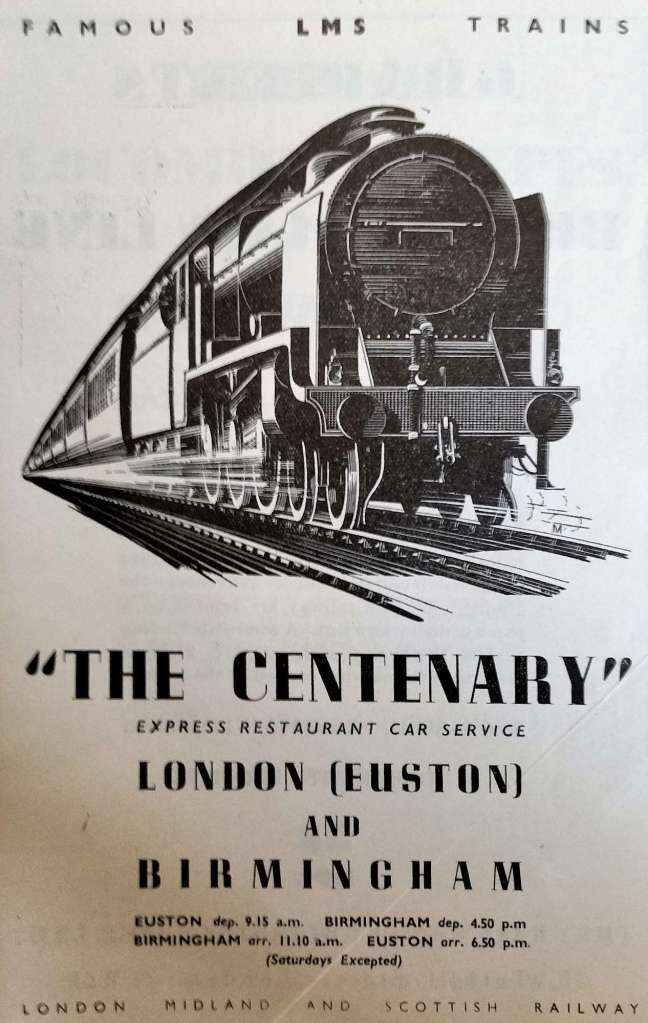
The LMS placed adverts across 3 full pages for three express restaurant car services: The ‘Lancastrian’; the ‘Mancunion’; and the ‘Centenary’. …………
The ‘Lancastrian’. [2: pVIII]The ‘Mancunion’. [2: pIX]The ‘Centenary’. [2: pX]
In the midst of a small batch of older railway magazines, was a partial copy of the July 1918 copy of “The Railway and Travel Monthly.”
The price for the magazine: 1 shilling
Edited by: G.A. Sekon.
I find these old magazines quite interesting particularly for the contemporary view they provide on what, for us, is railway history.
Articles and Advertising. …
The articles listed on the contents page of the magazine were:
Coloured Presentation Plate of Great Central Railway 4-6-0 Express Locomotive “Lord Farringdon,” No. 1169.
The 4-6-0 Locomotives of the London and South Western Railway.
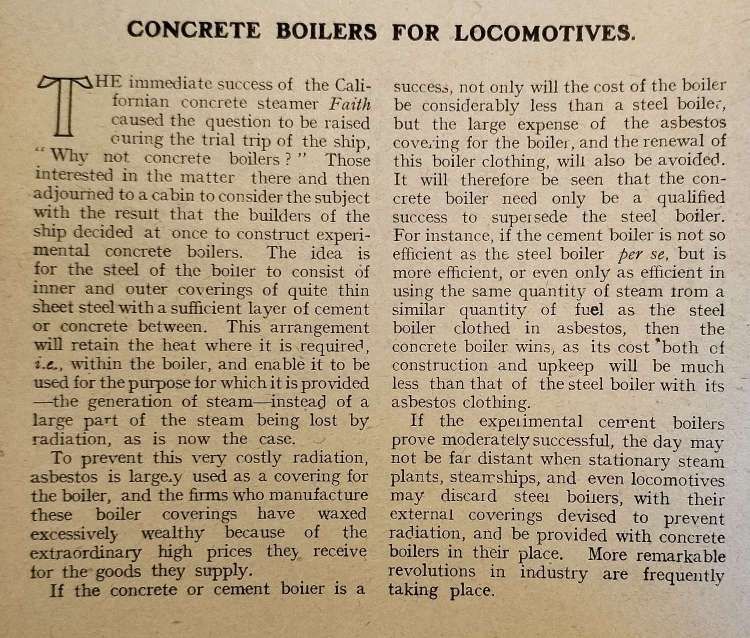
Concrete Boilers for Locomotives.
The short article on p10 of the magazine on concrete boilers for locomotives. [1: p10]
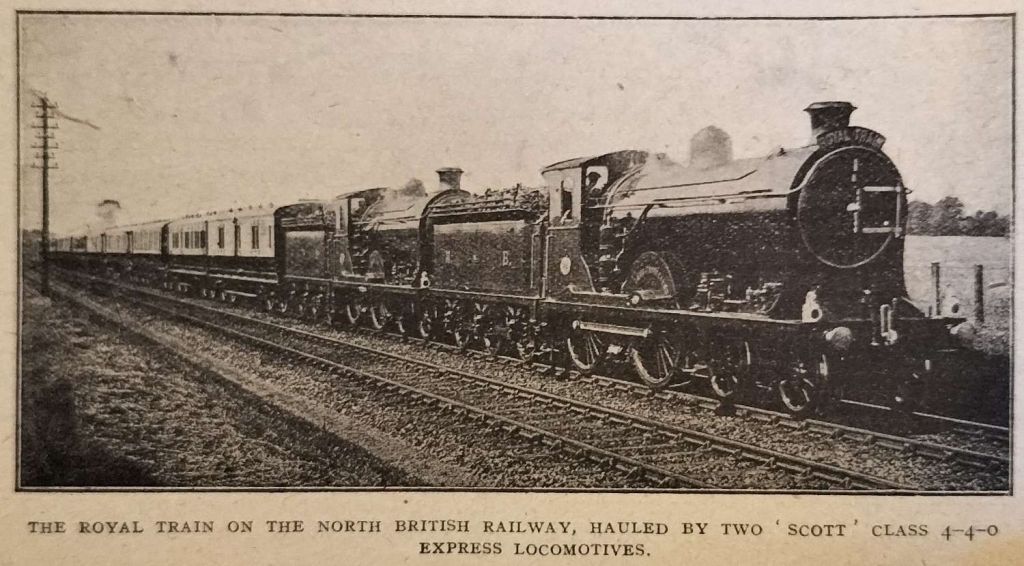
The Naming of British Locomotives, (its advertising influence: the methods adopted).
The King in Scotland(an illustration).
The Royal Train on the North British Railway, hauled by two ‘Scott’ class 4-4-0 express locomotives. [1: p22]
Side Door Coaches for American Suburban Trains
British Express Trains and Locomotives.
Three Position Light-Signal on the Metropolitan Railway.
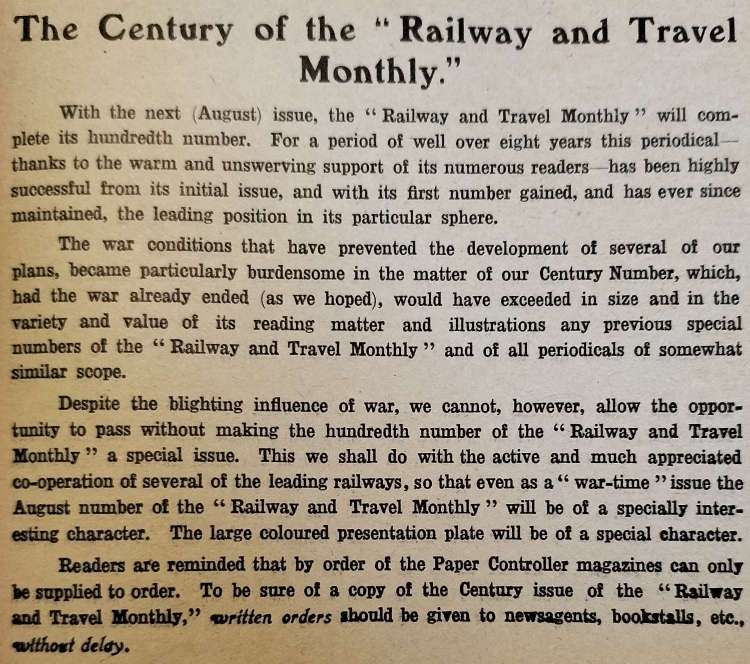
The Century of the ” Railway and Travel Monthly.”
A short note on p39 of the magazine which tried to describe plans for celebrating the 100th anniversary of a magazine in war-time conditions. [1: p39]
Correspondence.
Nautical News and Notes.
Dock, Harbour, and Shipbuilding Comments.
The Why and the Wherefore.
Apposite Aphorisms
What is Happening on our Railways.
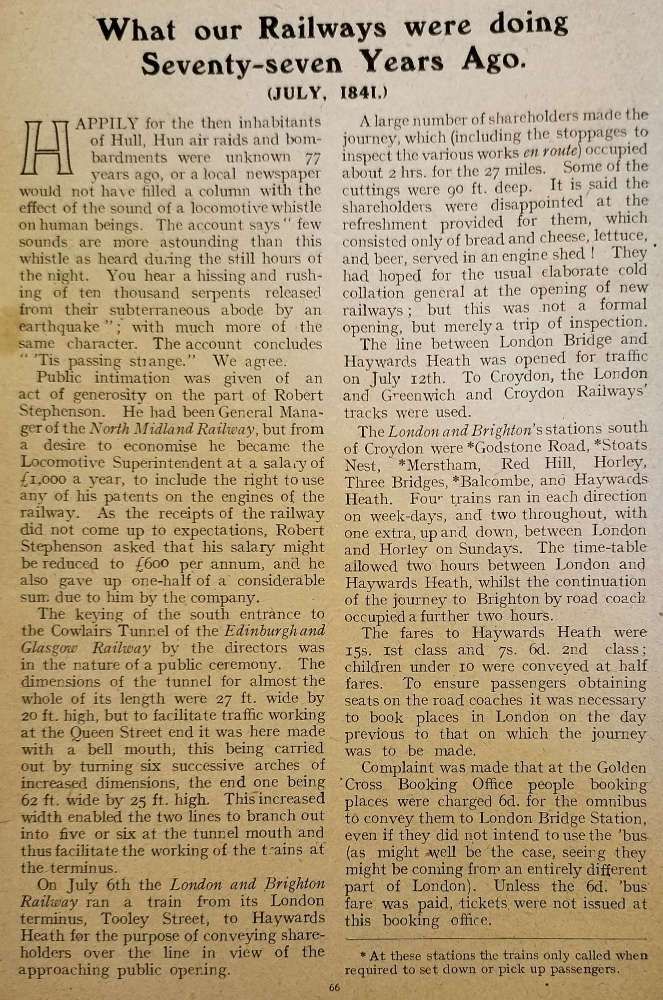
What our Railways were doing Seventy-Seven Years Ago.
Looking back 77 years from July 1918 to July 1841. I am not sure what the significance of 77 years was in the context of this magazine’s 99th edition. However, this retrospective takes us back to the very early railway years! [1: p66]
The Stephenson Locomotive Society.
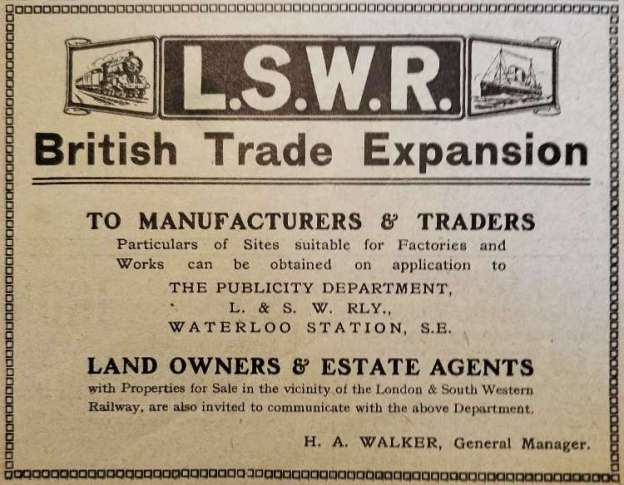
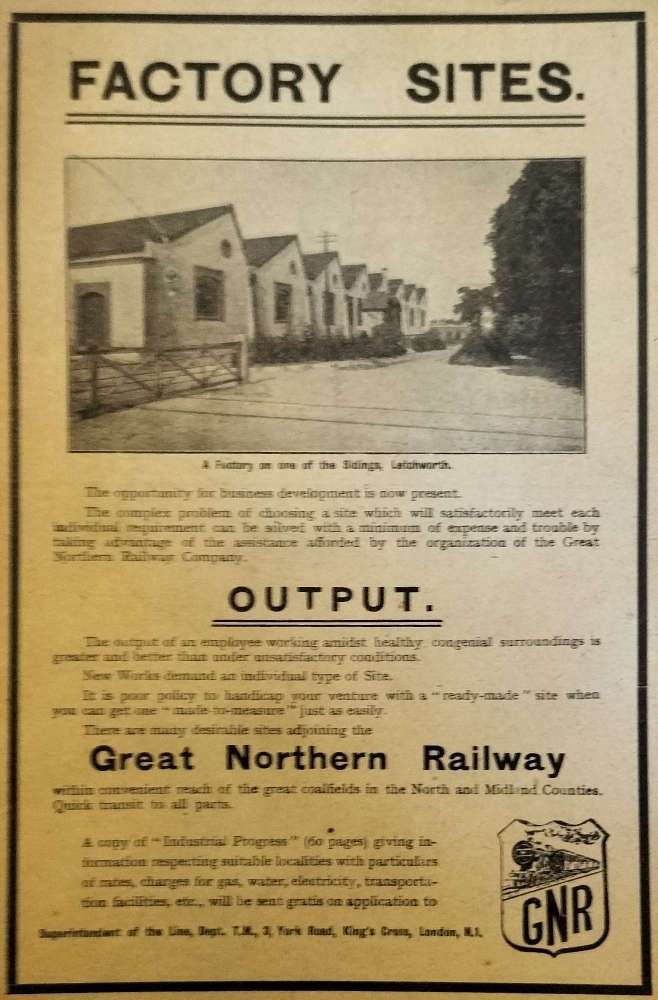
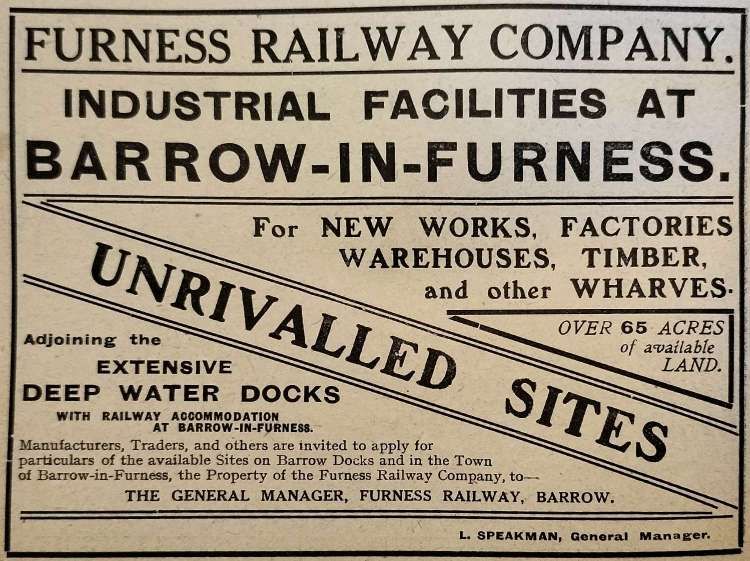
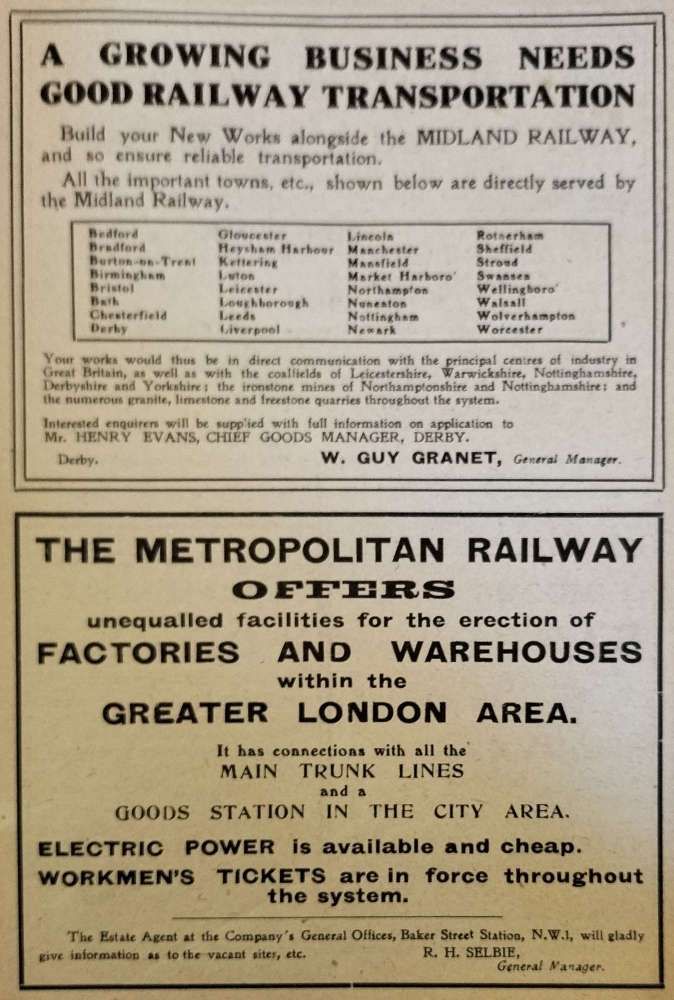
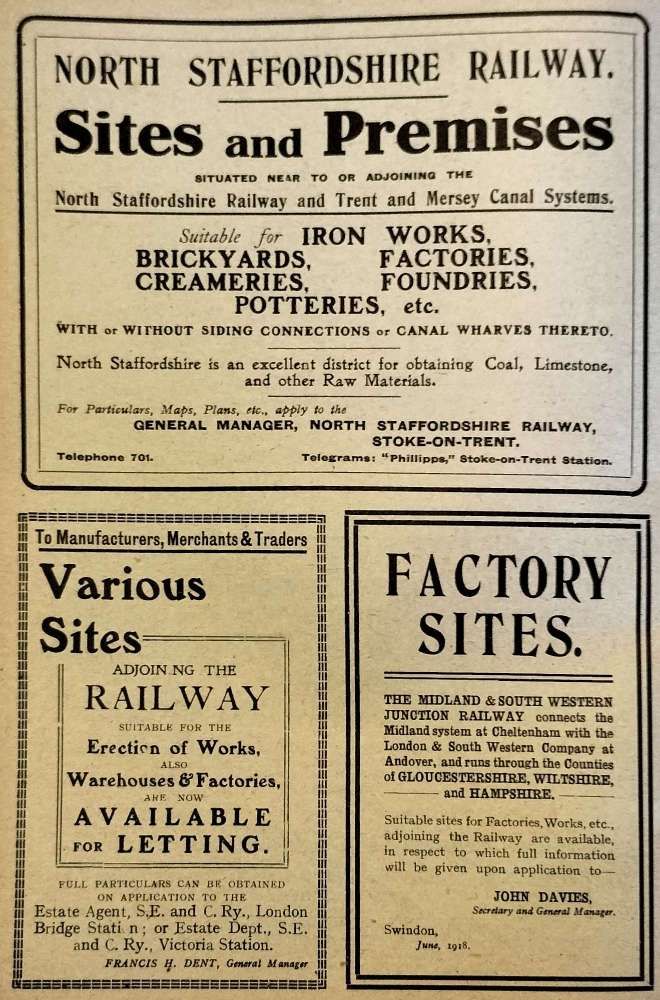
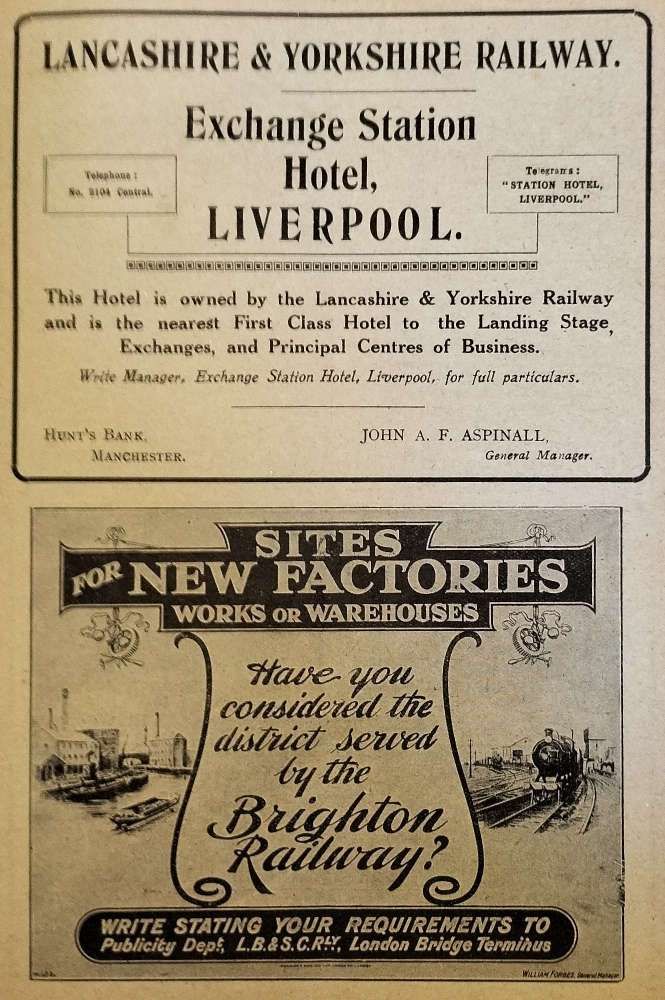
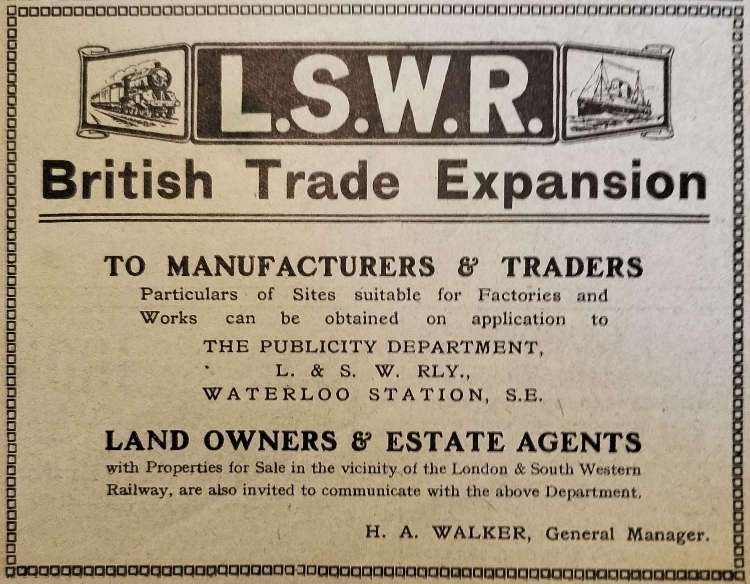
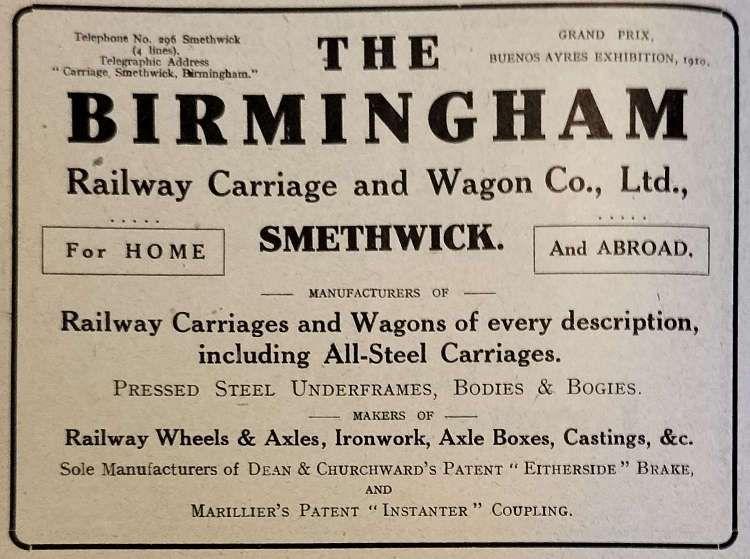
Much of the advertising space at the front of this magazine was given over to different railway companies seeking to attract manufacturers to their area of operation. These included adverts from: the Great Northern Railway; the Furness Railway; the Midland Railway; the Metropolitan Railway; the North Staffordshire Railway; the South Eastern and Chatham Railway; the Midland and South Western Junction Railway; the Lancashire and Yorkshire Railway; the London Brighton and South Coast Railway; and the London and South Western Railway. There was also a half page advert from the Birmingham Railway Carriage and Wagon Co., Ltd. These are all shown below.
Two other adverts, shown first and second below, were interesting. …
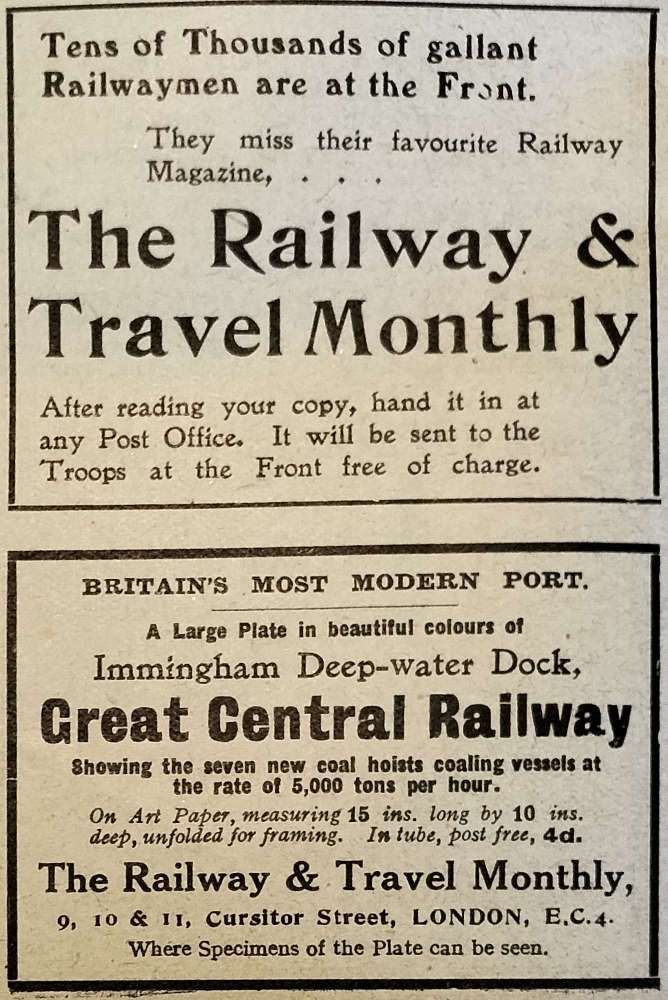
First, a poignant and generous advert from the publisher who had worked with the Post Office to provide an opportunity for readers of the magazine to hand in their read copies of the magazine at any post office to be ‘sent to the Troops at the Front free of charge’.
Second, an advert for a colour print of the Great Central Railway Immingham Deep-water Dock, unfolded for framing, in a tube, post free for the princely sum of 4d. And if you wanted to check how good it was you could call in at the journal’s offices on Cursitor Street, London.
Two adverts by the publishers of the Railway & Travel Monthly.The Great Northern Railway.The Furness Railway.The Midland Railway and the Metropolitan Railway.The North Staffordshire Railway, the South Eastern _ Chatham Railway, and the. Midland & South Western Junction Railway.The Lancashire and Yorkshire Railway, and the London Brighton and South Coast Railway.The London and South Western Railway.The Birmingham Railway Carriage and Wagon Co. Ltd.
References
G.A. Sekon (ed.); The Railway and Travel Monthly, July 1918.








 Roger Farnworth
