
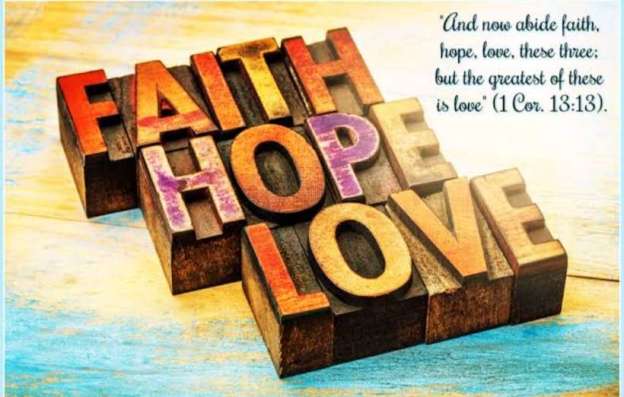
And now these three remain: faith, hope and love. But the greatest of these is love.
Faith
Our ‘Faith’ can mean what we believe. … When we talk about the faith of the Church we often mean a list of things that a Christian needs to believe. Over time the church has developed creeds which are intended to help us remember or recall together the important beliefs that we share. Often Christians say ‘The Creed’ when they are in church together on Sundays. Doctrine is very important but it is not what Paul is talking about in 1 Corinthians 13:13.
Our ‘Faith’ can mean what we believe. … When we talk about the faith of the Church we often mean a list of things that a Christian needs to believe. Over time the church has developed creeds which are intended to help us remember or recall together the important beliefs that we share. Often Christians say ‘The Creed’ when they are in church together on Sundays. Doctrine is very important but it is not what Paul is talking about in 1 Corinthians 13:13.
Another way we use the word ‘faith’ is to talk about how much faith we have. …
So, perhaps, we say to someone, if only you had enough faith, you would be healed. … Faith, in this context, seems to be something that we might be able to generate ourselves. There is a bible verse which we often hear like this “faith can move mountains.” And we take it to mean that strong belief and determination will allow us to overcome immense obstacles, achieving seemingly impossible things. I guess we imagine ourselves generating faith, screwing ourselves up to believe.
Just a bit more faith, just a bit more and we will see God work, we will have healing. … Perhaps we even try to demonstrate our faith by giving more generously, praying more earnestly, serving with greater commitment. But if we see faith this way, we have misunderstood what Jesus was talking about in the bible verse that we partially remembered.
In Matthew 17:20 and Mark 11:23, Jesus talks about faith as small as a mustard seed being able to move mountains. Have you ever seen a mustard seed? Mustard seeds are tiny, smaller than a grain of millet. The very point Jesus is making is that it isn’t the size of our faith that matters but where we place the little faith we have.
Throughout the whole New Testament there is only one root Greek word used for faith. It is the word PISTEO. Yes, it might be used in different contexts, tenses and verses. We can use it in many different ways but in the original language of the bible it has one meaning. PISTEO-faith always means ‘faithfulness’, ‘commitment’ and ‘steadfastness’ – faithfulness and commitment to God in Jesus. It is not focussed on what we can do, nor on how strongly we believe. PISTEO-faith is all about the one we have faith in. Mountains in our lives are moved not by the strength of our faith but by the God in whom we trust.
PISTEO-faith is about faithfully following Jesus but it is also about something more. …. I need a chair to illustrate this ……… What do you think of this chair? Is it a beautiful chair? …. What is this chair for? …. It does not matter so much where a chair comes from or how beautiful a chair is. … What matters is that we trust that it will hold our weight. It is no good just hovering over it, no good admiring as a beautiful chair, no good being tentative about it. We have to commit wholly to trusting in the chair and put our weight on it. … Then it does its job.
New Testament PISTEO-faith is just like this. We need to wholeheartedly, faithfully, follow Jesus and when we are faithful, when we place our weight on our faith, we will discover that it holds us secure.
So, that is Paul’s first word FAITH. …..
Hope
In the UK, we sometimes do this … (cross fingers) and we say. “Cross our fingers and hope it works out.” When we do this, we are seeing hope more as ‘wishful thinking’.
Alternatively, we can talk about ‘the power of positive thinking’, as if by just hoping something will happen, we will see it happen.
Sometimes we say to people, “I hope you get better soon.” Then, hope seems to be about wishing something was true.
None of these is Christian Hope. The bible actually has a lot to say about Hope. But for now, here are just three verses.
Psalm 33:20-21: We wait in HOPE for the Lord, he is our help and our shield. In him our hearts rejoice for we trust in his holy name.
Isaiah 40:31: Those who HOPE in the Lord will renew their strength. They will soar on wings like eagles. They will run and not grow weary, they will walk and not be faint.
Romans 8:25: We HOPE for what we do not have and we wait for it patiently.
Christian Hope is not wishful thinking. Nor is it positive thinking. Christian Hope is all about the one in whom we have Hopr. God our Father, the Lord Jesus Christ and God’s Spirit who dwells in us.
When we look forward with Hope, we see the future in God’s hands. We look forward with Hope because we have been made right with God through what Jesus has done for us at the cross. We look forward with HOPE because the Holy Spirit lives in us and leads us on into the future God has for us. … Because we hope in God, as Isaiah says, our strength is renewed. We will soar like eagles, we will have the stamina we need for the journey ahead.
So, FAITH, and HOPE.Paul’s third thing was LOVE. And, Paul says Love is the greatest of all three.
Love
The Apostle John, became the Bishop of Ephesus when he was an old man. We think that he wrote John’s Gospel, three short letters and the book of Revelation.
The first of John’s three letters is all about Love ….
“This is love, not that we loved God, but that God first loved us and sent his Son as an atoning sacrifice for our sin.” (1 John 4:10)
“This is how we know what love is: Jesus Christ laid down his life for us.” (1 John 3:16)
“How great is the love the Father has lavished on us, that we should be called children of God.” (1 John 3:1)
The story is told of John as Bishop of Ephesus, in his old age with his powers failing, sitting in front of his congregation to preach. He began his sermon. … Little children, love one another. …. And he continued: Little children, love one another. … And again: Little children, love one another. Indeed, his whole sermon consisted of the repetition of just 5 words: Little children, love one another.
The following Sunday, Bishop John sat down to preach again. He began his sermon: Little children, love one another. Again, his sermon was just the repetition of those five words: Little children, love one another.
By the next Sunday, the congregation was getting a little restless. John sat down to preach once again. How do you think he started his sermon? Yes, with just those five words … Little children, love one another. At the end of this service a number of people came to speak to him. “Bishop John,” they said, “Why do you just keep repeating those five words. Isn’t it time to move on to something different?”
Bishop John looked quietly at them and said, “My sermon will change when I see evidence that you are loving one another.”
Ultimately, the Gospel is a Gospel of love, nothing significantly more. God is the source of all love. God’s love has made us God’s children. God’s love comes to us in many different forms: …
God’s LOVE comes to us in the New Testament story of Jesus. … Love first came down to us at Christmas. It was born and walked about among us as a human being. Love died for us, love was outpoured for us at the Cross. Love came as sacrifice and service. Love brought dignity and purpose for Jesus’ friends, his disciples. Love brought new roles, new tasks to perform, new gifts to develop and share. Love came in the healing hands of Jesus.
God’s LOVE comes to us now in many different forms. … In the people we know who follow Jesus. In acts of charity which brings real hope into places of despair. In the prayers of faithful friends who hold us up before God when we struggle to pray for ourselves. Surprisingly, love turns up in unexpectedly places. …
St. John as Bishop of Ephesus says: “Little children, love one another for love comes from God.”
The Apostle Paul says: “Faith, Hope and Love abide, these three, and the greatest of these is love.”
FAITH-ful following of a faithful God will make mountains move.
HOPE in God will allow us all to soar on wings like eagles.
But most important of all, God’s LOVE has won our hearts and calls us all to LOVE as Jesus Christ has loved us.

 Roger Farnworth