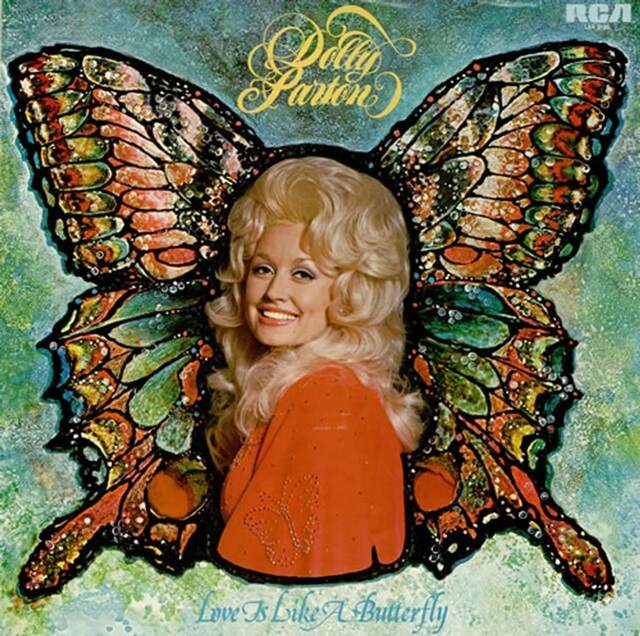
Dolly Parton first sang, ‘Love is like a butterfly’, in the Summer of 1974:
“Love is like a butterfly, as soft and gentle as a sigh,
The multi-coloured moods of love are like its satin wings,
Love makes your heart feel strange inside, it flutters like soft wings in flight,
Love is like a butterfly, a rare and gentle thing.”
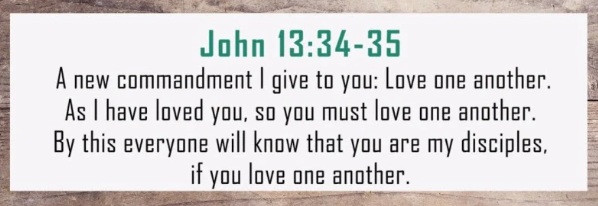
Jesus said: “I give you a new commandment, that you love one another.” His words seem to be at odds with our culture. In our society, love isn’t something you can command, love is something that you feel. Love is something that you fall into and fall out of. Love is as much about sexual attraction and desire as it is about anything else. When we say, ‘I love you’, to the love of our life – we are talking about deep feelings not about something that we feel we have much control over.
And yet Jesus says: ‘I command you to love one another’.
We know that love is so much more than sexual desire. We feel love for our parents, our children – we even feel some kind of love for the football team we support, for our friends and our work colleagues. But even in these relationships love can be so temporary or dependent on events and our emotions.
Love is just like a butterfly, made up of multicoloured moods, flitting here and there, dependent on circumstance and passion.
The love Jesus commands, the love that Jesus often talks about, is just not like that. Love, as Jesus sees it. Love modelled on the love of God, is constant and committed love, unwavering in its strength and focus, determined to be there for the one who is loved no matter what they do. Determined to love, even when it seems as though that love is rejected.
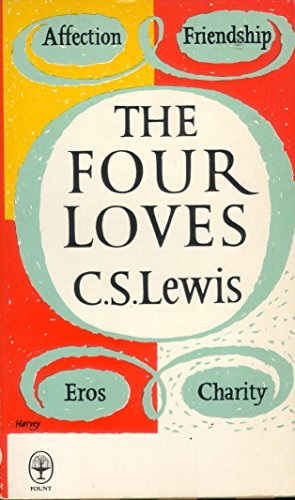
In English we have one word for love. The New Testament uses four different words for love.
Eros – for romantic and sexual love
Storge – genuine affection for someone
Philio – for brotherly love or fellowship
Agape – the love God has for us and the depth of love he calls on us to have for each other. A committed, divine, unconditional, self-sacrificing, active love, generously and freely given with no thought for the self, only for the other. It is this word ‘Agape’ that is used in our Gospel reading.
The King James bible translated ‘agape’ as ‘charity’. In today’s world ‘charity’ means something different. It has lost the emphasis on God’s self-sacrificial love for humankind. It has become something that often people do not want to receive, demeaning to their sense of honour. Or, it is the name of a kind of organisation that has some sort of good purposes. We need hold onto the word ‘love’ rather than the word ‘charity’ in today’s world if we are to begin to understand the meaning of the Greek word ‘agape’
C. S. Lewis, in his book The Four Loves, uses ‘agape’ to describe what he believed was the highest level of love known to humanity – a selfless love, a love that was passionately committed to the well-being of the other. It is ‘agape’. It is this kind of love that Jesus commands us to show, not erotic love, not even brotherly or sisterly love, not affection.
In last week’s Gospel (Easter 4), Jesus talked about a love that will not let us go.
“My sheep listen to my voice; I know them,and they follow me.I give them eternal life, and they shall never perish,no one can snatch them out of my hand.My Father who has given them to me, is greater than all;no one can snatch them out of my Father’s hand.”
“No one,” says Jesus, “will ever snatch you out of my hands.” It is not a sense of charity that God feels towards each of us, not a sense of charity that he feels for humankind. It is a love that give its all. No holds barred. A love that throws itself away in order to rescue those who are lost. A love that celebrates over every single person who returns to be enfolded by that love. It is that kind of love which we are commanded to show. Christ calls on us to decide to love others in the same way as God loves us.
Please, allow yourself to hear again that God loves and cares for you. And remind yourself again that God calls you not to love that is flighty or buffeted by circumstance, but to a love which is self-giving, committed and strong.
This article was originally written as an essay as part of Old Testament Studies for my MA.
Scholars have suggested a number of motives behind the writing of Ruth. [1] Whatever the merits of the different proposals, it seems to me that Ruth was just as likely to have been written as a bawdy adult comedy/pantomime. It could perhaps be subtitled ‘Carry On Gleaning’. It might have been the ‘Up Pompeii’ of ancient Israel. However, within the clever plot [2] and camouflaged by sexual innuendo, there are robust and intriguing characters that the reader can identify with. [3]
It was ‘Harvest Festival’ (‘Pentecost’ or the ‘Feast of Weeks’) [4] everyone had been drinking – the whole village was ‘happy’. Dinner had been followed by all the usual speeches. Old jokes had been told (and retold), particularly those about sheaves, grain and seed – full of the usual sexual innuendo. [5] Village dignitaries had pompously promised gifts to the poor, some had made commitments that they would rue, come the morning.
It was now time for the reading of Ruth; or rather, for the second, ‘real’ reading. Ruth was read in the morning in the Synagogue a beautiful story of loyalty, conversion, hope [6] and of the ancestry of King David, or so it always seemed in the morning light. In the Synagogue the village elders had pontificated about the importance of caring for the stranger, [7] about the possibility of redemption for the worst of aliens (even Moabites); [8] and about duty and honour They talked of Boaz, fulfilling his responsibilities; [9] of Naomi the godly mother-in-law (struggling to accept the consequences of her husband’s folly); [10] of a beautiful, modest, dutiful, Moabite daughter-in-law. [11] Characters full of loyalty and faithfulness. [12] A sickly-sweet story – the ‘Mills and Boon’ of the five scrolls. [13]
I don’t think Ruth was written for the Synagogue. Those pious interpreters probably missed the point. [14] It was written for the evening, for the party! It was, first and foremost (and still is), a ripping good yam! A really well written ‘comedy’, [15] full of innuendo, with real 3-D but ambiguous characters. Characters that you could easily read yourself into. You couldn’t but be drawn into the plot – especially if you’d had a little too much to drink!
The evening reading of Ruth was the highlight of the Festival!
So, how did people engage with the main characters?
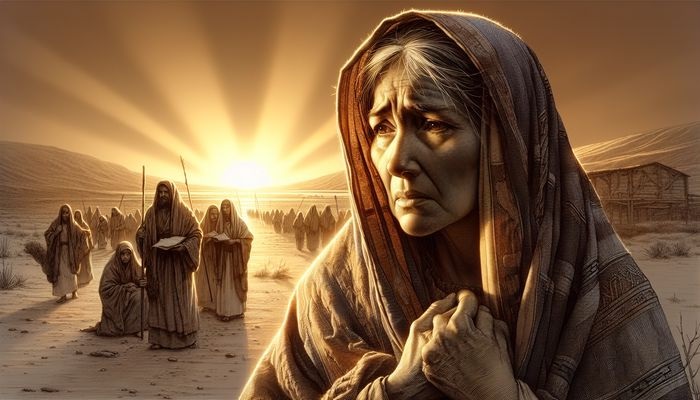
Naomi
Naomi enters the story through pain, suffering and complaint, [16] but her experience and response are full of ambiguity. Was she sinned against or sinning, party to the decision to go to Moab, or just following her husband, being punished for her husband’s sin, or the innocent victim? [17] Does she enter the story engulfed in bitterness trapped in her own prejudices, and remain so? Or is she, perhaps a model for working through grief? The narrative does not answer these questions directly – this is part of its strength. [18] No one is excluded, ancient/modem readers are invited into the plot, invited to see themselves in Naomi. Her experience and expression of suffering parallel theirs – they can feel their own pain worked out in Naomi’s character.
Naomi decides to return to Bethlehem. [79]
It would be natural also to question Yahweh’s role? Given prevailing theology, early audiences would see ’cause and effect Elimelech flirted with ‘Moabite foreigners’ and reaped the reward. [19] It seemed that his sons did too ‘sins of the fathers’ and all that! [20] How many generations would reap the rewards of Elimelech’s sin? None! Unless that is, Naomi, or one of her daughters-in-law, remarried! If that happened, would the curse remain?
Given all the possibilities, what is going on in Naomi’s mind? Perhaps this:
“Elimelech’s decision was wrong. I knew that right from the start. Moab, of all places! Whatever possessed him?”
“It’s an evil place’, I warned him. ‘Yahweh warned us against Moabites’, [21] I said. And I was right!”
“Losing Elimelech left me all alone in Moab! I couldn’t face the shame of returning to Bethlehem. I just had my two boys – I focused on them, but couldn’t really forgive Elimelech. I worked hard to secure wives for the boys and began to hope for grandchildren.”
“In ten years there were no children. How I wished that I’d chosen better wives. I’d decided to suggest that the boys should look for second wives, when both boys upped and died – Yahweh’s curse, [22] I’m sure.”
“Elimelech, what have you done? I am all alone, I have no one! I’m left with two barren Moabite women to care for! What is to become of me? I’d be better off dead.”
Naomi identifies herself with the dead rather than the living. [23] Her depression is self-reinforcing. She wants nothing more to do with these Moabite women they embody her distress. [24] The dialogue in Ruth 1.8-17 might suggest concern for her daughters-in-law [25] but actually depicts her as bitter and self-focused. Her subsequent silence on the journey speaks volumes. [26] Her ‘poem’ in Ruth 1:20-21 is melodramatic. [27] Her failure to mention Ruth reflects ambivalence toward Ruth: [28] “This Moabite woman is an embarrassment, she highlights my folly and disgrace, I do not want her here.” Yet Ruth is all Naomi has.
Naorm remains self-focused throughout the story, showing no concern for Ruth as she leaves for the fields to glean. [29] Apparently concerned for Ruth’s future happiness, she is, however, Gontent to risk Ruth’s honour at night at the threshing floor. [30] Her silence once she has her grandchild and the women extol Ruth’s virtue, is telling: “Calamity from the god of the patriarchy she has been quick to proclaim. Generosity from a wealthy man she is quick to praise. Grace from a foreign woman is perhaps beyond her comprehension. Little wonder that to the message, ‘your daughter-in-law who loves you is better than seven sons’, her response is silence“. [31]
Boaz
If Naomi is bitter and twisted, Boaz is ‘a pillar of the community’. [32] He greets everyone according to the proper religious formulae; [33] he speaks in a ponderous/pompous form of Hebrew; [34] his initial dealings with Ruth are very correct. [35] The listeners will recognise, in him, the leading men in their village – very proper, yet in the context of this yarn, possible to ridicule.
His pomposity is the appropriate foil for his growing infatuation with Ruth. [36] We cannot be sure what about Ruth attracts him – possibly beauty. [37] However, a slightly plump, country-girl Ruth might best fit a ‘Carry-On’ story. If this was a play we would see an exaggerated turning of the head as Boaz first notices Ruth, we might hear a quiet exclamation of delight before he draws himself together to ask his overseer, “Whose maiden is this?” [38] Boaz behaves properly toward Ruth, but the audience know that he’s hooked.
Boaz and Ruth’s conversations are laced with double meaning. He talks of ‘staying close’ [39] She talks of him ‘noticing’ [40] her, a foreigner. [41] He covers his confusion with a wordy statement but can’t quite avoid sexual overtones. [42] Her reply gives room for that little giggle, or raised eyebrow, that might accompany one meaning of ‘your maidservant’. [43] Boaz is hooked, his mild generosity of the morning gives way to profligacy [44] everyone listening ‘knows’ [45] where things are leading.
The tension, for the audience, is enhanced by the reputation of Moabite women. [46] Boaz is entering dangerous territory – what will happen to him?
We next meet Boaz at night on the threshing floor, in a slightly pickled state, asleep after celebrating the end of the harvest. Any Israelite would know that the fields were a dangerous place for an eligible man to sleep at night. Boaz’s alarm when woken was understandable – the Lilith, the demon maiden, could have been about, searching for a mate! [47]
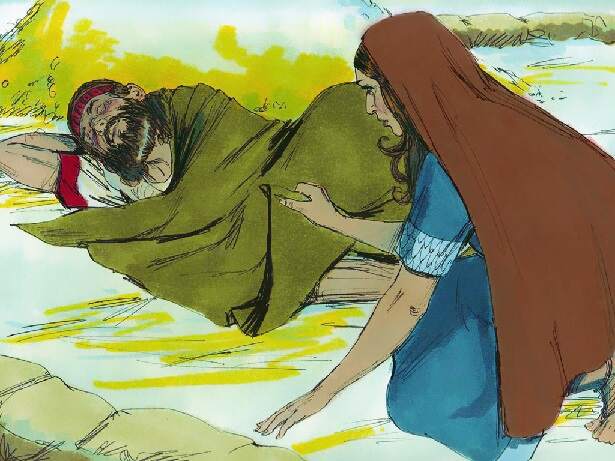
The audience is prepared for sexual encounter by the activities of Naomi and Ruth. They are clearly preparing for marriage. [48] Sexual innuendo continues with references to ‘feet’ [49] and ‘lying down’. [50] Boaz wakes, perhaps because of the cold on his legs, in his alarm he is undone/uncovered in more ways than one. Perhaps Ruth wakes him and he sees her uncovered before him. [51] Which is it? The audience is left to wonder.
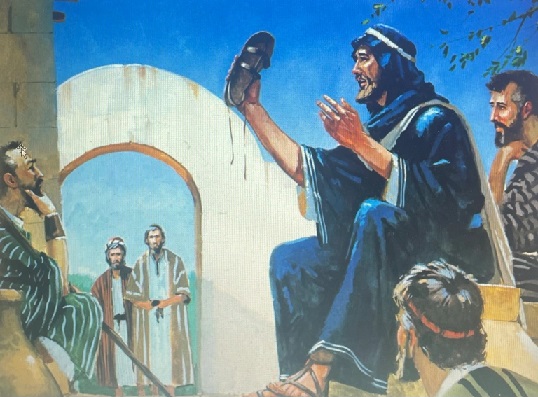
Which of these two images gives the better impression of what was happening that night in the field? [77]Boaz and Ruth. [78]
What does happen between Boaz and Ruth that night? We can’t be sure. We’re not sure that Boaz is really sure what happened. [52] – there was plenty of drink around that evening! We can, however, be sure that the ambiguity is intended by the author. [53] The audience cannot but see the similarities with other biblical stories. [54] They’re left to read almost anything into the situation.
Ruth seems to offer herself to him – Boaz recognises the sexual connotation in her reference to his cloak, but also that she is challenging him to fulfil his earlier blessing. [55] The audience is torn between titillation, at the possibility of sexual gratification, and jeering at pompous Boaz for being trapped by two women, [56] one a Moabite woman!
The latter part of the story has Boaz cunningly manoeuvring the anonymous relative [57] into a corner from which there is no retreat. He manages to buy [58] a Moabite woman without losing the respect of the community – he is the honourable redeemer. [59] In the story he’s definitely the winner. [60] The audience is left considering the motives of the village elders who sit at the gate of their village. What is happening as they make decisions? Is everything just as it appears, or are these ‘pompous’, ostensibly magnanimous/gracious, elders only really working for their own ends? Could that also be true of the elders teaching in the Synagogue?
Ruth
Ruth, a Moabite! The audience titters when she first enters the narrative. Moabites, and particularly their women are not good news. [61] The first possible signs of Ruth and Orpah’s loyalty [62] surprise them. Orpah’s decision to leave Naomi draws the audience’s boos: “We told you so, Moabites are no good! Go on Ruth, leave too!”
They hear her profession of loyalty [63] – its difficult to believe – they can’t credit good motives to Ruth: “She’s after something. Let’s wait and see!” Ruth’s loyalty to Naomi [64] continues to perplex the audience throughout the story. They are surprised at her willingness to glean in the field, but quickly they suspect that she will seduce the young Israelite men. Eventually they see her tangled with Boaz in a complicated romance, perhaps this is where she will show her true Moabite colours. The sly comparison with the Lilith tickles their fancy, [65] and they certainly have some fun at Boaz and Ruth’s expense.
But which side should they take? They have to decide. Prejudice says Ruth is evil, to be avonded Yet Rath shows faithfulness and loyalty, to Naomi and Boaz. [66] Yes, the author has allowed some titillation, but did anything wrong actually happen at the threshing Door Re can they believe that a Moabite woman is good? Yet if they don’t what does that say at the ancestry of their great King, David?
What does Ruth herself feel? Her husband is dead. Hier mother-in-lapse doesn’t want to know her. Chances of another husband in Moab are low. Who would want to marry second-hand goods? Israelite second-hand goods at that? [67]
Are Ruth’s motives as pure as they first seem? She has little choice. She cannot bring herself to follow Orpah who walks out of the narrative, probably into poverty and spinsterhood. [68] Ruth knows she’s committed to Naomi, no matter how bitter the wild woman is. Loyalty is her only option and she goes for it.
The journey to Bethlehem is hard – Naomi ignores her. [69] The entry into Bethlehem, harder still – for everyone ignores her. [70] She is determined not to be defeated. It is harvest-time and she heads for the fields – she’s heard Naomi mumbling about Boaz. [71] and determines that she will find his area of the field, she’s surprised to find it at the first attempt. This will be her way of helping both herself and Naomi. Her encounter with Boaz goes well – she can see that he’s interested in her. He’s clearly a respected man a bit ponderous/pompous but widowed Moabite women in Israel cannot be too choosy, can they?
Her triumph is hard to hide when see returns home – she tells Naomi of her work in the field, holding the name of Boaz for the last final flourish of her statement [72] (incidentally, holding the audience’s interest – they know something Naomi doesn’t know). She plays a small word game with Naomi, about men/maid-servants [73] which gently reminds Naomi of her earlier lack of care for Ruth.
Seven weeks she works in Boaz’s fields – she becomes quite fond of the old blighter. She isn’t surprised when Naomi suggests that marriage should be pursued, she listens to the plan and works out her own variation of it. [74] The risk is great, Boaz may just use her. In the event she has him trapped, just as on the following day he would trap the anonymous relative.
Conclusion
This is a very clever story, one that draws the audience in through an excellent plot and bawdy humour. The characters and the message contained within the story are such that the original audience could not have been left unmoved or challenged. It really does rate as “a ‘good yam’, superbly written”. [75] We can see God’s providence at work – and that seems to be the point. The story asks whether we can really see God at work in the lives of ordinary people. [76] The answer it provides is ‘Yes!’.
Notes
1:p25ff; 2:p259; 7:p201.
A well devised plot – intrigue draws us into each scene. A classic pattern of exposition/conflict/resolution (12:102ff). This “story has power to draw us in almost against our will” (11:p63f). Part of its allure is its honest embrace of pain (6:p25ff) see also note 15 below.
The interaction of the narrator and characters (12:p68-71) and the quality/depth of the characters (19:p37-40; 20:p71ff) is what makes this story.
17:p78; 21:p12f
8:p126 (note 29).
5:p146-165; 7:p197; 20:p71ff
cf. Exodus 23:9; Numbers p9:14.
Ruth 1:16f: cf. 15:p37,42 – re: conversion.
17:p102.
15:p36f.
5:p148-161.
Hesed, (חֶסֶד) Ruth 1:8 occurs frequently in the book, and carries the idea of covenant loyalty, cf. 5:p148; 7:p206; 21 p23.
21:p12 cf. 17:(whole book)
Although they would receive Rabbinic support (cf. 5:p148-165, 15:p37-47)
‘Comedy’ is also the literary term for ‘the story of the happy ending’ (19:p82; cf. 20:p72) – Ruth fits this traditional pattern.
17.p98
7 p208; 8:p72; 10:p197; 15 p36f.
Our response to narrative gaps affects our understanding of the story cf. 4 p12: 22:p20-25.
15:p36f
cf. e.g., Exodus 20:5; 34:7.
cf. Deuteronomy .23:3.
Ruth 1:13: cf. 21:p27; Exodus 20:5; 34:7.
8:p70f cf. 1:p46.
15:p 34.
15:p35f
Ruth 1:18, 8:p74.
15:p34f
Ruth 1:19-22, 8:p74f.
Ruth 2:2, 8:p76f
Ruth 3:2-4, 15:p36.
8:p82; Ruth 4:14-16.
ba’an (בעז) was one of the columns in the temple the name could mean ‘quickness/strength’ (1:p55), ‘powerful/potent’ (3:p51); he is introduced as a man of substance/worth/wealth (1:p56; 8:p83).
Ruth 2:4, 10:p205
Ruth 2:8-9,11-12; 15:p43.
Ruth 2:8-9, 15:p43.
8:p85: 15:p44
5:p161-163
Ruth 2:5 (RSV) – he is already thinking, ‘Who does she belong to?”
David Atkinson; The Message of Ruth;, IVP, Leicester, 1983,
A. Graeme Auld; Joshua, Judges and Ruth; St. Andrew Press, Edinburgh, 1984
Mieke Bal; Heroism and Proper Names, or the Fruits of Analogy; in Atalaya Brenner ed.; A Feminist Companion to Ruth; Sheffield Academic Press and Ruth St. Andrew Press, Sheffield, 1993.
Athalaya Brenner; Introduction; in Atalaya Brenner ed.; A Feminist Companion to Ruth; Sheffield Academic Press and Ruth St. Andrew Press, Sheffield, 1993.
Leila Leah Bronner; A Thematic Approach to Ruth in Rabbinic Literature; in Athalaya Brenner ed.; A Feminist Companion to Ruth; Sheffield Academic Press, Sheffield, 1993.
Walter Bruggemann; Old Testament Theology: in Patrick D. Miller ed., Fortress Press, Philadelphia. 1992.
John Craghan, C.SS.R.; Esther, Judith, Tobit, Jonah, Ruth; Michael Glazier, Wilmington, Delaware, 1982.
Danna Nolan Fewell & David M. Gunn; Compromising Redemption; Westminster/John Knox Press, Louisville, Kentucky, 1990.
Danna Nolan Fewell & David M. Gunn; Gender, Power, and Promise; Abingdon Press, Nashville, Tennessee, 1993.
John Goldingay; After Eating the Apricot; Paternoster, Carlisle, 1996.
John Goldingay: Models for Scripture; Paternoster, Carlisle, 1987.
David M. Gunn & Danna Nolan Fewell; Narrative in the Hebrew Bible; Oxford University Press, Oxford, 1993.
Paula S. Hiebert; Whence Shall Help Come to Me: The Biblical Widow; in Peggy L. Day (ed.); Gender and Difference in Ancient Israel; Fortress Press, Minneapolis, 1989.
Jonathan Magonet; A Rabbi’s Bible; SCM, London, 1991.
Jonathan Magonet; Bible Lives; SCM, London, 1992.
John H. Otwell; And Sarah Laughed; Westminster Press, Philadelphia, 1977.
Eugene H. Peterson; Five Smooth Stones for Pastoral Work; Eerdmans, Grand Rapids, Michigan, 1992
Ilona Rashkow, Ruth: The Discourse of Power and the Power of Discourse; in Athalaya Brenner ed.; A Feminist Companion to Ruth; Sheffield Academic Press, Sheffield, 1993.
Leland Ryken, How to Read the Bible As Literature; Zondervan, Grand Rapids, Michigan, 1984.
Leland Ryken; The Literature of the Bible; Zondervan, Grand Rapids, Michigan, 1974.
Jack M. Sasson; Ruth; 2nd Ed., reprinted, Sheffield Academic Press, Sheffield, 1995.
Elizabeth Cady Stanton, The Book of Ruth; in Athalaya Brenner ed.; A Feminist Companion to Ruth; Sheffield Academic Press, Sheffield, 1993.