

How are we meant to read Leviticus 18:22 and 20:13?
The later part of this article attempts to understand the nuances in different arguments about the actual meaning of these two texts. Attempting to do this is, of necessity, complex and really requires a far greater understanding of Ancient Hebrew than I can aspire to, having only followed a relatively short course at theological college. They say that a little knowledge can be a dangerous thing. Nowhere is this more true than in the area of ancient texts and their meaning. Any misunderstandings of the arguments made by others and covered in this article are solely mine.
The traditional view and the approach of much of the English-speaking international church to these two verses is to continue to use what have been accepted English translations of the texts. So, we have these translations:
Leviticus 18:22: You shall not lie with a male as with a woman; it is an abomination.
Leviticus 20:13: If a man lies with a male as with a woman, both of them have committed an abomination; they shall be put to death; their blood is upon them.
In order to get to grips with these two verses we need, first, to understand their context and then look at the meaning of the original Hebrew text. As part of doing so we may also need to look at similar uses of the words used in these two texts.
In addition, we will need to ask what status these texts have for Christians who now live under ‘grace’ rather than under ‘the law’. Romans tells us, “‘sin shall no longer be your master, because you are not under the law, but under grace.’ [Romans 6:14] … In the New Testament (NT), the Old Testament (OT) law is described as something that ‘proved to be death’ to us [Romans 7:10], ‘came to increase trespass’ [Romans 5:20], and held us ‘captive’ and ‘imprisoned’ [Galatians 3:23].” [3]
However, we cannot just dismiss ‘the law’. “In Matthew 5:17, Christ teaches that he is indeed not progressing away from the law: ‘Do not think that I have come to abolish the Law or the Prophets; I have not come to abolish them but to fulfill them.’ … [and] … Romans 3:31 says: ‘Do we then overthrow the law by this faith? By no means! On the contrary, we uphold the law.’” [3] If this is also true, how do we live not under ‘the law’ but under ‘grace’? How do we interpret OT law in a NT age?
First, context! …
The Holiness Code
The section of Leviticus in which the two verses fall (Leviticus 17 to 26) is often referred to as the Holiness Code. The emphasis, throughout these chapters is “on holiness, on being holy, on being pure. And so what you eat, what you do, what you are, all these things can affect how holy you are, how pure you are.” [2]
“And so,” says Jonathan Tallon, “eating the wrong food makes you less holy [Lev. 20:25]. Having a tattoo makes you less holy [Lev. 19:28]. Wearing clothes from different fibres – like wool and linen together – makes you less holy [Lev. 19:19]. Even having a physical disability makes you less holy [Lev. 21:16-23].” [2]
In part, the holiness code encouraged Israelites to be pure, separate from, different to their pagan neighbours. Everyday life became a symbol of that purity. Israelites were not to assimilate to surrounding cultures, just as different types of fibres shouldn’t be in the same cloth.
It is reasonable, therefore, in thinking about the meaning of the verses which make up the ten chapters of the ‘Holiness Code’, to ask what the prevailing cultural norms of those other cultures were. How were Israelites to be different from their neighbours?
It is probably also reasonable to note that there is no mention in Leviticus 18:22 & 20:13 of the actions/roles of two women.
But perhaps we are getting ahead of ourselves. Let’s look at the two chapters in Leviticus first.
Leviticus 18 and 20
I have found an article by Susan Day Pigott helpful as an introduction to these chapters. [25]
“Leviticus 18 and 20 forbid all sorts of sexual activity as well as foreign cult practices. In both, the purpose of the laws is clearly stated in the context of avoiding the practices of other nations. Lev. 18:3: “You shall not do as they do in the land of Egypt, where you lived, and you shall not do as they do in the land of Canaan, to which I am bringing you” (NRSV). Lev. 20:23: “You shall not follow the practices of the nation that I am driving out before you. Because they did all these things, I abhorred them” (NRSV). Thus, the first thing we should notice is that the laws of Leviticus 18 and 20 are about avoiding the practices of other nations—nations which worshiped other gods.
Leviticus 18 and 20 differ in the order and in some of the practices they list. Leviticus 18 simply cites the practices and sometimes labels them as abominations or other such things. Leviticus 20 tends to cite the practices and also commends punishments for each one. Often the penalty is death.
Both Leviticus 18 and 20 emphasize avoiding the worship of Molech, a foreign deity, especially in regard to child sacrifice (Lev. 18:21; Lev. 20:2-5). This is another clue that these laws revolve around avoiding the practices of other nations. Interestingly, the law forbidding sacrificing children to Molech appears immediately prior to the oft-prooftexted 18:22, usually understood to forbid homosexuality.
Most of the laws of Leviticus 18 forbid sexual relations amongst family members (Lev. 18:6-18). One verse warns against having sex with a menstruant (Lev. 18:19; cf. Lev. 20:18 which states that both the man and woman will be cut off from their people!). One verse forbids adultery (Lev. 18:20). And the next forbids sacrificing children to Molech (Lev. 18:21). Next comes our … verse (Lev. 18:22), followed by a verse forbidding bestiality (Lev. 18:23). The remaining verses emphasize that such practices are forbidden because the “defiled” nations practice them (18:24-30).
The laws of Leviticus 20 are more diverse. The chapter begins with the laws forbidding worship of Molech (Lev. 20:1-5). This is followed by forbidding the use of necromancers (Lev. 20:6), admonitions to remain holy (Lev. 20:7-8), and a warning against cursing one’s father or mother lest one be put to death (Lev. 20:9). The laws that follow focus on forbidden sexual relations, including our other … verse (v. 13) (Lev. 20:10-21). The chapter concludes with a restatement of the importance of making a distinction between Israel and the other nations (Lev. 20:22-26) and a final verse forbidding the consultation of necromancers (Lev. 20:27).” [25]
Tallon helps us to understand the prevailing culture in nations surrounding Israel in OT times: “In the surrounding cultures, the major socially acceptable form of same-sex activity was with male shrine prostitutes as part of temple worship to pagan gods and goddesses. And there is repeated rhetoric against these shrine prostitutes at different parts of the Hebrew Bible [see Deut. 23:17; 1 Kings 14:24 (linked with abomination), 15:12, 22:46, 23:7].” [2]
Susan Day Pigott draws attention to Leviticus 18:21 where pagan Molech worship is explicitly referenced and points to a passage in Isaiah:
“Upon a high and lofty mountain you have set your bed, and there you went up to offer sacrifice. Behind the door and the doorpost you have set up your symbol; for in deserting me, you have uncovered your bed, you have gone up to it, you have made it wide; and you have made a bargain for yourself with them, you have loved their bed, you have gazed on their nakedness. You journeyed to Molech with oil, and multiplied your perfumes; you sent your envoys far away, and sent down even to Sheol.” (Isa. 57:7-9 NRSV).
Susan Day Pigott comments: “Clearly, in this text, setting up your bed is a symbol for worship of Molech. Perhaps the same is true in Leviticus. And since both Levitical verses speak of lying with a male on the beds of a woman, perhaps the issue is sacred prostitution, not homosexuality.” [25]
More widely in the ancient Near East there were cultures like Ancient Greece, where the dominant form of male-male intercourse was (usually married) men with boys – pederasty. Perhaps is is significant, then, that the translation of Leviticus 20:13 above, talks of a man lying with a male (a boy or a man).
This means that we have two areas of ancient pagan life from which the Israelites were called, in the Holiness Code, to be different – pagan temple coupling between males and pederasty. These two things are manifestly different from faithful, loving, committed relationships. Tallon provides a helpful image to help us visualise this:
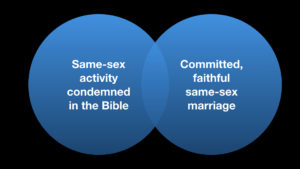
This simple Venn diagram helps us to understand that what was condemned in Leviticus was different from the matters we are discussing in the church today. Some overlap is reasonable – all relationships can go wrong and become sinful. [2]
If we are to take these two verses from Leviticus seriously, we have to engage with their context.
Second, we need to ask what status these verses have for people who follow Jesus.
Status of the Holiness Code in a Christian’s Life
We touched on this earlier in this article. This is a serious question which relates to the applicability of OT passages in our own context. We cannot just say that we write-off the OT and particularly the Holiness Code as inapplicable to Christians. Jesus, himself, does not do this. Rather than negating or dispensing with the OT law, Jesus reinvigorates it. In the Sermon on the Mount, he takes external rules and applies them internally to our hearts, thoughts and lives. So, for example, he says: “You have heard that it was said, ‘You shall not commit adultery. ‘ But I tell you that anyone who looks at a woman lustfully has already committed adultery with her in his heart.” [Matthew 5: 27-28]
Here, I have to part ways with Jonathan Tallon. His argument is that, “Christians don’t have to keep the Law. Why not? Because, with the arrival of the Messiah, Jesus, the time of the Law has come to an end. [Romans 10:4; Galatians 3:24-26]. We have been given a new law – the law of love. Love God, and love your neighbour [Galatians 5:14]. So it doesn’t matter whether you get a tattoo, or wear a cotton-polyester blend, or work on a Saturday (which is the Sabbath). The only thing that matters is whether what you are doing is loving.” [2]
I think that he overstates his case. It is true that as Christians, we are not under ‘the law’ but under ‘grace’. It is not true that we can, as a result, ignore what the OT scriptures say. Evangelical Christians believe that all scripture is ‘God-inspired’, breathed out by God. Not only does that mean that we have to treat it with respect, which we manifestly need to do, but also we need to listen to it and allow it to speak into our lives. That is actually what Tallon was doing as he helped us to understand the context in which these verses were written. It is also what Tallon was doing as he helped us to listen more carefully to the message of these passages from Leviticus. He is actually acknowledging that these OT passages do have something to say to us about what it means to be ‘loving’ and to live under ‘grace’.
How should we apply these verses (and others from Leviticus)? Taking them literally will mean that we have to accept the death penalty for homosexuality. [Leviticus 20:13] We will also need to accept that adultery is punishable by death. [Leviticus 20:10] It will mean that a person who gets a tattoo should be cut off from the community. [Leviticus 19:28] It will also mean that we cannot have mixed-fibres in our clothes nor mix food on our plates. [Leviticus 19:19] Or we take all these passages literally but ignore the bits we say no longer matter – we pick and choose.
While it is true that there is significant problem with taking these passages, as we read them today, primarily in translation, literally. We must also acknowledge that a significant number of the things written about in the Holiness Code are still seen, and must ever be seen, as wrong – incest is a prime example.
So, rather than taking these scriptures literally or saying that they no longer apply to us, we are, I think, intended to think these things through carefully, to understand the original point being made and then to apply these scriptures to help us understand what it means to be under ‘grace’ and living according to a ‘law of love’.
There is a sense in which our discussion so far has not yet delved deeply into the meaning of these passages. We have noted the context and the contrasts being made with the pagan world around Israel in OT times. In doing so we have focussed to a great extent on the verses translated into English.
What happens if we try to focus primarily on the Hebrew text? Is the position the same, or do have to look agin at out thinking?
Lost in Translation?
How sure are we that the English translation of the verses we are looking at are a fair and accurate translation of the original text?
Perhaps we should start by trying to understand the process of translation and then try to consider the original texts. …
Translation from Hebrew into English (or any other modern language is not simple. The original Hebrew text had to be interpreted by later readers to add what we would call vowels to the original words. Wikipedia is not necessarily the best authority to turn to but it is of general assistance. Wikipedia tells us that:
“Biblical Hebrew has been written with a number of different writing systems. From around the 12th century BCE until the 6th century BCE the Hebrews used the Paleo-Hebrew alphabet. This was retained by the Samaritans, who use the descendent Samaritan script to this day. However, the Imperial Aramaic alphabet gradually displaced the Paleo-Hebrew alphabet after the exile to Babylon, and it became the source for the Modern Hebrew alphabet. All of these scripts were lacking letters to represent all of the sounds of Biblical Hebrew, although these sounds are reflected in Greek and Latin transcriptions/translations of the time. … No manuscript of the Hebrew Bible dates to before 400 BCE. … Vowel and cantillation* marks were added to the older consonantal layer of the Bible between 600 CE and the beginning of the 10th century. The scholars who preserved the pronunciation of the Bibles were known as the Masoretes.” [4]
* Cantillation is is the manner of chanting ritual readings from the Hebrew Bible in synagogue services. The chants are written and notated in accordance with the special signs or marks printed in the Masoretic Text of the Bible, to complement the letters and vowel points.
This does not necessarily mean that meanings were changed in this process. As writing systems changed and as pointing was introduced and developed, the scholars of the time were seeking to preserve pronunciation, not to change it. But that process means a that an inevitable layer of interpretation occurred over a period of perhaps four centuries. We only need to think of the differences between 17th century English and 21st century English to realise that in four centuries a great deal of change can and does occur over time in pronunciations, in the meaning of specific words and in the way in which letters make up words.
In addition, Ancient Hebrew sentence structure is different from modern English. It is not just written from right to left, rather than our English practice of writing from left to right. In sentences, verbs nouns, etc are placed differently. There is perhaps also a greater sense that the meaning of particular words sometimes has to be determined by the context in which they are used. In modern English, these words are called ‘Homographs’ (words spelt the same but with different meanings). Examples in English include: Content (‘satisfied’ or ‘what is contained in something’); Does (‘female deer’ or ‘the third person singular form of the verb ‘to do”; Desert (‘a course in a meal’ or ‘a hot, arid region’; Minute (’60 seconds’ or ‘tiny’). These may be pronounced the same or differently, but they are spelt the same. We determine their meaning either by the context or by the pronunciation.
All these factors mean that we have to accept that the process of translation, almost inevitably, can distort the original meaning of a sentence. We have to rely on the best efforts of those who do the translation and it is why, often, translation is done by teams of scholars rather than by individuals. It is still possible that those teams of scholars will be culturally influenced and share the assumptions of the prevailing cultures in which they live. Or that they may choose to “dispel ambiguity by making the translation as simple as possible.” [1: p240]
Susan Day Pigott says: “The problem with all [English] translations is they don’t reflect what the Hebrew actually says.” [25]
Is she right?
In the case of Leviticus 18:22, Lings suggests “that the translators’ attempts to clarify the Hebrew text presents a reading that is not only harmful, but incongruent to the context of Leviticus.” [1] Particularly, Lings focusses on two primary things: the introduction of propositions by English translators; and the use of the rare Hebrew word miškevē.
In Hebrew, Leviticus 18:22 says:
ואת־זכר לא תשכב משכבי אשה תעובה הִוא
wĕʾet-zākār lōʾ tiškab miškĕbê (miškĕvê) tôʿēbâ hiw
A literal translation is: ‘With (a) male you shall not lie (the) lyings (or beds) of a woman. (An) abomination (tôʿēbâ) is that.’ [1: p231][5]
The Septugint reads thus:
καὶ μετὰ ἄρσενος οὐ κοιμηθήσῃ κοίτην γυναικός, βδέλυγμα γάρ ἐστιν.
The NRSV translation says: ‘You shall not lie with a male as with a woman, it is an abomination.’
In Hebrew, Leviticus 20:13 says:
ואיש אשר ישכב את־זכר משכבי אשה תעובה עשו שניהם מות יומתו דמיהם בם
wĕʾîš ʾăšer yiškab ʾet-zākār miškĕbê (miškĕvê) tôʿēbâ ʿāśû šĕnêhem môt yûmātû dĕmêhem bām
The Septuagint reads thus:
καὶ ὃς ἂν κοιμηθῇ μετὰ ἄρσενος κοίτην γυναικός, βδέλυγμα ἐποίησαν ἀμφότεροι, θανατούσθωσαν, ἔνοχοί εἰσιν
English (NRSV):
If a man lies with a male as with a woman, both of them have committed an abomination; they shall be put to death; their blood is upon them.
First, then, in Leviticus 18:22, English translators have added the prepositions as and with to give sense to the verse. There is an assumption made in that decision. That assumption is that the verse is making a comparison between a ‘normal’ action and a ‘deviant’ action. [1: p246-247] Lings points out that this assumption is not warranted by the verse. “To substantiate such a translation, the Hebrew equivalent for as (kě) must be connected directly to miškevē (“lyings”) since the Hebrew preposition attaches grammatically to either a noun or an infinitive.” [1: p236-237] That does not occur in the verse. Instead, “miškevē is the direct object of the verb tiškav (you shall not lie).” [1: p237] “Similarly, another grammatical construction that validates the English translation “with a woman” involves the Hebrew preposition ‘eth appearing a second time in front of ’iššâ.” [1: p237] This construction does not exist in Lev. 18:22.
“The Hebrew phrase kӗšōkhēv’eth (“as one lies with”) also conveys the same meaning that traditional English translators seek, but it is not present within the original text.” [1: p237] The absence of an equivalent preposition in Hebrew casts doubt on an assumption that the verse compares “normative” and “deviant” sexual actions.
Secondly, “the plural word miškevē is a rare biblical word. Therefore, it warrants careful scrutiny. In fact, miškevē only occurs one more time in the entire Bible besides its parallel occurrence in Lev. 20:13. [1: p245, p241] In Gen. 49:4, the verse explicitly refers the incestuous activity of Reuben with his father’s concubine, Bilhah. While “lyings”, “acts of lying down,” or “beds” are possible translations for the word miškevē, the comparison to the Hebrew singular word for bed, yātsūa, suggests that the two Hebrew words are not interchangeable. [1: p240] Lings asserts that the plural miškevë may focus on the deviant nature of Reuben’s incestuous relationship with Bilhah. [1: p241] The philological nuance implies that miškevē means rape of a family member.” [1]
If Lings is right, the incestuous connotation of the word miškevē may make more sense in the context of Leviticus 18 as much of that chapter relates to divine condemnation of incest but the connection is not as clear there as it is in Leviticus 20 which focusses primarily on incest . In Leviticus 20:13, “the miškevē ‘iššâ is an act that is punished identically to other acts that are clearly incestuous. Therefore, the likely meaning of miškevē ‘iššâ refers … to incestuous male-male rape.” [1] If Lings is right, this certainly means that it is less easy to apply miškevē ‘iššâ it to all erotic, same-sex relationships.
Lings’ reading of the Hebrew text suggests that Leviticus 18:22 clearly condemns incestuous, same-sex rape. It is far less sure that it can be used to condemn all same-sex relationships.
מִשְׁכְּבֵי אִשָּׁה (miškevē ‘iššâ)
Are things really as simple as Lings suggests?
Scholars cannot agree on the right way to interpret Leviticus 18: 22 and 20:13. There are a significant number who argue for a traditional interpretation. Mark Preston Stone highlights many of these in the introduction to his paper which was published in the journal Currents in Biblical Research. [5]
The earliest of those on Stone’s list were arguing their point before there was any recognition of the possibility of faithful loving homosexual relationships and show little or no differentiation between varying forms of homosexual actions and relationships.
In 1994, Saul M. Olyan published an article which carefully considered philological issues (‘philology’ being the study of the structure, historical development, and relationships of a language or languages) which the two verses and their contexts raise. [6]
Oylan’s conclusion was that the verses related to male-to-male anal sex. Together with two other papers published in 1994 and 1995, Oylan’s essay heralded a new era in research into the two verses in Leviticus.
Since 1994, there have been 21 different scholarly studies which have been reported in French, English and German, all of these have differences of approach. Mark Preston Stone [5] has surveyed the papers produced and in doing so concluded that those which are still considered viable have 5 different main themes. Papers by Olyan [6], Dershowitz [7][8][9], Stewart [10][11], Töyräänvuori [12], and Wells [13] are representative of the main perspectives espoused by those studies.
“Much of the disagreement stems “from the Hebrew phrase משכבי אשה. English translations tend to gloss this as analogical, ‘as one lies with a woman’ … but literally we have … ‘And with a male you shall not lie down the beds of a woman’ … Many interpreters have assumed that משכב connotes ‘the act of lying’ … This may be possible but, as Wells [13] insists, the primary meaning of the noun is ‘bed’. What could this mean, and why is it worthy of proscription? We can see that all translations are freely interpretive in their understanding of משכבי אשה, so the question before us is whether such translations are justified or whether another rendering is preferable.” [5]
Oylan compares משכבי אשה with a similar, but male, reference in Number 31:17 and Judges 21:11-12, משכב זכר (‘the lying down of a male’) which, in both those contexts, refers to a woman who is a virgin (who has not know male vaginal penetration). [5][6: p184] Oylan argues that it is reasonable to assume that since משכב זכר has a restricted usage, it is likewise reasonable to assume that משכבי אשה must also have a very specific meaning. But we must note that משכב זכר is singular and that משכבי אשה is plural. Oylan considers that in Hebrew thought, male anal penetration was seen as analogous to vaginal penetration and that משכבי אשה is aimed at the penetrator rather than the one penetrated. [5][6: p186-188]
In commenting on Oylan’s paper, others, including Jerome Walsh [14] have argued that the one addressed is the one penetrated rather than the penetrator. Both agree on the link with Numbers 31:17 and Judges 21:11-12.
If we accept Oylan’s and Walsh’s working hypothesis that both Leviticus 18:22 and 20:13 proscribe male same-sex anal intercourse, we have to ask, why? Why might this have been an issue in ancient Israelite society?
Stone cites a list of those who see this as a blanket ban on all same-sex erotic behaviour. The actual references are not necessarily as important as the number of references: Smith (1967), Wenham (1979), Niditch (1982), Greenberg (1988), Alpert (1989), Levine (1989) Eilberg-Schwartz (1990), Biale (1992), Gagnon (2001), Kiuchi (2007), Zehnder (2008), Himbaza, Schenker & Edart (2012). [5]
A more restricted variant sees this prohibition as referring only to physical same-sex activity. Stone calls these views ‘traditional’. Stone tells us that, “the first explicit articulation of this broad reading can be traced to the late 4th century CE Apostolic Constitutions (linking it to Sodom in Gen. 19), it did not become the mainstream Christian reading until the Middle Ages with Peter Damian, Peter of Poitiers, and Peter Cantor. … Early Jewish views [were] similarly diverse and complicated … Both the uncertainty with and popularity of this view can be glimpsed in some of the earliest English translations. Wycliffe’s 1382 translation, for instance, offered two different renderings: ‘Thou shalt not be meddled with a man, by lechery of a woman, for it is an abomination. (Thou shalt not be mixed together with a man, like in a fleshly coupling with a woman, for it is an abomination)’.” [5][15: p217-18]
Stone also wants us to note that if Leviticus 18:22 & 20:13 can be accurately described as articulating a universal ban on homosexual behaviour, “then it would constitute the only known ban of this sort among ancient Near Eastern and Classical sources, which are typically concerned with issues of class, incest, and violence (see Olyan 1994 for a brief survey).” [5]
He further comments that, “if one insists that the opaque Hebrew of Lev. 18.22/20.13 really does represent an unprecedented ban on all male same-sex intercourse, the burden of proof remains high: The laws of Leviticus come from literate cultural producers, and the views found there do not always necessarily reflect Israelite culture as a whole but a limited segment (see Albertz and Schmitt 2012: p1-56) [5][16]. Even if we were to conclude that the most reasonable understanding of Lev. 18.22/20.13 was a blanket prohibition against ‘homosexuality’—certainly now the minority view among specialists—there is no obvious reason to assume this view would have carried the same weight in every context. The most we could say is that it represents one particular view from one segment of society. Many scholars have noted the contradictory views of sexual ethics by comparing the following: Lev. 18.9 and 20.17 forbid sex and marriage, respectively, with one’s sister. And yet in Gen. 20, we encounter Abraham’s marriage to Sarah, his half-sister, with no hint of censure. In Lev. 18.6 and 20.21, a man is forbidden from marrying the wife of his brother—in stark contradiction to the law of Levirate marriage in Deut. 25. Or compare Lev. 18.18, which forbids marriage to two sisters, with Jacob’s marriages to Leah and Rachel. We should reemphasize here not only the uniqueness of Lev. 18.22/20.13 within the biblical literature, but also—if one insists it articulates a blanket prohibition against either ‘homosexuality’ or even male same-sex anal intercourse in general— its sui generis character compared with ancient Mediterranean and Near Eastern cultures. On the other hand, laws against incest (Deut. 22.30, 27.20-23), adultery (Exod. 20.14; Deut. 5.18, 22.22-27; Num. 5.11-31; Ezek. 18.6-11, 33.26) and bestiality (Exod. 22.19; Deut. 27.21) are found elsewhere.” [5]
Stone also notes (as per Lings [16]) that the comparative particle ‘as‘ (not present in the Hebrew) has to be worked quite hard and has the potential to mean other things than most translators might intend. (For instance ‘as’ might be taken to mean ‘in the same way as’ which could give freedom for bisexual relationships provided the participant(s) do not use the same erotic practices with men as with women.)
An alternate traditional view which dates back as far as Philo of Alexandria (first century CE) is that Leviticus 18:22 & 20:13 should be seen as referring particularly to pederasty. Luther’s translation reflects this (‘Du sollst nicht beim Knaben liegen wie beim Weibe; denn es ist ein Greuel’, ‘Knaben’ = ‘boys’). While we today would condemn these relationship due to their predatory power differential, in antiquity they were condemned for their feminisation of boys, the squandering of sperm and the absence of procreative intent. [5][17]
Some commentators argue that Leviticus 18:22 and 20:13 specifically allude to Genesis 1-3. People can be found on the traditional side of the debate and on the more liberal side, that use an assumed link to Genesis 1-3 to argue their case. [5]
Comparative evidence from antiquity has also played a significant role in the debate. Stone notes that the available material is sparse, at best. It does exist in Hittite Laws and in the Egyptian Book of the Dead. [5]
In antiquity ‘active’ and ‘passive’ roles were seen differently depending on the prevailing culture. Oylan sees there as gendered [6: p189], ‘male’=active, ‘female’=passive. In other cultures the concerns about active and passive roles revolved around other factors such as class, social role and age. Walsh argues that since the Levitical laws are addressed in the first instance to the free male Israelite citizen, “The central issue in both laws is not gender confusion in general, but precisely gender confusion wherein the free male citizen takes on the “female” role….The male sexual role is to be the active penetrator; the passive role of being penetrated brings shame to a man (at least to a free adult male citizen) who engages in it and, in the later redactional stratum, also to the one who penetrates him. Apart from this situation, the Hebrew Bible is silent.” [14: p207-208]
Stone goes on to assert that “When scholars appeal to the evidence from the comparative material they broadly agree that the anxiety reflected cannot be reduced to a broad taboo against male same-sex erotic behaviour. On the contrary, sex acts between men of different status were not only allowed but even taxed (e.g., Greco-Roman pederasty) or at the very least broadly institutionalized and incorporated into specialized priestly roles. Some roles intentionally blurred the gender boundaries and seem to have involved some form of sex work (e.g., the Assyrian assinnu, kurgarrû, kuluʾu, and kalû) (see eg. [18: p28-36] [19]). [5]
It seems that across the ancient near- and middle-east ‘homosexuality’ was not a real concern and where these matters do appear, they are rare and cannot easily be mapped onto modern conceptions of sexuality. They seem to be concerned “with issues of power and social class, ancient conceptions of appropriate gender roles, and maintaining proper boundaries between these categories. … Sex benefitted the active/penetrative party, not the passive/penetrated. Note, too, that these ancient anxieties around male same-sex anal intercourse are largely premised on misogyny.” [5] what does seem to be a shared concern is male to male sex between parties of the same class which is effectively seen as rape by the penetrator. if this argument is followed then the better translation of Leviticus 18:22 would be “Sex for the conquest, for shoring up the ego, for self-aggrandizement, or worse, for the perverse pleasure of demeaning another man is prohibited. This is an abomination.” [20: p206 & 21: p132-33] It does not seem unreasonable to postulate that a concern for the social standing of the participants referred to in Leviticus 18: 22 & 20:13 is at least a part of reason for its consideration as tôʿēbâ.
A parallel possibility which must carry some weight in out thinking is what has often been referred to as ‘cult prostitution’. There is debate about whether this existed and in what form but a considerable number of scholars are listed by Stone as considering that activity as the focus of Leviticus 18:22 & 20:13. In concert with these views are a number who relate the principal concern of the two verses to ‘idolatry’. Stone quotes Deuteronomy 23:17-18 here:
“None of the daughters of Israel shall be a temple prostitute; none of the sons of Israel
shall be a temple prostitute. You shall not bring the fee of a prostitute or the wages of a male prostitute into the house of the LORD your God in payment for any vow, for both of these are abhorrent to the LORD your God.” (NRSV)
He notes, however, that there is nothing in the broader context of Lev. 18 and 20 that would suggest a restriction to the cultic sphere. [5]
There is also a possibility, argued for by Dershowitz [7] that the earliest textual version of Leviticus 18 did not include verses 18-23. This is a particularly technical proposal based on an apparent contradiction in the structure of the chapter which suggests additions by an editor. [5] [7]
Stone then concentrates on three specific hypotheses about Leviticus 18:22 & 20:13.
a. Töyräänvuori (2020) [12] “has recently proposed the novel view that male same-sex
intercourse is not even addressed in these verses. Instead, the law is concerned about ambiguous paternity resulting from a male-male-female threesome.” [5] In this scenario it is what is conceived in the womb that is an abomination (tôʿēbâ). “The children resulting from such situations would have unclear social roles, and ‘the statutes aim to prevent the creation of illicit and potentially abominable offspring. The creation of such offspring would be considered as disruptive to the social order, but ultimately it is questions of inheritance that the statutes aim to resolve’ [12: p249 & 250].” [5]
b. Stewart (2000, 2006) [10][11] “has argued that the laws are concerned only with male same-sex incest.” [5] His hypothesis has been picked up and expanded by Lings [1][15: p231-250] and Milgrom [22: p1786] Stewart’s argument revolves round משכב זכר (‘lying of a male’ – in Stewart’s argument this means ‘vaginal penetration’) and משכבי אשה (‘lyings of a woman’ – ‘vaginal receptivity’) Stewart points to Genesis 49:4 whereאביך משכבי (‘the bed of your father’ talks of Reuben’s sexual activity with one of Jacob’s wives – incest) and he argues that “The lyings-of-a-woman still presumes the agency of a male but refers to an act with another male by a kind of literary gender play. Just as the ‘lyings-of-your-father’ refers to a usurpation of the father’s bed by the son, the ‘lyings-of-a-woman’ metonymically refer to a male as incestuous object—a metonym because elaboration of the incest category has been (primarily) in terms of female objects (Lev. 18.7-16).” [11: p97]
Stewart also argues that the “singular משכב indicates licit sex, whereas the plural משכבי is a technical term indicating illicit sex. What is illicit? Incest, and in the particular case of Lev. 18.22, all the ‘male versions’ of prohibitions just enumerated [11: p74]. It is a catch-all phrase … tacked on ‘to make sure that the general prohibition against incest applies in all directions’ [1: p245].” [5] So, incest is the target of Leviticus 18:22 & 20:13, rather than male same-sex activity in general.
c. Wells (2020) [13] “has proposed that the issue is … that of prohibiting sexual intercourse with an ‘unavailable’ man—either due to his being married to a woman (i.e., adultery) or his being a younger male under the authority of another woman.” [5] He notes elements missing from both Leviticus 18:22 & 20:13, particularly that neither qualify the זכר ‘male’ with כל ‘all/every’. … “This is significant because the pattern elsewhere is to identify the illicit sexual partner, typically preceded by another word (e.g., ‘nakedness’) or a preposition, and אשה is always qualified so as to limit the prohibition to a certain woman or situation. Given this pattern, every illicit sexual partner in Lev. 18 is restrictively qualified unless we find כל or a similar all encompassing reference (e.g., 18.23). Since we lack any such indicator in 18.22 or 20.13, we should infer that the prohibition is similarly restricted to a particular person or situation. For Wells, this qualifier is משכבי אשה. … The second missing element is … the almost universal choice to translate [using] analogy, but we are missing a Hebrew particle of comparison.” [5] We have already noted this factor.
Given these two things, the missing ‘all/every’ and a missing analogy, Wells insists that משכב should in this context mean a ‘location’ rather than an ‘action’. He concludes this on the basis of the usage of the verb שכב elsewhere. “Outside of Lev. 18.22/20.13, there are eleven other uses of the verb שכב with an adverbial accusative. In eight of these, it is clearly an adverbial accusative of location (2 Sam. 4.5, 11.9, 12.16, 13.31; Mic. 7.5; Ps. 88.6; Ruth 3.8, 14). Wells draws an analogy to the modern English idiom, ‘I found the two of them in bed together’ [13: p129]. The remaining three are Priestly texts with an adverbial accusative of ‘manner’ (Lev. 15.18; 19.20; Num. 5.13), namely, שבכת זער ‘a lying of seed’ (i.e., seminal emission). ‘This use’, says Wells, ‘shows that the priestly authors…already had an expression at hand that they could use to convey the sexual nature of an act, and this expression does not occur in [Lev. 18.22 and 20.13]’ [13: p129].” [5]
Wells presents a carefully argued linguistic analysis/critique to support an understanding of ‘location’ rather than ‘manner’. This results in a relatively straightforward translation of the text of Leviticus 18:22 into English – ‘And with a male you shall not lie on the beds of a woman; it is an abomination’. He then goes on to consider why ‘lying on the beds of a woman’ might be worthy of censure. He starts by considering the particular form of the plural משכבי. Hebrew nouns can take different forms The normal plural form of משכב would be משכבות , “but the construct plural in משכבי אשה corresponds to the alternative form משכבים*. Besides Leviticus 18:22 & 20:13 there are very few other ancient Hebrew texts with this plural form.” [5]
I am not confident enough of what little I understand of ancient Hebrew to comment on the quality of Wells arguments. I have to rely on Stone’s analysis. Wells notes the parallel use in Genesis 49: 4, which we have already encountered, and a use in intertextual material (1QSa I, 8-10). “Wells concludes that these four occurrences (Gen. 49.4; Lev. 18.22, 20.13; 1QSa I, 10) … all refer to illicit sex [13: p139] In each case the noun related to the plural construct represents the opposite gender of the sexual partner. … Wells seeks to provide an interpretation that can incorporate both Gen. 49.4 and 1QSa I.10, the latter of which is clearly not about incest. This is an important point, but Wells’ discussion muddies things a bit by incorrectly describing the idiom in 1QSa I.10 as connoting an inherently illicit sexual act … Regardless, the more salient point is Wells’ broader conclusion, which does not require the assumption that the act is necessarily illicit: ‘In this way, I arrive at my proposal that משכבי [or] משכבים* is an abstract plural that communicates the notion of someone’s lying-down area or zone. We might even say that it stands for an individual’s sexual domain’ [13: p140].” [5] Stone carefully observes possible objections to this notion and, again, I have to defer to his capacity to engage with the detailed arguments put forward by Wells and the cogency of Wells’ conclusions. Nonetheless, in context, Wells’ conclusion is that no general prohibition is intended in our two passages but rather men who legitimately were not free to have such relations – those already married or those who, though single, fall under the guardianship of an Israelite woman. Stone comments: “As for who is left for licit male same-sex activity, the implication would be that male slaves, foreign travelers (but not a resident foreigner, גר), and possibly male prostitutes were permissible [13: p147-148]. The primary drivers include purity issues, but more pertinent are concerns to maintain social cohesion while ensuring the community behaves differently from certain groups of foreigners [23: p39]. Since there is no other legal material in the Pentateuch that comes close to speaking of such concerns, Wells also thinks the specific regulations found in Lev. 18.22 and 20.13, along with a handful of others, were ‘comparatively new’ additions [13: p154-56].” [5]
Conclusion
Stone’s conclusion, it seems to me, is very significant: “The sheer variety of proposals about Lev. 18.22/20.13 should lead us to emphasize the tentative nature of any hypothesis. While we might find some arguments more compelling than others, all are ultimately more suggestive than decisive. At present, no clear consensus exists, but research trends reflect a growing resistance to understanding the law as a blanket condemnation of ‘homosexuality’. As the survey has shown, many now find this to be an unacceptable category error and opt for alternative proposals related to issues of power and social class, ancient conceptions of appropriate gender roles, and maintaining the proper boundaries between these categories.” [5]
This ‘provisionality’, it seems to me, has to extend to the more conservative approaches to these two texts. Stone quotes Seow: “We must move beyond the explication of texts. The issue of homosexuality is not merely an exegetical one—that is, it is not merely a question of what the ancient texts ‘meant’. It is, more importantly, a hermeneutical issue, a question of how we understand the texts and appropriate them for our specific contexts.” [24: pX]
It seems to me that we will never be sure of the meaning of these texts.
There is a lack of clarity in the original Hebrew which has then been compounded by the choices made by translators. The net effect of these two factors is that two texts which are complex in their original form, have been rendered simply in English and have then been built on by others in a way that the original Hebrew probably does not warrant.
However, this conclusion, in itself must also be regarded as provisional. It may well be wrong. For me, personally, I would want to look elsewhere in scripture to form my theology and praxis. The English translation of these texts is not enough, neither is the ancient Hebrew. I would want to allow the New Testament to provide the appropriate theological landscape on which an approach were to be built.
References
- K. Renato Lings, The ‘Lyings’ of a Woman: Male-Male Incest in Leviticus 18:22?; in Theology & Sexuality Volume 15, No. 2, Equinox Printing, London, 2009: reported in https://blog.smu.edu/ot8317/2019/04/11/lost-in-translation-alternative-meaning-in-leviticus-1822, accessed on 18th July 2023.
- https://www.bibleandhomosexuality.org/does-leviticus-mean-homosexuality-is-an-abomination, accessed on 18th July 2023.
- https://openthebible.org/article/three-benefits-of-the-law-for-those-under-grace/#:~:text=We%20read%2C%20%E2%80%9CFor%20sin%20shall,Our%20salvation%20rests%20upon%20this., accessed on 18th July 2023.
- https://en.wikipedia.org/wiki/Biblical_Hebrew, accessed on 19th July 2023.
- Mark Preston Stone; Don’t Do What to Whom? A Survey of Historical-Critical Scholarship on Leviticus 18.22 and 20.13; in Currents in Biblical Research Volume 20, No. 3, 2022, p207-37; accessed via. https://www.researchgate.net/publication/361182281_Don’t_Do_What_to_Whom_A_Survey_of_Historical-Critical_Scholarship_on_Leviticus_1822_and_2013_Currents_in_Biblical_Research_203_2022_203-233_UNCORRECTED_PRE-PRINT, 25th July 2023.
- Saul M. Olyan; ‘And with a Male You Shall Not Lie the Lying Down of a Woman’: On the Meaning and Significance of Leviticus 18:22 and 20:13; in the Journal of the History of Sexuality Volume 5, No. 2, 1994, p179-206.
- Idan Dershowitz; Revealing Nakedness and Concealing Homosexual Intercourse: Legal and Lexica Evolution in Leviticus 18; in Hebrew Bible & Ancient Israel Volume 6 No. 4, 2017, p510-26.
- Idan Dershowitz; The Secret History of Leviticus; in The New York Times, 21st July 2018. Op-ed.
- Idan Dershowitz; Response to: ‘Was There Ever an Implicit Acceptance of Male HomosexualIntercourse in Leviticus 18?’ by George M. Hollenback in Zeitschrift für die alttestamentliche Wissenschaft Volume 131 No. 3, 2019, p464-466; in Zeitschrift für die alttestamentliche Wissenschaft Volume 131 No.4, 2019, p625-628
- David Tabb Stewart; Ancient Sexual Laws: Text and Intertext of the Biblical Holiness Code and Hittite Law; Ph.D. dissertation, University of California, Berkeley, 2000.
- David Tabb Stewart; Leviticus; in Deryn Guest, Robert Goss, Mona West, and Thomas Bohache (eds.), The Queer Bible Commentary; SCM, London, 2006, p77-104.
- Joanna Töyräänvuori; Homosexuality, the Holiness Code, and Ritual Pollution: A Case of Mistaken Identity; in the Journal for the Study of the Old Testament Volume 45, No. 2, 2020, p236-267.
- Bruce Wells; On the Beds of a Woman: The Leviticus Texts on Same-Sex Relations Reconsidered; in Hilary Lipka and Bruce Wells (eds.); Sexuality and Law in the Torah; Library of Hebrew Bible/Old Testament Studies No. 675; T&T Clark, Bloomsbury, London, 2020, p123-158.
- Jerome T. Walsh; Leviticus 18:22 and 20:13: Who is Doing What to Whom?; in the Journal of Biblical Linguistics Volume 120, 2001, p201-209.
- K. Renato Lings, Love Lost in Translation: Homosexuality and the Bible; Trafford, Bloomington Indiana, 2013.
- Ranier Albertz & Rüdiger Schmitt; Family and Household Religion in Ancient Israel and the Levant; Eisenbrauns, Winona Lake, Indiana, 2012.
- Note, however, that the sex laws in Leviticus 18 and 20 do not seem to consistently address this particular concern as “there are no laws against other genital acts that result in ejaculation without the possibility of conception (e.g., male masturbation, coitus interruptus, necrophilia, male-female anal intercourse, sex with a post-menopausal woman).” [5]
- Martti Nissinen; Homoeroticism in the Biblical World: A Historical Perspective (trans. Kirsi Stjerna); Fortress, Minneapolis, 1998.
- Saana Svärd & Martti Nissinen; (Re)constructing the Image of the Assinnu; in Saana Svärd and Agnès Garcia Ventura (eds.), Studying Gender in the Ancient Near East; Eisenbrauns, University Park, Pennsylvania, 2018, p373-411.
- Steven Greenberg; Wrestling with God & Men: Homosexuality in the Jewish Tradition; University of Wisconsin Press, Madison, 2004.
- William Stacey Johnson; A Time to Embrace: Same-Sex Relationships in Religion, Law, and Politics (2nd ed.); Eerdmanns, Grand Rapids, Michigan, 2012.
- Jacob Milgrom; Leviticus 17-22; Anchor Bible Commentaries 3A, Doubleday, New York, 2000.
- Hilary Lipka; Sexual Transgressions in the Hebrew Bible; Sheffiled Phoenix, Sheffield, 2006.
- C.L. Seow; Introduction; in C. L. Seow (ed.), Homosexuality and Christian Community; Westminster John Knox, Philadelphia, 1996, pVII-XII.
- Susan Day Pigott; Leviticus Defiled: The Perversion of Two Verses; in a Blog: Scribalishness; 28th February 2014; accessed via. https://wp.me/p4cVdH-2w on 24th July 2023.
 Roger Farnworth