
Tag Archives: jesus

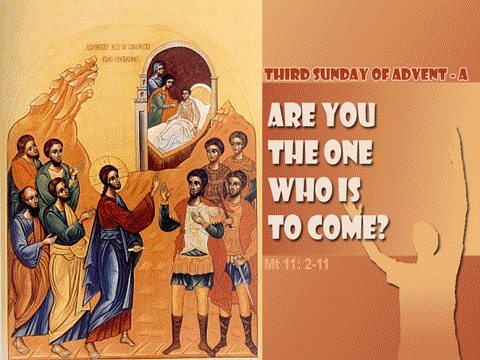
Sunday 14th December 2025 – Matthew 11: 2-11

How are you doing with your presents? Bought them all yet?

Surprisingly we’ve bought nearly all of ours already – and don’t ask me how much we’ve spent! It is hard work though, isn’t it, trying to pick something that you think someone will appreciate. And then comes that exciting job of wrapping them up – trying to hold three different bits of paper together at the same time as cutting the sellotape; sticking the sellotape onto one finger and trying to fold everything back up, only to discover that a bit of the tape has stuck to the paper and ripped it! Then there’s the present which turns out to be just too big for the largest sheet or roll of wrapping paper you could find.

I find wrapping presents to be is a bind!

And then you sit back a look at your endeavours and it’s still pretty obvious what most things are – it isn’t easy to disguise the shirt with the collar which sticks up above the rest of the pack, a tennis racket is a tennis racket even inside Christmas wrapping, a bottle of wine is a bottle of wine however you try to wrap it – and a mountain bike – well what else could it be?

It is a wonder that anyone is surprised by the presents that they get.

And yet we are, aren’t we. There is always something that comes as a complete surprise – even if we’ve given everyone a list of what we want, we still get that present or presents which are impossible to guess from their wrapping. We look at them and wonder what they might be.

Sometimes the surprise is positive. I’ve had some wonderful unexpected presents. But the surprise can also be negative. … As a teenager in the 1970s, I set my sights on a lovely pair of cowboy boots that had good 3 inch high heels, and 1.5 inch platforms. They were bright orange in colour. I told my parents about them and they assured me that my boots would be waiting for me on Christmas morning.

As teenagers are wont to do, I slithered downstairs on Christmas morning, trying not to betray my excitement. Mum and Dad had always said “No!” to my choice in clothes before and they still held the purse strings!

When we started opening the presents, I was immediately aware that I was going to be disappointed. There were no presents large enough. Still I maintained a slim hope that perhaps the boot calves had been folded over to get them into a smaller box. But no, when I opened the present from Mum and Dad, there were a pair of boots, ankle height, elasticised slip-on boots with half inch heels – Chelsea Boots. How could they have got it so wrong? I thought. I don’t think I wore boots more than once. I was really disappointed!

John the Baptist believed that he was preparing the way for a Jewish Messiah. He had in mind what he wanted. The trouble was that when that Messiah arrived he did not fit John’s idea of a Messiah. God’s gift to Israel was not what it wanted. Not even John the Baptist, who did so much to prepare the way for Jesus had any confidence in what Jesus was doing now that His ministry had started.

I guess John the Baptist was sitting in prison wondering whether his life had been wasted!

In our reading, Jesus has to remind John of passages from Isaiah about the suffering servant.

 Israel, and John the Baptist, had ignored these prophecies about the Messiah and clung onto the one’s they preferred – those that foretold a military messiah, a powerful leader who would free them from the yoke of oppression.

‘No,’ says Jesus, ‘I am here to inaugurate a different kingdom, a kingdom built on justice for all, and peace and healing for the oppressed.’

The thing with God is … that we can never pin God down. We think we have listened. We form our ideas of what God wants, or what God is doing. And then, … well, God does something different. We’ve tried to understand what he wants and yet again we’ve been trapped by our own ideas and our limited understanding of God.

It is wonderful when God surprises us with something new, something different. The incarnation of Jesus, was one of those occasions: the most important of them. In Jesus’ life and death he turned convention on its head, he disturbed the status quo, and out of a shameful death brought new life and hope to the world.

Jesus is God’s present to us this Christmas. ……… But don’t go thinking that you’ll get the present you’ve asked for!

Jesus at work in our lives is more disturbing, more exciting, more wonderful than we can anticipate. I was disappointed with my boots back in the 1970s, but I have never been disappointed with Jesus. Occasionally confused, sometimes disturbed, sometimes bewildered, sometimes wondering what I believe and why, but following Jesus’ lead has taken me all over the place – to University to study Civil Engineering, to different Councils to work as a bridge engineer, to Uganda for a time, into training for the ministry, marriage later in life, into ministry in the Church of England in and around Manchester, and most recently to retirement here in Shropshire! And God continues to change and challenge me – and I am still slow to learn and slow to trust!

Ultimately, John the Baptist died before he could see Jesus come in his glory.

In Jesus’ death, shame became glory. The Bible reminds us that the cross was itself Christ’s glory, Christ’s throne. It was the place where the love of God for the world was revealed.

As Christians, we can look back with gratitude to those days. … For those who lived through them, they were days full of hope …. then of deep disappointment … and then of hope once again. … Days full of shocks and surprises. Their world was truned on its head more than once.

Our God is a God of surprises. God asks for our loyalty and trust. God wants to surprise each of us with God’s presence in Christ this Christmas time. May we be those who are open to those surprises. Amen. 

The Sermon on the Plain (Luke 6: 20-31)

Luke 6: 20-31 is known as “The Sermon on the Plain” and is parallel to Matthew Chapters 5 to 7, which are known as “The Sermon on the Mount”. It is known as ‘The Sermon on the Plain’ because Luke writes in Luke 6:17 “Jesus came down with them and stood on a level place”. …

There are four blessings in this passage, rather than the eight blessings in Matthew’s Gospel, and ‘woes’ follow quickly and starkly after the blessings. Whereas in Matthew’s Gospel the ‘woes’ are much more gently couched and hidden in the longer text.


Luke’s account of Jesus’ words is much more direct, more immediate, more pressing, and does not, obviously, carry a spiritual meaning. Here in Luke’s Gospel Jesus says, ‘Blessed are you poor, for yours is the kingdom of God’. In Matthew he says, ‘Blessed are the poor in spirit, for theirs is the kingdom of heaven’. … We need to hear and heed both of these versions of Jesus’ sermon if we are not to misinterpret what he says. …

Recognising our spiritual poverty (as in Matthew’s Gospel) is important if we are to hear the gentle word of God’s love spoken to us in the bible. Spiritual poverty is the opposite of arrogantly assuming that we know God’s will and purposes, it encourages an enquiring mind, seeking out what God’s Holy Spirit is doing in our lives. It accepts that we will always have something to learn. It might even mean that we really do try to see things from the perspective of those with whom we disagree.

But what might it mean to say that the poor are blessed? …

Jesus uses the present tense. … The poor already have the Kingdom of Heaven. … They are blessed now. … This is hard to accept. It seems uncaring. How can those who have next to nothing be blessed? …… Perhaps Jesus means that for those who are poor there is nothing to distract them from their need for the love of God. Whereas for those of us who have resources and money, who are wealthier than so many, we can be distracted by our wealth. Rather than relying on God for our daily needs, our daily bread, we rely on own resources. Perhaps we are in danger of missing God’s blessing.

This seems to be borne out in human experience. It is when we are aware of our deepest needs that we are most prone to pray. … Even those of us who profess no faith in God.

In Luke’s Gospel, Jesus goes on to say: ‘Blessed are you who hunger now, for you will be satisfied. Blessed are you who weep now, for you will laugh.”

The parallel lines in Matthew’s Gospel say: ‘Blessed are those who hunger and thirst for righteousness, for they will be filled’, and ‘Blessed are those who mourn, for they will be comforted’.

Jesus, in Matthew’s Gospel, seems to be more concerned about some kind of spiritual intensity. … Jesus’ statements, in Luke, are more pithy and seemingly more concerned about physical things. It is those who do not have enough to eat now who will be satisfied; those who weep now will laugh. It is people’s immediate; substantive needs that Luke’s words focus on.

In each of these two cases in Luke’s Gospel, one part of the sentence is in the present and the other in the future. Jesus, in Luke, seems to be saying, ‘I know you are hungry, I know you weep and your tears exhaust you. But what you suffer now does not need to define you’.

The truth is that as Christians, we are defined by God’s perspective, God’s idea of who we are. We are defined by God’s love. We are defined by the Kingdom of Heaven. There is a place beyond our current situations when hunger will be satisfied, and tears will no longer fall. … While we are building the Kingdom of God on earth we can experience pain, suffering and persecution, but something is certain: the Kingdom will be attained, and you will have your fill and you will laugh! …

I don’t think this is meant to be just about a heavenly future, a hope of heaven; although it is certainly that. But it is more. It is about the land of the living, it is about living as people who have hope, who trust that the whole of their future is in God’s hands, who persevere because they believe, along with the psalmist who says (in Psalm 27:13): “I believe I will see the goodness of the Lord in the land of the living.” And along with Isaiah (in Isaiah 40: 31): “Those who wait on the lord will renew their strength, they shall mount up with wings like eagles, they shall run and not be weary, they shall walk and not faint.” With our future secure in God’s hands, we are free to love and to live with courage today.

Jesus’ first three blessings encourage us to live as those who are not distracted by all the things we have; to live as those who believe that the future is in God’s hands.

Jesus’ fourth blessing seems utterly absurd. How can those who experience hatred and abuse be blessed. How can those who are persecuted be blessed? Jesus seems to answer that question by explaining that when we experience difficulty for our faith we are identifying with the Old Testament prophets. We are identifying with myriad faithful saints of God.

We know that Jesus’ words spoke directly to the early church and were heard, not as absurd, but as an encouragement to see beyond their current circumstances – suffering and persecution were not the ultimate reality, but rather a sign of new life and hope.

I cannot imagine the things those who are persecuted face. I do know that it is not just Christians across the world who experience times of deep darkness, or hatred from neighbours and acquaintances. We repeatedly see them on our television screens. In Gaza, in Ukraine, in the Democratic Republic of Congo, in Sudan and South Sudan. So often it is the weak and vulnerable who suffer most. There is little that I can do for them but pray and give.

To the question, ‘Where is God when the innocent die, or face persecution?’ The answer available to us, the only answer I can offer, seemingly the only one God offers us, is a story of God becoming human, living first as a refugee, then as an itinerant preacher, before dying in acute suffering, treated as a common criminal, on a cross.

The God we believe in has identified with human suffering, has felt the pain of rejection, has been persecuted. … This God points to the cross and says time and again, “I love you, this is my answer to your questions. This is how much I care. ”

The Godhead, Father, Son and Holy Spirit torn apart as Jesus cries out, “My God, My God, why have you forsaken me?”

It is as if God says to us, “This is where you will find the answers to all the questions you ask – in sitting at the foot of the cross and pondering on the depth of love that it demonstrates.”

As Paul says in our reading from Ephesians: “I pray that the God of our Lord Jesus Christ, the Father of glory, may give you a spirit of wisdom and revelation as you come to know him, so that, with the eyes of your heart enlightened, you may know what is the hope to which he has called you, what are the riches of his glorious inheritance among the saints.”

This God, who loves us so much, welcomes us at his table to share in bread and wine. This God, calls on all his saints, you and me too, to live in the light of that loving welcome and acceptance. To live as those who are not distracted by all the things we have; to live as those who believe that the future is in God’s hands; and to love others with an all-inclusive, death-accepting love that knows no limit.

Prayer
God our Father, you redeem us and make us all your children in Christ. You extend a loving welcome to all. Look with favour upon us, give us true freedom and bring us to the inheritance you promise. We ask this through our Lord Jesus Christ, Your Son our Lord. Amen.

The Persistent Widow – Luke 18: 1-8

Have you ever made a commitment to doing something and then found it really hard? Perhaps a friend has asked you for a favour and you’ve agreed before finding out what they want, and what seemed like a simple job turns into a nightmare. Or perhaps you have started to decorate the lounge only to realise that the plaster is really damp and you need a new damp-proof membrane. If we are not going to just put our heads in our hands and give up, these circumstances call for perseverance.

What other kinds of things have you had to face? Where have you had to persevere against the odds? … Perhaps it is a visit to the hospital, and as you sit waiting for your appointment, or in the casualty department, you begin to realise just how dependent you are on others, how out of control life feels. Or the trip to the benefit office, where you are asked all sorts of intrusive questions and you feel like walking out, but you know that you have to stick it if you’re going to get the cash you so desperately need. Or perhaps you are struggling with the cost of feed and seed rising and the value of grants and the income from produce depleting.

Our Gospel reading this morning talks of a woman facing just this kind of circumstance. Can you imagine how she might have been feeling? Waiting for someone else to do something. Being rebuffed time and again. Sitting in the waiting room, wondering if this time, on this visit, something might be done to change her circumstances. How does she feel? …… Perhaps you can hear the desperation in her cry for justice, “For heavens sake, grant me justice against my adversary. Things just cannot go on like this. I can’t cope any longer.” …. Or perhaps you can hear her anger, “I’m not moving from this spot until you grant me what I ask. And I mean it! I’m not moving, not an inch.” ……

It is quite an image. … Jesus uses it to get us to think about prayer. To show us that we should always pray and never give up.

If that corrupt judge will grant that woman’s request because she would not give up, how much more will God grant the request of those who pray to him day and night? Those who come to him in faith.

So, what kind of circumstances do we face where Jesus’ advice applies? … Perhaps it is our own personal or family circumstances. We have a long-standing illness or complaint. We have somehow found ourselves in conflict with another member of our family, and we are no longer talking, and perhaps that circumstance has lasted for years. Perhaps we have been trying to get justice, or deal with noisy neighbours. Perhaps we have been unjustly accused.

Perhaps it is the world in which we live – perhaps we are weighed down by the conflicts which surround our world and which we wish were resolved – in Ukraine, in Palestine, in Sudan, in Myanmar, among the drug cartels in South America. Perhaps it is the injustice of the distribution of the world’s resources, or even the poverty some face in our own country, even in our rural communities.

Perhaps it is the life of our own churches. Numbers seem to be decreasing, hope for the future life of our congregations just seems to be ebbing away, where are the next generation of church goers?

In all of these areas, what would Jesus say to us? … We have his answer in our Gospel reading. … “Always pray and never give up!” And how do we respond? … “Oh, we’ve tried that and it didn’t work?” …. “Always pray,” says Jesus, “and never give up! … Demonstrate your faith and trust in me by praying and believing that I can change these circumstances.” … “Believe me, trust me,” says Jesus, “Don’t give up on me!”

Jesus challenge is to a renewed commitment to prayer. ……

How can we do this? …. Firstly by making space in our day, perhaps only a little time in the busyness of our lives when we say to God, and remind ourselves that all these things are in God’s hands. That we can trust God. … Secondly by making time to pray together as churches, time to listen out for God speaking to us. These are words in season for us. If we are serious about facing the reality of where we are as churches, with declining numbers and with an air of despondency over us. If we want things to be different, then we need to pray. Even if our prayer is something like this. “Lord, I believe but I also doubt. I fail to consistently trust you. I cannot see where the answers will come from. It all seems hopeless. I am not even sure that you hear my prayer. But, Lord, please act, if you are there and you hear me, please respond!”

With prayers like that, we are in good company – listen to the Psalmists speak out their prayers:

Psalm 10:1: Why, O Lord, do you stand far off? Why do you hide yourself in times of trouble?

Psalm 13: 1-2: How long, O lord? Will you forget me for ever? How long will you hide your face from me? How long must I wrestle with my thoughts and every day have sorrow in my heart?

Psalm 22: 1-2: My God, my God, why have you forsaken me? Why are you so far from saving me, so far from the words of my groaning? O my God, I cry out by day, but you do not answer, by night, and am not silent.

Like Jacob, in our first reading today, wrestling with God, fighting his fears and doubts, Refusing to let go until he receives God’s blessing, our prayer needs to be honest, embracing our hopes and fears. Like the widow in the Gospel reading, it needs to be persistent and faithful even in the midst of our doubts.

In the midst of the praise and rejoicing that is so much a part of the Psalms, we hear the honest cry of hurt and anger, of loss and anguish.

Let’s heed Jesus’ story of the widow in our Gospel reading, and chose to persevere in prayer, whether our faith is strong or weak, looking to God to act and change things.

Luke 12: 32-40

Last week’s Gospel reading from Luke 12: 13-31, had Jesus telling the story of a rich man who had done well for himself and decided to enjoy the fruit of his labours – he built bigger barns to store his wealth and got ready for a long retirement. Jesus called him a fool, for he had given no thought to his eternal welfare. We could imagine him hoarding everything for himself and giving nothing, or very little, to God; hoarding everything for himself and giving no thought to the poor. And we saw him condemned as a fool.

Jesus ended his talk with his disciples after the story of the rich man with very similar words to those used by Matthew in his record of the Sermon on the Mount. “Don’t worry about material things,” Jesus says, “Instead strive for God’s kingdom and all these things will be given to you as well.”

Our Gospel reading today follows directly on from those words. … Immediately after, Jesus says, “Do not be afraid, little flock, for it is your Father’s good pleasure to give you the kingdom.”

The Gospel reading expands these thoughts: “Do not be afraid little flock. … Sell your possessions, and give alms. Make purses for yourselves that do not wear out, an unfailing treasure in heaven, where no thief comes near and no moth destroys. For where your treasure is, there your heart will be also.”

How do we feel when we hear Jesus’ exhortation to sell our possessions and give to the poor? … If you’re anything like me you’re likely to respond in one of two ways: either you will feel guilty, then perhaps remember the appeal from the Aid Agencies for the latest part of the world in trouble, get out your credit card and make a telephone donation. Or you will try to justify yourself. Don’t I already give enough? How can I possibly give more? And, like me, if you’re not careful, there’s a danger that you’ll dismiss the Gospel reading from your mind with a sense that it no longer applies to you.

These challenging words of Jesus are hard to handle! And if we’re not careful we become just like the rich young ruler in Matthew’s Gospel who asked Jesus, “What must I do to gain eternal life?” … He heard Jesus say ““If you want to be perfect, go, sell your possessions and give to the poor, and you will have treasure in heaven. Then come, follow me.” He found Jesus’ words too hard, and walked sadly away from Jesus because his riches were too great.

Is a sense of guilt or self-justification the right way to respond to today’s Gospel reading? … How should we respond? … After all, we are all relatively rich when compared with the income of everyone in the world, even if we are pensioners or clergy! Perhaps I should sell all my theological books. My model railway. The nice furniture that we have in the vicarage. Perhaps I should cash in my savings and give them to Oxfam. Perhaps this is what Jesus wants? … And maybe I need to allow this passage to challenge me about my acquistorial nature – I love to collect things! … But would this help me to really learn to trust my heavenly Father? … For with all this wealth, with insurance, with an effective health service and social services, with the safety net that this society provides it is very difficult for us to know what it means to trust God for our daily needs. …

So how does God expect us to respond to the challenge?

Greater generosity is clearly part of our calling. And if the regular giving of many to the Church of England is any measure of our generosity, then we still have a lot to learn about giving and trusting God. But that is not the main challenge of our Gospel reading. …

Jesus’ challenge is actually far deeper, much harder to handle. For just as in the first part of Luke 12, with the story of the rich farmer, just as with Jesus’ sayings about the kingdom and the wealth of this world, in our passage this morning, Jesus is challenging us not to give more, but to let go of everything we think we own. “It is not yours, it is God’s,” says Jesus. “Everything is God’s.”

The challenge is to let go of all of our securities – our wealth, our status – and to trust God. “And,” says Jesus, “when you do so, you will begin to lay up treasure for yourselves in heaven. You will begin to experience the kingdom of God at work in your life. You will have no problem with giving, for you will be glad to return to God what is his already.”

Our Gospel reading this morning is not so much a challenge to us to be more generous. Although it is definitely that. It is more pertinently a challenge to see everything we have as not ours but God’s, held on trust to be used to bring in the kingdom of God

One of the regular parts of the liturgy in the Church of England expresses this so well. In many Anglican churches these words follow the Offertory: ‘Yours Lord, is the greatness, the power, the glory, the splendour, and the majesty, for everything in heaven and on earth is yours. All things come from you and of your own do we give you.’

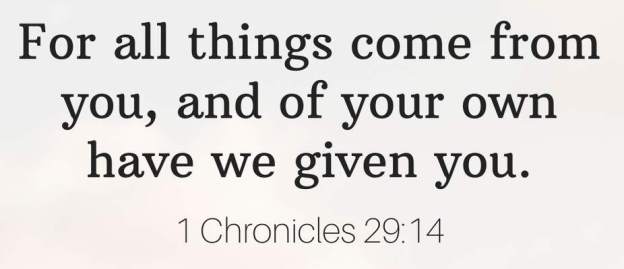
All things come from you, and of your own do we give you.

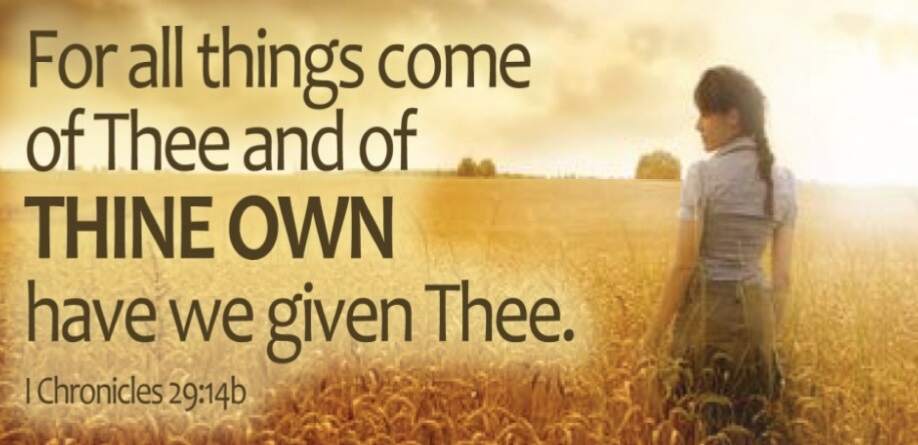
These are words taken from the Old Testament, from 1 Chronicles 29: 11-14. And I will finish this short reflection with those words: …

“Yours, LORD, is the greatness and the power and the glory and the majesty and the splendour, for everything in heaven and earth is yours. Yours, LORD, is the kingdom; you are exalted as head over all. … Everything comes from you and we have given you only what comes from your hand.” (1 Chronicles 29: 11 & 14b)

And our response to the love of God for us, has to be: … “All things come from you, and of your own do we give you.”

John 17: 20-26 – The Sunday After Ascension Day 2025

During this week the church celebrated Ascension Day. The day when Jesus returned to heaven after his death and resurrection. The Ascension begs a question:

What exactly is happening as Jesus goes into heaven?

Is this the triumphant finale, the final victory parade? When at last Jesus goes home to the Father, to be paraded through the streets of heaven in victory – much like a Roman general would be feted after a battlefield victory, or a triumphant football team parades through its home town or city.

Is the Ascension the final triumphant seal on Christ’s work on earth? Or is it the time when Jesus is welcomed into that indescribable unity which is the Trinity of the Godhead – back home at last?

Or is it a moment of desertion. The disciples have only just received Christ back among them after his death and now cruelly he is taken from them into heaven. A renewed relationship is abruptly ended!!

A commission is given and then the bombshell is dropped. “Listen!” says Jesus, “I have a job for you to do – to be my witnesses throughout the known world.” … “Great, Lord, when do we get down to business, when do we work out the strategy, when do you provide the plan of action?” … “Not us, not me!” says Jesus, “You! I’m going away and you’ll never see me again this side of heaven!”

Or is this, actually, rather than desertion, the point at which followers become leaders, children become adults? Is this primarily the point where Jesus followers can no longer hide behind a leader and have to begin to make choices themselves?

For all the participants in the Ascension story, this must have been a confusing moment. A time which carried so much emotion – parting from friends, losing a friend and leader, going home … All sorts of mixed emotions.

Ultimately this is all true. … Christ goes home in victory. A job well done. … He leaves behind a ragged group of followers who must have felt deserted. … And perhaps most crucially for the church today, Jesus is asking this ragged group to stand up for themselves. To be what he knows that they can be with the Spirit’s strength – a missionary band that will turn the known world upside down within a century.

You may well recognise this prayer of St. Teresa of Avila. … In summary:

Christ has no body now but yours.
No hands, no feet on earth but yours.
Yours are the eyes through which He looks compassion on this world.
Christ has no body now on earth but yours.

The Ascension story reminds us that we are the ones that count – between now and eternity God has left his concerns, his mission in our hands. And as a result of Ascension Day, it behoves us to commit ourselves again to serving to God – to discovering his way and walking in it, to being his hands, eyes and feet in our local communities.

Our Gospel reading reminds us that in this endeavour, we need to give the highest priority to just one thing …. Working together with a common purpose – being united.

Jesus makes one thing his priority in his final long prayer in John 17 – God’s call to his church to be ‘one’, to be united. ….. We have not done so well with this! Have we?! It is, I believe, our greatest failure.

Rather than unity being the high priority that Jesus makes it in our gospel reading. The church down the ages has always set Jesus’ prayer for unity aside in favour of other things. … Often these other things have been so very important to us. Doctrinal purity comes high up the list, perhaps the role of women in ministry, perhaps issues of human sexuality, perhaps inclusive church, perhaps ….. the list could go on. One of the most significant lessons from church history is that the Church has played fast and loose with Jesus’ call to be one.

‘Being one’ does not mean that we all agree about everything. ‘Being one’ is about recognising just one thing and one thing alone. ‘Being one’ is about recognising that we are family, God’s family. However much we wish it was not true, however much we wish we could choose our Christin sisters and brothers we must not. Our failure to be one, gives the lie to all that we claim as Christians. We cannot claim to love others if we don’t love each other, in our churches, in our communities, in the national church and in the international church.

God’s call is that we work together for a common aim. For the church that aim, that purpose, is the Good News, the Gospel of Jesus.

Just as Jesus, at his Ascension, leaves his disciples to do his work, so God gives us the freedom to choose to build hope, joy and peace in our world and in our church. Each of us, each one of us, sits in the midst of a stream of the overflowing love of God. … We have a choice, over whether we share that love with each other. And so very often we have chosen not to do so.

The national church makes this period between Ascension and Pentecost a time of prayer, it calls it a “Novena” (that just means 9 days – 9 days of prayer). Our prayer needs to be that we will be one just as Jesus desires that we be one. Nothing for God, for Jesus, has a higher priority, not getting things doctrinally correct, not our own priorities, not the state of our buildings, not even the future of our churches. One thing matters above all else to Jesus, that we are united. We are one family under God.

This is Jesus’ prayer for us. Listen again to what he prays:

(John 17:20-23) “I do not ask for these only, but also for those who will believe in me through their word, that they may all be one, just as you, Father, are in me, and I in you, that they also may be in us, so that the world may believe that you have sent me. The glory that you have given me I have given to them, that they may be one even as we are one, I in them and you in me, that they may become perfectly one, so that the world may know that you sent me and loved them even as you loved me.”

A New Commandment: John 13: 31-35 – 18th May 2025

Dolly Parton first sang, ‘Love is like a butterfly’, in the Summer of 1974:

“Love is like a butterfly, as soft and gentle as a sigh,

The multi-coloured moods of love are like its satin wings,

Love makes your heart feel strange inside, it flutters like soft wings in flight,

Love is like a butterfly, a rare and gentle thing.”

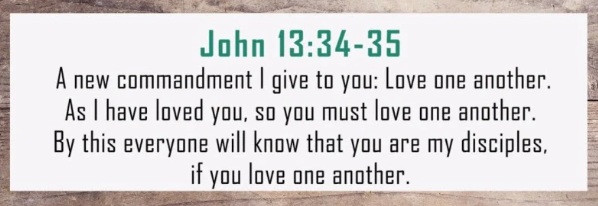
Jesus said: “I give you a new commandment, that you love one another.” His words seem to be at odds with our culture. In our society, love isn’t something you can command, love is something that you feel. Love is something that you fall into and fall out of. Love is as much about sexual attraction and desire as it is about anything else. When we say, ‘I love you’, to the love of our life – we are talking about deep feelings not about something that we feel we have much control over.

And yet Jesus says: ‘I command you to love one another’.

We know that love is so much more than sexual desire. We feel love for our parents, our children – we even feel some kind of love for the football team we support, for our friends and our work colleagues. But even in these relationships love can be so temporary or dependent on events and our emotions.

Love is just like a butterfly, made up of multicoloured moods, flitting here and there, dependent on circumstance and passion.

The love Jesus commands, the love that Jesus often talks about, is just not like that. Love, as Jesus sees it. Love modelled on the love of God, is constant and committed love, unwavering in its strength and focus, determined to be there for the one who is loved no matter what they do. Determined to love, even when it seems as though that love is rejected.

In English we have one word for love. The New Testament uses four different words for love.

Eros – for romantic and sexual love

Storge – genuine affection for someone

Philio – for brotherly love or fellowship

Agape – the love God has for us and the depth of love he calls on us to have for each other. A committed, divine, unconditional, self-sacrificing, active love, generously and freely given with no thought for the self, only for the other. It is this word ‘Agape’ that is used in our Gospel reading.

The King James bible translated ‘agape’ as ‘charity’. In today’s world ‘charity’ means something different. It has lost the emphasis on God’s self-sacrificial love for humankind. It has become something that often people do not want to receive, demeaning to their sense of honour. Or, it is the name of a kind of organisation that has some sort of good purposes. We need hold onto the word ‘love’ rather than the word ‘charity’ in today’s world if we are to begin to understand the meaning of the Greek word ‘agape

C. S. Lewis, in his book The Four Loves, uses ‘agape’ to describe what he believed was the highest level of love known to humanity – a selfless love, a love that was passionately committed to the well-being of the other. It is ‘agape’. It is this kind of love that Jesus commands us to show, not erotic love, not even brotherly or sisterly love, not affection.

In last week’s Gospel (Easter 4), Jesus talked about a love that will not let us go.

My sheep listen to my voice; I know them, and they follow me. I give them eternal life, and they shall never perish, no one can snatch them out of my hand. My Father who has given them to me, is greater than all; no one can snatch them out of my Father’s hand.”

“No one,” says Jesus, “will ever snatch you out of my hands.” It is not a sense of charity that God feels towards each of us, not a sense of charity that he feels for humankind. It is a love that give its all. No holds barred. A love that throws itself away in order to rescue those who are lost. A love that celebrates over every single person who returns to be enfolded by that love. It is that kind of love which we are commanded to show. Christ calls on us to decide to love others in the same way as God loves us.

Please, allow yourself to hear again that God loves and cares for you. And remind yourself again that God calls you not to love that is flighty or buffeted by circumstance, but to a love which is self-giving, committed and strong.

A Quiet Revival

Now, here is a thing. We have got used to the idea that church is becoming increasingly irrelevant in the modern world. We have come to believe that the Christian faith, in particular, is declining rapidly. Recent work by YouGov and the Bible Society calls these assumptions into question. Their work suggests that the opposite is in fact true!

For decades,” says Paul Williams, Chief Executive Officer of the Bible Society, “Church attendance and nominal adherence to Christianity has been declining, and it has been assumed that this decline would continue and was in some sense an inevitable product of modernity. While the decline has certainly been real, we now know that the trend has been reversed. The tide of faith, whose ‘melancholy, long-withdrawing roar’ was described by Matthew Arnold, has now turned.” [1:p4]

He goes on to say that the results of a thorough and robust study “demonstrate that over the space of only six years, there has been a significant growth in the numbers of
people going to church; Christians are practising their religion more intentionally; more young people are finding faith; more people are reading the Bible. … Large numbers of young adults, male and female, have started going to church, reading the Bible regularly, practising prayer and worshipping Jesus Christ as God. A new generation is finding hope in the Christian message and in established Christian communities. This hope is both personal and social. It appears to meet a hunger for connection, belonging and purpose but it also helps frame meaningful engagement in the world to address some of the intractable problems that we all face – injustice, inequality, climate change – and to form an alternative to the individualistic, competitive, materialistic worldview that has come to dominate western societies in recent decades
.” [1: p4]

Paul Williams goes on to say: “There will be an instinct to use these results to support
one or other of the various narratives that mark our contested cultural moment. But I urge the reader to pay attention to the detail of this study to understand what is happening. A remarkable new and life-giving phenomenon seems to be under way in Britain. The past few decades have witnessed a widespread empirical falsification of the secularisation thesis, mainly because in all parts of the world except Western Europe the world has become more, not less religious. This report suggests that even this outlier may not remain so for much longer
.”

Background

McAleer & Barward-Symmons comment:

“For many decades now, the general assumption has been that Christianity, and in particular churchgoing, in England and Wales is in a state of permanent decline. Survey data, media headlines and prominent thinkers all seemed to point in one direction, with published attendance and membership figures from major denominations appearing to confirm this. From the sociological insistence in the 1960s that secularisation was inevitable and the new atheism of the 2000s, through to the more recent findings from the 2021 census showing the perilous collapse of Christian identity and headlines from last year proclaiming we were entering Britain’s first ‘atheist age’, the story seems clear – Christianity, particularly active Christianity, is on the way out.

Yet over the past few years, a different story has been emerging from the peripheries. In the United States, young men are heading to church in remarkable numbers, [2] transforming the landscape of the Church. Recent data even shows that young adults in the UK are more spiritual and less atheistic than older generations. [3] Prominent public atheists have been questioning their beliefs, while key public figures – from intellectuals such as Jordan Peterson and Tom Holland through to popular culture
figures and athletes – have been open about their engagement with Christianity. More significantly, stories are emerging from the ground, including those collected by people such as Justin Brierley and Lamorna Ash, showing that young people in particular are exploring Christianity in a new way, suggesting that the previous assumptions may need to be shifted. But firm numbers have been hard to come by – until now.

Using nationally representative data through a prestigious polling agency, The Quiet Revival demonstrates that far from declining, the Church has grown. In particular we see that ‘Gen Z’ young adults are more likely to attend church regularly than any generation ahead of them bar the over-65s, and in particular we see that young men are attending in remarkable numbers. The Church is transforming before our eyes, and the figures presented in this report show the proof. As outlined throughout, this fact has implications both for civil society and for Christian denominations, networks and congregations. It is hard to overstate its importance both for our national self-understanding and for the Church’s understanding of itself.” [1: p12]

The Key Findings of the Report

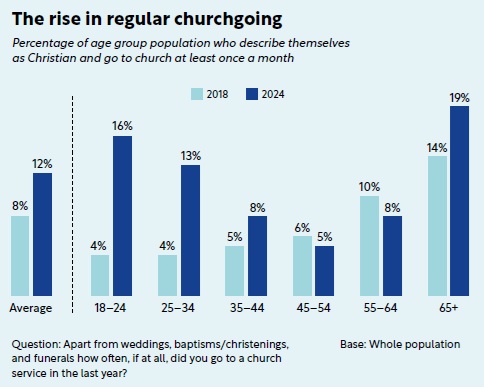
  1. Having a Christian faith is again being normalised and is arguably even culturally attractive. 12% of adults in England and Wales are attending church monthly. … “Church attendance in England and Wales is on the rise. This represents a startling change to decades-long trends and presumptions, with the most dramatic increase seen among young people, particularly young men. In 2018, just 4% of 18–24-year-olds said they attended church at least monthly. Today this has risen to 16%, with young men increasing from 4% to 21%, and young women from 3% to 12%. This is now the second most likely age group to attend church regularly. Overall, churchgoing Christians now make up 12% of the population, up from 8% in 2018. In numerical terms, that’s growth from 3.7m in 2018 to 5.8m in 2024 – an increase of 56%.” [1: p6]
  2. Young adults are finding their way into church in remarkable numbers. 32% of churchgoers aged 18–54 are from an ethnic minority. … In addition to absolute growth in churchgoing, including among the white population, the Church in England and Wales is also becoming more diverse. Just under 1 in 5 churchgoers (19%) are from an ethnic minority, but among 18–54-year-olds this rises to 1 in 3 (32%). At the same time Catholicism has risen sharply and Pentecostalism has become the third biggest Christian tradition, with the share of churchgoers identifying as Anglicans dropping steadily. [1: p6]
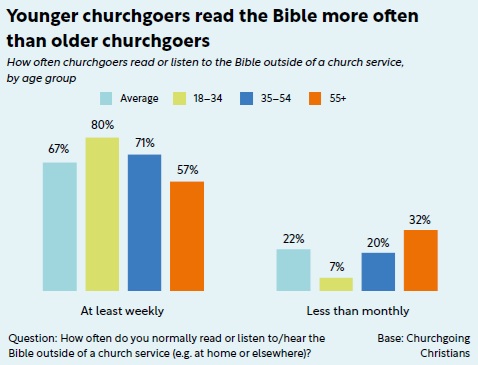
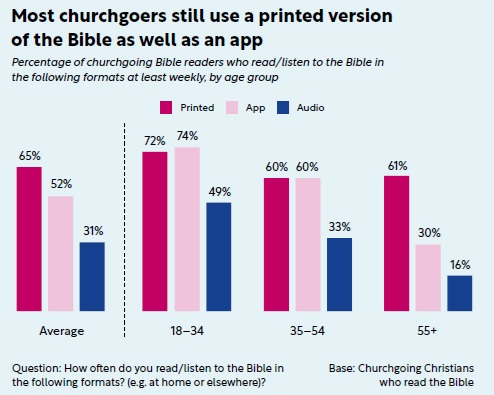
  3. This is a growing Church interested in belonging, believing and practising. 67% of churchgoing Christians read the Bible at least weekly outside of church. … Alongside this significant demographic change within churches, we see evidence of an active and vibrant Church. Rates of belief in God remain high, while both Bible reading and rates of confidence in the Bible have increased among churchgoers compared to 2018, indicating that new attenders are just as engaged in Christian belief and practice. [1: p7]
  4. The idea that Britons are to some extent Christian ‘by default’ is rapidly diminishing. 27% of adults say they are Christian but don’t regularly go to church, compared to 32% in 2018. … At the same time, those who don’t engage in practices such as churchgoing or Bible reading are less likely than ever to identify themselves as Christian. Christianity increasingly involves an active commitment rather than a passive cultural label, and there is a clear difference between churchgoing and non-churchgoing Christians. [1: p7]
  5. Our youngest group is showing above average engagement in spiritual practice. 35% of 18–24-year olds say there is ‘definitely a God/gods or higher power’. … The young people in our sample don’t just go to church more, they show above-average levels of warmth to spirituality, the Church and spiritual practice. This group of 18–24-year-olds are the most likely to pray regularly, with 40% saying they pray at least monthly. More than half of them (51%) have engaged with a spiritual practice over the past six months, compared to 42% of those older than them. They are also the group most interested in learning more about the Bible, with 37% of 18–24s saying they are curious to discover more about it. [1: p8]
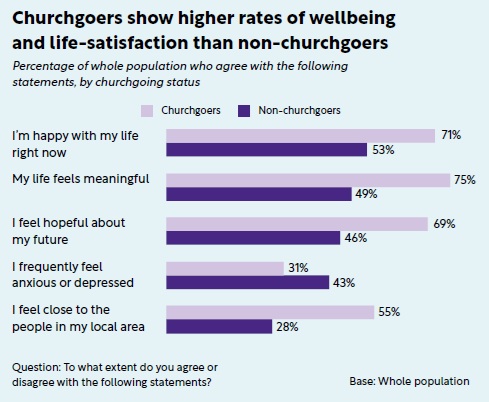
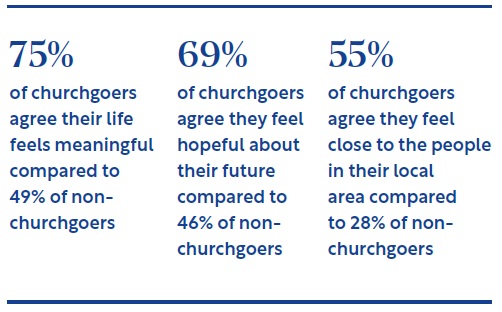
  6. Churchgoers show the lowest reports of feeling frequently anxious and depressed. 63% of 18–34-year-old churchgoers say they feel close to people in their local area, compared to 25% of non-churchgoers their age. … With much of the population, in particular young people, struggling with mental health, loneliness and a loss of meaning in life, Church appears to be offering an answer. We found that churchgoers are more likely than non-churchgoers to report higher life satisfaction and a greater feeling of connection to their community than non-churchgoers. They are also less likely to report frequently feeling anxious or depressed – particularly young women. [1: p8]
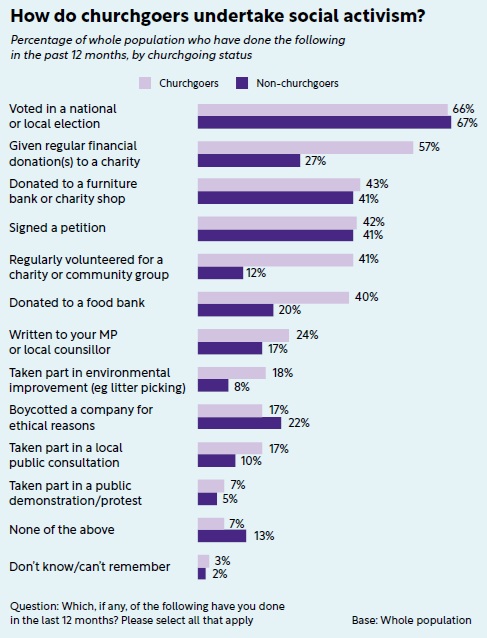
  7. Churchgoers are more likely to desire social change and to engage in social activism activities. 79% of churchgoers agree it’s important to them to try to make a difference in the world. … This is not solely about personal development, however, and we also see that churchgoers are more likely to actively participate in activities aimed at benefitting the community around them. Churchgoers are more likely to volunteer, donate to foodbanks and give to charitable causes, demonstrating the positive effect of Christian faith on their lives – and the impact that a rise in churchgoing can have on society as a whole. [1: p9]
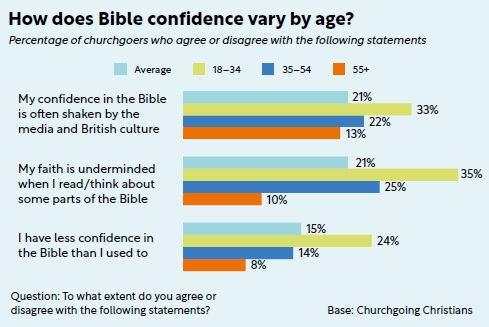
  8. Young Christians report finding the Bible more challenging than older Christians. 35% of 18–34-year-old churchgoers agree that their faith is undermined when they think/read about some parts of the Bible. … There is clear need for more discipleship around Scripture. Approximately one-third of churchgoers say they lack confidence in navigating or understanding the Bible and speaking about it with others. Among young Christians, rates of Bible reading, Bible confidence, and interest in learning more are high. However, we also see that compared to older churchgoers, they are more likely to say the media and British culture often shake their faith in the Bible and report they have less confidence in the Bible than they used to. They are also the age group to report they find learning about the Bible to be challenging. This poses a challenge to the Church but also an opportunity to tap into and learn from their energy and enthusiasm while enabling them to go deeper into Scripture. [1: p9]
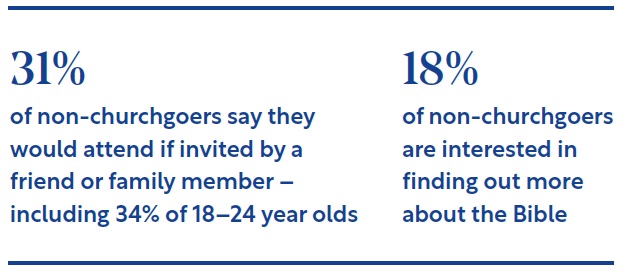
  9. We see openness even among non-churchgoers towards Christianity and the Bible. 34% of 18–24-year-old non-churchgoers would attend church if invited by a friend. … The astonishing growth in churchgoing is matched by an openness to Christianity and the Bible: 31% of non-churchgoers say they would attend church if invited by a friend or family member, rising to 34% among 18–24-year-olds. Over half of non-churchgoers (56%) would be happy for a Christian friend to pray for them, while 18% say they would be interested in learning more about the Bible. Relationships are key here: over a fifth (22%) of non-churchgoing 18–34s say they would read the Bible if recommended by a family member or friend they trust, compared to 13% who would if a trusted celebrity or public thinker recommended it. [1: p10]
  10. The tide of faith is coming in again, and the Church needs to adjust to a new and strangely hopeful reality. … We have four recommendations in response to this data. First, we urge policy-makers and opinion-formers to take more account of the existence of churchgoing Christians in society. Second, the Church should work on increasing Bible discipleship to grow Bible confidence and through this tap into the increased openness and cultural opportunity. Third, the Church should engage in intergenerational conversations within congregations and more widely, to enable churchgoers to learn from one another’s wisdom. Finally, it should recognise the importance and impact of authentic personal relationships.[1: p10]

About the Research

The report’s authors provide the following commentary on the report:

The report references two data sets commissioned by Bible Society to track attitudes to the Bible and Christianity and related religious behaviours in the adult population of England and Wales. Both surveys were conducted by YouGov on large, nationally representative samples.

The 2018 sample surveyed 19,101 adults in England and Wales, while the 2024 sample surveyed 13,146 adults. Both samples therefore give a 1% margin of error at a 99% confidence level, meaning they are highly reliable. The surveys were conducted through YouGov’s online panel to population targets, and further refined with post stratification weighting. It is worth noting that because we surveyed adults, we are not able to comment in depth on the portion of the population, or the Church, which is under 18.

All figures, unless otherwise stated, are from YouGov Plc. In 2018: total sample size was 19,101 adults. Fieldwork was undertaken between 11th October and 13th November 2018. The survey was carried out online. The figures have been weighted and are representative of all England/Wales adults (aged 18+). Ethnicity targets are based on 2011 census data.

In 2024: total sample size was 13,146 adults. Fieldwork was undertaken between 4th November and 2nd December 2024. The survey was carried out online. The figures have been weighted and are representative of all England/Wales adults (aged 18+). Ethnicity targets are based on 2021 census data. Throughout the report, we refer to ‘churchgoers’. By this we mean people who both describe themselves as Christian and go to church at least once a month – around 30% of all those who identify as Christian.
At times we also mention trends seen among other faiths. As the primary focus of this report is on exploring Christians (both practising and nonchurchgoers) and those with no religion, we have not explored non-Christian faiths by religion; rather, they are grouped together. There are obvious limits to this approach, and therefore all our observations on non-Christian faiths could be nuanced further in future studies.

Due to GDPR sensitivities, questions pertaining to religious practice like church attendance and Bible reading were optional. On these questions a small percentage of the sample refused to answer – circa 3%. This is in line with the standard dropout rate. Where we make population claims, such as the number of adults who say they go to church regularly, we have recoded refusals as ‘prefer not to say’ to keep the full base in the sample. However, as we do not know the churchgoing status of these participants, when we compare churchgoers to non-churchgoers in Chapters 2–4, participants who did not answer have been removed from analysis, rather than categorised as non-churchgoers. Including or removing them has little or no effect on the overall figures.

We know the results of this report will be surprising to some and will naturally raise further questions about the methodology behind it. To help answer some of these we’ve included an FAQ section at the end of the report.” [1: p11] That FAQ section appears below.

FAQs

Is this just down to immigration? – In short, no. The Church in England and Wales in undeniably changing shape and becoming more diverse, just as Britain as a whole is becoming more diverse. However, the growth in churchgoing among young people is seen at scale among young White people. While these could all be migrants, at the scale we’re seeing it seems highly unlikely.

It is worth noting that in between the surveys new census data was made available, which means the sampling targets were changed between the waves to ensure the sample reflects the most up-to-date view of what England and Wales looks like. This has primarily impacted how many people of Black, Asian, and other Minority Ethnicities are in the sample. As people in these ethnic groups are more likely to be Christian, this has naturally had an effect on the shape of the data, particularly when it comes to averages, and some of the trends we observe reflect this. This is not problematic, and indeed, gives us a better picture of the Church today, but we have exercised caution in drawing comparisons between the 2018 and 2024 waves when it comes to ethnicity trends outside of the white population.

Is the methodology sound? – Yes, both surveys we draw from are based on large, representative samples from one of the country’s leading research companies. Both sample sizes give a 1% margin of error at a 99% confidence level, meaning they are highly reliable. While minor changes were made to the questionnaire between the 2018 and 2024 waves, all questions used for comparison have remained the same, and the surveys were conducted under the same conditions at the same time of year. For more information see https://yougov.co.uk/about/panel-methodology

Could there be something about the sample? – In polling research we are always reliant on trusting that what participants say is a true reflection of what they think and how they act. While it is possible participants may not be answering truthfully, or have misunderstood our questions, we would need to question in turn why these effects have only become observed in 2024, and not previous survey waves. All research panels have bias, and non-probability sampling is always at risk of producing a non-representative sample. It is also theoretically possible the sample has polled a disproportionate number of young Christians. At this sample size, and the way the YouGov panel is built and maintained, this is again highly unlikely.

If you are interested in reading the report, please click on the link below and you’ll be taken to a page where you can download the report and a PowerPoint presentation. 

Download The Quiet Revival

If you have any problems please do not hesitate to contact the Bible Society on 01793 418222 or by emailing them on contactus@biblesociety.org.uk

References

  1. R. McAleer & R. Barward-Symmons; The Quiet Revival; The Bible Society, Swindon, 2025.
  2. ‘In a First Among Christians, Young Men Are More Religious Than Young Women’, Ruth Graham: https://www.nytimes.com/2024/09/23/us/young-men-religion-gen-z.html
  3. ‘Gen Z half as likely as their parents to identify as atheists’, Kaya Burgess in The Times: https://www.thetimes.com/uk/religion/article/gen-z-half-as-likely-as-their-parents-to-identify-as-atheists-wp2vl0l29

The Fox and the Hen – Luke 13: 31-35

(The 2nd Sunday of Lent)

Images of animals are common in fables and fairy stories. They’re not so common in the New Testament. Sheep and Shepherd’s appear now and then, but in today’s Gospel we have two in the space of a few short verses. Two very contrasting images – Herod the fox and Jesus, the mother hen.

Fox and hen are ancient foes, as many a tale tells us.

They often start like this…. “Once upon a time there was a little Red Hen, who lived on a farm all by herself. An old Fox, crafty and sly, had a den in the rocks, on a hill near her house. …” – You may have told tha kind of story to your own children – certainly many parents have.

Are you familiar with the story? If not, there is a version of it at the end of this article…

Fox and hen – cunning evil fox, gentle little clever hen. That’s the pattern. It must ever have been so! For Luke cleverly juxtaposes the two images. Herod, the fox, the creature who eats chicken for supper. Jesus, the mother hen, who desperately loves her silly chicks and does everything she can to protect them.

First the fox: this Herod is not the same Herod who massacred the innocents. This Herod is his son. This Herod only makes a few short appearances in Luke’s gospel, yet he has a pivotal place in it. Luke’s purpose in writing his Gospel is to answer just one question. And it is Herod the fox who asks the question in Luke Chapter 9 – “Who is this man about whom I hear such things?” And, says Luke, … Herod tried to see Jesus.

Luke the evangelist reminds us of the aim and purpose of evangelism -to invite just that question and to encourage that quest.

And Herod is still wondering who Jesus is when towards the end of the Gospel of Luke, Jesus is brought before him at his trial.

We used to give our ancient Kings interesting and descriptive names Edward the Confessor, Ethelred the Unready. This Herod could be given a similar name. Herod the ambivalent, or Herod the undecided. For although he wanted to know more about Jesus he was never ready to act one way or the other. And in Luke 23, he sends Jesus back to Pilate for a final life or death decision.

Luke compares Herod, the cunning fox who stayed in power by careful political manoeuvring, with Jesus. Herod used Jerusalem as his power base, Jesus wept over Jerusalem. Jesus says that he longs for Jerusalem as a mother hen gathers her chicks under her wings in times of trouble.

This is not an image that we focus on so often…. Christ as lamb of God, or as the lion of Judah, resonate with our faith. Jesus the mother hen seems faintly ridiculous – why is that?

We know that God is neither masculine nor feminine – but God cannot be called “it” for the Bible reminds us time and again that God has a personality. Most often male imagery is used to speak about God, but by no means every time. … In our short Gospel reading, God is compared to a mother hen and the feminine image is important. God broods over Jerusalem with a depth of self-sacrificial love. He longs for their safety and eternal security and will do anything to give life to his children.

Perhaps this image of God, of Jesus, as the mother hen seems ridiculous because hens are seemingly brainless, clucking birds They are angular funny birds. It does seem … just ridiculous to compare God to a hen! But perhaps that is the point after all. For the hen destined for the pot is no more or no less helpless than the lamb led to slaughter.

The prophet Isaiah reminds us that the “man of sorrows” had no form or comeliness that we should admire him. Isaiah suggested that if we had seen him suffering we would have hid our faces in embarrassment – “we hid as it were our faces from him.”

Yes, hens are silly little things. But there is a story told of a fast moving grass fire and of a hen caught out in the open with her chicks. As the flames approached the hen could see that she and her brood would never out run the danger and so she gathered her chicks under her wings and settles down as tight to the ground as she can. The flames rapidly passed over the place where she sat and moved on across the grassland. As the ground cooled around her roasted body there was movement under her wings and the young chicks pushed their way out into the open and began to forage for scraps in the scarred landscape.

Luke compares Jesus, the mother hen who would die to protect her chicks, with the political authority of the day, Herod, the Fox, who held onto power by ruthless cunning.

We worship a God who describes himself to us in the person of Jesus, who broods over us, longing for good for us, longing for our security and peace. In our prayers, and as we say the creed together we express our confident trust in that ‘mother-hen’ kind of love that God has for us.

_____________________________________________

The Fox and the Little Red Hen

Once upon a time there was a little Red Hen, who lived on a farm all by herself. An old Fox, crafty and sly, had a den in the rocks, on a hill near her house. Many and many a night this old Fox used to lie awake and think to himself how good that little Red Hen would taste if he could once get her in his big kettle and boil her for dinner. But he couldn’t catch the little Red Hen, because she was too wise for him. Every time she went out to market she locked the door of the house behind her, and as soon as she came in again she locked the door behind her and put the key in her apron pocket, where she kept her scissors and a sugar cookie.

Once upon a time there was a little Red Hen, who lived on a farm all by herself. An old Fox, crafty and sly, had a den in the rocks, on a hill near her house. Many and many a night this old Fox used to lie awake and think to himself how good that little Red Hen would taste if he could once get her in his big kettle and boil her for dinner. But he couldn’t catch the little Red Hen, because she was too wise for him. Every time she went out to market she locked the door of the house behind her, and as soon as she came in again she locked the door behind her and put the key in her apron pocket, where she kept her scissors and a sugar cookie.

At last the old Fox thought up a way to catch the little Red Hen. Early in the morning he said to his old mother, “Have the kettle boiling when I come home tonight, for I’ll be bringing the little Red Hen for supper.” Then he took a big bag and slung it over his shoulder, and walked till he came to the little Red Hen’s house. The little Red Hen was just coming out of her door to pick up a few sticks for kindling wood. So the old Fox hid behind the wood-pile, and as soon as she bent down to get a stick, into the house he slipped, and scurried behind the door. In a minute the little Red Hen came quickly in, and shut the door and locked it. “I’m glad I’m safely in,” she said.

Just as she said it, she turned round, and there stood the ugly old Fox, with his big bag over his shoulder. Whiff! how scared the little Red Hen was! She dropped her apronful of sticks, and flew up to the big beam across the ceiling. There she perched, and she said to the old Fox, down below, “You may as well go home, for you can’t get me.”

“Can’t I, though!” said the Fox. And what do you think he did? He stood on the floor underneath the little Red Hen and twirled round in a circle after his own tail. And as he spun, and spun, and spun, faster, and faster, and faster, the poor little Red Hen got so dizzy watching him that she couldn’t hold on to the perch. She dropped off, and the old Fox picked her up and put her in his bag, slung the bag over his shoulder, and started for home, where the kettle was boiling.

He had a very long way to go, up hill, and the little Red Hen was still so dizzy that she didn’t know where she was. But when the dizziness began to go off, she whisked her little scissors out of her apron pocket, and snip! she cut a little hole in the bag; then she poked her head out and saw where she was, and as soon as they came to a good spot she cut the hole bigger and jumped out herself. There was a great big stone lying there, and the little Red Hen picked it up and put it in the bag as quick as a wink.

Then she ran as fast as she could till she came to her own little farm-house, and she went in and locked the door with the big key. The old Fox went on carrying the stone and never knew the difference. My, but it bumped him well! He was pretty tired when he got home. But he was so pleased to think of the supper he was going to have that he did not mind that at all. As soon as his mother opened the door he said, “Is the kettle boiling?”

“Yes,” said his mother; “have you got the little Red Hen?”

“I have,” said the old Fox. “When I open the bag you hold the cover off the kettle and I’ll shake the bag so that the Hen will fall in, and then you pop the cover on, before she can jump out.”

“All right,” said his mean old mother; and she stood close by the boiling kettle, ready to put the cover on.

The Fox lifted the big, heavy bag up till it was over the open kettle, and gave it a shake. Splash! thump! splash! In went the stone and out came the boiling water, all over the old Fox and the old Fox’s mother! And they were scalded to death. But the little Red Hen lived happily ever after, in her own little farmhouse.

Temptation (Luke 4:1-13)

I want to invite you to think back with me, first, to the years 2000 and 2005. Two significant events occurred in the life of two different sports people which hit the headlines.

25 years ago in April 2000, South Africans were stunned by allegations that Hansie Cronje, captain of the national cricket team, had taken bribes to fix matches. The very idea that this national hero and role model would contemplate doing something dishonest and corrupt seemed incomprehensible.

When some allegations were confirmed there was a real sense of national mourning. People asked: ‘If someone like Hansie Cronje can do this what hope is there for the rest of us?’ [1]

Cronje’s response on TV, when allegations were confirmed, was to blame the devil for making him accept bribes to fix results.

South Africans saw this as an attempt by Cronje to evade responsibility for his actions. And they were right.

To say, ‘The devil made me do it,’ is to attempt to avoid facing our own internal demons. We are responsible for our own actions … even if we feel that there might be mitigating circumstances.

Around 4 years later, in the winter of 2004/5, Ellen MacArthur came to prominence as one of our most outstanding sports-people. It surprised me, as I was thinking about this article, that it was as long ago as March 2005 that the TV programme about her was shown. Do you remember it? … It was the story of her amazing journey round the Antarctic as part of the Vendée Globe Race. [2]

It was filmed by her using just a few cameras on her yacht. I can still vividly remember my sense of disbelief at the stamina and commitment she showed, the difficulties that she faced and the obstacles that she overcame. You may well not remember the TV programme. … I was bowled over. I saw the speed of the yacht, the height of the waves. I saw her, in one sequence,  hanging by one arm from the mast, 60 ft about the deck in the middle of a storm, trying to mend wind-measuring equipment. The camera showed just how much the yacht was rolling from side to side and at the top of the mast Ellen was alternatively far out over the swell on the port side of the yacht before being thrown across to the starboard side and again far out over the mountainous waves.

At one point in the programme, talking about her early life, Ellen said that she had a dream which she didn’t believe would ever become a reality. Yet, she said, with persistence she had realised that dream. For Ellen, the chance to pit herself against the ultimate sailing challenge was the dream.

Fulfilling the dream required wholehearted commitment to see it through, remaining true to herself and to the values she had embraced.

Martin Luther King Jr. is famous for his sermon on the 28th August 1963 from the steps of the Lincoln memorial in Washington DC. “I have a dream,” he said, “that my four little children will one day live in a nation where they will not be judged by the color of their skin but by the content of their character.” [3]

Just under 5 years later on 4th April 1968 he was assassinated in Memphis, Tennessee.  Martin Luther King Jr. had a dream that became the focus of his whole life, and he was martyred for that dream.

Successful people the world-over will tell you that pursuing a dream, to be the best, requires commitment, application and stamina. They will tell you of the sheer slog of hard work involved, the guts and determination that it takes to be the best. And they will tell you too that the feeling which comes after success, like the joy of holding that gold medal, the status that they achieve – makes all the hard work worthwhile. Their dream, their mission achieved, they have every right to feel proud.

On the first Sunday in Lent, we remember that Jesus was tempted. In the Gospel stories, he is engaged in the sternest of tests of his commitment to his mission. The account in Mark is short. In Matthew and Luke we get a much fuller account of the battle he fought. Satan tries, and fails, to turn Jesus away from God’s plan. Satan offers Jesus the easy way out. Both Matthew and Luke talk of three different temptations.

Actually, it is effectively the same temptation in three different forms. … The temptation to set aside God’s plan for his life – to put the dream on hold. This was a temptation which Hansie Cronje could not handle, … it was a temptation that Ellen MacArthur faced and overcame.

Jesus is first tempted to put himself first – to change stones into bread. Then he is tempted to grasp power for himself rather than bring in God’s kingdom. And Satan also tempts Jesus to look for the easy route to draw people to himself, to seek fame rather than suffering and death. To look for the instant, short-term solution, rather than face real and necessary struggles ahead. All of these are temptations to destroy the dream, his mission. Temptations to turn aside from God’s plan.

In each case, it’s God’s plan that Jesus chooses to follow  – a path of self-denial that will lead through the cross to eventual resurrection. God’s plan, God’s dream, is the defeat of the power of death and evil. Unlike Hansie Cronje, Jesus remains committed to the dream, no matter the cost. Much as Ellen MacArthur did, much at Martin Luther King Jr and many Christian martyrs did, Jesus remains focussed on the dream, on God’s dream, God’s plan.

So what is God’s dream? … What are we called to commit to wholeheartedly? … Perhaps the simplest expression of that dream is God’s desire to see the growth of the Kingdom of God on earth. Only you can answer the question about what part in God’s dream, God’s plan for the coming of God’s kingdom is for you. You might, though, have other people’s help in identifying your part in the plan in the coming of the Kingdom. But ultimately remaining true to God’s plan for you and refusing to be drawn away into other things, is what overcoming temptation is all about.

Here, though, are four clear challenges from Luke’s story of the temptations of Jesus. …………..

Priorities: Jesus was tempted to place physical need above spiritual, to live without trusting God, …… to turn stones into bread. ….… We so easily base our security in our jobs, our homes and families, and our money rather than in God. … We need to begin again to experience God’s provision for us, rather than just living off our own resources. … So, here’s a first challenge – to be prepared to make sacrifices in our lifestyle, to make serving God our priority. …. Perhaps as a sign of our commitment to God’s Kingdom this Lent, rather than giving up chocolate we could do something different? … Something positive? …

One option for families might be to use “Count Your Blessings,” a Lent initiative by Action for Children and Christian Aid [2] that encourages people to be grateful for what they have. Their websites have details. Or perhaps we could join with the Stewardship organisation in its 40 Acts of Kindness 2025, ‘Do Lent Generously’ [3] – a movement of thousands of people on a mission to impact their communities by creating moments of radical generosity.

Prayer and Worship: In being tempted to turn stones into bread, Jesus was tempted to turn away from his relationship with God and to become self-reliant. …. How can we together, begin to show our reliance on God? …. By praying and worshipping, together and alone, by expressing together, our need of God’s help. God can & does provide the resources we need to follow the dream. We need both to rely on God, & to be seen to do so. This is a challenge to spend more of ourselves in worship and prayer.

Persistence: In Satan’s encouragement to throw himself off the temple, Jesus was tempted to look for the instant, the short-term solution. To wow people into the kingdom, to impress with magic and illusion. … We can so easily fall into the trap of looking for the stop-gap solution, the one that will only require a little effort now, not a long-term commitment. The easy option. … God’s call is to persistence, to commitment, to seeing things through. This is exemplified in the bible’s word which we translate ‘faith’ – the Greek ‘pisteo’ and is derivatives is a word that means ‘faithfulness’ – it is a word about consistently being true to what we believe, no matter what happens. If we are not careful we read it as being something about screwing ourselves up to believe just a bit more. So we say to ourselves, ‘Strong faith now can move mountains’ when the perspective of the original Greek is that ‘ongoing faithful commitment will move mountains.’ Faithful persistent commitment to God’s call even when it is hard.

Place God’s kingdom above personal advancement: Satan tempted Jesus to worship him. To gain a position of power and influence. God wanted Jesus to walk the way of the cross. … It is so easy, isn’t it to want others to see our commitment, our diligence. To want others to praise us. To want to take the lead. Whereas God, in the example of Jesus, is calling us to a path of humility and possibly even suffering, and if we are to be leaders, then it will be a great cost to ourselves. …..

Ellen MacArthur had a dream – she gave it her wholehearted, persistent commitment, she risked everything to achieve it.  Martin Luther King Jr. was faithful; to God’s call, working for racial justice in America. His commitment to God’s call led to his death. Jesus remained faithful in the midst of temptation. That faithful commitment, even unto death on a Cross, brought about salvation for us and for our world.

Hansie Cronje gave in to the temptations around him. The contrast could not be more sharp. …

We need a dream, God’s dream. We need to listen for his word, watch out for what God is doing and make that our dream. And if we really commit ourselves to that dream, we will grow closer to God, and the dream, through God’s power and strength, can become a reality.

References

  1. https://www.indiatoday.in/sports/cricket/story/2000-ind-vs-sa-series-court-says-some-matches-fixed-attempts-made-to-fix-others-2566577-2024-07-14, accessed on 4th March 2025.
  2. Ellen MacArthur: Sailing through Hell; BBC TV; via https://genome.ch.bbc.co.uk/b58e550e1e4540af9433fde579834d47, accessed on 4th March 2025.
  3. https://www.npr.org/2010/01/18/122701268/i-have-a-dream-speech-in-its-entirety, accessed on 5th March 2025.
  4. https://www.christianaid.org.uk/sites/default/files/2022-07/count-your-blessings.pdf, accessed on 5th March 2025.
  5. https://www.stewardship.org.uk/40acts, accessed on 5th March 2025.

What You See is Not What You Are Going to Get! (Luke 5:1-11)

What do the images below have in common?

What do a tadpole, a caterpillar, eggs and a hyacinth bulb have in common? …..

Ultimately – something like, … What you can see now is not what you are going to get. … A tadpole will become a frog, toad or perhaps a newt. An egg will become a bird or a reptile. These eggs if they had been incubated would have become chickens.

A caterpillar might become either a butterfly or a moth, and a hyacinth bulb will become a beautiful flower.

And our final image – a book cover for the story of the Ugly Duckling, a young chick ostracised for being different but who becomes a beautiful swan.

What you see is not what you are going to get!

How do these things change? Either by metamorphosis or by growth they become what they were always meant to be. In each case, the change does not just occur by magic. The potential is already there inside of them.

In Luke 5: 1-11, Simon Peter was someone with a great deal of potential.

From our Gospel reading, we know that Simon Peter was a Fisherman. Other stories in the Bible help us to get to know Simon Peter a little better. As we read the Gospel and later stories in the Acts of the Apostles we get to know Simon Peter relatively well. He was a typical country fisherman. He lived a hard life, with a hand-to-mouth existence. He was hot-tempered and impetuous, he often made mistakes. You might say that ‘he wore his heart on his sleeve’, and you might describe him as a ‘rough diamond’. He was not one to suffer fools gladly. He spoke his mind even when doing so got him a rebuke.

He challenged Jesus when Jesus talked about his death. ‘Lord, you cannot be serious, nothing like that will happen to you.’ And Jesus rebukes him; ‘Get behind me Satan.’

We know that, at least once, Simon Peter allowed circumstances to overwhelm him to the point where he denied Jesus three times.

But that is not all that we know about Simon Peter. … We know that he met Jesus and that something in this person Jesus changes Simon Peter for ever. … It didn’t all happen in an instant, but it started to happen in the Gospel story that we read today. It began to happen as Simon Peter listened to Jesus speak while sitting in his boat, it began to happen when he saw one of Jesus miracles.

Both Jesus’ words and what Jesus did pointed to him being someone very special. In the presence of this special person, Simon Peter couldn’t ignore his own weaknesses and failings. Simon Peter felt small and useless and wanted these feelings to go away. So he kneels in front of Jesus and asks Jesus to go away: ‘Jesus, depart from me because I am a sinful man’.

But Jesus does not do what Simon Peter asks. Jesus takes Simon Peter by the hand and lifts him up off his knees, and he says, ‘Simon Peter, I have a job for you.’ … I can see the potential in you, I can see who you will become. Peter I want you to be my fisherman now – only you’ll be catching not fish but women and men to be my followers.

And we know how the story ends – this Ugly Duckling of a man becomes a Swan – he becomes one of Jesus most faithful followers and eventually becomes the leader of the church.

Simon Peter’s story speaks to our hearts. … Many of us can find something of ourselves in him. … We make mistakes, we ‘put our foot in it’, we can be impetuous we hold negative feelings in our hearts and occasionally they surface to damage our friendships and relationships. We too can find ourselves failing to stand up for what is right or to stand up for our friends. We, like Simon Peter, are only human.

But you know, the same potential for change that Jesus saw in Simon Peter, is there in each of us. Jesus can and does take me, he can take you, and he can transform us. We no longer need to feel that we are no good – just like Simon Peter we can admit to God our weakness and our failings and then God takes us as we are, lifts us up off our knees, and makes something special. We become a better version of ourselves and our God given potential can be fulfilled.

We no longer need to feel like the Ugly Ducking or the Caterpillar, for God in Jesus sees the Swan and the Butterfly that we really are – and as we give ourselves to God – he draws out all the good that is in us.