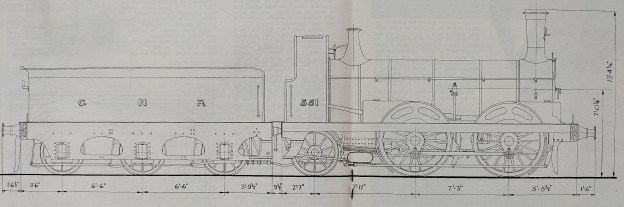
The Great Northern Railway recognised the value of ‘mixed traffic’ locomotives in the 19th century. Lindsay says that seventy five locos of this class were built. One source says that a total of 117 Class 18 locos were built. [4] The Great Northern Railway Society says that 153 were built. [5] The different sources seem to agree that fifty of the class were out-sourced from locomotive builders, the remainder were built in-house at the Great Northern’s Doncaster works. [1]

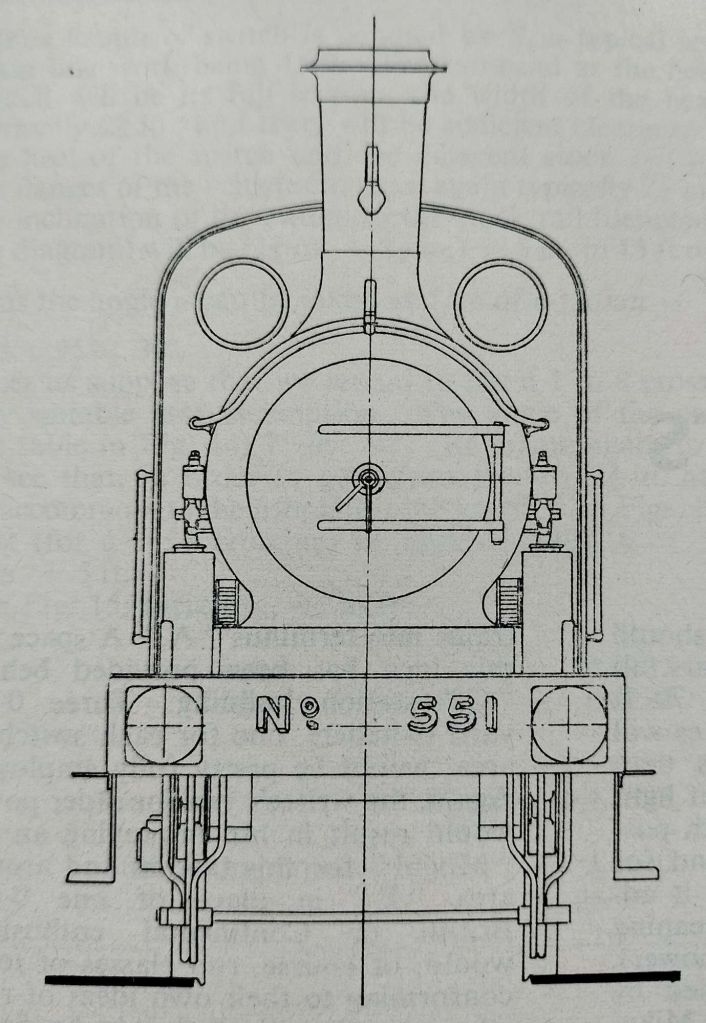

The specification sent to outside loco constructors differed in at least one respect from that used in-house – the total heating surface of the outside builders locomotives was 543 sq. ft rather than 537.5 sq ft. [1]
Delivery of locomotives from outside firms was in the following order:
1875 – Nos. 551-556 from Sharp, Stewart & Co. (Works Nos. 2564-2569)
1876 – Nos. 557-580 from Sharp, Stewart & Co. (Works Nos. 2570-2575, 2585-2594, 2646-2653))
1876 – Nos. 581-600 from Kitson & Co. (Works Nos. 2059-2078)
It should be noted, however, that there was no direct correlation between the sequence of Works Nos. and the locomotive fleet numbers. “For instance, engine Nos. 563 and 564 bear makers’ Nos. 2586 and 2585 respectively.” [1]
Messrs Sharp, Stewart & Co. locomotives were recorded as being 31 tons 13 cwt in weight. [1]
The Great Northern Railway (GNR) “was … By incorporated in 1846 with the object of building a line from London to York. It quickly saw that seizing control of territory was key to development, and it acquired, or took leases of, many local railways, whether actually built or not. In so doing, it overextended itself financially.” [2]
“Nevertheless, it succeeded in reaching into the coalfields of Nottinghamshire, Derbyshire and Yorkshire, as well as establishing dominance in Lincolnshire and north London. Bringing coal south to London was dominant, but general agricultural business, and short- and long-distance passenger traffic, were important activities too. Its fast passenger express trains captured the public imagination, and its Chief Mechanical Engineer Nigel Gresley became a celebrity.” [2]
There was a significant amount of cross-country good traffic which saw these locomotives being well-used. I believe that they were designated ‘Class 18’ within the GNR’s fleet. They were “the first type of loco to actually be built at Doncaster, rather than by outside contractors … they were used on goods trains and certain secondary passenger trains,” [3] and at times were referred to as ‘luggage engines’, because they were used to bring a second train carrying larger trunks and other passenger luggage in the day when carriages carried regular luggage on their roofs.[3].
References
- T.A.Lindsay; Great Northern Railway Engine No. 551; in Model Railway News Volume 40 No. 748, October 1964, p532-533. (Non-commercial use of drawings authorised.)
- https://en.m.wikipedia.org/wiki/Great_Northern_Railway_(Great_Britain), accessed on 29th March 2024.
- https://www.lner.info/forums/viewtopic.php?p=137505&sid=2418e9a33ffd0ca31a29be36138a3084#p137505, accessed on 29th March 2024.
- https://en.m.wikipedia.org/wiki/Locomotives_of_the_Great_Northern_Railway_(Great_Britain), accessed on 29th March 2024.
- https://www.gnrsociety.com/locomotive-class/18-series, accessed on 29th March 2024.
 Roger Farnworth