Tag Archives: Gospel of Luke

The Sermon on the Plain (Luke 6: 20-31)

Luke 6: 20-31 is known as “The Sermon on the Plain” and is parallel to Matthew Chapters 5 to 7, which are known as “The Sermon on the Mount”. It is known as ‘The Sermon on the Plain’ because Luke writes in Luke 6:17 “Jesus came down with them and stood on a level place”. …

There are four blessings in this passage, rather than the eight blessings in Matthew’s Gospel, and ‘woes’ follow quickly and starkly after the blessings. Whereas in Matthew’s Gospel the ‘woes’ are much more gently couched and hidden in the longer text.


Luke’s account of Jesus’ words is much more direct, more immediate, more pressing, and does not, obviously, carry a spiritual meaning. Here in Luke’s Gospel Jesus says, ‘Blessed are you poor, for yours is the kingdom of God’. In Matthew he says, ‘Blessed are the poor in spirit, for theirs is the kingdom of heaven’. … We need to hear and heed both of these versions of Jesus’ sermon if we are not to misinterpret what he says. …

Recognising our spiritual poverty (as in Matthew’s Gospel) is important if we are to hear the gentle word of God’s love spoken to us in the bible. Spiritual poverty is the opposite of arrogantly assuming that we know God’s will and purposes, it encourages an enquiring mind, seeking out what God’s Holy Spirit is doing in our lives. It accepts that we will always have something to learn. It might even mean that we really do try to see things from the perspective of those with whom we disagree.

But what might it mean to say that the poor are blessed? …

Jesus uses the present tense. … The poor already have the Kingdom of Heaven. … They are blessed now. … This is hard to accept. It seems uncaring. How can those who have next to nothing be blessed? …… Perhaps Jesus means that for those who are poor there is nothing to distract them from their need for the love of God. Whereas for those of us who have resources and money, who are wealthier than so many, we can be distracted by our wealth. Rather than relying on God for our daily needs, our daily bread, we rely on own resources. Perhaps we are in danger of missing God’s blessing.

This seems to be borne out in human experience. It is when we are aware of our deepest needs that we are most prone to pray. … Even those of us who profess no faith in God.

In Luke’s Gospel, Jesus goes on to say: ‘Blessed are you who hunger now, for you will be satisfied. Blessed are you who weep now, for you will laugh.”

The parallel lines in Matthew’s Gospel say: ‘Blessed are those who hunger and thirst for righteousness, for they will be filled’, and ‘Blessed are those who mourn, for they will be comforted’.

Jesus, in Matthew’s Gospel, seems to be more concerned about some kind of spiritual intensity. … Jesus’ statements, in Luke, are more pithy and seemingly more concerned about physical things. It is those who do not have enough to eat now who will be satisfied; those who weep now will laugh. It is people’s immediate; substantive needs that Luke’s words focus on.

In each of these two cases in Luke’s Gospel, one part of the sentence is in the present and the other in the future. Jesus, in Luke, seems to be saying, ‘I know you are hungry, I know you weep and your tears exhaust you. But what you suffer now does not need to define you’.

The truth is that as Christians, we are defined by God’s perspective, God’s idea of who we are. We are defined by God’s love. We are defined by the Kingdom of Heaven. There is a place beyond our current situations when hunger will be satisfied, and tears will no longer fall. … While we are building the Kingdom of God on earth we can experience pain, suffering and persecution, but something is certain: the Kingdom will be attained, and you will have your fill and you will laugh! …

I don’t think this is meant to be just about a heavenly future, a hope of heaven; although it is certainly that. But it is more. It is about the land of the living, it is about living as people who have hope, who trust that the whole of their future is in God’s hands, who persevere because they believe, along with the psalmist who says (in Psalm 27:13): “I believe I will see the goodness of the Lord in the land of the living.” And along with Isaiah (in Isaiah 40: 31): “Those who wait on the lord will renew their strength, they shall mount up with wings like eagles, they shall run and not be weary, they shall walk and not faint.” With our future secure in God’s hands, we are free to love and to live with courage today.

Jesus’ first three blessings encourage us to live as those who are not distracted by all the things we have; to live as those who believe that the future is in God’s hands.

Jesus’ fourth blessing seems utterly absurd. How can those who experience hatred and abuse be blessed. How can those who are persecuted be blessed? Jesus seems to answer that question by explaining that when we experience difficulty for our faith we are identifying with the Old Testament prophets. We are identifying with myriad faithful saints of God.

We know that Jesus’ words spoke directly to the early church and were heard, not as absurd, but as an encouragement to see beyond their current circumstances – suffering and persecution were not the ultimate reality, but rather a sign of new life and hope.

I cannot imagine the things those who are persecuted face. I do know that it is not just Christians across the world who experience times of deep darkness, or hatred from neighbours and acquaintances. We repeatedly see them on our television screens. In Gaza, in Ukraine, in the Democratic Republic of Congo, in Sudan and South Sudan. So often it is the weak and vulnerable who suffer most. There is little that I can do for them but pray and give.

To the question, ‘Where is God when the innocent die, or face persecution?’ The answer available to us, the only answer I can offer, seemingly the only one God offers us, is a story of God becoming human, living first as a refugee, then as an itinerant preacher, before dying in acute suffering, treated as a common criminal, on a cross.

The God we believe in has identified with human suffering, has felt the pain of rejection, has been persecuted. … This God points to the cross and says time and again, “I love you, this is my answer to your questions. This is how much I care. ”

The Godhead, Father, Son and Holy Spirit torn apart as Jesus cries out, “My God, My God, why have you forsaken me?”

It is as if God says to us, “This is where you will find the answers to all the questions you ask – in sitting at the foot of the cross and pondering on the depth of love that it demonstrates.”

As Paul says in our reading from Ephesians: “I pray that the God of our Lord Jesus Christ, the Father of glory, may give you a spirit of wisdom and revelation as you come to know him, so that, with the eyes of your heart enlightened, you may know what is the hope to which he has called you, what are the riches of his glorious inheritance among the saints.”

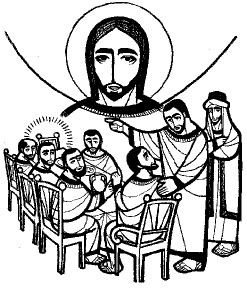
This God, who loves us so much, welcomes us at his table to share in bread and wine. This God, calls on all his saints, you and me too, to live in the light of that loving welcome and acceptance. To live as those who are not distracted by all the things we have; to live as those who believe that the future is in God’s hands; and to love others with an all-inclusive, death-accepting love that knows no limit.

Prayer
God our Father, you redeem us and make us all your children in Christ. You extend a loving welcome to all. Look with favour upon us, give us true freedom and bring us to the inheritance you promise. We ask this through our Lord Jesus Christ, Your Son our Lord. Amen.

The Persistent Widow – Luke 18: 1-8

Have you ever made a commitment to doing something and then found it really hard? Perhaps a friend has asked you for a favour and you’ve agreed before finding out what they want, and what seemed like a simple job turns into a nightmare. Or perhaps you have started to decorate the lounge only to realise that the plaster is really damp and you need a new damp-proof membrane. If we are not going to just put our heads in our hands and give up, these circumstances call for perseverance.

What other kinds of things have you had to face? Where have you had to persevere against the odds? … Perhaps it is a visit to the hospital, and as you sit waiting for your appointment, or in the casualty department, you begin to realise just how dependent you are on others, how out of control life feels. Or the trip to the benefit office, where you are asked all sorts of intrusive questions and you feel like walking out, but you know that you have to stick it if you’re going to get the cash you so desperately need. Or perhaps you are struggling with the cost of feed and seed rising and the value of grants and the income from produce depleting.

Our Gospel reading this morning talks of a woman facing just this kind of circumstance. Can you imagine how she might have been feeling? Waiting for someone else to do something. Being rebuffed time and again. Sitting in the waiting room, wondering if this time, on this visit, something might be done to change her circumstances. How does she feel? …… Perhaps you can hear the desperation in her cry for justice, “For heavens sake, grant me justice against my adversary. Things just cannot go on like this. I can’t cope any longer.” …. Or perhaps you can hear her anger, “I’m not moving from this spot until you grant me what I ask. And I mean it! I’m not moving, not an inch.” ……

It is quite an image. … Jesus uses it to get us to think about prayer. To show us that we should always pray and never give up.

If that corrupt judge will grant that woman’s request because she would not give up, how much more will God grant the request of those who pray to him day and night? Those who come to him in faith.

So, what kind of circumstances do we face where Jesus’ advice applies? … Perhaps it is our own personal or family circumstances. We have a long-standing illness or complaint. We have somehow found ourselves in conflict with another member of our family, and we are no longer talking, and perhaps that circumstance has lasted for years. Perhaps we have been trying to get justice, or deal with noisy neighbours. Perhaps we have been unjustly accused.

Perhaps it is the world in which we live – perhaps we are weighed down by the conflicts which surround our world and which we wish were resolved – in Ukraine, in Palestine, in Sudan, in Myanmar, among the drug cartels in South America. Perhaps it is the injustice of the distribution of the world’s resources, or even the poverty some face in our own country, even in our rural communities.

Perhaps it is the life of our own churches. Numbers seem to be decreasing, hope for the future life of our congregations just seems to be ebbing away, where are the next generation of church goers?

In all of these areas, what would Jesus say to us? … We have his answer in our Gospel reading. … “Always pray and never give up!” And how do we respond? … “Oh, we’ve tried that and it didn’t work?” …. “Always pray,” says Jesus, “and never give up! … Demonstrate your faith and trust in me by praying and believing that I can change these circumstances.” … “Believe me, trust me,” says Jesus, “Don’t give up on me!”

Jesus challenge is to a renewed commitment to prayer. ……

How can we do this? …. Firstly by making space in our day, perhaps only a little time in the busyness of our lives when we say to God, and remind ourselves that all these things are in God’s hands. That we can trust God. … Secondly by making time to pray together as churches, time to listen out for God speaking to us. These are words in season for us. If we are serious about facing the reality of where we are as churches, with declining numbers and with an air of despondency over us. If we want things to be different, then we need to pray. Even if our prayer is something like this. “Lord, I believe but I also doubt. I fail to consistently trust you. I cannot see where the answers will come from. It all seems hopeless. I am not even sure that you hear my prayer. But, Lord, please act, if you are there and you hear me, please respond!”

With prayers like that, we are in good company – listen to the Psalmists speak out their prayers:

Psalm 10:1: Why, O Lord, do you stand far off? Why do you hide yourself in times of trouble?

Psalm 13: 1-2: How long, O lord? Will you forget me for ever? How long will you hide your face from me? How long must I wrestle with my thoughts and every day have sorrow in my heart?

Psalm 22: 1-2: My God, my God, why have you forsaken me? Why are you so far from saving me, so far from the words of my groaning? O my God, I cry out by day, but you do not answer, by night, and am not silent.

Like Jacob, in our first reading today, wrestling with God, fighting his fears and doubts, Refusing to let go until he receives God’s blessing, our prayer needs to be honest, embracing our hopes and fears. Like the widow in the Gospel reading, it needs to be persistent and faithful even in the midst of our doubts.

In the midst of the praise and rejoicing that is so much a part of the Psalms, we hear the honest cry of hurt and anger, of loss and anguish.

Let’s heed Jesus’ story of the widow in our Gospel reading, and chose to persevere in prayer, whether our faith is strong or weak, looking to God to act and change things.

Shame at the wedding banquet …. Luke 14:1,7-14

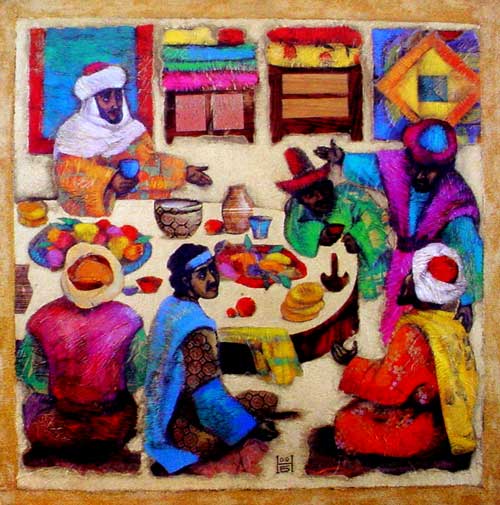
feastWhenever I hear today’s Gospel reading, I can feel myself cringing in embarrassment at the situation that the wedding guest creates for themselves.

I can just imagine all the other guests muttering to one another: Did you see that?  The cheek of it ‑ thinking that they should sit in the best place!  Surely, no‑one in their right mind would do such a thing?  After all, we all know our place and we’d never put ourselves in such a situation, would we?

I can also imagine the shame that the guest must have felt having been moved from their chosen seat to the worst place ‑ in full view of all the other guests.   I guess they wished that the ground would swallow them up, as they went red in the face and started to stammer.

This parable ‑ seemingly about the etiquette of dinner invitations ‑ turns into a story about shame and honour.  Luke draws us into the story by choosing a scenario that we can identify with ‑ we’ve all been to wedding feasts and we all know the social rules that go with them.  Bridal party on the top table ‑ everyone else in the rest of the room, carefully placed so all possible conflicts are avoided and no‑one is left on their own.   We know the rules and we are expected to stick by them ‑ so how could anyone be so foolish, do such a shameful thing as sit in the wrong place?

Shame is a very powerful emotion ‑ accompanied by often visible signs ‑ and it is one that we seek to avoid.  It can bring very real distress and pain.  Shame can also be a healthy reminder to us that we’ve transgressed, that we’ve done something wrong. To avoid being shamed, we have to think about doing the right thing, about being honourable.

CN22TN CAnd this is where Luke takes his parable ‑ by describing the honourable way to behave when you have a wedding invitation.  Start off by assuming that you have been allocated the worst place and you might just find that you are rewarded with a better seat. And Luke wraps up the tale with these words of wisdom: “If you put yourselves above others, you will be put down.  But if you humble yourself, you will be honoured.”

This story is worldly-wise ‑ perhaps it echoes advice in Proverbs: “Do not take a place among the great; better to be invited ‘come up here,’ than be humiliated in the presence of the prince.” The parable is a neat and slightly crafty lesson on how to get on in the world.  And yet…….  As with all of Jesus’ parables it has a meaning on many other levels.

There are several lessons here for Christians about knowing one’s place as a Christian disciple.  But first a few words which come from a different direction. A true story. A friend of mine had not been to church in a very long time. The first time she came to church with her family she chose to sit near the front of the church – it was a little odd, for no one came to sit with them until just as the service was starting … She enjoyed her first service in church – the singing was wonderful and the family decided to come again. The next Sunday they took the same seats, the same people came to sit with them and again they enjoyed the worship. They started going to church regularly. It was only after they had been there a couple of months that one of the congregation came to them and asked why they were sitting in the choir stalls …

So many who come to church no longer know the right things to do, don’t understand why in Anglican churches we don’t use the front pews. Often I have seen new people sitting right at the front (in the best seats) then not able to work out what to do with their service sheets and hymn books and clearly feeling ill-at-ease, feeling shamed. How do we help these people to feel at home? It is so important. …

Having seen that the parable can be turned on its head. What are the other lessons here for Christians about knowing one’s place as a Christian disciple?

There’s a message for those in leadership.  Jesus was speaking to the lawyers and Pharisees when he told this tale and he wanted them to heed the warning about pushing themselves forward in the sight of God.  In Jesus’ day it was all too easy for the well‑off and the legally trained to imagine that they were superior in God’s sight to the poor and to those without the opportunity to study, let alone practice the law.  So he spoke to the powerful people in the Jewish faith ‑ wanting them to think about the way they related to other Jews.  This, of course, is also important for powerful Christians, such as church leaders (ordained or lay), to remember when they relate to other Christians.  Power and learning make no difference to the way that God relates to his children.

But Jesus spoke not just to the powerful and learned ‑ he also spoke to his disciples.  Perhaps you remember the story of James and John who were eager to take the top two places at Jesus’ right and left hand ‑ above everyone else.  They didn’t know what they we asking, because Jesus’ came in his glory not on a throne but on a cross and the places on either side of him were reserved for thieves.

James and John were rebuffed and reminded that this was not the aim of discipleship ‑ it was not for them to seek the highest places.   So to for us ‑ there is no hierarchy in our church, our parish, our Deanery, our Diocese  ‑ we are all brothers and sisters in Christ.  Yes, we have different roles and some of these roles mean that some people are more visible than others.  But as disciples, we all occupy the same place ‑ as God’s children, all equal in his eyes.  So this parable reminds us that we need to act with humility in the church.

There is however a wider message delivered by this parable and this would have been obvious for those in the world for which Luke was writing.   Within Luke’s lifetime, thousands of non‑Jews had become Christians.  They had entered, as it were, into the dinner party prepared by the God of Abraham, Isaac and Jacob.  Many Jewish Christians found this difficult, if not impossible to understand or approve.  They were so eager to maintain their own places at the top table that they could not grasp God’s great design to stand the world on its head.  They couldn’t see that their pride, their belief that they were favoured, blotted out God’s generosity to others and ultimately denied their own place as Jews in God’s plan for the world.

Because, in the end, if anyone reckons that they deserve to be favoured by God, not only do they declare that they don’t need God’s grace, mercy and love, but they also imply that those who don’t deserve it shouldn’t have it.  And perhaps this is the most challenging aspect of this parable ‑ a message for all Christians.  Whenever we act without humility and see ourselves as better than others, not only do we shame ourselves but we act dishonourably towards other people by seeking to limit their access to God’s love and God’s grace.  And where does that leave us in relation to God? For each of us needs the grace of God as much as anyone else.

So lets keep our eyes open for those who are new and who struggle with knowing the social rules of our church, let’s give them every help and support that we can.

May this parable also prompt us to be aware of those times when we bring shame on ourselves because of our lack of humility.  May it also cause us to rejoice that God’s love is so forgiving that at the end we will all be invited to feast at God’s banquet.

The Sabbath …. (Luke 13: 10-17 and Isaiah 58:9b-14)

Sabbath. … The very idea feels Victorian! It smacks of rules to be kept and of restriction of freedom. If your experience is anything like mine growing up in the 1960s and 1970s, you’ll remember a Sabbath, or a Sunday, which meant being in Church three times (yes, three times each Sunday), no television, only Christian books, no playing out. Supposedly the ‘Sabbath’ was day of rest, but really it was a day of restrictions and rules. Nowadays, if we have any idea at all what Sabbath is about then I suspect that we honour it more in the breach than in the keeping. The idea of a day when we can’t play, can’t work – a day that has to be all about Church and God. That is not our idea of fun! ….

But, we need space, we need time to recuperate. We need time for ourselves and our families. Even if we don’t find that space on a Sunday, we’ve learnt just how important it is to make space in the week for those we love and for ourselves. We honour the Sabbath in a way that fits our lifestyle. Jo and I make sure that we keep her day off as special. We both used to take Tuesdays as our day off (in Manchester) Now, usually, Jo does not work on a Friday.

One way or another though, we’re hampered by our culture when we come to think about what the Bible calls ‘the Sabbath’. We have a history of keeping Sunday special that we need to acknowledge – which some will argue is essentially biblical and therefore very important. While others will see the idea of ‘the Sabbath’ as yet another example of the irrelevance of the Bible and Christianity to the modern world. For in today’s world just doesn’t seem to allow people the space to rest! Certainly such times are at a premium!

But, look again at our passages this morning. How do our ideas of Sabbath fit with the biblical evidence? Who is right? Do you remember the ‘Keep Sunday Special Campaign’ Were they right? Or are those who see ‘Sabbath’ as an anachronism right?

For sure, we mustn’t be like the leader of the synagogue – Jesus clearly has no time for his attitudes! Yes the bible does command us to keep the Sabbath – but Jesus also makes it clear elsewhere that the Sabbath is made for humanity, not humanity for the Sabbath. So perhaps then, we can ignore any idea of keeping Sundays special and do our own thing!

But wait, Isaiah clearly has something else in mind. He calls the idea of ‘Sabbath’ a delight!!

So … What is the Sabbath about? How can we keep it?

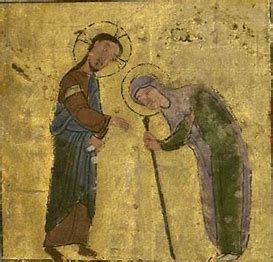
Look first at our gospel reading, Luke 13: 10-17 – clearly Jesus sees the Sabbath as a time for healing, but what kind of healing? Physical healing? Yes, a woman is set free from a debilitating condition. But the gospel writers seem to have more in mind. … This woman has spent eighteen years doubled up, face to the ground, unable to see more that a footstep or two in front of her – she was trapped – her physical condition speaks so clearly of the spiritual condition of so many people – certainly of the synagogue leaders, but also of many people in our world today.

Figuratively, we spend so much of our time looking at the ground just in front of our feet – bound up in our work, our homes, our fears and worries – they loom so large that we can see nothing else.

Figuratively, we spend so much of our time looking at the ground just in front of our feet – bound up in our work, our homes, our fears and worries – they loom so large that we can see nothing else.

The Sabbath, says Jesus, is about being set free from this bondage. It is about being enabled once again to see the whole picture. The Sabbath is intended to allow us to regain a correct perspective, to affirm again that our concerns, our limited vision of the world around us, are not actually the way things are. As we observe the Sabbath, we can begin to replace our narrow perspective with God’s wider perspective As we observe the Sabbath, we affirm again that our God is Lord – despite what our immediate circumstances might suggest. … Sabbath is about making room for a realignment of our perspectives, and this happens most effectively in worship.

Our Old Testament reading from Isaiah 58: 9b-14, has something to add. …

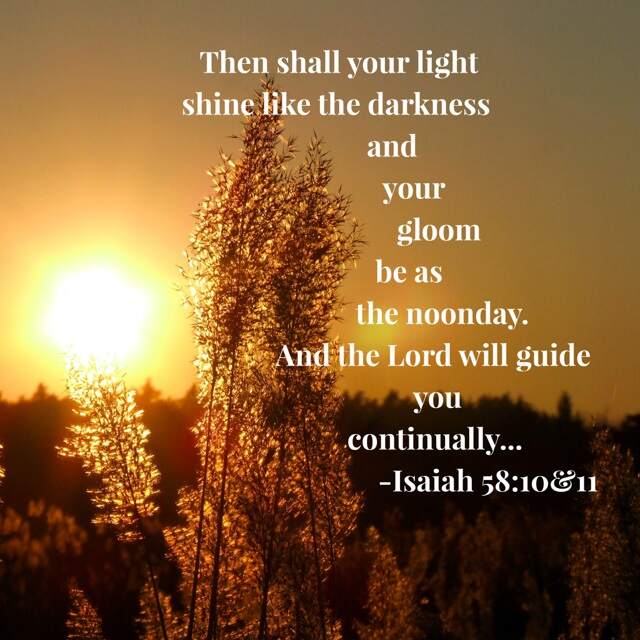
While the Gospel speaks about removing the negative, of release from wrong perspectives, Isaiah calls us to consider the positive. The Sabbath fast, or any other fast, is intended to refocus our minds on what matters most. Isaiah helps us to focus on what are God’s priorities.

‘Delight in the Lord’ he says, because, when you do, you will begin to see with God’s eyes – the removal of gossip, the feeding of the hungry, meeting the needs of others, bringing light into darkness, rebuilding lives and communities.

So Sabbath is about rest, about time for each other, about time for our families – but primarily it is about giving time to the reordering and refocusing of our lives. It is about God’s perspective becoming our perspective. It is about picking-up God’s concerns and letting them become our priorities.

So we need to make our own ‘Sabbath’, whether it is on a Sunday, or perhaps when our shift pattern, or working week allow. And the Bible’s claim is that if we fail to do so, we will lose perspective on life and our living will become directionless. …

The Bible has still more to say …

On top of the principle of Sabbath, a weekly day enshrined in the ten commandments, there was also a principle of every 7 years letting the land rest for a whole year and people were to stop working in the fields, and then every 49th year (7 lots of 7 years) there was the year of jubilee, of celebration – a sacred time of freedom and celebration when land was returned to its original owners and slaves returned to their homes, freed from bondage.  These yearly periods were a time of sabbatical, a time of resting and refreshing and preparation for the next cycle of 7 years, or 49 years.

If you listened to the BBC Sunday Worship on Radio 4 last week you will have been reminded that the Roman Catholic church is, this year (2025), observing a Year of Jubilee.

The BBC’s Sunday Worship [1] focussed on young people on pilgrimage to Rome.

Pilgrimage is itself a form of Sabbath a time for refocussing on what God wants for our lives.

That principle of a ‘Sabbath’, a sabbatical, is something which the Church of England sees as important for all its clergy and lay ministers. It makes allowance for clergy to have what Lichfield Diocese calls ‘extended study leave’ and often it is just that, a time when reading and ideas have space to refresh and strengthen, reinvigorate ministry.

We all need these times of Sabbath: times of refreshment, renewal and reorientation. I’d like to finish this reflection with a prayer attributed to St. Patrick, which I am sure you will know well, a prayer which is all about refocussing our lives around God who is Father, Son and Holy Spirit. Let us pray:

Be thou my vision, O Lord of my heart,
be all else but naught to me, save that thou art;
be thou my best thought in the day and the night,
both waking and sleeping, thy presence my light.

Be thou my wisdom, be thou my true word,
be thou ever with me, and I with thee Lord;
be thou my great Father, and I thy true son;
be thou in me dwelling, and I with thee one.

Be thou my breastplate, my sword for the fight;
be thou my whole armour, be thou my true might;
be thou my soul’s shelter, be thou my strong tower:
O raise thou me heavenward, great Power of my power.

Riches I heed not, nor man’s empty praise:
be thou mine inheritance now and always;
be thou and thou only the first in my heart;
O Sovereign of heaven, my treasure thou art.

High King of heaven, thou heaven’s bright sun,
O grant me its joys after victory is won;
great Heart of my own heart, whatever befall,
still be thou my vision, O Ruler of all.

References

  1. https://www.bbc.co.uk/programmes/m002h9mr, accessed on 20th August 2025.

Luke 12: 32-40

Last week’s Gospel reading from Luke 12: 13-31, had Jesus telling the story of a rich man who had done well for himself and decided to enjoy the fruit of his labours – he built bigger barns to store his wealth and got ready for a long retirement. Jesus called him a fool, for he had given no thought to his eternal welfare. We could imagine him hoarding everything for himself and giving nothing, or very little, to God; hoarding everything for himself and giving no thought to the poor. And we saw him condemned as a fool.

Jesus ended his talk with his disciples after the story of the rich man with very similar words to those used by Matthew in his record of the Sermon on the Mount. “Don’t worry about material things,” Jesus says, “Instead strive for God’s kingdom and all these things will be given to you as well.”

Our Gospel reading today follows directly on from those words. … Immediately after, Jesus says, “Do not be afraid, little flock, for it is your Father’s good pleasure to give you the kingdom.”

The Gospel reading expands these thoughts: “Do not be afraid little flock. … Sell your possessions, and give alms. Make purses for yourselves that do not wear out, an unfailing treasure in heaven, where no thief comes near and no moth destroys. For where your treasure is, there your heart will be also.”

How do we feel when we hear Jesus’ exhortation to sell our possessions and give to the poor? … If you’re anything like me you’re likely to respond in one of two ways: either you will feel guilty, then perhaps remember the appeal from the Aid Agencies for the latest part of the world in trouble, get out your credit card and make a telephone donation. Or you will try to justify yourself. Don’t I already give enough? How can I possibly give more? And, like me, if you’re not careful, there’s a danger that you’ll dismiss the Gospel reading from your mind with a sense that it no longer applies to you.

These challenging words of Jesus are hard to handle! And if we’re not careful we become just like the rich young ruler in Matthew’s Gospel who asked Jesus, “What must I do to gain eternal life?” … He heard Jesus say ““If you want to be perfect, go, sell your possessions and give to the poor, and you will have treasure in heaven. Then come, follow me.” He found Jesus’ words too hard, and walked sadly away from Jesus because his riches were too great.

Is a sense of guilt or self-justification the right way to respond to today’s Gospel reading? … How should we respond? … After all, we are all relatively rich when compared with the income of everyone in the world, even if we are pensioners or clergy! Perhaps I should sell all my theological books. My model railway. The nice furniture that we have in the vicarage. Perhaps I should cash in my savings and give them to Oxfam. Perhaps this is what Jesus wants? … And maybe I need to allow this passage to challenge me about my acquistorial nature – I love to collect things! … But would this help me to really learn to trust my heavenly Father? … For with all this wealth, with insurance, with an effective health service and social services, with the safety net that this society provides it is very difficult for us to know what it means to trust God for our daily needs. …

So how does God expect us to respond to the challenge?

Greater generosity is clearly part of our calling. And if the regular giving of many to the Church of England is any measure of our generosity, then we still have a lot to learn about giving and trusting God. But that is not the main challenge of our Gospel reading. …

Jesus’ challenge is actually far deeper, much harder to handle. For just as in the first part of Luke 12, with the story of the rich farmer, just as with Jesus’ sayings about the kingdom and the wealth of this world, in our passage this morning, Jesus is challenging us not to give more, but to let go of everything we think we own. “It is not yours, it is God’s,” says Jesus. “Everything is God’s.”

The challenge is to let go of all of our securities – our wealth, our status – and to trust God. “And,” says Jesus, “when you do so, you will begin to lay up treasure for yourselves in heaven. You will begin to experience the kingdom of God at work in your life. You will have no problem with giving, for you will be glad to return to God what is his already.”

Our Gospel reading this morning is not so much a challenge to us to be more generous. Although it is definitely that. It is more pertinently a challenge to see everything we have as not ours but God’s, held on trust to be used to bring in the kingdom of God

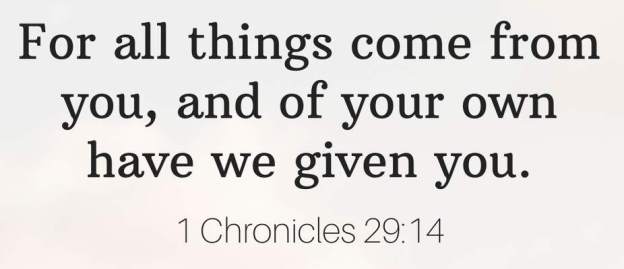
One of the regular parts of the liturgy in the Church of England expresses this so well. In many Anglican churches these words follow the Offertory: ‘Yours Lord, is the greatness, the power, the glory, the splendour, and the majesty, for everything in heaven and on earth is yours. All things come from you and of your own do we give you.’

All things come from you, and of your own do we give you.

These are words taken from the Old Testament, from 1 Chronicles 29: 11-14. And I will finish this short reflection with those words: …

“Yours, LORD, is the greatness and the power and the glory and the majesty and the splendour, for everything in heaven and earth is yours. Yours, LORD, is the kingdom; you are exalted as head over all. … Everything comes from you and we have given you only what comes from your hand.” (1 Chronicles 29: 11 & 14b)

And our response to the love of God for us, has to be: … “All things come from you, and of your own do we give you.”