
Over the last few weeks, our lectionary readings have contained a series of revelations about Jesus.
On Christmas Day, we heard John’s revelation of Jesus as “the Word, who from the very beginning was with God and was God but also the Word made flesh living among us.”
At Epiphany, we heard of the wise men and their gifts, showing Jesus to be a king, worthy of worship and one destined to die.
Last week, at Christ’s Baptism we heard God’s revelation: “This is my Son, my beloved, with whom I am well pleased.”
These revelations actually took place over a period of thirty years. But for us, heard in the space of four weeks, they are rather more intense. Each week, we learn more of Jesus’ being and purpose. Today is no different.
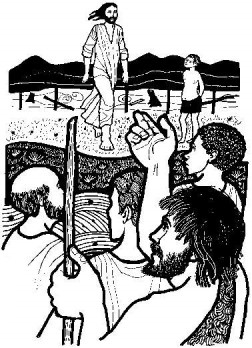
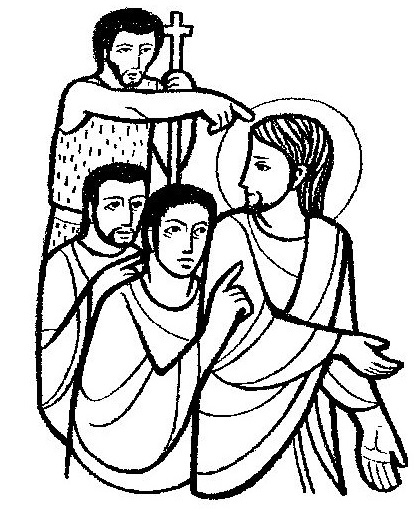
Today John announces to the crowd gathered around him at the Jordan “Here is the Lamb of God who takes away the sin of the world.” A few sentences later he says that Jesus is “the one who baptises with the Holy Spirit.” And he goes on to remind everyone that Jesus is God’s son. Then Andrew tells his brother that the Messiah, the Anointed has been found.
Jesus’ appearances seem to come thick and fast, quicker and quicker. Chapters 1 and 2 of John’s Gospel seem to emphasise this. So, in today’s reading: v29: the next day John saw Jesus coming; v35: the next day John watched Jesus walk by; then v43: the next day Jesus decided to go to Galilee; and Chapter 2 v 1: On the next day there was a wedding in Cana of Galilee!
It is almost as though John, the writer of the Gospel is feeling a great deal of intensity as he writes. “I must get this across,” he says to himself, “I must.” He seems desperate to make sure that his readers know Jesus’ credentials as fully and as quickly as he can relay them.
Indeed, after the opening of the gospel it seems to markedly slow down, the intensity drops and the reader has more time to reflect on who Jesus is – through stories and accounts of Jesus’ conversations.
Next week, we return to Matthew’s gospel for a number of weeks and get chance to see how Jesus’s ministry progresses. It’s also an opportunity to see whether he actually lives up to the titles that have been revealed to us over the last few weeks. So it is almost as though our Gospel reading is asking us to take stock of the names, and roles, that have been showered on Jesus. We are invited to take all this information that we have been given about Jesus, make sure we understand what it means and then use this in the coming weeks to help us understand the unfolding story of the next three years of Jesus= life.
In this article, we can only scratch the surface of what John, the Gospel writer, hopes we will understand about Jesus.
“Lamb of God.” John the Baptist expected his listeners to recall pictures from the Old Testament; the lamb provided by God for Abraham to slaughter, the lamb of Isaiah 53, led to the slaughter for the sins of God’s people; the Passover Lamb from Exodus. The word ‘lamb’, for John’s listeners connected strongly with words like ‘sin’ or ‘atonement’ – the way in which we can be reconciled with God despite our wrongdoing.
This Lamb is given by God – a gift from him. We can’t provide for our own atonement, instead God reaches out to us to draw us back to him.
“The Lamb of God, who takes away the sin of the whole world,” says John the Baptist. Jesus will take away all sin, everyone’s sin. There is nothing exclusive or limited. Nothing narrow. No sin too heinous, no wickedness too terrible! Listen to the words of Isaac Watts’ hymn:
Not all the blood of beasts, on Jewish altars slain,
Could give the guilty conscience peace
Or wash away its stain.
But Christ the heavenly Lamb, Takes all our sin away;
A sacrifice of nobler name, And richer blood than they
Believing, we rejoice, To see the curse remove;
We bless the Lamb with cheerful voice, And sing his wondrous love.
“Baptiser with the Spirit.” John the Baptist baptised people into a readiness for the coming of the Messiah. In the early church, baptism initiated people into the family of God. Jesus, however, welcomes us into God’s kingdom by giving the Holy Spirit. Jesus gives us the same gift as he received at his baptism – God’s spirit to guide us and lead us. And this is particularly important every time we baptise someone in our churches. When we baptise we incorporate people into the same family as Jesus, they become children of God, children of the Holy Spirit.
“Son of God.” Jesus’ relationship with God was made explicit at his Baptism. He is loved by God – he is ‘the beloved’. At Jesus baptism we are shown something of the closeness and intimacy between God and Jesus. It is only the one loved by God, the one who was with God, who was God. Only that one can secure salvation – no other.
“Messiah.” At the beginning of the first century, there was intense speculation about the Messiah, the ‘anointed one’. In the Old Testament, anointing was used to describe the way in which people were appointed for special tasks, and given God’s spirit to enable them to carry out this task. People were waiting for a Messiah – a kingly figure embodying God’s rule. Andrew calls Jesus, ‘Messiah’. He recognises Jesus as the long awaited king who would fulfil the Old Testament prophecies and bring about God’s reign on earth.
Lamb of God, Baptiser with the Spirit, Son of God, Messiah – John, the Gospel writer’s names for Jesus. John wants us to carry these names with us as we read his Gospel. It is as though he says to us, “You will only understand my message fully if you realise that this is what I want to show you. Here is the one who by his life and death fulfils these roles and in doing so brings hope.”
As we read the Gospels let’s use these names to inform our reading and to help us understand for ourselves just who Jesus is: Lamb of God, Baptiser with the Spirit, Son of God, Messiah.



 Roger Farnworth