During this week the church celebrated Ascension Day. The day when Jesus returned to heaven after his death and resurrection. The Ascension begs a question:
What exactly is happening as Jesus goes into heaven?
Is this the triumphant finale, the final victory parade? When at last Jesus goes home to the Father, to be paraded through the streets of heaven in victory – much like a Roman general would be feted after a battlefield victory, or a triumphant football team parades through its home town or city.
Is the Ascension the final triumphant seal on Christ’s work on earth? Or is it the time when Jesus is welcomed into that indescribable unity which is the Trinity of the Godhead – back home at last?
Or is it a moment of desertion. The disciples have only just received Christ back among them after his death and now cruelly he is taken from them into heaven. A renewed relationship is abruptly ended!!
A commission is given and then the bombshell is dropped. “Listen!” says Jesus, “I have a job for you to do – to be my witnesses throughout the known world.” … “Great, Lord, when do we get down to business, when do we work out the strategy, when do you provide the plan of action?” … “Not us, not me!” says Jesus, “You! I’m going away and you’ll never see me again this side of heaven!”
Or is this, actually, rather than desertion, the point at which followers become leaders, children become adults? Is this primarily the point where Jesus followers can no longer hide behind a leader and have to begin to make choices themselves?
For all the participants in the Ascension story, this must have been a confusing moment. A time which carried so much emotion – parting from friends, losing a friend and leader, going home … All sorts of mixed emotions.
Ultimately this is all true. … Christ goes home in victory. A job well done. … He leaves behind a ragged group of followers who must have felt deserted. … And perhaps most crucially for the church today, Jesus is asking this ragged group to stand up for themselves. To be what he knows that they can be with the Spirit’s strength – a missionary band that will turn the known world upside down within a century.
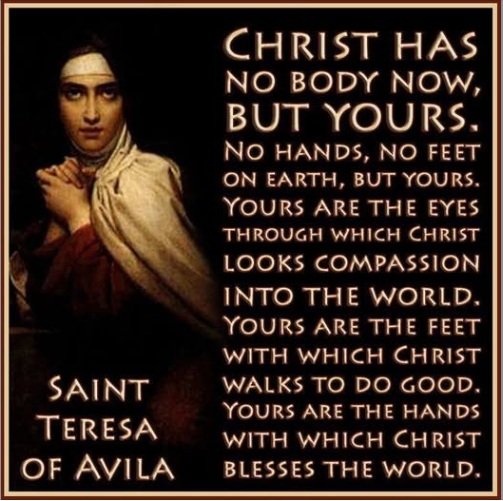
You may well recognise this prayer of St. Teresa of Avila. … In summary:
Christ has no body now but yours. No hands, no feet on earth but yours. Yours are the eyes through which He looks compassion on this world. Christ has no body now on earth but yours.
The Ascension story reminds us that we are the ones that count – between now and eternity God has left his concerns, his mission in our hands. And as a result of Ascension Day, it behoves us to commit ourselves again to serving to God – to discovering his way and walking in it, to being his hands, eyes and feet in our local communities.
Our Gospel reading reminds us that in this endeavour, we need to give the highest priority to just one thing …. Working together with a common purpose – being united.
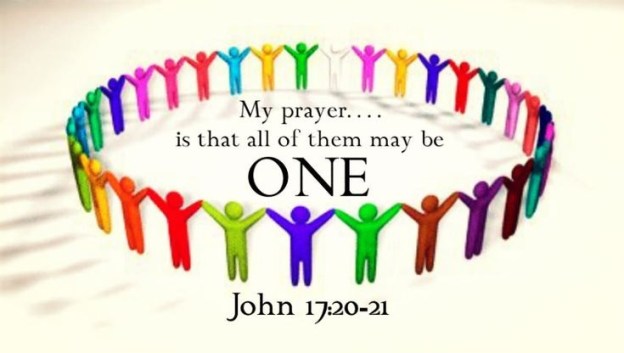
Jesus makes one thing his priority in his final long prayer in John 17 – God’s call to his church to be ‘one’, to be united. ….. We have not done so well with this! Have we?! It is, I believe, our greatest failure.
Rather than unity being the high priority that Jesus makes it in our gospel reading. The church down the ages has always set Jesus’ prayer for unity aside in favour of other things. … Often these other things have been so very important to us. Doctrinal purity comes high up the list, perhaps the role of women in ministry, perhaps issues of human sexuality, perhaps inclusive church, perhaps ….. the list could go on. One of the most significant lessons from church history is that the Church has played fast and loose with Jesus’ call to be one.
‘Being one’ does not mean that we all agree about everything. ‘Being one’ is about recognising just one thing and one thing alone. ‘Being one’ is about recognising that we are family, God’s family. However much we wish it was not true, however much we wish we could choose our Christin sisters and brothers we must not. Our failure to be one, gives the lie to all that we claim as Christians. We cannot claim to love others if we don’t love each other, in our churches, in our communities, in the national church and in the international church.
God’s call is that we work together for a common aim. For the church that aim, that purpose, is the Good News, the Gospel of Jesus.
Just as Jesus, at his Ascension, leaves his disciples to do his work, so God gives us the freedom to choose to build hope, joy and peace in our world and in our church. Each of us, each one of us, sits in the midst of a stream of the overflowing love of God. … We have a choice, over whether we share that love with each other. And so very often we have chosen not to do so.
The national church makes this period between Ascension and Pentecost a time of prayer, it calls it a “Novena” (that just means 9 days – 9 days of prayer). Our prayer needs to be that we will be one just as Jesus desires that we be one. Nothing for God, for Jesus, has a higher priority, not getting things doctrinally correct, not our own priorities, not the state of our buildings, not even the future of our churches. One thing matters above all else to Jesus, that we are united. We are one family under God.
This is Jesus’ prayer for us. Listen again to what he prays:
(John 17:20-23) “I do not ask for these only, but also for those who will believe in me through their word, that they may all be one, just as you, Father, are in me, and I in you, that they also may be in us, so that the world may believe that you have sent me. The glory that you have given me I have given to them, that they may be one even as we are one, I in them and you in me, that they may become perfectly one, so that the world may know that you sent me and loved them even as you loved me.”
An essay written in 1998 as part of training to become an Anglican Priest.
INTRODUCTION
Susan Hill tells the story of a young woman, Ruth, whose husband dies suddenly. As Ruth works through her grief she is supported daily by Jo, the 14 year old brother of her dead husband. In the early months after the accident he is the only one who can reach into her grief (Hill: p9-116). Jo’s care of Ruth is effective care. He has no training but be deeply loves her
Christ has enjoined us to love our neighbour as ourselves. All questions of pastoral care, and particularly bereavement care, must start from the premise that all Christians, at the appropriate time and place, have something to offer, presumably love, in the first instance. This essay outlines the key issues in bereavement care and explores the different levels of care that a church congregation can provide to those working through the pain of loss.
1. THEORIES OF LOSS
Arnold van Gennep proposed a theory of loss in his book “Rites de passage” which has become generally accepted. He envisaged three main ‘stages’. A person experiencing loss starts in a ‘Prelminal’ stage caused by the separation, which is characterised by detachment, pain and anxiety; passes through a ‘Liminal’ stage of transition, characterised by ambivalence, distortion, chaos and loneliness; and gradually reaches a ‘Post-liminal’ stage of reincorporation back into the community, a time of new beginnings and moving on (from lecture by A. Chatfield). Much has subsequently been written about bereavement. William Worden talks of four tasks of mourning: accepting the reality of loss, working through the pain of grief, adjusting to an environment in which the deceased is missing, and emotionally locating the deceased and moving on with life (Worden p10ff) Ainsworth-Smith and Speck speak of three main phases: shock and disbelief, awareness, and resolution (Ainsworth-Smith: p5ff). Elizabeth Kubler-Ross suggests that dying patients and their families go through similar grief processes (Kubler-Ross: p150ff). She identifies five different stages: denial and isolation, anger, bargaining (more obvious in the terminally ill than in the bereaved), depression, and acceptance (ibid. p35-101). Colin Murray Parkes identifies a series of different behaviour patterns common among the bereaved, from broken hearts (and increased attendance at doctor’s surgeries) through alarm and stress, searching, mitigation, anger and guilt, to the gaining of a new identity. (Parkes p36-112)
These different theories all suggest a process which takes some considerable time. It would be possible to describe each individual stage in each theory but this is not necessary within the scope of this essay, the diversity of description of these stages serves to illustrate the fact that each individual responds to the loss associated with bereavement in different ways. Each author emphasises the need to recognise the way in which the individual is responding to their loss. Strath and Speck talk in a number of places of the way in which the various feelings tend to flow back and forth during the grief process like the tide coming in and out each day. Each time the tide comes in it can leave behind a different ‘response’ (eg. Ainsworth-Smith: p30-31). It must be appreciated that these theories are models to assist understanding rather than timetables for grief or routes through the grief process.
2. ATYPICAL GRIEF
Parkes points out that for some people the grief process can become distorted. He highlights two specific reactions “one was a tendency for grief to be prolonged, the other a tendency for the reaction to bereavement to be delayed.” (Parkes: p125). His work suggested that persistent panic attacks, persisting and intense guilt, intense separation anxiety, strong but only partially successful attempts to avoid grieving, and development by the patient of symptoms mirroring those of the deceased, were all associated with abnormal grief (ibid: p128). Worden outlines a number of factors which contribute to a falure to grieve. These fall into relational, circumstantial, historical, personality, and social categories. He considers abnormal grief under a series of headings: chronic grief reactions, delayed grief reactions, exaggerated grief reactions; and masked grief reactions (Worden: p73-74) Ainsworth-Smith and Speck identify the main distortions of the proces of grieving as delay, denial, prolongation and clinical depression (Amsworth-Smith p106-112).
Those caring for the bereaved need to be able to identify atypical grief if they are to be able to reassure those whose grieving is ‘normal” and be able recognise the need for greater help for others “Grief may be strong or weak, brief or prolonged, immediate or delayed, particular aspects of it may be distorted and symptoms that usually cause little trouble may become major sources of distress In some cases it may seem that a particular response is the consequence of a number of circumstances cach of which contributes to the outcome, in others, one factor may appear to be the chief determinant” (Parkes p136).
The texts refer to ‘determinants of grief’. Parkes suggests that there are a number of factors (determinants) which will influence the way people respond to loss – previous experience of loss, current issues (personality, sex, age, socio-economic status, nationality, religion and culture); and issues subsequent to the loss (support or isolation, other stresses, new opportunities).
3. SPECIAL CIRCUMSTANCES
Most of the authors referred to above write of the need to give special consideration to those grieving different kinds of death. Each loss will have its own unique issues but it is possible to group losses into some broad categories that enable the development of understanding. For example, Worden provides details of anticipated grief responses to suicide, sudden death, sudden infant death, miscarriages, still births, abortion, long term illness and AIDS (Worden: p93ff). He helpfully suggests appropriate caring responses for each case as part of his discussion.
4. WHAT DOES ALL THIS MEAN?
We have undertaken a rapid review of current thinking in relation to grief and the process of grieving. It illustrates the need for those involved in caring to have a thorough understanding of bereavement. It seems to indicate that care of the bereaved is something for experts or specialists. I want to suggest that, although there are clearly circumstances when only an expert will do, this is not just an area for the specialist. There is much that a caring Christian community can give to those experiencing bereavement. The remainder of this essay discusses such ministry and highlights gifts and qualities necessary for those involved in it.
5. A HIERARCHY OF CARE
All of us live within a complex network of social relationships, friends, immediate family, work, church and other acquaintances which is supplemented at different times by contact with specific professionals. Bereavement, at least temporarily, extends that social network as we are visited by funeral directors, clergy, extended family and, dependent on our need, by counsellors and therapists.
Society has its own pattern of care and there are now many organisations specialising in bereavement care. The church should not set itself up in competition with those who provide specialist support and counselling but may be able to offer some of these services if they are not available locally and may well be able to provide support for its own members without competing with others. In any locality, the church needs to work out a specific caring response to those who have been bereaved.
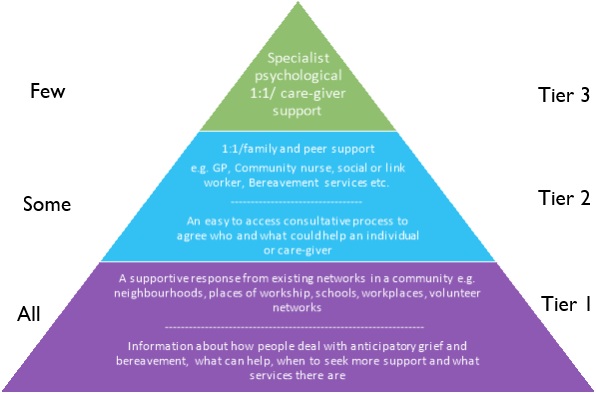
Care for the bereaved may involve prayer, practical support, listening, counselling and therapy. Members of the church will be involved in all levels of care either in a professional capacity or as members of the body of Christ. It is possible to think in terms of a hierarchy of care with professionals providing specialist care and other equally valid ministries being undertaken by ordinary people, such as church members, for which the primary qualifications are love, sensitivity and time. The church should encourage members of its congregations to enter the fields of counselling, and psychotherapy Church leaders should also be aware of Christians in their vicinity with these skills. There is, however, much more that a congregation can do than just referring those grieving to specialists. We will consider later the nature and development of appropriate qualifications for involvement in this ministry. Firstly we must consider the unique position and role of the clergy.
Public Health Palliative Care: developing a community response to Covid-19 pandemic; written evidence submitted by the Royal College of General Practitioners (DEL0327)
6. THE CLERGY
Those outside the church will often not meet a member of the clergy except in connection with one of the occasional offices baptisms, weddings and funerals. Wesley Carr calls these occasions ‘brief encounters’ (Carr: p11) Many funerals in the UK are still conducted by a religious figure, usually Christian. The minister has to become accustomed to ministering to those with no obvious belief. She or he seems to represent something significant. But most people would not be able to articulate what! He or she is probably believed to be able to manage everything that surrounds this final boundary to life. She or “he looked to as a man [or woman] of professed faith, who is believed to be able to face the spectre of death and, as it were, to defeat it. Whereas ordinary people are afraid of death and dying, the minister is supposed not to be. [She or] he is expected to be competent. His [or her] believed strength in the face of death and … ability to handle it produce a curious amalgam in people’s minds, whereby he [or she] may almost become the purveyor of death. As such, [she or]he is both needed and shunned” (ibid. p106-107). Because the minister has [her or] his own struggles, “the pressure upon him [or her] is to respond by acting a part, so that [she or] he may meet the expectations of [their] audience and not be hurt [themselves]” (ibid: p107).
The funeral is a very significant part of the bereavement process and is therefore a major pastoral ministry that the church is able to offer to the community. Early in the bereavement process, it serves to crystallise the immediate realities, that a person has died and that the living have to do something about this. It provides a fixed reference point to which people can relate as they work through the bereavement process. It becomes crucial to the way that the family remembers the dead relative.
The clergyperson, therefore, has a vital role of directing the funeral service (as a kind of choreographer of grief), articulating in the service things that the bereaved may not be able to articulate themselves, and allowing the appropriate expression of feeling “People under stress surrender to him [or her] an alarming amount of power, which [she or] he has to hold with astuteness. As a Christian he [or she] may be tempted to respond with almost glib talk of life after death, rather than profound exploration of the gospel emphasis that life is in the midst of death” (ibid. p117).
“A considerable investment may be held even by those who have no formal religious belief m the representative role of the muruster in terms of unchangingness and security. But her [or his] ability to behave, and sometimes say things, which may sensitively challenge the established expectations may also be crucial” (Ainsworth-Smith: p116)
It is important that members of the clergy are able to engage with their own issues of loss, their own fears of death, and their own mortality, so that they grow in self understanding, Failure to do so will prevent effective involvement in the losses of others. The clergy also need to be aware of the processes of grieving, being able to judge when the grieving process has become distorted. They need to be able to counsel and to listen but must be able to judge their own limitations for caring (through lack of time, interaction with their own issues, or where care requires more professional involvement).
7. THE BODY OF CHRIST
The local church, or the body of Christ, has much to offer to the bereaved. Firstly, through its corporate nature, it is a living and theological resource for the community (Gal 6:2,10). The church should be the one place above all others where people are welcomed into a loving community which cares for its members and for outsiders (Rom. 12:4-5; 1 Cor. 12:12-27, Eph 4:1-6); a place where we carry each other’s burdens. It is a place where death and loss can be faced in a community that is centred on the suffering and death of Christ. It is a place where Christ’s death is regularly ‘made real’ in Holy Communion. It can offer services for the bereaved, such as funerals, requiems, thanksgiving services, services for loss of babies, and anniversary services. Each of these meets specific needs and is surrounded by opportunities for care. The church has various fellowship and support groups (home-groups. Mothers Union, youth groups, men’s groups) which have been learning to care for each other at a deeper level than much of the rest of the community. There is a sense in which, at times, care which comes from a community seems much stronger and mere effective than that from a few individuals.
Secondly, the individual members of the body of Christ have different gifts to offer. We considered possible areas of ministry earlier in this essay. It is important that those involved in the care of the bereaved are personally prepared for their ministry through engagement with their own experiences of loss, fears of death and mortality. It is important that they understand the process of grieving and that it will essentially be unique to each person that they care for. The level of training appropriate for ministry will vary dependent on the person’s involvement, those offering a listening or immediate prayer ministry will need more training than those who see their ministry as limited practical care or more remote prayer. Likewise the natural capabilities required of those ministering will depend on their role. Qualities necessary for ministry to the bereaved would to a greater or lesser degree include listening skills, transparency, durability, adaptability, time and commitment, approachability, experience of loss or bereavement; honesty before death, and a lack of their own agenda. it is also important that this ministry is clearly ‘other focused’ and that people are not trying to work out their own grief through caring for others.
8. DEVELOPMENT OF CARING CONGREGATIONS
We have discussed many of the specific areas of care that a congregation can offer. We have noted that, as its pastoral care structures develop, there will be a natural sense in which care for all people and also, therefore, for the bereaved will develop. Specific training in specialist skills will be appropriate for some members of the congregation; particularly in counselling, listening skills, and bereavement visiting. A congregation should be encouraged to engage with individual and corporate loss at all levels – the teaching of the church should touch this area regularly; home-groups should work together on recognising their own sense of loss and consider what ministry they, as a group, might have in this area, at times of change in the church, the element of loss should be acknowledged and faced; individuals should be helped to face their own fears of death and their own mortality.
CONCLUSION
Towards the end of Susan Hill’s novel Ruth visits Potter who had been present when her husband died. They share together the events of that day:
“Without any warning, the tears rose up and broke out of her, and Potter sat on his chair saying nothing, and yet being a comfort to her, taking some of her grief on to himself. She wept as she had never wept before in front of another human being, and it was a good thing to do; it was more value than all the months of sobtary mourning. It brought something to an end” (Hill: p135).
The local church is in a unique position to provide both community and individual care to those experiencing bereavement. The aim of all of its ministry in this area must be to provide space to allow each individual to grieve in the sure knowledge that they are, and will always be, accepted and loved, both by special friends and the whole church community.
BIBLIOGRAPHY
Susan Hill; In the Springtime of the Year; Penguin, London, 1977, (International Edition, 5th April 2012).
Wesley Carr; Brief Encounters: Pastoral Ministry through the Occasional Offices; SPCK, London, 1985.
Elizabeth Kubler-Ross; On Death and Dying; Tavistock, London, 1970.
Colin Murray Parkes; Bereavement: Studies of Grief in Adult Life; Penguin, London, 1986.
J. William Worden; Grief Counselling and Grief Therapy: A Handbook for the Mental Health Practitioner; Routledge, London, 1991.
Ainsworth-Smith & P Speck; Letting Go: Caring for the Dying and Bereaved; SPCK, London, 1982.
Public Health Palliative Care: developing a community response to Covid-19 pandemic; written evidence submitted by the Royal College of General Practitioners (DEL0327); via https://committees.parliament.uk/writtenevidence/9415/html, accessed on 14th April 2025.
Now, here is a thing. We have got used to the idea that church is becoming increasingly irrelevant in the modern world. We have come to believe that the Christian faith, in particular, is declining rapidly. Recent work by YouGov and the Bible Society calls these assumptions into question. Their work suggests that the opposite is in fact true!
“For decades,” says Paul Williams, Chief Executive Officer of the Bible Society, “Church attendance and nominal adherence to Christianity has been declining, and it has been assumed that this decline would continue and was in some sense an inevitable product of modernity. While the decline has certainly been real, we now know that the trend has been reversed. The tide of faith, whose ‘melancholy, long-withdrawing roar’ was described by Matthew Arnold, has now turned.” [1:p4]
He goes on to say that the results of a thorough and robust study “demonstrate that over the space of only six years, there has been a significant growth in the numbers of people going to church; Christians are practising their religion more intentionally; more young people are finding faith; more people are reading the Bible. … Large numbers of young adults, male and female, have started going to church, reading the Bible regularly, practising prayer and worshipping Jesus Christ as God. A new generation is finding hope in the Christian message and in established Christian communities. This hope is both personal and social. It appears to meet a hunger for connection, belonging and purpose but it also helps frame meaningful engagement in the world to address some of the intractable problems that we all face – injustice, inequality, climate change – and to form an alternative to the individualistic, competitive, materialistic worldview that has come to dominate western societies in recent decades.” [1: p4]
Paul Williams goes on to say: “There will be an instinct to use these results to support one or other of the various narratives that mark our contested cultural moment. But I urge the reader to pay attention to the detail of this study to understand what is happening. A remarkable new and life-giving phenomenon seems to be under way in Britain. The past few decades have witnessed a widespread empirical falsification of the secularisation thesis, mainly because in all parts of the world except Western Europe the world has become more, not less religious. This report suggests that even this outlier may not remain so for much longer.”
Background
McAleer & Barward-Symmons comment:
“For many decades now, the general assumption has been that Christianity, and in particular churchgoing, in England and Wales is in a state of permanent decline. Survey data, media headlines and prominent thinkers all seemed to point in one direction, with published attendance and membership figures from major denominations appearing to confirm this. From the sociological insistence in the 1960s that secularisation was inevitable and the new atheism of the 2000s, through to the more recent findings from the 2021 census showing the perilous collapse of Christian identity and headlines from last year proclaiming we were entering Britain’s first ‘atheist age’, the story seems clear – Christianity, particularly active Christianity, is on the way out.
Yet over the past few years, a different story has been emerging from the peripheries. In the United States, young men are heading to church in remarkable numbers, [2] transforming the landscape of the Church. Recent data even shows that young adults in the UK are more spiritual and less atheistic than older generations. [3] Prominent public atheists have been questioning their beliefs, while key public figures – from intellectuals such as Jordan Peterson and Tom Holland through to popular culture figures and athletes – have been open about their engagement with Christianity. More significantly, stories are emerging from the ground, including those collected by people such as Justin Brierley and Lamorna Ash, showing that young people in particular are exploring Christianity in a new way, suggesting that the previous assumptions may need to be shifted. But firm numbers have been hard to come by – until now.
Using nationally representative data through a prestigious polling agency, The Quiet Revival demonstrates that far from declining, the Church has grown. In particular we see that ‘Gen Z’ young adults are more likely to attend church regularly than any generation ahead of them bar the over-65s, and in particular we see that young men are attending in remarkable numbers. The Church is transforming before our eyes, and the figures presented in this report show the proof. As outlined throughout, this fact has implications both for civil society and for Christian denominations, networks and congregations. It is hard to overstate its importance both for our national self-understanding and for the Church’s understanding of itself.” [1: p12]
The Key Findings of the Report
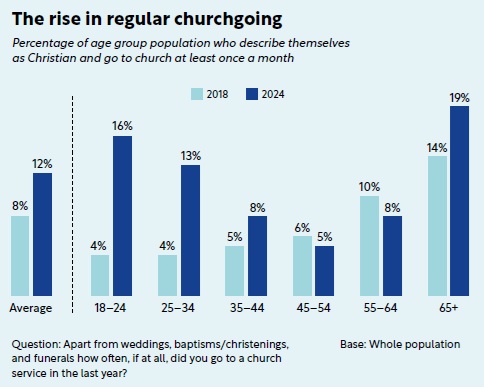
Having a Christian faith is again being normalised and is arguably even culturally attractive. 12% of adults in England and Wales are attending church monthly. … “Church attendance in England and Wales is on the rise. This represents a startling change to decades-long trends and presumptions, with the most dramatic increase seen among young people, particularly young men. In 2018, just 4% of 18–24-year-olds said they attended church at least monthly. Today this has risen to 16%, with young men increasing from 4% to 21%, and young women from 3% to 12%. This is now the second most likely age group to attend church regularly. Overall, churchgoing Christians now make up 12% of the population, up from 8% in 2018. In numerical terms, that’s growth from 3.7m in 2018 to 5.8m in 2024 – an increase of 56%.” [1: p6]
Young adults are finding their way into church in remarkable numbers. 32% of churchgoers aged 18–54 are from an ethnic minority. … In addition to absolute growth in churchgoing, including among the white population, the Church in England and Wales is also becoming more diverse. Just under 1 in 5 churchgoers (19%) are from an ethnic minority, but among 18–54-year-olds this rises to 1 in 3 (32%). At the same time Catholicism has risen sharply and Pentecostalism has become the third biggest Christian tradition, with the share of churchgoers identifying as Anglicans dropping steadily. [1: p6]
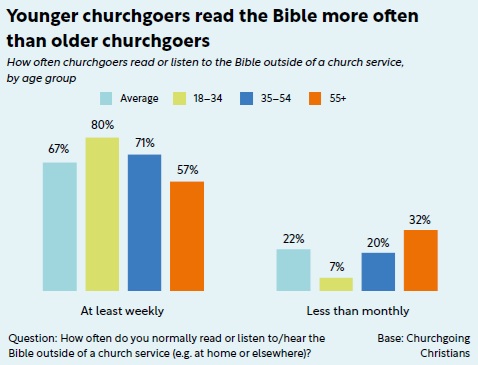
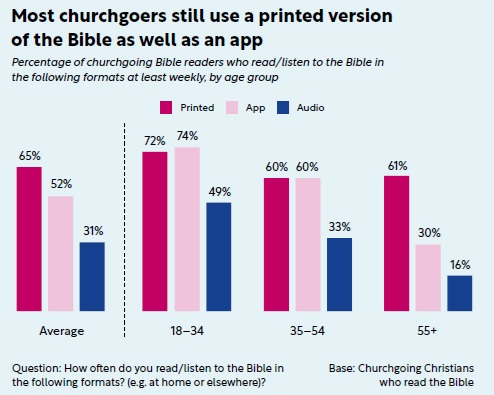
This is a growing Church interested in belonging, believing and practising. 67% of churchgoing Christians read the Bible at least weekly outside of church. … Alongside this significant demographic change within churches, we see evidence of an active and vibrant Church. Rates of belief in God remain high, while both Bible reading and rates of confidence in the Bible have increased among churchgoers compared to 2018, indicating that new attenders are just as engaged in Christian belief and practice. [1: p7]
The idea that Britons are to some extent Christian ‘by default’ is rapidly diminishing. 27% of adults say they are Christian but don’t regularly go to church, compared to 32% in 2018. … At the same time, those who don’t engage in practices such as churchgoing or Bible reading are less likely than ever to identify themselves as Christian. Christianity increasingly involves an active commitment rather than a passive cultural label, and there is a clear difference between churchgoing and non-churchgoing Christians. [1: p7]
Our youngest group is showing above average engagement in spiritual practice. 35% of 18–24-year olds say there is ‘definitely a God/gods or higher power’. … The young people in our sample don’t just go to church more, they show above-average levels of warmth to spirituality, the Church and spiritual practice. This group of 18–24-year-olds are the most likely to pray regularly, with 40% saying they pray at least monthly. More than half of them (51%) have engaged with a spiritual practice over the past six months, compared to 42% of those older than them. They are also the group most interested in learning more about the Bible, with 37% of 18–24s saying they are curious to discover more about it. [1: p8]
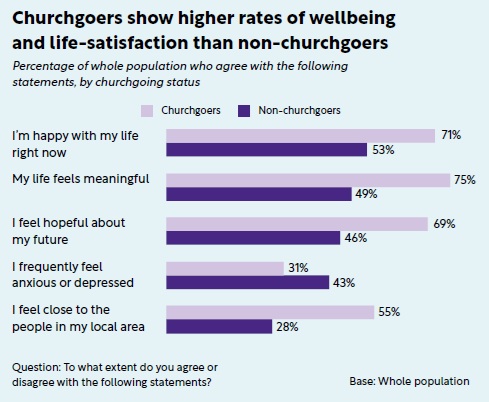
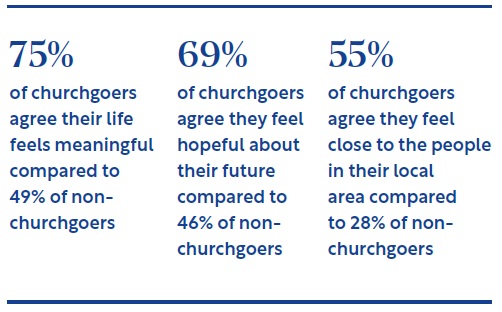
Churchgoers show the lowest reports of feeling frequently anxious and depressed. 63% of 18–34-year-old churchgoers say they feel close to people in their local area, compared to 25% of non-churchgoers their age. … With much of the population, in particular young people, struggling with mental health, loneliness and a loss of meaning in life, Church appears to be offering an answer. We found that churchgoers are more likely than non-churchgoers to report higher life satisfaction and a greater feeling of connection to their community than non-churchgoers. They are also less likely to report frequently feeling anxious or depressed – particularly young women. [1: p8]
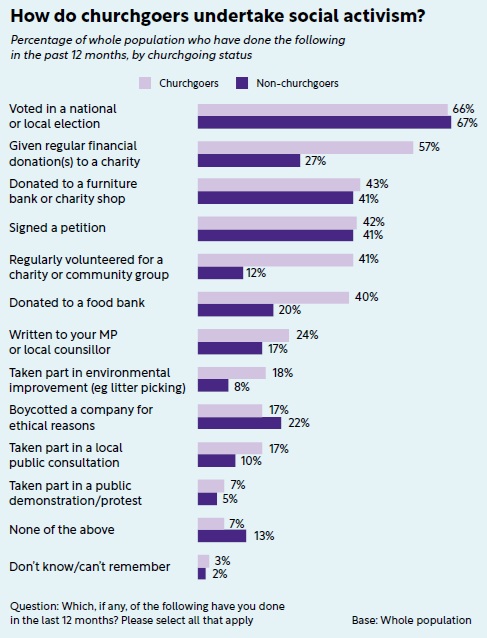
Churchgoers are more likely to desire social change and to engage in social activism activities. 79% of churchgoers agree it’s important to them to try to make a difference in the world. … This is not solely about personal development, however, and we also see that churchgoers are more likely to actively participate in activities aimed at benefitting the community around them. Churchgoers are more likely to volunteer, donate to foodbanks and give to charitable causes, demonstrating the positive effect of Christian faith on their lives – and the impact that a rise in churchgoing can have on society as a whole. [1: p9]
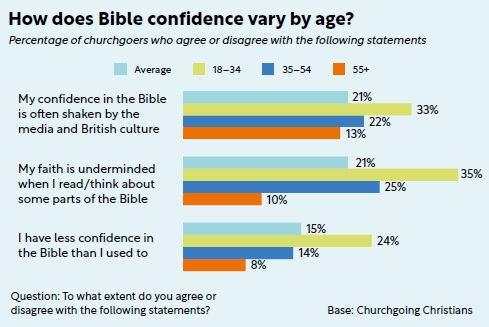
Young Christians report finding the Bible more challenging than older Christians. 35% of 18–34-year-old churchgoers agree that their faith is undermined when they think/read about some parts of the Bible. … There is clear need for more discipleship around Scripture. Approximately one-third of churchgoers say they lack confidence in navigating or understanding the Bible and speaking about it with others. Among young Christians, rates of Bible reading, Bible confidence, and interest in learning more are high. However, we also see that compared to older churchgoers, they are more likely to say the media and British culture often shake their faith in the Bible and report they have less confidence in the Bible than they used to. They are also the age group to report they find learning about the Bible to be challenging. This poses a challenge to the Church but also an opportunity to tap into and learn from their energy and enthusiasm while enabling them to go deeper into Scripture. [1: p9]
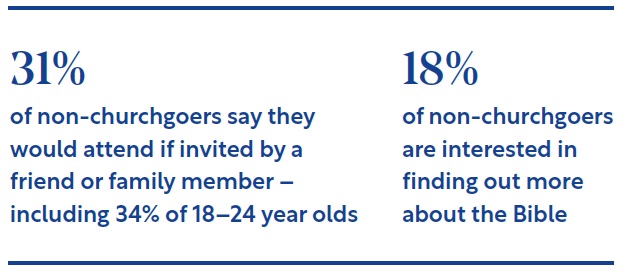
We see openness even among non-churchgoers towards Christianity and the Bible. 34% of 18–24-year-old non-churchgoers would attend church if invited by a friend. … The astonishing growth in churchgoing is matched by an openness to Christianity and the Bible: 31% of non-churchgoers say they would attend church if invited by a friend or family member, rising to 34% among 18–24-year-olds. Over half of non-churchgoers (56%) would be happy for a Christian friend to pray for them, while 18% say they would be interested in learning more about the Bible. Relationships are key here: over a fifth (22%) of non-churchgoing 18–34s say they would read the Bible if recommended by a family member or friend they trust, compared to 13% who would if a trusted celebrity or public thinker recommended it. [1: p10]
The tide of faith is coming in again, and the Church needs to adjust to a new and strangely hopeful reality. … We have four recommendations in response to this data. First, we urge policy-makers and opinion-formers to take more account of the existence of churchgoing Christians in society. Second, the Church should work on increasing Bible discipleship to grow Bible confidence and through this tap into the increased openness and cultural opportunity. Third, the Church should engage in intergenerational conversations within congregations and more widely, to enable churchgoers to learn from one another’s wisdom. Finally, it should recognise the importance and impact of authentic personal relationships.[1: p10]
About the Research
The report’s authors provide the following commentary on the report:
“The report references two data sets commissioned by Bible Society to track attitudes to the Bible and Christianity and related religious behaviours in the adult population of England and Wales. Both surveys were conducted by YouGov on large, nationally representative samples.
The 2018 sample surveyed 19,101 adults in England and Wales, while the 2024 sample surveyed 13,146 adults. Both samples therefore give a 1% margin of error at a 99% confidence level, meaning they are highly reliable. The surveys were conducted through YouGov’s online panel to population targets, and further refined with post stratification weighting. It is worth noting that because we surveyed adults, we are not able to comment in depth on the portion of the population, or the Church, which is under 18.
All figures, unless otherwise stated, are from YouGov Plc. In 2018: total sample size was 19,101 adults. Fieldwork was undertaken between 11th October and 13th November 2018. The survey was carried out online. The figures have been weighted and are representative of all England/Wales adults (aged 18+). Ethnicity targets are based on 2011 census data.
In 2024: total sample size was 13,146 adults. Fieldwork was undertaken between 4th November and 2nd December 2024. The survey was carried out online. The figures have been weighted and are representative of all England/Wales adults (aged 18+). Ethnicity targets are based on 2021 census data. Throughout the report, we refer to ‘churchgoers’. By this we mean people who both describe themselves as Christian and go to church at least once a month – around 30% of all those who identify as Christian. At times we also mention trends seen among other faiths. As the primary focus of this report is on exploring Christians (both practising and nonchurchgoers) and those with no religion, we have not explored non-Christian faiths by religion; rather, they are grouped together. There are obvious limits to this approach, and therefore all our observations on non-Christian faiths could be nuanced further in future studies.
Due to GDPR sensitivities, questions pertaining to religious practice like church attendance and Bible reading were optional. On these questions a small percentage of the sample refused to answer – circa 3%. This is in line with the standard dropout rate. Where we make population claims, such as the number of adults who say they go to church regularly, we have recoded refusals as ‘prefer not to say’ to keep the full base in the sample. However, as we do not know the churchgoing status of these participants, when we compare churchgoers to non-churchgoers in Chapters 2–4, participants who did not answer have been removed from analysis, rather than categorised as non-churchgoers. Including or removing them has little or no effect on the overall figures.
We know the results of this report will be surprising to some and will naturally raise further questions about the methodology behind it. To help answer some of these we’ve included an FAQ section at the end of the report.” [1: p11] That FAQ section appears below.
FAQs
Is this just down to immigration? – In short, no. The Church in England and Wales in undeniably changing shape and becoming more diverse, just as Britain as a whole is becoming more diverse. However, the growth in churchgoing among young people is seen at scale among young White people. While these could all be migrants, at the scale we’re seeing it seems highly unlikely.
It is worth noting that in between the surveys new census data was made available, which means the sampling targets were changed between the waves to ensure the sample reflects the most up-to-date view of what England and Wales looks like. This has primarily impacted how many people of Black, Asian, and other Minority Ethnicities are in the sample. As people in these ethnic groups are more likely to be Christian, this has naturally had an effect on the shape of the data, particularly when it comes to averages, and some of the trends we observe reflect this. This is not problematic, and indeed, gives us a better picture of the Church today, but we have exercised caution in drawing comparisons between the 2018 and 2024 waves when it comes to ethnicity trends outside of the white population.
Is the methodology sound? – Yes, both surveys we draw from are based on large, representative samples from one of the country’s leading research companies. Both sample sizes give a 1% margin of error at a 99% confidence level, meaning they are highly reliable. While minor changes were made to the questionnaire between the 2018 and 2024 waves, all questions used for comparison have remained the same, and the surveys were conducted under the same conditions at the same time of year. For more information see https://yougov.co.uk/about/panel-methodology
Could there be something about the sample? – In polling research we are always reliant on trusting that what participants say is a true reflection of what they think and how they act. While it is possible participants may not be answering truthfully, or have misunderstood our questions, we would need to question in turn why these effects have only become observed in 2024, and not previous survey waves. All research panels have bias, and non-probability sampling is always at risk of producing a non-representative sample. It is also theoretically possible the sample has polled a disproportionate number of young Christians. At this sample size, and the way the YouGov panel is built and maintained, this is again highly unlikely.
If you are interested in reading the report, please click on the link below and you’ll be taken to a page where you can download the report and a PowerPoint presentation.


 Roger Farnworth