
Tag Archives: christianity

The Sermon on the Plain (Luke 6: 20-31)

Luke 6: 20-31 is known as “The Sermon on the Plain” and is parallel to Matthew Chapters 5 to 7, which are known as “The Sermon on the Mount”. It is known as ‘The Sermon on the Plain’ because Luke writes in Luke 6:17 “Jesus came down with them and stood on a level place”. …

There are four blessings in this passage, rather than the eight blessings in Matthew’s Gospel, and ‘woes’ follow quickly and starkly after the blessings. Whereas in Matthew’s Gospel the ‘woes’ are much more gently couched and hidden in the longer text.


Luke’s account of Jesus’ words is much more direct, more immediate, more pressing, and does not, obviously, carry a spiritual meaning. Here in Luke’s Gospel Jesus says, ‘Blessed are you poor, for yours is the kingdom of God’. In Matthew he says, ‘Blessed are the poor in spirit, for theirs is the kingdom of heaven’. … We need to hear and heed both of these versions of Jesus’ sermon if we are not to misinterpret what he says. …

Recognising our spiritual poverty (as in Matthew’s Gospel) is important if we are to hear the gentle word of God’s love spoken to us in the bible. Spiritual poverty is the opposite of arrogantly assuming that we know God’s will and purposes, it encourages an enquiring mind, seeking out what God’s Holy Spirit is doing in our lives. It accepts that we will always have something to learn. It might even mean that we really do try to see things from the perspective of those with whom we disagree.

But what might it mean to say that the poor are blessed? …

Jesus uses the present tense. … The poor already have the Kingdom of Heaven. … They are blessed now. … This is hard to accept. It seems uncaring. How can those who have next to nothing be blessed? …… Perhaps Jesus means that for those who are poor there is nothing to distract them from their need for the love of God. Whereas for those of us who have resources and money, who are wealthier than so many, we can be distracted by our wealth. Rather than relying on God for our daily needs, our daily bread, we rely on own resources. Perhaps we are in danger of missing God’s blessing.

This seems to be borne out in human experience. It is when we are aware of our deepest needs that we are most prone to pray. … Even those of us who profess no faith in God.

In Luke’s Gospel, Jesus goes on to say: ‘Blessed are you who hunger now, for you will be satisfied. Blessed are you who weep now, for you will laugh.”

The parallel lines in Matthew’s Gospel say: ‘Blessed are those who hunger and thirst for righteousness, for they will be filled’, and ‘Blessed are those who mourn, for they will be comforted’.

Jesus, in Matthew’s Gospel, seems to be more concerned about some kind of spiritual intensity. … Jesus’ statements, in Luke, are more pithy and seemingly more concerned about physical things. It is those who do not have enough to eat now who will be satisfied; those who weep now will laugh. It is people’s immediate; substantive needs that Luke’s words focus on.

In each of these two cases in Luke’s Gospel, one part of the sentence is in the present and the other in the future. Jesus, in Luke, seems to be saying, ‘I know you are hungry, I know you weep and your tears exhaust you. But what you suffer now does not need to define you’.

The truth is that as Christians, we are defined by God’s perspective, God’s idea of who we are. We are defined by God’s love. We are defined by the Kingdom of Heaven. There is a place beyond our current situations when hunger will be satisfied, and tears will no longer fall. … While we are building the Kingdom of God on earth we can experience pain, suffering and persecution, but something is certain: the Kingdom will be attained, and you will have your fill and you will laugh! …

I don’t think this is meant to be just about a heavenly future, a hope of heaven; although it is certainly that. But it is more. It is about the land of the living, it is about living as people who have hope, who trust that the whole of their future is in God’s hands, who persevere because they believe, along with the psalmist who says (in Psalm 27:13): “I believe I will see the goodness of the Lord in the land of the living.” And along with Isaiah (in Isaiah 40: 31): “Those who wait on the lord will renew their strength, they shall mount up with wings like eagles, they shall run and not be weary, they shall walk and not faint.” With our future secure in God’s hands, we are free to love and to live with courage today.

Jesus’ first three blessings encourage us to live as those who are not distracted by all the things we have; to live as those who believe that the future is in God’s hands.

Jesus’ fourth blessing seems utterly absurd. How can those who experience hatred and abuse be blessed. How can those who are persecuted be blessed? Jesus seems to answer that question by explaining that when we experience difficulty for our faith we are identifying with the Old Testament prophets. We are identifying with myriad faithful saints of God.

We know that Jesus’ words spoke directly to the early church and were heard, not as absurd, but as an encouragement to see beyond their current circumstances – suffering and persecution were not the ultimate reality, but rather a sign of new life and hope.

I cannot imagine the things those who are persecuted face. I do know that it is not just Christians across the world who experience times of deep darkness, or hatred from neighbours and acquaintances. We repeatedly see them on our television screens. In Gaza, in Ukraine, in the Democratic Republic of Congo, in Sudan and South Sudan. So often it is the weak and vulnerable who suffer most. There is little that I can do for them but pray and give.

To the question, ‘Where is God when the innocent die, or face persecution?’ The answer available to us, the only answer I can offer, seemingly the only one God offers us, is a story of God becoming human, living first as a refugee, then as an itinerant preacher, before dying in acute suffering, treated as a common criminal, on a cross.

The God we believe in has identified with human suffering, has felt the pain of rejection, has been persecuted. … This God points to the cross and says time and again, “I love you, this is my answer to your questions. This is how much I care. ”

The Godhead, Father, Son and Holy Spirit torn apart as Jesus cries out, “My God, My God, why have you forsaken me?”

It is as if God says to us, “This is where you will find the answers to all the questions you ask – in sitting at the foot of the cross and pondering on the depth of love that it demonstrates.”

As Paul says in our reading from Ephesians: “I pray that the God of our Lord Jesus Christ, the Father of glory, may give you a spirit of wisdom and revelation as you come to know him, so that, with the eyes of your heart enlightened, you may know what is the hope to which he has called you, what are the riches of his glorious inheritance among the saints.”

This God, who loves us so much, welcomes us at his table to share in bread and wine. This God, calls on all his saints, you and me too, to live in the light of that loving welcome and acceptance. To live as those who are not distracted by all the things we have; to live as those who believe that the future is in God’s hands; and to love others with an all-inclusive, death-accepting love that knows no limit.

Prayer
God our Father, you redeem us and make us all your children in Christ. You extend a loving welcome to all. Look with favour upon us, give us true freedom and bring us to the inheritance you promise. We ask this through our Lord Jesus Christ, Your Son our Lord. Amen.

Luke 12: 32-40

Last week’s Gospel reading from Luke 12: 13-31, had Jesus telling the story of a rich man who had done well for himself and decided to enjoy the fruit of his labours – he built bigger barns to store his wealth and got ready for a long retirement. Jesus called him a fool, for he had given no thought to his eternal welfare. We could imagine him hoarding everything for himself and giving nothing, or very little, to God; hoarding everything for himself and giving no thought to the poor. And we saw him condemned as a fool.

Jesus ended his talk with his disciples after the story of the rich man with very similar words to those used by Matthew in his record of the Sermon on the Mount. “Don’t worry about material things,” Jesus says, “Instead strive for God’s kingdom and all these things will be given to you as well.”

Our Gospel reading today follows directly on from those words. … Immediately after, Jesus says, “Do not be afraid, little flock, for it is your Father’s good pleasure to give you the kingdom.”

The Gospel reading expands these thoughts: “Do not be afraid little flock. … Sell your possessions, and give alms. Make purses for yourselves that do not wear out, an unfailing treasure in heaven, where no thief comes near and no moth destroys. For where your treasure is, there your heart will be also.”

How do we feel when we hear Jesus’ exhortation to sell our possessions and give to the poor? … If you’re anything like me you’re likely to respond in one of two ways: either you will feel guilty, then perhaps remember the appeal from the Aid Agencies for the latest part of the world in trouble, get out your credit card and make a telephone donation. Or you will try to justify yourself. Don’t I already give enough? How can I possibly give more? And, like me, if you’re not careful, there’s a danger that you’ll dismiss the Gospel reading from your mind with a sense that it no longer applies to you.

These challenging words of Jesus are hard to handle! And if we’re not careful we become just like the rich young ruler in Matthew’s Gospel who asked Jesus, “What must I do to gain eternal life?” … He heard Jesus say ““If you want to be perfect, go, sell your possessions and give to the poor, and you will have treasure in heaven. Then come, follow me.” He found Jesus’ words too hard, and walked sadly away from Jesus because his riches were too great.

Is a sense of guilt or self-justification the right way to respond to today’s Gospel reading? … How should we respond? … After all, we are all relatively rich when compared with the income of everyone in the world, even if we are pensioners or clergy! Perhaps I should sell all my theological books. My model railway. The nice furniture that we have in the vicarage. Perhaps I should cash in my savings and give them to Oxfam. Perhaps this is what Jesus wants? … And maybe I need to allow this passage to challenge me about my acquistorial nature – I love to collect things! … But would this help me to really learn to trust my heavenly Father? … For with all this wealth, with insurance, with an effective health service and social services, with the safety net that this society provides it is very difficult for us to know what it means to trust God for our daily needs. …

So how does God expect us to respond to the challenge?

Greater generosity is clearly part of our calling. And if the regular giving of many to the Church of England is any measure of our generosity, then we still have a lot to learn about giving and trusting God. But that is not the main challenge of our Gospel reading. …

Jesus’ challenge is actually far deeper, much harder to handle. For just as in the first part of Luke 12, with the story of the rich farmer, just as with Jesus’ sayings about the kingdom and the wealth of this world, in our passage this morning, Jesus is challenging us not to give more, but to let go of everything we think we own. “It is not yours, it is God’s,” says Jesus. “Everything is God’s.”

The challenge is to let go of all of our securities – our wealth, our status – and to trust God. “And,” says Jesus, “when you do so, you will begin to lay up treasure for yourselves in heaven. You will begin to experience the kingdom of God at work in your life. You will have no problem with giving, for you will be glad to return to God what is his already.”

Our Gospel reading this morning is not so much a challenge to us to be more generous. Although it is definitely that. It is more pertinently a challenge to see everything we have as not ours but God’s, held on trust to be used to bring in the kingdom of God

One of the regular parts of the liturgy in the Church of England expresses this so well. In many Anglican churches these words follow the Offertory: ‘Yours Lord, is the greatness, the power, the glory, the splendour, and the majesty, for everything in heaven and on earth is yours. All things come from you and of your own do we give you.’

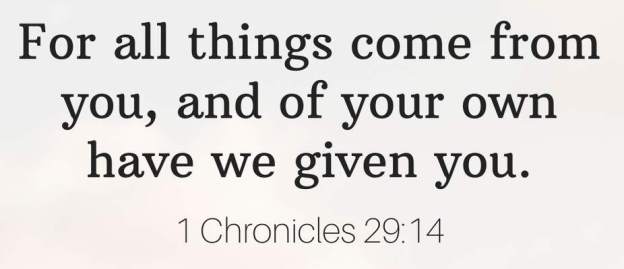
All things come from you, and of your own do we give you.

These are words taken from the Old Testament, from 1 Chronicles 29: 11-14. And I will finish this short reflection with those words: …

“Yours, LORD, is the greatness and the power and the glory and the majesty and the splendour, for everything in heaven and earth is yours. Yours, LORD, is the kingdom; you are exalted as head over all. … Everything comes from you and we have given you only what comes from your hand.” (1 Chronicles 29: 11 & 14b)

And our response to the love of God for us, has to be: … “All things come from you, and of your own do we give you.”

A New Commandment: John 13: 31-35 – 18th May 2025

Dolly Parton first sang, ‘Love is like a butterfly’, in the Summer of 1974:

“Love is like a butterfly, as soft and gentle as a sigh,

The multi-coloured moods of love are like its satin wings,

Love makes your heart feel strange inside, it flutters like soft wings in flight,

Love is like a butterfly, a rare and gentle thing.”

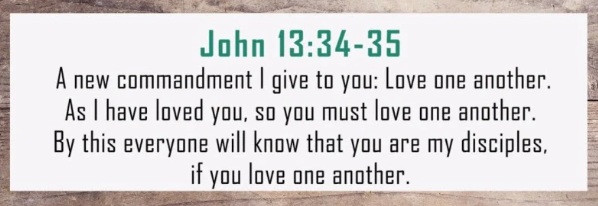
Jesus said: “I give you a new commandment, that you love one another.” His words seem to be at odds with our culture. In our society, love isn’t something you can command, love is something that you feel. Love is something that you fall into and fall out of. Love is as much about sexual attraction and desire as it is about anything else. When we say, ‘I love you’, to the love of our life – we are talking about deep feelings not about something that we feel we have much control over.

And yet Jesus says: ‘I command you to love one another’.

We know that love is so much more than sexual desire. We feel love for our parents, our children – we even feel some kind of love for the football team we support, for our friends and our work colleagues. But even in these relationships love can be so temporary or dependent on events and our emotions.

Love is just like a butterfly, made up of multicoloured moods, flitting here and there, dependent on circumstance and passion.

The love Jesus commands, the love that Jesus often talks about, is just not like that. Love, as Jesus sees it. Love modelled on the love of God, is constant and committed love, unwavering in its strength and focus, determined to be there for the one who is loved no matter what they do. Determined to love, even when it seems as though that love is rejected.

In English we have one word for love. The New Testament uses four different words for love.

Eros – for romantic and sexual love

Storge – genuine affection for someone

Philio – for brotherly love or fellowship

Agape – the love God has for us and the depth of love he calls on us to have for each other. A committed, divine, unconditional, self-sacrificing, active love, generously and freely given with no thought for the self, only for the other. It is this word ‘Agape’ that is used in our Gospel reading.

The King James bible translated ‘agape’ as ‘charity’. In today’s world ‘charity’ means something different. It has lost the emphasis on God’s self-sacrificial love for humankind. It has become something that often people do not want to receive, demeaning to their sense of honour. Or, it is the name of a kind of organisation that has some sort of good purposes. We need hold onto the word ‘love’ rather than the word ‘charity’ in today’s world if we are to begin to understand the meaning of the Greek word ‘agape

C. S. Lewis, in his book The Four Loves, uses ‘agape’ to describe what he believed was the highest level of love known to humanity – a selfless love, a love that was passionately committed to the well-being of the other. It is ‘agape’. It is this kind of love that Jesus commands us to show, not erotic love, not even brotherly or sisterly love, not affection.

In last week’s Gospel (Easter 4), Jesus talked about a love that will not let us go.

My sheep listen to my voice; I know them, and they follow me. I give them eternal life, and they shall never perish, no one can snatch them out of my hand. My Father who has given them to me, is greater than all; no one can snatch them out of my Father’s hand.”

“No one,” says Jesus, “will ever snatch you out of my hands.” It is not a sense of charity that God feels towards each of us, not a sense of charity that he feels for humankind. It is a love that give its all. No holds barred. A love that throws itself away in order to rescue those who are lost. A love that celebrates over every single person who returns to be enfolded by that love. It is that kind of love which we are commanded to show. Christ calls on us to decide to love others in the same way as God loves us.

Please, allow yourself to hear again that God loves and cares for you. And remind yourself again that God calls you not to love that is flighty or buffeted by circumstance, but to a love which is self-giving, committed and strong.

A Quiet Revival

Now, here is a thing. We have got used to the idea that church is becoming increasingly irrelevant in the modern world. We have come to believe that the Christian faith, in particular, is declining rapidly. Recent work by YouGov and the Bible Society calls these assumptions into question. Their work suggests that the opposite is in fact true!

For decades,” says Paul Williams, Chief Executive Officer of the Bible Society, “Church attendance and nominal adherence to Christianity has been declining, and it has been assumed that this decline would continue and was in some sense an inevitable product of modernity. While the decline has certainly been real, we now know that the trend has been reversed. The tide of faith, whose ‘melancholy, long-withdrawing roar’ was described by Matthew Arnold, has now turned.” [1:p4]

He goes on to say that the results of a thorough and robust study “demonstrate that over the space of only six years, there has been a significant growth in the numbers of
people going to church; Christians are practising their religion more intentionally; more young people are finding faith; more people are reading the Bible. … Large numbers of young adults, male and female, have started going to church, reading the Bible regularly, practising prayer and worshipping Jesus Christ as God. A new generation is finding hope in the Christian message and in established Christian communities. This hope is both personal and social. It appears to meet a hunger for connection, belonging and purpose but it also helps frame meaningful engagement in the world to address some of the intractable problems that we all face – injustice, inequality, climate change – and to form an alternative to the individualistic, competitive, materialistic worldview that has come to dominate western societies in recent decades
.” [1: p4]

Paul Williams goes on to say: “There will be an instinct to use these results to support
one or other of the various narratives that mark our contested cultural moment. But I urge the reader to pay attention to the detail of this study to understand what is happening. A remarkable new and life-giving phenomenon seems to be under way in Britain. The past few decades have witnessed a widespread empirical falsification of the secularisation thesis, mainly because in all parts of the world except Western Europe the world has become more, not less religious. This report suggests that even this outlier may not remain so for much longer
.”

Background

McAleer & Barward-Symmons comment:

“For many decades now, the general assumption has been that Christianity, and in particular churchgoing, in England and Wales is in a state of permanent decline. Survey data, media headlines and prominent thinkers all seemed to point in one direction, with published attendance and membership figures from major denominations appearing to confirm this. From the sociological insistence in the 1960s that secularisation was inevitable and the new atheism of the 2000s, through to the more recent findings from the 2021 census showing the perilous collapse of Christian identity and headlines from last year proclaiming we were entering Britain’s first ‘atheist age’, the story seems clear – Christianity, particularly active Christianity, is on the way out.

Yet over the past few years, a different story has been emerging from the peripheries. In the United States, young men are heading to church in remarkable numbers, [2] transforming the landscape of the Church. Recent data even shows that young adults in the UK are more spiritual and less atheistic than older generations. [3] Prominent public atheists have been questioning their beliefs, while key public figures – from intellectuals such as Jordan Peterson and Tom Holland through to popular culture
figures and athletes – have been open about their engagement with Christianity. More significantly, stories are emerging from the ground, including those collected by people such as Justin Brierley and Lamorna Ash, showing that young people in particular are exploring Christianity in a new way, suggesting that the previous assumptions may need to be shifted. But firm numbers have been hard to come by – until now.

Using nationally representative data through a prestigious polling agency, The Quiet Revival demonstrates that far from declining, the Church has grown. In particular we see that ‘Gen Z’ young adults are more likely to attend church regularly than any generation ahead of them bar the over-65s, and in particular we see that young men are attending in remarkable numbers. The Church is transforming before our eyes, and the figures presented in this report show the proof. As outlined throughout, this fact has implications both for civil society and for Christian denominations, networks and congregations. It is hard to overstate its importance both for our national self-understanding and for the Church’s understanding of itself.” [1: p12]

The Key Findings of the Report

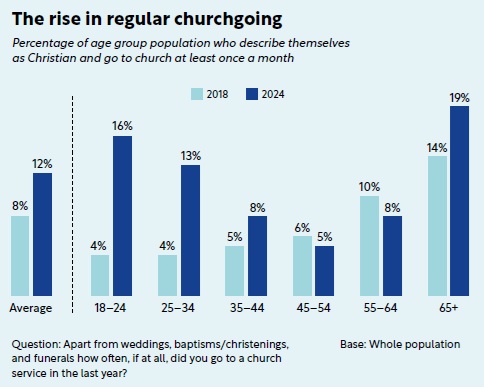
  1. Having a Christian faith is again being normalised and is arguably even culturally attractive. 12% of adults in England and Wales are attending church monthly. … “Church attendance in England and Wales is on the rise. This represents a startling change to decades-long trends and presumptions, with the most dramatic increase seen among young people, particularly young men. In 2018, just 4% of 18–24-year-olds said they attended church at least monthly. Today this has risen to 16%, with young men increasing from 4% to 21%, and young women from 3% to 12%. This is now the second most likely age group to attend church regularly. Overall, churchgoing Christians now make up 12% of the population, up from 8% in 2018. In numerical terms, that’s growth from 3.7m in 2018 to 5.8m in 2024 – an increase of 56%.” [1: p6]
  2. Young adults are finding their way into church in remarkable numbers. 32% of churchgoers aged 18–54 are from an ethnic minority. … In addition to absolute growth in churchgoing, including among the white population, the Church in England and Wales is also becoming more diverse. Just under 1 in 5 churchgoers (19%) are from an ethnic minority, but among 18–54-year-olds this rises to 1 in 3 (32%). At the same time Catholicism has risen sharply and Pentecostalism has become the third biggest Christian tradition, with the share of churchgoers identifying as Anglicans dropping steadily. [1: p6]
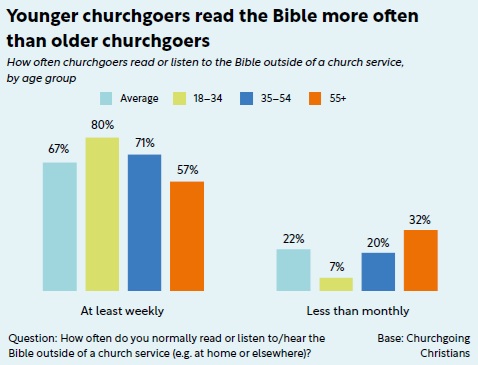
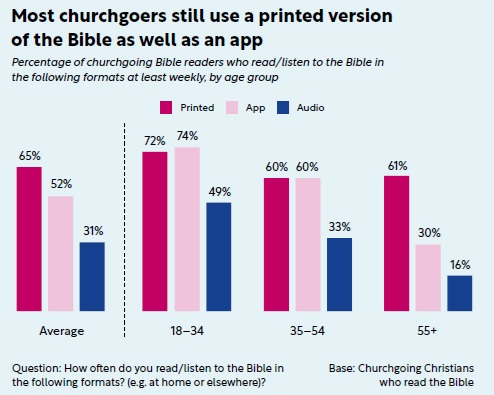
  3. This is a growing Church interested in belonging, believing and practising. 67% of churchgoing Christians read the Bible at least weekly outside of church. … Alongside this significant demographic change within churches, we see evidence of an active and vibrant Church. Rates of belief in God remain high, while both Bible reading and rates of confidence in the Bible have increased among churchgoers compared to 2018, indicating that new attenders are just as engaged in Christian belief and practice. [1: p7]
  4. The idea that Britons are to some extent Christian ‘by default’ is rapidly diminishing. 27% of adults say they are Christian but don’t regularly go to church, compared to 32% in 2018. … At the same time, those who don’t engage in practices such as churchgoing or Bible reading are less likely than ever to identify themselves as Christian. Christianity increasingly involves an active commitment rather than a passive cultural label, and there is a clear difference between churchgoing and non-churchgoing Christians. [1: p7]
  5. Our youngest group is showing above average engagement in spiritual practice. 35% of 18–24-year olds say there is ‘definitely a God/gods or higher power’. … The young people in our sample don’t just go to church more, they show above-average levels of warmth to spirituality, the Church and spiritual practice. This group of 18–24-year-olds are the most likely to pray regularly, with 40% saying they pray at least monthly. More than half of them (51%) have engaged with a spiritual practice over the past six months, compared to 42% of those older than them. They are also the group most interested in learning more about the Bible, with 37% of 18–24s saying they are curious to discover more about it. [1: p8]
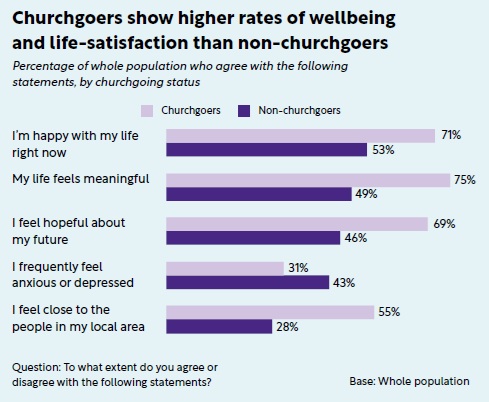
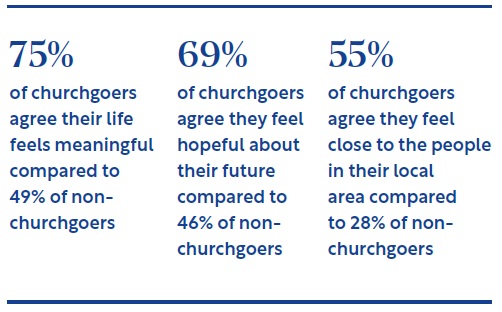
  6. Churchgoers show the lowest reports of feeling frequently anxious and depressed. 63% of 18–34-year-old churchgoers say they feel close to people in their local area, compared to 25% of non-churchgoers their age. … With much of the population, in particular young people, struggling with mental health, loneliness and a loss of meaning in life, Church appears to be offering an answer. We found that churchgoers are more likely than non-churchgoers to report higher life satisfaction and a greater feeling of connection to their community than non-churchgoers. They are also less likely to report frequently feeling anxious or depressed – particularly young women. [1: p8]
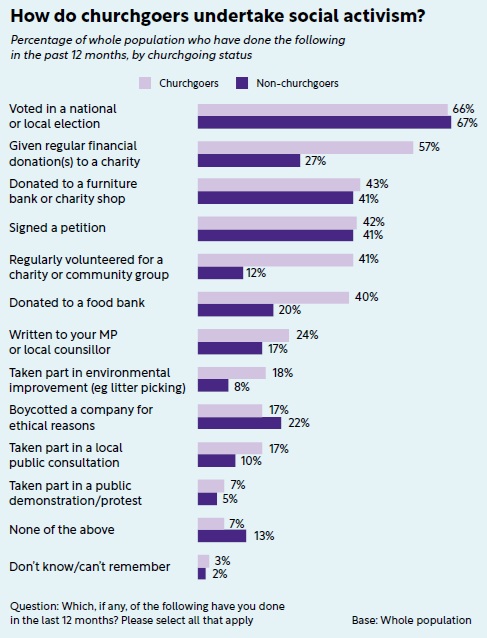
  7. Churchgoers are more likely to desire social change and to engage in social activism activities. 79% of churchgoers agree it’s important to them to try to make a difference in the world. … This is not solely about personal development, however, and we also see that churchgoers are more likely to actively participate in activities aimed at benefitting the community around them. Churchgoers are more likely to volunteer, donate to foodbanks and give to charitable causes, demonstrating the positive effect of Christian faith on their lives – and the impact that a rise in churchgoing can have on society as a whole. [1: p9]
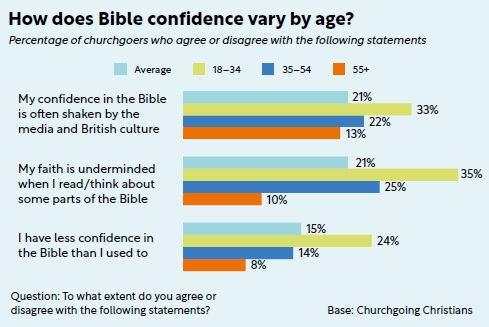
  8. Young Christians report finding the Bible more challenging than older Christians. 35% of 18–34-year-old churchgoers agree that their faith is undermined when they think/read about some parts of the Bible. … There is clear need for more discipleship around Scripture. Approximately one-third of churchgoers say they lack confidence in navigating or understanding the Bible and speaking about it with others. Among young Christians, rates of Bible reading, Bible confidence, and interest in learning more are high. However, we also see that compared to older churchgoers, they are more likely to say the media and British culture often shake their faith in the Bible and report they have less confidence in the Bible than they used to. They are also the age group to report they find learning about the Bible to be challenging. This poses a challenge to the Church but also an opportunity to tap into and learn from their energy and enthusiasm while enabling them to go deeper into Scripture. [1: p9]
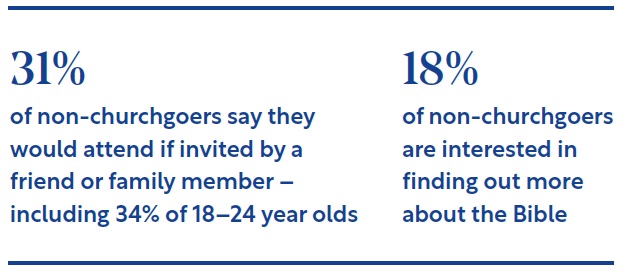
  9. We see openness even among non-churchgoers towards Christianity and the Bible. 34% of 18–24-year-old non-churchgoers would attend church if invited by a friend. … The astonishing growth in churchgoing is matched by an openness to Christianity and the Bible: 31% of non-churchgoers say they would attend church if invited by a friend or family member, rising to 34% among 18–24-year-olds. Over half of non-churchgoers (56%) would be happy for a Christian friend to pray for them, while 18% say they would be interested in learning more about the Bible. Relationships are key here: over a fifth (22%) of non-churchgoing 18–34s say they would read the Bible if recommended by a family member or friend they trust, compared to 13% who would if a trusted celebrity or public thinker recommended it. [1: p10]
  10. The tide of faith is coming in again, and the Church needs to adjust to a new and strangely hopeful reality. … We have four recommendations in response to this data. First, we urge policy-makers and opinion-formers to take more account of the existence of churchgoing Christians in society. Second, the Church should work on increasing Bible discipleship to grow Bible confidence and through this tap into the increased openness and cultural opportunity. Third, the Church should engage in intergenerational conversations within congregations and more widely, to enable churchgoers to learn from one another’s wisdom. Finally, it should recognise the importance and impact of authentic personal relationships.[1: p10]

About the Research

The report’s authors provide the following commentary on the report:

The report references two data sets commissioned by Bible Society to track attitudes to the Bible and Christianity and related religious behaviours in the adult population of England and Wales. Both surveys were conducted by YouGov on large, nationally representative samples.

The 2018 sample surveyed 19,101 adults in England and Wales, while the 2024 sample surveyed 13,146 adults. Both samples therefore give a 1% margin of error at a 99% confidence level, meaning they are highly reliable. The surveys were conducted through YouGov’s online panel to population targets, and further refined with post stratification weighting. It is worth noting that because we surveyed adults, we are not able to comment in depth on the portion of the population, or the Church, which is under 18.

All figures, unless otherwise stated, are from YouGov Plc. In 2018: total sample size was 19,101 adults. Fieldwork was undertaken between 11th October and 13th November 2018. The survey was carried out online. The figures have been weighted and are representative of all England/Wales adults (aged 18+). Ethnicity targets are based on 2011 census data.

In 2024: total sample size was 13,146 adults. Fieldwork was undertaken between 4th November and 2nd December 2024. The survey was carried out online. The figures have been weighted and are representative of all England/Wales adults (aged 18+). Ethnicity targets are based on 2021 census data. Throughout the report, we refer to ‘churchgoers’. By this we mean people who both describe themselves as Christian and go to church at least once a month – around 30% of all those who identify as Christian.
At times we also mention trends seen among other faiths. As the primary focus of this report is on exploring Christians (both practising and nonchurchgoers) and those with no religion, we have not explored non-Christian faiths by religion; rather, they are grouped together. There are obvious limits to this approach, and therefore all our observations on non-Christian faiths could be nuanced further in future studies.

Due to GDPR sensitivities, questions pertaining to religious practice like church attendance and Bible reading were optional. On these questions a small percentage of the sample refused to answer – circa 3%. This is in line with the standard dropout rate. Where we make population claims, such as the number of adults who say they go to church regularly, we have recoded refusals as ‘prefer not to say’ to keep the full base in the sample. However, as we do not know the churchgoing status of these participants, when we compare churchgoers to non-churchgoers in Chapters 2–4, participants who did not answer have been removed from analysis, rather than categorised as non-churchgoers. Including or removing them has little or no effect on the overall figures.

We know the results of this report will be surprising to some and will naturally raise further questions about the methodology behind it. To help answer some of these we’ve included an FAQ section at the end of the report.” [1: p11] That FAQ section appears below.

FAQs

Is this just down to immigration? – In short, no. The Church in England and Wales in undeniably changing shape and becoming more diverse, just as Britain as a whole is becoming more diverse. However, the growth in churchgoing among young people is seen at scale among young White people. While these could all be migrants, at the scale we’re seeing it seems highly unlikely.

It is worth noting that in between the surveys new census data was made available, which means the sampling targets were changed between the waves to ensure the sample reflects the most up-to-date view of what England and Wales looks like. This has primarily impacted how many people of Black, Asian, and other Minority Ethnicities are in the sample. As people in these ethnic groups are more likely to be Christian, this has naturally had an effect on the shape of the data, particularly when it comes to averages, and some of the trends we observe reflect this. This is not problematic, and indeed, gives us a better picture of the Church today, but we have exercised caution in drawing comparisons between the 2018 and 2024 waves when it comes to ethnicity trends outside of the white population.

Is the methodology sound? – Yes, both surveys we draw from are based on large, representative samples from one of the country’s leading research companies. Both sample sizes give a 1% margin of error at a 99% confidence level, meaning they are highly reliable. While minor changes were made to the questionnaire between the 2018 and 2024 waves, all questions used for comparison have remained the same, and the surveys were conducted under the same conditions at the same time of year. For more information see https://yougov.co.uk/about/panel-methodology

Could there be something about the sample? – In polling research we are always reliant on trusting that what participants say is a true reflection of what they think and how they act. While it is possible participants may not be answering truthfully, or have misunderstood our questions, we would need to question in turn why these effects have only become observed in 2024, and not previous survey waves. All research panels have bias, and non-probability sampling is always at risk of producing a non-representative sample. It is also theoretically possible the sample has polled a disproportionate number of young Christians. At this sample size, and the way the YouGov panel is built and maintained, this is again highly unlikely.

If you are interested in reading the report, please click on the link below and you’ll be taken to a page where you can download the report and a PowerPoint presentation. 

Download The Quiet Revival

If you have any problems please do not hesitate to contact the Bible Society on 01793 418222 or by emailing them on contactus@biblesociety.org.uk

References

  1. R. McAleer & R. Barward-Symmons; The Quiet Revival; The Bible Society, Swindon, 2025.
  2. ‘In a First Among Christians, Young Men Are More Religious Than Young Women’, Ruth Graham: https://www.nytimes.com/2024/09/23/us/young-men-religion-gen-z.html
  3. ‘Gen Z half as likely as their parents to identify as atheists’, Kaya Burgess in The Times: https://www.thetimes.com/uk/religion/article/gen-z-half-as-likely-as-their-parents-to-identify-as-atheists-wp2vl0l29

The Fox and the Hen – Luke 13: 31-35

(The 2nd Sunday of Lent)

Images of animals are common in fables and fairy stories. They’re not so common in the New Testament. Sheep and Shepherd’s appear now and then, but in today’s Gospel we have two in the space of a few short verses. Two very contrasting images – Herod the fox and Jesus, the mother hen.

Fox and hen are ancient foes, as many a tale tells us.

They often start like this…. “Once upon a time there was a little Red Hen, who lived on a farm all by herself. An old Fox, crafty and sly, had a den in the rocks, on a hill near her house. …” – You may have told tha kind of story to your own children – certainly many parents have.

Are you familiar with the story? If not, there is a version of it at the end of this article…

Fox and hen – cunning evil fox, gentle little clever hen. That’s the pattern. It must ever have been so! For Luke cleverly juxtaposes the two images. Herod, the fox, the creature who eats chicken for supper. Jesus, the mother hen, who desperately loves her silly chicks and does everything she can to protect them.

First the fox: this Herod is not the same Herod who massacred the innocents. This Herod is his son. This Herod only makes a few short appearances in Luke’s gospel, yet he has a pivotal place in it. Luke’s purpose in writing his Gospel is to answer just one question. And it is Herod the fox who asks the question in Luke Chapter 9 – “Who is this man about whom I hear such things?” And, says Luke, … Herod tried to see Jesus.

Luke the evangelist reminds us of the aim and purpose of evangelism -to invite just that question and to encourage that quest.

And Herod is still wondering who Jesus is when towards the end of the Gospel of Luke, Jesus is brought before him at his trial.

We used to give our ancient Kings interesting and descriptive names Edward the Confessor, Ethelred the Unready. This Herod could be given a similar name. Herod the ambivalent, or Herod the undecided. For although he wanted to know more about Jesus he was never ready to act one way or the other. And in Luke 23, he sends Jesus back to Pilate for a final life or death decision.

Luke compares Herod, the cunning fox who stayed in power by careful political manoeuvring, with Jesus. Herod used Jerusalem as his power base, Jesus wept over Jerusalem. Jesus says that he longs for Jerusalem as a mother hen gathers her chicks under her wings in times of trouble.

This is not an image that we focus on so often…. Christ as lamb of God, or as the lion of Judah, resonate with our faith. Jesus the mother hen seems faintly ridiculous – why is that?

We know that God is neither masculine nor feminine – but God cannot be called “it” for the Bible reminds us time and again that God has a personality. Most often male imagery is used to speak about God, but by no means every time. … In our short Gospel reading, God is compared to a mother hen and the feminine image is important. God broods over Jerusalem with a depth of self-sacrificial love. He longs for their safety and eternal security and will do anything to give life to his children.

Perhaps this image of God, of Jesus, as the mother hen seems ridiculous because hens are seemingly brainless, clucking birds They are angular funny birds. It does seem … just ridiculous to compare God to a hen! But perhaps that is the point after all. For the hen destined for the pot is no more or no less helpless than the lamb led to slaughter.

The prophet Isaiah reminds us that the “man of sorrows” had no form or comeliness that we should admire him. Isaiah suggested that if we had seen him suffering we would have hid our faces in embarrassment – “we hid as it were our faces from him.”

Yes, hens are silly little things. But there is a story told of a fast moving grass fire and of a hen caught out in the open with her chicks. As the flames approached the hen could see that she and her brood would never out run the danger and so she gathered her chicks under her wings and settles down as tight to the ground as she can. The flames rapidly passed over the place where she sat and moved on across the grassland. As the ground cooled around her roasted body there was movement under her wings and the young chicks pushed their way out into the open and began to forage for scraps in the scarred landscape.

Luke compares Jesus, the mother hen who would die to protect her chicks, with the political authority of the day, Herod, the Fox, who held onto power by ruthless cunning.

We worship a God who describes himself to us in the person of Jesus, who broods over us, longing for good for us, longing for our security and peace. In our prayers, and as we say the creed together we express our confident trust in that ‘mother-hen’ kind of love that God has for us.

_____________________________________________

The Fox and the Little Red Hen

Once upon a time there was a little Red Hen, who lived on a farm all by herself. An old Fox, crafty and sly, had a den in the rocks, on a hill near her house. Many and many a night this old Fox used to lie awake and think to himself how good that little Red Hen would taste if he could once get her in his big kettle and boil her for dinner. But he couldn’t catch the little Red Hen, because she was too wise for him. Every time she went out to market she locked the door of the house behind her, and as soon as she came in again she locked the door behind her and put the key in her apron pocket, where she kept her scissors and a sugar cookie.

Once upon a time there was a little Red Hen, who lived on a farm all by herself. An old Fox, crafty and sly, had a den in the rocks, on a hill near her house. Many and many a night this old Fox used to lie awake and think to himself how good that little Red Hen would taste if he could once get her in his big kettle and boil her for dinner. But he couldn’t catch the little Red Hen, because she was too wise for him. Every time she went out to market she locked the door of the house behind her, and as soon as she came in again she locked the door behind her and put the key in her apron pocket, where she kept her scissors and a sugar cookie.

At last the old Fox thought up a way to catch the little Red Hen. Early in the morning he said to his old mother, “Have the kettle boiling when I come home tonight, for I’ll be bringing the little Red Hen for supper.” Then he took a big bag and slung it over his shoulder, and walked till he came to the little Red Hen’s house. The little Red Hen was just coming out of her door to pick up a few sticks for kindling wood. So the old Fox hid behind the wood-pile, and as soon as she bent down to get a stick, into the house he slipped, and scurried behind the door. In a minute the little Red Hen came quickly in, and shut the door and locked it. “I’m glad I’m safely in,” she said.

Just as she said it, she turned round, and there stood the ugly old Fox, with his big bag over his shoulder. Whiff! how scared the little Red Hen was! She dropped her apronful of sticks, and flew up to the big beam across the ceiling. There she perched, and she said to the old Fox, down below, “You may as well go home, for you can’t get me.”

“Can’t I, though!” said the Fox. And what do you think he did? He stood on the floor underneath the little Red Hen and twirled round in a circle after his own tail. And as he spun, and spun, and spun, faster, and faster, and faster, the poor little Red Hen got so dizzy watching him that she couldn’t hold on to the perch. She dropped off, and the old Fox picked her up and put her in his bag, slung the bag over his shoulder, and started for home, where the kettle was boiling.

He had a very long way to go, up hill, and the little Red Hen was still so dizzy that she didn’t know where she was. But when the dizziness began to go off, she whisked her little scissors out of her apron pocket, and snip! she cut a little hole in the bag; then she poked her head out and saw where she was, and as soon as they came to a good spot she cut the hole bigger and jumped out herself. There was a great big stone lying there, and the little Red Hen picked it up and put it in the bag as quick as a wink.

Then she ran as fast as she could till she came to her own little farm-house, and she went in and locked the door with the big key. The old Fox went on carrying the stone and never knew the difference. My, but it bumped him well! He was pretty tired when he got home. But he was so pleased to think of the supper he was going to have that he did not mind that at all. As soon as his mother opened the door he said, “Is the kettle boiling?”

“Yes,” said his mother; “have you got the little Red Hen?”

“I have,” said the old Fox. “When I open the bag you hold the cover off the kettle and I’ll shake the bag so that the Hen will fall in, and then you pop the cover on, before she can jump out.”

“All right,” said his mean old mother; and she stood close by the boiling kettle, ready to put the cover on.

The Fox lifted the big, heavy bag up till it was over the open kettle, and gave it a shake. Splash! thump! splash! In went the stone and out came the boiling water, all over the old Fox and the old Fox’s mother! And they were scalded to death. But the little Red Hen lived happily ever after, in her own little farmhouse.

Mark 10: 2-16 – A Warm Welcome – St. Andrew, Ryton – 6th October 2024 (19th Sunday after Trinity)

A series of clipart images are included in this article/sermon which I believe are free to download and royalty free. The first, at the head of this article is a picture of a welcome mat.


People place welcome mats outside the front door of their houses. Do you have one? ….. I think they carry a mixed message, something like this: “It is nice to see you but please do wipe your feet before you come into my house!”

It conveys a sense that visitors are welcome if they …..?

A true welcome is really about greeting someone in a warm and friendly way. A few pictures to illustrate what we do to welcome people into our homes. …..

What things do we do when someone comes to our house to make them feel welcome?

Pretty much naturally, when we do welcome someone into our home we offer a warm drink, some biscuits, a comfy chair, a warm room, a welcoming smile and an invitation to return.

But, has anyone ever come to your house who you don’t want to welcome in? … Sometimes we get people selling us stuff we don’t want, or someone we find it difficult to likecomes to the door. I remember letting a bathroom salesman into my house and then spending the whole time he was there wishing I hadn’t.

Or what above a Jehovah’s Witness or a Mormon missionary….. Perhaps we keep them standing on the doorstep rather than let them in.

A challenging question for clergy might be what constitutes a true welcome be for the awkward and abusive homeless person on the vicarage doorstep?

How do you feel when someone you don’t want around is on your doorstep? Perhaps you feel a bit aggressive and defensive, or maybe mean, awkward, uncomfortable or even guilty, as you turn them away?

It’s not always easy welcoming some people into our homes, our places of work, our schools, or even our churches – is it?

Towards the end of our Gospel reading today, we heard about some people who were not made to feel welcome by Jesus’ disciples.

Jesus was teaching and people were bringing little children to have Jesus touch them. The disciples criticized the parents and told them to stop bringing their children to Jesus. When Jesus heard what his disciples were saying, he was very upset. “Let the children come to me and don’t stop them!” Jesus said. “The Kingdom of God belongs to those who are like these children. Anyone who doesn’t come like a little child will never enter.” And the Gospel tells us, that Jesus took the children in his arms and blessed them.

Jesus really knew how to make a child feel welcome. Perhaps you might be able to imagine how those children must have felt when Jesus took them up in his arms and blessed them? That image – that we often see in stained glass windows in churches – of Jesus with the children in his arms is one that should reminds us to make everyone feel welcome like Jesus did!

The kind of welcome we offer to others is critical. It says so much about us. When we welcome people into our homes or into our churches, we are sharing something of ourselves with them, and in doing so we make ourselves vulnerable. Because, at times, our guests can ride rough-shod over our hospitality.

The temptation is to respond like the disciples – to try to exclude those who don’t understand our ways of doing things – and there are plenty of churches that do just that. To come to the main service in the church that I grew up in, you were expected to have a letter of introduction from another similar church before you could be part of the worship!

Some churches refuse to have baptisms in their main services – because the wider baptism party may disrupt their quiet worship. Some churches refuse to even make their building available to the community – a great sadness when those churches are the only large indoor community space available.

In our Gospel, Jesus models a response of loving welcome – an acceptance of the mess and the noise that goes with children being around, but a true acknowledgement that they have so much to offer us. This is the response that we are called on the make in our churches, not only to children, but to all who need the love of our Saviour – open, loving, vulnerable welcome!

Back to our welcome mat and that gallery of welcome pictures. …

What does our figurative welcome mat say to those who cross the threshold of the church for the first time? Is our welcome warm, open and true? Or is it grudging and perhaps motivated by fear that we will have to be different, to change, if we truly welcome them?

Do we do our best to extend that welcome – perhaps with a warm drink, something to eat, comfortable seating, a warm space, a welcoming smile and a heartfelt invitation to come again?

What does our figurative welcome mat say to people? Wipe your feet, clean yourself up, sort yourself out and come in – or does it really say that people are welcome as they are?

The God we worship worship week after week offers an open, inclusive welcome to all. God includes everyone without exception and God calls on us to do the same.

Romans 1: 16-32 – Paul’s Discussion Considered

Interpreting what the Bible says requires an approach which looks carefully at the context. Both literary and community contexts are always important. So, before considering particular verses in Romans 1, we need to look at the wider narrative context.

The letter to the church in Rome is Paul’s longest letter, and his most intricate argument. Many have seen it as a complete overview of Christian doctrine, but others feel Paul was dealing with a very specific issue as the ex-Jewish rabbi who became the ‘Apostle to the Gentiles’.” [2] As Graeme Codrington explains: “The view of Romans as a systematic theology has always been problematic, especially in how to integrate chapters 9 – 11 into the flow of the book. Any explanation of the purpose of the letter must result in a consistent exegesis that makes sense of the whole letter. And seeing it a summary of the Gospel does not achieve this.” [2]

So what might Paul be doing in the early chapters of the Epistle to the Romans? And indeed, throughout the whole of the epistle?

It seems to me that the traditional reading of Romans 1, that sees homosexual activity as part of a decent into immorality and, along with other things, a sign that God has abandoned people into the sin that they have chosen, is not an unreasonable initial reading of the immediate text of Romans 1: 16-32. A caveat to this comment must be that the verse which immediately follows this passage (Romans 2: 1) begs a question regarding Paul’s purpose in writing as he does in Romans 1: 16-32 and in the whole of the epistle. Is Paul, in some way, responding to Jewish views about Gentiles?

If these verses express Paul’s consider opinions, they might be better read as Paul having a specific set of excessive sinful behaviours in mind, rather than just homosexuality in general. A better reading of Romans 1: 16-32, is to see Paul speaking to a group of people who have “taken their sexuality to excess and gone against nature, descending into sexual depravity.” [2] In addition, it seems that the traditional reading of these verses fails to consider fully, given the ‘therefore’ of Romans 2: 1, the wider context of Paul’s concerns and hence his careful argument in the letter to the Romans. If either of these questions has some merit, then, as well as seeking to understand what particular excesses Paul is speaking of, we need to:

  • take time to understand exactly who is being talked of;
  • carefully ask whether this is Paul’s thinking, or whether he is effectively quoting others before then going on to comment on their beliefs, and if so, who they might be, and why might Paul be doing so;
  • think about what having ‘gone against nature‘ means.

Graeme Codrington comments that, “most scholars believe that Paul was mainly addressing the issue of Jews and Gentiles and how they were to integrate in the New Testament era. He uses the central theme of covenant and God’s faithfulness and righteousness in covenant relationship to us as his main argument.” [2]

He quotes N.T. Wright as saying that Romans is primarily, “A Jewish Theology for the Gentile world, and a welcome for Gentiles designed to make the Jewish world jealous. … The creator/covenant god has brought his covenant purpose for Israel to fruition in Israel’s representative, the Messiah, Jesus…. The actual argument of Romans, the ‘poetic sequence’ of the letter, relates to this underlying ‘narrative sequence,’ that is, the theological story of the creator’s dealings with Israel and the world, now retold so as to focus on Christ and the Spirit.” [1]

“In fact,” Codrington continues, “Wright goes further to suggest that Paul’s specific reason for writing the letter to church in Rome was to ensure that Jews and Gentiles in Rome worked together and acted as a unified church, in order to provide a base for his missionary activities in the West. This is a very compelling reading of the whole letter.” [2]

In the first of a series of articles about Romans, Daniel Castello explains it as follows:

“Here in the Epistle to the Romans, [Paul] is advocating something that earlier in his life he would have found detestable: the inclusion of the Gentiles in Israel. What a turn of events! When Paul says he is crucified with Christ, he is not just saying something platitudinous; he speaks this way out of a reality, one that undoubtedly causes him shame, inspires within him humility, and perhaps creates within him sympathy for his fellow Jews. And yet this gospel occasioned for Paul tortuous forms of physical hardship and persecution (including stonings and lashes).

These many features of his background led him to consider his apostleship with dedication and passion. At one point, he was persecuting fellow Jews for their beliefs in Jesus as Messiah; later, he became the greatest advocate for Gentile Christians among his fellow Jewish Christians. The shift was difficult for onlookers to believe and difficult for Paul to bear. The Jewish-Christian interface is not something that Paul talks about simply; it is the very stuff of his life.” [6]

Paul probably wrote to the Roman church from Corinth. The epistle is dated AD late 55 to early 57. Some textual variants name Phoebe, a deacon of the church in Cenchreae, as the messenger who took the epistle to Rome. [5] Codrington comments as follows:

“Emperor Claudius had banished Jews from Rome in 49AD, leaving an entirely Gentile church to grow without Jewish influence – a unique circumstance in the early church era. Claudius died in 54AD, and Jews began to return to Rome. Jewish Christians would have come back to the Roman church but probably not welcomed with open arms – there was considerable tension throughout the region between Jewish and Gentile Christians. Paul was planning to use Rome as a base for his missionary work in the western Mediterranean, but was nervous that Rome would succumb to the problems that had happened in Antioch when he was based there, when Jewish Christians had tried to impose Jewish traditions on the church there, and caused deep divisions between Jews and Gentiles. These problems are explained in Galatians 2 and Acts 15, including a confrontation Paul had with Peter himself over the issue of the divide between Jews and Gentiles in the early church.” [2]

This issue of the divide between Jews and Gentiles was the single most significant issue that the early church had to deal with, and provoked its first crisis.

Codrington argues that it is “no surprise that Paul dedicates a whole letter to the issue, and that in this letter we see some of his most passionate and insightful writings. This letter to the Roman church was written in order to show that the Gospel might have come to the Jews first, but it is intended for everyone. Gentiles should not marginalise Jews, nor Jews impose their Judaistic history on the Gentiles. Gentiles should not look down on Jews for their ancient spiritual practices. Jews should not try and impose these practices on Gentiles. Jews should not look down on Gentiles for some of the cultural practices of the Greeks and Romans. And Gentiles should be careful not to assimilate too closely to the Graeco-Roman culture, especially when doing so caused their Jewish brothers and sisters to battle with their faith. For example, in Acts 15:28-29, in a letter written to the churches, Christians were told that the Jewish law was no longer applicable, but that they should abstain from food sacrificed to idols and from sexual immorality. Paul specifically overrides this in Romans, with a few references to food sacrificed to idols, explaining that there are no issues with this at all in itself, but that Christians should be sensitive to each other, and especially sensitive to their weaker brothers and sisters and those with less faith (see Romans 14 in particular).” [2]

I think that this ‘theory’ about the letter to the Roman church is really quite plausible. If we are willing to accept that this is, at least, one possible way of reading the epistle, then we need to return to the text of its first chapter and look carefully at what Paul may be saying.

It seems to me that Codrington is right to assert that, “Paul begins his letter by using standard Jewish critiques of Gentiles, and especially Jewish critiques of Rome itself. These include the Jewish disgust of public nudity, public displays of sensuousness, the revealing clothes the Romans wore, homosexual relationships, and Gentile eating habits.” [2]

Codrington suggests that Jewish Christians, throughout the Roman Empire, were gravely concerned about Gentile Christians who still frequented the temples and ate food sacrificed in those temples. He says: “All of these issues were general concerns in many locations at the time – passages similar to Romans 1:18-32 can be found in The Dead Sea Scrolls, for example (in fact, some scholars suggest that Romans 1:18-32 are actually part of well-known Hellenistic Jewish literature which Paul goes on to critique in Romans 2.” [2]

Gary Shogren, in a blog which takes a traditional, non-affirming, stance on sexuality, highlights something of the parallel nature of this part of Romans with the text of particular parts of the Dead Sea Scrolls:

“In 1:29-31 Paul writes up a so-called vice list. Vice lists and virtue lists were a common figure of speech in that era, whereby the author would compile a list of [behaviours] and present them with little elaboration, in order to give his readers direction toward holiness and away from wickedness. One example from the Dead Sea Scrolls: “to the spirit of deceit belong greed, sluggishness in the service of justice, wickedness, falsehood, pride, haughtiness of heart, dishonesty, trickery, cruelty, much insincerity, impatience, much foolishness, etc.” (1QS IV, 9-11). Philo wrote one list that contains a whopping 147 elements. We have already mentioned 1 Corinthians 6:9-10; two other vice lists were likewise connected with exclusion from the eschatological kingdom (Gal 5:19-21; Eph 5:5). The fruit of the Spirit are presented in the form of a virtue list (Gal 5:22-23).

Paul mentions 20 elements in this list, ranging from breaking the Ten Commandments (“they disobey their parents”) to the mundane (“boasting”). If the greatest commandment of Torah was to love Yahweh with all one’s being (Deut 6:4), then to be a “God-hater” (v. 30) is the greatest form of wickedness.” [7]

The ‘You, therefore, have no excuse’ (Διὸ ἀναπολόγητος εἶ ὦ ἄνθρωπε = Therefore inexcusable you are O man) at the beginning of chapter 2 of the Epistle to the Romans is very significant. It is difficult to overemphasize its importance. The key question is who is being addressed in these words.

Codrington comments: “The only reading that fits into the overall flow of Romans and makes sense of the message of the letter is that in Romans 2:1 the shift to the direct address (the second person singular), along with the coordinating conjunction (Greek:  Διὸ), indicates that the reader who agrees with or [the person] responsible for writing Romans 1:18-32 is now the person addressed.” [2]

Having used a very Jewish form of critique of the Gentiles, Paul, in continuing his argument (Romans 2) is turning back to face his Jewish listeners/readers and saying: “You, therefore, have no excuse, you who pass judgment on someone else, for at whatever point you judge another, you are condemning yourself, because you who pass judgment do the same things.” [Romans 2: 1, NIV]. This is a rebuke and it is potent! [8][9][10][11]

If this is the case, Paul is effectively saying that those who believe the things stated in Romans 1: 18-32 are the one’s who will face God’s judgement. So, Paul speaks to those who support the words spoken in Romans 1:18-32 and he says:

Because of your stubbornness and your unrepentant heart, you are storing up wrath against yourself for the day of God’s wrath, when his righteous judgment will be revealed.” (Romans 2:5. NIV)

This is a shocking statement for the Jewish Christians in Rome. Really shocking! Paul speaks to them directly, he quotes their argument/opinions and follows it with this statement: “You, therefore, have no excuse, you who pass judgment on someone else, for at whatever point you judge another, you are condemning yourself, because you who pass judgment do the same things.” [Romans 2: 1, NIV]

Paul goes on, in the verses that follow, to argue that both Jew and Gentile have rebelled against God and that: “There will be trouble and distress for every human being who does evil: first for the Jew, then for the Gentile; but glory, honour and peace for everyone who does good: first for the Jew, then for the Gentile. For God does not show favouritism.” [Romans 2: 9-11, NIV]

It is from this base that Paul develops his argument in chapter 2-8 of Romans. God’s grace and justification ‘through faith alone‘ means that, as Codrington says: “Jews are welcomed equally with Gentiles, not rejected (chapters 9-11). So now the church must live in unity, characterised by love – for each other and for everyone (chapters 12-13). Unity requires agreeing to remain in diversity and accept differences in the way we express our faith (chapters 14-16).” [2]

The whole epistle is essentially the outworking of Paul’s understanding of God’s grace. Codrington points us to what N.T. Wright says: “The poetic sequence of Romans, therefore, consists of a major argument, as is now regularly recognized, running not just as far as chap. 8 but all the way to chap. 11. A good deal of this argument is a matter of setting up the terms of the discussion so that they can then be used quite directly when the real issue is confronted head on. Once the great argument is complete, Paul can turn to other matters in chaps. 12-16. These are not to be marginalized: 15: 7-13, for instance, has a good claim to be considered the real summing-up of the entire letter, not merely of 14: 1 – 15: 6.” [1][2]

Codrington also points us to” “A good summary of … the whole letter to the Romans … in Romans 14:13-14 (similar to 2:1): ‘Therefore let us stop passing judgment on one another. Instead, make up your mind not to put any stumbling block or obstacle in the way of a brother or sister. I am convinced, being fully persuaded in the Lord Jesus, that nothing is unclean in itself. But if anyone regards something as unclean, then for that person it is unclean.‘” [Romans 14: 13-14, NIV]

Ultimately, Paul makes his point in summary in Romans 15: 7-13: “Accept one another, then, just as Christ accepted you, in order to bring praise to God.” [Romans 15: 7, NIV] … “Jews and Gentiles alike have disappointed God, but God is faithful and has established a new covenant with us, in Jesus.” [2]

So, back to Romans 1:18-32. …

It seems as though Paul’s main concern is not, primarily at least, with the content of these verses but rather with what Jewish Christians might think about Gentile behaviour. Paul is concerned about Jewish judgement of Gentiles. If we are to understand these verses correctly, this is the context within which we must work. It is, effectively, the only way in which things makes sense. The pronouncements in these verses are the self-righteous expression of Jewish condemnation of Gentiles!

As Codrington states: “The list of sins is therefore more about what Jewish people found repulsive in Gentiles than what Paul did.” [2] As the list goes on, it becomes easier and easier to hear a developing bitterness and a repudiation/judgement on virtually every aspect of Gentile life. In fact, the list covers every perceived evil in community, family and individual life that must have also been as true of Jews as well as Gentiles! … For instance, who has never disobeyed their parents? [Romans 1: 30]

The anger and judgement expressed in this passage highlights the importance of Paul’s words about judging others which follow immediately in Romans 2: 1. Paul is not describing homosexuality as worse than any other sin, but rather talking of excesses in the Gentile world. It is difficult to equate the excessive behaviour Paul seems to be describing here, with loving, close and committed same sex relationships.

We cannot even be sure that Paul sees things the way that they are expressed in these verses. Paul is primarily pointing out that seeing other people’s activities as vile and condemning them for acting in this way brings judgement on those making the assessment. … This must give us grounds to take stock of our own attitudes.

On the other hand, neither can we be sure, from this passage, that homosexuality is not sinful. There are two grounds for this.

The first is related to the context in which Paul is arguing – the idolatry of the Gentile world and particularly as it appeared in Corinth and Rome. It is impossible to separate out pagan worship in Rome’s temples or the excesses of Roman patrons to their younger charges, or the behaviour of owners with slaves, from the excesses of which Paul writes. We just cannot tell what Paul or, perhaps, any other commentator would want to say about committed, faithful homosexual relationships which may, or may not have been recognised in the society of the time. We just don’t know.

The second relates to the use in this part of the letter to the Romans of the argument that some things are ‘against nature‘ (παρὰ φύσιν). [Romans 1: 26-27] We will come back to this conundrum in another article.

We cannot legitimately use Romans 1: 16-32 to condemn all homosexual behaviour, nor can we justifiably argue that committed, faithful homosexual relationships are acceptable. That they might not be within the scope of Paul’s developing argument does not, in and of itself, indicate approval.

If, however, we look at the whole of the letter to the Romans, which emphasises God’s love, faithfulness and kindness to us, it is “quite difficult to imagine that Paul would use these verses to speak against lifelong, loving, covenantal same gender relationships. The emphasis of Romans 1 is that people who push the boundaries of their behaviour to unnatural extents are sinning against God. But all of us do this in one way or another, and we’re all in need of God’s grace.” [2]

In this short article, we have, I think, shown that there are at least some grounds for questioning traditional assumptions about the first chapter of the epistle to the Romans. When these verses are, set alongside Paul’s emphasis in the letter on God’s grace, justification by faith, and God’s faithfulness and kindness towards us, they leave us needing to take great care in how we apply them in our own context.

We will be arguing from unsure foundations if we assert that the first chapter of the epistle to the Romans makes an unequivocal statement about lifelong, loving, covenantal same-gender relationships.

We are left, however, with one significant issue to address which might seem to be conclusive – the question of what is meant by something being ‘against nature‘ (παρὰ φύσιν). We will look at this question in another short article which can be found here. Although we will need to continue to bear in mind a reservation/uncertainty about the place that Romans 1: 26-27 has in Paul’s thinking. Is it Paul’s own views, or is he quoting others? Is Paul quoting what many a Jewish Christian might be thinking and then countering it with his ‘you therefore’ in Romans 2: 1? Or is he expressing, in Romans 1:16-32, his own understanding of God’s position?

References

  1. N.T. Wright: https://ntwrightpage.com/2016/05/07/romans-and-the-theology-of-paul, accessed on 7th June 2024.
  2. Graeme Codrington: The Bible and Same Sex Relationships, Part 10: Re-read Romans 1; https://www.futurechurchnow.com/2015/10/15/the-bible-and-same-sex-relationships-part-10-re-read-romans-1, accessed on 7th June 2024.
  3. Graeme Codrington: The Bible and Same Sex Relationships, Part 11; https://www.futurechurchnow.com/2015/10/15/the-bible-and-same-sex-relationships-part-11-shameful-acts-and-going-against-nature, accessed on 8th June 2024.
  4. Graeme Codrington: The Bible and Same Sex Relationships, Part 12; https://www.futurechurchnow.com/2015/11/12/the-bible-and-same-sex-relationships-part-12-what-romans-1-is-really-all-about, accessed on 8th June 2024.
  5. https://en.wikipedia.org/wiki/Epistle_to_the_Romans, accessed on 9th June 2024.
  6. Daniel Castello; Introduction to the Epistle to the Romans; https://spu.edu/lectio/introduction-to-the-epistle-to-the-romans, accessed on 9th June 2024.
  7. Gary Shogren; Romans Commentary, Romans 1:18-3:20; https://openoureyeslord.com/2018/02/27/romans-commentary-romans-118-320, accessed on 10th June 2024.
  8. https://www.bibleref.com/Romans/2/Romans-2-1.html, accessed on 13th June 2024.
  9. https://biblehub.com/commentaries/romans/2-1.htm, accessed on 13th June 2024.
  10. Dan Wilkinson; The Punctuation Mark That Might Change How You Read Romanshttps://www.patheos.com/blogs/unfundamentalistchristians/2015/09/the-punctuation-mark-that-might-change-how-you-read-romans, accessed on 13th June 2024. Note: this article draws on  reference [11] of which I have not been able to get a copy.
  11. C.L. Porter; Romans 1.18–32: Its Role in the Developing Arguement; in New Testament Studies, 40(02), 1994; p210.