Tag Archives: bible

Ruth: “Carry On Gleaning” – A Comedy with a Deeper Meaning?

This article was originally written as an essay as part of Old Testament Studies for my MA.

Scholars have suggested a number of motives behind the writing of Ruth. [1] Whatever the merits of the different proposals, it seems to me that Ruth was just as likely to have been written as a bawdy adult comedy/pantomime. It could perhaps be subtitled ‘Carry On Gleaning’. It might have been the ‘Up Pompeii’ of ancient Israel. However, within the clever plot [2] and camouflaged by sexual innuendo, there are robust and intriguing characters that the reader can identify with. [3]

It was ‘Harvest Festival’ (‘Pentecost’ or the ‘Feast of Weeks’) [4] everyone had been drinking – the whole village was ‘happy’. Dinner had been followed by all the usual speeches. Old jokes had been told (and retold), particularly those about sheaves, grain and seed – full of the usual sexual innuendo. [5] Village dignitaries had pompously promised gifts to the poor, some had made commitments that they would rue, come the morning.

It was now time for the reading of Ruth; or rather, for the second, ‘real’ reading. Ruth was read in the morning in the Synagogue a beautiful story of loyalty, conversion, hope [6] and of the ancestry of King David, or so it always seemed in the morning light. In the Synagogue the village elders had pontificated about the importance of caring for the stranger, [7] about the possibility of redemption for the worst of aliens (even Moabites); [8] and about duty and honour They talked of Boaz, fulfilling his responsibilities; [9] of Naomi the godly mother-in-law (struggling to accept the consequences of her husband’s folly); [10] of a beautiful, modest, dutiful, Moabite daughter-in-law. [11] Characters full of loyalty and faithfulness. [12] A sickly-sweet story – the ‘Mills and Boon’ of the five scrolls. [13]

I don’t think Ruth was written for the Synagogue. Those pious interpreters probably missed the point. [14] It was written for the evening, for the party! It was, first and foremost (and still is), a ripping good yam! A really well written ‘comedy’, [15] full of innuendo, with real 3-D but ambiguous characters. Characters that you could easily read yourself into. You couldn’t but be drawn into the plot – especially if you’d had a little too much to drink!

The evening reading of Ruth was the highlight of the Festival!

So, how did people engage with the main characters?

Naomi

Naomi enters the story through pain, suffering and complaint, [16] but her experience and response are full of ambiguity. Was she sinned against or sinning, party to the decision to go to Moab, or just following her husband, being punished for her husband’s sin, or the innocent victim? [17] Does she enter the story engulfed in bitterness trapped in her own prejudices, and remain so? Or is she, perhaps a model for working through grief? The narrative does not answer these questions directly – this is part of its strength. [18] No one is excluded, ancient/modem readers are invited into the plot, invited to see themselves in Naomi. Her experience and expression of suffering parallel theirs – they can feel their own pain worked out in Naomi’s character.

Naomi decides to return to Bethlehem. [79]

It would be natural also to question Yahweh’s role? Given prevailing theology, early audiences would see ’cause and effect Elimelech flirted with ‘Moabite foreigners’ and reaped the reward. [19] It seemed that his sons did too ‘sins of the fathers’ and all that! [20] How many generations would reap the rewards of Elimelech’s sin? None! Unless that is, Naomi, or one of her daughters-in-law, remarried! If that happened, would the curse remain?

Given all the possibilities, what is going on in Naomi’s mind? Perhaps this:

Elimelech’s decision was wrong. I knew that right from the start. Moab, of all places! Whatever possessed him?”

“It’s an evil place’, I warned him. ‘Yahweh warned us against Moabites’, [21] I said. And I was right!”

“Losing Elimelech left me all alone in Moab! I couldn’t face the shame of returning to Bethlehem. I just had my two boys – I focused on them, but couldn’t really forgive Elimelech. I worked hard to secure wives for the boys and began to hope for grandchildren.”

“In ten years there were no children. How I wished that I’d chosen better wives. I’d decided to suggest that the boys should look for second wives, when both boys upped and died – Yahweh’s curse, [22] I’m sure.”

“Elimelech, what have you done? I am all alone, I have no one! I’m left with two barren Moabite women to care for! What is to become of me? I’d be better off dead.”

Naomi identifies herself with the dead rather than the living. [23] Her depression is self-reinforcing. She wants nothing more to do with these Moabite women they embody her distress. [24] The dialogue in Ruth 1.8-17 might suggest concern for her daughters-in-law [25] but actually depicts her as bitter and self-focused. Her subsequent silence on the journey speaks volumes. [26] Her ‘poem’ in Ruth 1:20-21 is melodramatic. [27] Her failure to mention Ruth reflects ambivalence toward Ruth: [28] “This Moabite woman is an embarrassment, she highlights my folly and disgrace, I do not want her here.” Yet Ruth is all Naomi has.

Naorm remains self-focused throughout the story, showing no concern for Ruth as she leaves for the fields to glean. [29] Apparently concerned for Ruth’s future happiness, she is, however, Gontent to risk Ruth’s honour at night at the threshing floor. [30] Her silence once she has her grandchild and the women extol Ruth’s virtue, is telling: “Calamity from the god of the patriarchy she has been quick to proclaim. Generosity from a wealthy man she is quick to praise. Grace from a foreign woman is perhaps beyond her comprehension. Little wonder that to the message, ‘your daughter-in-law who loves you is better than seven sons’, her response is silence“. [31]

Boaz

If Naomi is bitter and twisted, Boaz is ‘a pillar of the community’. [32] He greets everyone according to the proper religious formulae; [33] he speaks in a ponderous/pompous form of Hebrew; [34] his initial dealings with Ruth are very correct. [35] The listeners will recognise, in him, the leading men in their village – very proper, yet in the context of this yarn, possible to ridicule.

His pomposity is the appropriate foil for his growing infatuation with Ruth. [36] We cannot be sure what about Ruth attracts him – possibly beauty. [37] However, a slightly plump, country-girl Ruth might best fit a ‘Carry-On’ story. If this was a play we would see an exaggerated turning of the head as Boaz first notices Ruth, we might hear a quiet exclamation of delight before he draws himself together to ask his overseer, “Whose maiden is this?” [38] Boaz behaves properly toward Ruth, but the audience know that he’s hooked.

Boaz and Ruth’s conversations are laced with double meaning. He talks of ‘staying close’ [39] She talks of him ‘noticing’ [40] her, a foreigner. [41] He covers his confusion with a wordy statement but can’t quite avoid sexual overtones. [42] Her reply gives room for that little giggle, or raised eyebrow, that might accompany one meaning of ‘your maidservant’. [43] Boaz is hooked, his mild generosity of the morning gives way to profligacy [44] everyone listening ‘knows’ [45] where things are leading.

The tension, for the audience, is enhanced by the reputation of Moabite women. [46] Boaz is entering dangerous territory – what will happen to him?

We next meet Boaz at night on the threshing floor, in a slightly pickled state, asleep after celebrating the end of the harvest. Any Israelite would know that the fields were a dangerous place for an eligible man to sleep at night. Boaz’s alarm when woken was understandable – the Lilith, the demon maiden, could have been about, searching for a mate! [47]

The audience is prepared for sexual encounter by the activities of Naomi and Ruth. They are clearly preparing for marriage. [48] Sexual innuendo continues with references to ‘feet’ [49] and ‘lying down’. [50] Boaz wakes, perhaps because of the cold on his legs, in his alarm he is undone/uncovered in more ways than one. Perhaps Ruth wakes him and he sees her uncovered before him. [51] Which is it? The audience is left to wonder.

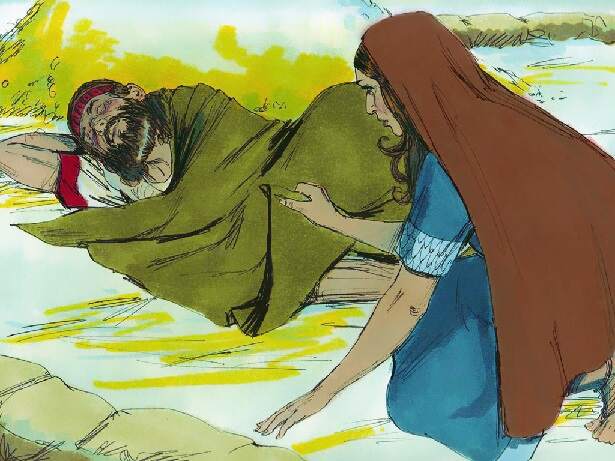
Which of these two images gives the better impression of what was happening that night in the field? [77]
Boaz and Ruth. [78]

What does happen between Boaz and Ruth that night? We can’t be sure. We’re not sure that Boaz is really sure what happened. [52] – there was plenty of drink around that evening! We can, however, be sure that the ambiguity is intended by the author. [53] The audience cannot but see the similarities with other biblical stories. [54] They’re left to read almost anything into the situation.

Ruth seems to offer herself to him – Boaz recognises the sexual connotation in her reference to his cloak, but also that she is challenging him to fulfil his earlier blessing. [55] The audience is torn between titillation, at the possibility of sexual gratification, and jeering at pompous Boaz for being trapped by two women, [56] one a Moabite woman!

The latter part of the story has Boaz cunningly manoeuvring the anonymous relative [57] into a corner from which there is no retreat. He manages to buy [58] a Moabite woman without losing the respect of the community – he is the honourable redeemer. [59] In the story he’s definitely the winner. [60] The audience is left considering the motives of the village elders who sit at the gate of their village. What is happening as they make decisions? Is everything just as it appears, or are these ‘pompous’, ostensibly magnanimous/gracious, elders only really working for their own ends? Could that also be true of the elders teaching in the Synagogue?

Ruth

Ruth, a Moabite! The audience titters when she first enters the narrative. Moabites, and particularly their women are not good news. [61] The first possible signs of Ruth and Orpah’s loyalty [62] surprise them. Orpah’s decision to leave Naomi draws the audience’s boos: “We told you so, Moabites are no good! Go on Ruth, leave too!”

They hear her profession of loyalty [63] – its difficult to believe – they can’t credit good motives to Ruth: “She’s after something. Let’s wait and see!” Ruth’s loyalty to Naomi [64] continues to perplex the audience throughout the story. They are surprised at her willingness to glean in the field, but quickly they suspect that she will seduce the young Israelite men. Eventually they see her tangled with Boaz in a complicated romance, perhaps this is where she will show her true Moabite colours. The sly comparison with the Lilith tickles their fancy, [65] and they certainly have some fun at Boaz and Ruth’s expense.

But which side should they take? They have to decide. Prejudice says Ruth is evil, to be avonded Yet Rath shows faithfulness and loyalty, to Naomi and Boaz. [66] Yes, the author has allowed some titillation, but did anything wrong actually happen at the threshing Door Re can they believe that a Moabite woman is good? Yet if they don’t what does that say at the ancestry of their great King, David?

What does Ruth herself feel? Her husband is dead. Hier mother-in-lapse doesn’t want to know her. Chances of another husband in Moab are low. Who would want to marry second-hand goods? Israelite second-hand goods at that? [67]

Are Ruth’s motives as pure as they first seem? She has little choice. She cannot bring herself to follow Orpah who walks out of the narrative, probably into poverty and spinsterhood. [68] Ruth knows she’s committed to Naomi, no matter how bitter the wild woman is. Loyalty is her only option and she goes for it.

The journey to Bethlehem is hard – Naomi ignores her. [69] The entry into Bethlehem, harder still – for everyone ignores her. [70] She is determined not to be defeated. It is harvest-time and she heads for the fields – she’s heard Naomi mumbling about Boaz. [71] and determines that she will find his area of the field, she’s surprised to find it at the first attempt. This will be her way of helping both herself and Naomi. Her encounter with Boaz goes well – she can see that he’s interested in her. He’s clearly a respected man a bit ponderous/pompous but widowed Moabite women in Israel cannot be too choosy, can they?

Her triumph is hard to hide when see returns home – she tells Naomi of her work in the field, holding the name of Boaz for the last final flourish of her statement [72] (incidentally, holding the audience’s interest – they know something Naomi doesn’t know). She plays a small word game with Naomi, about men/maid-servants [73] which gently reminds Naomi of her earlier lack of care for Ruth.

Seven weeks she works in Boaz’s fields – she becomes quite fond of the old blighter. She isn’t surprised when Naomi suggests that marriage should be pursued, she listens to the plan and works out her own variation of it. [74] The risk is great, Boaz may just use her. In the event she has him trapped, just as on the following day he would trap the anonymous relative.

Conclusion

This is a very clever story, one that draws the audience in through an excellent plot and bawdy humour. The characters and the message contained within the story are such that the original audience could not have been left unmoved or challenged. It really does rate as “a ‘good yam’, superbly written”. [75] We can see God’s providence at work – and that seems to be the point. The story asks whether we can really see God at work in the lives of ordinary people. [76] The answer it provides is ‘Yes!’.

Notes

  1. 1:p25ff; 2:p259; 7:p201.
  2. A well devised plot – intrigue draws us into each scene. A classic pattern of exposition/conflict/resolution (12:102ff). This “story has power to draw us in almost against our will” (11:p63f). Part of its allure is its honest embrace of pain (6:p25ff) see also note 15 below.
  3. The interaction of the narrator and characters (12:p68-71) and the quality/depth of the characters (19:p37-40; 20:p71ff) is what makes this story.
  4. 17:p78; 21:p12f
  5. 8:p126 (note 29).
  6. 5:p146-165; 7:p197; 20:p71ff
  7. cf. Exodus 23:9; Numbers p9:14.
  8. Ruth 1:16f: cf. 15:p37,42 – re: conversion.
  9. 17:p102.
  10. 15:p36f.
  11. 5:p148-161.
  12. Hesed, (חֶסֶד) Ruth 1:8 occurs frequently in the book, and carries the idea of covenant loyalty, cf. 5:p148; 7:p206; 21 p23.
  13. 21:p12 cf. 17:(whole book)
  14. Although they would receive Rabbinic support (cf. 5:p148-165, 15:p37-47)
  15. ‘Comedy’ is also the literary term for ‘the story of the happy ending’ (19:p82; cf. 20:p72) – Ruth fits this traditional pattern.
  16. 17.p98
  17. 7 p208; 8:p72; 10:p197; 15 p36f.
  18. Our response to narrative gaps affects our understanding of the story cf. 4 p12: 22:p20-25.
  19. 15:p36f
  20. cf. e.g., Exodus 20:5; 34:7.
  21. cf. Deuteronomy .23:3.
  22. Ruth 1:13: cf. 21:p27; Exodus 20:5; 34:7.
  23. 8:p70f cf. 1:p46.
  24. 15:p 34.
  25. 15:p35f
  26. Ruth 1:18, 8:p74.
  27. 15:p34f
  28. Ruth 1:19-22, 8:p74f.
  29. Ruth 2:2, 8:p76f
  30. Ruth 3:2-4, 15:p36.
  31. 8:p82; Ruth 4:14-16.
  32. ba’an (בעז) was one of the columns in the temple the name could mean ‘quickness/strength’ (1:p55), ‘powerful/potent’ (3:p51); he is introduced as a man of substance/worth/wealth (1:p56; 8:p83).
  33. Ruth 2:4, 10:p205
  34. Ruth 2:8-9,11-12; 15:p43.
  35. Ruth 2:8-9, 15:p43.
  36. 8:p85: 15:p44
  37. 5:p161-163
  38. Ruth 2:5 (RSV) – he is already thinking, ‘Who does she belong to?”
  39. Ruth 2:8, of. Ruth 1:14 – root (דָבֵק) – cleave – cf. Genesis 2:24; 34:3.
  40. Ruth 2:10 cf. 21:p51
  41. Ruth 2:10: Ruth is a נָכְרִיָה – a ‘temporary foreigner’ – emphasising her alienness (14:p147), or ‘one not recognised as part of the family (21:p51).
  42. Ruth 2:12: of. Ezekiel 16:8 – which is using sexual imagery.
  43. Ruth 2:13 – שִׁפְחַת – may be ‘concubine’, but Ruth 3:9 – אַמַתִי  – does mean ‘concubine’ (21:p53).
  44. Ruth 2:14-17, 21:p54
  45. Ruth 3:4 – ידע – there is double meaning when this word is used (7:p218).
  46. Numbers 25:1-5; cf. Genesis 19:31-38.
  47. 21:p76-80
  48. Ruth 3:3; cf. Ezek. 16:8-13.
  49. Ruth 3:4,7,14; בול  – feet/legs/genitals (7:p217; 9:p156,193, 18:p37f, 21:p70)
  50. Ruth 3:4,7,8,13,14 root שָׁכַב – ‘to lie with/down’ (7:p218; 18:p39).
  51. Ruth 3:4 – נליח – the Hebrew works both ways.
  52. 8:p87.
  53. 2:p272; 7:p217; 15:p46f
  54. Ruth 4:11f; Jacob/Leah/Rachel – Genesis 29; Judah/Tamar – Genesis 38 (3:p62ff, 8:p72f, 9:p104f).
  55. Ruth 3:9 cf. Ruth 2:12.
  56. 7:p212; 10:p207
  57. The Hebrew (בְּלֹנִי אַלְמני) – 7:p222f, 8:p91; 15:p45 and specifically p127-129
  58. Ruth 4:10: cf. 13:p140, note 140 – they would not question the ‘purchase’, just her Moabite status!
  59. 2:p275f, 15:p45f; 21:p107ff, 115ff, 136ff.
  60. 8:p91f
  61. Genesis 19:31-38, Numbers 25:1-5; Deuteronomy 23:3f, Judges 3:12-30, 1:p33; 8:p69f, 15:p38.
  62. Ruth 1:6,10.
  63. Ruth 1:16f
  64. 16:p97
  65. Ruth 3:8-9 cf. 21:p76-80.
  66. Hesed, (חֶסֶד)
  67. 8:p97f.
  68. 8:p97f.
  69. Ruth 1:18; 8:p74.
  70. Ruth 1:19-21.
  71. Ruth 2:1.
  72. Ruth 2:19.
  73. Ruth 2:21f; 8:p98f; 21:p58.
  74. Ruth 3:9 cf. Ruth 3:4; 8:p99ff; 17:p101f.
  75. 4:p9: quoting Goitein; Iyyunim ba-miqra; Yavneh, Tel Aviv, 1957; p49.
  76. 2:p280; 7:p197.
  77. https://emilysmucker.com/2020/04/27/five-actual-romantic-lessons-from-the-life-of-ruth, accessed on 14th October 2024.
  78. https://www.radstockwestfieldmethodists.co.uk/book-of-ruth-chapter-3-.php, accessed on 14th October 2024.
  79. https://www.bookbaker.com/ko/v/Genesis-A-Visual-Exploration-Ruth-and-Naomi/8a99ff0b-37ca-4dc0-8e51-09a03b1a14e3/13, accessed on 14th October 2024.

References

  1. David Atkinson; The Message of Ruth;, IVP, Leicester, 1983,
  2. A. Graeme Auld; Joshua, Judges and Ruth; St. Andrew Press, Edinburgh, 1984
  3. Mieke Bal; Heroism and Proper Names, or the Fruits of Analogy; in Atalaya Brenner ed.; A Feminist Companion to Ruth; Sheffield Academic Press and Ruth St. Andrew Press, Sheffield, 1993.
  4. Athalaya Brenner; Introduction; in Atalaya Brenner ed.; A Feminist Companion to Ruth; Sheffield Academic Press and Ruth St. Andrew Press, Sheffield, 1993.
  5. Leila Leah Bronner; A Thematic Approach to Ruth in Rabbinic Literature; in Athalaya Brenner ed.; A Feminist Companion to Ruth; Sheffield Academic Press, Sheffield, 1993.
  6. Walter Bruggemann; Old Testament Theology: in Patrick D. Miller ed., Fortress Press, Philadelphia. 1992.
  7. John Craghan, C.SS.R.; Esther, Judith, Tobit, Jonah, Ruth; Michael Glazier, Wilmington, Delaware, 1982.
  8. Danna Nolan Fewell & David M. Gunn; Compromising Redemption; Westminster/John Knox Press, Louisville, Kentucky, 1990.
  9. Danna Nolan Fewell & David M. Gunn; Gender, Power, and Promise; Abingdon Press, Nashville, Tennessee, 1993.
  10. John Goldingay; After Eating the Apricot; Paternoster, Carlisle, 1996.
  11. John Goldingay: Models for Scripture; Paternoster, Carlisle, 1987.
  12. David M. Gunn & Danna Nolan Fewell; Narrative in the Hebrew Bible; Oxford University Press, Oxford, 1993.
  13. Paula S. Hiebert; Whence Shall Help Come to Me: The Biblical Widow; in Peggy L. Day (ed.); Gender and Difference in Ancient Israel; Fortress Press, Minneapolis, 1989.
  14. Jonathan Magonet; A Rabbi’s Bible; SCM, London, 1991.
  15. Jonathan Magonet; Bible Lives; SCM, London, 1992.
  16. John H. Otwell; And Sarah Laughed; Westminster Press, Philadelphia, 1977.
  17. Eugene H. Peterson; Five Smooth Stones for Pastoral Work; Eerdmans, Grand Rapids, Michigan, 1992
  18. Ilona Rashkow, Ruth: The Discourse of Power and the Power of Discourse; in Athalaya Brenner ed.; A Feminist Companion to Ruth; Sheffield Academic Press, Sheffield, 1993.
  19. Leland Ryken, How to Read the Bible As Literature; Zondervan, Grand Rapids, Michigan, 1984.
  20. Leland Ryken; The Literature of the Bible; Zondervan, Grand Rapids, Michigan, 1974.
  21. Jack M. Sasson; Ruth; 2nd Ed., reprinted, Sheffield Academic Press, Sheffield, 1995.
  22. Elizabeth Cady Stanton, The Book of Ruth; in Athalaya Brenner ed.; A Feminist Companion to Ruth; Sheffield Academic Press, Sheffield, 1993.

Mark 10: 2-16 – A Warm Welcome – St. Andrew, Ryton – 6th October 2024 (19th Sunday after Trinity)

A series of clipart images are included in this article/sermon which I believe are free to download and royalty free. The first, at the head of this article is a picture of a welcome mat.


People place welcome mats outside the front door of their houses. Do you have one? ….. I think they carry a mixed message, something like this: “It is nice to see you but please do wipe your feet before you come into my house!”

It conveys a sense that visitors are welcome if they …..?

A true welcome is really about greeting someone in a warm and friendly way. A few pictures to illustrate what we do to welcome people into our homes. …..

What things do we do when someone comes to our house to make them feel welcome?

Pretty much naturally, when we do welcome someone into our home we offer a warm drink, some biscuits, a comfy chair, a warm room, a welcoming smile and an invitation to return.

But, has anyone ever come to your house who you don’t want to welcome in? … Sometimes we get people selling us stuff we don’t want, or someone we find it difficult to likecomes to the door. I remember letting a bathroom salesman into my house and then spending the whole time he was there wishing I hadn’t.

Or what above a Jehovah’s Witness or a Mormon missionary….. Perhaps we keep them standing on the doorstep rather than let them in.

A challenging question for clergy might be what constitutes a true welcome be for the awkward and abusive homeless person on the vicarage doorstep?

How do you feel when someone you don’t want around is on your doorstep? Perhaps you feel a bit aggressive and defensive, or maybe mean, awkward, uncomfortable or even guilty, as you turn them away?

It’s not always easy welcoming some people into our homes, our places of work, our schools, or even our churches – is it?

Towards the end of our Gospel reading today, we heard about some people who were not made to feel welcome by Jesus’ disciples.

Jesus was teaching and people were bringing little children to have Jesus touch them. The disciples criticized the parents and told them to stop bringing their children to Jesus. When Jesus heard what his disciples were saying, he was very upset. “Let the children come to me and don’t stop them!” Jesus said. “The Kingdom of God belongs to those who are like these children. Anyone who doesn’t come like a little child will never enter.” And the Gospel tells us, that Jesus took the children in his arms and blessed them.

Jesus really knew how to make a child feel welcome. Perhaps you might be able to imagine how those children must have felt when Jesus took them up in his arms and blessed them? That image – that we often see in stained glass windows in churches – of Jesus with the children in his arms is one that should reminds us to make everyone feel welcome like Jesus did!

The kind of welcome we offer to others is critical. It says so much about us. When we welcome people into our homes or into our churches, we are sharing something of ourselves with them, and in doing so we make ourselves vulnerable. Because, at times, our guests can ride rough-shod over our hospitality.

The temptation is to respond like the disciples – to try to exclude those who don’t understand our ways of doing things – and there are plenty of churches that do just that. To come to the main service in the church that I grew up in, you were expected to have a letter of introduction from another similar church before you could be part of the worship!

Some churches refuse to have baptisms in their main services – because the wider baptism party may disrupt their quiet worship. Some churches refuse to even make their building available to the community – a great sadness when those churches are the only large indoor community space available.

In our Gospel, Jesus models a response of loving welcome – an acceptance of the mess and the noise that goes with children being around, but a true acknowledgement that they have so much to offer us. This is the response that we are called on the make in our churches, not only to children, but to all who need the love of our Saviour – open, loving, vulnerable welcome!

Back to our welcome mat and that gallery of welcome pictures. …

What does our figurative welcome mat say to those who cross the threshold of the church for the first time? Is our welcome warm, open and true? Or is it grudging and perhaps motivated by fear that we will have to be different, to change, if we truly welcome them?

Do we do our best to extend that welcome – perhaps with a warm drink, something to eat, comfortable seating, a warm space, a welcoming smile and a heartfelt invitation to come again?

What does our figurative welcome mat say to people? Wipe your feet, clean yourself up, sort yourself out and come in – or does it really say that people are welcome as they are?

The God we worship worship week after week offers an open, inclusive welcome to all. God includes everyone without exception and God calls on us to do the same.

Romans 1: 16-32 – Paul’s Discussion Considered

Interpreting what the Bible says requires an approach which looks carefully at the context. Both literary and community contexts are always important. So, before considering particular verses in Romans 1, we need to look at the wider narrative context.

The letter to the church in Rome is Paul’s longest letter, and his most intricate argument. Many have seen it as a complete overview of Christian doctrine, but others feel Paul was dealing with a very specific issue as the ex-Jewish rabbi who became the ‘Apostle to the Gentiles’.” [2] As Graeme Codrington explains: “The view of Romans as a systematic theology has always been problematic, especially in how to integrate chapters 9 – 11 into the flow of the book. Any explanation of the purpose of the letter must result in a consistent exegesis that makes sense of the whole letter. And seeing it a summary of the Gospel does not achieve this.” [2]

So what might Paul be doing in the early chapters of the Epistle to the Romans? And indeed, throughout the whole of the epistle?

It seems to me that the traditional reading of Romans 1, that sees homosexual activity as part of a decent into immorality and, along with other things, a sign that God has abandoned people into the sin that they have chosen, is not an unreasonable initial reading of the immediate text of Romans 1: 16-32. A caveat to this comment must be that the verse which immediately follows this passage (Romans 2: 1) begs a question regarding Paul’s purpose in writing as he does in Romans 1: 16-32 and in the whole of the epistle. Is Paul, in some way, responding to Jewish views about Gentiles?

If these verses express Paul’s consider opinions, they might be better read as Paul having a specific set of excessive sinful behaviours in mind, rather than just homosexuality in general. A better reading of Romans 1: 16-32, is to see Paul speaking to a group of people who have “taken their sexuality to excess and gone against nature, descending into sexual depravity.” [2] In addition, it seems that the traditional reading of these verses fails to consider fully, given the ‘therefore’ of Romans 2: 1, the wider context of Paul’s concerns and hence his careful argument in the letter to the Romans. If either of these questions has some merit, then, as well as seeking to understand what particular excesses Paul is speaking of, we need to:

  • take time to understand exactly who is being talked of;
  • carefully ask whether this is Paul’s thinking, or whether he is effectively quoting others before then going on to comment on their beliefs, and if so, who they might be, and why might Paul be doing so;
  • think about what having ‘gone against nature‘ means.

Graeme Codrington comments that, “most scholars believe that Paul was mainly addressing the issue of Jews and Gentiles and how they were to integrate in the New Testament era. He uses the central theme of covenant and God’s faithfulness and righteousness in covenant relationship to us as his main argument.” [2]

He quotes N.T. Wright as saying that Romans is primarily, “A Jewish Theology for the Gentile world, and a welcome for Gentiles designed to make the Jewish world jealous. … The creator/covenant god has brought his covenant purpose for Israel to fruition in Israel’s representative, the Messiah, Jesus…. The actual argument of Romans, the ‘poetic sequence’ of the letter, relates to this underlying ‘narrative sequence,’ that is, the theological story of the creator’s dealings with Israel and the world, now retold so as to focus on Christ and the Spirit.” [1]

“In fact,” Codrington continues, “Wright goes further to suggest that Paul’s specific reason for writing the letter to church in Rome was to ensure that Jews and Gentiles in Rome worked together and acted as a unified church, in order to provide a base for his missionary activities in the West. This is a very compelling reading of the whole letter.” [2]

In the first of a series of articles about Romans, Daniel Castello explains it as follows:

“Here in the Epistle to the Romans, [Paul] is advocating something that earlier in his life he would have found detestable: the inclusion of the Gentiles in Israel. What a turn of events! When Paul says he is crucified with Christ, he is not just saying something platitudinous; he speaks this way out of a reality, one that undoubtedly causes him shame, inspires within him humility, and perhaps creates within him sympathy for his fellow Jews. And yet this gospel occasioned for Paul tortuous forms of physical hardship and persecution (including stonings and lashes).

These many features of his background led him to consider his apostleship with dedication and passion. At one point, he was persecuting fellow Jews for their beliefs in Jesus as Messiah; later, he became the greatest advocate for Gentile Christians among his fellow Jewish Christians. The shift was difficult for onlookers to believe and difficult for Paul to bear. The Jewish-Christian interface is not something that Paul talks about simply; it is the very stuff of his life.” [6]

Paul probably wrote to the Roman church from Corinth. The epistle is dated AD late 55 to early 57. Some textual variants name Phoebe, a deacon of the church in Cenchreae, as the messenger who took the epistle to Rome. [5] Codrington comments as follows:

“Emperor Claudius had banished Jews from Rome in 49AD, leaving an entirely Gentile church to grow without Jewish influence – a unique circumstance in the early church era. Claudius died in 54AD, and Jews began to return to Rome. Jewish Christians would have come back to the Roman church but probably not welcomed with open arms – there was considerable tension throughout the region between Jewish and Gentile Christians. Paul was planning to use Rome as a base for his missionary work in the western Mediterranean, but was nervous that Rome would succumb to the problems that had happened in Antioch when he was based there, when Jewish Christians had tried to impose Jewish traditions on the church there, and caused deep divisions between Jews and Gentiles. These problems are explained in Galatians 2 and Acts 15, including a confrontation Paul had with Peter himself over the issue of the divide between Jews and Gentiles in the early church.” [2]

This issue of the divide between Jews and Gentiles was the single most significant issue that the early church had to deal with, and provoked its first crisis.

Codrington argues that it is “no surprise that Paul dedicates a whole letter to the issue, and that in this letter we see some of his most passionate and insightful writings. This letter to the Roman church was written in order to show that the Gospel might have come to the Jews first, but it is intended for everyone. Gentiles should not marginalise Jews, nor Jews impose their Judaistic history on the Gentiles. Gentiles should not look down on Jews for their ancient spiritual practices. Jews should not try and impose these practices on Gentiles. Jews should not look down on Gentiles for some of the cultural practices of the Greeks and Romans. And Gentiles should be careful not to assimilate too closely to the Graeco-Roman culture, especially when doing so caused their Jewish brothers and sisters to battle with their faith. For example, in Acts 15:28-29, in a letter written to the churches, Christians were told that the Jewish law was no longer applicable, but that they should abstain from food sacrificed to idols and from sexual immorality. Paul specifically overrides this in Romans, with a few references to food sacrificed to idols, explaining that there are no issues with this at all in itself, but that Christians should be sensitive to each other, and especially sensitive to their weaker brothers and sisters and those with less faith (see Romans 14 in particular).” [2]

I think that this ‘theory’ about the letter to the Roman church is really quite plausible. If we are willing to accept that this is, at least, one possible way of reading the epistle, then we need to return to the text of its first chapter and look carefully at what Paul may be saying.

It seems to me that Codrington is right to assert that, “Paul begins his letter by using standard Jewish critiques of Gentiles, and especially Jewish critiques of Rome itself. These include the Jewish disgust of public nudity, public displays of sensuousness, the revealing clothes the Romans wore, homosexual relationships, and Gentile eating habits.” [2]

Codrington suggests that Jewish Christians, throughout the Roman Empire, were gravely concerned about Gentile Christians who still frequented the temples and ate food sacrificed in those temples. He says: “All of these issues were general concerns in many locations at the time – passages similar to Romans 1:18-32 can be found in The Dead Sea Scrolls, for example (in fact, some scholars suggest that Romans 1:18-32 are actually part of well-known Hellenistic Jewish literature which Paul goes on to critique in Romans 2.” [2]

Gary Shogren, in a blog which takes a traditional, non-affirming, stance on sexuality, highlights something of the parallel nature of this part of Romans with the text of particular parts of the Dead Sea Scrolls:

“In 1:29-31 Paul writes up a so-called vice list. Vice lists and virtue lists were a common figure of speech in that era, whereby the author would compile a list of [behaviours] and present them with little elaboration, in order to give his readers direction toward holiness and away from wickedness. One example from the Dead Sea Scrolls: “to the spirit of deceit belong greed, sluggishness in the service of justice, wickedness, falsehood, pride, haughtiness of heart, dishonesty, trickery, cruelty, much insincerity, impatience, much foolishness, etc.” (1QS IV, 9-11). Philo wrote one list that contains a whopping 147 elements. We have already mentioned 1 Corinthians 6:9-10; two other vice lists were likewise connected with exclusion from the eschatological kingdom (Gal 5:19-21; Eph 5:5). The fruit of the Spirit are presented in the form of a virtue list (Gal 5:22-23).

Paul mentions 20 elements in this list, ranging from breaking the Ten Commandments (“they disobey their parents”) to the mundane (“boasting”). If the greatest commandment of Torah was to love Yahweh with all one’s being (Deut 6:4), then to be a “God-hater” (v. 30) is the greatest form of wickedness.” [7]

The ‘You, therefore, have no excuse’ (Διὸ ἀναπολόγητος εἶ ὦ ἄνθρωπε = Therefore inexcusable you are O man) at the beginning of chapter 2 of the Epistle to the Romans is very significant. It is difficult to overemphasize its importance. The key question is who is being addressed in these words.

Codrington comments: “The only reading that fits into the overall flow of Romans and makes sense of the message of the letter is that in Romans 2:1 the shift to the direct address (the second person singular), along with the coordinating conjunction (Greek:  Διὸ), indicates that the reader who agrees with or [the person] responsible for writing Romans 1:18-32 is now the person addressed.” [2]

Having used a very Jewish form of critique of the Gentiles, Paul, in continuing his argument (Romans 2) is turning back to face his Jewish listeners/readers and saying: “You, therefore, have no excuse, you who pass judgment on someone else, for at whatever point you judge another, you are condemning yourself, because you who pass judgment do the same things.” [Romans 2: 1, NIV]. This is a rebuke and it is potent! [8][9][10][11]

If this is the case, Paul is effectively saying that those who believe the things stated in Romans 1: 18-32 are the one’s who will face God’s judgement. So, Paul speaks to those who support the words spoken in Romans 1:18-32 and he says:

Because of your stubbornness and your unrepentant heart, you are storing up wrath against yourself for the day of God’s wrath, when his righteous judgment will be revealed.” (Romans 2:5. NIV)

This is a shocking statement for the Jewish Christians in Rome. Really shocking! Paul speaks to them directly, he quotes their argument/opinions and follows it with this statement: “You, therefore, have no excuse, you who pass judgment on someone else, for at whatever point you judge another, you are condemning yourself, because you who pass judgment do the same things.” [Romans 2: 1, NIV]

Paul goes on, in the verses that follow, to argue that both Jew and Gentile have rebelled against God and that: “There will be trouble and distress for every human being who does evil: first for the Jew, then for the Gentile; but glory, honour and peace for everyone who does good: first for the Jew, then for the Gentile. For God does not show favouritism.” [Romans 2: 9-11, NIV]

It is from this base that Paul develops his argument in chapter 2-8 of Romans. God’s grace and justification ‘through faith alone‘ means that, as Codrington says: “Jews are welcomed equally with Gentiles, not rejected (chapters 9-11). So now the church must live in unity, characterised by love – for each other and for everyone (chapters 12-13). Unity requires agreeing to remain in diversity and accept differences in the way we express our faith (chapters 14-16).” [2]

The whole epistle is essentially the outworking of Paul’s understanding of God’s grace. Codrington points us to what N.T. Wright says: “The poetic sequence of Romans, therefore, consists of a major argument, as is now regularly recognized, running not just as far as chap. 8 but all the way to chap. 11. A good deal of this argument is a matter of setting up the terms of the discussion so that they can then be used quite directly when the real issue is confronted head on. Once the great argument is complete, Paul can turn to other matters in chaps. 12-16. These are not to be marginalized: 15: 7-13, for instance, has a good claim to be considered the real summing-up of the entire letter, not merely of 14: 1 – 15: 6.” [1][2]

Codrington also points us to” “A good summary of … the whole letter to the Romans … in Romans 14:13-14 (similar to 2:1): ‘Therefore let us stop passing judgment on one another. Instead, make up your mind not to put any stumbling block or obstacle in the way of a brother or sister. I am convinced, being fully persuaded in the Lord Jesus, that nothing is unclean in itself. But if anyone regards something as unclean, then for that person it is unclean.‘” [Romans 14: 13-14, NIV]

Ultimately, Paul makes his point in summary in Romans 15: 7-13: “Accept one another, then, just as Christ accepted you, in order to bring praise to God.” [Romans 15: 7, NIV] … “Jews and Gentiles alike have disappointed God, but God is faithful and has established a new covenant with us, in Jesus.” [2]

So, back to Romans 1:18-32. …

It seems as though Paul’s main concern is not, primarily at least, with the content of these verses but rather with what Jewish Christians might think about Gentile behaviour. Paul is concerned about Jewish judgement of Gentiles. If we are to understand these verses correctly, this is the context within which we must work. It is, effectively, the only way in which things makes sense. The pronouncements in these verses are the self-righteous expression of Jewish condemnation of Gentiles!

As Codrington states: “The list of sins is therefore more about what Jewish people found repulsive in Gentiles than what Paul did.” [2] As the list goes on, it becomes easier and easier to hear a developing bitterness and a repudiation/judgement on virtually every aspect of Gentile life. In fact, the list covers every perceived evil in community, family and individual life that must have also been as true of Jews as well as Gentiles! … For instance, who has never disobeyed their parents? [Romans 1: 30]

The anger and judgement expressed in this passage highlights the importance of Paul’s words about judging others which follow immediately in Romans 2: 1. Paul is not describing homosexuality as worse than any other sin, but rather talking of excesses in the Gentile world. It is difficult to equate the excessive behaviour Paul seems to be describing here, with loving, close and committed same sex relationships.

We cannot even be sure that Paul sees things the way that they are expressed in these verses. Paul is primarily pointing out that seeing other people’s activities as vile and condemning them for acting in this way brings judgement on those making the assessment. … This must give us grounds to take stock of our own attitudes.

On the other hand, neither can we be sure, from this passage, that homosexuality is not sinful. There are two grounds for this.

The first is related to the context in which Paul is arguing – the idolatry of the Gentile world and particularly as it appeared in Corinth and Rome. It is impossible to separate out pagan worship in Rome’s temples or the excesses of Roman patrons to their younger charges, or the behaviour of owners with slaves, from the excesses of which Paul writes. We just cannot tell what Paul or, perhaps, any other commentator would want to say about committed, faithful homosexual relationships which may, or may not have been recognised in the society of the time. We just don’t know.

The second relates to the use in this part of the letter to the Romans of the argument that some things are ‘against nature‘ (παρὰ φύσιν). [Romans 1: 26-27] We will come back to this conundrum in another article.

We cannot legitimately use Romans 1: 16-32 to condemn all homosexual behaviour, nor can we justifiably argue that committed, faithful homosexual relationships are acceptable. That they might not be within the scope of Paul’s developing argument does not, in and of itself, indicate approval.

If, however, we look at the whole of the letter to the Romans, which emphasises God’s love, faithfulness and kindness to us, it is “quite difficult to imagine that Paul would use these verses to speak against lifelong, loving, covenantal same gender relationships. The emphasis of Romans 1 is that people who push the boundaries of their behaviour to unnatural extents are sinning against God. But all of us do this in one way or another, and we’re all in need of God’s grace.” [2]

In this short article, we have, I think, shown that there are at least some grounds for questioning traditional assumptions about the first chapter of the epistle to the Romans. When these verses are, set alongside Paul’s emphasis in the letter on God’s grace, justification by faith, and God’s faithfulness and kindness towards us, they leave us needing to take great care in how we apply them in our own context.

We will be arguing from unsure foundations if we assert that the first chapter of the epistle to the Romans makes an unequivocal statement about lifelong, loving, covenantal same-gender relationships.

We are left, however, with one significant issue to address which might seem to be conclusive – the question of what is meant by something being ‘against nature‘ (παρὰ φύσιν). We will look at this question in another short article which can be found here. Although we will need to continue to bear in mind a reservation/uncertainty about the place that Romans 1: 26-27 has in Paul’s thinking. Is it Paul’s own views, or is he quoting others? Is Paul quoting what many a Jewish Christian might be thinking and then countering it with his ‘you therefore’ in Romans 2: 1? Or is he expressing, in Romans 1:16-32, his own understanding of God’s position?

References

  1. N.T. Wright: https://ntwrightpage.com/2016/05/07/romans-and-the-theology-of-paul, accessed on 7th June 2024.
  2. Graeme Codrington: The Bible and Same Sex Relationships, Part 10: Re-read Romans 1; https://www.futurechurchnow.com/2015/10/15/the-bible-and-same-sex-relationships-part-10-re-read-romans-1, accessed on 7th June 2024.
  3. Graeme Codrington: The Bible and Same Sex Relationships, Part 11; https://www.futurechurchnow.com/2015/10/15/the-bible-and-same-sex-relationships-part-11-shameful-acts-and-going-against-nature, accessed on 8th June 2024.
  4. Graeme Codrington: The Bible and Same Sex Relationships, Part 12; https://www.futurechurchnow.com/2015/11/12/the-bible-and-same-sex-relationships-part-12-what-romans-1-is-really-all-about, accessed on 8th June 2024.
  5. https://en.wikipedia.org/wiki/Epistle_to_the_Romans, accessed on 9th June 2024.
  6. Daniel Castello; Introduction to the Epistle to the Romans; https://spu.edu/lectio/introduction-to-the-epistle-to-the-romans, accessed on 9th June 2024.
  7. Gary Shogren; Romans Commentary, Romans 1:18-3:20; https://openoureyeslord.com/2018/02/27/romans-commentary-romans-118-320, accessed on 10th June 2024.
  8. https://www.bibleref.com/Romans/2/Romans-2-1.html, accessed on 13th June 2024.
  9. https://biblehub.com/commentaries/romans/2-1.htm, accessed on 13th June 2024.
  10. Dan Wilkinson; The Punctuation Mark That Might Change How You Read Romanshttps://www.patheos.com/blogs/unfundamentalistchristians/2015/09/the-punctuation-mark-that-might-change-how-you-read-romans, accessed on 13th June 2024. Note: this article draws on  reference [11] of which I have not been able to get a copy.
  11. C.L. Porter; Romans 1.18–32: Its Role in the Developing Arguement; in New Testament Studies, 40(02), 1994; p210.