Tag Archives: 1929

Petrol Railmotors – The Railway Magazine, September 1922

The Railway Magazine of September 1922 carried two short articles about new petrol Railmotors. …

North Eastern Railway (NER) – Petrol Rail Motor Bus

The first short article was about an experimental vehicle used by the NER.

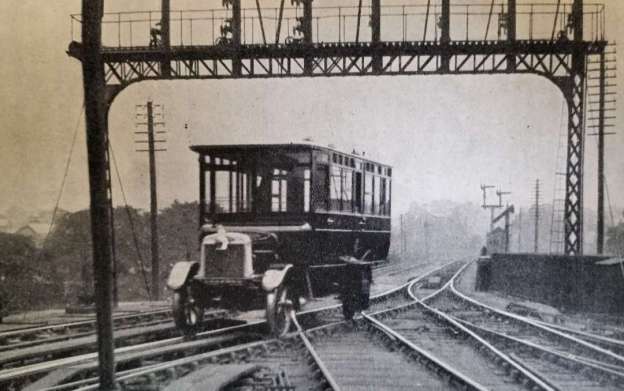
On certain portions of the NER network, the company realised that “there was room for a service conducted on lines as nearly as possible identical with those of motor buses on the roads. With the view of ascertaining, without much initial expenditure, whether the scheme is likely to prove financially successful, they have converted one of their ‘Leyland’ road motor ‘buses, formerly running on the road services in the vicinity of Durham, so as to make it suitable for running on the railway.” [1: p234]

The war resulted in a significant increase in railway working expenses which made it impossible to provide a train unit on some of the country branches, where the number of people travelling was small, “sufficiently cheap to cover its working expenses out of the small revenue available,” [1: p234]
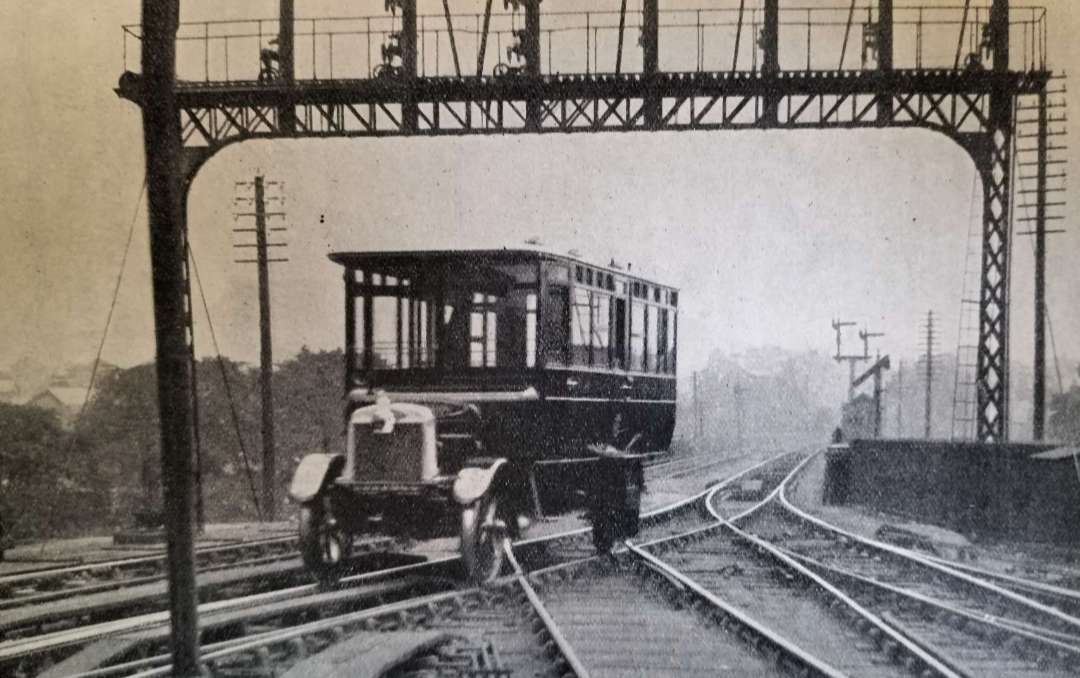
NER Rail Motor [1: p235]

The NER needed to devise a cheaper form of rail transport. As a first step, it decided to convert one of its own fleet of petrol-powered road buses. The company’s intention was to undertake a trial at low cost before developing a design specifically tailored to rail use.

The experimental unit entered service on 19th July 1922. If “the results  of the working of this vehicle are encouraging, the company intend[ed] to build vehicles [capable of] carrying up to 40 passengers, and maintaining an average speed of approximately 30 m.p.h.” [1: p236]

The railmotor operated between Copmanthorpe, York, Strensall and Earswick, and was “manned by a motorman and a conductor exactly in the same way as if it were running on the highway. Single journey tickets [were] issued on board, so that passengers [did not have] the trouble of going to the booking office. It [had] accommodation for 26 passengers. It [ could]  be driven from both ends, and run in either direction, and the motive power consist[ed] of a 35-h.p. Leyland engine of the standard type, supplied by the builders for their ordinary commercial road vehicles.” [1: p236]

The donor vehicle was one of three Leyland Motor Co. buses that the NER purchased on 21st July 1921. “With a long bonnet and a overhanging roof at the front, it was a typical design for that time. The conversion was completed at York Carriage Works. Initially No. 110 in the Road Vehicle fleet, it was renumbered as No. 130Y shortly after conversion because No. 110 was already occupied in the Coaching Stock list.” [2]

An “additional radiator and an additional driving position were located at the rear of the vehicle. Central passenger doors were fitted to both sides of the saloon. …. Folding steps were also added to allow access from rail level. These were later replaced with fixed steps, and eventually removed altogether. An electric headlamp was also fitted.” [2]

The LNER website continues: “the initial York duty involved a service to Haxby, Strensall, Earswick, and Copmanthorpe. NER Petrol Autocar No. 2105 took over this duty on 9th July 1923, and No. 130 was transferred to Selby. At Selby, No. 130 operated daily return trips to Straddlethorpe, York, Goole, Catleford, Goole, Market Weighton, Cawood, and Hemingborough. This resulted in a full timetable that started at 6:52am and finished at 7:44pm. No. 130 took part in the Stockton & Darlington Centenary celebrations, but continued these Selby duties until November 1926.” [2]
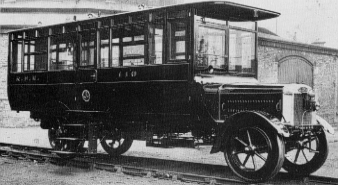
Railmotor No. 110, later No. 130. The fold-down steps can be seen clearly in this image. [2]

On 11th November 1926 the railmotor/railbus “caught fire whilst being filled up with petrol at Selby shed. The entire bus was reportedly gutted within 15 minutes. Reports also suggest that someone used a naked paraffin lamp to check the level of the petrol tank. Only the chassis remained, and it was eventually decided not to rebuild or replace the bus. No. 130 was officially withdrawn from stock on 9th April 1927.” [2]

It seems as though the initial experiment was successful enough to allow the NER to authorise the building of a further experimental petrol railmotor (No. 2105) in September 1922. A Daimler engine was purchased in October and “the remainder of the vehicle was built at York Carriage Works and was completed in July 1923. By this time, Grouping had occurred, and the autocar was given the LNER number 2105Y. It was later renumbered as No. 22105 in August 1926.” [3]
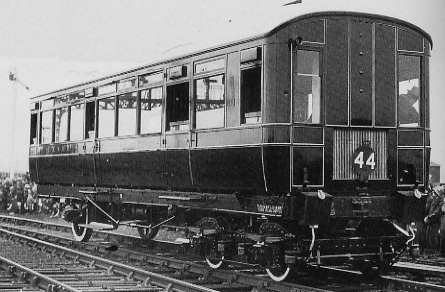
Railmotor No. 2105 (later renumbered 22105) [3]

It seated 40 in third class accommodation, seats were in pairs either side of a central gangway. “The distinctive wheel arrangement had a two axle bogie at the engine end, and a single fixed axle at the other end. The single fixed axle was powered from the motor via a clutch, three-speed gearbox, and propeller shaft with two universal joints. 40mph was reportedly possible. Radiators were fitted to both ends.” [3]

This Railmotor took over the service provided by No. 130 and continued to operate local services in and around York until 1930. By 1930, it had been renumbered 22105.Closure of a series of local stations that year led to it being reassigned to the Hull area. It is “known to have been given an extensive timetable in the Hull area from 1st May to 17th July 1932 when it worked a 14 hour timetable including Beverley, Thorne North, Brough, Willerby & Kirk Ella, and Hull. Reports suggest it was unreliable during this period and was often replaced by a Sentinel steam railcar.” [3]

Over the next two years, No. 22105 did not work any revenue-earning services. It was withdrawn from service on 19th May 1934.

What is perhaps surprising is that these two experimental vehicles were not the first ones used on the NER network. The NER had experimented with petrol railmotors just after the turn of the 20th century. Two examples are worthy of note.

A. Petrol-electric Railmotors/Autocars

The NER were reviewing their operation of suburban passenger services on Tyneside. Alongside the introduction of electric trains on an urban network of lines which would later develop into the Tyne and Wear Metro, the NER ordered two experimental railcars/railmotors to work other, non-electrified, parts of the network.

Both railcars were built at the York Carriage Works, together with the original Tyneside electric stock, in 1902-3 and numbered 3170 and 3171. They were 53.5 feet long and weighed around 35 tons. They had clerestory roofs, bow ends, large windows and matchboard sides. There were four compartments inside, the engine room with the principal driving position, a vestibule, the passenger saloon and a driving compartment. There was no guard’s compartment. The passenger saloon had 52 seats. These were reversible and upholstered in standard NER pattern. With curtains at the windows, radiators between the seats and electric lighting, the passenger accommodation was described as ‘cosy’ and seems to have been very popular with the travelling public.” [4]

These two railmotors were referred to as ‘autocars’ after the steam push/pull autotrain services already operated by the NER.

The Embassy & Bolton Abbey Railway comments: “These NER railcars were the first in the world to use petrol-electric technology. At that time, diesel engines were less advanced and not as reliable as their petrol counterparts. The concept of using internal combustion engines to power electric traction motors would later be developed into the diesel electric technology used to power many of BR’s ‘diesel’ locos.” [4]
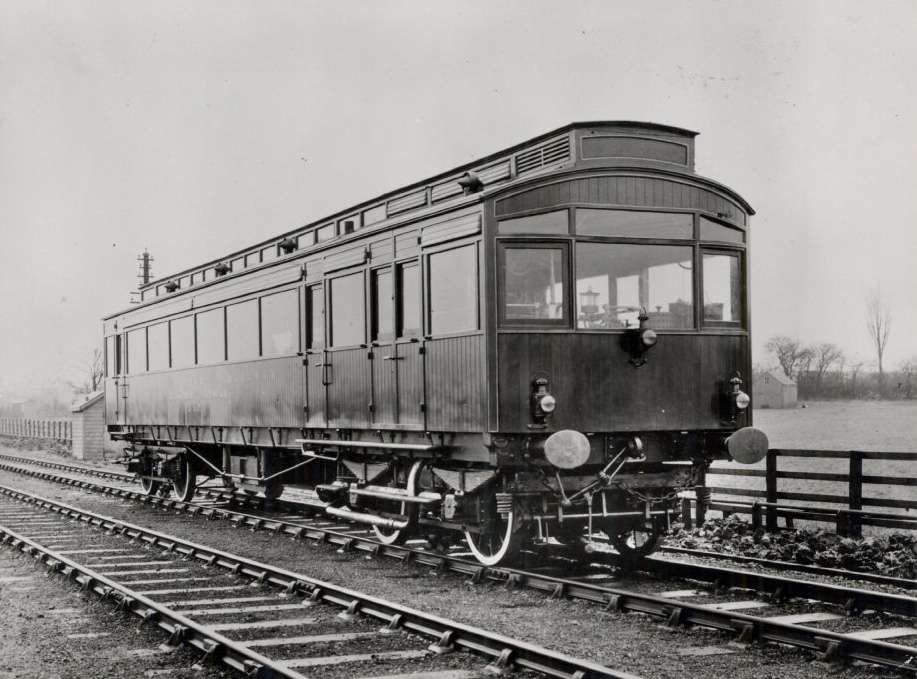
One of the two NER petrol-electric railmotors. [5]

Initially the railmotors/autocars saw service “between West Hartlepool and Hartlepool stations (in direct competition with electric tramcars) and Scarborough to Filey (as a replacement of a steam service). Later, the autocars were transferred to the Selby – Cawood branchline to work the passenger services there. In 1923, no.3170 was fitted with a larger engine and new generator giving it sufficient power to pull a conventional carriage, thus increasing passenger capacity. It worked in the Harrogate area for a while before rejoining its twin on the Cawood branch. No. 3171 was withdrawn in 1930 and No. 3170 in 1931.” [5]

These vehicles had a petrol engine and a generator in their engine rooms, producing electricity for two Westinghouse 55HP traction motors which were mounted on the bogie underneath. A series of different petrol engines were used during the life of these vehicles. “In 1923, no. 3170 was given a third engine, a 225HP 6 cylinder ex-WD engine rumoured to come from a First World War tank. This new engine gave 3170 more torque and enough power to haul an autocoach as a trailer, though it seems not to have affected the maximum speed.” [5]

The LNER showed an interest in these vehicles and went on to test Armstrong diesel-electric railcars in the 1930s, but by then Sentinel steam railcars had been introduced. “These were not as reliable or popular, they had more seats and fitted better into the contemporary infrastructure.” [4]

No. 3171 was dismantled when withdrawn. When No. 3170 was withdrawn on the 4th April 1931 it was transported to Kirkbymoorside near Pickering, where the body became a holiday home. “Fitted with a tin roof and veranda it was well protected from the weather and survived there until September 2003 when it was sold to carriage restorer Stephen Middleton who moved it to the Embsay and Bolton Abbey Steam Railway.” [5]

B. A Petrol Directors’ Vehicle
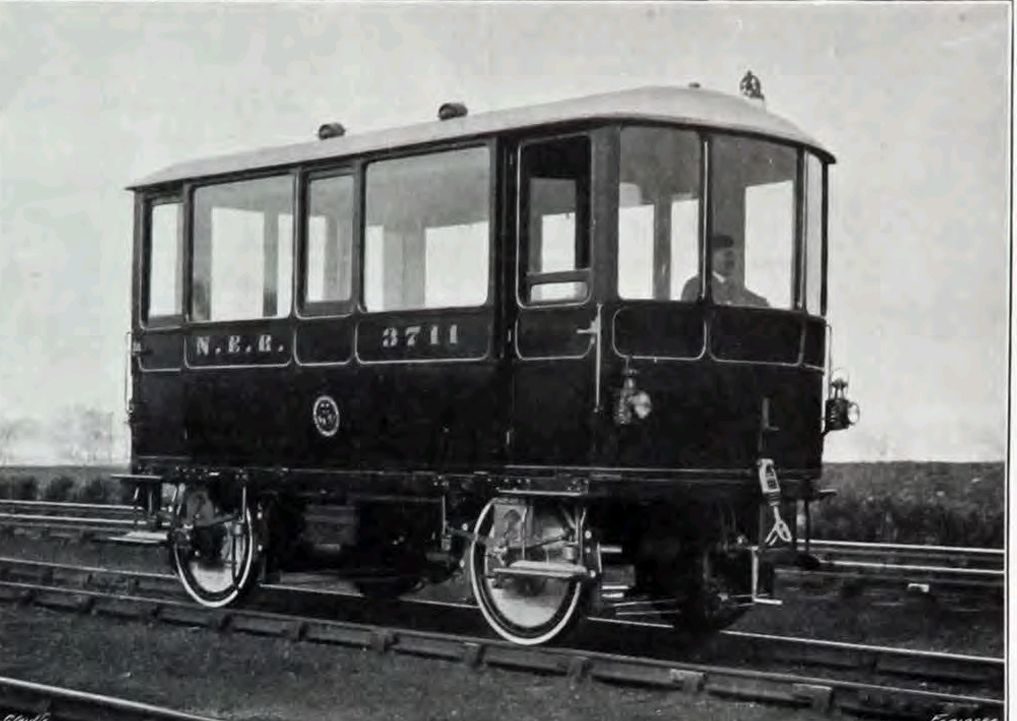
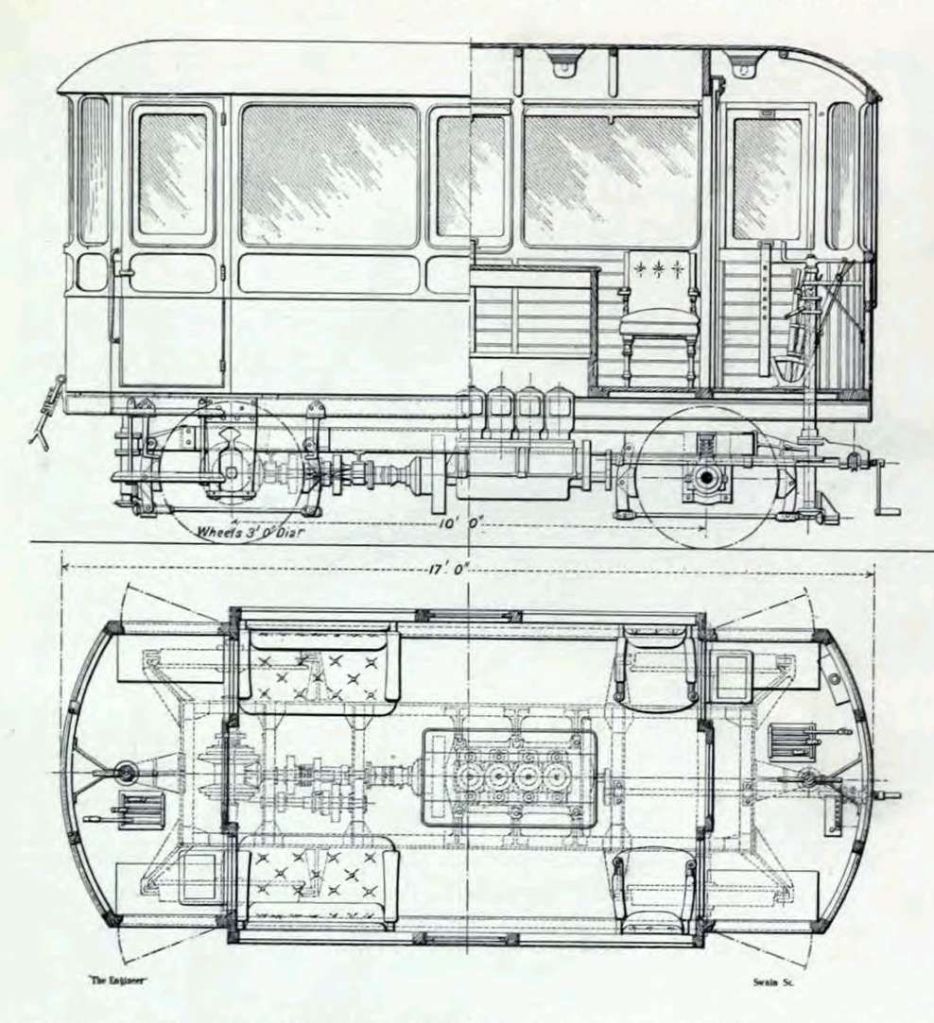
NER Directors’ Inspection Car [8: p358]
Side elevation and Plan of NER Inspection Car [8: p460]
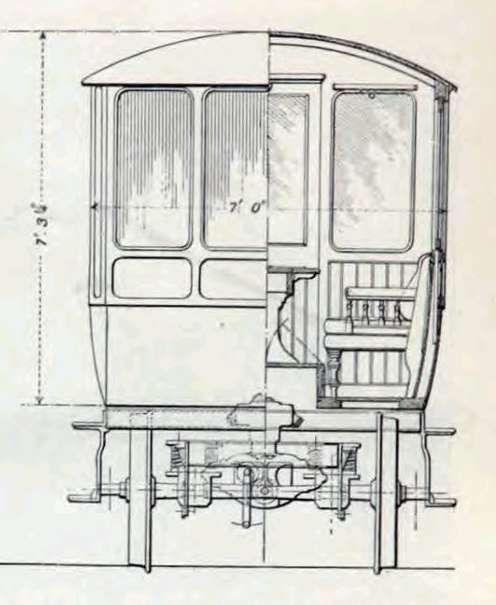
End elevation of NER Inspection Car. [8: p460]

The Engineer reported in early 1908 that “The North-Eastern Railway Company [had] recently built at its York carriage works and introduced into service a petrol rail motor inspection car designed for the use of its executive officers. The car [was] 17 ft in length by 7 ft in width, with a wheel base of 10 ft. It [was] arranged with a driver’s compartment at each end, and with an open saloon 10 ft. long in the middle. The saloon [was] entered through either of the driver’s compartments, and there [was] a permanent seating accommodation for six passengers, whilst two extra seats [were] provided on camp stools.” [8: p358]

It seems reasonable to ask why, with the  experience gleaned in the very early years of the 20th century, the NER felt the need in 1922 to commission further experimental vehicles. Was it because the technology had developed significantly? Had the early experiments been less than satisfactory?

Weston, Cleveland & Portishead Light Railway

The second short piece in The Railway Magazine of September 1922 related to a Railmotor constructed by the Drewry Car Company Limited (Works No. 1252), to the instructions of Colonel H.F. Stephens, who, along with other roles, was Engineer and General Manager of the Weston, Clevedon and Portishead Light Railway.

The railmotor was powered by a 4-cylinder Baguley 35 hp petrol engine with a 3-speed gearbox and its oil consumption, on easy gradients, [was] 16 miles to the gallon. It had a maximum speed of 25 mph. It was 19ft long and driven by a chain drive from either end. It had 2ft diameter wheels. [1: p239][6]
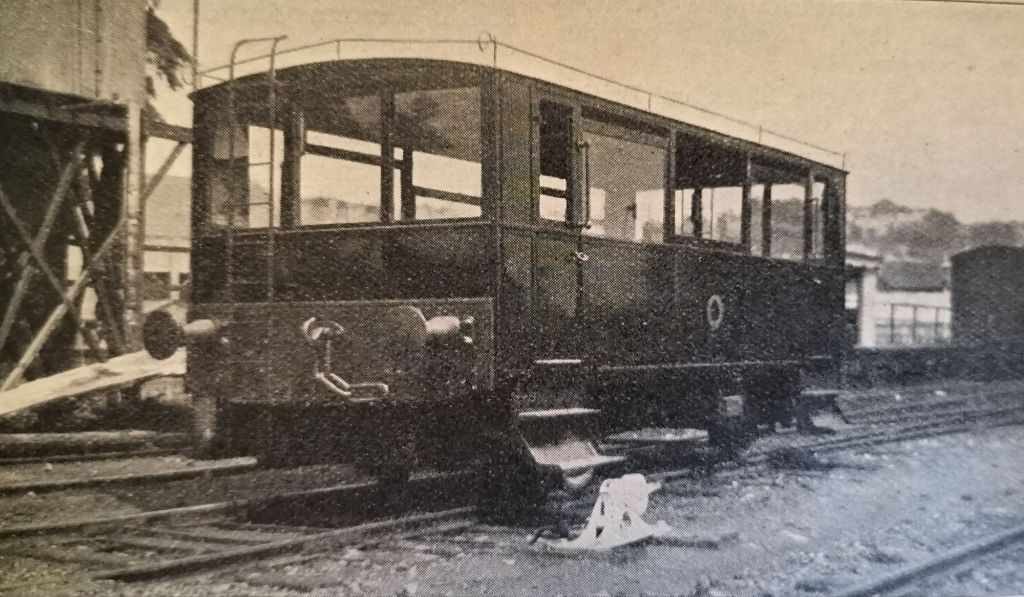
A Drewry Railmotor at the Weston, Cleveland & Portishead Light Railway. [1: p239]

The vehicle had full visibility all round. Glazed throughout above waist height. Side widows were openable. The panels below the windows were of steel. Acetylene lighting was provided for travel after-dark. The unit carried a maximum of “42 passengers – 30 sitting and 12 standing. The car [was] provided with rails round the roof to enable light luggage and market produce to be carried outside, thus giving the passengers more accommodation.” [1: p239]

Colonel Stephens “was a pioneer of petrol traction. The WC&PR was the first of his railways to introduce railcars. … Due to low running costs [the Drewry Railmotor] was relatively profitable. … Originally the petrol tank was fitted inside the railcar together with spare cans of petrol. As smoking was then common, it was later realised that this was a hazard and a cylindrical horizontal petrol tank was fitted at one end above the buffer beam.” [6]

A light four-wheel wagon built by Cranes was bought in 1925 for the railcar to carry extra luggage or milk churns.” [6]
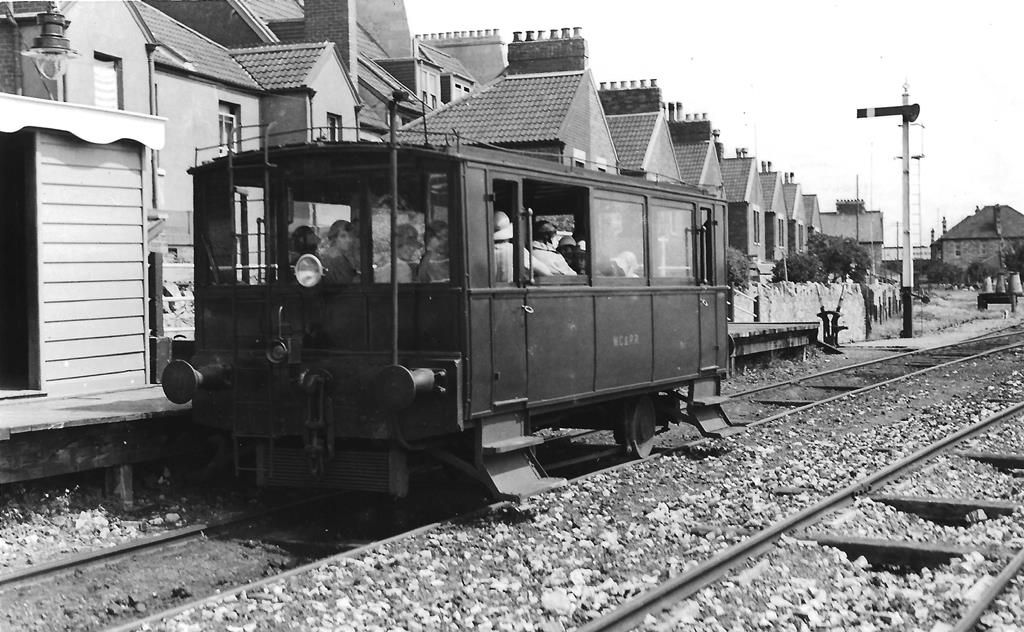
The Weston, Clevedon and Portishead Light Railway’s first Drewry railcar at the Ashcombe Road terminus in Weston-super-Mare. It was built for the WC&P in 1921 and operated until the line closed in 1940, © Public Domain. [7]

References

  1. The Railway Magazine, Westminster, London, September 1922.
  2. https://www.lner.info/locos/IC/ner_petrol_bus.php, accessed on 8th August 2024.
  3. https://www.lner.info/locos/IC/ner_petrol_autocar.php, accessed on 8th August 2024.
  4. https://www.embsayboltonabbeyrailway.org.uk/oldsite/nerautocar.html, accessed on 8th August 2024.
  5. https://electricautocar.co.uk, accessed on 8th August 2024.
  6. https://www.wcpr.org.uk/Railcars.html, accessed on 8th August 2024.
  7. https://commons.m.wikimedia.org/wiki/File:Ashcombe_Road_-_WCPLR_small_railcar.jpg, accessed on 8th August 2024.
  8. The Engineer; 3rd April 1908, p358 and 1st May 1908, p460.
Advertising in the November 1929 Railway Magazine

This article features advertising from the November 1929 edition of The Railway Magazine. It will probably be of interest to compare the various adverts here with those in The Railway Magazine of November 1938. An article about the 1938 magazine can be found here. [2]

The Southern Railway

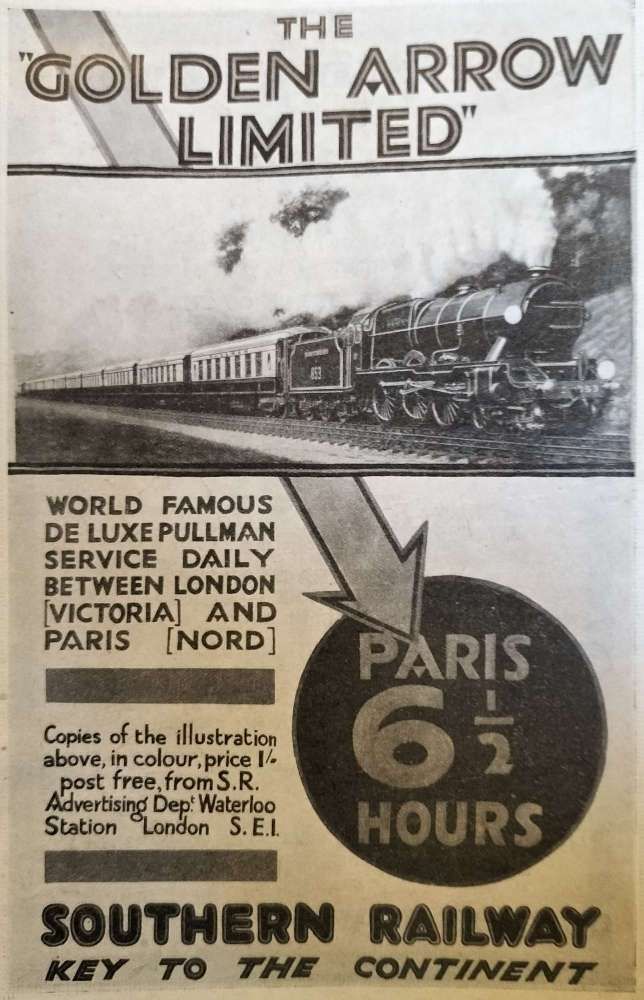
The Southern Railway had a single page advertisement in the magazine which featured the Golden Arrow Pullman Service between London and Paris.

London to Paris in 6 hrs 30 mins! [1: pIII]

Wikipedia tells us that, “The Flèche d’Or was introduced in 1926 as an all-first-class Pullman service between Paris and Calais. On 15th May 1929, the Southern Railway introduced the equivalent between London Victoria and Dover while simultaneously launching a new first class only ship, the ‘Canterbury’, for the ferry crossing. The train usually consisted of 10 British Pullman cars, hauled by one of the Southern Railway’s Lord Nelson class locomotives, and took 98 minutes to travel between London and Dover. Because of the impact of air travel and ‘market forces’ on the underlying economy of the service, ordinary first- and third-class carriages were added in 1931. Similarly the first-class-only ferry, ‘Canterbury’, was modified to allow other classes of passenger.” [3]

It is not surprising that the train service ceased at the outbreak of the Second World War in September 1939. “It resumed after the war on 15th April 1946, initially running with the pre-war Pullmans and the Trianon Bar car, a converted twelve-wheeled Pullman. The Southern Railway flagship, the ‘Invicta’ replaced the ‘Canterbury’ from 10th October 1946. As of 1949, the all-Pullman train was scheduled to depart from London Victoria at 10:30, with the connecting train from Calais reaching Paris (Gare du Nord) at 17:30, and from Paris at 12:15, with the connecting train from Dover arriving in London at 19:30. This worked out to a scheduled journey time of 6 hours eastbound and 6 hours, 15 minutes, westbound.” [3]

Four Full-page Adverts from the LMS

The LMS had four full-page adverts in the November 1929 magazine:

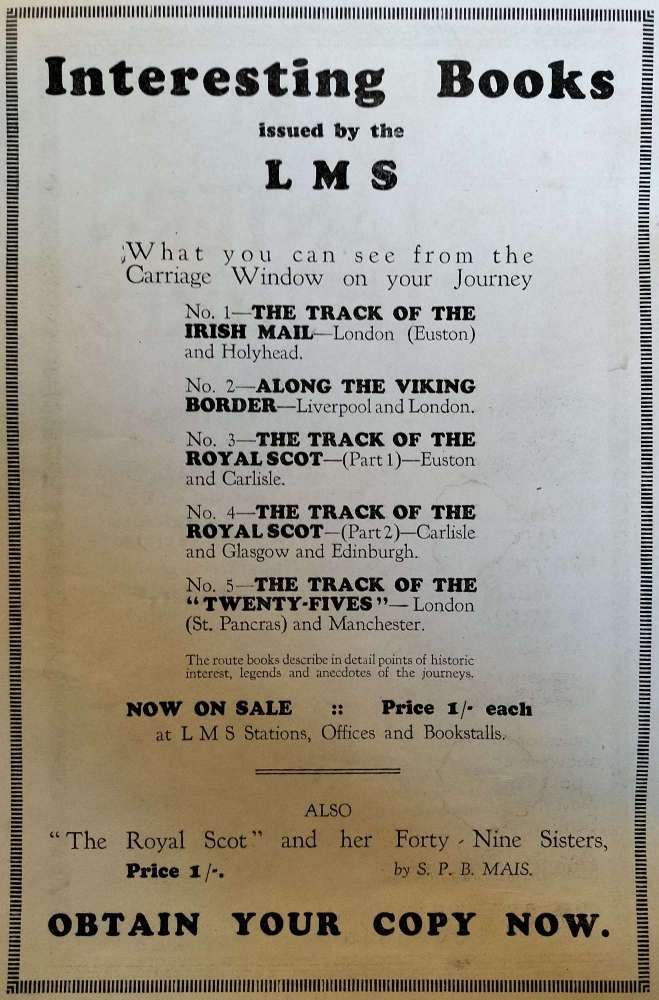
The first advert was for a series of ‘Carriage Window’ books. …

The first page pointed to a series of ‘carriage window’ books which helped travellers to comprehend what they were seeing beyond the windows on their journeys. [1: p IV]

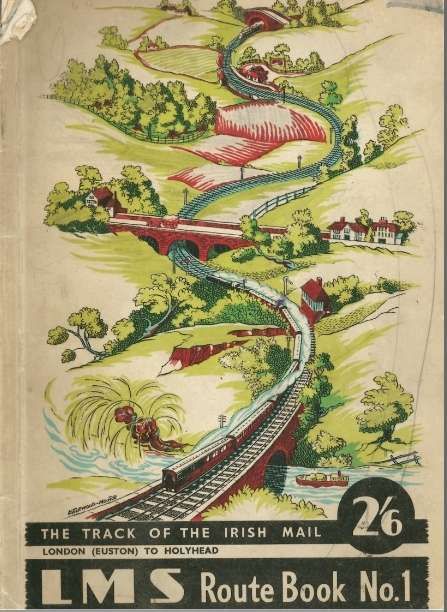
These ‘Carriage Window’ books were usually entitled ‘The Track of the …’. They covered a number of different main line routes.

The frontispiece from the edition of ‘Track of the Irish Mail’ issued in 1947. [4]

In the article about The Railway Magazine of November 1938 we noted that the LNER was supplying scripts and slides for talks about their network. In 1929, the LMS was offering a similar range of lectures. …

Lecture notes and slides, illustrating holiday places and places of general interest on the LMS, supplied free! There is also a suggestion that a lecturer may be available too! [1: p V]

The LMS also advertised the dining experience on their express services. …

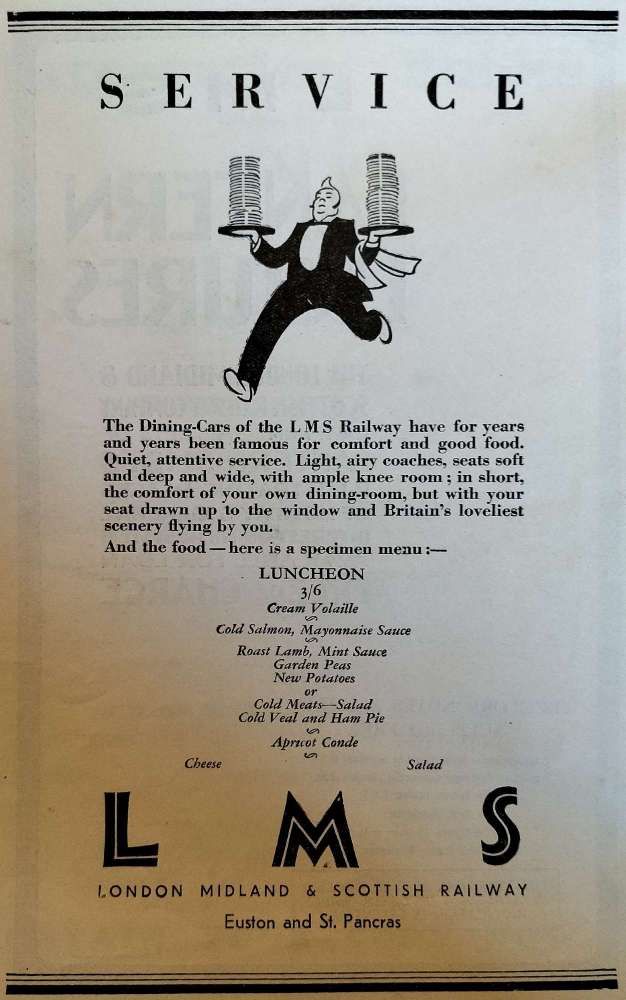
The dining experience on LMS is celebrated in this advert. I wonder whether their customers saw the advertised service or had similar disappointments as people in later generations? The food on offer probably simplified preparation work. [1: p VI]
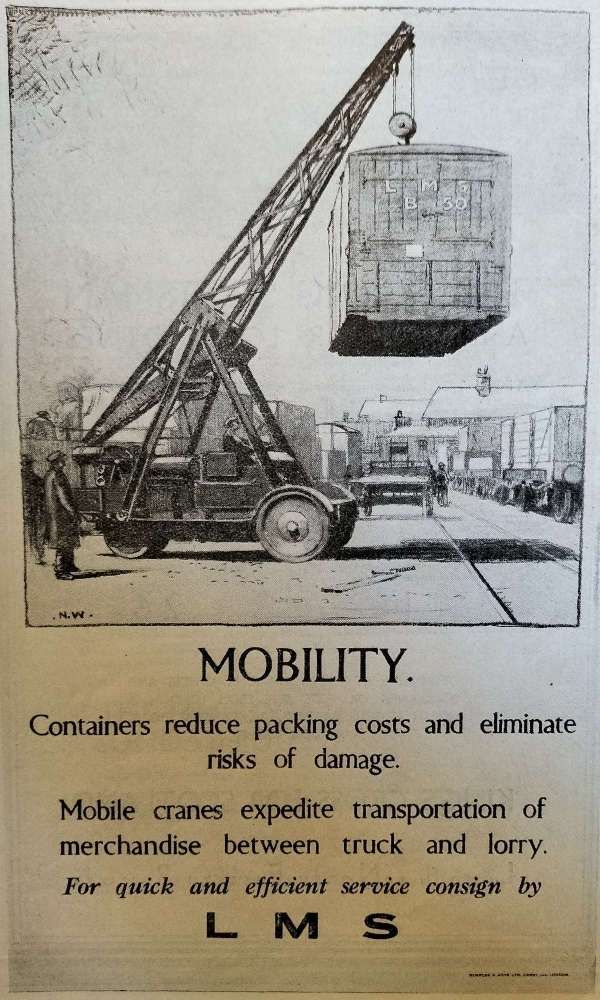
The use of containers on the LMS was clearly established by 1929. Mobile cranes in goods depots at railheads facilitated transfer from railway wagons to trucks and lorries.  [1: p VII]

Four LNER Full-page Adverts

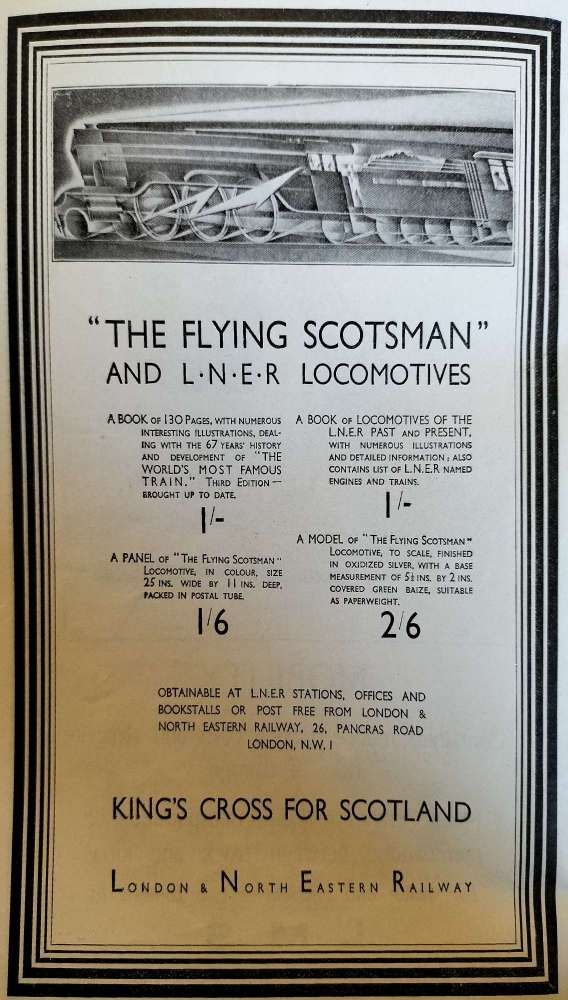
The first advert is for two books, a picture and a model celebrating ‘The Flying Scotsman’ and other LNER locomotives.

Two books, a ‘panel’ and a paperweight, all available direct from the LNER! [1: pVIII]
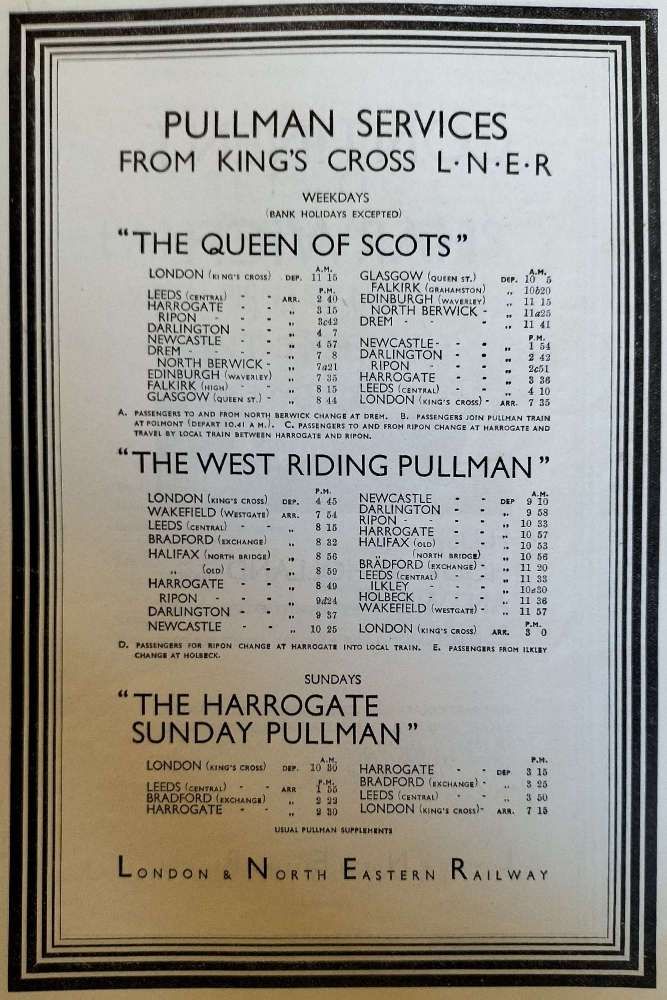
Pullman services provided by the LNER. The ‘Queen of Scots’, the ‘West Riding Pullman’, the ‘ Harrogate Sunday Pullman’. [1: pIX]
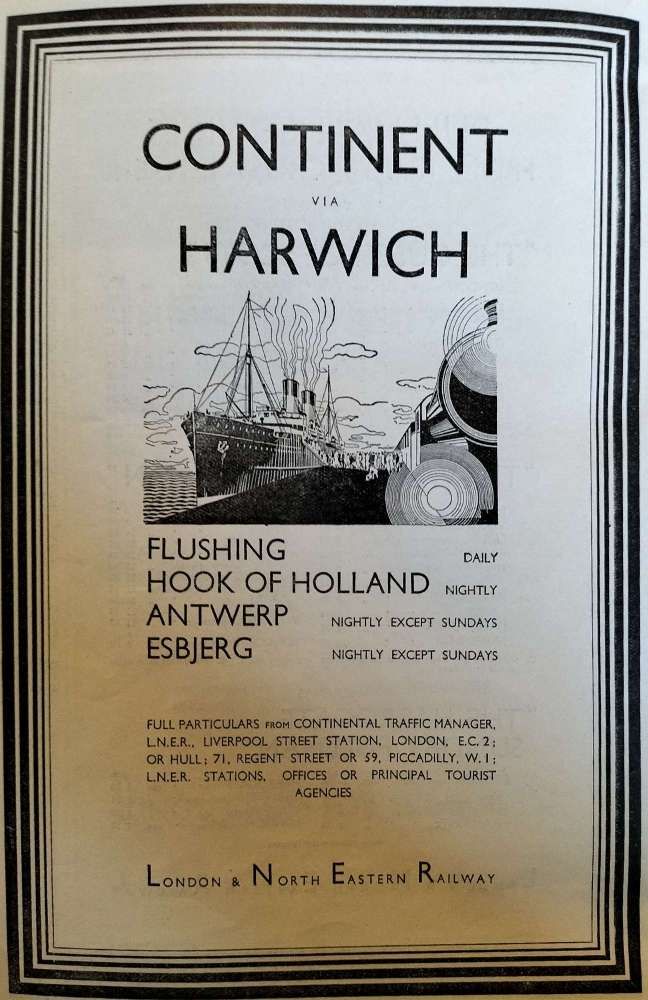
Ferry routes to Flushing (every day), to Hook of Holland (every night) to Antwerp and to Esbjerg (both nightly except Sundays). [1: pX]
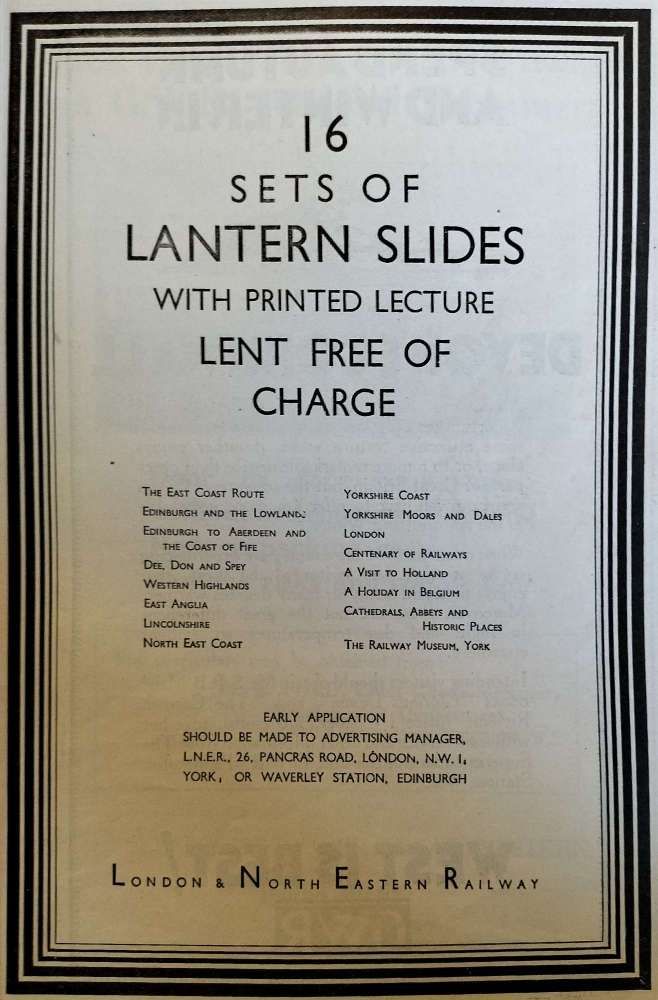
LNER slides and lectures, available free of charge! It seems from this advert, and that from 1938, that this practice was normal during the interwar period. Some interesting subjects! [1: pXI]

Two GWR Adverts

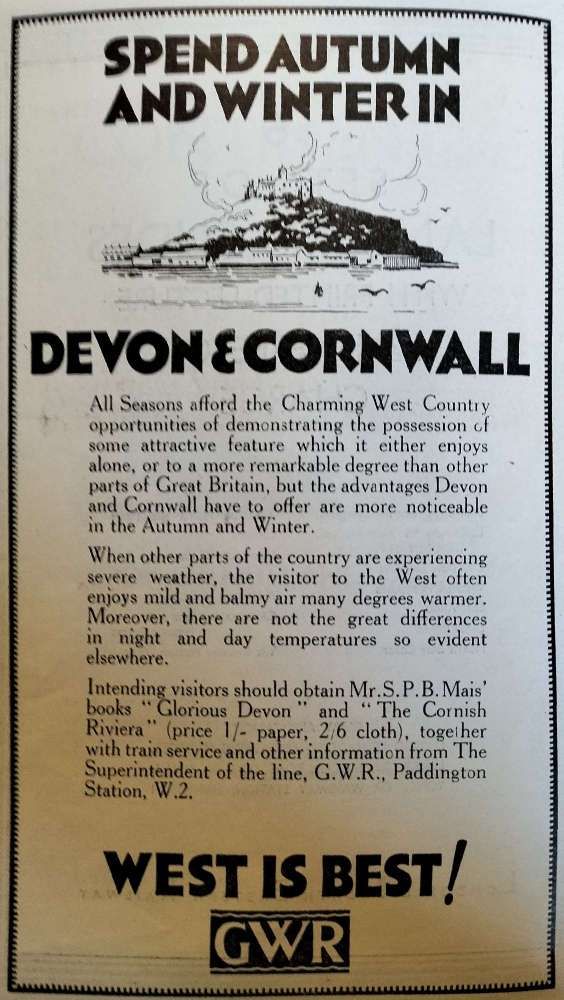
The first GWR adverts seems to be endeavouring to extend the summer season in the West Country. …

The GWR encourages out-of-season travel to the West Country, and the purchase of travel books direct from the GWR. [1: pXII]

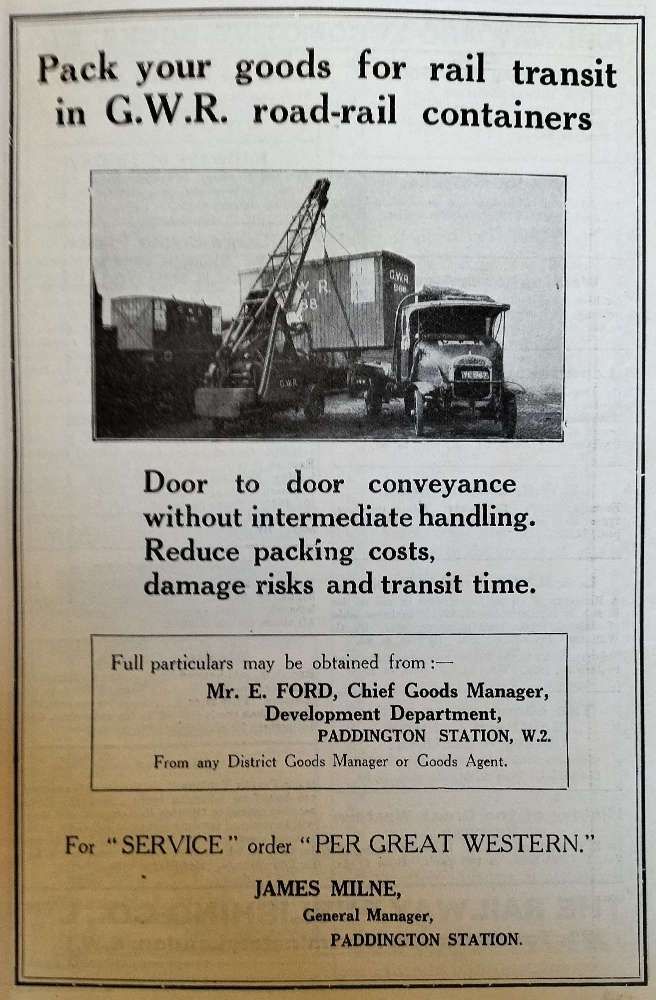
Their second advert focussed on their container service. …

Advertising the GWR container services, the photograph used shows a contemporary mobile crane and a GWR road-lorry. [1: pXIII]

Other Adverts

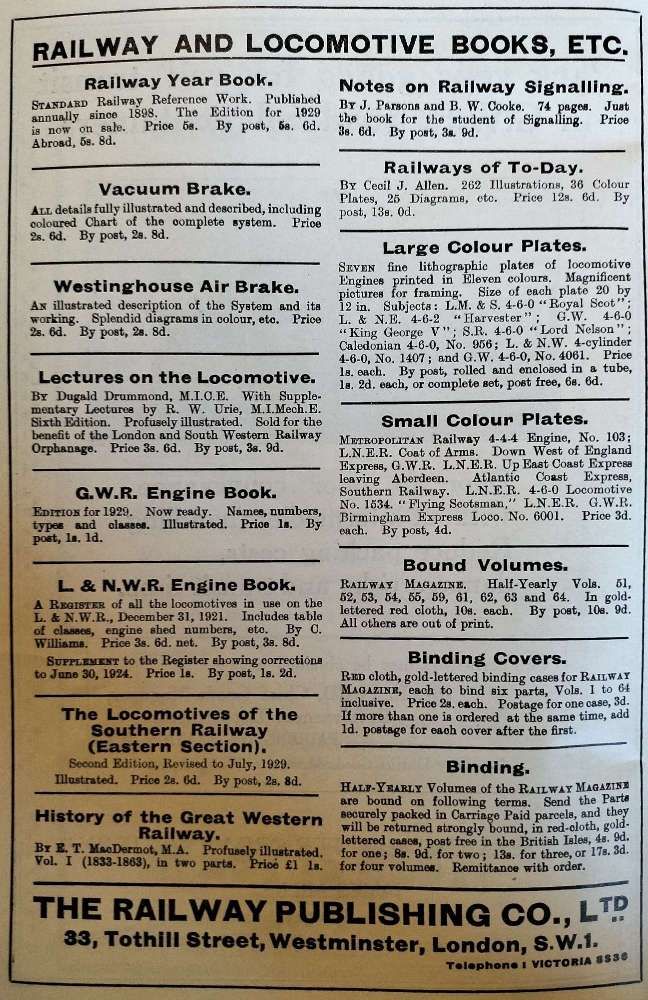
A regular feature is a full-page advert from the Railway Publishing Co. Ltd. [1: pXIV]
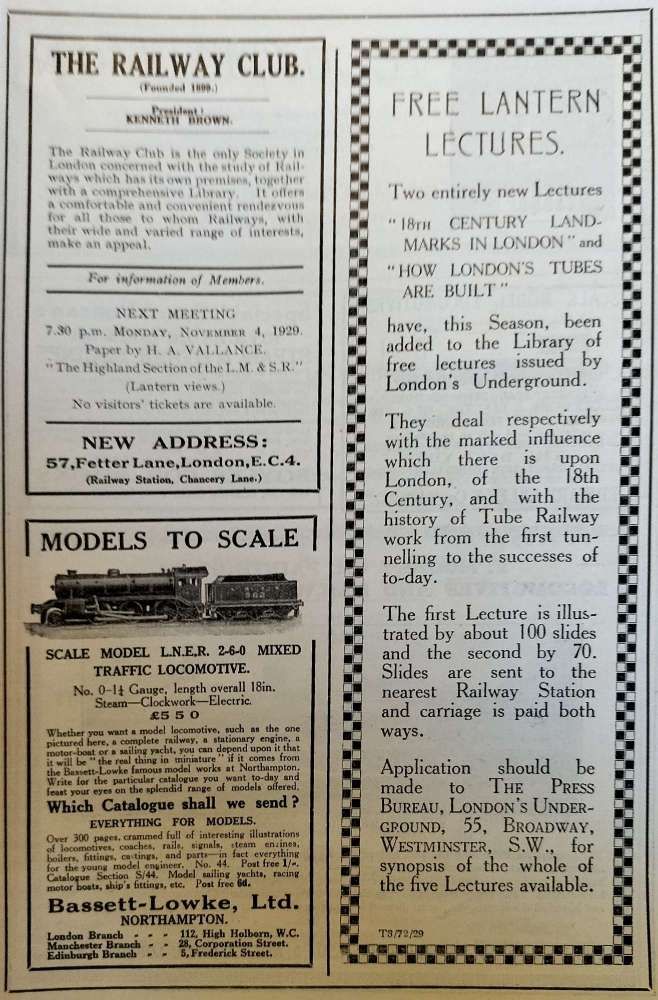
Adverts from ‘The Railway Club’ and Bassett-Lowke sit alongside an offering from the Press Bureau of London’s Underground of two new lectures, the first about London’s landmarks, the second about the building of the underground railways. [1: pXV]
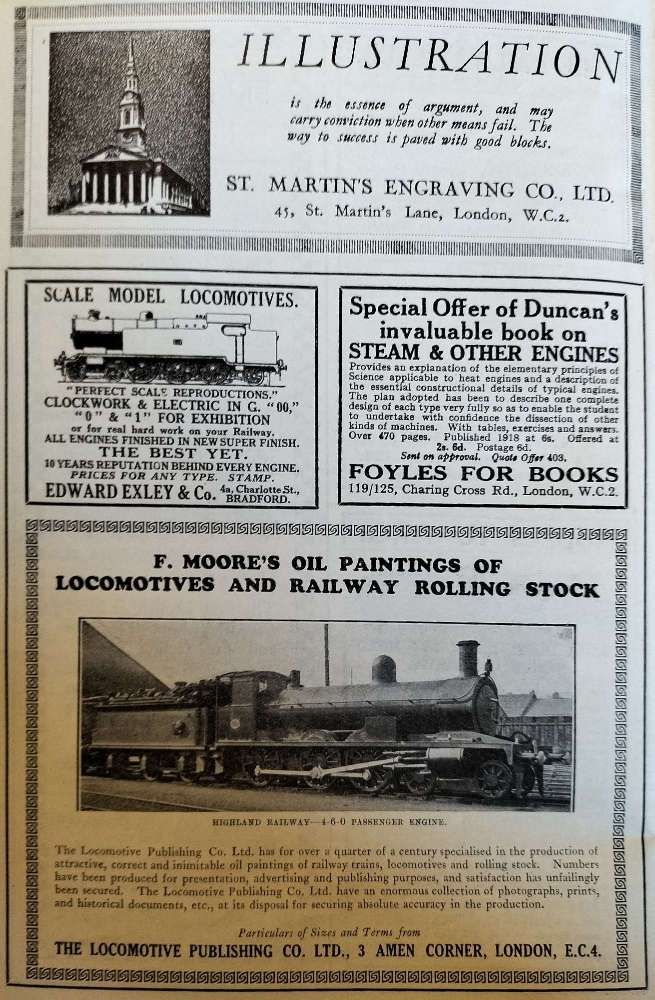
The advert from St. Martin’s Engraving Co. Ltd. appears also in the November 1938 magazine. Fouled for Books is still a going concern in 2024. Edward Exley & Co. was founded in Bradford in about 1920 and the company is still in existence in 1924, undertaking repairs of Exley products from the past. [5] F. Moore was not the name of a real artist, but rather the name adopted by the Locomotive Publishing Company, which employed the services of the rather reclusive Edwin Thomas Rudd to do the actual painting. [6][1: pXVI]
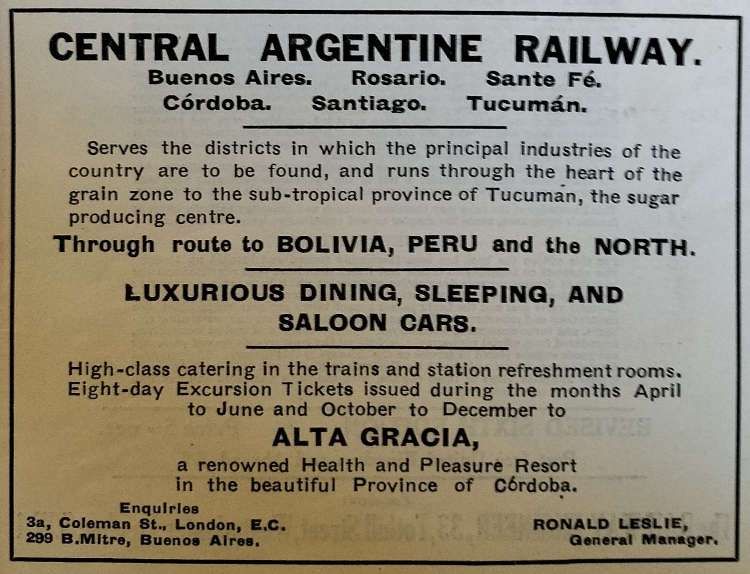
The Central Argentine Railway [1: pXVII]

The Central Argentine Railway was one of four broad gauge (5ft 6in/1676mm) British companies that built  and operated railway networks in Argentina. Established in the 19th century, to serve the provinces of Santa Fe and Córdoba, in the east-central region of the country, it eventually also served Buenos Aires, Tucumán, and Santiago del Estero. It effectively ceased to exist after nationalisation.

British railway companies operating in Argentina, including the CA, were nationalized in 1948 by the Juan Perón administration. The CA took over the northern section of the Ferrocarril Rosario y Puerto Belgrano and then became part of the state-owned Ferrocarril General Bartolomé Mitre.” [7]

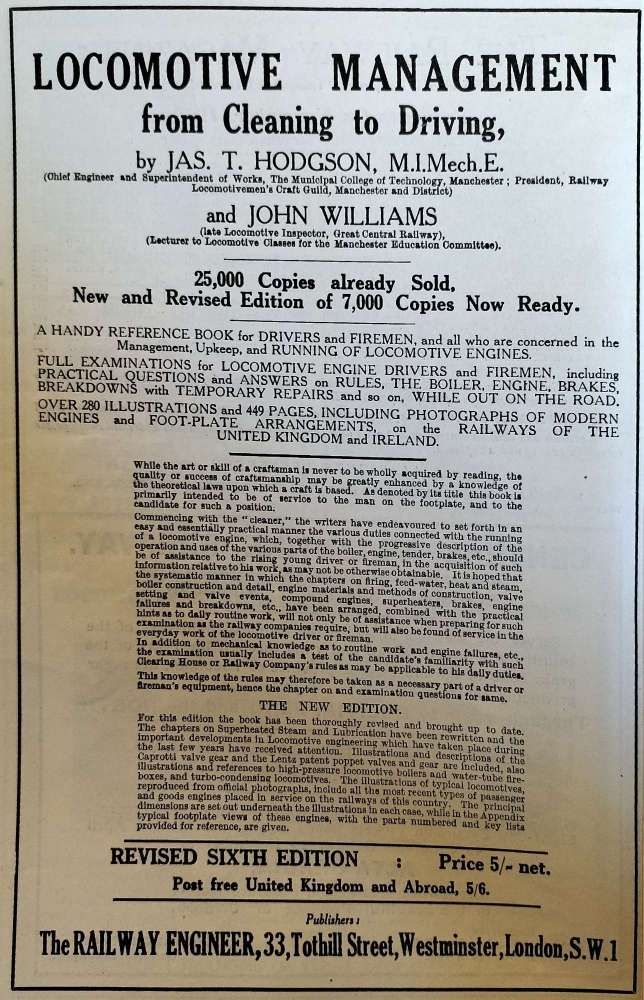
This final advert from the front pages of the November 1929 magazine promoted a publication by The Railway Engineer, the revised 6th edition of “Locomotive Management – from Cleaning to Driving” by Jas T. Hodgson and John Williams. [1: pXVIII]

‘Locomotive Management – from Cleaning to Driving’ was a standard text which went through regular revisions to keep it up-to-date.

Some LMS “Business” Posters

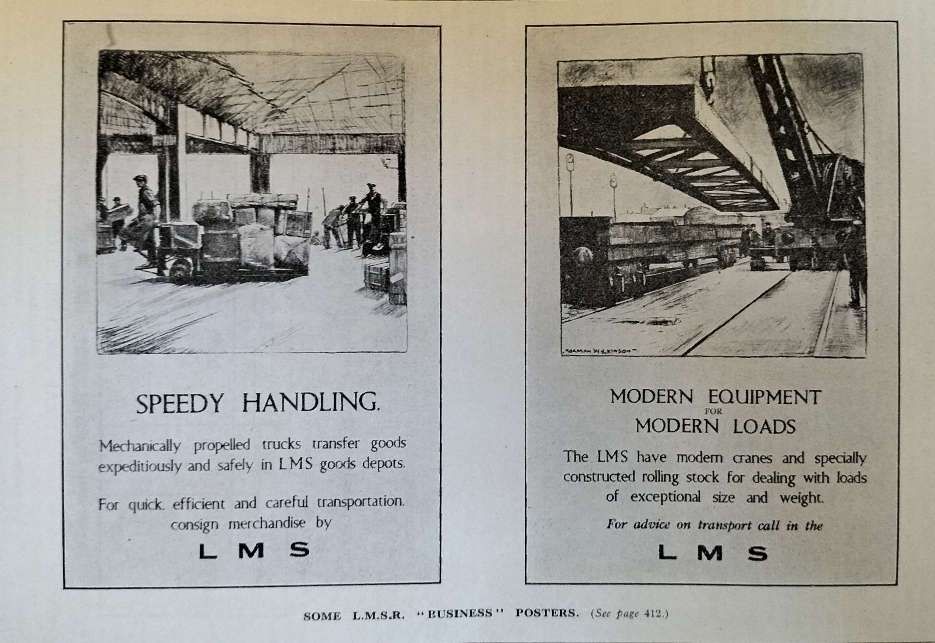
The LMS. sent specimen copies of an “admirable set of new posters recently issued by them depicting the various goods traffic facilities offered on their system. There [were] four posters altogether, all drawn by Mr. Norman Wilkinson, and these differ from the usual run of such things inasmuch as they are in black and white, with good bold red and black lettering beneath each picture.” [1: p412] Two were reproduced in the magazine.

Two of the LMS posters were reproduced in monochrome in The Railway Magazine. [1: p410]

One poster dealt with “‘Modern Equipment for Modern Loads’, and illustrate[d] the fact that the LMS. have modern cranes and specially constructed rolling-stock for dealing with loads of exceptional size and weight; another is mainly concerned with ‘Mobility’, and stresses the fact that containers reduce[d] packing costs and eliminate[d] risks of damage – besides expediting transportation of merchandise between truck and lorry. A third poster – a specially fine bit of work, this illustrate[d] the LMS. method of ‘rapid transport of goods from ship to dock’ – that is, by means of electric trucks – the contention being that modern LMS. steamers and handling appliances ensure[d] safe and expeditious transportation of goods between Great Britain and the Irish Free State and Northern Ireland. The last of the series also deals with ‘Speedy Handling’ by means of mechanically-propelled trucks, which ‘transfer goods expeditiously and safely in LMS. goods depots’.” [1: p412]

New GWR posters

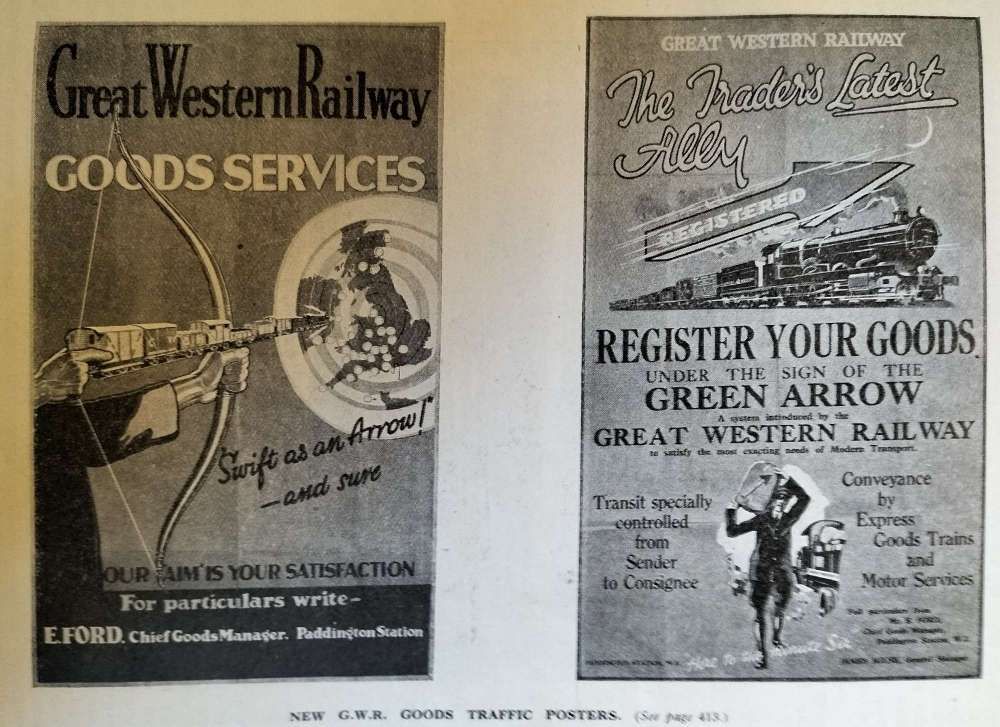
Two posters which have been issued by Mr. E. Ford, Chief Goods Manager, GWR. … They may be regarded as good examples of the modern tendency to recognise that there is almost as much scope for advertising goods traffic facilities as for those provided by the passenger department. The first emphasise[d] the fact that express freight trains provide[d] for rapid transit, usually on the basis of collection one evening and delivery early next morning, while it is quite appropriate that a first-class express engine should be shown at the head of the train, in that the latest express engines [were] quite frequently employed for running these trains, especially those on ‘registered’ service, with which the poster [was] particularly concerned. The poster itself [was] in colour, with lettering in black, white and amber on a blue ground. Pictorial portions [were] in full colour, while the arrow [was] in green, with amber shading, to emphasise ‘The Sign of the Green Arrow’.” [1: p 413]

The two GWR posters were reproduced in monochrome in the Railway Magazine. [1: p411]

The second poster also use[d] the symbol of an arrow to indicate, in this case, speed and sureness. The train itself [was] utilised as the arrow, while the target [was] an outline map of the British Isles in green, the name of the principal centres served by the GWR. was indicated as arrow destinations. The poster in other respects [was] on a green ground, utilising also blue, red and amber to an effective degree.” [1: p413]

These two posters go some way towards addressing the veracity of different views about the commencement of the ‘Green Arrow’ service referred to in my article about the November 1938 edition of the magazine. These posters demonstrate that the GWR, at least, was offering a Green Arrow service by November 1929 and suggest that the service reached into Scotland and so into the territories of the LMS and LNER.

References

  1. The Railway Magazine, Westminster, November 1929.
  2. https://rogerfarnworth.com/2024/07/20/advertising-in-the-railway-magazine-of-november-1938.
  3. https://en.m.wikipedia.org/wiki/Golden_Arrow_(train), accessed on 29th July 2024.
  4. http://www.britishtransporttreasures.com/product/the-track-of-the-irish-mail-euston-to-holyhead-l-m-s-route-book-no-1-anon-1947-ebook, accessed on 29th July 2024.
  5. https://en.m.wikipedia.org/wiki/Edward_Exley_Limited, accessed on 30th July 2024.
  6. https://culhamticketoffice.co.uk/bits/hidden-pages/fmoore.html, accessed on 30th July 2024.
  7. https://en.m.wikipedia.org/wiki/Central_Argentine_Railway, accessed on 30th July 2024.

Railway Staff – A 1929 Census

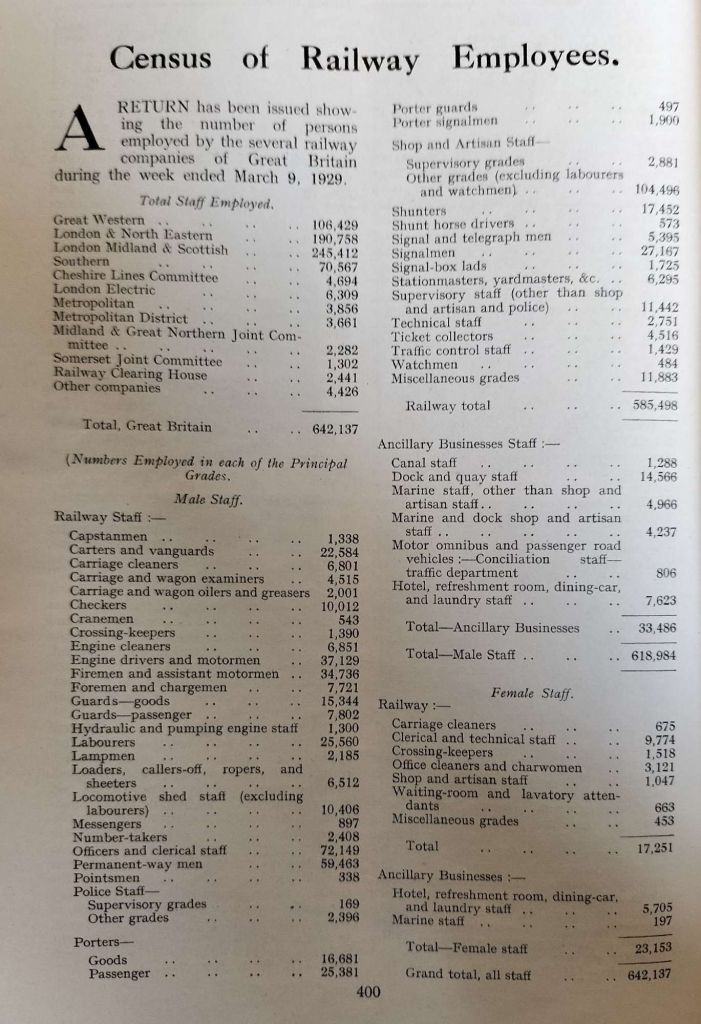
The Railway Magazine in November 1929 reported the breakdown of staffing across Britain’s railways in the week ending 9th March 1929. [1: p400]

The census of railway employees in 1929. [1: p400]

It is interesting, first, to note the relative sizes of the staff numbers of the Big Four railway companies. Significantly the largest employer was the LMS. The LNER had around 55,000 less staff than the LMS. Strikingly, the GWR had  significantly less staff again, with the SR the smallest, with less than one third of the staff numbers of the LMS. I wonder whether these figures might have resulted in some careful thinking, particularly by the LMS about the efficiency of their organisation? It would have been helpful to see the relative levels of income to compare against these figures. …

Secondly, I was struck by the relative numbers of male and female staff: 619,000 men to 17,000 women. 10 years after the first world war, very few of the women employed on the railways at that time would still have been employed by the railway companies. … What might have been the figures in a census during WW1?

Hidden within those figures are other striking comparisons. …

  • There were 6,800 male carriage cleaners and only 675 female carriage cleaners.
  • It seems that male officers and clerical staff totaled just over 72,000, supplemented by over 2,700 technical staff. Women employed in these areas amounted to around 9,800. It is unlikely that many supervisory positions in these areas would have been open to women, perhaps head offices of the railway companies may have had female managers in typing pools?
  • The role of crossing-keeper seems to have been far more equitably staffed between men (1,400) and women (1,500). Often a station master’s wife (or the wife of  another male employee) would be a crossing-keeper at a nearby crossing. One wonders whether there was a pay differential between men and women in this occupation?
  • Cleaning roles for carriages and engines were given to men (13,600). Office cleaners were set alongside charwomen (3,100) and it appears that all lavatory attendants  and waiting room staff were women (660).
  • Shop and artisan staff are recorded separately. Men seem to have filled all supervisory roles (2,900) with 104,500 men in other grades (excluding watchmen and labourers). There were just over 1,000 women in similar roles.
  • There were 7,600 male hotel, refreshment room, dining car and laundry staff and 5,700 women.

I am sure that as you look at the figures other matters will come to light.

I wonder what heading wheeltappers would be recorded under? Probably ‘carriage and wagon examiners’.

It also seems that in 1929 there was a ‘profession’ that trainspotters could aspire to. Across the railways of Britain there were 2,408 ‘number-takers’!

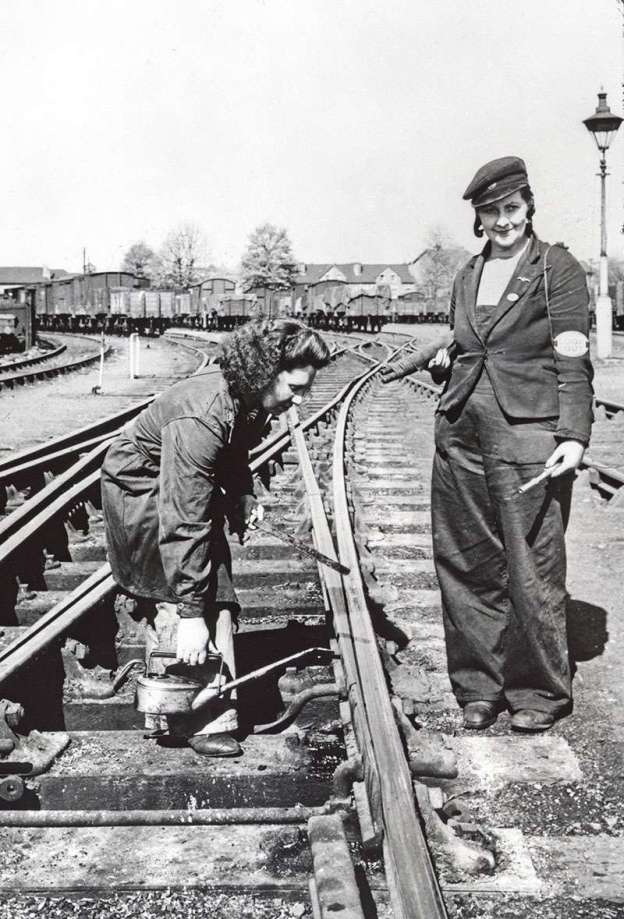
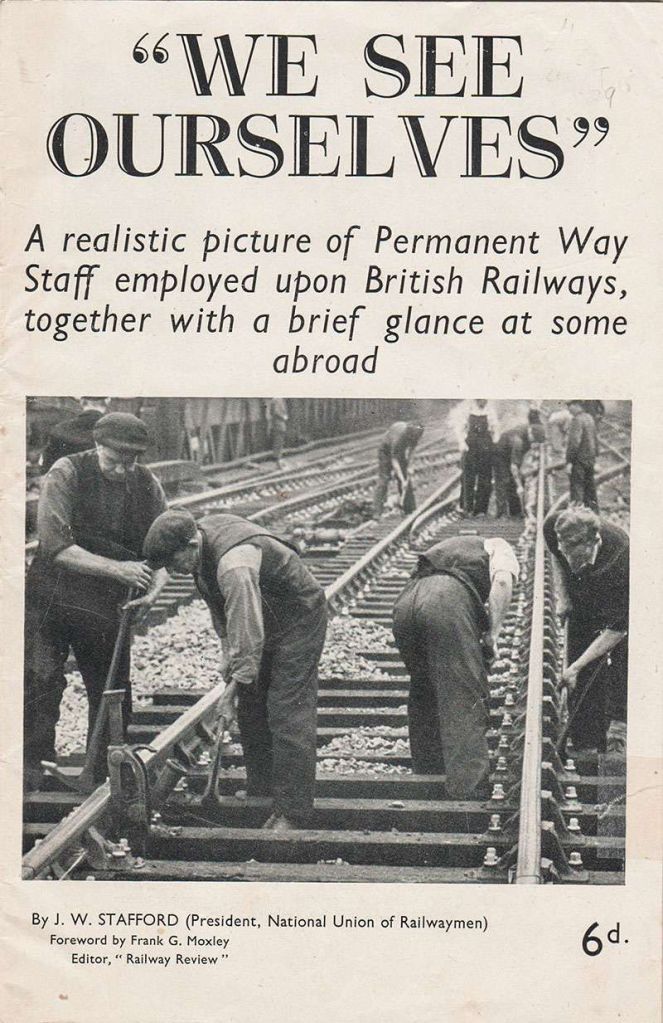
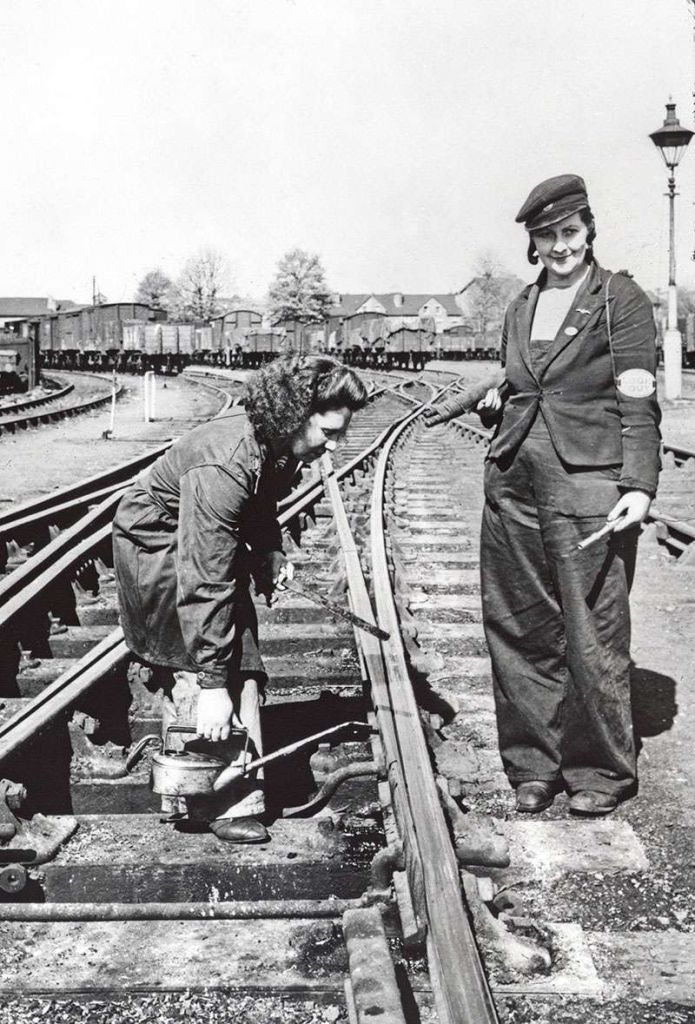
And finally … There are two pictures below showing railway employees at work on the railways. I came across the second while searching for a wartime image of women at work on the railways. The first is the cover page from the booklet which included the second picture. The “booklet, [was] published for six old pence in the BR era, by J W Stafford, the President of the NUR with the evocative title ‘We See Ourselves’. J W Stafford was a lengthman on the Great Western Railway, and later British Railways, for 33 years before he was elected president of the NUR in 1954. He asserted that it was management’s view in the 1930s that the heavier the tool, the greater would be the output of work, and that this belief had not entirely died out in the 1950s.” [2]

Men at work on the railways. [2]

The foreword by Frank Mosley notes that “Credit for building a cathedral is seldom given to the men who carefully and skilfully laid the stones. It is the same with a railway – in building it and keeping it in good order.”

Didcot Railway Centre comments: “This booklet itself is a comprehensive and very honest reflection of all aspects of Permanent Way staff employment, its challenges and its future prospects. Extending to no less than 21 sections on 23 pages, it includes ‘As Others see us’; ‘We were the Pioneers’; ‘Our Girls’; ‘A Dangerous Occupation’; ‘The Whitewash Train’ to ‘Airing our Grievances’.” [2]

The section entitled ‘Our Girls’ is a frank reflection that wartime shortages of men caused females to be employed on this work. Stafford, writing in the BR era, considered that given the arduous and dangerous nature of normal activities, it simply wasn’t a suitable environment for women!

I suspect that today that thinking would be seen as sexist, even if it wasn’t in the mid-20th century. Women clearly proved themselves effective railway employees in both world wars.

Women at work on the railways during WW2. [2]

References

  1. The Railway Magazine, November 1929.
  2. https://didcotrailwaycentre.org.uk/article.php/596/tuesday-treasures-march-2024, accessed on 30th July 2024.