Category Archives: Various

Matthew 14: 13-21 – 2nd August 2020 – How to Read a Story?

Matthew 14: 13-21

Many of us, when we go on holiday, take with us something to read, usually a novel or two, occasionally a biography. Apart from reading books about railway history, I’m an avid reader of suspense, crime and murder mystery novels. I really like the police procedurals like Rebus from Ian Rankin, Alan Banks by Peter Robinson, Bob Skinner from Quintin Jardine and books by Rachel Lynch, Harlen Coben, James Patterson, … etc.

This isn’t really the time or place to chatter on about what I like to read. But I do want to ask you about the way in which you read a story or a novel. Who do you identify with most readily? Whose eyes are you looking through as the story unfolds? Is it the hero or the heroine, a bystander, or someone else who is involved in the plot?

I guess to some extent it depends on how the book is written, whether it is in the 1st person or the 3rd person, whether you are actually encouraged to identify with one character or another. Some of the most intriguing stories are those where the author encourages you to see things through the eyes of one character, to identify with them, only to find out that they are not the person you thought they were. The experience can be quite shocking!

It is usual for us, when we read a story or a novel, to identify with someone … to live the story through them.

So, I wonder, when we read stories in our bibles do we do the same? Or do we sort of stand detached, alongside events almost like spectators?

I think the bible authors had just the same kind of intentions as modern story-tellers do. They want to draw us into the story, to get us involved.

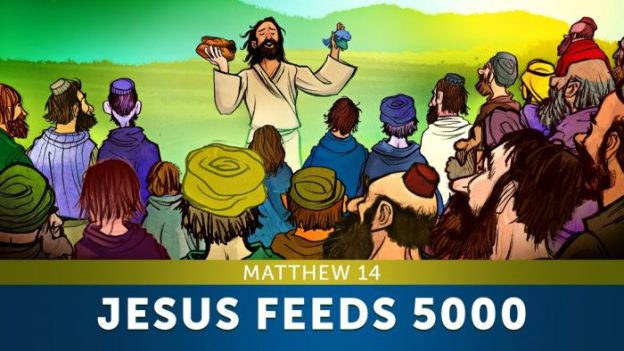
We are given an account of the feeding of the 5,000 in all of the Gospels, Matthew, Mark, Luke and John. All the accounts are different in their own way, all reflect the perspective or agenda of the particular Gospel writer. All help us to have different perspectives on the story! So Matthew and Mark place this story just after the death of John the Baptist – and in the context of the story that is clearly meant to be important. Luke suggests that the 12 have just arrived back from their mission as healers and preachers and that they are desperate to talk to Jesus about the things they have done and seen happen. John adds personal detail mentioning both Andrew and Philip, two of the disciples, by name – and mentioning that the five loaves and two fish came from the picnic box of a young boy. The same story told in four different ways.

Not only is the story told slightly differently by our four Gospel writers – highlighting different things in the story. We also have the opportunity to see the story through different people’s eyes. If we allow ourselves to imagine it, we can look out on the story through the eyes of the disciples, perhaps particularly Andrew or Philip, we can watch as members of the crowd, we could take the young boy’s perspective (although he does not appear in Matthew 14) or we could see things through Jesus’ eyes.

One thing I could ask you to try would be to choose a character from the story in Matthew 14 and listen again to the story trying to see things from their perspective and then perhaps share with others who have read the story but who have chosen other characters, what you saw. It would be a good way to broaden your understanding of a passage that you have read.

I’d like to highlight a couple of things that might come from doing just that as we read this story:

Jesus: The context of this story of the feeding of the 5,000 is set for us in each of our Gospels. Jesus has just heard of the death of his cousin, John the Baptist, he is in mourning. … The disciples have returned from the mission he has set them and they are full of excitement; clamouring and eager to talk to him about their impact on other people’s lives. … Our reading tells us that Jesus hearing about John’s death, withdrew by boat, privately to a solitary place. I guess he needed space to mourn. The other Gospels tell us that he withdrew with his disciples. In Mark we hear Jesus say these words to his disciples: “Come away to a deserted place all by yourselves and rest a while”.

Jesus is exhausted, emotionally, spiritually and physically – he is done in and he needs space. His disciples similarly need space to rest and recuperate from their mission. I can imagine Jesus climbing up the slopes on the far side of Galilee – so grateful for the opportunity to rest, only minutes later to look up and see a large crowd gathering. Jesus was exasperated, grief-stricken, exhausted, ready for a break. … I guess, some of those feelings will be shared by parents and others here who have still to take their holiday, maybe even by those who have just had their holiday with children in tow.

In this instance, Jesus sets aside his own needs for the needs of the crowd. Even in the midst of his tiredness and grief he is willing to give himself to their demands for his attention. A while back, on our day off at 8.30 in the morning the doorbell rang. Still in my night clothes, I answered the door and there was a man of the road – can I have some breakfast. Come back later I said, we are still in bed. At 9.00 he was back, this time shouting through the letterbox, a few expletives about our laziness and unwillingness to serve him. He eventually got a piece of my mind and some days later came back to apologise. What does Jesus’ attitude in our Gospel reading say to me about my attitude to this man? Could I not have served him rather than place my own needs for rest first?

As Christians, all of us are here to be God’s hands and feet in society. Jesus challenges us, not just by his words, but by his actions, to be willing to go the extra mile in serving others! And only after having done so, here in this story, do the following verses tell us that he makes time again for solitude and rest!

The disciples: John and Mark have the disciples chuntering away before they come up with a very small amount of food. John has them ‘borrowing’ the food from a young lad. Both the disciples and the young lad had no idea what their paltry, tiny offering would make. They perhaps only made the offering to reinforce the fact that trying to provide for this host of people was a lost cause. ‘Lord, we just have to send them away – can’t you see that now?’

But Jesus takes their reluctant, tiny offering and turns it into the most sumptuous of banquets. … Like the disciples we so easily see what we have to offer as not enough. We are not gifted enough, our congregations are too small, we can’t possibly afford to meet Parish Share, we cannot meet the maintenance demands of our buildings – it is hopeless. … And it is so easy to think like that.

We are small and seemingly overwhelmed by the world around us, yet God is still working in our midst. We reminded ourselves last week that it is when we feel small  and helpless, then we are most like the Kingdom of God, for it is then that God can work through us. Things are fragile, they are certainly very dependent on the life of God’s Spirit. God is quietly at work in our midst and we have had a part to play in his work in our world.

Here in the characters of our story – seeing events through their eyes – we can be:

  • challenged and encouraged;
  • spurred on to service; and
  • reminded of God’s love and provision for us.

Prayers

Why not try what I have suggested for your prayers this week? Sit with this or another passage of Scripture for a little while. Try picking one of the characters in the story and see things from their perspective. Ask yourself: What do they notice? What do they do? Why, what motivates their actions? If you chose the passage from Matthew 14, you might find that you gain a different insight to the ones that I have suggested. …………..

Take time as well to pray for the work of the church, for those in authority in our world, for peace, for the needy, for those who are unwell and for those who are at rest with the Lord.

Matthew 13: 31-33, 44-52 – The Kingdom

Matthew 13:31-33, 44-52

Jesus gives us a number of pictures of the Kingdom of God or the Kingdom of Heaven.

First, the mustard seed – something so small that you can hardly see it, yet when it is fully grown it is almost as big as a tree – seemingly insignificant and of no apparent value yet having an impact far beyond what could be imagined.

Second, the Kingdom is like yeast which when mixed into the dough leavens the whole loaf and makes it rise – perhaps just 7g or 10g of yeast will leaven 500g of flour. so, the kingdom is alive and growing. It’s an agent which turns something flat and dry into something light and airy.

Thirdly, two pictures about the value of the Kingdom, treasure hidden in the field, and a pearl of great price. The kingdom has hidden value, easily missed for years, like treasure trove in a field, trampled under foot as the farmer ploughs the field, or a pearl hidden inside an ugly clam.

The overall impression is of something easily missed, seemingly of little value or importance – but yet, ultimately of immense worth. Something hidden, seemingly small and of little value – yet far more important than we can imagine.

So when Jesus uses the words “the Kingdom of God”, what is he talking about?

In the Gospels we hear Jesus saying these words on many occasions: “Repent, for the kingdom of God has come close to you.” And in the context it sounds a little as though he is talking about himself.

So, is that what the Kingdom is? Anywhere where Jesus is present? …

Elsewhere Jesus talks of the Kingdom as being within us. … So, is that what the kingdom is about – not something physical but something that governs our hearts? …

Sometimes Jesus seems to talk of the Kingdom as being something for the future, something beyond this life – somewhere that we call Heaven. … So is that what the Kingdom is about – something that Christ will bring in when he returns, whenever that may be – something not for now but for then, for the future?

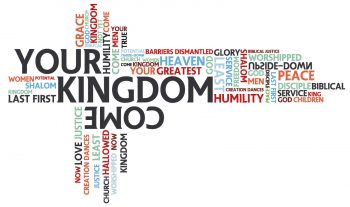
What are you praying when we pray those words in the Lord’s Prayer … ‘Your Kingdom Come’?

The Kingdom of God is the Rule of God – wherever it may be. Yes, it does refer to heaven, and we look forward to a time when all that is evil is gone, when peace and justice, mercy and goodness have sway.

But it also encompasses life here on earth – God’s rule in our hearts, changing us, calling us on to love others, to work for a just, peaceful world, experiencing his presence with us. But a lot more than that too.

The church has fallen into the trap down the years of identifying itself with the Kingdom and of seeing God’s kingdom being about the rule of earthly Christian Kings. …………… So we have been responsible in the past for the Crusades; the temporal power and authority of the Bishop of Rome has been called the Holy Roman Empire; we have assumed that because we have a Christian heritage, all our culture must also be Christian, that the values we live by must be the values that the world should live by; and at times we have been arrogant and aggressive.

But says Jesus – that is not the kingdom. The kingdom is often insignificant, often overlooked. It is not about physical wealth, or might or power. In fact, the church is most like the Kingdom when it is weak and small, unsuccessful and overlooked by society. And the Kingdom exists where hope is born out of nothing, where God’s servants live like yeast in the dough of society, where truth and light and goodness is a treasure to be discovered hidden in the lives of ordinary people.

And as we look at ourselves and the world around us. As we feel insignificant and small, as our churches seem to have little hope for the future, … then we are most like the Kingdom of God, for then we can begin to feel the weakness and hopelessness of so many around us. And we can be part of our community like the yeast in the dough – not going out arrogantly with the answers, but rather joining our community in seeking God=s presence, looking for signs of the Kingdom, carrying with us the love of God and looking out for that love evident in the lives of those around us.

Then God’s kingdom is coming here on earth and small seeds of hope will germinate in our lives and the lives of those around us – and perhaps new shoots of life will develop and in time trees of righteousness and justice and peace may well have grown in the places where we live and work.

Prayers for the coming of God’s Kingdom

Almighty God,
your ascended Son has sent us into the world
to preach the good news of your kingdom:
inspire us with your Spirit
and fill our hearts with the fire of your love,
that all who hear your Word
may be drawn to you,
through Jesus Christ our Lord.     Amen

God of our salvation, hope of all the ends of the earth,
we pray:
Your kingdom come.

That the world may know Jesus Christ as the Prince of Peace,
we pray:
Your kingdom come.

That all who are estranged and without hope
may be brought near in the blood of Christ,
we pray:
Your kingdom come.

That the Church may be one in serving
and proclaiming the gospel,
we pray:
Your kingdom come.

That we may be bold to speak the word of God
while you stretch out your hand to save,
we pray:
Your kingdom come.

That the Church may be generous in giving,
faithful in serving, bold in proclaiming,
we pray:
Your kingdom come.

That the Church may welcome and support
all whom God calls to faith,
we pray:
Your kingdom come.

That all who serve the gospel may be kept in safety
while your word accomplishes its purpose,
we pray:
Your kingdom come.

That all who suffer for the gospel
may know the comfort and glory of Christ,
we pray:
Your kingdom come.

 That all who are unwell may know your consolation, strength and healing …….. particularly ……………we pray:
Your kingdom come.

That your constant care will be the experience of all who rest in you …….. particularly …………… we pray:
Your kingdom come.

That the day may come when every knee shall bow
and every tongue confess that Jesus Christ is Lord,
we pray:
Your kingdom come.

Almighty God,
by your Holy Spirit you have made us one
with your saints in heaven and on earth:
grant that in our earthly pilgrimage
we may ever be supported by this fellowship of love and prayer,
and know ourselves surrounded by their witness
to your power and mercy;
through Jesus Christ our Lord.
Amen.


19th July 2020 – Don’t Judge a Book By its Cover – Matthew 13: 24-30

Some people are just doomed to be failures. That’s something we sometimes say. It is just the judgement being made in the story in our gospel reading. As out talk for this morning, I want to tell you a story about a teenager called T. J. Ware:

Some people are just doomed to be failures. … T. J. Ware was made to feel this way almost every day in school.

By high school, T. J. was the neighbourhood troublemaker. Teachers cringed when they saw he was in their class. He wasn’t very talkative, didn’t answer questions and got into lots of fights. He had failed every test throughout his school career.

Everyone at the school as invited to sign up for training, about becoming more involved in their communities. T. J. was one of 405 young people who signed up.

The community leaders briefed the course leader: We have a real spectrum represented today, from the brightest student to T. J. Ware, the boy with the longest arrest record in our part of the city.” This wasn’t the first time T.J had been described this way.

At the start of the weekend course, T. J. was literally standing outside the circle of students, against the back wall, with that “go ahead, impress me” look on his face. He didn’t readily join the discussion groups, didn’t seem to have much to say. But slowly, he got drawn in.

The ice really melted when the groups started to build a list of positive and negative things that had occurred at school that year. T. J. had some definite thoughts on those situations. The other students in T. J.’s group welcomed his comments. All of a sudden T. J. felt like a part of the group, and before long he was being treated like a leader. He was saying things that made a lot of sense, and everyone was listening. T. J. was actually quite smart, and he had some great ideas.

The next day, T. J. was very active. By the end of the course, he had joined the Homeless Project team. He knew something about poverty, hunger and hopelessness. The other students on the team were impressed with his passionate concern and ideas. They elected T. J. co-chairman of the team.

When T. J. showed up at school on Monday morning, he arrived to a firestorm. A group of teachers were protesting to the headteacher about T. J. being elected co-chairman. The very first community-wide service project was to be a giant food drive, organized by the Homeless Project team. These teachers couldn’t believe that the headteacher would allow this crucial beginning to stay in the incapable hands of T. J. Ware.

They reminded the headteacher, “He has an arrest record as long as your arm. He’ll probably steal half the food.” The headteacher reminded them that the purpose of the course was to uncover any real passion that a student had and reinforce its practice until true change can take place. The teachers left the meeting shaking their heads in disgust, firmly convinced that failure was imminent.

Two weeks later, T. J. and his friends led a group of 70 students in a drive to collect food. They collected a school record: 2,854 cans of food in just two hours. It was enough to fill the empty shelves in two community centres, and the food took care of needy families in the area for 75 days.

 The local newspaper covered the event with a full-page article the next day. That newspaper story was posted on the main bulletin board at school, where everyone could see it. T. J.’s picture was up there for doing something great, for leading a record-setting food drive. Every day he was reminded about what he did. He was being acknowledged as leadership material.

T.J. started showing up at school every day and answered questions from teachers for the first time. He led a second project, collecting 300 blankets and 1,000 pairs of shoes for the homeless shelter. The event he started now yields 9,000 cans of food in one day, taking care of 70 percent of the need for food for one year.

T. J. reminds us that we cannot judge people by their appearance and that we need to leave all final judgements about people to God. What appear to be weeds may well turn out to be something very different!

References

1.  https://theoutsiderslizm.weebly.com/tj-ware.html, accessed on 13th July 2020.

12th July 2020 – Gossip, Seeds and Growth – Matthew 13: 1-9, 18-23

My colleague Revd Ben Brady writes:

The parable of the sower is one of the few parables where Jesus gives us an interpretation along with the story, but this doesn’t mean it’s straight forward. Parables are a genre of stories to chew on and reflect over. Basically, this is a disclaimer to say that my interpretation below is not the only way of reading it and I encourage you to read it for yourself and see how it speaks to you. What I am about to share has spoken to me in our context.

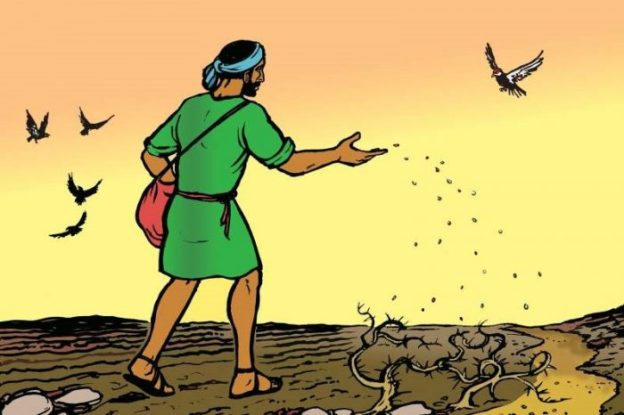
So we begin with the sower scattering seed everywhere. We are told that the seeds land in four different areas. They land on the path, on rocky ground, among thorns, and then on good soil.

Gosh this sounds messy! Why not just throw all the seed on the good soil? Why not avoid the places that the seed won’t work? I think it’s because we can never know what will take root or what good soil even looks like.

The seed being scattered is the message of good news. It is thrown everywhere regardless of what the ground looks like. I think the four locations are less about us trying to decipher different types of people, but to see the seed as something growing and changing within them, regardless of how we may perceive them as “good or bad soil”.

The question is what are we sowing and how can we sow?

I believe we sow through relationships, conversations and simply sharing our experience; our story of how God is in our lives.

The biggest hurdle can be how little we think of our own story of faith. Maybe we don’t think it is ‘flashy’ enough. Most people have less a “Damascus road” experience, pardon the pun, where Paul is blinded, thrown off his horse and hears the voice of Christ. We should be thankful for that as he wrote a majority of the New Testament. But we usually have an “Emmaus Road” experience. We look back at times in our lives and see that Jesus was with us, even though we may not have seen it.

Regardless of which “Road” experience you had, people respond to hearing stories and experiences. I’m more likely to try something new because a friend suggests it, than reading about it elsewhere.

Christianity is a shared faith. All of our stories join together as people of faith. During the early church, Christians were described as “gossiping the gospel” among fellow slaves in households. People’s curiosity was piqued by hearing how Christ and his followers were transforming lives – whether it be outwardly, caring for the widows, or inwardly, knowing they are loved by God, the creator of all things through Christ.

Back to the parable, the sower is throwing the seed everywhere regardless. For me, this implies an abundance of seeds. We cannot run out of our story. Not only does our story have no “use by” date, we are adding to it daily by simply living. This is not a solo mission, we are not alone. Matthew says in verse 23 “But as for what was sown on good soil, this is the one who hears the word and understands it, who indeed bears fruit and yields, in one case a hundredfold, in another sixty, and in another thirty.” The people who have been changed, become sowers too. Their story joins our story of the Church continuing to this day.

To close, part of the Collect for Sunday 12th July 2020 says “hear our prayer which we offer for all your faithful people, that in their vocation and ministry they may serve you in holiness and truth to the glory of your name”.

This is a prayer for all of us, not just people in positions of leadership.

We don’t “convert” people, the Holy Spirit does. We are messengers with Good News.

We are the sowers.

What do we sow? Our testimony.

What is that? Our own story.

Revd Ben Brady


5th July 2020 – Childlike Faith – Matthew 11:16-19, 25-30

Here are three quotes about children:

A child can ask questions that a wise man cannot answer. ~Author Unknown

While we try to teach our children all about life, our children teach us what life is all about. ~ Angela Schwindt

Children find everything in nothing; men find nothing in everything. ~Giacomo Leopardi.

That last quote is, I think, about children’s capacity to wonder at what they encounter as opposed to our adult cynicism. … At times children have the capacity to cut through the nonsense and get to the heart of the matter. So often, children are transparent when we are at best clouded and insecure.

This is why, I think, Jesus talks in Matthew 11 of God revealing things to children that are hidden from the wise and learned. Sometimes the only appropriate response to things we encounter is that of wonder and praise. Sometimes things are just beautiful, any attempt to explain them diminishes them.

We find it difficult to accept that children’s faith is real, and yet the truth is that children have not yet encountered the cynicism which destroys faith. They can still wonder at the seemingly unexplained, and they know that God is there for them.

Here are a few little stories (culled from elsewhere) to enjoy:

A Sunday School asked her young class to learn Psalm 23.  She gave them a month.  One young lad was excited about the task, but he just couldn’t remember the Psalm.  After much practice, he could barely get past the first line.  On the day the children were going to recite the psalm in front of the congregation, he was really nervous.  His turn came and he stepped up to the microphone. He said proudly, “The Lord is my shepherd . . . and that’s all I need to know!”

When a mother saw a thunderstorm forming in mid-afternoon, she worried about her seven-year-old daughter who would be walking home from school. Deciding to go to meet her, she saw her daughter walking nonchalantly along, stopping to smile whenever lightning flashed.  Seeing her mother, the little girl ran to her, explaining happily, “All the way home, God’s been taking my picture!”

A foundation stage teacher was watching her children drawing. She would occasionally walk around to see each child’s artwork. As she wandered round the classroom, she stopped by one little girl who was working hard. She asked what her drawing was. The girl replied, “I’m drawing God.” The teacher paused and said, “but no one knows what God looks like.” Without missing a beat, or looking up from her drawing the girl replied, “They will in a minute.”

God does not call Christians to be childish, but he does ask us to be child-like in our faith, full of wonder, love and praise; open to seeing the beauty in everything and everyone; honest about ourselves and the world around us; willing to learn and grow; always asking questions and seeking knowledge; playful; full of hope; able to overcome grudges because we don’t hold onto things for too long; able, because we have learnt to trust God even in the worst of times, to see the good in every circumstance; able, because we trust God, to come though adversity in his grace and strength and power.

Try to make room today for a child-like faith: seek to find God in every encounter you have with others; seek to receive God’s promises for yourself once again. Let’s allow children to teach us about wonder, about life and joy and hope, and ultimately about faith as well. For, in doing so, I believe that we will discover that the last verses of the reading from Matthew are true. Let’s hear and hold onto Jesus own words:
“Come to me, all you that are weary and are carrying heavy burdens, and I will give you rest. Take my yoke upon you, and learn from me; for I am gentle and humble in heart, and you will find rest for your souls. For my yoke is easy, and my burden is light.”

28th June 2020 – A Cup of Cold Water – Matthew 10: 40-42

The interests of the wealthy Western world are often at odds with the interests of the majority of peoples on our planet. We have an unjust global trading system, we have nations so burdened by debt that it suffocates any chance of recovery, we have trade surpluses from wealthy countries dumped in the third world destroying the livelihoods of local producers. We have inefficient and ineffective aid arrangements and are still far from finding an acceptable global position on climate change. … The cards are stacked against the poor – the poor get poorer while the rich line their pockets.

And we are part of the system which makes this happen – we elect the leaders that make these decisions. I wonder what you might want to say to leaders of the most wealthy countries in the world, if you had the chance? If you=d been invited to speak at the latest G7 or G8 meeting what would you have said were the priorities for our world? What would Jesus want to say to them?

Perhaps it is there in our Gospel reading this morning:

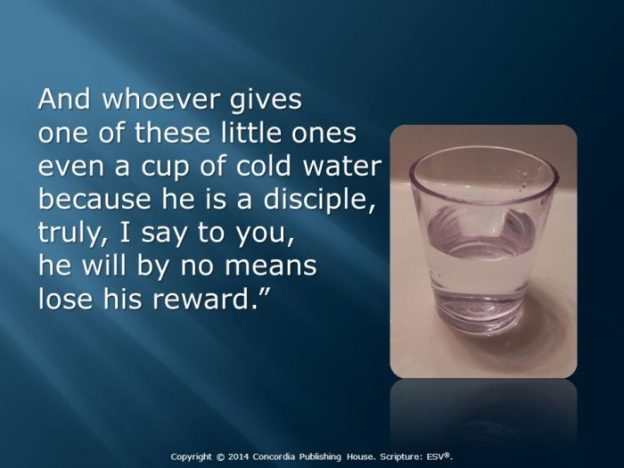
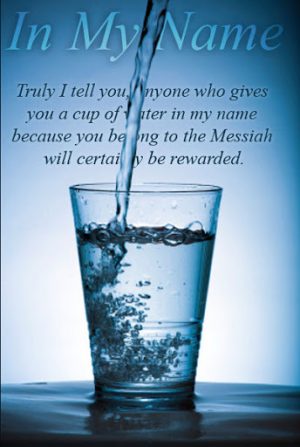
“Whoever gives even a cup of cold water to one of these little ones in the name of a disciple – truly I tell you, none of these will lose their reward.”

This verse at the end of Matthew 10 points forward to a later story in the gospel of Matthew – in Matthew 25 – the story of the sheep and the goats.

In that story, Jesus welcomes the sheep into the kingdom and he says,

“I was hungry and you gave me food, I was thirsty and you gave me something to drink, I was a stranger and you welcomed me, naked and you clothed me.”

“When was that, Lord,” the righteous reply.  Jesus response: “Just as you did it to one of the least of these who are members of my family, you did it to me.”

When you gave money to Christian Aid to provide shelter, clean water and good food, you did it to me. When you gave money to Oxfam to help people begin to stand on their own two feet, you did it to me. When, at Harvest, you gave money for a water tank in Kisoro in Uganda, (as did the churches of the Parish of the Good Shepherd, a year or two back), you did it for me. When you welcomed the immigrant and the asylum seeker into the life of your church, you welcomed me, or even just the newcomer who did not know anyone. When you fought for the rights of the poor and the dispossessed, you fought for me. When you understood and acted on the pressing climate issues which faced the world, you did it for me.

Sadly, the story in Matthew 25 also tells of those who did not give and share, who did not welcome the stranger – and Jesus is just as clear that their failure to act for those who were marginalised, hungry, thirsty and hurting was a failure to serve him. And in the story they receive not a blessing but a curse.

So what can we do to fulfil our Lord’s commission to us?

The very least we can do is be welcoming to all who are new. In our churches, when we are able once again to attend, that will mean watching out for those who are new and taking time to be with them to welcome them over coffee at the end of the service. And in doing so, we will welcome the stranger in our midst – particularly the asylum seeker and the immigrant. We can choose to set aside our embarrassment, perhaps our fears and prejudices and commit ourselves to friendship and love.

We could write to our leaders, and to our MP, and tell them of our concern for the poor and the dispossessed and demand that they use our resources, our taxes, to bring about justice in our world.

We can begin to buy or continue to buy produce which has been fairly traded. This seems to me to be a no-brainer. … Wherever possible we can choose goods in our supermarkets that guarantee not to have been bought at unfairly low prices. We cannot continue to exploit others in our world just so that we can get our bananas, our coffee, our tea, our sugar, our chocolate a few pence cheaper. We are committed as churches in our parish, for all church functions, to only using fairly-traded coffee and tea (I wonder if we are sticking to that promise?) And we have promised that we will do everything we can to fight for justice for the whole world – even if that means a little extra expense for ourselves. And that is a big commitment: we have agreed to fight injustice in whatever form we encounter it, financial, racial, climate or ……… And we know that this is one of the Marks of Mission to which all Anglican Church assent.

Jesus doesn’t give us the option. The reward he mentions in our Gospel reading, the reward of the righteous, is not a reward given to pious and holy people who go to Church, it is a reward give to those who follow Jesus, who live according to his values, who give of themselves to others in just the same way as Jesus would have done.

It is enough, at least at first, to take just one small step in the right direction: just talking to the stranger in church on a Sunday morning; just setting up a standing order to Christian Aid, Oxfam or Tear Fund; even just giving a cup of water to someone in need, says Jesus is a start down the road. Just one small step, but it is a step down a route which places others needs on a par with our own. And it is the same road that Jesus travelled – a road which ultimately runs through the cross and on into resurrection.

“Just as you did it to one of the least of these,” says Jesus, “You did it to me.”

…. “Whoever gives even a cup of cold water to one of these little ones …….. truly I tell you, none of these will lose their reward.”

21st June 2020 – Prayer is like sunbathing! – Matthew 10:27

My colleague, Revd. Ben Brady writes:

Have you said your prayers today?

What is prayer? … Is there a WRONG way to pray? … Why pray?

So what is prayer?

“It’s like sunbathing” according to Rowan Williams. [1]

He speaks of allowing ourselves to soak in the presence of God like sun rays. I like that, more importantly, I CAN do that. In Rowan’s description, prayer is opening ourselves to God’s presence, to allow ourselves feel and be shaped by God like a potter with clay. This image suggests a lovely relaxing experience and sometimes I do feel a deep sense of peace in prayer. However, often prayer also triggers different emotions, challenges and less comfortable feelings.

I find it is important to remember that prayer is an intentional act. We decide to be active participants and therefore can work through difficulties in prayer rather than simply passively accepting them.

A popular practice is called “The Examen”. This is when you think through your day, addressing what you are thankful for, sorry about and where you experienced a sense of the Divine; a holy moment. This approach to prayer allows the positives and negatives to coexist. We don’t have to ignore our anger or sadness in favour of gratitude. We can be with God in both our frustration and joy.

Over time, I’ve reflected on who I am and how my interests impact my prayer life. I’m always trying to be aware of how I’m feeling and how I can be in that same headspace with God in prayer. I’m a musician and so sometimes listen to music, but sometimes I simply sit in silence. I can be fidgeting, so I hold something (holding cross, prayer rope, rosary). Sometimes I close my eyes, sometimes I look at an Icon or look out the window. I have times when I use the daily offices set by the Church of England. Sometimes I use The Book of Common Prayer but at other times I can’t be bothered with “Thee’s, Thou’s and “Sundry places”. What I find matters most is that I’m willing to adapt my approach to prayer to ensure that I don’t just avoid spending time with God because ‘I’m just not in the mood’.

A little while ago, Rev. Liz Devall and I hosted sessions on different forms of prayer called “Pick & Mix Prayer”. This was an opportunity for people to gather and try out different or new forms of meeting with God. I really like this idea of having a “Pick & Mix Prayer” approach. A famous saying is that it takes longer to prepare to pray, than the actual praying. I believe there is wisdom in that.

St. Ignatius suggests standing just next to where you will be praying, say the Lord’s Prayer and then sitting down. This gives yourself time to enter into a prayerful space. A friend of mine said that he loves Morning and Evening Daily Office prayers, because once he has said the words, read the Psalms, the set readings and the Gospel Canticle, he feels more focused on who he is praying to.

I’ll be honest, despite my best intentions I sometimes slip into a superstitious way of thinking about prayer. I’ll hear myself think “well I didn’t pray properly today so it’ll probably be a crap day”. This is not true, we do not believe in a petty God who deliberately trips us up throughout the day due to missing/forgetting/not feeling it on a particular day. The Gospel has a very different description of prayer. I love the verse from Matthew 10:27:

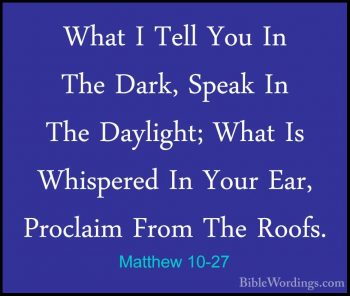
“What I say to you in the dark, tell in the light; and what you hear whispered, proclaim from the housetops.”

God may whisper life changing news to us in the smallest of quiet prayerful moments. We might sunbathe in prayer and feel replenished, altered and enlivened. We may just receive enough strength to face the next day.

Rev. Ben

References:

  1. For a parallel but different reflection, see what Revd. Giles Fraser has to say picking up Rown Williams theme: https://www.theguardian.com/commentisfree/belief/2012/jul/27/religious-sunbathing-giving-up-control, accessed on 20th June 2020.

Trinity Sunday – 7th June 2020

Think of the smallest child you know. It might be one of your own, or a grandchild, a nephew, a niece or a neighbour’s child.

Almost inevitably, the clothes they wear are endearing.

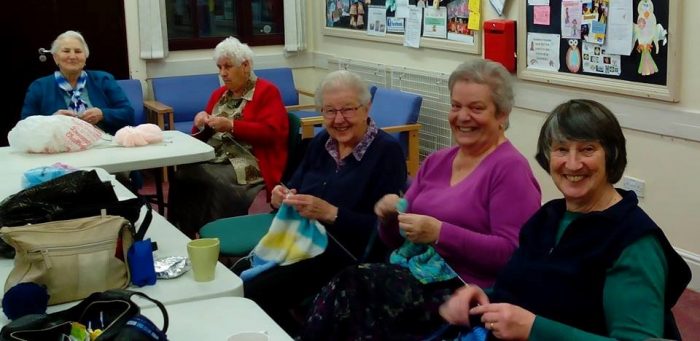
We have a neo-natal knitting group in our Parish which meets at Holy Trinity Church and Community Centre on a Wednesday. You can find out more about them at the bottom of this reflection. They make some of the most wonderful, the most amazing small things which contribute to keeping delicate little ones alive and well. Their work is much appreciated by the hospitals they work for.

Little clothes suit tiny people! You and I need something a little bigger to wear. And during this time of crisis, I am finding that some of the things I normally wear are getting gradually tighter.

Nevertheless, if I was to ask you to put on a small child’s jumper, you’d look at me as though I was being daft. I guess you would probably tell me that you were too large, or that the jumper or cardigan was too small.

It is Trinity Sunday this weekend. It is the patronal festival for Holy Trinity Church, one of the five churches in our Parish of the Good Shepherd, Ashton-under-Lyne. This is often a Sunday when clergy struggle to help us understand what God is like. It is as though, if we try once again, we might just this year be able to explain the Trinity. We come up with a whole range of different images which are helpful to some extent but which never quite work. I guess we wind up proving something very important – that our minds are too small to comprehend fully what God is like!

We all do it. We often expect God to be able to fit into our human-sized minds. So, when we think about God we come up with all sorts of questions, like: How can God possibly be able to hear us all praying at once?

What we mean when we ask such questions, is that we know a human being could not do that, so it must be impossible for God as well.

Or perhaps we say something like – everything has to begin somewhere, everything has a beginning, so God too must have had a beginning!

It is so hard to understand God. So often, when we ask these kinds of questions, it is the same as holding out a child’s jumper; holding out our small human shape (or jumper) and expecting God to climb into it. And, of course, God does not fit, because God is so much bigger and deeper and wider and higher than any human being can comprehend.

God is so different. God is always going to be full of wonderful mystery for us. However much we learn about God, however clever we are, however much we think about God, we will always struggle to understand God. We will never be able to hold God’s nature in our minds and understand God, no more than a child’s sweater can hold someone like me.

So, does that mean that we cannot know God? Not at all! We are not at the moment able to make physical contact with other people outside our own household. But just imagine if we could walk across a room and shake hands with another person. Imagine talking with someone you don’t know, finding out things about them.

You might ask questions like these:  How old are you? What do you do during the week? How many people are in your family? What is your favourite colour? What music do you like listening to?

We don’t need to completely understand someone before we can become friends. Indeed, being friends is partly about discovering new things about each other and about sharing together in discovering things around us.

Just because God is God and I am a human being – it does not mean that we cannot be friends. There are people in our church communities who talk with God everyday! Did you know that? It is called praying. And if you ask them, they might well tell you that God is the person that they love and trust best in their lives!

We’ve been given a lifetime to get to know God really well and to live as his friends. Sometimes we waste that time,at other times we realise that nothing else matters as much as knowing God and how much God loves us.

Sometimes we can’t be bothered to talk about God, or sometimes we let our behaviour suggest that God isn’t worth knowing, sometimes we are unkind of difficult or rude or selfish. But at other times we feel such love for God that we cannot wait to tell other people. And sometimes our loving behaviour speaks of God too.

God is Father, Son and Holy Spirit. God is wonderful and all-knowing. God is the maker of the universe and of each one of us. God is the one who came as Jesus to die to love and save us. God is present in and with his people, living in us as the Holy Spirit. We cannot possibly expect to fully understand a God as amazing as that!

The fact that God is great and full of holy mystery should make us excited not frustrated. It should encourage us to get to know God more. But, ultimately, if I could get a hold on God, if I could fit God into my small mind then God wouldn’t be God.

I wonder how big a jumper we’d need for God to fit in it?

Neonatal Knitters are a community group who knit, crochet and sew items for the Neonatal units of Tameside, St Mary’s and Royal Oldham hospitals.  We meet every Wednesday 10.30 – 1.00 at Holy Trinity Church and Community Centre.  We are a very friendly bunch and welcome new members from our community.  Unfortunately, we cannot include children in our group for safety reasons and we do not have the capacity to teach people to knit or crochet.  For more information please drop into the group any week, check out our Facebook page (Neonatal Knitters) or email us on neonatalknitters@outlook.com.


Sunday 31st May 2020 – Pentecost – A Reflection by Cath Sheldon (ALM)

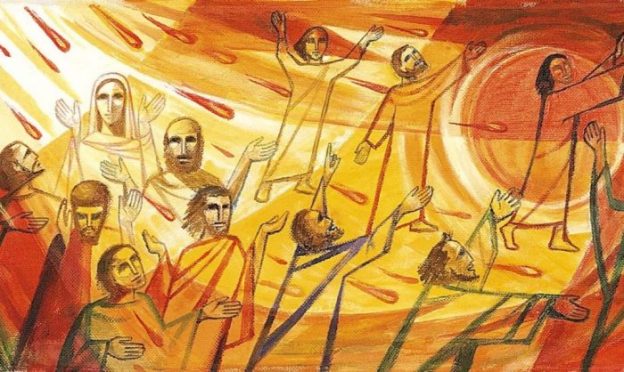
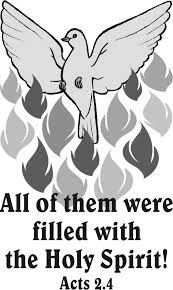
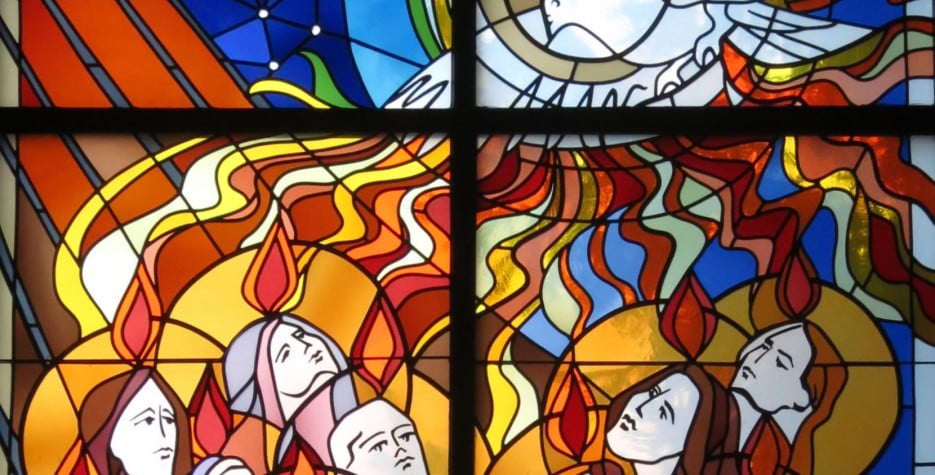
The featured image above has a sense of both the wind and flames of Pentecost, and the call to move out into the world as God’s ambassadors and servants. [1]

Today is Pentecost or Whit Sunday the birthday of the Christian Church and a time for celebration and gifts.

Gift, what does that word conjure up?   Something given to us, something special that the person who is giving has taken the time to pick, or that one thing we were born with and able to excel at without trying, a talent.

On the very first Pentecost the Holy Spirit descended on the disciples and gave them the gift to be able to go out into the world and spread the Gospel.   It says in Acts 2, ‘suddenly there was a noise from the sky which spread like a strong wind blowing, and it filled the whole house where they were sitting.  Then they saw what looked like tongues of fire which spread out and touched each person there’. (Flames of fire just like candles on a birthday cake!) The Holy Spirit being the ultimate gift from Jesus.

Jesus told them at The Ascension, “I am going so I can send the Spirit to you”. (The Holy Spirit is another name of comforter, which is very apt).  They were able to speak and be understood in different languages, what must that have felt like?

Just before the lockdown, the Parish of the Good Shepherd in Ashton-under-Lyne started a group to learn to speak Spanish, we were given simple phrases and words to learn, it certainly wasn’t something that happened straight away! So, it must have felt pretty frightening to the disciples, that they were able to understand and speak a language that was not their own.

Do we all have this gift, to be able to go out and spread the love that God has for us all?   Yes, I think we do, because it not just about speaking, it’s what we do and how we conduct ourselves.  We all know that person who has the knack of being able to say the right thing when someone needs a helping hand with a problem, it might not be the answer, but sometimes it is a pointer in the right direction.   Or that person who sees that something needs doing and organises a group to do it or just gets on with it without a big show.

The past few weeks have brought out the gifts in people. Simple things like shopping for those who are self-isolating, or making contact by phone or text to check that people are OK. We are reflecting the love of God with what we do in our daily lives.

The way we ‘do’ church has changed during the pandemic, many of us have followed services online, radio, television, from many different sources, and we have received each week, by post or email the service and prayer sheet.   And although we have not been able to meet up with our friends from our own church, we are able to worship God with others who we may never meet but have so much in common with.    But we are still in touch with other because we pray together, sing together.    The fact that we haven’t physically seen each other doesn’t necessarily mean we are apart, God has given us the gift of being part of the his greater family.

Some ‘gifts’ are waiting to be recognised.   It takes a nudge, a word, an email or a post on social media to start the ball rolling.   We question ourselves, could I do that?  Do I have the time? Am I qualified enough? Am I doing this for the right reason?   But if we put our trust in God, he will show us the way. God will help us fit things into our daily lives. God will show us where to find the time. God will point us in the right direction.

No matter what our gift is, it is a mission given by God, and all we need to do is trust in him.

References

  1. https://buildfaith.org/planning-for-pentecost, accessed on 29th May 2020.
  2. https://www.officeholidays.com/holidays/pentecost-sunday, accessed on 29th May 2020.


John 17: 1-11 – Sunday 24th May 2020

Father, the hour has come; glorify your Son so that the Son may glorify you (NRSV)

I wonder what Jesus means when he says these words? …

If we are to discover answers to this question, we need to look at the context.

In our Gospel reading, time seems to have stood still. The first 12 chapters of the Gospel cover the first 33 years of Jesus’ life. Then, from the beginning of Chapter 13 right through to the end of Chapter 17, we are in the Upper Room at a Passover Meal with Jesus and his disciples, his friends. This is last evening of Jesus’ time with his disciples before the Crucifixion.

We have watched Jesus washing his disciples’ feet. We have heard him talking of the Holy Spirit who will walk alongside them, live within them, help them to be witnesses to the love of God as they live their lives. We know that these actions and these words were spoken as much for us as for the disciples’ benefit.

In what Jesus says and does, he is encouraging us to share in his priorities for our lives: serving others; receiving their service to us with grace and love; witnessing to the love of God; listening to the inner voice of the Holy Spirit; and later in Chapter 17, placing a priority on working together as one, respecting each other, knowing that without our shared fellowship and witness, we are so much poorer.

And in the middle of all this, come those words of Jesus:

Father, the hour has come; glorify your Son so that the Son may glorify you.

I guess that there are two ways that we can think about those words.

First, there is the wider context of all that Jesus has been saying and doing in the Upper Room and the wider context of the whole prayer in John 17. He could be praying that God will be glorified through the lives of his friends. Jesus has commissioned them to serve him and they will, from now on, be the ones through whom God is glorified. This means that we are the ones to be God’s visible presence in the world. Our actions, good or bad speak about the Lord that we claim to follow and serve. Our choices and actions speak loudly about the God we say we serve. We are the ones who will glorify God. Or our behaviour and actions could bring shame on the God we say we serve. So, Jesus prays that God will be glorified by the choices we make and by our actions.

Secondly, and in line with the immediate context of John 17: 1-6, Jesus could be talking about something very different. …

When Jesus talks about himself being glorified and so bringing glory to God, it seems that he has in mind the days which immediately follow this prayer. He sees the events of the crucifixion and resurrection as being about glory! And particularly, the events of Good Friday. For Jesus, the glory of God will be revealed in him at the cross and in his resurrection. As Jesus is lifted-up in the eyes of everyone, so he gives glory to God.

Glory is to be found, not in power and influence, but in obedient submission to God’s will.

Jesus’ throne is the Cross. God’s glory is revealed in suffering. God is revealed most clearly at the place of suffering.“Father, use these next hours,” prays Jesus in John 17, “to glorify me and to glorify you.” And Jesus re-emphasises this as he says to God the Father, in John 17:4: “I glorified you on earth by finishing the work that you gave me to do.”

Jesus’ example to us is one which centres on the Cross. It is at the Cross, the place of suffering, that God’s redeeming work is done. The place of weakness is the place of glory! This is the place where we discover who God really is, and God’s glory is revealed.

We are safe in the love of God, in some mysterious way, because of the Cross.

And because of the Cross, we too can serve others without counting the cost. And if we suffer, we can be sure that, in Christ, God has walked the same journey that we walk. God is not surprised or shocked by our struggles, but there alongside us each step of the way.


Prayers for Sunday 24th May 2020 from Jesuit communities in the USA.

Jesus Christ, you travelled through towns and villages “curing every disease and illness.” At your command, the sick were made well. Come to our aid now, in the midst of the global spread of the coronavirus, that we may experience your healing love.

Heal those who are sick with the virus. May they regain their strength and health through quality medical care.

Heal us from our fear, which prevents nations from working together and neighbours from helping one another.

Heal us from our pride, which can make us claim invulnerability to a disease that knows no borders.

Jesus Christ, healer of all, stay by our side in this time of uncertainty and sorrow.

Be with those who have died from the virus. May they be at rest with you in your eternal peace.

Be with the families of those who are sick or have died. As they worry and grieve, defend them from illness and despair. May they know your peace.

Be with the doctors, nurses, researchers and all medical professionals who seek to heal and help those affected and who put themselves at risk in the process. May they know your protection and peace.

Be with the leaders of all nations. Give them the foresight to act with charity and true concern for the well-being of the people they are meant to serve. Give them the wisdom to invest in long-term solutions that will help prepare for or prevent future outbreaks. May they know your peace, as they work together to achieve it on earth.

Whether we are home or abroad, surrounded by many people suffering from this illness or only a few, Jesus Christ, stay with us as we endure and mourn, persist and prepare. In place of our anxiety, give us your peace. …… Jesus Christ, heal us.          Amen.