Category Archives: Various

Advent Sunday 2020

Mark 13: 24-37 – 29th November 2020

It is over 30 years since the fall of many of the Soviet states in Europe.

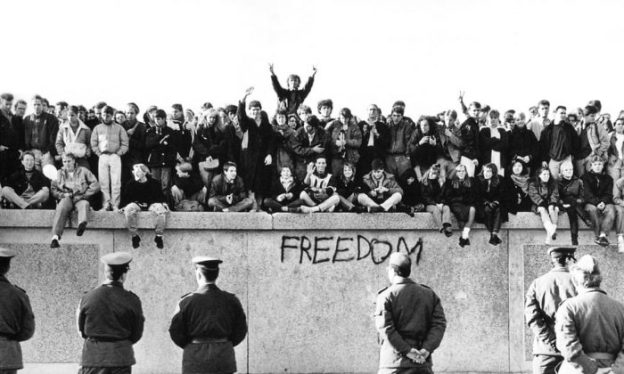
31 years since the Berlin Wall was torn down!

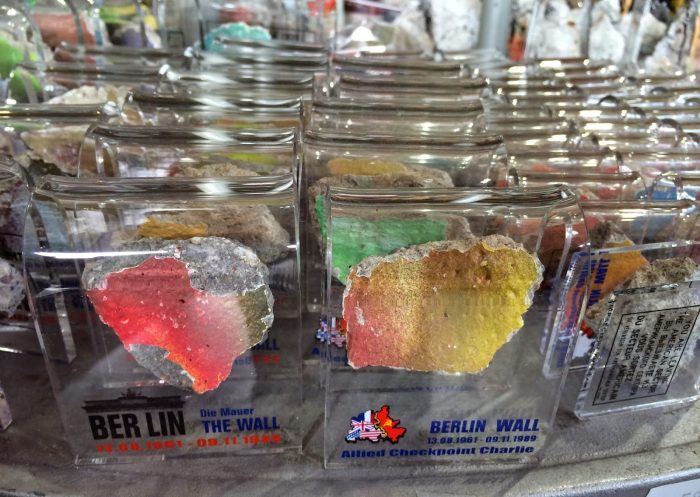
My brothers-in-law travelled there at the end of 1989 and picked up a souvenir piece of the wall. Pieces of the Berlin wall are still on sale today.

Over the New Year Holiday, the Berlin Wall was being dismantled. … The end of the Berlin Wall was the end of probably the most potent symbol of oppression in Europe in the 20th Century.

It’s disturbing to realise that it all happened over 30 years ago now. Maybe, at that time, you shared my sense of unbelief – ‘Is this really happening?’ It was hard to believe that the world order that I had grown up in – that of a Cold War, stand-off between two superpowers – was seemingly coming to an end. Something that even just months before those amazing events at the end of 1989 seemed impossible.

This same seeming impossibility surrounded the Jewish people in the centuries before Christ. They had been longing for a Messiah – someone who would change the course of history for ever. They were so often disappointed, different men came promising what they could not deliver. No doubt Israel felt the mocking eyes of others as they clung onto this seemingly vain hope of a glorious Messiah. Someone who would bring in Israel’s golden age. Everything pointed against it. Israel was a pawn, a minor league nation caught in the ebb and flow of the politics of the real powers.

In Advent, as Christians, we do at least two things – firstly, we remember, we enter into something of the feelings of the people of Israel as they waited for the coming of their Messiah. We wait with them. … They had to wait 500 years from the first promises made to them. We allow ourselves the month of December – but we wait for the coming of the Christ-child. Unlike them we know for sure that he will come – for we’ve read the story before.

But we are in other ways just like them. For we impose our expectations on him – we know what the Christmas story is all about – we’ve got the story neatly packaged. … We need the story to be constant, unchanging because life is too busy, too pressurised at this time of year. ‘Let’s stick to the routine,’ we say, ‘enjoy the celebrations, and hopefully have time to relax in January!’ Although what those Christmas celebrations will be like in 2020 is still a matter of uncertainty.

If we are not careful – if we don’t make the time to reflect, to listen, to wait – we’ll miss the Christ-child. We’ll not see the miracle of God in human form. Just as most of Israel missed its Messiah, so God’s grace will pass us by. Advent is our time to centre ourselves before Christmas, to focus on the true meaning of the Christmas story, to grasp that God’s Son, the Christ, God incarnate, Emmanuel, God with us – Jesus, is coming and he is coming for us, for me.

But we also wait in other ways … for many of us, life is not the way we want it to be and we pray for God’s intervention. It feels at times as though nothing is happening. Times like this are hard. We wait for God to come, and he seems absent. We are a little like the people of Israel awaiting their Messiah.

Advent is not just preparing for Christmas, but about looking forward to Christ’s Second Coming. Jesus spoke about this our Gospel reading. A difficult passage, because this Second Coming seems for Jesus to be so immediate. And so we, the Church, have our questions – raised at different times with different intensity. Why has it been so long? Has God forgotten us? Is Jesus never coming back? Were we intended to take it literally? Was Jesus mistaken? Is it important to believe in the Second Coming?

And these questions are often mirrored in our experience of daily life as at times God seems to be absent. And our experience of waiting in some way matches that of those nations waiting year after year under the tyranny of Communism. Seemingly without hope – yet in 1989 there was that dramatic change. What was unbelievable, happened. The wall came down, Communist regimes toppled.

Similar but different.

In our daily lives, we hold onto a promise – a promise to be taken on trust. Jesus’ promise to be there for us in the midst of all that life brings our way – Christ will come again.

But, as Christians, we also have something of the reality on deposit. In the meal of Holy Communion we look back to the realities of Christ=s first coming – his death and resurrection. And we also look forward to that heavenly banquet in which we will all share – a meal that Jesus promised to eat with us in his Kingdom.

We can believe that God is with us in our suffering. We can believe that Christ will return. Things that people dream about, do happen, God’s, presence with us is real, and Christ Second Coming is no more impossible than the collapse of the Berlin Wall felt to a divided Europe, a divided Germany. The seemingly impossible is possible with God.

Christ has died, Christ is risen, Christ will come again.

Remembrance Sunday 2020

Remembrance Sunday

On Sunday 8th November, Remembrance Sunday, all our churches would usually have been full of people remembering, along with millions around our world, the many women and men who have given their lives in the different conflicts of the past 110 and more years.  People who either by choice, or through compulsion, risked their lives in the pursuit of peace and justice.  We owe our freedom to many such people who have stood up against tyranny and oppression – to people who risked everything, laying themselves on the line.

Things are very different this year! We enter another national lockdown because of Coronavirus on Thursday 5th November and our churches will now only be open for private prayer for the next few weeks.

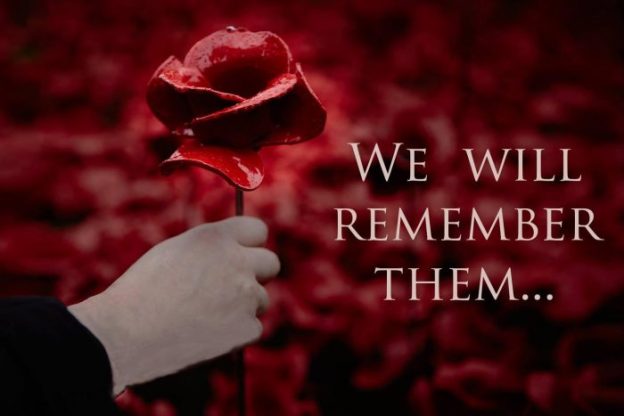
But we will all remember. …. Some will be able to attend church on 8th November, others will want to remain at home. We have sent out Remembrance Sunday prayer cards to people who usually attend our churches or who receive mailings. The prayers included here are specifically for Remembrance Sunday and Armistice Day. As you use them, you might want to have a poppy to hand.

As I said in our Parish magazine this month:

Our remembering will … include the memories of those who have served on the battlefield or in conflict zones around our world will no doubt justifiably tell and re-tell stories of valour and bravery. For those who served, >remembering= will also bring to the front of the mind stories of those who did not return. Remembering brings to the surface the naked fear of conflict, the pain of loss and a real sense of comradeship.

 But remembering is so very important to us all, not just on Remembrance Sunday or Armistice Day, but in all areas of our lives. Remembering leads to us telling our stories. Both as individuals and communities. And as we tell our story, we reaffirm our roots, and we define who we are. We put our own lives in context. For today=s world, where we define ourselves not so much by where we come from as by our networks of friends and acquaintances can so easily become a rootless place where we do not know who we really are.

Our shared memories are our key to understanding ourselves. And our collective memory needs to be sustained by hearing the stories of our past. By hearing from those who went out from us here to serve in different arenas in our world. These stories, these people are so much a part of who we are here … today. They contribute to our history, they strengthen our community spirit.

Our stories are important. Remembering is vital. Nowhere is this more true than in relation to the conflicts with which we have been involved as a nation. Failure to engage with and learn from our past is the height of modern arrogance. We have to hear again the stories of conflict, of bravery, of pain and loss. And we need to allow those stories, … that remembering, to change us now. It must inform our thinking about the future, it must be allowed to change our wills and our actions.

 For in today’s world, we are all called to take new & different risks. To act for justice, for peace in society, in the world around us. To work for racial justice, to fight discrimination, to engage with injustice in whatever form it might arise.”

We have the promise of God in Christ: “Work,” says Jesus, “for the coming of God’s kingdom and I will be with you always.” God does not leave us alone to face new challenges, to risk our lives in the cause of his Kingdom. He promises always to be with us. So let us covenant again, as people of different races, ages, interests, appearances, and with different views, choose to live together in harmony, to work within our own communities, groups and congregations, for peace, justice and understanding.

Prayers

A prayer of commemoration for the fallen

Father of all, remember your holy promise, and look with love on all your people, living and departed.

On this day we especially ask that you would hold forever all who have suffered during war, those who returned scarred by warfare, those who waited anxiously at home, and those who returned wounded, and disillusioned; those who mourned, and those communities that were diminished and suffered loss.

Remember too those who acted with kindly compassion, those who bravely risked their own lives for their comrades, and those who in the aftermath of war, worked tirelessly for a more peaceful world.

And as you remember them, remember us, O Lord; grant us peace in our time and a longing for the day when people of every language, race, and nation will be brought into the unity of Christ’s kingdom. This we ask in the name of the same Jesus Christ our Lord. Amen.

A prayer for World peace
O God of the nations,
as we look to that day when you will gather people
from north and south, east and west,
into the unity of your peaceable Kingdom,
guide with your just and gentle wisdom all who take counsel
for the nations of the world,
that all your people may spend their days in security, freedom, and peace, through Jesus Christ, our Lord. Amen.

Prayers with poppies – suitable for children, as well as adults!

All you need for this simple prayer is a poppy.

Look at your poppy. Poppies are bright and cheerful flowers: give thanks to God for the lives of those who have died in war, remembering all the joy they brought to families and friends, and all the good things they did for their home and their country.

Then look at the red petals: red reminds us of danger and harm. Ask God to be close to those who are still facing danger each day, to give courage to the armed forces, and compassion to all who help others.

Place your whole hand over the poppy: poppies are also fragile and need to be handled gently. God cares for those who are hurting and those who are sad. Ask God to comfort all who are grieving the loss of someone they love.

Finally place a finger on the centre of the poppy: ask God to help you play your part in working for peace in the world.


All Saints’ Day – Matthew 5:1-12 & Revelation 7: 9-17

The reading from Revelation set for All Saints’ Day paints a vivid picture of the future – looking forward, imagining an ultimate destination for all of the saints, for all of us.

The technical term for the book of Revelation is that it is ‘eschatological.’ Eschatology is the study of the last things. Under its umbrella in Christian thinking we could place the coming of God’s Kingdom, the return of Christ, immortality and eternal life, judgement, heaven and hell – perhaps too, what we might understand by ‘Christian hope’. The passage in Revelation is a vision of what the future might hold.

The book of Revelation is written to a church suffering persecution. That church found the imagery of Revelation dramatic and hope-giving. Words of hope spoken to people in the midst of suffering.

The author is encouraging their first hearers to believe that there is something more than the difficult things they are currently experiencing. That ultimately, the faithful will have a place in a new heaven and a new earth. The author hopes that such knowledge will change their listeners understanding of the present.

We are now entering the time in the Christian year when our eyes are turned to look forward. Where the Gospel and our other readings look ahead – not just to the Incarnation – the first coming of Christ – but to Christ’s return. We will hear words on Jesus’ lips that promise his return, parables that encourage us to be ready for that return. A return that has not taken place and which, at times, it seems might never take place.

It is true that all that the Gospels promise us has not yet been fulfilled. The death and resurrection of Christ are at the heart of our faith. Jesus has inaugurated his Kingdom here on earth. But we know that everything that the Kingdom stands for seems as far away today as it must have done in Jesus’ day.

As we listen to Jesus words over the coming weeks, we will hear him emphasising that we are living in what we might call ‘in-between times’. As Jesus speaks, he seems to say, “My death and resurrection will inaugurate the Kingdom, but its final fruition is dependent on my return.”

He wants his listeners to know that their lives are lived within an on-going flow of history which reflects the purposes of God, a history which will come to an end in God’s good time. He wants them, and us, to realise that while we cannot know the time and place – God will bring all things to a final conclusion.

We live in the ‘now and not yet’ of God’s salvation history; looking forward with real hope to a time when history will finally be resolved, when Christ will come again. But living now with the reality of a world of complications, of joy and sadness, of hope and disappointment; a world where God is seen most clearly in the lives of those who love and serve him – even when serving God brings persecution and trouble. And so, John, in his epistle, says:

“Beloved, we are God’s children now; what we will be has not yet been revealed. What we do know is this: when Christ is revealed, we will be like him, for we will see him as he is.”

We are being transformed, made new, through our experiences in this life. Day by day, God is working that transformation in us. Our Gospel reading gives a shape to the transformed lives we are to live as God’s saints here in the present:

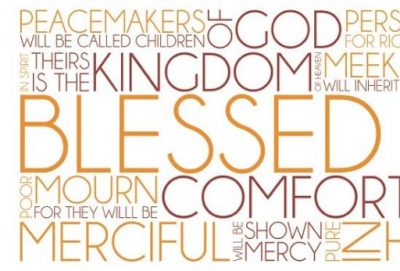
“Blessed,” says Jesus, “are those who are aware of the poverty of their own spirit – who realise just how easily good motives turn to bad. Blessed are those who mourn over their own weakness. Blessed are those who choose a path of meekness rather than power and self-aggrandisement. Blessed are those who hunger and thirst after righteousness. Blessed are all these because in doing so they will be changed, they will be renewed. The very characteristics that they long for, they will have. Blessed they will be, as they are merciful to others, as the purity of their motives and their heart becomes clear. Blessed they will be as they become courageous peacemakers.”

“Most blessed will they be,” says Jesus, “when they share something of my sufferings.” For through those sufferings they will be transformed and truly be the salt of the earth, lights in the darkness of a world which is longing for the acceptance and the love of God.

Matthew 21: 23-32 – True obedience.

You’ll have noticed two different parts to the Gospel reading set in the lectionary for 27th September 2020. ……

The first, a challenge to Jesus’ authority coming from Jesus’ religious enemies – the chief priests and elders. Jesus confronts some of the highest-ranking, most powerful authorities within Judaism. These chief priests and elders, members of a “scribal elite” class, played important, visible roles in the life of their community and in particular within their religion. Jesus’ catches them out in their duplicity. They are more worried about how they look in front of the crowd than they are about what was true and just and right.

The second, a story about two sons who vacillate between obedience and disobedience to their father. Listening to this second story about the two sons — one who verbally refuses his father’s command to work in a vineyard but later changes his mind and obeys, and another who agrees to toil in the vineyard but does not keep his promise — we might be tempted to moralize it. We may assume its message is simply “Actions speak louder than words!” or “Don’t be such a hypocrite!” or “Obey your father!”

In Jesus’ day, it probably was seen differently. For to refuse your father’s demand made in public would be to shame him and yourself, so you’d say ‘Yes’ even if you had no intention of obeying him. Public face was everything. Jesus challenges this assumption and his listeners pick up on the challenge. Of course, say the chief priests and elders, the one who initially said ‘No’ was the one who did the will of his father. The culturally appropriate behaviour of the son who said ‘Yes’ did not produce obedience to the father. It was the son who started off behaving in a way that shamed him and his father who was ultimately obedient.

So, says Jesus, to the chief priests and elders who have joined the crowd listening to him. You’re the ones who talk publicly about faith and about obedience to God’s will, but you fail to follow through on those public statements when it comes to the crunch.

John the Baptist came preaching and teaching, his message was from God, but it wasn’t you, the religious people, who listened to him, it was the tax collectors, the prostitutes, the outcasts. It was the ones whom you condemn, who listened and who acted on John’s words and whose lives were changed through their obedience.

Being religious gives you a standing, a place of honour, in your community but when it comes to the crunch, that place of honour matters more to you than obedience to God’s will!

So, if John the Baptist was the focus of debate in our Gospel reading; if John provided the catalyst to challenge religious dogma and to bring about change; if John’s message drew new people to faith, but left the religious people standing watching on the side lines. What might be this Gospel’s challenge to us, the religious people of our day?

Where might God be at work in ways that we who are religious struggle to comprehend?

Because, if God is active or discoverable in the efforts of someone like John, a wild-eyed long-haired prophet who sets up camp in the wilderness calling for a new world to come into being, a world marked by justice, changed lives, and a recognition that God intends for more than just things staying as they are …… then perhaps people who care about religious language, symbols, practices, and truth should be curious people, bent on keeping their eyes open for new ways in which God might be made known, or ways in which the God’s purposes might be expressed.

We have that responsibility to our wider world – to work for justice, fairness and peace, and to meet human need. … But where might God be asking us to be at work in our own towns, communities and parishes, and in what ways might we act obediently to the Father here?  How might those of us who have said ‘Yes’ to God, be people who come through on our commitment.

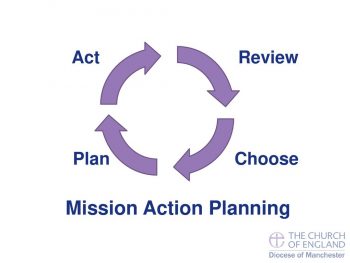
Many Churches have Mission Action Plans or equivalents which highlight many things that local parish communities see as the way in which they can make  that ‘Yes’ become real. Does your church have one? If so, are you familiar with what it says? Perhaps, if not, you could ask your church leaders for a copy, explore what it says and perhaps offer to assist with the implementation of the Plan,

Alternatively, you might read the Plan and feel that it needs to change to reflect the circumstances of your own local community at the time you read it.If so, you might want to offer to participate in a review of the Plan.

Or, if your Church has not thought about these issues in the past and as a result has no Plan, You might even want to help to develop one.

But it is not just what our parishes/churches do that constitutes our ‘Yes’ to God. There will be more than this, there will also be things outside the activities of our parish where you see God at work and where a ‘Yes’ to following God will need to become real for you in obedience to God’s will. There may be a community activity which you can participate in, or a gap in necessary provision within your community which you might seek to fulfil as part of your discipleship as a follower of Jesus.

What is God asking of you/us today?

Matthew 21: 28-32 – Shame and Two Sons

An excellent illustration of the dynamics of shame and honour in the parables of Jesus is found in Matthew 21:28-32 where Jesus tells the story of two sons asked by their father to work in the vineyard The first adamantly refuses, but later changes his mind and goes to work. The second agrees to work, but never actually does.

Tennent comments: “Most Western readers do not sense the real tension in the story. Certainly the first son, who refused to work but eventually did, is being honored by Jesus and compared with the tax collectors and sinners who initially refused to honor God, but were now repenting and entering the kingdom. Western readers find Jesus’ question patently obvious and the whole construction seems to lack the tension that is so ‘often present in parables. However, the tension of this parable is felt when heard within the context of a shame-based culture. From an honor and shame perspective, the son who publicly agreed to work is actually better than the son who publicly shamed his father by refusing to work and telling him that to his face. Even though the one who refused to work later changed his mind and worked while the former never actually obeyed the father, the public shaming of the father is still a greater sin than not performing the task.[1] The first son may have eventually obeyed the father, but the father lost face. The second son may have not obeyed the father, but he protected the father’s public honor.”[2]


[1] J. H. Neyrey, “Honor and Shame in the Gospel of Matthew,” Westminster John Knox Press, 1998: p31.

[2] Tennent; “Theology in the Context of World Christianity: How the Global Church is Influencing the Way We Think About and Discuss Theology;” Zondervan, Grand Rapids, Michigan, 2007: p87.

Matthew 20:1-16 and Jonah 3:10 – 4:11 – A Good Sulk!

One thing I really like about the Old Testament in our Bibles is that we see people in the raw. Nothing seems to be covered up. The Bible refuses to focus only on people who have positive, fulfilling relationships with God. It shows both bad and good in even its greatest heroes – even when they would rather hurl abuse at God than sit quietly and at peace in his presence. The story of Jonah is a case in point.

In the reading set for 20th September 2020, Jonah is sulking; angry & resentful that the enemies of his people should be let off the punishment he thinks they deserve, just because they have repented. Jonah has a problem with God!

Do you remember the story of Jonah? God tells him to go & preach in Nineveh. Jonah doesn’t want to go to Nineveh, the capital city of Assyria, a hated enemy of Israel, so he jumps on a boat to Spain. God brings about a storm, Jonah realises that he’s the cause and gets the sailors to throw him into the sea.  A big fish swallows Jonah, and three days later spews him out onto the shore – by now a chastened man, ready to do what God wants of him.  He goes to Nineveh, still wanting the city to be destroyed – and tells them that they have forty days in which to repent.  And Nineveh listens, its people repent – God is merciful and does not destroy the city.

This makes Jonah really angry, livid – that God should be merciful to the sworn enemies of his people. Like a sulking child, Jonah spits out his contempt of God – “I knew it would end up like this! If you’d listened to what I said, this would never have happened.” He even has the gall to quote the psalms he knows:- … “You are a gracious God and merciful, slow to anger, abounding in steadfast love.” … Jonah’s not praising God, but saying that God’s love is irritating and inappropriate.

“Let me die – I’d be better off dead,” says Jonah”.  You can just see him, can’t you, sitting down with a sulky face, arms crossed, not looking God in the eye.

We’ve all done it, we’ve all been there.  Self-righteous indignation makes us boil, and we take it out on those around us.  Whether that’s our parents when we were younger, our spouses or very good friends, I guess they’ve all been on the receiving end of our sulks.

How does God deal with it? There’s no attempt at self-defence. That would be my natural instinct in the same situation.  God knows where his prophet is coming from and he loves this angry ball of resentment just as much as ever.  Loving parents on the receiving end of anger and resentment from their children, know that usually it’s a lack of understanding or experience that is behind the outburst.  They know that, if possible, they should stay calm and loving and pick up the pieces once the child has got over their sulk.  So too with God.   He gives Jonah a little time, a little comfort and a little experience in the shape of the vine that enables Jonah to see things from God’s perspective.

The point Jonah had completely missed, that we often forget, is that God doesn’t only love and care for those we think he ought to.  He doesn’t share our lines of demarcation which make some (usually including ourselves) “deserving” and others not. When Jesus started to live out God’s love in practice: spending time with gentiles, tax collectors and prostitutes, religious people were disgusted that God might choose such people for his friends.  Time and again in the Gospels, Jesus tries to help us understand that God’s love is so much wider and more far-reaching than we seem to grasp.

Look at the Gospel reading set for 20th September 2020. In this parable,the first lot of workers see the generosity of the employer to those who started work late, as a raw deal for themselves and resent it. … If our basis for reckoning in life is simply what we’re worth on an hourly rate, then the longest working labourers have a point.

But the owner sees things differently, he sees the needs of those left in the market place, just as God sees all people with their needs and is concerned to provide for them all.

Both in our own lives, and in the life of our churches we can fall into the trap of wondering why God blesses some people and not others.  It’s not fair – why does life seem to go so right for someone we know who never darkens the door of the church, when my life’s difficult?  It’s not fair – why do other churches seem to be growing, when this church is not?

Life doesn’t always seem fair.  But step back, look at the bigger picture, what is God doing in other people’s lives, drawing them back to him.   Perhaps in doing this we will gain deeper understanding into why certain things are happening, that will enable us to see God’s purpose.

Whenever we see God’s generous love in evidence, however much of a surprise, we mustn’t question or quibble, but should rejoice with the angels at the amazing love of God.

Matthew 16: 21-28 – 30th August 2020 – Take Up Your Cross

I first met Graham Turnbull in 1994. In the previous couple of years he’d felt God calling him to work in Rwanda. He’d left his job as a solicitor & trained to teach English as a Foreign Language. He left the UK in 1994 to travel overland to Rwanda – taking a landrover to the place he’d be working there.

As he was travelling, the genocide started in Rwanda and many people were killed. Graham was unable to enter Rwanda and I shared a house with him for two weeks in Kisoro in Uganda.

When the troubles subsided, he taught for 2 years in a place called Cyangugu in Rwanda. But he began to feel that he should be working for the UN as an ‘observer’. Observers travelled round Rwanda ensuring a visible international presence and so keeping violence to a minimum, a risky venture. His friends and family prayed it through with him, and in spite of the dangers agreed that God did seem to be calling him to this role.

Less than two months after he joined the UN there was an item on the BBC evening news – 5 UN observers had been killed in an ambush. Graham was the one Briton in the team. He was 37 years old when he died. …………..

God called Graham to Rwanda and led him to work with the UN. Graham gave his life in God’s service.

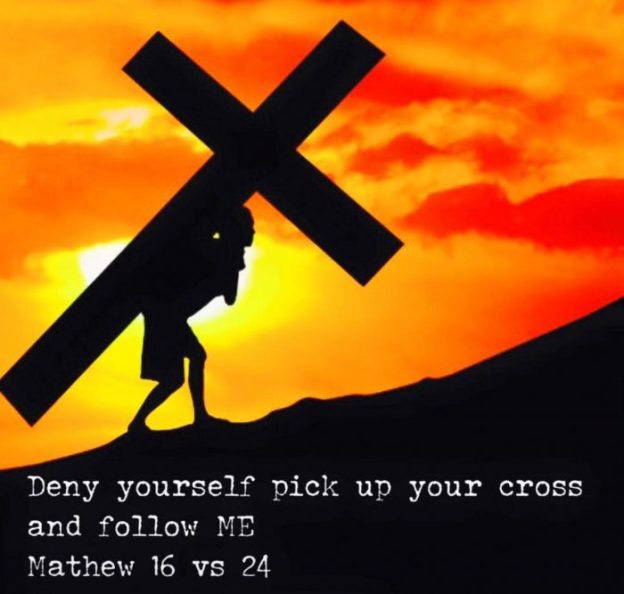
I wonder, is this what Jesus means in our Gospel reading when he says: “If any want to become my followers, let them deny themselves and take up their cross and follow me. For those who want to save their life will lose it, and those who lose their life for my sake will find it.”

Is he calling us to his kind of sacrificial lifestyle?

For many Christians around the world, this does indeed seem to be the case. The majority of saints who fill the Anglican calendar were martyred for their faith. There were more Christians tortured and killed in the 20th Century than throughout the whole of the history of the Church before that. But is Jesus calling us to that level of self-sacrifice?

Last week (on Sunday 23rd August 2020) those of us following the Anglican lectionary heard Peter acknowledge Jesus as Messiah. Now we hear Jesus talking of his death, placing the Cross right at the centre of what it means to understand him as Messiah. Jesus is saying, very clearly, that his disciples, that we, will not understand him unless we understand the cross, and in some incomprehensible way take it on board for ourselves. In this passage, Jesus isn’t calling us to martyrdom, but rather to making the Cross central in our lives.

Why is the cross so important, so crucial in our understanding of Jesus as King, as Messiah?

Lesslie Newbigin says that the Cross “is the supreme parable: the kingdom of God, both hidden and manifest in the dying of a condemned and excommunicated man.”

Jesus says: “Unless a grain of wheat fall into the ground and die it will bear no fruit.”

Paul talks of the cross as demonstrating God’s weakness, a mystery that shows that God’s weakness is stronger than our strength.

The cross was the place where sin was defeated, where redemption was won, where Jesus opened a door for us back into God’s presence. The Bible claims that at the place of seeming weakness, the greatest victory was won.

So what does Jesus mean when he talks of us taking up our cross?

Let me suggest three different things: the Cross is about identification, about self-denial/sacrifice and about weakness.

Firstly, we can identify with those who are suffering.

In Phil. 3:10, Paul says: “I want to know Christ and the power of his resurrection and the sharing of his sufferings by becoming like him in his death.” Graham, whom I mentioned earlier, and others like him have paid the ultimate price for commitment to Christ. Persecution continues throughout the world and we are called to ‘identify’ with those who are experiencing Christ’s sufferings. To read their stories, to pray for them, to write to them and to their persecutors, to demonstrate Christ’s love in action.

Secondly, self-denial/sacrifice.

Do we really understand as individuals and as congregations, what Jesus means by self-denial? Is there any evidence of the Cross in our life together? Are we prepared to make ourselves vulnerable so that others might know God’s love? Are we willing to let our guard down – let others see our weaknesses, our fears, perhaps let others know about how God has helped us? Perhaps, for us, self-denial means giving time or energy to serving Jesus in different ways in the Church family.

Thirdly, weakness.

Some of us are very conscious of our weakness, conscious of pain, and of suffering. The Cross of Christ, the Cross we are called to take up, makes it clear that Christ identifies with our weakness and pain. It promises that in facing our weakness we will find God. Not when we are strong, not when life is wonderful, but most clearly, most real-ly, when we are at our point of greatest weakness, when the night is dark, when everything seems to be destroying us. Then, when we are weak Christ not only walks alongside us, but in the words of the poem ‘Footprints’ so loved by many, it is then that he carries us.

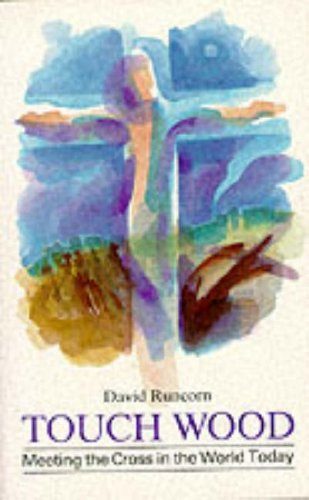
Finally, another quote, this time from David Runcorn, in a book called “Touch Wood: Meeting the Cross in the World Today.”

The Cross shows us a God: “who comes to us from beneath. He enters our world through its weakness, its wounds, its places of rejection. He shares our emptiness. He enters the absence of all we long for and becomes it. He makes it his own. He enters our desolation so completely that he makes our deepest cry his own, ‘My God, why have you forsaken me?'”

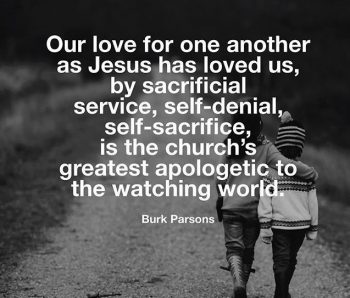
The cross is central. We are very unlikely to be called, like Graham Turnbull, to sacrificing our lives for the Gospel. But in the Cross, Jesus calls us to service, to self-denial, to sacrifice – and with every fibre of his being, Jesus understands and identifies with our sense of weakness.


Matthew 16: 13-20 – 23rd August 2020 – Peter the Rock?

Peter is the rock on which the church was built. At least that’s what our Gospel reading suggests. ….. St. Paul says similar things about us as Christians. Listen to his words from Ephesians 2:

You are no longer foreigners and aliens, but fellow-citizens with God’s people and members of God’s household, built on the foundation of the apostles and prophets, with Christ Jesus himself as the chief cornerstone. In him the whole building is joined together and rises to become a holy temple in the Lord. And in him you too are being built together to become a dwelling in which God lives by his Spirit. [1]

We are God’s temple, God’s dwelling place, rocks, bricks being built into God’s Church. As Paul suggests in the second reading set for today from Romans 12. [2] Each of us exercising our different gifts and strengths, supporting and caring for each other is in Paul’s thinking, strengthened as a building by the interlocking nature of our lives together.

Jesus says to Peter: “You are the rock on which I will build my church.”

But Peter was anything but a rock. Yes, he has just exclaimed that Jesus is Messiah – but two verses later Peter shows just how fickle he is. He cannot accept Jesus’ statement to his disciples that he must die. “God forbid, that this should happen to you, Lord,” he says. And Jesus uses the strongest of words to rebuke him.

Later, as we know so well, Peter promises always to be faithful, yet within 24 hours of that promise he has denied his Lord three times. Peter is no rock. He’s not even stable enough to build a dog kennel on, let alone a house or a church!

So what is Jesus talking about? He knows how unstable Peter is. ………..

Jesus is looking beyond what is self-evident. He sees into Peter’s heart and he also sees his potential. Jesus’ seemingly unfathomable statement about Peter is based not on what we can see of Peter, not even on what Peter thinks of himself. Jesus’ statement, Jesus’ confidence in Peter is built not on Peter but on Jesus’ confidence in the transforming love of God.

And as we watch Peter in the story of the early Church we see someone who gradually becomes a rock, a place of certainty, a person, who in the end, dies a martyr’s death. We see God transforming Peter, dealing with the rough edges of his personality, dealing with the selfishness and sinfulness, the pride which is so much a part of his life. Moulding and making Peter into the rock that Jesus said he always was.

We too are living stones being built into a temple fit for God. Just like Peter, we are being changed and renewed, we mess up, we get things wrong, we hurt ourselves and each other. We definitely are not perfect! However, just like Peter, whatever we currently feel about ourselves, whatever we think others think about us, Jesus sees us as his rocks, his stones, his bricks.

And just like Peter we are called to build God’s church. We are called to be the secure point, the place of hope, the signpost to others around us. We are called to point others to the one who has loved us, who thinks the world of us and who gives life purpose and meaning. We are called to point others to Christ and to be the rock on which they can begin their life of faith.

We are called, as the Church in our community, to be a visible manifestation of the Kingdom of God in that community. If people cannot see the Kingdom of God in the church that serves them, where will they encounter that Kingdom?

We are not perfect, and never will be this side of heaven. But we are called to be a people, like the apostle Peter, who learn over time how to be more like Jesus. This is Jesus’ vision for us, or of us … that we are a community, in our parishes, and in our individual churches, that shines with the light of the Gospel. When God looks at us, that is what God sees. God sees the possibilities, the improbable joys, the unlikely achievements.

And, dare I say it, that is God’s hope for the way we relate to each other.

When we look at those with whom we struggle, we are intended to look through God’s eyes, to see the possibilities, unlikely as they may seem. To see what that person might become if loved and accepted and trusted. To see the possibilities, the improbable joys, the unlikely achievements.  To see that they too could be a Peter – a rough cut stone which could become the most beautiful of diamonds.

You and I are being built, being changed as God deals with us throughout our lives. You and I are each being built into the person God already knows we are, and it is God’s intention that we together become the people we are meant to be. His family, his people, his nation.

References

  1. Ephesians 2: 19-22.
  2. Romans 12: 1-8.

Matthew 15: 10-28 – 16th August 2020

What do you make of the Gospel reading set for 16th August 2020? … What does Jesus mean when he talks about the children and the dogs? Does it sound racist? Was Jesus being racist? That seems to be a blasphemous question to ask. Doesn’t it? ……..

“First let the children eat all they want,” he told her, “for it is not right to take the children’s bread and toss it to the dogs.”

Why did Jesus say those words? Was it just rhetorical, aimed at getting the response it did? Was he just quoting a standard Jewish phrase? Was he, perhaps, working out his theology on the hoof? Learning as he went along? Applying what he had been taught by others and then discovering that it didn’t work or it was wrong. … Only realising as a result of this incident that his calling was wider than just to Israel? On the surface, in the first instance, he seems no different from his disciples. … Was it the woman herself that changed his mind? ……. What was going on? ………….

The Jewish establishment of Jesus’ day was concerned above all with purity – and we saw something of that in the first few verses of our Gospel reading. Our gospel goes on to raise real questions about racial purity. Just who does God see as his people. For many Jews it was clear – only the chosen people, only Jews. God wasn’t concerned for others, for the Gentiles.

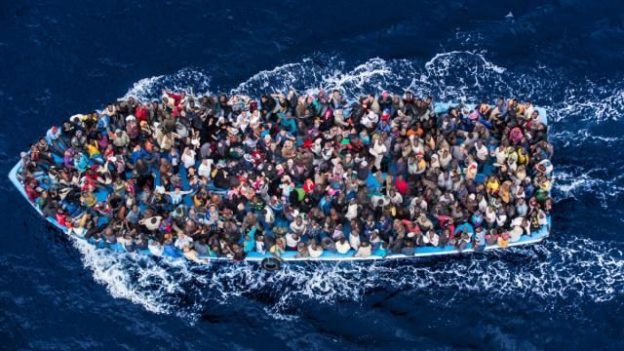
Over the past few weeks in the Summer of 2020, we have once again seen images of refugees crossing the Channel in really unseaworthy boats, often small inflatables. I guess that we will also remember stories of people dying in container lorries in recent years. How should we respond to the stories we hear?

There is a very strong lobby which wants us to be fortress Britain. We are too full says that lobby. We cannot take any more. …

The world-wide statistics are indeed frightening.

According to the UNHCR, at the end of 2019, there were 79.5 million people displaced from their homes (about 1% of the world’s population) Many of them, 45.7 million displaced within their own countries but 29.6 million were refugees – people who have been forced out of their country of origin. Of these 5.6 million are Palestinian refugees and 3.6 million are Venezuelan refugees. Most (4 out of 5) stay as close as possible to their country of origin because they want, if at all possible, to return to their own land. ……There were 4.2 million asylum seekers throughout the world. [1]

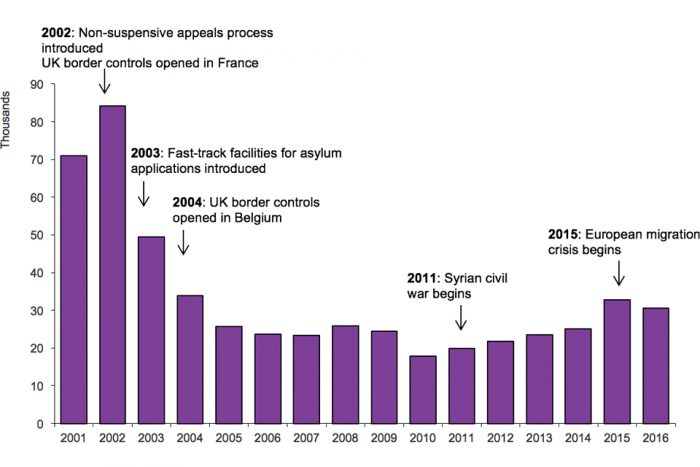
The Governments statistics on asylum seekers show that, for the past 15 years or so numbers have actually been considerably lower than they were just after the millennium. [5]

What does this mean for the UK/Europe? The latest detailed figures available from the Red Cross [2] are for 2018.

Asylum Seekers: the UK received applications for asylum for 37,500 people (including dependents). This is far less than Germany (162,000), France (110,000), Greece (65,000) and Italy (49,000).

That works out as 5 applications per 10,000 UK population. In Europe the figure is 14 per 10,000 people.

Refugees whose claim for asylum has been accepted by the state in which they now dwell are given ‘leave to remain.’ But are still refugees. [2]

According to UNHCR statistics, at the end of 2018 there were 126,720 people still classed as refugees in the UK.  The number in Turkey is 3.7 million! [3]

The Syrian Crisis started in 2011. In the four years to 2015, the UK took 216 Syrian Refugees – 216 in 4 years! In 2020 the number has reached close to 20,000, the figure which was promised by the UK government.

At any one time around 5,000 people are waiting on the French side of the Channel to try to cross to the UK. Last year 1,900 crossed the channel, this year it has been 4,000, so far.

The most astounding figure that I have come across is the number of people granted asylum in Germany. This reached its peak in 2015 – wait for it – 440,000. Yes, over 400,000 in one year! Over the past 30 years, Germany has received at least 3.6 million asylum applications, or nearly one-third (32%) of all asylum applications in Europe over the period. [4]

In this context, what is our response to be, put up walls and exclude those most in need? Britain for the British! Fortress Britain. Keep everyone else out?

When we read the Old Testament we see that there was a constant tension in the life of Israel between those who believed that the Jewish race should be pure and ethnically ‘clean’, (whatever their reasons) and those who had a much broader vision. So Nehemiah and Ezra enact laws to prevent Jews marrying foreigners, yet the stories of Ruth and Jonah, probably written at around the same time, suggest that God is interested in the outsider and the foreigner. Ruth, who became the grandmother of King David (the person who became the symbol for the nation of Israel), was a hated foreigner, a Moabitess. And in Jonah, it is Nineveh, the hated Assyrian enemy city, that repents.

Jesus grew up in a community for whom those issues of racial purity were very important. Israel was for the Jews, no one else! That attitude would have been accepted as normal, an unwritten truth that the community accepted and which no one challenged. At some stage Jesus had to confront those attitudes in himself and his friends and family. Was this Gospel story the moment when it started to happen? …

Ultimately Jesus healed the woman’s daughter. But did he go through some sort of conflict within himself first? ………..

Does that help us when we grapple with our own feelings and ideas? Does it help to think of Jesus having similar struggles and overcoming them? Was this incident for Jesus just a little like the temptations in the wilderness – a real struggle? Or was it no more than the equivalent of swatting a fly? Easy? After all he was God, wasn’t he? Nothing too big or difficult for him! …

But Jesus was a real human being who had to learn and grow just like us. The toddler who had to take his first steps, the five year old who had to learn to read. ……

We have an ongoing struggle to engage with now in our country. It is a real struggle for the heart of our nation. Are we going to be xenophobic, focused only on ourselves, or are we going to be the open, relatively welcoming nation, that for much of our history we have been?

The issues are, of course, complicated.  Governments of all persuasions have struggled to work out what to do. There are no easy answers. ………

But I want to live in a country, in a world, where people matter; indeed that is a Gospel imperative. As Christians, we are called to respond to real need with a generous and open heart. We are called to set aside prejudice and to be open and welcoming.

Working that out can at times be complicated. We may need to make difficult choices at times. We will need to choose to be open, to place love and concern at the heart of our motives and actions. And as we do so we will begin to be a community that we can all be proud of, a community that welcomes the stranger.

References

  1. https://www.unhcr.org/globaltrends2019, accessed on 15th August 2020.
  2. https://www.redcross.org.uk/about-us/what-we-do/how-we-support-refugees/find-out-about-refugees%20, accessed on 15th August 2020.
  3. https://www.unhcr.org/uk/asylum-in-the-uk.html, accessed on 15th August 2020.
  4. https://www.pewresearch.org/global/2016/08/02/number-of-refugees-to-europe-surges-to-record-1-3-million-in-2015/#:~:text=Germany%20received%20an%20unprecedented%20442%2C000,of%20Europe%27s%202015%20asylum%20seekers, accessed on 15th August 2020.
  5. https://www.gov.uk/government/publications/immigration-statistics-october-to-december-2016/asylum, accessed on 16th August 2020.

1 Kings 19: 1-18; Matthew 14: 22-33 – Sunday 9th August 2020 – Holidays and Retreats

We are in holiday season – and our Old Testament Reading tells the story of the first known package holiday. Not arranged by TUI or Jet – this holiday is arranged by God.

Elijah has been working all hours as the head prophet in the Yahweh organisation. Business has not been that good. The competition have been gaining ground. It seems like bankruptcy is on the cards. Yahweh could well go out of business – or succumb to a hostile takeover by the Baal conglomerate. … The tension is brought to a head on Mount Carmel. Elijah challenges the opposition. A credibility test – whoever wins is the real God.I guess that you know the story well – Elijah wins. Baal cannot provide the fire to light the sacrifice on his altar. Yahweh, the God of the Bible, sends fire down from heaven. The whole Baal organisation is in turmoil – Baal’s prophets are killed. Elijah is on cloud nine. But things are not quite that simple – the chief shareholder of the Baal conglomerate is incensed. Queen Jezebel will not go away, she issues threats on Elijah’s life.

How does Elijah respond?

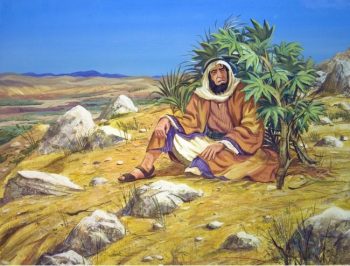
The tension of recent events has got to him. Rather than confident trust in God, built on the foundation of what God has just done at Mount Carmel, Elijah panics – he runs. It’s a classic case of depression and stress – he’s taken on more than he can handle. Elijah can now only see problems where once he saw opportunities. Run down, feeling hopeless, he runs off into the desert.

I don’t know about you but there have been times in my life when I’ve been just like Elijah in our reading. Stressed out, having lost perspective on life, God seems to have disappeared.

It isn’t always something as drastic as Elijah’s experience that affects us. It’s strange isn’t it how often when we review something we have done, that it’s the negative things we remember rather than the good. Or, I wonder, have you ever had the experience in some unguarded moment of tearful emotions overcoming you. Sometimes holidays, perhaps because we begin to relax, or perhaps because of the memories they evoke, are times when life is particularly hard – times when we’re prone to self-pity – even times when God feels distant.

How did God deal with his faithful servant Elijah in this time of darkness? ……….

It’s important to note that God doesn’t tell Elijah to snap out of it – or to buck his ideas up.

No! First God allows Elijah time to rest and sleep; then God makes sure that he is well fed and watered; and then he takes him on a forty day excursion to the mountains.

At times we need to hear this – rest and recuperation are God’s gifts to us – listen to Jesus in Matthew’s Gospel: “Come to me, all you that are weary and carrying heavy burdens, and I will give you rest.” ……..

Secondly, God helps Elijah to see that although God can work in power, God is to be heard most clearly in the silence. God’s words of comfort to Elijah are whispered gently to him. Time away from noise and business, times of holiday and retreat, are times when we can hear God. Times when we can be resourced again for faithful service.

Life can drain us, it can pull us down, we can feel defeated. Holidays and retreats are God’s gift to us, they’re times when we can choose to make space for him. Times when we can pick up our Bibles again. Times when we can make space to pray. Times when we can set aside noise and competition and listen to God’s still small voice of hope. ……

Peter’s story in Matthew’s Gospel is a little different!

He is out of the boat walking towards Jesus. …. For a moment things seem to be going really well – until he looks around and sees the storm and suddenly the water underneath his feet really does feel like water. And Peter begins to sink. Life for him, like Elijah, is overwhelming. Peter is desperate.  “Lord, save me,” he cries. And Peter, like Elijah, discovers that God is there for him. …..

Both Peter and Elijah have seen God at work in dramatic ways – Elijah on Mount Carmel, Peter, with the feeding of the 5,000. But both discover that they have to learn to trust God for themselves. It is not what they have seen that counts – not even what they have been involved in. They for themselves have to learn to trust the quiet voice of God in the midst of what life can bring.

Peter cries out, “Lord, save me.” …. Elijah stands still, listening to God’s voice.

Whoever we are, whatever our nature and whatever our experience of life, we need too to learn to place our confidence and trust not in our own abilities, not in the faith of others but in the love that we discover God has for us. And when God reaches out to us in love, we need, like Elijah and Peter, to trust him.

And we can trust God to be there for us at all times – providing the strength that we need for each day, intervening on occasions, but most of all assuring us of his loving presence.

And when we come to Communion, when we release our burdens in confession, when we receive again the reality of Christ’s death and resurrection, when we eat the food that God provides for us. We can hear God speaking once again in the silence, God says again – “I love you, rely on me!”

Every day that we come to Holy Communion can be a holiday – a Holy day!