A series of clipart images are included in this article/sermon which I believe are free to download and royalty free. The first, at the head of this article is a picture of a welcome mat.

People place welcome mats outside the front door of their houses. Do you have one? ….. I think they carry a mixed message, something like this: “It is nice to see you but please do wipe your feet before you come into my house!”
It conveys a sense that visitors are welcome if they …..?
A true welcome is really about greeting someone in a warm and friendly way. A few pictures to illustrate what we do to welcome people into our homes. …..
What things do we do when someone comes to our house to make them feel welcome?
A Warm DrinkSomething to EatA Comfortable ChairA Warm RoomA SmileA Invitation to Return
Pretty much naturally, when we do welcome someone into our home we offer a warm drink, some biscuits, a comfy chair, a warm room, a welcoming smile and an invitation to return.
But, has anyone ever come to your house who you don’t want to welcome in? … Sometimes we get people selling us stuff we don’t want, or someone we find it difficult to likecomes to the door. I remember letting a bathroom salesman into my house and then spending the whole time he was there wishing I hadn’t.
Or what above a Jehovah’s Witness or a Mormon missionary….. Perhaps we keep them standing on the doorstep rather than let them in.
A challenging question for clergy might be what constitutes a true welcome be for the awkward and abusive homeless person on the vicarage doorstep?
How do you feel when someone you don’t want around is on your doorstep? Perhaps you feel a bit aggressive and defensive, or maybe mean, awkward, uncomfortable or even guilty, as you turn them away?
It’s not always easy welcoming some people into our homes, our places of work, our schools, or even our churches – is it?
Towards the end of our Gospel reading today, we heard about some people who were not made to feel welcome by Jesus’ disciples.
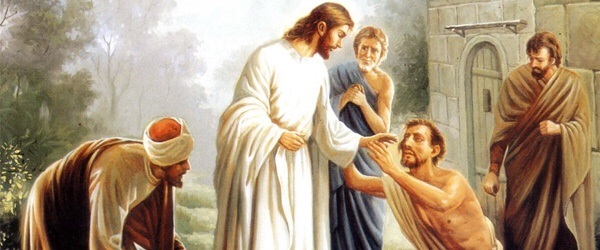
Jesus was teaching and people were bringing little children to have Jesus touch them. The disciples criticized the parents and told them to stop bringing their children to Jesus. When Jesus heard what his disciples were saying, he was very upset. “Let the children come to me and don’t stop them!” Jesus said. “The Kingdom of God belongs to those who are like these children. Anyone who doesn’t come like a little child will never enter.” And the Gospel tells us, that Jesus took the children in his arms and blessed them.
Jesus really knew how to make a child feel welcome. Perhaps you might be able to imagine how those children must have felt when Jesus took them up in his arms and blessed them? That image – that we often see in stained glass windows in churches – of Jesus with the children in his arms is one that should reminds us to make everyone feel welcome like Jesus did!
The kind of welcome we offer to others is critical. It says so much about us. When we welcome people into our homes or into our churches, we are sharing something of ourselves with them, and in doing so we make ourselves vulnerable. Because, at times, our guests can ride rough-shod over our hospitality.
The temptation is to respond like the disciples – to try to exclude those who don’t understand our ways of doing things – and there are plenty of churches that do just that. To come to the main service in the church that I grew up in, you were expected to have a letter of introduction from another similar church before you could be part of the worship!
Some churches refuse to have baptisms in their main services – because the wider baptism party may disrupt their quiet worship. Some churches refuse to even make their building available to the community – a great sadness when those churches are the only large indoor community space available.
In our Gospel, Jesus models a response of loving welcome – an acceptance of the mess and the noise that goes with children being around, but a true acknowledgement that they have so much to offer us. This is the response that we are called on the make in our churches, not only to children, but to all who need the love of our Saviour – open, loving, vulnerable welcome!
Back to our welcome mat and that gallery of welcome pictures. …
What does our figurative welcome mat say to those who cross the threshold of the church for the first time? Is our welcome warm, open and true? Or is it grudging and perhaps motivated by fear that we will have to be different, to change, if we truly welcome them?
Do we do our best to extend that welcome – perhaps with a warm drink, something to eat, comfortable seating, a warm space, a welcoming smile and a heartfelt invitation to come again?
A Warm DrinkSomething to EatA Comfortable ChairA Warm RoomA SmileA Invitation to Return
What does our figurative welcome mat say to people? Wipe your feet, clean yourself up, sort yourself out and come in – or does it really say that people are welcome as they are?
The God we worship worship week after week offers an open, inclusive welcome to all. God includes everyone without exception and God calls on us to do the same.
My worst in church was being called up to help with the chalice at Communion in my church in Didsbury in the early 1990s and tripping over the steps on the way up to the altar. I fell flat on my face in front of everyone and then found everyone sniggering as I gave them the cup. How did I feel? … I wished that the ground would open and swallow me up!
The bridegroom in John 2:1-11 was in just such an embarrassing predicament. This was supposed to be his special time. He & his new wife had been escorted through the streets with burning torches, lighting their way to their new home. They weren’t going away on a honeymoon, but would keep open house for an entire week for people to come along and celebrate the occasion. This was Jewish custom, and the celebrations and showing hospitality to guests were a sacred duty. And what has happened, but the wine has run out! Not because his guests have been over-indulging. Apparently, he’s just been to stingy – he’s not bought enough.
Perhaps he’d underestimated how much wine he’d need. Perhaps he didn’t have the money to buy enough wine, even the cheapest available, to meet his needs. But there was no room for excuses – it was his duty to pay for the celebration. Deeply embarrassed, perhaps red in the face, getting hot, wanting a hole to open up and swallow him, he waited for the complaints from his guests to roll in. Can you imagine his prayer, “Why does this always happen to me? … Please Lord don’t let anyone notice.”
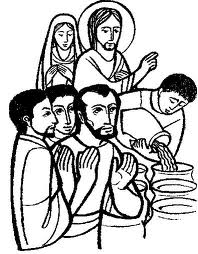
But one guest did notice. Mary saw and she told Jesus. And Jesus quietly set to work. He gets the servants to fill the six water pots with water, the water is turned into wine and the bridegroom’s embarrassment turns to amazement and joy. The equivalent of over 700 bottles of wine, the finest wine appears from nowhere. No longer does the bridegroom face shame and humiliation.
The reading concludes: “Jesus performed this first miracle…… there he revealed his glory
and his disciples believed in him.” Those who were with Jesus knew that this was an act of divine power – an act in which the personal situation of the bridegroom was transformed. This miracle revealed the nature of Jesus’ ministry: Jesus, the provider of joy, transforming sadness and embarrassment into experiences of gladness and rejoicing. Jesus, the one who can overcome our mistakes/failings, bringing good out of seeming disaster.
The good news of the Gospel is that this is what God is like. If Jesus transformed one situation, then God can transform the situations that we find ourselves in today.
Perhaps we’ve made mistakes – like the bridegroom without enough wine. We may look back over our lives, and think “if only I’d not done or said that.” There may be things that have happened in the last few days – we’ve done or said something we regret. These things can linger with us, leaving us feeling embarrassed, ashamed, and not knowing what to do.
Perhaps we are low in resources – like the bridegroom who couldn’t provide adequately for his guests? There are times when we feel spiritually dry, we struggle to pray, we wonder where God is. Or we feel physically weak, no energy to do what matters. Or emotionally drained, with no motivation to sustain relationships or get on with our work.
Perhaps life is full of sadness – like the bridegroom who sees his joyful day disappearing before his eyes. We see others around who are happy, but find it hard to be like them. We know that others think we should be smiling, but it’s not as easy as all that…..
Whether trivial or significant, God in Jesus is ready to transform these situations. He can, and does break into our lives. We think or feel that we are defined by the past, by our mistakes and failings. But God says, “No!” Just as Jesus transformed the bridegroom’s day from failure to joy, God can transform our lives bringing good out of the mess we see in our lives.
Not only is God ready to transform situations, he is even at work when we cannot ask him ourselves. The bridegroom wasn’t actually aware that Jesus was working to help him until the steward announced that there was more, and even better, wine on offer. It was someone else, Mary, who noticed the need, and asked Jesus to act. When we are unable to pray, or don’t know what to pray for – we don’t need to worry that we’ll be left helpless. God will act.
God can act unilaterally, but more often than not it is through others around us. Those who notice the way things are and do something. … Action isn’t always appropriate. When we see our friends or family members struggling – we can follow Mary’s example. We can talk quietly to Jesus, in the background, and we can have confidence that we have done the right thing. For we have given their situation to God. And God is able to work for good in any situation.
And when Jesus acts, when God acts, we may be amazed at what happens – the bridegroom didn’t just receive enough wine to get by on. He got good, fine wine – more than he needed, better than he needed. The generosity of God was overwhelming at the wedding in Cana. And when Jesus acts to transform our situations, our lives, we can expect this same generosity. However, with Jesus, it’s not about quick fixes that solve the problem for the moment. No, God’s work in our lives will often be quiet, often over the longer term. We may experience setbacks, but God will not give up.
We can experience transformation, and as Jesus works in our lives the glory of God will be revealed – just as it was at Cana. And we can be part of that transformation in the lives of others by taking the mess and muddle that we see to God, by asking God to break in a bring hope and transformation.
Lord Jesus, just as you transformed the situation of the bridegroom at Cana, may you work in our lives, transforming our embarrassments, our inadequacies, our sadnesses, our mistakes, into experiences of gladness and joy, to the glory of your name. Amen.
A talk given on 17th September 2023 at St. Alkmund, Whitchurch.
If I were to ask for a show of hands this morning of those who have never wronged anyone. How might you respond?
Some might be ask themselves what right I have to ask a question like this. Is it, perhaps, the wearing of a dog collar that means I feel I can do so?
Some might think about what others around them might think if they put up their hand. … People here this morning probably know me too well. Although I know that I have never done anything too bad, I have certainly not broken any laws, they might remember that one time when I …………… What will they think of me?
Others might want to challenge my presuppositions behind asking the question. They might want to enter into a philosophical debate about my presumptions. … What might I mean by ‘wrong’? What might I mean by ‘never’? Do I mean ‘wrong’ in an absolute sense, measured against a set of laws? Or do I mean ‘wrong’ in a relative sense, in terms of the breakdown of relationships? Am I talking about ‘wrong’ in terms of personal moral responsibility, or of complicity in the actions, or failures to act, of my group, my family, my village, my class, my business, my society?
Ultimately, I guess, whether we readily admit our failings, or we only do so at our lowest ebb when self-doubt is strongest, very few of us would put our hands, and so today’s Gospel reading is for us, for you and for me. We all need or have needed someone’s forgiveness.
But our Gospel reading turns the question round the other way. It asks: What do you do when you have been wronged? What do we do when people hurt us or upset us? It talks about a need for us to forgive others.
There are many questions we could wrestle with this morning about ‘forgiveness’. But rather than embarking on a philosophical debate, let’s allow the Gospel story to speak. ……..
Just suppose, for a moment or two, that you have been hurt, maligned or mistreated by someone else.
Suppose (use fingers to count) someone lets you down, cheats on you, loses their temper with you, says some cruel and unkind things, steals from you, makes you look stupid, and breaks something of yours when you let them borrow it. … How do you respond? ……….
When Peter speaks to Jesus, he believes that he is setting a very high standard: “How often should I forgive someone? 7 times, Lord?” It seems as though Peter is saying: Seven times seems about the limit, fairly generous really. You might just as well give up on someone after that. Or perhaps, Peter is asking something like, “Am I being too generous, Lord, what do you think, perhaps after just 3/4 times?”
And Jesus response, I think, leaves Peter reeling – not seven times but seventy-seven times – or in some translations seventy times seven – 490 times. … “As often as is necessary,” is Jesus’ response. “Keep forgiving until you lose count completely!”
And Jesus then tells a story to help us understand that it is because we have been loved so much, forgiven so much ourselves by God, that we should forgive others.
Jesus’ story is about an employee or servant who has a wife and children and who has overspent on his company credit cards, someone who has maxed out. He has spent his boss’s money on himself and his family. He has stacked up a huge amount of debt with his boss.
The Boss calls for his servant and demands repayment of what is owed. The servant falls on his knees and begs to be given more time to pay. The master, the boss, feels sorry for his servant and lets him off the whole debt! Just like that!
The debt is cancelled. How does the servant feel? … I guess that, if you have struggled under the burden of significant debt, an unpayable mortgage, a large gambling debt, a payday loan which is escalating out of control. Then you will know something of the immense relief, the unbridled joy of the servant. …
Now that is just what the bible says God has done for you and for me. He has cancelled the debt we owe, he has forgiven what we have done wrong, and continues to do so, perhaps even things that only we and God know about! …. The meanness, the selfishness, the pride, the hypocrisy, the fibs, the tax evasion, the days ‘off-sick’ which weren’t, the snails and slugs we have thrown over the garden fence onto our neighbour’s property, our failure to recycle, the driving above the speed-limit on the motorway… you know, all those kinds of things, as well as what might be much bigger things ….. When we say sorry to God for these things he forgives us. The only question is whether we mean what we say when we say we are sorry, and, I guess, whether, ultimately, we are willing to make restitution to those we have harmed.
God has forgiven me and you more than we can imagine. It is just as though we owed God more than a million pounds (IOU a million) and he has cancelled the debt. The debt is gone, we have been set free of debt. (Tear up the I.O.U.). ……
So, back to the Gospel story, … here is this happy, free servant. He’s wandering back from the house of his master, his boss, to tell his family the good news. He’s over the moon, he’s delighted, it is wonderful. And he meets a fellow servant of his boss, his master. This fellow servant owes him a few quid.
And the same thing happens; this other servant falls on his knees and begs to be given more time to pay. But what does the first servant do? He grabs him by the neck, shakes him and has him thrown into prison until he can pay the debt.
What Jesus wants us to ask ourselves is this: Is it reasonable for the first servant to behave this way? Is it fair and right? What do we think?
Of course it isn’t. …
Yet forgiveness remains something we all find difficult – often impossible. … Jesus is suggesting in this story that we will only begin to be able to forgive, if we can comprehend how much we ourselves are loved, how much we been forgiven.
Jesus says that it is when we know that we are loved without conditions, that we can begin to show that kind of love to others.
The love God has for us is that kind of love.
Our regular Sunday services allow time for confession and for us to hear God=s word of forgiveness for us. We also join together in the Lord’s prayer: ‘forgive us our trespasses as we forgive those who trespass against us’. Weekly reminders of just how crucial forgiveness is.
It is only in the security and strength of God=s forgiving love for us, that we can be free to love and that we can begin to forgive others generously in return.
Yes, for their sake and for God=s sake … but actually also for our own sake. … For, finding a way to forgive, is essential for the sake of our own health and well-being. For when we hold onto grudges, it is as if we throw ourselves into debtors’ prison until the perceived debt has been paid. A failure, on my part, to forgive can destroy me. …. So, the last few words of our Gospel reading, as awful as they are, reflect no more than the natural consequence of the first servant’s failure to forgive. …
Rather than finishing on this negative note, let’s think forward to the central act of our service this morning. Let’s focus on the love shown to us in Christ. … On the forgiveness which is ours in Christ, no matter what we have done, no matter how guilty or ashamed we feel. And, as we prepare for our Communion, let’s allow ourselves once again, as we receive the elements of bread and wine, to sense the love of God suffusing our minds and hearts. This act of love which we re-member in our bodies, is an act of deeply healing, forgiving love from a God who thinks the world of each one of us. We are loved, forgiven, set free. Words are just not enough, but bread and wine, body and blood, warm our hearts and embrace us in God’s arms of mercy.
And the child’s father and mother were amazed at what was being said about him. Then Simeon blessed them and said to his mother Mary, “This child is destined for the falling and the rising of many in Israel, and to be a sign that will be opposed so that the inner thoughts of many will be revealed – and a sword will pierce your own soul too.”
Sunday 19th March 2023 – Luke 2:33-35
An updated reflection. ………….
On Mothering Sunday (Mother’s Day) we give thanks for those who Mother us, for those who today and in years gone by have given themselves to and for us. For those who have made sacrifices so that we might enjoy life. In many communities now, only to say thank you to Mums, is to ignore all those who care for us. In families across our land, grandparents, aunties, uncles, fathers, foster parents and social services carers provide motherly love and care to many children. This is a day when we celebrate all who have and do provide motherly care.
Our Gospel reminds us that loving and caring in this way is a sacrifice of self-giving. A vocation to which many of us are called. A vocation which not only means a daily grind of tiredness and worry, but one which often can involve experiencing the deepest of pain – sometimes because that care is rejected by those we love, sometimes because of the hurt done to those we love and care for.
Mary understood that pain. At the death of her Son, she bore in her body the pain of the cross – she felt the nails being hammered into the wrists of her son, she agonised as she watched him die the most painful of deaths. She had to release her child into God’s eternal care long before his time. And as those things happened I’m sure she will have felt a mixture of all the emotions a mother can feel – anger, guilt, shame, and deep aching loss. Like any mother, her grief was unbearable.
Mary also understood the joy of motherhood – she watched her precocious child grow to be a wonderful man. She felt the joy of being part of the making of this special son.
Mothers today face all of these emotions. Today we stand with them, pray for them and celebrate their self-giving love. We pledge ourselves again, for another year to work for the stability of family life, to help those who find the burden of caring too difficult.
As we look around our world today, we reflect on the tremendous burden born by mothers, grandparents and others, as they watch the healthy younger generation around our world dying for lack of drugs to treat those who are HIV positive; who see children dying for nothing other than the lack of clean water, or the cost of a mosquito net; as we watch families still struggling to come to terms with Coronavirus for lack of available, affordable vaccines.
We see the burden of care carried by so few for so many children, we see children struggling for lack of food, their carers working night and day to bring in only just enough for survival. We see schools and their staff carrying an increasing burden so as to keep our society working.
In other ways today, our celebration is mixed with sadness and mourning.
We are acutely aware of people important to us, whom we have lost and who we wish were still with us.
Our prayers also carry the weight of what we see each day on our televisions and what we know to be true for many around our world. We try, in our worship, to imagine the pain of mothers on both sides of the Ukraine conflict. We struggle to comprehend the depth of loss felt by all parents, but particularly by mothers, who have lived through the earthquakes in Syria and Turkey.
And we bring all this, the stuff of life in our world, the joy and the struggle, with us as we pray and as we come to Communion. In the midst of many conflicting, painful or joyful feelings, we give thanks for all that our mothers mean to us, all that our mothers have meant to us. And as we quietly remember Jesus’ sacrifice, we seek to understand the pain of those who are suffering for love throughout our world today.
I have long felt that, in understanding God’s call on our lives, the pivotal passage in the New Testament of the Christian Bible is John 17.
I have discovered more recently, in early retirement, just how significant that chapter of the Bible is for me personally. In discussions around difficult issues I have found myself returning to Jesus’ prayer in John 17. The call for unity embodied in that prayer pulls at my heart strings and provokes a surprisingly strong emotional response. …
Professor David Ford seems to have a similar sense of the profound importance of that chapter to the overall message of John’s Gospel, and, as a consequence, to the whole New Testament story. He speaks of John 17 as the point at which John’s Gospel, “sounds its greatest depths, reaches its greatest heights, opens up its innermost secret of intimate mutual indwelling, and orients the desires of readers toward union with the ultimate desire of Jesus.” [1: p9]
If we are to take Jesus’ prayer in John 17 seriously, that ‘we will be one, as he and the Father are one’, we have to take our differences over many issues seriously, address them and, in the midst of our disagreement, then seek unity — that is the challenge of John 17.
In this respect, Loveday Alexander writes that: “We shall need (as Pilling frequently reminds us in the report about human sexuality, [2]) ‘a complex process of theological discernment, a process that begins with the discipline of listening, which requires the ability to move outside the limitations of our own experience to pay attention to what God is doing in the experience of others.’” [3: p48]
Let’s take this particular issue as an example of the challenge posed by the prayer of Jesus in John 17. Loveday Alexander was writing in 2014 about the ongoing debate within the Church of England over human sexuality. We are now, at the time of writing, in 2022, and that process of listening in relation to human sexuality has been going on in the Church of England over the past 8 years.
We are probably more aware of the issues, in this particular context, than we ever were, but as far as I can see, we are no closer to a way forward that will hold us all together in unity and that will satisfy, not only those with different views within the Church of England, but also those in the wider Anglican Communion.
Indeed, a number of us in the wider Anglican Communion still see the very process of listening to be too great a compromise. For some of us, Scripture is clear, the matter is determined by the text of Scripture and the traditional teaching of the church. There must be no equivocation over the issues involved. The firm belief of parts of the Anglican Communion is that the Church of England and a number of other provinces in the Anglican Communion need to repent and return to the tenets of Scripture. That view, held with great integrity and commitment, says that unity is just not possible while parts of the Communion are so manifestly in error.
Others of us cannot accept that position. For us, a careful study of Scripture and the cultures in which it was written and our own lived experience lead us to a very different conclusion. Many in this other part of our church family are just as resolute as those in the first group.
In reality, we are not united but divided, and it seems that we hold each other to account as responsible for that division.
And yet, in this particular context, we are not so very far apart. We see many of the of the possible perversions in all sexual relationships as sinful. We are not happy to condone engagement in physical sexual acts outside of committed, faithful, monogamous relationships. We strongly condemn abuse in all its forms whether inside or outside of a marriage and family life. We see no place for promiscuity, no place for selfishness. I hope we also have a strong commitment to mutuality in marriage and in relationships.
But, we do not agree on one key issue relating to who can participate in a committed, faithful, monogamous sexual relationship. And for so many of us, on whichever side of the argument we sit, this matter is essentially insurmountable, either because of our view of about what scripture says, or because of our essential identity as human beings. It seems as though neither side in the debate can see any grounds for hope and both seem to agree that this issue takes us beyond the remit of Jesus’ prayer for unity in John 17.
As I have already said, that prayer in John 17 is, for me, a pivotal point in scripture. And it provides the context for Jesus’ later commission in John 20:21-22. “Peace be with you. As the Father has sent me, so I send you.” When he had said this, he breathed on them and said to them, “Receive the Holy Spirit…”’ (John 20:21-22)
As we have noted, Professor David Ford (the author of a new (in 2022) commentary on St. John’s Gospel [1]) agrees with this assessment. He talks of Jesus’ prayer in John 17 being “the most profound and far-reaching chapter in the Bible” [4]. Jesus “prays (John 17:18) about what he later does in the pivotal verse John 20:21, and pours out his ultimate desire for all of us later believers: that we be united in love with each other and with him, ‘as’ he is united in love with his Father, and that this might overflow into the world God loves (John 17:20-26). It is a mission of inspired loving, for the sake of the whole world, including (since Jesus is the one through whom ‘all things came into being’ – John 1:3) the whole of creation.” [4]
“All through John’s Gospel readers have been prepared for the death of Jesus (beginning with John 1:29), and for the resurrection of Jesus (beginning with John 2:22), and for the giving of the Holy Spirit (beginning with John 1:33). Now, climactically [in John 20:21-22], the crucified and resurrected Jesus actually gives the Holy Spirit. The words that accompany this give all of us Christians our core vocation and mission. We are sent ‘as’ Jesus was sent.” [4]
“But,” says Ford, “the ‘as’ does not mean exact repetition. We are not in first century Palestine. His Spirit is breathed into us so that we can both learn from how he was sent and also improvise endlessly upon it. We are to be inspired in our learning together (the Holy Spirit guides us into ‘all the truth’ – John 16:13, so our learning is never to stop), in our loving like Jesus, and in our praying like Jesus (try praying the Lord’s Prayer in the light of John 17!).” [4]
In his commentary, Ford says that the thrust of John’s Gospel is towards “doing life-giving signs for all who are in need, daringly crossing deep divisions, seeking more and more truth, engaging critically and constructively with the civilization of which it is a part, prophetically challenging the pathologies of power, modeling servant leadership, and building communities of prayer, love, and friendship that serve God’s love for all people and all creation, seeking to be part of the fulfillment of the desire of Jesus in his final prayer.” [1: p11]
“The essentials,” he says, “are summed up in John 20:21-22. Jesus gives us the deep ‘peace’ of knowing we are utterly loved, at home abiding in the love at the heart of all reality; the deep purpose of being ‘sent’ to love as he was sent by his Father; and, amazingly, the ‘Holy Spirit’—breathed into us minute by minute as he lives in us, we live in him, and we are energised and inspired to learn, pray, love, and serve as never before.” [4]
One significant element of John’s gospel message is the way in which “it nurtures in readers a global horizon that can unite them with the desire of Jesus for an ultimate unity of all people and all creation in love and peace.” [1: p11]
This means, as we have already noted, that we are to be inspired in our learning together, in our loving like Jesus, and in our praying like Jesus. … Jesus prayer is pivotal to our corporate life as his Church.
As Professor David Ford says: we are to be inspired by Jesus’ prayer in John 17 which calls us to a unity with each other which reflects the unity of the Godhead. We are called to reflect in our relationships the “innermost secret of intimate mutual indwelling,” [1: p9] that characterises the relationship between the three members of the Trinity. Indeed, Ford entitles the chapter in his commentary which focusses on John 17, ‘The Summit of Love’.
Our missionary calling as disciples of Jesus is a call, primarily, to unity. This is to be one of our ultimate values, it is to define us as followers of Jesus. It is to be at the very core of who we are. For me, this increasingly means an emotional, almost visceral, commitment to unity.
Whatever our differences in theology and practice, whatever different denominations we might form, we are called first and foremost to a loving unity which surmounts all barriers. We are to be ‘like Jesus’ who prayed, with what was close to his dying breath, that we would be one ‘as he and the Father are one’.
“John’s gospel is indeed irrefutable in its clear, concise and transparent yearning for authentic Christlike discipleship today and always, to exemplify human love one for another, unconditionally, non-selectively, non-judgementally – just as Jesus did, so also should we do similarly.” [5: p24]
While commenting on John 1:29, Ford offers us a definition of sin: “This also is a pointer to the meaning of the sin of the world. [John 1:29] The basic sin indicated in the Gospel of John is lack of faith/trust/belief, inevitably involving lack of love. The desire/will of God is for a love inseparable from trust. The ultimate desire of Jesus, expressed above all in his climactic prayer in John 17, is for people to be united in trust and love with God and one another through him, a unity in which the whole of creation is embraced. This is the “summit of love,” the joy, the “eternal life,” the peace, for which people are created and into which they are invited, and whatever prevents or distorts or falsifies or opposes this is sin.” [1: p48-49]
Essentially, nothing pertaining to our faith should be allowed to take us outside of the scope of Jesus’ prayer for unity. Historically, the Church has allowed many things to take priority over that prayer. In doing so, each time, it places itself outside of Jesus’ desire for it.
At the moment, I find it nigh impossible to envisage the reconciliation of people holding divergent views on human sexuality within the Church of England and the Anglican Communion. I am grateful that others are ultimately responsible as the guardians of our unity and our faithfulness to the canon of scripture. My fervent prayer is that the Spirit will continue to lead us into all truth and that we will be able to fully accept our differences and fully embrace the unity for which Jesus prayed.
References
Professor David Ford; The Gospel of John: A Theological Commentary; Baker, Grand Rapids, Michigan, 2021.
The Pilling Report was published by Church House publishing on 28/11/2013. Its full title is The Report of the House of Bishops Working Group on Human Sexuality.
Revd Canon Professor Loveday Alexander; Homosexuality and the Bible: Reflections of a Biblical Scholar; in Grace and Disagreement: Shared Conversations on Scripture, Mission and Human Sexuality; The Archbishops’ Council, 2014, p24-51.
Jenny Plane Te Paa; Theology and the Politics of Exclusion: An Indigenous Woman’s Perspective; in Terry Brown .ed; Other Voices, Other Worlds; Church Publishing, New York, 2006, p15ff.
John J. Pilch in ‘Introducing the Cultural Context of the Old Testament’ focuses on Wisdom literature, and to help his readers understand how important honour and shame were in Ancient Israel, Pilch takes them on a journey of discovery around the book of Proverbs (Pilch: pp49-70). He comments: “The core values of Mediterranean culture are ‘honor and shame’” (Pilch: p49). He explains it like this:
“The central or core value of our Mediterranean ancestors in the faith is ‘interpersonal contentment’. This value dictates that people should be content with what they have and not worry about getting ahead of others, achieving more than others, or being better than others. This, in fact, is what Mediterranean people are ‘anxious’ about: not to infringe on others, and not to allow others to infringe on them.
“Such anxiety revolves especially around the value feeling of ‘honour’ and ‘shame’. Whatever the status into which a person is born is ‘honourable’ and must be maintained throughout life. Indeed, being born into honour is the chief way of getting it. The reason for genealogies in the Bible is to let the reader know that the person to whom this genealogy is applied is honourable because the entire ancestral line is full of honourable people.” (Pilch: p52.)
Pilch then goes on to help his students reflect on a whole series of different verses from Proverbs (3:9, 16, 35; 4:8; 5:9; 6:33; 8:18; 11:16; 13:18; 14:31; 15:33; 18:3, 12; 20:3; 21:21; 22:4; 26:1, 8; 27:18; 29:23). His asertion is that these proverbs are intended to direct and control people’s behaviour and to do so they include sanctions and rewards. It seems as though the writer of Proverbs ‘carrot and stick’ (my words) are honour and shame. Take Proverbs 13:18 as an example:
“He who ignores discipline comes to poverty and shame,
But whoever heeds correction is honoured.”
“Honor is contrasted with disgrace (shame). … Honor results from heeding instruction, particularly reproof (discipline). The book of Proverbs is … ‘wisdom literature’ which is practical, down-to-earth advice on successful living. Such wisdom helps a person maintain honor” (Pilch: p57), and avoid being shamed.
Pilch then encourages his readers to look at references to shame in Proverbs ( which include: Proverbs 10:5; 12:4; 13:5; 14:35; 17:2; 18:3; 19:26; 25:8-10; 28:7; 29:15). Shame, he says, “in a positive view, is a sensitivity to one’s honor and a determination to guard and maintain it. In a negative view it is the result of a loss of honor” (Pilch: p61). Consider Proverbs 28:7 as an example:
“He who keeps the law is a discerning son,
but a companion of gluttons disgraces his father.”
“Gluttony bespeaks having more than enough. The Mediterranean cultural obligation when one has more than enough is to share with those who do not have enough. To be capable of gluttony means one has refused to share, and this is shameful. Notice who bears the shame. The father is tainted by the son’s misbehaviour.” (Pilch: p63). Pilch goes on to explain that shame and honour are never purely personal matters. The son shames the father, the father bears that shame as a deep pain negating his honour, his place in the community, he is reduced as a person.
Shame in Proverbs, then, is a sanction. It seems to as much affect the family of a miscreant rather than necessarily just the miscreant him/herself. For those who are shamed, there is little they can do to change the circumstances. Shame overwhelms them but they have nowhere to turn to resolve their predicament. Their honour has been taken away.
References:
Please see the bibliography on Honour and Shame on this blog.
It is only days now before I am back in Uganda again. It will be three short weeks and Jo, my wife, will not be with me as she has to continue to work in the UK. I have just been thinking back to my first visit to Uganda in 1994. …….
Proverbs 8: 1-3 (ESV)
Does not wisdom call? Does not understanding raise her voice? On the heights beside the way, at the crossroads she takes her stand; beside the gates in front of the town, at the entrance to the portals she cries aloud.
When I first went to Uganda in 1994, I travelled by train from Mombasa. A beautiful journey travelled at a snail’s pace in some ancient but well kept carriages and with silver service for meals and attendants who made up beds for passengers. The journey took for ever and included an unscheduled stop in Jinga because of a freight train derailment closer to Kampala. Our train waited 6 hours in Jinga!
On the last leg of the journey to Kampala, I was reading from Proverbs 8 – the passage above. It was as we came into the suburbs of Kampala that I looked up from reading to notice on the skyline a number of different religious buildings. I remember seeing two cathedrals, a Bahai temple and a mosque (I think). Here were various claims to wisdom calling out from the heights, ‘Listen to me!’
Kampala is a city of many hills and it seemed to me, on that first day that I saw it, to have a religious building on the top of each one.
I travelled down in a car from Kampala to Kisoro, a long journey, really long. Half way through the last leg of the journey, travelling over dirt roads, I caught a glimpse of Mt. Muhabura. It was the dry season and the dust in the air meant that I did not see it again until leaving Kisoro when I travelled back over the same road to Kabale.
Mount Muhabura, also known asMount Muhavura, is aninactive volcanoin theVirunga Mountainson the border betweenRwandaandUganda. At 4,127 metres (13,540 ft) Muhabura is the third highest of the eight major mountains of the mountain range, which is a part of theAlbertine Rift, the western branch of theEast African Rift. Its summit contains a smallcrater lake. The limited evidence for this volcano suggests that it last erupted some time in theHolocene, but the exact date is not known. Muhabura is partly in theVolcanoes National Park, Rwanda and partly in theMgahinga Gorilla National Park, Uganda. [1]
Anyone from Kisoro will tell you what the name of the mountain means and hence why the Diocese is named after it. Muhabura is ‘the guide’, the ‘one who leads me home’ – a mountain visible for miles around calling the people back to their homeland.
It strikes me again now, as it did back in 1994, that ‘Muhabura’ is an excellent name for a diocese. It is our Christian calling to be people who call others back to faith, back to where they belong. The wisdom of the Christian faith is not primarily intellectual, it is not ‘clever’, per see. Christian wisdom is primarily about relationship, about knowing God.
Someone is truly wise in God’s eyes when they are one of his people, in relationship with him, listening to his word, and full of his all-embracing inclusive love. When we gather together as Christians we aspire to be those in whom God’s wisdom dwells, to be a community faithfully drawing those around us back home, back to God. So we should be like Mt. Muhabura, a true and faithful guide, in an uncertain world.
Proverbs 8:1-3 has more for us than this. … Wisdom stands at the crossroads; …….. beside the gates in front of the town, at the entrance to the portals she cries aloud.
Proverbs 8:1-3 also encourages us to count on God’s wisdom at the crossroads, at the place of decision, the place where we have to make choices. And it encourages us to seek wisdom in the gates of the city. The place of business for any community in Old Testament times was the gates of the city. It was where the village elders met, it was often the market place. God’s wisdom is not just spiritual wisdom but practical wisdom, and available to us as we go about the daily business, decusion-making and transactions of our working lives.
Mary Magdalene is in the Garden of the Tomb – mourning the loss of the person who turned her life around. The one who loved her when no one else did. The one who brought her healing when she was filled with demons and mentally disturbed. The one who gave her dignity. The one who made her feel loved and accepted. But now he was gone, Jesus is gone, he is dead. Nothing can bring him back.
And what makes it worse for Mary is that someone has removed his body, stolen his body. She no longer has somewhere to go, somewhere to express her grief, somewhere to place her memories. For her, this theft, this desecration, is the greatest of cruelty – it brings despair.
At Easter we celebrate the resurrection of Jesus. So easily, we rush past Good Friday and the long hours of Saturday, we rush past the pain of death and mourning and move as quickly as possible to the resurrection. It is uncomfortable to stay too long with death, with the cross – we prefer to think about new life, new hope – about resurrection.
The story of Mary in the Garden of the Tomb reminds us of the pain of grief, but it also of the need to allow grief to run its course. However much we long for the darkness to pass, for the feelings of anger, of guilt, of despair to go away, we cannot just brush them under a carpet of false hope. Nor can we talk glibly of the Christian hope of resurrection without experiencing the reality of loss.
If we are not careful, as Christians, we become so concerned to emphasise resurrection hope that we forget that it has always been a hope borne through the pain of death and loss. Resurrection can only follow death and loss – just as it did on that first Easter morning. Our resurrection hope is not just a general hope of resurrection, nor is it just about heaven, nor is it a denial of the reality and power of death,.
Christian hope of resurrection is specific and personal it relates to me and those I love. It is not an abstract, general, hope of resurrection.
Christian resurrection hope does not deny the reality and power of death. It is, in fact, is born in the midst of death, Calvary precedes Easter, and in a very real sense over this Easter season we are called to feel something of the power of death, to struggle with the disciples through death, through the uncertainty and fear for the future that Jesus’ death left them with. It is, in a very real way, intended to be a struggle for us to move through Good Friday into Easter Saturday and then on to Easter Day and ultimately, finally, resurrection hope. Hope born out of death.
Christian hope is for now as much as for the future, the impossible is possible with God, new things can be born out of the shell of the old, new things can spring to life, the phoenix can rise from the ashes of despair. We can be renewed, made new, have new life now, as individuals and as communities. This too is resurrection hope.
Mary Magdalene discovered resurrection hope not through dismissing her grief and putting on a brave face, but rather in her grief – Jesus himself drew alongside her, he reached out to her with one word of comfort – “Mary.” Hope, real hope, was born from the darkness of despair. This was no false dawn that would fade, this was a new day in which the brightness of the sun would warm Mary’s heart.
In some words that have at times been very special for Jo and me. Isaiah promised Israel:
“When you pass through the waters I will be with you, and through rivers they shall not overwhelm you.” ‘I will stand with you’ says Isaiah, speaking for God, ‘I will stand with you in the pain, … you are not alone’.
For Mary, resurrection still meant loss – Mary could never have Jesus back as she had known him. “Do not hold on to me,” he says. “Do not keep clinging onto me.” Mourning and grief are about letting go – letting go because we have confidence that we can trust our loved ones to God – letting go because we cannot hold on to them, letting go because we also trust in God’s love for us.
Jesus resurrection does not deny death, it fulfils it. Jesus resurrection assures us of all God=s promises not to leave us or forsake us – neither in life nor in death will he let us go. He draws near to us in darkness and despair, he speaks our name and gently draws us to himself where true hope begins.
One of the early experiences I remember well is watching Doctor Who. I always sat on the settee, with a cushion close at hand – and when things seemed to be getting to frightening I’d bring the cushion up to my face and peep over the top. If things looked really bad I’d hide behind the back of the settee – peeping out occasionally – with my imagination running riot!
I’ve carried this forward into adult life – some friends and I went to the cinema to watch Braveheart. The film has some very graphic and dramatic battle scenes. I was unaware of how I was responding. Each time an axe hit someone’s torso I was apparently jumping in my seat. At one point, I looked along the row of friends to find that they were all watching me rather than the screen.
I always get engrossed in what I’m watching on TV or at the cinema – and I find that I can usually anticipate the story line. My imagination works overtime – and if I’m not careful when I am watching TV, I find that the anticipation has got the better of me – I’ve got up from my seat and left the room. Before I even realize what I’m doing, I am in the kitchen putting the kettle on to boil! In some things we watch on TV it is easy to get ahead of the action, anticipate what is going to happen and react accordingly.
We have a similar, but greater, problem with Holy Week and the Easter story. We can anticipate everything that is going to happen. It’s not that the plot is predictable or easy to anticipate – for us it’s the problem of hindsight.
We know that Palm Sunday’s jubilation was followed by the despair of Good Friday. We know that the seeming failure of Good Friday was quickly overtaken by the triumph of the first Easter Day. Hindsight is supposed to be beneficial – but in the case of the Easter story it robs us of the possibility of living through the events as they happened.
What was going through the disciple’s minds as they came into Jerusalem on that first Palm Sunday? What was Jesus feeling as he rode into Jerusalem on that donkey? Our danger is that knowing the outcome we minimize the intensity of the events and feelings of Holy Week because we know it turned out OK in the end.
What was Jesus feeling as he entered Jerusalem knowing what the week ahead would hold? Was he was already feeling that overwhelming sense of loneliness that comes when we are completely misunderstood.
How many times had he told his disciples that he was going to Jerusalem to die? How often had they failed to hear what he said?
Palm Sunday dramatizes for us the chasm in understanding which existed between Jesus and everyone around him – his disciples and the happy shouting crowds. … Jesus was alone. Really alone – no one understood what he was doing – no one grasped what was about to happen!
When we talk of Christ’s suffering – we think primarily of the Cross. We miss the agony of the anticipation, the loneliness of the last week of his life. The shame of abandonment and torture. … And because we miss his anguish we minimize the significance of many of the events of that last week. With the benefit of hindsight we rush on to the resurrection – to the good news.
As Jesus repeatedly talks about his death his disciples remain at best confused, at worst oblivious to what he is saying. And the loneliness Jesus felt in the crowd of Palm Sunday, gets replaced by the loneliness of the garden of Gethsemane. Only he can walk this road. No one will walk it with him!
When we grasp this, we will begin to be able to believe that Jesus understands our loneliness. … He knows the loneliness of the cell for those in solitary confinement; those condemned to die for their faith. But more than that – he feels the dark loneliness of depression; he is with us in the loneliness of the hospital bed; he knows the loneliness of watching other people=s pain; and he knows the loneliness of being misunderstood. It=s not just that he cares – he knows what we go through. He is the one that has gone before – he is the one who calls us on – in spite of the darkness or the pain – to continue to serve, to continue to love, to continue to hope.
So, as we live through this Holy Week, lets not get to far ahead of the plot anticipating the final outcome. Let’s rather to the best of our ability stay with the story watching and feeling it unfold. For then, perhaps only then, will we really begin to understand how much God loves us.
Have you ever experienced what it is like to be an outsider? The first time I went to Uganda in 1994, I had people’s warnings ringing in my ears. “Be careful travelling on the buses.” … “Everyone’ll be out to get what they can from you.” “Don’t walk around on your own at night.” I also had had my own fears about going to a different culture. And, yes, I did feel like an outsider. I was white, everyone else was black. I was treated like an oddity because I was different. A reversal of what many black and Asian people felt in coming here.
You may have experienced something like this – perhaps joining a new club, going to a new job, or a new town/city, going to the hospital for the first time. Unease in unfamiliar surroundings is something many of us experience. Often it isn’t helped by the way that those in the know, those who already belong, behave.
What would it have felt like as a Gentile coming into the temple in Jerusalem for the first time? An unfamiliar place with strange customs. It can’t be too hard to imagine some of the confusion and uncertainty that any Gentile must have felt.
The temple had its barriers even at the best of times – there was the Holy of Holies at the centre – where only God and the occasional male priest could go, next, separated by a richly embroidered curtain was the Holy Place where offerings to God were left by the priests (all of whom were male), next was the court where the altar sat – Jewish men were welcome here – then there was an outer court where Jewish women were allowed, and out beyond this – in the outermost court of the temple Gentiles were permitted. The temple system reinforced these divides, both gender and nationality. A place that was intended to proclaim God’s welcome had become a place where barriers obstructed access to God.
No doubt the Temple was a place of familiarity and comfort for those who attended regularly, particularly Jewish men. Everything had a structure and a place – it was somewhere safe and secure. But those very structures created barriers for others and a hierarchy of access to God. Rather than seeing the different outer courts as places of welcome for the outsider, Jews began to see those courts of lesser significance – and the Gentile Court, rather than being a place for worship, had become a place of business. The place where Gentiles could worship had become a market place.
In our reading, Jesus erupts into this outer court, turning over tables and setting animals and birds free. And his comment in Mark’s version of the story reinforces his concern for the outsider; “It is written,” he says “God’s house will be called a house of prayer for all nations.” The temple, says Jesus, is not to be a barrier to worship but a place of worship. The way the temple is run, the way things are done, needs to draw in the outsider.
Later, Matthew’s Gospel tells us that, at the moment of Jesus death, the curtain in the Temple was torn in two from top to bottom – opening the path for everyone directly into God’s presence. No longer could anyone justify barriers which restricted access to God.
The Jews had allowed their place of worship to become a place that created barriers between God and those who came seeking him.
These short verses In John’s Gospel seem like a window into what it was like in the temple in Jesus’ day. But they are not a window, they are a mirror allowing us to see what we are like, they are a direct challenge to us:
How open are we to welcoming the outsider? Are we as welcoming as we think? What barriers do we place between God and those who seek him? Are we no better than the temple authorities?
How hard is it for new people to get their heads around our liturgy? How keen are we to have people in our services who don’t know what to do? What do we do to help those who are new? In a lot of our churches you can tell who is new … the regulars pick the seats at the back of church. I’m not sure why we see those as the best, but we hardly ever sit on the front row, do we. Often a guest will come into church and see the front seats clear and chose to sit there – anywhere else they’d be the best seats! It is only once the service starts that they realise their mistake – which bit of paper am I supposed to look at now, which book, do I stand or sit at this point in the service? Our guests end up feeling embarrassed. …. Is it any surprise that they choose not to return?
What happens after our services? Who talks to whom? Who seeks to include the outsider? One of our previous suffragan bishops, told a story about his wife Early in his ministry in the Diocese of Manchester he attended one church to preach and his wife went with him. At the end of the service she went to get her coffee and was very politely served and then she stood to one side, quietly drinking her coffee, and no one spoke to her.
When the Bishop introduced her to a few people, one woman said, “If only I’d known you were the Bishop’s wife, I’d have come over to talk to you.”
I wonder whether she had any real idea what she had just said about her own, and her church’s, attitude to the outsider.
How do we respond when children are noisy? How do we cope if someone sits in our regular seat? Do you have baptisms in your main church service? If so, what do you feel about Baptism families? Are we quicker to comment that they are bound not to return – rather than to welcome them, understanding just how alien the service must feel to them? How welcome do we make people feel? Are we really as helpful and welcoming as we=d like to think we are? We need to try to imagine what a newcomer sees and feels as they enter our buildings.
These short verses in our reading challenge each of us to take a step back to look at we do in God’s church, God’s temple. To try to look at what we do through the eyes of the outsider.
Jesus gave priority to the Gentile, to the outsider. He explodes in anger over the ugly barriers that religious people had created almost without thinking.
If nothing else, these short verses in our reading demonstrate that Jesus longs that we and all his followers will give priority, not to our own hopes and desires, but to those of our community and the wider world. Priority to drawing them into relationship with God.