Category Archives: Comments and Reflections

Sunday 11th January – Mark 1: 4-11 – The Baptism of Christ

MARK 1:4-11 & GENESIS 1:1-5 – 11th January 2015

The authors of the lectionary have placed our Old Testament reading alongside our Gospel reading for a reason. They want us to see them in parallel. In both cases God is doing something new. I am not an expert in classical music, but as I thought about these two readings from Genesis and Mark it seemed to me that they could be described as two different movements from the same symphony. I’m told that the classical composers used variations on the same theme to develop their composition and that if you listen carefully to the music you can hear the main theme being repeated. …..

Perhaps you can imagine a heavenly orchestra playing the first 5 verses of Genesis. Dark, creation-imagebrooding music portrays an overwhelming sense of chaos and darkness. I imagine that the composer would use discordant modern themes to convey a sense of disorder. Then over this music comes the main theme of the symphony – quietly at first, starting with flute and piccolo, and gradually engaging the whole orchestra. Like a wind gradually rising from a gentle breeze to a violent gale. God’s mighty wind sweeps across the universe. God is speaking, and his very words change the universe for ever. “Let there be light” and light appears. God saw that it was good, and Day and Night were born.

God breaks into the history of the universe with a powerful word of creation.

Our second reading comes much later in the symphony. The main musical themes are now well developed – we’ve heard them over and again throughout the symphony. When John the Baptist imgresappears we return to that same discordant, abrupt and harsh theme that we heard right at the beginning of the symphony. His harsh manner, his odd clothing, his strange habits all seem to echo the chaos and darkness of Genesis. The sound from the orchestra builds and noise of the crowds coming to John for baptism shake the concert hall and then John’s voice can be heard as a sharp solo, perhaps, by the oboe cutting through the surrounding noise.
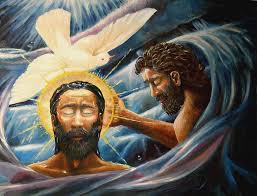
Then quietly at first the main theme appears again. The theme that represented God at work as Creator gradually supersedes the chaos of the early part of this movement. Jesus has come for baptism. The Word of God, from the beginning of John’s Gospel, is beginning his work. And as Jesus comes up out of the waters of baptism the whole orchestra joins the theme – the heavens are rent open, the Spirit descends on Jesus and God speaks, a strong solo voice: “You are my Son, the Beloved; with you I am well pleased”.

Can you see the common themes in the two passages?

The milling crowd, longing for God to act in their lives; and the universe awaiting God’s creative action.

The wind of God, and the Spirit of God hovering over the waters of the deep and the waters of baptism.

The word of God bringing creation, “Let there be light”; and the Word of God, Jesus, God’s Son, whose ministry brings redemption.

God’s delight is obvious in both passages. Looking at creation, ‘God saw that it was good’. Looking down on his Son, God said, “You are my beloved Son, with you I am well pleased”.

The theme from each movement of our symphony is the same. God creating his world and God redeeming that same world. All part of the same plan. In our symphony, both represented by the same theme.

Now, at the beginning of 2015, we are participating in what the Bible calls the end times, the days between Jesus’ first and second coming. We are participating in what might be called the final movement of the symphony.

In the first movement, God saw that everything was good. What does he see now, at the start of this new year? Where are the signs of new creation? Where are the dark, formless voids that still await God’s creative action?

In the later movement God expressed overwhelming pleasure at the baptism of his Son. What things in our world, or in our lives, give God pleasure?

Where might we begin to hear that same musical theme of God’s intervention in our own town, our own place of work, our own community? What do we long that God would do in our town and in our world? How might the final movement of our symphony be played out? What should I do? What should we do to participate in God’s work in our own community and around our world?

Ashton Christmas Markets

It has been a delight, once again, to be able to experience a Christmas Market in the centre of Ashton. An Ice-skating rink, 30 or so Christmas cabins, a beer tent with excellent mulled wine and a stage showcasing many wonder local groups. A tremendous lantern parade before the Christmas lights were switched on. And this year the opportunity for Churches to be involve in events on the main stage. On Sunday 7th December GAP Puppets from St. Mary’s Haughton Green (http://www.gappuppets.com/) were invited by the Town Centre Anglican Churches to lead carol singing.TJ 3GAP 10

Did you miss it – sorry! But don’t worry. The Markets are on until 21st December!

Some pictures of the event(s)!

10389244_10152837000818376_1185946557595116499_n10432088_10152837156843376_5228701688697784248_n 10698671_10152837155228376_7616782741715756022_n Ashton-Market-Night-Scene-800x600 Market4_7118397 Fireworks2_7116210

Remembrance Sunday

On Remembrance Sunday we join with millions around our world in remembering the many men and women who have given their lives in the different conflicts of the past 100 and more years.  People who either by choice, or through compulsion, have risked their lives in the pursuit of peace and justice.  We owe our freedom to many such people who have stood up against tyranny and oppression – to people who risked everything, laying themselves on the line.

So we remember.

Those who have served on the battlefield or in conflict zones around our world will no doubt tell and re-tell stories of valour and bravery. And for those who served, ‘remembering’ will also bring back to the front of the mind stories of those who did not return. Remembering brings to the surface the naked fear of conflict, the pain of loss and a real sense of comradeship.

But remembering is so very important to us all, not just on Remembrance Sunday, but in all areas of our lives. Remembering leads to the telling of our own stories. Both as individuals and communities. And as we tell our story, we reaffirm our roots, and we define who we are. We put our own lives in context. For in today’s world, where we define ourselves not so much by where we come from as by our networks of friends and acquaintances; today’s world, can so easily become a rootless place where we do not know who we really are.

Our shared memories are our key to understanding ourselves. And our collective memory needs to be sustained by hearing the stories of our past. By hearing from those who went out from us here to serve in different arenas in our world. These stories, these people are so much a part of who we are here in our villages, towns and cities today. They contribute to our history, they strengthen our community spirit.

Our stories are important. Remembering is vital. Nowhere is this more true than in relation to the conflicts with which we have been involved as a nation. Failure to engage with and learn from our past is the height of modern arrogance. We have to hear again the stories of conflict, of bravery, of pain and loss. And we need to allow those stories, … that remembering …, to change us now. It must inform our thinking about the future, it must be allowed to change our wills and our actions.

For today we’re all called to take new & different risks. To act for justice, for peace in society, in the world around us. To work for racial justice, to fight discrimination, to engage with injustice in whatever form it might arise. To look to overcome the barriers which so easily arise between people, and… if necessary to risk our reputations, to be willing to take knocks, sometimes to be misunderstood; even to face persecution.

Where do we find the courage to do this? As Christians we have the promise of God in Christ. ‘Go,’ says Jesus, ‘into all the world, work for the coming of my kingdom, seek first my kingdom, of justice and peace and I will be with you always.’ God does not leave us alone to face new challenges, to risk our lives in the cause of his Kingdom. He promises always to be with us.

Matthew 22:15-22

Clever questions can catch people out. There’s the old chestnut: “Have you stopped cheating on your wife?” To answer “Yes” implies that you were and you have stopped, to answer “No” implies that you have been and you still are. The is apparently no answer that does not leave you in a bad light, unless you step outside the confines of the question and answer it in your own way – just as politicians do in a radio or TV interview: “I have never cheated on my wife and never will.”

Trick questions that put people on the spot have been around for a long time. So it’s not surprising that Jesus faced some in his time.  There’s one in Matthew 22:15-22, the Pharisees question has a very definite double edge.   The issue of paying tax to the Roman emperor was one of the hottest topics in the Middle East in Jesus’ day.

unnamedIsrael was an occupied land.  There were taxes on agricultural yield and a personal ‘poll tax’.  That’s why the Romans took a census to count how much tax they could levy.  Paying tax in Roman coin was a threefold burden to the people of Israel: no-one liked paying taxes, Israel hated foreign rule and this tax reminded them of their invaders, and the image of Caesar on the coin was regarded as idolatry, breaking the command about graven images in Exodus.

Jesus appears to be in a ‘lose-lose’ situation when he is asked whether people should pay taxes to the Emperor or not.  If he supported paying tax he would be accused of being unpatriotic.  If he opposed tax-paying, he could be reported as a trouble-maker and rebel.  The question has no right answer.  Either reply is wrong.  ‘Yes’ is religiously offensive. ‘No’ is politically dangerous.

Incidentally, this is all part of an honour/shame conflict being played out between Jesus and the religious leaders – please read some of my other posts to find out more.

Jesus asks whose head is on the coin he is given.  Caesar’s, of course. So Jesus responds, the coin is Caesar’s property, it bears his image, so people should give to him what is his.  It is all right to give back to Caesar what belongs to him.  It is his money – so pay your taxes in the normal way.  That is half of Jesus’ answer.

The other side of the matter is that God should receive his due.  Israel must offer God the worship and service he deserves.  In this case there is no limited tax bill, but a completely open account.  There is only one proper way of responding to God’s generosity – with the worship, love and service of our whole lives.  That’s the other half of Jesus’ answer.

So Jesus neatly turns the question back on his questioners.  What are they giving to God of themselves, their devotion and their obedience?  But his response raises a bigger question – and that is ‘how does one’s civic duty weigh up against one’s duty to God?’

Where do we stand in this?  Should we as Christians be obedient citizens and pay our taxes with an honest and ready heart?  ‘In general, yes, we should’ comes the answer from this passage – unless and until it clashes with our commitment to God.  We’ve seen Christians throughout history who’ve put their commitment to God before their civic duty, and we remember some of those people as saints and martyrs.

There are Christians who openly confess Christ in lands where that is a crime, who defy unjust public policies, who support human rights, and who resist tyranny.  They do it because they believe that Caesar’s rights are limited and that God’s are not.

There are times too when we will have to examine our conscience about issues where our society’s ways and God’s ways diverge. The financial crisis in the banking system is a case in point.  Even if we didn’t really understand the details, it affected us all.

And what might God have to say about the part that society has played in building up the now failing financial systems, or about the actions that bankers have taken on our behalf.  It’s easy to say that it’s the fault of ‘the City’, but maybe we have to look a little closer to home for some of the reasons.

Might people – or even we ourselves – have become too greedy? Might people – or even we ourselves – have become too caught up in wanting to improve our own financial situation without thinking about the impact on others? Might people – or even we ourselves – have become too impatient, wanting everything now even if we can’t afford it – and becoming too used to being in debt?

Perhaps we need to reassess our duty to God. Perhaps we need to continue to say that banks need to be fairer, that they need to be modelled on God’s values. Perhaps we have to be wise where we invest – looking for ethical banking practices; maybe we have to think twice before taking out loans; making investments that serve the good of all not just a few; maybe we have to remember that God is present in all aspects of our lives including our money and that our decisions over money need to be bound up in our desire to live his ways.

Jesus used a single coin to help people think about their relationship with the state and with God.  As we handle the coins in our pockets or our purses, may they be a constant reminder that God is present in all parts of our lives – and that definitely includes our finances.


Karma Nirvana – Jasvinder Sanghera – 2

I have been reading books by Jasvinder Sanghera.

Firstly, her autobiography, “Shame” and her later book, “Daughters of Shame” – both published by Hodder & Stoughton.

I have found reading these both eye-opening and shocking. I have been aware for some time of the power of ‘izzat’ or ‘namus’ – the overwhelming power of ‘honour’ in some communities. Hearing people’s stories in some depth and engaging with the reality that for some people, some families, ‘honour’ is significantly more important that the life of family members.

It causes me to wonder just how significant these issues are here in Ashton-under-Lyne. It is good to know that there is an organisation to whom we can refer those who are trapped by these problems. Al;though, it is clear that as a white clergyperson, I am very unlikely to ever see behind the closed doors where these issues are a major problem.

In “Daughters of Shame”, Jasvinder says that “trying to explain the concept of honour is one of the hardest things … Asian people don’t question it: they’re swaddled in it from the moment they are born, it’s as though the absorb it along with their mother’s milk. Honour – izzat – is the cornerstone of the Asian community and since the beginning of time it’s been the job of girls and women to keep it polished. And that’s really hard because so many things can tarnish it.”[1] The stories that Jasvinder Sanghera relates are deeply disturbing, ultimately quite horrifying. She goes on to say that “wearing lipstick, owning a mobile phone, cutting your hair; any of those things could be said to bring dishonour on a family because those are all signs that a girl is getting westernised, which is what Asian families fight so hard against. They’d lock up their daughters for months on end rather than let that happen.”[2]

Would it be possible to get a better picture of the extent of these problems in a place like Ashton-under-Lyne?

(please also see my earlier post about Karma Nirvana – on 8th September 2014 and the website: http://www.karmanirvana.org.uk)

[1] Jasvinder Sanghera; “Daughters of Shame” Hodder & Stoughton, London: 2009, p27.

[2] ibid.

Thought for the Day

In all that is going on in Syria and Iraq these words from John Bell seem very appropriate. They remind us that we cannot claim the high moral ground, without first examining our motives and attitudes.

http://www.bbc.co.uk/programmes/p027v9jb

Just in case the link does not work, here is the text of John Bell’s Thought for the Day on 3rd October 2014 on the Radio 4 Today programme:

Thought for the Day – 03/10/2014 – John Bell

I could only have an hour with Salaam Hannah last week. He’s a Christian clergyman from Syria whose church has been destroyed, and half the population of his town has moved elsewhere to escape the violence.

Only an hour, so I asked him the question I often ask of people coming from places affected by war: ‘What do we in the West need to know about your nation?’ And he made the same reply as I heard in the past when I asked the same question of Avner Gvoryahu from Israel and Shehade Shehade from Palestine and Anna Zaki from Egypt. He said ‘Things are much more complicated than you imagine.’

And then he went on, not so much to give his analysis of the tragedy of Syria as to comment on Western attitudes. And it was not easy to listen to…

He said that from his perspective the West seems to think that democracy is the answer, but democracy has to grow up from the ground, not be enforced from outside.

He asked whether nations which were major arms producers should expect to be welcomed as peacemakers and honest brokers in countries where their weapons are being used to kill.

He suggested that, for the West, overseas engagement seemed so often to be based on economic expediency to the benefit of the benefactor, but seldom was cultural or ethical expediency part of the process.

And he asked whether we ever thought of the consequences of our actions – as when you support the overthrow of a dictator, only to discover that he was sitting on a hornet’s nest, and that deposing such a kingpin does not guarantee peace.

Salaam spoke with no rancour, but with sadness as he questioned some of the suppositions which many of us hold true.

Later, I remembered the moment in Jesus’ ministry when he met a Syrian, a woman who asked him if he would heal her daughter. He demurred and referred to her race as ‘dogs.’ She questioned his language and then something in their conversation – her plain speaking from a context he knew little about – changed him. He felt for her pain and rather than dismiss her, he agreed to help her.

Having met people from both sides involved in the troubles in Northern Ireland and apartheid in South Africa, I am convinced that it is only when we drop our unquestioned presumptions and feel for the pain of the one we despise that we begin to move towards peace. It will not be fully secured by military hardware or economic master-plans but by the less exotic arts of listening, thinking outside the box and empathy, however hard it is to imagine doing this right now.


Matthew 18:21-35 – Forgiveness

The last thing we want to do when we have been hurt, is to forgive!

When Peter comes to Jesus to ask how often he should forgive someone – he believes that he is setting a high standard: “How often should I forgive? 7 times?” And Jesus response leaves him reeling – not seven times but seventy-seven times – or in some translations seventy times seven – 490 times. “As often as is necessary,” is Jesus’ response. ‘Keep forgiving until you completely lose count!’

Jesus then tells a story to help us understand that it is because we have been loved so much, forgiven so much ourselves by God, that we should forgive others. Jesus’ story is about a servant who has a wife and children and has overspent on all his credit cards, someone who has maxed out. He has stacked up a huge amount of debt with his boss.

The Boss calls for his servant and demands repayment of what is owed. The servant falls on his knees and begs to be given more time to pay. The master, the boss, feels sorry for his servant and lets him off the whole debt! Just like that! The debt is cancelled. How does the servant feel?

So, here is this happy, free servant. He’s wandering back from the house of his master, his boss, to tell his family the good news. He’s over the moon, he’s delighted, it is wonderful. And he meets a fellow servant of his boss, his master. This fellow servant owes him a few quid.

And the same thing happens; this other servant falls on his knees and begs to be given more time to pay. But what does the first servant do? He grabs him by the neck and shakes him and has him thrown into prison until he can pay the debt.

I think Jesus wants us to ask ourselves this question: Is it reasonable for the first servant to behave this way with the second? Is it fair and right? What do we think?

No, it isn’t. Yet forgiveness remains something we find difficult – often impossible. Not just in our personal circumstances … As we think back over the last 100 years we can remember many seemingly unforgivable acts. The Holocaust, South African Apatheid, The Rwandan Genocide, ethnic cleansing in the Balkans, the troubles in Northern Ireland, the Moors Murders, the Shipman affair, 9/11 and 7/7. And as we dwell on those atrocities we feel the pain of those who took the greatest hurt, we feel something of their anger and we feel justified in refusing to allow the possibility of forgiveness to the perpetrators. They are unforgiveable – forgiveness is surely not possible for the Hitlers, the Hutu Interahamwe, Myra Hindley and Ian Brady, Harold Shipman, for the terrorists who bombed the twin towers in New York or the bus and tube in London, for those who behead their enemies …………

And yet … there is another perspective we have to hear. We have to hear the voices of people like Desmond Tutu who suffered under the injustice of Apartheid, who became Archbishop of Cape Town, who organised the Truth and Reconciliation Commission in South Africa, who also had a part to play in the aftermath of the Rwandan Genocide.

In his book, “No Future Without Forgiveness” about the work of reconciliation in South Africa, he talks of visiting Rwanda in 1995 and of speaking in a stadium rally: … “I told them that the cycle of reprisal and counter-reprisal that had characterized their national history had to be broken, and that the only way to do this was to go beyond retributive justice to restorative justice, to move on to forgiveness, because without it there was no future.”

In the 1990s, I remember watching the mother of one of the Moors Murders victims talking about her feelings for Myra Hindley. Her anger was fully justified. No one can rightly argue that she should feel anything else towards those who destroyed her family. However what was just as obvious was that her anger and her ongoing inability to let go, if not to forgive, had a deep effect on her own life, it was evident that over many years she had carried her bitterness and anger. Not a waking moment had gone by without the desire for revenge. And in this sense she was trapped, she was unable to move on. We might reflect that in such circumstances it would be impossible to move on and certainly we have no right to judge, for her life was destroyed when her child was taken from her. But the fact remains, that she was not only devastated by the murder of her child, she was also held trapped by subsequent feelings which would not let her go.

A striking example, in 2011, of a different response, was that demonstrated by Tariq Jahan in Birmingham after the death of his son – killed by a car driven directly at him in what was perceived to be a racist and hate motivated crime. Tariq’s own ability to see beyond his own grief, and his courageous comments to the media, started a very long, and no doubt extremely painful, process for himself, of being able to let go of the anger and bitterness he must feel. But not only did he begin to set himself free, his timely comments set his own community free from a desperate cycle of revenge

These matters are not easy to engage with.

When we think of forgiveness as letting the other person off the hook, of setting them free, then perhaps we can understand and sympathize with a refusal to forgive. But when we realize that a failure to forgive doesn’t so much imprison the one who has harmed us, but rather imprisons us in bitterness and hatred, in a constant desire for revenge – then we have to forgive, we have to let go – for without doing so we cannot move on, we are trapped, we are imprisoned by our own choice. And as a result we continue to give the person who harmed us in the past, on-going power over us. We get hurt again and again.

Put like this, it seems that for our own sanity, forgiveness is ultimately our only option. We have to begin, however hard it is to do so, to find a way to forgive.

Jesus suggests in his story that we’ll only begin to be able to forgive, if we can comprehend how much we ourselves are loved, how much we been forgiven. Jesus says that it is when we know that we are loved without conditions, that we can begin to show that kind of love to others.  The love God has for us is that kind of love.

Every time we have a baptism I am reminded of that love. Baptism is a sign of God’s forgiving, generous love, offered to a child before he or she can possibly have done enough to deserve that love. Our baptism and the repeated occasions when we see a child or an adult baptized are our personal sign of God’s love.

Baptism reminds all of us that we are loved by God – no matter what. It’s a sign that if we give our lives to God, then we’ll begin to understand that we have been loved and accepted from the beginning.

We need to hold onto this truth – that real forgiveness is ours. Baptism is a sign of this.

Our regular Sunday services also allow time for confession and for us to hear God’s words of forgiveness for us. Reminders of just how crucial forgiveness is.

It is in the security and strength of God’s forgiving love that we can be free to love, and that we can begin to forgive others generously in return. Yes, for their sake and for God’s sake, but also perhaps most crucially for the sake of our own health and well-being as well.

Karma Nirvana – Jasvinder Sanghera

I picked up the Church Times over the weekend and discovered an interesting interview. Jasvinder Sanghera founded Karma Nirvana in 1993 as a helpline for people in danger of honour abuse and honour kilings.

The article on the rear of the Church Times is an interview with Jasvinder.

She escaped a forced marriage but her sister Robin was unable to do so and committed suicide by setting herself on fire.

Jasvinder Sanghera, CBE was born in September 1965 in Derby and her parents originate from India, the Punjab.  Jasvinder’s family were Sikhs and she was one of seven sisters and one brother. She fled home when in her teens as her parents were forcing her to marry a stranger. She was disowned by her family, rejected by her parents and treated by them as an outcast. They regard her as having deeply shamed them. She has no contact with her past family today.

Jasvinder tells her story in her true story in Shame, published by Hodder and Stoughton. She tells more stories of British victims in her second book, Daughters of Shame. Both books have been translated into various languages including Japanese, Polish, Spanish.

She says that Shame, is her personal story: “I wished for it to be an honest account, because I felt the responsibility of telling a story that I knew was one of many. It took longer to write, as it was quite painful, but the whole experience has been cathartic, and it has helped shape UK policy and practice today.”

Karma Nirvana is now a national and international charity that has been instrumental in developing several refuge centres across the United Kingdom which serve as safe-housing for South Asian men and women fleeing forced marriages. Jasvinder says: “Karma Nirvana serves all those affected by honour abuse. The survivor stories are the most important ones to hear. No one can argue with the testimony of real-life experience. I feel that, in telling my story, it has given others the courage to speak out, and our visibility enables others to believe that there is life when you take a stand.”

Jasvinder had been awarded several awards in recognition for her contribution in the field of forced marriages and honour based violence including:

  • The Woman of the Year Award 2007
  • Pride of Britain Award 2009
  • Global Punjabi Society Award 2012
  • Cosmopolitan Wonder Woman Award 2010
  • Inspirational Woman of the Year Award 2008
  • Asian Woman Achievement Award 2007
  • Ambassador for Peace Award 2008

Jasvinder has been listed as one of the Guardian’s 100 most Inspirational Women in the World. She was awarded an Honorary Doctorate of University of Derby for her contribution to knowledge in the field of forced marriages and honour based violence.[3] This has led to providing evidence to several Government Select Committees and acting as an Expert Witness to Courts across the UK and internationally.

Romans 13: 8-14 and Matthew 18: 15-20

Have you noticed how when you tell a child not to do something, they seem to become more determined than ever to do that one thing?  When you tell a child not to play with matches, you seem to put the idea into their head that matches are extremely exciting to play with!

And it’s not just children, there is something fascinating about anything forbidden that seems to entice us to do things we know we shouldn’t; Just to be awkward, or to find out what will happen, to satisfy our curiosity.  The classic Biblical example is the story of Adam and Eve in the Garden of Eden.  God says “Don’t eat the fruit on that tree,” so what do they do?  They eat it and only then do they find that the consequences were just as bad as was promised. They’d have been better off obeying God.

Schools are now advised that negative rules are not helpful – it’s been discovered that children continually told not to do things don’t flourish well.  So rules in schools are now positive. Instead of, “Don’t treat other people badly,” it’s, “Treat other people well.” Instead of  “Don’t run in the corridor,” it’s “Walk in the corridor.”

It’s actually much easier to learn to do things sensibly than remember a list of things that you mustn’t do!   But this idea of replacing negative rules with positive ones isn’t new. It’s something Jesus did.

The Old Testament tells us that Moses received Ten Commandments, ten rules that God gave for life – and Paul reminds us of some our reading from Romans: AYou shall not commit adultery; You shall not murder; You shall not steal; You shall not covet@. Can you remember all ten? Where would you find them now if asked?

The rules Paul quotes are negative rules – as most of the ten commandments are. If we can’t remember them and if we don’t react well to being told not to do something, then maybe these rules are no longer the best way of governing our lives.

Paul reminds us that Jesus told people to rethink the way they lived their lives – and instead of giving a list of “don’t” rules, he said, “There’s only one rule to remember – love your neighbour, love other people as you love yourself.” Perhaps Jesus knew that people don’t remember lists of rules, perhaps he knew that we’re often curious to find out what happens when we do the things we’re told not to.

Whatever his reason, Jesus said that life is simple really – love other people, treat them the way you would want to treat yourself.  And of course, by living like this, we naturally won’t steal, be unfaithful in our relationships or harm other people.

Christianity and the church are often seen to be unattractive – only interested in telling people what they shouldn’t do. But this is so wrong – being a Christian, coming to church is about enjoying life to the full – but in a way that shows love and respect to those around us.

And this, I think, is what Jesus is talking about in Matthew 18. He is asking us to think about how we deal with disputes. What we should do when we feel that someone else in church has wronged us, or done something with which we disagree.

We might be straight-talking, here in Ashton-under-Lyne, but most of us are still not very receptive to that straight-talking, and more often than not straight-talking in public leads to offence being taken by someone. So Jesus says, give respect to the one with whom who disagree – speak with them in private about your disagreement, or the offence that they have caused.

At work, the boss who balls someone out in public gains not respect but fear. The boss who talks quietly with someone when things have gone wrong garners respect.

Go to someone who has upset you in private to work things out, says Jesus, often this will be enough, but if not, then take witnesses with you and try again. And only then, if the person cannot see sense, bring the problem out into the open. It seems to me that this is all about respect – giving the respect to someone who has offended me, that I wish they had given to me in the first place.

Jesus and Paul agree – Our love is the first, the primary, measure of our commitment to God and to our faith, not our ability to follow the rules!

Shame Cultures and Abuse

The link below is to an article which was on the front page of the Saturday Guardian (30th August 2014) in the wake of the news coming out of Rotherham during August 2014.

http://www.theguardian.com/society/2014/aug/29/-sp-untold-story-culture-of-shame-ruzwana-bashirRuzwana Bashir is the co-founder and CEO of Peek.com.

Perhaps the most significant statement is this:

“When I first told my mother about the abuse I’d suffered, she was absolutely devastated. The root of her anger was clear: I was heaping unbound shame on to my family by trying to bring the perpetrator to justice. In trying to stop him from exploiting more children, I was ensuring my parents and my siblings would be ostracised. She begged me not to go to the police station.”

Ruzwana’s family was trapped in a culture of honour and shame. And the small community to which they belonged was also trapped in a dynamic which forced them to shun the person/people who had brought abuse to the surface. That honour/shame dynamic focussed blame not on the perpetrator of abuse but on the one abused.

Ruzwana says taboos must be challenged, and in this particular context that seems to be painfully obvious. We need, however, to be very careful not to identify this kind of problem solely with cultures that tend to have strong honour/shame value systems.

The dynamic also exists in other communities. Very few of us like to see the status-quo challenged or disturbed. We have a natural tendency to want to hide difficult issues away. Often it is the whistle-blower, or the one to brings an issue to the surface, that is seen as in the wrong, rather than the one who committed the abuse (or the wrong) which has been uncovered.

We see this tendency in large bureaucracies and in small communities. Very few areas of society are immune.

While it is true that traditional conservative communities are likely to behave in this way and it is true that these communities have to find ways to address the desire to avoid shame. This is true too for much of society: shame is a factor that we all need to understand, and when it demands that we cover up things that are wrong, it must be addressed.