Category Archives: Ashton-under-Lyne Blog

A Festival of Good Food in Tameside

A FESTIVAL OF FOOD

This year Tameside Markets have joined forces with About Tameside magazine to present the Tameside Food Festival 2015. The event ties in with Love Your Local Market and the annual Celebrate Tameside Food & Drink Awards. Beginning on May 9th on Denton Civic Square you will find a mix of food retailers offering fresh produce and hot food to make your mouth water. There will be live cooking demonstrations by the Ashton Farmers’ Market Chef and free food crafts for the children. Joining the fun will be Teddy Tameside and Maggie the Magpie, Tameside Market’s mascot. For the first event in Denton we will be welcoming the Mayor of Tameside, Cllr Dawson Lane, who will be meeting some of the local food traders.

Organisers have been delighted to have support from local Town Teams from Ashton-under-Lyne, Droylsden, Denton and Hyde to bring these events to the town centres. There is also additional sponsorship from Irwell Valley Housing and Santander. The second event will actually be part of Stalybridge Farmers’ Market on May 10th around Armentieres Square.

The Food Festival will be appearing at some key locations in Tameside comprising:

May 9th – Denton Civic Square
May 10th – Armentieres Square, Stalybridge
May 16th – Villemomble Square, Droylsden
May 23rd – Civic Square, Hyde
May 30th – Market Ground, Ashton-under-Lyne.

Visitors to the event will also be able to find out more about the local town teams, the Tameside Loyalty Card and how to vote for their favourite café, restaurant, bakers/confectioners and take-away.

Come along for a great day out and support some of the great food outlets we have here in Tameside.

For further information email – markets@tameside.gov.ukhttp://www.tameside.gov.uk/markets

Details also available on your local Town Team website

http://www.visitashton.com
http://www.shopathyde.com
http://www.droylsden.com
http://www.dentontown.com


Uganda April 2015

On Monday I’ll be in Uganda for 10 days visiting friends and hopefully making a valuable contribution in a few different ways.10447622_10204586288887820_7962076033077622007_n

I fly to Kigali in Rwanda on 13th and hopefully cross the border that evening into Uganda to stay at Kisoro for 3 nights. I hope that I’ll get a chance to visit two projects that churches in Ashton Deanery have funded at Nyakimanga, a village near the Rwandan border and at Sesame Girl’s School near the Cathedral in Kisoro. I’ll be staying with Rt. Revd. Cranmer Mugisha, Bishop of Muhabura and his wife Hope.

Stephen and Brenda 1

I then find my way to Kampala where I have been asked to take the wedding of Stephen and Brenda. Steve was a teenager the second time I went to Uganda in 1997 and it is a real privilege to be asked to take their wedding service. The picture is from their giving away ceremony earlier this year.

This will be my 5th visit to Uganda! People in Ashton may remember visits from Uganda to Ashton by a number of friends: SimonPeter Kansiime, Revd. John and Alice Tumusiime, Bp. Cranmer and Hope Mugisha. It has been good to establish a partnership in the Gospel with friends from Uganda!

Listen to the Women!

LISTEN TO THE WOMEN!?!Empty-Tomb-759395

Have you noticed? Perhaps you have.

In the four gospels we have differing accounts of what happened on that first ‘Easter’ morning. I’m pretty sure that you will have noticed that … but have you noticed one of the things that they have in common? All of them concur that it was the women who remained with Jesus to the end and who were first privy to the wonder of the empty tomb. The men seem to have a secondary role in the story. Why does this matter?

In the Jewish culture of the time a woman’s witness was not deemed admissible evidence in a court of law. Women could not to be counted as members of the obligatory ten persons necessary to begin prayer or to set up a Synagogue. The prevailing culture did not trust women. Yet it is women that Jesus trusts to be the first witnesses of the resurrection and it is predominantly the women who remain faithful to Jesus through the story of the crucifixion.”

St. Bede explained, many years ago, that the festival of ‘Easter’ was derived from the name of a goddess whose festival was held on the spring equinox, ‘Eostre’. Interestingly the name ‘Eostre’ is at the root of the word ‘oestrogen’ a female sex hormone. So should we be surprised that those who physically bear new life into the world should also be the first witnesses of the New Life of the Resurrection, and that the English language both preserves and reflects that truth.

Was there something special about these women?

Perhaps the reason these women were privileged to be the first witnesses on this earth of Christ’s resurrection was because they were amongst the few disciples who didn’t leave Christ during His great trial, and were with Him at the cross when some of His other disciples had betrayed or deserted Him.

Not only did these women never desert Jesus, but also they never stopped serving Him – even after he had died. We are told that on the morning after the Sabbath, Mary Magdalene, and other women who had followed Jesus out of Galilee, came with spices to anoint and prepare His body for burial. One of many ‘woman’s tasks’ – like cooking, cleaning, washing and sewing – that these women were accustomed to doing, and which they’d done for Jesus many times before.

Christ acknowledged the faithful and loving service that these women had given Him throughout His mortal life, and realised that what women do to sustain and provide physical life is important and valued in the eyes of God. He knew that their willingness to take care of His physical body, even after He was dead, was a sign of their great love and devotion, and so He blessed and rewarded them for it.

The last century has seen great changes in what is considered ‘women’s work’. The traditional role of a woman staying at home and running the household has virtually disappeared. Women are increasingly free to find fulfilment in the work place as well as, or instead of, the home. However, surveys show that women still do the majority of housework, and there are areas of work where women still find it hard to be accepted. There are places where gender stereotypes still prevail!

The Venerable Rachel Treweek the new Bishop of Gloucester

Under God, our church (the Church of England) now recognises that gender is not a barrier to serving Christ in any role. The recent ordinations of Libby Lane as Bishop of Stockport,  Alison White as Bishop of Hull and Rachel Treweek as Bishop of Gloucester are testimony to the truth that in God there is neither male nor female. That, ultimately, there is no longer something which we can call ’women’s work’ (or for that matter, ‘men’s work’).

The resurrection stories highlight the truth that God entrusts important messages to those who faithfully serve him. When we argue about who does what; when we become too focussed on gender roles; or when we become too concerned about our status and about power and influence we miss out. For while we are arguing our case, Jesus turns to someone else who has been faithful in service and entrusts his message of love to them.

What matters most of all is our relationship with God, with Jesus and with each other. It is relationships that are central to the Christian faith, and it is love that matters more than power, or rights, or influence. It is relationships that matter more than codes of conduct, or fulfilling what is expected of us. Yes, during Jesus’ life on earth, women had traditional roles; they ministered to Jesus’ physical needs and remained faithful to him. As a result they were among the most privileged of all Christ’s disciples: they never deserted the Saviour; their testimonies of Him never faltered; they never stopped bearing witness of His divinity.

So, it was the women who were entrusted first with the Good News, ‘Christ is Risen!’

It was the women who first were told to ‘Go and tell’.

We have heard their message down the ages. A quick glance around almost any congregation will of course confirm that it is women who constitute the numerical majority of the Christian faithful. But this is not just a message for women to share. Christ calls on all his faithful ones to shout, ‘Christ is Risen!’ and to find ways to ‘Go and tell’ others of all that we have received from him – men, women and children!

The message is alive in both men and women, and we both have a mandate to share the message this Easter. Christ is alive and well; He dwells within us, and calls us (all, whoever we are) to share in the work of the Kingdom. Ashampoo_Snap_2015.04.06_07h20m56s_045_

HAPPY EASTER


The Transfiguration – Mark 9:2-9; Colossians 1:15-20; 2 Corinthians 4:3-6.

In Colossians 1:15-20, Paul struggles to impress on us the nature and importance of  Jesus as God’s Son.

Christ is the image of the invisible God, the firstborn of all creation; for in him all things in heaven and on earth were created, things visible and invisible, whether thrones or dominions or rulers or powers – all things have been created through him and for him. He himself is before all things, and in him all things hold together. He is the head of the body, the church; he is the beginning, the firstborn from the dead, so that he might come to have first place in everything. For in him all the fullness of God was pleased to dwell, and through him God was pleased to reconcile to himself all things, whether on earth or in heaven, by making peace through the blood of his cross.

Paul and others like him were doing their theology for the first time. They had met with the risen Jesus, some had lived alongside him for at least three years, and they were all struggling to put into words and ideas the reality of what they had encountered.

Paul talks in Colossians of Jesus as the image of the invisible God, as someone in whom the whole Godhead dwells bodily. He has begun to realise just exactly who Jesus was and is, and it excites him. And in that passage from Colossians it’s as though, words tumble out as Paul realises just what it all means. We can almost feel his longing that his readers will understand too.

The Transfiguration (Mark 9:2-9) was part of the same kind of process going on for Peter. Up to now, he has seen Jesus healing, he has felt his own poverty and sinfulness alongside the richness of Jesus character, he has listened to Jesus speaking, he has seen his wisdom and listened to his parables and gradually it has become clearer to him that Jesus is more than just a special person, but try as he might he can’t get his head round it all. In the verses immediately preceding our Gospel reading he has hesitantly voiced what is inside his head. “You are the Messiah, the Holy one of God,” he says to Jesus.

But ultimately he still isn’t sure what he means … and then comes the Transfiguration. He sees Jesus and Moses and Elijah together and he believes he’s worked it out. He places Jesus on the highest pedestal that his mind can comprehend. Jesus is the equal of Moses and Elijah, perhaps the greatest prophet ever. And for a Jew, that was saying something!

And Peter wants to build booths, small shrines, little churches. He leader, his master is in his mind the equal of Moses, the equal of Elijah. This needs to be marked. And then God speaks: … “This is my Son, my Chosen, listen to him.” Listen only to him.

Peter discovers that he has not gone far enough. His own mind just was not big enough to comprehend who Jesus was, who Jesus is. The truth was just so much bigger than he ever thought.

And we are left facing the same truth – Jesus is bigger than our own ideas of him. God is beyond our comprehension and we will only begin to understand God, to relate to God if we relate to Jesus. And we will only do that if we allow ourselves to see God=s revelation of him. The lesson of the Transfiguration is that creating our own image of Jesus, of God, achieves little. All it does is bring God down to our own level. And depending on our own perspective we create a Christ who is meek and mild, or a Christ who is white rather than a Jew, a red-haired handsome specimen of humanity; or perhaps we might create Christ as the freedom fighter, the revolutionary, the liberator, or we see him as the social reformer.

“No,” says God, “Jesus is bigger than all of this – he is my Son. You can’t pin him down. You can’t domesticate him. He is there to challenge you, to save you, to draw the best out of you. Listen to him.”

We are intended to be dazzled by the light of Jesus face. To be drawn to him, and to see the world fade into dimness. And in that encounter, God expects us to be changed, to be renewed, to be challenged, to be shaken out of our present categories, our concepts of the way things are.

By meeting with Christ, we begin to understand God as Father, Son and Holy Spirit – but more than that – we are challenged to move out with hope into our world, believing that God’s kingdom in Jesus is all that other’s really need, looking to bring that kingdom into being, looking for the signs of God’s presence in the world around us. Longing to serve our Lord, longing to be changed still more. Longing to be Transfigured in our encounter with Jesus.

For as Paul says in the reading from 2 Corinthians:

It is the God who in creation said “Let there be Light!” “Let light shine out of darkness,” who has also shone into our own hearts to give the light of the knowledge of the Glory of God in the face of Jesus Christ.


Ashton-under-Lyne – Popular Market!

The market in Ashton-under-Lyne has won a national award for the second year running. it has again been voted Britain’s Favourite Market in a public ballot. So says an article in the Manchester Evening News and Tameside Advertiser.

More than 100,000 votes were cast in favour of the site in a poll run by the National Association of British Market Authorities (NAMBA) . Councillor John Taylor, deputy leader of Tameside council, said it was ‘fantastic news’. He said: “We have been told it is history in the making for one market to be voted Britain’s favourite on two consecutive years.

“It is a testament to the many loyal customers but also the continued drive of traders and staff to make the market a modern, forward-looking and appealing focal point in the borough, attracting new shoppers all the time. “Thanks to everyone who voted and massive congratulations to everyone involved in making Ashton Market the very special place it is.”

Ashton has had a market for more than 700 years but its hall had to be rebuilt after a devastating fire in 2004. It now boasts more than 250 stalls both inside the historic building and outside, as well as a food court which can cate rfor business or social meetings.

Market chiefs also provide wi-fi for visitors and use social media to keep shoppers and traders up to date with the latest deals, competitions and news. Cooking demonstrations and culinary workshops are regularly held at the market, including some which promote the Love Food Hate Waste project.

A former winner of Britain’s Greenest Market and Market Team of the Year, the market takes part in Love Your local Market fortnight – an annual event that encourages the public to shop at their nearest marketplace. And, most recently, it hosted Tameside Christmas Market for the second consecutive year, drawing in 10,000 visitors. It will return this winter.

http://www.manchestereveningnews.co.uk/news/local-news/ashton-market-voted-nations-favourite-8574561


LEAP – A Reader’s Story!

One of the privileges of being Team Rector of the Parish of the good Shepherd in Ashton-under-Lyne is the access that this gives to some of the charities in the town that are doing such good work. I am delighted to be able to say that I’ve been involved in LEAP (St. Peter’s Partnerships) for a number of years. The charity is active throughout Tameside and particularly in St. peter’s Ward in the West End of Ashton seeking to address the significant disadvantage faced by many.

Here is one story to warm the heart which is typical of the work LEAP is involved with.

http://www.thebuildingfuturesgroup.com/members-news/reading-is-on-the-menu-for-tony/


Ashton-under-Lyne Town Centre – Latest News

The latest information about Ashton-under-Lyne Town Centre comes from a press briefing provided at the turn of the year:

Ashton Market still open for business during works

WORK has started to transform Ashton’s historic Market Square into a modern vibrant space in the heart of the town for people to shop, visit, socialise and do businessAshton Market CGI

The exciting plans will see the introduction of new stalls and kiosks, high quality landscaping and trees, a performance and seating areas as well as new street furniture and lighting.

A phased approach will be taken to complete the works to ensure the market remains open throughout and disruption is kept to a minimum.  However, as with any major construction project there will be some disruption and residents are urged to continue to support their local market and businesses and shop locally whilst the improvements are carried out.

Ashton has one of the busiest town centres in Greater Manchester and its market – established in 1413 – was voted Britain’s Favourite Market in 2014, however the Market Square was beginning to look tired and dated.  Investment in the much loved Ashton Outdoor Market is crucial to ensure it keeps up with modern shopping habits and continues to compete with neighbouring towns as well as online retailers.

The plans for Ashton market square have been designed to complement the town’s heritage assets in addition to the multi-million pound “Vision Tameside” redevelopment plans. This once in a lifetime opportunity for Tameside will not only transform the appearance of the town centre but will also see a new Tameside College campus in the town at the end of 2015.

This dramatic change to the number of people working and studying in the heart of the town will provide a major boost to the market, local shops and economy and will help to attract new investment and businesses to Ashton and the wider Tameside area.

The redevelopment plans aren’t just about the way the market looks as the Council’s Markets team is also developing a range of initiatives to help attract new market traders to ensure there is a greater choice of quality goods on offer which will appeal to more shoppers.

Cllr Bill Fairfoull, Chair of Ashton Town Team, said “Both the indoor and outdoor markets offer great choice and value for money but we need to improve the area for the next generation whilst retaining its charm and appeal. Please keep supporting the market and local businesses while the improvements works are carried out.”

Market Trader, Monica, who sells quality handbags and luggage, said “It’s great news that the Council is investing in Ashton Outdoor Market.  As a long standing market trader I think the town centre needs reinvigorating to bring shoppers back”.

The Council’s Environmental Services team, are carrying out the works and have vast experience in working on similar large scale projects.  They have received numerous awards, from the National Considerate Constructors Scheme, for the way in which they deliver projects in a professional and respectful way paying particular attention to the environment, their neighbours and members of the community.

Shoppers are reminded that parking charges in Tameside town centres have now been reduced to just £1 for three hours and £2 for all day parking – among the cheapest local authority parking in Greater Manchester. There is also the new Tameside Loyalty Card scheme to give people even more incentive to shop local (www.tamesideloyaltycard.co.uk).

For further details see www.tameside.gov.uk/ashton/marketsquare

Sunday 11th January – Mark 1: 4-11 – The Baptism of Christ

MARK 1:4-11 & GENESIS 1:1-5 – 11th January 2015

The authors of the lectionary have placed our Old Testament reading alongside our Gospel reading for a reason. They want us to see them in parallel. In both cases God is doing something new. I am not an expert in classical music, but as I thought about these two readings from Genesis and Mark it seemed to me that they could be described as two different movements from the same symphony. I’m told that the classical composers used variations on the same theme to develop their composition and that if you listen carefully to the music you can hear the main theme being repeated. …..

Perhaps you can imagine a heavenly orchestra playing the first 5 verses of Genesis. Dark, creation-imagebrooding music portrays an overwhelming sense of chaos and darkness. I imagine that the composer would use discordant modern themes to convey a sense of disorder. Then over this music comes the main theme of the symphony – quietly at first, starting with flute and piccolo, and gradually engaging the whole orchestra. Like a wind gradually rising from a gentle breeze to a violent gale. God’s mighty wind sweeps across the universe. God is speaking, and his very words change the universe for ever. “Let there be light” and light appears. God saw that it was good, and Day and Night were born.
God breaks into the history of the universe with a powerful word of creation.

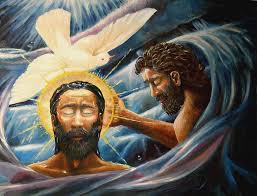
Our second reading comes much later in the symphony. The main musical themes are now well developed – we’ve heard them over and again throughout the symphony. When John the Baptist imgresappears we return to that same discordant, abrupt and harsh theme that we heard right at the beginning of the symphony. His harsh manner, his odd clothing, his strange habits all seem to echo the chaos and darkness of Genesis. The sound from the orchestra builds and noise of the crowds coming to John for baptism shake the concert hall and then John’s voice can be heard as a sharp solo, perhaps, by the oboe cutting through the surrounding noise.

Then quietly at first the main theme appears again. The theme that represented God at work as Creator gradually supersedes the chaos of the early part of this movement. Jesus has come for baptism. The Word of God, from the beginning of John’s Gospel, is beginning his work. And as Jesus comes up out of the waters of baptism the whole orchestra joins the theme – the heavens are rent open, the Spirit descends on Jesus and God speaks, a strong solo voice: “You are my Son, the Beloved; with you I am well pleased”.

Can you see the common themes in the two passages?

The milling crowd, longing for God to act in their lives; and the universe awaiting God’s creative action.

The wind of God, and the Spirit of God hovering over the waters of the deep and the waters of baptism.

The word of God bringing creation, “Let there be light”; and the Word of God, Jesus, God’s Son, whose ministry brings redemption.

God’s delight is obvious in both passages. Looking at creation, ‘God saw that it was good’. Looking down on his Son, God said, “You are my beloved Son, with you I am well pleased”.

The theme from each movement of our symphony is the same. God creating his world and God redeeming that same world. All part of the same plan. In our symphony, both represented by the same theme.

Now, at the beginning of 2015, we are participating in what the Bible calls the end times, the days between Jesus’ first and second coming. We are participating in what might be called the final movement of the symphony.

In the first movement, God saw that everything was good. What does he see now, at the start of this new year? Where are the signs of new creation? Where are the dark, formless voids that still await God’s creative action?

In the later movement God expressed overwhelming pleasure at the baptism of his Son. What things in our world, or in our lives, give God pleasure?

Where might we begin to hear that same musical theme of God’s intervention in our own town, our own place of work, our own community? What do we long that God would do in our town and in our world? How might the final movement of our symphony be played out? What should I do? What should we do to participate in God’s work in our own community and around our world?

Ashton Christmas Markets

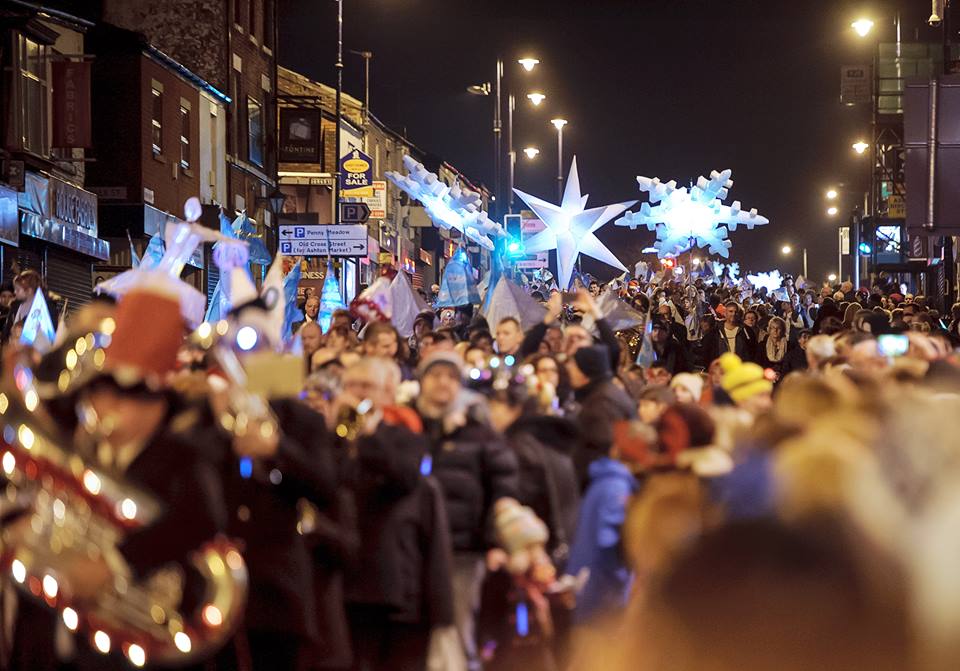
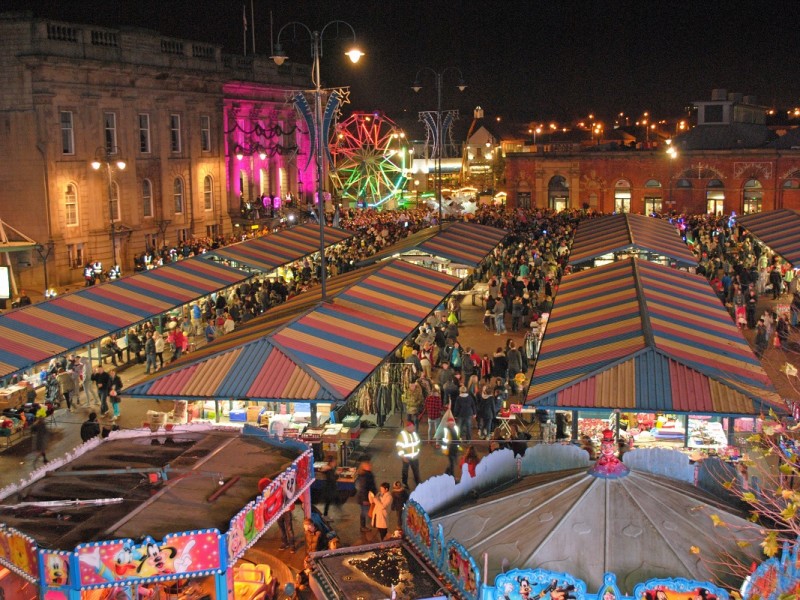
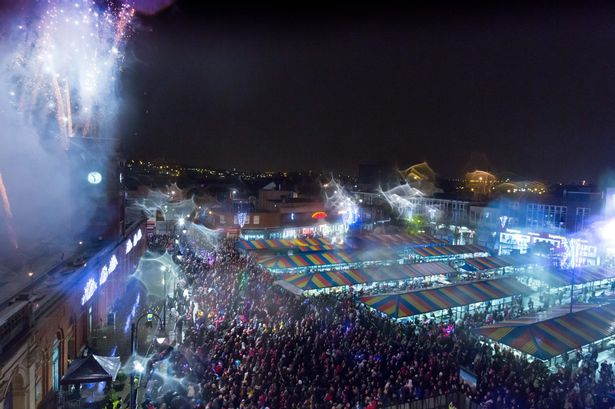
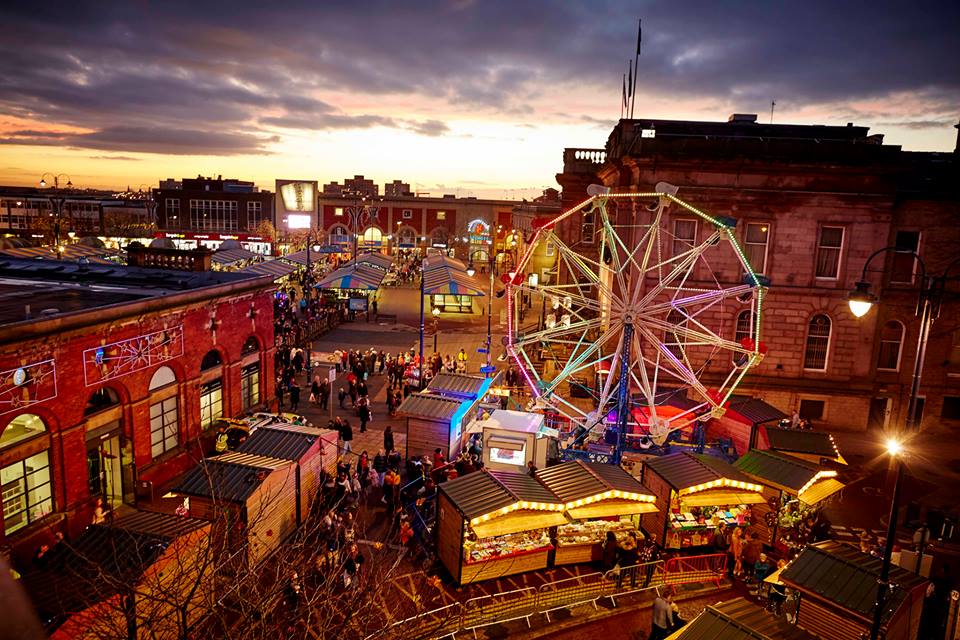
It has been a delight, once again, to be able to experience a Christmas Market in the centre of Ashton. An Ice-skating rink, 30 or so Christmas cabins, a beer tent with excellent mulled wine and a stage showcasing many wonder local groups. A tremendous lantern parade before the Christmas lights were switched on. And this year the opportunity for Churches to be involve in events on the main stage. On Sunday 7th December GAP Puppets from St. Mary’s Haughton Green (http://www.gappuppets.com/) were invited by the Town Centre Anglican Churches to lead carol singing.TJ 3GAP 10

Did you miss it – sorry! But don’t worry. The Markets are on until 21st December!

Some pictures of the event(s)!

10389244_10152837000818376_1185946557595116499_n10432088_10152837156843376_5228701688697784248_n 10698671_10152837155228376_7616782741715756022_n Ashton-Market-Night-Scene-800x600 Market4_7118397 Fireworks2_7116210

Remembrance Sunday

On Remembrance Sunday we join with millions around our world in remembering the many men and women who have given their lives in the different conflicts of the past 100 and more years.  People who either by choice, or through compulsion, have risked their lives in the pursuit of peace and justice.  We owe our freedom to many such people who have stood up against tyranny and oppression – to people who risked everything, laying themselves on the line.

So we remember.

Those who have served on the battlefield or in conflict zones around our world will no doubt tell and re-tell stories of valour and bravery. And for those who served, ‘remembering’ will also bring back to the front of the mind stories of those who did not return. Remembering brings to the surface the naked fear of conflict, the pain of loss and a real sense of comradeship.

But remembering is so very important to us all, not just on Remembrance Sunday, but in all areas of our lives. Remembering leads to the telling of our own stories. Both as individuals and communities. And as we tell our story, we reaffirm our roots, and we define who we are. We put our own lives in context. For in today’s world, where we define ourselves not so much by where we come from as by our networks of friends and acquaintances; today’s world, can so easily become a rootless place where we do not know who we really are.

Our shared memories are our key to understanding ourselves. And our collective memory needs to be sustained by hearing the stories of our past. By hearing from those who went out from us here to serve in different arenas in our world. These stories, these people are so much a part of who we are here in our villages, towns and cities today. They contribute to our history, they strengthen our community spirit.

Our stories are important. Remembering is vital. Nowhere is this more true than in relation to the conflicts with which we have been involved as a nation. Failure to engage with and learn from our past is the height of modern arrogance. We have to hear again the stories of conflict, of bravery, of pain and loss. And we need to allow those stories, … that remembering …, to change us now. It must inform our thinking about the future, it must be allowed to change our wills and our actions.

For today we’re all called to take new & different risks. To act for justice, for peace in society, in the world around us. To work for racial justice, to fight discrimination, to engage with injustice in whatever form it might arise. To look to overcome the barriers which so easily arise between people, and… if necessary to risk our reputations, to be willing to take knocks, sometimes to be misunderstood; even to face persecution.

Where do we find the courage to do this? As Christians we have the promise of God in Christ. ‘Go,’ says Jesus, ‘into all the world, work for the coming of my kingdom, seek first my kingdom, of justice and peace and I will be with you always.’ God does not leave us alone to face new challenges, to risk our lives in the cause of his Kingdom. He promises always to be with us.