Category Archives: Ashton-under-Lyne Blog

Luke 3:1-6 – 2nd Sunday in Advent

LUKE 3:1-6

Why was Luke so precise? …….. In the 15th year of Tiberius, when Pontius Pilate was governor of Judea, Herod ruler of Galilee, Philip ruler of Ituraea and Trachonitis, Lysanias ruler of Abilene, in the high priesthood of Annas and Caiphas. ……. Why was Luke so precise?

We know that he was a doctor, an ordered man, who at the beginning of his Gospel says that he’d decided to write a careful, orderly account for a friend Theophilus – so that he may know the truth concerning the things about which he had been instructed.

In the early chapters of his Gospel he is at pains to root the story of Jesus in the historical events of the day – its as if he=s saying, “This is not just a story – it’s the truth! I’m not just telling stories to encourage you – I’m telling it like it is! It’s true, God did really become human – I can date the story pretty exactly.”

There’s a danger that when we read the Bible we see it as a mixture of nice stories and good quotes. A kind of moral almanac which we can dip into when we feel the need. A spiritual help – keeping us in touch with God. And in one way the Bible is like this – but it is so much more.

The Bible is a historical document – not only telling stories, but interpreting them. It is the story of human history told from God’s perspective. One Hindu teacher said that it was not so much a religious book as “a unique interpretation of human history and God at work in it.”

So, Luke wants us to grasp that this is a historical story. But it seems to me that he has more than this in mind: it’s like the whole world is lined up at the start of our gospel reading – ugly and foreboding.

Tiberius – the head of the Roman Empire – who’d brought peace to the world – but peace at great cost in human life. No one dared challenge the power of Rome, & those who did … were crushed.

Pilate – manipulating governor – concerned to protect his own skin.

Herod and his family – half jews – not really concerned for the people they governed.

Annas and Caiaphas – high priests who should’ve been guarding their flock, but who were more concerned for their own status.
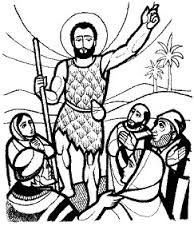
urlIn the midst of all this power, and abuse of power, what is God’s solution? A mad man crying in the wilderness – John the Baptist clothed in animal skins. Not the solution we would have chosen – but perhaps this is Luke’s point. First, God is born as a baby in a stable, then he chooses as his herald an unrespected mad-man, then he comes healing and talking of a Kingdom that is not of this world, a finally he achieves his victory not in terms of political power, but by stretching out his arms on the cross.

God’s purposes are achieved not through physical or political power, but through the mad-man crying in the wilderness, through humility and suffering.

Luke wants us to know that it is through people like us. Those with no power, those with difficulties and problems, those even who feel that if people knew what we were really like they would think us mad! That God chooses to work. Here in the reality of our lives God will work – not just to make us feel good – but to reach out to others around us. It is us who are called to be prophets. It is us who are called to prepare the way, to clear the way so that Christ can come to others.
Remembrance Sunday – Mark 1:14-20

Sunday November 8th 2015 – Remembrance Sunday

The Gospel reading set for today in the church’s lectionary is Mark 1:14-20, where Jesus calls James and John to follow him.

There are many things in the world that change dramatically during their life cycle – caterpillars, tadpoles eggs, acorns, flower bulbs – all of them change into something else. One of Hans Christian Andersen stories also focusses on that

process of change – The Ugly Duckling.

A caterpillar changes into a butterfly or a moth, and acorn into an oak tree, eggs into birds, tadpoles into frogs or toads, a plain amaryllis bulb into a striking flower, and an Ugly Ducking into a Swan

Each grows to be very different. But their ability to change and grow doesn=t just appear from nowhere. The Potential is already inside of them.

Jesus choses James and John to follow him. They encounter Jesus and follow him and in doing so are changed for ever.

We don’t know that much about Jesus disciples. We do know that James and John were fishermen. We know that they were relatively slow learners and that on one occasion that asked Jesus to let them sit on either side of him when he came into his kingdom, that they were interested in power and places of honour more than they were in listening to Jesus. As Jesus says in that Gospel passage the places either side of him when he came into his kingdom were reserved for two thieves at the Cross.

James and John may not have been quick learners or good listeners but something about being with Jesus, something in this person, Jesus, changes James and John for ever. It doesn’t all happen in an instant, but it starts to happen as James and John listen to Jesus speak and when they see Jesus’ miracles. They are changed as he follows Jesus.

“James, John, I have a job for you, follow me,” Jesus says. “I can see the potential in you, I can see who you will become. I want you to be my fishermen now – only you’ll be catching not fish but men and women to be my followers.”

And we know how the story ends – these ugly ducklings of men become Swans, they become the most faithful of Jesus followers, one is martyred not long after Jesus dies, the other lives to a ripe old age and becomes bishop of Ephesus and writes letters which remind people that it is not power and influence that matter but love and service.

Jesus does not just call James and John. He calls each of us to follow him. Rough diamonds that we are, self-deprecating or over confident, strong or weak. All of us called to be his followers.

And, just like James and John, there is potential for change in each of us. Jesus can take us and transform us. We no longer need to feel that we are no good, we can admit to God our weakness and our failings and then God takes us as we are and makes something special. We no longer need to feel like the Ugly Ducking or the Caterpillar, for God in Jesus sees the Swan and the Butterfly that we really are – and as we give ourselves to God – he draws out all the good that is in us.

Perhaps this is a very important message for today. James died a martyrs death, John lived on into old age, and lived for Jesus, no doubt honouring his brother’s memory and calling on others to live lives of love and forgiveness. Perhaps it is no accident that John’s epistles major on these two themes. And so I’ll leave the last word with John – word that he remembers as being on Jesus’ own lips:

“This is my commandment, that you love one another as I have loved you. No one has greater love than this, to lay down one’s life for one’s friends. You are my friends if you do what I command you.” (John 15:17)

The Most Important Thing …….

MARK 10:46-52

Sunday 25th October 2015

The Last Sunday After Trinity

What’s the most important thing in your life? ……………. The children? The grandkids? The football team? The husband? The wife? The bingo? Bowling? Work? What is the most important thing in your life? What’s so important that you put it above everything else?

We have been reading though Mark’s Gospel for most of the year. We know by now what Jesus has been saying about himself and God’s kingdom. He has spoken of his own death, he has talked of God’s kingdom as a place of radically different values. And while all that has been happening, various people around Jesus have been making it very clear where their priorities lie. The 10th chapter of Mark contains two poignant stories immediately before that of Bartimaeus. First we read of a rich young man whose riches were the most important thing in his life. He was unable to give them up to follow Jesus.

Then we read of James and John asking for special privileges – wanting to sit at Jesus’ right and left hand when Jesus comes in his glory. Their desire is for power and influence. Little do they know what they are asking for! For when Jesus talks of himself being glorified he is talking of the cross. Nonetheless, James and John are interested primarily in power, wealth and influence. Previously, on more than one occasion in the Gospel, the disciples had been caught arguing like little boys in the school playground about who was the greatest among them and Jesus had to bring a child into their midst to help them see what greatness was really all about.

These are all stories about people fixated on wealth and power, rather than on following Jesus. And at the end of chapter 10, after these stories, Mark chooses to tell us the story of Bartimaeus. Here too is someone who is really focussed on what he wants, someone who will not let anything get in his way, not his disability, not the jibes of the crowd, not the scorn of the disciples. Nothing. …

“I want my sight,”says Bartimaeus when Jesus asks him what he wants. He believes that Jesus can give him his sight. He might not really understand who Jesus is, he only sees him as Son of David, not Son of God. But he is desperate and determined, he believes. … Jesus sees his faith and heals him. And Bartimaeus follows Jesus.

Mark is being very clever in this 10th chapter of his Gospel.

People believed then, and still believe now, that wealth is a blessing from God – surely the Rich Young Man was blessed, surely wealth was no barrier to being a follower of Jesus. But Jesus makes it clear that his wealth did stand in the way between him and the possibility of knowing God.

James and John, and the other disciples had been with Jesus for 3 years. Surely, by now, they would understand just a little bit of what Jesus ministry was about. Hadn’t he talked with them about suffering and death. But no, they’ve failed to catch on, and they make fools of themselves.

The privilege of wealth, the privilege of being a companion of Jesus. Are both are compared by Mark with a blind beggar.

People in Jesus day saw sickness as a consequence of Sin. When you looked at a blind beggar – your first question would be, “What has he or his parents done wrong, that he is here begging like this? That he is shamed in this way?” And before we assume superiority over people who lived in a culture long gone, we need to remind ourselves that we still make similar assumptions. How many times, when you’ve been going through hard times have you said something like, “What have I done to deserve this?” …. We still think in terms of consequences.

It is the person regarded by society as the Sinner and the outcast, the blind man, who gets his priorities right. The Rich Man walks away saddened, Bartimaeus is healed and follows Jesus on the Way. The disciples bicker as they surround Jesus, they even try to prevent Bartimaeus from reaching Jesus. Bartimaeus, even with his limited understanding of Jesus, knows that Jesus is the answer to his problems. He’s not interested in bickering, Bartimaeus pursues Jesus tenaciously, and then follows him enthusiastically.

Mark is making a very significant point … that those we see as outsiders, those on the margin of society, those who seem to be outside of the community of faith, those whom we might even feel tempted to condemn. They may just have something to teach us about faith and about an appropriate focus for our lives.

It would be so easy for us to lose our focus, to get so bound up, like the disciples, in the politics or the business of being Church, that we no longer focus on following Jesus. It would be so easy for us, like the rich man, to let other things become more important than our relationship with Jesus. And before we know it our faith will have ceased to be about love for God and will have become no more than meaningless ritual.

At times we need the Bartimaeus, the outsider who discovers for themselves the love of God, that new church member who cannot stop talking about what God has done for them, perhaps even a person whose morals, or lifestyle, or position in society that we abhor. At times we need the outsider, the newcomer to remind us of the reality of our faith, the depth of God’s love for us, to challenge us about where our priorities lie.

What is most important to us?

Bartimaeus reminds us that focussed, committed pursuit of our faith, “following Jesus on the way”, has be our highest priority.

How to Measure Success! – Sunday 13th September 2015 – Mark 8:27-38

Divine_Direction_00037502FOLLOWINGCHRISTTakeUpYourCrossISAIAH 50:4-9a, James 3:1-12 & Mark 8:27-38


I guess that most of us would want to be seen by others as successful. We’d like to be able to say that we have made something of our lives. None of us want to be seen as a failure.

How do you measure success?

Is it climbing to the top of the social ladder? Keeping up with the Jones=s? Getting promotion at work? Moving to live in the better area of town? Being liked by everyone?

How have you gone about achieving success? … Our OT reading used the phrase, “I have set my face like a flint.” How might we phrase that in today’s language?  – Go for it, no matter the cost – Climbing over dead men’s bodies – The end justifies the means?

Ambition, determination, wholehearted commitment to our goals. Quite good things in themselves. Often, however, when our hopes for ourselves conflict with the interests of others we can produce all sorts of justifications for less than generous attitudes and actions.

Our readings speak about wholehearted commitment.

Peter confesses that Jesus is the Messiah, the Christ. Immediately Jesus turns to his disciples and explains his deepest commitment. This is a turning point in the Gospel of Mark. It is almost as though a dark cloud blots out the sun. Everything seems wonderful in the story until we reach chapter 8 of Mark’s Gospel. For the disciples, it has been wonderful following Jesus. Now, darkness and danger looms. Jesus speaks about his death and he sets his face like a flint towards Jerusalem, nothing is going to stop him fulfilling God’s will – nothing will deflect him from the path of the cross.

And Jesus calls his followers to the same kind of self-sacrifice, “If anyone wants to follow me, they must deny themselves, take up their cross and follow me.”

In a complete negation of all that the world says, success for Jesus is measured in terms of apparent personal failure. It is in the journey to and through the cross that success is achieved! In Jesus’ weakness, God’s purposes are fulfilled. …

In his letter, James highlights how easily our tongues lead us into hypocrisy. We say one thing and do another, or we say one thing in church and something completely different in another context. He challenges us to be consistent in our commitments, to walk the walk as well as talk the talk: to be those who live out their Sunday faith on Monday, and Tuesday, and every day of the week.

In our reading from Isaiah , the Suffering Servant, sets his face like a flint into the suffering that is coming his way – confident of God’s help to endure. There’s no disgrace, no shame, in the torture he faces because he knows that he can trust God for his future, for his ultimate vindication.

How strange and different these attitudes are. How different to our own attitudes?

We strive to protect ourselves. We’ve taught ourselves to be self-reliant. “Look after number one – no one else will!”

We’ve learnt to see weakness is shameful. Success in the world’s terms is important to our sense of self-worth. We don’t like all this talk about denying ourselves and about taking up our own cross. We cannot be seen to fail, even if that means that we need to put others down.

Success, for Jesus, was all about failure and shame. Somehow, in some way that we find difficult to explain, evil spends itself like waves crashing on a beach, when it meets Jesus at the Cross.

The message of the cross is that evil is ultimately defeated in our world not through aggression but through suffering and death. And we don’t like to hear it, we don’t want to hear it. I want my revenge if I am hurt, I want those who hurt me to suffer and to the extent that I give in to my desires, I feed the cycle of unease and distrust.

Jesus calls us take up our cross, to bear shame for the sake of the kingdom, not to retaliate. We are called to set aside self-protection and look to the interests of others – to deny ourselves. We are called to walk with Jesus on the way of the cross – most often in the smaller things of life – the petty disagreements, the small misunderstandings.

We are called to use our tongues to build and not destroy. How? Our first reading gives us a clue:

“The Lord God has given me the tongue of a teacher that I may know how to sustain the weary with a word. Morning by morning he wakens  – wakens my ear to listen as those who are taught.”

Says Isaiah – we need the ‘tongue of a teacher’ – the openness that doesn’t hoard knowledge (because knowledge is power) but shares it with others. Openness that shares ourselves with others. Openness which allows us to share the glory and praise with others. Openness that makes ourselves vulnerable so as to lift others from their weariness. Words of encouragement rather than gossip. Building not destroying.

And, says Isaiah, we also need to be willing to listen. We can’t close our minds in some sort of self-righteous crusade. (We know what’s best and we’re going to do it. Blow everyone else!)

You can get everything in life you want if you will just help enough other people get what they want. Zig Ziglar quote - success comes from helping everyone, especially your peersNo. … It was because Christ was open to others, vulnerably sharing himself with them listening to their needs, that he set his face like a flint to the cross. Because he was aware of others – he chose suffering and death. The challenge for us is to be so open with others that we are prepared, ultimately, if necessary, to set aside our well-being, our comfort, so as to meet their needs.

So, how do we succeed?

Jesus answer would be, “By becoming vulnerable. By being willing to die, by being willing to embrace failure.”

A very different measure of success!

Children and Dogs – Mark 7:24-37

6th September 2015

Mark 7:24-37

Children and Dogs ….

In the light of the events of the last few weeks the Gospel set for 6th September makes uncomfortable reading. I wonder what you make of it? … What does Jesus mean when he talks about the children and the dogs? Does it sound racist? Was Jesus being racist? That seems to be a blasphemous question to ask. Doesn’t it? ……..

“First let the children eat all they want,” he told her, “for it is not right to take the children’s bread and toss it to the dogs.”

Why did Jesus say those words? Was it just rhetorical, aimed at getting the response it did? Was he just quoting a standard Jewish phrase? Was he, perhaps, working out his theology on the hoof? Learning as he went along? Applying what he had been taught by others and then discovering that it didn’t work or it was wrong, only realising as a result of this incident that his calling was wider than just to Israel?

On the surface, in the first instance, he seems no different from his disciples. … Was it the woman herself that changed his mind? ……. What was going on? ………….

We know that the Jewish establishment in Jesus’ day was concerned above all with purity. Last week we heard Jesus challenging hypocritical ritual purity laws. This week our gospel raises questions about racial purity. Just who does God see as his people. For many Jews the issue was clear – only the chosen people, only Jews. God wasn’t concerned for others, for the Gentiles.

Over past month or so, we have seen graphic images of refugees crossing the Mediterranean and we have heard reports of many being killed crossing the sea or in lorries in different parts of Europe. How should we respond to what we hear and see. There is a very strong lobby which wants us to be fortress Britain. We are too full says that lobby. We cannot take any more. Yet the figures are striking. Since the start of the Syrian crisis the UK has taken 216 Syrian refugees – 216 in 4 years. The camp near the channel tunnel has about 5,000 refugees wanting to come to Britain, that sounds a little more demanding. But the most astounding figure is the number of refugees who have been granted asylum in Germany in the past year – wait for it – ¾ million. Yes, ¾ million. In this context, what is our response to be, put up walls and exclude those most in need? Britain for the British! Fortress Britain. Keep everyone else out?
The rhetoric is disturbing – words like ‘swarm’ have been used, among others, which effectively allow us to ignore the true human stories of refugees and see them as a blight upon our lives – as animals (dogs) rather than people. Only the picture of the little boy dead on the beach has brought us up short.

When we read the Old Testament story we see that there was a constant tension in the life of Israel between those who believed that the Jewish race should be pure and ethnically ‘clean’, (whatever their reasons) and those who had a much broader vision. So Nehemiah and Ezra enact laws to prevent Jews marrying foreigners. Yet the stories of Ruth and Jonah, probably written at around the same time, suggest that God is interested in the outsider and the foreigner. Ruth, who became the grandmother of King David (the person who became the symbol for the nation of Israel), was a hated foreigner, a Moabitess. And in Jonah, it is Nineveh, the hated Assyrian enemy city, that repents.

Jesus grew up in a community for whom those issues of racial purity were very important. Israel for the Jews, no one else! That attitude would have been accepted as normal, an unwritten truth that the community accepted and which no one challenged. At some stage Jesus had to confront those attitudes in himself and his friends and family. Was this Gospel story the moment when it happened? …

Ultimately Jesus healed the woman’s daughter. But did he go through some sort of conflict within himself first? ……….. Does that help us when we grapple with our own feelings and ideas? Does it help to think of God/Jesus having similar struggles and overcoming them? Was this incident, for Jesus, just a little like the temptations in the wilderness – a real struggle? Or was it no more than the equivalent of swatting a fly? Easy? After all he was God, wasn’t he? Nothing too big or difficult for him!

But Jesus was a real human being who had to learn and grow just like us. The toddler who had to take his first steps, the five year old who had to learn to read. ……

We have a struggle to engage with now. It is a real struggle for the heart of our nation. Are we going to be xenophobic, focused only on ourselves or are we going to be the open, welcoming nation, that for much of our history we have been? ……

There are no easy answers, …. but I want to live in a country, in a world, where people matter; where we respond to real need with a generous and open heart. I want our children and other people’s children to grow up in a world which seeks to set aside prejudice and is open and welcoming.

In the churches of the Parish of the Good Shepherd, Ashton-under-Lyne this morning we bring a number of children to be baptized. The words of our baptism service talk about God’s blessing and love for those children. I want them to grow up in a world where people are valued for who they are. I want God’s love for them to be seen in those they encounter day by day. I want our lives to be attractive, drawing people into closer relationship with God.

There will be difficult choices along the way, but we will need to choose to be open, to place love and concern at the heart of our motives and actions. And as we do so we will begin to be a community that we can be proud of, a community that children that we bring to baptism can also be proud of.

John 6:51-58 – Holy Communion


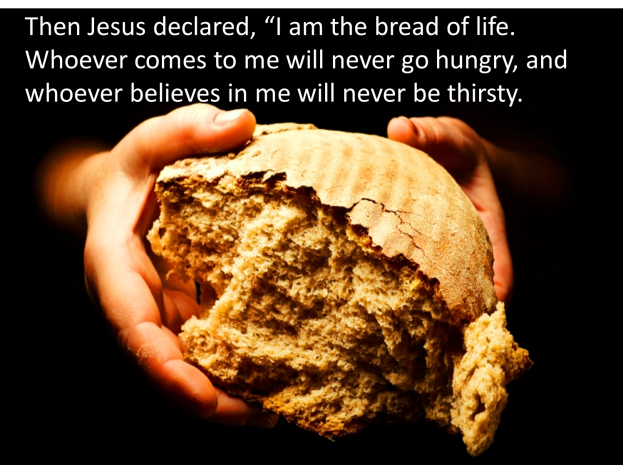
In the Gospel readings over the past two weeks we have heard Jesus say these words: “I am the bread of life. Whoever comes to me will never be hungry, and whoever believes in me will never be thirsty.” And over the Summer period the lectionary asks us to spend time in John 6. Sunday’s Gospel readings seem to have become repetitive – almost too repetitive. Why do we spend so much time focussing on this one chapter of John’s Gospel?

John’s Gospel does not have the story of the Last Supper and the institution of Holy Communion. Where the other Gospels focus on that story, John chooses to highlight Jesus washing his disciples feet. It is here, in John 6, a passage that commences with the feeding of the 5000 that John chooses to reflect on the importance of the Communion meal of bread and wine to his first readers.

We reflected in my post: “God loves and calls us all” ( http://wp.me/p45mBO-mw) that as physical beings we need food and drink to survive. John wants us to understand that our participation in Holy Communion is just as important to our survival as spiritual beings.

All of us, although we might not want to admit it, are really quite fragile. We all have needs and longings at the core of our being which need to be fulfilled. So many of us feel driven to try to fulfil these longings for significance, for meaning in our lives. It’s part of the human condition! We long for our deepest needs to be met and we search for ways to make this happen! These needs are spiritual – but in the end they are also physical. For when these needs are not met our physical well-being is compromised. We encounter and suffer from depression, or the stress we feel opens up the possibility of heart attack, or arthritis. The physical and the spiritual cannot be separated.

Jesus says to us all: “I am the bread of life. Whoever comes to me will never be hungry, and whoever believes in me will never be thirsty. … Whoever feeds on this bread will live for ever.” Or to put it more succinctly, “I am all you will ever need.”


John is so concerned that we grasp this message that he places Jesus cryptic words about Holy Communion alongside the story of Jesus meeting the physical needs of the crowd in feeding the 5,000. John is saying to us: “See, just as Jesus met physical needs he can meet spiritual needs as well.” God is interested in everything that makes up who we are, there is no distinction between physical and spiritual. In God’s eyes it is all one.

And John wants us to grasp that participating in a meal together is deeply significant for our spiritual and physical well-being. When we eat together, we do so much more that satisfy physical hunger and thirst. Eating together speaks volumes about our relationships. When we share a meal together we say very clearly to those we are with: “You are worth sacrificing time for.” When we invite friends round for a meal we really are valuing them. So often it is sharing a meal together that cements friendships and relationships – whether it be the marriage breakfast, or the business lunch, or any other kind of meal. Eating together either creates or cements those bonds of commitment.

So, when we share Holy Communion together we cement our relationship with God and our relationships with each other. We enact, in a way that physically affects us, the drama of Jesus’ death. We take into ourselves again the signs of that passion. We receive again the physical signs of God’s love for us and as we do so we are renewed and we’re strengthened for all that life can bring our way.

Jesus says: “I am the bread of life. Whoever comes to me will never be hungry, and whoever believes in me will never be thirsty.”

The Transfiguration – Glimpses of Glory – August 6th 2015

2 Peter 1:16-19 and Luke 9.28-36

Glimpses of Glory – Back in the 1980s I used to do a lot of walking in the Lake District. One of my favourite places is Lake Buttermere – I love sitting on the ground at the end of the lake closest to Buttermere village on a still summer evening. It’s a place I identify with a key moment in my life.

I was sitting there one summer day in the 1980s. The lake was completely still and the towering masses of Robinson, Fleetwith Pike and Chapel Crag were reflected perfectly in its blue waters. It was a day to die for! It was in the middle of this beauty that for the first time I felt that God loved me. I had known for years that he did, but this was different. My heart was strangely warmed and I felt what I believed to be true.

This was for me a “Glimpse of Glory.” A moment when something changed for ever. You may well have had a similar experience – perhaps looking at the face of your first child or grandchild, perhaps listening to an evocative speaker, perhaps sitting with a dying friend or relative as they finally meet their Lord. Perhaps even the first time that we came to believe in Jesus. Moments which change our lives. Times when we gained a new perspective on our lives. Moments when something seemed to fall into place. Defining moments in our lives. “Glimpses of Glory.”

For Peter, James and John the Transfiguration of Jesus was one such moment, a moment when the curtains of heaven were drawn aside and they saw Jesus as he really was, as the Son of God in all his glory. This was their “Glimpse of Glory” and as Peter reminisces in his letter – it clearly changed their lives.

But moments like these are elusive. We can’t manufacture them, we can’t make them happen. Whatever you call them, “Glimpses of Glory”, “Mountain top experiences.” We want them to last for ever, but they don’t. “Mountain top” experiences cannot last. They slip from our fingers. Just as suddenly as we have encountered them, they’re gone. They become part of the past – sometime just good memories to reflect on.

Peter’s first response is to speak almost without thinking, “This is a moment to die for,” he says. “It must be captured. We must build churches or shrines.” Peter wants to cling on to the experience, to make it concrete, physical.

We read his later response in his letter: “we were eye witnesses to his majesty,” he says. But what mattered to us was the voice of God speaking to us in the experience. “And what we need to do,” says Peter, “is to allow the experience to be the first fruits, the deposit, the guarantee of the truth which has yet to be revealed.” Here are his exact words ….. “Be attentive to this as to a lamp shining in a dark place, until the day dawns and the morning star rises in your hearts.”

Peter knew that his “Glimpse of Glory” was more than just a positive experience, it was a glimpse of the way things really are, Jesus as King and Lord in Glory. Peter knew that just for a moment he had seen things from God’s perspective. That rather than building a shrine to the experience, he needed to allow the truth of the experience govern the way he lived, until God’s reign in Jesus was obvious for all to see.

So Peter says to us today. “Those moments in your lives, where the veil of heaven seems to have been drawn aside and you have felt God’s touch, or been overwhelmed by joy, where you have encountered truth not just as ideas but as living reality (like I did at Buttermere), where you have been deeply affected by the faith of a relative or friend . Allow those moments to be for you, lamps in the darkness, the precursors of the dawn. For they are moments when you have seen with God’s eyes; moments when you have seen the way things really are, and the way they will be. Don’t create physical shrines, but take from them the courage to believe until the day dawns and the light has come.”

God loves and calls us all – John 6:24-35 and Ephesians 4:1-16

“I am the bread of life. Whoever comes to me will never be hungry, and whoever believes in me will never be thirsty” – John 6:35 .

These words from Jesus follow the story of the feeding of the 5,000. …

We have all probably experienced what is is like to be physically hungry. Just as those 5,000 who were fed by Jesus did. However, in the context of that miracle, Jesus talks about our hunger and thirst – not so much physical but spiritual.

Just as we feel hunger, all of us experience deep longings at the core of our beings which need to be fulfilled. Longings to be accepted, to be loved, to count for something, to make an impact, for others to see us as significant, as important or as strong.

Often these longings are well hidden away, but at times we encounter them in powerful ways. Perhaps in grief over the loss of a loved one, perhaps in the dark of the night when we are less in control of our emotions, perhaps at the point where everything seems to be going so well for us, yet something seems to be missing.

So many of us are driven to fulfil these longings for significance, for meaning in our lives. Perhaps we become workaholics, or we become demanding and jealous in our relationships, or we pursue success at the cost of everything else, or we turn to alcohol or drugs, or … some of us even go shopping.

And this is not a new problem – throughout the Old Testament – the people of Israel sought meaning, security and hope anywhere that they could. The prophets of old called their actions “prostitution.” For rather than being faithful to a God who had shown them immeasurable love, who had rescued them from slavery and had given them their own land, they wanted tangible security – gods that they could touch and feel. They sought solutions to their problems where no solutions would be found.

It’s part of the human condition! We long for our deepest needs to be met and we search for ways to make this happen!

Jesus says: “I am the bread of life. Whoever comes to me will never be hungry, and whoever believes in me will never be thirsty.” Or to put it more succinctly, “I am all you will ever need.”

All those desires for meaning, for hope, for significance, for love – those thirsts, those hungers. Pursue me, get to know me, spend time with me – and I will meet them. This is not just some idle promise made by a preacher looking for something to say on a Sunday evening. These are the timeless words of Jesus. They are Jesus promise to us.

And note: he doesn’t say “I’ll find you something to do for me, and then you’ll feel better” No, Jesus is talking about our very being, the very core of who we are, the bit no one else can see. Right at the core of who we are, that’s where Jesus will be – meeting our deepest desires for wholeness. And not just sparingly, but overwhelmingly, generously, and, just as in the story of the feeding of the five thousand, there’ll be plenty of leftovers, flowing out of hearts that are truly loved. For once we really know that we are loved, we can really begin to love others.

This is what Paul talks about in the Ephesians reading set for today. …

Out of the joy of knowing that we are loved will always come a response ….

Some of us will have seen an excellent example of being surprised by joy this week as we watched some of the celebrations of the England cricket team at what, I guess, for them, as well as for us, is an unexpected victory. The Guardian had some great photos – the great hug between Joe Root and Ian Bell after the winning run had been scored, the leap of joy by Joe Root when he scored the winning run. A jump that was high enough to see the stumps under his feet. Amazing natural responses of joy.

For Christians, there is also an overwhelming response of joy to the unbelievable truth that each of as individuals is loved by God and that  we together are God’s people, loved and accepted by him.  Paul says that the natural outworking of that joy is worship and loving service. We respond in worship and service. We use the gifts that God has given us as part of God’s on-going mission in the world. We give of ourselves to others, just as God in Jesus has given himself for us.

Jesus says: “I am the bread of life. Whoever comes to me will never be hungry, and whoever believes in me will never be thirsty.” … In the Eucharist, I meet with you, I feed you. And in me you will find all that you need for life – and you are resourced to give of yourself to others in my church and in the world.

I want to leave you with Paul’s words from Ephesians …. as we read them, let’s remember that elsewhere in his letters Paul extends the list of gifts to include all kinds of ministry and service. And let’s hold one question in the forefront of our minds: ‘What can I/we do to respond in love to the God who loves me/us so much?

“When Christ ascended on high  … he gave gifts to his people. The gifts he gave were that some would be apostles, some prophets, some evangelists, some pastors and teachers, to equip the saints for the work of ministry, for building up the body of Christ, until all of us come to the unity of the faith and of the knowledge of the Son of God, to maturity, to the measure of the full stature of Christ. … Speaking the truth in love, we must grow up in every way into him who is the head, into Christ, from whom the whole body, joined and knitted together by every ligament with which it is equipped, as each part is working properly, promotes the body’s growth in building itself up in love.”                                                (Ephesians 4.8-16)

25th July is St. James’ Day

A thought or two for St. James’ Saint’s Day and for Sunday 26th July ….

St John and St James' mother recommending her children to Jesus, panel of altar of St James, by Leonardo di Ser Giovanni (active 1358-1371), silver foil with embossed decoration, Chapel of Crucifix, Cathedral of St Zeno, Pistoia, Italy, 14th century

St John and St James’ mother recommending her children to Jesus, panel of altar of St James, by Leonardo di Ser Giovanni (active 1358-1371), silver foil with embossed decoration, Chapel of Crucifix, Cathedral of St Zeno, Pistoia, Italy, 14th century

Matthew 20:17-34

Matthew 20:17-34 provides some interesting contrasts: first Jesus talks of the death he must die – his passion, his glory, his enthronement, his coming into his kingdom through death and resurrection!

Then, immediately after he says these words, James and John’s mother asks him a favour for her sons – it is as though she just has not been listening to what Jesus said. She sees him as the Messiah, she has fixed ideas of what he will do as Messiah, and so she seeks preferment for her sons. “When you come into your kingdom grant that my sons will sit one on your right and one on your left!”

Jesus response: “You don’t know what you are asking!” is telling. For the places reserved either side of him when he came into his kingdom were for two thieves and brigands. James and John and their mother had no idea what they were asking for – and ironically they made the request immediately after Jesus had made it very clear what his enthronement would be like.

James and John and their mother are contrasted for us in our reading with two groups of two other men.

The first contrast is with the thieves on the cross. Jesus chosen supporters when he came into his kingdom were from outside his band of followers, people who we would say were completely undeserving. Yet one of those thieves was the first into the kingdom of heaven as Jesus promised that he would be with him in paradise. The first into the kingdom of heaven was a thief, possibly even a murderer. But one who recognised his need of salvation.

That’s one contrast – between righteous disciples of Jesus who don’t listen and renegades, one of whom encountered Jesus and whose life was transformed even in the midst of death.

But that isn’t the only contrast that is made for us. At the end of our reading two other men are mentioned. Not two good disciples, but two people who cannot see. Two blind people. Two people who should not have been able to recognise who Jesus was. Yet two people who really did see him for who he was: “Lord, Son of David, have mercy on us!”

James and John, faithful but perhaps self-righteous disciples, could not see for looking. They were so focussed on what they wanted and on what they believed, that they did not listen to Jesus.

James and John are contrasted with two blind men and two brigands. Brigands who had no right to assume God’s love for them, blind men who could not be expected to see clearly. And in the comparison it is very clearly James and John, the supposedly faithful disciples, who come off worst, who look foolish and grasping. Who appear foolish!

Matthew’s challenge to his first readers and to us who listen to his Gospel is really quite clear. Are we so wrapped up in our own concerns, our own ideas, however much they might be about Jesus, that we fail to hear him speak? Have we got our preconceived ideas about what he is like, so much so that we are just completely unable to hear him speak when he shakes those assumptions?

We are Jesus disciples, just like James and John. … Will we remain open to listen to what God is saying to us, will we remain open to be changed? John and James had to suffer not only Jesus rebuke, but the rebuke that came from their own eyes as first they saw two blind men respond to Jesus and then, quite a while later began to understand that it was on the Cross that Jesus was glorified rather than an ornate throne of gold. How foolish they must have felt as they began to grasp what God was really doing among them – nothing like the assumptions that they first made!

So this is Matthew’s challenge to us. Are we likely to be caught out? So caught up in our own understanding of faith or in our own issues that we miss what God is actually doing right in front of our eyes?