Author Archives: Roger Farnworth

Unknown's avatar

About Roger Farnworth

A retired Civil Engineer and Priest

Shame in the New Testament – some themes

In the last few posts we have considered some Old Testament passages in which shame is a significant theme, or where shame seems to have an impact on events. In due course we will consider some New Testament passages where this is also true. But first, some of the themes within the New Testament that are shame related.

I consider that the key elements of the New Testament approach to shame are:

(a) lack of a ‘sense of awe’;

(b) honour and shame;

(c) shame in the teaching of Jesus;

(d) the face of God; and

(e) shame and the Cross and the Passion of Christ.

We’ll take each of these in turn over the next few days:

1.  A sense of awe and discretion-shame seem to be absent from the pages of the New Testament. Indeed there is even seems to be an unabashed shamelessness evident:  “At almost every point of symbolic significance, shame – conceived as a sense of awe, a reticence before the holy – is abolished. There are no holy places that one may no longer enter into: there is no temple in the Revelation of John. There are no holy things that one may no longer touch: Peter, with his Old Testament scruples about unclean animals, is told that there are no unclean things now. When Jesus dies, the veil of the temple is rent in two. … Jesus does away with special holy places and permits free access to God.” (Schneider: p115, cf., Mt.27:51; Mk.15:38; Lk.23:45; Acts.10:9ff,24ff; Rev.21:22.)

Further, Jesus challenges the traditional meaning of the Sabbath (Mt.12:1ff; Lk.13:10ff.), and introduces familiarity into relationship with God. Paul defeats ‘Judaisers’ who want to impose Jewish rituals on new Gentile believers. (Acts 15: 1-35.)

This might appear to suggest that all vestiges of shame/awe can be cast off, and perhaps explains the absence of shame in the traditional thinking of Western society and the Western church. This is, I believe, not what was intended. We are intended to read the New Testament against the backcloth of the Old.

The New Testament: “adds an important dynamic to the picture. The religious encounter is not only one of reticence before that which one venerates; it also involves the revelation of what is hidden. Religion may be understood as the dialectic of covering and uncovering of the sacred in time and space. … The freedom and intimacy of the New Testament presuppose the restraint and respect of the Old Testament. The invitation to address God as ‘Abba‘ is issued to those who dared not utter His name.” (Schneider: p116.)

This does not, however, go far enough. The ‘dynamic of covering and uncovering’ is essential to religious experience, but so also is the sense that ‘shame’ has been dealt with. This is not to imply that we are now to be ‘shameless’, or that ‘shame’ should no longer be part of the experience of Christians, but rather to note that the experience of shame, first noted at the Fall, has been realigned or renewed by the work of the ‘Second Adam’.

References:

Carl D. Schneider; “Shame, Exposure, and Privacy“; Beacon Press, Boston, 1977.

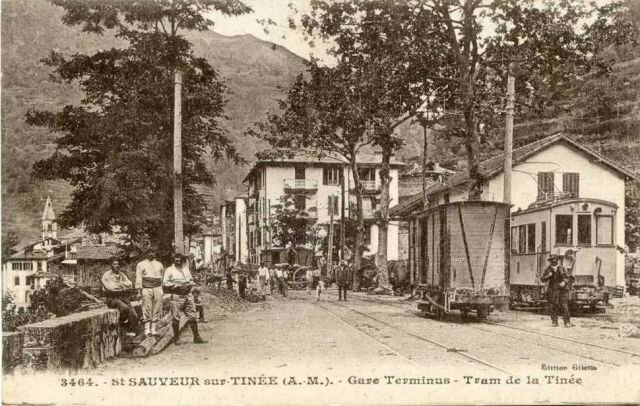
Chemins de Fer de Provence 8 – Tramway in the Tinée Valley

The Tinée Valley – Pont de la Mescla to St Sauveur-de-Tinée

This line was 26.5 Km long and connect villages in the Tinée velley to Nice to Digne line of the Chemins de Fer du Sud which became the Chemins de Fer de Provence.

Like other lines of the Tramways Alpes Maritimes (TAM), the electric current was single phase. The civil engineering works (bridges, tunnels) were executed by the Department.

The line was built in 1911 and operation started on 1st April 1912. Landslides affected the operation of the line in the early months. The original opening was delayed from January to April because of landslides and on 2nd April a further landslide affected several hundred metres of track and destroyed power lines.

The line operated until July 1931.

There were three trains in each direction and the journey along the line took 2 hours and 5 minutes. Between Tinée (SF) and St Sauveur the line climbed 333 metres or about 1000 feet. As well as passenger trains, two freight trains would traverse the line, one in each way. These took about 2 hours and 50 minutes to travel the length of the line.

There are some pictures below.

References:

http://marc-andre-dubout.org/cf/baguenaude/tinee/tinee.htm
“De Nice à Chamonix les réseaux secondaires des alpes françaises” – Jean Robert – G. Fuseau (Montreuil) – 1961.
“Gares de la Côte d’Azur et du Haut-Pays Alpes-Maritimes” – Marie – Equinoxe – 2008.
“Les tramways des Alpes Maritimes” – Delaveau – MTVS – n°46 – 1988.
“Les voies ferrées secondaires des Alpes-Maritimes”- Riffaud – MTVS – 1978.
“Tramways des Alpes maritimes (TAM) et Sud-France” – Magazine des Chemins de fer Régionaux et Urbains – n° 146 – 1978.
“Tramways des Alpes maritimes (TAM) et Sud-France – Compléments” – Magazine des Chemins de fer Régionaux et Urbains – n° 150 – 1978.
Wikipedia

Psalms

There are a myriad of references to shame in the Psalms and it would take too long to examine these here. However, one theme which we have not addressed in biblical references is that of being seen as shameful by God. Shame in our own eyes, shame in the eyes of our community have been recurring themes, but ‘shamed by God’ has not. Robin Stockitt points to references in the Psalms that show that biblical writers can define shame in terms of divine abandonment. He provides some examples:

Psalm 89: “‘You have rejected, you have spurned, you have been very angry with your anointed one. You have renounced the covenant with your servant and have defiled (shamed) his crown in the dust. … You have cut short the days of his youth, you have covered him with a mantle of shame.” (Ps. 89:38f,45). The king was not guilty or lacking in obedience. “The king had placed his trust in YHWH but had appeared foolish. It looked as if his trust had been misplaced. As Bechtel puts it, ‘both the violation of trust and the reversal of expectation caused shame.'” (Stockitt: pp114-115.)

Psalm 25: 1-3: ‘To you O Lord, I lift up my soul. O my God, in you I have trust, let me not be shamed.” In this and other Psalms the psalmist explicitly and publicly puts “his trust in YHWH, therby exposing him to the risk of being taunted or mocked by others less devout than himself. He therefore cries to the Lord that he would not suffer humiliation and shame in the eyes of his adversaries.” (Stockitt: p115.)

Psalm 35: 4, 26: “The corollary of this is that the one who has been shamed asks that the Lord would vindicate his faith by shaming his opponents … Here God is the subject of the act of shaming, suggesting that God’s shaming is connected to both his judgement and to a sense of disclosure. By shaming the opponents of the Psalmist, God is making plain their deceit and hypocrisy for all to see. The psalmist is not so much demanding revenge but that the falsehood of his enemies be recognised as falsehood. God’s active role in shaming can be seen also in the NT where the same collection of meanings is evident. … [see 1 Cor.1:27]. Here God is seen to be exposing the false wisdom and strength of those who do not know him. He is judging the hardness of their hearts by shaming them.” (Stockitt: p115.)

He comments finally that “shame in the biblical material does not have the primary meaning of private individual embarrassment that it has come to mean in the present day. Rather, shame has the sense of being in a place or location where there is a loss of honour, recognition and dignity. It is experienced in the public domain, it is corporate in its mechanisms and it is potentially devastating in its consequences.” He too sees shame as having a capacity to destroy our very being. (Stockitt: p115.)

References:

Please see the bibliography on this site.

Chemins de Fer de Provence 7 – the line to St. Martin Vesubie.

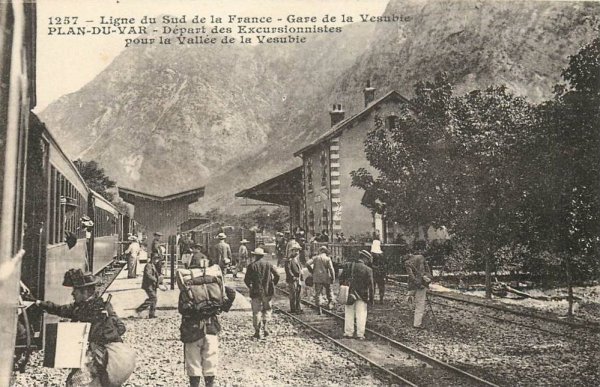
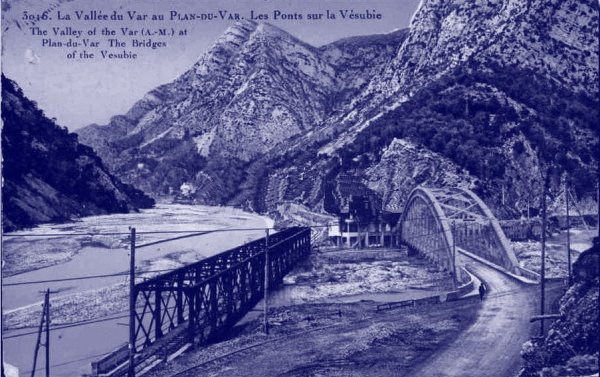
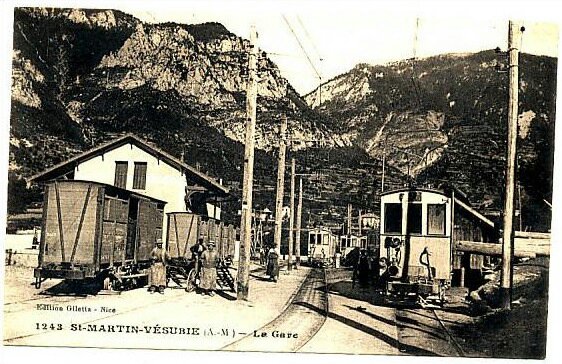
Route VesubieThis line travelled from the Chemins de Fer de Provence station at Plan-du-Var for 24 km to St. Martin-Vésubie. It was a branch-line of that network. It branched from the main-line after the Vésubie and followed the river bank. It was opened on 1st September 1909 and reached Roquebillière as late as 24th November 1926 before being extended to St Martin-Vésubie. Operations stopped very quickly after that, in 1928.

The route ran past Duranus and Utelle before going through St. Jean-de-la Riviere and on to Lantosque and Roquebillière, before finally reaching St. Martin-Vésubie.

Trams provided the regular service which was twice daily in each direction.

06lantosque01 06plan-du-var01 06plan-du-var02a 06plan-du-var07 06roquebilliere01 06roquebilliere02 06st-jean-la-riviere02 06st-jean-la-riviere07 06stmartin-vesubie01

Tramways St. Martin06stmartin-vesubie04

vesubie015

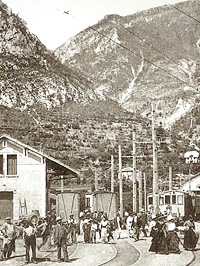
Theses pictures are nearly all old postcards. They are a selection of available images which can be followed up in the references below.

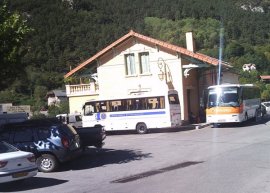
The small terminus at St. Martin-Vésubie was below the town. In the modern picture, buses have replaced the tram but the passenger building is still standing and well restored. The station had limited facilites but these did included goods depots, a lamp room and a small shop.

References:

http://marc-andre-dubout.org/cf/baguenaude/vesubie/vesubie.htm

“Nice to Chamonix secondary networks of French alps” – Jean Robert – G. Time (Montreuil) – 1961

“Stations of the Côte d’Azur and the High Country Alpes-Maritimes” – Marie – Equinoxe – 2008
“Trams Alpes Maritimes” – Delaveau – MTVS – No. 46-1988
“The secondary railways in the Alpes-Maritimes” – Riffaud – MTVS – 1978
” Tramways of the Maritime Alps (TAM) and South-France ” – Magazine of Railways Regional and Urban – n ° 146-1978.
” Tramways of the Maritime Alps (TAM) and South France – Supplements “- Magazine of Railways Regional and Urban – n ° 150-1978.
Wikipedia

Chemins de Fer de Provence 6 – More Tramways Still!

Tramway de Nice et du Littoral

The Tramway de Nice et du Littoral was a network of trams which served Nice and the communes of the department of the Alpes Maritimes between 1878 and 1953. These notes have been culled and translated from the French Wikipedia site as noted in the references below.

800px-Jardin_public

The Paris Financial Corporation , together with the Society of Public Works and Buildings constructed a network of horse tramways in Nice which was finished in February 1878 and started service on 3rd March that year.

The network comprised four lines: Place Massena – Pont Magnan; Place Massena – Abbatoirs; Place Massena – Saint Maurice; Pont Magnan – Sainte Helena. These were single track lines of standard gauge (1440 mm).Nice_-_Avenue_de_la_Gare

The network was leased to the Compagnie Générale des Omnibus de Marseille, on 4th September 1879. And after that company failed the ‘Société nouvelle des Tramways de Nice (SNTN) took over running the system in 1887.

In addition, in 1895, Compagnie Anonyme des Tramways Électriques de Nice-Cimiez was awarded a concession for a tram line between the Rue de l’Hôtel des Postes and Cimiez zoo. That line was built to a gauge of 600mm and used electric traction batteries because of its difficult route. It was commissioned on 24th November, 1895.

220px-ND_307_-_NICE_-_L'Avenue_de_la_Gare

BJ_106_-_NICE_-_Avenue_de_la_Gare

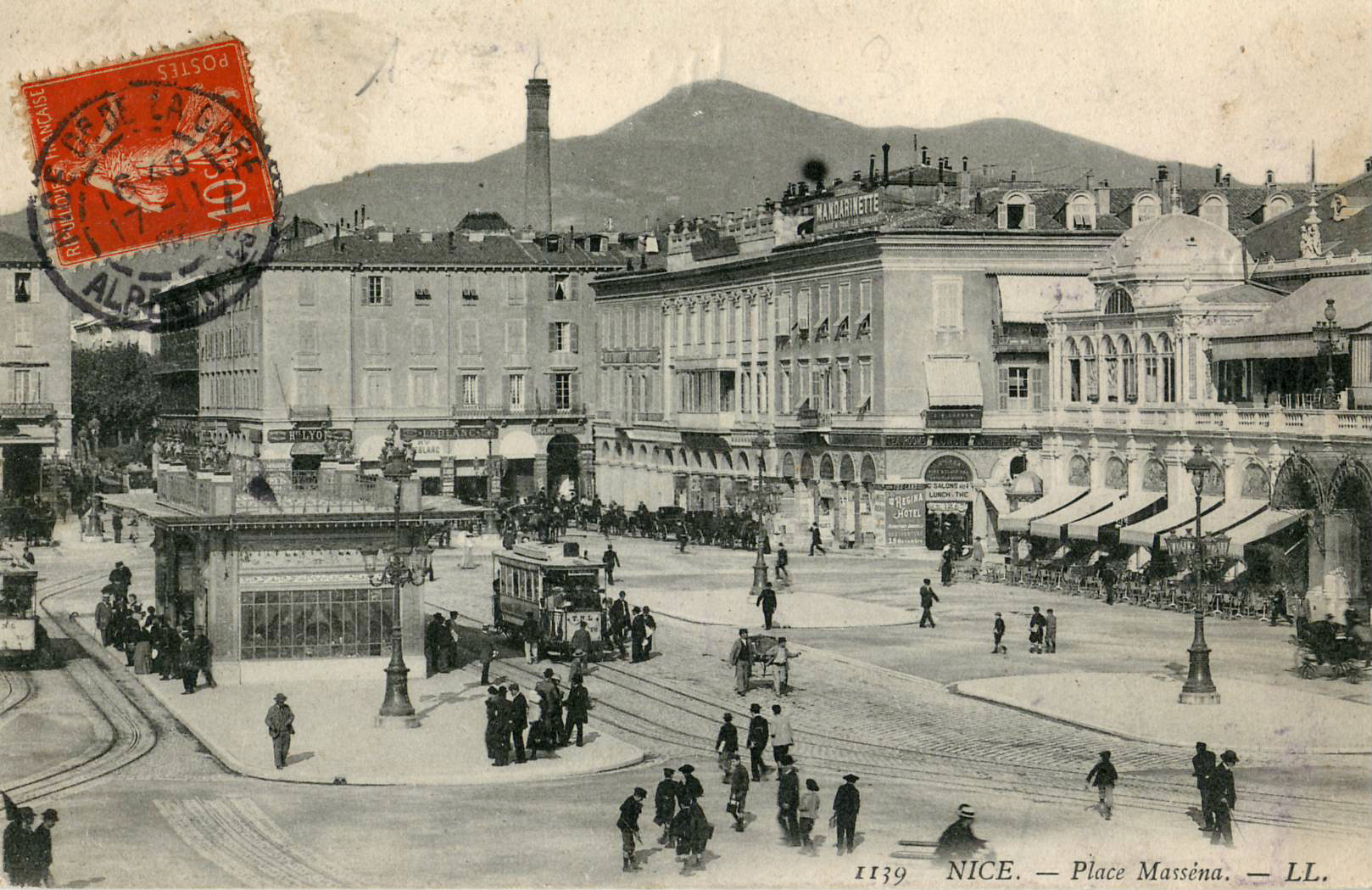
LL_1139_-_NICE_-_Place_Masséna

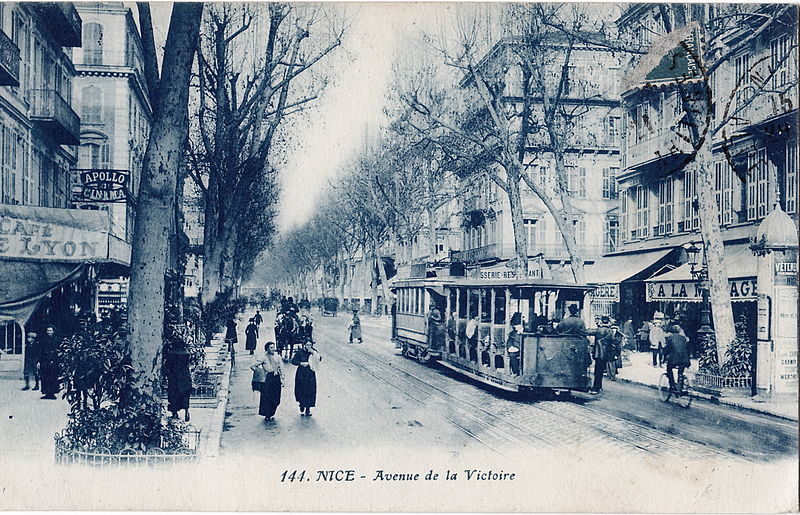
 Place Massena was at the centre of the network and the other two photos show trams on Le Rue de la Gare

La Compagnie des Tramways de Nice et du Littoral (TNL)

This company was created to replace the old “Société nouvelle des Tramways de Nice”, on 16th September, 1897. Its purpose was to: create a network along the Cote D’Azur from Cagnes to Menton , with a branch to the port of Nice and to Contes; it was to electrify the urban network to resume operation to Cimiez which had lapsed.

The lines opened in the following order: Nice – Cimiez , 13th January, 1900; Place Massena – Villefranche-sur-Mer, on 1st February 1900;, Nice – Saint Laurent du Var, 7th February, 1900; Port – Saint Maurice, 12th February 1900;c Nice – Cagnes, 14th March 1900; Nice – Contes, 2nd June, 1900; Nice – Beaulieu, 3rd June, 1900; Magnan – Saluzzo, 3rd November, 1902; and Gambetta – Massena (via Avenue Joseph Garnier), also on 3rd November 1902.

The network centred on the Place Massena where most lines converged. All the lines were electrified by underground gutter and a fleet of 100 trams was used.

Compagnie des Tramways de Monaco

The Compagnie des Tramways de Monaco was founded in 1897 by entrepreneur Mr. Crovetto Monaco. He obtained the concessions on these lines: Place d’Armes – Saint Roman, opened May 14, 1898; Gare de Monaco – Government Square, opened March 11, 1899; Casino – Gare de Monte-Carlo, opened May 3, 1900.

In 1900, the network was linked to the LNP (Line Nice – Monte Carlo). In then in 1908, the company was absorbed by the company TNL. However,by 1931 trams had disappeared completely from the principality.

La ligne de Monaco et Menton

This line connects Nice, Villefranche, Beaulieu, Monaco and Monte Carlo by a linee along the Basse Corniche. It opened on 7th November 1903. An extension from Monaco to Menton Opened on 20th December, 1903. The line connected with with the network of urban tramways in Monaco.

800px-ND_-_Route_de_Nice_à_Monaco_-_La_Baie_d'Eze

Extensions

Extensions were built over time, either to the departmental network or the urban network.

Departmental network

The departmental tram network comprised 14 lines to be built, assigned to the LNP or to the Chemins de Fer du Sud . The latter through its subsidiary: Les Tramways des Alpes-Maritimes (TAM).

800px-Viaduc_du_Caramel2

The LNP obtained the concession of the following lines: Le Pont-de-Saint-Jean (commune de A further route – La Grave de Peille – L’Escarène –  was never built.Villefranche-sur-Mer ) – Saint-Jean-Cap-Ferrat, which opened on 7th December 1907; Nice – Levens , opened 15th June, 1908; Cagnes – Antibes and Cap d’Antibes, opened on 1st February, 1909; Contes – Bendejun , opened on 1st February, 1909; Pont de Peille – La Grave de Peille, opened in 1911; Menton – Sospel: Menton – Villa Caserta, opened in October, 1911 and Villa Caserta – Sospel, opened in April, 1912.Giletta_3205_-_LEVENS_-_Excursion_en_Tram_-_Environs_de_...

The tram to Antibes linked with the network of trams in Cannes.

Urban network

Magnan – La Madeleine , 27 April 1908

Line from Menton to Sospel

This line from Menton to Sospel is open April 15, 1912, as part of the construction of the departmental network. Its length is 18 km. It marks the end of the extension of the LNP. See http://fr.wikipedia.org/wiki/Tramway_de_Menton_à_Sospel for more information.

The apogee of the tram network

The growth of the population of Nice and the surrounding towns and villages led to a rapid development of the network. In 1930, the LNP network consisted of 144 km of track, and had a fleet of 183 drive trams and 96 trailers.

Developments and end of the network

However, very soon the tramways suffered strong competition from road vehicles and by 1934 the coastal routes and the suburban network, including the routes to the various villages and communes had entirely disappeared. The municipality also gradually closed the urban lines, so that by 1939 there were only four lines left: Line 3: Abattoirs – La Madeleine Trinity Victor; Line 9: Port – Saint Augustine; Line 22: Gare PLM – Carras; Line 35: Rue Hôtel des Postes – Cimiez.

During the Second World War, two lines were reopened as all buses were requisitioned: Line 6: Passage à niveau – Pasteur; Line 7: Passage à niveau – Riquier. The tramways to Contes and  La Grave de Peille also reopened.

At this time the network had 48 drive trams and 22 trailers (some additional drive vehicles were also built in 1942).

After the Second World War, the trams were replaced by trolleybuses and the last tram ran on 10th January 1953.

800px-Artaud_&_Nozais_144_-_NICE_-_Avenue_de_la_Victoire

 References

http://fr.wikipedia.org/wiki/Tramway_de_Nice_et_du_Littoral

“Les tramway de Nice et du Littoral,” Connaissance du Rail , No. 320-321,‎ mars 2008

Jean Robert, Nice to Chamonix Secondary networks Alpes-Maritimes, Montreuil. Impr. Time, 1961, p101.

Lamentations 1

Today we return to another example provided by Saul M. Olyan

“The rhetoric of honor [and shame] is introduced twice in Lamentations 1. In verse 6, we are told that ‘all her honor has gone forth from the daughter of Zion’. The wider context of the poem suggests that this loss of honor is as a result of the humiliations Jerusalem has endured: her defeat, her exile, the loss of the Temple, the disloyalty of her allies, the desperation of her people. Her diminishment is extreme; she has descended from a position of honor to a place of shame. … In verse 8 we are told that ‘all who honoured her despise her, for they have seen her nakedness’; in verse 11 she states: ‘See YHWH and look, for I am despised’.” (Olyan: p216.)

This passage is interesting in that, rather than being a narrative, it is a lament. The author laments over Jerusalem and one of the principal concerns in this lament is her disgrace, her shame. The enemy’s scorn and laughter is unbearable (Lam. 1:7). It is worth noting also that the equation in this lament is between sin and impurity, rather than sin and guilt – ‘Jerusalem has sinned greatly and so has become unclean’ (Lam. 1:8).

References:

Saul M. Olyan; “Honour, Shame, and Covenant Relations in Ancient Israel and its Environment“; in Journal of Biblical Literature, Vol. 115, No. 2, Summer 1996; p201-218.

Isaiah 52 and 53

Isaiah 52:13 – 53:12 (and Psalm 22)

John J. Pilch asks us to consider Isaiah 53 and Psalm 22 as classic passages where shame appears. In these two passages, the language is all about humiliation at the hands of enemies. “Second Isaiah describes the Suffering Servant as having an appearance that was ‘marred beyond human semblance’ (Isa. 52:14, cf. Ps. 22:6) and as being ‘despised and rejected by men’ (Isa. 53:3, cf. Ps. 22:6).” (Pilch: p105.)

Pilch parallels Isaiah 53 and Psalm 22, in both passages the word ‘despised’ literally means ‘shamed’. These unidentified enemies of the suffering servant of Isaiah and the psalmist know how to destroy a person. They “are culturally astute. They know how to add to the shame of the lamenter’s predicament. They mock him; laugh at him with an ear-to-ear laugh and ‘wag their heads’ (Ps. 22:7).” (Pilch: p106.) He asks his readers to take careful note of the ‘sign language’ in Isaiah 53, ‘wagging the head’, or shaking the head, at someone is a picture worth a thousand words in the cultures of the Old Testament!

Here in Isaiah 53, guilty or innocent, but most probably innocent, the Suffering Servant is utterly destroyed by the shaming of others. Shame reaches right to the core of the Servant’s being and feels like torture, like dying.

References:

John J. Pilch; “Introducing the Cultural Context of the Old Testament;” Wipf & Stock, Eugene, Oregon, 1991.

Chemins de Fer de Provence 5 – More Tramways around Nice

Trams in the ValleysImage

After annexing Nice, the French authorities continued to develop the infrastructure in the County of Nice. The coastline was already provided with good road and rail infrastructure. The hinterland and mountains were difficult to access. To open up the villages, the administration implemented the plans established by the Sardinian engineers before annexation.

Many roads used to connect to different villages around Nice could only be traversed with great care and travel times were long. For example: St Martin Lantosque (now St Martin Vésubie) was 10 hours from Nice in 1876 and even with the help of the Digne train in 1894, the journey still took 7½ hours.

It was decided on 10th February 1906 that tramways would serve four valleys:

– The valleys Vésubie 34 km from Plan du Var to St MartinImage

– Valley Tinée 24 km from Mescla to St Saviour

– Valley Estéron 29 km from Pont Charles Albert to Roquestéron

– High Var valley 19 km from  le Pont du Gueydan to Guillaume

The Tram was the economic solution existing dirt roads could accommodate rails but a number of civil enginering structures would be needed. Work began in 1907 on the Vésubie line. It took two years to complete and finally in September 1909 the line came into service. The power system was not complete so the company had to use steam locomotives. This solution resulted in a number of accidents and regular derailments disrupted traffic. Following these incidents, the government implement a series of works to realign and accelerate the implementation of the power supply. Line started regular electrical operation in October 1910.

Line along the Tinée connecting Mescla to St Saviour opened in April 1912. Then the 1st World War postponed the commissioning of lines to Guillaume and Roquesteron until 1923 and 1924.

For a while twice daily tram services carried passengers and goods on these lines. Farmers went to Nice to sell their products, see a doctor or settle their affairs, and tourists and lovers of alpine sports could access the mountains. Nice was served fresh produce direct from the mountains: milk, fruits and vegetables, wood, hay, etc …

In 1929, however, the competition from road transport forced a decision to close the tramways and the last service was closed in 1931.Image

References:

The content of this post has been translated from http://www.mangiapan.net/page.php?id_sujet=38, with some amendments.

Chemins de Fer de Provence 4 – Tramways near Nice

At much the same time as a network of metre gauge lines was being built in Var and the Alpes Maritimes, smaller towns were seeking cheaper ways still to connect to the outside world. A number of electric tramways were built usually following the line of what are now roads. The Sospel to Menton tramway is one of these but there were many more. The map shows just how many!

image

Along with three lines (Nice-Digne; Meyrargues-Nice; and Toulon-St-Raphael), a network of seven electric tramway lines were built as part of the Chemins de Fer du Sud.

In August 1909 a line from Plan-du-Var reached St-Martin-Vésubie (33.8 km). In December 1911, a network around Cagnes-Sur-Mer and Grasse serving Pré-du-Lac, Grasse, and Cagnes-PLM (25 km). A line from Villeneuve to Vence was inaugurated on the same day (11km). April 1912 saw the commissioning the line to La Mescla-St-Sauveur-sur Tinée (23.8 km) In October 191a short line to Bar (3.2 km) was established. Finally, after the war (1914-1918), the last two lines, Pont de Gueydan-Rabbets (19.1 km) and Pont Charles Albert Roquestéron (28.6 km) were completed.

image

image

image

image

Isaiah 20

Another example of shame in the Old Testament world the use of shaming is the formal sanction of political shaming. Lyn Bechtel points this out: “One of the characteristics of warfare in the ancient Near East (and especially Assyria) was the use of psychological warfare. It was within this area of psychological warfare that shaming was employed. … A captured vassal was not just vindictively tortured; he was made a public example for all to see, so that he served as warning by demonstration of what happened to delinquents. It was publicity, not necessarily pain, that was the primary motive for shameful and inhumane treatment of captives. The Assyrians openly boasted of their shaming and violence because a reputation for shame and violence was the main means of softening up and incapacitating an enemy population in advance” (Bechtel: p63). It was as though it was better to die than be shamed in this way.

Prisoners were marched naked and bound, exposing them to the heat, but also exposing their private parts to mockery. The captives nakedness was symbolic of the defencelessness of their nation and demonstrative of its failure to attain victory. “Shaming made it possible to dominate and control defeated warriors because shame was restrictive and psychologically repressive. The victors would not have to worry about a counter-offensive if the enemy warriors were psychologically demoralised and rendered physically ineffective and defenceless” (Bechtel: p64). Their shame was total, they had been destroyed, they had no honour, they were effectively dead. They were no threat!

“Captive warriors or kings were made to walk naked, to grovel in the dust abjectly, or to feel helpless and defenceless in order to ‘put them down’ into … Conversely, putting others down had the effect of strengthening the confidence and sense of superiority of the victors.” (Bechtel: p64.)

So, Isaiah is asked by God in Isaiah 20 to walk naked and barefoot throughout Jerusalem as a graphic image of prophecy. He is called on to make clear to Israel the consequences of an alliance with Egypt and Cush. It will only result in shame. “Walking naked involved double shame: the shame that Isaiah experienced from being naked in the presence of his community, and the shame the people of Jerusalem would have experienced when they saw the shameful sight. … It was unpleasant to see because the public shame of one member of the community reflected shame on the entire community.” (Bechtel: p66.)

Isaiah is shamed himself, and those who see his graphic demonstration of prophecy feel the strength of the message because they can understand Isaiah’s shame, and because they are shamed themselves by his uncovered naked presence.
References:

Lyn M. Bechtel; “Shame as a Sanction of Social Control in Biblical Israel: Judicial, Political, and Social Shaming;” in Journal for the Study of the Old Testament, Issue 49, 1991; p47-76.