

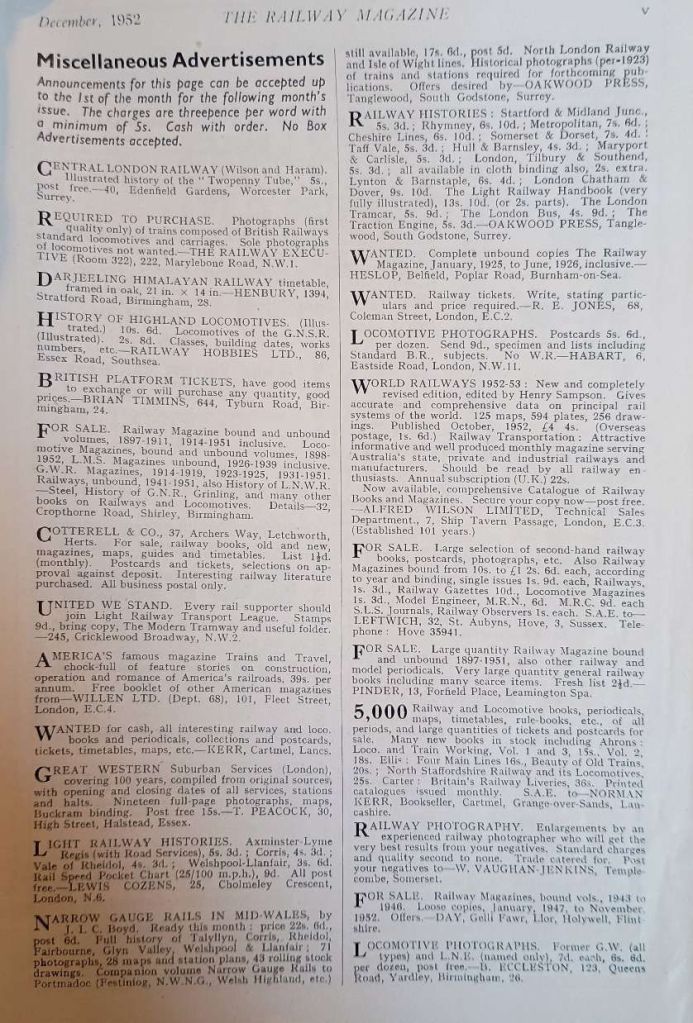
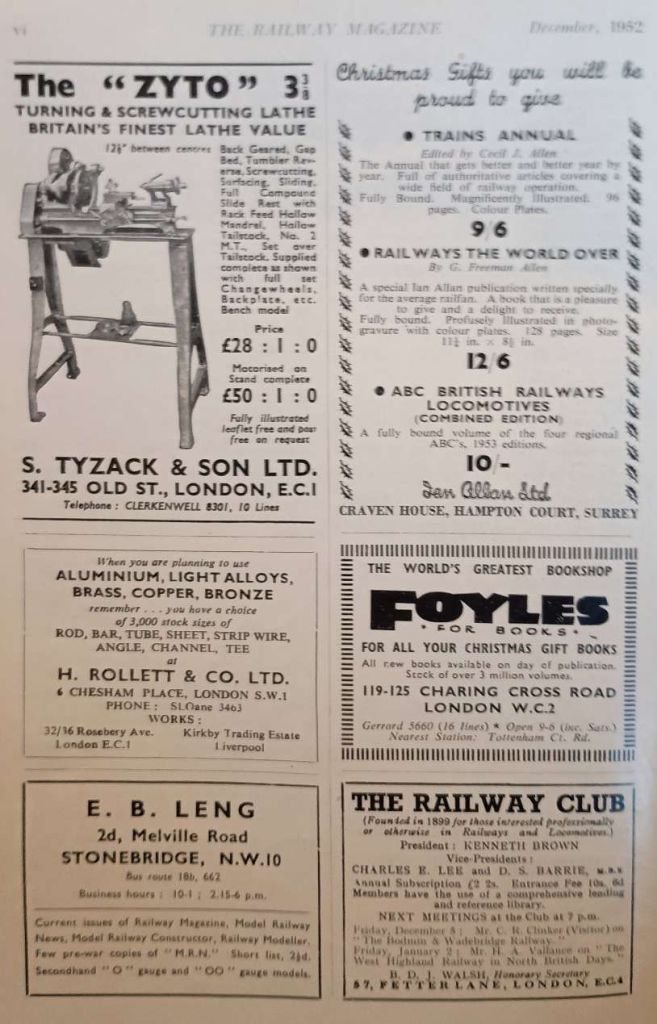
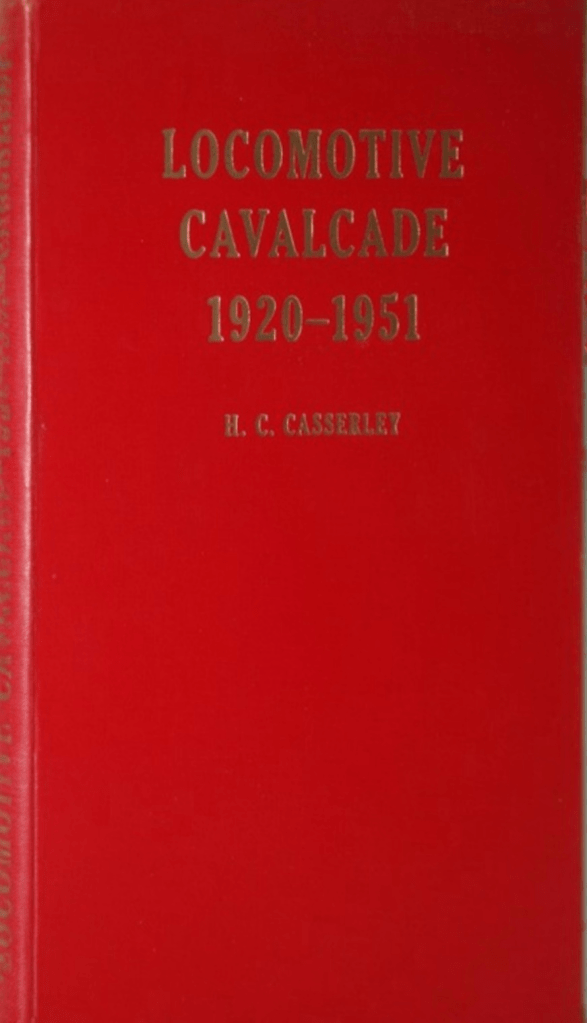
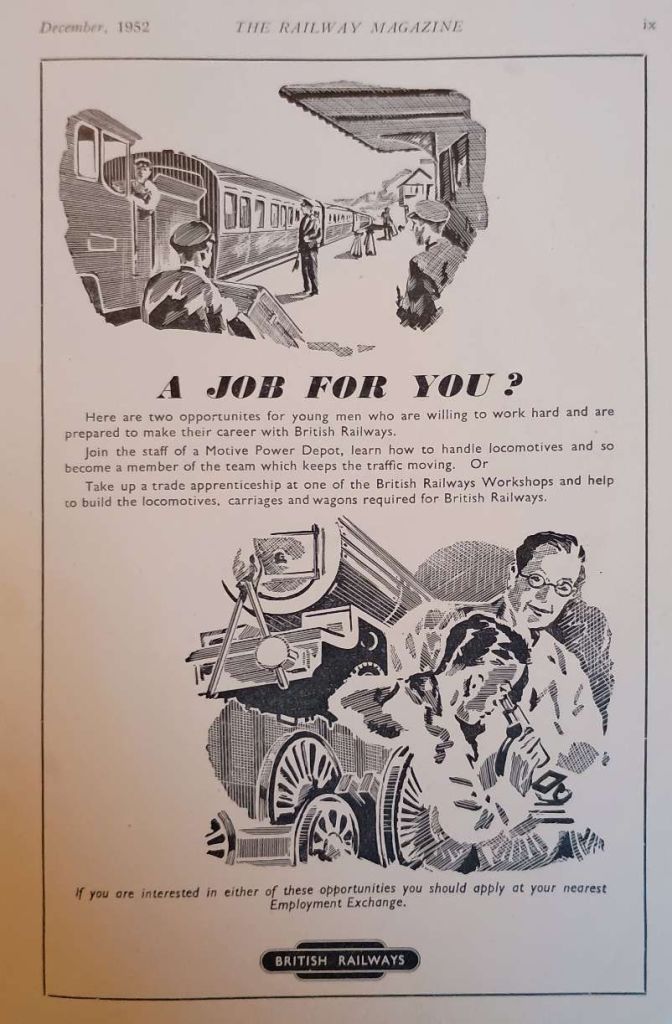
Another snapshot of advertising from the 1950s Railway Magazine. The featured image is the front cover photograph from the December 1952 issue. The adverts in this issue are an eclectic mix of modelling tools, books, railway equipment, chemical elements, British Railways jobs and miscellaneous items. …
J.F. Stringer & Co. Ltd – E.W. Model B Lathe
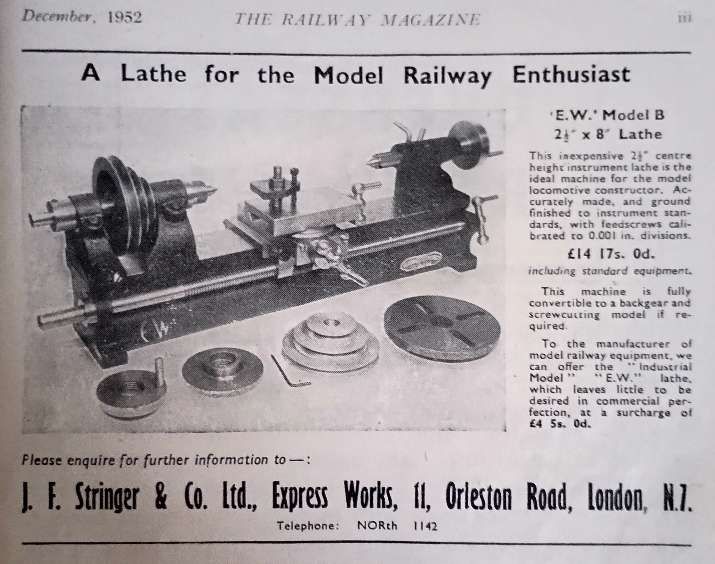
“Conceived, designed and manufactured by John Frederick Stringer, the 2.5″ x 8″ EW lathe was first built circa 1946/47, just after the formation of his first company, J. F. Stringer & Co. Ltd. … Due to the economic strictures that prevailed during the early 1950s, the EW was cleverly designed and marketed as the “Convertible”, being available as a basic plain-turning model less backgear and screwcutting that could then be upgraded, as the owner’s finances permitted, with parts that simply bolted on to effect the desired improvements. For the better healed, or those with the opportunities for extra overtime, it could also be had as a complete machine with countershaft and motor ready to tackle a wide range of model and experimental engineering jobs.” [2]
The December 1952 edition of The Railway Magazine carried the advert. We know that it was also carried in the June 1952 magazine with the lathe offered at the same price as in the December issue of the magazine. This was at a time when a skilled man could earn around £9 a week!
Lathes.co.uk tells us that this lathe was “constructed in an absolutely straightforward manner, the EW had a 19.5-inch long, 2.5-inch wide bed of hollow box section (an arrangement that required no corebox), ground on the top surface and feet – and with three bracing ribs up the back face. It was designed for ease of manufacture on a limited range of machine tools – for the original works had only two South Bend lathes, a mechanical hacksaw, an ordinary pillar drill and a small horizontal miller – it is surprising that so much could be done with so little. … [It was] of unusual design, the headstock carried a 0.75-inch diameter spindle, bored through 13/32″ with a No. 1 Morse taper running in plain bearings carried on two entirely separate, box-form, cast-iron posts that were jigged so as to be interchangeable between machines. The top of each post was split, bored and homed honed to form the headstock bearings (the spindle running directly in the cast iron) and the base clamped to the V-edged (dovetail) bed with a transverse through bolt. The spindle carried a narrow, 3-step Z-section V-belt pulley.” [2]
More information can be found on https://www.lathes.co.uk/ew. [2]
Ericsson Railway Telephones
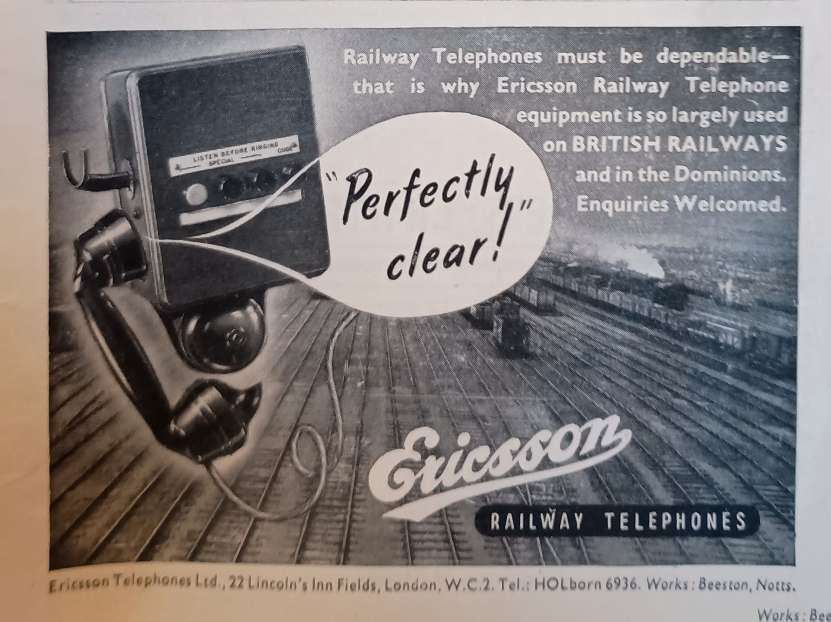
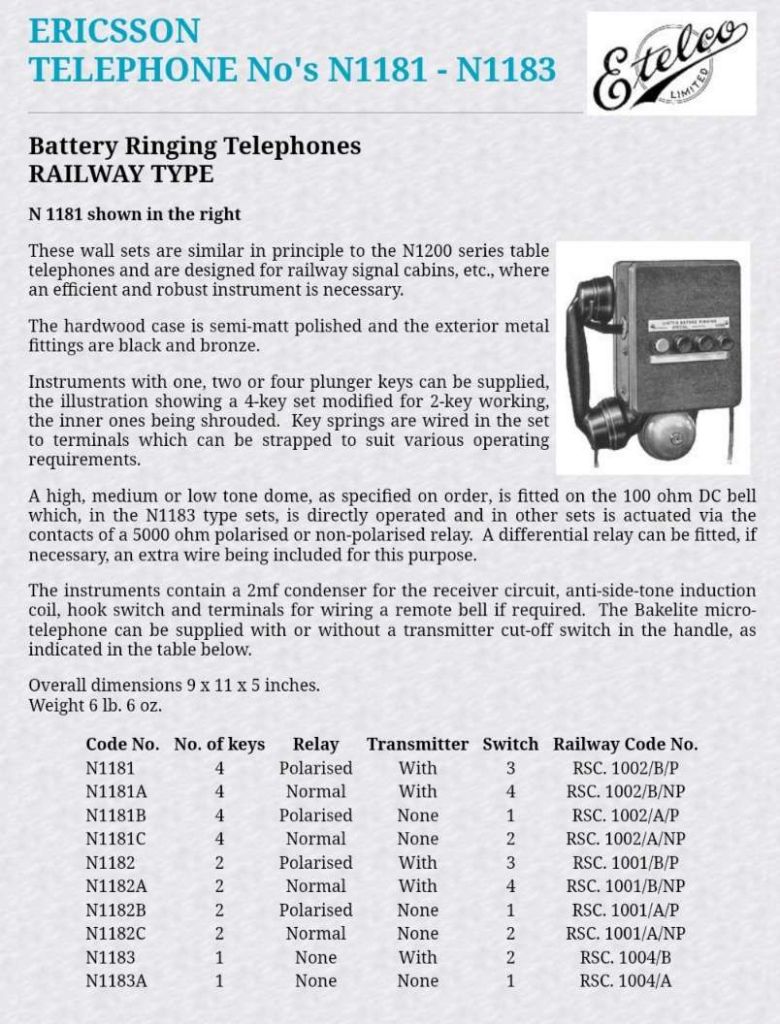
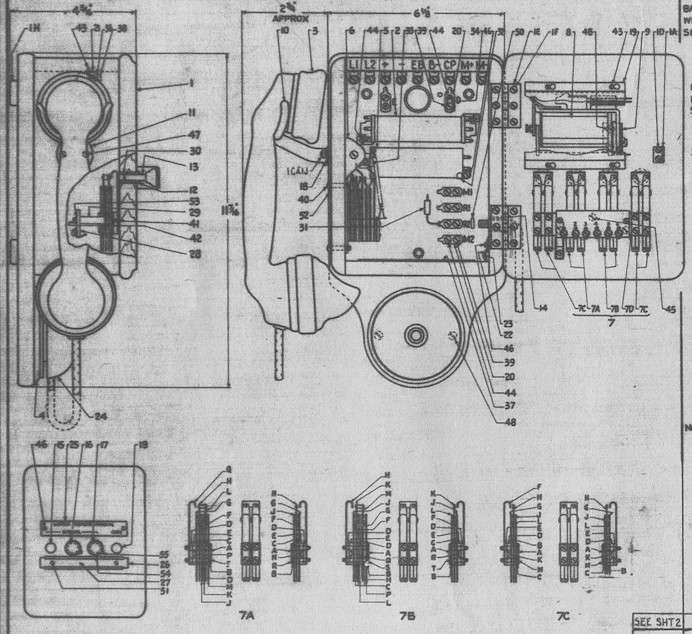
Ericsson Bulletin No 17 describes the phones which it supplied to British Railways.A copy of the article can be found on page 40 of that bulletin. [4]
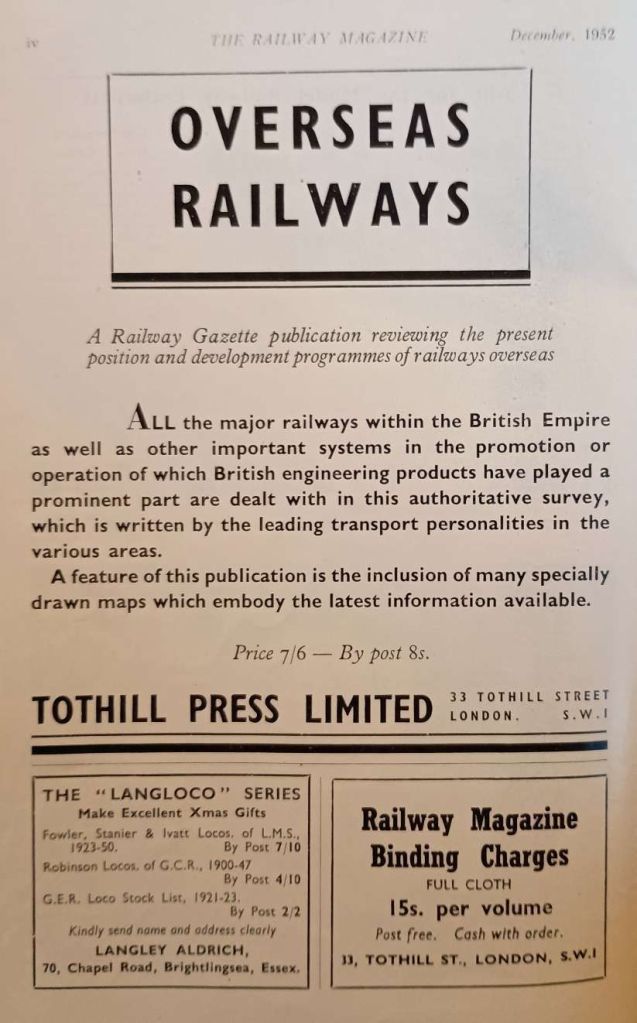
Overseas Railways
A book produced annually by the Railway Gazette which reviewed the current position and development programmes of railways overseas. The Railway Gazette was, like The Railway Magazine published by the Tothill Press in London.

The final advert in the issue was on the back cover. It was placed by ICI advertising a particular ‘rare earth’ metal – Cerium. Rare-earth metals are of growing interest in the 21st century.
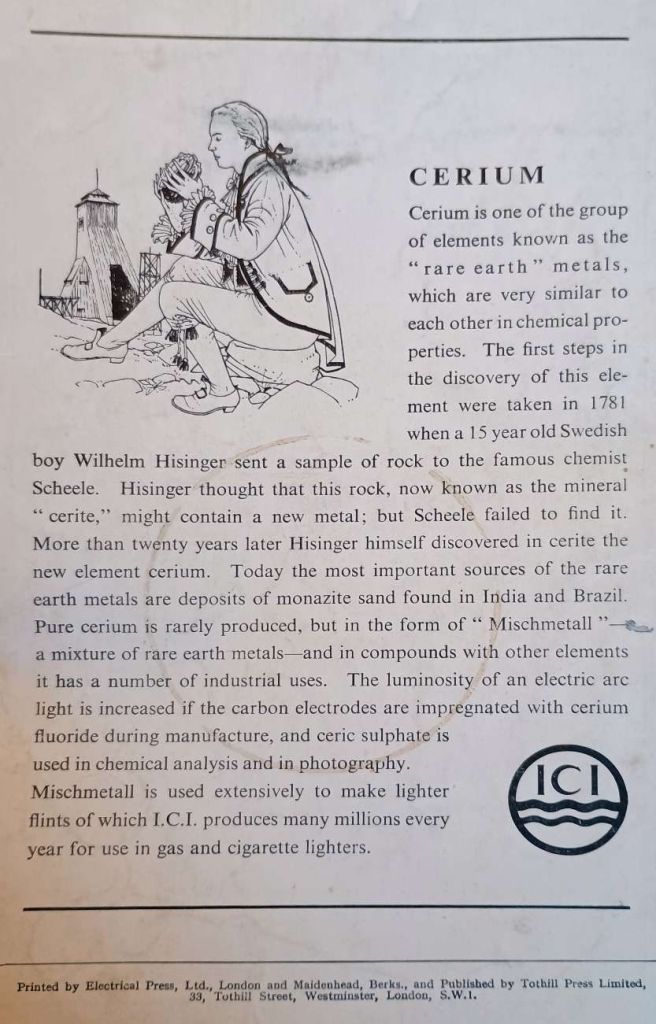
Cerium (Ce, atomic number 58) is the most abundant rare earth element, a soft, silvery-grey metal that tarnishes in air. It is used extensively in catalytic converters, glass polishing, alloys, and lighter flints due to its high reactivity and unique catalytic properties, though it’s rarely used in pure form because it oxidizes rapidly and reacts with water, finding applications in products from fuel cells to military optics. [6]
“Cerium was first identified by Jöns Berzelius and Wilhelm Hisinger in the winter of 1803/4. Martin Klaproth independently discovered it around the same time. Although Cerium is one of 14 rare earth elements it was discovered independently of them. There are some minerals that are almost exclusively cerium salts such as cerite, which is cerium silicate. A lump of this mineral had been found in 1751 by Axel Cronstedt at a mine in Vestmanland, Sweden. He sent some to Carl Scheele to analyse it but he failed to realise it was new element. In 1803, Berzelius and Hisinger examined it themselves and proved that it contained a new element.” [6]
“It was not until 1875 that William Hillebrand and Thomas Norton obtained a pure specimen of cerium itself, by passing an electric current through the molten cerium chloride.” [6]
In railways, Cerium is primarily used as an alloying additive in steel components to improve their material properties, such as corrosion resistance, strength, and toughness.
References
- The Railway Magazine Volume 98, No. 620; Tothill Press, London, December 1952.
- https://www.lathes.co.uk/ew, accessed on 15th January 2026.
- https://www.britishtelephones.com/ericsson/n1181.htm, accessed on 15th January 2026.
- https://www.britishtelephones.com/ericsson/bulletin/17_40.htm, accessed on 15th January 2026.
- H.C. Casserley; Locomotive Cavalcade, 1920-1951; Self Published, 1952.
- https://periodic-table.rsc.org/element/58/cerium, accessed on 15th January 2026.
 Roger Farnworth