Last week’s Gospel reading from Luke 12: 13-31, had Jesus telling the story of a rich man who had done well for himself and decided to enjoy the fruit of his labours – he built bigger barns to store his wealth and got ready for a long retirement. Jesus called him a fool, for he had given no thought to his eternal welfare. We could imagine him hoarding everything for himself and giving nothing, or very little, to God; hoarding everything for himself and giving no thought to the poor. And we saw him condemned as a fool.
Jesus ended his talk with his disciples after the story of the rich man with very similar words to those used by Matthew in his record of the Sermon on the Mount. “Don’t worry about material things,” Jesus says, “Instead strive for God’s kingdom and all these things will be given to you as well.”
Our Gospel reading today follows directly on from those words. … Immediately after, Jesus says, “Do not be afraid, little flock, for it is your Father’s good pleasure to give you the kingdom.”
The Gospel reading expands these thoughts: “Do not be afraid little flock. … Sell your possessions, and give alms. Make purses for yourselves that do not wear out, an unfailing treasure in heaven, where no thief comes near and no moth destroys. For where your treasure is, there your heart will be also.”
How do we feel when we hear Jesus’ exhortation to sell our possessions and give to the poor? … If you’re anything like me you’re likely to respond in one of two ways: either you will feel guilty, then perhaps remember the appeal from the Aid Agencies for the latest part of the world in trouble, get out your credit card and make a telephone donation. Or you will try to justify yourself. Don’t I already give enough? How can I possibly give more? And, like me, if you’re not careful, there’s a danger that you’ll dismiss the Gospel reading from your mind with a sense that it no longer applies to you.
These challenging words of Jesus are hard to handle! And if we’re not careful we become just like the rich young ruler in Matthew’s Gospel who asked Jesus, “What must I do to gain eternal life?” … He heard Jesus say ““If you want to be perfect, go, sell your possessions and give to the poor, and you will have treasure in heaven. Then come, follow me.” He found Jesus’ words too hard, and walked sadly away from Jesus because his riches were too great.
Is a sense of guilt or self-justification the right way to respond to today’s Gospel reading? … How should we respond? … After all, we are all relatively rich when compared with the income of everyone in the world, even if we are pensioners or clergy! Perhaps I should sell all my theological books. My model railway. The nice furniture that we have in the vicarage. Perhaps I should cash in my savings and give them to Oxfam. Perhaps this is what Jesus wants? … And maybe I need to allow this passage to challenge me about my acquistorial nature – I love to collect things! … But would this help me to really learn to trust my heavenly Father? … For with all this wealth, with insurance, with an effective health service and social services, with the safety net that this society provides it is very difficult for us to know what it means to trust God for our daily needs. …
So how does God expect us to respond to the challenge?
Greater generosity is clearly part of our calling. And if the regular giving of many to the Church of England is any measure of our generosity, then we still have a lot to learn about giving and trusting God. But that is not the main challenge of our Gospel reading. …
Jesus’ challenge is actually far deeper, much harder to handle. For just as in the first part of Luke 12, with the story of the rich farmer, just as with Jesus’ sayings about the kingdom and the wealth of this world, in our passage this morning, Jesus is challenging us not to give more, but to let go of everything we think we own. “It is not yours, it is God’s,” says Jesus. “Everything is God’s.”
The challenge is to let go of all of our securities – our wealth, our status – and to trust God. “And,” says Jesus, “when you do so, you will begin to lay up treasure for yourselves in heaven. You will begin to experience the kingdom of God at work in your life. You will have no problem with giving, for you will be glad to return to God what is his already.”
Our Gospel reading this morning is not so much a challenge to us to be more generous. Although it is definitely that. It is more pertinently a challenge to see everything we have as not ours but God’s, held on trust to be used to bring in the kingdom of God
One of the regular parts of the liturgy in the Church of England expresses this so well. In many Anglican churches these words follow the Offertory: ‘Yours Lord, is the greatness, the power, the glory, the splendour, and the majesty, for everything in heaven and on earth is yours. All things come from you and of your own do we give you.’
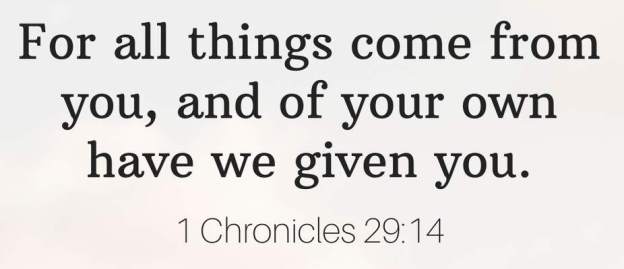
All things come from you, and of your own do we give you.
These are words taken from the Old Testament, from 1 Chronicles 29: 11-14. And I will finish this short reflection with those words: …
“Yours, LORD, is the greatness and the power and the glory and the majesty and the splendour, for everything in heaven and earth is yours. Yours, LORD, is the kingdom; you are exalted as head over all. … Everything comes from you and we have given you only what comes from your hand.” (1 Chronicles 29: 11 & 14b)
And our response to the love of God for us, has to be: … “All things come from you, and of your own do we give you.”
 Roger Farnworth