Monthly Archives: Dec 2024

Genoa’s Early Tram Network – Part 1 – General Introduction, Tunnels, The Years before World War One, and the Early Western Network.

Introduction and Early History

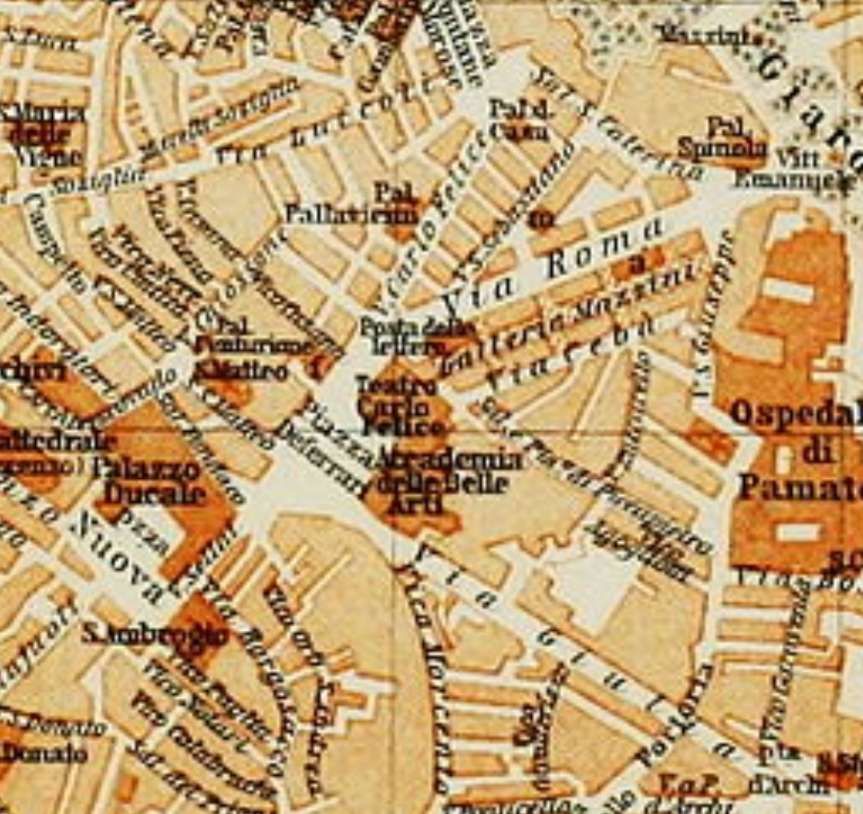
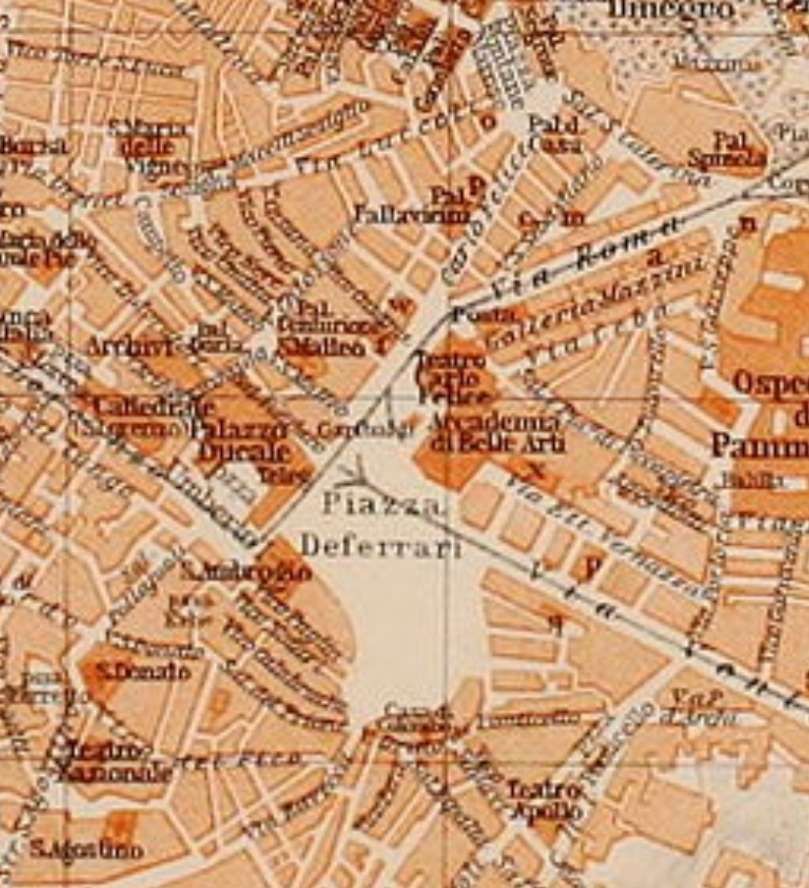
We begin this article with a look at maps of the Piazza Raffeale de Ferrari and its immediate environs over the years around the turn of the 20th century. The Piazza became one of two focal points for tramways in the city (the other was Caricamento).

I found the series of maps interesting and they provoked a desire to find out more about the network of horse-drawn and later electric trams and tramways of Genoa. ….

This map of 1886 shows the Piazza Raffeale de Ferrari a little to the left of the centre. Via Carlo Felice runs away from the Piazza to the North-northeast, Via Roma to the Northeast. The map extract is taken from the Italy Handbook for Travellers of 1886 produced by Karl Baedeker, © Public Domain. [10]
This map of 1906 is taken from Karl Baedeker’s Italy Handbook for Travellers. It shows an enlarged Piazza Raffeale de Ferrari, © Public Domain. [11]
This version of the map was produced for the 1913 Baedeker guide. This has tramways shown and the Piazza is beginning to take a shape that is more recognisable in the 21st century, © Public Domain. [12]

Italian Wikipedia informs us that: “The first public transport in Genoa was provided by a horse bus service linking the city centre and Sampierdarena, that started in 1873. In 1878, the French company Compagnia Generale Francese de Tramways (CGFT, French General Company of Tramways) began to build a horse tram system.” [16][17]

A map of the horse-drawn tramways operated by the French company Compagnia Generale Francese de Tramways, © Arbalete and licenced for reuse under a Creative Commons Licence (CC BY-SA 2.0). [19]

Towards the end of the century, the new urban plan led to the construction of new roads with wider carriageways, principal among these were:

  • Via Assarotti connecting Piazza Corvetto to Piazza Manin;
  • Via XX Settembre, built between 1892 and 1899, widening Strada Giulia and connecting the Palazzo Ducale (Piazza de Ferrari) with Porta Pila and the banks of the River Bisagno (once the eastern boundary of the city);
  • Corso Buenos Aires, once outside the city walls, was lowered to the level of Ponte Pila and the new Via XX Settembre, to form a single artery that would connect the centre with the Albaro district;
  • Corso Torino, perpendicular to Corso Buenos Aires.

After this work was done, the city began to look more modern and the widened streets made room for tramways in the centre and East of the city. The municipal administration began to plan new lines, both towards the eastern suburbs and in the central districts of the city. [19]

The city welcomed competition and set up a series of concessions which were given to different groups: the French Company kept the Western concession; Val Bisagno and the hilly areas to two Swiss businessman (Bucher & Durrer); and the east of the city was granted to a group of local businessmen. [19][20: p66]

The two parties, other than the French, formed companies:  Bucher created the Società di Ferrovie Elettriche e Funicolari (SFEF) in 1891. [20: p85] The Genoese entrepreneurs founded the Società Anonima Tramways Orientali (SATO) in 1894. [20: p120] The two companies took on the two concessions which envisaged electric traction on metre-gauge lines to accommodate running on the narrow winding streets of the city centre. [19]

By 1894, SFEF had achieved no more than a single short electric tram line between Piazza Manin and Piazza Corvetto, whilst SATO had not progressed beyond the planning stage. The CGFT system had extended through the city and the Val Polcevera, but was still horse operated.” [16][17]

In 1894, the German company Allgemeine Elektrizitäts Gesellschaft (AEG) … bought both the SFEF and SATO companies. The following year AEG created the company Officine Electrical Genovesi (OEG), … which took over the city’s existing electricity supply company, and the Società Unione Italiana Tramways Elettrici (UITE), … which purchased the CGFT’s concession. By the end of 1895, AEG had a monopoly of both electricity supply and public transport provision in the city.” [16][17] Under AEG’s “ownership, SFEF and SATO developed a tram network of more than 53 km (33 mi) reaching Nervi and Prato, whilst UITE electrified their lines to Voltri and Pontedecimo.” [16][17]

As we have already noted, the first electric traction line connected Piazza Corvetto to Piazza Manin, running along Via Assarotti. [20: p92] It was activated by SFEF on 14th May 1893 [20: p96] The single-track line was 800 metres long and ran on a constant gradient of 7% [20: p95]; the tickets cost 10 cents. The electrification (600 V DC) was via an overhead cable and was carried out by AEG of Berlin, which, as we have already seen, later acquired a significant shareholding in the company. [19][20: p86-87]

In subsequent years the SFEF network expanded rapidly; in 1895-96 the Monte line to the North of the city centre entered into service, including the Sant’Ugo spiral tunnel; in 1896 the line from Piazza Principe to Piazza Brignole was born. It included two tunnels in the Castelletto area. [21: p20] , In 1897, the Val Bisagno line up to Prato began operation. [19][21: p26]

The first SATO line entered into service on 26th July 1897, connecting Piazza Raibetta to Staglieno through the Circonvallazione a Mare, [20: p122] followed two years later by the long coastal line to Nervi. [20: p127] In 1900 the eastern trams reached the central Piazza de Ferrari, travelling along the new Via XX Settembre which was formed through widening of the old Via Giulia. [19][21: p53]

The two networks, SFEF and SATO, were technically compatible and the two companies, both controlled by AEG, soon unified the two networks. [20: p142]

Finally in December 1901, AEG merged SFEF and SATO into an enlarged UITE.” [16][17]

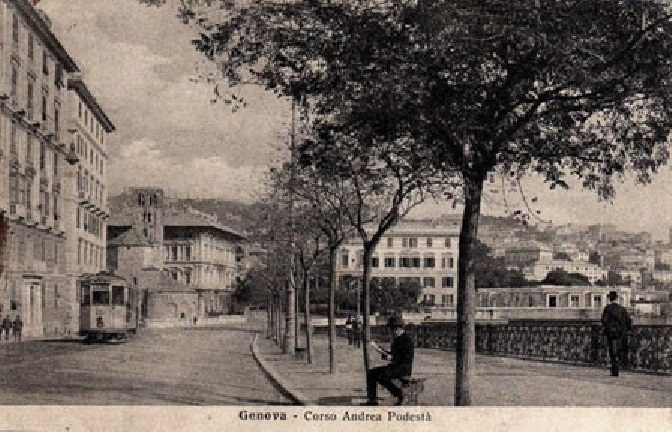
An early postcard image showing a tram at work on Corsa Andrea Podesta, © Public Domain. [19]
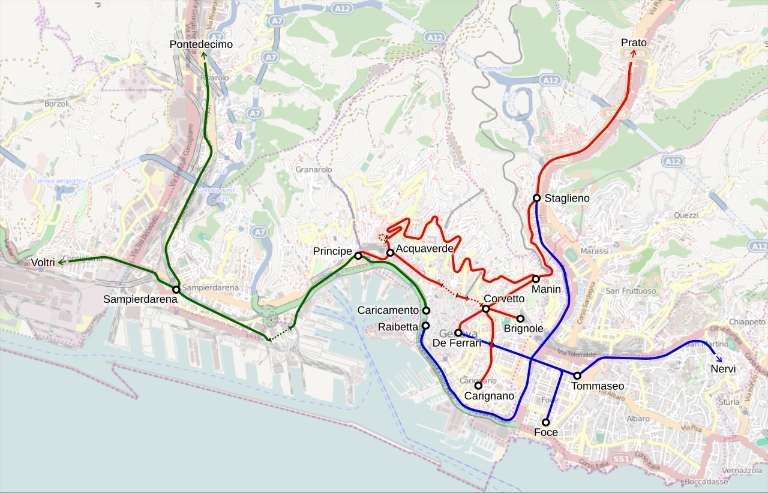
This map shows the three companies’ lines immediately prior to the date of unification under UITE. The Green lines were UITE (the former French Company). The Red lines were SFEF. The Blue lines were SATO, © Arbalete and authorisedd for reuse under a Creative Commons Licence (CC BY-SA 2.0. [19]

The enlarged UITE found itself managing 70 km of network, divided between the 30 km of the ‘Western network’: (formerly the French Company) and the 40 km of the ‘Eastern network’ (formerly SFEF and SATO). [20: p170-171] The unification of the network led to an increase in overall traffic, symbolised by the creation of the vast ring terminus in Piazza de Ferrari in 1906. [20: p129]

This seems the right time to look again at the ‘ring terminus’ in Piazza de Raffeale Ferrari. ….

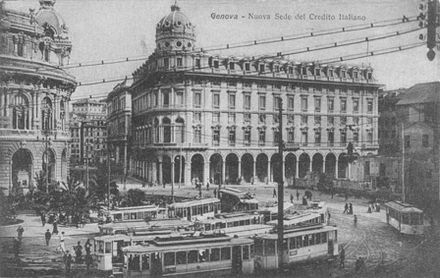
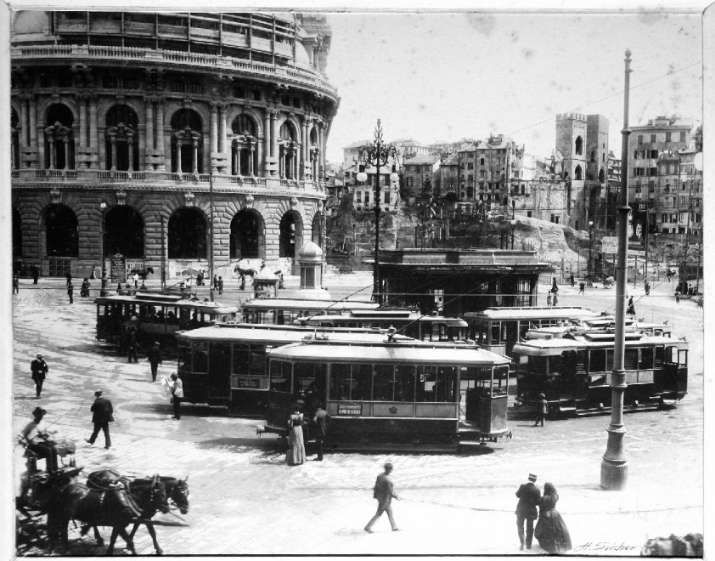
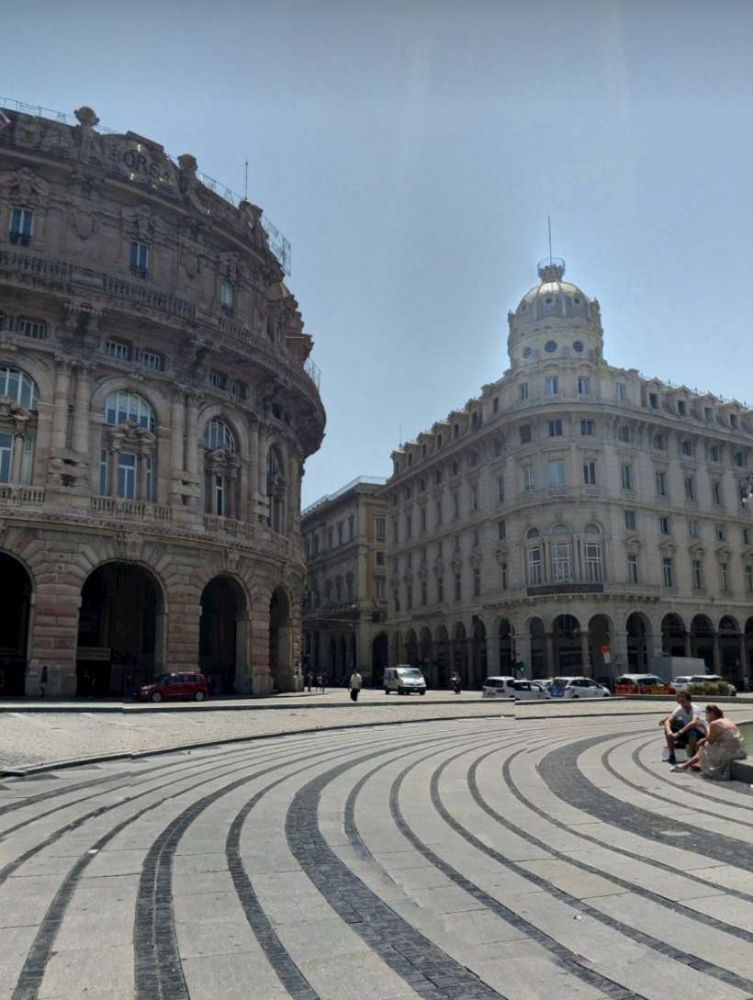
Trams on Piazza Raffeale de Ferrari Genoa (Genova), © Public Domain. [1]
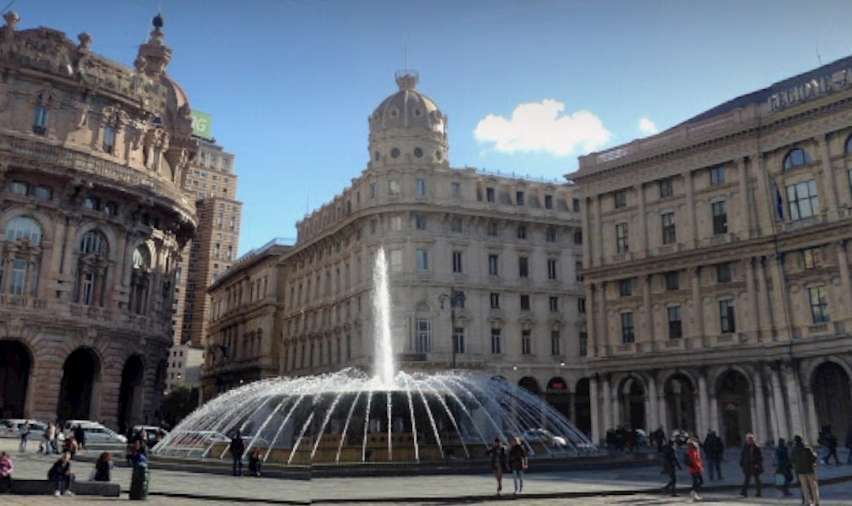
A similar view in the 21st century. [Google Streetview, 2015]
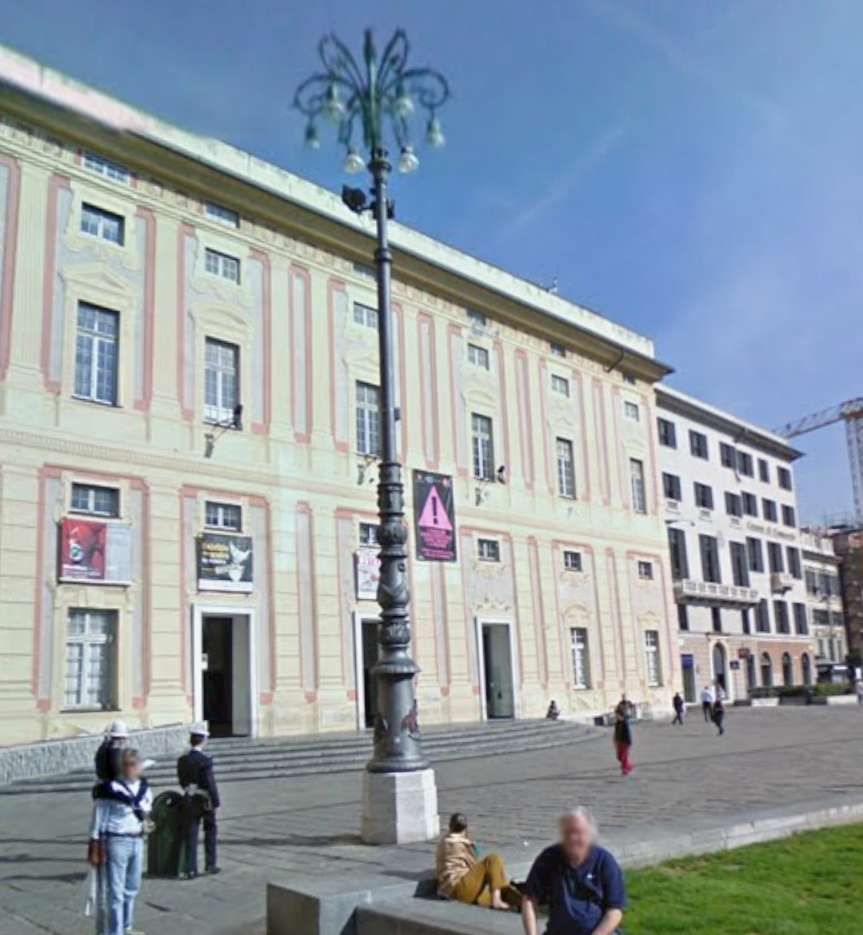
Trams on Piazza Raffeale de Ferrari, Palazzo Ducale is on the left of the photograph, © Public Domain. [7]
A ground-level view from a similar location.  [Google Streetview, 2009]
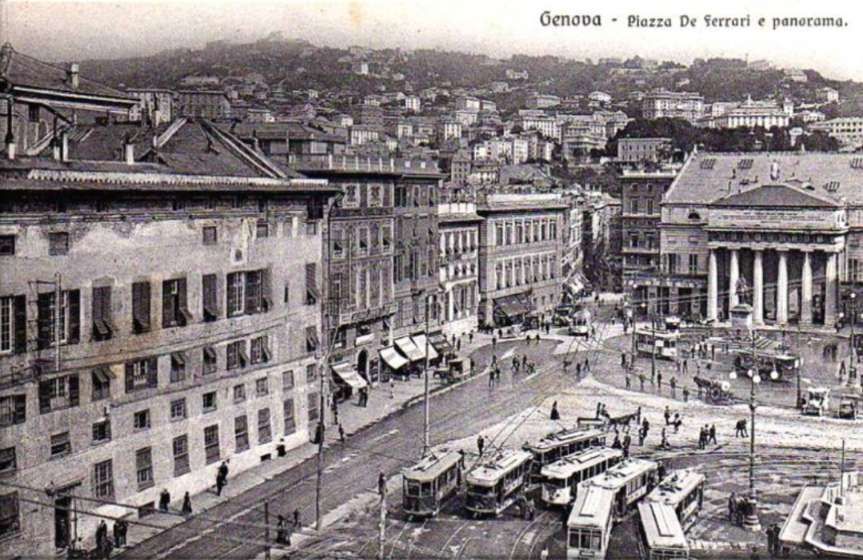
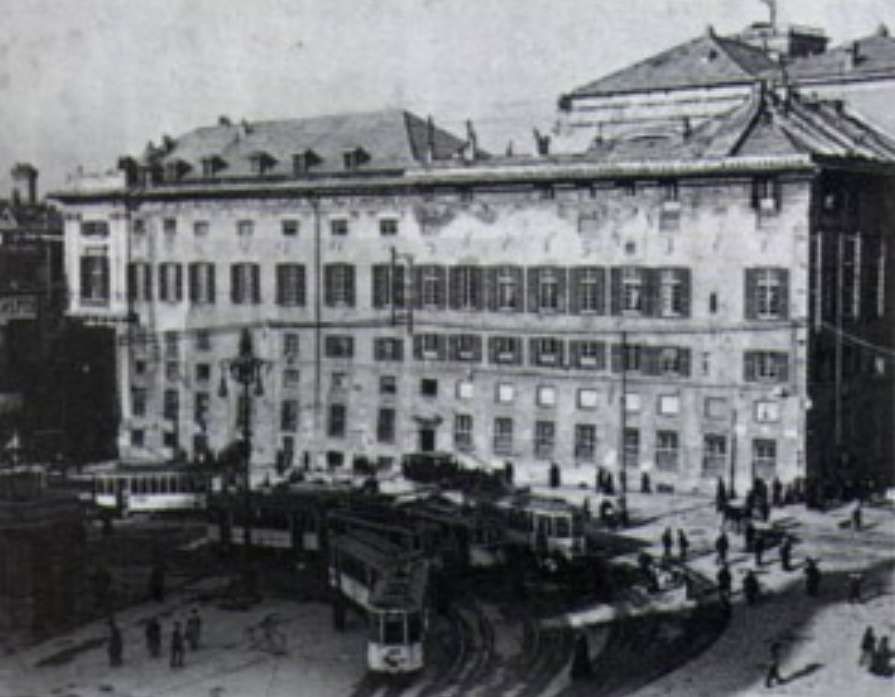
Another view of Piazza Raffeale de Ferrari and of Palazzo Ducale, © Public Domain. [8]
A similar view of Palazzo Scale from ground-level across the Piazza Raffeale de Ferrari. [Google Streetview, 2015]
Also on Piazza Raffeale de Ferrari, trams gather again! But when is this? The building to the right in the image below is not present in this image, yet is present in the image of the Piazza earlier in this sequence of images, © Public Domain.
From a similar direction as the image above. The building on the left is very much the same as the building on the left in the monochrome image above. Was that monochrome photo taken prior to the building on the right being built, or was the building destroyed during the First World War and then rebuilt at a later date? [Google Streetview, 2016]
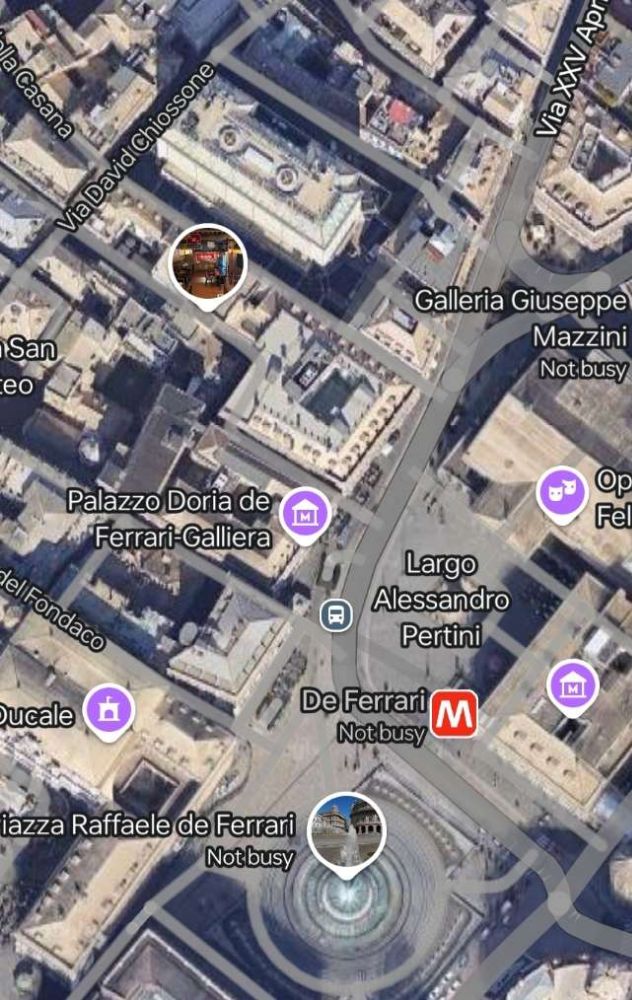
The Piazza Raffeale de Ferrari in the 21st century. North of the piazza, at the top-right of this image two streets run out of the piazza. Via Roma curves away to the Northeast and what was Via Carlo Felice (now Via XXV Aprile) heads North-northeast. [Google Maps, November 2024]
Piazza Raffeale de Ferrari, Via Roma (to the right of the building on the right side of this image), and Via Carlo Felice (now Via XXV Aprile), © Public Domain. [7]
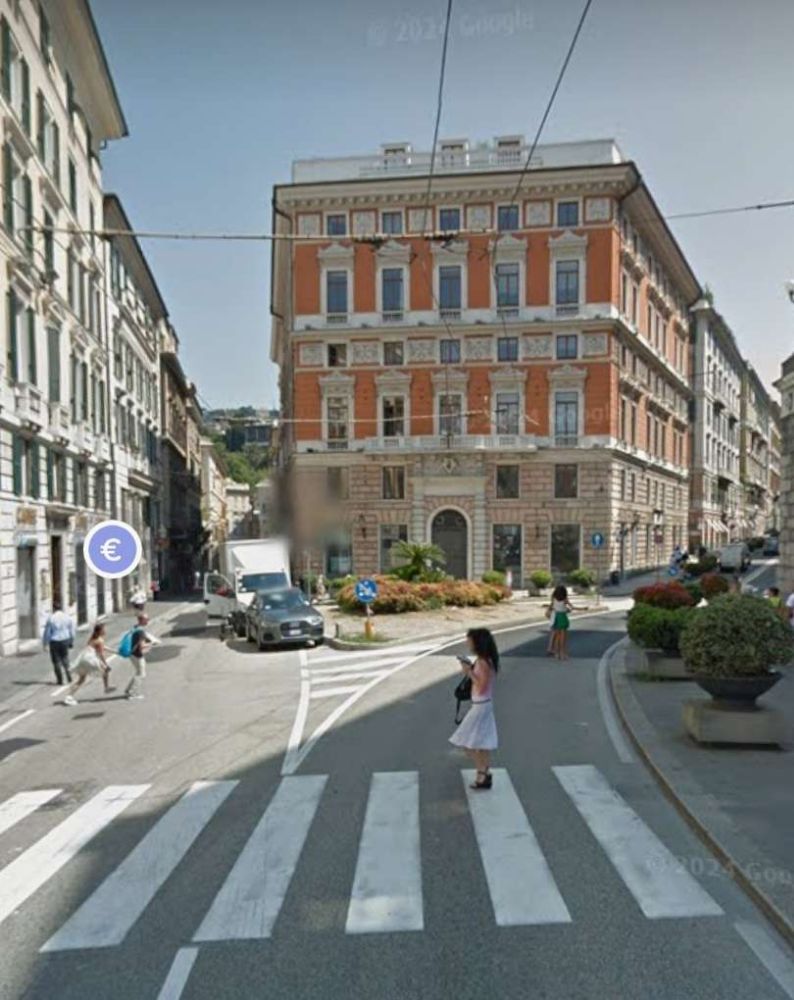
The same location in the 21st century. Via Roma is on the right side of the building at the centre of this image. Via XXV Aprile (once Via Carlo Felice) is on its left. [Google Streetview, July 2015]

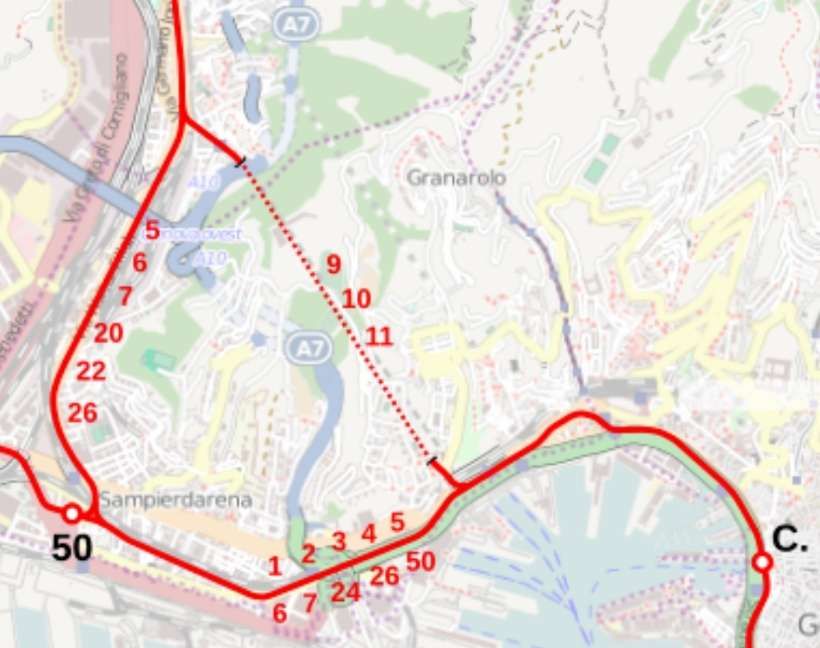
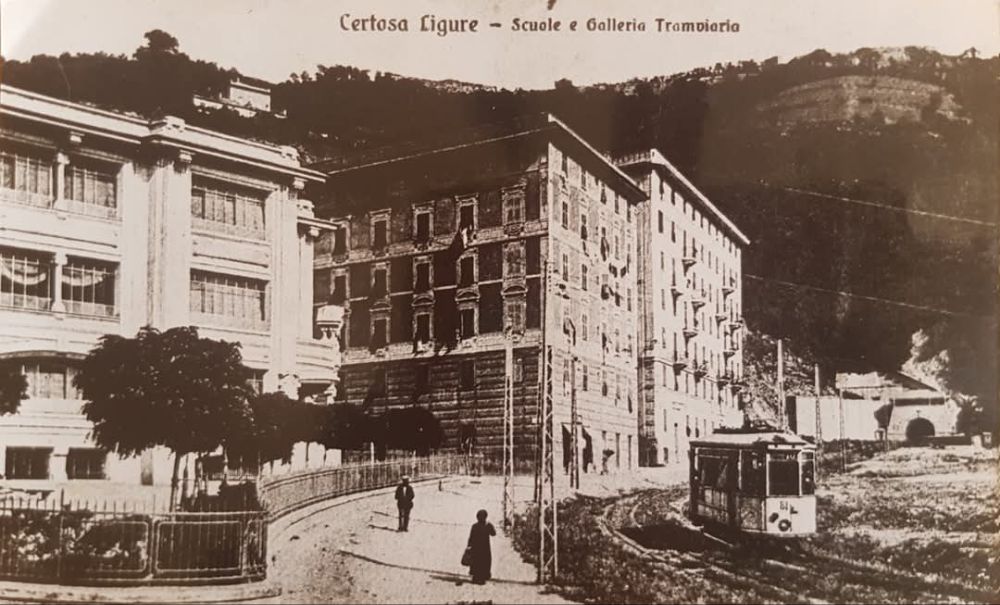
In 1908, after three years of construction work, Galleria Certosa (Certosa Tunnel) was put into use. It facilitated tram journeys to and from the Polcevera valley, avoiding the crossing of San Pier d’Arena. [19][21: p38] The tunnel connected Piazza Dinegro, in the port area, to the Rivarolo district in Val Polcevera. It was 1.76 km long. [22]

In 1934, Galleria Certosa was used every day by five lines: Tram No. 9 (San Giorgio-Rivarolo), tram No. 10 (San Giorgio-Bolzaneto), tram No. 11 (San Giorgio-Pontedecimo) and the two circular lines between San Giorgio and Sampierdarena. [22]

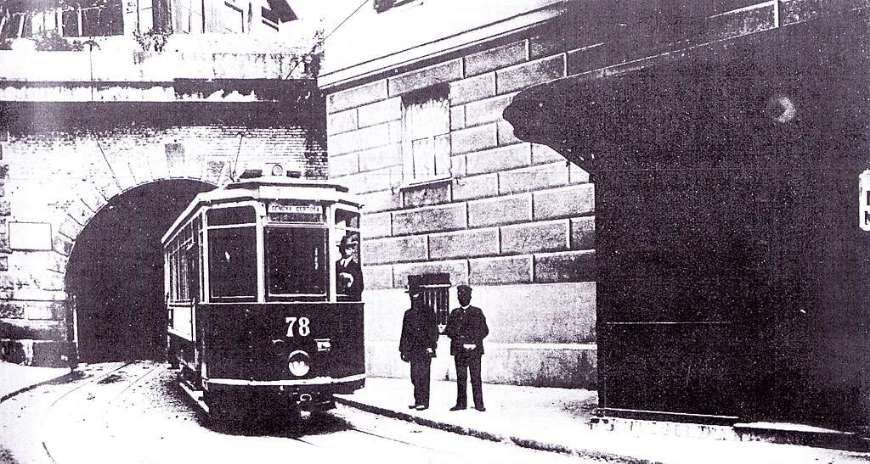
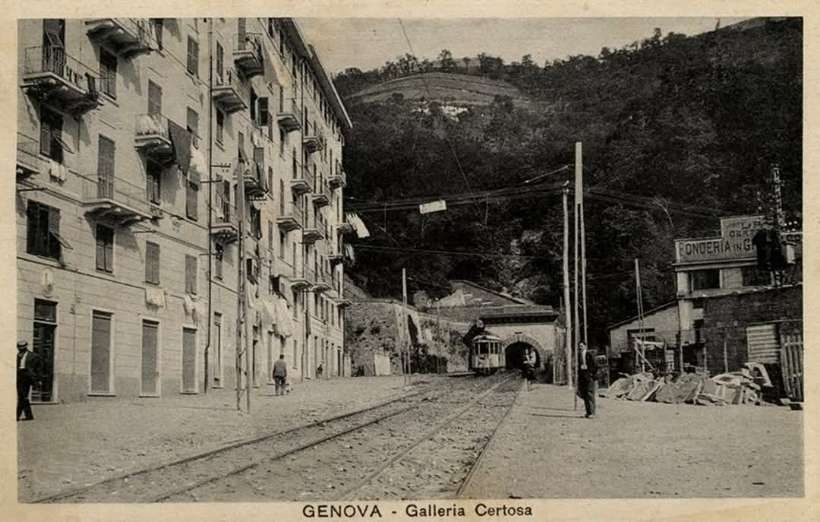
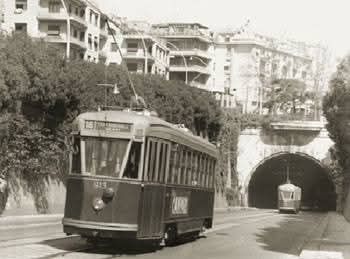
Tram No 78 at the southern entrance to Galleria Certosa, © Public Domain. [22]
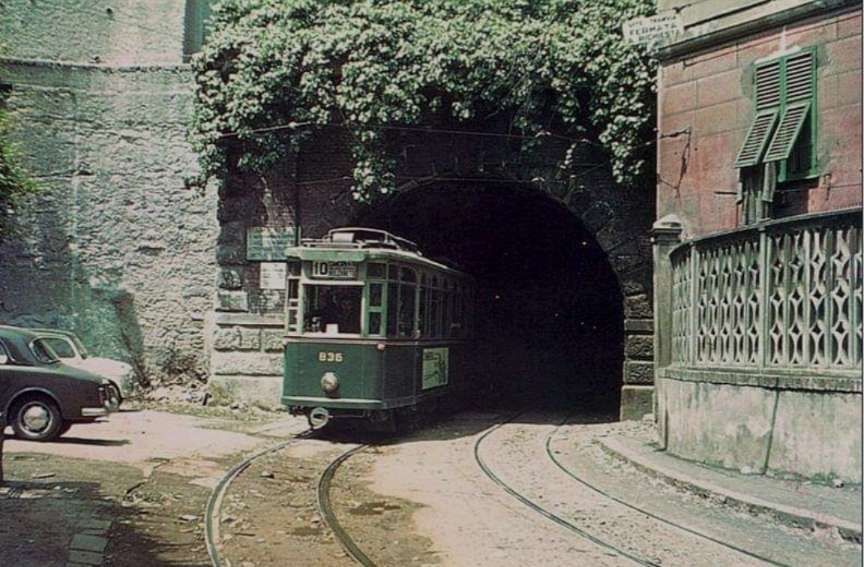
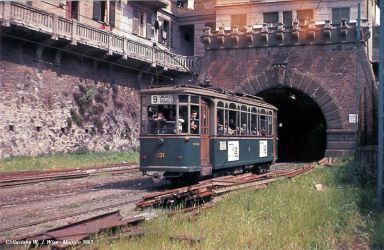
In the mid-20th century, Tram No 836 providing the No.10 service exits the South Portal of the tunnel. This image was shared by Paolo Siri on the Sei di Certosa Se … Facebook Group on 2nd February 2014. [23]
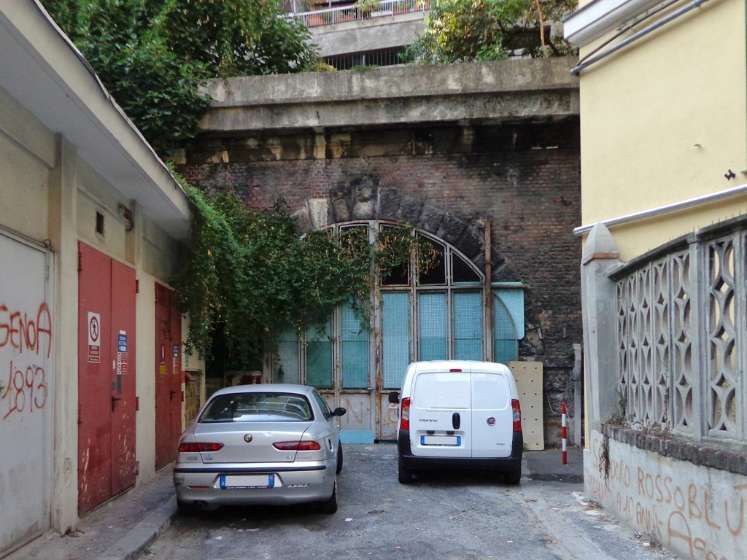
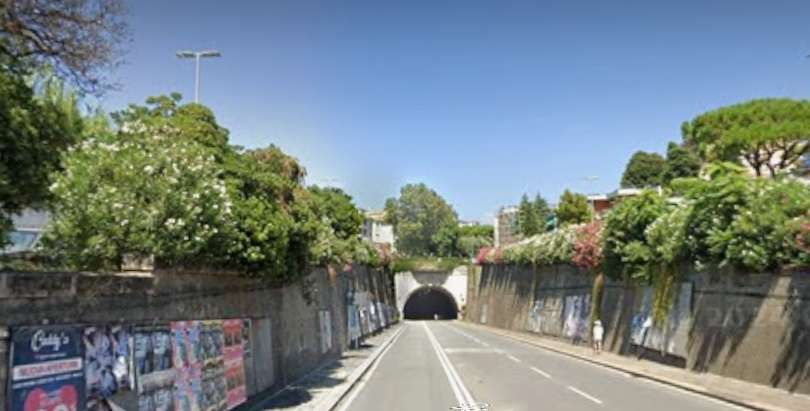
The South Portal (seen in the monochrome image above) is no longer in use, © Arbalete and authorised for reuse under a Creative Commons Licence (CC BY-SA 3.0) [22]
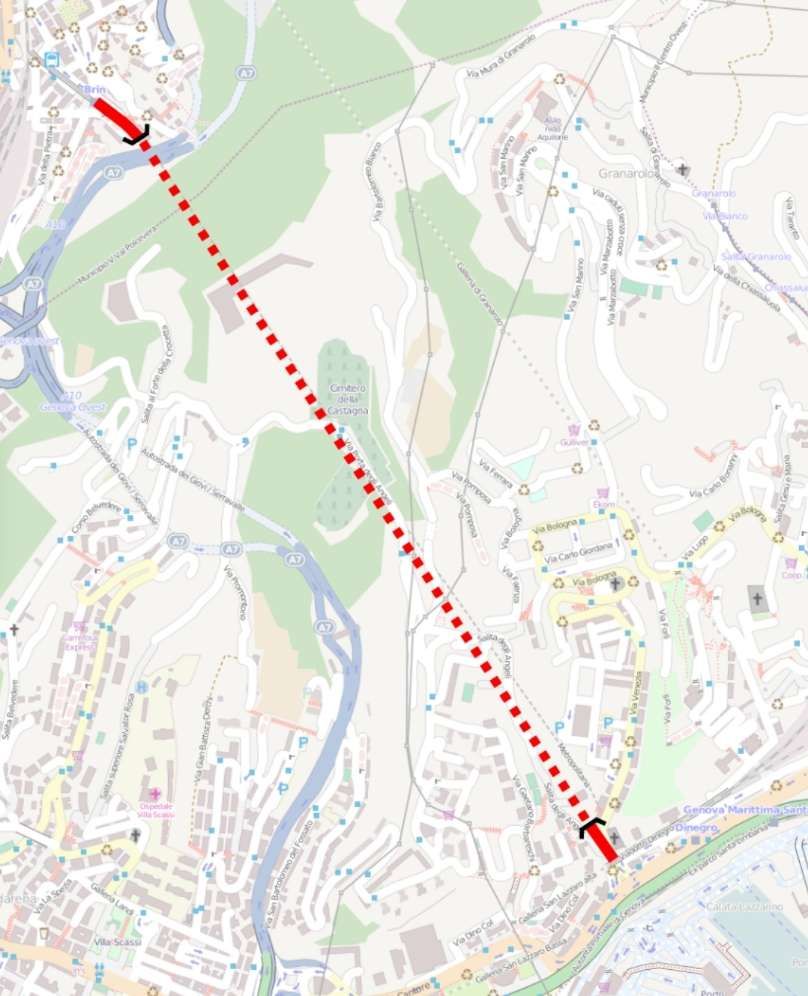
Galleria Certosa was a lengthy tunnel. It is shown here superimposed on a modern map of Genoa, © Arbalete and authorised for reuse under a Creative Commons Licence (CC BY-SA 3.0) [22]
A view looking towards Galleria Certosa from some distance to the Northwest through the site of what became Brin Metro Station. This image was shared on the Foto Genova Antica Facebook Group on 28th September 2020 by Pietro Spanedda, © Public Domain. [37]
Tram service No. 9 (Tram No. 831(?)) is about to enter the North portal of the tunnel. This image comes from the mid-20th century. [24]
The North Portal of Galleria Certosa. Much of the tunnel is now used by the Metro. Brin Metro Station is immediately behind the camera, © Arbalete and authorised for reuse under a Creative Commons Licence (CC BY-SA 3.0) [22]

Tram Tunnels (Galleria)

Having noted the construction of Galleria Certosa in the early years of the 20th century (above), it is worth looking at some other tunnels which were built to facilitate the movement of trams.

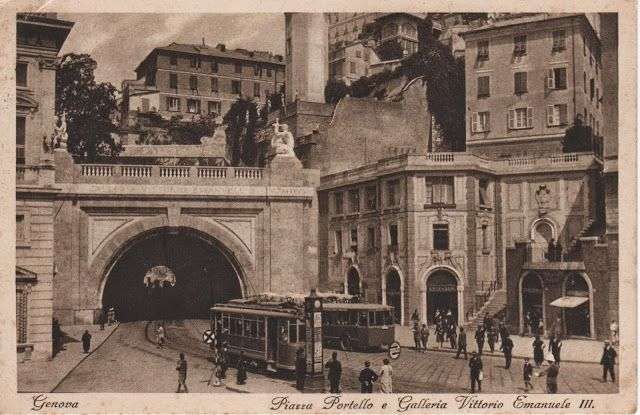
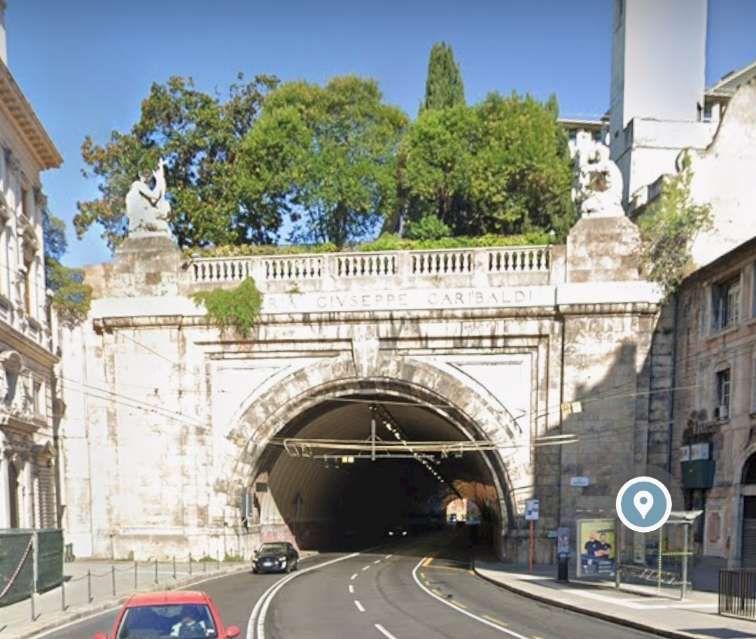
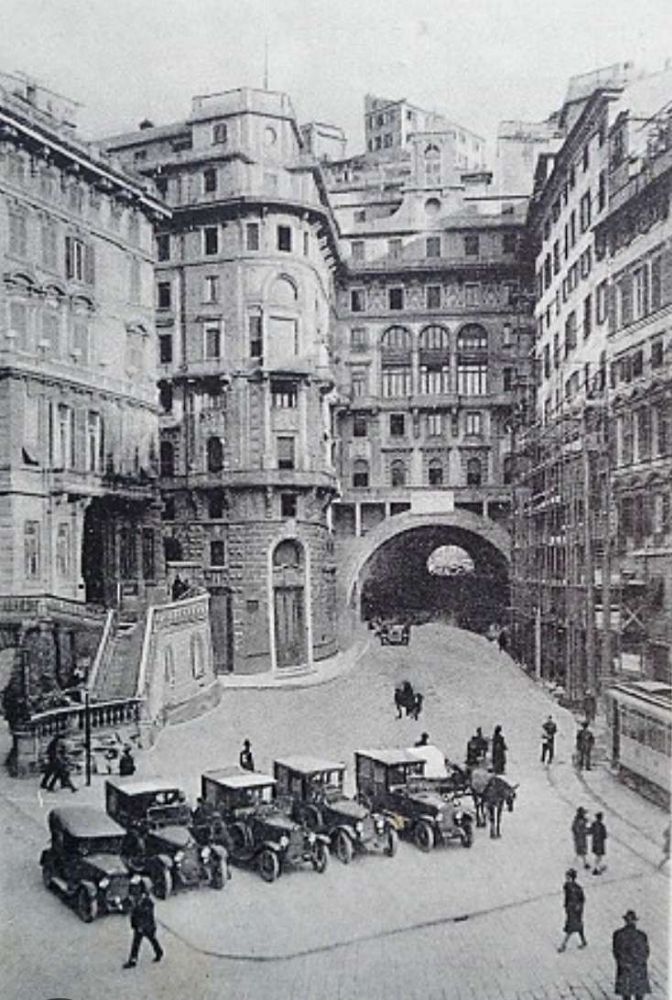
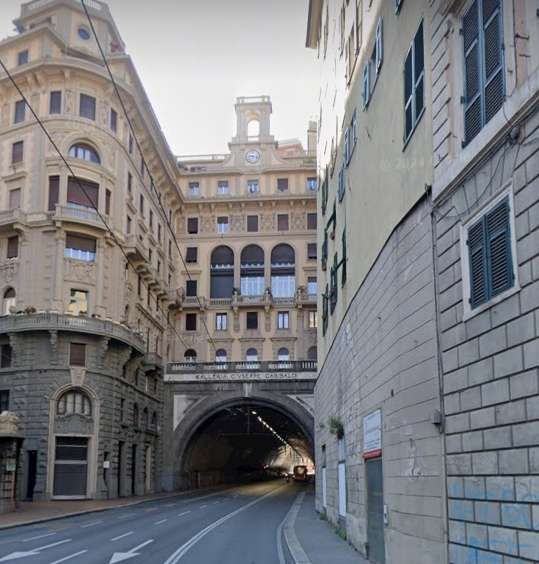
Galleria Vittorio Emanuele III (renamed Galleria Giuseppe Garibaldi on 27th November 1943)

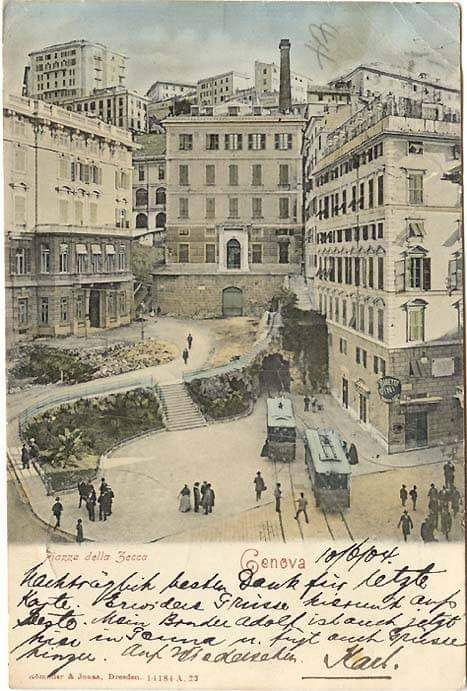
There seems to be quite a story to the life of this tunnel! The first two photographs show the first tunnel. They focus on the portal in Piazza Della Zeccan.

Piazza della Zecca with trams approaching and leaving a single track tunnel on the line of what will be Galleria Giuseppe Garibaldi. Piazza della Zecca has still not reached its fullest extent and the tunnel portal still has to be constructed, © Public Domain. [70]
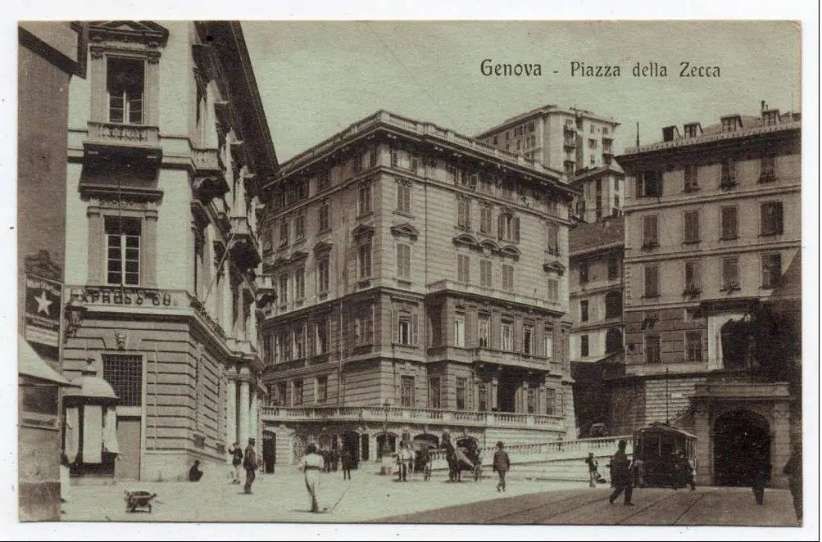
Piazza della Zecca in a more complete form but still with a single track tunnel. [71]

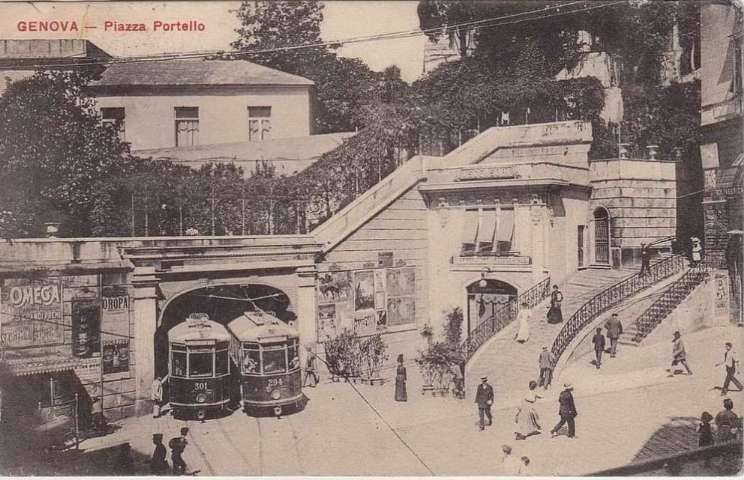
These next two photographs show the tunnel as it was first widened in the form which preceded the Galleria Vittorio Emanuele III which had a much smaller bore.

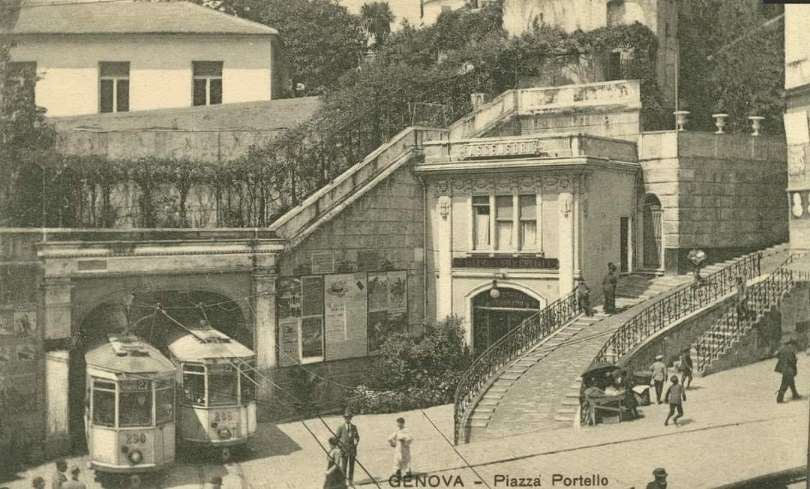
Two views of Piazza Portello with trams exiting and entering the Galleries which preceded Galleria Vittorio Emanuele III, © Public Domain. [38][39]
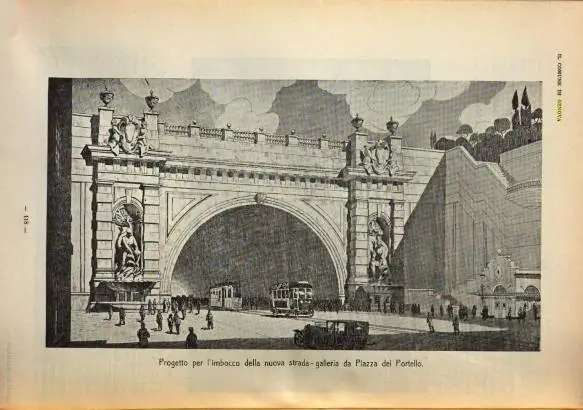
An engraving of the proposed Galleria Vittorio Emanuele III, © Public Domain. [26]
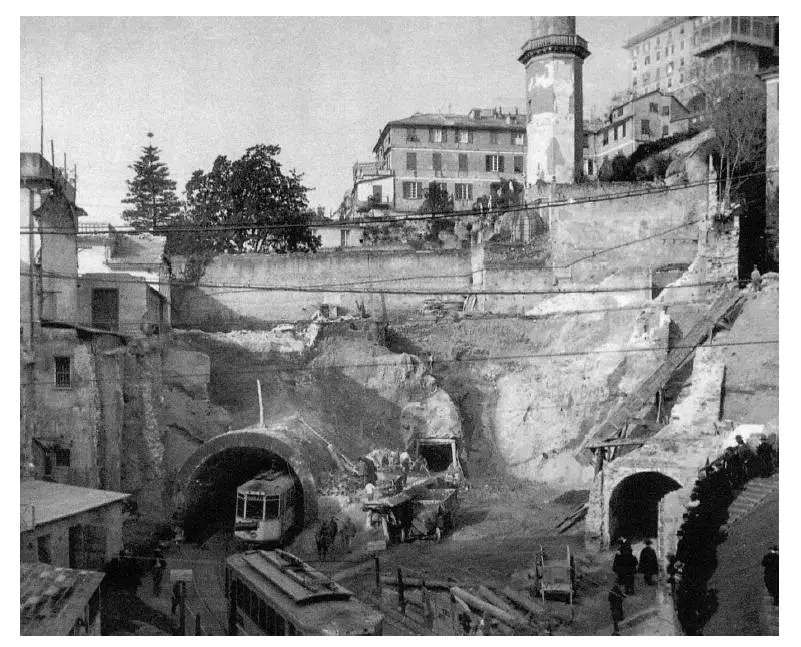
The Southeast end of Galleria Vittorio Emanuele III during construction with trams using the narrow older tunnel which preceded the larger bore seen on other photographs below, © Public Domain. [26]
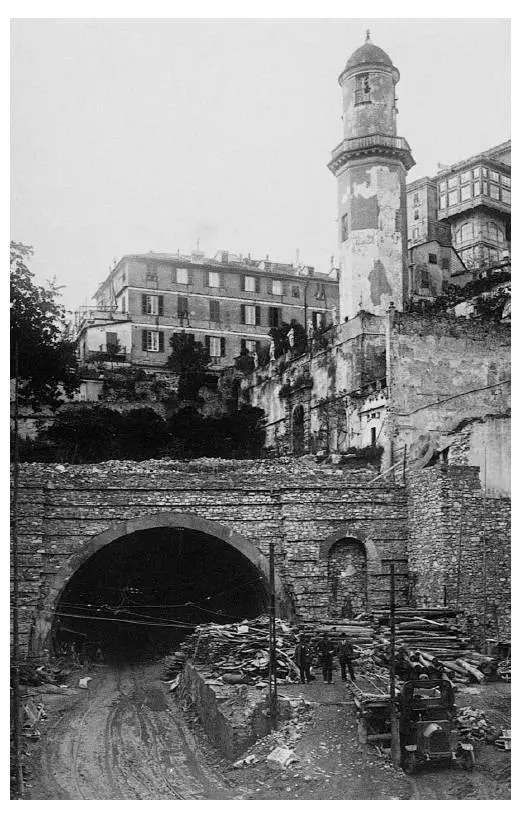
Galleria Vittorio Emanuele III later during construction work the full size bore is now complete but the decorative portal still has to be built, © Public Domain. [26]
A postcard view of the Southeast Portal of Galleria Vittorio Emanuele III (later Giuseppe Garibaldi), © Public Domain. [26]
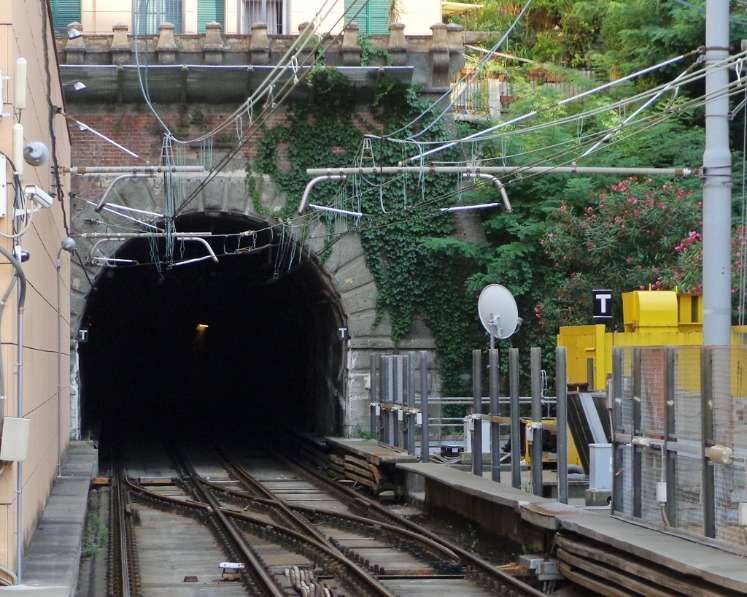
The Southeast Portal of Galleria Giuseppe Garibaldi in the 21st century. [Google Streetview, August 2024]
The Northwest Portal of Galleria Vittorio Emanuele III (later Giuseppe Garibaldi) soon after construction, © Public Domain. [25]
A 21st century view of the Northwest portal of Galleria Giuseppe Garibaldi. [Google Streetview, August 2024]

Galleria Sant’Ugo

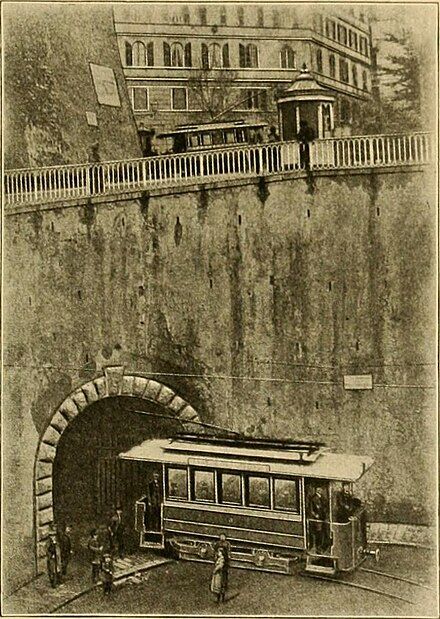
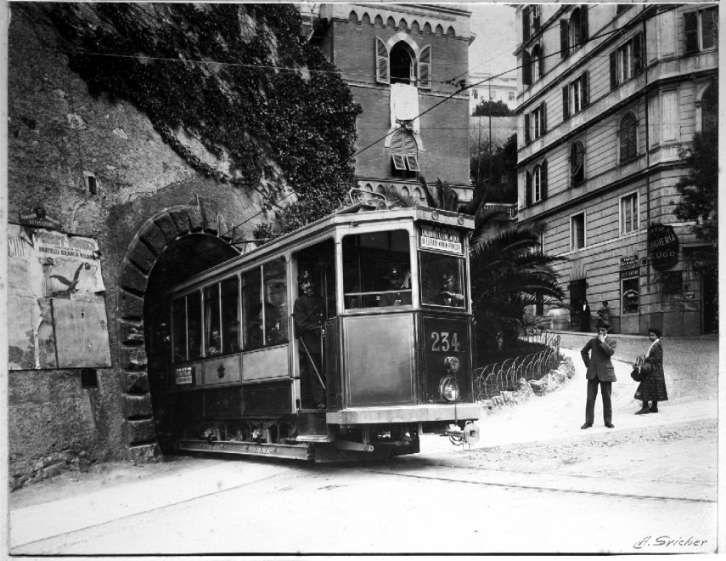
A tram at the lower Portal of Galleria Sant’Ugo, © Public Domain. [27]
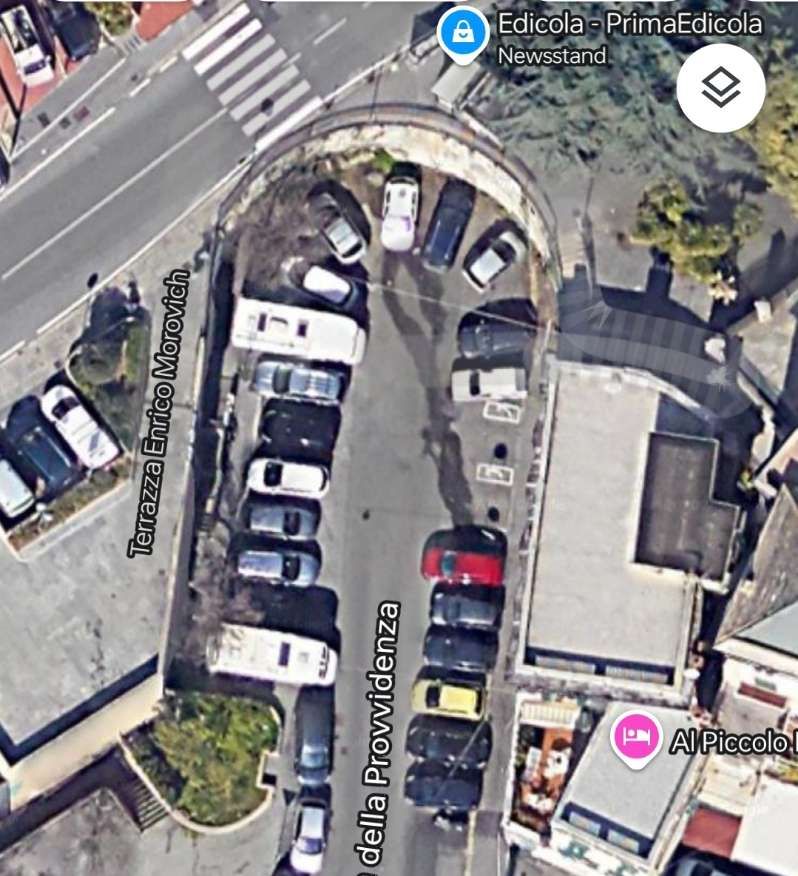
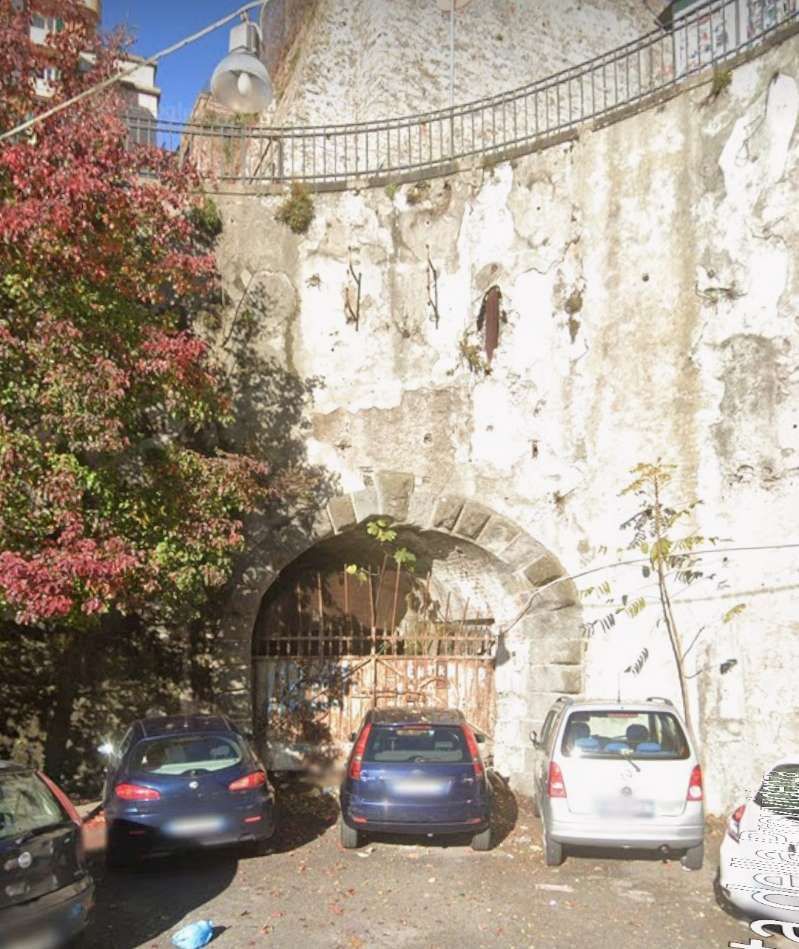
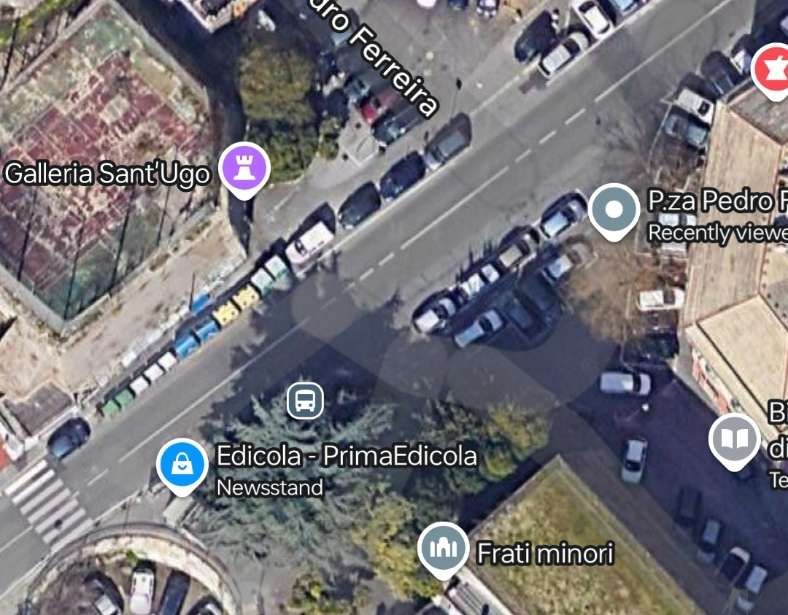
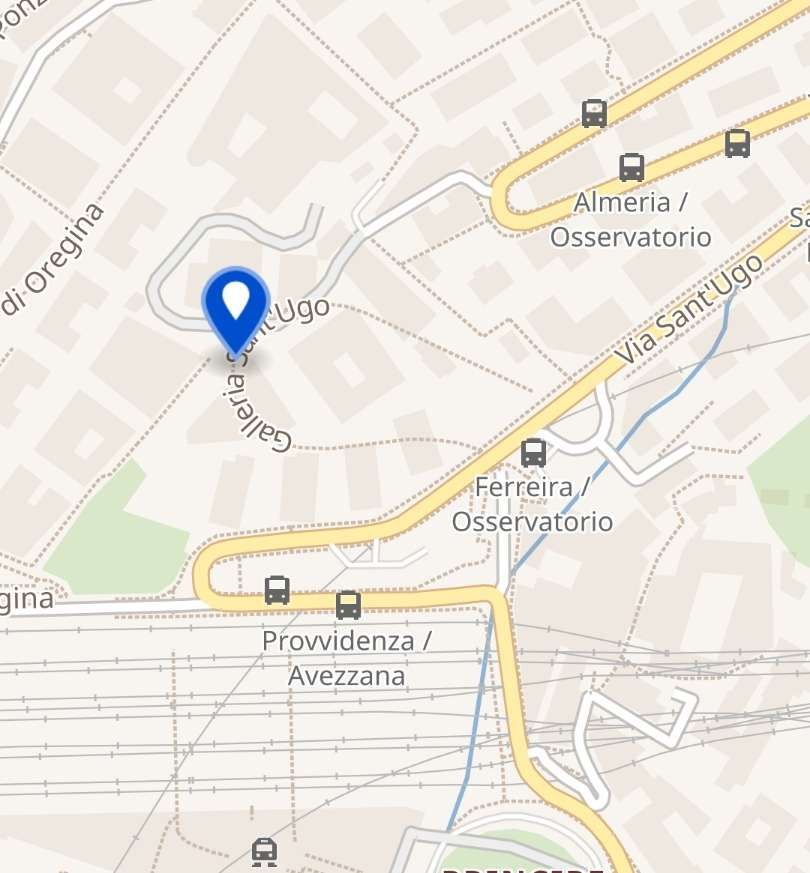
The route of Galleria Sant’Ugo appears on city centre maps North of Principe Railway Station. Its lower entrance was on Salita Della Provvidenza. Its upper entrance only a very short distance away to the Northeast but at a higher level in Piazza Ferreira. [27]
Galleria Sant’Ugo left the surface at the North end of Salita Della Provvidenza. [Google Maps, November 2024]
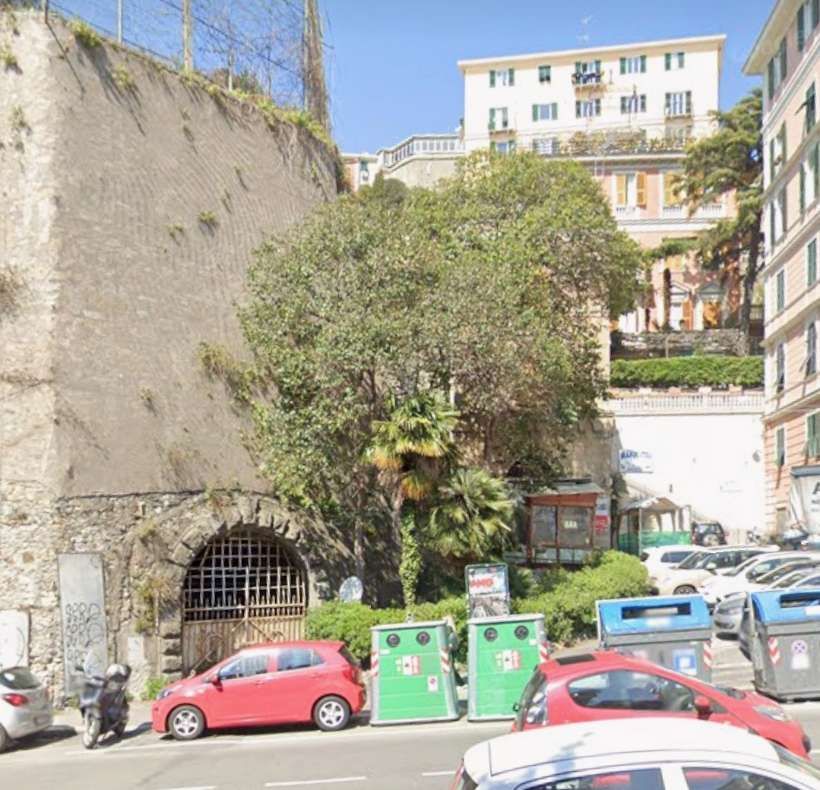
The lower entrance to Galleria Sant’Ugo in the 21st century. [Google Streetview, December 2020]
The Upper Portal of Galleria Sant’Ugo in Piazza Ferreira, © Public Domain. [28]
The upper (marked by the purple flag) and lower entrances of Galleria Sant’Ugo were geographically very close together! [Google Maps, November 2024]
The upper entrance to Galleria Sant’Ugo in Piazza Ferreira. [Google Streetview, August 2024]

Galleria Chrisoforo Colombo

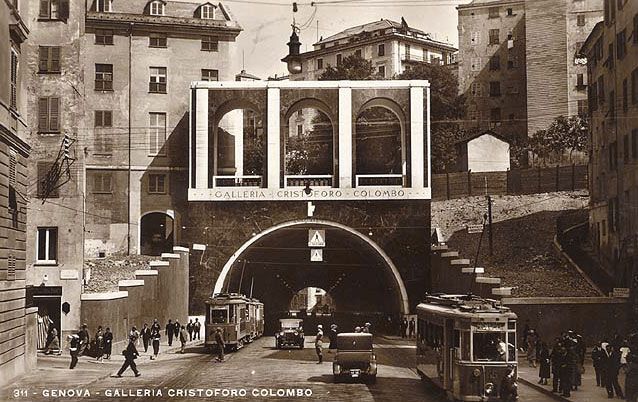
Named after Christopher Columbus, whose house was nearby, the gallery was opened to the public in the 1930s and was hailed as the city’s gateway to the sea. It connected Piazza de Ferrari and Piazza della Vittoria.

The Northwest Portal of Galleria Chrisoforo Colombo in its early years, © Public Domain. [28]
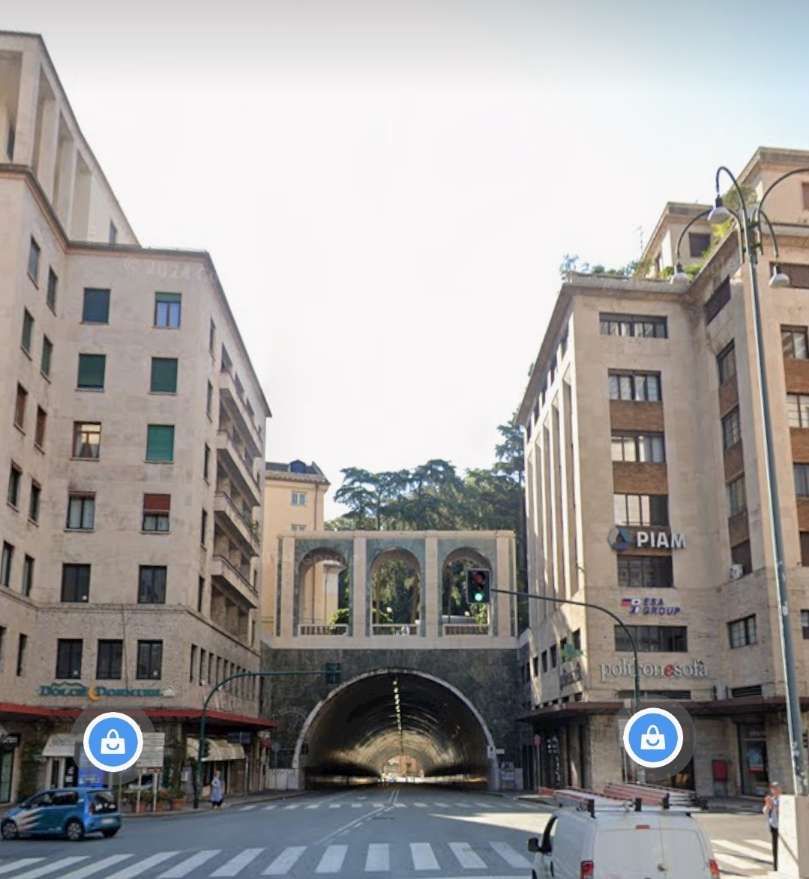
The Northwest Portal of Galleria Chrisoforo Colombo in the 21st century. [Google Streetview, August 2024]
The Southeast Portal of Galleria Chrisoforo Colombo in its early years, © Public Domain. [29]
The Southeast Portal of Galleria Chrisoforo Colombo in the 21st century. [Google Streetview, August 2024]
The blue flag points to the line of the Galleria Chrisoforo Colombo.
A closer view of the location.

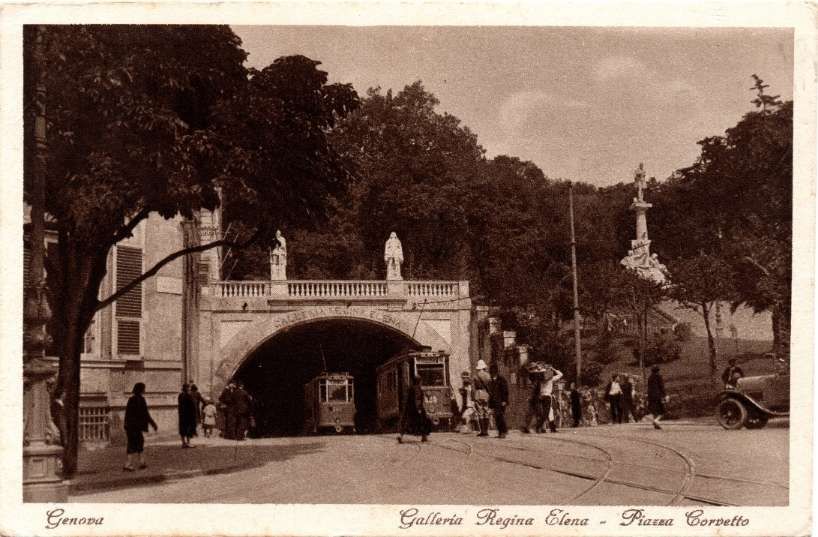
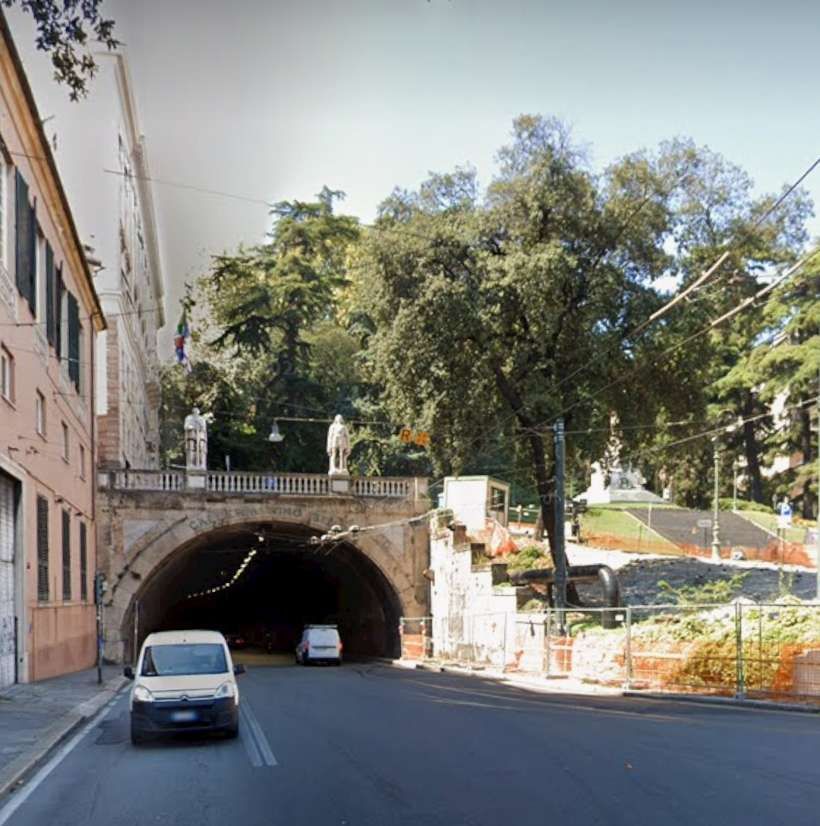
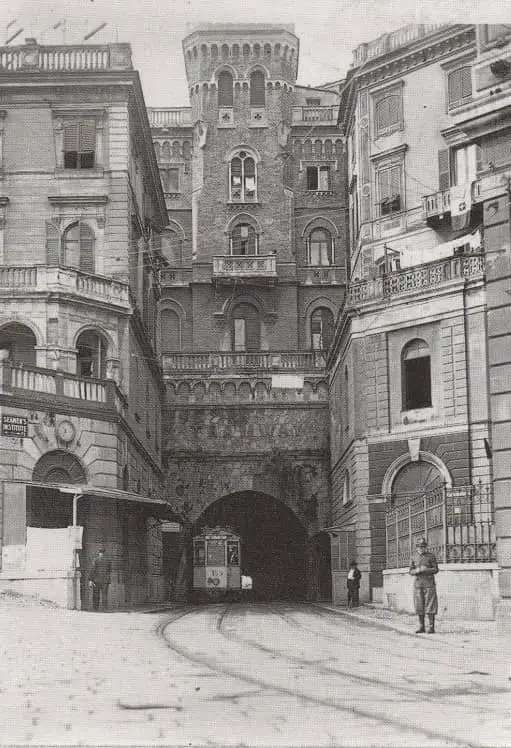
Galleria Regina Elena (today Nino Bixio)

The West Portal of Galleria Regina Elena (now Nino Bixio), © Public Domain. [30]
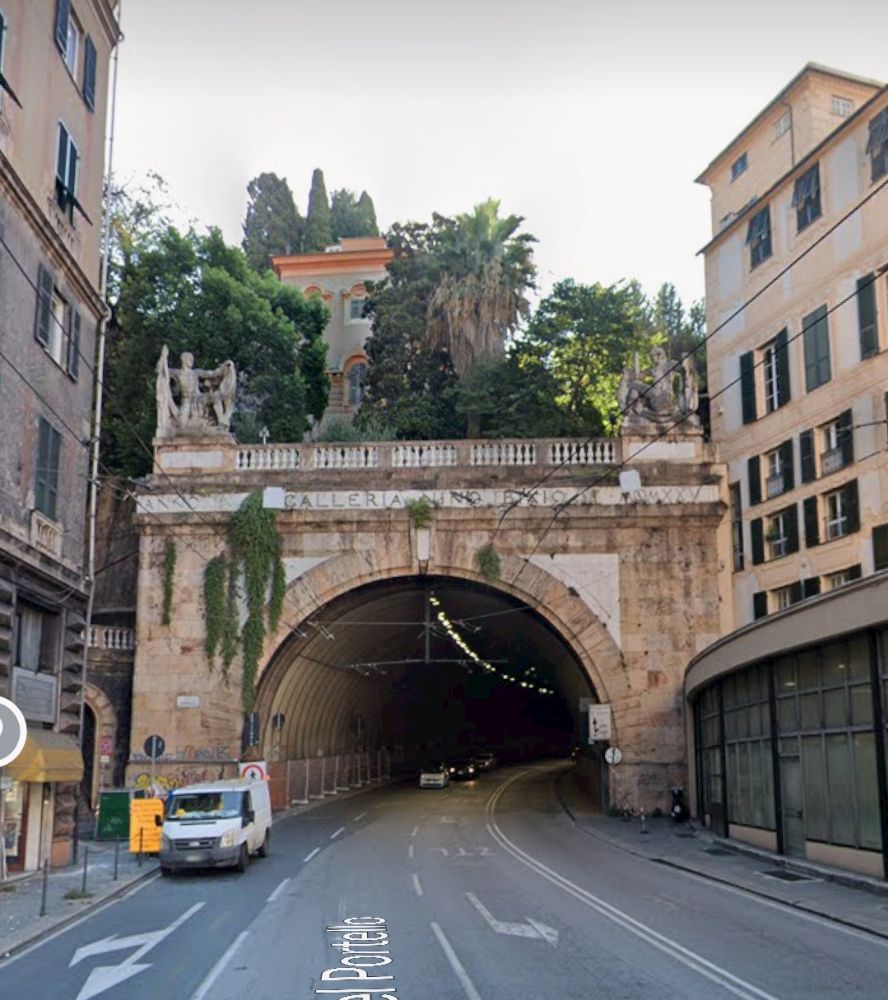
The West Portal of Galleria Nino Bixio in the 21st century. [Google Streetview, August 2024]
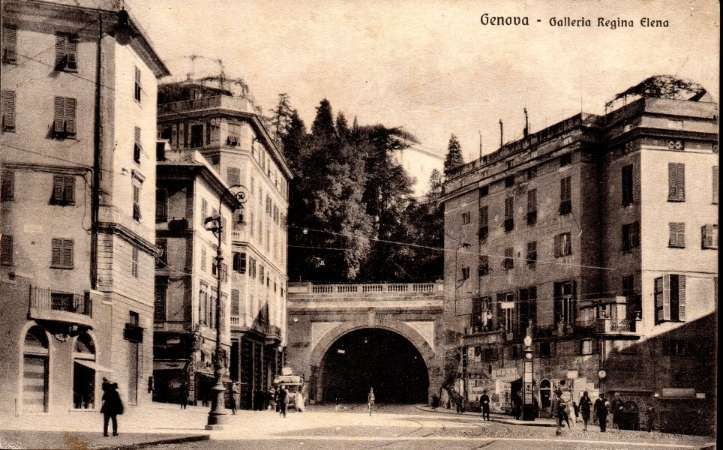
The East Portal of Galleria Regina Elena (now Nino Bixio), © Public Domain. [30]
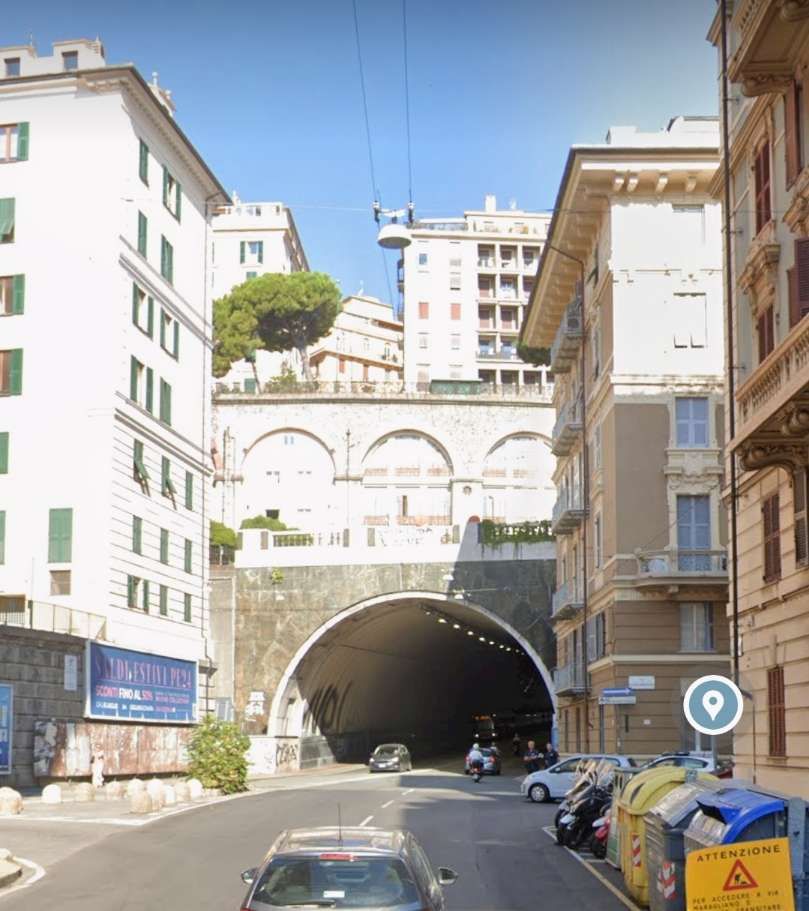
The East Portal of Galleria Nino Bixio in the 21st century. [Google Streetview, August 2024]
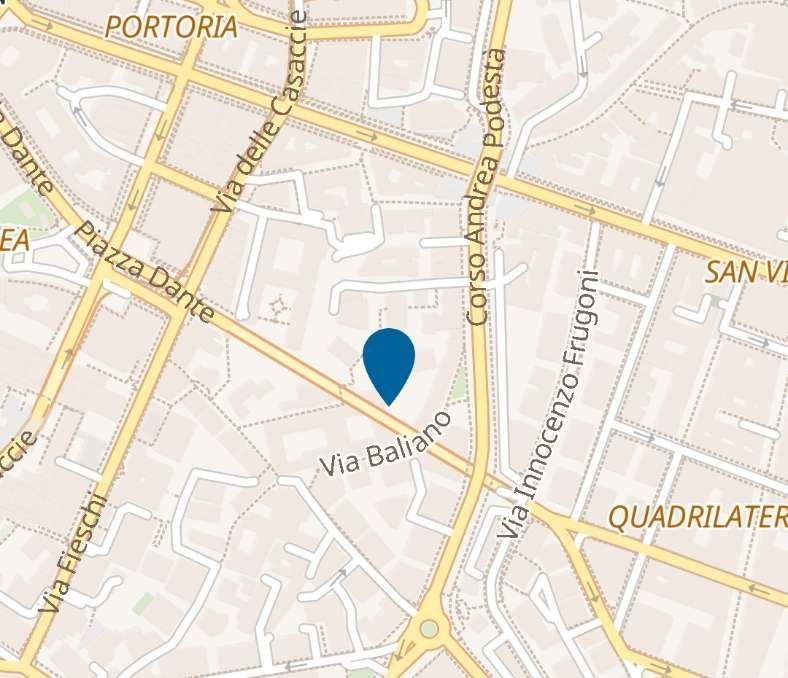
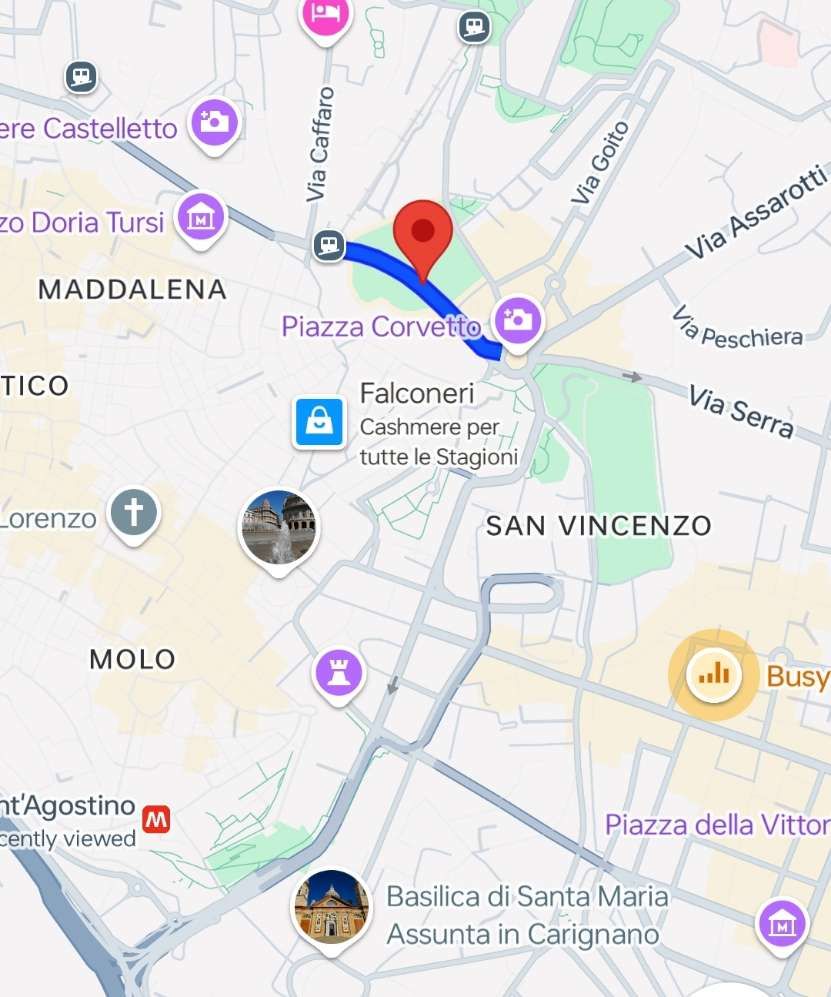
The location of Galleria Nino Bixio. [Google Maps, November 2024]

Galleria Dei Tram Via Milano

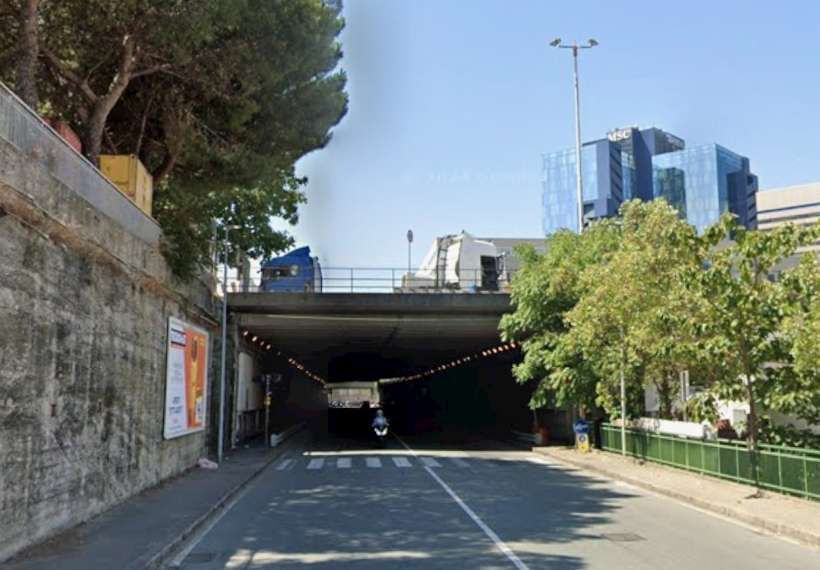
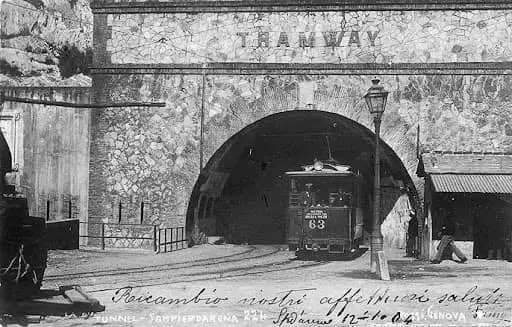
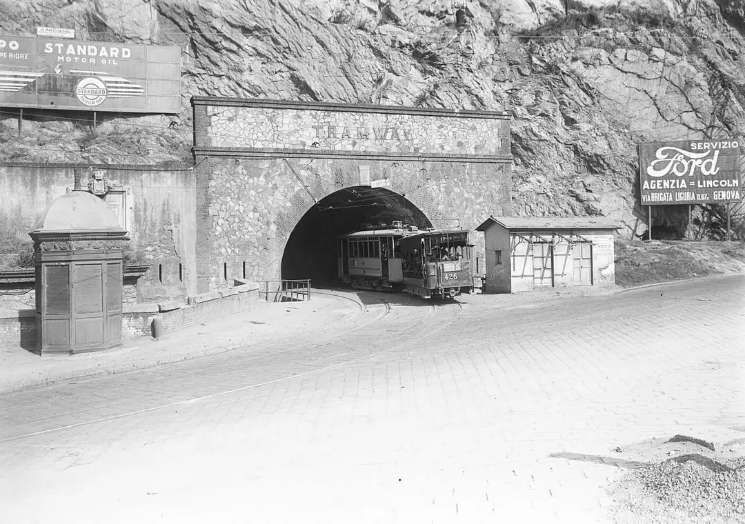
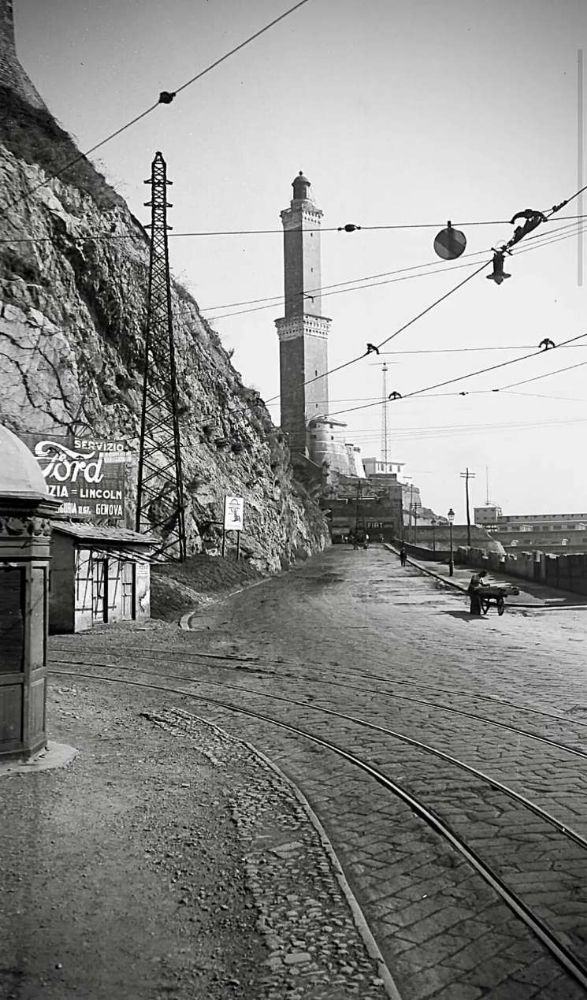
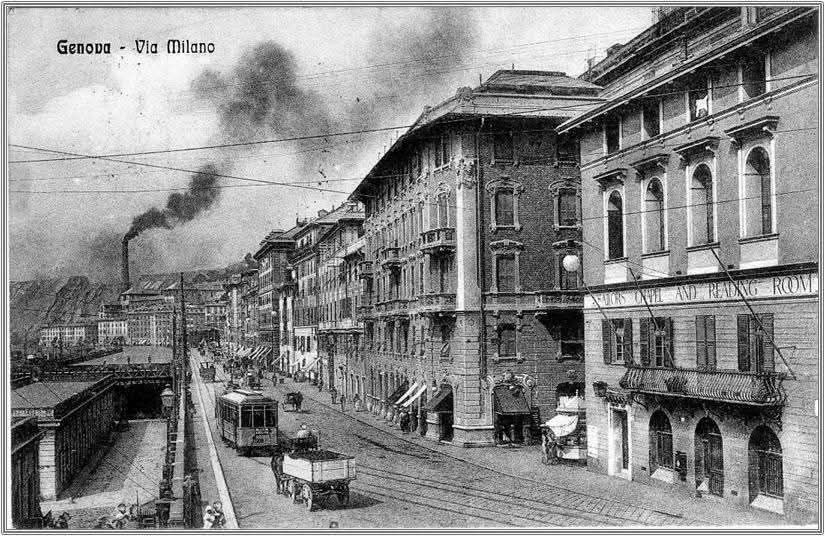
Now long gone, there was a tram tunnel on Via Milano to the Southwest of the city centre. It took the tramway (and roadway) under San Benigno Hill. It was.built in 1878 by the Compagnia Generale Francese dei Tramways for its horse-drawn trams. Its Southwest portal was in Largo Laterna. Its Northeast portal is shown in the first image below.

The Northeast portal of the Galleria on Via Milano before its demolition when the San Benigno Hill was raised to the ground. The three images below show the Southwest end of the tunnel. This image was shared by Silvia Brisigotti on the Foto Genova Antica Facebook Group on 3rd February 2024, © Public Domain. [34]
A similar location on Via Milano in the 21st century. There are no features to tie the two images together! [Google Streetview, August 2024]
Three different images showing the Southwest portal of the Galleria Via Milano and its immediate environment. The third of the images illustrates its proximity to Genoa’s (Genova’s) Lighthouse on Largo Laterna. These images were shared by Silvia Brisigotti on the Foto Genova Antica Facebook Group on 16th January 2024, © Public Domain. [35]
A similar location on Via Milano in the 21st century. The lighthouse can be seen on the right of this photograph. [Google Streetview, August 2024]

Until Galleria Certosa was constructed all tram services for the Western suburbs of the city had to pass through this tunnel.

Galleria Goffredo Mameli

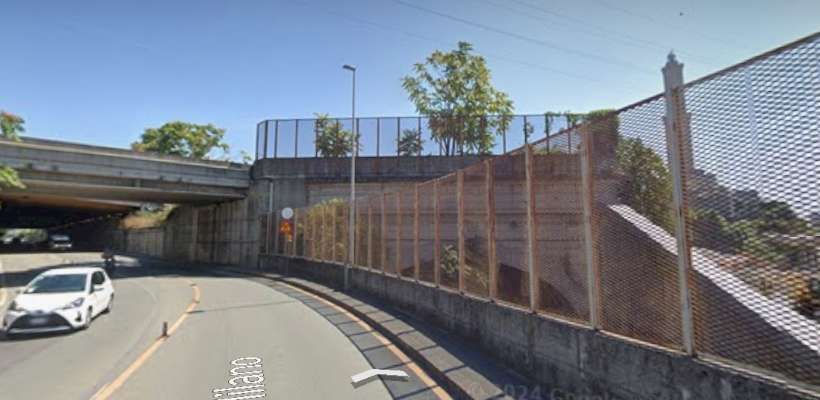
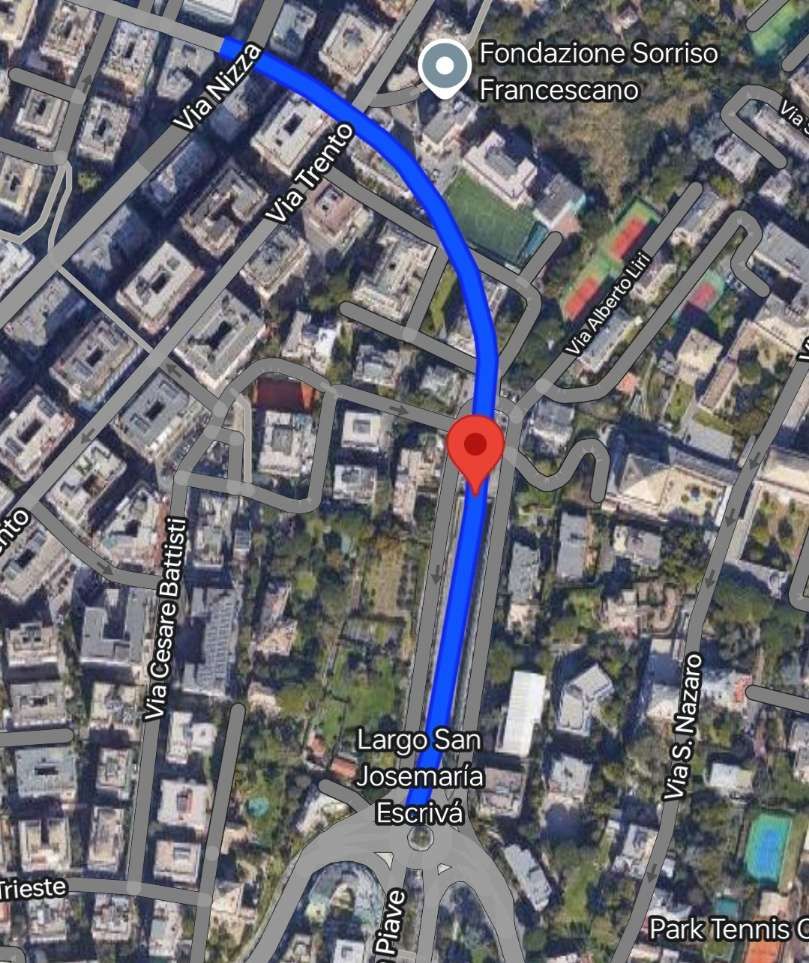
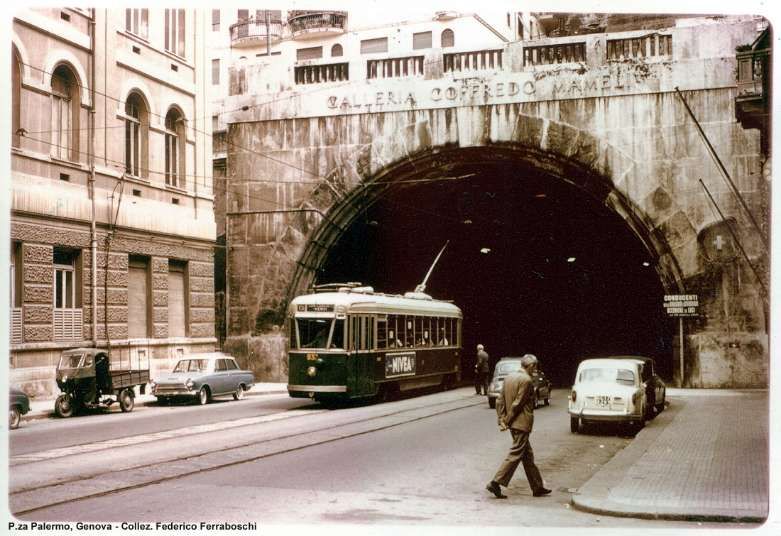
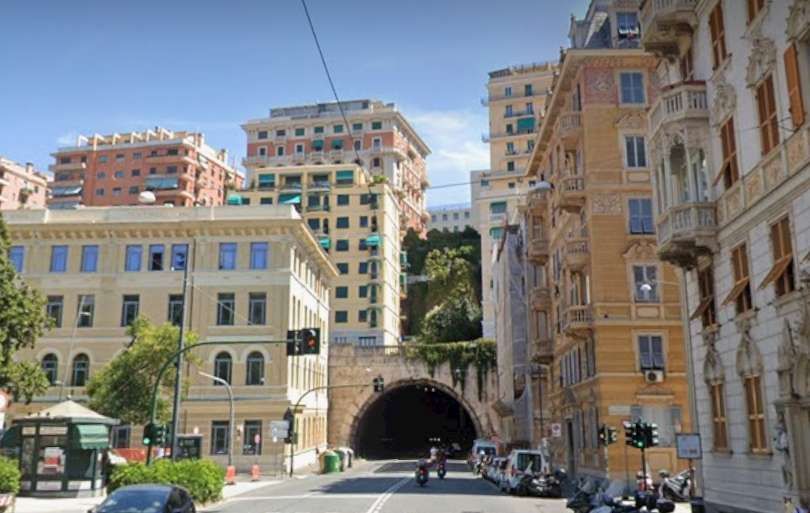
This tunnel curved through the Eastern parts of the city from Via Piave to Via Carlo Barabino at the bottom of Piazza Palermo.

Galleria Goffredo Mameli. [Google Maps, November 2024]
In Piazza Palermo, UITE No. 937 exits Galleria Goffredo Mameli in service on the Line 15, De Ferrari – Galleria Mameli – Nervi Service in the later years of the network’s life, © Public Domain. [36]
Looking East at the bottom of Piazza Palermo towards the West Portal of Galleria Goffredo Mameli. [Google Streetview, August 2024]
The South Portal of Galleria Goffredo Mameli, © Public Domain. [40]
The South Portal of Galleria Goffredo Mameli. [Google Streetview, August 2024]

The Years Before World War One

In the early years of the 20th century, the municipal administration began to consider the idea of taking control of the tram service. In anticipation of this, in 1913, it built its own line from Marassi to Quezzi, known as Municipal Line A, it was operated by UITE on behalf of the Municipality. [19][21: p44]

Before the start of World War 1, the tram network provided these services: [19]

I. Western Network:

1 Caricamento – San Pier d’Arena (Sampierdarena in other sources) – Sestri – Pegli – Voltri
2 Caricamento – San Pier d’Arena – Sestri – Pegli
3 Caricamento – San Pier d’Arena – Sestri
4 Caricamento – San Pier d’Arena
5 Caricamento – San Pier d’Arena – Rivarolo
6 Caricamento – San Pier d’Arena – Rivarolo – Bolzaneto
7 Caricamento – San Pier d’Arena – Rivarolo – Bolzaneto – Pontedecimo
8 Caricamento – Galleria Certosa – Certosa
9 Caricamento – Galleria Certosa – Certosa – Rivarolo
10 Caricamento – Galleria Certosa – Certosa – Rivarolo – Bolzaneto
11 Caricamento – Galleria Certosa – Certosa – Rivarolo – Bolzaneto – Pontedecimo

II. Eastern Network:

21 De Ferrari – Manin – Staglieno
22 De Ferrari – Manin
23 De Ferrari – Manin – Castelletto
24 De Ferrari – Manin – Castelletto – San Nicholo
25 Circuit in the hilly suburbs
26 Piazza Principe – Corso Ugo Bassi
27 De Ferrari – Zecca – Principe
28 Caricamento – De Ferrari – Galliera ‘Ospital
29 De Ferrari – Carignano
30 Circular Raibetta – Brignole – Corvetto – Raibetta
31 De Ferrari – Staglieno – Molassana – Prato
32 De Ferrari – Staglieno – Molassana
33 De Ferrari – Pila – Staglieno
34 Staglieno – Iassa
35 Pila – Staglieno
36 Pila – Staglieno – Molassana
37 De Ferrari – San Fruttuoso
38 De Ferrari – Foce
39 De Ferrari – San Francesco – Sturla – Priaruggia – Quinto – Nervi
40 De Ferrari – San Francesco – Sturla – Priaruggia – Quinto
41 De Ferrari – San Francesco – Sturla – Priaruggia
42 De Ferrari – San Francesco – Sturla
43 De Ferrari – Villa Raggio – Lido
44 De Ferrari – Tommaseo – San Martino – Borgoratti
45 De Ferrari – Tommaseo – San Martino – Sturla
46 De Ferrari – Tommaseo – San Martino
47 De Ferrari – Tommaseo
48 Raibetta – Pila

III. Municipal line:

A De Ferrari – Quezzi

The Western Network, particularly before World War One

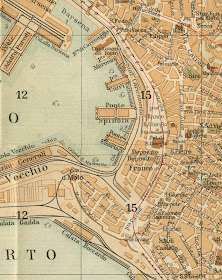
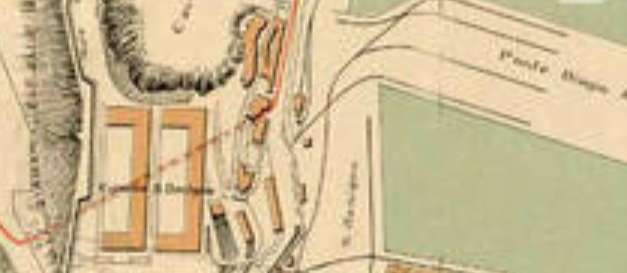
Lines 1 to 11 constituted the Western Network. All of these lines had their city centre terminus at Piazza Caricamento. The Piazza is shown on the adjacent 1916 map.

The map shows part of the Port area of Genoa (Genova) in 1916 with a significant series of standard-gauge railway sidings in evidence (black lines) and some red lines which indicate the metre-gauge tram routes. Piazza Caricamento is close to the water halfway down the map extract. [31]

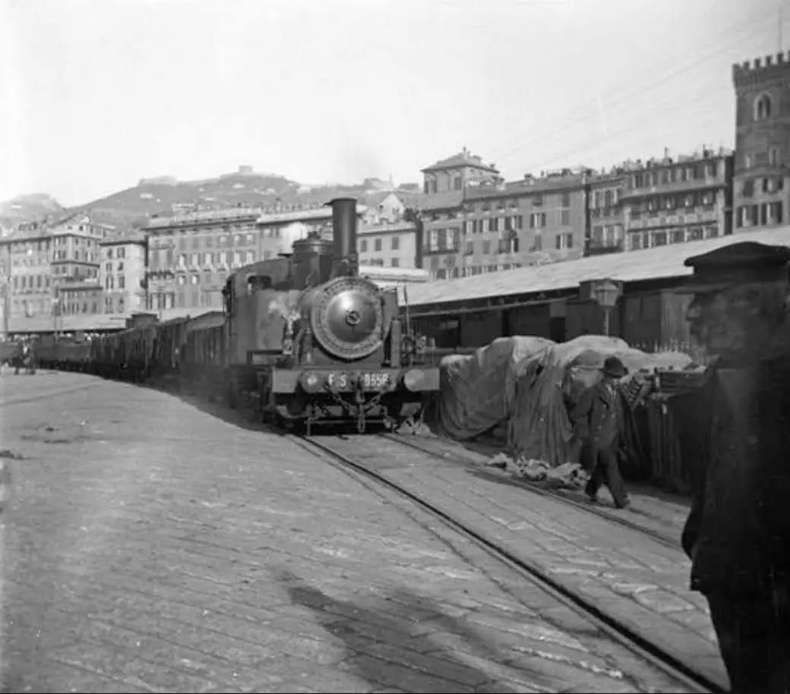
A typical photograph of a freight movement on the standard-gauge railway serving the port. The building behind the locomotive front onto Piazza Caricamento., © Public Domain and shared by Enrico Pinna on the Foto Genova Antica Facebook Group on 22nd January 2023. [33]

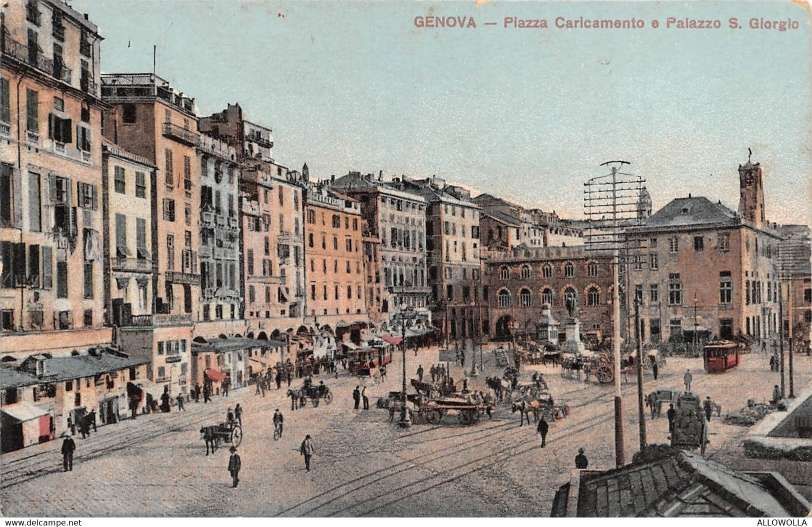
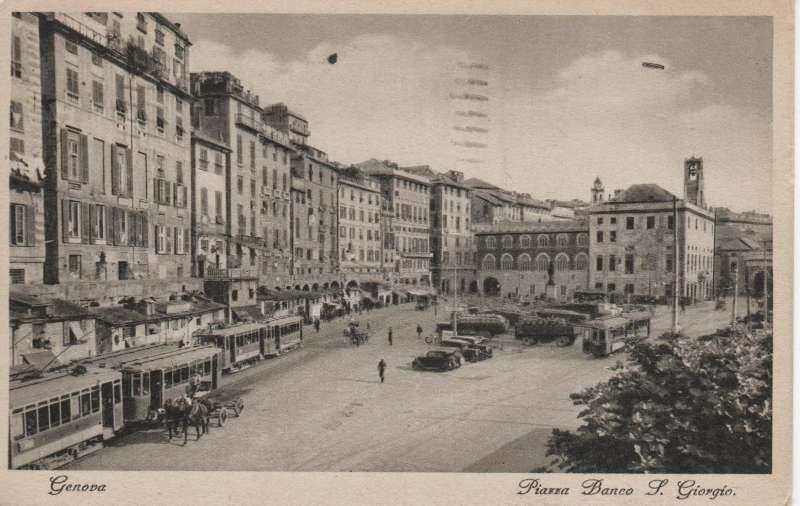
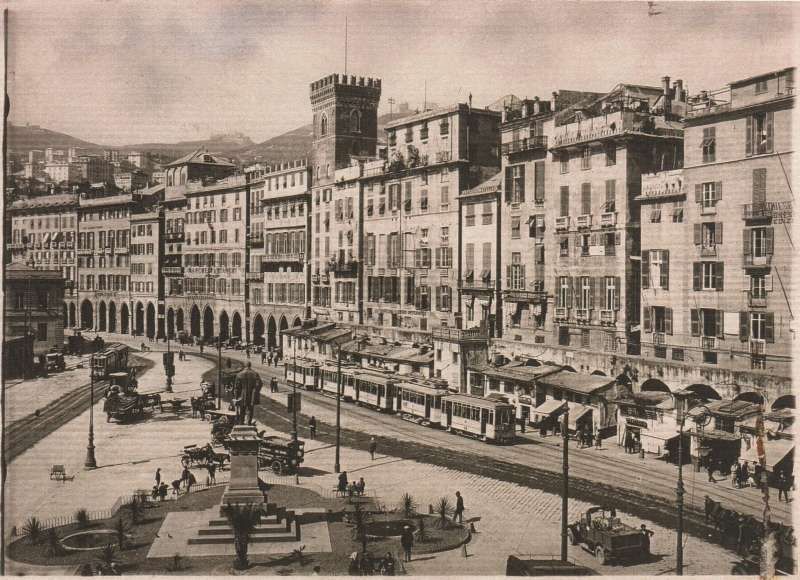
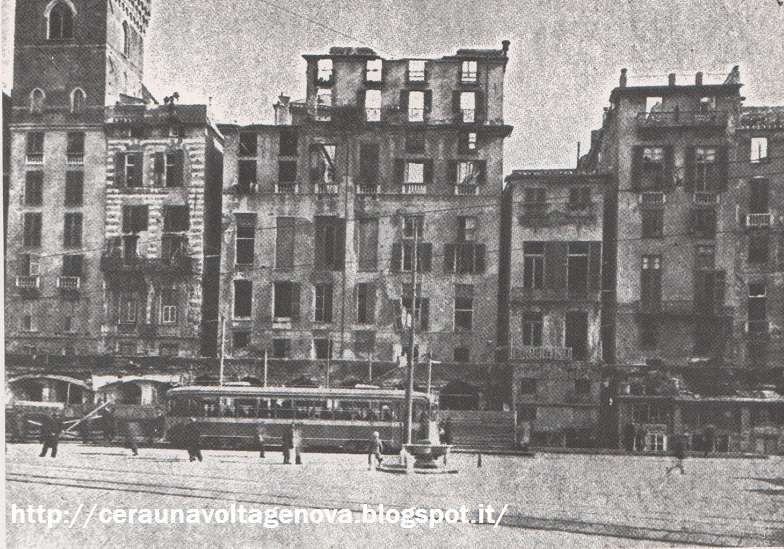
The postcard images below show trams operating in Piazza Caricamento at different times over the life of the tram network in the 20th century.

Piazza Caricamento, (postcard dated 1908), © Public Domain. [31]
Piazza Caricamento (postcard dated 1910), © Public Domain. [31]
Piazza Caricamento, (postcard dated 1936), © Public Domain. [31]
Piazza Caricamento, later than the previous view, © Public Domain. [31]
Piazza Caricamento in October 1942 sowing war damage to properties on the East side of the Piazza, © Public Domain. [32]

There were three main routes out of Piazza Caricamento, one of which followed the coast round to meet the lines on the East of the city. The other two shared the bulk of the services leaving the piazza. One of these two routes ran West through San Pier d’Arena (Sampierdarena), the other ran through Galleria Certosa.

The only tramway route serving the western suburbs before the construction of Galleria Certosa is shown here in black between Pizza Caricamento, Principe and San Pier d’Arena (Sampierdarena), © Arbalete and authorisedd for reuse under a Creative Commons Licence (CC BY-SA 2.0). [19]
The distribution of tramway routes in the West of the city after Galleria Certosa was put into use, © Arbalete and licenced for reuse under a Creative Commons Licence (CC BY-SA 2.0). [19]

The route to San Pier d’Arena (Sampierdarena) closely follows the coast and ran through the Galleria on Via Milano before the San Benigno Hill was raised to the ground.

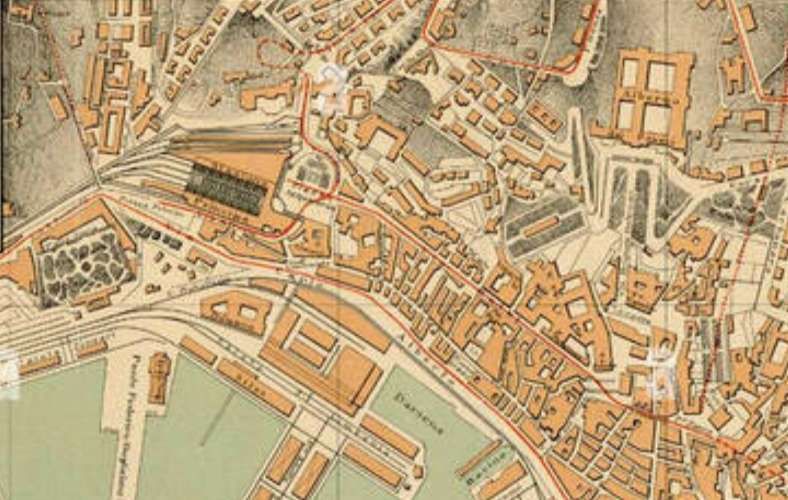
The 1916 map shows the first length of the tramway Northwest of Piazza Caricamento (red line) which served both the two routes mentioned above. It ran on the south side of Principe Railway Station across the top of the Port. [31]
A crowded Pizza Acquaverde, located in front of the Principe Station, dominated by the statue of Christopher Columbus. Among buses and trolleybuses there is a tram waiting at the station. Another tram (a 900) is on the route from Piazza Caricamento towards Sampierdarena. This image probably comes from the late 1950s or early 1960s, © Public Domain. [36]
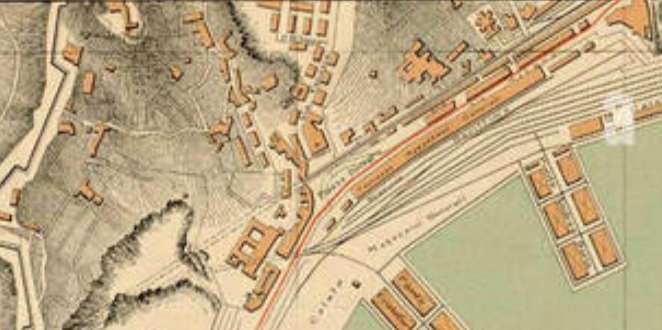
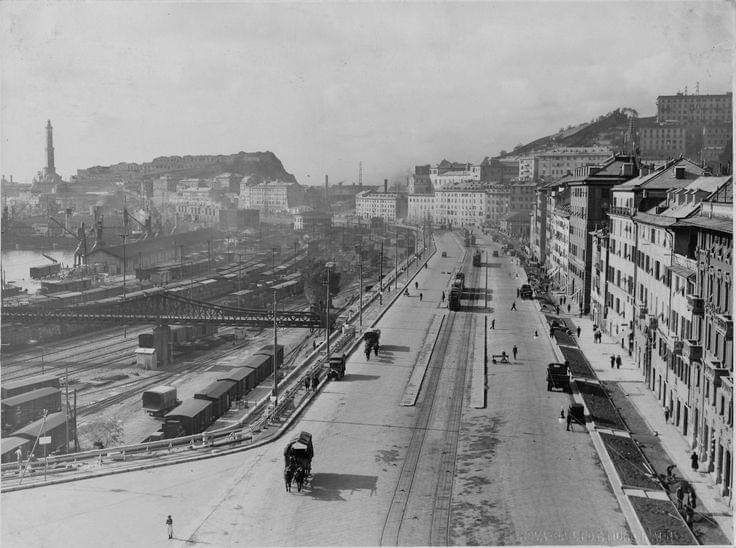
The redline marking the tramway runs down the West side of the Port on this next extract from the 1916 – Via Milano, later Via Bruno Buozzi. [31]
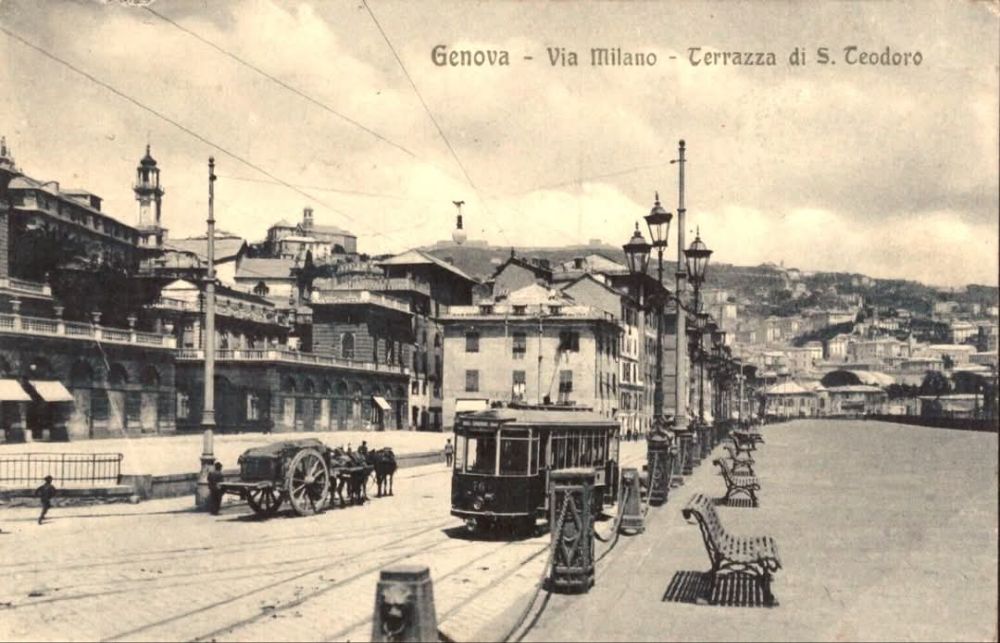
An early postcard image showing the curve from Via San Benedetto into Via Milano.[42]
The same location, also prior to the widening of Via Milano and the renaming of the fist length ahead as Via Bruno Buozzi. [41]
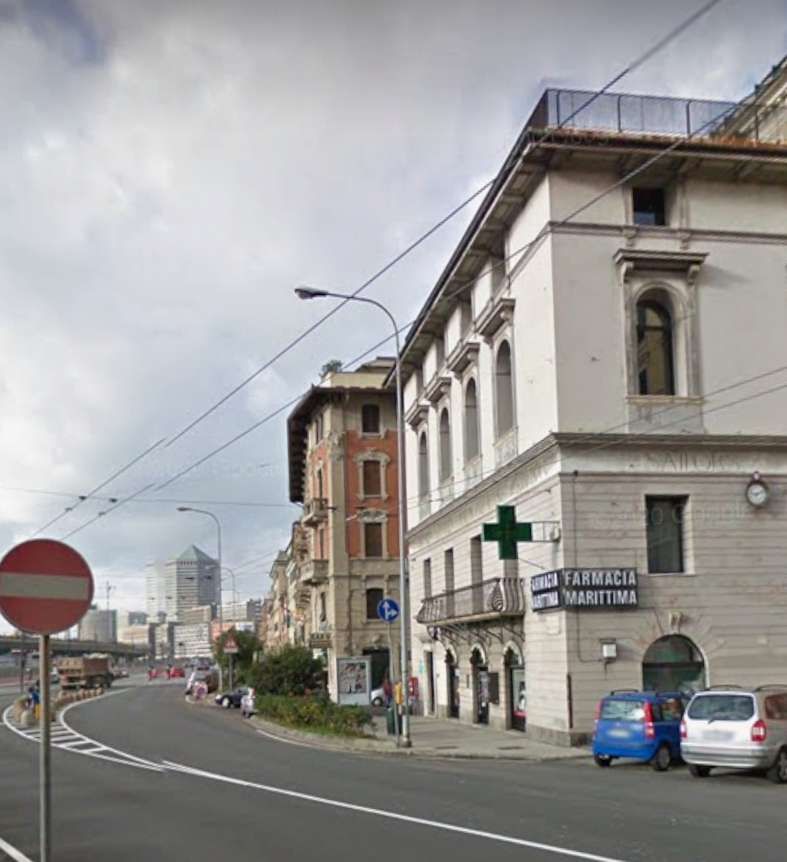
The same location in the 21st century. [Google Streetview, 2010]
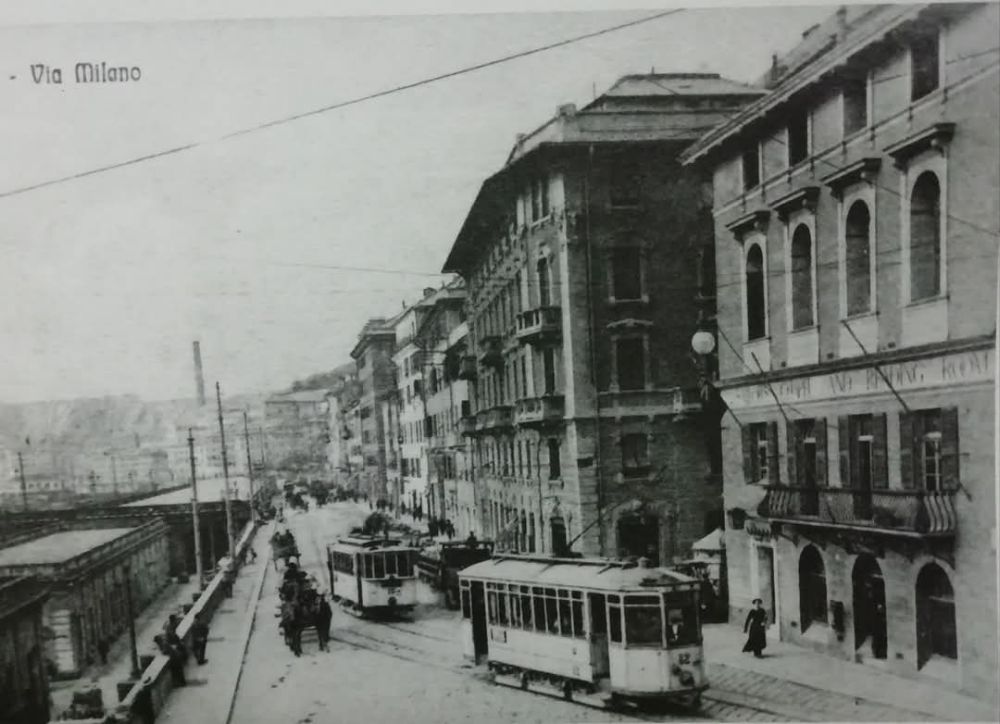
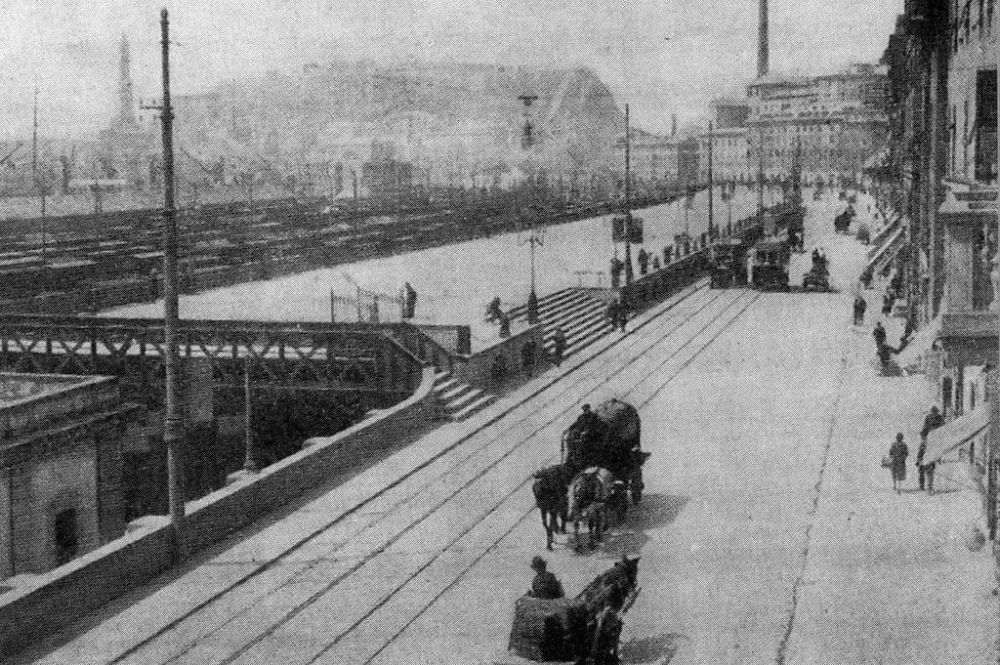
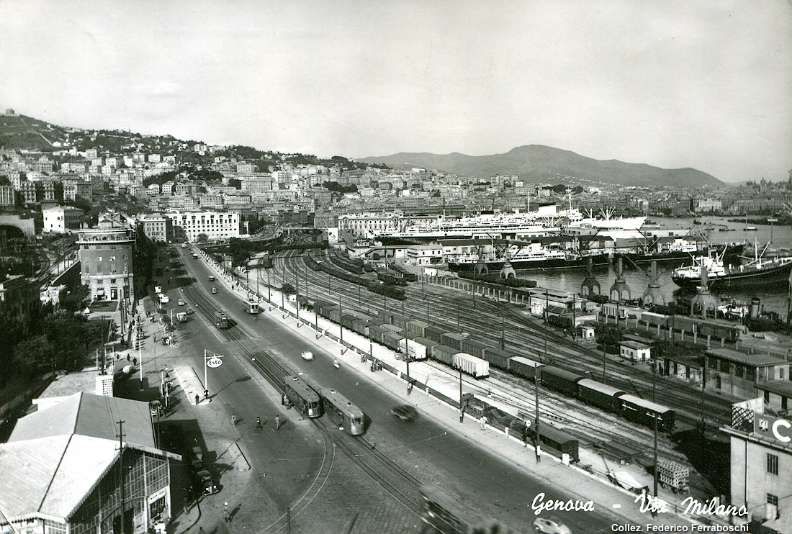
Via Milano (eventually Via Bruno Buozzi) with tram tracks on the seaward side. A promenade separates the FS sidings from the carriageway and trams, © Public Domain. [47]
A view Northeast along Via Milano before the widening of the highway and its renaming as Via Bruno Buozzi. [49]
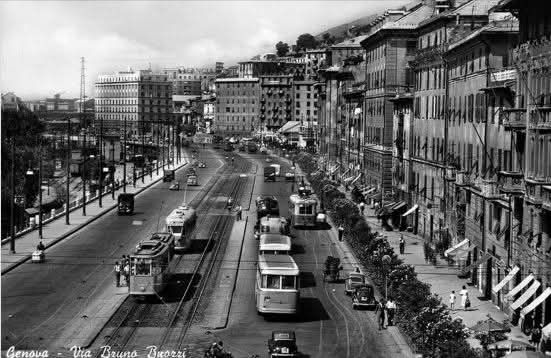
A later view of Via Milano/Via Bruno Buozzi with tramway tracks in the centre of the widened carriageway, © Public Domain. [46]
Somewhat later in the 20th century and taken a little further to the West, this postcard image shows the same centre-of-carriageway tracks the section of Via Milano seen here was renamed Via Bruno Buozzi. [45]
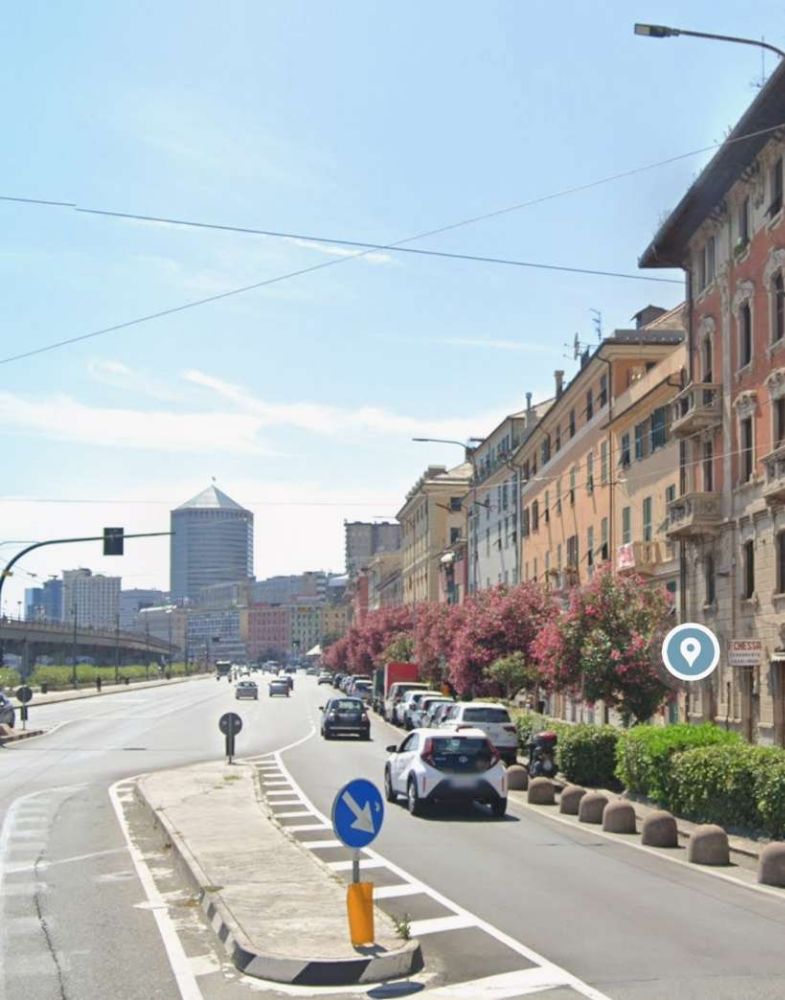
Via Bruno Buozzi in the 21st century. [Google Streetview, August 2024]
This extract from the same 1916 map shows the line of the Galleria which carried the tramway West towards San Pier d’Arena (Sampierdarena). [31]
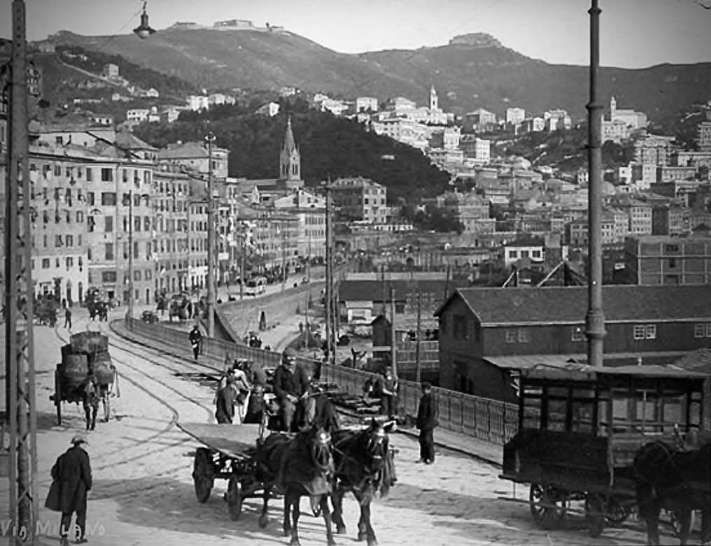
The view back towards the centre of Genoa from the point where the tramway turned to run through the Galleria under San Benigno Hill, © Public Domain. [48]
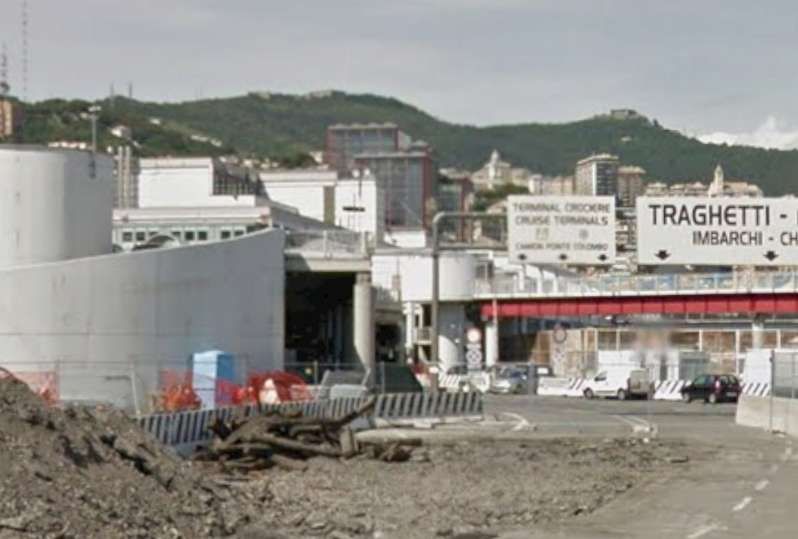
It is difficult, given the modern layout of this area of Genoa, to be definitive about the location of the monochrome image immediately above. This image is taken from a very similar position. The skyline at the rear of this image is a very good match for that in the image above.  [Google Streetview, May 2014]
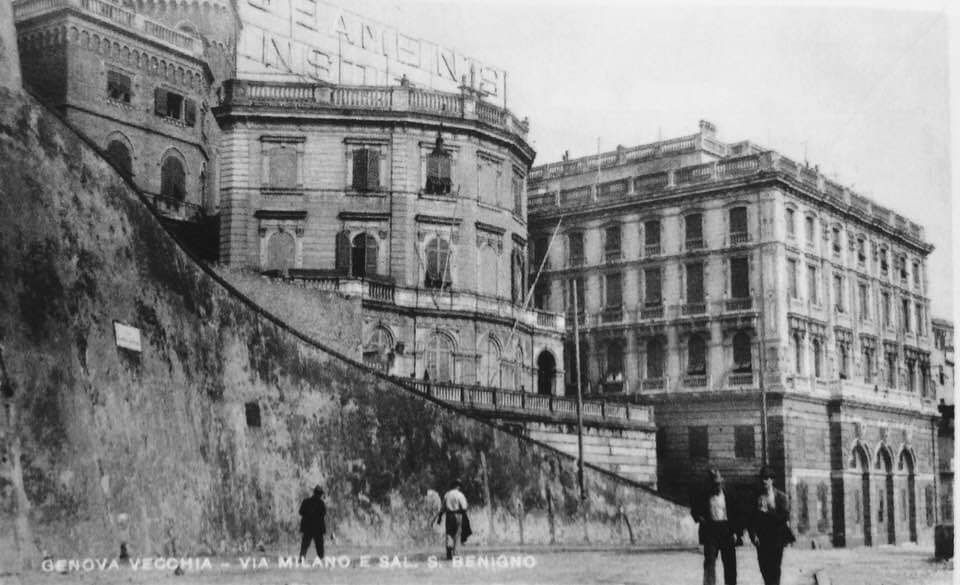
The tramway turned to the right to enter the tunnel under San Benigno Hill. The tunnel portal was beyond the end of the masonry wall behind the steeply inclined accessed road onto the hill. There is no practical modern equivalent to this view, © Public Domain.  [44]

Pictures of the Galleria can be seen earlier in this article.

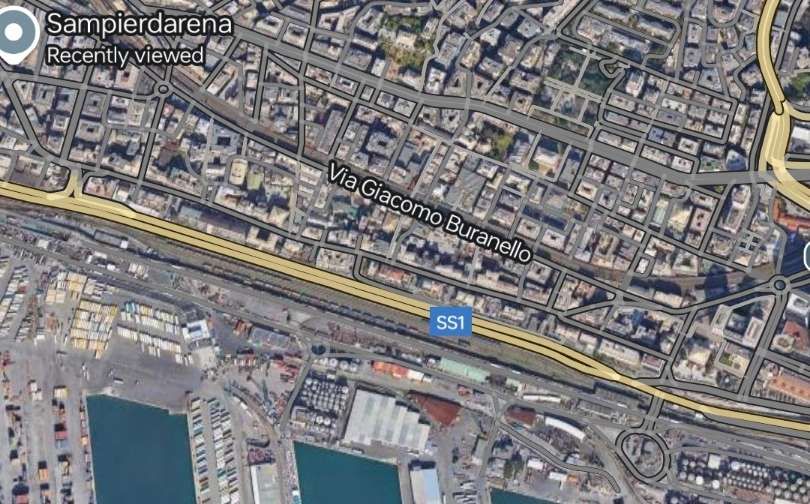
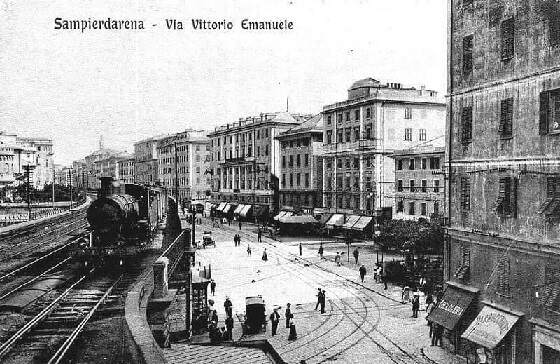
West of the Galleria, the original tramway ran along what is now Via Giacomo Buranello (what was Via Vittorio Emanuele) to Sampierdarena. This route appears to the North of the SS1 on the satellite image below.

In this extract from Google’s satellite imagery Sampierdarena is marked top left. The modern SS1 runs along the line of what was Via Milano. Careful inspection of this image shows the railway sidings which remain on the South side of the SS1.
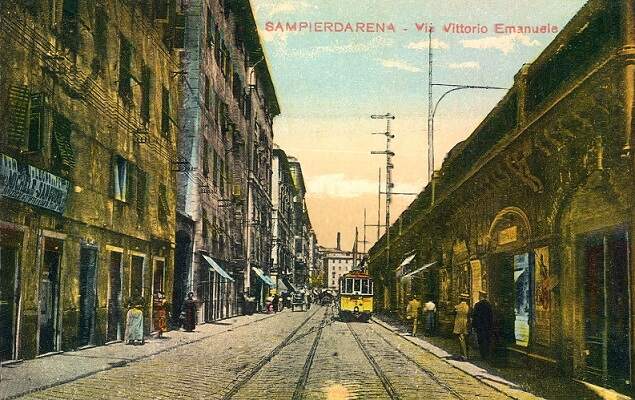
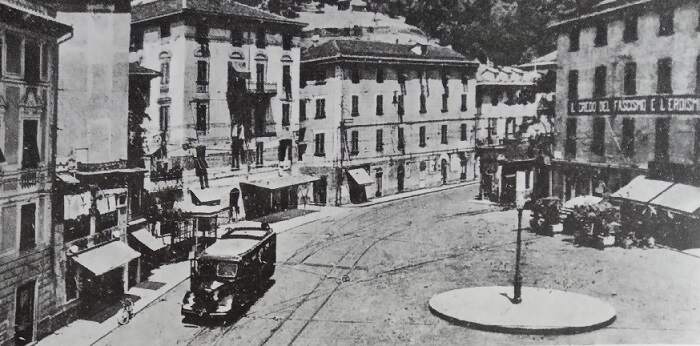
Via Vittorio Emanuele (later Via Giacomo Buranello) looking West, (c) Public Domain. [93]
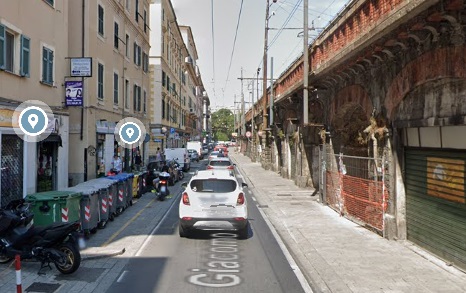
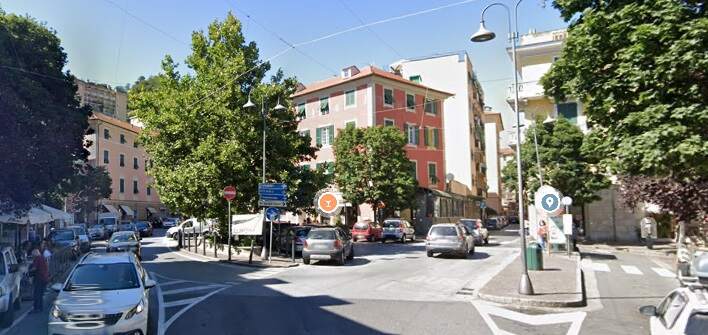
The same view in the 21st century. [Google Streetview, August 2024]
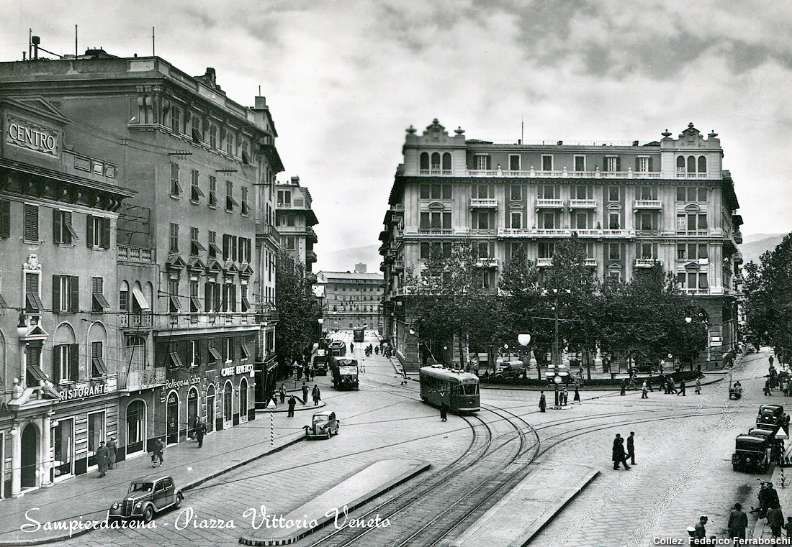
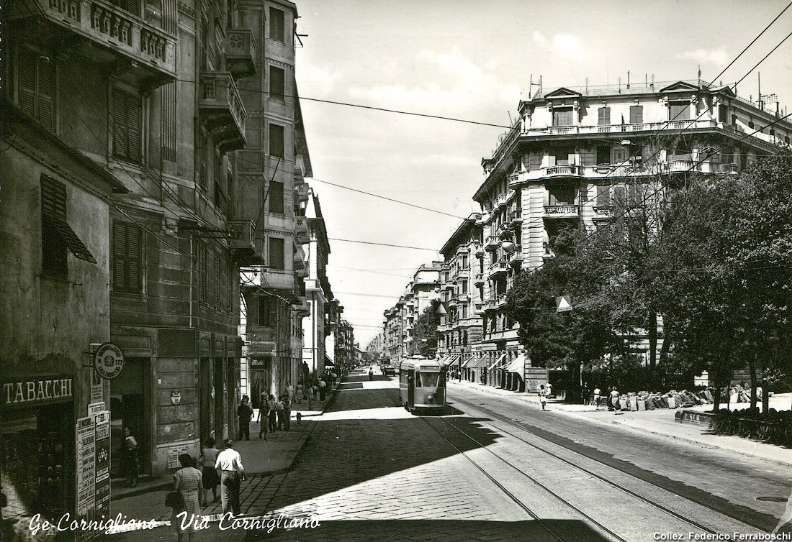
Looking West, Sampierdarena, Piazza Vittorio Veneto. A tram is arriving in the Piazza from the West. It has travelled along Via Cornigliano, © Public Domain. [50]
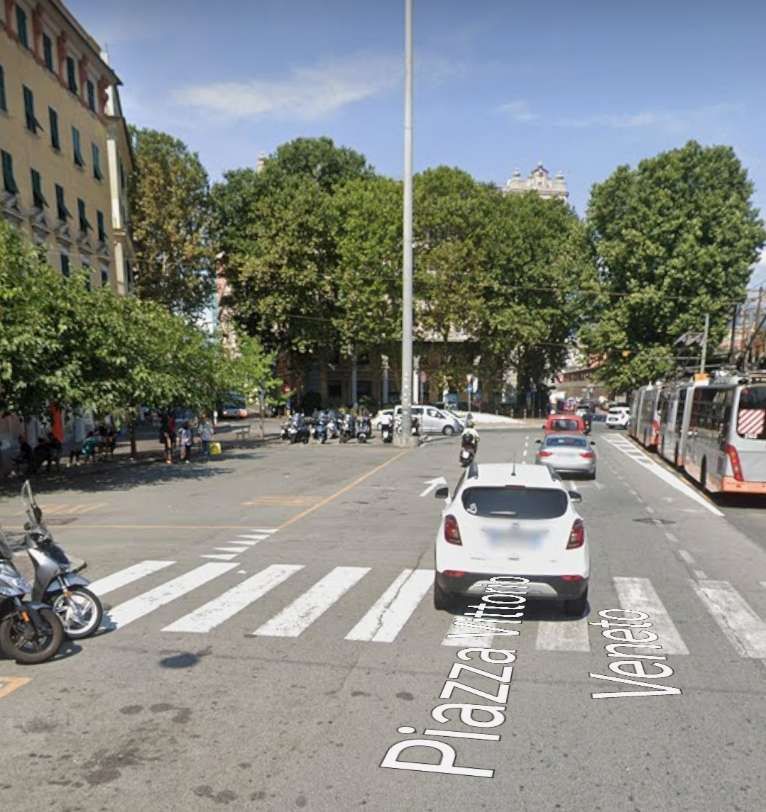
A view of Piazza Vittorio Veneto from a similar bearing, but this time at ground level in 21st century
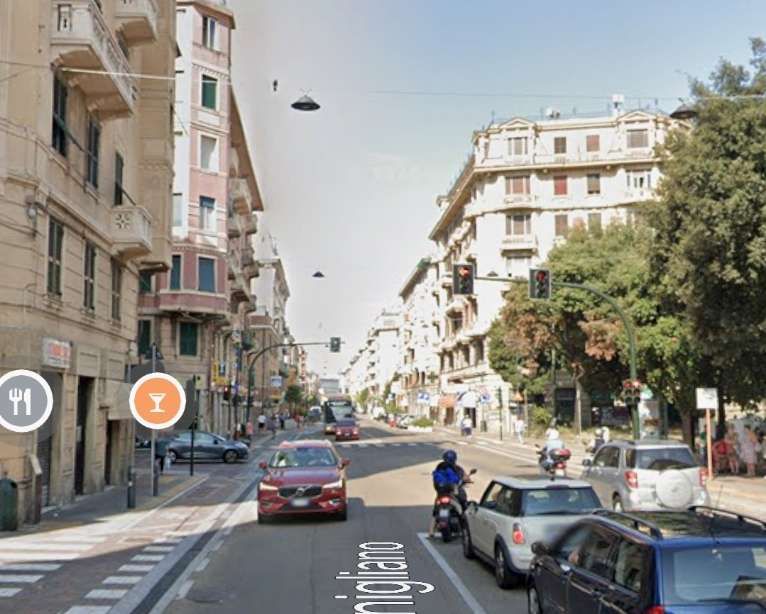
  Via Cornigliano leaves the Piazza to the left rear. [Google Streetview, August 2024]

Before looking at line further West from Sampierdarena we need to note a line which was added to the network before WW1.

A second tramway was built which ran alongside the railway sidings on what is now the SS1, it was then Via Milano, towards Sampierdarena. The route is illustrated by the mid-20th century view below.

Trams on Via Milano/Via Sampierdarena – in this image, the tracks of the Genoese port can be seen, populated by a range of FS goods wagons. Two 900 UITE units are passing each other on tram tracks which occupy the centre of Via Milano, © Public Domain. [36]
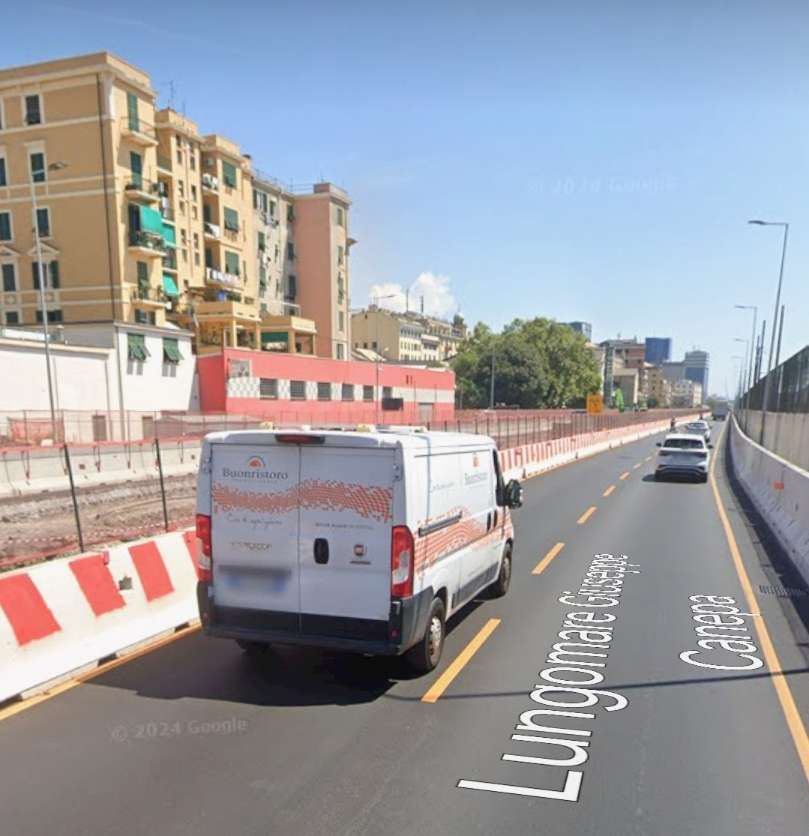
Looking East along the SS1 during some major roadworks. The railway sidings are just off to the right side of the photograph. [Google Streetview, August 2024]

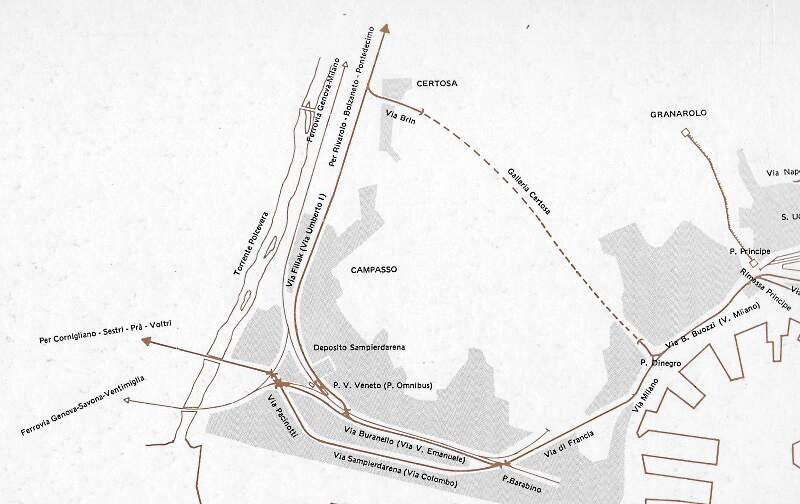
That route along Via Sampierdarena (Via Milano and Via Colombo) and then Via Pacinotti is illustrated at the bottom of the map below. After running along the centre of Via Sampierdarena, trams turned inland, heading Northwest to join the earlier route, West of Piazza Vittorio Veneto on Via Pacinotti.

A map provided by the Marklinfan.com Forum which shows the new coastal tram route mentioned above. [92]

The Western Network’s Coastal Line(s)

At Sampierdarena the original lines of the Western network separated. Some lines continuing along the coast and others turning inland. The lines diverged at the West end of Piazza Vittorio Veneto. The coastal line ran along what is today Via Frederico Avio, then turned onto what is now Via Antonio Pacinotti, before turning West on what is now Via Raffaele Pieragostini, crossing the River Polcevera at Ponte di Cornigliano, running along Via Giovanni Ansaldo before joining Via Cornigliano at Piazza Andrea Massena.

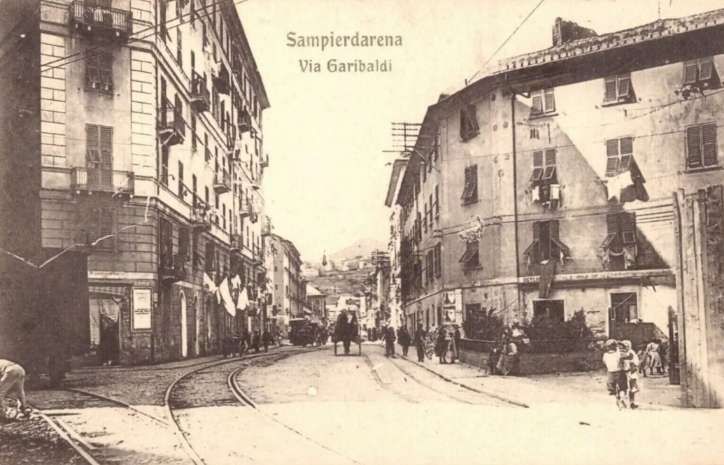
This image shows the tramway at what is now the junction between Via Frederico Avio (entering bottom right) and Via Antonio Pacinotti (which heads away from the camera). At the time this was Via Garibaldi. (c) Public Domain. [61]
The same location in the 21st century. The vacant lot is the location of the building on the right of the monochrome image above. [Google Streetview, August 2024]
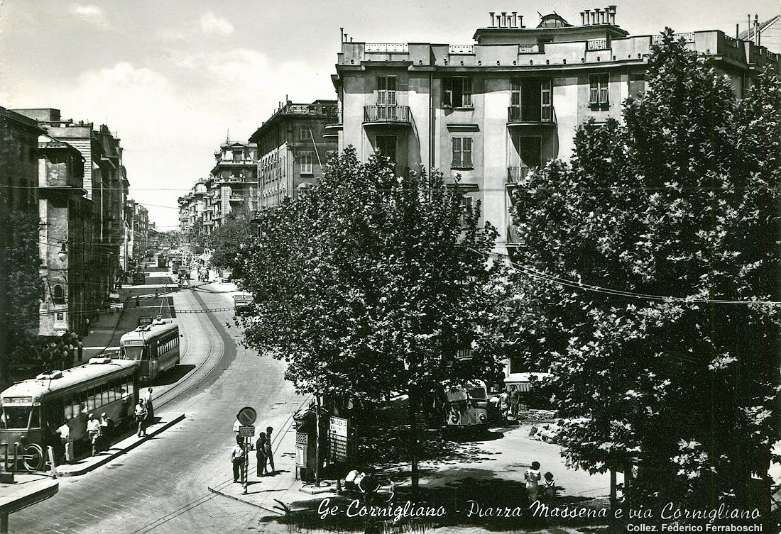
This mid-20th century postcard view shows trams following Via Cornigliano West of Piazza Massena, © Public Domain. [50]
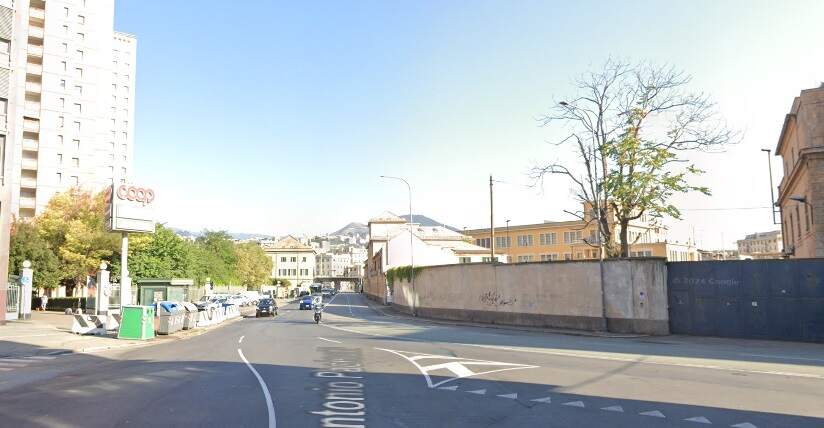
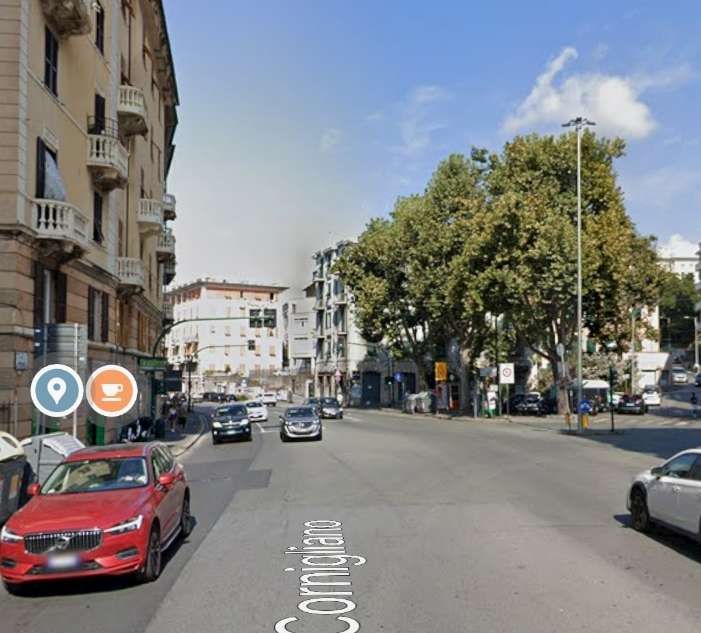
Piazza Massena at the East end of Via Cornigliano as it appears in the 21st century. The tramway followed Via Cornigliano round to the left ahead. [Google Streetview, August 2024]
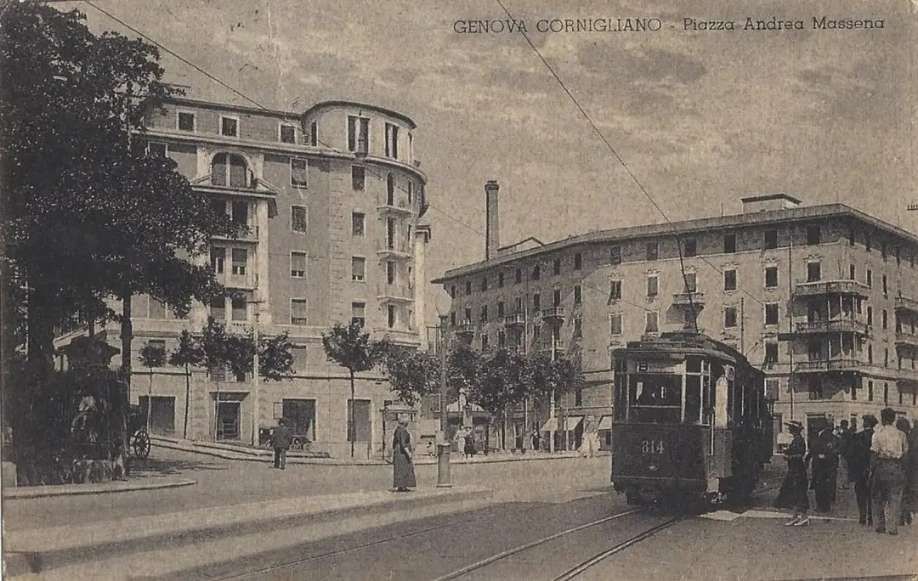
Another view of Piazza Massena in Cornigliano. This image was shared on the C’era una volta Genova Facebook Group by Gianfranco Dell’Oro Bussetti on 8th March 2017, (c) Public Domain. [2]
A similar view of Piazza Massena in 2024. [Google Streetview, August 2024]
Looking West along Via Cornigliano to the West of San Pier d’Arena (Sampierdarena), © Public Domain. [36]
The same location in the 21st century. [Google Streetview, August 2024]
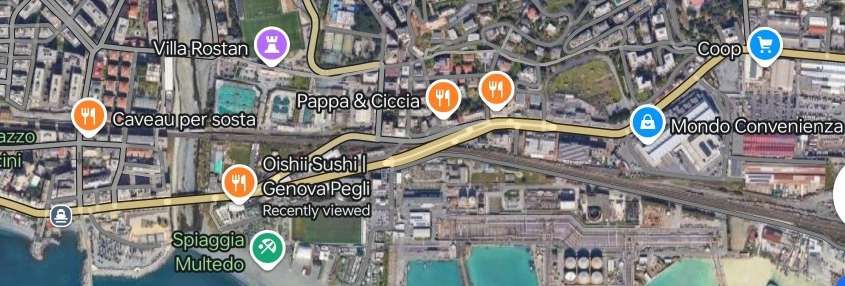
The route West followed the yellow road on this extract from Google Maps satellite imagery. A modern flyover takes the present SS1 over the railway. The original route of the tramway follo
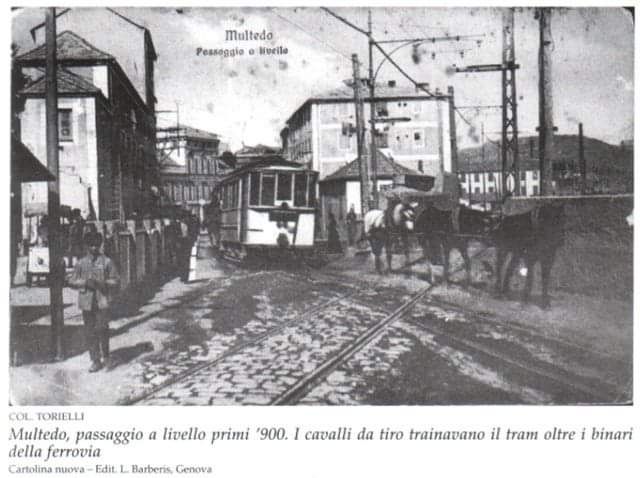
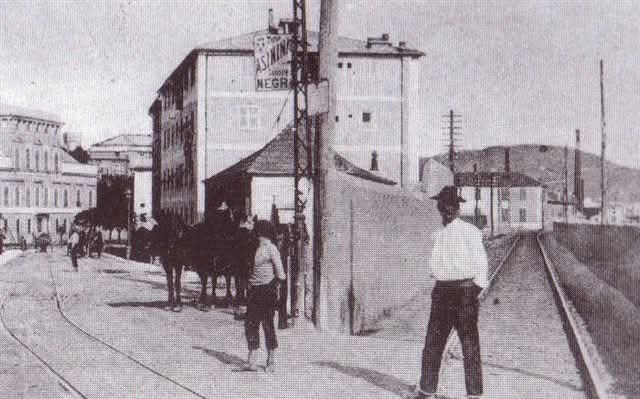
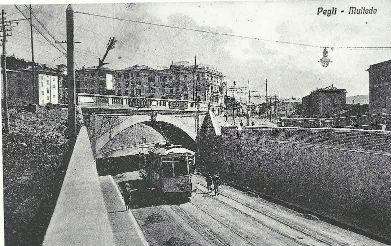
Two images which show the metre-gauge tramway crossing the standard-gauge railway, © Public Domain. [4]
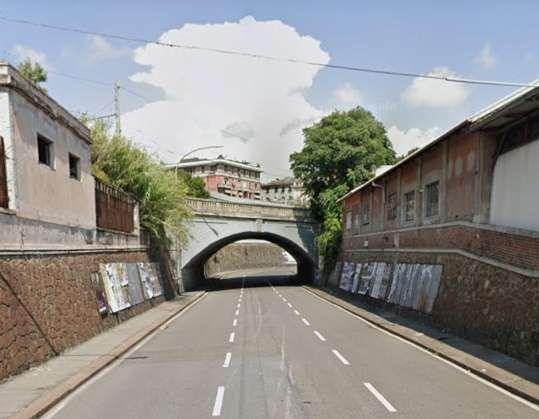
The tramway/road underpass built in the 1930s. A significant amount of excavation was required to take trams under the railway, © Public Domain.[5]
Looking West along the line of the Tramway towards the underpass in the 21st century
Looking back Northeast towards the underpass in the 21st century.[Google Streetview, Aug 2024]
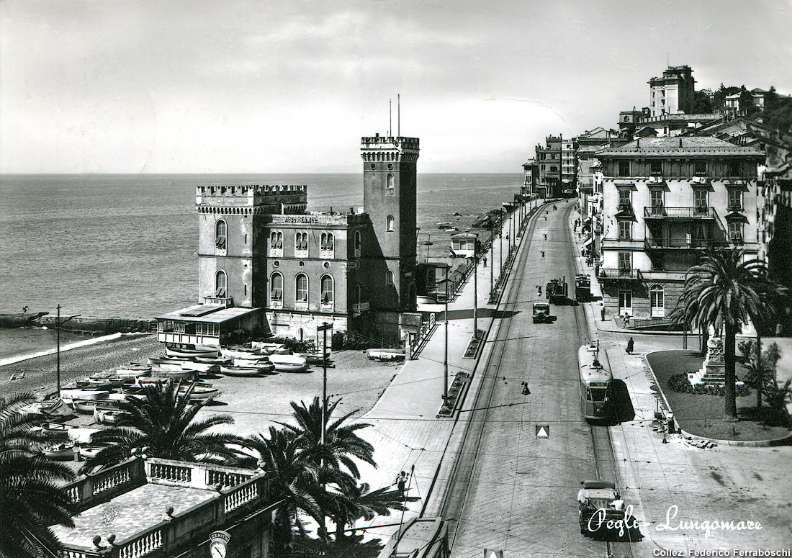
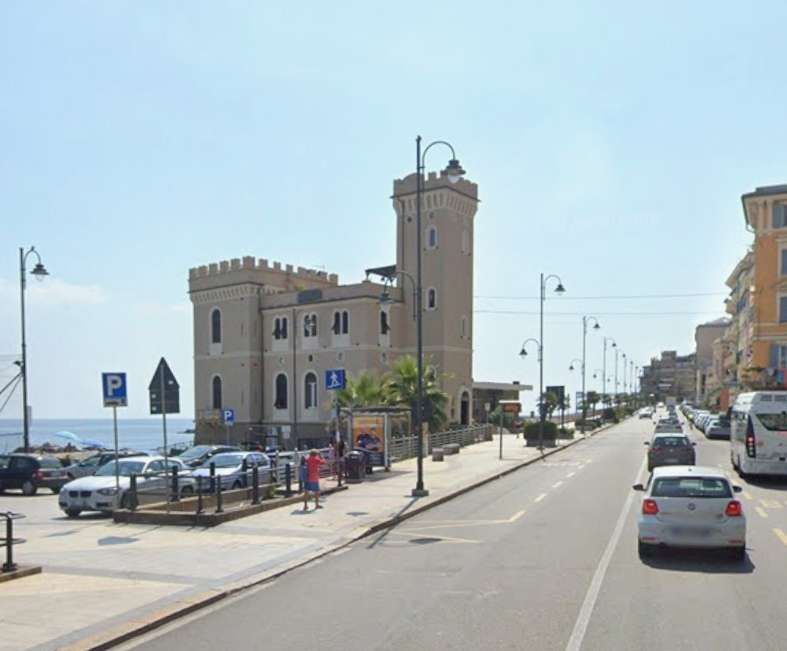
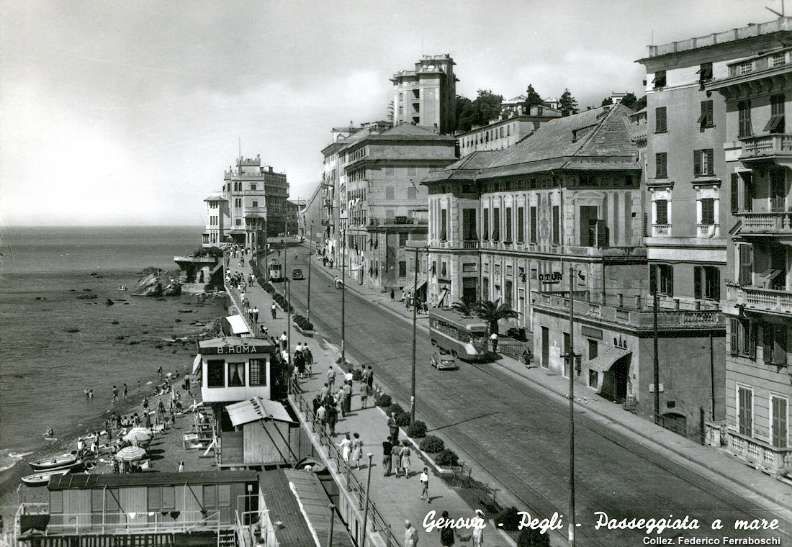
Tram No. 999, the last of the UITE series, is in transit on the Pegli seafront, in service on Line No. 1, Caricamento to Voltri. Miramare Castle is on the sea front. The Castle is in use as a hotel in the 21st century, © Public Domain. [50]
Lungomare di Pegli (SS1) and Miramare Castle in the 21st century. [Google Streetview, August 2024]
This photograph was taken from Miramare Castle. A 900 series tram is heading West and a tram is approaching from the West.  [50]
A similar view, taken from a point a little further to the West, in 21st century
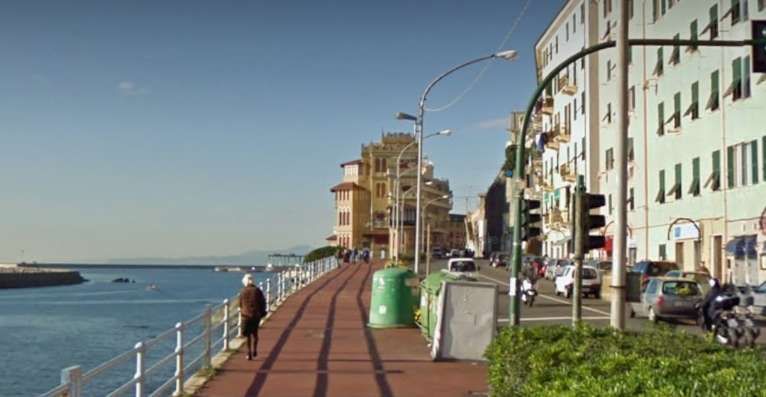
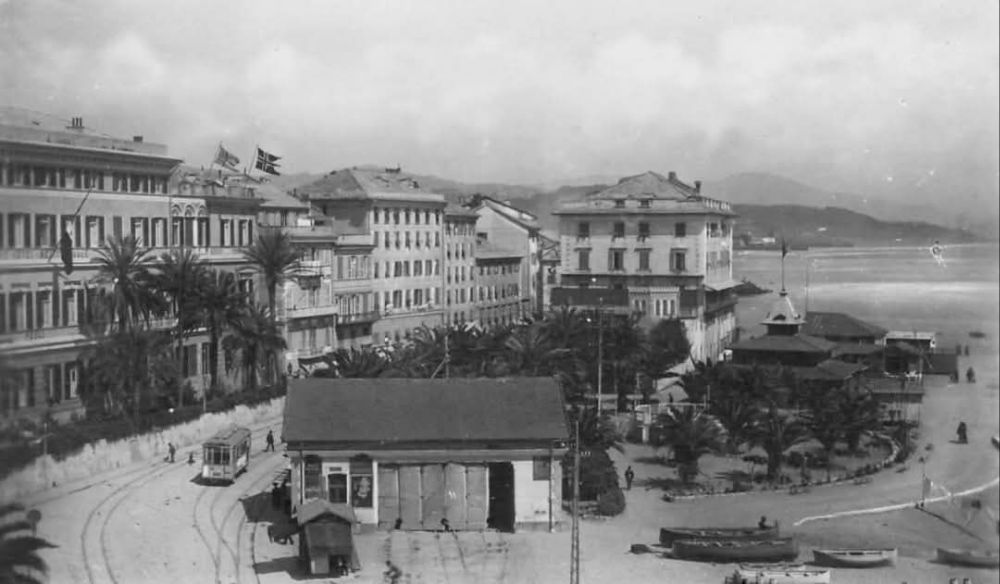
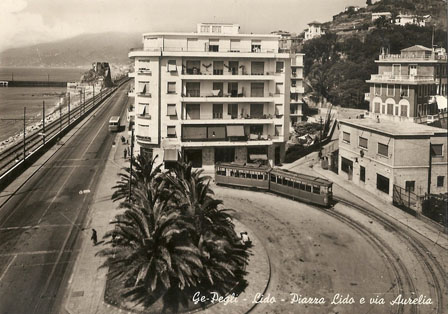
Looking East at Pegli 1925. [58]
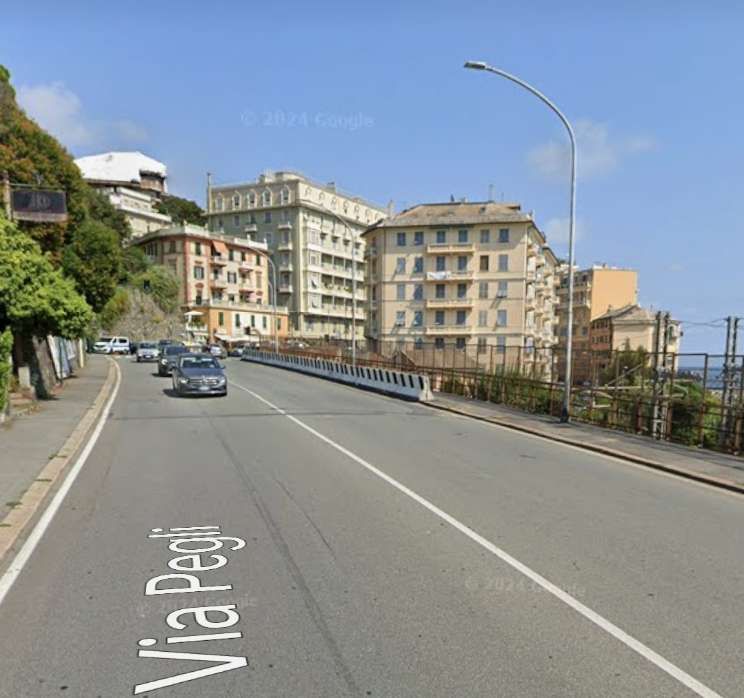
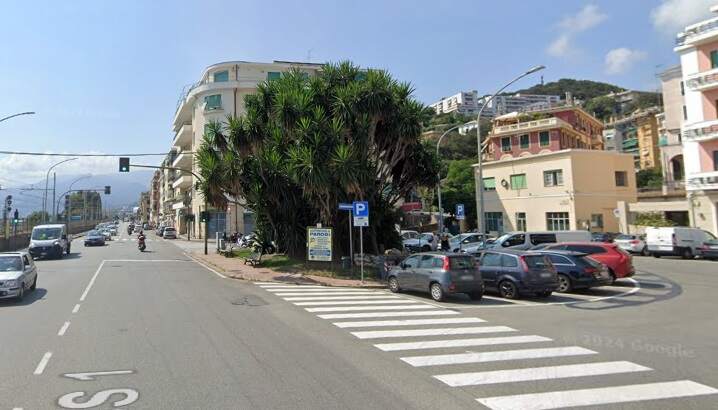
At ground level in the 21st century. Looking East from a similar location on the SS1( Via Pegli). [Google Streetview, August 2024]
The terminus of some tram routes at Pegli!, (c) Public Domain. [91]
The same location in the 21st century. [Google Streetview, August 2024]

Beyond Pegli, only Line No. 1 travelled on to Voltri. These next few photographs were taken in Voltri.

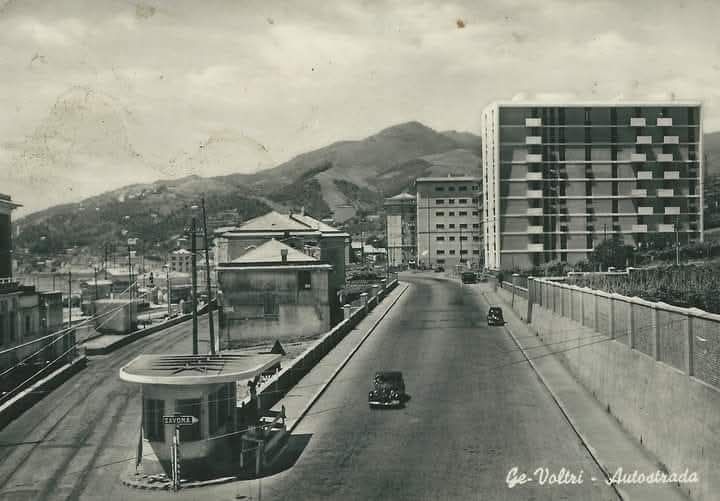
An early view West towards Voltri along Via Voltri. [52]
The same location in the 21st century. [Google Streetview, August 2024]
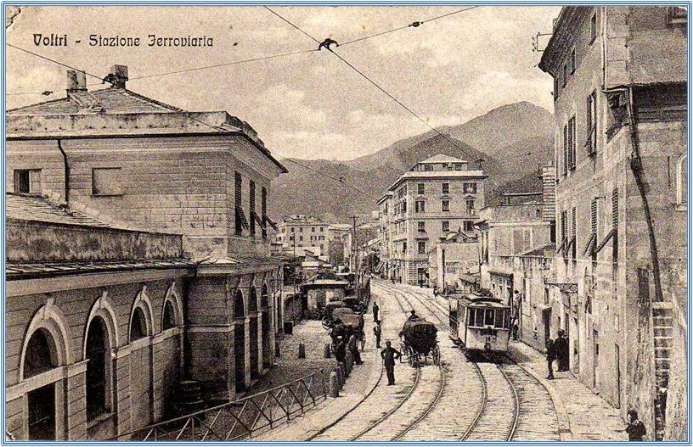
The tramway outside Voltri Railway Station, © Public Domain. [60]
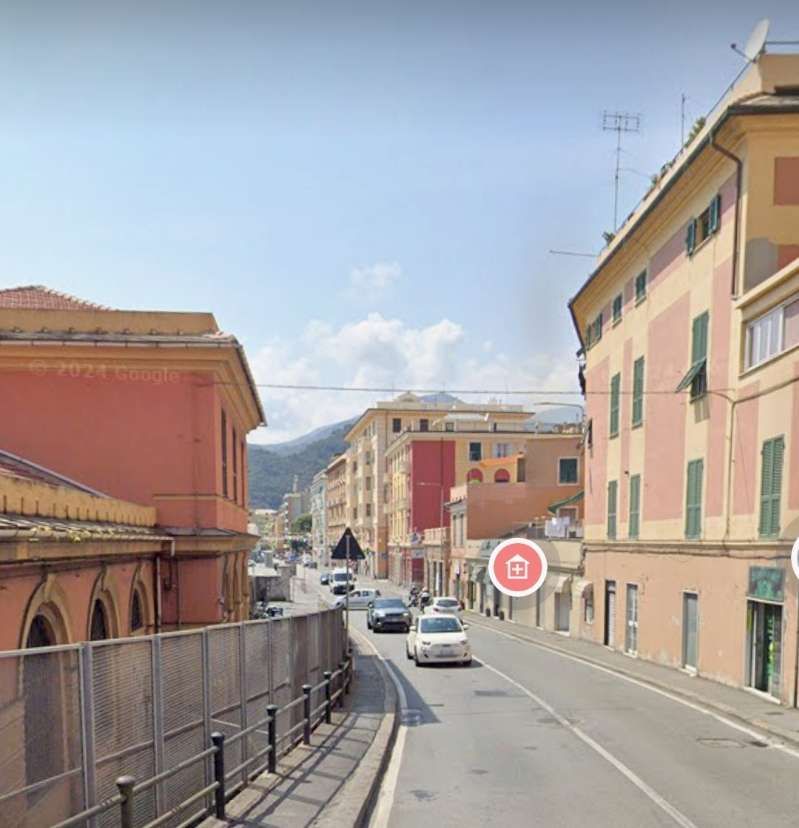
The same location in the 21st century. [Google Streetview, August 2024]
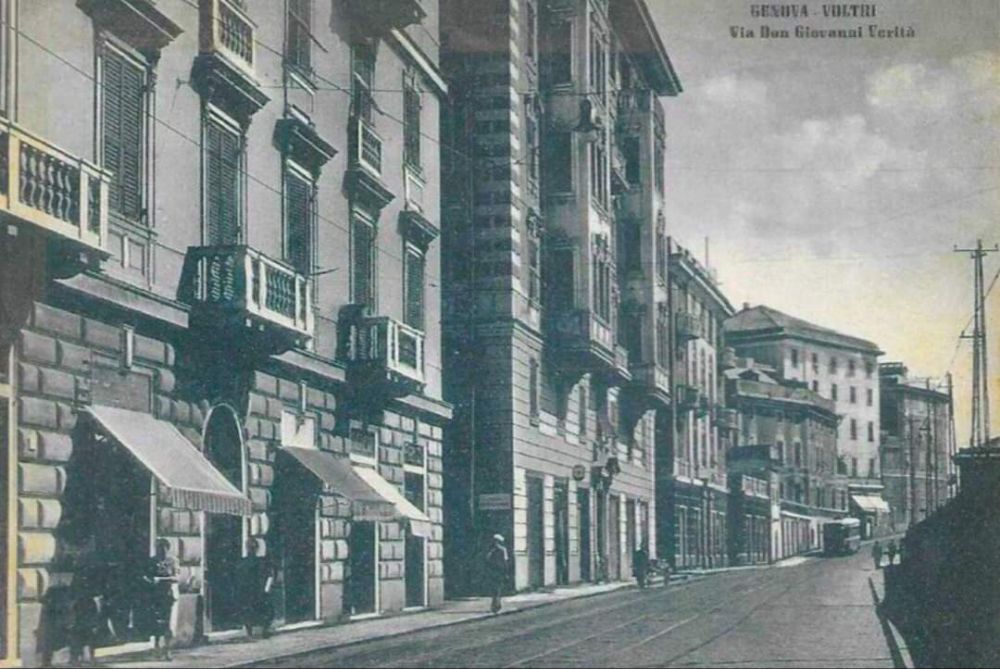
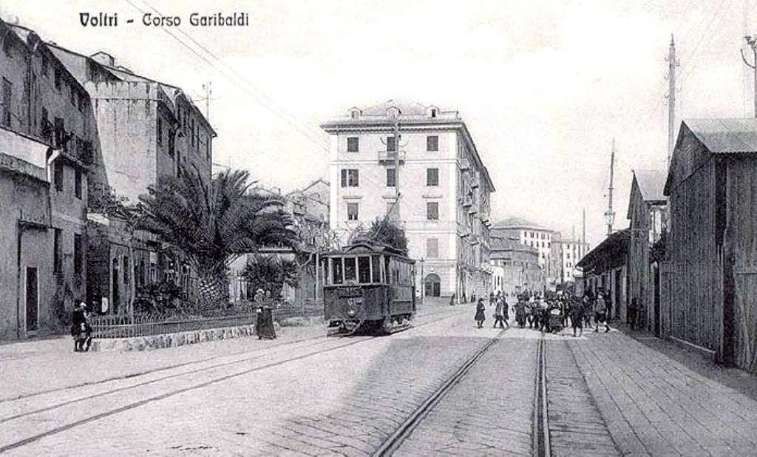
Looking East along Via Dom Giovanni Verita towards Genova, © Public Domain. [51]
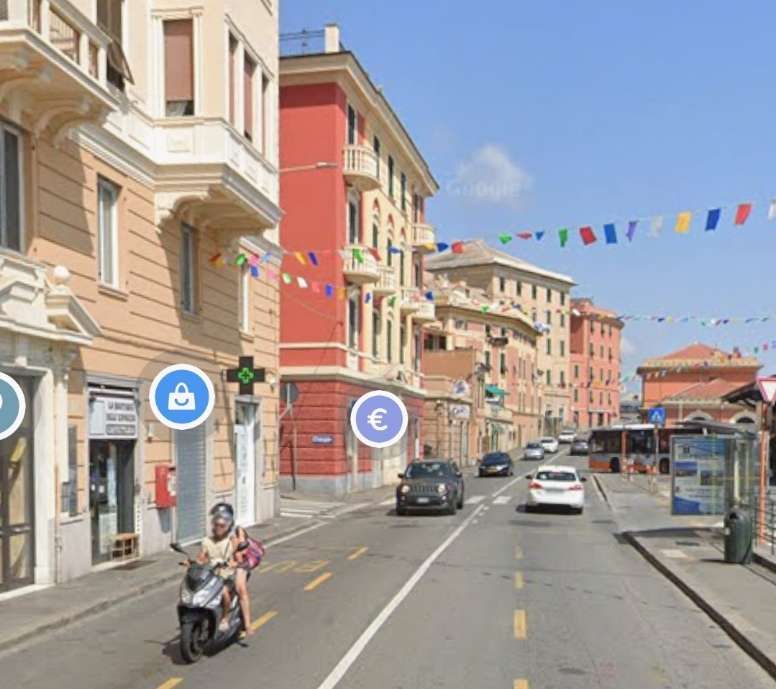
The same location in 21st century. The station building can be seen on the right of the image. [Google Streetview, August 2024
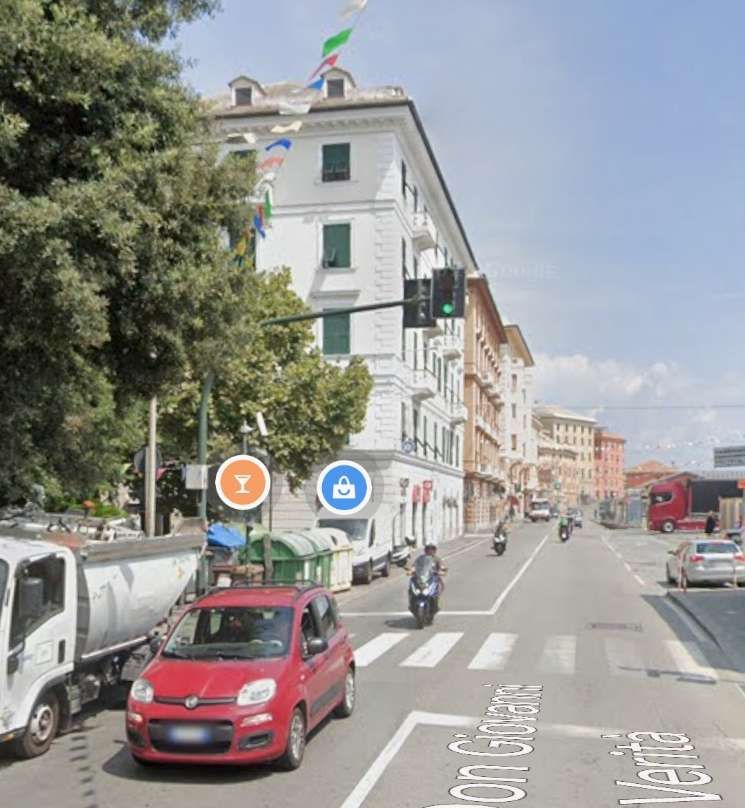
Back in the day, Via Dom Giovanni Verita was Corsa Garibaldi. This view looks East along the road towards the railway station. The buildings in the distance match those in the two images above., © Public Domain. [43]
Looking West on Via Dom Giovanni Verita, the station building is just beyond the red lorry cab. The three roofs of the furthest buildings are the same as those in the three images above. [Google Streetview, August 2024]
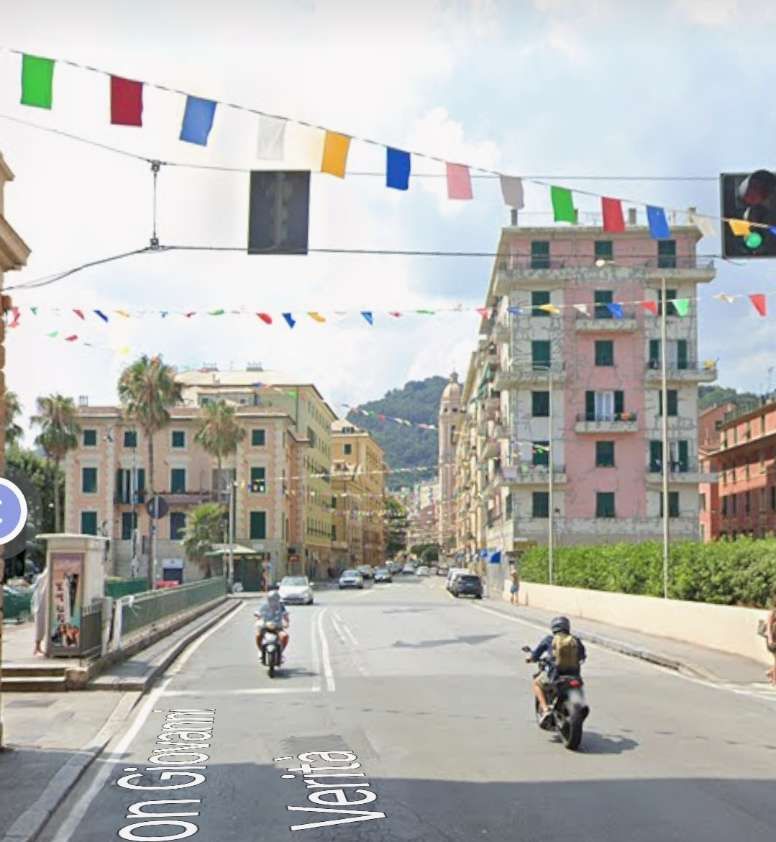
Looking West across the bridge on Don Giovanni Verita, Voltri, early in the 20th century, © Public Domain. [54]
The same location, looking West. [Google Streetview, August 2024]
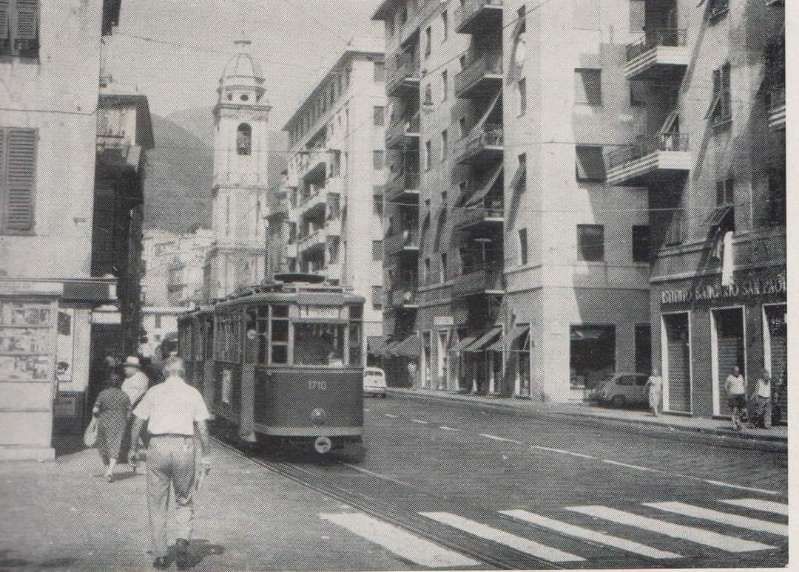
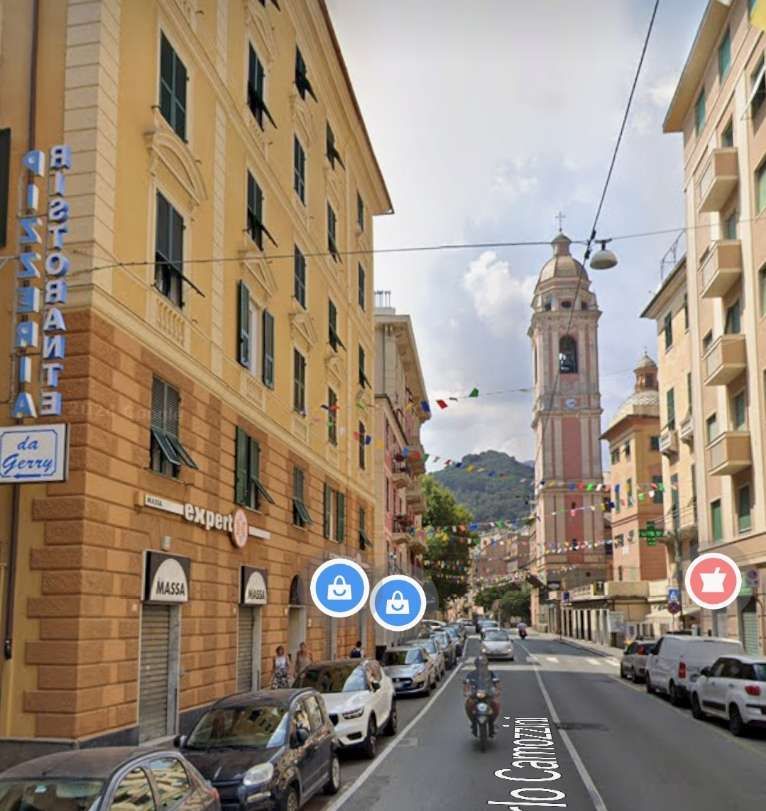
Looking West along Via Carlo Camozzini, Voltri in the mid-20th century, © Public Domain. [57]
Looking West from a very similar location on Via Carlo Camozzini. [Google Streetview, August 2024]

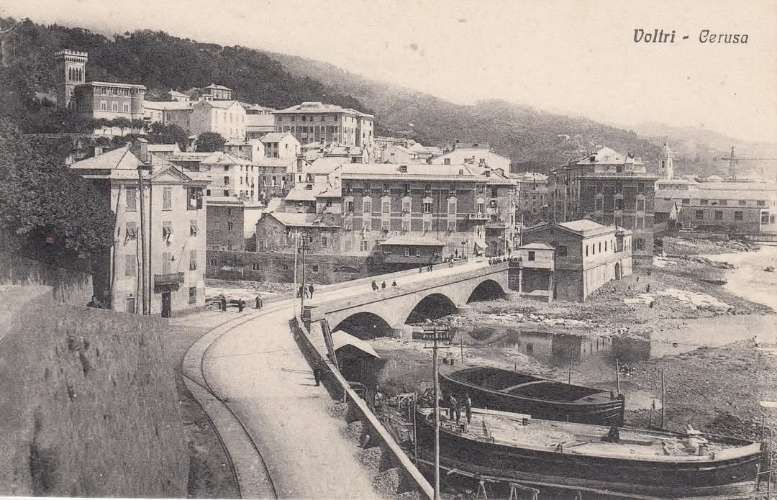
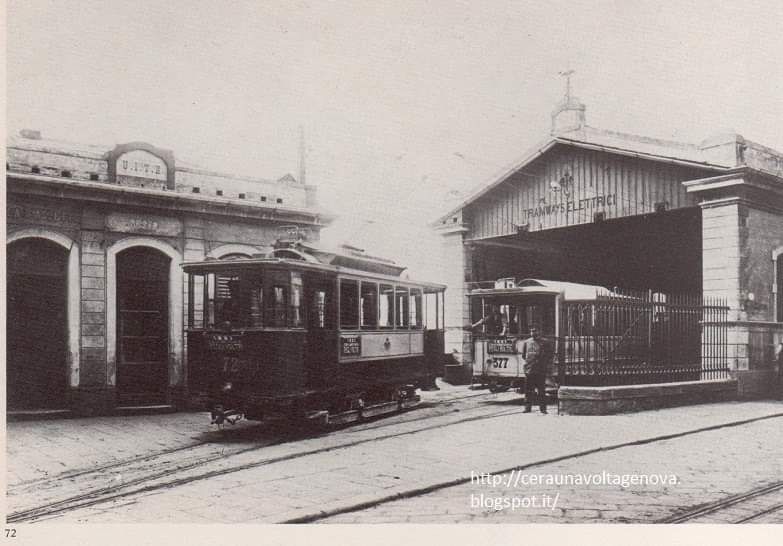
The tram depot was in Voltri close to the mouth of the River Cerusa (below).

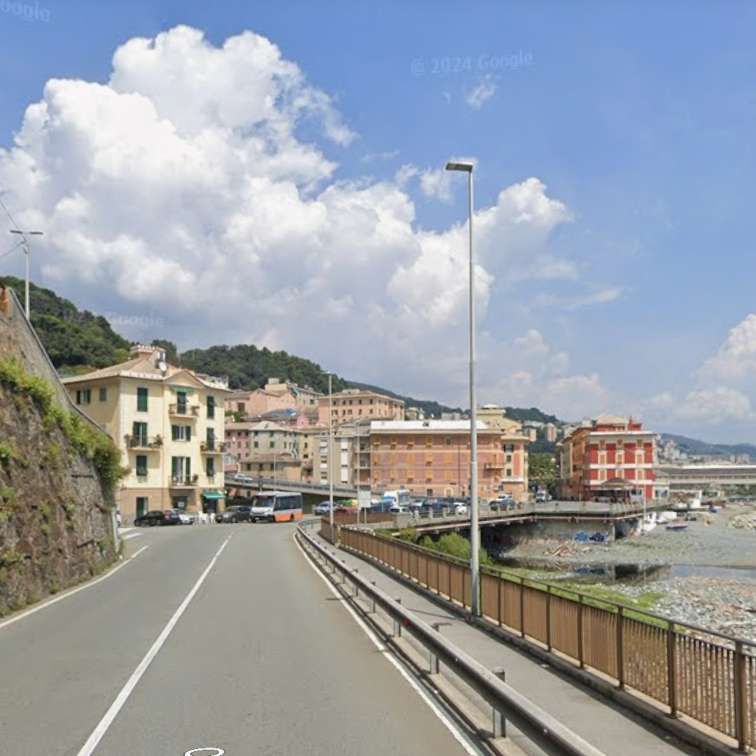
The bridge in this image spans the mouth of the Cerusa River. The photograph looks East towards Genoa. The building just beyond the river on a platform above the beach is the Tram Depot. There are clearly tram tracks running towards the camera which suggests that the line’s terminus was to the West of the Cerusa River. [56]
The same view in the 21st century. [Google Streetview, August 2024]
The tram depot in Voltri seen from the Northeast. The bridge over the River Cerusa is off to the right o, © Public Domain. [55]

We have followed the Western Network as far as we can along the coast. We now need to look at the line(s) of the Western network which ran up the valley of the River Polcevera from Sampierdarena.

To do this we need to return to Piazza Vittorio Veneto in Sampierdarena.

The Western Network and Val Polcevera (the Valley of the River Polcevera)

The lines to the North left Piazza Vittorio Veneto at its Western end, passing immediately through an underpass under the FS Standard Gauge railway.

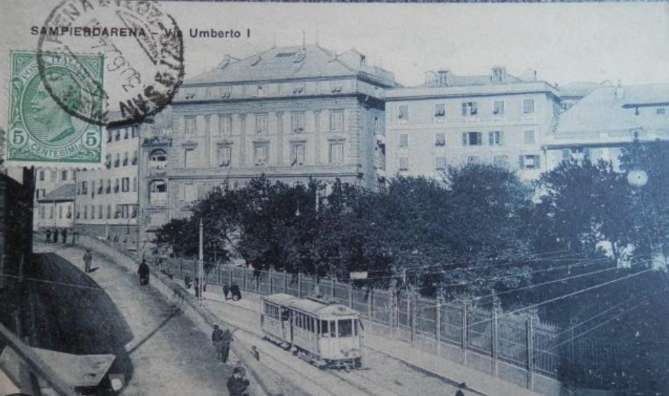
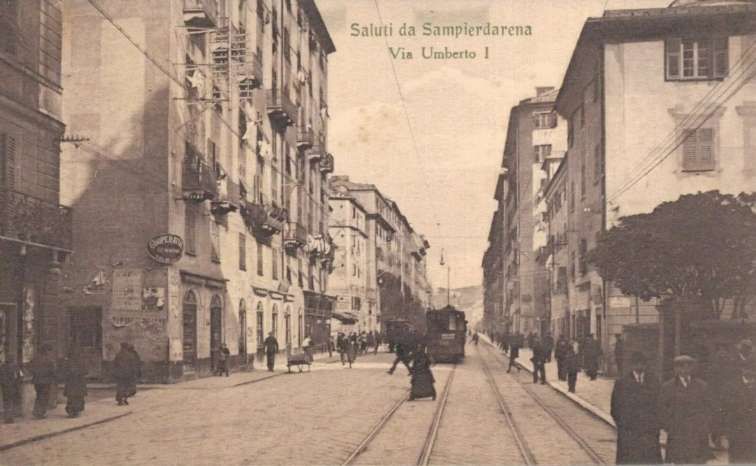
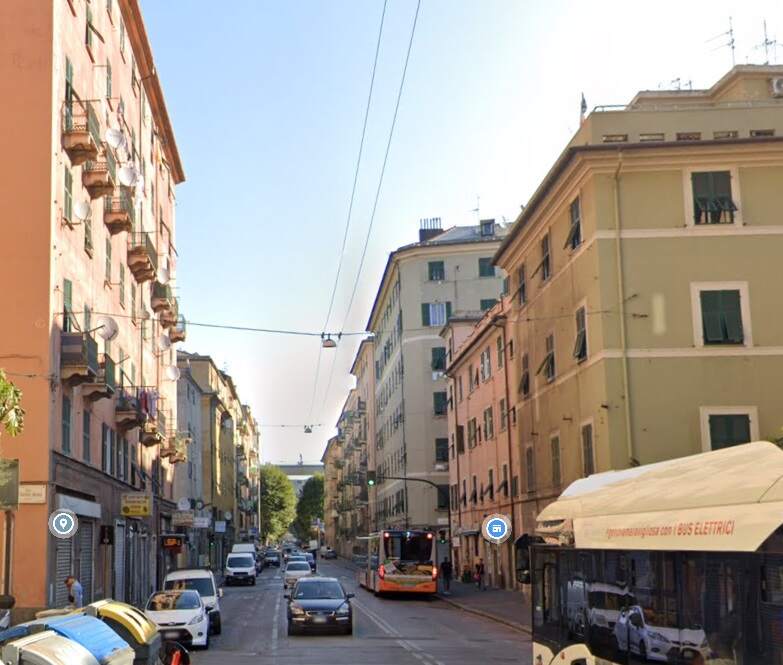
In the 19th century the route was known as ‘Via Vittorio Emanuele’. In the early years of the 20th century the road was renamed ‘Via Umberto 1’. In 1935, the city gave the road the name ‘Via Milite Ignoto’ (the Unknown Soldier). This decision appears to have been short-live as very soon the road was divided into two lengths, the more southerly length becoming ‘Via Martiri Fascisti’, the remaining length, ‘Via delle Corporazioni’. After the end of Word War Two renaming again occurred. In 1945 the names which continue to be used in the 21st century were chosen – ‘Via Paolo Reti’ and ‘Via Walter Fillak ‘. Fillak and Reti were partisans in WW2. [59][66]

A view from above … This is Piazza (Via) Vittorio Emanuele seen from the West. The tram tracks can be seen heading away through the underpass in the foreground. [75]

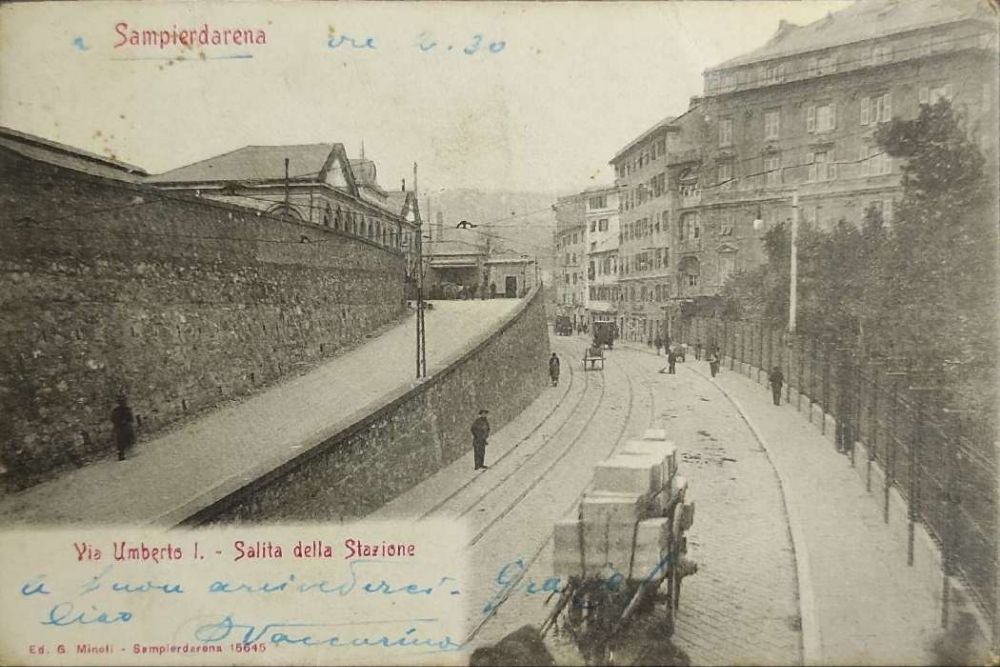
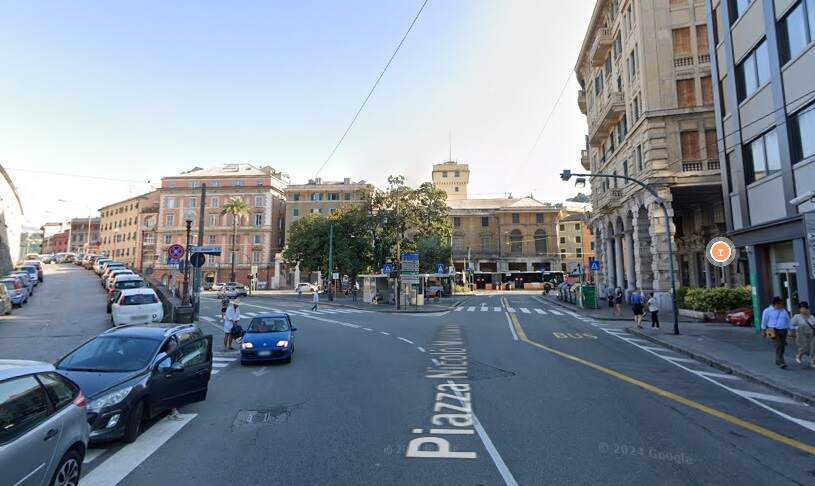
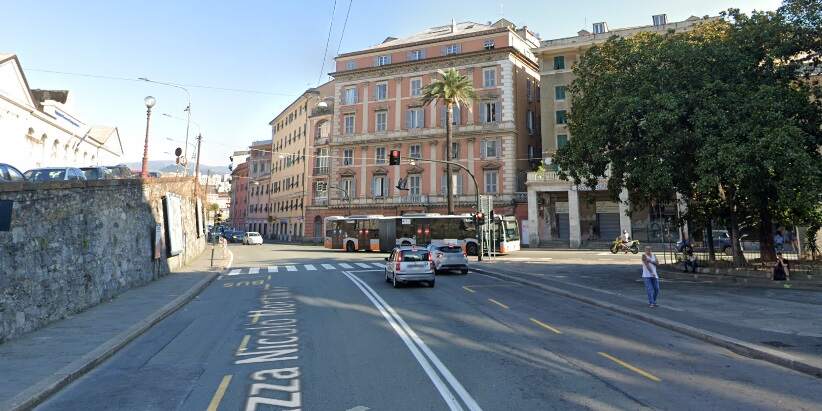
The route of this part of the old tramway network begins at this rail underpass (where the street is now named, ‘Piazza Nicolo Montano’, having once been Via Nino Bixio), [65] before running along Via Paolo Reti and then Via Walter Fillak. Just beyond the underpass the railway station access left the road on the left. The first old postcard views below show this location.

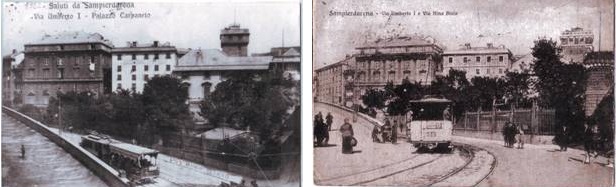
Two pixelated, low definition images showing the bottom end of what was Via Umberto 1. One the left in both images is the incline leading to the Sampierdarena Railway Station forecourt. [59]
A tram sits at a stop at Piazza Montano. This image was shared on the Foto Genova Antica Facebook Group by Annamaria Patti on 22nd May 2022. [3]
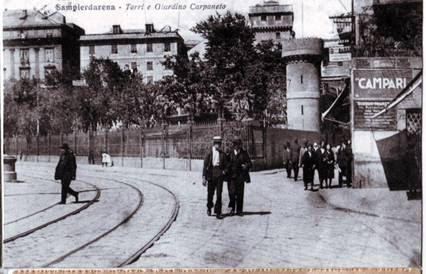
Three further postcard views, of better quality, of the bottom end of Via Umberto 1, (c) Public Domain. [59][62][63]
The view to the Northeast from the rail underpass in 2024. The station approach is on the left. The old tramway curved round to the left below the station approach’s retaining wall. [Google Streetview, August 2024]
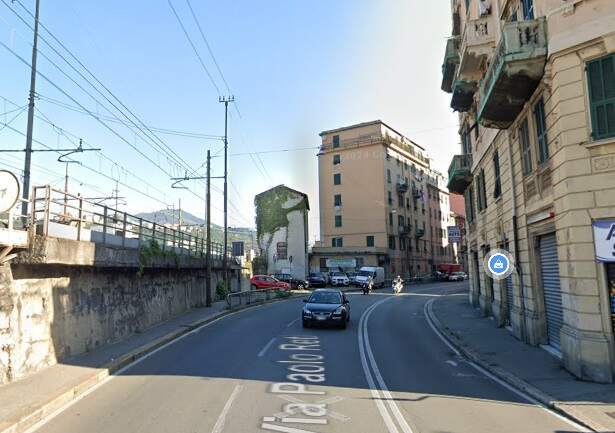
Just a little further along the old tram route. The retaining wall on the left supports the station approach road. The tramway ran on along what is now Via Paolo Reti. For some distance the road was flanked by a retaining wall supporting the FS standard-gauge railway. [Google Streetview, August 2024]

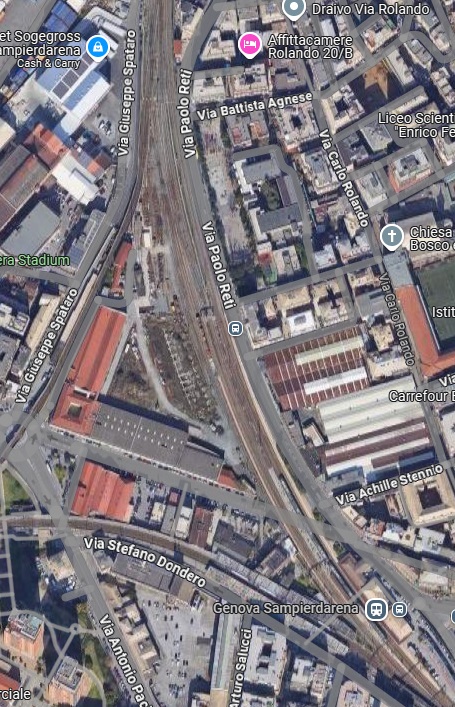
The adjacent Google satellite image shows roads over which the old tramway ran. In the bottom right is Piazza Nicolo Montano. It is also possible to make out the station approach ramp which has a number of cars parked on it. In the immediate vicinity of the passenger railway station, railway buildings can be seen separating Via Paolo Reti from the railway but very soon the road and the railway run side-by-side with the railway perhaps 2 to 3 metres above the road. Via Eustachio Degola passes under the railway just to the North of the station buildings. Towards the top of the satellite image, Via Paolo Reti can be seen turning away from the railway wall. [Google Maps, December 2024]

Via Paolo Reti (the former Via Umberto 1) turns away from the railway wall which is now much lower than it was near the station buildings. [Google Streetview, August 2024]
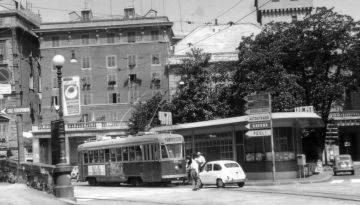
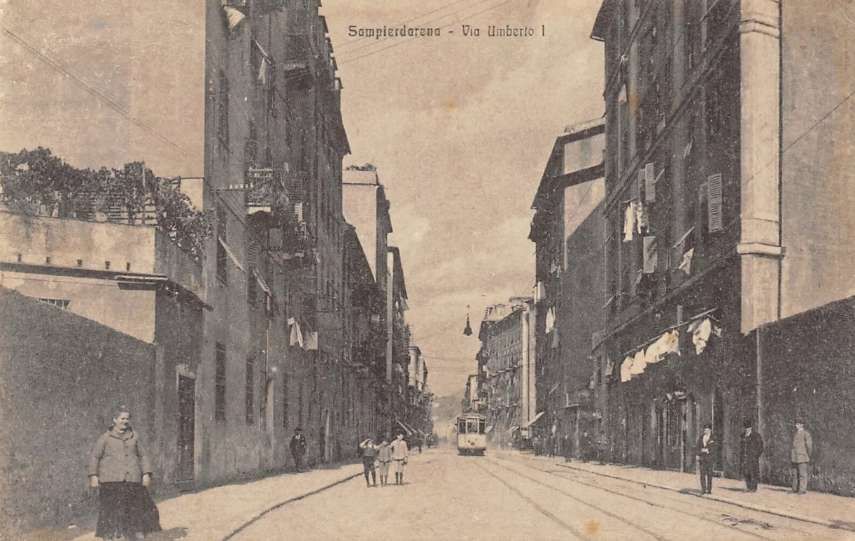
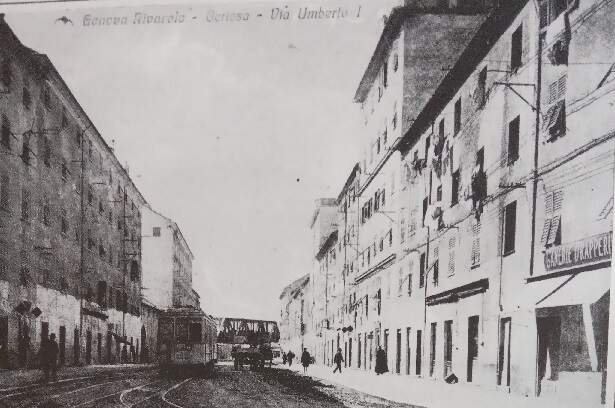
Via Umberto 1, looking North from the bend visible in the photograph above where the road leaves the side of the railway, (c) Public Domain. [68]
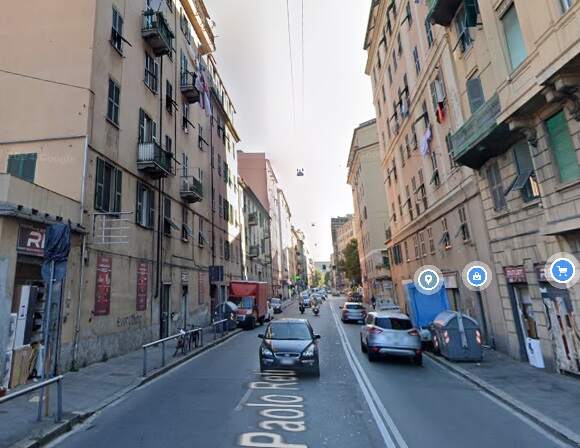
Via Paolo Reti (once Via Umberto 1) at the same location as the monochrome image above. [Google Streetview, August 2024]

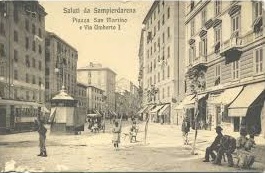
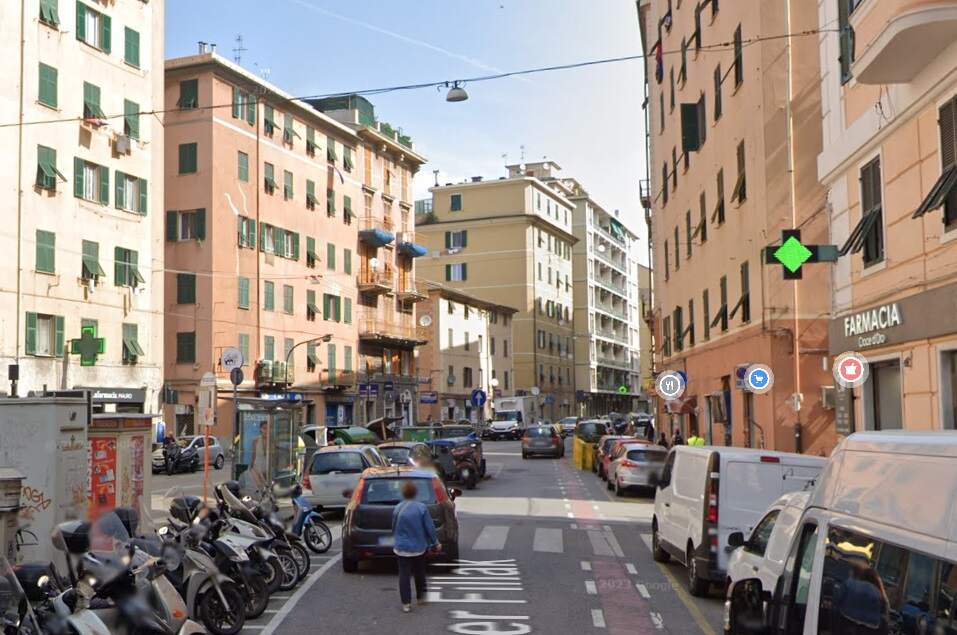
The monochrome image below purports to show Piazza San Marino. As far as I can work out the piazza was historically, ‘Piazza Vittorio Emanuele III’ and later renamed for another partisan from World War 2 – ‘Piazza Ricardo Masnata’.

A relatively low quality image of Piazza San Marino and Via Umberto 1. The piazza later became Piazza Ricardo Masnata. This view looks North with a tram visible on the left, (c) Public Domain. [64]
Piazza Ricardo Masnata, looking North. There is little to link this image from 2024 with the monochrome image above, other than the alignment of the roads and the shape of the piazza. However, at the centre of this image is a lower building which also appears in the monochrome image. [Google Streetview, August 2024]
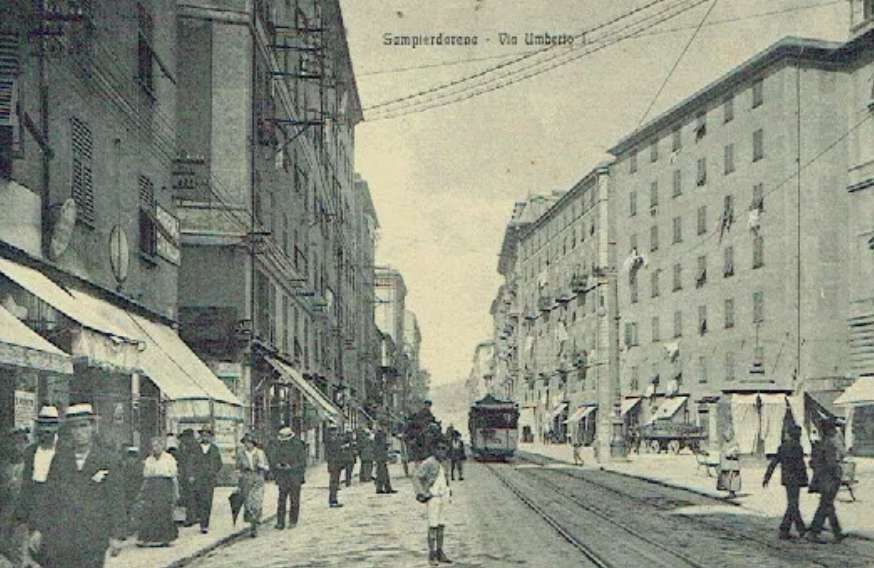
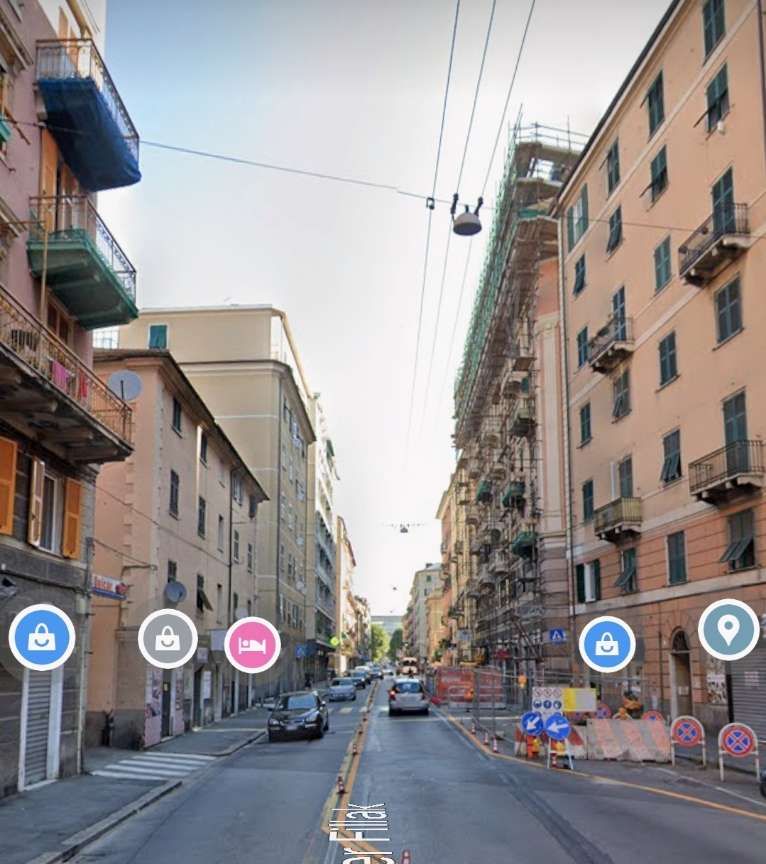
Via Umberto 1 looking North from what became Piazza Ricardo Masnata, (c) Public Domain. [67]
The same location in the 21st century. [G
Via Umberto 1, now Via Walter Fillak with a tram heading towards Genoa. [69]
The same location on Via Walter Fillak in the 21st century. [Google Streetview, August 2024]

The line from Sampierdarena ran towards Certosa where, once Galleria Certosa was completed, it met the line through the tunnel.

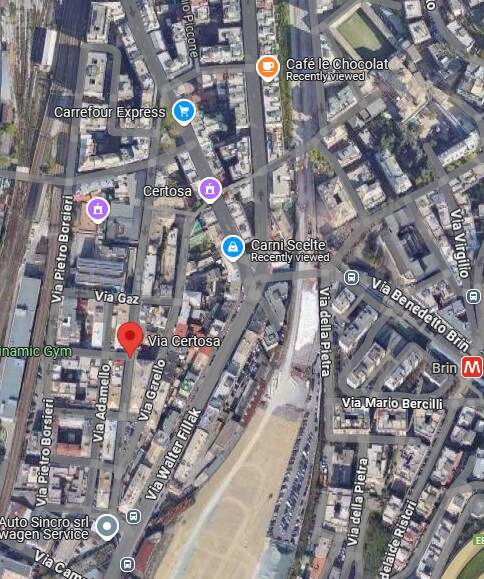
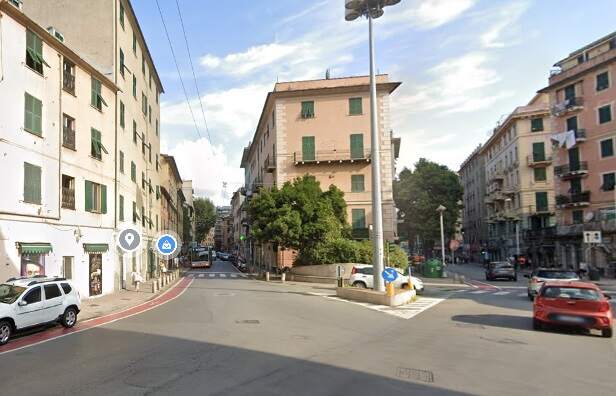
A satellite view of Certosa. Trams approached the centre of Certosa from the South-southwest on Via Walter Fillak, from the Southeast on Via Beedetto Brin and from the Northnorthwest on Via Germano Jori. [Google Maps, December 2024]
Galleria Certosa can be seen in the right background of this image. The tram is turning towards the underpass beneath the FS standard-gauge railway, © Public Domain. [72]
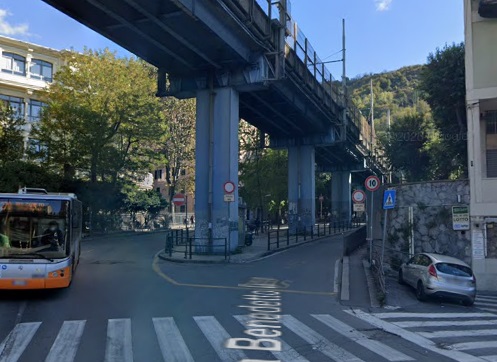
A similar view in the 21st century. The Metro station at Brin is at the high level. [Google Streetview, October 2020]
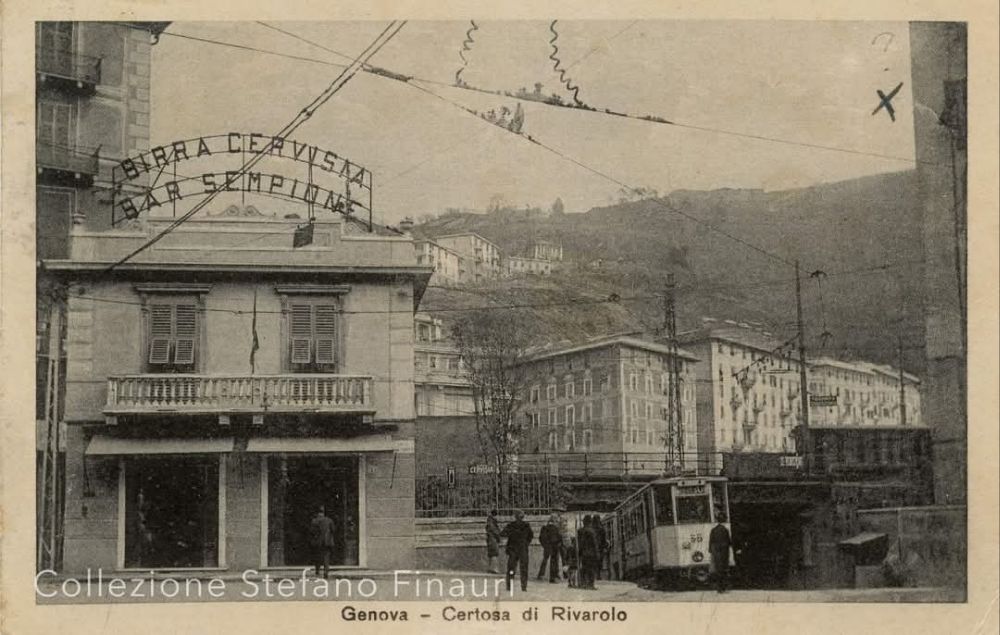
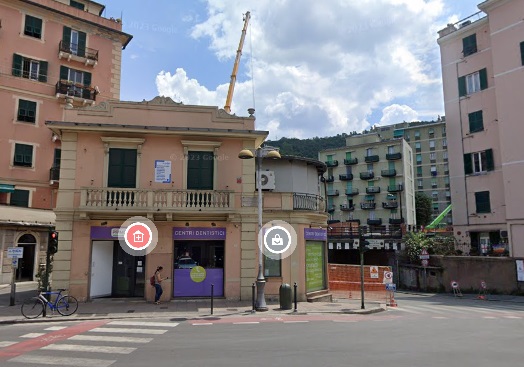
A tram has just passed under the railway (on Via Benedetto Brin) and is approaching the junction with Via Germano Jori (then Umberto 1) and Via Teresio Mario Canepari, © Collection of Stefano Finauri, Public Domain. [73]
A very similar view in the 21st century. [Google Streetview, August 2024]
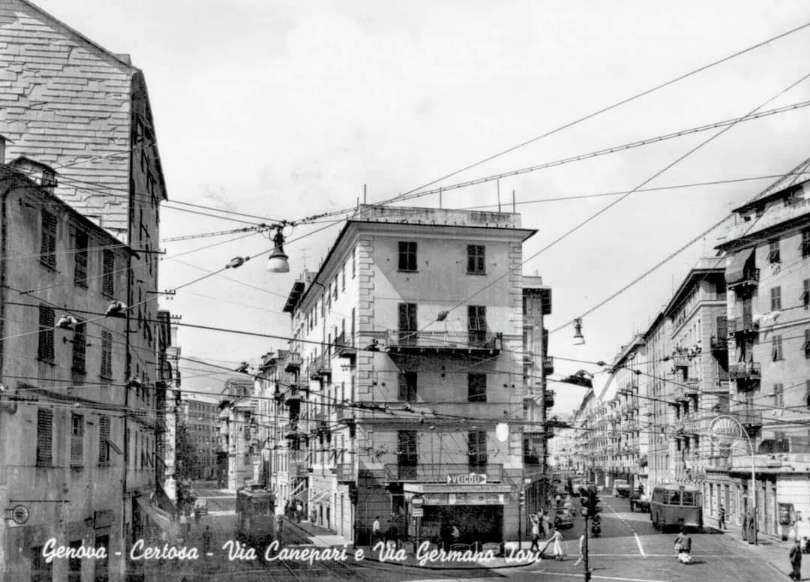
A mid-20th century postcard view, looking North from junction between Via Germano Jori and Via Teresio Mario Canepari. A tram is heading South along Via Germano Jori, © Public Domain. []
The same view in the 21st century, at the junction of Via Germano Jori, Via Teresio Mario Canepari and Via Benedetto Brin. [Google Streetview, August 2024]
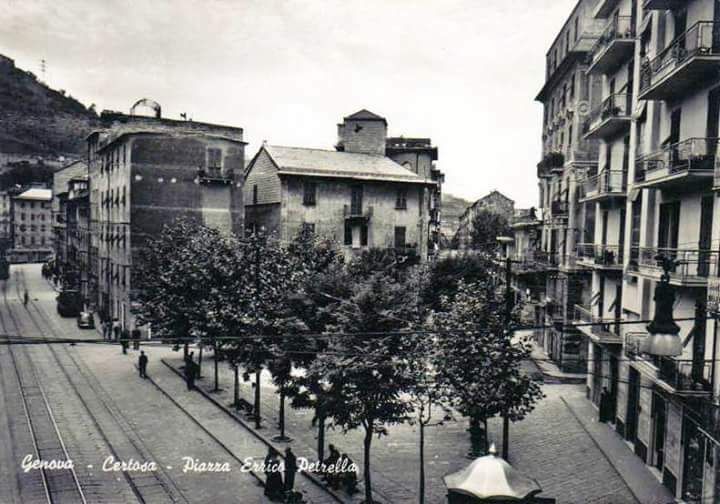
Piazza Errico Petrella looking South, Via Germaon Jori is on the left, Via Certosa on the right. A tram can be seen in the distance at the junction of Via Germano Jori with Via Benedetto Brin and Via Walter Fillak. [74]
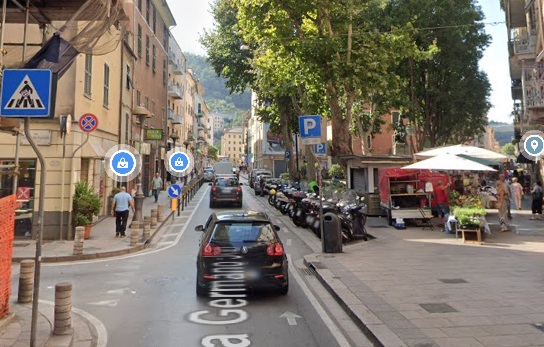
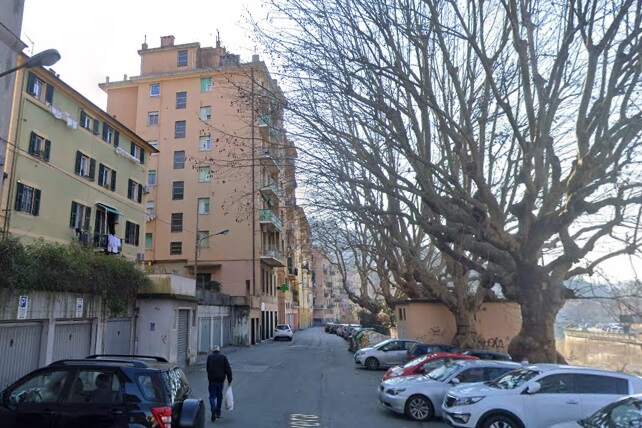
Looking South from Piazza Errico Petrella with Via Germano Jori ahead and Via Certosa behind the white canopies to the right. [Google Streetview, August 2024]
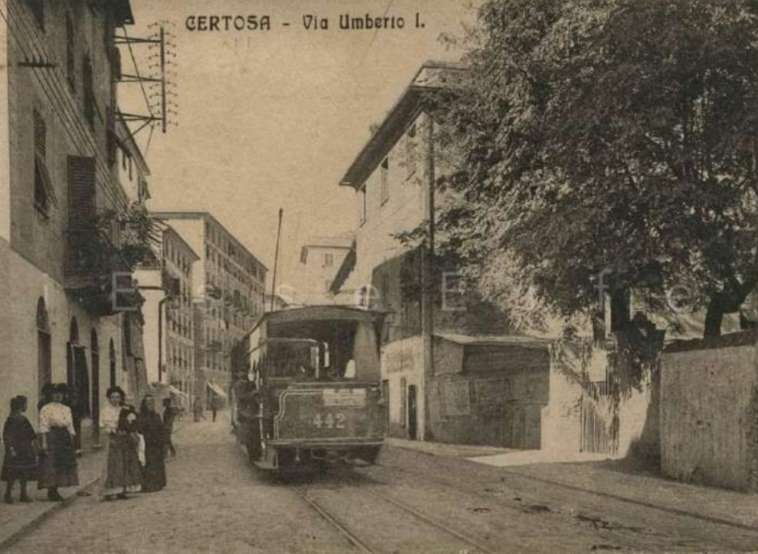
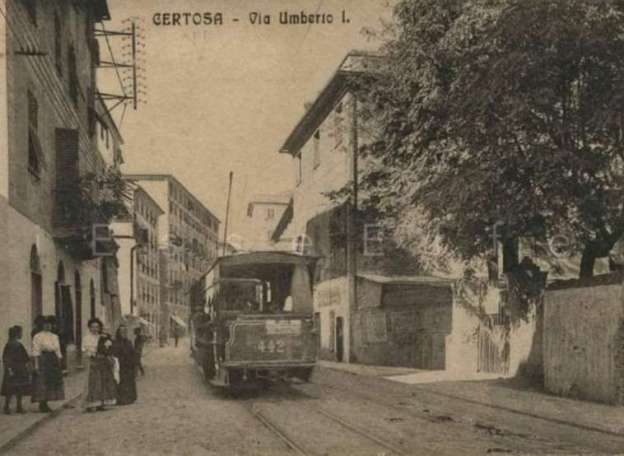
A tram on Via Umberto 1 in Certosa. It is difficult to locate this photograph in the 21st century as much of the built environment has changed but it is most likely a view North from Piazza Errico Petrella, © Public Domain. [53]
This is a possible location for the monochrome image above. This view looks North from Piazza Errico Petrella, the street geometry is similar, but the buildings do not match. In Certosa, northbound and southbound traffic is separated. This is Via Germano Jori. [Google Streetview, August 2024]
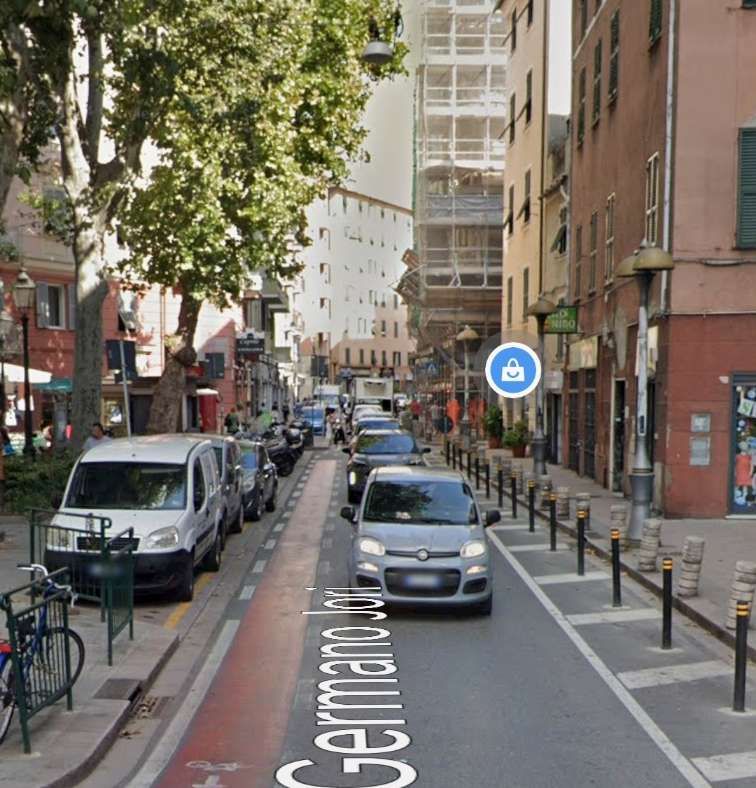
Looking South from the bridge over the River Torbella. The building on the right is the
Biblioteca Civica – Cervetto Rivarolo. Trams ran over this bridge and along Via Germano Jori which is the right fork in the road ahead. [Google Streetview, August 2024]
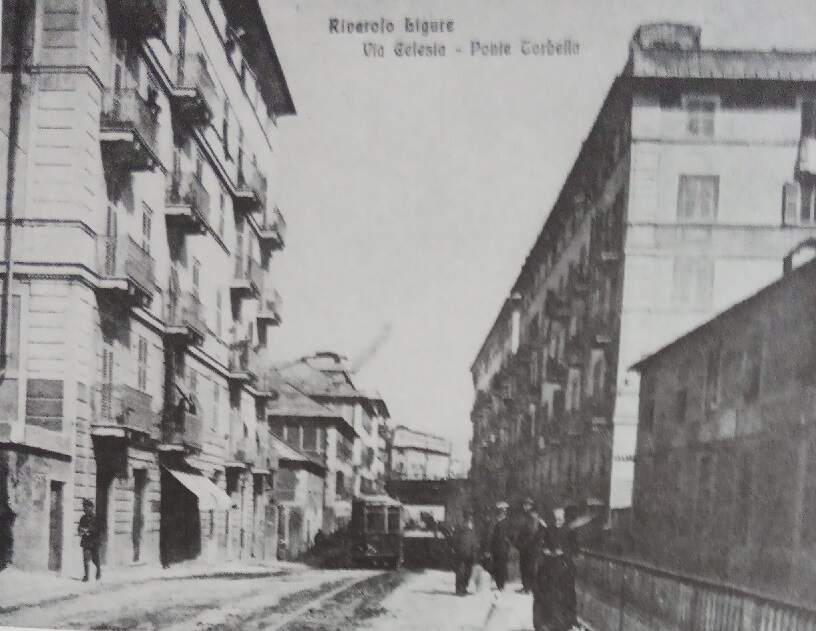
Looking North from the bridge over the Torbella river which separated Certosa from Rivarolo (Superior). This image was shared on the C’era una volta Genova Facebook Group by Luca Dasso on 17th December 2020, (c) Public Domain. [76]
A tram at the same location in the early 20th century. This image was shared on the C’era una volta Genova Facebook Group by Robert Cito on 19th October 2023, (c) Public Domain. [78]
A similar view North from the bridge over the River Torbella in the 21st century. [Google Streetview, August 2024]
This is a 1905 photograph looking North on Via Gioachino Rossini close to its junction with Via alla Stazione di Rivarolo (on the left). This image was shared on the C’era una volta Genova Facebook Group by Luca Dasso on 24th July 2018, (c) Public Domain. [81]
Continuing North through Rivarolo on what was still in the early years of the 20th century, Via Umberto 1. Tram No. 6 is heading for Bolzaneto. This image was shared on the C’era una volta Genova Facebook Group by Robert Cito on 18th October 2023. It is again difficult to accurately locate this image. A bridge similar to that shown on this photo remains but the landscape around it seems much altered, (c) Public Domain. [77]
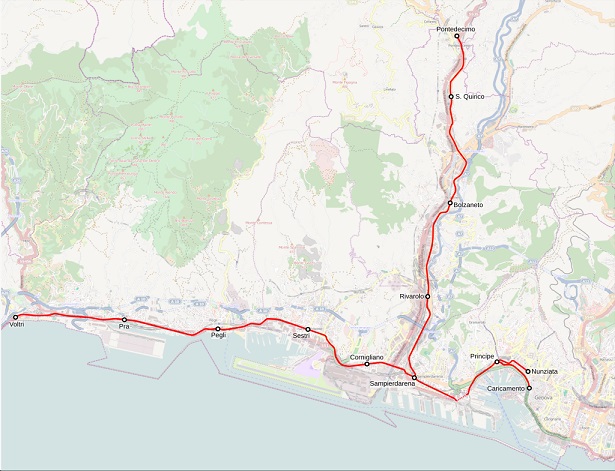
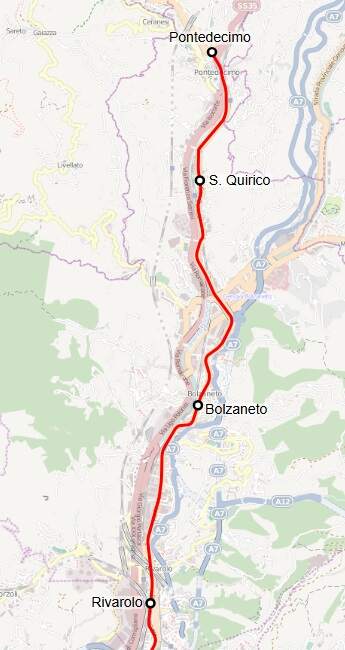
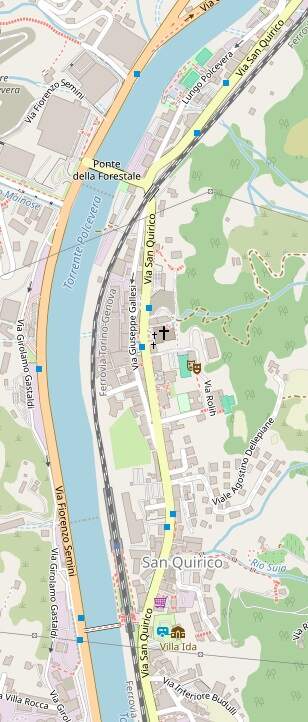
This extract from a file based on openstreetmap.org shows the remaining length of the tramway, from Rivarolo through Bolzaneto and San Quirico to Pontedecimo, (c) Arbalete, and authorised for reuse under a Creative Commons Licence (CC BY-SA 3.0). [19]

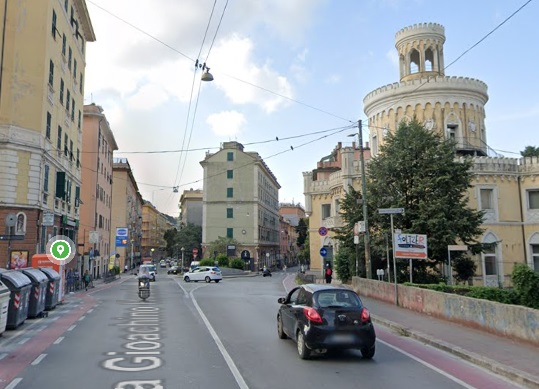
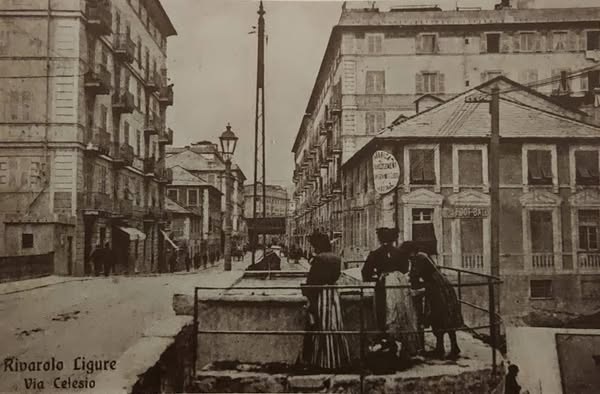
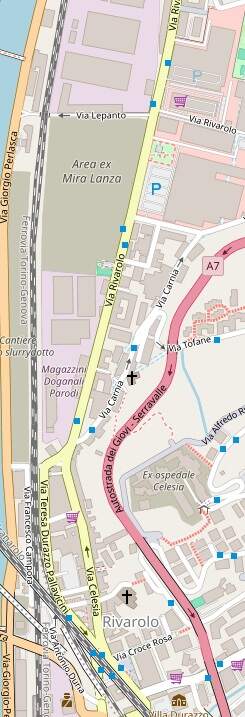
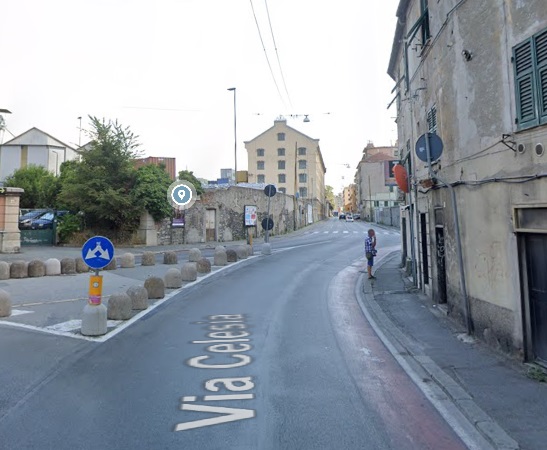
The tramway followed Via Celesia through Rivarolo (Superior). Rivarolo and Via Celesia can be seen at the bottom of this extract from openstreetmap.org. [79]

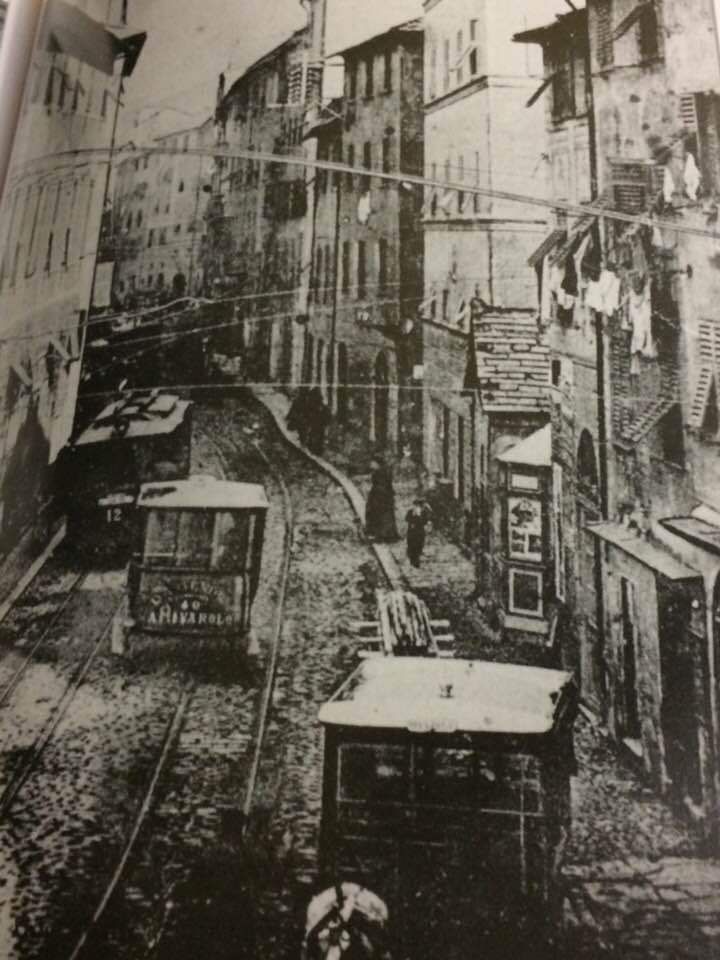
This image from the early 20th century looks North along Via Celesia. Space on the street was clearly at a premium! [80]
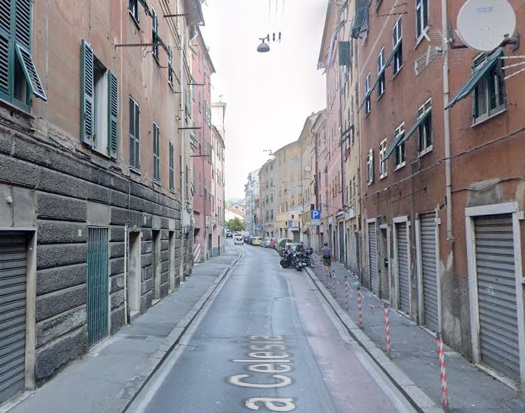
Via Celesia in the 21st century. [Google Streetview, August 2024]

North of Via Celesia, the tramway ran along Via Rivarolo.

This postcard shows the junction at the North end of Via Celesia, circa. 1920s. Via Rivarolo is ahead. This image was shared on the C’era una volta Genova Facebook Group by Mario Vanni on 18th August 2019, (c) Public Domain. [82]
The smae location in the 21st century. [Google Streeetview, August 2024]
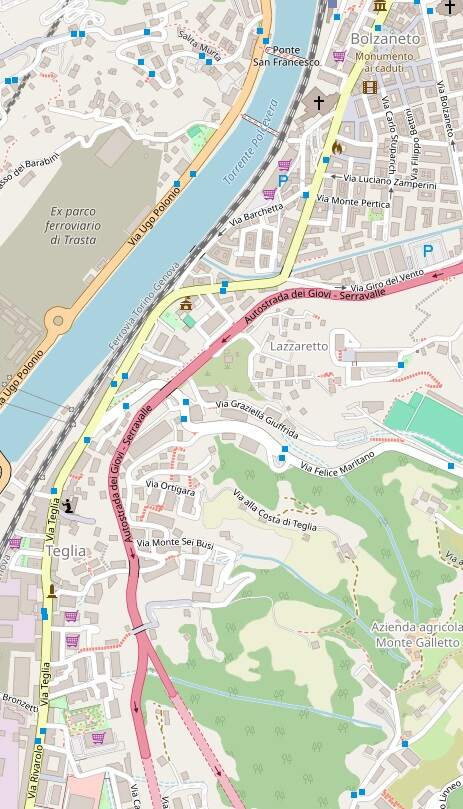
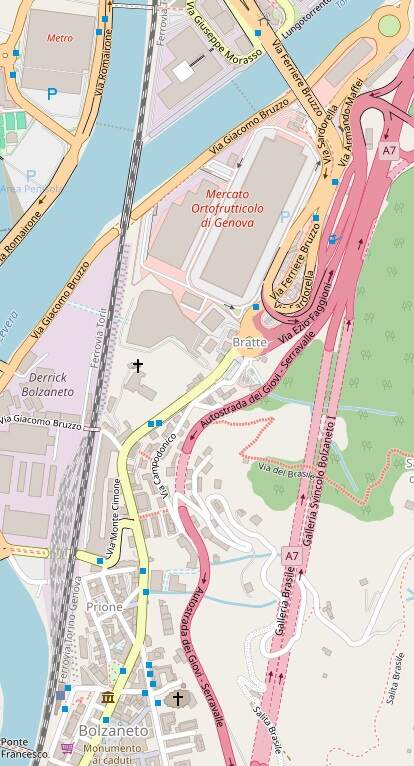
This next extract from openstreetmap.org shows Via Rivarolo entering bottom-left. Trams ran on into Teglia on Via Teglia and continued on to Bolzaneto (in the top-right of this extract) along Via Constantino Reta. [79]
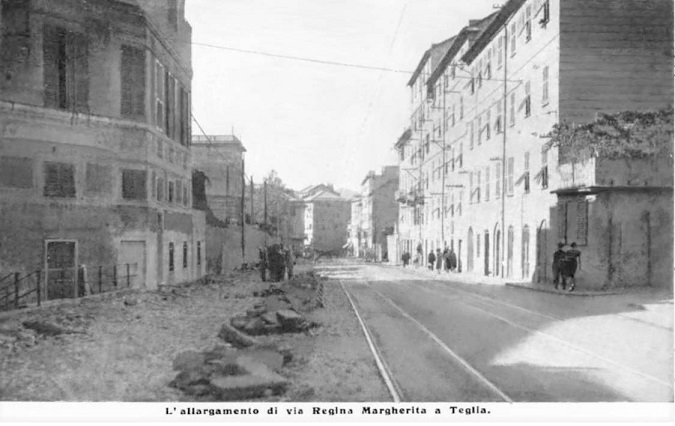
This postcard view looks South along what is now Via Teglia (then Via Regina Margherita. This image was shared on the C’era una volta Genova Facebook Group by Elio Berneri on 19th October 2020, (c) Public Domain. [83]
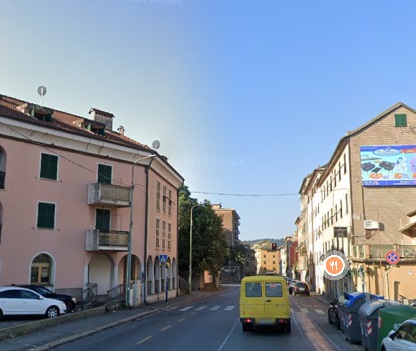
A very similar view at the same location in the 21st century. [Google Streetview, August 2024]
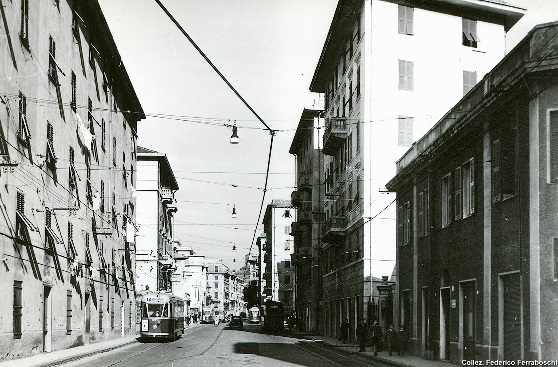
Car 906 in service on line 7 Caricamento – Pontedecimo, one of the longest of the UITE, is seen here running in Bolzaneto. The photograph was taken facing North. In the background you can see another Tramcar, as well as a third on the track in the opposite direction, (c) Public Domain. [84]
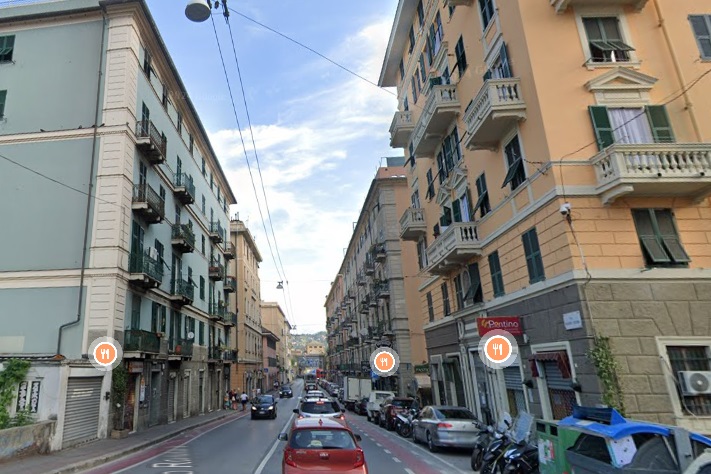
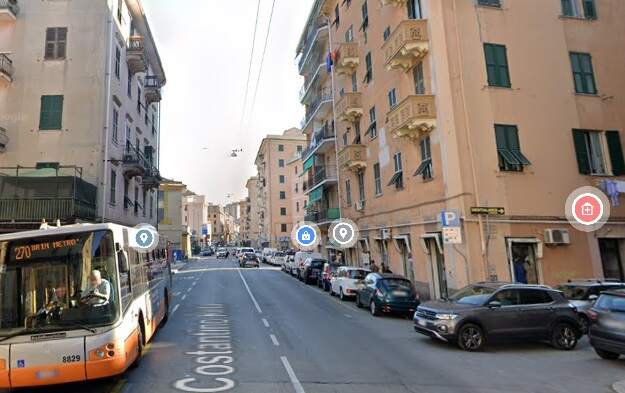
A similar North facing view in Bolzaneto in the 21st century. [Google Streetview, August 2024]
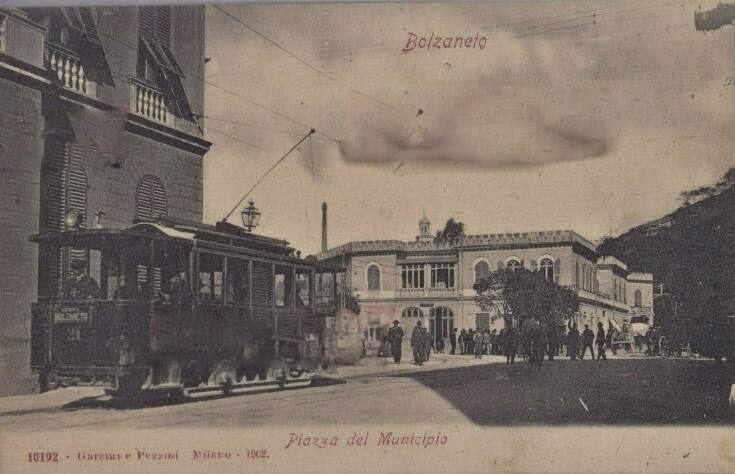
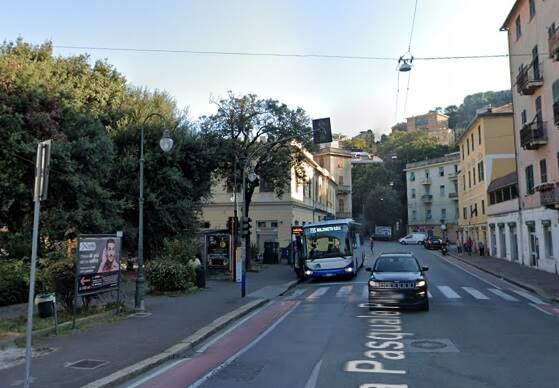
A tram waits at Piazza del Municipio in Bolzaneto. This image was shared by Mario Vanni on the C’era una volta Genova Facebook Group on 8th July 2021, (c) Public Domain. [85]
A very similat view of the same location in the 21st century. The road on which the bus is standing is now known as Via Pasquale Pastorino. [Google Streetview, August 2024]
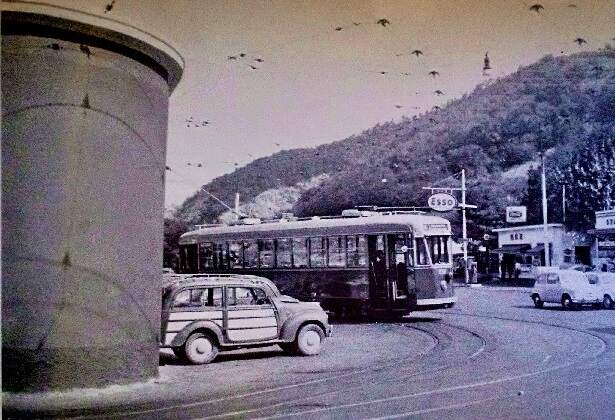
A few hundred metres to the Northeast is the area known as ‘Bratte’. A tram waits in the mid-20th century to set off for Caricamento. This image was shared on the C’era una volta Genova Facebook Group by Roberto Della Rocca on 12th December 2020. [86]
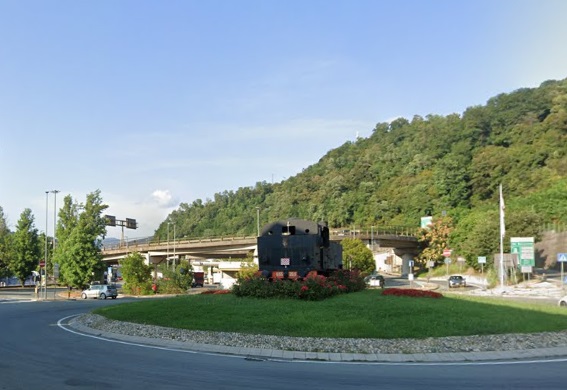
A similar view at the same location in the 21st century. [Google Streetview, August 2024]

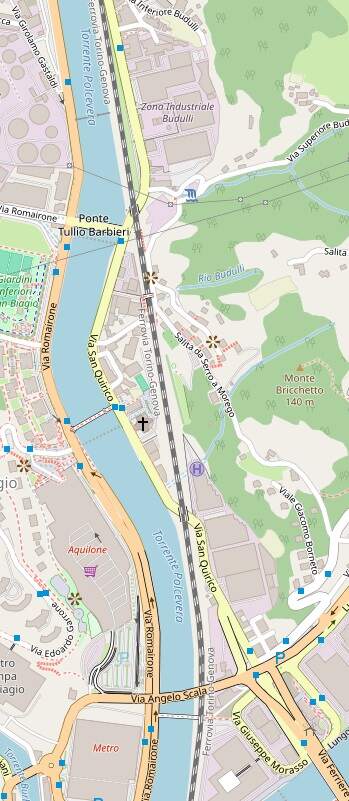
North of Bratte, Trams crossed the River Secca, a tributary of the Polcevera, following Via Ferriere Bruzzo and then continued North alongside the River Polcevera on Via San Quirico.

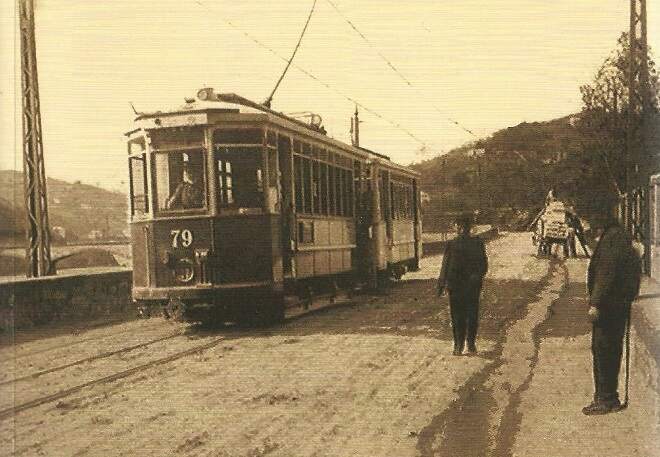
Tram No 79 leads a trailer car South on Via San Quirico in the first decades of the 20th century. It seems as though Ponte Tullio Barbieri can be seen behind the tram. This image was shared by Sergio De Nicolai on the C’era una volta Genova Facebook Group on 21st October 2018. [88]
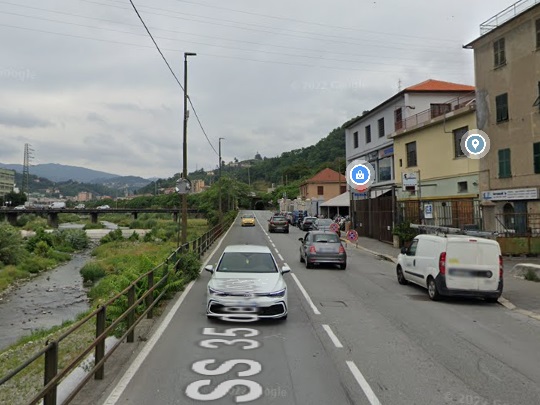
A similar location on Via San Quirico in the 21st century. [Google Streetview, July 2022]

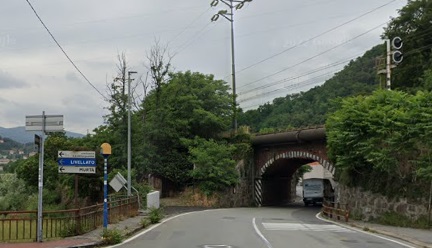
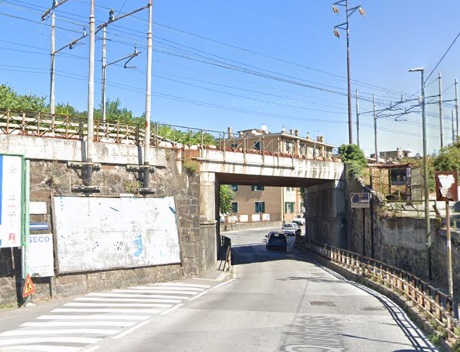
Trams passed under the FS Standard-gauge lines close to Ponte Tullio Barbieri. [Google Streetview, June 2022]
Trams ran on through the centre on San Quirico on Via San Quirico.
Before returning to the side of the river, passing under the railway again. [Google Streetview, July 2022]

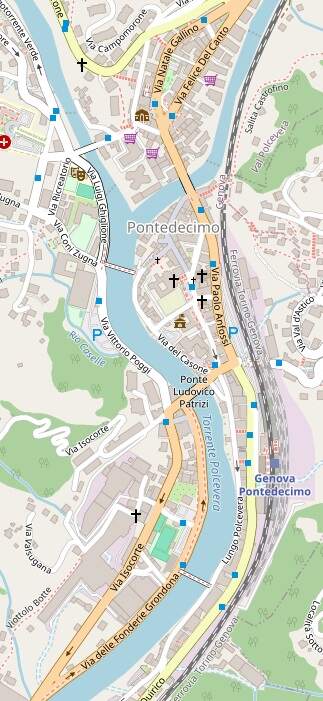
The next length of the journey is the last. Trams terminated at Pontedecimo. [79]

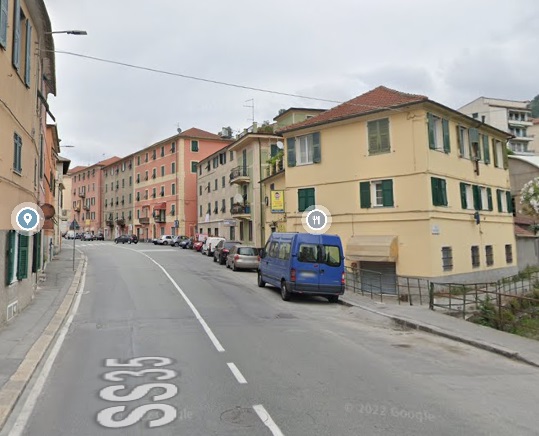
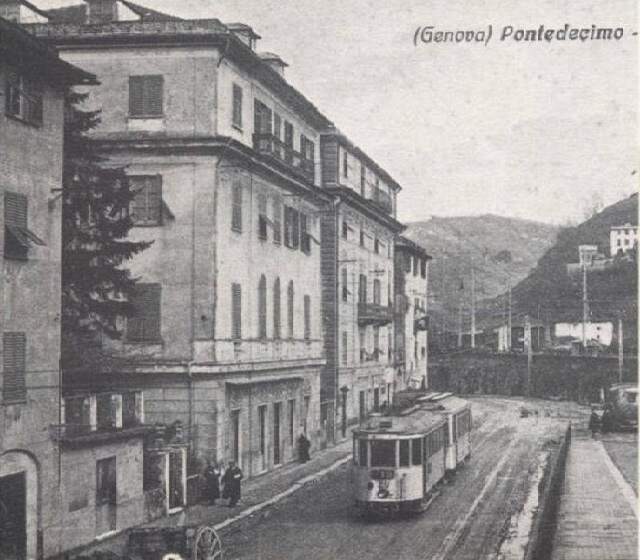
A tram and trailercar on Lungo Polcevera in Pontedecimo close to Pontedecimo Railway Station, This image was taken looking South along the river bank and was shared by Giorgio Gioli on the C’era una volta Genova Facebook Group on 4th November 2020. [89]
This view looks South along the bank of the River Polcevera at a location similar to that in the image above. [Googler Streetview, January 2021]
The central piazza in Pontedecimo. The terminus of the tram service. This image was shared on the C’era una volta Genova Facebook Group by Roberto Cito on 29th October 2023. [87]
Trams terminated in Pontedecimo. [Google Streetview, July 2022]
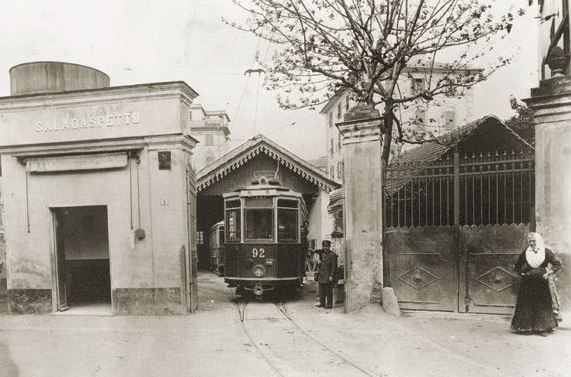
The tram depot at Pontedecimo. This image was shared on the C’era una volta Genova Facebook Group by Alessandro Lombardo on 30th October 2019. [90]

References

  1. https://commons.m.wikimedia.org/wiki/File:Genova,_piazza_De_Ferrari_with_tram.jpg, accessed on 10th November 2024.
  2. https://www.facebook.com/photo/?fbid=1401973673209093&set=gm.1438159026228377, accessed on 4th December 2024.
  3. https://www.facebook.com/photo/?fbid=10225181204176020&set=pcb.4980915058674284, accessed on 4th December 2024.
  4. https://www.facebook.com/share/p/uff2Q5eUj27cv1zK, accessed on 4th December2024
  5. https://www.facebook.com/share/p/XS39hojRUKuee7Fk, accessed on 4th December 2024.
  6. Not used
  7. https://www.guidadigenova.it/storia-genova/portoria-piccapietra, accessed on 14th November 2024.
  8. http://www1.palazzoducale.genova.it/storiche/storica10, accessed on 14th November 2024.
  9. https://www.facebook.com/groups/gianfranco.curatolo/permalink/4283487231695528/?app=fbl, accessed on 14th November 2024.
  10. https://commons.m.wikimedia.org/wiki/File:Genoa_1886_-_Italy_handbook_for_travellers.jpg, accessed on 15th November 2024.
  11. https://commons.m.wikimedia.org/wiki/File:Genoa_1906_-_Italy_handbook_for_travellers.jpg, accessed on 15th November 2024.
  12. https://commons.m.wikimedia.org/wiki/File:Genova_italy_1913.jpg, accessed on 15th November 2024.
  13. https://www.stagniweb.it/foto6.asp?File=tram_ge&Inizio=1&Righe=1&InizioI=1&RigheI=50&Col=5, accessed on 15th November 2024.
  14. https://www.collectoravenue.it/index.php/en/shop/cartolinagenovapiazzacorvettotram194033892-detail, accessed on 15th November 2024.
  15. https://www.ebay.co.uk/itm/152214705370?mkcid=16&mkevt=1&mkrid=711-127632-2357-0&ssspo=JNiy4OlNSAG&sssrc=4429486&ssuid=afQhrar7TGK&var=&widget_ver=artemis&media=COPY, accessed on 15th November 2024.
  16. https://en.m.wikipedia.org/wiki/AMT_Genova, accessed on 15th November 2024.
  17. Storia [History] (in Italian). AMT Genova; https://www.amt.genova.it/amt/amt-istituzionale/storia, accessed on 15th November 2024.
  18. http://www.uwrbancenter.comune.genova.it/sites/default/files/quaderno_arch_2011_03_21.pdf, accessed on 16th November 2024.
  19. Rete tranviaria di Genova; https://it.wikipedia.org/wiki/Rete_tranviaria_di_Genova, accessed on 26th November 2024.
  20. AMT (ed.); History of public transport in Genoa; Genoa, SAGEP Editrice, 1980.
  21. Paolo Gassani; Photo history of the tramway in Genoa , Genoa, Nuova Editrice Genovese, 1982.
  22. https://it.m.wikipedia.org/wiki/Galleria_Certosa, accessed on 27th November 2024.
  23. https://www.facebook.com/share/yMAPjmu6yE9CdhCt, accessed on 27th November 2024.
  24. https://www.lapolcevera.it/news/id/2352/cat/0/tip/1/Quando-da-Certosa-si-arrivava-a-Dinegro-con-il-tram-.html, accessed on 27th November 2024.
  25. https://dearmissfletcher.com/tag/galleria-giuseppe-garibaldi, accessed on 27th November 2024.
  26. https://www.facebook.com/groups/gianfranco.curatolo/permalink/8064067336970813/?app=fbl, accessed on 27th November 2024.
  27. https://m.wikidata.org/wiki/Q57466295, accessed on 28th November 2024.
  28. https://uk.pinterest.com/mantero1059, accessed on 28th November 2024.
  29. https://pastvu.com/p/720638, accessed on 28th November 2024.
  30. https://www.genovacollezioni.it/Default.aspx?q=CARTOLINE%20PAESAGGISTICHE&t=GALLERIA%20REGINA%20ELENA, accessed on 28th November 2024.
  31. https://ceraunavoltagenova.blogspot.com/2014/10/piazza-caricamento.html?m=1, accessed on 28th November 2024.
  32. https://ceraunavoltagenova.blogspot.it, accessed on 28th November 2024
  33. https://www.facebook.com/groups/fotogenovaantica/permalink/5685345834897866/?app=fbl, accessed on 28th November 2024.
  34. https://www.facebook.com/groups/fotogenovaantica/permalink/6981769868588783/?app=fbl, accessed on 28th November 2024.
  35. https://www.facebook.com/share/p/drRbQXEGcmKJdz6A/?, accessed on 28th November 2024.
  36. https://www.stagniweb.it/foto6.asp?File=tram_ge&Inizio=1&Righe=10&InizioI=1&RigheI=50&Col=5, accessed on 29th November 2024.
  37. https://www.facebook.com/share/p/FMgB1iVAaWiPNnKh, accessed on 29th November 2024.
  38. https://jenikirbyhistory.getarchive.net/topics/tram+transport+in+genoa, accessed on 29th November 2024.
  39. https://www.facebook.com/share/p/d9oFanfv5vD5WaiNhttps://www.facebook.com/share/p/d9oFanfv5vD5WaiN/, accessed on 29th November 2024.
  40. https://www.facebook.com/share/p/wYt15NoX8Mr9ypWg, accessed on 30th November 2024.
  41. https://images.app.goo.gl/gsrU1q3rJALvZngS7, accessed on 30th November 2024.
  42. https://www.guidadigenova.it/en/museums-genoa, accessed on 30th November.
  43. https://uk.pinterest.com/antoniettasatta48, accessed on 30th November 2024.
  44. http://www.sanpierdarena.net/Miani.htm, accessed on 30th November 2024.
  45. https://www.stagniweb.it/foto6.asp?File=l_cart&righe=1&inizio=31&InizioI=1&RigheI=50&Col=5, accessed on 30th November 2024.
  46. https://genovaquotidiana.com/2019/01/18/via-buozzi-il-civ-fa-capitozzare-gli-oleandri-e-rivendica-il-gesto-su-facebook-ma-e-un-reato, accessed on 30th November 2024.
  47. https://www.facebook.com/share/p/ZWYfrGt7G1939S9u, accessed on 30th November 2024.
  48. https://it.pinterest.com/pin/484981453600622954, accessed on 30th November 2024.
  49. https://www.genovacollezioni.it/Default.aspx?q=CARTOLINE%20PAESAGGISTICHE/LE%20VIE%20%28GENOVA%29, accessed on 30th November 2024.
  50. Not used
  51. https://www.ebay.co.uk/itm/115763406405?mkcid=16&mkevt=1&mkrid=711-127632-2357-0&ssspo=Fbvtwm00Q0S&sssrc=4429486&ssuid=afQhrar7TGK&var=&widget_ver=artemis&media=COPY, accessed on 1st December 2024.
  52. https://picclick.it/GENOVA-VOLTRI-Autostrada-355749405047.html, accessed on 1st December 2024.
  53. https://www.facebook.com/groups/fotogenovaantica/permalink/8344927118939711/?app=fbl, accessed on 1st December 2024.
  54. https://www.facebook.com/share/p/6tSJoFzSasA4xmu3, accessed on 1st December 2024.
  55. https://www.facebook.com/share/p/zEf2KTXYZhPjguZX, accessed on 1st December 2024.
  56. https://www.facebook.com/share/p/4hRGt2WPmqNiZVbp, accessed on 1st December 2024.
  57. https://www.facebook.com/share/p/aGd9JKEJxxSRn9ia, accessed on 1st December 2024.
  58. https://www.facebook.com/share/p/idwwKc9CdoGfQZJw, accessed on 1st December 2024.
  59. http://www.sanpierdarena.net/Umberto%20I%20via.htm, accessed on 1st December 2024.
  60. https://www.facebook.com/share/p/HHN7WWEPXs9oNcEo, accessed on 1st December 2024.
  61. http://www.sanpierdarena.net/Garibaldi%20%20via.htm, accessed on 2nd December 2024.
  62. https://en.todocoleccion.net/postcards-europe/italia-sampierdarena-tranvia-via-umberto-i-postal-ano-1924~x354863523, accessed on 2nd December 2024.
  63. https://www.ade-commerce.com/genova/11488-444.html, accessed on 2nd December 2024.
  64. https://www.ebay.it/itm/174536201862, accessed on 2nd December 2024.
  65. http://www.sanpierdarena.net/Bixio%20Nino.htm, accessed on 2nd December 2024.
  66. http://www.sanpierdarena.net/MASNATA%20piazza%20.htm, accessed on 2nd December 2024.
  67. https://www.ebay.it/itm/224002923884, accessed on 2nd December 2024.
  68. https://www.ebay.it/itm/254349164553, accessed on 2nd December 2024.
  69. https://www.ebay.it/itm/393235493801, accessed on 2nd December 2024.
  70. https://www.facebook.com/share/p/An4Vodj6noSjruUM, accessed on 2nd December 2024.
  71. https://www.facebook.com/share/p/CYT3Wkb6YWLbAT24, accessed on 2nd December 2024.
  72. https://www.ebay.co.uk/itm/350908506772, accessed on 3rd December 2024.
  73. https://www.facebook.com/share/p/DXjPiBiqC7sCL643, accessed on 3rd February 2024.
  74. https://picclick.it/44459-Genova-Certosa-Rivarolo-Panorama-151828747218.html, accessed on 3rd December 2024.
  75. https://www.facebook.com/photo/?fbid=10232988450560527&set=gm.7724149347629282&idorvanity=903038299740455&__cft__[0]=AZVr5xtKCXiMxS-c4pGOUE3YGYCwwYGpM43-lfcKbcKTSCD-BJe-fmJqn0qZfyk9TQED9y_VPuVRzq39J0bFbkLKoFGz6kOLg0891_K6_MOv0Iq1Ppxm6nLu6CcX01puDbgn7DQaGoOiSU3LQ-XfdPP8CaXDW7hbVVaj06T_R6VqX7IqYNr9LOS5PfXk2EZygGbITURlAhuoWhjV1VaQ1mLb&__tn__=EH-R, accessed on 3rd December 2024.
  76. https://www.facebook.com/photo?fbid=3861773430513069&set=pcb.3821731724537750, accessed on 3rd December 2024.
  77. https://www.facebook.com/photo?fbid=299207253067928&set=pcb.7027731573937733, accessed on 3rd December 2024.
  78. https://www.facebook.com/photo/?fbid=299896119665708&set=pcb.7032010463509844, accessed on 3rd December 2024.
  79. https://www.openstreetmap.org/search?query=genova#map=13/44.47342/8.90957, accessed on 3rd December 2024.
  80. https://www.facebook.com/share/p/qf1DLAhNoiuB3JbA, accessed on 3rd December 2024.
  81. https://www.facebook.com/photo/?fbid=2032824086741355&set=gm.1992781060766168, accessed on 3rd December 2024.
  82. https://www.facebook.com/photo/?fbid=1285825284920697&set=gm.2607205412657060, accessed on 3rd December 2024.
  83. https://www.facebook.com/photo/?fbid=3732530906786449&set=gm.3658399444204313, accessed on 3rd December 2024.
  84. https://www.stagniweb.it/foto6.asp?File=tram_ge&Inizio=5&Righe=10&InizioI=1&RigheI=50&Col=5, accessed on 3rd December 2024.
  85. https://www.facebook.com/photo?fbid=1877966582373228&set=pcb.4394846693892914, accessed on 3rd December 2024.
  86. https://www.facebook.com/photo/?fbid=10218412266399363&set=gm.3808759165835006, accessed on 3rd December 2024.
  87. https://www.facebook.com/photo/?fbid=306188622369791&set=pcb.7071692396208317, accessed on 3rd December 2024.
  88. https://www.facebook.com/photo/?fbid=469944593414846&set=gm.1813515448747610, accessed on 3rd December 2024.
  89. https://www.facebook.com/photo/?fbid=10217065604864645&set=gm.3704153626295561, accessed on 3rd December 2024.
  90. https://www.facebook.com/photo/?fbid=2406380456348447&set=gm.2755847204459546, accessed on 3rd December 2024.
  91. https://commons.wikimedia.org/wiki/File:Genova_Pegli,_tramway_terminus.jpg, accessed on 10th December 2024.
  92. https://www.marklinfan.com/f/topic.asp?TOPIC_ID=4530&whichpage=1, accessed on 16th December 2024.
  93. https://www.facebook.com/photo/?fbid=851357163339749&set=gm.6796097163822722&idorvanity=574539035978597, accessed on 16th December 2024.