
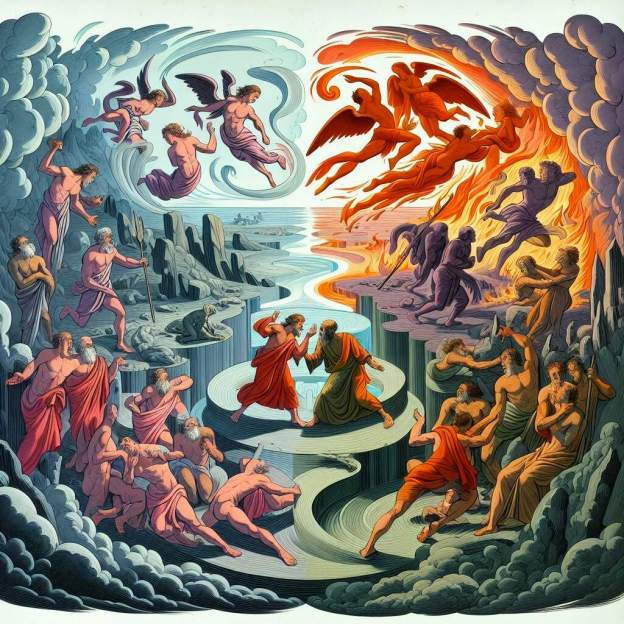
The featured image above is one person’s attempt to reflect the angst associated with ‘dishonorable passions’ and ‘natural relations versus those contrary to nature’. [22]
In a previous article about Romans 1: 16-32, (https://rogerfarnworth.com/2024/06/15/romans-1-16-32-pauls-discussion-considered), [2] I think we demonstrated that we cannot, with any integrity, assert that the first chapter of the epistle to the Romans makes an unequivocal negative statement about lifelong, loving, covenantal same-gender relationships.
It is possible that Paul is quoting what many a Jewish Christian might be thinking and then countering it with his ‘you therefore’ in Romans 2: 1. That interpretation, if correct, would mean that, rather than expressing his own understanding of God’s position in Romans 1: 16-32. He is, in fact, quoting Jewish Christians and then going on to challenge their sense of superiority over their Gentile siblings. Indeed, “some biblical scholars have long suspected that these verses were borrowed, with some reworking and paraphrasing, from some other source, as the language and word choices are atypical of the rest of the book of Romans.These verses resemble a rhetorical tool used by contemporaries of Paul to contrast the Jews and Gentiles, the basic argument being that idolatry, as practiced by the pagan Gentiles, leads to all manner of sinful behaviour.” [10]
In the midst of the passage is an assertion about particular same-sex sexual activities being ‘against nature‘ (παρὰ φύσιν). [Romans 1:26-27]
If we think that Paul is quoting others, then these words are tangential to Paul’s argument in Romans 1, and are of little importance. But, if these are Paul’s own words, then we need to give our attention to them. The meaning of those two words is particularly important if we remain unsure as to who is speaking. Is it Paul? Or is he quoting others, specifically Jewish Christians? This particular question is discussed in the article mentioned above (which can be found here).
Let’s work on the assumption that these words are indeed important. in that case, we need to consider two things if we are to understand the phrase ‘against nature‘ (παρὰ φύσιν):
- We need to ask what particular activities are being referred to as being, ‘against nature’ (παρὰ φύσιν: para physin); and
- We need to question what is meant by something being ‘against nature‘ (παρὰ φύσιν: para physin).
The intention in this article is to address these two concerns. In passing, we will also note a couple of other Greek words used in the two verses: ἀτιμίας (atimias) and ἀσχημοσύνη (aschēmosynē).
First, here are the words in the relevant verses translated into English in the NIV and the NRSV.
Romans 1: 24-27 in the NIV reads:
“Therefore God gave them over in the sinful desires of their hearts to sexual impurity for the degrading of their bodies with one another. They exchanged the truth about God for a lie, and worshipped and served created things rather than the Creator—who is forever praised. Amen. … Because of this, God gave them over to shameful lusts. Even their women exchanged natural sexual relations for unnatural ones. In the same way the men also abandoned natural relations with women and were inflamed with lust for one another. Men committed shameful acts with other men, and received in themselves the due penalty for their error.” [Romans 1: 24-27 (NIV)]
Romans 1: 24-27 in the NRSV reads:
“Therefore God gave them up in the lusts of their hearts to impurity, to the degrading of their bodies among themselves, because they exchanged the truth about God for a lie and worshipped and served the creature rather than the Creator, who is blessed for ever! Amen. … For this reason God gave them up to degrading passions. Their women exchanged natural intercourse for unnatural, and in the same way also the men, giving up natural intercourse with women, were consumed with passion for one another. Men committed shameless acts with men and received in their own persons the due penalty for their error.” [Romans 1: 24-27 (NRSV)]
Without wanting to chase back all the way through Romans 1, we can note that the ‘Therefore‘ of verse 24 refers back to the way in which people, probably particularly Gentiles, “exchanged the glory of the immortal God for images made to look like a mortal human being and birds and animals and reptiles.” [Romans 1: 23 (NIV)]
So, the argument in these verses goes like this: ‘because of their idolatry, God has given Gentiles over to the sinful desires of their hearts and to their idolatry (v24-25). And because of this (v26) God gave them over to shameful lusts/degrading passions. Women exchanged natural sexual desires for unnatural ones. Men abandoned natural relations with women and were inflamed with lust for one another committing shameful/shameless acts with other men.’
The Greek text is included in the references to this article below, at reference [8]. The key words are highlighted in italics above and in the Greek in the references. These are:
Shameful lusts/degrading passions: πάθη ἀτιμίας (‘passions of dishonour‘)
Unnatural: παρὰ φύσιν (‘against nature‘)
Shameless/shameful acts: ἀσχημοσύνην κατεργαζόμενοι (‘shame working out‘)
Having already considered the question whether this is Paul speaking, or whether he is quoting others, I guess our next question must be whether the acts being described are explicitly sinful or are to be seen in another category. The text sees these actions as shameful/shameless, degrading and against nature. Is that the same as being ‘sinful’? Is being ‘against nature‘ the same as being ‘sinful’?
A parallel question which we must consider is what exactly the text is saying is shameful/shameless and ‘against nature‘.
To be clear, traditional arguments appear to misread Romans 1. Those traditional arguments refer back to the creation stories, deriving from them what is seen to be the only form of marriage allowed in Scripture, that between a man and a woman. Those arguments go on to point to Matthew 19 and Mark 10 in which Jesus appears to say that that issues related to marriage hinge on how God created humanity. so, the traditional arguments say: “the sin of homosexuality is the giving up of natural desires and engaging in unnatural acts, which are defined as any same gender sexual activity.” [3]
But is that what the text says? Careful consideration of the text suggests that a different argument is being made. First, in Romans 1: 18-23, the argument is being made that the wrath of God is revealed from heaven “against all ungodliness and wickedness of those who by their wickedness supress the truth.” [NRSV: Romans 1: 18] … “Claiming to be wise, they became fools; and they exchanged the glory of the immortal God for images resembling a mortal human being or birds or four-footed animals or reptiles.” {NRSV: Romans 1: 22-23] This is, first and foremost, a concern about idolatry. “People have stopped worshipping God, who should be obviously known to them through the creation they live in. They turn to idol worship instead, and God allows them to experience life without Him.” [3]
So, God gives idol worshippers over to “impurity for the degrading of their bodies among themselves, because they exchanged the truth about God for a lie and worshipped and served the creature rather then the Creator, who is blessed for ever! Amen.” [NRSV: Romans 1:24-25] This is then developed by the next two verses: “God gave them up to degrading passions. Their women exchanged natural intercourse for unnatural, and in the same way also the men, giving up natural intercourse with women, were consumed with passion for one another. Men committed shameless acts with men and received in their own persons the due penalty for their error.” [NRSV: Romans 1:26-27]
We have already noted that degrading passions/shameful lusts: as the NSRV and the NIV translate πάθη ἀτιμίας actually mean something different, perhaps ‘passions of dishonour‘, something dishonourable, not highly valued, not held in honour or not respected. A translation closer to the meaning of the original words would not be ‘degrading passions‘ or ‘shameful lusts‘ but ‘of ill repute’ or ‘socially unacceptable’. It seems, perhaps, that the translators of the NRSV and NIV have allowed preconceptions of the meaning of πάθη ἀτιμίας to dictate their translation. πάθη ἀτιμίας actually “refers to something that is culturally unacceptable, rather than something that is morally wrong.” [3]
In judging whether it is reasonable to differentiate between ‘culturally unacceptable’ and ‘morally wrong’, it might be helpful to look back to Romans 1:18. In that verse, the text does refer to ‘wickedness‘ (NRSV/NIV), ἀδικίαν. In that verse, the wickedness referred to is the supressing of the truth of the Godhead, replacing it with idols. The same word (ἀδικίᾳ) appears in Romans 1:29. It heads a list of “every kind of wickedness, evil, covetousness, malice. Full of envy, murder, strife, deceit, craftiness, they are gossips, slanderers, God-haters, insolent, haughty, boastful, inventors of evil, rebellious toward parents, foolish, faithless, heartless, ruthless. They know God’s decree, that those who practice such things deserve to die, yet they not only do them but even applaud others who practice them.” [Romans 1:29-32]
The two occurrences of the word ἀδικίαν/ἀδικίᾳ appear either side of Romans 1:26-27 but the text uses a different word, ἀτιμίας when dealing with the specific sexual matters covered in those two verses. In those two verses, there is a different dynamic to the ‘wickedness’ (sinfulness/guiltiness) of the surrounding verses. Romans 1:26-27 appear to operate on the basis of a ‘shame’/’honour’ spectrum. Honour/dishonour in the eyes of society seem to be at stake. The text uses ἀτιμίας to describe those things mentioned in verses 26 and 27 of Romans 1. “The plain meaning of [ἀτιμίας] is something culturally unacceptable, and does not carry a moral connotation.” [3]
Codrington says that there is a “clear progression in [the text’s] description of a descent into moral decay, from idolatry to culturally unacceptable behaviour to sinful actions to moral decay to the complete destruction of humanity. ” [3]
Codrington asks us to consider other examples of the use of ἀτιμίας to which I have added one:
- Romans 9:21 – ἀτιμίας “refers to a potter making a pot ‘for common use’. This is a euphemism for a chamber pot – not morally unclean, but culturally unacceptable to talk about in public … the same usage is found in 2 Timothy 2:20.” [3]
- 2 Corinthians 6:8 the writer talks of being ‘shamed’ (ἀτιμίας) for the Gospel.
- 2 Corinthians 11:21 – the writer refers to themselves as ἀτιμίαν, (NRSV: ‘To my shame…’.
- 1 Corinthians 11:14 – it is ‘shameful’ (ἀτιμία) for a man to wear long hair – not a moral issue, nor a creation ordinance, just a societal norm being contravened.
- 1 Corinthians 15:43 (ἐν ἀτιμία) – in a state of disgrace, used of the unseemliness and offensiveness of a dead body).
There is no New Testament occurrence of ἀτιμίας which expresses a moral judgment – it is used to refer to ‘unseemingliness‘, to cultural preferences and societal norms. “So when Paul calls certain passions ‘shameful’ in Romans 1:26, he is not saying they are wrong; he is merely saying they do not enjoy social approval and are culturally unacceptable.” [3]
There is a further word which we need to look at – ἀσχημοσύνη – it, or an associated word, appears only three times in the New Testament, in Romans 1:27, 1 Corinthians 12:23 and Revelation 16:15. In the book of Revelation, ἀσχημοσύνην is used to denote being seen naked as shameful. Literally, ‘without form’, not nice, unseemly, inappropriate. In 1 Corinthians it appears alongside ἀτιμότερα (less honourable). In that context, ἀσχήμονα seems to mean unpresentable [parts], less honourable parts. [9] It was socially unacceptable in Jewish Christian culture at the time to even name private body parts. “These references have no moral judgment in them.” [3]
In Romans 1:27 ἀσχημοσύνη appears to have the connotation of ‘lewdness’, of shameless behaviour. This seems to be the only location when the word is used in this way. Why, if it was intended to convey deep moral outrage, did the writer not use more unambiguous words? Does the use of ἀσχημοσύνη suggest that the actions to which it refers fall into a category of being unacceptable in Jewish Christian culture rather than morally wrong?
We have something else to consider before thinking about the meaning of the phrase παρὰ φύσιν. We need to try to determine exactly what it was that men and women were doing that was παρὰ φύσιν.
Women in Romans 1:26
“Their women exchanged natural intercourse for unnatural, …” [Romans 1:26 (NRSV)]
This verse does not explicitly say that women were having sex with women. “It simply says that women were doing something unnatural with their bodies.” [3] Careful consideration of the context both in society and in the biblical text is critically important. What was it that Paul saw as unnatural?
The traditional argument relies of verse 27 and considers that Paul was paralleling the two matters – verse 27 refers to men having sex with men, so the reference in verse 26 must be about women having sex with women. But was that what Paul was saying?
Codrington reminds us that the “Old Testament never mentions, nor prohibits, lesbian sexual activity. In fact, there is almost no acknowledgement of female sexuality at all – the focus of all sexual prohibitions and instructions is the male. This is in line with Jewish – and ancient cultural – views on both gender and procreation. … Ancient cultures believed that all life was in the sperm, with the woman providing nothing more than an incubator for the foetus. That women would enjoy sex, or take an active role in it, was almost unthinkable. And for women to take a dominant role in sexual activity was considered, … ‘unnatural’.” [3]
The word that the NRSV translates as ‘intercourse’ is χρῆσιν (chrēsin). Apart from Romans 1:26-27 the word is absent from the New Testament but it is “used frequently in other literature of the time, and meant ‘use, relations, function, especially of sexual intercourse’ The emphasis of this word is on the functionality of the sex … insemination and procreation. Any sex that could not result in insemination is ‘unnatural’. [3] Verse 26 does not indicate the sex of the woman’s partner. Culturally, “the prohibitions on women having sex that was considered inappropriate include having sex during menstruation, oral or anal sex (these would involve non-procreative ejaculation), or mutual masturbation. Paul could also have been referring to having sex with an uncircumcised man.” [3]
It is, of course, possible that Paul is talking, in Romans 1:26, of lesbian sexual activity, but this is not certain and perhaps, in the light of the absence of references in the Old Testament and in the structure of Paul’s argument, unlikely. [15]
What Paul is probably saying is that “any sexual activity that is not aimed at insemination is considered socially unacceptable to the Jews.” [3] and as the letter to the Romans unfolds, Paul goes on in Romans 2 to tell his Jewish Christian readers that they should not judge others in this way and ultimately, in Romans 14:13-14 to say, “Let us therefore no longer pass judgment on one another. … I know and am persuaded in the Lord Jesus, that nothing is unclean in itself. …” [Romans 14:13-14]
Men in Romans 1:27
What does Paul condemn when he says, “Men, giving up natural intercourse with women, were consumed with passion for one another. Men committed shameless acts with men and received in their own persons the due penalty for their error.”? [Romans 1:27 (NRSV)]
We have noted that Paul’s argument focusses primarily on cultural rather than moral issues, societal norms rather than absolute morality, but what does Paul have on his mind as he writes Romans 1:27?
“Paul could not help but be thinking here of Leviticus 18 and 20,” [17:p74] and the Holiness Code. Paul’s concern is to discourage his readers from involvement in Roman temple worship but also not to judge those involved. So in this verse, Paul could have been referring to pederasty. In Rome, “it was very common for young boys to give themselves to older men as a way of gaining social advantage. Mark Anthony had famously done this when he was a teenager, but was by no means an isolated case. This kind of mutuality in pederasty was considered “unnatural” (as in socially unacceptable) by Jews and most Gentiles as well.” [3][18]
Male same-sex sexual activity was normal in Roman and Greek culture. If Paul’s intention was to condemn all “homosexual activity in Rome, his words actually don’t go far enough. Paul is concerned here with men who’s sexuality is out of control.” [3] We must also note Paul’s use of the word χρῆσιν (chrēsin) which we have just seen relates to the ‘misuse’ of someone “upon whom a sexual act has been performed, and could apply to pederasty or temple prostitution. Both of these issues would make sense in the context of the passage, and be consistent with … Scripture … It definitely has the tone of abuse, excess and being out of control. The men are ‘inflamed with lust’.” [3]
So, is Paul condemning same-sex sexual practice, per se? Or is he more concerned about what is being done and for what reason? If same-sex sexual activity is occurring and neither partner is ‘inflamed by lust’ would he see that as wrong?
And what about the last phrase of verse 27 – ‘received in their own persons the due penalty for their error.’ We do not know what Paul was referring to here, but what is clear is that the word he uses to describe the behaviour to which he has been referring – ‘error’ (πλάνης (planēs)) – is a less judgemental word than ‘sin’, ‘evil’ or ‘wickedness’. When used elsewhere in the New Testament this word (it appears a total of six times) has been translated: ‘error’ (Romans 1:27); ‘deceit’, ‘deceitful’ (Ephesians 4:14); error, deceit (1 Thessalonians 2:3); ‘deluding’, delusion, ‘departure’, (2 Thessalonians 2:11); ‘error’, ‘wandering’ (James 5:20); ‘error’ (1 John 4:6). [19 + NRSV] The meaning of πλάνης appears to be around having been deceived, having wandered off. This meaning is far more neutral than other possible words such as ‘sin’ or ‘evil’. It is illuminating also to note that in each of the references to ‘deceit’ above, the sense is that of ‘having been deceived’ or ‘refusing to deceive others’ rather than ‘having been the deceiver’. So:
- “We must no longer be children, tossed to and fro and blown about by every wind of doctrine, by people’s trickery, by their craftiness in deceitful scheming.” [Ephesians 4:14]
- “Our appeal does not spring from deceit or impure motives or trickery.” [1 Thessalonians 2:3]
- “God sends them a powerful delusion, leading them to believe what is false.” [2 Thessalonians 2:11]
- “Whoever brings back a sinner from wandering will save the sinner’s soul from death and will cover a multitude of sins.” [James 5: 20] This is the closest link between πλάνης and ‘sin’, but sin here is regarded as a ‘wandering’ (πλάνης) not a wilful act.
- “From this we know the spirit of truth and the spirit of error.” [1 John 4:6] here the dynamic involved is truth/error, rather than right/wrong.
This begs the question of how certain we can be, that here in Romans 1:27, we find God’s final definitive statement against male same gender sexual activity?
Codrington asks: “If today’s LGBT people express their sexual activity without being “inflamed with lust”, and do not receive “the due penalty” in their bodies, can we say that God is not against their activity? … These verses … [are] not as clear as they may first appear.” [3]
We reached this conclusion without directly focussing on another important question of whether the same-sex sexual acts to which Paul refers are the same as loving faithful, committed, same-sex relationships which include sexual intimacy. As Michael Younis says: In Paul’s thinking, “the conception of sex and the roles of the respective partners differs drastically from today’s world.” [16] While there is undoubtedly still abuse in today’s world, for many gay couples, “Sexuality … is used not as a means for domination, but rather as a means of mutual love and respect. The use of sex as a means for domination constitutes rape or domestic abuse, both of which are criminal offences where the victim has the right to prosecute to perpetrator.” [16]
Against Nature (παρὰ φύσιν)
We focus now on the phrase that formed the tile of this article – παρὰ φύσιν.
Codrington tells us that in παρὰ φύσιν, παρὰ is a word that is familiar to modern ears because we have uses of the word derived from the Greek. παρὰ usually means ‘besides’, ‘more than’, ‘over and above’ or ‘beyond’. In English, we use this word to indicate similar things, “for example a paralegal is someone not totally qualified to be a lawyer, but who assists a real lawyer; and paranormal is something other than normal (rather than ‘opposed to normal’).” [3]
Codrington continues: In the Romans 1 context, the phrase παρὰ φύσιν “could mean ‘more than nature’ or ‘beyond nature’, but is probably better rendered ‘contrary to nature’ as most modern translations have it. But the sense of the phrase is not ‘in opposition to the laws of nature’ but rather ‘unexpected’ or ‘in an unusual way’. We might say, for example: ‘Contrary to his nature, John woke up early and went for a run’. This is not a moral issue, but refers to the character of something or someone.” [3]
In attempting to better understand the phrase παρὰ φύσιν,it is perhaps important that we look at other occurrences of its use, or of the use of φύσιν (or its derivatives). And here we have our first problem, The words φυσικός and φύσις, which are both translated as some form of the words ‘nature’, ‘natural’, or ‘instinctive’, present a considerable challenge. Paul only uses the phrase sparingly in his epistles. In fact, as Ness tells us, the word “is never used in the canonical books of the Septuagint, Paul’s source for Old Testament material. … The only other text in the [New Testament] that uses φυσικός is 1 Peter 2:12: ‘But these people blaspheme in matters they do not understand. They are like unreasoning animals, creatures of instinct (φυσικα), born only to be caught and destroyed, and like animals they too will perish.” [3]
So, perhaps Paul is speaking of something deeply engrained in human beings. Perhaps Paul is claiming that same-sex relations are unnatural, contrary to God’s plan for humanity, making all same-sex sexual relations a sin, regardless the context. If Paul was using παρὰ φύσιν in one particular way then that becomes a reasonable assumption.
However, we have already noted that the English phrase ‘contrary to nature’ does not necessarily refer to a moral issue.
To be sure of what Paul is talking about, we cannot just take our own understanding of one possible meaning, nor can we necessarily rely on our own instincts, our own cultural assumptions and apply them to the culture of Paul’s day. We have first to accept that in choosing to interpret the phrase ‘contrary to nature‘ as being about something utterly abnormal or abhorrent, we are making a choice to do so. We are perhaps, taking a cultural norm and making it a moral issue.
Here, starting with the example above, are ways in which the phrase, similar phrases or similar thinking might be used which imply no clear moral judgement, or which require considerable additional thinking to determine their ethics:
- Contrary to his nature, John woke up early and went for a run;
- Human beings cannot fly, if God had intended them to do so, he would have given them wings. Flight is ‘contrary to our nature‘, but we subvert that reality each time we fly to go on holiday;
- Aldous Huxley: ‘Consistency is contrary to nature, contrary to life. The only completely consistent people are the dead.’ No moral judgement is implied by Huxley;
- St. Augustine: ‘Miracles are not contrary to nature but only contrary to what we know about nature’;
- Roger is naturally longsighted, so he wears glasses to correct his sight;
- Is cosmetic surgery, or any surgery, contrary to nature?
- Is genetic modification, or cloning, contrary to nature?
- The choices made by different cultures about what it is appropriate to eat could also fall into this category – things that make me cringe, like the idea of eating dogs or horses, frogs legs or locusts.
- Human beings cannot breath under water, yet, contrary to our nature we have found ways to over come this.
Perhaps we might want to argue that some of those things require significant ethical consideration before we agree that they are right or wrong, but simply describing them as contrary to nature does not get close to resolving the debate. Perhaps some of these things cause an emotional response in me either of fear or dislike.
Throughout history cultures have made similar judgements about a variety of things, men having long hair, the wearing of beards, women speaking/leading in church, what constitutes male or female clothing. Some of these things carry a lot of stigma in particular cultures but they are not, ultimately, moral issues even when they might be enforced as such.
Codrington encourages us to think carefully about this within the context of the Roman world: “This concept of ‘according to nature’ or ‘contrary to nature’ needs to be understood properly in context. It is only since the Renaissance that the concept of ‘natural law’ has embedded itself in Western philosophy. In Paul’s world, the concept of ‘natural law’ was something linked with Stoicism, and referred mainly to socially unacceptable behaviour. It was a commonly used concept, and was not typically associated with moral rights and wrongs built into the fabric of reality as we perceive it today. For example, the Greek Stoic philosopher Epictetus criticised men who shaved their body hair in order to look more like women, saying that such men act ‘against [their] nature’ (physis) (Discourses 3.1.27–37). [11] Philo of Alexandria, a Jewish contemporary of Paul living in Alexandria, used para physin three times in his ‘On the Special Laws’ (3.7-82), [12] where he applies it to: (1) intercourse between a man and women during her menstrual period, (2) intercourse between a man and a boy (pederasty), and (3) intercourse between a person and an animal (bestiality). He also calls men who have sex with barren women (instead of divorcing them and remarrying) ‘enemies of nature’. While we might find pederasty and bestiality vile and evil, what do we make of the other issues? The defining characteristic of these sexual activities is not consent, or mutuality or love. The defining characteristic that groups them together is that there is no possibility of having children. This is what is defined as ‘unnatural sex’ in classical literature.” [3]
Codrington quotes Marilyn Riedel who writes: “The concept of ‘natural law’ was not fully developed until more than a millennium after Paul’s death. He thought ‘nature’ was not a question of universal law or truth but, rather, a matter of the character of some person or group of persons, character which was largely ethnic and entirely human: Jews are Jews ‘by nature’, just as Gentiles are Gentiles ‘by nature’. ‘Nature’ is not a moral force for Paul: humankind may be evil or good ‘by nature’, depending on their own disposition. Paul uses ‘nature’ in the possessive, that is, not in the abstract ‘nature’ but as someone’s nature. Paul is therefore writing about the personal nature of the pagans in question.” [3][20]
Bryan Ness quotes James Brownson: “When we seek to bring ancient discussions into our modern context, we run into some problems. In the ancient world we see almost no interest at all in the question of sexual orientation, particularly among critics of same-sex behaviour. Rather, we see the kinds of discussion found in Romans 1 focusing on two problems: the subjective problem of excessive lust and the objective problem of behavior that is regarded as ‘contrary to nature’. Yet when these discussions are translated into a modern context, the question of lust tends to recede into the background, because, as we have seen, it seems irrelevant to the question of committed gay unions. Instead, the focus falls on the objective problem that same-sex eroticism is ‘contrary to nature’. Traditionalists generally are far more comfortable talking about sexuality ‘objectively’ than in dealing with the inner and subjective aspects of sexual orientation. This is true in no small part because the Bible does not envision the category of sexual orientation; it only addresses the problem of excessive desire.” [10][13: p170]
Returning to early Christian, and parallel Jewish, thought: “For early Jews in particular, the Alexandrian school had a great influence in what was considered ‘natural’. In the third century, Clement of Alexandria asserted that ‘to have sex for any purpose other than to produce children is to violate nature’. This concept was also taught by Philo (to a Jewish audience). For him, any use of human sexuality which did not produce children ‘violated nature’. For some early Christians, celibacy was as unnatural as homosexuality, and so was masturbation. Failure to divorce a barren wife was ‘unnatural’ as well. Jewish thinking … believed that ‘unnatural sex’ is any sexual activity which is not capable of inseminating a woman. This is not a moral category, but a cultural one. For example, Maimonides, an early Jewish scholar within the Rabbinic tradition (and hostile to [same-sex sexual] activity as well) … addressed the issue of ‘unnatural sex’ between a husband and wife: ‘A man’s wife is permitted to him. Therefore he may do whatever he wishes with his wife. He may have intercourse with her at any time he wishes and kiss her on whatever limb of her body he wants. He may have natural or unnatural sex, as long as he does not bring forth seed in vain’.” [3][14]
It is perhaps the last sentence of the quote from Maimonides that is the most instructive – the moral issue for him was about ‘bring[ing] forth seed in vain’. The natural/unnatural question was not a moral issue, it was neutral in any moral sense.
Codrington also reminds us that the letter to the Romans uses the phrase παρὰ φύσιν sparingly – in Romans 1:26-27, and Romans 11:24. It is used also in 1 Corinthians: “the word φύσις appears elsewhere in Romans and in 1 Corinthians.” [3] this is picked up in our next few paragraphs.
A biblical understanding of ‘Nature’
We have already looked at a number of biblical references with the hope of understanding what Paul and other authors understand by the use of the word φύσιν and the phrase παρὰ φύσιν.
There are more to consider:
- Romans 2:27: Paul talks of Gentiles being ‘uncircumcised ‘by nature’ (ἐκ φύσεως);
- Galatians 2:15: Paul talks of Jews being circumcised ‘by nature’ (φύσει) – often translated ‘by birth’ rather than ‘by nature’, but the same Greek word is used. Paul effectively argues that circumcision is a cultural practice, a social norm, rather than a moral requirement or an eternal command.
- 1 Corinthians 11:14: Paul says: “Does not nature itself tell you that it is shameful for a man to have long hair.” (οὐδὲ ἡ φύσις αὐτὴ διδάσκει ὑμᾶς ὅτι ἀνὴρ μὲν ἐὰν κομᾷ ἀτιμία αὐτῷ ἐστιν). both φύσις and ἀτιμία are used here. Paul uses the same language when speaking of the length of men’s hair as he does when speaking about same-sex sexual activity.
- Romans 11:24: Paul uses ‘nature’ (φύσιν), and ‘contrary to nature’ (παρά φύσιν) to describe Gentile conversion to Christian faith. “After all, if you were cut out of an olive tree that is wild by nature (φύσιν), and ‘contrary to nature’ (παρά φύσιν) were grafted into a cultivated olive tree, how much more readily will these, the natural (φύσιν) branches, be grafted into their own olive tree.” [Romans 11:24] Codrington comments: “Paul is saying, ‘you Jews might think that some of the actions of Gentiles are socially unacceptable, but God has done something even more culturally unacceptable to you as Jews: he’s included these Gentiles in His Kingdom, alongside you’. The key point here is simple: if God Himself can do something παρά φύσιν it clearly cannot be something inherently evil or immoral.” [3]
Alongside the fact that the idea of ‘natural law’ did not fully enter Western thought until the Middle Ages at the earliest (cf. Riedel, [20]) we can be relatively sure that ‘nature’ was not a moral force for Paul but rather a cultural/social norm or something personal to a particular person (according to ‘her nature’).
The evidence, here, is as clear as it can be. That something is ‘contrary to nature’ or ‘against nature’ does not make it “morally wrong, but rather indicates something that is against what the writer – and/or reader – would see as normal, expected and usual.” [3] The statement that specific sexual acts were ‘against nature’ does not necessarily mean “they were perceived to be morally wrong, but just [that] they were unusual, socially unacceptable or not normal.” [3]
In summary then:
In Romans 1 and 2 , it seems as though Paul holds his readers to account for judging others. He sees his readers’ position as being based on their own cultural mores and dislikes (their own ‘nature’). As the letter unfolds, it seems as though Paul is attempting to “encourage unity between Jewish and Gentile Christians, and to help them overcome the way they each saw each others’ cultural practices. Gentiles despised circumcision, and did not like the dietary laws of the Jews; and the Jews were disgusted by a whole range of Gentile practices, especially the way they flaunted their bodies in public at their bath houses, and their sexual habits.” [3]
Paul wants his readers to recognise their own cultural prejudices. He chooses, when he is unambiguously speaking of same-sex sexual acts, not to use words which denote moral or ethical wrong. He is perfectly capable doing so as we have seen in parts of Romans 1. Where we might easily describe pederasty as heinous sin, the closest Paul gets to this is when talking of what he sees Gentiles doing more as ‘falling into error’ than ‘heinous evil’. He is cautious in his words and he is surprisingly unwilling to condemn. However, when talking of other things he is perfectly capable of condemnation: “They were filled with every kind of injustice, evil, covetousness, malice. Full of envy, murder, strife, deceit, craftiness, they are gossips, slanderers, God-haters, insolent, haughty, boastful, inventors of evil, rebellious toward parents, foolish, faithless, heartless, ruthless. They know God’s decree, that those who practice such things deserve to die.” [Romans 1: 29-32]
Romans 1: 26-27 is written in the midst of Paul’s comments about idolatry, cultic temple practices and Roman pagan activities in which same-gender sexual activity played a major part. It has to be stretched significantly beyond any ‘elastic limit’ to be seen as applying to faithful, loving, lifelong homosexual relationships today. And, even if this argument were to be pursued to its limit, it can only apply to sexual activity itself not to any ‘orientation’, feelings of love, or lifelong commitments of companionship and fidelity.
Even if everything is still remains less clear that this, Romans 1, for me at least, is not a passage which contains sufficient certainty of meaning to be used as a definitive statement of condemnation of those who as part of a loving, long-term, committed relationship engage in same-sex sexual activity.
Romans 1 is not a passage that can safely carry that burden. It must as a result be subject to a wider theological, ethical and biblical thinking and to the paramount understanding of God as a God of love who reaches out to his creatures in gracious, merciful love, making no distinction between male and female, Gentile and Jew, slave or free, [Galatians 3: 28] and not making a distinction between people on the basis of “disability, economic power, ethnicity, gender, gender identity, learning disability, mental health, neurodiversity, or sexuality.” [21]
References
- N.T. Wright: https://ntwrightpage.com/2016/05/07/romans-and-the-theology-of-paul, accessed on 7th June 2024.
- https://rogerfarnworth.com/2024/06/15/romans-1-16-32-pauls-discussion-considered
- Graeme Codrington: https://www.futurechurchnow.com/2015/10/15/the-bible-and-same-sex-relationships-part-11-shameful-acts-and-going-against-nature, accessed on 8th June 2024.
- Graeme Codrington: https://www.futurechurchnow.com/2015/11/12/the-bible-and-same-sex-relationships-part-12-what-romans-1-is-really-all-about, accessed on 8th June 2024.
- https://en.wikipedia.org/wiki/Epistle_to_the_Romans, accessed on 9th June 2024.
- Daniel Castello; Introduction to the Epistle to the Romans; https://spu.edu/lectio/introduction-to-the-epistle-to-the-romans, accessed on 9th June 2024.
- Gary Shogren; Romans Commentary, Romans 1:18-3:20; https://openoureyeslord.com/2018/02/27/romans-commentary-romans-118-320, accessed on 10th June 2024.
- Διὸ παρέδωκεν αὐτοὺς ὁ θεὸς ἐν ταῖς ἐπιθυμίαις τῶν καρδιῶν αὐτῶν εἰς ἀκαθαρσίαν τοῦ ἀτιμάζεσθαι τὰ σώματα αὐτῶν ἐν αὐτοῖς, οἵτινες μετήλλαξαν τὴν ἀλήθειαν τοῦ θεοῦ ἐν τῶ ψεύδει, καὶ ἐσεβάσθησαν καὶ ἐλάτρευσαν τῇ κτίσει παρὰ τὸν κτίσαντα, ὅς ἐστιν εὐλογητὸς εἰς τοὺς αἰῶνας· ἀμήν. … Διὰ τοῦτο παρέδωκεν αὐτοὺς ὁ θεὸς εἰς πάθη ἀτιμίας· αἵ τε γὰρ θήλειαι αὐτῶν μετήλλαξαν τὴν φυσικὴν χρῆσιν εἰς τὴν παρὰ φύσιν, ὁμοίως τε καὶ οἱ ἄρσενες ἀφέντες τὴν φυσικὴν χρῆσιν τῆς θηλείας ἐξεκαύθησαν ἐν τῇ ὀρέξει αὐτῶν εἰς ἀλλήλους, ἄρσενες ἐν ἄρσεσιν τὴν ἀσχημοσύνην κατεργαζόμενοι καὶ τὴν ἀντιμισθίαν ἣν ἔδει τῆς πλάνης αὐτῶν ἐν ἑαυτοῖς ἀπολαμβάνοντες.
- https://biblehub.com/text/1_corinthians/12-23.htm, accessed on 26th September 2024.
- Bryan Ness; Paul on Same-Sex Sexual Relations in Romans; in Spectrum, 4th May 2021; via, https://spectrummagazine.org/views/paul-same-sex-sexual-relationships-romans/, accessed on 30th September 2024.
- https://classics.mit.edu/Epictetus/discourses.3.three.html, accessed on 1st October 2024.
- Philo; De Specialibus Legibus, III; via https://scaife.perseus.org/reader/urn:cts:greekLit:tlg0018.tlg024.1st1K-grc1:3.7, cf.; https://summerstudy.yale.edu/sites/default/files/chapter_3._gender.pdf, https://www.earlychristianwritings.com/yonge/book29.html, https://www.loebclassics.com/view/philo_judaeus-special_laws/1937/pb_LCL320.473.xml, all accessed on 1st October 2024.
- James V. Brownson; Bible, gender, sexuality: Reframing the church’s debate on same-sex relationships; Wm. B. Eerdmans Publishing, Grand Rapids, Michigan, 2013.
- cf., the Mishneh Torah Issurei B’iah 21:9 (https://www.myjewishlearning.com/article/judaism-and-sexuality), https://prism.ucalgary.ca/server/api/core/bitstreams/770995b3-cc5b-4ed2-90be-7d0cb53e46a8/content, all accessed on 1st October 2024.
- Codrington asserts that “In classical literature … lesbianism is never discussed in this way. … Male homosexuality was discussed a lot in classical literature. When female homosexuality was discussed, it was always preceded by discussions of male homosexuality, which was itself typically preceded by discussions on unnatural heterosexual sexual activity. This is a very typical progression when dealing with sexual issues in ancient literature. It’s very unlikely that Paul would break with this literary form, unless he was trying to make a different point. To say that Romans 1:26 forbids lesbian sexual activity is to read much more into the verse than is actually there.” [3]
- Michael Younes; Engaging Romans: An Exegetical Analysis of Romans 1:26-27; John Carroll University, Summer 2017, via https://collected.jcu.edu/cgi/viewcontent.cgi?article=1077&context=mastersessays#:~:text=Romans%201:26%E2%80%9327%20offers,over%20against%20the%20LGBTQ+%20community, accessed on 1st October 2024.
- James D.G. Dunn; 38A Word Biblical Commentary Romans 1-8; Word Books, Dallas, Texas, 1988.
- This is what Martti Nissinen believes to be the case, Martti Nissinen; Homoeroticism in the Biblical World: A Historical Perspective; Fortress Press, 2004.
- https://biblehub.com/greek/plane_s_4106.htm, accessed on 2nd October 2024.
- Marilyn Riedel; Hermeneutics of Homosexuality; [broken link: http://users.wi.net/~maracon/lesson1.html, attempted access on 2nd October 2024.]
- https://www.inclusive-church.org/the-ic-statement, accessed on 2nd October 2024.
- https://bible.art/p/cslrdLTqR4obex8ipiFo/romans-1:26-27-for-this-reason-god, accessed on 2nd October 2024.
 Roger Farnworth
Pray first for wisdom and a clear hears then read the passage. The meaning is clear. Homosexuality is recognized as being practiced and is an abomination.
The word ‘homosexuality’ is not used in these two verses, neither is the word ‘abomination’. We read those two words into what was written here when we read them from our culture. The meaning is not clear and the more we look into and understand Paul’s culture, the less clear the meaning becomes.