
The Parable of the Unforgiving Servant
A talk given on 17th September 2023 at St. Alkmund, Whitchurch.
If I were to ask for a show of hands this morning of those who have never wronged anyone. How might you respond?
Some might be ask themselves what right I have to ask a question like this. Is it, perhaps, the wearing of a dog collar that means I feel I can do so?
Some might think about what others around them might think if they put up their hand. … People here this morning probably know me too well. Although I know that I have never done anything too bad, I have certainly not broken any laws, they might remember that one time when I …………… What will they think of me?
Others might want to challenge my presuppositions behind asking the question. They might want to enter into a philosophical debate about my presumptions. … What might I mean by ‘wrong’? What might I mean by ‘never’? Do I mean ‘wrong’ in an absolute sense, measured against a set of laws? Or do I mean ‘wrong’ in a relative sense, in terms of the breakdown of relationships? Am I talking about ‘wrong’ in terms of personal moral responsibility, or of complicity in the actions, or failures to act, of my group, my family, my village, my class, my business, my society?
Ultimately, I guess, whether we readily admit our failings, or we only do so at our lowest ebb when self-doubt is strongest, very few of us would put our hands, and so today’s Gospel reading is for us, for you and for me. We all need or have needed someone’s forgiveness.
But our Gospel reading turns the question round the other way. It asks: What do you do when you have been wronged? What do we do when people hurt us or upset us? It talks about a need for us to forgive others.
There are many questions we could wrestle with this morning about ‘forgiveness’. But rather than embarking on a philosophical debate, let’s allow the Gospel story to speak. ……..
Just suppose, for a moment or two, that you have been hurt, maligned or mistreated by someone else.
Suppose (use fingers to count) someone lets you down, cheats on you, loses their temper with you, says some cruel and unkind things, steals from you, makes you look stupid, and breaks something of yours when you let them borrow it. … How do you respond? ……….
When Peter speaks to Jesus, he believes that he is setting a very high standard: “How often should I forgive someone? 7 times, Lord?” It seems as though Peter is saying: Seven times seems about the limit, fairly generous really. You might just as well give up on someone after that. Or perhaps, Peter is asking something like, “Am I being too generous, Lord, what do you think, perhaps after just 3/4 times?”
And Jesus response, I think, leaves Peter reeling – not seven times but seventy-seven times – or in some translations seventy times seven – 490 times. … “As often as is necessary,” is Jesus’ response. “Keep forgiving until you lose count completely!”
And Jesus then tells a story to help us understand that it is because we have been loved so much, forgiven so much ourselves by God, that we should forgive others.
Jesus’ story is about an employee or servant who has a wife and children and who has overspent on his company credit cards, someone who has maxed out. He has spent his boss’s money on himself and his family. He has stacked up a huge amount of debt with his boss.

The Boss calls for his servant and demands repayment of what is owed. The servant falls on his knees and begs to be given more time to pay. The master, the boss, feels sorry for his servant and lets him off the whole debt! Just like that!
The debt is cancelled. How does the servant feel? … I guess that, if you have struggled under the burden of significant debt, an unpayable mortgage, a large gambling debt, a payday loan which is escalating out of control. Then you will know something of the immense relief, the unbridled joy of the servant. …
Now that is just what the bible says God has done for you and for me. He has cancelled the debt we owe, he has forgiven what we have done wrong, and continues to do so, perhaps even things that only we and God know about! …. The meanness, the selfishness, the pride, the hypocrisy, the fibs, the tax evasion, the days ‘off-sick’ which weren’t, the snails and slugs we have thrown over the garden fence onto our neighbour’s property, our failure to recycle, the driving above the speed-limit on the motorway… you know, all those kinds of things, as well as what might be much bigger things ….. When we say sorry to God for these things he forgives us. The only question is whether we mean what we say when we say we are sorry, and, I guess, whether, ultimately, we are willing to make restitution to those we have harmed.
God has forgiven me and you more than we can imagine. It is just as though we owed God more than a million pounds (IOU a million) and he has cancelled the debt. The debt is gone, we have been set free of debt. (Tear up the I.O.U.). ……
So, back to the Gospel story, … here is this happy, free servant. He’s wandering back from the house of his master, his boss, to tell his family the good news. He’s over the moon, he’s delighted, it is wonderful. And he meets a fellow servant of his boss, his master. This fellow servant owes him a few quid.

And the same thing happens; this other servant falls on his knees and begs to be given more time to pay. But what does the first servant do? He grabs him by the neck, shakes him and has him thrown into prison until he can pay the debt.
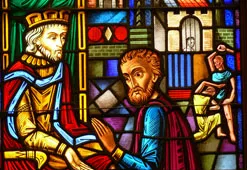
What Jesus wants us to ask ourselves is this: Is it reasonable for the first servant to behave this way? Is it fair and right? What do we think?
Of course it isn’t. …
Yet forgiveness remains something we all find difficult – often impossible. … Jesus is suggesting in this story that we will only begin to be able to forgive, if we can comprehend how much we ourselves are loved, how much we been forgiven.
Jesus says that it is when we know that we are loved without conditions, that we can begin to show that kind of love to others.
The love God has for us is that kind of love.
Our regular Sunday services allow time for confession and for us to hear God=s word of forgiveness for us. We also join together in the Lord’s prayer: ‘forgive us our trespasses as we forgive those who trespass against us’. Weekly reminders of just how crucial forgiveness is.
It is only in the security and strength of God=s forgiving love for us, that we can be free to love and that we can begin to forgive others generously in return.
Yes, for their sake and for God=s sake … but actually also for our own sake. … For, finding a way to forgive, is essential for the sake of our own health and well-being. For when we hold onto grudges, it is as if we throw ourselves into debtors’ prison until the perceived debt has been paid. A failure, on my part, to forgive can destroy me. …. So, the last few words of our Gospel reading, as awful as they are, reflect no more than the natural consequence of the first servant’s failure to forgive. …
Rather than finishing on this negative note, let’s think forward to the central act of our service this morning. Let’s focus on the love shown to us in Christ. … On the forgiveness which is ours in Christ, no matter what we have done, no matter how guilty or ashamed we feel. And, as we prepare for our Communion, let’s allow ourselves once again, as we receive the elements of bread and wine, to sense the love of God suffusing our minds and hearts. This act of love which we re-member in our bodies, is an act of deeply healing, forgiving love from a God who thinks the world of each one of us. We are loved, forgiven, set free. Words are just not enough, but bread and wine, body and blood, warm our hearts and embrace us in God’s arms of mercy.
 Roger Farnworth