Monthly Archives: Sep 2023

The First Generation Electric Tramways of Nice again. Five more lines. (Chemins de Fer de Provence/Alpes-Maritimes No. 89) …

Jose Banaudo published a two volume set of books about the historic trams of Nice, “Nice au fil du Tram.” Articles based around the first of these two volumes can be found on this blog.

This is the second in a series looking at the second volume. The first can be found on this link:

The First Generation Electric Tramways of Nice again. Four of the Urban Lines. (Chemins de Fer de Provence/Alpes-Maritimes No. 88)

La Ligne de Riquier et du Parc-Imperial

This line was almost entirely double-tracked. It originated on the Place de Riquier (today Auguste-Blanqui), west of the PLM station on the Nice – Ventimiglia line which serves this working-class district to the east of the city. It ran down Rue Arson, passing the depot on Boulevard Ste. Agatha. 

Initially, an old building stood out from other frontages along the route and required a short section of single track (304 metres) The building was demolished in 1914 and the single-track section was eliminated.  At the intersection with Rue Barbéris, a branch headed east to serve a warehouse. At Rue Barla, the Ligne du Port crossed the rails on Rue Arson. Shortly thereafter, two other branches made it possible to deliver wagons to the Giordan metallurgical plant and the cement warehouse on Rue Lascaris.  The line then reached the Eastern corner of the Port, where it joined the Monte-Carlo line and the Voie des Docks towards the Quai des Deux-Emmanuel.

After running along a length of Rue des Deux-Emmanuel, the line turned right onto Place Cassini (now Ile-de-Beauté) where there was a significant tram-halt.  In order to make it easier for the trams that had their terminus here to reverse, a complete loop went around the church of Notre-Dame du Port via Rue Rusca, Rue Fodéré and Rue Pacho.  At the West end of the square, the tramway passed in front of the monument in honor of President Sadi Carnot, whose bronze bust disappeared during the requisition of non-ferrous metals during the last war, then it went up Rue Cassi to Place Garibaldi.  From there, the route was common with other lines on the Boulevards of Pont-Vieux and Mac-Mahon (today Jean-Jaurès), Place Masséna, Avenue de la Gare (today Jean-  Médecin) and Avenue Thiers to the PLM station.
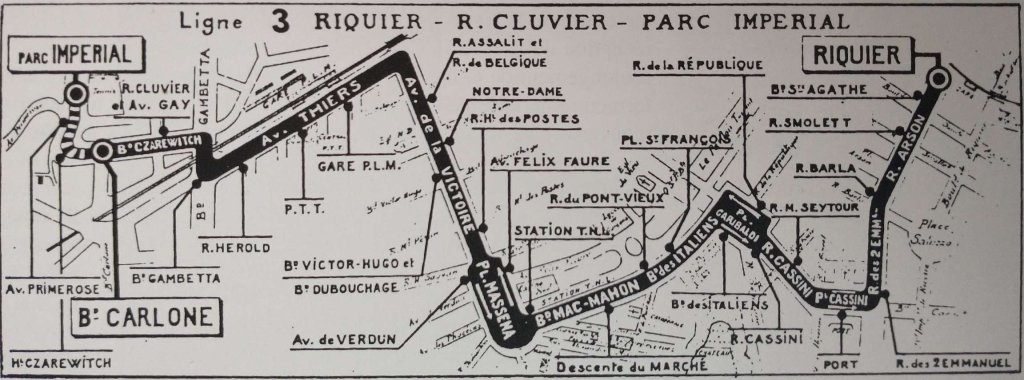
The Route from Place de Riquier to Parc-Imperial via the PLM Station on Avenue Thiers. This image shows the route as it was before 1934. It comes from the collection of Richard Panizzi. [1: p23]

Jose Banaudo continues: “After stopping at the station, the line continued West along Avenue Thiers where a new main post office was installed in 1931 in a large red brick building, in a rather incongruous style in our latitudes.  At the intersection of Boulevard Gambetta, the Parc-Impérial line briefly joined the ‘Circulaire’  in order to pass under the bridge of the PLM Marseille-Nice line.  Then, it branched off to the left into Boulevard du Czaréwitch (today Tzaréwitch) whose name honors the Crown Prince of Russia, Nicolas Alexandrovitch, who died in 1865 in a villa in this district where the Imperial family used to come stay in the winter.” [1: p22]
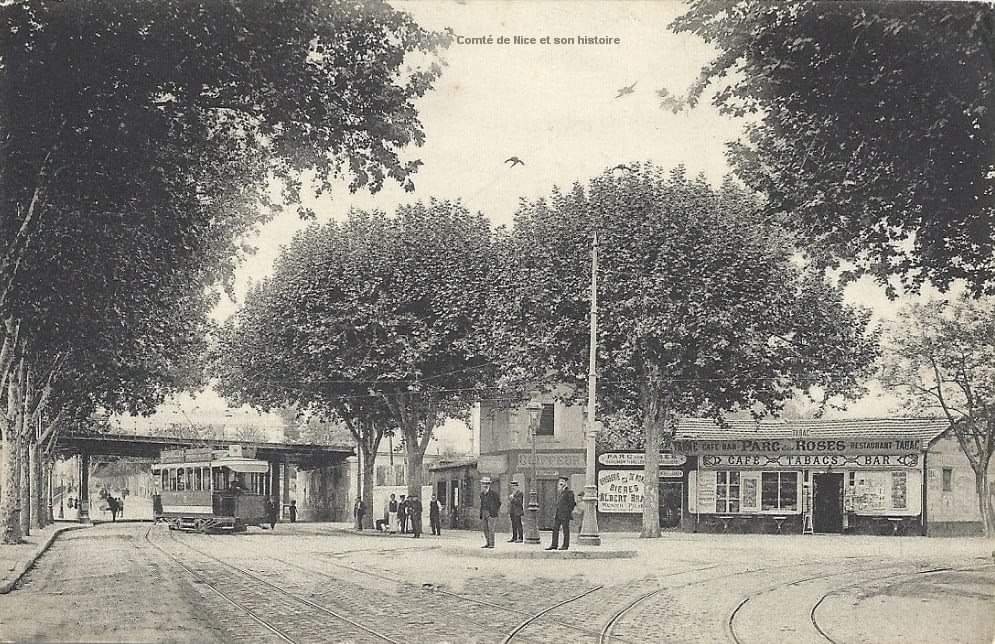
After passing under the railway bridge, T1 motor car crosses the triangle junction on Boulevard Gambetta to enter Boulevard Czaréwitch. This postcard image was shared on the Comte de Nice et son Histoire Facebook Group by Roland Coccoli on 18th June 2019 and 6th April 2023. [3]
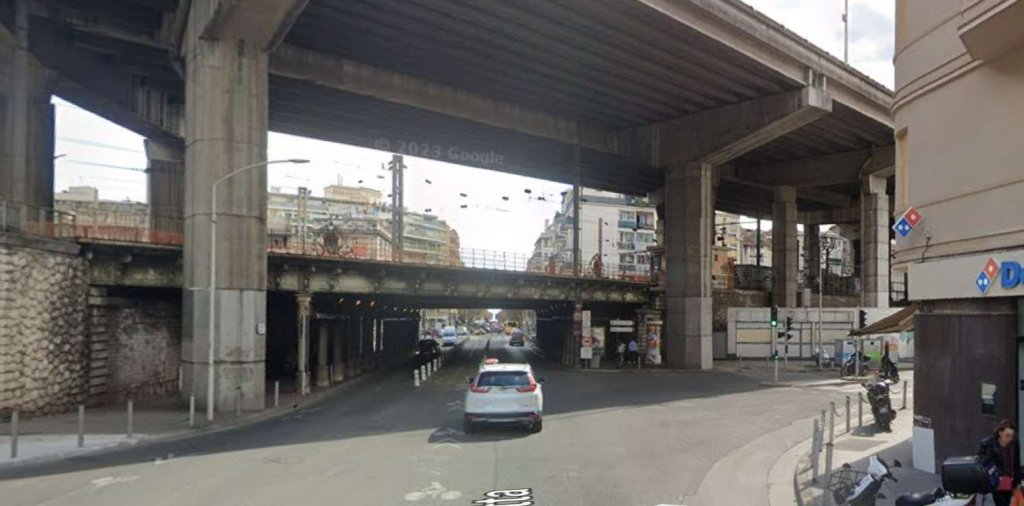
The same location in 2023, Boulevard Gambetta looking South. The scene is now dominated by the motorway flyover. [Google Streetview, April 2023]
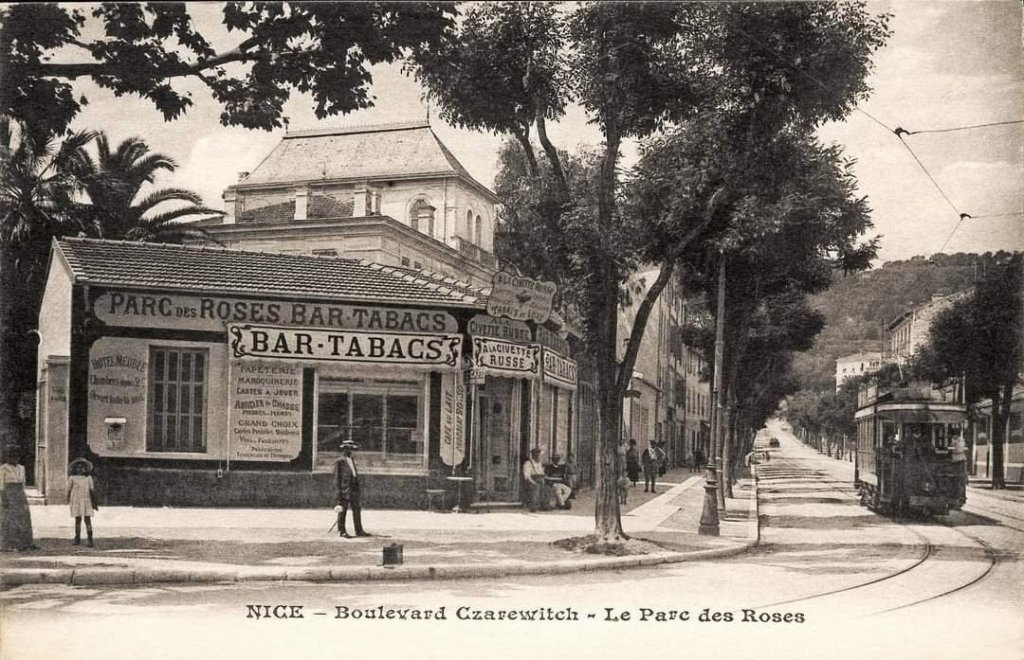
This postcard image comes from the collection of Jean-Pierre Garacio and was shared on the Comte de Nice et son Histoire Facebook Group on 27th January 2015 by Jean-Paul Bascoul. The photograph shows Boulevard Czaréwitch running into the distance on the right and depicts a T2 motor car arriving from Parc-Impérial and passing in front of the Parc des Roses hotel/bar-restaurant. The mention of “Civette Russet” above the entrance door at the centre of the image indicates the strength of the Russian community in this district where the imperial family frequently stayed in the second half of the 19th century. [4]
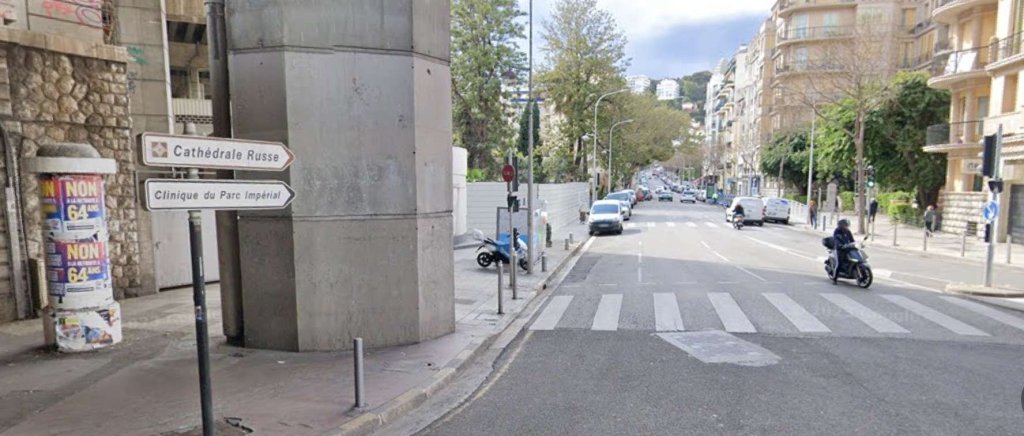
The camera is in approximately the same location taking this photograph. Boulevard Tzarewitch runs East from its junction with Boulevard Gambetta. [Google Streetview, April 2023]

Trams then passed in front of the Russian Orthodox cathedral, completed in 1912, and stopped at the crossroads with Rue Cluvier where the double track ended.  The urban service terminus was set shortly before the intersection with Avenue de la Tour-Lascaris (today Boulevard François-Grosso).

There was a further 529 metres of single-track climbing Boulevard du Parc-Impérial and Avenue d’Angleterre (today Paul-Arène) to terminate at the Southwest corner of the Grand Hôtel du Parc-Impérial. 
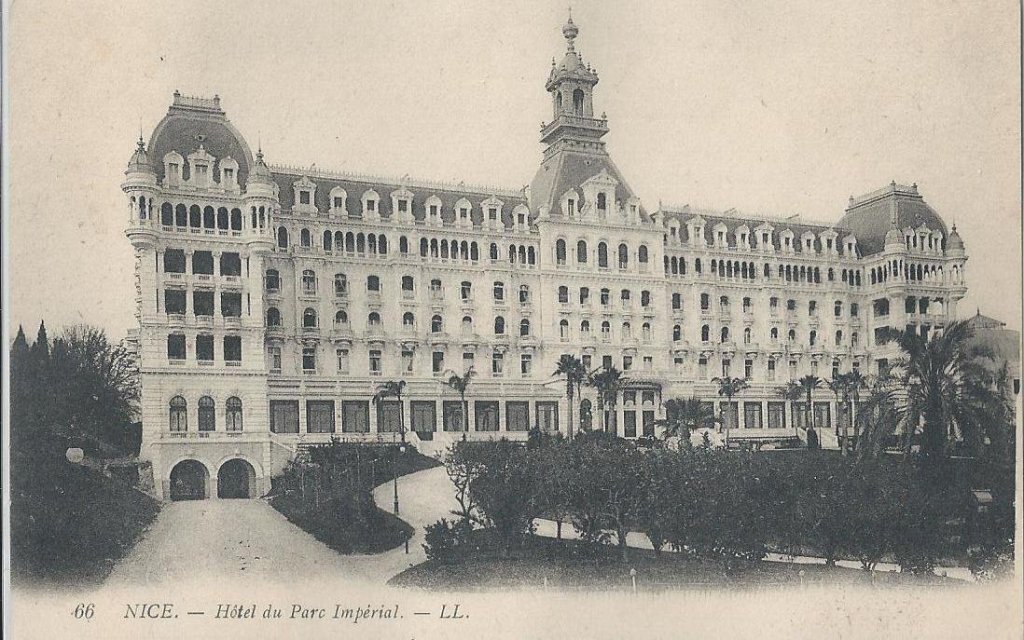
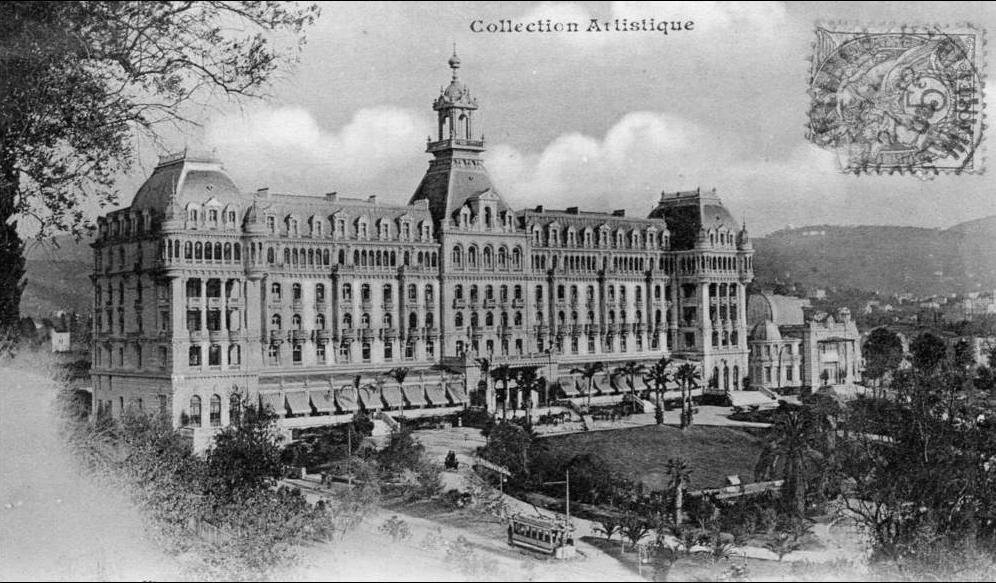
This is a postcard image of l’Hotel Parc-Imperial, Nice. [2]
Another view of the Hotel Imperial at Parc Imperial. In the foreground of this image a tram can be seen approaching the terminus of the line. This length of line was only used in the holiday season (between December and May). [5]

The Hotel opened in 1900 on the property where the Russian Imperial family came for vacation. It was this luxury establishment which had financed the extension of the tramway to its doors. The single-track section was only operated during the tourist (winter) season, from 1st December to 15th May.  It disappeared in the post-war years  when the hotel found itself in a difficult financial situation leading to its acquisition by the city of Nice in 1926 with a view to transforming it into a school.
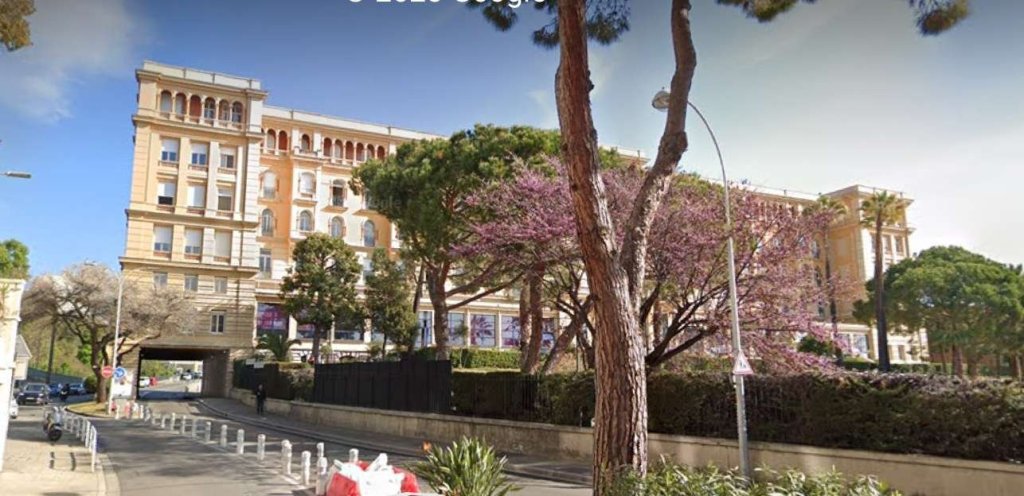
The Hotel Parc Imperial was purchased by the City of Nice in 1926 the roofline has changed but the building seems to have the same footprint in 2023. The tram seen in the image above was approaching the Hotel along the road in the foreground, (Avenue Paul-Arene in the 21st century). [Google Streetview, April 2023]

The Riquier-Parc-Impérial line linked a working-class district and a residential area in the hills, passing through the main transfer points of the urban network: the Port, Places Garibaldi and Masséna, then the PLM station. The route was used by services from Mont-Boron to the PLM station which used it after running between Mont-Boron and the Port on the Monte-Carlo interurban line.  In the 1934 redesign, this route disappeared with the exception of the Riquier – Port – Garibaldi section which was integrated into the new line No. 7. Line No. 7 was the last line served by trams, running until 10th January 1953.

La Ligne de la Gendarmerie, Pasteur, St. Pons et St. Andre

This line linked Place Masséna with St. Andre.

From the TNL station on Place Masséna, the double-track line ran along Rue Gioffredo.  Initially, this route also served the Monte-Carlo and Levens lines, and then, from 1934, all services serving the east of the city took this route. After passing behind Masséna high school and Voeu church, trams for St. Andre met the line arriving from the PLM station via Rue Tonduti-de-L’Escarène, and then saw the interurban lines turn away to the right via Rue Defly towards Place Garibaldi.

Until the end of the Masséna – Garibaldi route via the left bank of the River Paillon in 1934, Rue Defly and Pont Garibaldi were only used by interurban services to Levens, Villefranche, St. Jean-Cap-Ferrat, Beaulieu and Monte Carlo.

At the end of Rue Gioffredo, the service connection to the Cimiez line turned away to the left and St. Andre trams turned right into Boulevard Carabacel where there was a connection to the construction materials warehouse of Charles Véran. At Place Carabacel (today Jean-Moulin), tracks to Pont and Rue Barla turned away to the right. The tramway to Levens rejoined that for St. Andre after having detoured through Place Garibaldi.

The line then ran along the right bank of the River Paillon, then only lightly developed, via the quays of Place d’Armes and Pasteur (today Galliéni and Lyautey).  After passing under the PLM Nice – Ventimiglia railway, trams arrived at the stop serving  the Gendarmerie, which was the terminus for several years. From there, the single track followed the shoulder of the roadway on land recovered from the river bed.  Two branches served a fuel trader and the Andréis steel construction works.  The tramway then ran under the bridge of the PLM Nice – Cuneo line, after which there was a passing loop at the stop called ‘Vésubie’, at the intersection of avenue Florès.  It then ran alongside the district named Pasteur after the large hospital built in 1913, and where a velodrome brought great entertainment on race days. The valley narrowed here, at the foot of the hill where the monastery of Cimiez and the ancient abbey of St. Pons stand. Two stops with passing loops followed, at St. Pons-Octroi and St. Pons-Asile, the latter serving the psychiatric hospital Ste. Marie.

Shortly after this narrow passage where the ligne de Contes could be seen on the other bank of the river and where some services continued towards Levens, the St. André tramway left the Paillon valley to follow the Chemin de Grand Communication No. 19 (currently Departmentale No. 19) into the narrow valley of the River Banquière to reach the terminus at St. André.
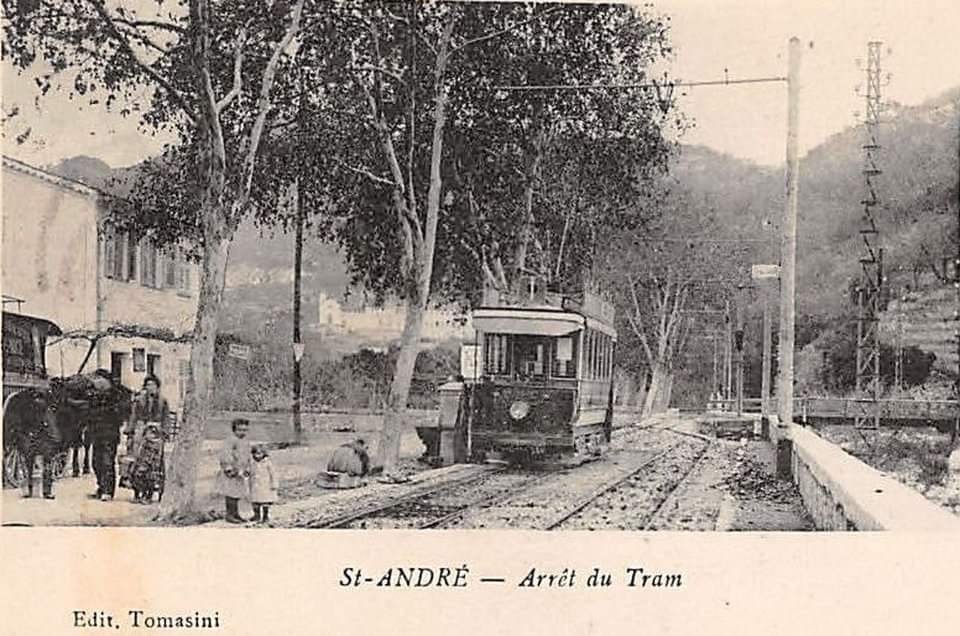
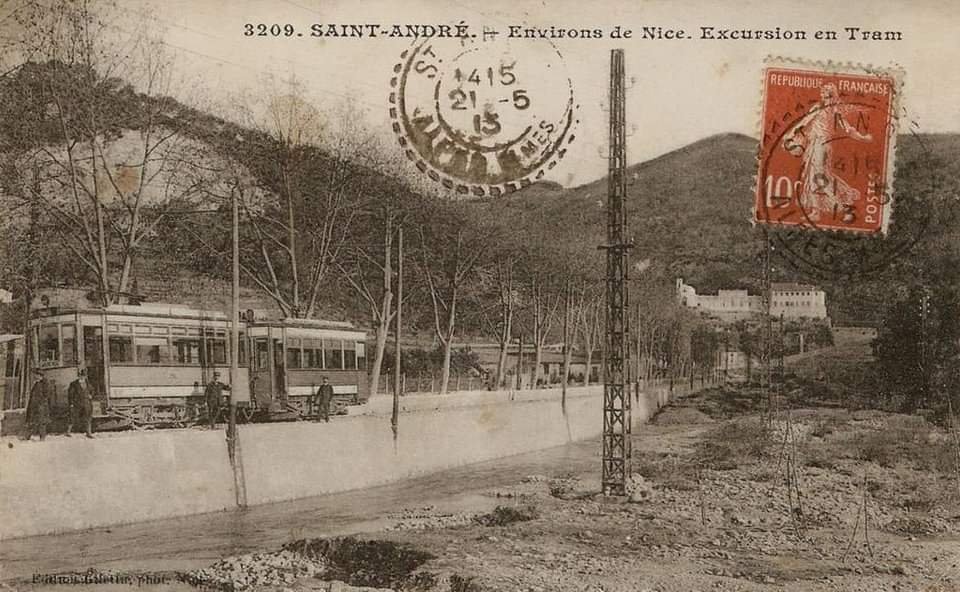
A tram for St. Andre waiting at the tram stop in the village which was in the Valley of the River Banquiere. [9]
Possibly a service for Levens in the immediate vicinity of St. Andre. These two images were shared by Roland Coccoli on the Comte de Nice et Son Histoire Facebook Group on 17th May 2020. [6]

I have been unable to locate these two views in relation to the landscape around St. Andre de la Roche in 2023. However, one group of buidlings does appear on the image below.
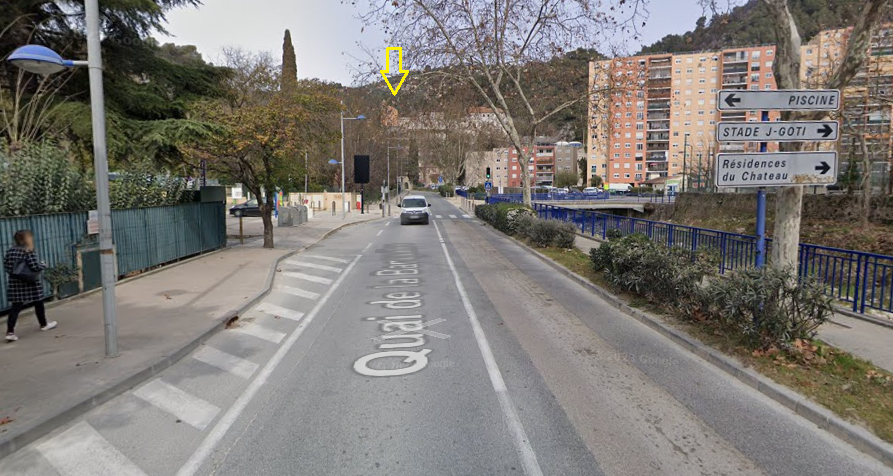
The group of buildings marked by the yellow arrow appear on both the monochrome images above. This suggests that the tram stop featured in those images was somewhere along the length of the M19 (Quai de las Banquiere) visible in this photograph. [Google Streetview, May 2023]

This line closed in September 1948 in favour of a replacement bus service.

La “Rocade” des Rules Barla, De Lepante et Assalit (Sauzzo – Gare PLM – Carras)

This route, was created to link the East to the West of the city of Nice via the main railway station. The location of its termini was altered several times. Intentionally, it served less busy streets.
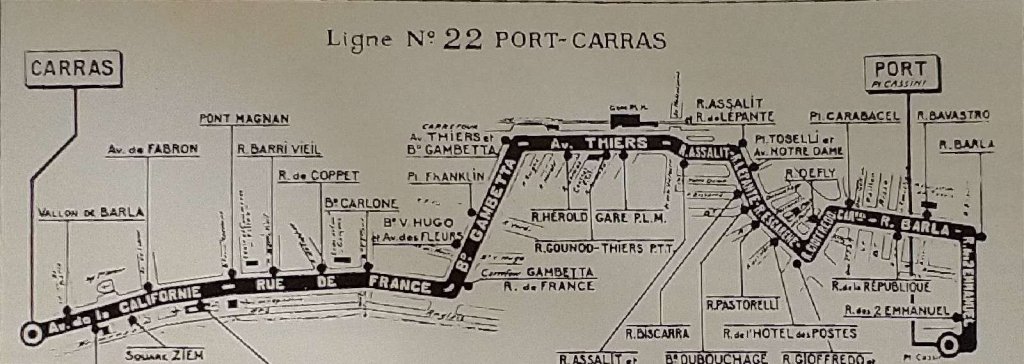
The route as of 1934, from the collection of Richard Panizzi. [1: p28]

At its Eastern end it originated not far from the Port in the Riquier district, on Place Saluzzo (today Max-Barel) which since 1908 has been the starting point of the “Moyenne Corniche” towards the Col de Villefranche.  From there, a dedicated route led via Boulevard Imperatrice-de-Russie Boulevard (today Lech-Walesa) to warehouses which were used by the army during the First World War. 

The double track followed Rue Barla in a westward direction where, just 87 m from its starting point, it crossed Rue Arson and the line going down from Riquier towards the Port.  Shortly after, the tram passed in front of the tobacco factory.
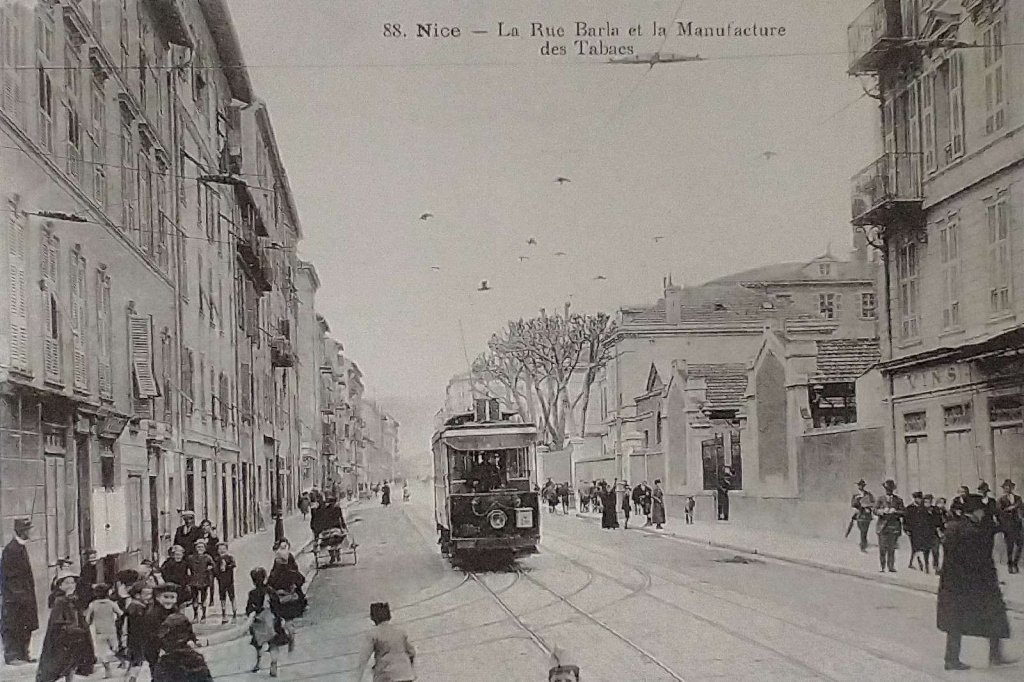
A T2 motor car providing a Carras – Saluzzo service has just passed in front of the ‘Manufacture des Tabacs’ and is arriving at the crossroads of Rue Barla and Rue Arson. The branch to the left is used by freight trains traveling between the port and Gare du Sud, from the collection of Andre Lebecque. [1: p27]
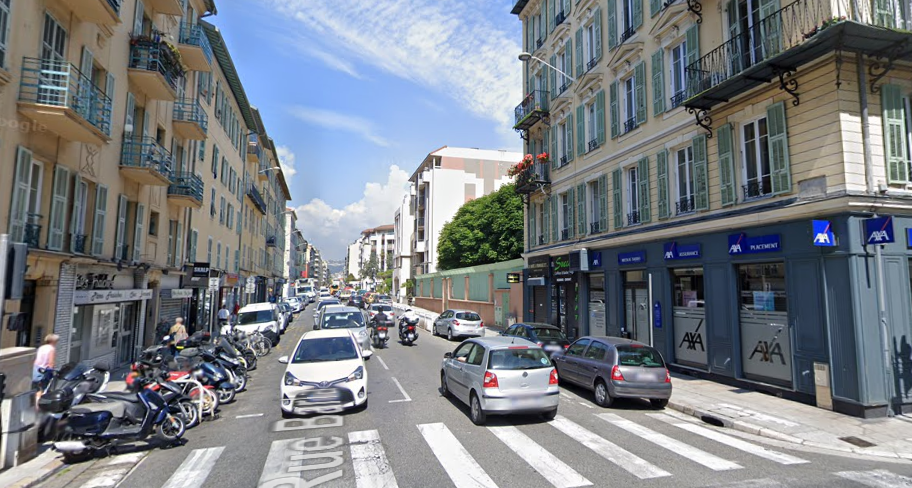
Approximately the same location in the 21st century. This photograph was taken at the junction of Rue Baral and Rue Arson. [Google Streetview, January 2019

At the crossroads with Rue de la République, it crossed the line of Abattoirs, La Trinité and Contes, and then crossed the River Paillon on Le Pont Barla. Banaudo says that this was, “a beautiful structure with three cast iron arches in a style similar to that of the Garibaldi bridge nearby.” [1: p27] 

Now on the right bank of the Paillon, the line met La Ligne de St. Pons which it followed for a short distance along Boulevard Carabacel and Rue Gioffredo. [1: p27]
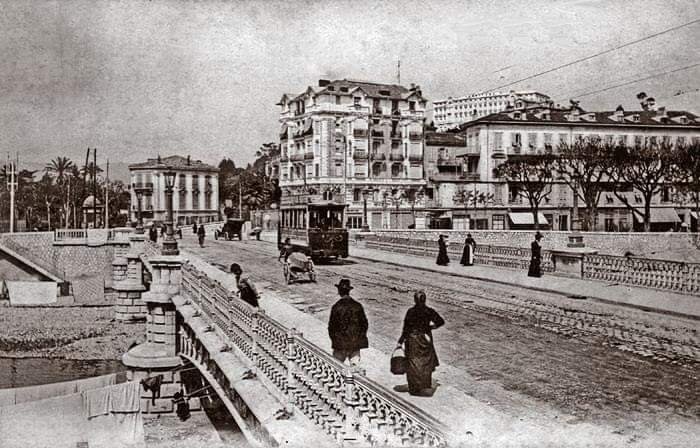
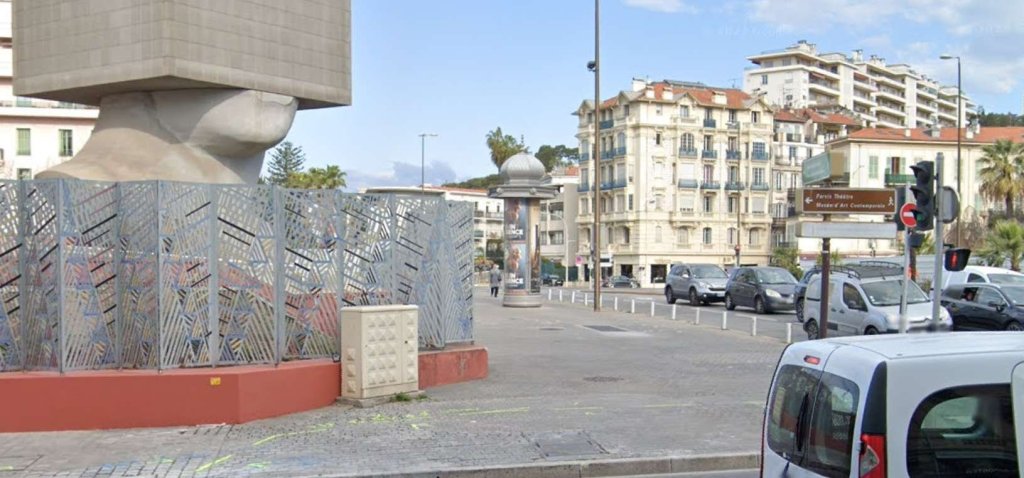
A Thomson tram crosses le Pont Barla towards the street of the same name and Place Saluzzo.  In the background is Place Carabacel (today Jean-Moulin), from where the St. Pons line branched off towards Place-d’Armes (today Galliéni). Note the sheets, which have been washed in the river, drying on lines below the bridge. This photograph was shared on the Comte de Nice et son Histoire Facebook Group on 7th June 2016 by Roland Coccoli. [7]
A similar view in 2023. The building just to the right of the centre of this image is the same as that at the centre of the image above. [Google Streetview, April 2023]

Arriving at the intersection of Rue Tonduti-de-L’Escarène, the tramway branched off to the North taking this fairly narrow street to Place Sasserno.  From there, it entered Rue de Lépante, which commemorates “a terrible naval battle against the Turks in 1571 in which ships crewed from Nice participated.” [1: p27]

Turning sharply to the West, the line followed the narrow Rue Assalit at the end of which it came out at the end of Avenue de la Gare (today Jean-Medecin). It crossed the tram tracks there and entered Avenue Thiers, stopping in front of the PLM station before following Avenue Thiers along its entire length to the intersection with Boulevard Gambetta.  At Boulevard Gambetta, the trams turned South towards the crossroads of Rue de France and then turned West to run along the same route as lines to La Madeleine, La Californie and Cagnes to a terminus at either Pont-Magnan or at Carras depending on its year of operation. [1: p27]
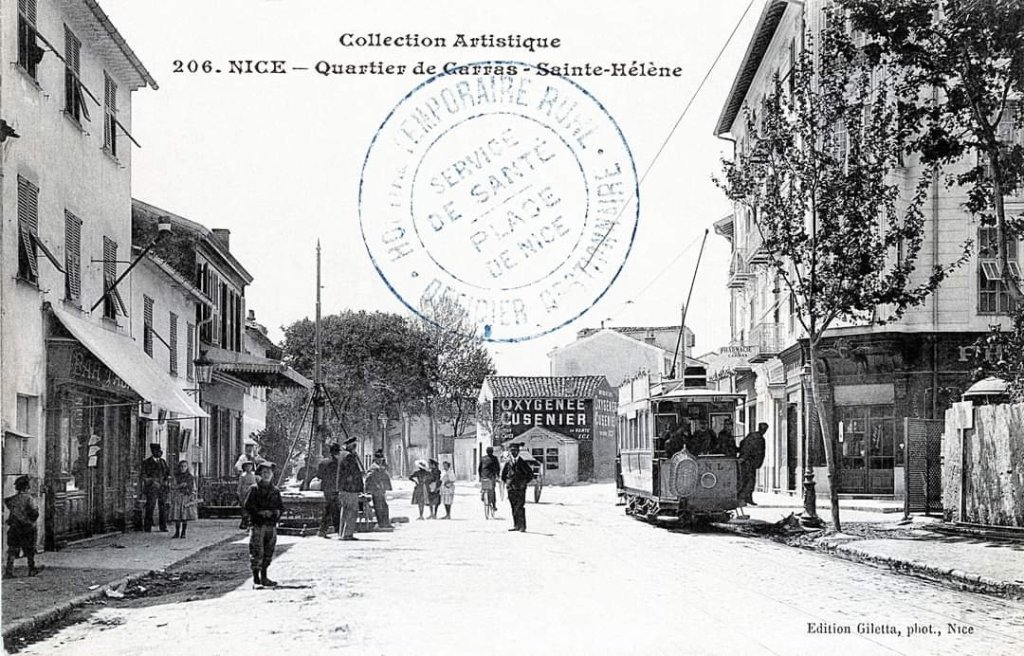
Nice – Carras District – Saint Helene – tram stop. The stamp at the centre of the card shows that it was sent during WWI from the Ruhl temporary hospital which was used for war-wounded soldiers and which was in the building that in calmer times was the Ruhl Hotel on the Promenade des Anglais. This postcard image was shared on the Comte de Nice et son Histoire Facebook Group by Jean-Paul Bascoul on 26th February 2023. [8]
The Avenue de la Californie in 2023. The road forms the main artery for Nice’s modern tram service to and from the Airport. This photograph is taken close to the terminus of the tram route in Carras. [Google Streetview, April 2023]

This line closed in November 1948 in favour of a replacement bus service.

La “Circulaire” Par le Passage a Niveau (Ste. Agathe – Passage a Niveau Gambetta)

Of all of the lines in the Nice tram network, this line was the most varied. Over most of the route, it followed tracks used by other lines. The only exceptions, Banaudo tells us, “being the lengths between Gare du Sud and  PN  Gambetta and at the Gambetta / Czaréwitch crossroads.” [1: p30]
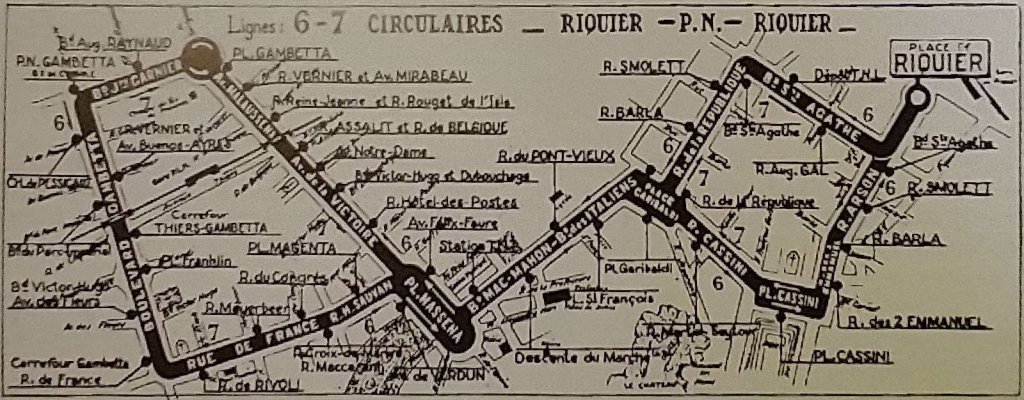
This route map comes from the collection of Richard Panizzi. [1: p31]

Banaudo goes on to say that the route, “lost its circular character in 1934 with the elimination of the north-south axis via the avenues, but part of its route was taken up later to create line 7 which  was the last served by trams, closing in 1953.” [1: p30]

Initially, the ligne “Circulaire” services left Place Masséna along Avenues de la Gare (now Jean-Medecin) and Malaussena to Place Gambetta (today Général De Gaulle) in front of the Gare du Sud.  “There, the route branched off to the west taking Boulevard Joseph-Garnier to the level crossing of the Nice – Digne and Nice – Meyrargues lines of the Chemins de fer du Sud de la France (SF).  The TNL double track crossed that of the SF by a quadruple crossing on which traffic was governed by instructions common to the two companies.  Here, the trains had priority over the trams: an announcement by electric bell warned the barrier guard of their approach, who closed the signals for the tram and then stretched four chains across the road to stop traffic.  In the north-west corner of the level crossing, a TNL track connected to a long siding belonging to the SF, through which the goods convoys commuting from the Port were pushed back towards the goods yard of the Gare du Sud.” [1: p30]
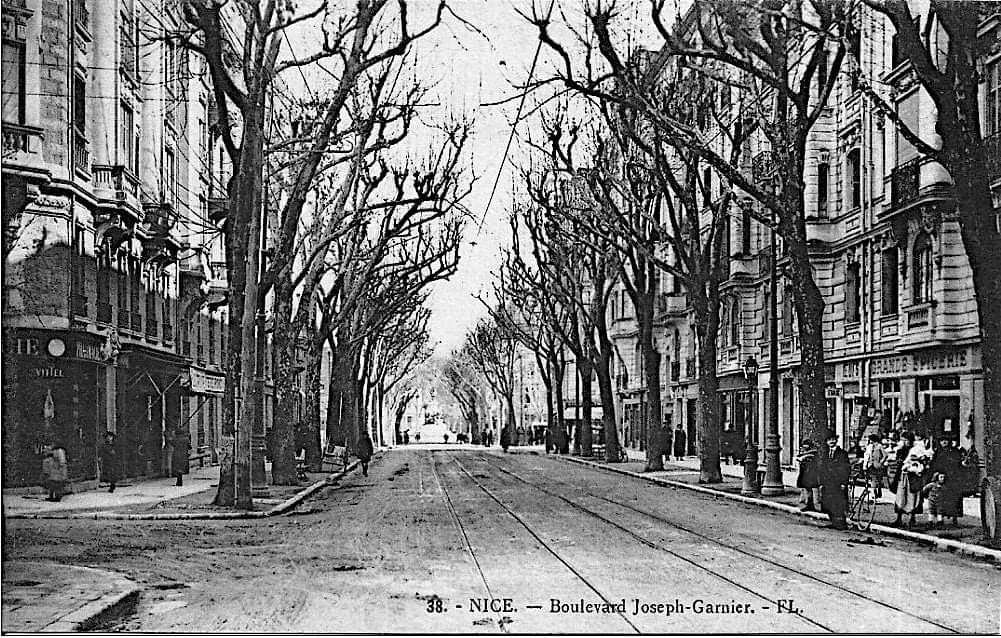
A winter view of Boulevard Joseph-Garnier looking East with tram tracks visible in the road surface. [9]
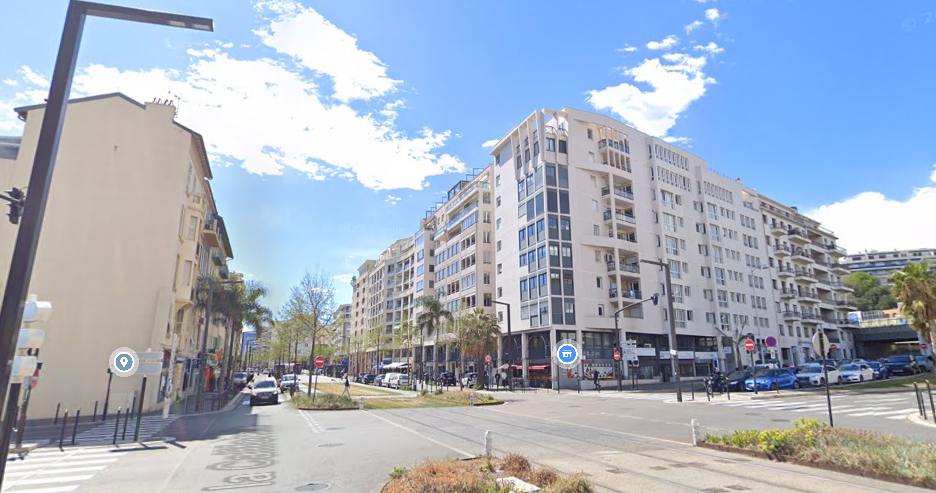
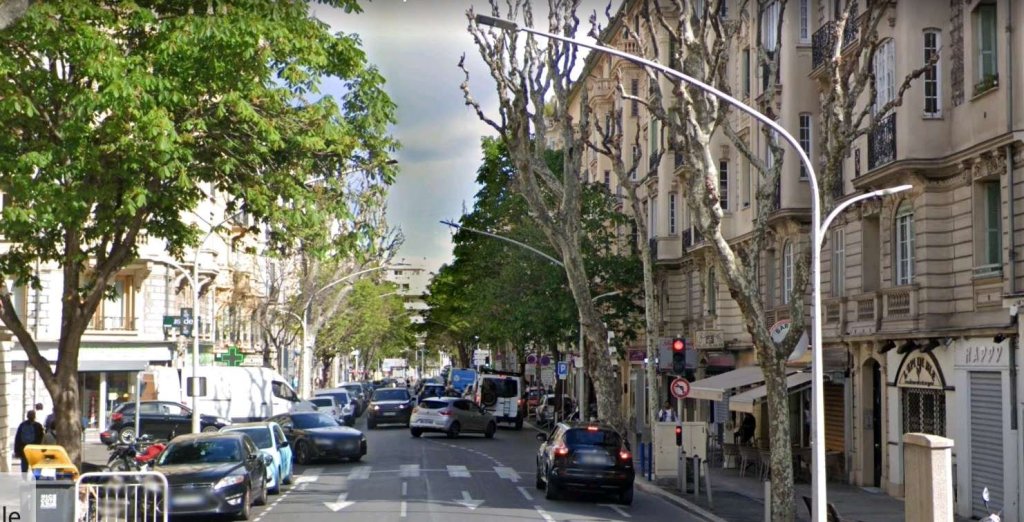
The same location on Boulevard Joseph-Garnier in April 2023. The photograph is taken from a point just a few tens of metres to the West od the monochrome image above. [Google Streetview, April 2023]

After this the “Circulaire” ran South along Boulevard Gambetta.  At the crossroads of Boulevard Czaréwitch (today Tzaréwitch), the line to the Parc-Impérial left to the West. The “Circulaire” then passed under the railway bridge.  After which, the lines towards the PLM Station branched off to the East onto Avenue Thiers. Some distance further South, the “Circulaire” turned left (East) into Rue de France, joining the route used by trams serving La Madeleine, Carras and Cagnes and returned to Place Masséna.

Banaudo tells us that, “Later, the route was extended eastwards in three stages: – First to the Port via Boulevards Mac-Mahon and du Pont-Vieux (today Jean-Jaurès), Place Garibaldi and Rue  Cassini. Then, an additional loop was added to this circuit: from the Port, it went up Rue Arson to Boulevard Ste.  Agathe, running along that street to reach Rue de la République and then Place Garibaldi.” [1: p30]

A third short “extension allowed Place de Riquier to be served, which the tramway reached in one direction via the Port and in the other via Boulevard Ste. Agathe.” [1: p30]
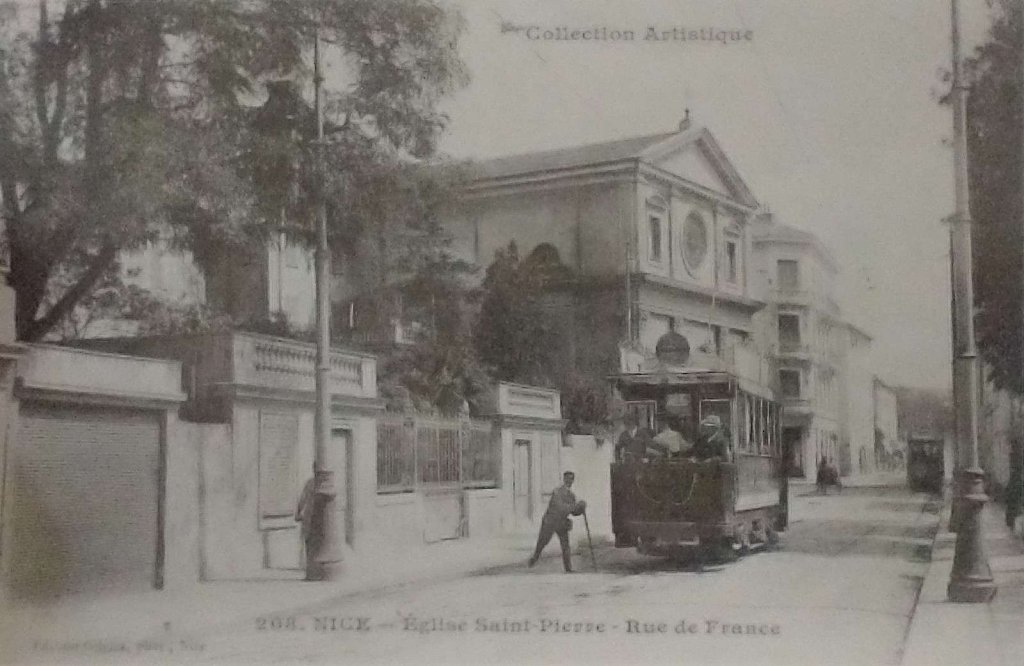
Rue de France, the Thomson tramcar nº 38 has just passed a car going in the opposite direction in front of the l’Eglise St.Pierre-d’Arène heading towards Boulevard Gambetta. The disk at the front of the roof indicates that the tram is on the “circulaire” service. The photograph was taken by Giletta in the period before the 1st World War. The church was extensively  remodelled in the period between the two world wars. This image comes from the collection of Jean-Pierre Garacio. [1: p32]

This line finally closed in January 1953 in favour of a replacement bus service.

La Ligne de la Madeleine (Masséna – La Madeleine)

The last line to open in Nice’s urban tram network served La Madeleine running initially from Place Masséna but it’s Eastern terminus changed on a number of occasions. First to the Port, then Abattoirs and finally La Trinité Victor. 

Departing from Place Masséna, the tramway first the main East-West artery heading towards Carras and Cagnes. At Pont Magnan it turned North and became a single-track route. A passing loop was installed just to the North of the junction.
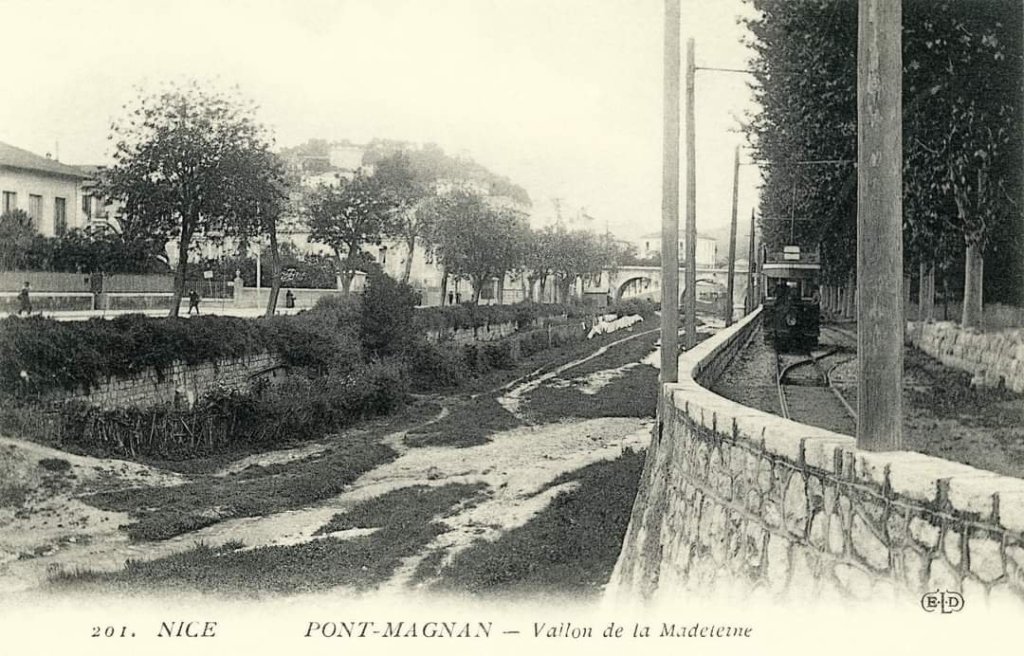
Just to the North of Rue de France a tram sits in the passing loop presumably awaiting the arrival of another tram from Place Masséna. This image looks North toward the PLM railway viaduct. It was shared on the Comte de Nice et son Histoire Facebook Group on 2nd February 2023 by Jean-Paul Bascoul. [14]
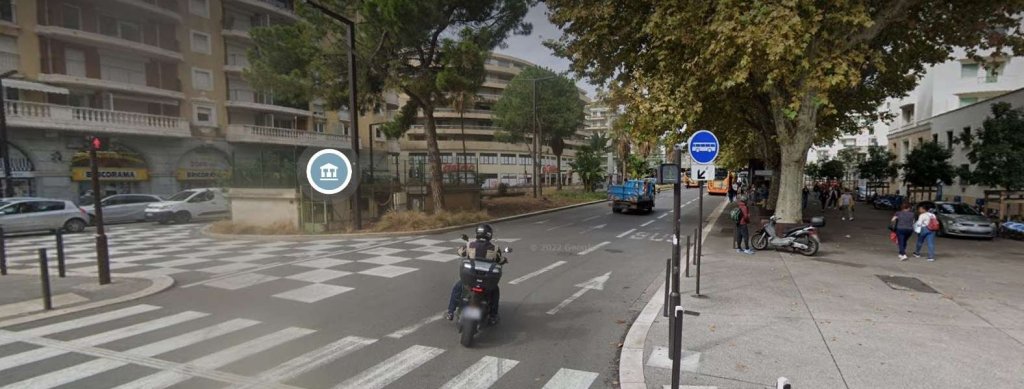
Looking from Rue de France along Boulevard de la Madeleine in October 2022. During the 20th century, the River Magnan was culverted leaving the immediate area looking very different to the monochrome view above! [Google Streetview, October 2022]
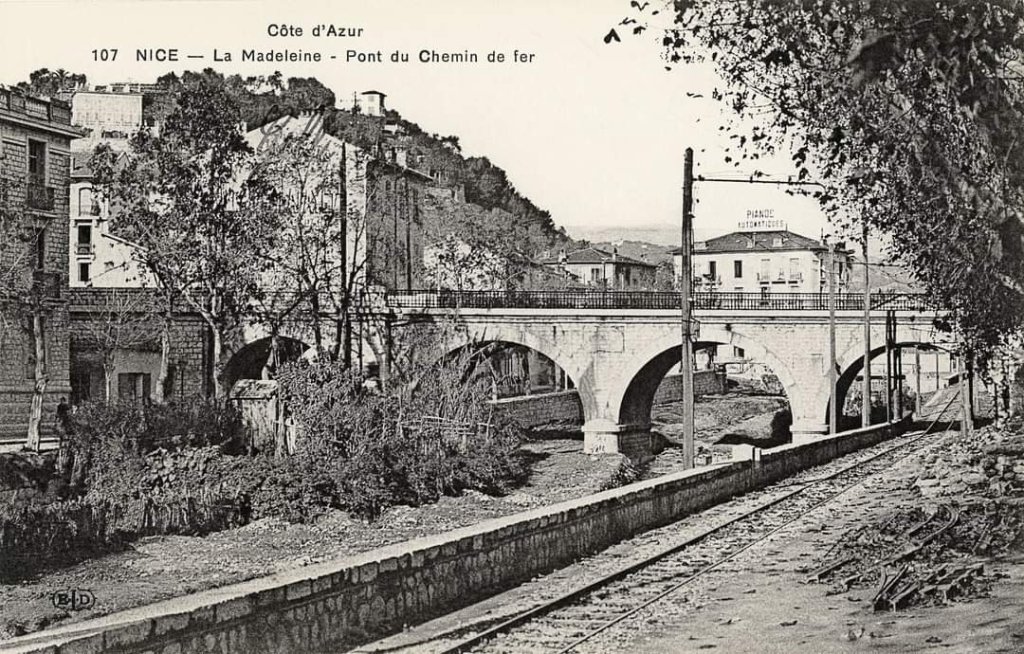
The tramway running along the left bank of the River Magnan the PLM Marseille – Nice railway was carried over the River on the viaduct at the centre of this image which looks North and which was shared on the Comte de Nice et son Histoire Facebook Group by Jean-Paul Bascoul on 16th April  2020. [11]
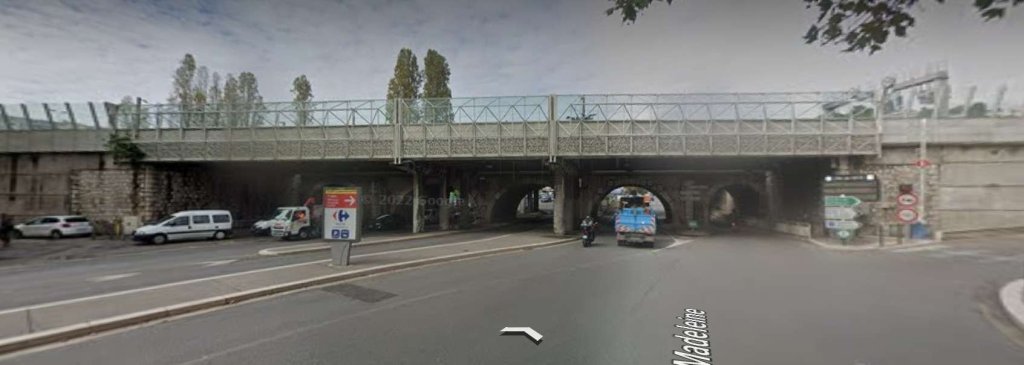
A similar view in 2022 to that immediately above. The railway viaduct, in the 22st century is flanked on both North and South faces by the high level dual carriageway Voie Pierre Mathis. [Google Streetview, October 2022]

Passing under the PLM Marseille – Nice railway line, the track ran along the left bank of the River Magnan, between Boulevard de La Madeleine and the river. Jose Banaudo tells us that the line “takes its name from the silkworm breeding industry … which flourished in this sector until the end of the 19th century.” [1: p33]
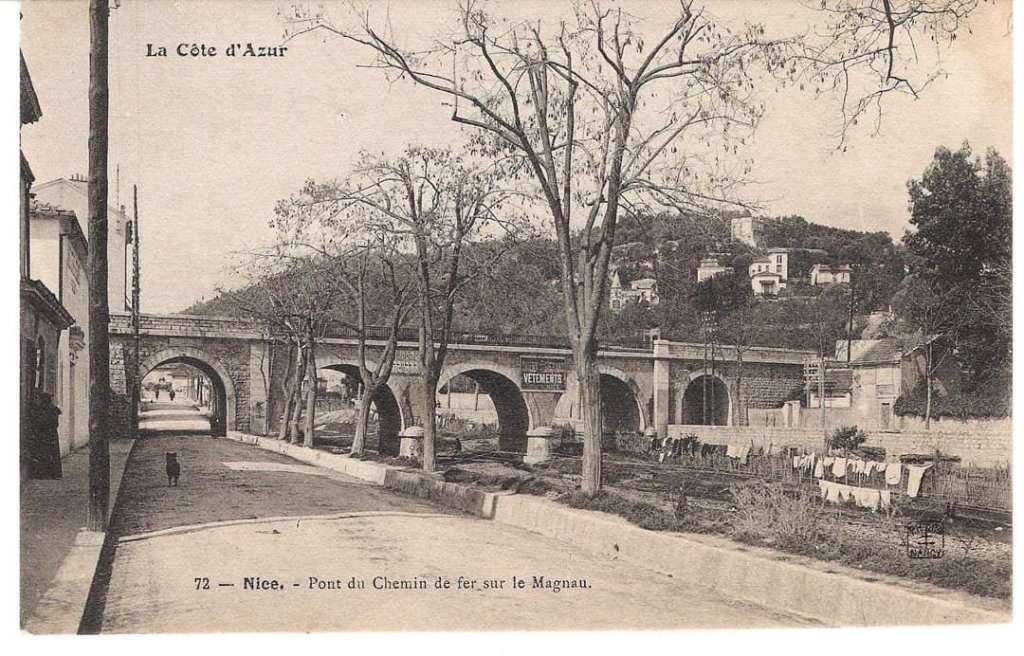
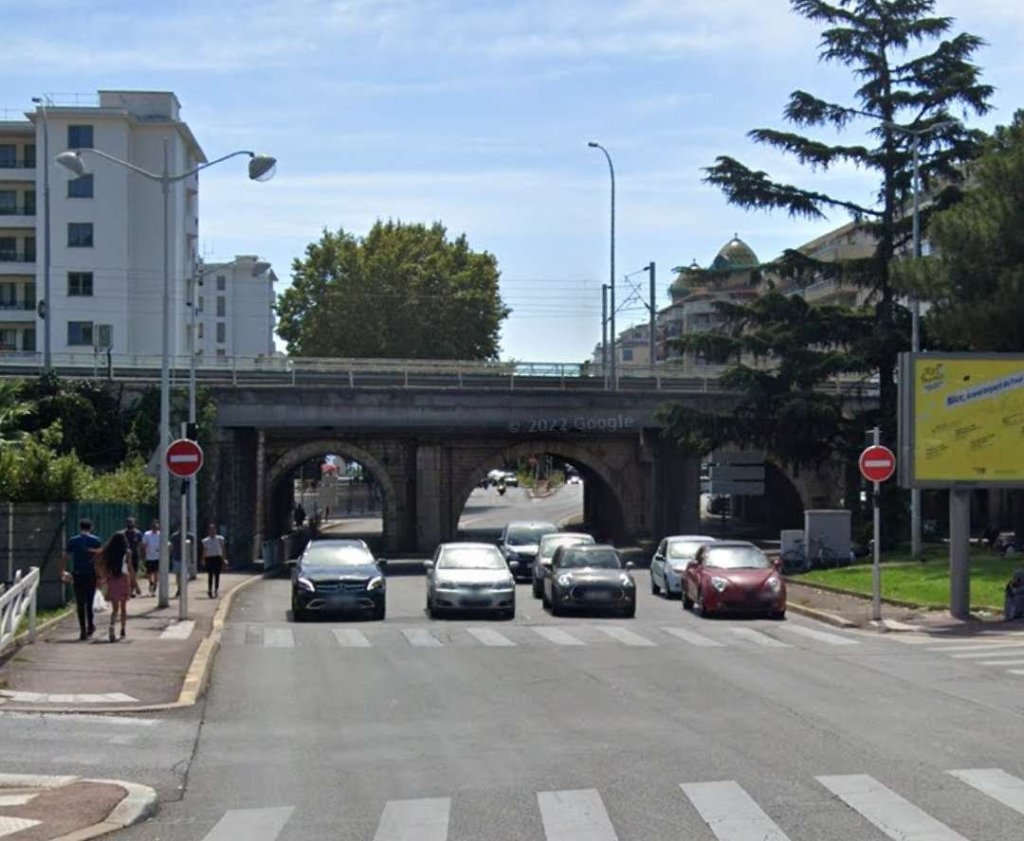
Looking South, this postcard image shows the railway viaduct across the Valley of the River Magnan. Trams ran between the road at the river. This image was shared on the Comte de Nice et son Histoire Facebook Group by Roland Coccoli on 16th April 2016. [12]
Also looking South towards the Mediterranean, this 21st century view emphasises the changes which have occurred in the valley of the River Magnan. [Google Streetview, August 2020]
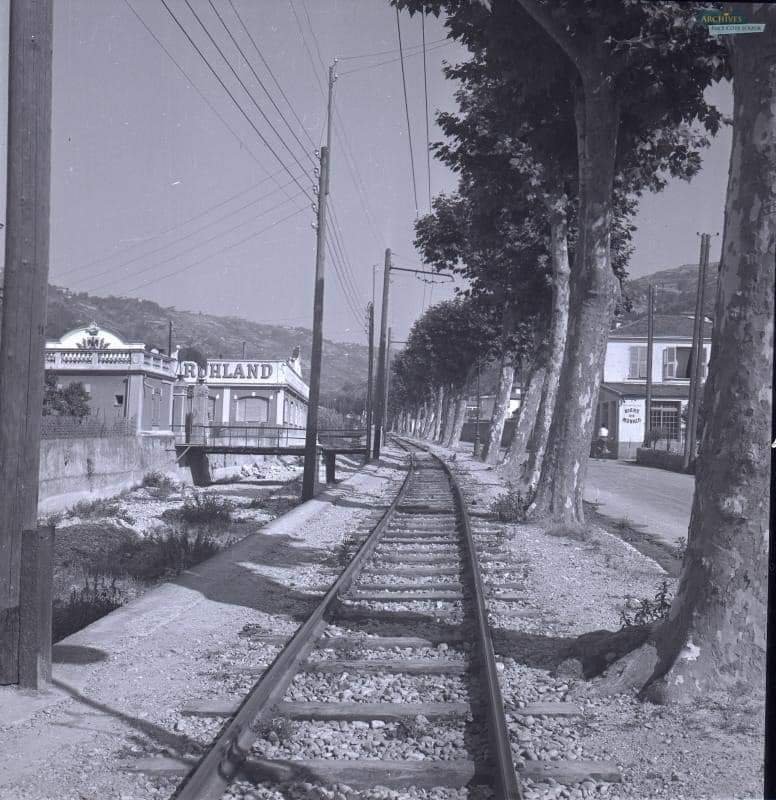
Further North and looking North in 1942. Some work was undertaken in the river channel that year. This image predates the work. It was shared on the Comte de Nice et son Histoire Facebook Group by Charles Louis Fevrier on 17th January 2021. [13]
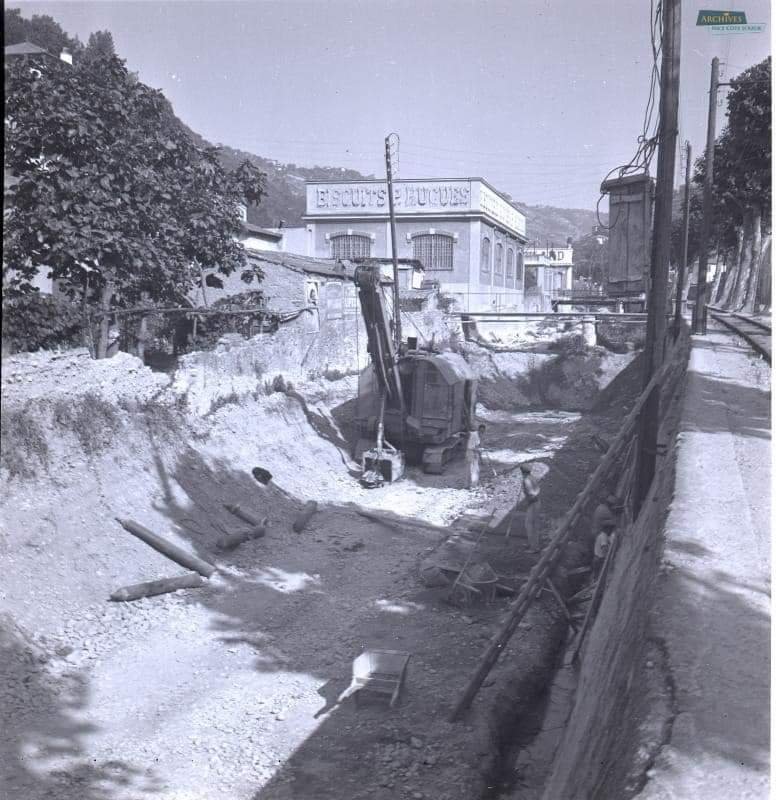
Approximately the same view during the work in 1942. [13]
Looking North again. The Boulevard de la Madeleine follows the line of the River Magnan which continues in culvert. It is impossible to locate a modern photograph at the location of the monochrome images above as there has been so much development in the river valley. [Google Streetview, April 2023]
Looking South at the same location. All three of these images were shared on the Comte de Nice et son Port Facebook Group on 17th January 2021 by Charles Louis Fevrier. The tramway is visible in all three images. [13]

The Magnan valley, then a relatively sparsely populated district on the edge of the city, justified its tram service due to the presence of “numerous craft workshops and small factories such as a mechanical piano factory, a glassworks, a biscuit factory, a button factory and several laundries. These establishments also left their names on the tram stops, and later on the bus stops.” [1: p33]
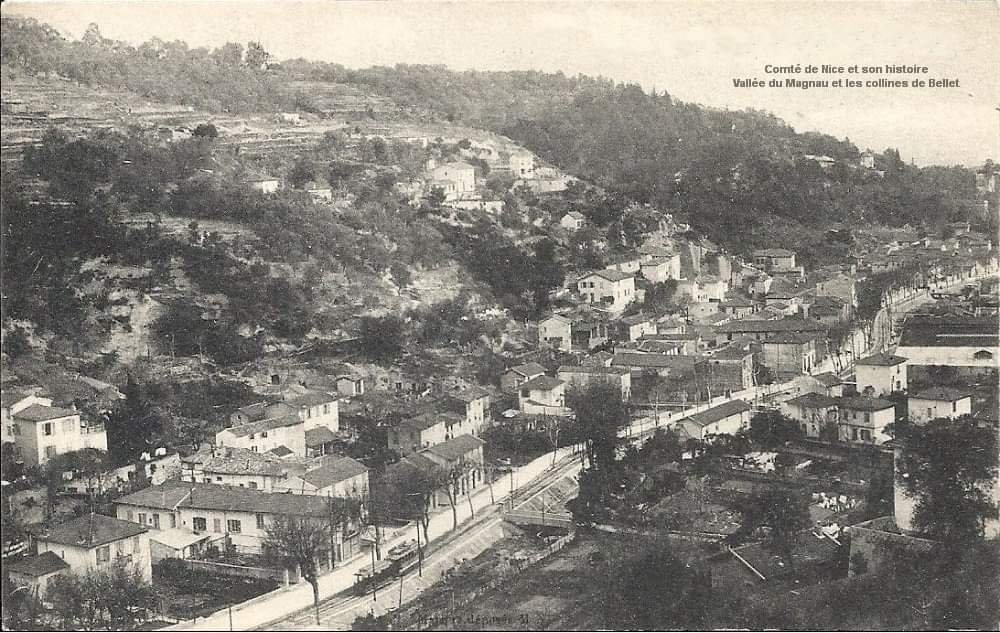
A tram running along the left bank of the River Magnan in La Madeleine. This image was shared on the Comte de Nice et son Histoire Facebook Group on 10th October 2019 by Roland Coccoli. [10]

On Sundays, the activity of the workshops was replaced by renowned restaurants with dance floors and boules. Many city dwellers came to spend a relaxing day in the countryside, which inevitably included an excursion to the “Trou des Etoiles”, a natural cave, 35 m deep at the base of Ventabrun hill which was then mentioned in the most prestigious tourist guides.” [1: p33]

Passing loops sat in front of two restaurants, “Chalet des Roses” and “Les Orangers”. The terminus was in the Place de La Madeleine (today Alexandre-Blanchi) below the church, the cemetery and la gare Sud-France station which served the village.
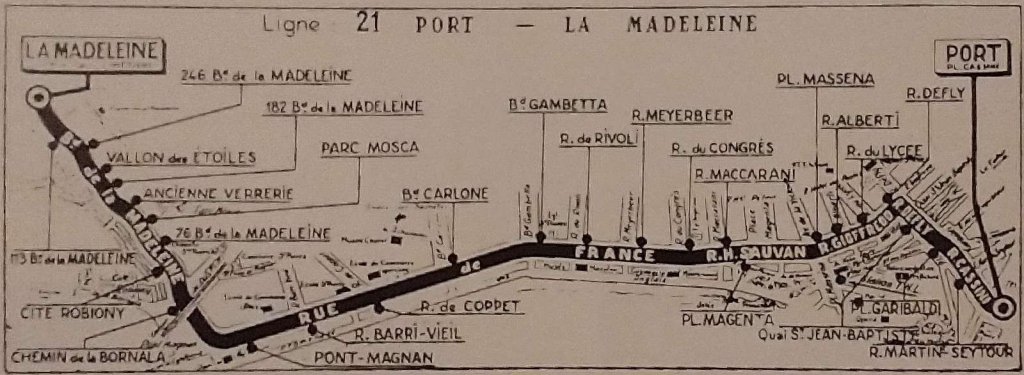
Once again, this route map comes from the collection of Richard Panizzi. [1: p34]

This line closed in December 1951 in favour of a replacement bus service.

References

  1. Jose Banaudo; Nice au fil du Tram, Volume No. 2: Les Hommes, Les Techniques; Les Editions de Cabri, Breil-sur-Roya, France, 2005. This is a french language text.
  2. https://cartepostale-ancienne.fr/image/data/nice2/nice%20anciennes%20cartes%203%20-%20Copie%20(2).jpg, accessed on 18th September 2023.
  3. https://m.facebook.com/groups/ciccoli/permalink/3653570808222095, accessed on 18th September 2023.
  4. https://m.facebook.com/groups/ciccoli/permalink/3603827463196430, accessed on 19th September 2023.
  5. https://www.geneanet.org/cartes-postales/view/5006424#0, accessed on 19th September 2023.
  6. https://m.facebook.com/groups/ciccoli/permalink/2772946732951178, accessed on 19th September 2023.
  7. https://m.facebook.com/groups/ciccoli/permalink/1767626043483257, accessed on 23rd September 2023.
  8. https://m.facebook.com/groups/ciccoli/permalink/3627417797504063, accessed on 23rd September 2023.
  9. https://m.facebook.com/groups/ciccoli/permalink/3258725034373343, accessed on 23rd September 2023.
  10. https://m.facebook.com/groups/ciccoli/permalink/3254264148152765, accessed on 27th September 2023.
  11. https://m.facebook.com/groups/ciccoli/permalink/3660228510889658, accessed on 27th September 2023.
  12. https://m.facebook.com/groups/ciccoli/permalink/1747300928849102, accessed on 27th September 2023.
  13. https://m.facebook.com/groups/ciccoli/permalink/2999148096997706, accessed on 27th September 2023.
  14. https://m.facebook.com/groups/ciccoli/permalink/3608755489370294, accessed on 27th September 2023.
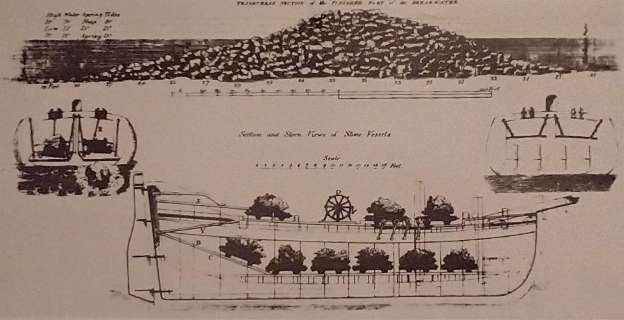
Early Railways in Plymouth

The first railways in the area were of wooden rails used during the construction of docks facilities. Some were in use in the Naval Dockyard in 1724, [2] and in 1756 John Smeaton laid some more to help move materials in his workyard on the mainland which was preparing stonework for the Eddystone Lighthouse. [4: p5-8] [1]

Smeaton’s Workyard near the location of Millbay Docks was used for a fastidious trial construction of the lighthouse to ensure that the massive stone blocks used in its construction would fit with each other before undertaking the work on site, 14 miles out to sea. To move these blocks around the Workyard, Smeaton made use of a ‘Rail Road’ which comprised of a four-wheel carriage running on a timber road. In Smeaton’s own words, stones were “delivered upon the four-wheel carriage that runs along the timber road, commonly called at the Collieries, where they are used, a Rail Road: and being landed upon the carriage, any stone can be delivered upon any of the Bankers in the line of the work-sheds on either side: or the carriage being turned a quarter round upon the Turnpike, or Turnrail, it can be carried along the road that goes up the middle of the yard, and be delivered upon any part of its area destined for their deposition; all the stones marked for the same course being deposited together; from which place they can be again taken up upon the carriage, run along the road, and be delivered upon any Banker in the line of sheds, or upon the Platform, and afterwards returned back to the same place of deposition, ready to be carried to sea in their proper orderA Banker in a mason’s yard is a square stone of a suitable size, made use of as a work-bench.” [4: p6-7]

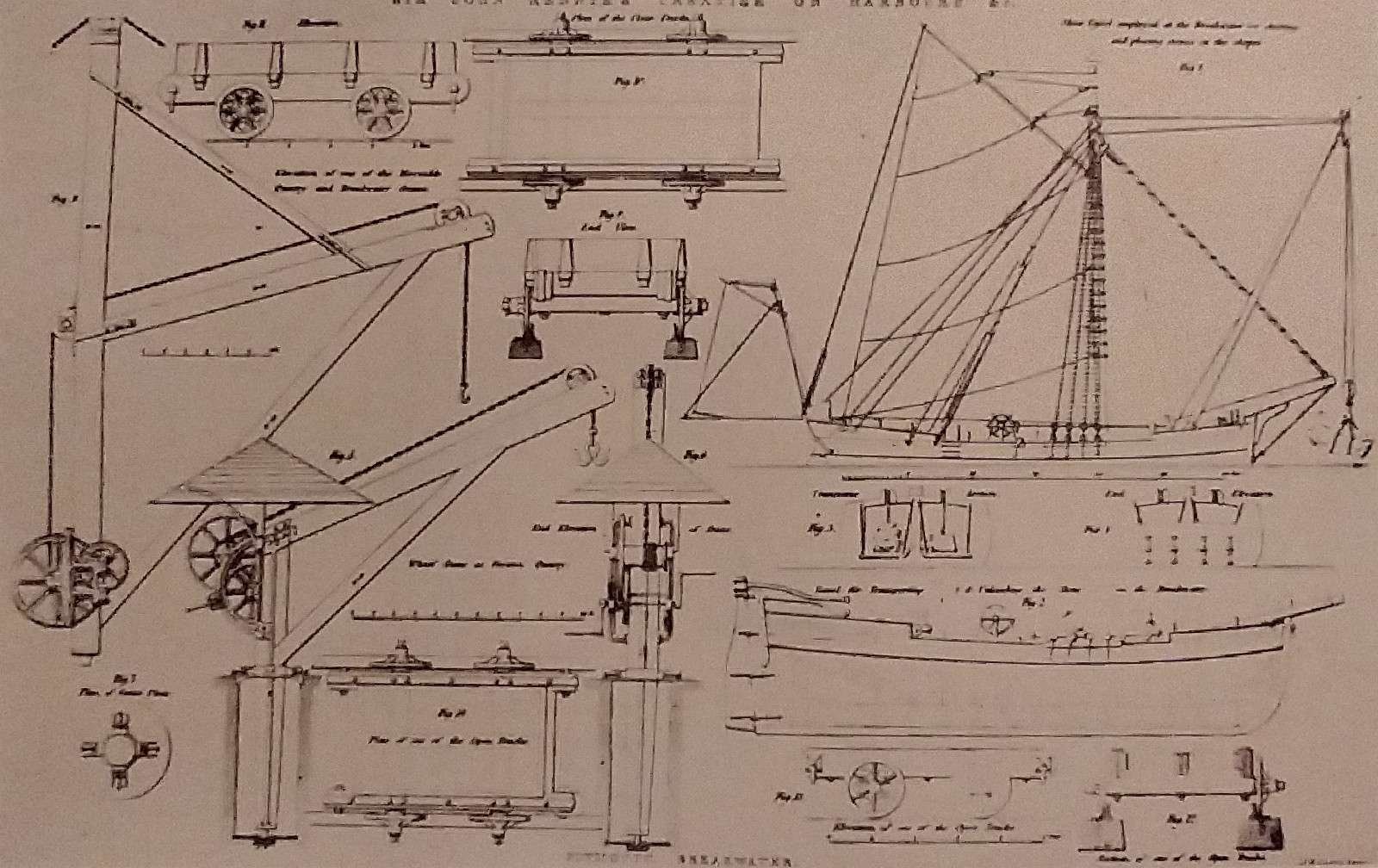
In 1812, John Rennie laid a 3 ft 6 in (1.07 m) gauge metal tramway to help with the construction of the Plymouth Breakwater; rails were laid in the quarry at Oreston and on the breakwater, and loaded wagons were conveyed between the two on ships. [5][1]

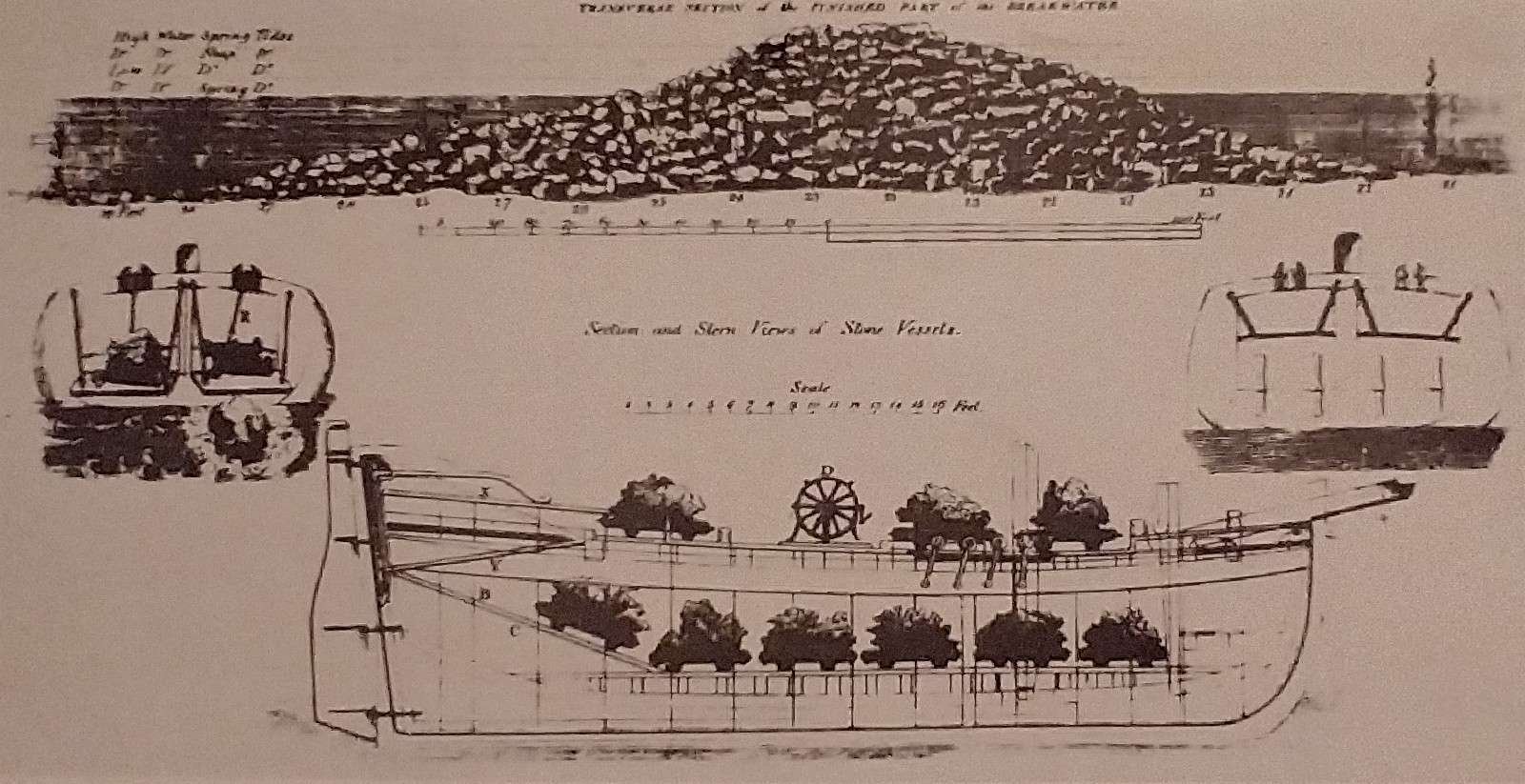
Rennie’s use of a ‘Rail Road’ is recorded in three different contemporary accounts: “The first of these is ‘Two Excursions to the Ports of England, Scotland and Ireland in 1816, 1817 and 1818, with a description of the Breakwater at Plymouth and the Caledonian Canal‘ translated from the (French) original of Charles Dupin. The second book …  [was] published by J. Johns of “Dock” (soon to become “Devonport”) in a booklet dated November 1820 entitled ‘Interesting Particulars Relative to the Great National Undertaking, the Breakwater now Constructing in Plymouth Sound.’ From these two books, a good picture of Rennie’s little railway can be formed, whilst the third book, Rennie’s own mammoth publication provides yet another set of carefully-scaled drawings, similar to Smeaton’s previous records.” [4: p9-10]

An engraving in Rennie’s book which shows the wagons used on his ‘railway’ [4: illustration between p8 & p9]

Rennie’s 3ft 6in gauge railway allowed horses to bring large stone blocks on flatbed wagons (or smaller stones in wagons fitted with sides), from his quarry at Oreston to a quay where the wagons were turned on a turntable and loaded onto vessels with iron rails in their holds and taken to the sites of the breakwater. On arrival a form of tippler appears to have been used to discharge the wagonloads onto the sides of the breakwater. [4: p10-11]

A second engraving from Rennie’s book which shows the wagons in place in the hold and on the deck of one of the wessels which transported stone from the quarry to  the site of the breakwater [4: illustration between p8 & p9]

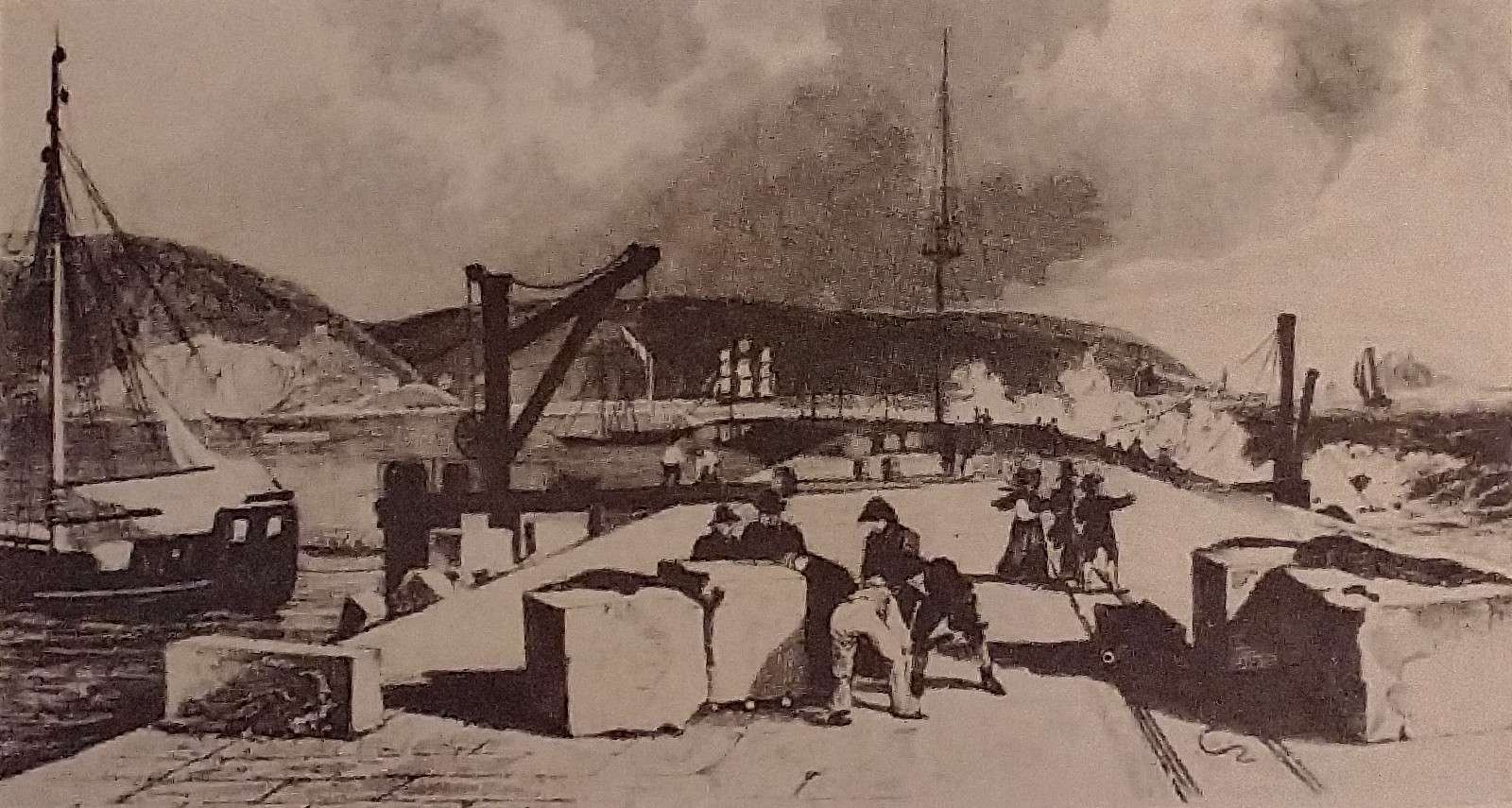
The building of the breakwater extended over some thirty years, and in its final stages a railway was actually constructed on the surface of the “wall” enabling the ships to be unloaded in the reverse manner to that of the loading at Oreston, even down to the provision of turn-tables. … This … has given rise to the claim that this was the first rudimentary ‘train ferry’.” [4: p12]

A further engraving from Rennie’s book which shows the breakwater with the railway on its surface. [4: illustration between p8 & p9]

Kendall noted in 1968, that the quarry at Oreston still continued to supply stone for the maintenance of the breakwater. [4: p12]

On their journey around England in 1826 and 1827,  Von Oeynhausen and Von Dechen visited the Plymouth Breakwater and the later Plymouth & Dartmoor Railway referred to below. [7: p51-55] Of the Breakwater Railway, they commented: “For the transport of the larger masses of stone, 10 ships of 80 tons burden have been built in the Royal Dockyard. These ships can carry 16 blocks, each of 5 tons weight, in two rows, each block resting on a wagon which runs on a railway. The two railways on the ships are extended to the breakwater by drawbridges; and then the wagons are drawn out of the ships by cranes and unloaded. In this manner, a ship of 80 tons can be unloaded in 40 or 50 minutes. The ships are brought to the place where the stones are required to be laid by the help of buoys.” [7: p55]

A more conventional tramway was opened on 26th September 1823. The 4 ft 6 in (1.37 m) Plymouth & Dartmoor Railway ran from Princetown to Sutton Harbour and the Cattewater. Branches were opened to Cann Quarry in 1829 and to Plympton in 1834, followed by the Lee Moor Tramway in 1854. Haulage on these lines in Plymouth was always by horses (although the Lee Moor Tramway did have two 0-4-0ST locomotives which spent most of their life at the Lee Moor end of the tramway). The Lee Moor line remained in use until 1960. [1][3][6: p9]

The Plymouth & Dartmoor Railway is covered in much greater detail in the article accessed via this link:

……………. (Currently being written) ……………………..

References

  1. https://en.m.wikipedia.org/wiki/Railways_in_Plymouth#:~:text=A%20more%20conventional%20tramway%20was,Lee%20Moor%20Tramway%20in%201854, accessed on 20th September 2023.
  2. Paul Burkhalter; Devonport Dockyard Railway; Twelveheads Press, Truro, 1996.
  3. Eric R. Shepherd; The Plymouth and Dartmoor Railway and the Lee Moor Tramway; ARK Publications (Railways), Newton Abbot, Devon, 1997.
  4. H.G. Kendall; The Plymouth & Dartmoor Railway; The Oakwood Press, Lingfield, Surrey, 1968.
  5. David St John Thomas; West Country Railway History; David & Charles, Newton Abbot, 1973.
  6. Russell Leitch; Plymouth’s Railways in the 1930s including “The Gear’s Poor Relation”; Railway Correspondence & Travel Society, Peterborough, 2002.
  7. C. Von Oeynhausen and H. Von Dechen; Railways in England 1826 and 1827; translated from the German by E.A. Forward and edited by Charles E. Lee and K.R. Gilbert; Newcomen Society, Cambridge, 1971.

Matthew 18: 21-35 – How Many Times?

The Parable of the Unforgiving Servant

A talk given on 17th September 2023 at St. Alkmund, Whitchurch.

If I were to ask for a show of hands this morning of those who have never wronged anyone. How might you respond?

Some might be ask themselves what right I have to ask a question like this. Is it, perhaps, the wearing of a dog collar that means I feel I can do so?

Some might think about what others around them might think if they put up their hand. … People here this morning probably know me too well. Although I know that I have never done anything too bad, I have certainly not broken any laws, they might remember that one time when I …………… What will they think of me?

Others might want to challenge my presuppositions behind asking the question. They might want to enter into a philosophical debate about my presumptions. … What might I mean by ‘wrong’? What might I mean by ‘never’? Do I mean ‘wrong’ in an absolute sense, measured against a set of laws? Or do I mean ‘wrong’ in a relative sense, in terms of the breakdown of relationships? Am I talking about ‘wrong’ in terms of personal moral responsibility, or of complicity in the actions, or failures to act, of my group, my family, my village, my class, my business, my society?

Ultimately, I guess, whether we readily admit our failings, or we only do so at our lowest ebb when self-doubt is strongest, very few of us would put our hands, and so today’s Gospel reading is for us, for you and for me. We all need or have needed someone’s forgiveness.

But our Gospel reading turns the question round the other way. It asks: What do you do when you have been wronged? What do we do when people hurt us or upset us? It talks about a need for us to forgive others.

There are many questions we could wrestle with this morning about ‘forgiveness’. But rather than embarking on a philosophical debate, let’s allow the Gospel story to speak. ……..

Just suppose, for a moment or two, that you have been hurt, maligned or mistreated by someone else.

Suppose (use fingers to count) someone lets you down, cheats on you, loses their temper with you, says some cruel and unkind things, steals from you, makes you look stupid, and breaks something of yours when you let them borrow it. … How do you respond? ……….

When Peter speaks to Jesus, he believes that he is setting a very high standard: “How often should I forgive someone? 7 times, Lord?” It seems as though Peter is saying: Seven times seems about the limit, fairly generous really. You might just as well give up on someone after that. Or perhaps, Peter is asking something like, “Am I being too generous, Lord, what do you think, perhaps after just 3/4 times?”

And Jesus response, I think, leaves Peter reeling – not seven times but seventy-seven times – or in some translations seventy times seven – 490 times. … “As often as is necessary,” is Jesus’ response. “Keep forgiving until you lose count completely!”

And Jesus then tells a story to help us understand that it is because we have been loved so much, forgiven so much ourselves by God, that we should forgive others.

Jesus’ story is about an employee or servant who has a wife and children and who has overspent on his company credit cards, someone who has maxed out. He has spent his boss’s money on himself and his family. He has stacked up a huge amount of debt with his boss.

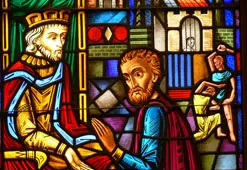
The Boss calls for his servant and demands repayment of what is owed. The servant falls on his knees and begs to be given more time to pay. The master, the boss, feels sorry for his servant and lets him off the whole debt! Just like that!

The debt is cancelled. How does the servant feel? … I guess that, if you have struggled under the burden of significant debt, an unpayable mortgage, a large gambling debt, a payday loan which is escalating out of control. Then you will know something of the immense relief, the unbridled joy of the servant. …

Now that is just what the bible says God has done for you and for me. He has cancelled the debt we owe, he has forgiven what we have done wrong, and continues to do so, perhaps even things that only we and God know about! …. The meanness, the selfishness, the pride, the hypocrisy, the fibs, the tax evasion, the days ‘off-sick’ which weren’t, the snails and slugs we have thrown over the garden fence onto our neighbour’s property, our failure to recycle, the driving above the speed-limit on the motorway… you know, all those kinds of things, as well as what might be much bigger things ….. When we say sorry to God for these things he forgives us. The only question is whether we mean what we say when we say we are sorry, and, I guess, whether, ultimately, we are willing to make restitution to those we have harmed.

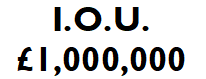
God has forgiven me and you more than we can imagine. It is just as though we owed God more than a million pounds (IOU a million) and he has cancelled the debt. The debt is gone, we have been set free of debt. (Tear up the I.O.U.). ……

So, back to the Gospel story, … here is this happy, free servant. He’s wandering back from the house of his master, his boss, to tell his family the good news. He’s over the moon, he’s delighted, it is wonderful. And he meets a fellow servant of his boss, his master. This fellow servant owes him a few quid.

And the same thing happens; this other servant falls on his knees and begs to be given more time to pay. But what does the first servant do? He grabs him by the neck, shakes him and has him thrown into prison until he can pay the debt.

What Jesus wants us to ask ourselves is this: Is it reasonable for the first servant to behave this way? Is it fair and right? What do we think?

Of course it isn’t. …

Yet forgiveness remains something we all find difficult – often impossible. …  Jesus is suggesting in this story that we will only begin to be able to forgive, if we can comprehend how much we ourselves are loved, how much we been forgiven.

Jesus says that it is when we know that we are loved without conditions, that we can begin to show that kind of love to others. 

The love God has for us is that kind of love.

Our regular Sunday services allow time for confession and for us to hear God=s word of forgiveness for us. We also join together in the Lord’s prayer: ‘forgive us our trespasses as we forgive those who trespass against us’. Weekly reminders of just how crucial forgiveness is.

It is only in the security and strength of God=s forgiving love for us, that we can be free to love and that we can begin to forgive others generously in return.

Yes, for their sake and for God=s sake … but actually also for our own sake. … For, finding a way to forgive, is essential for the sake of our own health and well-being. For when we hold onto grudges, it is as if we throw ourselves into debtors’ prison until the perceived debt has been paid. A failure, on my part, to forgive can destroy me. …. So, the last few words of our Gospel reading, as awful as they are, reflect no more than the natural consequence of the first servant’s failure to forgive. …

Rather than finishing on this negative note, let’s think forward to the central act of our service this morning. Let’s focus on the love shown to us in Christ. … On the forgiveness which is ours in Christ, no matter what we have done, no matter how guilty or ashamed we feel. And, as we prepare for our Communion, let’s allow ourselves once again, as we receive the elements of bread and wine, to sense the love of God suffusing our minds and hearts. This act of love which we re-member in our bodies, is an act of deeply healing, forgiving love from a God who thinks the world of each one of us. We are loved, forgiven, set free. Words are just not enough, but bread and wine, body and blood, warm our hearts and embrace us in God’s arms of mercy.

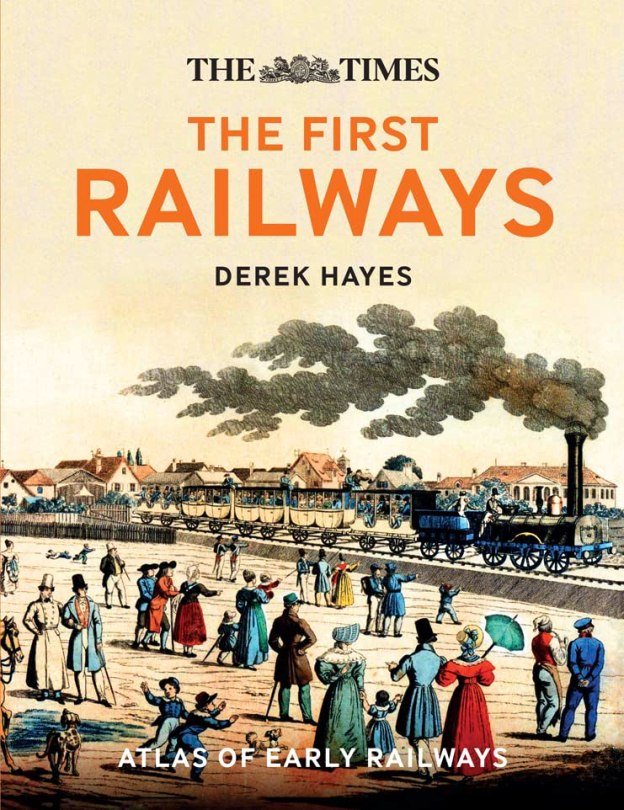
The First Railways: Atlas of Early Railways

Derek Hayes: The Times, HarperCollins, 2017

I picked up a copy of this book in September 2023. It is large format Hardback book of 272 pages. The listed price is £30.00 but my copy cost me just over £10 plus postage and it is in an excellent pre-owned condition. I had anticipated a well-illustrated book which would be a relatively easy read. I was pleasantly surprised to find that while it was an excellent read, it was also a well-researched, scholarly work with: all maps and illustrations properly catalogued and sources noted; a significant bibliography of scholarly works; and a comprehensive index.

Hayes’ book brings together in one volume the history of waggonways, tramways and tramroads as well as early modern steam railways. It  provides some superb copies of contemporary maps. Illustrations and text are exceptionally well laid out. I thoroughly enjoyed reading through some concise introductions to significant plateways and railways of the period.

Wooden Rails and Horse/Manpower

The book begins with a review of significant lines which were first constructed with wooden rails.

– Hayes tells us that, “The earliest definitively documented application of a cross-country railed way in Britain is that of entrepreneur Huntingdon Beaumont: his waggonway ran from Strelley to Wollaton, now in the West part of Nottingham. … Documents fix the date of this first waggonway at between October 1603 and October 1604.” [1: p14]

– Other early waggonways include: some close to Broseley, Shropshire, leading to wharves on the River Severn dated at around 1605; and several feeding to the River Tyne in the 1630s. Practice differed between these two areas. In Shropshire, wagons were usual relatively small on narrow-gauge tracks which fed straight into the mines they served. In the Northeast, wagons were larger and the gauge wider.

– In Wales, a Shropshire-type of waggonway was in use in Neath, Glamorgan before 1700. In Scotland, the first available records, from 1722, cover the Tranant to Cockenzie railway close to Edinburgh which was another Shropshire-style waggonway.

We have evidence that throughout the 1700s, wooden waggonways were in use. Examples include: the Alloa Waggonway (built in 1766); Ralph Allen’s wooden railway in Bath, Somerset (built in 1731); Whitehaven, Cumbria’s waggonways which converged on staiths in the harbour (1735); the Middleton Railway in Leeds (1758); Tyneside/Northumberland/Durham (1608 onwards, significant maps have been retrieved dated 1637, 1761 and 1788). Hayes draws attention to a number of Northeast waggonways: the Plessey Waggonway; the Killingworth Waggonway; waggonways associated with Dunstan Staiths (the last of which closed in 1990!); the Tanfield Waggonway (built between 1725 and 1738); the Beamish South Moor Waggonway (built around 1780); the Pelton Moor (built between 1746 and 1787) and Deanry Moor (built 1779) Waggonways. Hayes also mentions the replica wooden waggonway at Beamish Open-Air Museum. [1: p15-31]

This 1830 map of South Wales, part of the large ‘Map of the Inland Navigations, Canals and Rail Roads with the Situations of the various Mineral Productions throughout Great Britain’, of which
many extracts are shown in Hayes’ book, shows a large number of railways despite being published the same year as the opening of the Liverpool Manchester Railway. The majority of the lines shown are plateways. After an early start with edge rails, most of the lines built after about 1800 were of the plateway type. Many of these railways are referred to in the book. [1: p66-67]

The book goes on to focus on the transition between wooden and iron rails, noting the practice of overlaying wooden rails with cast-iron plates, a system which was in use as early as 1767 in Coalbrookdale, Shropshire. [1: p36]

Cast and Wrought Iron

Hayes then looks at the introduction of Cast Iron and the later Wrought (or ‘maleable’) Iron. Again two different practices developed:

– L-shaped plateways with wheels without flanges were in use underground as early as 1787, these were then used above-ground in the Shropshire area, in the Forest of Dean, on a number of lines in South Wales, and by Benjamin Outram on the Butterley Gangroad, Little Eaton Gangway and the Peak Forest Tramway. Other examples include: the Lancatser Canal Tramroad; the Ticknall Tramway; the Caldon Low Tramway; the Surry Iron Railway, the Gloucester and Cheltenham Railway; the Middlebere Plateway, Dorset; the Silkstone Waggonway Near Barnsley; The Forest of Dean and Severn & Wye Railways; the Somerset Coal Canal Railway; the Kilmarnoch & Troon Railway; and the South Wales Railway and Canal Network (including the Hay Railroad between Brecon, Hay and Kington. A departure from the us of L-shaped Cast Iron plates was the use of granite for the Haytor Granite Railway which supplied granite from Dartmoor to wharves on the River Teign. [1: p38-71]

– Edge rails with flanged wheels saw greater early use in the Northeast and on a number of lines in South Wales, although many in South Wales were converted from edge-rails or round bars to plateways because of the influence of Benjamin Outram. Those lines remained as plateways until the 1830s. Wrought or ‘maleable’ iron was initially expensive as larger section rails were used. This changed when first ‘T- section’ and then ‘I-section’ rails were produced by a rolling process. Many early edge railways used short- sections of rail in a fish-belly shape. Hayes details some of the most significant very early iron edge railways: the Forest Line of the Leicester Navigation; the Lake Rock Rail Road; the Belvoir Castle Railway; the Mansfield & Pinxton Railway; the Plymouth & Dartmoor Railway; the Stratford & Moreton Railwaythe Monkland & Kirkintilloch Railway and its later siblings, the Garnkirk & Glasgow Railway, and the Ballochney Railway; the Slate Railways of North Wales, (including the Llandegai, Penrhyn, Nantile and Dinorwic Railways); and the Northeast Coalfield. [1: p72-93]

A short section [1: p94-99] covering inclined planes and stationary engines precedes Hayes coverage of the first ‘Travelling Engines’ and ‘Working Locomotives’ in the ear before Stephenson growing ascendancy. [1: p100-127]

Steam Power

Richard Trevithick was to be the person who solved the question of how to use steam-power on rails as a Travelling Engine. It required the use of high-pressure steam. …

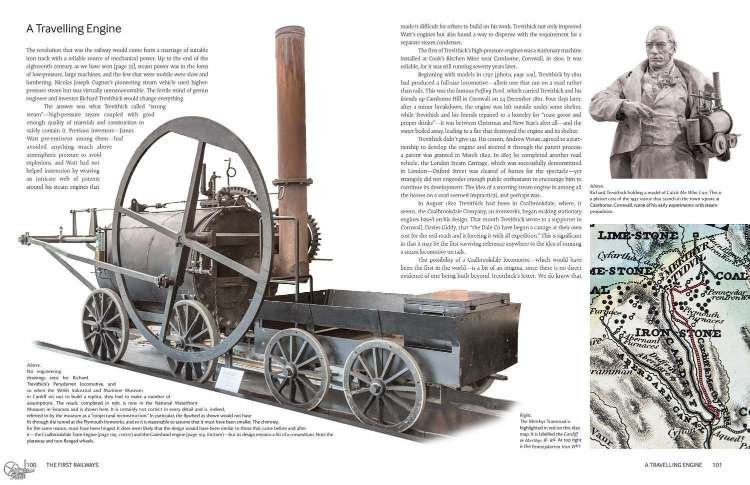
The railway revolution came from a marriage of suitable iron track with a reliable source of mechanical power. Up to the end of the eighteenth century, steam power was in the form of low pressure, large machines, and the few that were mobile were slow and lumbering. The engineer and inventor Richard Trevithick would change everything. His answer was what he called ‘strong steam’ – high-pressure steam coupled with good enough quality of materials and construction to safely contain it. The first of Trevithick’s high-pressure engines was a stationary machine installed at Cook’s Kitchen Mine near Cambare, Cornwall, in 1800. It was reliable, for it was still running seventy years later. … In August 1802, Trevithick had been in Coalbrookdale, where, it seems, the Coalbrookdale Company, an ironworks, began making stationary propulsion engines based on his design. That month Trevithick wrote to a supporter in Cornwall, Davies Giddy, that “the Dale Co have begun a carrage at their own cost for the real-roads and is forceing it with all expedition.” This is significant in that it may be the first surviving reference anywhere to the idea of running a steam locomotive on rails. However, the possibility of a Coalbrookdale locomotive – which would have been the first in the world is a bit of an enigma, since there is no direct evidence of one being built beyond Trevithick’s letter. … When Trevithick’s Penydarren locomotive first ran in South Wales, it did so on a plateway and would have had wheels without flanges. [1: p100-101]

A good introduction to George Stephenson’s early activities [p128-133] is followed by a focus on the Hetton Colliery Railway which, after a competition between engineers, George Stephenson designed with three self-acting inclines and level sections worked by horses or by his locomotives. By the date of opening, Hetton Colliery Railway became the first to be designed specifically for locomotive use and featured three of Stephenson’s ‘patent travelling engines’. “Just over half the route was worked by locomotives. … The other five sections were all inclines. Three were worked on a self-acting basis and two … used engines. Despite being advised by Stephenson … to use maleable- or wrought-iron rails, the Hetton Colliery Railway used …cast-iron edge rails, each 3ft 9 ins long and laid on stone and wooden blocks. They gave the company a lot of trouble. … Despite considerable on-going modifications, … the railway proved conclusively the value of the locomotive engine and provided valuable experience for Stephenson. … [It] lasted for well over a century: the last section closed only in 1972, the result of the decline of the coal industry rather than issues with the railway.” [1: p134-139]

Most early railways were related to mineral interests and carried freight. The first passengers were carried, if at all, as an after thought. On the Swansea & Oystermouth Railway (later known as the Swansea & Mumbles Railway), which was built by 1806 to transport coal, iron ore, and limestone, Benjamin French offered the company £20/year in lieu of tolls “for permission to run a waggon or waggons on the Tram Road… for conveyance of passengers.” The proposal was accepted by the company, and French began his service with what was essentially a stagecoach with the wheels adapted to run on rails on 25 March 1807 – this is the world’s first documented regular rail passenger service. It seems to have been popular, for French’s permission was renewed the following year for £25. Ultimately mineral traffic on the line did not live up to expectation and passenger traffic became relatively more important. After a 9 year hiatus starting in 1855 both horse-power and steam competed for until 1898 when the companies involved merged. The line was by then essentially a tourist attraction, and a pier was built at the western end of the line to provide a destination. In 1929 the line was electrified and had 13 tramcars Popularity grew, and during the depression years of the 1930s 5 million passengers a year were being carried. But the popularity did not last, traffic declined, and the line closed in 1960.

These early railways were local affairs but there were visionaries who perceived that longer distances would soon become possible. Hayes points us to: Benjamin Outram, who proposed a double-track railway from London to Bath; Richard Lovell Edgeworth, who in 1802 published a paper entitled ‘On the Practicability and Advantage of a General System of Rail-roads‘; Thomas Telford, who surveyed a 125 mile route from Glasgow to Berwick in 1809-10, recommending the use of a railway rather than one of his favoured canals; John Stevens (in the US) who argued that railways would be better than canals over longer distances; William James, who in 1802 proposed railways from Bolton to Manchester and Liverpool, and who, in 1808, proposed a General Railroad Company to build a network of railways across Britain; Edward Pease, in 1821, imagined a London to Edinburgh railway; and Thomas Gray, who in 1820 was the first to proposed a detailed railway network  covering all of the British Isles which could be used for poor-relief by creating massive levels of employment during its construction. [1: p140-143]

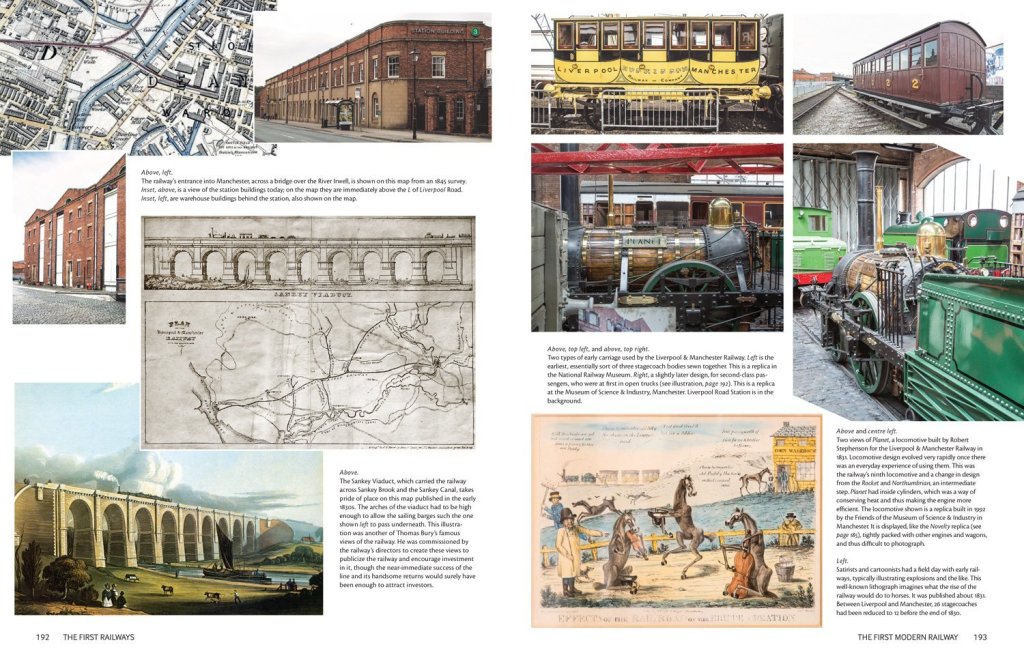
Detailed studies of the Stockton & Darlington Railway [1: p144-167]and the Canterbury & Whitstable Railway [1: p168-171] precede discussion of what Hayes calls ‘the First Modern Railway’, The Liverpool & Manchester Railway. Hayes provides a detailed and well-illustrated ‘chapter’ about that railway, including contemporary maps and images. [1: p172-193]

Another double-page spread from Hayes’ book. [1: p192-193]

Further short studies look at: Agenoria’s Railway and at the batch of locomotives, of which Agenoria was one, the other three being exported to the united States, one of which (the Stourbridge Lion) became the first steam locomotive to run in North America in August 1829; the Cromford & High Peak Railway; the Leicester & Swannington Railway; and the Stanhope & Tyne Railway. Honourable mentions include: the Bristol and Gloucestershire Railway; the Avon & Gloucestershire Railway; the Whitby & Pickering Railway; and the Bodmin & Wadebridge Railway.

Hayes then reflects on the gradual development of a national network of railways and a growing number of skilled railway engineers, [1: p206-225] before picking out one railway, the London & Greenwich Railway, which has a claim to have been the first commuter railway. [1: p226-229]. Hayes closes his book with a short look at the transfer of railway technology from the UK to the rest of the world. [1: p230-259].

Summary

In summary, Hayes book is, as the rear of the dust-jacket claims, “A highly illustrated and readable account of the earliest railways, from the first wooden-railed waggonways to the development of the railway network of the 1840s and beyond. During this period the modern railway engine was invented and refined; it rapidly outpaced the horse and developed into a swift and strong machine that changed the course of world history forever.” [1]

There are 700 maps and other illustrations and the story is brought to life by a lively narrative supported by well chosen photograph and railway ephemera.

The book is something of which its author can be justifiably proud. I thoroughly recommend it’s inclusion on the library of anyone interested in the development of the railways from their early beginnings. It is worth its cover price of £30.00, but if you can find it in good condition for around £10.00 second-hand, then jump at the opportunity to make a purchase!

References

  1. Derek Hayes; The First Railways: Atlas of Early Railways; The Times, HarperCollins, Glasgow, 2017. [2]
  2. https://www.amazon.co.uk/First-Railways-Derek-Hayes/dp/0008249482, accessed on 14th September 2023.

Derry History – The Harbour Tramways/Railways

The ‘Modern Tramway’ Journal of September 1963 had a short article about the Harbour Tramways in Derry, written by J.H. Price. …

The 3-rail mixed gauge track of the dockside tramways in Derry. These were closed from 1st September 1962, © J.H. Price. [1: p315]

Friday 31st August, 1962, saw the closing of the dockside tramways of the Port and Harbour Commissioners in Derry. This was probably “a delayed outcome of the closing in 1957 of much of the hinterland railway system, which … diverted much traffic to Dublin, and since 1950 the rail traffic over the Commissioners lines has fallen from 200,000 tons to just over 10.000 tons per year. Now road transport is used for all traffic.” [1: p314]

The city of Derry was unusual in having four separate railway termini, two on each side of the River Foyle. On the western side was the Foyle Road, terminus of the Great Northern Railway’s 5ft 3jn gauge line to Omagh and Portadown, separated by nearly two miles of quays from the L&LSR’s 3 ft. gauge terminus at the Graving Dock. Across the river on the eastern shore was the Waterside terminus of the Ulster Transport Authority (ex-NCC) main line to Coleraine and Belfast, and further south on the same side was Victoria Road station, the terminus of the 3ft gauge line to Strabane owned by the Ulster Transport Authority and worked for them by the County Donegal Railway.

The narrow gauge lines were closed in 1953 and 1954 respectively, but the broad gauge lines were still in use in 1963.

To allow railway wagons to reach the town quays and the quayside warehouses, the … Port and Harbour Commissioners built from 1867 onwards a system of dock tramways worked initially by horses. Most of the lines were of three-rail mixed gauge. … In 1872 steam traction was introduced, with broad-gauge tank locomotives fitted with dual couplings so as to haul broad or narrow-gauge wagons; mixed gauge trains were not unusual.” [1: p314]

From about 1950 the Commissioners two latter-day locomotives (both 0-6-0 saddle tanks) were displaced by road tractors, but remained in their shed for another three years. Photographs of these two locomotives can be seen towards the end of this article.

For a short time in the 1880 the Lough Swilly passenger trains ran over the dock tramways as far as the Middle Quay, but this ceased in 1888, and a link for passenger traffle was provided instead from 1897 onwards by the 4ft 8in gauge horse tramway of the City of Derry Tramway Company, replaced by motor buses in 1920.” [1: p314-315]

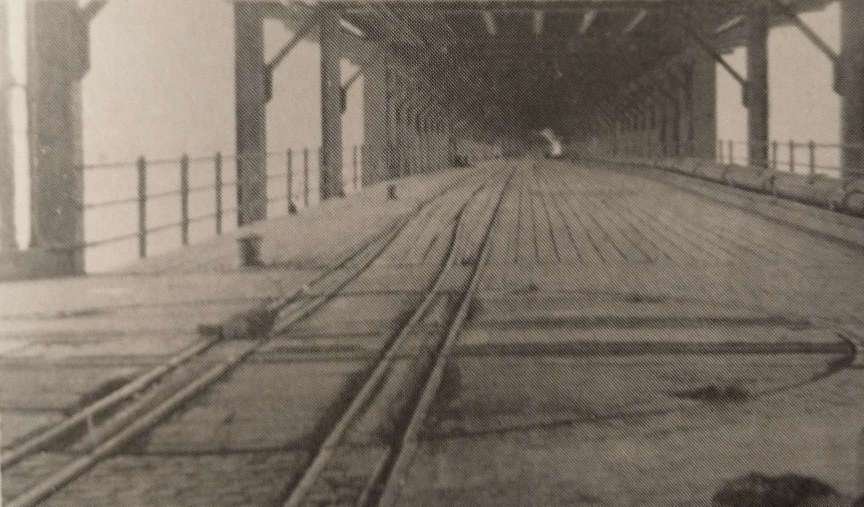
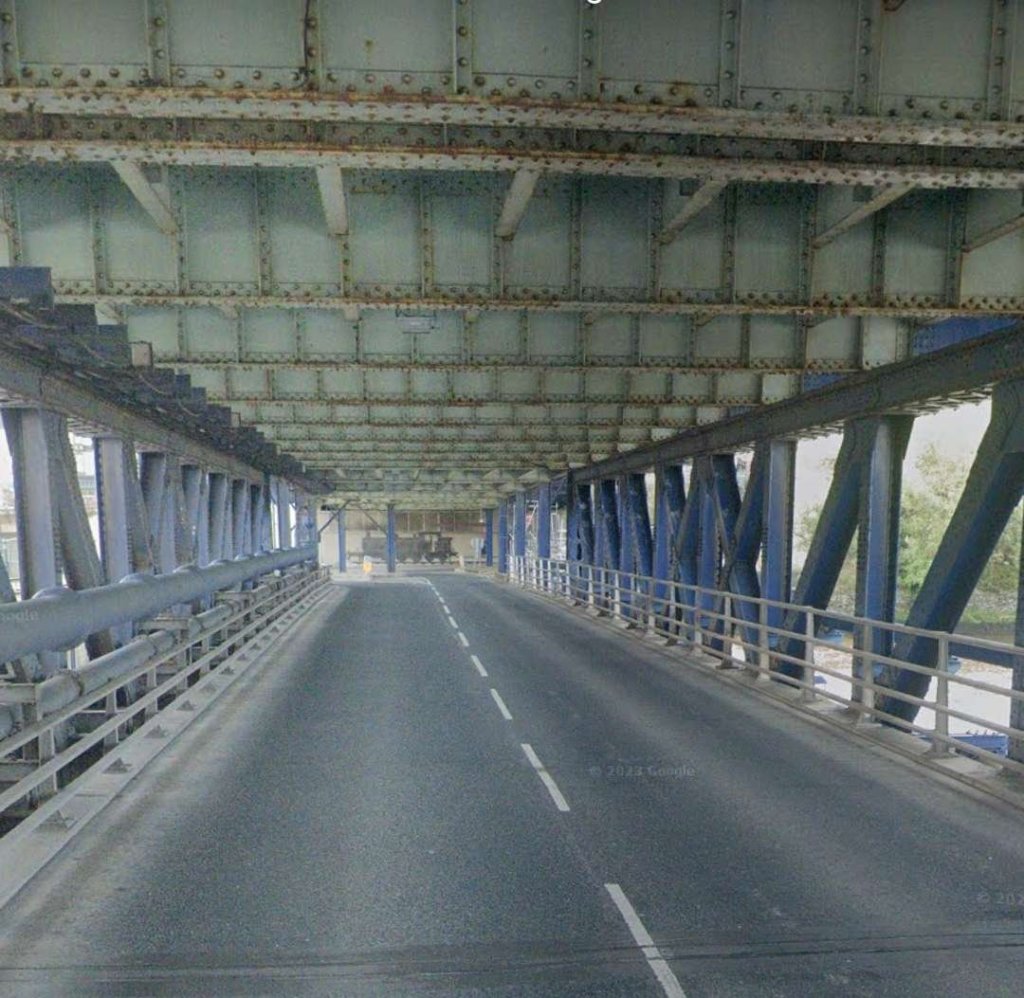
Since part of the original scheme was to allow the railways of the eastern shore an access to the quays and warehouses on the western, or town, side, the layout included a railway across the lower deck of the Carlisle Bridge, and this was continued when the bridge was reconstructed as the Craigavon Bridge in 1933. The upper deck of the bridge carrie[d] a roadway and footpaths. Locomotives were not allowed on the bridge, and for many years the wagons were moved across by rope and capstan.” [1: p315]

The lower deck of the Craigavon Bridge in Derry showing one of the mixed gauge turntables, © J.H. Price. [1: p315]
The lower deck of the Craigavon Bridge in 2023. [Google Streetview, April 2023]

This installation included two of Ireland’s few mixed-gauge turntables (the others were at Strabane, Larne Harbour and Carnlough), and to ensure that the narrow-gauge wagons were balanced correctly on the turntables, the 3 ft. gauge track was brought to the centre of the broad gauge instead of remaining at one side.

Price commented that the whole layout was distinctly unusual. He considered it likely (in 1963) that some portions of the trackwork would remain in place for years to come.

Craigavon Bridge was designed by the City Architect, Matthew A Robinson. Construction began in the late 1920s and was finished in 1933. As we have noted, the lower deck of the bridge originally carried a railway line for freight wagons, but that was replaced by a road in 1968. At each end, a silhouetted mural of a railway station stands to mark the former railway. [2]

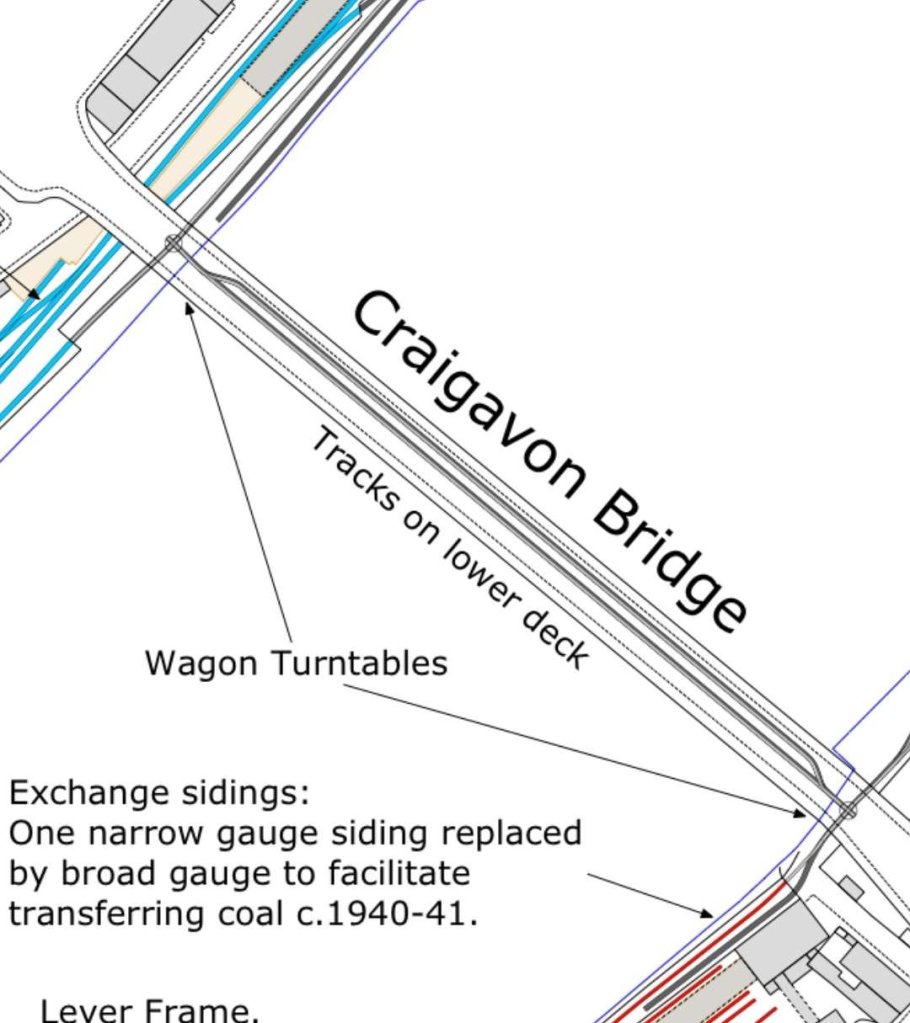
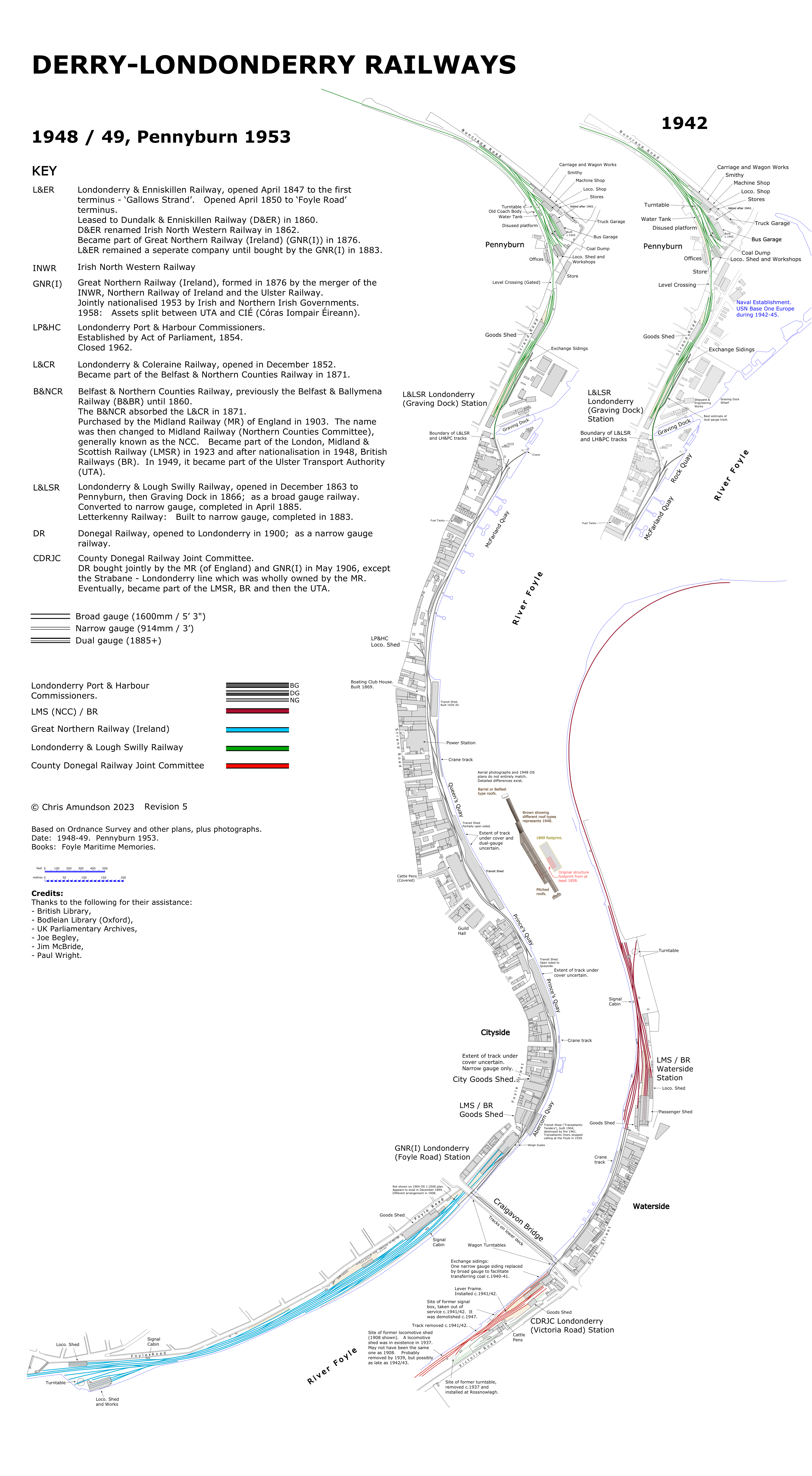
The Port and Harbour Commissioners Tramways have been carefully mapped by Chris Amundson after study of all available sources. His work covers track layouts throughout the life of railways and tramways in Derry. This is not the place to share large electronic files but his mapping can be found on the Irish Railway Modeller forum. His CAD map from the late 1940s can be found here. [3] Just a few extracts from that drawing. …….

This first extract shows the track layout close to Craigavon Bridge. The grey/black lines are those of the Port and Harbour Commissioners Tramways, the red lines are those of the County Donegal Railways Joint Committee. The turquoise blue lines are those of the Great Northern Railway (Ireland). It is worth noting the two wagon turntables, each of which sits at one end of the bridge, © Chris Amundson. [3]
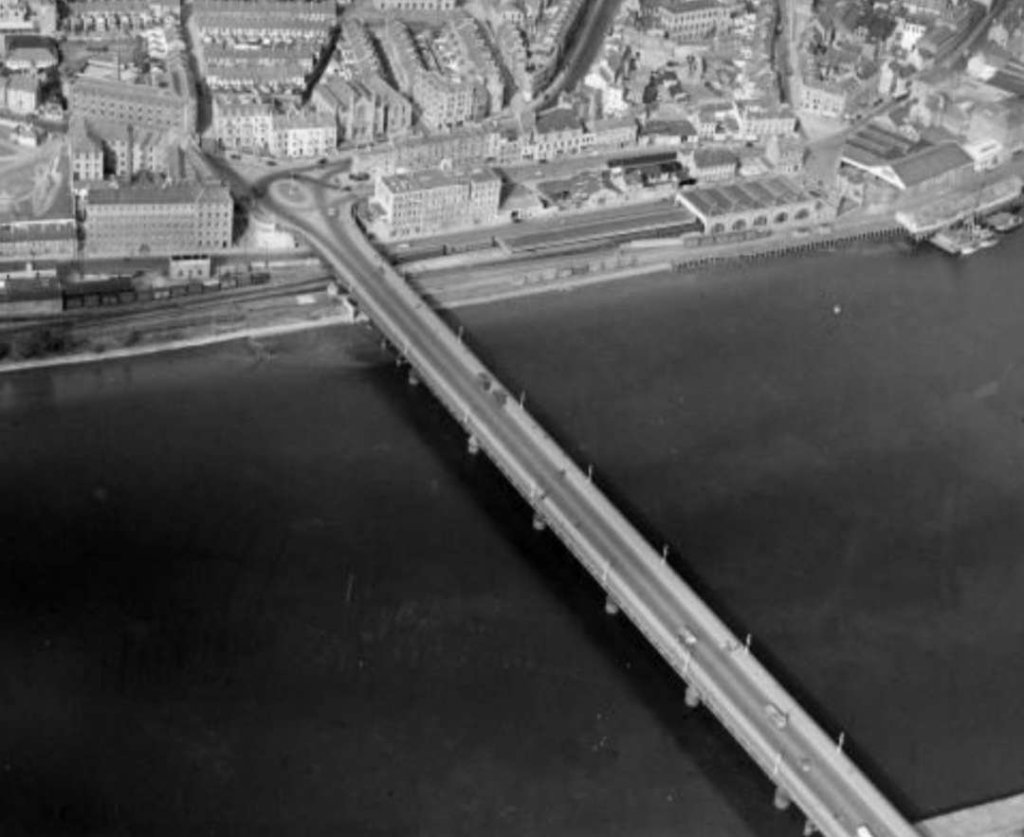
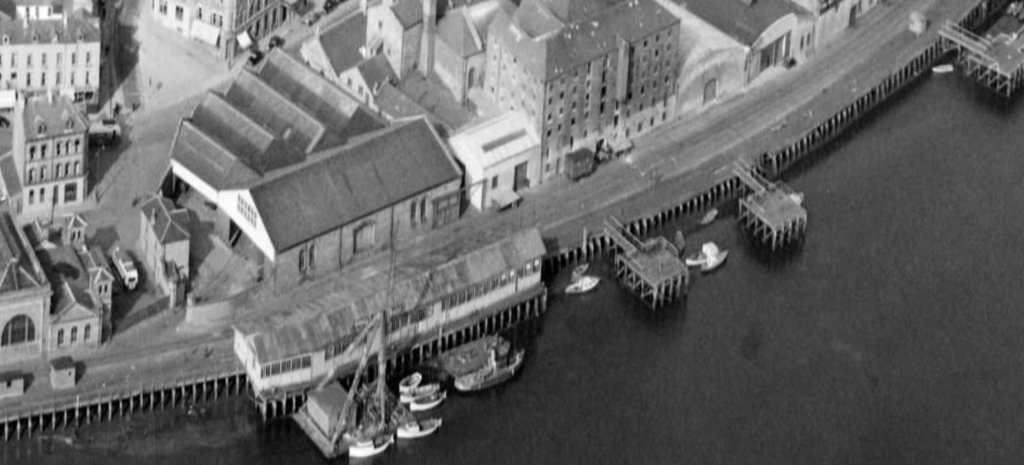
Craigavon Bridge in 1949, as seen in a Britain from Above Aerial Image (XAW027082) © Historic England. [13]
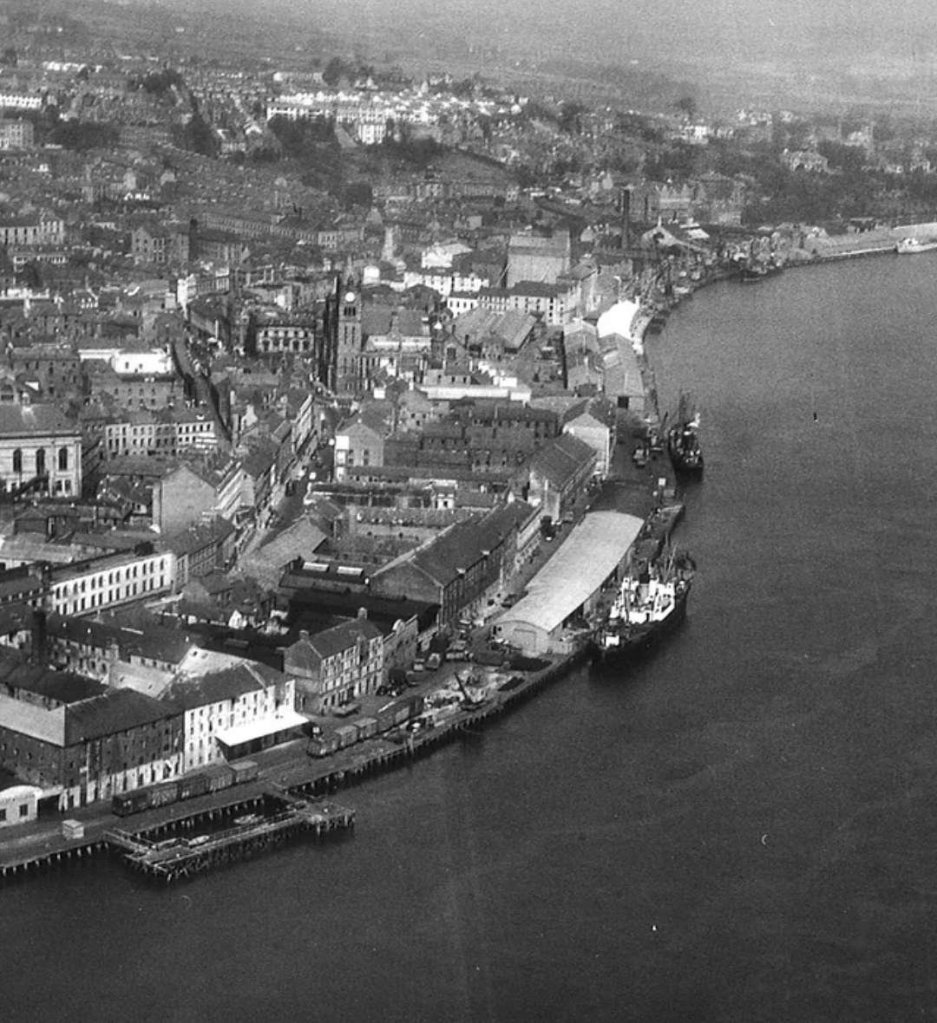
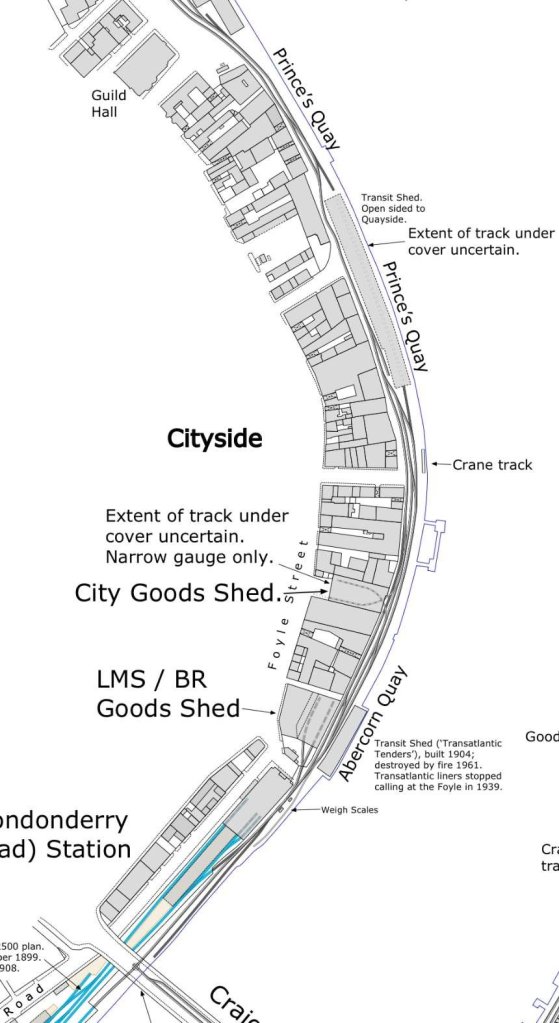
A general aerial view of the quays at Derry with the centre of the city close alongside. The light roofed building adjacent to the ship at Prince’s Quay. Further to the North are the transshipment sheds opposite the Guildhall sitting between Prince’s Quay and Queen’s Quay. [11]
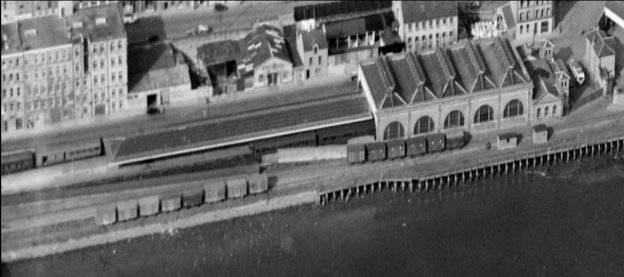
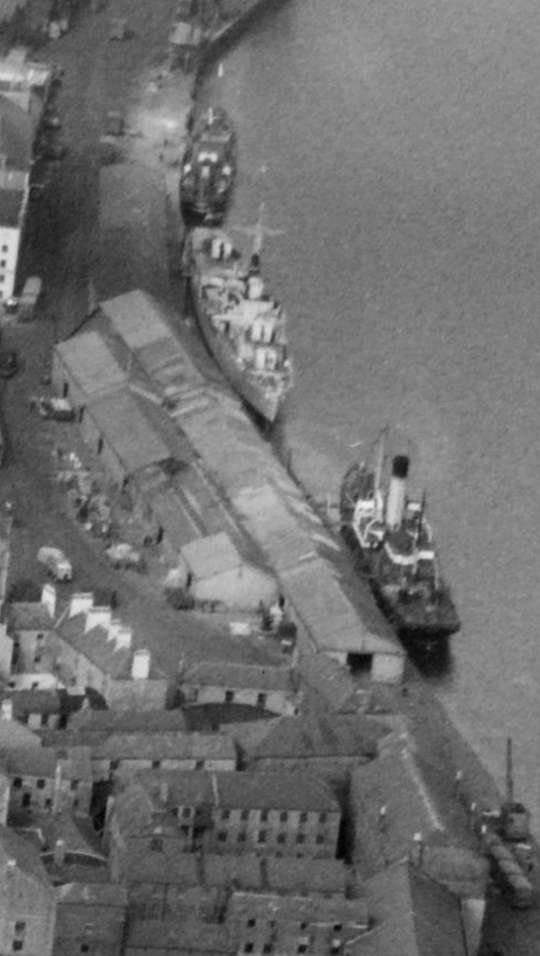
Abercorn Quay and the GNR(I) Foyle Road station with covered wagons sitting on the Port and Harbour Commissioners’ rails, on an extract from photograph XAW027081, © Historic England. [12]
This extract from photograph XAW027081 overlaps with the one above and also shows Abercorn Quay, © Historic England. [12]
Open wagons sit on the Port and Harbour Commissioners’ rails at the South end of Prince’s Quay on an extract from photograph XAW027081, © Historic England. [12]
The transshipment shed on the quayside between Prince’s and Queen’s Quays. The Guildhall is just off the extract on the left. This extract is also taken from photograph XAW027081, © Historic England. [12]
The Port and Harbour Commissioners Tramways ran along the City side (West side) of the River Foyle. This extract shows Abercorn Quay and Prince’s Quay, © Chris Amundson. [3]
This extract shows Queen’s Quay and includes the location of the Port and Harbour Commissioners Tramways Loco. Shed, © Chris Amundson. [3]
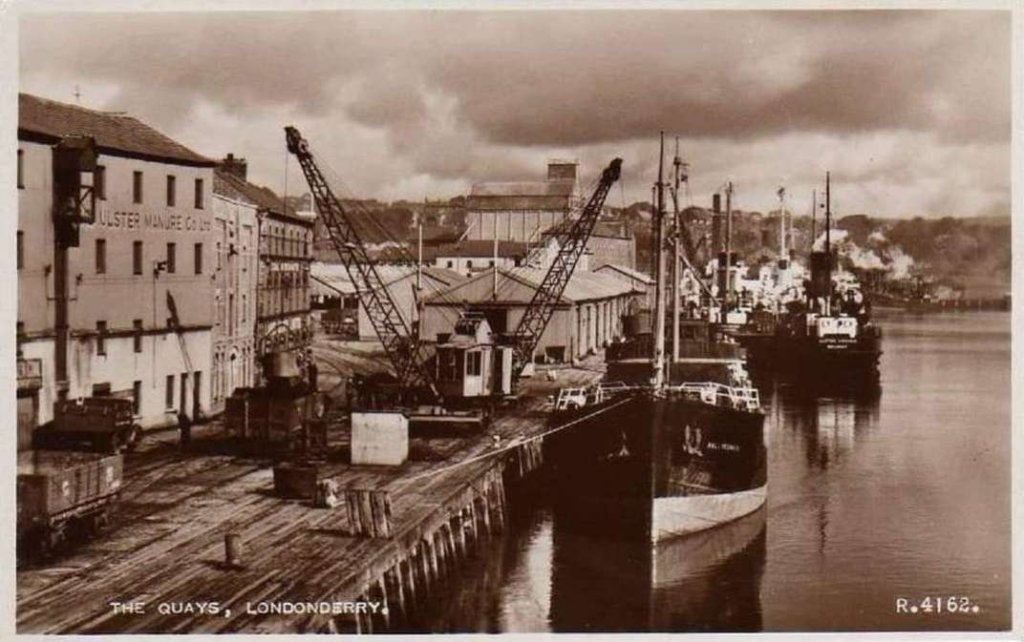
This photograph looks North from Prince’s Quay. The 2 cranes are unloading coal at Berths 12 and 13. Astern of the ship (Kelly’s ‘Ballyedward’) in the foreground are the Liverpool and Heysham berths and their transshipment sheds. The Guildhall is hidden by the buildings on the left. The large building to the left of the tip of the righthand crane is McCorkells grain store. The new City Hotel and Quayside are now on that site. The boat behind the ‘Ballyedward’ on the right is the Belfast SSCo’s ‘Ulster Drover’ which carried cattle to Glasgow until about 1958. Scrapped in 1959. This photograph was shared on the Derry of the Past Facebook Page on 22nd January 2017. [14]
The quay, before the 1890s as the Guildhall has yet to be built. You can see Harbour House and Custom House in the image (the Guildhall would have been just behind the Harbour House). The platform in the foreground is the Lough Swilly Railway’s original Middle Quay Station. This image was shared to the Derry of the Past Facebook Page by Michael Burns & J Knox on 9th August 2016. [5]
A similar view in 2020. Harbour House and Custom House are visible in this photograph which was taken when the leaves were not on the trees. The Customs House is closest to the right side of the image. The Guildhall beyond Harbour House. [Google Streetview, December 2020.
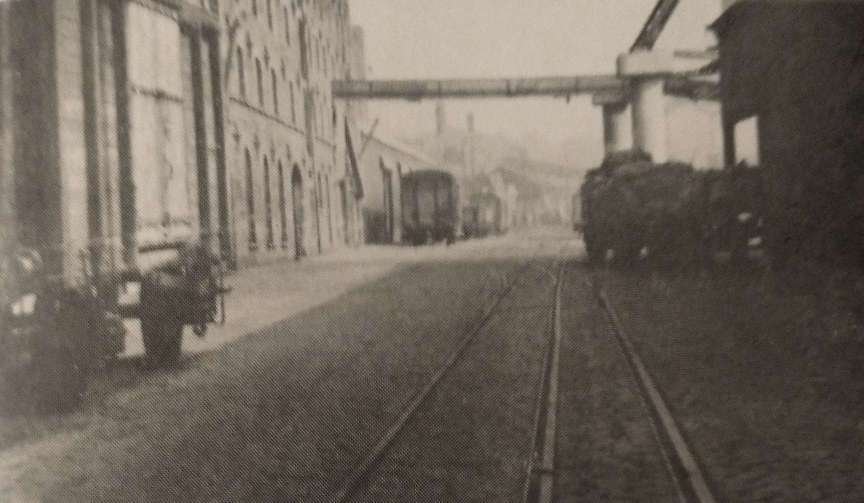
This view looks South from alongside the Transit Shed. The balconied building on the right is the Guildhall. The dual-gauge track enabled wagons of both gauges to access the various warehouses and quays along the River Foyle. This image was shared on the Irish Railways Past and Present Facebook Group by John McKegney on 9th December 2020. [5]
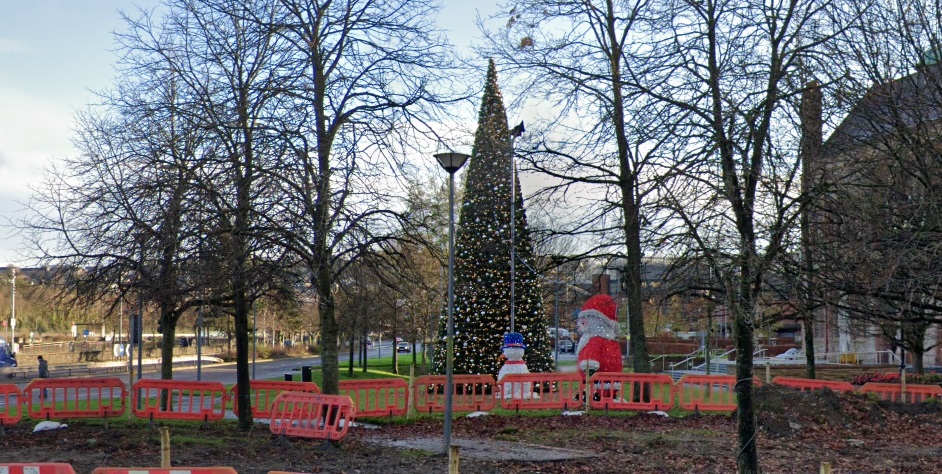
The best that we can do using Google Streetview to replicate the older image above. The Guildhall is on the right of this view camouflaged by the bare trees of winter. The Christmas tree is probably siting over the place that the old tracks in the image above would have run. [Google Streetview, December 2020]
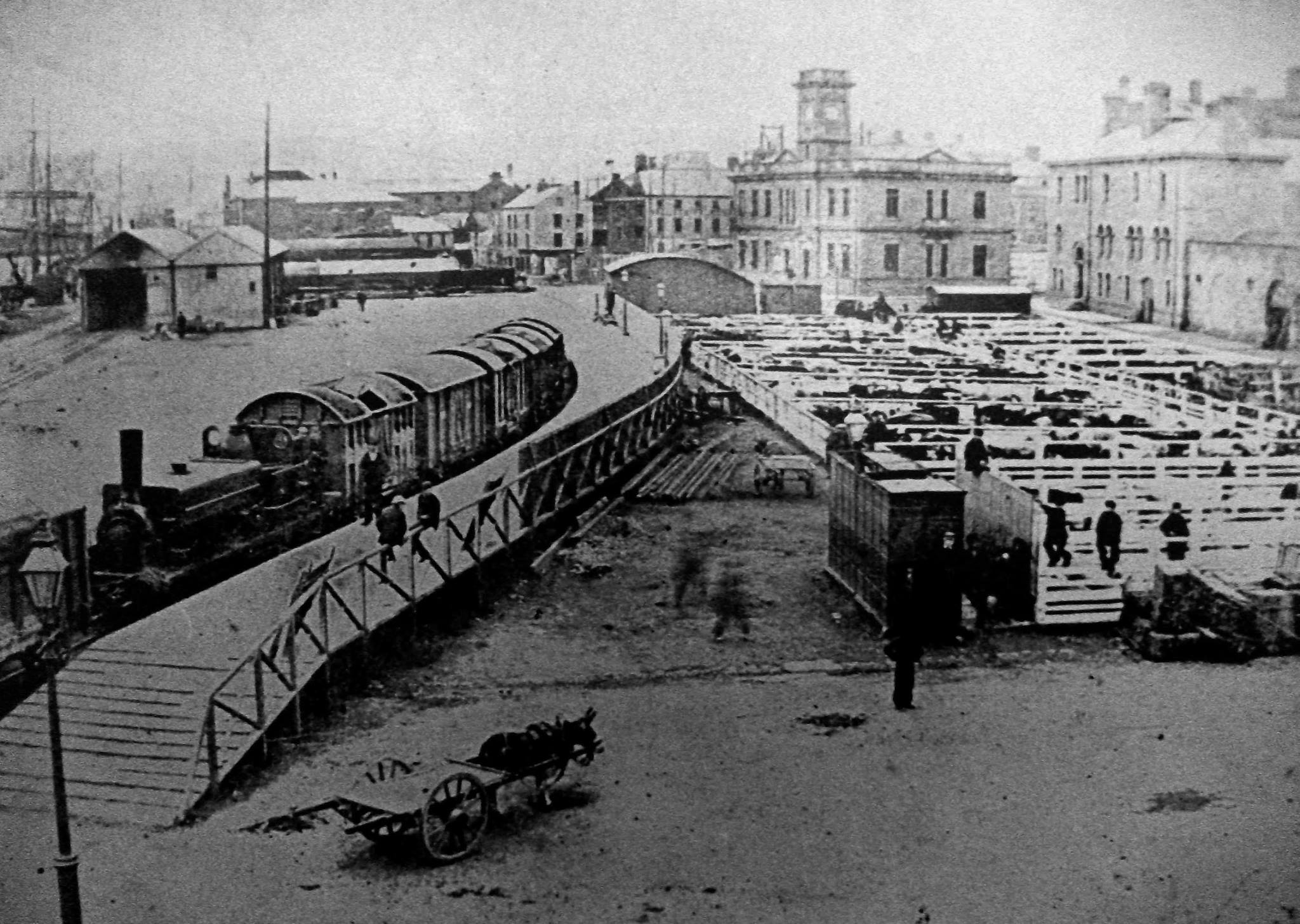
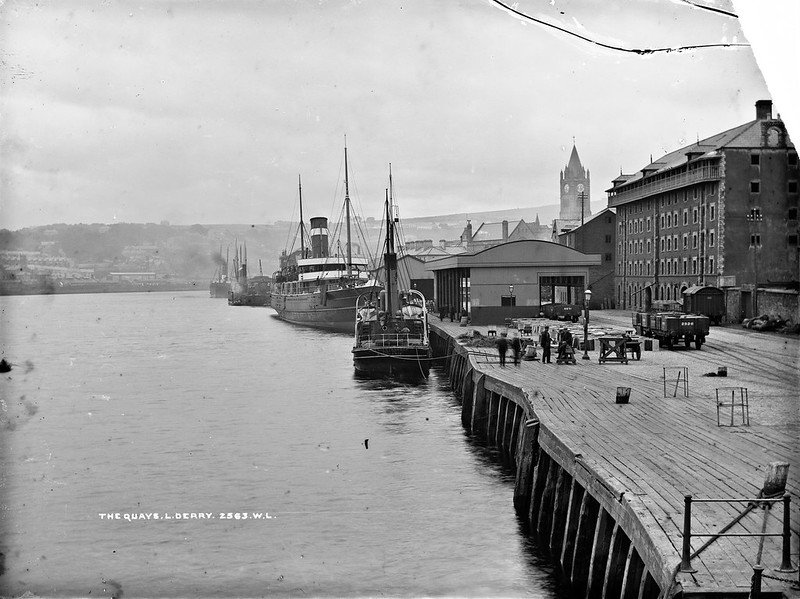
Looking South towards the Guildhall (the clock tower is clearly visible) from Queen’s Quay, probably sometime in the first decade of 20th century. The smaller vessel, nearest the photographer, is the Screw Steamer ‘Harrier’. Built in 1892, she was torpedoed in 1943 (by U-boat U181). The larger steamer, just beyond, is the Packet Steamer ‘Duke of York’. Built in 1894, she was renamed the ‘Peel Castle’ in 1911/1912, and pressed-into service as an Armoured Boarding Vessel during WWI, © Robert French, held in the Lawrence Photograph Collection of the National Library of Ireland. [15]
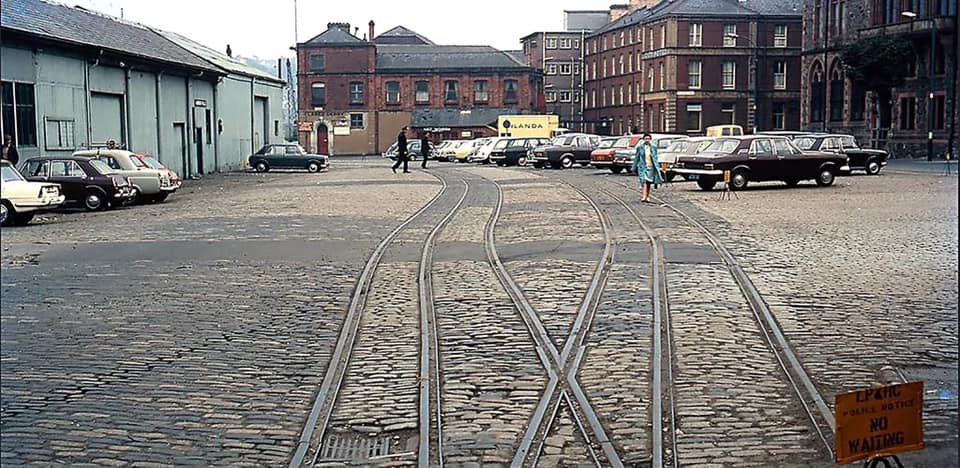
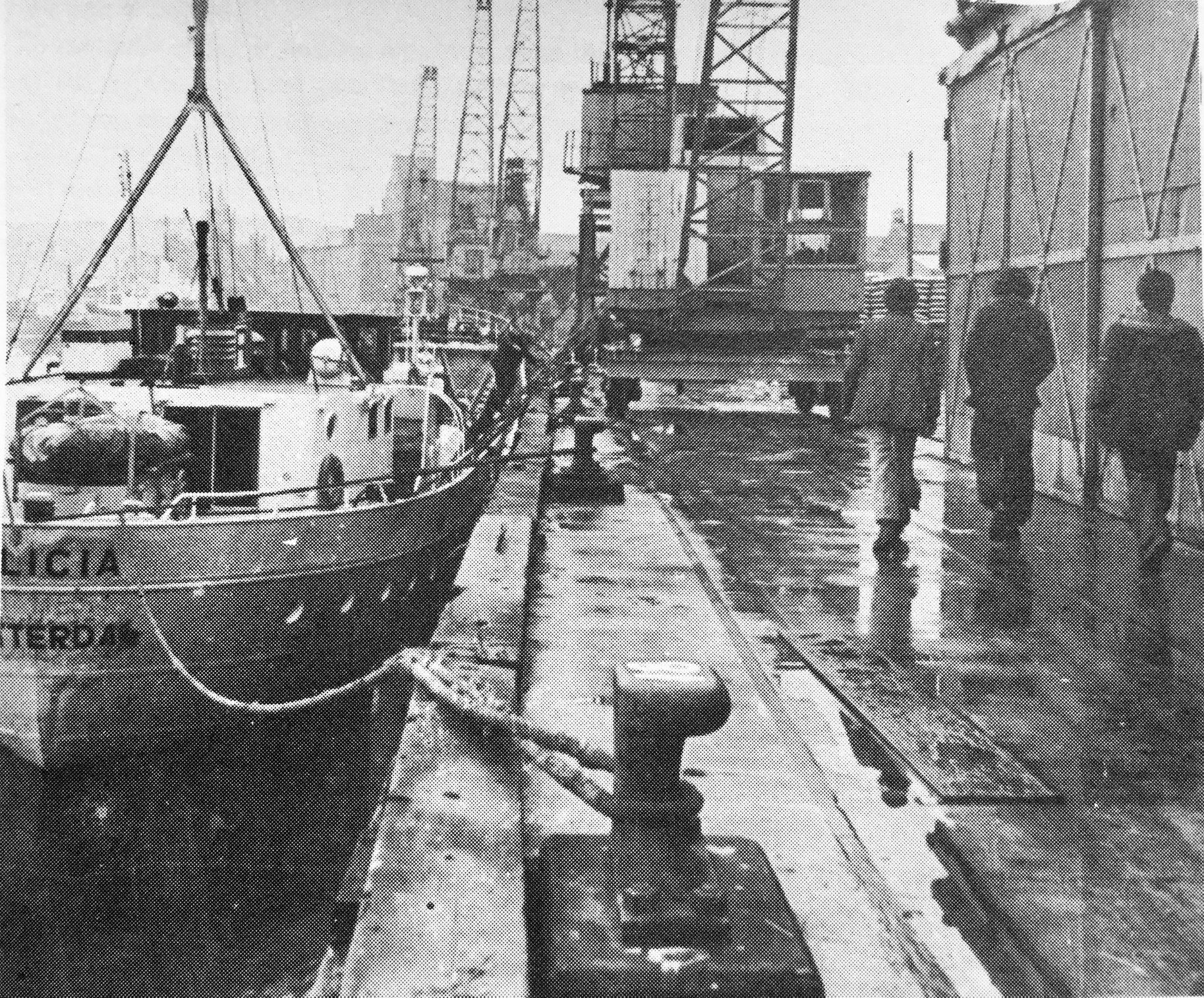
North of the Guildhall and the large transit shed but South of the Loco Shed there is a second transit shed shown on the mapping . This photograph was taken in the 1980s looking South from alongside that transit shed towards the crane tracks. The crane is sitting at the North end of the tracks. The image was shared on the Derry of the Past Facebook Page by Joseph Keys on 7th July 2020. [6]
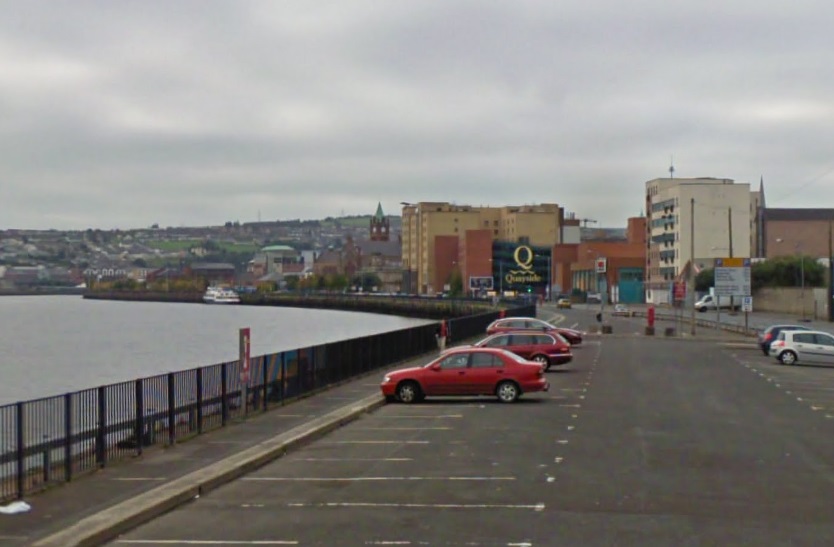
A similar view in September 2009. [Google Streetview, September 2009]
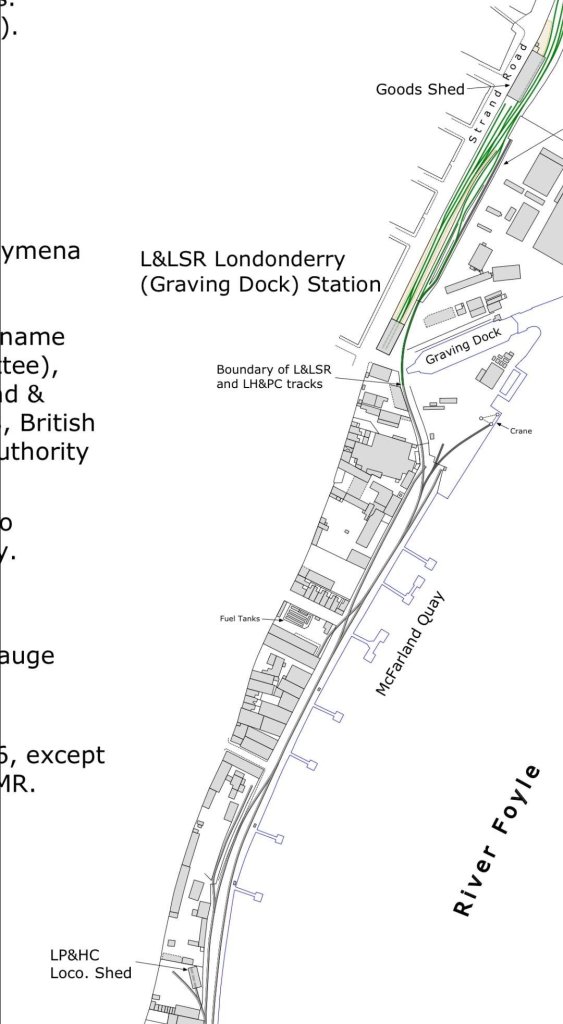
This final extract shows the northern extent of the Port and Harbour Commissioners Tramways. The Loco. Shed can be seen bottom-left. McFarland Quay and the Graving Dock appear to the South of the L&LSR Graving Dock station. The L&LSR’s tracks are shown by the green lines, © Chris Amundson. [3]

To the North of the Goods Shed and just off the North edge of the extract above the L&LSR crossed the Strand Road at level on a shallow angle.

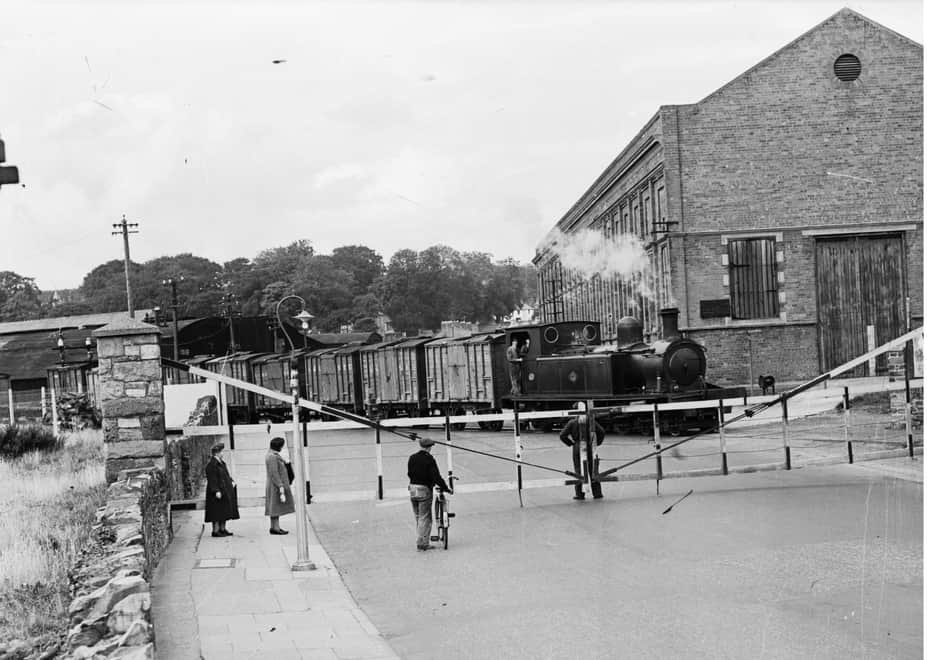
This photograph is taken looking North through the level-crossing on Strand Road. It shows the final train on the L&LSR, entering Graving Dock Station from the North, crossing Strand Road. The Crossing Gates emphasise the width of the road and the shallow angle of the crossing. [16]
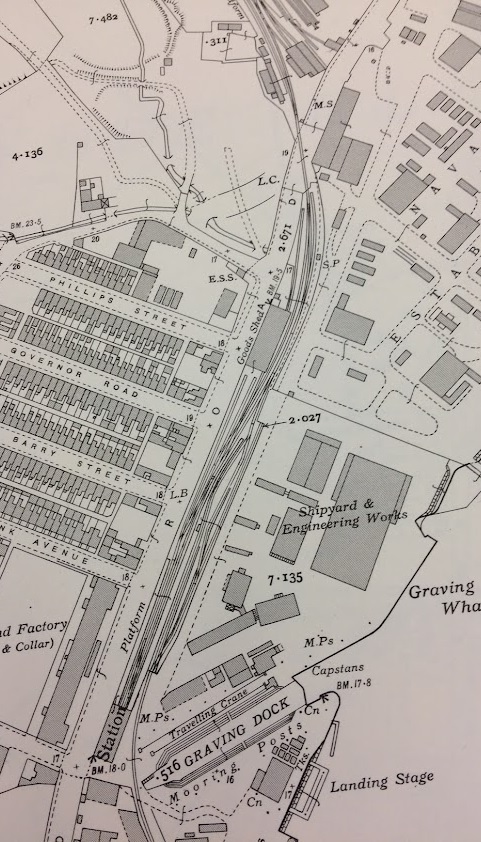
This extract from the Ordnance Survey at the turn of the 20th century shows the Graving Dock, the L&LSR Station and the Strand Road crossing. The Port and Harbour Commission’s dual-gauge tramroad enters the extract from the South and terminates alongside Graving Dock Railway Station where a connection is made with the L&LSR sidings. Ownership of the tracks switched from the Commission to the L&LSR at the Southwest end of the Graving Dock.
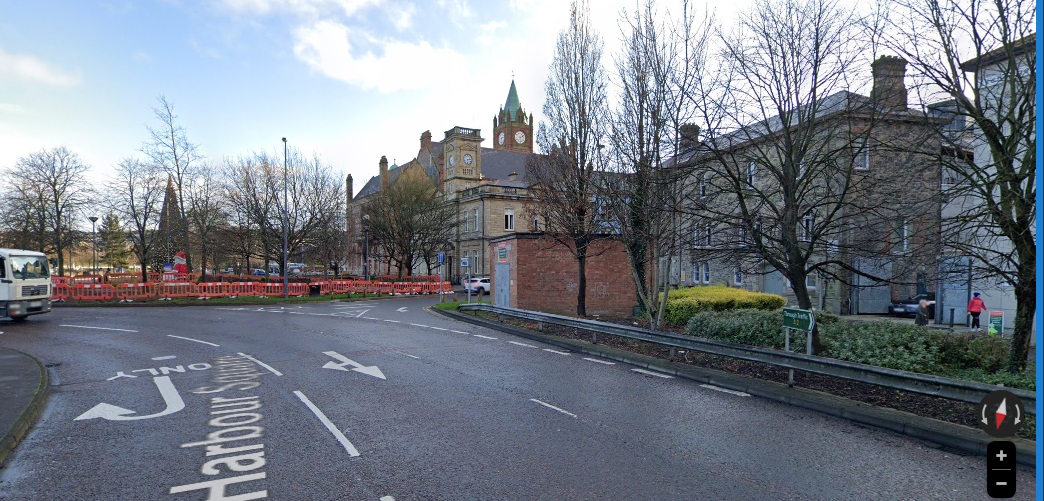
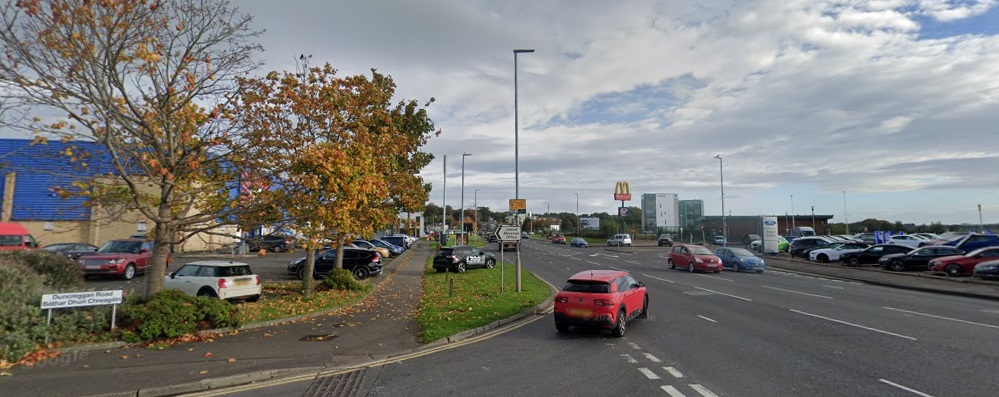
The view North from the mouth of Duncreggan Road in 2022. The western kerb of Strand Road was under the location of the car parked on the grass verge close to the centre of the picture, perhaps under the location of the offside rear wheel. The level crossing gates were perhaps a short distance to the North of the same car. [Google Streetview, October 2022]

The next two images show the Port and Harbour Commission’s Locomotive 0-6-0ST No. 1 at work on the West side of the River Foyle. Both are embedded Getty Images.

Londonderry Port & Harbour 0-6-0ST No.1. Locomotive & General Railway Photographs. Ireland, 1933.
Locomotive 0-6-0ST No. 1 in 1933, (Photo by Science & Society Picture Library/SSPL/Getty Images). [7]
Londonderry Port & Harbour 0-6-0ST No. 1
Locomotive 0-6-0ST No. 1 again, (Photo by Science & Society Picture Library/SSPL/Getty Images). [8]
Locomotive No. 1 again, this locomotive was built by Robert Stephenson & Co. (Works No 2738). It is on display in the Ulster Folk and Transport Museum at Cultra near Belfast. [9]
The Port and Harbour Commission’s Locomotive No. 3, ‘R.H. Smyth’. This locomotive is an Avonside Engineering Company locomotive, built in 1928, (Works No. 2021). Described as “generally similar to the B6 class 0-6-0 saddle tanks, but with a wheelbase of 9 feet and a gauge of 5 feet 3 inches”. The engine was designed to work on dual gauge track with both 5’3″ and 3′ gauge wagons, and had a pair of offset narrow gauge buffers. It was stood down from operational duties in 1959. By 1968 the engine had been out of use for several years and the Reverend L.H. Campbell decided to buy her to save her from the scrapyard. By February 1968 the engine was his, remaining for the time being in the Harbour Commissioners’ sheds. In 1972, the Reverend decided to pass the engine on to the Railway Preservation Society of Ireland so that it could be restored to working order. The handover officially took place on 1st May that year. It has an interesting history in preservation. [10]

No. 3’s story is taken up by the Railway Preservation Society of Ireland: “The little engine lay outside for many years until it became practical to overhaul her. She first steamed in preservation in summer 1977. For many years she served as yard shunting engine at Whitehead, and was a guinea pig for the inner firebox repair on No.85. Her public duties included train rides up and down the site at Whitehead, hauling early Easter Bunny and Santa trains before they became mainline trains. … In the summer of 2000 the loco was hired to contractors Henry Boot who were relaying the Bleach Green – Antrim line for NIR. A locomotive was needed to pull ballast hoppers, and as IÉ and NIR were not in a position to loan a locomotive, the RPSI was approached. The locomotive pulled over fifty thousand tons of stone from 18th June until 25th November 2000. On the latter date she returned to Whitehead and resumed her shunting duties. … By 2004 “R.H. Smyth” was in need of an overhaul, but didn’t seem likely to return to steam until the Guinness engine came out of traffic as steam shunting engine. Then the contractors relaying the Bleach Green – Whitehead line stepped in. They required an engine to haul ballast trains, just as Henry Boot had. The locomotive was given a thorough overhaul in double quick time, and was moved to Greenisland in early August 2005. After a busy five months ballasting, the engine returned home to Whitehead in December 2005. … From 2006 until 25th November 2012, when it returned to Whitehead, the engine was on loan to the Downpatrick and County Down Railway, although for the last couple of years of that stay, the locomotive was out of service awaiting a decision on boiler repairs. … In late 2019 the locomotive received a cosmetic overhaul and went on display in the Museum at the head of a mini goods train. The narrow gauge coupler has been reinstated.” [10]

References

  1. J.H. Price; The Londonderry Harbour Tramways; in Modern Tramway and Light Railway Review, Volume 26, No. 309; Light Railway Transport League and Ian Allan Hampton Court, Surrey; September 1963, p314-315.
  2. https://en.m.wikipedia.org/wiki/Craigavon_Bridge, accessed on 23rd August 2023.
  3. https://irishrailwaymodeller.com/uploads/monthly_2023_08/_com.apple.Pasteboard.nBUrho.png.5793b7e2d13018c0cf5dab48c9af4431.png, accessed on 24th August 2023.
  4. https://www.facebook.com/Derryofthepast/photos/a.1007190669332324/1210256352359087, accessed on 31st August 2023.
  5. https://www.facebook.com/photo/?fbid=10157961821301219&set=gm.1848708821949134, accessed on 31st August 2023.
  6. https://www.facebook.com/Derryofthepast/photos/a.1007190669332324/3528479063870126, accessed on 31st August 2023.
  7. https://www.gettyimages.co.uk/detail/news-photo/londonderry-port-harbour-0-6-0st-no-1-locomotive-general-news-photo/102725492?adppopup=true, accessed on 31st August 2023.
  8. https://www.gettyimages.co.uk/detail/news-photo/londonderry-port-harbour-0-6-0st-no-1-news-photo/102725493?adppopup=true, accessed on 31st August 2023.
  9. https://preservedbritishsteamlocomotives.com/1-londonderry-port-and-harbour-commissioners-0-6-0st-robert-stephenson-co-works-no-2738, accessed on 31st August 2023.
  10. https://www.steamtrainsireland.com/rpsi-collection/12/no3-rh-smyth, accessed on 31st August 2023.
  11. https://www.foyleport.com/history, accessed on 2nd September 2023.
  12. https://www.britainfromabove.org.uk/image/XAW027081, accessed on 2nd September 2023.
  13. https://www.britainfromabove.org.uk/image/XAW027082, accessed on 2nd September 2023.
  14. https://encrypted-tbn0.gstatic.com/images?q=tbn:ANd9GcR1FLJqvbOkkkChRaiNFNgSY3FWAMKYYHSyWg&usqp=CAU, accessed on 3rd September 2023.
  15. https://flic.kr/p/267Co9D, accessed on 3rd September 2023.
  16. https://www.derryjournal.com/lifestyle/travel/remembering-the-swilly-train-3330773, accessed on 10th September 2023.
The Purton Viaduct and the Purton Steam Carriage Road

On the road between Purton and Etloe on the Northwest side of the Severn Estuary there is a railway viaduct. Seemingly it sits remote from any former railway. Although you might just be forgiven for thinking that it is a remnant of the Forest of Dean Central Railway, or even associated with the Severn & Wye Railway which ran close to, but to the South of, the hamlet of Purton.

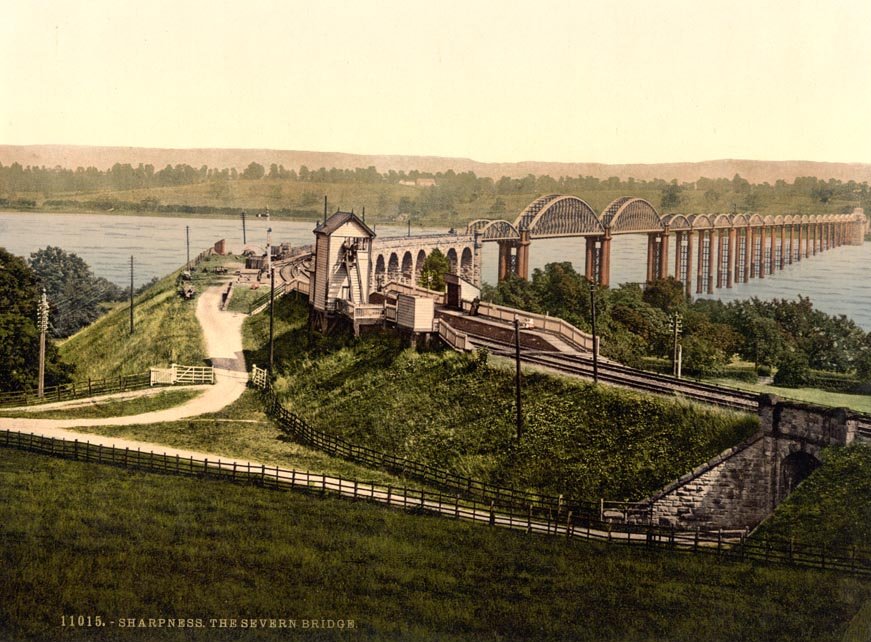
The Severn Bridge Railway Station sat just to the South of Purton on the West Bank of the River Severn. [9]
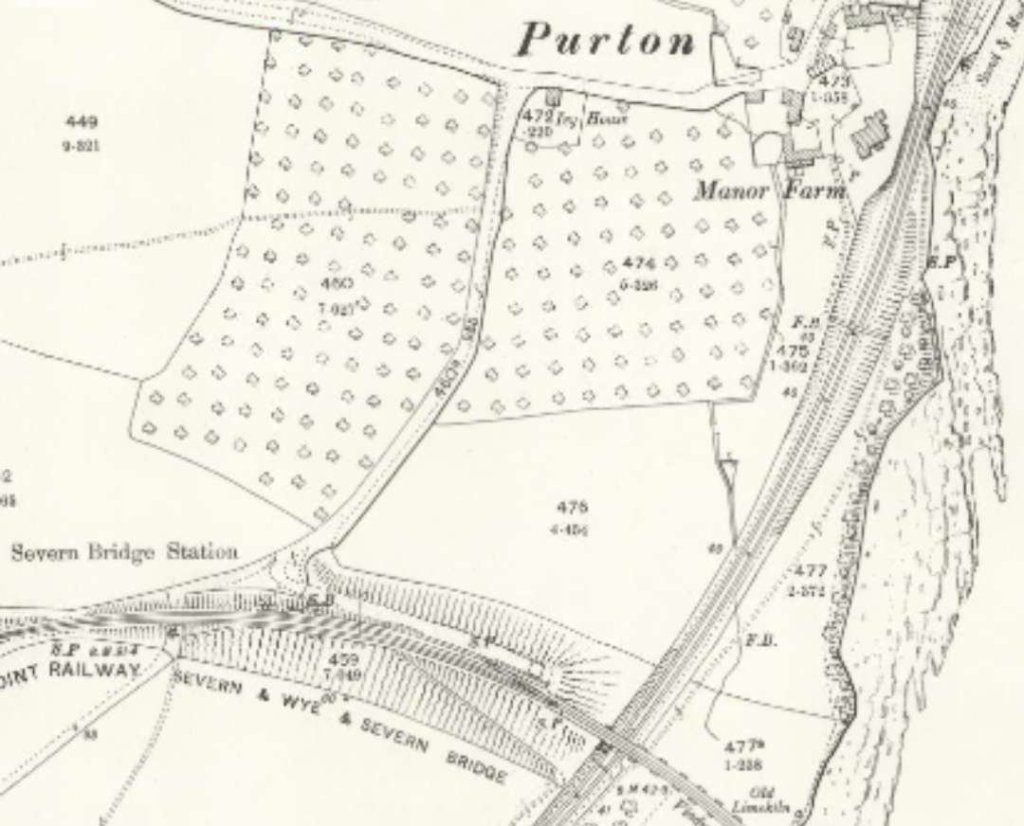
Purton sits just to the North of the Severn Bridge Station on the Severn and Wye Railway. This map extract comes from the 25″ Ordnance Survey of 1901. [10]

It is, in fact, the main remnant of a planned railway/tramroad – the Purton Steam Carriage Road! It can be seen on the map extract below which shows the viaduct just to the North of the hamlet.

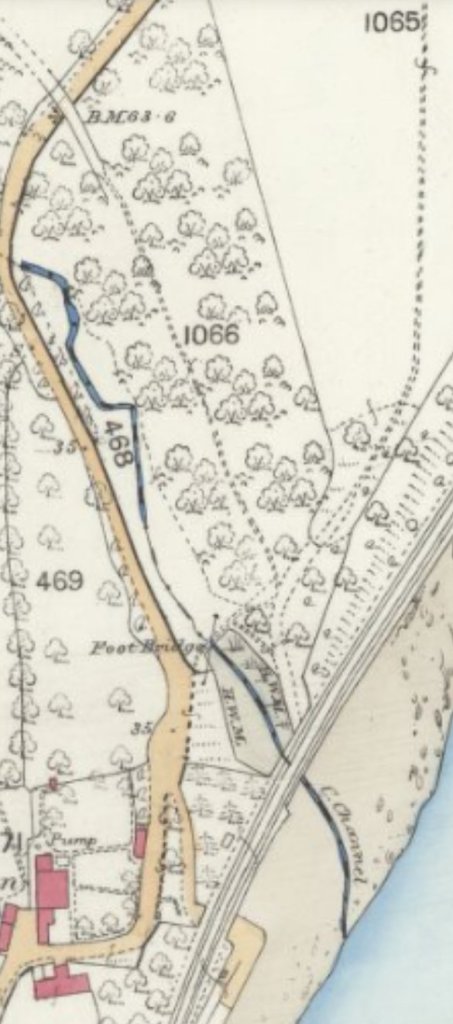
Purton Viaduct appears at the top-left corner of this map extract. The hamlet of Purton is bottom-left. Purton Pill is just below the centre of the extract. Historically, there was a ferry across the River Severn at this location. This map extract comes from the 1879 25″ Ordnance Survey. In 1879, a footpath can be seen following the approximate line of the proposed railway. [11]

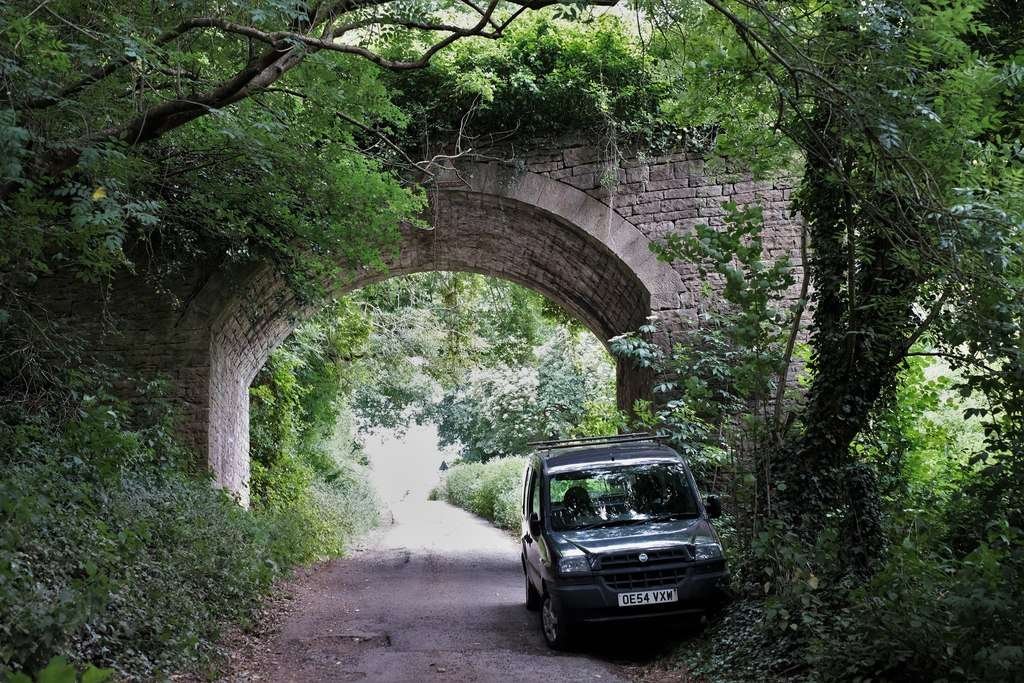
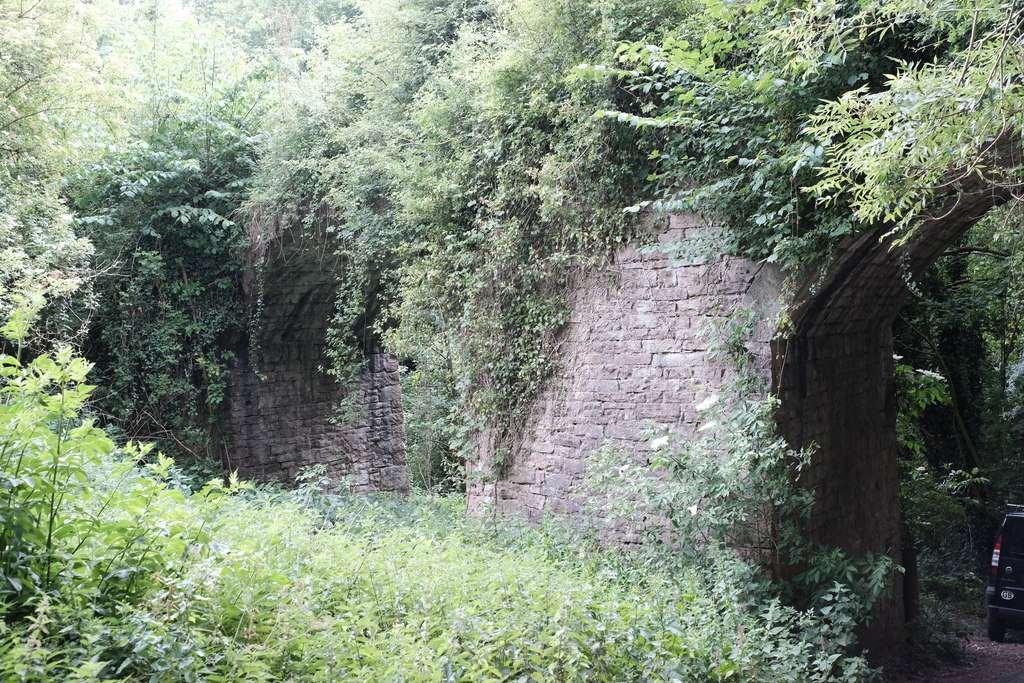
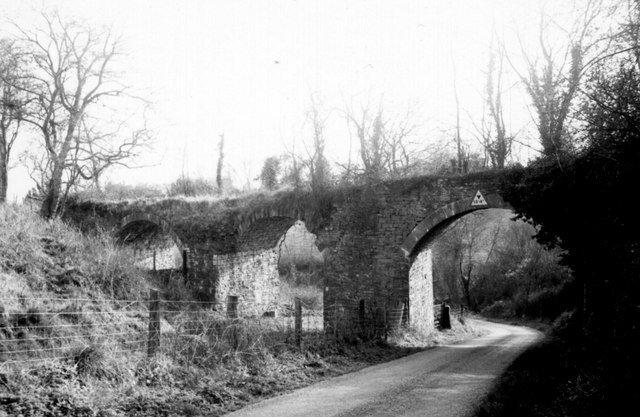
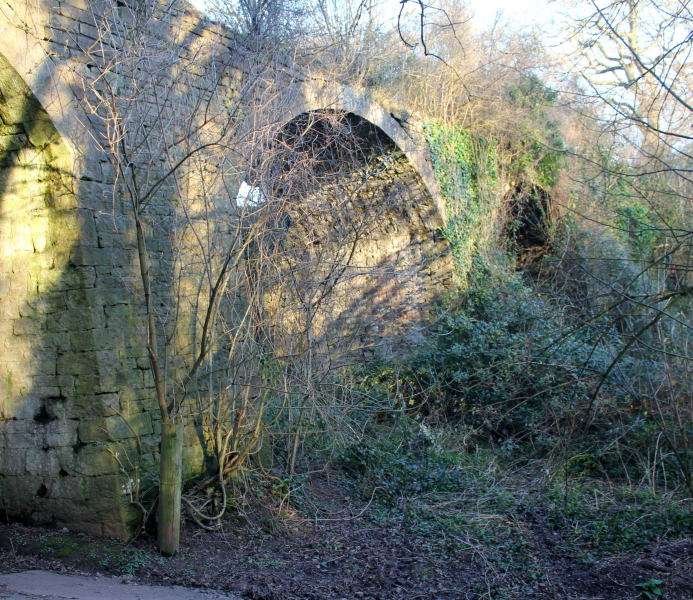
The viaduct was built, circa. 1832, of red sandstone rubble with dressed voussoirs. It has 3 arches of diminishing heights, its main pier is wedge shaped, so that the viaduct is slightly angled. The tallest arch spans the road. The centre arch is damaged on the NE side. Its Southeast wall continues as retaining wall for some distance. Part of the parapet survives at the north west end.

The viaduct is of considerable historical and industrial archaeological interest: the Purton Steam Carriage Road was planned in 1830, just a few years after the Stockton and Darlington Railway first ran in 1825.

Sadly, it was never to carry the goods it was intended for, but it seems to have had considerable effect on local politics at the time, and on later railway enterprises in the area.

The finance was to come from a prominent local Iron-master, Charles Mathias of Lamphey Court, Pembrokeshire. The viaduct is the most tangible surviving evidence for an industrial scheme which would have involved the first crossing of the Severn on a moveable bridge.” [1]

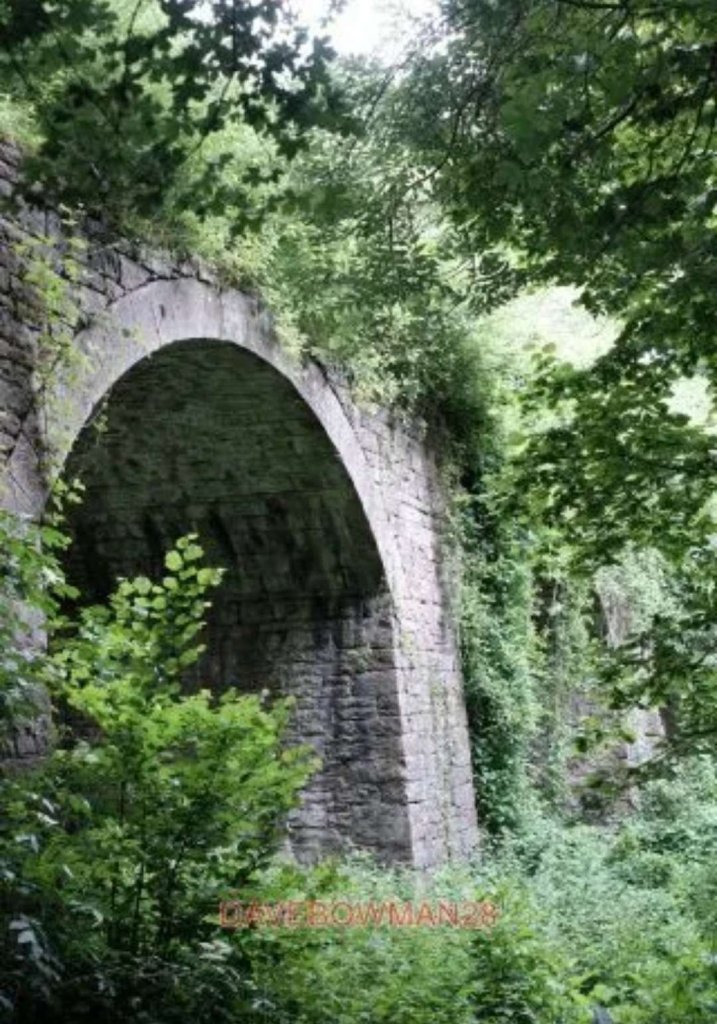
An arch of the Purton Viaduct, © John Winder and licensed for reuse under a Creative Commons Licence (CC BY-SA 2.0) [2]

The Purton Steam Carriage Road Company predated the Forest of Dean Central Railway and intended to build a line, 8 miles or so long, from a purpose-built dock at Purton Pill to the then-new Foxes Bridge Colliery in the Forest of Dean.

A scheme drafted earlier in the century was  revived in 1830 and supported by a number of Forest industrialists. As we have already noted, “The promoter of the Parliamentary Bill, presented to Parliament in 1832, was one Charles Mathias, who was so confident of the Bill’s success that he purchased the required land and began construction of the line. Unfortunately, the Bill met strong opposition from the Commissioners of Woods, failed to make its second reading and was withdrawn. Mathias’ premature and misplaced enthusiasm had led to the construction of various bits of railway infrastructure.” [3]

The structures completed included:

  • All or part of Nibley Hill Tunnel near Blakeney (the portals are each marked as “old quarry” on the 1892-1914 OS 25″ map);
  • A cutting here and there; and
  • Purton Viaduct.
Another arch of the Purton Viaduct. The road is that between Purton and Etloe, © John Winder and licensed for reuse under a Creative Commons Licence (CC BY-SA 2.0) [3]

Purton Viaduct is Grade II Listed by Historic England. It is recognised as being of “considerable historical and industrial archaeological interest”, but is suffering from the vegetation which has almost hidden it from view in places! [3]

The viaduct is noted in Neil Parkhouse’s, “Forest of Dean Lines and the Severn Bridge” which is the second volume in Lightmoor Press’, “British Railway History in Colour” series. [6]

Another view of the Purton Viaduct, © John Winder and licensed for reuse under a Creative Commons Licence (CC BY-SA 2.0) [4]
Another view of the Purton Viaduct, this time from the early 1970s. It shows the viaduct relatively clear of vegetation after a team of volunteers, led by archaeologist David Bick spent time removing vegetation, © John Bayes and licensed for reuse under a Creative Commons Licence (CC BY-SA 2.0) Interestingly, John Bayes calls the tramroad /railway, the ‘Hayes Locomotive Tramway’.[5]
This picture of the Viaduct in 2016 appears in Grace’s Guide. [8]

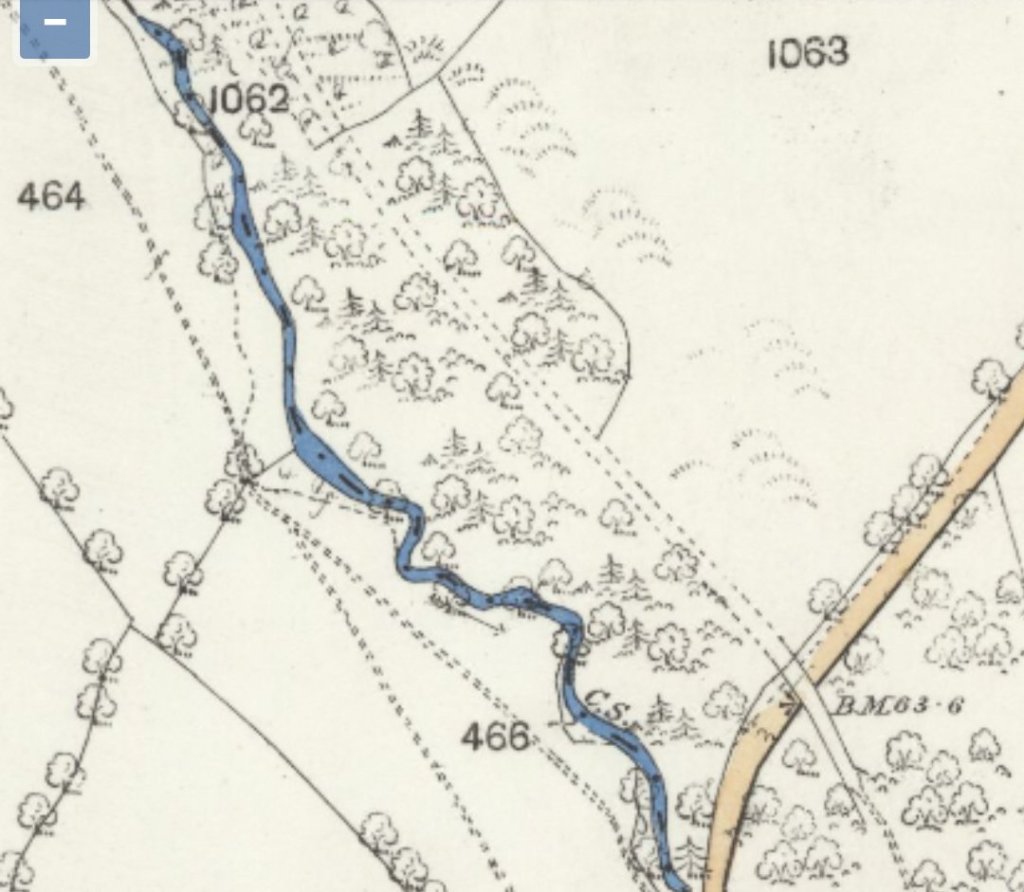
North of the Viaduct, the line of the Purton Steam Carriage Road can be followed on older maps, as the map extract below shows.

Purton Viaduct appears in the bottom-right of this map extract and the route of the planned Purton Steam Carriage Road can be seen as the double-dotted track heading Northwest from the viaduct. This extract is from the 1879 25″ Ordnance Survey. [11]
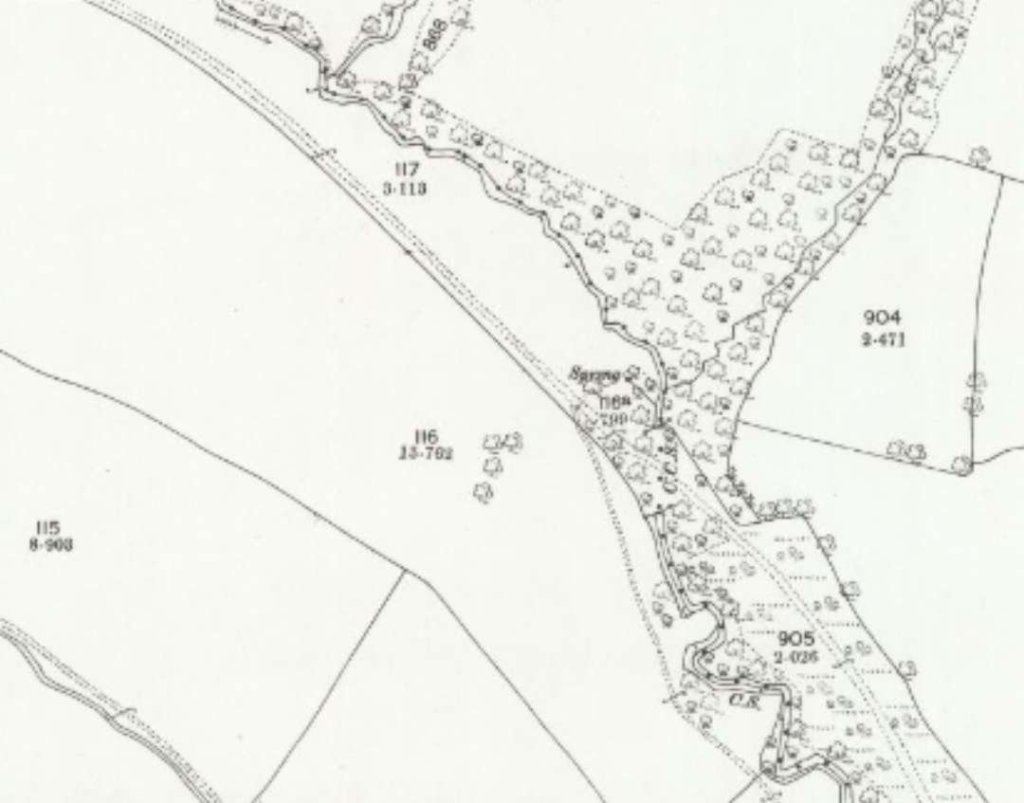
The line of the proposed Carriage Road runs from bottom-right to top-left on this extract from the 25″ 1878/1879 Ordnance Survey. [12]
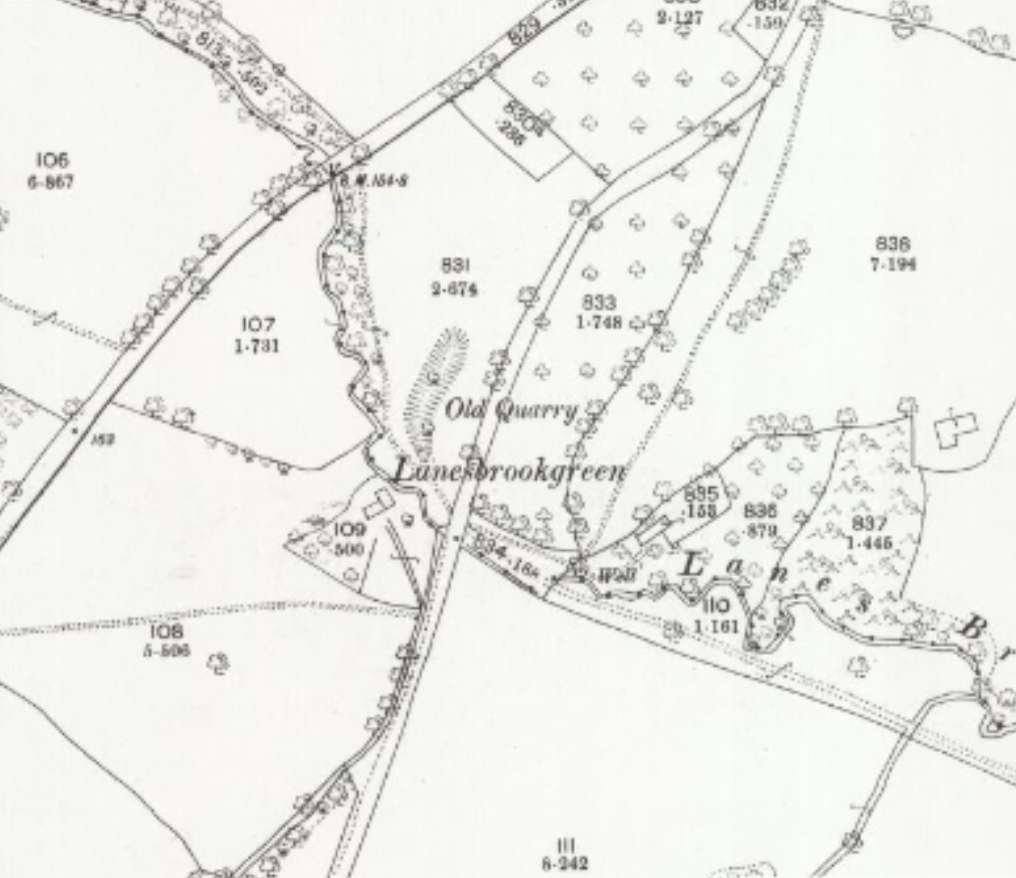
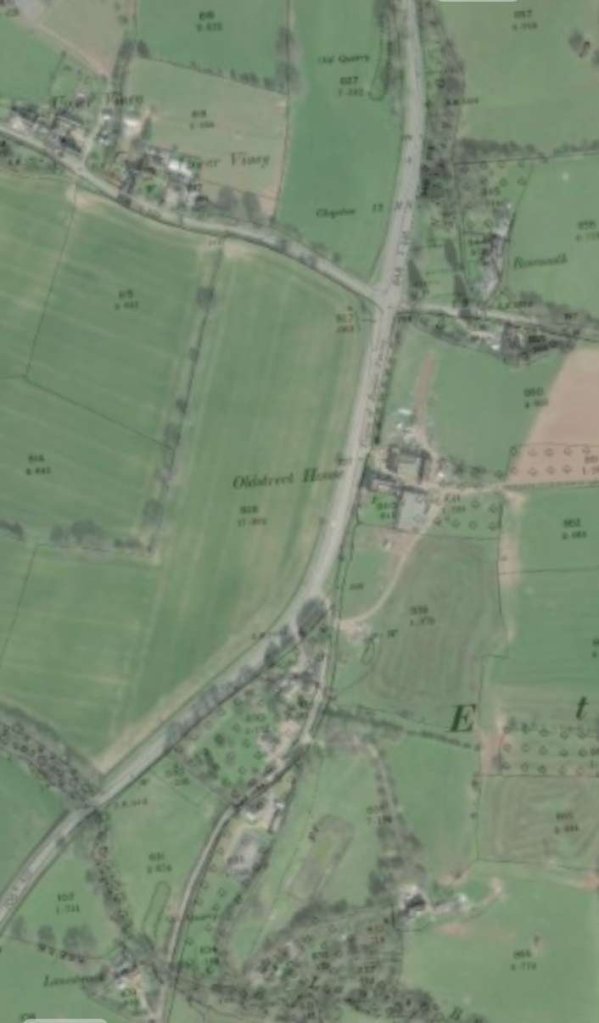
The line of the proposed Carriage Road runs from the bottom-right towards the top-left on this extract from the 25″ 1878/1879 Ordnance Survey. Approximately at the centre of the extract the Ordnance Survey chose to name the made-made defile at Lanesbrookgreen as an Old Quarry. It is in fact the location of what was to be the Southern mouth of Nibley Hill Tunnel. [12]
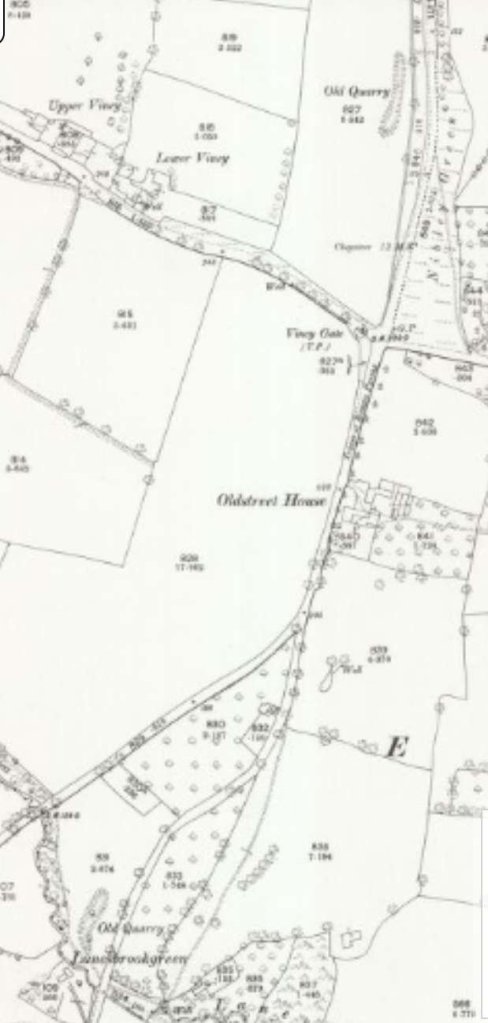
This slightly out of focus extract from the 25″ Ordnance Survey of 1878/1879 shows both the North and South ends of Nibley Hill Tunnel marked as Old Quarries. The road running North-South adjacent to the line of the northerly length of Nibley Hill Tunnel and then crossing its line to the North of the proposed southern portal is now the A48. [12]
This composite image overlays modern satellite imagery over the 25″ Ordnance Survey from the turn of the 20th century. The defiles marking the proposed tunnel entrances can be made out at the top and bottom of this image. The A48 is easily made out. [14]

Nibley Hill Tunnel would have been 600 yards in length and would have taken the Purton Steam Carriage Road into the Forest of Dean close to the village of Blakeney.

The Purton Steam Carriage Road was one of two early proposed Tramroads in the Forest of Dean which were close to the line of what became the Forest of Dean Central Railway.

To the North was the proposed Moseley Green and Tilting Mill Tramroad which was intended to link the valley of Blackpool Brook with the outside world by connecting mines in the Moseley Green area with the Bullo Pull Tramroad. It was not pursued. Instead, in 1832, the Purton Steam Carriage Road was devised to access the Blackpool Brook valley. [13]

Its route North of Nibley Hill Tunnel is difficult to identify on the Ordnance Survey mapping of the late-19th and early-20th centuries.

References

  1. https://historicengland.org.uk/images-books/photos/item/IOE01/06871/35, accessed on 9th September 2023.
  2. https://www.geograph.org.uk/photo/6503314, accessed on 6th September 2023.
  3. https://www.geograph.org.uk/photo/6503290, accessed on 6th September 2023.
  4. https://www.geograph.org.uk/photo/6503302, accessed on 6th September 2023.
  5. https://www.geograph.org.uk/photo/1284797, accessed on 6th September 2023.
  6. The National Archive holds records associated with this proposed line which can be accessed at Kew. The relevant details can be found on the following links: https://discovery.nationalarchives.gov.uk/details/r/C7435267, accessed on 17th September 2021. https://discovery.nationalarchives.gov.uk/details/r/C7435264, accessed on 17th September 2021.
  7. Further details are available on Grace’s Guide, https://www.gracesguide.co.uk/Purton_Steam_Carriage_Road, accessed on 17th September 2021.
  8. https://www.gracesguide.co.uk/File:JD_Purton_2016_01.jpg, accessed on 17th September 2021.
  9. https://en.wikipedia.org/w/index.php?curid=22482341#/media/File:The_Severn_Bridge_Sharpness_England.jpg, accessed on 9th September 2023.
  10. https://maps.nls.uk/view/109727260, accessed on 9th September 2023.
  11. https://maps.nls.uk/view/109727257, accessed on 9th September 2023.
  12. https://maps.nls.uk/view/109726411, accessed on 9th September 2023.
  13. https://booksrus.me.uk/gn/page%2079.html, accessed on 9th September 2023.
  14. https://maps.nls.uk/geo/explore/#zoom=15.7&lat=51.75242&lon=-2.48792&layers=168&b=1, accessed on 9th September 2023.