
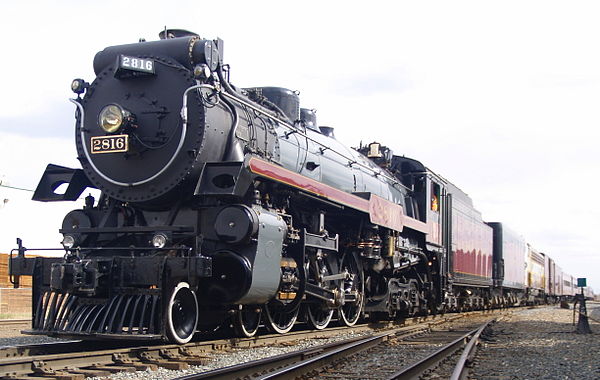
The featured image for this article is a photograph of Canadian Pacific Railway No. 2816 ‘Empress’ leading an excursion on 10th May 2008. [5] The Canadian Pacific (CP) and the Canadian National (CN) are both North American companies that choose to call themselves ‘Railways’ rather than ‘Railroads’. (This photo is licensed under the Creative Commons Attribution-Share Alike 3.0 Unported license.)
“Rail transport terms are a form of technical terminology applied to railways. Although many terms are uniform across different nations and companies, they are by no means universal, with differences often originating from parallel development of rail transport systems in different parts of the world, and in the national origins of the engineers and managers who built the inaugural rail infrastructure. An example is the term railroad, used (but not exclusively) in North America, and railway, generally used in English-speaking countries outside North America and by the International Union of Railways. In English-speaking countries outside the United Kingdom, a mixture of US and UK terms may exist.” [1][2]
The Canadian Broadcasting Corporation (CBC), in answer to a question submitted to it in May 2002 [3] comments that the word ‘Rail’ came from the Old French term for an iron rod – ‘reille’ which was in turn based on the Latin word for’rule’ or ‘straight stick’ – ‘regula’. The CBC answer continues: ‘Way’ was carted into Old English from the German and Dutch terms for’move’ or ‘carry’ (weg). ‘Road’ is an Old English term for journey by horseback (rad), which is related to the verb ‘ride’ (ridan).
“These words have been closely tied since the 19th century, and nobody – not even journalists at CP or the CBC – can railroad you into picking one term over the other. Both news organizations prefer railway. So does the Globe and Mail’s Style Book, which boldly states that ‘Railway is the Canadian term’.”… The Oxford Guide to Canadian English Usage is a little less rigid: “Canadians say both railway and railroad, but railway is much more common, as in the company name Canadian National Railways. Railway is also preferred in Britain. Railroad is more common in the United States.” [3]
“Proper nouns can be tricky, and many news outlets warn writers to make sure they get a company’s name correct – for example, some firms use Railway, others Railroad, and still others Rail Road. So while the US-based Associated Press tells its journalists to write ‘railroad’ in all second references, it also advises them to look up the actual names of railroads first. Which manual does AP recommend? The ‘Official Railway Guide’, which has been published in the United States for more than a century!” [3]
CBC is also happy to note that similar discrepancies occur in Canada. “The Canadian Railway Museum, south of Montreal, invites people to visit what it calls the largest collection of railway equipment in the country. Who runs it? The Canadian Railroad Historical Association, of course!” [3]
Ultimately the CBC says that usage often boils down to “convention and individual preference.” [3]
The August 1905 edition of The Railway Magazine has something to say about this, a view from much earlier in the history of railways/railroads. …
“Railway or Railroad? – In England we have remained fairly true to the use of the word railway, to describe a “rail road,’ but in the United States the word railroad is mostly used to describe every railway; now, however, there is being discussed the rival claims of the two words. Sometimes the one has served to designate a company which stands in a certain legal relation to another; thus, as is well known, the ABC railroad company may be the operating organisation for the ABC railway company, or vice versa. In reorganisations and consolidations in the United States, the two words have been of great utility and convenience. During the early epochs of United States railway history the term Rail Road was used almost exclusively, while in England the term railway is quite as old as the institution itself, and for many years past, “railway” has been used almost exclusively throughout Great Britain and her colonies. An eminent philologist to whom the relative merits of the two words were submitted decided in favour of the term “railway,” partly on the ground that “railway was better adapted to the use as both noun and adjective, and that it sounded better, affording a smoother form of expression. The American railway writer, Mr. B. H. Meyer, in his first monograph on railway subjects, employed the word ‘railroad’ but in all subsequent publications he has used the word ‘railway’, as being, on the whole, a much more agreeable and facile form of expression. American railway legislation has been conspicuously wanting in the definition of terms; and had the English custom of defining the terms used been adopted by American law makers it is not improbable that either railway or railroad would have held the field to the practical exclusion of the other. However, both words abound in American laws, and neither can be said to have defeated the other, either in legislation or in company terminology. Virginia has now declared that the two terms shall be used and construed synonymously in the laws and decisions of the State.” [4: p169-170]
I guess that the use of ‘railway’, ‘rail road’ or ‘railroad’ is a matter of preference partially influenced by where we live in the world. It is worth remembering, however, that care is needed when referring to particular railway/railroad companies to ensure that their proper name is used. Just a few examples to illustrate this from the US to finish:
The Airlake Terminal Railway
The Alabama and Florida Rail Road Company
The Alaska Railroad
The AN Railway
The Arizona & California Railroad
The Baltimore and Ohio Railroad
The BNSF Railway
The Chesapeake and Ohio Railway
The Central Pacific Railroad
I guess that each of these companies would want their correct name used when referring to them.
References
- https://en.m.wikipedia.org/wiki/Glossary_of_rail_transport_terms, accessed on 14th August 2024.
- Des McAuliffe, Des (1999). The Snowtown to Port Pirie Line. Proceedings of the 1999 Convention. Modelling the Railways of South Australia; Adelaide. 1999, p1-129.
- https://www.cbc.ca/news2/indepth/words/quick/queries/railway.html, accessed o. 14th August 2024.
- The Railway Magazine, London, August 1905.
- https://en.m.wikipedia.org/wiki/Canadian_Pacific_2816, accessed on 14th August 2024.
 Roger Farnworth